BMC Biomedical Engineering
Trelles Trabuccoet al. BMC Biomedical Engineering (2019) 1:21
https://doi.org/10.1186/s42490-019-0021-0
R E S E A R C H A R T I C L E
Open Access
User perspective and higher cognitive
task-loads influence movement and
performance in immersive training
environments
Juan Trelles Trabucco
1*, Andrea Rottigni
1, Marco Cavallo
1, Daniel Bailey
1, James Patton
2and G. Elisabeta Marai
1Abstract
Background: In virtual reality (VR) applications such as games, virtual training, and interactive neurorehabilitation, one can employ either the first-person user perspective or the third-person perspective to perceive the virtual environment; however, applications rarely offer both perspectives for the same task. We used a targeted-reaching task in a large-scale virtual reality environment (N=30 healthy volunteers) to evaluate the effects of user perspective on the head and upper extremity movements, and on user performance. We further evaluated how different cognitive challenges would modulate these effects. Finally, we obtained the user-reported engagement level under the different perspectives.
Results: We found that first-person perspective resulted in larger head movements(3.52±1.3m)than the third-person perspective(2.41±0.7m). First-person perspective also resulted in more upper-extremity movement
(30.08±7.28mcompared to 26.66±4.86m)and longer completion times(61.3±16.4scompared to 53±10.4s)for more challenging tasks such as the “flipped mode”, in which moving one arm causes the opposite virtual arm to move. We observed no significant effect of user perspective alone on the success rate. Subjects reported experiencing roughly the same level of engagement in both first-person and third-person perspectives(F(1.58)=0.9,P=.445). Conclusion: User perspective and its interaction with higher-cognitive load tasks influences the extent of movement and user performance in a virtual theater environment, and may influence the choice of the interface type (first or third person) in immersive training depending on the user conditions and exercise requirements.
Keywords: User perspective, Engagement, CAVE2
Background
Interactive virtual reality (VR) applications that engage human motor performance span a wide variety of domains, including piloting remote vehicles, movement performance training, and neurorehabilitation therapy following brain injury. These applications often seek to stimulate brain activity, facilitate practice-based learning, and to leverage the brain’s capability for reorganizing its structure [1]. In this sense, using a display to provide
*Correspondence:[email protected]
1Department of Computer Science, University of Illinois at Chicago, 851 S Morgan Street, 60607 Chicago, USA
Full list of author information is available at the end of the article
visual feedback to the trainer or trainee can reinforce learning and performance skills. As technology evolves, new opportunities for trainee feedback become possi-ble. For example, out-of-body perspectives in immersive environments allow for motion feedback that may other-wise not be visible or apparent to the trainee. However, whether such interactive approaches impact the user per-formance and mental load is an open research question. For instance, it is not currently known which characteris-tics of virtual reality are most beneficial for rehabilitation training [2], although one avenue might be to increase the patient’s engagement with the therapy [3]. Engagement, as defined in the videogame literature, is the experience
Trelles Trabuccoet al. BMC Biomedical Engineering (2019) 1:21 Page 2 of 12
involving a lack of awareness of time and the real world, and a sense of being in the task environment [4].
From the multiple VR characteristics to consider, the user perspective is of particular interest, since it can dramatically influence the user’s perception of their body within the environment. A first-person perspec-tive presents the world directly through the character’s eyes, though sometimes without a body representation. In contrast, a third-person perspective, while not natu-ral, allows a full view of body motions. In our study, we displayed the virtual character in front of the user’s view-point; the avatar did not act as a mirror. Three studies have compared these user perspectives in general VR applica-tions. Salamin’s experiments using a head-mounted dis-play endorsed the use of the first-person perspective for precision tasks and the use of third-person perspective for movement tasks [5]. Later, Salamin found that partici-pants attempting to catch a ball estimated distances better and performed more similarly to real world-conditions in third-person perspective [6]. Covaci et al. [7] compared the perspectives in a cave automatic virtual environment (CAVE) with a ball throwing task. In this task, participants underestimated distances in both perspectives; however, similarly to Salamin results, they performed slightly bet-ter in third-person perspective. It remains unclear what other effects if any, the viewer perspective may have on aspects like motion or perceived engagement and whether VR applications in some domains justify their choice (e.g., limb-studies [8]).
Not only the engagement can vary depending on the user perspective but also based on the chosen immersive environment. Immersive environments use stereoscopic imagery to enhance depth perception and position track-ing to react to user’s movement, betrack-ing the most common head-mounted displays and small rooms with projectors [9]. Another environment is a virtual-reality theater where instead of using projectors, the setup uses tiled-displays. Compared to head-mounted displays, a virtual-reality the-ater provides a nonintrusive and collaborative experience (although not in this study), only requiring the users to wear lightweight polarized glasses. Besides, virtual-reality theaters provide higher-resolution than most of the com-mercial head-mounted displays and allow the user to see the real world. Despite the potential benefits of these virtual-reality theaters to a variety of interactive training, few studies have yet explored such benefits.
In this work, we evaluate the relationships between user perspective and user performance, motion, and per-ceived level of engagement. From a motor rehabilitation perspective, such an evaluation would be enriched by further considering the context of cognitive load levels. Therefore, we test under varying cognitive loads the exist-ing null hypothesis that user perspective does not influ-ence user performance, body head, and upper-extremity
movements, or self-perceived level of engagement. To test this hypothesis, we use a virtual target-reaching game to evaluate the effects of both first- and third-person perspectives in a virtual reality theater environment, a CAVE2 [10]. The game makes possible the use of dif-ferent challenge levels, leading to exercises with varying cognitive loads.
Results
Head movements
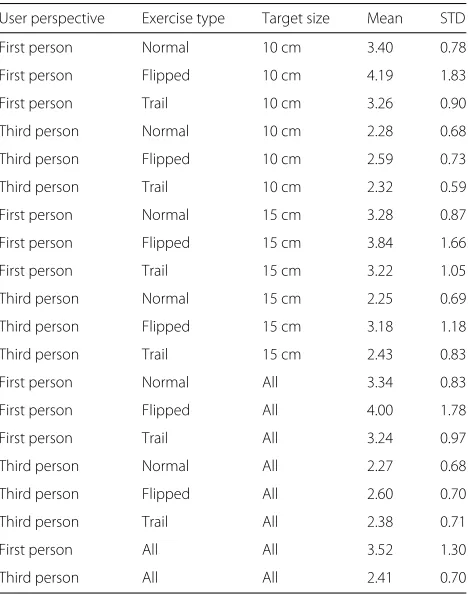
We found that first person user perspective caused larger head movements (3.52±1.3SDm) than third-person per-spective (2.41±0.7SDm; main effectF(1, 29) = 159.2,
P < .0001; see Fig.1). The flipped exercise head move-ment was also significantly higher than both normal and trail exercises in first-person (F(2, 58)= 19.4,P< .0001) and similarly in third-person. Data distribution passed the normality test (P = 0.064) and sphericity assumption after the application a Box-Cox transformation. Results statistics are available in Table1.
Upper-extremity movements
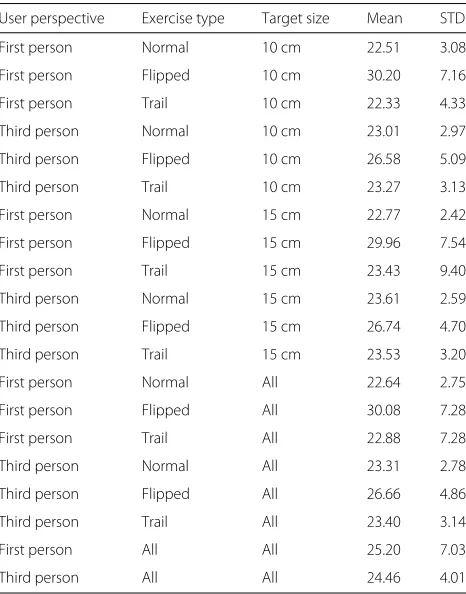
Exercise type caused the largest effect on the upper-extremity movement (F(2319)=168.4,P < .0001). The flipped exercise mode lead to longer trajectories: flipped exercises (Fig. 2) in first-person perspective (30.08 ± 7.28SDm) had longer trajectories than flipped exercises in third-person perspective (26.66±4.86SDm). The second effect was caused by the interaction between the perspec-tive and exercise type (F(2319)=25.6,P<.0001).
We noted that the displayed trail paths did not influ-ence the movement chosen by a subject; none of the subjects followed a straight line, but rather the expected geodesic curve. We further noticed that in the flipped exercise mode, different subjects adopted different strate-gies when negotiating the higher cognitive load: some sub-jects aimed for the targets directly, while others explored the space from the frontal plane towards the sagittal plane, to first scan the area. Results statistics are available in Table2.
Completion time
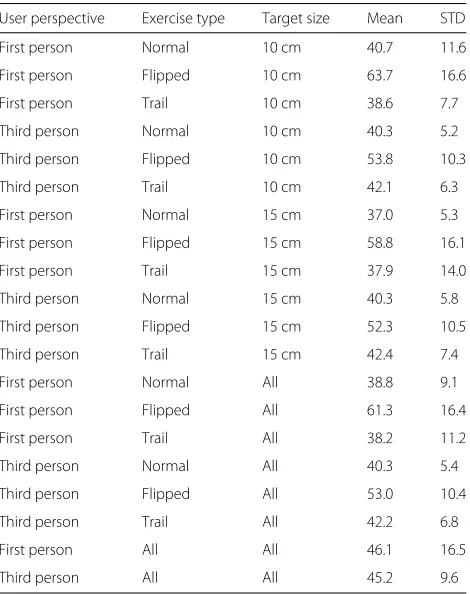
The results show complex variation in the comple-tion time, related to both user perspective (first or third) and exercise type (normal, trail, or flipped) (Fig. 3). Surprisingly, perspective effects varied inter-actively with the exercise type (ANOVA main effect
F(2, 58) = 39.7,P < .0001). In particular, for the nor-mal exercise type, the third person completion times were the same as the first person times. For the trail type, the third person times were higher than the first person times (M_trail_third=42.2s, SD_trail=6.8s;
Trelles Trabuccoet al. BMC Biomedical Engineering (2019) 1:21 Page 3 of 12
Fig. 1Head movement results. Distribution plots for the total head trajectory distance after 20 attempts, for each exercise type and user perspective. The two colored polylines show the mean of each perspective distribution, and its variation with the exercise type
than the first person times (M_flipped_third=53s,
SD_flipped_third=10.4s; M_flipped_first=61.3s;
SD_flipped_first=16.4s).
The largest effect on completion time was caused by the flipped exercise type, which lead to the largest com-pletion time (F(2, 58) = 200.4,P < .0001, followed by pairwise post hoc comparisons; Fig.3). User perspective also influenced completion time (F(1, 29)=7.5,P =.01, followed by pairwise post hoc comparisons; Fig. 3). Target size apparently also influenced completion time (F(1, 29) = 10.9,P = .003); although the ANOVA results suggested an effect of the target sphere size, we did not find significant differences in the post hoc anal-ysis. We further found interactions between perspective and target size (F(1, 29) = 6.8,P = .015). The data passed the Lilliefors test (P = .094) after perform-ing a Box-Cox transformation, and did not violate the sphericity assumption. Results statistics are available in Table3.
Hitting the target - score
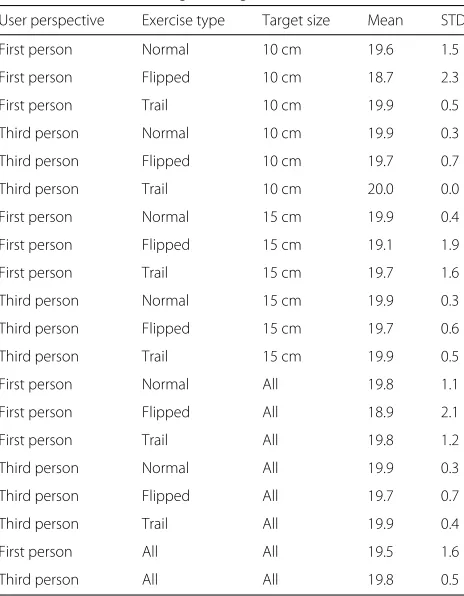
Subjects obtained high scores consistently in all three exer-cise types (M=19.66,MED=20,MIN=9,MAX=20), in both first and third-person perspectives. Again, we found differences due to multiple factors. User perspective caused the largest effect on the score (F(1319) = 86.4,
P < .0001); the first-person perspective correlated with
lower scores in flipped mode (M = 18.9,SD = 2.1)
Table 1Results for head movements (in meters)
User perspective Exercise type Target size Mean STD
First person Normal 10 cm 3.40 0.78
First person Flipped 10 cm 4.19 1.83
First person Trail 10 cm 3.26 0.90
Third person Normal 10 cm 2.28 0.68
Third person Flipped 10 cm 2.59 0.73
Third person Trail 10 cm 2.32 0.59
First person Normal 15 cm 3.28 0.87
First person Flipped 15 cm 3.84 1.66
First person Trail 15 cm 3.22 1.05
Third person Normal 15 cm 2.25 0.69
Third person Flipped 15 cm 3.18 1.18
Third person Trail 15 cm 2.43 0.83
First person Normal All 3.34 0.83
First person Flipped All 4.00 1.78
First person Trail All 3.24 0.97
Third person Normal All 2.27 0.68
Third person Flipped All 2.60 0.70
Third person Trail All 2.38 0.71
First person All All 3.52 1.30
Trelles Trabuccoet al. BMC Biomedical Engineering (2019) 1:21 Page 4 of 12
Fig. 2Hand movement results. Distribution plots for the total trajectory distance after 20 attempts, for each exercise type and user perspective
in comparison to the third-person perspective (M=19.9,
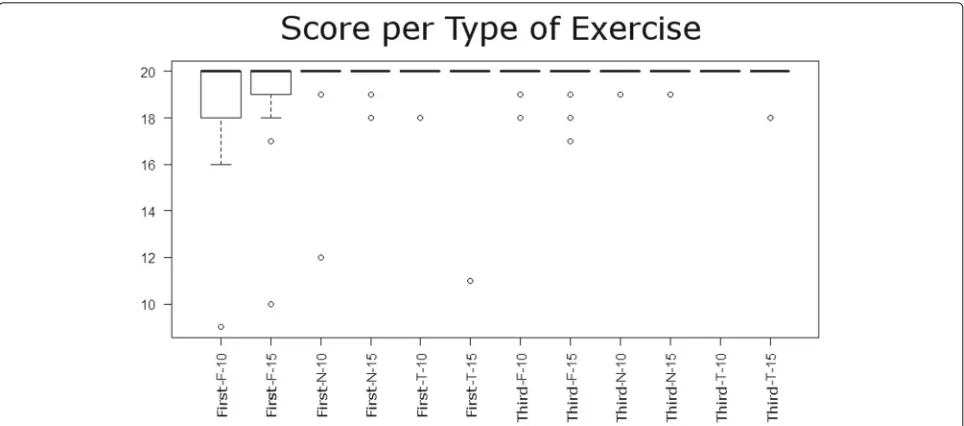
SD = 0.7). The exercise type caused the second largest effect on the score (F(2319) = 37.1,P < .0001); scores for exercises in flipped mode were significantly lower than in the normal and trail modes. Results also suggest the effect of other factors on the score, such as the target size (F(1319)=30.7,P<.0001), the interaction between per-spective and exercise type (F(2319) = 31.2,P < .0001), the interaction between perspective and target size (F(1319) = 14.5,P = .0002), and the interaction of all the factors (F(2319) = 3.25,P = .04). However, the post hoc analysis indicated that flipped exercises were the most common factor associated with subjects missing tar-gets (Fig.4). Additionally, the skewed distribution to the right (higher scores) suggests the reaching exercise game had overall low difficulty. Results statistics are available in Table4.
Level of engagement
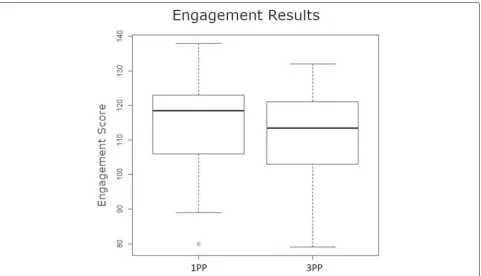
We found no significant differences in the engage-ment questionnaire score between first and third-person perspectives (F(1, 58) = 0.59,P = .445; Fig. 5). Non-parametric analysis also revealed no significant differences (Kruskal-Wallis test,X2 = 2.72,P = .0989).
The data distribution transformed with the Box-Cox function satisfied the normality test (P = .1192) and the Levene’s test (P = .766). Results statistics are available in Table5.
Table 2Results for upper-extremity movements (in meters)
User perspective Exercise type Target size Mean STD
First person Normal 10 cm 22.51 3.08
First person Flipped 10 cm 30.20 7.16
First person Trail 10 cm 22.33 4.33
Third person Normal 10 cm 23.01 2.97
Third person Flipped 10 cm 26.58 5.09
Third person Trail 10 cm 23.27 3.13
First person Normal 15 cm 22.77 2.42
First person Flipped 15 cm 29.96 7.54
First person Trail 15 cm 23.43 9.40
Third person Normal 15 cm 23.61 2.59
Third person Flipped 15 cm 26.74 4.70
Third person Trail 15 cm 23.53 3.20
First person Normal All 22.64 2.75
First person Flipped All 30.08 7.28
First person Trail All 22.88 7.28
Third person Normal All 23.31 2.78
Third person Flipped All 26.66 4.86
Third person Trail All 23.40 3.14
First person All All 25.20 7.03
Trelles Trabuccoet al. BMC Biomedical Engineering (2019) 1:21 Page 5 of 12
Fig. 3Completion time results. Completion-time distribution plots for each exercise type and user perspective
Discussion
Body movements
As shown by our results, we found differences in head and hand movements depending on the user perspective and the three exercise types. These differences are of par-ticular importance for VR-based rehabilitation, where the patient’s condition constrains the range of motion that patient can perform.
The user perspective had the main effect on the head movements; there was significantly longer total distance traveled by the head over 20 reaching attempts in the first-person (M=3.52, SD=1.30) perspective than third-person perspective (M= 2.41, SD=0.70). Compared to the third-person perspective, in which the avatar and tar-gets appear in front of the user, the first-person perspec-tive required the subjects to explore a wider area of screen space, which implicitly required the use of peripheral vision. From the perspective of VR-based rehabilitation, the use of the first-person perspective may be beneficial when the patient requires broader spatial exploration as in rehabilitation of spatial neglect [11].
For upextremity movements, the first-person per-spective with higher cognitive load exercises (i.e., flipped) yielded longer trajectories. In contrast, upper-extremity movements for the normal and trail exercise settings did not reveal significant differences between the two user
Table 3Results for completion time (in seconds)
User perspective Exercise type Target size Mean STD
First person Normal 10 cm 40.7 11.6
First person Flipped 10 cm 63.7 16.6
First person Trail 10 cm 38.6 7.7
Third person Normal 10 cm 40.3 5.2
Third person Flipped 10 cm 53.8 10.3
Third person Trail 10 cm 42.1 6.3
First person Normal 15 cm 37.0 5.3
First person Flipped 15 cm 58.8 16.1
First person Trail 15 cm 37.9 14.0
Third person Normal 15 cm 40.3 5.8
Third person Flipped 15 cm 52.3 10.5
Third person Trail 15 cm 42.4 7.4
First person Normal All 38.8 9.1
First person Flipped All 61.3 16.4
First person Trail All 38.2 11.2
Third person Normal All 40.3 5.4
Third person Flipped All 53.0 10.4
Third person Trail All 42.2 6.8
First person All All 46.1 16.5
Trelles Trabuccoet al. BMC Biomedical Engineering (2019) 1:21 Page 6 of 12
Fig. 4Score results. Score distribution plots for each exercise type and user perspective
perspectives; thus, revealing a zero-effect from the visual cues shown as trails and the shortest path between the hand and target on the trajectory distance.
User performance
Our results indicate that the user perspective alone is not the main factor influencing user performance, but a combination of user perspective and cognitive load. As expected, we found that flipped exercises (higher cogni-tive load) required more time to be completed (Fig. 3) in both user perspectives and had lower success rates (Fig.6), compared to the normal and trail exercises. How-ever, for this higher cognitive load exercise, subjects took more time to complete the task and had lower task success rates in the first-person perspective than in the third-person perspective. For normal exercises, there were no differences between user perspectives. For trail exercises, subjects took longer to complete the task in third-person perspective compared to first-person perspective (oppo-site case than trail exercises) and had similar success rates between the two perspectives. Similar to Salamin [6], user perspective alone did not influence completion time, and similar to Covaci et al. [7], user perspective alone did not influence task success.
We believe that the opposite results in completion time between the higher cognitive load task and the trail task relies on two factors: movements feedback and environ-mental feedback. In third-person perspective, the subjects were able to instantly observe wrong actions in the avatar
Table 4Results for hitting the target - score
User perspective Exercise type Target size Mean STD
First person Normal 10 cm 19.6 1.5
First person Flipped 10 cm 18.7 2.3
First person Trail 10 cm 19.9 0.5
Third person Normal 10 cm 19.9 0.3
Third person Flipped 10 cm 19.7 0.7
Third person Trail 10 cm 20.0 0.0
First person Normal 15 cm 19.9 0.4
First person Flipped 15 cm 19.1 1.9
First person Trail 15 cm 19.7 1.6
Third person Normal 15 cm 19.9 0.3
Third person Flipped 15 cm 19.7 0.6
Third person Trail 15 cm 19.9 0.5
First person Normal All 19.8 1.1
First person Flipped All 18.9 2.1
First person Trail All 19.8 1.2
Third person Normal All 19.9 0.3
Third person Flipped All 19.7 0.7
Third person Trail All 19.9 0.4
First person All All 19.5 1.6
Trelles Trabuccoet al. BMC Biomedical Engineering (2019) 1:21 Page 7 of 12
Fig. 5Engagement results Engagement score for first-person perspective and third-person perspective
and make corrections accordingly while in the first-person perspective, the restricted field of view did not ease this immediate feedback. This movement feedback was partic-ularly useful for the higher cognitive task, the most unfa-miliar for the subjects. As for environmental feedback, in the trail exercise, the displayed segment connecting the closest hand to the target was more visible in the first-person perspective; thus, it caught the subject’s attention faster. These visual cues may also be helpful to get peo-ple’s attention back, especially for patients with spatial neglect. Opposed to Salamin’s preference for using the first-person perspective for precision tasks [5], we believe that the third-person perspective feedback is preferred for precision tasks with a higher cognitive load that require unfamiliar movements and performed on an environment with field of view constraints. The recommendation may not apply to other cognitive tasks such as memory atten-tion unless mixed in a dual attenatten-tion setup with unfamiliar movements.
Level of engagement
In this study, we found that the user perspective had no significant effect on the degree of user-perceived engagement. Our findings are supported by the conflict-ing results reported by Denisova and Cairns [12] (first-person perspective more immersive) and respectively by Salamin [5] (third-person perspective more engaging). We believe that the low degree of task difficulty (for a healthy
subject) and the static foot positioning required by the rehabilitation application may have influenced the sub-jects’ sense of engagement. As suggested by Faria et al. [13], exercises requiring more cognitive effort and atten-tion may gather more attenatten-tion. On the other hand, the study of Schuurink and Toet [14] suggests that the level of stimulation induced by a virtual reality environment is independent of the question of first- and third-person perspectives; our results support Schuurink and Toet’s conclusion in the context of tasks with relatively reduced cognitive effort.
We looked into the self-perceived level of engagement due to its potential to improve a patient’s experience with rehabilitation tasks. To measure this we used the definition of engagement from the gaming literature, while implementing our experiments in an immersive VR environment. We note that the term ‘immersion’ is overloaded between gaming research and VR research. Gaming research operates under the definition given by Jennet et al. [4], who describe the different levels of engagement as immersion, an experience felt by gamers.
Table 5Results for level of engagement (from questionnaire)
User perspective Mean STD
First person 114.3 23.6
Trelles Trabuccoet al. BMC Biomedical Engineering (2019) 1:21 Page 8 of 12
Fig. 6Boxplot of the score per exercise combination. Scores computed as number of targets touched for all the combination of exercises in 20 attempts: First-person perspective or third-person perspective executed in normal (N) mode, flipped (F) mode or trail (T) mode with targets of 10 or 15 cm of diameter
In the gaming literature, immersion is therefore used interchangeably with engagement and involvement [15]. Jennet et al. further created the IEQ questionnaire to assess immersion (defined as engagement), based on com-ponents that influence the gamer experience. In contrast, VR research uses the term immersion to describe a prop-erty of the technology [16] that influences the level of presence — the “illusion of being there, notwithstanding that you know for sure that you are not” [17]. Each of the two definitions of immersion is equally influential in its field of origin. Because we seek to measure game engage-ment, in our questionnaire we followed the Jennet et al. [4] definition. This definition acknowledges the influence of presence on engagement, and suggests that presence only appears at the deeper level of engagement.
Depth perception errors
Based on the questionnaire feedback, in the third-person perspective a few subjects experienced misperceptions, with no further impact, for objects placed to the sides and close to the frontal plane. Two of the subjects reported that in the third-person view the displayed scene seemed to be rendered in 2D; another subject thought mistak-enly that the objects were behind the avatar. It is pos-sible the lack of geometrical visual cues in spherical targets contributed to these isolated depth perception issues, although we provided consistently shadows as a cue. For example, Powell et al. [18] suggest using com-plex geometries (more comcom-plex than our simple sphere geometry) to further provide visual cues for reaching tasks. Nevertheless, none of these reported ln appear
to have resulted in lower user performance than in the first-person view.
Conversely, no subjects reported depth-perception errors in first-person perspective, despite lower user per-formance results under specific settings. A recent study [19] in CAVE-like environments suggested that targets near the screen—that hence appear large to the user (as in first-person perspective)—are easier to understand than objects far into the scene (as in third-person perspective). Results from the Bruder et al. study [19] further report up to 50% misinterpretations of distance for objects that are further away. We believe their findings help explain the difference in our user reports of depth-perception errors.
Assumptions and limitations
head-Trelles Trabuccoet al. BMC Biomedical Engineering (2019) 1:21 Page 9 of 12
mounted displays (e.g., non-intrusive equipment) that make such environments relevant to rehabilitation clin-ics. Last but not least, as suggested by Levin et al. [20], in general, further evaluation of the performance, qual-ity and surrogate aspects of motor behavior are needed to analyze the fidelity of VR environment tasks to physical environment tasks. We note, nevertheless, on the deliber-ate simplicity of the exercise set we designed and we tested in this work, in collaboration with a domain expert.
For our study design, even though we randomized the starting user perspective per subject, the order of the exercises with different target sizes was not randomized which could introduce confounding effects. Moreover, our study considers engagement from the perspective of a self-reported “experience that produces a lack of aware-ness of time and the real world” [4]. We do not consider other aspects of the virtual reality experience such as embodiment (the sensation of being inside a body) [21].
The success score median of 20 (out of 20) across all exercises and both perspectives indicates that our game had an easy level of difficulty for healthy subjects. We cor-roborated this last statement with the results of the user survey; on a 1 to 5 Likert scale from easy to difficult, subjects scored the first-person perspective as 2.04±0.92 and the third-person perspective as 2.21 ± 0.92. These results are not surprising as the arm-reaching exercises were designed for physical therapy patients, but tested on healthy subjects; rehabilitation patients would find the exercises more difficult. Furthermore, we allowed the healthy subjects eight seconds to target each object, when in fact they only needed an average of 2.3 seconds±1.1. These numerical results may not transfer to a population of stroke subjects. Besides, even though we developed our application in collaboration with rehabilitation experts, further studies with actual actions is required to evaluate its application on the target population and the transfer-ability of our results. Finally, while using smaller target sizes did not increase the difficulty, it may be possible that smaller objects than the ones we used could make the game more challenging.
Conclusion
We presented the results from a user study comparing the effect of first-person and third-person user perspec-tives, under varying cognitive load, on user performance and upper-extremity movements for a set of reaching tasks in a virtual reality theater environment. Also, we analyzed the effect of user perspectives on the degree of engagement using a questionnaire. Considering only user perspective, the first-person perspective required the par-ticipants to make more head movements compared to the third-person perspective. For upper-extremity motion, the interaction between user perspective and higher-cognitive load exercises influenced the movements. These
head and upper-extremity movements are essential when assessing the range of motion suitable for VR-based reha-bilitation therapy. For user performance, the user perspec-tive and the type of exercise influenced the completion time and the scores. Finally, as hypothesized initially, the user perspective did not influence the self-perceived engagement for this set of relatively easy tasks.
Methods
Participants
Thirty students (8 women and 22 men), aged 18–32 years (M = 24.6 years, SD=3.6 years) from the University of Illinois at Chicago were recruited for the user study (UIC IRB #2016-0332). Inclusion criteria included being over 18 years old, being an enrolled student, and not having significant physical impairments. We asked every par-ticipant about their physical conditions (e.g., movement problems in their trunk, upper-body or head) and their ability to perceive objects in 3D. We explained that any issue would limit their experience with the environment and would affect the expected results. The participants self-reported not having any physical condition that could limit their experience with the environment. Also, none of them reported having stereoscopic vision problems (i.e., problems perceiving depth cues).
Apparatus and materials
CAVE2 environment
The CAVE2 environment [10] is a large-scale VR environ-ment composed of 72 high-resolution displays arranged in eighteen columns in a circular fashion (Fig 7). The arrangement provides an area of 320 degrees of screens with a resolution of 36 Megapixels per eye. Fourteen Vicon Bonita infrared cameras track the position of retroreflec-tive markers in tracking glasses and controllers in an area of 34 square meters. Twenty speakers and two subwoofers mounted at the top and bottom of the columns provide stereo 3D sound.
A Kinect v2 sensor is located in front of the cen-tral display (73 cm from the ground) to track the subject upper-extremity joints; the Vicon cameras only track the head position. In our study, to provide quality tracking points for the Kinect sensor, each subject was required to stand in the center of the environment approximately 3.3 meters away from the screens.
Trelles Trabuccoet al. BMC Biomedical Engineering (2019) 1:21 Page 10 of 12
Fig. 7CAVE2 environment. View of the CAVE2 environment, displaying the third-person perspective of a task. 72 high-resolution displays are arranged in eighteen columns in a circular fashion, providing an area of 320 degrees of screen space with a resolution of 36 Megapixels for each user eye
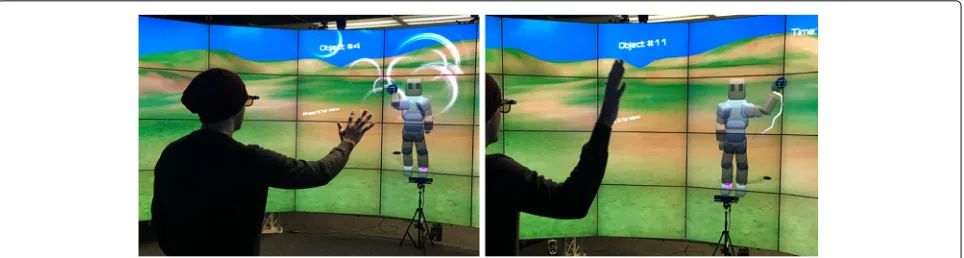
(Fig.8). Experimenters can also select the number of tar-gets to reach to. In order to increase or decrease the difficulty of the exercise, experimenters can also vary the target size. To further investigate the role of cognitive function on the user performance under the two per-spectives, the prototype implements three exercise types (Fig.9): 1) easy: normal view; 2) difficult: flipped (the left limb actions moved the right limb, and vice versa); and 3) very easy: trail—a mode that displays a trajectory path and a trace of the hand’s movements to help guide and document the upper-extremity motion.
The CAVE2 environment has, like most second-generation, modern immersive theaters, no ceiling or floor projection. This is due partly to display-technology constraints (while providing remarkably higher resolution and brighter environments than older systems with pro-jected light, displays cannot provide passive/active stereo for multiple users at ceiling or floor locations), and partly due to collaboration requirements (for collaborative use,
analysts wish to roll in desks and chairs to create a comfortable-enough environment; in this way, in addition to the environment immersive capabilities, they can con-tinue to use their laptops and web-based technologies as they do in the office). Because of this design, the field of view in the first-person perspective is restricted; sub-jects only see their hands for fully extended arm elevations between 90 to 120 degrees approximately. Additionally, in the first person perspective the associated trail in trail mode is naturally only visible within the field of view. Object placement is constrained to be always inside the screen-visible space. We use the same space constraint for the third-person perspective, in order to compare both views under the same conditions. Moreover, we used a transparent material for the avatar body, to avoid poten-tial occlusion issues for objects appearing in front of the avatar in the third-person perspective. Before running the experiment, we verified that the distance of an object was perceived similarly on both user perspectives by placing
Trelles Trabuccoet al. BMC Biomedical Engineering (2019) 1:21 Page 11 of 12
Fig. 9Exercise modes. Exercises in flipped mode (left) and trail mode (right). The flipped mode (left) requires users to use the opposite side to manipulate the avatar correct side (i.e., right physical hand activates left virtual hand, and vice-versa), which requires a higher cognitive load. The trail mode (right) shows a trajectory path to help guide and document the user motion
a styrofoam sphere at different locations and a virtual sphere at the same location in the virtual scene.
Data
Movement logs from each exercise were recorded in JSON format by the application. The data was preprocessed using Python scripts and further analyzed using R for the statistical tests and G*Power for the power analysis. In addition to the movement logs, we recorded each user study session using a wide lens camera.
Study design
To determine whether the user perspective and the train-ing setttrain-ings have an effect on the user performance and body movements in the reaching-objects rehabilitation task, we designed twelve exercises. These activities com-bined the two user perspectives (first-person and third-person), the three exercise types (normal, flipped [i.e., right physical extremity activates left virtual upper-extremity, and vice-versa], and trail), and two target sizes (spheres of 10 and 15 cm in diameter). Each exercise pre-sented 20 targets, one at a time, and gave up to eight seconds to attempt to touch the target before it disap-pears. At the beginning of each user study session, each subject performed two rounds of exercises that combined the different settings. We updated the CAVE2 parameters to adjust the virtual scene to the subject’s interpupillary distance. Next, we randomly assigned the starting spective. However, the six exercises within each user per-spective had the same fixed order. The subject first worked with bigger targets in normal mode, then changed to the flipped mode, and finished with the trail mode. Finally, each subject repeated the exercises, this time using the smaller targets. The smaller targets were used to increase the difficulty of the game. Arm reaching was selected by our collaborator at the Shirley Ryan AbilityLab in Chicago, IL, as “the simplest full body task appropriate for a stroke survivor”, and thus appropriate for this study. The number and size of targets, the exercise timing, and the exercise
frequency were furthermore selected empirically in order to pose a sufficient challenge to a healthy player. Never-theless, the number and size of targets, the timing, and the frequency could be adjusted per subject.
We derived two user performance metrics: the total time required to complete the 20 attempts (comple-tion time) and the score per exercise represented as the number of objects caught. In addition, to obtain body movement metrics, we recorded the subject’s joint posi-tions. Body movement metrics included the total number of meters traveled by the hands and head displacements.
Finally, to determine whether the user perspective had an effect on the perceived level of engagement of the CAVE2 environment for the given task, we used the IEQ questionnaire [4]. As recommended by Jennett et al. [4], we grouped the IEQ questions in sub-domains: basic attention, temporal dissociation, challenge, emo-tional involvement, and enjoyment. The sum of thirty questions on a Likert scale, from one to five, determines the engagement score. At the end of each study session, subjects filled out one survey per user perspective, and were asked to provide any additional feedback to the experimenter.
Analysis of data
Trelles Trabuccoet al. BMC Biomedical Engineering (2019) 1:21 Page 12 of 12
Greenhouse-Geisser correction [25]. We usedP < 0.05 to determine significant differences. Furthermore, we per-formed post hoc analysis using pairwise comparisons with the Holm-Bonferroni adjustment [26] for paramet-ric approaches. For nonparametparamet-ric methods, we used the differences of differences cross-factor contrast test [23] to analyze interactions and pairwise comparisons for inde-pendent variables.
For the analysis of the level of engagement, we per-formed a one-way ANOVA test for data that passed the normality and homogeneity of variance assumptions, and a Kruskal-Wallis test [27] for data that violated the assumptions. As in the previous design, we also used
P<0.05 to determine significant differences.
Abbreviations
CAVE: Cave automatic virtual environment; VR: Virtual reality
Acknowledgements
We thank the faculty, staff and students at the Electronic Visualization Laboratory.
Authors’ contributions
GEM and JP conceived the idea and supervised the project. JT, AR and MC designed and implemented the CAVE2 application. GEM and JT designed and implemented the user study. JT analyzed the data. JT, DB, JP and GEM wrote the manuscript. All authors gave authorization for the manuscript publication. All authors read and approved the final manuscript.
Funding
This work was supported in part by NSF awards CNS-1456638 and IIS-0952720. The funding body has no role in the design of the study, and collection, analysis, and interpretation of data and in writing the manuscript.
Availability of data and materials
Data are available on request.
Ethics approval and consent to participate
The user study protocol (#2016-0332) was reviewed and approved by the Institutional Review Board at the University of Illinois at Chicago. All the participants provided written informed consent before participating in a user study session.
Consent for publication
Not applicable.
Competing interests
The authors declare that they have no competing interests.
Author details
1Department of Computer Science, University of Illinois at Chicago, 851 S
Morgan Street, 60607 Chicago, USA.2Department of Bioengineering,
University of Illinois at Chicago, 851 S Morgan Street, 60607 Chicago, USA.
Received: 11 December 2018 Accepted: 11 July 2019
References
1. Cheung KL, Tunik E, Adamovich SV, Boyd LA. Neuroplasticity and virtual reality. In: Virtual Reality for Physical and Motor Rehabilitation. New York: Springer; 2014. p. 5–24.
2. Laver K, George S, Thomas S, Deutsch J, Crotty M. Virtual reality for stroke rehabilitation: an abridged version of a cochrane review. Eur J Phys Rehabil Med. 2015;51(4):497–506.
3. Levac DE, Sveistrup H. In: Weiss PLT, Keshner EA, Levin MF, editors. Motor Learning and Virtual Reality. New York: Springer; 2014, pp. 25–46. 4. Jennett C, Cox AL, Cairns P, Dhoparee S, Epps A, Tijs T, Walton A.
Measuring and defining the experience of immersion in games. Int J Hum Comput Stud. 2008;66(9):641–61.
5. Salamin P, Thalmann D, Vexo F. The benefits of third-person perspective in virtual and augmented reality? In: Proceedings of the ACM Symposium on Virtual Reality Software and Technology. New York: ACM; 2006. p. 27–30.
6. Salamin P, Tadi T, Blanke O, Vexo F, Thalmann D. Quantifying effects of exposure to the third and first-person perspectives in virtual-reality-based training. IEEE Trans Learn Technol. 2010;3(3):272–6.
7. Covaci A, Olivier A-H, Multon F. Third person view and guidance for more natural motor behaviour in immersive basketball playing. In: Proceedings of the 20th ACM Symposium on Virtual Reality Software and Technology. New York: ACM; 2014. p. 55–64.
8. Laver KE, Lange B, George S, Deutsch JE, Saposnik G, Crotty M. Virtual reality for stroke rehabilitation. Cochrane Database Syst Rev. 2017;11. 9. Munzner T. Visualization Analysis and Design. Boca Raton: AK Peters/CRC
Press; 2014.
10. Febretti A, Nishimoto A, Thigpen T, Talandis J, Long L, Pirtle J, Peterka T, Verlo A, Brown M, Plepys D, et al. Cave2: a hybrid reality environment for immersive simulation and information analysis. In: The Engineering Reality of Virtual Reality 2013. Burlingame: International Society for Optics and Photonics; 2013. p. 864903.
11. Dvorkin AY, Bogey RA, Harvey RL, Patton JL. Mapping the neglected space: gradients of detection revealed by virtual reality. Neurorehabil Neural Repair. 2012;26(2):120–31.
12. Denisova A, Cairns P. First person vs. third person perspective in digital games: do player preferences affect immersion? In: Proceedings of the 33rd Annual ACM Conference on Human Factors in Computing Systems. New York: ACM; 2015. p. 145–8.
13. Faria A, Couras J, Cameirão M, Paulino T, Costa G, i Badia SB. Impact of combined cognitive and motor rehabilitation in a virtual reality task: an on-going longitudinal study in the chronic phase of stroke. Los Angeles: 11th ICDVRAT; 2016.
14. Schuurink EL, Toet A. Effects of third person perspective on affective appraisal and engagement: Findings from second life. Simul Gaming. 2010;41(5):724–42.
15. Calleja G. In-game: From Immersion to Incorporation. Cambridge: MIT Press; 2011.
16. Slater M, Lotto B, Arnold MM, Sánchez-Vives MV. How we experience immersive virtual environments: the concept of presence and its measurement. Anu Psicol. 2009;40:193–210.
17. Slater M. Immersion and the illusion of presence in virtual reality. Br J Psychol (Lond Engl 1953). 2018;109(3):431.
18. Powell V, Powell W. Locating objects in virtual reality-the effect of visual properties on target acquisition in unrestrained reaching. In: Proc 10th Intl Conf on Disability, Virtual Reality and Assoc. Technologies, Gothenburg, Sweden. Reading; 2014.
19. Bruder G, Argelaguet F, Olivier A-H, Lécuyer A. Cave size matters: Effects of screen distance and parallax on distance estimation in large immersive display setups. Presence Teleoperators Virtual Environ. 2016;25(1):1–16. 20. Levin MF, Deutsch JE, Kafri M, Liebermann DG. Validity of virtual reality
environments for sensorimotor rehabilitation. In: Virtual Reality for Physical and Motor Rehabilitation. New York: Springer; 2014. p. 95–118. 21. Kilteni K, Groten R, Slater M. The sense of embodiment in virtual reality.
Presence Teleoperators Virtual Environ. 2012;21(4):373–87.
22. Lilliefors HW. On the kolmogorov-smirnov test for normality with mean and variance unknown. J Am Stat Assoc. 1967;62(318):399–402. 23. Wobbrock JO, Findlater L, Gergle D, Higgins JJ. The aligned rank
transform for nonparametric factorial analyses using only anova procedures. In: Proceedings of the SIGCHI Conference on Human Factors in Computing Systems. New York: ACM; 2011. p. 143–6.
24. Mauchly JW. Significance test for sphericity of a normal n-variate distribution. Ann Math Stat. 1940;11(2):204–9.
25. Greenhouse SW, Geisser S. On methods in the analysis of profile data. Psychometrika. 1959;24(2):95–112.
26. Holm S. A simple sequentially rejective multiple test procedure. Scand J Stat. 1979;6(2):65–70.
27. Kruskal WH, Wallis WA. Use of ranks in one-criterion variance analysis. J Am Stat Assoc. 1952;47(260):583–621.
Publisher’s Note