VOLUME 39, ARTICLE 48, PAGES 1305
,
1330
PUBLISHED 19 DECEMBER 2018
https://www.demographic-research.org/Volumes/Vol39/48/ DOI: 10.4054/DemRes.2018.39.48
Research Article
Order matters: The effect of premarital
pregnancy on second childbearing in Japan
Fumiya Uchikoshi
Ryohei Mogi
© 2018 Fumiya Uchikoshi & Ryohei Mogi.
This open-access work is published under the terms of the Creative Commons Attribution 3.0 Germany (CC BY 3.0 DE), which permits use, reproduction, and distribution in any medium, provided the original author(s) and source are given credit.
1 Introduction 1306
2 Background 1307
2.1 Recent increase in premarital pregnancy in Japan 1307 2.2 Negative association between premarital pregnancy and second
childbearing
1309
2.3 Positive association between premarital pregnancy and second childbearing
1310
2.4 Null association between premarital pregnancy and second childbearing
1311
2.5 Selective mechanisms of premarital pregnancy 1311
3 Data and methods 1312
3.1 Data 1312
3.2 Methods 1315
4 Results 1316
4.1 Results of propensity score matching 1316
4.2 Descriptive analysis 1318
4.3 Results of discrete time logistic model 1320
5 Conclusion 1322
6 Acknowledgments 1324
Order matters: The effect of premarital pregnancy
on second childbearing in Japan
Fumiya Uchikoshi1
Ryohei Mogi2
Abstract
BACKGROUND
Although nonmarital childbearing is uncommon in Japan, in contrast to the trends observed in other countries, the number of premarital pregnancies has increased. While prior studies have examined the determinants of premarital pregnancy, little is known about its consequence on individuals’ subsequent childbearing.
OBJECTIVE
The aim of this study is to investigate the effect of premarital pregnancy on a second childbirth in Japan.
METHOD
We use Japanese General Social Survey Life Course Study data, which covers women ages 28–42 in 2007. We use discrete time logistic regressions to estimate the individual risk of experiencing a second childbirth. Additionally, because being pregnant before marriage occurs selectively depending on individual demographic characteristics, we attempt to balance the propensity to experience premarital pregnancy by using propensity score matching.
RESULTS
The results reveal that experiencing premarital pregnancy causes a higher likelihood of second childbirth at earlier and later ages, defined as month at risk starting from one year after the first birth.
CONCLUSION
Our results support the life course change hypothesis. This predicts that premarital pregnancy, which is highly likely to be unintended, increases the risk of bearing a second child, possibly by relatively reducing both women’s attachment to paid employment and the opportunity cost of having a second child.
1 University of Wisconsin, Madison, USA. Email:[email protected].
CONTRIBUTION
Premarital pregnancy may affect women’s subsequent life course through the influence of the strong linkage between marriage and fertility and the Japanese work culture. The results could be applicable to other East Asian countries.
1. Introduction
In the past, marriage and childbearing have been strongly linked. From the middle of the 20th century, however, family formation has changed in many developed countries: As cohabitation and nonmarital childbearing has increased the order of union formation, conception, and childbirth has become more flexible (Perelli-Harris et al. 2012; Raley 2001). In Western countries the increasing number of couples who have a child outside of marriage is commonly interpreted within the framework of the second demographic transition (Lesthaeghe 1983; Van de Kaa 1987).
In Japan, this family formation change occurs differently from the trend in other developed countries: There is a low proportion of nonmarital birth – approximately 2.29% in 2015 (National Institute of Population and Social Security Research 2017). Hence, childbirth, for the most part, occurs in a marital union. Recently, the order of marriage and conception has become more flexible than in the past. The proportion of premarital pregnancies3 (Dekichatta kekkon) among first births increased from 12.6% in 1980 to 27.9% in 2002 and has since been stable (Ministry of Health, Labor, and Welfare 2000, 2010).
Does the order of family formation influence individuals’ demographic behavior? Perelli-Harris (2014) compares second birth risks among (1) unmarried couples who continue cohabiting after their first childbirth, (2) couples who get married after their first childbirth, and (3) couples who get married before first childbirth in the United States and across European countries. The hazard of having a second child among women who marry after their first birth is similar to that of couples who were married before the first birth. However, compared to the other two groups, couples that continue cohabiting after childbirth are less likely to have a second child. This result illustrates that the sequence of marriage and childbearing with respect to fertility does not matter as much as the marriage itself (Perelli-Harris 2014).
Although this result relates to the order of marriage and childbearing, what is the order of marriage and conception in the Japanese case? In Western nations considerable
3 The term ‘premarital pregnancy’ signifies the pregnancy happened outside of marriage. Thus, it does not
attention has been paid to the rapid increase in nonmarital childbearing and its consequences (Bumpass, Raley, and Sweet 1995; Cherlin 2010; Upchurch, Lillard, and Panis 2002; Wu and Wolfe 2001). However, in Japan prior research has focused on the determinants of premarital pregnancy (Kamata 2006, 2012; Otani 1993; Raymo and Iwasawa 2008) and its consequences have not received sufficient attention.
Based on previous studies, we aim to examine the impact of premarital pregnancy on second childbirth in Japan using a unique retrospective dataset that records the individual’s family and occupational history at month level. We propose that the association between premarital pregnancy and second childbirth can be hypothesized in three directions (i.e., negative, positive, and null). Additionally, we use propensity score analysis to adjust the risk of premarital pregnancy to address a selection problem, because premarital pregnancy is concentrated among the low-educated and couples who get married at younger ages (Kamata 2006; Otani 1993; Raymo and Iwasawa 2008).
This article is divided into five sections, with this introduction as the first section. In the second section we describe the recent increase in premarital pregnancy in Japan and explain three possible hypotheses regarding the impact of premarital pregnancy on second childbearing. The third section presents the method and data used. The results are discussed in the fourth section. In the final section we present the discussion, limitations, future developments, and conclusion.
2. Background
2.1 Recent increase in premarital pregnancy in Japan
In Japan, where the male breadwinner model is dominant in both the public and private spheres, marriage is strongly associated with fertility (Raymo, Musick, and Iwasawa 2015). Although in many respects family structure and attitudes toward family values have been transformed over the decades (e.g., a decrease in family size, an increase in single-person households, and a decline in parental intervention in marriage), the proportion of nonmarital birth is still a quantitative minority, i.e., 2.29% in 2015 (National Institute of Population and Social Security Research 2017), and premarital pregnancy, for the most part, ends in marriage.
In contrast to the increase of nonmarital childbearing and the decrease in premarital pregnancy in the United States (Bachu 1999; Raley 2001) and European nations (Perelli-Harris et al. 2012), a continuous increase in premarital pregnancy has been observed in Japan in recent decades. The proportion of premarital pregnancies among first births was 12.6% in 1980, which is roughly similar to that in the United States in the corresponding period (Bachu 1999). However, as Figure 1 shows, the proportion gradually increased to 27.9% in 2002, after which it stabilized (Ministry of Health, Labor, and Welfare 2000, 2010).
Figure 1: Trends of premarital pregnancy and childbirth outside marriage
Source: Ministry of Health, Labor, and Welfare 2000 and 2010.
premarital pregnancy occurs unintentionally as a result of sexual intercourse without effective contraceptive use (Otani 1993).4
2.2 Negative association between premarital pregnancy and second childbearing
Premarital pregnancy can be conceptualized as an “event-oriented” phenomenon (Knab and Harknett 2006) that may have an impact on the subsequent life course. The unintended nature of premarital pregnancy suggests three hypotheses: it may have a negative or positive effect on second childbearing, or no effect.
The negative hypothesis predicts that couples that conceive before marriage have a lower desire for additional childbearing than couples that conceive after marriage. The theory of couples’ interdependence (Kelley 1979; Scanzoni 1979), which assumes that couples are interconnected through behavioral and psychological exchanges derived from their romantic relationship, predicts that pregnancy causes conflict within the couple. If the pregnancy is unintended, its negative impact on marital well-being is stronger because the marriage is undertaken to avoid having a child out of wedlock (Hertog 2009) rather than for the relationship itself (Knab and Harknett 2006; Surra et al. 1987).
Two sets of empirical studies support this hypothesis. First, unintended pregnancy decreases the mother’s well-being (Institute of Medicine 1995). Since there is a positive association between prior mother’s wellbeing and subsequent fertility (Parr 2010), it is predicted that unintended pregnancy will have a negative association with second childbirth. Second, premarital pregnant couples have a higher probability of ending their relationship (Billy, Landale, and McLaughlin 1986; Knab and Harknett 2006; McCarthy and Menken 1979; Surra et al. 1987; Teachman 2002). Premarital pregnancy occurs among non-normative types of couples, such as in the case of women’s educational hypogamy (Raymo and Iwasawa 2008), which is also positively associated with divorce (Tzeng 1992). In the Japanese context, divorced women face considerable difficulty in having an additional child unless they remarry. Therefore, it is highly likely that premarital pregnancy negatively influences the occurrence of second childbirth.
4 While experiencing premarital pregnancy is associated with early marriage and lower educational attainment
2.3 Positive association between premarital pregnancy and second childbearing
Alternatively, premarital pregnancy may have a positive effect on second childbearing. If people project their own life course with regards to marriage, childbirth, and occupational careers, unintended life course events that involve a nonreversible aspect (Knab and Harknett 2006; Morgan and Rindfuss 1999) might change their planned life course.
Focusing on the life course theory, it is particularly interesting to look at the causal impact of premarital pregnancy on subsequent life course outcomes. As stated, previous studies argue that premarital pregnancy is likely to be unintended. Guzzo and Hayford (2011) propose that this unintended pregnancy or childbirth may positively affect additional childbearing. Unintended pregnancy, by definition, occurs without the intention to have a child. Thus, it may “derail women’s educational or employment trajectories” (Guzzo and Hayford 2011: 1498) and it then reduces the opportunity cost of having a second child. By contrast, because it is planned, an intended pregnancy may not reduce women’s attachment to working life.
Any pregnancy, regardless of whether it occurs before or after marriage, could discourage Japanese women from pursuing their expected occupational career. Indeed, it is still common for women to quit their job at the time of marriage or first childbirth (Gender Equality Bureau Cabinet Office 2013; National Institute of Population and Social Security Research 2012). However, women who conceive before marriage are more likely to quit their job than women who get pregnant after marriage (Iwasawa and Kamata 2014). Thus, women who become pregnant before marriage may face greater difficulty continuing in their job and achieving their expected career trajectory.
Even if an intended pregnancy decreases a woman’s attachment to paid work but does not result in leaving her job, we can assume that the effect of the decrease in attachment to her expected career path remains. For example, women who intentionally get pregnant may be planning when it is better for them to have a child in order to balance work and family life and pursue their career, whereas women whose pregnancy is unplanned may also intend continuing their job after marriage or childbearing but may not be ready to balance work and family in order to do so. While this is about two different populations, with or without premarital pregnancy, if premarital pregnancy – usually unintended – is causally linked to additional childbearing, its effect is explained by the fact that it is more likely to derail women’s projected life-course trajectory.
effect of a decrease in attachment to work resulting from premarital pregnancy is much greater than that resulting from pregnancy after marriage. Premarital pregnancy has been considered a deviant behavior in Japan and anecdotal evidence in the media suggest that women who conceive premaritally are likely to be evaluated as lacking the capacity to plan in the workplace, thus negatively influencing their promotion. As a result, even if they continue in their job, they are more likely to feel detached from their occupational career. Therefore, the opportunity cost of having a second child is smaller for women who conceive before marriage than for women who get pregnant after marriage, because premarital conception derails their expected career path.
2.4 Null association between premarital pregnancy and second childbearing
Finally, couples that conceive before marriage may have the same probability of having a second child as couples that conceive after marriage. As previously noted, Perelli-Harris (2014) compares second birth risks among couples who continue cohabiting, who marry after their first birth, and who marry before their first birth. She concludes that the order of childbirth and marriage does not matter for second birth risks, but marriage itself positively influences this risk. Although the mechanism for explaining this is not mentioned, other studies suggest that cohabiting couples have less fertility intentions than married couples (Raley 2001) because the instability of cohabiting makes it less feasible to invest in children (Zhang and Song 2007).
If this finding can be applied to the order of conception and marriage, it will support the null hypothesis that the order of pregnancy and marriage is unrelated to additional childbirths: Couples who conceive before marriage and other married couples are the same in that they both marry at some point, regardless of the order of marriage and conception. Because the link between marriage and fertility is strong in Japan, this hypothesis may be more applicable in the Japanese case.
2.5 Selective mechanisms of premarital pregnancy
childbirths because couples characterized as such are more likely to have a second child earlier than are other types of couples.
As we will discuss in the methods section, we use propensity score matching methods to balance the individual’s propensity to experience premarital pregnancy, which allows us to control the selection problem. By examining the causal impact of premarital pregnancy on second childbirth we extend our knowledge about the consequence of unintended and nonstandard family behavior on subsequent life course outcomes.
3. Data and methods
3.1 Data
To investigate the impact of premarital pregnancy on additional childbearing in Japan we use the Japanese General Social Survey Life Course Study (JGSS2009-LCS). This survey is unique in that it records the respondent’s life course events (such as job career, marriage, and fertility history) at the month level. It fits our research interests because it allows us to separate married couples that conceived before marriage from other married couples. To benefit from this study we use event history analysis to estimate the respondent’s risk of experiencing second childbirth and compare it by order of pregnancy and marriage.
The data for this analysis was created in the following manner. First, we created person-month data for the second-birth sample, starting from twelve months after the first childbirth. Premarital pregnancy is defined as cases in which the first child was born within the first seven months of marriage. As prior studies have shown that married couples who conceive before their marriage are likely to dissolve their relationship (Raymo, Bumpass, and Iwasawa 2004), premarital pregnancy is positively associated with whether the respondent’s first marriage ends in dissolution (statistically significant at the 0.01% level from the authors’ chi-square test). In the context of a strong linkage between marriage and fertility, being divorced is negatively associated with childbearing. Therefore, in estimating individual risks of experiencing a second childbirth we created a dummy variable of 1 if a respondent is currently divorced and 0 otherwise (i.e., married). We also included month at risk and age at first birth in the estimation.
divorce. Thus, caution should be applied when interpreting the “unknown” category of spouse’s education.
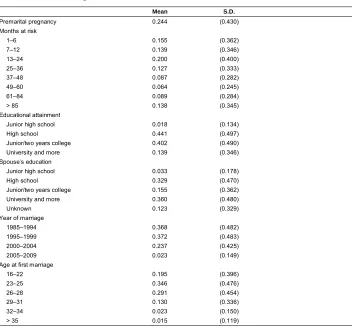
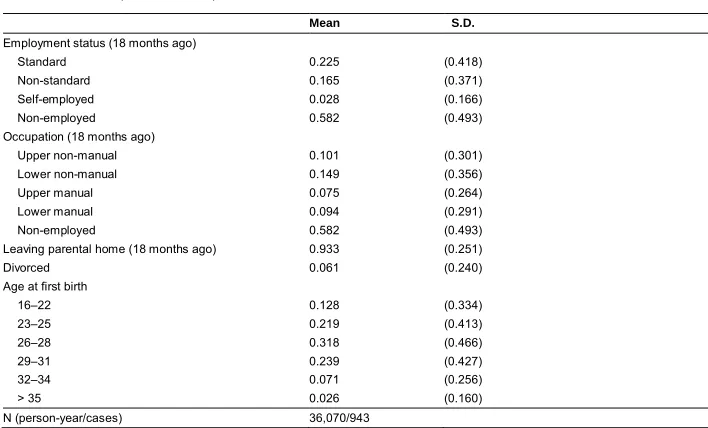
Of the 1,529 women in the original data we omitted those without any children, the currently widowed or never-married; those whose first birth resulted in twins; cases lacking information about educational attainment, timing of first marriage, or first birth; cases lacking information about occupation 18 months before the first childbirth and co-residence with parents; and women whose first childbirth occurred within 12 months of the time of the survey. Thus, the total sample used for the analysis consisted of 943 females ranging in age between 28 and 42 years in 2008 and who were currently married or experienced marriage in the past (Table 1).
Table 1: Descriptive statistics
Mean S.D.
Premarital pregnancy 0.244 (0.430)
Months at risk
1–6 0.155 (0.362)
7–12 0.139 (0.346)
13–24 0.200 (0.400)
25–36 0.127 (0.333)
37–48 0.087 (0.282)
49–60 0.064 (0.245)
61–84 0.089 (0.284)
> 85 0.138 (0.345)
Educational attainment
Junior high school 0.018 (0.134)
High school 0.441 (0.497)
Junior/two years college 0.402 (0.490)
University and more 0.139 (0.346)
Spouse’s education
Junior high school 0.033 (0.178)
High school 0.329 (0.470)
Junior/two years college 0.155 (0.362)
University and more 0.360 (0.480)
Unknown 0.123 (0.329)
Year of marriage
1985–1994 0.368 (0.482)
1995–1999 0.372 (0.483)
2000–2004 0.237 (0.425)
2005–2009 0.023 (0.149)
Age at first marriage
16–22 0.195 (0.396)
23–25 0.346 (0.476)
26–28 0.291 (0.454)
29–31 0.130 (0.336)
32–34 0.023 (0.150)
Table 1: (Continued)
Mean S.D.
Employment status (18 months ago)
Standard 0.225 (0.418)
Non-standard 0.165 (0.371)
Self-employed 0.028 (0.166)
Non-employed 0.582 (0.493)
Occupation (18 months ago)
Upper non-manual 0.101 (0.301)
Lower non-manual 0.149 (0.356)
Upper manual 0.075 (0.264)
Lower manual 0.094 (0.291)
Non-employed 0.582 (0.493)
Leaving parental home (18 months ago) 0.933 (0.251)
Divorced 0.061 (0.240)
Age at first birth
16–22 0.128 (0.334)
23–25 0.219 (0.413)
26–28 0.318 (0.466)
29–31 0.239 (0.427)
32–34 0.071 (0.256)
> 35 0.026 (0.160)
N (person-year/cases) 36,070/943
3.2 Methods
Multiple methods have been proposed to control for selection bias in premarital pregnancy (for a review, see Cerulli 2015; Guo and Fraser 2014; Morgan and Winship 2015). From these we chose propensity score matching. The rationale for choosing this method is as follows: This study examines the effect of premarital pregnancy on the risk of having a second child, using discrete-time event history methods. Using propensity score matching for event history analysis allows us to match the samples with covariates before the treatment.5 In other words, we aim to balance the samples using confounders at the beginning of the risk set (the first month of being at risk of bearing a second child). However, due to the nature of data for event history models, regression adjustments or propensity score reweighting balance the samples with covariates after the treatment, which is not our purpose in this study.6
Therefore, we applied propensity score matching using a standard approach, which is nearest neighbor matching using caliper 0.1 (see Guo and Fraser 2014 for details about the method). The analytic process of propensity score matching is as follows. First, we chose conditioning variables associated with the selection bias receiving treatment (i.e., premarital pregnancy). Second, we estimated a logistic regression model to predict the probability of individuals experiencing premarital pregnancy, using these conditioning variables as independent variables. The estimated conditional probability of assignment to a specific treatment is defined as the propensity score. The propensity score is understood as a balancing measure, which summarizes the information of multiple independent variables affecting selection bias. One of the properties of this score is that, conditional on it, the independent variables (or covariates) are independent of the assignment to a particular treatment. In other words, selecting cases with the same propensity score enables us to remove the selection bias regarding experiencing premarital pregnancy. Therefore, the expected difference between the treatment and non-treatment conditions is equal to the average treatment effect (ATE) in causal inference. This treatment effect is estimated at the population level because it is not possible to simultaneously observe potential outcomes under the two conditions. If we define ATE as τ, the propensity score for each case as ( ), and assignment into the treatment as , then the relationship between ATE and the expected difference is expressed as follows:
= τ = [ ( | ( ), = 1) − ( | ( ), = 0)].
5 A similar analytical strategy, which applied propensity score matching to an event history model, is found in
Zhang’s (2017) study on the effect of cohabitation on marital dissolution in China.
6 In addition, our sensitivity analyses using regression adjustment and propensity score reweighting did not
Third, we matched the treated cases to the controlled cases based on this propensity score. The purpose of propensity score matching is to create a new subsample that shares similar propensity scores. Of the multiple ways of matching algorithms we chose the most standard technique, i.e., nearest neighbor matching within a caliper. We first randomly chose treated casei, and controlled casej. If the absolute difference in the propensity score between these two cases fell within a predefined caliper ε and was the smallest among all possible pairs of i and other potential controlled cases within the caliper, we selected them as the matching pair(s). In this study the size of the caliper was set at 0.1, which is a typical value in propensity score matching. Additionally, we selected one case as controlled, which means that we adopted 1:1 matching.7
Our analytical strategy is as follows. First, we present the results of propensity score matching. Second, we present a descriptive trend of the second childbirth functions of premarital pregnancy women and non-premarital pregnancy women using the Kaplan–Meier estimation, including both the observed and balanced results. Finally, we examine the causal impact of premarital pregnancy on second childbirth using a discrete time logistic model with covariates in the matching as independent variables.
4. Results
4.1 Results of propensity score matching
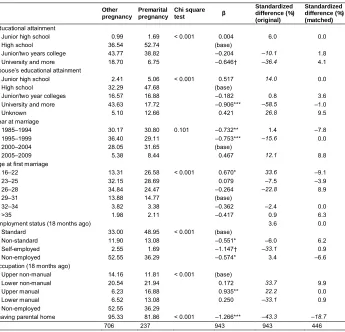
The covariates that are used both in matching and estimating risks were selected and defined with reference to prior studies of determinants of premarital pregnancy in Japan (Kamata 2006; Iwasawa and Kamata 2014; Raymo and Iwasawa 2008). As described in Table 2, the covariates used in this study are the respondent’s (= wife’s) education, the spouse’s (= husband’s) education, year and age at the time of their first marriage, the respondent’s employment status and occupation (18 months before the first birth), and leaving the parental home (18 months before the first childbirth). Table 2 describes the distribution of covariates between premarital pregnancy and other pregnancy at the time of the first childbirth. The results of the chi-square test show that the distribution of all variables is significantly different at 0.1%, except for the year at the time of marriage (p = 0.101). Age at first marriage is significant (at 5%) when we examine the
7 We were unable to include likely confounders of the relationship between premarital pregnancy and the
multivariate logistic regression, but respondents who are university graduates and spouses of university graduates are less likely to experience premarital pregnancy, as are married respondents in older cohorts (1985−1994, 1995−1999), those who have nonstandard employment, those unemployed 18 months before the first childbirth, and those who do not live with their parents. Regarding occupation, respondents who are employed as upper manual workers are more likely to experience premarital pregnancy than professional workers. As these results show, whether one experiences premarital pregnancy or not is selective.
Table 2: Descriptive statistics for propensity score analysis
Other pregnancy Premarital pregnancy Chi square test β Standardized difference (%) (original) Standardized difference (%) (matched) Educational attainment
Junior high school 0.99 1.69 < 0.001 0.004 6.0 0.0
High school 36.54 52.74 (base)
Junior/two years college 43.77 38.82 –0.204 –10.1 1.8
University and more 18.70 6.75 –0.646† –36.4 4.1
Spouse’s educational attainment
Junior high school 2.41 5.06 < 0.001 0.517 14.0 0.0
High school 32.29 47.68 (base)
Junior/two year colleges 16.57 16.88 –0.182 0.8 3.6
University and more 43.63 17.72 –0.906*** –58.5 –1.0
Unknown 5.10 12.66 0.421 26.8 9.5
Year at marriage
1985–1994 30.17 30.80 0.101 –0.732** 1.4 –7.8
1995–1999 36.40 29.11 –0.753*** –15.6 0.0
2000–2004 28.05 31.65 (base)
2005–2009 5.38 8.44 0.467 12.1 8.8
Age at first marriage
16–22 13.31 26.58 < 0.001 0.670* 33.6 –9.1
23–25 32.15 28.69 0.079 –7.5 –3.9
26–28 34.84 24.47 –0.264 –22.8 8.9
29–31 13.88 14.77 (base)
32–34 3.82 3.38 –0.362 –2.4 0.0
>35 1.98 2.11 –0.417 0.9 6.3
Employment status (18 months ago) 3.6 0.0
Standard 33.00 48.95 < 0.001 (base)
Non-standard 11.90 13.08 –0.551* –6.0 6.2
Self-employed 2.55 1.69 –1.147† –33.1 0.9
Non-employed 52.55 36.29 –0.574* 3.4 –6.6
Occupation (18 months ago)
Upper non-manual 14.16 11.81 < 0.001 (base)
Lower non-manual 20.54 21.94 0.172 33.7 9.9
Upper manual 6.23 16.88 0.935** 22.2 0.0
Lower manual 6.52 13.08 0.250 –33.1 0.9
Non-employed 52.55 36.29
Leaving parental home 95.33 81.86 < 0.001 –1.266*** –43.3 –18.7
N 706 237 943 943 446
Although we do not show the results in the table, in the observed sample the mean standardized difference in covariates is 18.6% and the median standardized difference is 14.0%. By contrast, in the adjusted sample the mean standardized difference is reduced to 4.7% and the median standardized difference is 3.9%, which suggests that the matching balanced the gap in the propensity score between the premarital pregnancy group and the others. For each covariate shown in the table the absolute value of the mean standardized difference above 10% is italicized. In the observed sample 14 variables had standardized differences of more than 10%, whereas in the adjusted model each covariate was balanced between the treated group and the controlled group.
Therefore, we balanced the covariates between the treated (premarital pregnancy) and the controlled (other pregnancy) group. After matching between both groups using propensity score matching we obtained 223 cases for each group.8
4.2 Descriptive analysis
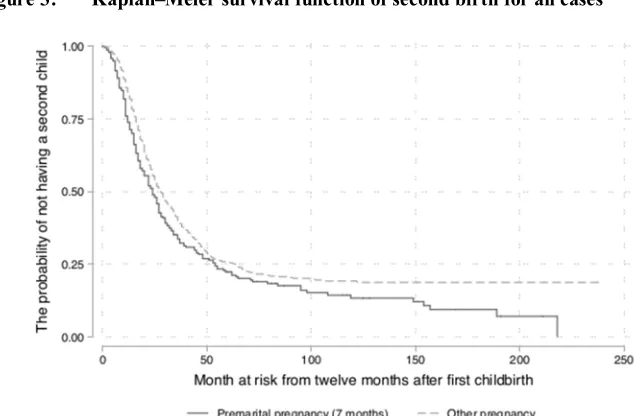
Figure 2 shows the results of the Kaplan–Meier estimation of the survival curves (Allison 2014) for second childbirth. For comparison, the trend of the observed cases is also shown in Figure 3. As these graphs show, after propensity score matching, women who conceive premaritally are more likely to experience a second childbirth earlier from twelve months after the first childbirth, but this rate converges to that of other pregnancies at the middle (approximately 50 months), and the converged gap widens once more at later months. In contrast to the estimated results, the observed survival functions show that the difference in childbirth timing between premarital pregnancy couples and other pregnancy couples continues and gets bigger at later periods of duration at risk (Figure 3). The difference between premarital pregnancy and other pregnancies is marginally significant in the adjusted sample (p = 0.103 by log-rank test) and is statistically significant in the observed sample (p = 0.014). This relationship is also confirmed using the Wilcoxon-Breslow-Gehan test (p = 0.104 for the adjusted sample and p = 0.005 for the observed sample).
8 Compared with the matched cases, both wives and husbands among the unmatched cases are more likely to
Figure 2: Kaplan–Meier survival function of second birth for the cases adjusted by propensity score matching
These results suggest that propensity score matching removes selection bias regarding the experience of premarital pregnancy. Nevertheless, the timing of additional childbirths is slightly earlier among the premarital pregnancy couples. In addition to the baseline differences between both groups in the likelihood of second childbirth, the propensity to have another child varies by the timing of month at risk, which suggests that the relationship between the likelihood of additional childbirth and premarital pregnancy is time dependent. Therefore, in the following analysis we relax our assumption that the shape of the hazard is the same regardless of whether or not the pregnancy is treated as premarital.
4.3 Results of discrete time logistic models
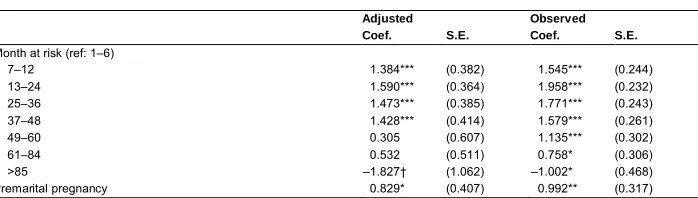
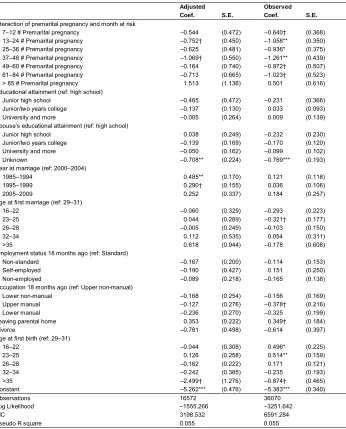
Table 3 presents both the adjusted (matched) and the observed results of the discrete time logistic regressions. This model relaxes our assumption that month at risk is independent of whether a premarital pregnancy is experienced. The results show that the effect of premarital pregnancy on second childbirth is greatest at the beginning of month at risk (i.e., 1−6 months). In this period the experience of premarital pregnancy significantly increases the odds of a second childbirth by 2.29 times (=exp(0.829)) more than the odds of other pregnant women in the matched sample, while the result of the observed sample shows that premarital pregnancy experience increases the odds by 2.70 times (=exp(0.992)). However, the interaction of premarital pregnancy and month at risk shows negative values, except for a risk at more than 85 months. For example, premarital pregnancy at 37−48 months at risk nearly offsets the baseline effect of premarital pregnancy (0.829 – 1.069 = ‒0.240) among the matched sample, whereas before and after the month at risk the negative values of the interaction terms decrease.
Table 3: Results of Discrete Time Logit Models
Adjusted Observed
Coef. S.E. Coef. S.E.
Month at risk (ref: 1–6)
7–12 1.384*** (0.382) 1.545*** (0.244)
13–24 1.590*** (0.364) 1.958*** (0.232)
25–36 1.473*** (0.385) 1.771*** (0.243)
37–48 1.428*** (0.414) 1.579*** (0.261)
49–60 0.305 (0.607) 1.135*** (0.302)
61–84 0.532 (0.511) 0.758* (0.306)
>85 –1.827† (1.062) –1.002* (0.468)
Table 3: (Continued)
Adjusted Observed
Coef. S.E. Coef. S.E.
Interaction of premarital pregnancy and month at risk
7–12 # Premarital pregnancy –0.544 (0.472) –0.640† (0.368)
13–24 # Premarital pregnancy –0.752† (0.450) –1.058** (0.350)
25–36 # Premarital pregnancy –0.625 (0.481) –0.936* (0.375)
37–48 # Premarital pregnancy –1.069† (0.550) –1.261** (0.439)
49–60 # Premarital pregnancy –0.164 (0.740) –0.972† (0.507)
61–84 # Premarital pregnancy –0.713 (0.665) –1.023† (0.523)
> 85 # Premarital pregnancy 1.513 (1.136) 0.501 (0.616)
Educational attainment (ref: high school)
Junior high school –0.465 (0.472) –0.231 (0.366)
Junior/two years college –0.137 (0.130) 0.033 (0.093)
University and more –0.005 (0.264) 0.009 (0.139)
Spouse’s educational attainment (ref: high school)
Junior high school 0.038 (0.249) –0.232 (0.230)
Junior/two years college –0.139 (0.169) –0.170 (0.120)
University and more –0.050 (0.162) –0.099 (0.102)
Unknown –0.708** (0.224) –0.769*** (0.193)
Year at marriage (ref: 2000–2004)
1985–1994 0.485** (0.170) 0.121 (0.118)
1995–1999 0.290† (0.155) 0.036 (0.106)
2005–2009 0.252 (0.337) 0.184 (0.257)
Age at first marriage (ref: 29–31)
16–22 –0.060 (0.329) –0.293 (0.223)
23–25 0.044 (0.289) –0.321† (0.177)
26–28 –0.005 (0.249) –0.103 (0.150)
32–34 0.112 (0.535) 0.054 (0.311)
>35 0.618 (0.944) –0.178 (0.608)
Employment status 18 months ago (ref: Standard)
Non-standard –0.167 (0.200) –0.114 (0.153)
Self-employed –0.190 (0.427) 0.151 (0.250)
Non-employed –0.089 (0.218) –0.165 (0.138)
Occupation 18 months ago (ref: Upper non-manual)
Lower non-manual –0.168 (0.254) –0.156 (0.169)
Upper manual –0.127 (0.276) –0.378† (0.216)
Lower manual –0.236 (0.270) –0.325 (0.199)
Leaving parental home 0.353 (0.222) 0.349† (0.184)
Divorce –0.781 (0.498) –0.614 (0.397)
Age at first birth (ref: 29–31)
16–22 –0.044 (0.308) 0.496* (0.225)
23–25 0.126 (0.258) 0.514** (0.159)
26–28 –0.162 (0.222) 0.171 (0.121)
32–34 –0.242 (0.385) –0.235 (0.193)
>35 –2.499† (1.276) –0.874† (0.465)
Constant –5.262*** (0.476) –5.383*** (0.340)
Observations 16572 36070
Log Likelihood –1555.266 –3251.642
AIC 3198.532 6591.284
Pseudo R square 0.055 0.055
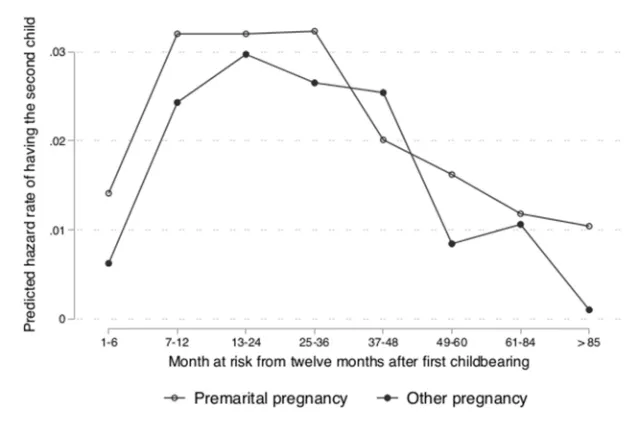
Figure 4 presents the predicted hazard rate based on the model for premarital pregnancy and other pregnancy. For conventional women without premarital pregnancy experience the hazard is low for the first six months, high from the second six months to the end of fourth year, and has a decreasing trend afterwards. The trend of women with premarital pregnancy is slightly different. Premarital pregnancy has a high hazard of second childbirth in each category of months at risk except for 37–48 months. However, the gap between them is larger during the earlier and later months.
Figure 4: The predicted hazard rate of having the second child, premarital pregnancy and other pregnancy
5. Conclusion
Considering that nonmarital childbearing is still a quantitative minority in Japan, a recent increase in premarital pregnancy in this developed country could be considered a unique demographic trend.
Prior studies have examined the determinants of premarital pregnancy in Japan (Kamata 2006, 2012; Otani 1993; Raymo and Iwasawa 2008), but studies of its consequences are scarce, except for the work of Iwasawa and Kamata (2014), which examines the effect of premarital pregnancy on women’s subsequent careers. Despite limited knowledge regarding the effect of premarital pregnancy on life course outcomes, inquiry into its consequences warrants examination. If the timing of pregnancy before or after marriage influences second childbirth, this suggests that unintended premarital pregnancy will change a woman’s life course.
Therefore, in this study we aim to investigate the impact of premarital pregnancy on second childbirth. The results of discrete time logistic regression show that experiencing premarital pregnancy causes a high risk of second childbirth at earlier and later months at risk, defined as starting from one year after the first birth. The propensity to have a second birth approximately 2 and 3 years after having the first child does not significantly differ between premarital pregnancy and other pregnancy. During those periods the risk of additional childbirth is the highest. Since the sample of women used in this study ranges in age between 28 and 42 years, it is not possible to examine completed fertility. However, these results suggest that the total number of childbirths among women who had a premarital pregnancy might be larger than among other pregnant women.
The results support the life course change hypothesis. As we hypothesized, premarital pregnancy increases the risk of experiencing an additional childbirth. This unintended demographic behavior may reduce both women’s attachment to a working life and their opportunity cost of having a second child. Different effects of premarital pregnancy depending on month at risk, particularly during earlier months, could also be compatible with the hypothesis, because it is predicted that the effect of unintended pregnancy on reducing women’s attachment to working life is most notable immediately after childbirth.
childbirths, the majority of women who conceived before marriage in our dataset remain married. Although the alternative hypothesis predicts that these married women would have lower marital satisfaction and lower propensity to bear a second child, we are unable to directly observe their marital satisfaction. This point is a limitation of our study, which may be overcome by future research.
In addition, the limitation of using the propensity score matching technique should also be mentioned. This method removes selection bias when it includes all variables relevant to the matching procedure. This study, however, was not able to include all relevant variables such as family orientation or parenting skills because the survey did not capture those aspects. Although this limitation does not make the method unreliable, the results based on propensity score matching should be carefully interpreted.
The results of this study suggest that premarital pregnancy is a significant event that changes women’s subsequent work–family life course. As our life course hypothesis assumed, unintended premarital pregnancy may derail women from their expected career track. Thus, considering the increasing trend of premarital pregnancy, in Japan family planning will be a key factor in achieving women’s expected career path and having a balanced work–family life. Our results could also apply to other East Asian contexts. East Asian societies share a family system and values in which there is a strong tie between marriage and fertility. This is particularly evident in the low nonmarital birth rate. For example, in 2014 the nonmarital birth rate was 1.9% in South Korea and 4.0% in Taiwan according to the OECD family database (OECD 2018). In addition, as it has been observed in Japan, in South Korea, and also in China and Taiwan (Chang 1996; Ma and Rizzi 2017; Thornton, Chang, and Yang 1994), the premarital pregnancy rate increased rapidly from 3.7% in 1997–1999 to 10.0% in 2012– 2014 (Kim 2017). Thus, future research should also examine whether premarital pregnancy has a positive association with second childbirth in these other East Asian countries. Analyzing how women react to unintended life course events such as premarital pregnancy would reveal family formation norms and values.
6. Acknowledgments
The Japanese General Social Survey 2009 Life Course Study (JGSS-2009 LCS) is designed and conducted by the JGSS Research Center at Osaka University of Commerce (Joint Usage/Research Center for Japanese General Social Surveys accredited by the Ministry of Education, Culture, Sports, Science and Technology).
References
Akerlof, G., Yellen, J., and Katz, M. (1996). An analysis of out-of-wedlock childbearing in the United States. The Quarterly Journal of Economics 111(2): 277–317.doi:10.2307/2946680.
Allison, P.D. (2014). Event history and survival analysis. Thousand Oaks: Sage.
doi:10.4135/9781452270029.
Bachu, A. (1999).Trends in premarital childbearing: 1930–1994. Washington, D.C.: US Bureau of the Census.
Billy, J.O.G., Landale, N.S., and McLaughlin, S.D. (1986). The effect of marital status at first birth on marital dissolution among adolescent mothers. Demography
23(3): 329–349.doi:10.2307/2061434.
Bumpass, L.L., Raley, R.K., and Sweet, J.A. (1995). The changing character of stepfamilies: Implications of cohabitation and nonmarital childbearing.
Demography 32(3): 425–436.doi:10.2307/2061689.
Cerulli, G. (2015). Econometric evaluation of socio-economic programs: Theory and applications. Berlin: Springer.doi:10.1007/978-3-662-46405-2.
Chang, J. (1996). What do education and work mean? Education, nonfamilial work/living experiences and premarital sex for women in Taiwan. Journal of Comparative Family Studies 27(1): 13–40.
Cherlin, A.J. (2010). Demographic trends in the United States: A review of research in the 2000s.Journal of Marriage and Family 72(3): 403–419. doi:10.1111/j.1741-3737.2010.00710.x.
Gender Equality Bureau Cabinet Office (2013). White paper on a gender equality [electronic resource]. Tokyo: Cabinet Office, Government of Japan.
http://www.gender.go.jp.
Guo, S. and Fraser, M.W. (2014). Propensity score analysis: Statistical methods and applications.Thousand Oaks: Sage.
Guzzo, K.B. and Hayford, S. (2011). Fertility following an unintended first birth.
Demography 48(4): 1493–1516.doi:10.1007/s13524-011-0059-7.
Hertog, E. and Iwasawa, M. (2011). Marriage, abortion, or unwed motherhood? How women evaluate alternative solutions to premarital pregnancies in Japan and the United States. Journal of Family Issues 32(12): 1674–1699. doi:10.1177/ 0192513X11409333.
Institute of Medicine (1995).The best intentions: Unintended pregnancy and the well-being of children and families. Washington, D.C.: National Academies Press. Iwasawa, M. and Kamata, K. (2014). Marriage preceded by pregnancy and women’s
employment.Japan Labor Review 11(4): 21–51.
Japanese Association for Sex Education (2013).Sexual behavior of youth: The seventh survey of junior high school, high school, and university students in Japan (in Japanese). Tokyo: Japanese Association for Sex Education.
Kamata, K. (2006). Konzen ninshin ni kansuru shakai keizaiteki yoin no bunseki [An analysis of premarital pregnancy about socio-economic factors]. Journal of Economics 24: 45‒63.
Kamata, K. (2012). Zenkoku kazoku chosa wo mochiita bunseki: Konzen ninshin shussho no shakai keizaiteki yoin [An analysis based on National Family Research of Japan: Socio-economic factors in premarital pregnancy]. In: Anzo, S. and Kojima, H. (eds.). Mikuro deta no keiryo jinkogaku [Demographic analysis of microdata]. Tokyo: Hara Shobo: 67‒91.
Kawaguchi, A. (2005). Kekkon-to shussan-wa danjo-no chingin-ni donoyona eikyo-wo oyoboshite iruka [Effect of marriage and childbearing on male and female wages]. Nihon Rodo Kenkyu Zassi [The Japanese Journal of Labour Studies]
535: 42–55.
Kelley, H.H. (1979).Personal relationships: Their structures and processes. Hillsdale: Lawrence Erlbaum Associates.
Kim, K. (2017). Trends and determinants of premarital conception: Love in Korea.
International Journal of Japanese Sociology 26(1): 23–38. doi:10.1111/ijjs. 12062.
Knab, J. and Harknett, K. (2006). ‘Shotgun’ marriages and relationship outcomes. Paper presented at the Annual Meeting of the American Sociological Association, Montreal, Canada, August 10, 2006.
Konishi, S. and Tamaki, E. (2016). Pregnancy intention and contraceptive use among married and unmarried women in Japan.Japanese Journal of Health and Human Ecology 82(3): 110–124.doi:10.3861/jshhe.82.110.
Lesthaeghe, R. (1983). A century of demographic and cultural change in Western Europe: An exploration of underlying dimensions.Population and Development Review 9(3): 411–435.doi:10.2307/1973316.
Ma, L. and Rizzi, E. (2017). Entry into first marriage in China.Demographic Research
37(36): 1231–1244.doi:10.4054/DemRes.2017.37.36.
McCarthy, J. and Menken, J. (1979). Marriage, remarriage, marital disruption and age at first birth.Family Planning Perspectives 11(1): 21–30.doi:10.2307/2134478. Ministry of Health, Labor, and Welfare (2000).Specified report of vital statistics 2000
(in Japanese). Tokyo: Ministry of Health, Labor, and Welfare.
Ministry of Health, Labor, and Welfare (2010).Specified report of vital statistics 2010
(in Japanese). Tokyo: Ministry of Health, Labor, and Welfare.
Morgan, S.P. and Rindfuss, R.R. (1999). Reexamining the link of early childbearing to marriage and to subsequent fertility. Demography 36(1): 59–75. doi:10.2307/ 2648134.
Morgan, S.L. and Winship, C. (2015). Counterfactuals and causal inference: Methods and principles for social research. Cambridge: Cambridge University Press. National Institute of Population and Social Security Research (2012).Marriage process
and fertility of Japanese married couples: Overview of the results of the fourteenth Japanese national fertility survey in 2010. Tokyo: National Institute of Population and Social Security Research. http://www.ipss.go.jp/ps-doukou/e/ doukou14/Nfs14_Couples_Eng.pdf (accessed September 25th, 2018).
National Institute of Population and Social Security Research (2017). Latest demographic statistics (in Japanese). Tokyo: National Institute of Population and Social Security Research.
OECD (2018). OECD family database [electronic resource]. Paris: OECD.
http://www.oecd.org/els/family/database.htm (accessed on June 27th, 2018). Otani, K. (1993). Gendai nihon shusshoryoku bunseki [An analysis of fertility in
Parr, N. (2010). Satisfaction with life as an antecedent of fertility: Partner + Happiness = Children? Demographic Research 22(21): 635–662. doi:10.4054/DemRes. 2010.22.21.
Perelli-Harris, B. (2014). How similar are cohabiting and married parents? Second conception risks by union type in the United States and across Europe.European Journal of Population 30(4): 437–464.doi:10.1007/s10680-014-9320-2.
Perelli-Harris, B., Kreyenfeld, M., Sigle-Rushton, W., Keizer, R., Lappegård, T., Jasilioniene, A., Berghammer, C., and Di Giulio, P. (2012). Changes in union status during the transition to parenthood in eleven European countries, 1970s to early 2000s. Population Studies 66(2): 167–182. doi:10.1080/00324728.2012. 673004.
Raley, R.K. (2001). Increasing fertility in cohabiting unions: Evidence for the second demographic transition in the United States? Demography 38(1): 59–66.
doi:10.1353/dem.2001.0008.
Raymo, J.M., Bumpass, L., and Iwasawa, M. (2004). Marital dissolution in Japan:
Recent trends and patterns. Demographic Research 11(14): 395–420.
doi:10.4054/DemRes.2004.11.14.
Raymo, J.M. and Iwasawa, M. (2008). Bridal pregnancy and spouse pairing patterns in Japan. Journal of Marriage and Family 70(4): 847–860. doi:10.1111/j.1741-3737.2008.00531.x.
Raymo, J.M., Iwasawa, M., and Bumpass, L. (2009). Cohabitation and family formation in Japan.Demography 46(4): 785–803.doi:10.1353/dem.0.0075. Raymo, J.M., Musick, K., and Iwasawa, M. (2015). Gender equity, opportunity costs of
parenthood, and educational differences in unintended first births: Insights from Japan. Population Research and Policy Review 34(2): 179–199. doi:10.1007/ s11113-014-9348-3.
Ruzicka, L.T. (1976). Age at marriage and timing of the first birth.Population Studies
30(3): 527–538.doi:10.1080/00324728.1976.10410421.
Scanzoni, J. (1979). Social exchange and behavioral interdependence. In: Burgess, R.L. and Huston,T.L. (eds.).Social exchange in developing relationships. New York: Academic Press: 61–98.doi:10.1016/B978-0-12-143550-9.50009-4.
Teachman, J.D. (2002). Stability across cohorts in divorce risk factors. Demography
39(2): 331–351.doi:10.1353/dem.2002.0019.
Thornton, A., Chang, J.S., and Yang, L.S. (1994). Determinants of historical changes in marital arrangements, dating, and premarital sexual intimacy and pregnancy. In: Thornton, A. and Lin, H.-S. (eds.). Social change and the family in Taiwan. Chicago: University of Chicago Press: 178–201.
Tzeng, M.-S. (1992). The effects of socioeconomic heterogamy and changes on marital dissolution for first marriages.Journal of Marriage and Family 54(3): 609–619.
doi:10.2307/353246.
Upchurch, D.M., Lillard, L.A., and Panis, C. (2002). Nonmarital childbearing: Influences of education, marriage, and fertility. Demography 39(2): 311–329.
doi:10.1353/dem.2002.0020.
Van de Kaa, D.J. (1987). Europe’s second demographic transition.Population Bulletin
42(1): 1–59.
Wu, L.L. and Wolfe, B. (2001). Out of wedlock: Causes and consequences of
nonmarital fertility. New York: Russell Sage Foundation.
Yashiro, N. (2011). Myths about Japanese employment practices: An increasing insider-outsider conflict of interests. Contemporary Japan 23(2): 133–155.
doi:10.1515/cj.2011.008.
Zhang, J. and Song, X. (2007). Fertility differences between married and cohabiting couples: A switching regression analysis. Bonn: Institute for the Study of Labor (IZA Discussion Paper 3245).
Zhang, Y. (2017). Premarital cohabitation and marital dissolution in postreform China.