June 2019, Vol. 3, No. 1 [80-92] O-ISSN 2664-0430
Pakistan Social Sciences Review
www.pssr.org.pk
RESEARCH PAPERThe Application and Impact of PEEDA Act on Teachers’
Morale and Performance
PAPER INFO ABSTRACT
Received: February 20, 2019 Accepted: May 25, 2019 Online: June 30, 2019
This study was designed to find out “The impact of PEEDA Act on teachers’ morale and performance”. The study was qualitative as well as quantitative in nature. The target population was all the PEEDA Victims primary school teachers and their Head Teachers of district Dera Ghazi Khan. There were 503 PEEDA Victims out of which 285 were selected as the sample by using simple random sampling technique. To find out the morale and performance of PEEDA Victims, Two questionnaires were developed one for PEEDA Victims and other for their Head Teachers. The collected data were tabulated and analyzed by using SPSS version 20. Descriptive statistics like percentage, mean and standard deviation were applied to data to generalize the result. Z-test was applied to test the null hypotheses. The results of the study showed that PEEDA Act has slightly positive impact on teachers’ performance but it is negatively affecting teachers’ morale. Keywords: Punjab Employees Efficiency, Discipline and accountability Act (PEEDA) Victims, Morale, Performance Corresponding author Dr. Muhammad Humera Anwar Lodhi
huma.lodhi123@gmail. com
Introduction
The Education is one of the powerful factors responsible for the multiple growth of any society. According to Panda and Mohanty (2013) excellent teachers are fundamental part for the schooling system and education progression. Teachers are divided into good and bad on the basis of their performance. The performance could be explained as the duties performed by teachers in an education system at specific time period to achieve educational goals (mekennon, 2014).
1. Lecturer , Department of Education, University of Education Lahore Sub Campus Dera Ghazi Khan
According to Arreola in 2003, five basic skills required for effective teaching are Course knowledge, instructional plan ability, instructional delivery talent, Instructional evaluation expertise and course organization expertise. By these five expensive terms, it becomes clear that the evaluation of teaching cannot be accomplished by using a single evaluation device. This should be understood that it is frustrating and demoralizing for teachers that they are only responsible for their students’ test scores (Lindsay, 2015).
Jennings, (2013) discussed in his article that teacher evaluation system based on student result is risky for both teachers as well as organization. He said teachers’ accountability should not only be based on students’ academic results. Many educationists put great efforts in upgrading teacher evaluation standards several of which are Classroom inspections; Aptitude testing; Peer analysis; Students’ success and Students’ ranking (Theall, 2003). On the basis of evaluation report teachers are rewarded or punished.
Review of the related literature
In order to understand the different variables of proposed study, an extensive literature has been reviewed. To understand whether the morale is getting high or low and similarly the performance it was important to list out the symptoms of low morale and performance. Hills, (2014) described 25 warning signs of low staff morale like increase in slowness and absenteeism, team contradictions, ascending mistakes and the need to renovate work, mistrust among staff members, client hostility, uncooperative mind-set, little influence, lack of interest, inaccuracy, constant prolonged facial expression, declination in the appearance of the work area, insufficiency in trustworthiness, collapse in duty, rising complaints, dispute about apparently small issues, Zombie-like activities, high turnover, mutual reluctance (Reluctant to participate.), clash to authority, use of slogans like what’s the point and no one cares, conflicting demands, “Us” vs. “them” dialogues, secret discussions and prohibitory actions, objections of group members not carrying their load and tiresome attitude at meeting.
Measom, 2011 described the symptoms of low performance like decline in output, tardiness or absenteeism and personality and behavior Changes. Similarly Mahoney, Jerdee and Carroll, 1965 detailed some other symptoms of low performance like:
1. Goals are not being met.
2. Employee relies too heavily on others to meet goals. 3. The quality of work is poor.
4. Employee has difficulty working with boss or co-workers. 5. Employee is not able to embrace the company values. 6. Employee violates company policy.
Objectives of the Study
The following were the objectives of this study:
2. To identify the effect of PEEDA Act on teachers’ performance. 3. To find out the gender wise affect of PEEDA Act.
4. To give suggestions to Punjab education department for further improvement in PEEDA Act.
Methodology
The Alpha Reliability Coefficient value of questionnaire number one was found .90. The Alpha Reliability Coefficient value of items of Q no. 1 that measure teacher’s morale was .95 which is excellent and the Alpha Reliability Coefficient value of items of Q no. 1 that measure teacher’s performance is .83 that is good. The Alpha Reliability Coefficient value of questionnaire 2 was .90.The Alpha Reliability Coefficient value of items of Q no. 2 that measure teacher’s morale was .93 which is excellent and the Alpha Reliability Coefficient value of items of Q no. 2 that measure teacher’s performance was .96 that is also excellent. The collected data were arranged in a tabulated form. The descriptive statistics like percentage mean and standard deviation and the inferential statistics were applied. In this study following null hypothesis were tested to generalize the results.
HO1:There is no significant difference between the opinion of
male and female Head Teachers about the PEEDA Act regarding its effects on Victims’ morale.
HO2:There is no significant difference between the opinion of male and female Head Teachers about the PEEDA Act regarding its effects on Victims’ performance.
HO3: There is no significant difference between the opinion of
male and female teachers about the PEEDA Act regarding its effects on their morale.
HO4:There is no significant difference between the opinion of
male and female teachers about the PEEDA Act regarding its effects on their performance.
Analysis of data
Table 1: Responses of Head teachers about teacher morale Item
no. Statements Mean SD
are positive
TM6 The accused confidence increases 3.32 1.148 TM 7 The accused conversation is hopeless 3.61 1.012 TM 8 The accused have constant prolongedfacial expressions 3.33 1.166 TM 9 The accused personality grooms 3.25 1.289 TM 10 The accused attitude with colleagues isfriendly 3.17 1.070
Table 2: Responses of Head teachers about teacher performance Item
no. Statements Mean SD
TP 1 The accused attends staff meetingregularly 2.03 .944
TP 2 The accused participation in staffmeeting is suggestive 2.07 .889
TP 3 The complaints of accused from head ofinstitute decrease 2.03 .944 TP 4 The accused class results improve 2.01 .958 TP 5 The accused instruction deliveryimproves 1.94 1.092 TP 6 The accused plans the lessons regularly 1.92 1.082 TP 7 The accused checks the homework ofstudents regularly 1.96 1.028 TP 8 The accused absenteeism decreases 1.92 1.082
TP 9 The accused feels guilty 1.97 1.089
Table 3: Responses of PEEDA Victims about their morale Item
no. Statements Mean S D
TM 1 Teachers’ attitude is cooperative afterexecution of PEEDA Act 3.97 1.211
TM 2 Teachers take positive initiative forschool after implementation of
PEEDA Act 4.00 1.158
TM 3 Teachers’ commitment towards theirwork increases after PEEDA Act
implementation. 3.96 1.158
implementation of PEEDA Act.
TM5 You think that victims’ views arepositive about PEEDA Act. 3.90 .925 TM6 Teachers’ professionalism increases
after becoming the PEEDA victim. 3.81 .929
TM 7 Teachers’ are hopeless for theirprofessional future after PEEDA Act
implementation. 3.99 .908
TM 8 You think that teachers haveconstant prolonged facial expressions
after the execution of PEEDA Act. 3.81 1.251 TM 9 Victims’ attitude with colleagues isfriendly. 3.39 1.339
TM 10 You think that teachers’ views arepositive about PEEDA Act before
execution of PEEDA Act. 3.27 1.284
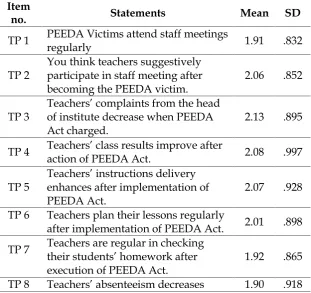
Table 4: Responses of PEEDA Victim about their performance Item
no. Statements Mean SD
TP 1 PEEDA Victims attend staff meetingsregularly 1.91 .832
TP 2 You think teachers suggestivelyparticipate in staff meeting after
becoming the PEEDA victim. 2.06 .852
TP 3 Teachers’ complaints from the headof institute decrease when PEEDA
Act charged. 2.13 .895
TP 4 Teachers’ class results improve afteraction of PEEDA Act. 2.08 .997
TP 5 Teachers’ instructions deliveryenhances after implementation of
PEEDA Act. 2.07 .928
TP 6 Teachers plan their lessons regularly
after implementation of PEEDA Act. 2.01 .898 TP 7 Teachers are regular in checkingtheir students’ homework after
execution of PEEDA Act. 1.92 .865
after becoming PEEDA victim.
TP 9 Teachers discipline followingcharacteristics increase after
becoming the PEEDA victim. 1.87 .947
TP 10 Teachers feel guilty after the chargeof PEEDA Act. 2.08 1.175
Testing Hypothesis Hypothesis 1: Table 5:
Groups Statistics
N X(Mean) SD Z
Male 128 3.79 1.13
1.375
Female 157 3.57 1.71
HO1: No significant difference exists between the opinion of male and
female teachers about the PEEDA Act regarding its affects on their morale.
CV = 1.375 TV = 1.96 CV < TV
As the difference is insignificant between the opinion of male and female teachers about PEEDA Act regarding its effect on their morale so the null hypothesis 1 is accepted.
Hypothesis 2: Table 6:
Groups Statistics
N X(Mean) SD Z
Male 128 2.003 0.81 0.21
Female 157 1.98 1.03
HO2:There is no significant difference exist between the opinion of male and female teachers about the PEEDA Act regarding its effects on their performance.
As the difference is insignificant between the opinion of male and female teachers about PEEDA Act regarding its effect on their performance so the null hypothesis 2 is accepted.
Hypothesis 3 Table 7:
Groups Statistics
N X(Mean) SD Z
Male 39 3.51 1.32 1.86
Female 64 2.95 1.72
HO3: There is no significant difference exist between the opinion of male and female Head Teachers of victims about the PEEDA Act regarding its effects on their morale.
Z = 1.86 CV = 1.86 TV = 1.96 CV < TV
As the difference is insignificant between the opinions of male female Head Teachers of victims about the PEEDA Act regarding its effects on their morale so the null hypothesis 3 is accepted.
Hypothesis 4 Table 8:
Groups Statistics
N X(Mean) SD Z
Male 39 2.01 1.12 0.176
Female 64 1.98 0.98
HO4: There is no significant difference exist between the opinion of male and female Head Teachers of victims about the PEEDA Act regarding its effects on their performance.
Z = 0.176 CV = 0.176 TV = 1.96 CV < TV
As the difference is insignificant between the opinions of male female Head Teachers of victims about the PEEDA Act regarding its effects on their performance so the null hypothesis 4 is accepted.
Results and Discussions
Following conclusion were drawn from the study,
cooperative. They also do not take positive initiatives for school. Victims do not remain committed to their job. Their tardiness increase and they are of opinion that that PEEDA Act is not a positive act. They lose their confidence due to the implementation of PEEDA Act. Their personality also depresses and they do not showing friendly attitude with their colleagues. This study shows the poor morale of victims. But victims are not hopeless with their professional future. They suggested that there may some rules be passed in future for their job protection and in favor of teachers.
The PEEDA Victims and their Head Teachers are of the opinion that the victims are attending the staff meetings regularly and they are suggestive as well. Their complaints are decreased after the implementation of PEEDA Act. Their class results get improved by bringing change in their pedagogy. They start checking homework of students on regular basis. Their absenteeism decreased and feeling of guilt is present in them. So this study also shows that the performance of victims improved after the implementation of PEEDA Act. According to responses of open ended questions Victims’ low morale is due to fear of punishment, reduced job passion, job dissatisfaction and fear of job loss.
The improvement in performance is due to fear of fine, damaged professional career, named as accused and use of unfair means during examination. The H01 that there is no significance difference between the opinion of male and female Head Teachers about the PEEDA Act regarding its effect on Victims’ morale is accepted by applying Z test (table 5). The H02 that there is no significance difference between the opinion of male and female Head Teachers about the PEEDA Act regarding its effect on Victims’ performance is accepted by applying Z test (table 6). The H03 that there is no significance difference between the opinion of male and female teachers about the PEEDA Act regarding its effect on Victims’ morale is accepted by applying Z test (table 7) . The H04 that there is no significance difference between the opinion of male and female teachers about the PEEDA Act regarding its effect on Victims’ performance is accepted by applying Z test(table 8).
impact company goals” in his study he concluded that Low morale of employees can lead to low production and loss of prosperity. In a study (why test should not be used to measure teacher performance), Jennings (2013) concluded that teacher evaluation should not rely on students results, our teachers deserve better. Similarly PEEDA Act should not be imposed on teachers by observing academic results of their students.
In response to the open ended questions, it was concluded that PEEDA Act increases the performance of teachers because of fear of penalties. Victims got afraid of damaged professional career. Attachment of word accused with the names of teachers also creates the feelings of embarrassment. Victims’ class results are improving by the use of fair, severity on students and the use of unfair means during examination because the teachers are forced to do this wrong doing for their existence. It is generally seen that with low morale, performance cannot be improved. In this study, PEEDA Victims have feeling of aggressiveness which may be the cause of low performance sometimes but the notion regarding the loss of job may tend to do the better with broken heart. Sometimes Victims thought that when once punished, fear of punishment is lost. Teachers are forced to increase class strength instead of maintaining class strength because of which they can’t concentrate on their class studies. Teachers thought that when they are late someday they are considered as absent so why they give their duties of that day. So teachers pass that day doing nothing.
For question no 2 “PEEDA Act makes the morale high”, not even a single respondent responded in favor of the statement. For this question, the responses against the statement were like Punishments can ever make the morale high. Fear of punishment is the cause of low morale. Feeling of guilt downs the morale. The reduced job passion made the morale down. Victims dissatisfied with their job. Fear of job loss is dominant over performance which makes the morale down. Favoritism among teachers and head of institute is also the main cause of low morale.
Recommendations
1. There should be some flexibility in the intensity and direct application of PEEDA Act on the minor inefficiencies of employees. For instance, accidental late comers should not be imposed this Act.
2. In PEEDA Act the word accused is used for the teacher that is not appropriate. It should be replaced with defendant teacher. 3. Teachers should be considered as responsible to maintain class
strength instead to increase class strength.
4. First make sure the removal of favoritism then implement PEEDA Act because the PEEDA Act is worthless where defective management exists, like give favor to some teachers to protect them from penalty.
5. The teachers’ evaluation should not only base on student academic results, some other performance indicators should also be considered like punctuality, behavior, professional certificates, evaluation reports etc.
6. Teachers’ morale should be kept high for genuine performance by appreciation instead of punishment.
7. Intensity of the penalties should be decreased.
References
Arreola, R., Theall, M., & Aleamoni, L. M. (2003). Beyond Scholarship: Recognizing the Multiple Roles of the Professoriate: paper presented Paper presented at the2003AERA Convention, Chicago.
Hills. L. (2014). Five Signs of Low Employee Morale and How to Counteract It: Blue Pencil Institute, www.bluepencilinstitute.com. ... December 3,2015
Jaffery .W.R. (2014). Report of additional secretary government of Punjab on management and professional development department Pakistan (Punjab Institute of Human Resource Development-PIHRD), Lahore
Jennings, J. (2013). Presidents, Congress, and The Public Schools. Cambridge: Harvard Education Press.
Lindsay, R. A. (2015). We Can’t Measure Teacher Performance by Student Test Scores, Senior Research Fellow, Center for Inquiry (2015)
Measom, C. (2011). The Warning Signs of the Decline in Employee Motivation. University of Texas at Austin
Mekonnen, T. (2014) Factors Affecting Teachers’ Job Performance in Public Secondary Schools of West Hararghe Zone, Oromia Regional State (Doctoral dissertation), Haramaya University Mahoney, T.A., Jerdee, T.H., & Carroll,.S.J. (1965). The jobs of
management and industrial relations: A Journal of economy and Society, 4(2), 97-110.
Panda, B.N. & Mohanty, R.C. (2003). How to become a competent/successful teacher: Discovery Publishing House, New Delhi
Theall, M. (2003). Beyond Scholarship: Recognizing the Multiple Roles of the Professoriate: Paper presented at the AERA Convention, Chicago