ORIGINAL RESEARCH
Introduction
Deaths due to other than natural causes attract scrutiny under an investigation into the circumstances of the death. This investigation is known as an inquest. The purpose and manner in which an inquest is conducted is encoded in the Inquests Act.1 The classification of whether a death is due to natural causes, or other than natural causes, is left to the clinician taking care of the patient. In order to make this distinction, the clinicians need to be aware of what defines a death due to causes other than natural.
There are four main categories of unnatural deaths (Table I). Three are defined in the National Health Act: Regulations for the provision of forensic pathological services.2 In July of 2008, the law regarding anaesthetic deaths changed to what is now known as Procedure-Related Deaths. This new change is reflected in the Health Professions Act 56 of 1975 (Table I) and directly impacts on the practice of anaesthesiologists.3 Misclassifying unnatural deaths as natural may attract a charge of defeating the ends of justice, liable on conviction to a fine or to imprisonment for a period not exceeding five years, or to both a fine and such imprisonment.2 The Health Professions Council may also bring sanctions of unprofessional conduct against the practitioner who willfully misclassifies deaths for any reason including, but not limited to, financial gain.4
Most doctors received very little training regarding the laws governing medical practice and how to apply the law. Clinicians
continue to inadequately complete death certificates and this may be related to their misunderstanding of the law or their inability to apply their knowledge.5,6 Doctors and other healthcare professionals are left to their own devices to educate themselves on the law and its application.7 Clinicians may consult a variety of sources to assist when difficult situations arise. A senior colleague is both easily accessible and probably more knowledgeable and experienced. Workshops on medico-legal issues are available but focus on main causes of litigation for example consent, medical negligence and professional conduct. Very little is written about the law and its application to medical practice in a way doctors can easily understand and apply to their practice. This is evident regarding the law guiding reporting of unnatural and procedure-related deaths.
Amidst the ever-increasing volatile medico-legal climate in South Africa currently, clinicians have become the target of opportunistic attorneys.8 Membership of a private medico-legal insurance company is not only wise but mandatory in the private health sector. If the dictum ‘no negligence, no case’ is true, then clinicians need to educate themselves on how to avoid medico-legal errors that can be both career and psychologically devastating.
It is noticed, from clinical experience, that anaesthesiologists, medical officers, and surgeons alike, working in theatre and ICU, are less informed regarding the law governing unnatural and procedure-related deaths.9 Unnatural deaths classified as natural evade the scrutiny of an inquest; a natural death Background: Doctors complete death notification forms poorly, in South Africa and globally. This reduces accuracy of mortality statistics in South Africa, which is needed by policymakers and clinicians to focus on healthcare improvement initiatives. The law on procedure-related deaths was changed in 2008, directly informing on the practice of anaesthesiologists. Perioperative deaths continue to be misclassified, possibly related to doctors’ lack of knowledge or understanding of the law. This study aimed to determine if perioperative clinicians working in theatre and the Intensive Care Unit (ICU) knew and understood the law pertaining to deaths in the perioperative period.
Method: A survey was conducted at eight hospitals in the Durban area amongst specialists and non-specialists who work in theatre and ICU. The questionnaire had three parts: definitions, medico-legal experiences and clinical scenarios.
Results: Eighty responses were received, a response rate of 74%. More non-specialists responded (57%). When undecided on how to classify a death, clinicians mostly seek assistance from their private medico-legal insurance or a senior colleague. However, specialists are unable to define or classify unnatural and procedure-related deaths any better than non-specialists.
Conclusion: Specialist and non-specialist knowledge and application of the law relating to unnatural deaths in the perioperative period is poor. Forensic pathologist assistance is underutilised. More needs be done to empower doctors on medico-legal issues affecting perioperative clinical practice.
Keywords: perioperative deaths, unnatural deaths, procedure-related deaths
A survey of perioperative clinician’s knowledge and application of the law
regarding the classification of deaths in the perioperative period
S Moodley,1,2* K Govender1,3
1 Honorary Clinical Fellows, Department of Anaesthesiology, University of KwaZulu-Natal 2 Department of Anaesthesiology, King Edward VIII Hospital, Durban
11
A survey of perioperative clinician’s knowledge and application of the law regarding the classification of deaths in the perioperative period
misclassified as unnatural congests an already resource-strained forensic pathology services system. If senior colleagues are to be consulted on clinical dilemmas, they should know and be able to apply the law better than their more junior colleagues. The purpose of this survey was to assess the knowledge and application of the law regarding unnatural deaths, to deaths encountered by perioperative specialist and non-specialist anaesthetists working in theatre and the ICU.
Methods
Study population and site
This mixed methods study was conducted with a convenience sampling method at eight hospitals in and around Durban, KwaZulu-Natal, South Africa. A total of 108 doctors working in theatre and ICU (perioperative clinicians), were approached to voluntarily take part in this study. These clinicians ranged from junior medical officers (MO) to very experienced specialist anaesthetists. Data collection was done over a period of three weeks.
Questionnaire development
A self-administered questionnaire of both open- and closed-ended questions was developed and piloted at one of the hospitals among 10 doctors of varying levels of qualification from medical officer to specialist. Face validity was assessed with short post-pilot interviews. Individuals were asked about the questionnaire instructions, layout and length. Ease of completion, time to completion and question clarity were also assessed. The questionnaire was adjusted accordingly. The doctors and responses of the pilot survey were excluded from final analysis. The questionnaire had three parts: (1) definitions of unnatural and procedure-related deaths, (2) questions regarding medico-legal aspects of the respondent’s practice, and (3) six perioperative scenarios for the respondent to classify as natural or unnatural. The six scenarios are not encompassing of all possible eventualities that a clinician may experience regarding perioperative deaths. The scenarios were chosen to highlight specific difficulties with decisions commonly encountered perioperatively. Content validity of the questionnaire was assessed by a specialist forensic pathologist and K. Govender who has a background in medical law.
Statistical analysis
Definitions were reviewed by two investigators and coded into vague, incomplete and correct. For procedure-related deaths, an extra category of ‘time factor’ was included if the respondent mentioned a time cutoff within their definition for procedure-related deaths. Definitions having all components of the definition were coded as correct. If only some elements were present, it was coded as incomplete. Definitions that were non-specific or only provided examples were classified as vague. Any disagreement was discussed with the third investigator. Categorical data were summarised as counts and proportions.
Categories were grouped as follows: registrars, medical officers < 5 years and medical officers > 5 years were grouped as non-specialists, and specialists < 5 years and specialists > 5 years were grouped as specialists. Differences between groups were evaluated with a chi-squared test, with < 0,05 as statistically significant. Categorical groups less than five counts per cell in the 2 x 2 contingency table were compared using the Fisher’s Exact test with a significance level of < 0,05. IBM® SPSS® statistics package version 25 was used for all data analysis.
Ethical considerations
This study was approved by the Biomedical Research Ethics Committee (BREC) of the University of KwaZulu-Natal, College of Heath Sciences (BE303/16). The study was also approved by the KZN Department of Health (HRKM450/17), with each hospital’s medical manager providing gatekeeper permission. Respondents provided written consent. Details requested in the questionnaire were non-identifiable, ensuring anonymity and confidentiality.
Results
Of the 108 doctors approached, 80 responses were received; a response rate of 74%. All respondents were employed in the South African state sector. The qualification and experience of the respondents, divided into five categories, are described in Table II. There were more non-specialist respondents than specialist respondents.
Table III describes the exposure of the respondent to training regarding the law during undergraduate and postgraduate training as well as whether the respondent has their own personal medico-legal insurance cover.
The five most common options of where, or to whom, a respondent will seek assistance, are listed in Table IV and grouped for each qualification category. All respondent categories noted the Medical Protection Society (MPS) and a senior colleague as the two most common choices for assistance. Consultation with a forensic pathologist was noted in only three categories.
Most respondents believe that medico-legal knowledge may be improved by more workshops by the Department of Health. They also felt that protocols and workshops by legal advisors would also be helpful. Other suggestions of improvements are listed in Table V.
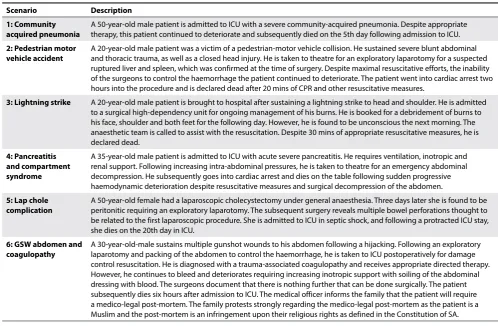
The description of each scenario is given in Table VI. Figure 3 shows the percentage of deaths classified as correct for the first five scenarios according to qualification and years of experience. Scenarios 1 and 2 were the only scenarios that achieved 100% correct for some qualifications. Scenario 4 was the worst classified scenario, while Scenario 2 was the best answered. The results for Scenario 6 are not included in Figure 3 as the classification of the death was left as an open answer question. This scenario was coded and summarised as follows: 72 respondents (90%) felt that this was an unnatural death which required a post-mortem; three (4%) felt that this was an unnatural death, but a post-mortem was not necessary; two (3%) felt that this should be classified as unnatural; two (3%) felt that this should be classified as a natural death and one respondent did not answer the question.
When the results of the six scenarios were pooled into two categories (specialists and non-specialists), specialists could not classify unnatural deaths any better than non-specialists [Scenario 1 (X2 = 2,301; p = 0,681); Scenario 2 (X2 = 4,426; p = 0,351); Scenario 3 (X2 = 2,809; p = 0,59); Scenario 4 (X2 = 2,181; p = 0,703); Scenario 5 (X2 = 1,430; p = 0,839); Scenario 6 (X2 = 2,330; p = 0,675)].
Discussion
Our study indicates that the typical respondent has a weak grasp of the law regarding unnatural and procedure-related deaths and is unable to apply their knowledge to common perioperative scenarios. Over 60% of all categories of respondents have private medico-legal insurance. All clinicians feel underprepared by their respective undergraduate and postgraduate training to confidently classify deaths as natural or unnatural. Most respondents will seek assistance from their medico-legal insurance company or from a senior colleague. However, specialist respondents were not better at defining the law or classifying deaths as compared to non-specialist respondents.
Much is written about the correct completion of the death notification form and the implications thereof; a problem not unique to South Africa.9-11 Doctors continue to confuse the cause, mechanism and manner of death. Death notification forms contribute statistics which guide clinicians and policymakers to focus efforts to try to reduce deaths due to various causes, especially preventable ones. Apart from Van Vuuren and colleagues, there is no literature in medical journals describing the updated law and its application.12 Misclassifications tend to be shrugged off as a medical mishap, and repercussions are not severe enough to warrant doctors to improve their knowledge of death classification. Focus is given to the more costly medico-legal infringements like negligence suits.8 Even so, ignorance would not hold as a reasonable defence and clinicians would be wise to educate themselves on all aspects of the law applicable to their practice.
It is left to the training programmes to inform and educate clinicians. However, respondents admit to being underprepared by undergraduate and postgraduate training programmes. This may be driving the need for private medico-legal insurance by most respondents. There are many benefits of private medico-legal insurance. Apart from providing medico-legal representation for a
lawsuit, many preventative strategies are provided to clinicians including interactive workshops, advice call centres and 24-hour helplines. A frequently updated website provides clinicians with various forms of support including ethico-legal guidelines, case discussions and news and law updates. However, organisations like MPS (the most popular reflected in this study), do not have material regarding assistance with classification of deaths. Websites of the HPCSA, SAMA and SASA are also not helpful in this regard. Definitions of unnatural and procedure-related deaths, together with the Acts from which they originate, are found in Table I.
The choice of assistance in classifying unnatural deaths was consistent across all categories of qualifications. Most clinicians would request assistance from their medico-legal insurance company; the second most common, a senior colleague. While it is true that there are a lot of senior and experienced clinicians in practice, this study demonstrated that specialist respondents don’t know the law, or how to classify deaths, any better than non-specialists. It is surprising that assistance from a forensics pathologist features very low on the hierarchy of assistance across all categories. As enacted in the regulations on provision of forensic pathological services, a forensic pathologist should be available at all mortuaries where post-mortems are done for 24-hour consultation. It would be wise to preferentially utilise these experts when in doubt.2
13
A survey of perioperative clinician’s knowledge and application of the law regarding the classification of deaths in the perioperative period
A death resulting from a commission or omission will be deemed a death from other than natural causes. Such is the case in Scenario 5, where the patient sustained an iatrogenic injury and, though recovered from the anaesthetic and procedure, later died in ICU from a cause that could be linked to the original procedure or complications thereof.
The final scenario (Table VI: Scenario 6) is unnatural because of an application of force. This is complicated by the mechanism of death due to exsanguination secondary to a coagulopathy. The mechanism of death does not detract from the initiating event of an application of force. Clinicians should not feel pressurised by demanding family members to forego the post-mortem on religious grounds. Provisions by the Minister of Health through the regulations of forensic pathological services ensures that a service shall be provided after hours, albeit on an adhoc basis, so as not to unnecessarily delay the religious practices for some religions. This satisfies both the statutory requirements of the National Health Act and the Constitutional rights of the deceased. The forensic pathologist on call at the referral state mortuary should be contacted in this regard.13
Limitations
This study’s findings are limited by the inherent limitations of surveys. The scenarios in this study do not cover all possible scenarios a clinician may be faced with. The provision of forensic pathological services may be developed differently in different provinces. The financial and human resources may limit the provision of some services as enacted in the regulations. However, should services be lacking, it is the duty of the MEC for health to furnish proof of progressive development and realisation of the provisions contemplated in the forensic regulations to the National Health Act within the budgetary constraints of the province and country.
Conclusion
The knowledge and application of the law regarding unnatural deaths is poor in perioperative clinicians. Specialists are not better at defining or classifying perioperative deaths than non-specialists. More should be done to empower clinicians to improve their knowledge and understanding of the law. This would be wise in the face of the medico-legal challenges
currently facing health care in South Africa. Engagement with interdepartmental seminars and workshops on the law and medical practice would be most useful at an undergraduate and postgraduate level.
Conflicts of interest
There are no conflicts to declare.
Acknowledgements
We are grateful to Dr Yasheen Brijmohun, a Specialist Forensic Pathologist, for his advice and guidance with this study.
References
1. Department of Justice. South Africa. The Inquests Act 58 of 1959. Government Gazette [statute on the Internet]. Available from: http://www.justice.gov.za/ legislation/acts/1959-58.pdf [Accessed 10 August 2018].
2. Department of Health. South Africa. National Health Act: Regulations regarding the rendering of Forensic Pathological Services 61 of 2003. Government Gazzette [statue on the Internet]. Available from: http://www.polity.org.za/ article/national-health-act-no-61-of-2003-2003-01-01 [Accessed 10 August 2018].
3. Department of Justice and Constitutional Development. South Africa. Health Professions Amendment Act Government Gazette [statute on the Internet]. Available from: http://us-cdn.creamermedia.co.za/assets/articles/ attachments/11035_healprofaa29.pdf [Accessed 10 August 2018].
4. Health Professions Council. South Africa. Health Professions Act 56 of 1974, as amended. Government Gazette [statue on the Internet]. Available from: http:// www.polity.org.za/article/national-health-act-regulations-rendering-of-forensic-pathology-service-2018-04-12 [Accessed 10 August 2018].
5. Birnbaum JK, Murray CJ, Lozano R. Exposing misclassified HIV/AIDS deaths in South Africa. Bull World Health Organ. 2011;89(4):278-85.
6. Burger EH, Groenewald P, Bradshaw D, Ward AM, Yudkin PL, Volmink J. Validation study of cause of death statistics in Cape Town, South Africa, found poor agreement. J Clin Epidemiol. 2012;65(3):309-16.
7. Burger EH, Groenewald P, Rossouw A, Bradshaw D. Medical certification of death in South Africa-moving forward. S Afr Med J 2015;105(1):27-30.
8. Howarth G, Hallinan E. Challenging the cost of clinical negligence. S Afr Med J 2016;106(2):141-2.
9. Burger EH, Van der Merwe L, Volmink J. Errors in the completion of the death notification form. S Afr Med J 2007;97(11):1077-81.
10. Rangaswamy K, Kamadod R. Medical Certification of Death: Development and Feasibility of Deployment of an Online Course for Practicing Doctors. National Journal of Integrated Research in Medicine. 2018;9(2):86-93.
11. Tuffin R, Quinn A, Ali F, Cramp P. A review of the accuracy of death certification on the intensive care unit and the proposed reforms to the Coroner’s system. Journal of the Intensive Care Society. 2009;10(2):134-7.
12. Jansen van Vuuren S. Acts and procedures concerning procedure-related deaths in South Africa. African Journal of Primary Health Care and Family Medicine. 2013;5(1).
13. Minister of Justice and Constitutional Development. . The Constitution of South Africa Available from: http://www.justice.gov.za/legislation/constitution/ SAConstitution-web-eng.pdf [Accessed 10 August 2018].
Appendix A: Tables and Figures
Table I. Definitions of unnatural and procedure-related deaths
Unnatural deaths1
The following shall be deemed to be deaths of unnatural causes:
a. Any death due to a physical or chemical influence, direct or indirect, or related complications
b. Any death, including those deaths which would normally be considered to be a death from natural causes, which may have been the result of an act of commission or omission which may be criminal in nature
c. Any death with is sudden and unexpected, or unexplained, or where the cause of death is not apparent d. Any death contemplated in the Health Professions Act (See below)
Procedure-related deaths2
The death of a person undergoing, or as a result of, a procedure of a therapeutic, diagnostic or palliative nature, or of which any aspect of such a procedure has been a contributory cause, shall not be deemed to be a death from natural causes
14
Southern African Journal of Anaesthesia and Analgesia 2019; 25(3)
Table II.Proportion of respondents by qualification and years of experience
Qualification and Experience N (%) N (%)
Non-specialists 46 (57)
MO < 5 years 13 (16) MO > 5 years 18 (22)
Registrar 15 (19)
Specialists 34 (43)
Specialist < 5 years 19 (24) Specialist > 5 years 15 (19)
MO: Medical officer
Table III.Proportion of respondents who feel adequately prepared by their respective training programmes and the proportion of individuals who pay for added medico-legal insurance
Question Qualification and
Experience n = Yes (%)
Do you feel that your undergraduate training has adequately prepared you regarding unnatural death certification?
MO < 5 years MO > 5 years Registrar Specialist < 5 years Specialist > 5 years
5 (50) 2 (20) 0 (0) 1 (10) 2 (20) Do you feel that your
postgraduate training has adequately prepared you regarding unnatural death certification? *
MO < 5 years MO > 5 years
Registrar Specialist < 5 years Specialist > 5 years
2 (12) 3 (18) 2 (12) 7 (41) 3 (18) Do you pay for your own
personal medico-legal insurance cover?
MO < 5 years MO > 5 years Registrar Specialist < 5 years Specialist > 5 years
8 (62) 13 (72) 10 (67) 17 (90) 14 (93)
MO: Medical officer
*Postgraduate training was defined as the completion of the Diploma in Anaesthesia and/or completion of registrar training with or without the final Fellow examination.
Table IV.Respondents most frequent choice of where they would seek assistance
Clinician category and most frequent choices for
help Total number selected
Medical Officer < 5 years MPS
Senior colleague SAMA
HOD Consultant
Other: Lawyer, Hospital CEO, HPCSA, Medical manager, HR 8 7 7 6 5 6
Medical Officer > 5 years MPS
Senior colleague Consultant HOD
Forensic pathologist
Other: SAMA, HPCSA, Medical manager, Lawyer, Ethics committee 8 7 7 6 6 13 Registrar MPS Senior colleague Consultant HOD Colleagues
Other: SAMA, Hospital ethics board, Medical manager, HPCSA, Lawyer, Matron, Forensic pathologist, Internet 9 7 7 6 3 10
Specialist < 5 years MPS
Senior colleague Forensic pathologist Lawyer
HOD
Other: SAMA, HPCSA, Hospital manager, SASA
15 9 8 5 4 7 Specialist > 5 years
MPS
Senior colleague HOD
SAMA
Forensic pathologist
Other: Lawyer, Hospital manager, SASA
9 6 5 3 2 4 Figure 1. Accuracy of the definition of unnatural deaths according to the qualification and years of experience
Figure 2. Accuracy of the definition of procedure-related deaths according to qualification and years of experience 6 11 69 72 60 68 66 31 22 40 21 33
0 20 40 60 80 100
MO < 5years MO > 5 years Registrar Specialist < 5 years Specialist > 5 years
Correct Incomplete Vague
17 7 16 13 31 39 60 47 40 62 28 20 21 27 8 17 17 16 20
0 20 40 60 80 100
MO < 5years MO > 5 years Registrar Specialist < 5 years Specialist > 5 years
Correct Incomplete Vague Time factor Figure 1. Accuracy of the definition of unnatural deaths according to the qualification and years of experience
Figure 1. Accuracy of the definition of unnatural deaths according to the qualification and years of experience
Figure 2. Accuracy of the definition of procedure-related deaths according to qualification and years of experience 6 11 69 72 60 68 31 22 40 21
0 20 40 60 80 100
MO < 5years MO > 5 years Registrar Specialist < 5 years
Correct Incomplete Vague
17 7 16 13 31 39 60 47 40 62 28 20 21 27 8 17 17 16 20
0 20 40 60 80 100
MO < 5years MO > 5 years Registrar Specialist < 5 years Specialist > 5 years
Correct Incomplete Vague Time factor
15
A survey of perioperative clinician’s knowledge and application of the law regarding the classification of deaths in the perioperative period
Table V.Suggestions by respondents of what can be done to improve understanding and application of the law regarding unnatural deaths
Type of intervention Counts of options
provided
Workshops by the DoH 29
Protocols by the DoH 14
Legal advice workshops 9
Clinical audits 9
Improved postgraduate training 8 Improved undergraduate training 7
Seminars 7
Forensic department seminars 2 Other: CPD teaching with points, DoH
roadshows, improved internship training
9
DoH: Department of Health
CPD: Continuous Professional Development
Figure 3. Classification of perioperative deaths by qualification and experience
0 20 40 60 80 100
Unnatural Unnatural
Unnatural Unnatural Natural
La
p Ch
ol
e
Pa
ncre
at
iti
s
Li
gh
tn
in
g
PV
A
CA
P
Sce
na
rio
5
Sce
na
rio
4
Sce
na
rio
3
Sce
na
rio
2
Sce
na
rio
1
Specialist >5 years Specialist <5 years Registrar MO >5 year MO <5 year
Figure 3. Classification of perioperative deaths by qualification and experience 0100
Unnatural Unnatural Unnatural Unnatural Natural
La
p Ch
ol
e
Pa
ncre
at
iti
s
Li
gh
tn
in
g
PV
A
CA
P
Sce
na
rio
5
Sce
na
rio
4
Sce
na
rio
3
Sce
na
rio
2
Sce
na
rio
1
Specialist >5 years Specialist <5 years Registrar MO >5 year MO <5 year
Table VI.Scenarios for classification as natural or unnatural
Scenario Description
1: Community acquired pneumonia
A 50-year-old male patient is admitted to ICU with a severe community-acquired pneumonia. Despite appropriate therapy, this patient continued to deteriorate and subsequently died on the 5th day following admission to ICU.
2: Pedestrian motor vehicle accident
A 20-year-old male patient was a victim of a pedestrian-motor vehicle collision. He sustained severe blunt abdominal and thoracic trauma, as well as a closed head injury. He is taken to theatre for an exploratory laparotomy for a suspected ruptured liver and spleen, which was confirmed at the time of surgery. Despite maximal resuscitative efforts, the inability of the surgeons to control the haemorrhage the patient continued to deteriorate. The patient went into cardiac arrest two hours into the procedure and is declared dead after 20 mins of CPR and other resuscitative measures.
3: Lightning strike A 20-year-old male patient is brought to hospital after sustaining a lightning strike to head and shoulder. He is admitted to a surgical high-dependency unit for ongoing management of his burns. He is booked for a debridement of burns to his face, shoulder and both feet for the following day. However, he is found to be unconscious the next morning. The anaesthetic team is called to assist with the resuscitation. Despite 30 mins of appropriate resuscitative measures, he is declared dead.
4: Pancreatitis and compartment syndrome
A 35-year-old male patient is admitted to ICU with acute severe pancreatitis. He requires ventilation, inotropic and renal support. Following increasing intra-abdominal pressures, he is taken to theatre for an emergency abdominal decompression. He subsequently goes into cardiac arrest and dies on the table following sudden progressive haemodynamic deterioration despite resuscitative measures and surgical decompression of the abdomen.
5: Lap chole complication
A 50-year-old female had a laparoscopic cholecystectomy under general anaesthesia. Three days later she is found to be peritonitic requiring an exploratory laparotomy. The subsequent surgery reveals multiple bowel perforations thought to be related to the first laparoscopic procedure. She is admitted to ICU in septic shock, and following a protracted ICU stay, she dies on the 20th day in ICU.
6: GSW abdomen and coagulopathy