Brock Education
A Journal of Educational Research and Practice
Volume 15 (2) Fall 2006
Faculty of Education
Brock Education Vol. 15, No. 2, 2006
Through the International Looking Glass:
Reflections from a Career in Global Education
Alan E. Wheeler Rahul Kumar
Brock University
On the eve of his retirement, Dr. Alan Wheeler (AW) was interviewed by Rahul Kumar (RK). The interview focused on Professor Wheeler’s
international experience which spans over four decades and his assessment of how educational developments might unfold on the international scene, with the increased prominence of globalization.
Since 1964, Prof. Wheeler’s teaching career has included long term postings in Tanzania (1967-72), Malaysia (1989-90), South and Central Asia, and Eastern Africa (1995-2000). A central theme in his work has been the exploration of ways in which Universities can function more effectively as “internationalizing agents.”
Préambule
À la veille de sa retraite de l’enseignement à la Faculté des sciences de l’éducation à l’université Brock, le professeur Alan Wheeler (AW)
Preamble
Professor Wheeler joined Brock University as a faculty member in
1977 and has maintained a strong interest and involvement in international and comparative education over the years.
Rahul Kumar received his formal education on three continents. He
A. Wheeler, R. Kumar
In my conversation with Professor Wheeler, it was
abundantly evident from his contemplative posture and reassuring tone, that he is passionate about this field of study. He entertained my questions seriously and his ponderings seemed as though he were taking me for a walk down memory lane. Just as easily he produced facts and figures to support his assertions. It was an educational experience for me.
In this interview, Professor Wheeler touched on numerous topics – the role of education of women, poverty and the AIDS pandemic in Africa, technology’s dubious role in addressing social problems, and the role of education in curbing many of the disturbing trends in societies around the world. By covering such a vast terrain, Dr. Wheeler demonstrated how things are inextricably interrelated and why it is important for educators to remain optimistic and committed to the education of the underprivileged for it is through such efforts that the general conditions stand to improve. And yet, Dr. Wheeler would be the first to caution us to be on guard against not-so-chaste intentions that often operate under the surface of international ventures by higher educational institutions.
RK: It is a great pleasure to speak with you on a topic that is not only current and relevant in today’s day and age, but one that you speak very passionately about. From where does this interest in international partage avec Rahul Kumar (RK) les points forts de son expérience
internationale de quatre décennies et ses réflexions sur les prospectives de développement de l’éducation sur la scène internationale dans le contexte de globalisation envahissante. Depuis 1964, la carrière du docteur Wheeler a compris de longs séjours en Tanzanie (1967-72), en Malaisie (1989-90), en Centre-Asie et en Asie du Sud ainsi qu’en Afrique orientale (1995-2000). Il s’est penché surtout sur le rôle des universités en tant qu’agents
Through the International Looking Glass
education emerge?
AW: I’m not really sure, but feel my international roots must have been a combination of both my home environment and a strong case of wanderlust! Certainly much of it was influenced by my family
environment. My father joined the Indian Medical Service as a young Canadian medical graduate from the University of Alberta in 1935 and, after a year’s study in tropical medicine in England, served as a medical officer in various parts of pre-independence India. As you can appreciate, this was a rather adventurous thing to do at the time. I came along in Karachi, Pakistan shortly after, but unfortunately left as a 2-year-old so any recollection of my very early years were only acquired by looking at the family photos over the years. Perhaps the photos themselves were also part of the international roots?
Still, I’ve always had an innate interest in international studies and felt geographical area of the world that I have been able to see in my lifetime. I realize that one can always travel globally in a virtual sense, but I’ve tried to be more concerned with practice and so I have proactively sought out international positions over the years. Our travels to date have only served to further stimulate my wanderlust appetite. I say “our” travels because my wife Hilde has been an integral part of all my long term assignments, some 11 years in total, and without her support, my international career wouldn’t have been possible, nor would it have been so enriched.
RK:Can you explain what you mean by International Education? Is it a discipline or a field of study, or … ?
A. Wheeler, R. Kumar
for deliberations which are essentially global in nature. Comparative Education, which is really a subset of this international orientation, therefore becomes an especially important mirror of the values and priority that a particular nation places on education.
RK: Can you briefly describe the countries and international projects that you have been involved with?
AW: My overseas experience has mainly been acquired through a series of longer-term assignments interspersed with shorter
consultancy positions. Collectively, I have educational work experience in a number of developing countries (Tanzania, Kenya, Uganda, Pakistan, India, Bangladesh, Nepal, Malaysia, Singapore, Somaliland, Thailand, Indonesia, Philippines, Egypt, Tajikistan, Kryghyzstan, and China) and have visited schools informally in others (Madagascar, Ethiopia, Turkey, Mexico, Nepal, and Sri Lanka). Remarkably, I’ve observed that classrooms the world over look and operate in a similar manner. This has always fascinated me and I suppose illustrates a type of educational “involution” whereby schools and educational systems continue to undergo “involution” rather than “revolution” through refinement and fine tuning of the original structure, namely the traditional classroom which is usually characterized by a high degree of teacher direction, one-way knowledge transmission, and an emphasis on rote learning. The result of the involution process is that there is often little real substantial change or innovation. For me, the intriguing question has been: What is it about the universal nature of classrooms that accounts for this resiliency?
Through the International Looking Glass
is also a major determining factor in meaningful change and school improvement.
RK: What was your first educational experience abroad?
AW: It came about after several frustrating attempts to land an overseas teaching position, as most international appointments then required a minimum number of years of experience abroad. I say frustrating because after University graduation, we were both keen to travel but of course lacked the prerequisite experience and were continually told to “come back when you have acquired a minimum of five years experience.” We argued that we should be allowed to qualify before we became encumbered with the normal restrictions of life i.e. family, mortgage, professional responsibilities, and the like. By this time, I had begun my science teaching career and Hilde was working in the local hospital. After one year they offered me the Vice-Principalship of the local high school and encouraged me to apply for the upcoming position of Principal of the new high school under construction. I could see the walls closing in and our international plans going out the window! Still, after some further experience under our belt, and several applications later, we were offered a position in Tanzania in 1967, which we immediately accepted. I laugh now because, once I hung up the phone we had to look in the atlas to find where we were going! Others must have had the same problem as our freight shipment was originally labelled for Tasmania before we discovered the error!
RK: It is often said that one’s first experience leaves a lasting impression. Is this true for you? Can you share with us any influences that your African experience had on your work?
AW: Our first acculturation experience certainly was a formative one and has influenced our lives greatly ever since. I began to better appreciate the real significance of the adage, “Thinking Globally, Acting Locally” and can honestly say that not a day goes by that I don’t draw on learning and experiences acquired in those five years in East Africa. On that note, I am deeply saddened by what has
A. Wheeler, R. Kumar
RK: Can you expand on what you feel has taken place in Africa?
AW: To set the scene, over 80% of the world’s six billion plus people reside in the developing world; collectively these nations make up less than twenty percent of the global wealth. This gross disparity between the “have” and “have not” countries of the world, the so-called Global Gap, manifests itself in many ways, but perhaps most dramatically in Africa. Aside from being the world’s poorest continent and suffering from the HIV-AIDs pandemic which we hear so much about, the startling fact is that even if its economy were to continue to grow at the confident rate achieved in the 1990’s, Africans would still have to wait until 2030 to achieve the income levels they had in the 1970s! Exclude Nigeria and the wait would last much longer.
The rapid technological and information-processing
advancements that have taken place in the developed world only serve to exacerbate existing global disparities. Such advances have given rise to a new dimension of the Global Gap – that of the digital divide and the creation of the “Net Generation,” the first generation of children to grow up in the digital era. The disturbing feature for Africans and others who reside in the developing world, which includes about 80% of the world’s population, is the fact that the Global Gap is widening rather than closing. Digital technology
undoubtedly is only one of many factors that contribute to the growing complexity and deepening disparities that exist in a period of
pronounced globalization.
RK: It is argued by some that the digital revolution is contributing to this gap that you speak of and others insist that it is helping bridging it. Surely there is a happy medium.
AW: I see the role of technology as critical to closing the global disparity gap but recognize the complexity and magnitude of the problem. The reality remains that while information and
Through the International Looking Glass
worldwide, are still without any type of connection. Hence it is clear that the development promise of science and technology remains largely unfulfilled for the poor of the world. There are many reasons for this and it is easy to point a finger: slow growth in the world economy, slow progress in reform among developing countries, and inadequate support from developed countries as mentioned earlier. For me, the message is abundantly clear: The goals of the Millennium Development Agenda are still achievable in most or possibly even all countries, but will require a dramatic acceleration and scaling up of action on many fronts, particularly in basic education, if information and communication technology is to play an active role in reducing the development and poverty gap.
RK: How do these global problems relate to education?
AW: The educational problems in the developed and less developed world differ markedly in both the massive scale and severity of the issues confronted. Less-developed countries for example, face massive general problems including basic literacy, which is nearly universal in the developed world but under 50% in many developing countries; far lower levels of completion of primary education; much higher attrition rates during and at the end of primary schooling; increased pressures caused by higher population growth rates; and more importantly, an average expenditure on schooling per student some 20 times lower than in the developed world. In virtually all respects, the material conditions of education in the developing world are far worse than in the developed world. The demographics are almost overwhelming and difficult to comprehend. There are more than 800 million illiterate adults in the world today, nearly 100 million primary-age children, and an even larger number of secondary-school-age students who are not even in school. Furthermore, millions of those who do attend school do not receive an education of a quality to help meet even their basic needs. Not to mention that the basic needs are changing in light of the rapidity of globalization forces and
A. Wheeler, R. Kumar
RK: What then do you see as the solution for overcoming such global problems?
AW: I am convinced, and I have never received any disagreement over this, that the ultimate answer resides in education. That is, if we are to successfully confront the massive developmental problems that beset the developing world, we must, in my opinion, transform the perception that the globalization process works only for the rich and powerful and is largely irrelevant for the great masses of the world. To bring about such a transformation, greater priority must be placed on the critical role that education plays in national development. The benefits of sound planning and investment in education can readily be seen in the success stories of the “Four Tigers” of Asia, namely: Hong Kong, Taiwan, South Korea, and Singapore. In all these countries, the common feature before industrial “take off” was access to a high quality primary education. A second important feature shared by the Four Tigers was the need to ensure that higher levels of education systems were in place on time. That is, as the expansion of primary education took place, the focus shifted to the expansion of secondary education and eventually to the tertiary level. In short, the process of national development is intimately intertwined with the quality and level of education in the respective societies.
RK: From your experience, can you reflect on some of the principles that a good international program or an international educator should be attuned to?
Through the International Looking Glass
members of the village who were directly involved in the planning, development, and implementation stages of the project. The funding agency’s main involvement was to provide the necessary agricultural training with respect to cocoa production. That is, Canada’s role was to supply the needed human resources and technical assistance as determined by the elected Village Committee. The second project of the villagers involved sheep farming on nearby available land. External funding was used to import sheep from Australia which were adapted to the tropical heat and to provide agricultural expertise on animal husbandry to the villagers as requested. Both these village projects were small in scale, involved a high level of direct involvement, and reflected a high sense of ownership (and I think pride) by the local community members. The prevalent attitude behind both endeavors of the villagers was to provide them with the necessary skills (and where necessary, limited human resources) and they will take responsibility for the rest. If you like, don’t give us the fish, rather teach us how to fish.
A. Wheeler, R. Kumar
term for the majority of those displaced. However, visitors to the site lauded the project as a highly successful international development project, complete with huge signs listing the various agencies involved. Many seemed impressed by the electronic bird scarers, the automated irrigation system, use of bulk fertilizers, and mechanical harvesters like you might expect to see in western Canada. Few if any visitors were taken to see the human devastation the project had on the several hundred individuals whose self-worth and way of life were largely destroyed as a consequence, to say nothing of the sustainability of the venture in the longer term. Which project (the small scale village cocoa/sheep project or the commercial production of rice), would you assign the better grade to?
I would like to think that such examples of poorly designed development projects in any sector, where those most directly involved are excluded from direct participation, decision making, and ownership in the process, are rare these days. I believe that we, as Canadians, have learned much over the years about effective international contribution and sound development principles and can do much to foster national development in countries far less fortunate than our own.
RK:In this day and age of limited resources, many institutions including Brock University, increasingly look to international programs to off-set funding short-falls? Do you see ethical problems with such initiatives?
AW: Your question reflects both good news and bad news. There is no doubt that we are more engaged in the process of fostering
Through the International Looking Glass
subsidize regular offerings. We should attempt to introduce all students to an international perspective throughout their academic and social experiences by establishing an ethos or culture in all programs that values both intercultural and international perspectives. I am encouraged to the extent that we have made real advances in this direction. Recent efforts in the Faculty of Education to InfuseGlobal
NotionsinTeacherEducation or I.G.N.I.T.E. provide an example of how internationalization is being translated for implementation at the classroom level. As countries around the world move into an era of global integration, citizenship can no longer be defined by national boundaries. For this reason, it is increasingly important that we learn to see ourselves—and those we educate as prospective teachers to see themselves—as responsible global citizens. By infusing such an ethos in our Teacher Education candidates, we help to ensure that, through their influence as future educators, young Canadians in their
classrooms will become more informed about and engaged in global issues. It is through such efforts that Canada’s international efforts can be furthered.
RK:Administratively, what resources are needed in order to see that such initiatives come to fruition and do not fizzle?
AW: The financial resources allotted for infusion of global notions into the teacher education curriculum are minimal as they build on what some are already doing and therefore should only add additional workload. What is required, which is much more difficult to achieve, is a shift in attitude of educators to deal meaningfully with international issues and global examples in their teaching and generally applying global thinking as a constant filter in all their actions. The real challenge is to bring about such a mind set.
RK: How do you feel Canada, which has been characterized as a “middle-power” nation, fairs on the international educational scene?
A. Wheeler, R. Kumar
exercise our global voice. We have the capacity to make a significant contribution, but are often conspicuously absent in our actions.
The aftermath and turmoil of the terrorist attacks of 9/11 has reflected our inward-looking side more than I would have liked and our global influence has waned considerably in recent years. This is unfortunate, as there was a time when Canada had a strong international voice with considerable moral authority. Consider, for example, what has
happened to Canada’s foreign aid allocation in recent years. The agreed-upon international benchmark of 0.7% of Gross National Product, established incidentally by Canada, reached a high mark of 0.49 % in 1992 and now is holding around 0.30 %. Since 1995, when Canada ranked sixth out of the world’s 22 richest countries for foreign assistance, it has tumbled to seventeenth place. The need for Canada to step up its assistance to others less fortunate is still acute. Despite a global rise in living standards over the past decade, there are still 1.3 billion people who subsist on $1 a day or less. Further, more than 27,000 children under the age of five die, most from preventable diseases such as measles, diarrhoea, and respiratory infection. Surely it is our moral obligation to help as Stephen Lewis, the eloquent UN AIDS Envoy, continually reminds us.
RK:What role would you like Canada to play on the world stage?
AW: Your framing of the question might best be answered using a theatrical metaphor. Should Canada assume a major role globally or are we to merely remain a minor player with an insignificant role? Like theatre itself, Canada’s global role should have a distinct purpose. That is, it should illuminate and instruct, and be capable of bringing about social readjustments, not only in individuals and communities but even across countries. We must, as Canadians, translate the time-tested adage, “Think Globally, Act Locally” as a national policy into concrete action.
Through the International Looking Glass
hope would be that with our proven multicultural script and experience, we could receive an Oscar Award for the Best Supporting Actor on the global stage, a role that would demonstrate through concrete action, that it is possible to make a global difference.
RK:Finally, as you will be retiring shortly, what international adventures do you and Hilde have planned for the future?
AW: Again, I would like respond to your question indirectly by quoting from a poem called the Challenge found during the excavation of the ancient Indus civilization city of Moenjodaro (in present day Pakistan) which dates back to at least 2500 years B.C. The original poem is very long but I believe the following verse best captures our hope for life after Brock and how challenges may unfold for Hilde and me in the future. Hopefully it will involve new cultural explorations and challenges with continued efforts to internationalize education.
Surgite!
The Challenge
Listen to the exhortation of the dawn! Look to this day !
For it is life, the very life of life.
In its brief course lie all the verities and realities of your existence;
The glory of action, the bliss of growth, the splendor of beauty. For yesterday is but a dream,
And tomorrow is only a vision;
But today, well lived, makes every yesterday a dream of happiness
and every tomorrow a vision of hope. Look well, therefore, to this day! Such is the salutation of the dawn.
Impacts de l’Acculturation Sur
la Scolarisation des Jeunes Innus
Impact of Acculturation on Schooling
of Innu Children
Jimmy Bourque
Haute École Pédagogique Berne-Jura-Neuchâtel à Bienne François Larose
l’Université de Sherbrooke
Brock Education Vol. 15, No. 2, 2006
R é s u m é
Cet article présente les résultats d’une recherche menée dans une communauté autochtone québécoise. Nous désirions décrire la relation entre différents profils d’acculturation et certaines variables d’ordre scolaire et socioculturel chez des élèves du secondaire. Le profil acculturatif privilégié demeure l’intégration. Les élèves bilingues présentent un profil d’assimilation plus prononcé que ceux qui ne considèrent maîtriser que leur langue vernaculaire. Enfin, les garçons adoptent davantage que les filles une attitude de rejet de la culture euro-canadienne.
Abstract
This article presents the results of a study conducted in a remote Aboriginal community in Quebec, in a band-controlled school on one of nine Algonquian reserves situated on the North Shore of the St. Lawrence.
Jimmy Bourque est titulaire d’un Ph. D. en éducation et agit
présentement à titre de chercheur invité à la Haute École Pédagogique Berne-Jura-Neuchâtel à Bienne, en Suisse.
François Larose est professeur titulaire au département d’Éducation
Impacts de l’acculturation sur la scolarisation des jeunes Innus
Against the backdrop of a 55.1% dropout rate of young Innu at the end of elementary school, the purpose of the study was to examine the link between attitudes toward culture and success in school. The article describes the relationship between different acculturation profiles and selected socio-cultural and school-related variables among secondary school students. The integration profile, which combines acceptance of the dominant culture and preservation of culture of origin, was found to be more frequent than the assimilation or separation profiles, and was positively correlated to success in school and perseverance. It appears that bilingual students show more of an assimilation profile than those who master only their native tongue. The separation profile, rejecting Euro-Canadian culture, is more prevalent among boys than girls, attibutable in many cases to the boys’ prolonged stays in the forest conducting traditional activities. The study raises the issue of a school system which hinders development of students with the strongest identification to their culture, that of the society which the school seeks to serve.
Introduction
Au Québec, selon le recensement de 2001, les autochtones atteignent un niveau de scolarisation moindre que leurs pairs euro-québécois. C’est notamment le cas des Innus, une nation algonquienne de langue algique, établie dans neuf réserves québécoises situées sur la Côte-Nord du Saint-Laurent, dans la région du lac Saint-Jean et près de Schefferville, mais aussi dans deux villages du Labrador (Leacock, 1995). Ainsi, tel que l’illustre le tableau 1, seulement 15.1% des allochtones du Québec abandonnent l’école avant la neuvième année. C’est le cas, par contre, pour 48.2% des autochtones québécois et pour 55.2% des Innus. De plus, si 24.6% des allochtones quittent l’école avec un diplôme de niveau secondaire (plus haut niveau complété), seuls 11.3% des autochtones et 14.6% des Innus possèdent cette certification à la fin de leurs études. Enfin, alors que 14.0% des allochtones complètent au moins un baccalauréat, seulement 5.8% des autochtones et 6.2% des Innus termineront leurs études avec ce diplôme en poche (Statistiques Canada, 2003).Cette situation se conjugue avec la prise en charge par les conseils de bande des opérations éducatives et la promotion des langues et cultures autochtones dans les écoles, mais Introduction
J. Bourque et François Larose
Allochtones Autochtones Innus
M oins d’une 9
eannée
15.10%
48.20%
55.20%
Diplôme secondaire
24.60%
11.30%
14.60%
Baccalauréat ou plus
14.00%
5.80%
6.20%
Tableau 1
Population de 25 ans et plus, données du recensement de 2001
atteignent un niveau de scolarisation moindre que leurs pairs euro-québécois. C’est notamment le cas des Innus, une nation algonquienne de langue algique, établie dans neuf réserves québécoises situées sur la Côte-Nord du Saint-Laurent, dans la région du lac Saint-Jean et près de Schefferville, mais aussi dans deux villages du Labrador (Leacock, 1995). Ainsi, tel que l’illustre le tableau 1, seulement 15.1% des allochtones du Québec abandonnent l’école avant la neuvième année. C’est le cas, par contre, pour 48.2% des autochtones québécois et pour 55.2% des Innus. De plus, si 24.6% des allochtones quittent l’école avec un diplôme de niveau secondaire (plus haut niveau complété), seuls 11.3% des autochtones et 14.6% des Innus possèdent cette certification à la fin de leurs études. Enfin, alors que 14.0% des allochtones complètent au moins un baccalauréat, seulement 5.8% des autochtones et 6.2% des Innus termineront leurs études avec ce diplôme en poche (Statistiques Canada, 2003).aussi avec la revendication, par les communautés, d’un contrôle accrû sur
l’éducation des jeunes autochtones (Hampton, 1995; Hookinaw-Witt, 1998). Cette demande découle du constat selon lequel, malgré que les autochtones québécois aient obtenu un certain pouvoir sur l’éducation de leurs enfants, leurs écoles continuent de calquer le système éducatif provincial (Bourque et Larose, 2000). Selon certains chercheurs, les communautés autochtones ne feraient, dans bien des cas,
qu’administrer le dispositif mis en place avant les prises en charge (Ryan, 1996).
Impacts de l’acculturation sur la scolarisation des jeunes Innus
Les causes de ces écarts sont plutôt attribuées à la culture, à l’établissement scolaire, aux parents ou aux élèves eux-mêmes (Deyhle et Swisher, 1997). Néanmoins, Ogbu et Simons (1998)
allèguent que l’étude des rapports de pouvoir entre groupes culturels et des attitudes qui en découlent ne doit pas être négligée. C’est pourquoi nous avons voulu explorer le lien entre l’acculturation et les résultats scolaires de jeunes Innus. Ce texte vise donc à vérifier l’existence de liens entre les attitudes face à l’acculturation et les résultats scolaires d’élèves Innus fréquentant une école secondaire.
L’acculturation: un construit bidimensionnel
Pour Redfield, Linton et Herskovits (1936) «L’acculturation comprend les phénomènes résultant du contact continu et direct entre groupes d’individus de différentes cultures et impliquant des
changements dans les cultures originales de l’un ou des deux
groupes.1» (p. 149). Or, si l’acculturation correspond à un processus culturel, donc collectif, elle réfère aussi à un processus individuel : l’acculturation psychologique. Si les changements d’ordre sociologique qu’impliquent les relations économiques et politiques inégales entre
1 Traduction libre de l'auteur.
Figure 1 : Stratégies d’acculturation psychologique
In tégra tion A ssim ila tio n
R ejet M a rg in a lisa tio n
+
-
Enjeu 1 : Préservation de l’héritage culturel
Enjeu 2 : Engagem ent dans la culture m ajoritaire.
J. Bourque et François Larose
deux collectivités peuvent être profonds, leurs impacts l’adoption d’une stratégie d’acculturation psychologique par un individu dépend de son positionnement face à deux enjeux : la préservation de son héritage culturel et l’engagement dans la société majoritaire (figure 1).
S’il est favorable à la préservation de sa culture, on dira qu’il présente un profil d’intégration s’il désire s’engager dans la culture dominante et un profil de rejet dans le cas contraire. De même, dans le cas où l’individu ne désirerait pas préserver son identité culturelle, il manifesterait un profil d’assimilation en se montrant favorable à la culture dominante alors que s’il se montrait réfractaire aux deux cultures, il adopterait le profil de marginalisation.
Acculturation et scolarisation autochtone
Dans le cas de la majorité des communautés amérindiennes canadiennes et québécoises, on peut considérer que le contact régulier et soutenu avec la société non-autochtone s’est effectué depuis plusieurs générations, bien que la nature de l’intégration socio-économique des populations autochtones ait varié en rythme et en intensité au gré de l’évolution historique particulière à chaque région (Kurtness, 1991).
Les rares études portant sur l’effet de variables d’ordre culturel sur le rendement scolaire présentent des résultats parfois contradictoires. Ainsi selon Montgomery, Miville, Winterowd, Jeffries et Baysden (2000), une intégration harmonieuse des identités
majoritaire et traditionnelle favoriserait la persévérance scolaire d’étudiants autochtones. Or, James, Chavez, Beauvais, Edwards et Oetting (1995) et Larose, Bourque, Terrisse et Kurtness (2001) avancent que l’identification à la culture dominante faciliterait la réussite et la persévérance scolaire alors que Bazylak (2002), Grantham-Campbell (1998) ainsi que Whitbeck, Hoyt, Stubben et LaFromboise (2001) affirment que c’est plutôt l’enculturation dans la culture d’origine qui aurait cette influence positive.
Acculturation et rendement scolaire : résultats d’une recherche menée dans une communauté isolée
Impacts de l’acculturation sur la scolarisation des jeunes Innus
mené une recherche exploratoire auprès d’un échantillon de
convenance formé des élèves fréquentant une école secondaire sous contrôle communautaire en milieu innu (Bourque, 2000). La recherche fut menée durant le semestre d’hiver 2000 à Unamen-Shipu (La Romaine), sur la basse Côte-Nord du Saint-Laurent. Il s’agit d’une petite communauté de moins de 1000 habitants, relativement isolée puisqu’elle n’est accessible que par bateau ou par avion, jouxtant avec une communauté euro-québécoise de 200 habitants environ.
Échantillon
Notre échantillon était composé de quarante-cinq sujets, représentant environ 69 % des effectifs scolaires du secondaire à l’école Olamen. Il s’agissait d’un échantillon de convenance fondé sur le volontariat des élèves présents à l’école au moment de réaliser le recueil des données. Notre échantillon représentait aussi
approximativement 35% des jeunes du village en âge de fréquenter l’école au niveau secondaire. Tous nos sujets fréquentaient l’école Olamen, placée sous l’autorité du conseil de bande depuis 1992.
L’échantillon comportait vingt-quatre (24) filles et vingt et un (21) garçons.
Les répondants se considéraient majoritairement bilingues puisque quarante (sur 45) d’entre eux déclaraient comprendre à la fois le français et la langue innue. Par ailleurs, trente-trois élèves se considéraient aptes à parler français et trente-trois des élèves
questionnés utilisaient surtout leur langue vernaculaire avec leurs amis. Vingt-neuf élèves fréquentaient les classes de premier cycle du secondaire, alors que dix de leurs pairs étaient inscrits au second cycle. Les six autres sujets fréquentaient les deux classes de cheminement particulier de l’école. Parmi ces élèves, dix-neuf faisaient des séjours prolongés en forêt avec leur famille et devaient, par conséquent, s’absenter de l’école pour des périodes s’étendant parfois sur plusieurs mois.
Les instruments
J. Bourque et François Larose
instruments. Nous avons d’abord administré un questionnaire socio-démographique permettant aux sujets d’identifier leurs habitudes linguistiques et leurs pratiques culturelles. De façon concomitante, nous avons procédé à l’administration d’une échelle d’acculturation inspirée du modèle de Berry (2003) et traduite, adaptée et validée d’une part auprès d’Innus à Betsiamites (Larose, 1996) et, d’autre part, au Lac Simon auprès d’Anicenabek (Larose, 1991). Cette échelle comporte vingt items à format de réponse de type Likert (quatre choix, de « très en désaccord » à « très en accord »).
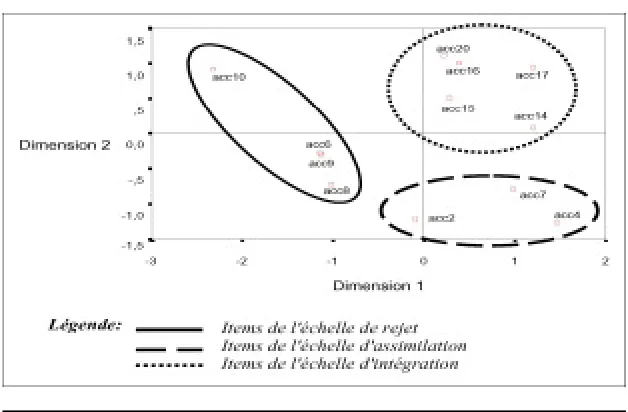
Elle se subdivise en trois sous-échelles mesurant les construits d’assimilation (sept items), de rejet (six items) et d’intégration (sept items). L’analyse de la structure factorielle, à l’aide de l’analyse d’un tableau de distance2, a d’abord révélé quelques failles structurelles quant à la répartition en facteurs des items. L’élimination des items
2Traduction libre de multidimensional scaling. Le faible nombre de sujets ne permettait pas l’utilisation d’analyses factorielles conventionnelles. Néanmoins, le type de pseudo-métrique utilisée dans le questionnaire correspond aux exigences de polarité de ce type de transformation spatiale (Borg, 1996; Coombs, 1964; Nishisato, 2004).
Impacts de l’acculturation sur la scolarisation des jeunes Innus
déviants nous a toutefois permis d’obtenir une structure satisfaisante à trois facteurs (figure 2) correspondant aux sous-échelles d’intégration (4 items), d’assimilation (3 items) et de rejet (5 items).
Enfin, nous avons eu accès aux dossiers scolaires des élèves, desquels nous avons extrait les résultats en français et mathématiques ainsi que le nombre d’absences pour chaque année scolaire depuis 1996-1997.
Résultats
Nous avons d’abord calculé les moyennes obtenues à chacune des sous-échelles d’acculturation. Pour chaque échelle, la valeur minimale possible correspond à une attitude défavorable au regard du construit ciblé, par exemple l’assimilation, alors que la valeur maximale correspond à une attitude favorable par rapport au dit construit. D’une manière générale, les élèves favorisent davantage l’intégration à la société euro-canadienne (m = 2.74; s = 0.57)que l’assimilation (m = 2.02; s = 0.69) ou le rejet (m = 1.95; s = 0.69).
Nous avons ensuite étudié les relations entre les variables socioculturelles sur lesquelles nous détenions de l’information d’une part et, d’autre part, les scores obtenus par les sujets aux différentes sous-échelles. La comparaison, à l’aide du test de Mann-Whitney3, entre les élèves qui se disent locuteurs bilingues (m = 2.15, s = 0.64) et ceux qui considèrent ne maîtriser que la langue innue (m = 1.67, s = 0.75) révèle que les premiers (bilingues) obtiennent un score plus élevé que les seconds (unilingues) à la sous-échelle d’assimilation (U = 104.500, p = 0.015).
Parallèlement, les résultats suggèrent une attitude de rejet plus marquée (U = 163.500, p = 0.042) chez les garçons (m = 2.15, s = 0.67) que chez les filles (m = 1.78, s = 0.67). Cette différence est particulièrement saillante (U = 27.000, p = 0.007) entre les filles qui ne
3 Le test de Mann-Whitney est un équivalent non-paramétrique du test t qui effectue
J. Bourque et François Larose
font pas de séjours prolongés en forêt (m = 1.58, s = 0.36) et les garçons qui pratiquent des activités traditionnelles requérant de tels séjours (m = 2.28, s = 0.69).
L’analyse des interactions entre les scores aux sous-échelles d’acculturation et les variables scolaires suggère la présence d’une certaine variabilité du score obtenu aux sous-échelles d’intégration et de rejet selon le niveau scolaire. Ainsi, nous observons une différence significative (U = 35.500, p = 0.016) entre les scores à l’échelle de rejet des élèves de première secondaire (m = 2.28, s = 0.72) et ceux de deuxième secondaire (m = 1.59, s = 0.44) ainsi que du deuxième cycle (m = 1.60, s = 0.49; U = 43.500, p = 0.008). De plus, les scores à l’échelle d’intégration varient entre la deuxième secondaire (m = 2.32, s = 0.46) et le second cycle (m = 3.04, s = 0.42; U = 8.500, p = 0.003). Il semble donc qu’en avançant dans le cheminement scolaire, le rejet fait de plus en plus place à l’intégration comme stratégie d’acculturation psychologique.
L’analyse des données disponibles permet aussi de constater la présence d’une corrélation4 négative entre le score à la sous-échelle de rejet et la moyenne obtenue par les élèves en français (ñ = -0.550,
p = 0.001) et en mathématiques (ñ = -0.341, p = 0.022). Le score à l’échelle de rejet est aussi positivement corrélé avec le nombre moyen d’absences annuelles (ñ = 0.357, p = 0.016).
Discussion
Assimilation ou intégration: les questionnements particuliers à Unamen-Shipu et leurs effets sur les probabilités de persévérance scolaire
Le profil d’acculturation le plus prononcé chez les élèves du secondaire d’Unamen-Shipu s’avère l’intégration, qui combine l’acceptation de la culture dominante et la préservation de la culture
4 La corrélation non-paramétrique de Spearman, qui calcule un coefficient à partir des
Impacts de l’acculturation sur la scolarisation des jeunes Innus
d’origine. En ce sens, on peut croire que c’est une attitude saine qui favorise l’adaptation à la structure macro-sociale tout en permettant la conservation d’une identité autochtone (Segall et al., 1999). Qui plus est, ce profil semble prendre de l’ampleur à mesure que l’on progresse dans la structure scolaire du secondaire, ce qui pourrait favoriser la poursuite d’études post-secondaires sans compromettre l’identité innue des élèves. Ce résultat pourrait donc supporter ceux de Montgomery
et al. (2000), selon qui l’intégration harmonieuse des deux identités favoriserait la persévérance scolaire. Cependant, il serait important de préciser cette relation entre intégration et niveau scolaire. Est-ce que le passage dans le réseau scolaire permet le développement de cette attitude d’intégration ou est-ce que les exigences du système
d’éducation agissent comme un filtre favorisant la réussite, et donc la poursuite, des élèves possédant déjà ce profil? Notons que nous n’avons observé aucun lien entre le score à la sous-échelle d’intégration et les résultats en français et mathématiques.
Le deuxième profil en importance est celui de l’assimilation, c’est-à-dire la perte de l’identité autochtone au profit de la culture dominante. Cette attitude semble reliée au profil linguistique des élèves: ceux qui disent parler le français et la langue innue présentent un profil d’assimilation plus prononcé que les élèves qui prétendent ne parler que leur langue vernaculaire. Ici, encore une fois, la question se pose: est-ce que le bilinguisme traduit un ensemble de variables, peut-être familiales, favorisant le développement d’un profil propice à l’assimilation ou est-ce que ce profil favorise l’apprentissage du français?
Enfin, le profil minoritaire, celui de rejet, est aussi celui qui suscite le plus d’interrogations. L’attitude de rejet démontre une position défavorable par rapport à la culture dominante, mais un fort désir de préserver la culture innue. Le statut minoritaire de ce profil démontre l’importance que les jeunes Innus d’Unamen-Shipu accordent à l’adaptation à la culture dominante. Les garçons pratiquant des activités traditionnelles en forêt constituent le sous-groupe le plus ancré dans ce profil, au contraire des filles qui ne font pas de séjours prolongés en forêt.
J. Bourque et François Larose
fois permis de nous demander si les clientèles scolaires persévérantes ne constituent pas un sous-échantillon sélectionné de facto selon le degré d’intégration aux paramètres psychosociaux définissant la société majoritaire. Ce serait donc le profil d’intégration qui favoriserait un passage en douceur dans le système scolaire. Si tel était le cas, il ne serait pas exclu que le profil moyen d’acculturation des jeunes ayant quitté l’école diffère de celui mis en lumière par notre étude.De plus, il serait intéressant de jeter un éclairage sur le lien entre la pratique d’activités traditionnelles et l’attitude de rejet : le rejet est-il exacerbé par cette forme particulière de socialisation ou agit-il comme facteur favorisant la participation à ces activités par le jeune?
Une question similaire se pose quant au lien entre la stratégie de rejet et le rendement en français. La participation aux activités en forêt amène-t-elle l’élève à accorder moins d’importance à
l’apprentissage du français au profit de sa langue vernaculaire ou est-ce le peu de succès en français, une des matières jugées essentielles dans le cadre du curriculum du secondaire, qui pousse l’élève à se détourner de l’école et à voir de façon plus favorable le mode de vie traditionnel des Innus? Nous observerions, dans ce dernier cas, une cause probable majeure de l’adoption par des adolescents d’une attitude réfractaire envers la culture euro-canadienne.
Finalement, les résultats scolaires des élèves et ce, autant en mathématiques qu’en français, s’avèrent corrélés avec le score obtenu à l’échelle de rejet, alors que cette même échelle est corrélée
positivement avec le nombre moyen d’absences annuelles. Il y a donc lieu de croire que la stratégie de rejet serait néfaste à un cheminement scolaire « réussi » selon les critères de la société québécoise. Tous ces résultats rejoignent davantage les conclusions tirées par Montgomery
et al. (2000) et, dans une moindre mesure toutefois, celles de James et al. (1995) et Larose et al. (2001) que les résultats obtenus par
Impacts de l’acculturation sur la scolarisation des jeunes Innus
Conclusion
La recherche menée à Unamen-Shipu présentait des limites évidentes. D’une part notre échantillon était numériquement limité. Il s’agit là d’une contrainte liée à la nature même du terrain, puisque seulement soixante-cinq élèves de niveau secondaire étaient inscrits à l’école Olamen au moment de l’administration des questionnaires. D’autre part, nos instruments étaient rédigés en français, alors que certains élèves éprouvent manifestement des difficultés de
compréhension de cette langue. Le choix nous a cependant été imposé par le faible pourcentage d’élèves (35.7%) pouvant lire la langue innue. Nous avons tenté de contrôler cette source de biais en nous assurant que des locuteurs innus suffisamment habiles en français se tiennent à la disposition des sujets lors de l’administration des
instruments et qu’ils puissent traduire les énoncés de façon stable au besoin. Malgré ces limites, nos résultats suggèrent que les profils d’attitudes au regard de la culture innue, du moins la représentation que les élèves peuvent en avoir, puissent jouer un rôle de variable modératrice au regard des probabilités de succès ou de persévérance scolaire.
J. Bourque et François Larose
Nos résultats appellent donc l’analyse systématique des efforts « d’amérindianisation » ou de valorisation des cultures autochtones entrepris par certains établissement scolaires et de leurs impacts sur les performances des élèves. De telles évaluations viendraient confirmer ou infirmer la thèse d’une composante culturelle aux écarts de rendement entre autochtones et allochtones. La conceptualisation même de l’école par les populations autochtones doit être questionnée : dans quelle mesure cette institution, dans sa forme actuelle,
correspond-elle à leur vision de l’éducation, à leurs aspirations individuelles et à leur projet collectif en tant que peuple? L’éducation formelle constitue-t-elle vraiment, pour les communautés autochtones isolées, une promesse de progrès, de mieux-être et de réussite sociale? De même, à la lumière des informations disponibles sur les conditions d’exercice, la composition et le roulement du corps enseignant affecté aux écoles autochtones, la qualité de l’enseignement dispensé dans ces écoles doit être scruté attentivement. En attendant les résultats
d’autres recherches, il semble que les administrateurs des institutions scolaires situées en milieu autochtone, de même que le personnel enseignant qui y œuvre, devront questionner leurs méthodes et éviter de teinter d’un colonialisme involontaire l’éducation de communautés déjà échaudées par des décennies de dérives éducationnelles.
Références
Bazylak, D. (2002). Journeys to Success : Perceptions of Five Female Aboriginal High School Graduates. Canadian Journal
of Native Education, 26 (2), 134 – 151.
Berry, J. W. (2003). Conceptual Approaches to Acculturation. In K. M. Chun, P. Balls-Organista et G. Marìn (Eds),
Acculturation. Advances in Theory, Measurement, and Applied Research. (pp. 17 – 37). Washington, DC: American Psychological Association.
Borg, I. (1996). Modern Multidimensional Scaling: Theory and
Applications. New York: Springer-Verlag Inc.
Bourque, J. (2000). Évaluation du dispositif d’enseignement des
Impacts de l’acculturation sur la scolarisation des jeunes Innus
Université de Sherbrooke, Faculté d’Éducation. Mémoire de maîtrise inédit.
Bourque, J. et Larose, F. (2000). Évaluation du dispositif
d’enseignement des mathématiques au secondaire dans une école innue. Cahiers de la recherche en éducation, 7, (2), 247-268.
Coombs, C.H. (1964). A theory of data. New York (NY): John Wiley Publisher.
Deyhle, D.et Swisher, K. (1997). Research in American Indian and Alaska Native Education: From Assimilation to Self-Determination. Review of Research in Education, 22, 113 – 194.
Grantham-Campbell, M. (1998). It’s Okay To Be Native: Alaska Native Cultural Strategies in Urban and School Settings.
American Indian Culture and Research Journal, 22 (4), 385 – 405.
Hampton, E. (1995). Towards a Redefinition of Indian Education. Dans M. Battiste et J. Barman (Eds), First Nations Education
in Canada: The Circle Unfolds. Vancouver: UBC Press. Hookinaw-Witt, J. (1998). Any Changes Since Residential
School? Canadian Journal of Native Education, 22 (1), 159 – 170.
Howell, D. C. (2003). Méthodes statistiques en sciences humaines
(5eédition). Traduit de l’anglais. Paris : De Boeck Université.
James, K., Chavez, E., Beauvais, F., Edwards, R., et Oetting, G. (1995). School Achievement and Dropout among Anglo and Indian Females and Males: A Comparative Examination.
American Indian Culture and Research Journal, 19 (3), 181 – 206.
Kurtness, J. (1991). Trois phases-clé dans l’acculturation des Montagnais du Québec. In M. Lavallée, F. Ouellet et F. Larose (dir.), Identité, culture et changement social (72-81). Paris: L’Harmattan.
Larose, F. (1991). La situation pédagogique des enfants
fréquentant l’école Amik-Wiche: état actuel et implications d’une prise en charge. Lac Simon: Conseil de bande du Lac Simon.
J. Bourque et François Larose
montagnaises de Shefferville, de Betsiamites et de Pointe-bleue ainsi que de la population allochtone de Shefferville et de St-Prime (lac St-Jean). Sherbrooke: Université de
Sherbrooke, Faculté d’éducation.
Larose, F., Bourque, J., Terrisse, B., et Kurtness, J. (2001). La résilience scolaire comme indice d’acculturation chez les autochtones : bilan de recherches en milieux innus. Revue des
sciences de l’éducation, 27 (1), 151 – 180.
Leacock, E. (1995). The Montagnais-Naskapi of the Labrador peninsula. In B. Morrisson et R. Wilson, (dir.), Native
peoples, the Canadian experience (150-180). Toronto: McClelland & Stewart.
Montgomery, D., Miville, M. L., Winterowd, C., Jeffries, B., et Baysden, M. F. (2000). American Indian college students: An exploration into resiliency factors revealed through personal stories. Cultural Diversity and Ethnic Minority Psychology, 6 (4). 387 – 398.
Nishisato, S. (2004). Dual scaling. In D. Kaplan (dir.), The sage
handbook of quantitative methodology for social sciences (3-24). Thousand Oaks (Ca): Sage Publications Inc.
Ogbu, J. U. et Simons, H. D. (1998). Voluntary and Involuntary Minorities: A Cultural-Ecological Theory of School
Performance with Some Implications for Education.
Anthropology & Education Quarterly, 29 (2), 155 – 188. Redfield, R., Linton, R. et Herskovits, M. (1936). Memorandum
on the Study of Acculturation. American Anthropologist, 38, 149-152.
Ryan, J. (1996). Restructuring First Nations’ Education: Trust, Respect and Governance. Journal of Canadian Studies, 31 (2), 115 – 132.
Statistiques Canada (2003). 2001 Aboriginal Population Profile. Document télé-accessible à l’URL : http://www12.statcan.ca/ english/census01/home/index.cfm
Whitbeck, L. B., Hoyt, D. R., Stubben, J. D., et LaFromboise, T. (2001). Traditional Culture and Academic Success among American Indian Children in the Upper Midwest. Journal of
Brock Education Vol. 15, No. 2, 2006
The
R
elationship
B
etween
C
ognitive
D
evelopment
and
La
nguage
L
earning in a
C
ross-
C
ultural
C
ontext:
A
R
eview of the
L
iterature and its
I
mplications
Une
R
ecension des
e
crits
S
ur le
R
apport
E
ntre le
D
éveloppement
C
ognitif et l’
A
pprentissage de la
L
angue en
C
ontexte
I
nterculturel
Thinan Sangpanasthada
Brock University
Thinan Sangpanasthada is a PhD candidate at Brock University,
conducting research in adult second language learning.
Abstract
This article examines the relation of cognitive and language development in early childhood and their subsequent effects on individual cultural development. Then the influences of cultural difference on adult language learners (including ESL learners) are discussed in the hope that language instructors will gain a deeper appreciation of the difficulties that ESL learners encounter in the language learning process. While all language learners learn differently from each other, those from a given culture have certain characteristics in common that set them apart from learners with a different cultural background. This insight can assist language instructors in creating a teaching and learning environment that meets the learning needs of all their learners.
R é s u m é
Thinan Sangpanasthada
développement culturel subséquent. Nous examinons l’influence de la difference culturelle sur l’adulte en situation d’apprentissage, en particulier l’adulte qui apprend l’anglais. Les resultats risquent d’intéresser les personnes qui enseignent l’anglais comme langue seconde, en leur fournissant une meilleure comprehension des difficultés que vivent les apprenantes et apprenants adultes. Au-delà des differences entre individus qui apprennent une langue seconde, nous présentons certaines
caractéristiques propres aux personnes d’une culture particulière. Armés d’une comprehension de ces caractéristiques, les formatrices et formateurs peuvent créer des environnements plus propices à l’apprentissage adulte.
Researchers have long attempted to identify the factors that influence individual success in learning a new language. Following decades of investigation, a long list of factors has been compiled, and a consensus has emerged that places the individual’s culture at or near the top of the list (e.g., Ashworth, 1992; Bell, 1988; Bloch &
Swadener1992; Brown, 1980; Cook, 1988; Dunn & Griggs, 1995; Durkin, 1995; Ellis, 1985; Hahn, 1989; Jordan, Tharp & Baird-Vogt, 1992; Lafayette & Schulz, 1976; Mauranen, 1993; Ogbu, 1987; Paivio & Begg, 1981; Reder, 1992; Reid, 1998; Saracho, 1993; Steffensen & Joag-Dev, 1984)
However, most of the research in this area has so far considered culture only in its most general sense, and this has prevented a detailed, in-depth analysis of the specific ways in which culture affects second language acquisition. The literature makes almost no reference at all to the implications that the relationship between culture and language acquisition has for second language instruction. Clearly, further research is needed to determine the specific cultural differences that act as barriers for second language learners in the language learning process, and more work needs to be done to identify the strategies that second language instructors can use to minimize the effect of these cultural differences and thus facilitate second language acquisition.
Cognitive development and language learning in a cross-cultural context
acquisition as described in the literature; 3) specific cultural
differences that impede some English as a Second Language (ESL) learners; and 4) implications for second language instruction that emerge from an analysis of the relationship between culture, cognitive development, and second language acquisition.
Language acquisition and cognitive development
Matlin (1989) has observed that “[t]he use of language is … the one ability that most differentiates humans from other animals.” Humans acquire language naturally and use it for a variety of purposes, including communication, self-expression, and information storage and transmission. For purposes of contrast, the following brief overview of language acquisition in terms of cognitive development is presented as a general background on the processes that come into play when humans acquire language naturally. The focus here will be limited to the period of infancy and early childhood, since this is the stage at which humans under normal circumstances acquire language naturally (as opposed to acquiring a second language, which generally takes place later in life).
Based on the work of Matlin (1989), the following points can be made in regard to the acquisition of language in infancy and early childhood in terms of the child’s cognitive development:
• Studies on infants reveal that they are able to differentiate between highly similar sounds, that they are aware that a speaker’s lips match the speech sounds coming from the speaker, and that they recognize the correspondence between tone of voice and facial expression.
• In the pre-verbal stage of language acquisition, young infants coo, and older infants babble. These vocalizations appear to have a communicative function, though the precise nature of this function has yet to be determined, and the communication may well be non-intentional. However, intentional communication does occur at this stage in the form of pointing and turn-taking.
Thinan Sangpanasthada
the first words that children acquire are those that name objects, since objects are the items in the child’s
environment that are the most readily perceptible to the child’s emerging cognitive functions.
• Children show overextension and underextensions in their word usage as their perception of word meaning changes from an emphasis on characteristic features to an
emphasis on defining features.
• Despite the fact that they are telegraphic and omit words that have a purely grammatical function, the two-word utterances common among children in the next stage of cognitive development have the capacity to express a wide variety of complex relationships. This indicates that while linguistic development lags behind cognitive development, effective communication is already achievable.
• While language comprehension precedes and outstrips language output, children grow increasingly skilled in monitoring their language output and correcting their mistakes.
• Although young children frequently violate the unwritten rules of social behavior, they become aware at an early age of the importance of courtesy terms in social interactions. It is only as their cognitive development advances that they begin to follow more closely the rules that govern social interaction and cultural rituals. These rules are generally apprehended at a deep subconscious or unconscious level, and influence all future learning, including second language learning. (In the context of ESL learning, such rules often need to be consciously ‘unlearned’ if they are significantly different from those that govern the social uses of English.)
Cognitive development and language learning in a cross-cultural context
listeners and monitor their own responses to other speakers as they develop a sense of which responses are appropriate and which ones are not.
While most of the processes described above do not apply to second language learning, they establish patterns of cognition that may, later in life, interfere adversely with the acquisition of a second
language. Contrasting the processes by which humans acquire language in infancy and early childhood with the language-learning processes of older learners and recognizing the potential that these differences have for interfering with later language learning provide important insights for ESL instruction.
Second Language Learning
Second language learning and aptitude vary considerably from individual to individual, and the level of proficiency achieved ranges widely from near-native fluency to bare minimum communicative competence. Some theorists note that second language learners who acquire the ability to use the language as proficiently as native speakers of the language are rare (Jahnke & Nowaczyk, 1998). As Schneiderman & Desmaris (1988) have pointed out, “to achieve native-like abilities in a second language, a person must master syntactic, semantic, and morphological knowledge, as well as [have] the talents for grammar and accent.” To this list might be added the major cognitive shifts that are required of some second language learners, as noted above. This is a significant challenge for most adult learners, who often lack the time and motivation to put in the effort required to achieve such mastery. Thus, the most realistic goal of second language instruction would be communicative competence rather than native-like fluency. The significance of this claim will become apparent later on in this discussion, when specific cultural differences between the second-language learner and native-English speakers are examined.
Definitions
Thinan Sangpanasthada
of English communication skills by non-native speakers. ESL acquisition is broadly defined as the internalization, by non-native speakers, of the rules and formulas that govern the use of English for the purposes of communicating in English (Ellis, 1985). According to some authorities, ESL training is defined as the providing of instruction in the use of English to non-native speakers in an English-speaking environment, that is, in a country such as Canada, the United States, or Britain (cf., TEFLNet – Network for TEFL teachers).
Culture is defined in various ways depending on the purpose for which the definition is being framed. However, for the purposes of examining the relation between culture and second language learning, a suitable working definition is one that views culture as “the
distinctive body of customs, knowledge, beliefs, and morals, laws, habits, and social institutions that characterize each separate society” (Penn State University Affirmative Action Office, 2006). Cultural differences can thus be defined as those elements of any two or more given cultures that set those cultures apart to the extent that is possible to identify them clearly as two separate cultures.
Overview of the influence of cultural differences in second language learning
Much of the literature on the relationship between culture and second language learning is vague about the precise nature of the relationship and the specific role that culture plays in the process. However, the categorization of cultural differences suggested by Ogbu (1982) does provide a useful tool for the present analysis. In his scheme, there are three major types of cultural differences:
Universal cultural difference: For all learners, the transition from home to school involves adjusting to new behavioral
requirements, social relations, style of language use or communication, and way of thinking.
Primary cultural difference: These are differences that existed before two culturally distinct populations came into contact with each other.
Cognitive development and language learning in a cross-cultural context
cultures come into contact with each other, especially if one culture is more dominant than the other. Secondary cultural differences emerge as a reaction to this cultural domination. Their purpose is to protect the subordinate culture’s own collective identity and to maintain a distinct boundary between the subordinate and the dominant culture.
From this analysis, it can be concluded that cultural differences play an important role in the second language learning process. ESL learners have to contend not just with universal cultural differences (such as those relating to the academic conventions of their new learning institution), but also with primary cultural difference and even the secondary cultural differences that arise as they struggle to preserve their cultural identity in their new surroundings (especially if they are learning English in an English-speaking environment). These various forms of cultural differences can interfere significantly with the learning process and slow down or even halt the learner’s progress. Lack of progress can be the source of considerable discouragement psychologically to the ESL learner and can have an adverse effect on his or her motivation.
One of the primary cultural differences that relates specifically to second language learning is the difference in teaching and learning styles that exists between different cultures. According to Ashworth (1992), teaching and learning approaches can and do affect ESL learners. Teaching approaches and learning approaches differ greatly from culture to culture. Some learners may be confused and frustrated by the way their ESL instruction is delivered to them, particularly if they were brought up with and have become accustomed to a very different style of instruction delivery. In some cultures, for example, a teacher-centered approach may be preferred over a learner-centered approach. According to Prodromou (1991), a learner-centered approach has been favored by many language instructors because it promotes “autonomy of the learner, self-access work, guessing strategies, [and] a more systematic approach to grammar, and [it emphasizes] the importance of using the language for communication, attitude to the target culture, and so on.” Like his Western
Thinan Sangpanasthada
more appropriate to second language learning than the teacher-centered approach. However, the hierarchical nature of certain traditional cultures, particularly those in the East, does not permit the learner to be the focus of instruction or the dominant force in the classroom. A learner who has been raised in such a culture may have difficulty adjusting to an environment in which he or she is expected to participate actively in his or her own learning process.
While culture exerts a powerful influence on social and interpersonal interaction, as has been demonstrated above, it has an equally powerful effect on the individual’s cognition, that is, the way he or she processes information, quite apart from the social or
interpersonal interactions by which that information is acquired. Hahn (1989) notes that an important cognitive factor in the learning process is field independence vs. field dependence, that is, the extent to which a person differentiates or does not differentiate between specific details and the additional information that surrounds them. A field-independent person focuses almost exclusively on the details, and thus approaches situations analytically. A field-dependent person, on the other hand, sees the details primarily as part of the surroundings in which they are located, and thus takes a more global approach to interpreting the situation. Studies have shown that field-independent subjects have greater success in language learning situations in which the deductive method predominates, whereas field-dependent subjects perform better when the instruction is conducted through the use of examples. Because of their analytical approach, field-independent learners tend to perform better at language learning tasks that require them to apply rules, look for patterns, organize data, and make generalizations. Field-dependent learners, on the other hand, tend to learn more easily when their learning involves interaction with others (native speakers, in the case of ESL learners) in social situations. A similar study by Hansen & Stansfield (1981) found that field-independent learners do better on tests of grammatical accuracy but do not perform as well in communicative tasks.
Cognitive development and language learning in a cross-cultural context
relationships produce individuals who are more field-independent. This finding suggests that individuals from Oriental cultures (which are rigidly and hierarchically structured) are more likely to be
field-dependent, while those from Western cultures (which are more loosely structured and emphasize individuality) are more likely to be field-independent. It follows that native speakers of English are generally field-independent, and this might account for the difficulty that many Oriental ESL learners have in learning English from native speakers and eventually achieving near-native competence.
Specific cultural differences that affect ESL
learners
Values
Attitudes to such matters as punctuality, privacy, and what society considers acceptable behavior in public may differ widely from one culture to the next. These attitudes inevitably affect the learner’s behavior in the classroom. For example, a learner who comes from a culture that places a high value on privacy may have difficulty talking about himself or herself and his or her personal feelings in an ESL classroom for an activity organized by an ESL instructor who does not regard such discussions as an invasion of the learner’s privacy.
Age and Gender
Thinan Sangpanasthada
discourages women from speaking out in public. Male learners, likewise, may have problems, such as difficulty accepting instruction from a female instructor.
Religion and Politics
Religious beliefs often determine what is acceptable and unacceptable behavior, both in public and in private, and there are often religious taboos placed on certain subjects. For example, if a learner belongs to a religion that places a taboo on discussing sex in public, he or she will be extremely uncomfortable if an instructor introduces sex as a topic for discussion in a classroom activity. Such a learner may refuse to participate in the discussion or may even leave the room. Furthermore, if learners from two strongly opposed religions happen to be in the same classroom, tensions can arise between them that puts a strain on the learning process.
Political differences raise similar problems. Learners who come from opposite sides of a political conflict have been know to refuse to sit in the same classroom with each other or to break out into violent arguments with each other during classroom discussions. These incidents serve as distractions from the language learning process and consume the time and energy of both the learners and the instructor.
Names
Cognitive development and language learning in a cross-cultural context
Body language
Body language differs greatly from culture to culture, and misunderstandings and embarrassment can result when gestures are misinterpreted. For example, in some cultures, looking down is a way of indicating respect or acknowledging one’s subordinate status. However, in other cultures (including Western culture) downcast eyes are an expression of shame or an admission of guilt. Learners who look down when speaking to an instructor may create the wrong impression in the instructor’s mind.
Dress
The manner in which a learner dresses may affect the learner’s ability to interact properly with other learners. If a learner comes to class wearing the traditional costume of his or her culture, he or she may be subjected to ridicule from the other learners. Not only does this attack the learner’s cultur