Responses to Questions
1. (a) A matter wave Ψ does not need a medium, but a wave on a string does. The square of the wave function Ψ for a matter wave describes the probability of finding a particle within a certain spatial range. The function for a wave on a string describes the displacement of a piece of the string from its equilibrium position as a function of location and time.
(b) Neither an EM nor a matter wave needs a medium in which to exist. The EM wave describes the amplitudes and directions of the electric and magnetic fields as a function of location and time. An EM wave represents a vector field and can be polarized. A matter wave is a scalar and cannot be polarized.
2. According to Bohr’s theory, each electron in an atom travels in a circular orbit and has a precise position and momentum at any point in time. This view is inconsistent with the postulates of quantum mechanics and the uncertainty principle, which does not allow both the position and momentum to be known precisely. According to quantum mechanics, the “orbitals” of electrons do not have precise radii, but describe the probability of finding an electron in a given spatial range.
3. As a particle becomes more massive, the uncertainty of its momentum (Δ = Δp m υ) becomes larger, which reduces the uncertainty of its position (due to Δ ≥ Δx / p). Thus, with a small uncertainty of its position, we can do a better job of predicting its future position.
4. Because of the very small value of , the uncertainties in both a baseball’s momentum and position can be very small compared to typical macroscopic positions and momenta without being close to the limit imposed by the uncertainty principle. For instance, the uncertainty in the baseball’s position could be
10
10− m, and the uncertainty in the baseball’s momentum 10−10kg m/s,⋅ and still easily satisfy the uncertainty principle. Yet we never try to measure the position or momentum of a baseball to that precision. For an electron, however, typical values of uncertainty in position and momentum can be close to the uncertainty principle limit, so the relative uncertainty can be much higher for that small object. 5. No. According to the uncertainty principle, if the needle were balanced, then the position of the center of
mass would be known exactly, and there would have to be some uncertainty in its momentum. The center of mass of the needle could not have a zero momentum and therefore would fall over. If the initial momentum of the center of mass of the needle were exactly zero, then there would be uncertainty in its position, and the needle could not be perfectly balanced (with the center of mass over the tip).
6. No. The hot soup will warm the thermometer when they come in contact. Thus the final temperature of the thermometer/soup system will be less than the initial temperature of the soup. Accordingly, the final thermometer reading will be lower than the original temperature of the soup. This is a situation where making a measurement affects the physical situation and causes uncertainty in the measurement. 7. No. However, the greater the precision of the measurement of position, the greater the uncertainty in
the measurement of the momentum of the object will be.
8. If you knew the position precisely, then you would know nothing about the momentum.
9. Yes, some of the air escapes the tire (and goes into the tire gauge) in the act of measuring the pressure. It is impossible to avoid this escape. The act of measuring the air pressure in a tire therefore actually changes the pressure, although not by much since very little air escapes compared to the total amount of air in the tire. This is similar to the uncertainty principle, in which one of the two factors limiting the precision of measurement is the interaction between the object being observed, or measured, and the observing instrument. By making the measurement, you have affected the state of the system. 10. Yes, this is consistent with the uncertainty principle for energy (Δ Δ ≥E t ). The ground-state energy
can be very precisely known because the electrons remain in that state for a very long time. Thus, as ,
t
Δ → ∞ Δ →E 0. However, the electrons do not remain in the excited states for very long, thus the t
Δ in this case is relatively small, making the ΔE, the energy width, relatively large.
11. The quantum-mechanical model predicts that the electron spends more time near the nucleus. In the Bohr model, the electron in the ground state is in a fixed orbit of definite radius. The electron cannot come any closer to the nucleus than that distance. In the quantum-mechanical model, the most probable location for the electron is the Bohr radius, but it can also be found closer to the nucleus (and farther away). See Fig. 28–6 for a visual representation of this question.
12. As the number of electrons goes up, the number of protons in the nucleus increases, which increases the attraction of the electrons to the center of the atom. Even though the outer electrons are partially screened from the increased nuclear charge by the inner electrons, they are all pulled closer to the more positive nucleus. Also, more states are available in the upper shells to accommodate many more electrons at approximately the same radius.
13. Because the nuclei of hydrogen and helium are different, the energy levels of the atoms are different. The presence of the second electron in helium will also affect its energy levels. If the energy levels are different, then the energy difference between the levels will be different and the spectra will be different. 14. If there were no electron spin, then, according to the Pauli exclusion principle, s subshells would be
filled with one electron, p subshells with three electrons, and d subshells with five electrons. The first 20 elements of the Periodic Table would look like the following:
H 1 1 1s He 2
1 2s
Li 3 1 2p
Be 4 2 2p
B 5 3 2p C 6
1 3s
N 7 1 3p
O 8
2 3pF 9
3 3p Ne 101 4s
Na 11 1 3d
Mg 12 2 3d
Al 13 3 3d
Si 14 4 3d
P 15 5 3d
S 16 1 4p
Cl 17 2 4p
Ar 18 3 4p K 19
1 5s
15. (a) and (c) are allowed for atoms in an excited state. (b) is not allowed. Only six electrons are allowed in the 2p state.
16. (a) Group VII. Outer electrons are 2 2 :s p2 5 fluorine. (b) Group II. Outer electrons are 3 :s2 magnesium. (c) Group VIII. Outer electrons are 3 3 :s p2 6 argon. (d) Group I. Outer electron is 4 :s1 potassium.
17. Both chlorine and iodine are in the same column of the Periodic Table (column VII). Thus, both of their outer electron configurations are p5 (5 electrons in their outer p shell), which makes them both halogens. Halogens lack one electron from a filled shell, so their outer electron orbit shapes are similar and can readily accept an additional electron from another atom. This makes their chemical reaction properties extremely similar.
18. Both sodium and potassium are in the same column of the Periodic Table (column I). Thus, both of their outer electron configurations are s1 (1 electron in their outer s shell), which makes them both alkali metals. Alkali metals have one lone electron in their outermost shell, so their outer electron orbit shapes are similar and they can readily share this electron with another atom (especially since this outermost electron spends a considerable amount of time very far away from the nucleus). This makes their chemical reaction properties extremely similar.
19. Rare-earth elements have similar chemical properties because the electrons in the filled 6s or 7s suborbitals serve as the valence electrons for all these elements. They all have partially filled inner f suborbitals, which are very close together in energy. The different numbers of electrons in the f suborbitals have little effect on the chemical properties of these elements.
20. Neon is a “closed shell” atom—a noble gas. All of its shells are completely full and spherically symmetric, so its electrons are not readily ionized. Sodium is a Group I atom (an alkali metal) that has one lone electron in the outermost shell, and this electron spends a considerable amount of time far away from the nucleus and also shielded from the nucleus. The result is that sodium can be ionized much easier than neon, which the two ionization energies demonstrate very well.
21. The difference in energy between n=1 and n=2 levels is much bigger than between any other combination of energy levels. Thus, electron transitions between the n=1 and n=2 levels produce photons of higher energy and frequency, which means that these photons have shorter wavelengths (since frequency and wavelength are inversely proportional to each other).
22. The Bohr model does violate the uncertainty principle, specifically by saying that an electron in a given orbit has a precise radius and a precise momentum. The uncertainty principle says that knowing both the location and the momentum precisely is not possible.
23. Noble gases are nonreactive because they have completely filled shells or subshells. In that
24. Spontaneous emission occurs when an electron is in an excited state of an atom and it spontaneously (with no external stimulus) drops back down to a lower energy level. To do this, it emits a photon to carry away the excess energy. Stimulated emission occurs when an electron is in an excited state of an atom but a photon strikes the atom and causes or stimulates the electron to make its transition to a lower energy level sooner than it would have done so spontaneously. The stimulating photon has to have the same energy as the difference in energy levels of the transition. The result is two photons of the same frequency—the original one and the one due to the emission.
25. Laser light is coherent (all of the photons are in the same phase) and ordinary light is not coherent (the photons have random phases relative to each other). Laser light is nearly a perfect plane wave, while ordinary light is spherically symmetric (which means that the intensity of laser light remains nearly constant as it moves away from the source, while the intensity of ordinary light drops off as 1/ ).r2 Laser light is always monochromatic, while ordinary light can be monochromatic, but it usually is not. However, both travel at c and both display the wave–particle duality of photons. Both are created when electrons fall to lower energy levels and emit photons. Both are electromagnetic waves.
26. The 0.0005-W laser beam’s intensity is nearly constant as it travels away from its source since it is approximately a plane wave. The street lamp’s intensity drops off as 1/r2 as it travels away from its source since it is a spherically symmetric wave. So, at a distance, the power from the lamp light actually reaching the camera is much less than 1000 W. Also, the street lamp’s intensity is spread out over many wavelengths (many of which are probably not in the visible range), whereas the laser’s intensity is all at one (assumed visible) wavelength.
27. No, the intensity of light from a laser beam does not drop off as the inverse square of the distance. Laser light is much closer to being a plane wave than a spherically symmetric wave, so its intensity is nearly constant along the entire beam. It does spread slightly over long distances, so it is not a perfect plane wave.
28. The continuous portion of the X-ray spectrum is due to the “bremsstrahlung” radiation. An incoming electron gives up energy in the collision and emits light. Electrons can give up all or part of their kinetic energy. The maximum amount of energy an electron can give up is its total amount of kinetic energy. In the photon description of light, the maximum electron kinetic energy will correspond to the energy of the shortest-wavelength (highest-energy) photons that can be produced in the collisions. The result is the existence of a “cutoff” wavelength in the X-ray spectrum. An increase in the number of electrons will not change the cutoff wavelength. According to wave theory, an increase in the number of electrons could result in the production of shorter-wavelength photons, which is not observed experimentally.
29. When we use the Bohr theory to calculate the X-ray line wavelengths, we estimate the nuclear charge seen by the transitioning electron as Z–1, assuming that the second electron in the ground state is partially shielding the nuclear charge. This is only an estimate, so we do not expect the calculated wavelengths to agree exactly with the measured values.
Responses to MisConceptual Questions
1. (b) A common error is to add up the coefficients (principal quantum numbers), which would give an answer of 15. However, the exponents represent the number of electrons in each subshell. In this case there are 19 electrons.
2. (b) The orbital quantum numbers are represented by the subshell letters: s=0 and p=1. Since only s and p subshells are present, only the orbital quantum numbers 0 and 1 are in the electron configuration.
3. (a) In considering electrons, if only the particle property of electrons is considered, then the electron is viewed as a point particle passing through the slit. The electron also has wave properties and therefore undergoes diffraction as it passes through the slit.
4. (c) A common misconception is that all of the electrons have their lowest quantum numbers when in the ground state. However, due to the Pauli exclusion principle, no two electrons can have the same quantum numbers. The ground state of an atom is when each electron occupies the lowest energy state available to it without violating the exclusion principle.
5. (e) The Pauli exclusion principle applies to all electrons within the same atom. No two electrons in an atom can have the same set of four quantum numbers. Electrons from different atoms can have the same set of quantum numbers (for example, two separate atoms in the same container or two atoms from different parts of the Periodic Table).
6. (c) The Heisenberg uncertainty principle deals with our inability to know the position and momentum of a particle precisely. The more precisely you can determine the position, the less precisely you can determine the momentum, and vice versa.
7. (a) In an atom, multiple electrons will be in the same shell and can therefore have the same value of n. Electrons in different shells can have the same value of m . Electrons in different atoms can also have the same set of four quantum numbers. The Pauli exclusion principle does not allow electrons within the same atom to have the same set of four quantum numbers.
8. (e) The Heisenberg uncertainty principle prohibits the exact measurement of position and velocity at the same time; the product of their uncertainties will always be greater than a constant value. 9. (c) The uncertainty principle allows for a precise measurement of the position, provided that there is
a large uncertainty in the momentum. It also allows for a precise measurement of the momentum, provided that the simultaneous measurement of the position has a large uncertainty. It does not allow for the precise measurement of position and momentum at the same time.
10. (d) Laser light is monochromatic (all photons have nearly identical frequencies), is coherent (all photons have the same phase), moves as a beam, and is created by a population inversion. A laser beam usually is intense, but it does not have to be brighter than other sources of light.
Solutions to Problems
nKE
; sin , 1, 2 ; tan
2
sin tan , 1, 2,
h h
d m m , x
p m
m x m
x m
d d
λ θ λ θ
λ λ
θ θ
= = = = … =
= → = → = = … →
34
4 27 19
n 7
KE
(6.63 10 J s)(1.0 m)
2 (4.0 10 m) 2(1.67 10 kg)(0.025 eV)(1.60 10 J/eV)
4.5 10 m h x
d d m
λ −
− − −
−
× ⋅
Δ = = =
× × ×
= ×
2. We find the wavelength of a pellet from Eq. 27–8. The half-angle for the central circle of the diffraction pattern is given in Section 25–7 as sin 1.22 ,
D
λ
θ= where D is the diameter of the opening. Assuming the angle is small, the diameter of the spread of the bullet beam is d =2 tanθ =2 sin .θ
3 3
27 34
1.22 1.22
; 2 tan 2 sin 2 2
(3.0 10 m)(2.0 10 kg)(120 m/s)(0.010 m) 4.5 10 m
2.44 2.44(6.63 10 J s)
h h d h
p m D Dm
Dm d h
λ
λ θ θ
υ υ
υ − −
−
= = = = = = →
× ×
= = = ×
× ⋅
This is more than 10 light-years. 11
3. The uncertainty in the velocity is given, so the uncertainty in the momentum can be calculated. Use Eq. 28–1 to find the minimum uncertainty in the position.
34
11 27
(1.055 10 J s) 5.3 10 m (1.67 10 kg)(1200 m/s)
x
p m υ
−
−
−× ⋅
Δ ≥ = = = ×
Δ Δ ×
4. The uncertainty in position is given. Use Eq. 28–1 to find the uncertainty in the momentum. 34
3
31 8
(1.055 10 J s) 4825 m/s 4.8 10 m/s (9.11 10 kg)(2.4 10 m)
p m
x m x
υ υ − × − ⋅ −
Δ = Δ ≥ → Δ ≥ = = ≈ ×
Δ Δ × ×
5. The minimum uncertainty in the energy is found from Eq. 28–2. 34
26 8 8
8 19
(1.055 10 J s) 1.055 10 J 1 eV 6.59 10 eV 7 10 eV
(1 10 s) 1.60 10 J
E t
−
− − −
− −
⎛ ⎞
× ⋅
Δ ≥ = = × ⎜⎜ ⎟⎟= × ≈ ×
Δ × ⎝ × ⎠
6. We find the lifetime of the particle from Eq. 28–2. 34
25 10
(1.055 10 J s)
2.6 10 s (2.5 GeV)(1.60 10 J/GeV)
t E
−
− −
× ⋅
Δ ≥ = = ×
Δ ×
7. We find the uncertainty in the energy of the muon from Eq. 28–2, and then find the uncertainty in the mass.
2 34
29 10 2
2 2 6 2 19
; ( )
(1.055 10 J s) 4.7955 10 J 1 eV 3.00 10 eV/
(2.20 10 s) 1.60 10 J
E E m c
t
m c
c t c c
−
− −
− −
Δ ≥ Δ = Δ →
Δ
⎛ ⎞
× ⋅ ⎛ ⎞
Δ ≥ = =⎜ × ⎟⎜⎜ ⎟⎟= ×
8. We find the uncertainty in the energy of the free neutron from Eq. 28–2, and then the mass uncertainty from Eq. 26–7. We assume that the lifetime of the neutron is good to 2 significant figures. The current experimental lifetime of the neutron is between 881 and 882 seconds.
34
2 54
2 8 2
(1.055 10 J s)
; ( ) 1.3 10 kg
(3.00 10 m/s) (880 s)
E E m c m
t c t
−
−
× ⋅
Δ ≥ Δ = Δ → Δ ≥ = = ×
Δ Δ ×
9. The uncertainty in the position is found from the uncertainty in the velocity and Eq. 28–1. The uncertainty in velocity is found by multiplying the velocity by its precision.
34
3 3
electron 31 4
34
33 33
baseball 4
electron e baseball
(1.055 10 J s) 1.485 10 m 1.5 10 m (9.11 10 kg)(120 m/s)(6.5 10 )
(1.055 10 J s)
9.661 10 m 9.7 10 m (0.14 kg)(120 m/s)(6.5 10 )
x p m x p m x m x υ υ − − − − − − − − − × ⋅
Δ ≥ = = = × ≈ ×
Δ Δ × ×
× ⋅
Δ ≥ = = = × ≈ ×
Δ Δ ×
Δ = Δ 29 lectron baseball 31 electron baseball
(0.14 kg) 1.5 10 (9.11 10 kg)
m m m υ υ −
Δ = = = ×
× Δ
The uncertainty for the electron is greater by a factor of 1 5 10. × 29.
10. The uncertainty in the energy is found from the lifetime and the uncertainty principle. 34 11 6 19 11 17 6
(1.055 10 J s) 1 eV
5.49 10 eV (12 10 s) 1.60 10 J
5.49 10 eV
1.0 10 5.5 10 eV
E t E E − − − − − − ⎛ ⎞ × ⋅
Δ = = ⎜⎜ ⎟⎟= ×
Δ × ⎝ × ⎠
Δ = × = ×
×
11. The uncertainty in position is given. Use Eq. 28–1 to find the uncertainty in the momentum. 34
3
31 9
(1.055 10 J s)
7720 m/s 7.7 10 m/s (9 11 10 kg)(15 10 m)
p m
x m x
υ υ − × − ⋅ −
Δ = Δ ≥ → Δ ≥ = = ≈ ×
Δ Δ . × ×
The speed is low enough that the electron may be treated with classical mechanics instead of relativistic mechanics. We calculate the minimum kinetic energy from the speed calculated above.
2 31 2 23 4
1 1
KE 2 2
19
23 4
1 eV
(9.11 10 kg)(7720 m/s) 2.715 10 J 1.694 10 eV 1.602 10 J
2.7 10 J, or 1.7 10 eV
mυ − − − −
− − ⎛ ⎞ = = × = × ⎜⎜ ⎟⎟= × × ⎝ ⎠ = × ×
12. We use the radius as the uncertainty in position for the neutron. We find the uncertainty in the momentum from Eq. 28–1. If we assume that the lowest value for the momentum is the least
uncertainty, then we can estimate the lowest possible kinetic energy (nonrelativistic) as the following: 2 34 2 15 2 12 27 13
1.055 10 kg m/s 1.2 10 m
( ) 1 MeV
2.314 10 J
2 2 2(1.67 10 kg) 1.60 10 J
14.46 MeV 14 MeV
p x E m m − − − − − ⎛ × ⋅ ⎞ ⎛ ⎞ ⎜ ⎟ ⎜ ⎟ ⎜ × ⎟ ⎛ ⎞
Δ ⎝Δ ⎠ ⎝ ⎠
= = = = × ⎜⎜ ⎟⎟
× ⎝ × ⎠
13. The momentum of the electron is found from the energy by the classical relationship.
p=
[
2 ( )mKE]
21 =[2(9.11 10× −31kg)(5.00 keV)(1.60 10× −16 J/keV)]21 =3.817 10× −23kg m/s⋅If the uncertainty in the energy is 1.00%, then the uncertainty in momentum can be found using the binomial expansion. Then use Eq. 28–1 to find the uncertainty in position.
KE 12 KE 12 12 1
2
[2 (1.0100 )] [2 ( )] (1 0.0100) [1 (0.0100)]
p′ = m = m + ≈ p +
Δ =p p′− =p p
( )
21 (0.0100) (3.8127 10= × −23kg m/s)⋅( )
21 (0.0100) 1.909 10= × −25kg m/s⋅
34
10 25
(1.055 10 J s) 5.53 10 m (1.909 10 kg m/s)
x p
−
− −
× ⋅
Δ ≥ = = ×
Δ × ⋅
14. Use the radius as the uncertainty in position for the electron. We find the uncertainty in the momentum from Eq. 28–1, and then find the energy associated with that momentum from Eq. 26–9.
34
19 15
(1.055 10 J s) 1.055 10 kg m/s (1.0 10 m)
p x
−
− −
× ⋅
Δ ≥ = = × ⋅
Δ ×
If we assume that the lowest value for the momentum is the least uncertainty, then we can estimate the lowest possible energy.
2 2 2 4 1/2 2 2 2 4 1/2
19 2 8 2 31 2 8 4 1/2
11
13
( ) [( ) ]
[(1.055 10 kg m/s) (3.00 10 m/s) (9.11 10 kg) (3.00 10 m/s) ] 1 MeV
3.175 10 J 200 MeV
1.60 10 J
E p c m c p c m c
− −
−
−
= + = Δ +
= × ⋅ × + × ×
⎛ ⎞
= × ⎜⎜ ⎟⎟≈
×
⎝ ⎠
15. The value of ranges from 0 to n− .1 Thus, for n=6, =0, 1, 2, 3, 4, 5 .
16. The value of m can range from − to + . Thus, for =3, m = − − −3, 2, 1, 0, 1, 2, 3 . The possible values of ms are − +12, 12.
17. The number of electrons in the subshell is determined by the value of . For each , the value of m can range from − to + , which is 2 +1 values. For each m value, there are two values of ms. Thus the total number of states for a given is N=2(2 +1).
2(2 1) 2[2(3) 1] 14 electrons
N= + = + =
18. The value of ranges from 0 to n−1. Thus for n=4, =0, 1, 2, 3. For each , the value of m can range from − to + , or 2 +1 values. For each m , there are two values of ms. Thus the number of states for each is 2(2 +1). The number of states is therefore given by the following:
2(0 1) 2(2 1) 2(4 1) 2(6 1)
N = + + + + + + + = 32 states
(4, 0, 0, 1 2
− ), (4, 0, 0, 1 2
+ ), (4, 1, –1, 1 2
− ), (4, 1, –1, 1 2
+ ), (4, 1, 0, 1 2
− ), (4, 1, 0, 1 2
+ ), (4, 1, 1, 1
2
− ), (4, 1, 1, 1 2
+ ), (4, 2, – 2, 1 2
− ), (4, 2, – 2, 1 2
+ ), (4, 2, –1, 1 2
− ), (4, 2, –1, 1 2 + ), (4, 2, 0, 1
2
− ), (4, 2, 0, 1 2
+ ), (4, 2, 1, 1 2
− ), (4, 2, 1, 1 2
+ ), (4, 2, 2, 1 2
− ), (4, 2, 2, 1 2 + ), (4, 3, – 3, 1
2
− ), (4, 3, – 3, 1 2
+ ), (4, 3, – 2, 1 2
− ), (4, 3, – 2, 1 2
+ ), (4, 3, 1− , 1 2
− ), (4, 3, – 1, 1 2
+ ), (4, 3, 0, 1
2
− ), (4, 3, 0, 1 2
+ ), (4, 3, 1, 1 2
− ), (4, 3, 1, 1 2
+ ), (4, 3, 2, 1 2
− ), (4, 3, 2, 1 2 + ), (4, 3, 3, 1
2
− ), (4, 3, 3, 1 2 + )
19. (a) For carbon, Z = 6. We start with the n=1 shell, and list the quantum numbers in the order ( , ,n m m, s).
1 1 1 1 1 1
2 2 2 2 2 2
(1, 0, 0,− ), (1, 0, 0,+ ), (2, 0, 0,− ), (2, 0, 0,+ ), (2, 1, 1,− − ) (2, 1, 1,, − 1 ) Note that, without additional information, there are other possibilities for the last two electrons. The third quantum number for the last two electrons could be –1, 0, or 1.
(b) For aluminum, Z =13. We start with the n=1 shell, and list the quantum numbers in the order ( ,n ,m m , s).
1 1 1 1 1 1
2 2 2 2 2 2
1 1 1 1 1 1 1
2 2 2 2 2 2 2
(1, 0, 0, ), (1, 0, 0, ), (2, 0, 0, ), (2, 0, 0, ), (2, 1, 1, ), (2, 1, 1, ),
(2, 1, 0, ), (2, 1, 0, ), (2, 1, 1, ), (2, 1, 1, ), (3, 0, 0, ), (3, 0, 0, ), (3, 1, 1, )
− + − + − − − +
− + − + − + − −
Note that, without additional information, there are other possibilities for the last electron. The third quantum number could be –2, –1, 0, 1, or 2, and the fourth quantum number could be either
1 2 + or 1
2 − .
20. For oxygen, Z = 8. We start with the n=1 shell, and list the quantum numbers in the order ( , ,n m m, s).
1 1 1 1
2 2 2 2
1 1 1 1
2 2 2 2
(1, 0, 0, ), (1, 0, 0, ), (2, 0, 0, ), (2, 0, 0, ), (2, 1, 1, ), (2, 1, 1, ), (2, 1, 0, ), (2, 1, 0, )
− + − +
− − − + − +
Note that, without additional information, there are two other possibilities that could substitute for any of the last four electrons. The third quantum number could be changed to 1.
21. The magnitude of the angular momentum depends only on .
L= ( +1) = 12 = 12(1.055 10× −34J s)⋅ = 3.65 10× −34 J s⋅
22. The value of m can range from − to + ,so we have m = − − − −4, 3, 2, 1, 0, 1, 2, 3, 4 . The value of can range from 0 to n −1. Thus we have n≥5 .
There are two values of 1 1
2 2
: , .
s s
23. The value of can range from 0 to n −1. Thus we have n≥4 .
The value of m can range from − to + , so ≥3 , and ≤ −n 1. So 3≤ ≤ −n 1. There are two values of 1 1
2 2
: , .
s s
m m = − +
24. The “g” subshell has =4. The value of m can range from − to + , so there are 9 values of m : 4, 3, 2, 1, 0, 1, 2, 3, 4
m = − − − − . Each of the 9 m values represents two states, so the “g” subshell can hold 18 electrons .
25. The configurations can be written with the subshells in order by energy (4s before 3d, for example) or with the subshells in principal number order (3d before 4s, for example, as in Table 28–4). Both are shown here.
(a) Z = 26 is iron.
1 2 2s s2 2 p s63 32 p d63 64s2 or 1 2 2s s2 2 p s63 32 p s d64 32 6 (b) Z = 34 is selenium.
1 2 2s s2 2 p s63 32 p d63 104 4s2 p4 or 1 2 2s s2 2 p s63 32 p s d64 32 104p4 (c) Z = 38 is strontium.
1 2 2s s2 2 p s63 32 p d63 104 4s2 p s65 2 or 1 2 2s s2 2 p s63 32 p s d64 32 104p s65 2
26. The configurations can be written with the subshells in order by energy (4s before 3d, for example) or with the subshells in principal number order (3d before 4s, for example, as in Table 28–4). Both are shown here.
(a) Silver has Z = 47.
1 2 2s s2 2 p s63 32 p d63 104 4s2 p d64 105 s1 or 1 2 2s s2 2 p s63 32 p s d64 32 104p s d65 41 10 (b) Gold has Z =79.
2 2 6 2 6 10 2 6 10 14 2 6 10 1
2 2 6 2 6 2 10 6 2 10 6 14 1 10
1 2 2 3 3 3 4 4 4 4 5 5 5 6 or
1 2 2 3 3 4 3 4 5 4 5 4 6 5
s s p s p d s p d f s p d s
s s p s p s d p s d p f s d
(c) Uranium has Z = 92.
2 2 6 2 6 10 2 6 10 14 2 6 10 2 6 3 1 2
2 2 6 2 6 2 10 6 2 10 6 14 2 10 6 2 3 1
1 2 2 3 3 3 4 4 4 4 5 5 5 6 6 5 6 7 or
1 2 2 3 3 4 3 4 5 4 5 4 6 5 6 7 5 6
s s p s p d s p d f s p d s p f d s
s s p s p s d p s d p f s d p s f d
27. (a) The principal quantum number is n= 5 .
(b) The energy of the state is found from Eq. 27–15b. 7 (13.6 eV)2 (13.6 eV)2 0.544 eV
5 E
n
(c) The d subshell has = 2 . The magnitude of the angular momentum depends on only. L= ( + =1) 6
(d) For each the value of m can range from − to + . m = − −2, 1, 0, 1, 2
28. The third electron in lithium is in the 2s subshell, which is outside the more tightly bound filled 1s shell. This makes it appear as if there is a “nucleus” with a net charge of + .1e Use the energy of the hydrogen atom, Eq. 27–15b.
2 (13.6 eV)2 (13.6 eV)2 3.4 eV 2
E
n
= − = − = −
We predict the binding energy to be 3.4 eV. Our assumption of complete shielding of the nucleus by the 2s electrons is evidently not correct. The partial shielding means the net charge of the “nucleus” is higher than +1e, so it holds the outer electron more tightly, requiring more energy to remove it. 29. In a filled subshell, there are an even number of electrons. Those electrons have m values of
, , , 1, 0,1, , 1, .
− − + … − … − For each of those electrons, Lz =m . When all of those Lz values are calculated and summed, the total is − + − +( 1) + + −( 1) + =0. Half of the electrons have spin angular momentum of “up,” and the other half have spin angular momentum of “down.” The sum of those spin angular momenta is also 0. Thus the total angular momentum is 0.
30. (a) The 4p → 3p transition is forbidden, because Δ = ≠ ±0 1. (b) The 3p → 1s transition is allowed, because Δ = −1. (c) The 4d → 2d transition is forbidden, because Δ = ≠ ±0 1. (d) The 5d → 3s transition is forbidden, because Δ = − ≠ ±2 1. (e) The 4s → 2p transition is allowed, because Δ = +1.
31. Since the electron is in its lowest energy state, we must have the lowest possible value of n. Since 2,
m = the smallest possible value of is =2 , and the smallest possible value of n is n=3 . 32. Photon emission means a jump to a lower state, so n=1, 2, 3, 4, or 5. For a d subshell, =2, and
because Δ = ±1, the new value of must be 1 or 3.
(a) =1 corresponds to a p subshell, and =3 corresponds to an f subshell. Keeping in mind that 0≤ ≤ −n 1, we find the following possible destination states: 2 , 3 , 4 , 5 , 4 , 5 .p p p p f f In the format requested, these states are: (2, 1), (3, 1), (4, 1), (5, 1), (4, 3), (5, 3) .
33. The smallest wavelength X-ray has the most energy, which is the maximum KE of the electron in the tube. A 28.5-kV potential difference means that the electrons have 28.5 keV of KE.
34 8
11
19 3
(6.63 10 J s)(3.00 10 m/s)
4.362 10 m 0.0436 nm (1.60 10 J/eV)(28.5 10 eV)
hc E
λ − −
−
× ⋅ ×
= = = × =
× ×
The longest wavelength of the continuous spectrum would be at the limit of the X-ray region of the electromagnetic spectrum, generally on the order of 1 nm.
34. The shortest wavelength X-ray has the most energy, which is the maximum kinetic energy of the electron in the tube:
34 8
4
19 9
(6.63 10 J s)(3.00 10 m/s)
3.552 10 eV 36 keV (1.60 10 J/eV)(0.035 10 m)
hc E λ − − − × ⋅ × = = = × ≈ × ×
Thus the operating voltage of the tube is 36 kV .
35. The energy of the photon with the shortest wavelength must equal the maximum kinetic energy of an electron. We assume that V is in volts.
0 0
34 8 9
0 (6.63 10 J s)(3.00 10 m/s)(10 nm/m) 1243 nm19 1240 nm (1.60 10 C)( V)
hc
E hf eV
hc
eV V V V
λ
λ − −
= = = →
× ⋅ ×
= = = ≈
×
36. The maximum energy is emitted when the shortest wavelength is emitted. That appears to be about 0.025 nm. The minimum energy is emitted when the longest wavelength is emitted. That appears to be about 0.2 nm. Use Eq. 27–4.
34 8
max max 9 19
min 4
34 8
3
min min 9 19
max
(6.63 10 J s)(3.00 10 m/s) (1 eV)
49,725 eV (0.025 10 m) (1.60 10 J)
5.0 10 eV
(6.63 10 J s)(3.00 10 m/s) (1 eV)
6215 eV 6 10 eV (0.2 10 m) (1.60 10 J)
hc E hf hc E hf λ λ − − − − − − × ⋅ × = = = = × × ≈ × × ⋅ × = = = = ≈ × × ×
37. We follow Example 28–7, using the Bohr formula, Eq. 27–16, with Z replaced by Z – 1.
2 4 2
2 7 1 2
3 2 2 2 2
9 1 10
9 1
1 2 ( 1) 1 1 (1.097 10 m )(27 1) 1 1
1 2
1
5.562 10 m 1.798 10 m
5.562 10 m e mk Z
h c n n
π λ λ − − − − ⎛ ⎞ ⎛ ⎞ ⎛ ⎞ =⎜⎜ ⎟⎟ − ⎜ − ⎟= × − ⎜ − ⎟ ′ ⎝ ⎠ ⎝ ⎠ ⎝ ⎠ = × → = = × ×
38. We follow Example 28–7, using the Bohr formula, Eq. 27–16, with Z replaced by Z – 1.
2 4 2
2 7 1 2
3 2 2 2 2
9 1 9
9 1
1 2 1 1 1 1
( 1) (1.097 10 m )(26 1)
2 3
1
9.523 10 m 1.050 10 m
9.523 10 m e mk
Z
h c n n
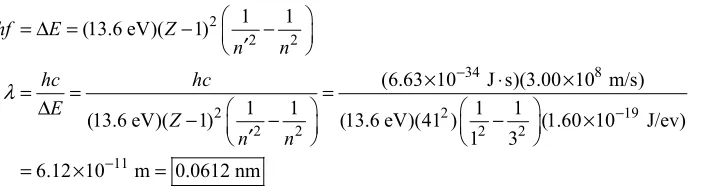
39. We assume that there is “shielding” provided by the 1s electron that is already at that level. Thus the effective charge “seen” by the transitioning electron is 42 –1 41.= We use Eqs. 27–10 and 27–15b.
2
2 2
34 8
2 2 19
2 2 2 2
11
1 1
(13.6 eV)( 1)
(6.63 10 J s)(3.00 10 m/s)
1 1 1 1
(13.6 eV)( 1) (13.6 eV)(41 ) (1.60 10 J/ev)
1 3
6.12 10 m 0.0612 nm
hf E Z
n n
hc hc
E
Z
n n
λ −
−
−
⎛ ⎞
= Δ = − ⎜ − ⎟
′
⎝ ⎠
× ⋅ ×
= = =
Δ ⎛ ⎞ ⎛ ⎞
− ⎜ ′ − ⎟ ⎜ − ⎟ ×
⎝ ⎠ ⎝ ⎠
= × =
We do not expect perfect agreement because there is some partial shielding provided by the n=2 shell, which was ignored when we replaced Z with Z – 1. That would make the effective atomic number a little smaller, which would lead to a larger wavelength. The amount of shielding could be estimated by using the actual wavelength and solving for the effective atomic number.
40. The wavelength of the Kα line is calculated for molybdenum in Example 28–7. We use that same procedure. Note that the wavelength is inversely proportional to (Z−1) .2
2
unknown Fe
unknown 2
Fe unknown
( 1) (26 1) 194 pm 1 24
229 pm
( 1)
Z
Z Z
λ λ
⎡ ⎤
−
= → =⎢ − ⎥+ =
− ⎣ ⎦
The unknown material has Z = 24, so it is chromium.
41. The energy of a pulse is the power of the pulse times the duration in time. E= Δ =P t (0.68 W)(25 10× −3s)= 0.017 J
The number of photons in a pulse is the energy of a pulse divided by the energy of a photon as given in Eq. 27–4.
9
16
34 8
(0.017 J)(640 10 m) 5.5 10 photons (6.63 10 J s)(3.00 10 m/s)
E E N
hf hc
λ −
− ×
= = = = ×
× ⋅ ×
42. Intensity equals power per unit area. The area of the light from the laser is assumed to be in a circular area, while the area intercepted by the light from a lightbulb is the surface area of a sphere.
(a)
3
2 2
2 3 2
0.50 10 W 70.74 W/m 71 W/m (1.5 10 m)
P I
r
π π
− − ×
= = = ≈
×
(b) 2 100 W 2 1.989 W/m2 2.0 W/m2 4 4 (2.0 m)
P I
r
π π
= = = ≈
The laser beam is more intense by a factor of
2 2 70.74 W/m
35.57 36 . 1.989 W/m = ≈
43. Transition from the E3′ state to the E2′ state releases photons with energy 1.96 eV, as shown in Fig. 28–20. The wavelength is determined from the energy.
34 8
7 19
(6.63 10 J s)(3.00 10 m/s)
6.34 10 m 634 nm (1.60 10 J/eV)(1.96 eV)
hc E
λ − −
−
× ⋅ ×
= = = × =
44. The angular half-width of the beam is given in Eq. 25–7, 1/2 1 22 ,
d
λ
θ = . where d is the diameter of the diffracting circle. The angular width of the beam is twice this. The linear diameter of the
beam is then the angular width times the distance from the source of the light to the observation point, ,
D r= θ for small angles. See the diagram. 9
4 4 4
1/2 1.22 1.22(694 103 m) 2.822 10 rad 5.644 10 rad 5.6 10 rad (3.0 10 m)
λ
d
θ − − θ − −
−
×
= = = × → = × ≈ ×
×
(a) The diameter of the beam when it reaches the satellite is as follows: D r= θ=(340 10 m)(5.644 10× 3 × −4rad)= 190 m
(b) The diameter of the beam when it reaches the Moon is as follows: D r= θ=(384 10 m)(5.644 10× 6 × −4rad)= 2.2 10 m× 5
45. We use Eq. 28–3 to find l and the unnumbered equation following it to findm .
2 34 2
2 34 2
2
(6.84 10 J s)
( 1) ( 1) 42
(1.055 10 J s) 1 1 4(1)( 42) 1 13
42 0 6, 7 6
2 2
L
L= + → + = = × −− ⋅ =
× ⋅
− ± − − − ±
+ − = → = = = − → =
34 34 2.11 10 J s
2 1.055 10 J s z
z L
L =m → m = = × −− ⋅ =
× ⋅
Since =6, we must have n≥7 .
46. (a) The minimum uncertainty in the energy is found from Eq. 28–2.
34
26 8 7
8 19
(1.055 10 J s) 1.055 10 J 1 eV 6.59 10 eV 10 eV
(1 10 s) 1.60 10 J
E t
−
− − −
− −
⎛ ⎞
× ⋅
Δ ≥ = = × ⎜⎜ ⎟⎟= × ≈
Δ × ⎝ × ⎠
(b) The transition energy can be found from the Bohr hydrogen atom energies, Eq. 27–15b, with Z = 1 for hydrogen.
2 2 2
2 1
2 2 2
8
9 8
2 1
1 1
(13.6 eV) (13.6 eV) (13.6 eV) 10.2 eV
2 1
6.59 10 eV 6.46 10 10 10.2 eV
n Z
E E E
n E
E E
−
− −
⎡ ⎤ ⎡ ⎤
= − → − = −⎢ ⎥ ⎢− − ⎥=
⎢ ⎥ ⎢ ⎥
⎣ ⎦ ⎣ ⎦
Δ = × = × ≈
−
The uncertainty in the energy is a very small fraction of the actual transition energy. (c) The wavelength is given by Eq. 27–4.
34 8 7
19 (6.63 10 J s)(3.00 10 m/s)
1.22 10 m 122 nm 1.60 10 J
(10.2 eV)
eV
hc hc
E hf
E
λ λ
−
− −
× ⋅ ×
= = → = = = × =
⎛ × ⎞
⎜ ⎟
⎜ ⎟
⎝ ⎠
r
Take the width in the line to be the uncertainty in the line’s value, based on the uncertainty in the energy. We will use Eq. 27–4 with the binomial expansion.
1
8
7
1 1 1
( ) 1
6.59 10 eV
| | (122 nm) 8 10 nm
10.2 eV
hc hc hc E hc E E
E
E E E E E E E E
E E
E
λ λ λ
λ λ
−
−
−
Δ Δ Δ
⎛ ⎞ ⎛ ⎞ ⎛ ⎞
+ Δ = + Δ = ⎛ Δ ⎞= ⎜⎝ + ⎟⎠ ≈ ⎝⎜ − ⎠⎟= ⎜⎝ − ⎟⎠ → +
⎜ ⎟
⎝ ⎠
Δ ×
Δ = = = ×
47. The value of can range from 0 to n−1. Thus for n=6, we have 0≤ ≤5. The magnitude of the angular momentum is given by Eq. 28–3, L= ( +1) .
Lmin =0; Lmax = 30
48. (a) We find the wavelength from Eq. 27–8.
34
34 34
(6.63 10 J s)
3.683 10 m 3.7 10 m (0.012 kg)(150 m/s)
h h p m
λ
υ
−
− −
× ⋅
= = = = × ≈ ×
(b) Use Eq. 28–1 to find the uncertainty in momentum.
34
32 32
(1.055 10 J s)
1.758 10 kg m/s 1.8 10 kg m/s (0.0060 m)
x p
x
−
− −
× ⋅
Δ ≥ = = × ⋅ ≈ × ⋅
Δ
49. Use Eq. 28–1 (the uncertainty principle) and Eq. 27–8 (the de Broglie wavelength).
34
27 27
8 (1.055 10 J s)
5.275 10 kg m/s 5.3 10 kg m/s (2.0 10 m)
p x
−
− −
−
× ⋅
Δ ≥ = = × ⋅ ≈ × ⋅
Δ ×
34
7 7
27 (6.63 10 J s)
1.257 10 m 1.3 10 m 5.275 10 kg m/s
h p
λ − − −
−
× ⋅
= = = × ≈ ×
× ⋅
50. (a) Boron has 4,Z = with an electron configuration of 1 2 ,s s2 2 so the outermost electron has 2
n= . We use the Bohr result with an effective Z. We might naively expect to get Zeff =1, indicating that the other three electrons shield the outer electron from the nucleus, or Zeff =2, indicating that only the inner two electrons accomplish the shielding.
2 2
eff eff
2 2 2 eff
(13.6 eV)( ) (13.6 eV)( )
8.26 eV 1.56
2
Z Z
E Z
n
= − → − = − → =
This indicates that the other electron in the n=2 shell does partially shield the electron that is to be removed.
(b) We find the average radius from Eq. 27–14.
2 2 10
10 1
eff
2 (0.529 10 m) 1.36 10 m (1.56)
n r r
Z
−
− ×
51. Use Eq. 27–14, which says that the radius of a Bohr orbit is inversely proportional to the atomic number. Also use Eq. 27–15b, which says that the energy of a Bohr orbit is proportional to the square of the atomic number. The energy to remove the electron is the opposite of the total energy. A simple approximation is used in which the electron “feels” the full effect of all 92 protons in the nucleus.
2
10 10 13
2 2
5
2 2
1
(0.529 10 m) (0.529 10 m) 5.75 10 m 92
92
| | (13.6 eV) (13.6 eV) 1.15 10 eV 115 keV 1
n
n n r
Z
Z E
n
− − −
= × = × = ×
= = = × =
52. We find the wavelength of the protons from their kinetic energy, using nonrelativistic mechanics and Eq. 27–8, and then use Eq. 24–21 for two-slit interference, with a small-angle approximation. If the protons were accelerated by a 480-V potential difference, then they will have 480 eV of kinetic energy.
p
34
4 27 19
p 8
KE
KE
; sin , 1, 2, ; tan
2
sin tan , 1, 2,
(6.63 10 J s)(28 m)
2 (7.0 10 m) 2(1.67 10 kg)(480 eV)(1.60 10 J/ev)
5.2 10 m
h h
d m m x
p m
m x x m m
d d
h x
d d m
λ θ λ θ
λ λ
θ θ
λ −
− − −
−
= = = = =
= → = → = = →
× ⋅
Δ = = =
× × ×
= ×
…
…
53. An h subshell has =5. For a given value, m ranges from − to + , taking on 2 +1 different values. For each m , there are two values of ms. Thus the number of states for a given value is
2(2 +1). Thus there are 2(2 + =1) 2(11)= 22 possible electron states.
54. (a) For each , the value of m can range from − to + ,or 2 +1 values. For each of these, there are two values of ms. Thus the total number of states in a subshell is N= 2(2 +1) .
(b) For =0, 1, 2, 3, 4, 5, and 6, N= 2, 6, 10, 14, 18, 22, and 26 , respectively.
55. For a given n, 0≤ ≤ −n 1. Since for each , the number of possible states is 2(2 +1), as shown in Problem 54, the number of possible states for a given n is as follows:
1 1 1 2
0 0 0
( 1)
2(2 1) 4 2 4 2 2
2
n n n n n
n n
− − −
= = =
−
⎛ ⎞
+ = + = ⎜⎝ ⎟⎠+ =
Ä
Ä Ä
The summation formulas can be found (and proven) in a pre-calculus mathematics textbook. 56. We find the wavelength of the electrons from their kinetic energy, using nonrelativistic mechanics.
e
34
6 31 3 19
e 6
KE
KE
; sin , 1, 2, ; tan
2
sin tan , 1, 2,
(6.63 10 J s)(0.450 m)
2 (2.0 10 m) 2(9.11 10 kg)(45 10 eV)(1.60 10 J/ev)
1.30 10 m 1.3 m
h h
d m m x
p m
m x m
x m
d d
h x
d d m
λ θ λ θ
λ λ θ θ λ μ − − − − − = = = = = = → = → = = → × ⋅
Δ = = =
× × × ×
= × ≈
…
…
57. In the Bohr model, Bohr 2 . 2
h
L n
π
= = In quantum mechanics, Lqm = ( +1) . For n=2, =0 or 1,= so that Lqm = 0(0 1)+ = 0 or Lqm = 1(1 1)+ = 2 .
58. The fractional uncertainty in the energy is found from the lifetime and the uncertainty principle, Eq. 28–2. Also use Eq. 27–4.
9
8 8
8 9
; 2
500 10 m
2 2.65 10 3 10
2 2 (3 00 10 m/s)(10 10 s)
h hc
E E hf
t t
h
E t
hc
E c t
π λ λ π π π λ − − − −
Δ = = = =
Δ Δ
Δ = Δ = = × = × ≈ ×
Δ . × ×
Use the binomial expansion to find the wavelength’s fractional uncertainty.
1
8
1 1 1
( ) 1
| | | | 3 10
hc hc hc E hc E E
E
E E E E E E E E
E
E E
E E
λ λ λ
λ λ λ
λ
−
−
Δ Δ Δ
⎛ ⎞ ⎛ ⎞ ⎛ ⎞
+ Δ = = = ⎜ + ⎟ ≈ ⎜ − ⎟= ⎜ − ⎟ →
Δ
+ Δ ⎛ + ⎞ ⎝ ⎠ ⎝ ⎠ ⎝ ⎠
⎜ ⎟
⎝ ⎠
Δ Δ Δ
Δ = → = = ×
59. Find the uncertainty in the position from Eq. 28–1.
34
37 1.055 10 J s
3.7 10 m (1300 kg)(0.22 m/s)
x m υ
−
−
× ⋅
Δ = = = ×
Δ
60. The difference in measured energies is found from Eq. 27–4.
2 1
2 1
34 8 21
9 9
1 1
(6.63 10 J s)(3.00 10 m/s) 1.670 10 J 487 10 m 489 10 m
hc hc E E E
λ λ
− −
− −
Δ = − = −
⎛ ⎞
= × ⋅ × ⎜⎜ − ⎟⎟= ×
× ×
⎝ ⎠
The lifetime of the excited state is determined from Eq. 28–2.
34
14 14
21
1.055 10 J s 6.317 10 s 6.32 10 s 1.670 10 J
E t t
E
−
− −
−
× ⋅
Δ Δ ≥ → Δ ≥ = = × ≈ ×
Δ ×
61. We assume that the particles are not relativistic. Conservation of energy is used to find the speed of each particle. That speed then can be used to find the momentum and finally the de Broglie wavelength. We let the magnitude of the accelerating potential difference be V.
2 1
initial final 2
27
proton proton electron electron proton
electron proton electron
electron proton
PE KE 2 ;
2 2
2 2
2
2 1.67 10 kg
2 9.11 10
2
eV h h h h
eV m x
m p m eV meV
m m
h h
x p p
x
h h
p x x m eV m
h h
p x m
x m eV
υ υ λ
υ
π π
π
π
− −
= → = → = = = = = = Δ
Δ Δ = → Δ =
Δ
Δ Δ Δ ×
= = = = =
Δ Δ ×
Δ
31kg = 42.8
62. Limiting the number of electron shells to six would mean that the Periodic Table stops with radon (Rn), since the next element, francium (Fr), begins filling the seventh shell. Including all elements up through radon, there would be 86 elements.
63. The de Broglie wavelength is determined by Eq. 27–8.
34
35 35
6.63 10 J s 1.95 10 m/s 2.0 10 m/s (68.0 kg)(0.50 m)
h h h
p m m
λ= = υ → υ= λ = × − ⋅ = × − ≈ × −
Since λ is comparable to the width of a typical doorway, yes, you would notice diffraction effects. However, assuming that walking through the doorway requires travel through a distance of 0.2 m, the time Δt required is huge.
0.20 m35 1.0 10 s34 3 1026 yr 1.95 10 m/s
d
t d t
υ
υ −
Δ = → Δ = = = × ≈ ×
×
64. Since from Eq. 27–16, 1 Z2 12 12 , n n
λ
⎛ ⎞
∝ ⎜ − ⎟
′
⎝ ⎠ we seek Z and n′X so that for every fourth value of nX
there is an nH such that the Lyman formula equals the formula for the unknown element.
2 2
2
2 2 2 2 2
H X X X X
1 1 1 1
1
Z Z Z
n n n n n
⎛ ⎞
− = ⎜⎜ − ⎟⎟= −
′ ′
⎝ ⎠
Consider atoms (with Z > 1) for which Z n2/ ′ =2X 1 → n′ =X Z, and for which
2 2 2
X H X H
65. The Kα line is from the n=2 to n=1 transition. We use the energies of the hydrogen atom with Z
replaced by Z−1,as in Example 28–7, using Eq. 27–16. 2 4 2
2
3 2 2
1 1 1
2 4 2
7 1 1
3 2 2 10 9 10 2 2
1 2 ( 1) 1 1
1 2 1 1 1 1 1
1 1 (1.097 m )
(0.154 m) 1 2
1 28.09 29 e mk Z
h c n n
e mk Z
h c n n
π λ
π λ
− − −
− −
− ×
×
⎛ ⎞ ⎛ ⎞
=⎜⎜ ⎟⎟ − ⎜ − ⎟ →
′
⎝ ⎠
⎝ ⎠
⎛ ⎞ ⎛ ⎞ ⎛ ⎞
= + ⎜⎜ ⎟⎟ ⎜ − ⎟ = + ⎜ − ⎟
′ ⎝ ⎠
⎝ ⎠
⎝ ⎠
= + ≈
The element is copper.
Solutions to Search and Learn Problems
1. We use Eq. 27–11, Bohr’s quantum condition, with n = 1 for the ground state.
1
1 1
1 2
/
n h
m r n m r m p p
r
x p x r
p r
υ υ υ
π
= → = → = = = Δ
Δ Δ ≈ → Δ ≈ = =
Δ
The uncertainty in position is comparable to the Bohr radius.
2. The periodicity of the Periodic Table depends on the number and arrangement of the electrons in the atom. The Pauli exclusion principle requires that each electron have distinct values for the principal quantum number, angular orbital quantum number, magnetic quantum number, and spin quantum number. As electrons are added to the atom, the electrons fill the lowest available energy states. Atoms with the same number of electrons in the outer shells have similar properties, which accounts for the periodicity of the Periodic Table. The quantization of the angular momentum determines the number of angular momentum states allowed in each shell. These are represented by the letters s, p, d, f, etc. The magnitude of the angular momentum also limits the number of magnetic quantum states available for each orbital angular state. Finally, the electron spin allows for two electrons (one spin up and one spin down) to exist in each magnetic quantum state. So the Pauli exclusion principle, quantization of angular momentum, direction of angular momentum, and spin all play a role in determining the periodicity of the Periodic Table.
3. (a) The quantum-mechanical theory retained the aspect that electrons only exist in discrete states of definite energy levels. It also retained the feature that an electron absorbs or emits a photon when it changes from one energy state to another.
(b) In the Bohr model the electrons moved in circular orbits around the nucleus. In the quantum-mechanical model the electrons occupy orbitals about the nucleus and do not have exact, well-defined orbits.
1 2
Earth Sun-Earth
2 24 11 2
74 74
Earth
34 7
2
[ ( 1)]
2 (5.98 10 kg)2 (1.496 10 m)
2.5255 10 2.53 10 (1.055 10 J s)(3.156 10 s)
r
L M r M r
T
M r
T
π υ
π π
−
= = = + = →
× ×
= = = × ≈ ×
× ⋅ ×
(b) There are 2 +1 values of m for a value of , so the number of orientations is as follows: N=2 + =1 2(2.5255 10 ) 1 5.051 10× 74 + = × 74 ≈ 5.05 10× 74
5. The “location” of the beam is uncertain in the transverse (y) direction by an amount equal to the aperture opening, D. This gives a value for the uncertainty in the transverse momentum. The momentum must be at least as big as its uncertainty, so we obtain a value for the transverse momentum.
p yy py py
y D D
Δ Δ ≥ → Δ ≥ = → ≈
Δ
The momentum in the forward direction is related to the wavelength of the light by px=λh. See the diagram to relate the momentum to the angle.
/
; / 2 y
x
p D
p h D
λ θ
λ π
≈ ≈ = “spread” 2
D D
λ λ
θ π
= = ≈
6. For noble gases, the electrons fill all available states in the outermost shell. Helium has two electrons which fill the 1s shell. For the other noble gases, there are six electrons in the p subshells, filling each of those shells. For each of these gases, the next electron would have to be added to an s subshell at much higher energy. Since the noble gases have a filled shell, they do not react chemically with other elements. Lithium, which has three electrons and is the first alkali metal, has its third electron in the 2s shell. This shell has significantly higher energy than the 1s shell. All of the alkali metals have one electron in their outer s subshell and therefore react well with halogens.
Halogens all have five electrons in their outer p subshell. They react well with atoms that have a donor electron in their outer shell, like the alkali metals.
7. The uncertainty in the electron position is Δ =x r1. The minimum uncertainty in the velocity, Δυ, can be found by solving Eq. 28–1, where the uncertainty in the momentum is the product of the electron mass and the uncertainty in the velocity.
min 1
34
6
31 10
1
( )
1.055 10 J s 2.19 10 m/s (9.11 10 kg)(0.529 10 m)
x p r m
mr
υ
υ − − −
Δ Δ = Δ ≥
× ⋅
Δ ≥ = = ×
× ×
8. According to the uncertainty principle, it is impossible to measure a system without disturbing, or affecting, the system. The more precisely you measure the position, the greater the disturbance in the momentum, and hence the greater the uncertainty in the momentum. The more precisely you measure the momentum, the greater the disturbance in the position, and hence the greater the uncertainty in the position. When measuring position and momentum, there is a minimum value for the product of the uncertainties in momentum and position.
D px
y
p