From potential to practice: how
accelerating access to HPV tests and
screen and treat programmes can help
eliminate cervical cancer
William Cherniak ,1,2 Nikki Tyler,3 Kriti Arora,1 Ilana Lapidos- Salaiz,3 Emma Sczudlo,1 Amy Lin,3 Matthew Barnhart,3 John Flanigan,4
Shannon Silkensen4
To cite: Cherniak W, Tyler N, Arora K, et al. From potential to practice: how accelerating access to HPV tests and screen and treat programmes can help eliminate cervical cancer. Fam Med Com Health 2019;7:e000182. doi:10.1136/ fmch-2019-000182
Received 23 May 2019 Revised 13 September 2019 Accepted 15 September 2019
1Bridge to Health Medical and
Dental, Toronto, Ontario, Canada 2Family and Community
Medicine, University of Toronto Faculty of Medicine, Toronto, Ontario, Canada
3Bureau for Global Health,
USAID, Washington, DC, USA 4Center for Global Health,
National Cancer Institute, Bethesda, Maryland, USA
Correspondence to Dr William Cherniak; w. cherniak@ mail. utoronto. ca © Author(s) (or their employer(s)) 2019. Re- use permitted under CC BY- NC. No commercial re- use. See rights and permissions. Published by BMJ.
AbstrACt
Human papillomavirus (HPV) vaccination campaigns to prevent cervical cancer are being considered and implemented in countries around the world. While vaccination will protect future generations, it will not help the millions of women currently infected, leading to an estimated 311 000 deaths per year globally. This paper examines a selection of strategies that when applied to both existing and new technologies, could accelerate access to HPV testing. Authors from the US Agency for International Development, the National Institutes of Health, and the Bridge to Health Medical and Dental, a non- governmental organisation, joined forces to propose a scalable and country- directed solution for preventing cervical cancer using an end- to- end approach. Collectively, the authors offer seven evidence- based strategies, that when used alone or in combination have the ability to reduce HPV- caused cervical cancer deaths and disability. These strategies include (1) consistent HPV test intervals to decrease HPV DNA test costs; (2) exploring market shaping opportunities; (3) employing iterative user research methodologies like human- centred design; (4) target product profiles for new HPV tests; (5) encouraging innovation around cervical cancer screen and treat programmes; (6) developing national cancer control plans; and (7) integrating cervical cancer screen and treat services into existing infrastructure. By using the strategies outlined here, in combination with HPV vaccination campaigns, national governments will be able to scale and expand cervical cancer screening programmes and provide evidence- based treatment programmes for HPV- infected women.
IntroduCtIon
Globally, in 2018, there were an estimated 570 000 new cases of cervical cancer and 311 000 deaths as a result of cervical cancer.1
Human papillomavirus (HPV) infection is estimated to contribute to 4.5% of all cancers worldwide. Specifically, over 20% of cancers in Indian and sub- Saharan Africa are linked to HPV infection.2
While scientific and technological advances continue to improve health outcomes across the globe, these advances often take too long to reach poor and marginalised populations. Current technologies for cervical cancer provide a stark example of such disparities in access. Specifically, most technologies that are used successfully to prevent, screen and treat cervical cancer in high- income coun-tries are out of reach to women in low and middle- income countries (LMIC).3
Chief among these is HPV vaccination, which has the potential to dramatically reduce the burden of cervical cancer in LMICs over the long term. International campaigns that have targeted girls aged 9–14 have achieved dramatic results in national scale- up.4
Vacci-nation of young girls has become the highest priority for many national cervical cancer programmes in LMICs. At the same time, the fruit of this labour may not be fully realised until approximately 2050. Right now, an esti-mated 10% of healthy women around the world are already infected with HPV,5 and
without accelerated action to screen and treat precancerous lesions, deaths resulting from cervical cancer are estimated to increase to 443 000 per year by 2030.6
One method developed as a screening tool for use in low- income settings is visual inspec-tion of the cervix with acetic acid (VIA). This is one of the options recommended by the WHO for cervical cancer screening in LMICs.7 However, VIA has a low sensitivity, ranging from 21.9% to 73.6% in one multi-country study.8 This means that many
precan-cerous cervical lesions will not be identified with this method alone. In addition, VIA has a very low positive predictive value (PPV) in most populations. For example, VIA’s PPV was only 6.2% in one study, which would
on September 12, 2020 by guest. Protected by copyright.
indicate that in such a population more than 90% of women identified as needing treatment did not actually have precancerous lesions.9 Moreover, the quality of VIA
is very provider dependent, and there is a high degree of subjectivity in the assessment of the visual inspection,10
which can further reduce the accuracy of the test in resource- constrained settings. User acceptability of VIA may also be limited due to low willingness on the part of patients to undergo the required pelvic exam,11 which is a
relatively resource- intensive procedure for health systems in LMICs.
In this context of VIA’s limitations, HPV testing has become a staple of cervical cancer screening guidelines.12
Many studies across a diverse range of countries and populations have been used to develop screening algo-rithms based on HPV testing. These algoalgo-rithms are more capable of detecting precancerous cervical lesions than
VIA.8 13–15 Appropriately, WHO guidelines provide tiered
screen and treat recommendations that consider resource availability and recommend, when possible, HPV testing for screening.7 While WHO recommends screening at
intervals of 5 years, emerging evidence suggests that HPV testing can elongate intervals between screenings greater than other methodologies, such as VIA and cytology. Strong evidence from a cohort of 20 000 patients at Kaiser Permanente demonstrated that a single negative HPV test can predict a very low risk of cervical intraepithelial neoplasia grade 3 or invasive cervical cancer (CIN3+) over 15 years.16 There is still a risk of acquiring HPV later
in life—although 75% of all infections are acquired by age 32—and epidemiology of infection differs between nations.17 Still, this experience from the USA suggests
that there could be great utility in using an HPV test in women over age 30 living in an LMIC. A negative result could confer up to 10 years of reassurance that the woman has a very low risk of CIN3+.16
Given the potential impact of HPV testing with screen and treat services for precancerous lesions in halting cervical cancer as a public health threat, this paper focuses on interventions. Both market- based and programmatic interventions can enable at- scale provisions in LMICs. This paper examines a selection of potential levers that could accelerate access to HPV testing, for both existing and new technologies. It also looks at potential innova-tions or approaches that may lower barriers to HPV testing with screen and treat programmes, such as increasing user acceptability, reducing price, standardising product preferences and integrating services into national cancer plans and the existing health infrastructure. Together, these interventions have the power to dramatically decrease cervical cancer incidence, morbidity and the number of deaths in LMICs.
Methods
This paper is built on experience, research and practice from a team of nine experts across three institutions. This collaboration first began at the UN Foundation Meeting
for the WHO Programme to Eradicate Cervical Cancer, when members of the National Institutes of Health (NIH) and Bridge to Health Medical and Dental (BTH) began discussions with members of US Agency for International Development (USAID) around a model for integrating and accelerating services for cervical cancer.
An initial concept note was drafted by all parties, with a stakeholders meeting held at the NIH in October 2017. From there, the team mapped a seven- tiered approach to scaling up and expanding cervical cancer eradication strategies, dividing work based on federal mandates and specific experiences of agencies.
Specifically, USAID built on knowledge of product development, scaling services and integrated frameworks on success of past initiatives such as tuberculosis (TB), malaria and HIV. The NIH provided data on research and development around HPV testing and cervical cancer treatment devices. BTH provided insights and literature from experiences on the ground of integrated screen and treat programmes and HPV testing.
For HPV tests, one team member conducted a struc-tured search of HPV test- producing companies. Each company was contacted individually for information.
ACCelerAte ACCess to hPV testIng through An end-to-end APProACh
To increase access to HPV testing as a means of reducing morbidity and mortality from cervical cancer, it is critical to employ an ‘end- to- end approach’. An ‘end- to- end’ approach encourages early planning for all aspects of new product introduction, as well as harmonising activities that have historically happened sequentially so they can be implemented in parallel and more quickly.18
Tradition-ally, the approach involves evaluating four core aspects of introduction and scale- up, including user understanding and acceptability; manufacturing and distribution; clin-ical evidence needed to meet regulatory requirements; and finally, policy, advocacy and financing. Coordination, collaboration and integration underpin all these compo-nents as it is crucial to align diverse stakeholder inter-ests, coordinate stakeholder activities and set a long- term vision and strategy.19 20
Beginning with the ‘end in mind’ for cervical cancer, we focus on sustainably implementing HPV testing, screening and treatment at scale in LMICs, where health systems are often overburdened and resources scarce. Stakeholder coordination plans for introduction and scale is often more challenging and possibly even more important in LMIC markets, as there may not be a single- for- profit company that takes the lead. By planning together with the end in mind, the diverse stakeholders needed for a successful introduction can facilitate healthy markets for the product or service, encourage faster and broader uptake, and accelerate the development of improved products—all ultimately generating better health outcomes more efficiently and quickly.18 These
levers include (1) increasing HPV test intervals to reduce
on September 12, 2020 by guest. Protected by copyright.
HPV DNA test costs; (2) exploring market- shaping oppor-tunities; (3) employing iterative user research method-ologies like human- centred design (HCD); (4) target product profiles (TPP) for new HPV tests; (5) encour-aging innovation around cervical cancer screen and treat programmes; (6) developing national cancer control plans; and (7) integrating cervical cancer screen and treat services into existing infrastructure. Each of these levers is described in the context of HPV testing and cervical cancer screen and treat programmes.
Increasing hPV test intervals reduces hPV dnA test costs Various studies have demonstrated that screening strat-egies involving initial HPV testing can be more cost- effective under certain assumptions than strategies that are based on cytology or VIA.21 22 Research by Goldie and colleagues modelled data to determine the cost of a single lifetime HPV test for women who screened positive using VIA or other cytological methods. Their data show that the cost of a single HPV test for these women is $39/ years of life saved.23 Furthermore, while a single lifetime
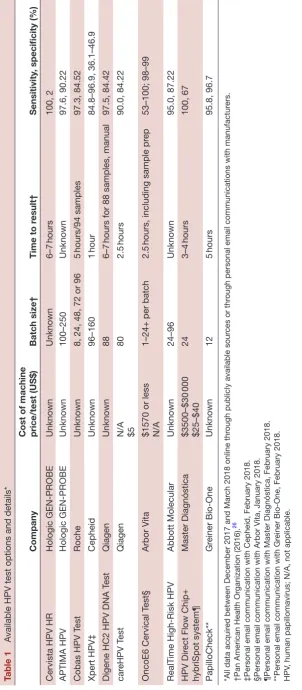
HPV test at age 35 has already demonstrated to be cost- effective compared with no screen, there is potential to lower the cost of HPV tests further. This can be achieved by lowering the price per HPV test kit. For example, as of 2018, the least expensive commercial HPV test kit price is $524; however, in many cases costs can reach as high as $40 (table 1), compared with $0.5–$3 for VIA, and $7–$12 for cytology.23
explore market-shaping opportunities to improve efficiency of the hPV test market
Market shaping is focused on enhancing the many inter-actions of a well- functioning market to increase access to priority health interventions.25 ‘It can accelerate product
access, enhance market stability, and increase last- mile availability as well as improve value for money in procure-ments and programmatic investprocure-ments.’ For example, the revolving fund at Pan American Health Organization26
takes advantage of its bulk purchasing power to protect people against some of the world’s worst disease, including polio, measles, and so on. To increase the affordability of HPV tests, partners can explore pooling procurement or coordinating orders to reduce the transaction costs asso-ciated with placing and responding to orders. By pooling procurement, a third party would consolidate orders for HPV tests across multiple buyers—reducing transac-tion costs for supply- side actors while providing greater demand visibility. Pooled procurement smooths out stag-gered ordering and production timelines. Furthermore, it streamlines supplier engagement with a single point of contact. To redistribute risks between suppliers and buyers, risk sharing interventions like advance market commitments or volume guarantees could incentivise suppliers to invest in developing and delivering new HPV tests. Lastly, lowering transaction costs, increasing market information and appropriately distributing risk between
suppliers and buyers could increase affordability and availability of HPV tests.
To further reduce the costs of HPV tests, institutions are exploring batch testing. By simultaneously assessing multiple samples, batching can reduce the cost per HPV test, which distributes the costs of equipment, consum-ables, maintenance and staff time over a larger volume of tests.27 A number of manufacturers have created
equip-ment that can run in batch or non- batch mode.
employ iterative user research methodologies like hCd to develop contextually appropriate hPV tests and generate demand
To increase uptake of HPV testing by end- users, iterative and immersive user research methods like HCD can be incorporated into product development and demand generation programmes for HPV testing. HCD prioritises collaborating with those most affected by a new interven-tion or programme. This understanding then informs the rapid and iterative development of prototypes and even-tually solutions.
HCD methods can encourage HPV testing. For example, using HCD, the acceptability of women collecting their own sample for HPV DNA tests was assessed. The research demonstrated that self- collection was acceptable.28
Further-more, when these samples were processed with a PCR- based HPV test, their quality compares with those obtained from physician- collected samples.29 In this study, samples were
collected by patients using ready- made test kits after instruc-tion from a community health worker (CHW). The samples were returned either the same or next day to the CHW for processing.29 Additional details regarding HPV testing
and these options are presented in table 1. HCD research provides insights and solutions into how to leverage self- testing to help nations achieve HPV test coverage targets.
tPPs for new hPV tests
TPPs are commonly referenced in the aid and development communities. A TPP defines a set of product attributes that could include information such as how the product will be used, by or for whom the product will be used, and the minimum and ideal performance criteria. TPPs could also include criteria such as product presentation, product storage and shelf life. TPPs communicate requirements for products that are not currently on the market. As such, TPPs provide market signals, guide the industry and develop products that meet the needs of the community.30 31 In 2014,
the WHO released a TPP for HPV testing.32 The WHO also
prequalified careHPV and Gene Xpert HPV as in vitro HPV diagnostic tests.33 To manufacturers, these two steps signal
marketplace confidence and indicate a need for new HPV tests. As more information emerges about HPV testing in LMICs, TPPs could be amended to include other important market and user research.
encourage innovation around cervical cancer screen and treat products
As mentioned above, many millions of women will not be vaccinated against HPV, leaving a generation or more
on September 12, 2020 by guest. Protected by copyright.
Table 1
A
vailable HPV test options and details*
Company
Cost of machine price/test (US$)
Batch size†
Time to r
esult†
Sensitivity
, specificity (%)
Cervista HPV HR
Hologic
PROBE
Unknown
Unknown
6–7
hours
100, 2
APTIMA HPV
Hologic
PROBE
Unknown
100–250
Unknown
97.6, 90.22
Cobas HPV T
est
Roche
Unknown
8, 24, 48, 72 or 96
5
hours/94
samples
97.3, 84.52
Xpert HPV‡
Cepheid
Unknown
96–160
1
hour
84.8–96.9, 36.1–46.9
Digene HC2 HPV DNA T
est
Qiagen
Unknown
88
6–7
hours for 88 samples, manual
97.5, 84.42
car
eHPV T
est
Qiagen
N/A $5
80
2.5
hours
90.0, 84.22
OncoE6 Cervical T
est§
Arbor Vita
$1570 or less N/A
1–24+ per batch
2.5
hours, including sample pr
ep
53–100; 98–99
RealTime
Risk HPV
Abbott Molecular
Unknown
24–96
Unknown
95.0, 87.22
HPV Dir
ect Flow Chip+
hybriSpot system¶
Master Diagnóstica
$3500–$30
000
$25–$40
24
3–4
hours
100, 67
PapilloCheck**
Gr
einer
One
Unknown
12
5
hours
95.8, 96.7
*All data acquir
ed between December 2017 and Mar
ch 2018 online thr
ough publicly available sour
ces or thr
ough personal email communications with manufactur
ers.
†Pan American Health Or
ganization (2016).
26
‡Personal email communication with Cepheid, February 2018. §Personal email communication with Arbor Vita, January 2018. ¶Personal email communication with Master Diagnóstica, February 2018. **Personal email communication with Gr
einer
One, February 2018.
HPV
, human papillomavirus; N/A, not applicable.
on September 12, 2020 by guest. Protected by copyright.
Figure 1 A Canadian family physician teaching a Kenyan obstetrician- gynaecologist how to use a portable thermocoagulation device.
in need of innovative solutions to screen and treat for precancerous cervical lesions. Innovations in this arena have the potential to revolutionise availability, cost and user acceptability of treatment.
The WHO recommends two options for treating precancerous cervical lesions as part of screen and treat programmes: loop electrosurgical excision procedure (LEEP) and cryotherapy.31 Techniques such as
thermo-coagulation, also called cold thermo-coagulation, are being revis-ited as potential treatment options to replace cryotherapy in low- resource settings.34 35
While effective, these technologies typically require complex infrastructure with expensive materials and some level of trained health provider, in particular around LEEP. However, an exciting addition to treatment options are more novel and portable thermocoagulation and gas- less cryotherapy devices.36 These devices can be
brought directly into the field and used on a per- patient basis, while linked with a comprehensive screen and treat campaign. This method has proven particularly useful as part of outreach services for rural, isolated communities. While further practical evidence is required to prove that this strategy works at scale, integration of these services on a smaller scale has ensured that cases are detected and treated in the same visit. For example, BTH in partner-ship with the County Government of Kisumu (CGK) and Africa Cancer Foundation have successfully pilot tested a portable thermocoagulator, upgrading the County Health Department from ‘See’ to ‘See and Treat’. See
figure 1 for BTH and CGK staff using the device. Facili-ties implementing this strategy should ensure that quality assurance systems are in place to prevent harm, such as pain or bleeding, which could occur through ablation of invasive cancers.
The cost of any novel therapy is always considered. Work by Maza and colleagues documents that most widely used cryotherapy devices have an estimated cost between $1700 and $2000, with additional tips costing approximately
$200 each. Additionally, the required gas and related costs can range from $13 to $38 per treatment. These costs are slightly less than the WiSAP Cold- Coagulator. The LMIC customised device costs about $2500. Among other advan-tages, the WiSAP tip can be sterilised with high- level disin-fection; it does not require autoclave.36
Although effective, current treatment options for precancerous lesions are invasive, and can be expensive in terms of infrastructure, personnel and equipment required. An alternative could be affordable and effec-tive non- surgical treatments. Several innovative, non- surgical treatments are being developed by the National Cancer Institute in the form of therapeutic vaccines, anti-virals and topical applications.35 The goal of therapeutic
vaccines is to elicit an immune response by targeting E6 and E7 antigens. As of 2018, there are therapeutic vaccine candidates in phase III clinical trials.35 Additionally, there
are several ongoing studies on the use of antiviral drugs to target HPV, as well as adoptive T- cell therapy. None have advanced to phase III clinical trials and have shown limited effectiveness to HPV.35 37
Finally, in order to treat precancerous lesions HPV infection must be rapidly diagnosed. There are different efforts to develop paper- based HPV screening technolo-gies; immunoassays constructed on nitrocellulose lateral flow strips. These efforts are far from complete, but a test is currently available to determine HPV vaccination status.38 This example illustrates an exciting potential
innovation that will bring a cost- effective test directly to the field.
develop comprehensive national cancer control plans that include hPV testing
To ensure alignment with the Ministry of Health, or equiv-alent, priorities and engender political commitment, HPV testing should be introduced as part of a comprehensive national cancer control plan, such as in Suriname.39 An
important first step would be a barrier assessment iden-tifying challenges to scale- up of cervical cancer services, categorised by level of urgency. This assessment would then inform the prioritisation of interventions, which could include increasing the capacity or staffing of health providers. Additionally, the assessment could be used to develop an algorithm for referral and care or to inte-grate HPV testing into existing health services so that the health system can enable more women to receive the proper follow- up treatment. Moreover, the control plan can consider a strategy for triaging patients to prioritise treatment, depending on the availability of a secondary test (eg, VIA, cytology or a different HPV test) and the feasibility of treatment.40 Current research suggests that
VIA may not be an effective or cost- effective method of triage, but additional research is required to determine preferred triage strategies.21 41
Integrate cervical cancer screen and treat services into the existing infrastructure of health services
As discussed previously, while HPV testing can revolutio-nise cervical cancer screening, the treatment component
on September 12, 2020 by guest. Protected by copyright.
of screen and treat is critical in the case of a positive screen. Without same- day treatment, many women with positive screen results may not be able to return for a follow- up visit and thus never receive appropriate treatment.22
To ease barriers to accessing relatively new forms of care, such as HPV testing and cervical cancer screen and treat services, integration into existing vertical disease programmes can be a powerful tool. Vertical programmes that currently provide diagnosis and treatment services for HIV/AIDS, TB, malaria and family planning all offer a channel with existing clinics to reach women at risk of cervical cancer. When integrated into functional clinics, screen and treat services can result in fewer cases being lost to follow- up and a lower number of invalid HPV tests; they can also eliminate the need for additional refriger-ation and transportrefriger-ation of specimens. These benefits are seen as a result of the testing being available directly in the field, with reduced challenges in transportation, storage and other realities of managing pathology in a low- resource setting. Collectively, these advantages can signifi-cantly increase the feasibility of implementing a national cervical cancer screening and treatment programme.
Women living with HIV are estimated to have a four-fold to fivefour-fold higher likelihood of cervical cancer inci-dence.42 43 In response, the US President’s Emergency
Plan for AIDS Relief has partnered with many organisa-tions to integrate cervical cancer screening and treatment into existing HIV platforms with initial success at a small scale.44 Furthermore, effective integration of cervical
cancer screenings has been shown to increase uptake of reproductive health services.45
A practical example is the Cervical Cancer Preven-tion Program in Zambia, which circumvented the heavy infrastructure issue by piggybacking on existing HIV prevention and treatment programmes to share equip-ment and clinic locations. This integration of services reduced the time required to implement cervical cancer screen and treat services, while also increasing partici-pation in regular gynaecological exams.46 Further, these
synergies opened up resources to address other barriers, such as enabling the purchase of LEEP equipment to treat precancerous cervical lesions. Another example of successful integration is the Cervical Cancer Screening and Preventive Therapy programme, which operated in Uganda, Tanzania, Nigeria and Kenya, and reported increased uptake of both cervical cancer screening and voluntary family planning interventions when the two were offered in tandem.45
Integration of programmes is a promising but relatively new strategy for promoting cervical cancer screening and treatment. The examples above leveraged VIA- based screening, but an integration strategy can be applied to HPV- based screening too. For HPV- based screening, inte-gration would be most straightforward at facilities that already use a screening platform for one disease, such as Gene Xpert for TB, because HPV test cartridges fit into the same machine. To date, the examples above have not yet scaled to achieve high- coverage screening rates. Going
forward, it may be worthwhile to integrate cervical cancer services with multiple existing programmes thereby over-coming any incompatibilities that prevent high screening rates.
ConClusIon
This paper applied an end- to- end approach to highlight a series of levers that could potentially accelerate access to HPV testing and screen and treat services. These levers included exploring global market- shaping opportunities to improve the market efficiency of HPV tests, employing iterative user research methodologies like HCD to develop new or improved HPV tests, aligning on TPPs for new HPV tests, encouraging innovation, developing national cancer control plans that include HPV testing, and integrating cervical cancer screen and treat services into existing infrastructure.
End- to- end planning can help align and coordinate diverse stakeholders across activities and facilitate healthy markets—ultimately, more successfully delivering cervical cancer technologies and interventions in LMICs.
Effective and efficient planning ensures that tailored products and programmes reach their target populations across a country. Now is the time for countries to iden-tify and invest in regionally, cost- effective technologies that are integrated into programmes that can be feasibly scaled. Together, we can protect our next generation of women from cervical cancer.
twitter William Cherniak @williamcherniak
Contributors WC, JF and MB conceived the study. NT, SS, KA, ILS, ES and AL participated in meetings around the paper. WC wrote the first draft with contributions of primary writing from all the authors. All authors reviewed, edited and approved the final draft of this manuscript.
Funding The authors have not declared a specific grant for this research from any funding agency in the public, commercial or not- for- profit sectors.
Competing interests None declared. Patient consent for publication Not required.
Provenance and peer review Not commissioned; externally peer reviewed. open access This is an open access article distributed in accordance with the Creative Commons Attribution Non Commercial (CC BY- NC 4.0) license, which permits others to distribute, remix, adapt, build upon this work non- commercially, and license their derivative works on different terms, provided the original work is properly cited, appropriate credit is given, any changes made indicated, and the use is non- commercial. See: http:// creativecommons. org/ licenses/ by- nc/ 4. 0/.
orCId id
William Cherniak http:// orcid. org/ 0000- 0003- 3001- 2400
reFerenCes
1 Bray F, Ferlay J, Soerjomataram I, et al. Global cancer statistics
2018: GLOBOCAN estimates of incidence and mortality worldwide
for 36 cancers in 185 countries. CA Cancer J Clin 2018;68:394–424.
2 de Martel C, Plummer M, Vignat J, et al. Worldwide burden of cancer
attributable to HPV by site, country and HPV type. Int J Cancer
2017;141:664–70.
3 Gakidou E, Nordhagen S, Obermeyer Z. Coverage of cervical cancer screening in 57 countries: low average levels and large inequalities.
PLoS Med 2008;5:e132.
on September 12, 2020 by guest. Protected by copyright.
4 Binagwaho A, Wagner CM, Gatera M, et al. Achieving high coverage in Rwanda's national human papillomavirus vaccination programme.
Bull World Health Organ 2012;90:623–8.
5 Crow JM. HPV: the global burden. Nature 2012;488:S2–3.
6 World Health Organization. Projections of mortality and causes of death 2015 and 2030.
7 Organization WH. Guidelines for screening and treatment of precancerous lesions for cervical cancer prevention who guidelines, 2013. Available: http://www. who. int/ reproductivehealth/ publications/ cancers/ screening_ and_ treatment_ of_ precancerous_ lesions/ en/ [Accessed 3 May 2018].
8 Jeronimo J, Bansil P, Lim J, et al. A multicountry evaluation
of careHPV testing, visual inspection with acetic acid, and
Papanicolaou testing for the detection of cervical cancer. Int J
Gynecol Cancer 2014;24:576–85.
9 Mittal S, Ghosh I, Banerjee D, et al. Reproducibility of cervical
intraepithelial neoplasia diagnosis on histological review of cervical punch biopsies from a visual inspection with acetic acid and
HPV detection- based screening program. Int J Gynaecol Obstet
2014;126:227–31.
10 Ajenifuja KO, Gage JC, Adepiti AC, et al. A population- based study
of visual inspection with acetic acid (via) for cervical screening in
rural Nigeria. Int J Gynecol Cancer 2013;23:507–12.
11 Safaeian M, Solomon D, Castle PE. Cervical cancer prevention—
cervical screening: science in evolution. Obstet Gynecol Clin North
Am 2007;34:739–60.
12 Walboomers JM, Jacobs MV, Manos MM, et al. Human
papillomavirus is a necessary cause of invasive cervical cancer
worldwide. J Pathol 1999;189:12–19.
13 Gravitt PE, Paul P, Katki HA, et al. Effectiveness of VIA, Pap, and HPV
DNA testing in a cervical cancer screening program in a peri- urban
community in Andhra Pradesh, India. PLoS One 2010;5:e13711.
14 Dartell MA, Rasch V, Iftner T, et al. Performance of visual inspection
with acetic acid and human papillomavirus testing for detection of high- grade cervical lesions in HIV positive and HIV negative
Tanzanian women. Int J Cancer 2014;135:896–904.
15 Longatto- Filho A, Naud P, Derchain SF, et al. Performance
characteristics of Pap test, VIA, VILI, HR- HPV testing, cervicography, and colposcopy in diagnosis of significant cervical pathology.
Virchows Arch 2012;460:577–85.
16 Schiffman M, Wentzensen N, Wacholder S, et al. Human
papillomavirus testing in the prevention of cervical cancer. J Natl
Cancer Inst 2011;103:368–83.
17 Burger EA, Kim JJ, Sy S, et al. Age of acquiring causal human
papillomavirus (HPV) infections: Leveraging simulation models to
explore the natural history of HPV- induced cervical cancer. Clin Infect
Dis 2017;65:893–9.
18 Harris E, Pérez- Casas C, Barnhart M, et al. Accelerating access
and scale- up of optimized ART in low- income and middle- income
countries: a call for a coordinated end- to- end approach. Curr Opin
HIV AIDS 2017;12:383–9.
19 Milestone D. Idea to impact: a guide to introduction and scale of global health innovations 2015;80.
20 DMaN T. Ready, set, launch: a country- level launch planning guide
for global health innovations. In: USAID, ed, 2017.
21 Campos NG, Tsu V, Jeronimo J, et al. When and how often to screen
for cervical cancer in three low- and middle- income countries: a
cost- effectiveness analysis. Papillomavirus Res 2015;1:38–58.
22 Denny L, de Sanjose S, Mutebi M, et al. Interventions to close the
divide for women with breast and cervical cancer between low- income and middle- income countries and high- income countries.
Lancet 2017;389:861–70.
23 Goldie SJ, Kuhn L, Denny L, et al. Policy analysis of cervical cancer
screening strategies in low- resource settings: clinical benefits and
cost- effectiveness. JAMA 2001;285:3107–15.
24 Goodman A. HPV testing as a screen for cervical cancer.. In: BMJ
(Clinical research). , 2015: 350, h2372.
25 ALaJ W. Health markets for global health: a market shaping primer, 2014. Available: https://www. usaid. gov/ sites/ default/ files/ documents/ 1864/ healthymarkets_ primer. pdf [Accessed 15 Oct 2018].
26. Pan American Health Organization. HPV testing for cervical cancer
prevention. Washington D.C.: Pan American Health Organization, 2016.
27 Legood R, Sadique Z, Patnick J, et al. Cost and logistics of
alternative roll- out options for implementing human papillomavirus testing as a triage in cervical screening: results of the sentinel sites
study. Br J Cancer 2012;107:1574–9.
28 Arrossi S, Thouyaret L, Herrero R, et al. Effect of self- collection
of HPV DNA offered by community health workers at home visits on uptake of screening for cervical cancer (the EMA study): a
population- based cluster- randomised trial. Lancet Glob Health
2015;3:e85–94.
29 Arbyn M, Verdoodt F, Snijders PJF, et al. Accuracy of human
papillomavirus testing on self- collected versus clinician- collected
samples: a meta- analysis. Lancet Oncol 2014;15:172–83.
30 Target product profiles and priority digital health products for TB, 2018. Available: http://www. who. int/ tb/ areas- of- work/ digital- health/ target- product- profiles/ en/ [Accessed 15 Oct 2018].
31 United nations international children's emergency fund target product profiles 2018.
32 Point of Care Tests - Target Prodcut Profiles and Research Questions, 2014. Available: http:// who. int/ reproductivehealth/ POTC- TPPs- 2016. pdf [Accessed 15 Oct 2018].
33 Organization WH. Public reports of WHO prequalified IVDs. 34 Wittet S. Cervical cancer screening and treatment in low- resource
settings, 2013. Available: https:// path. azureedge. net/ media/ documents/ RH_ ccp_ screening_ treatment. pdf [Accessed 19 Oct 2018].
35 Dolman L, Sauvaget C, Muwonge R, et al. Meta- analysis of
the efficacy of cold coagulation as a treatment method for
cervical intraepithelial neoplasia: a systematic review. BJOG
2014;121:929–42.
36 Maza M, Schocken CM, Bergman KL, et al. Cervical precancer
treatment in low- and middle- income countries: a technology
overview. J Glob Oncol 2017;3:400–8.
37 Haney K, Tandon P, Divi R, et al. The role of affordable, point- of- care
technologies for cancer care in low- and middle- income countries:
a review and commentary. IEEE J. Transl. Eng. Health Med.
2017;5:1–14.
38 Grant BD, Smith CA, Castle PE, et al. A paper- based immunoassay
to determine HPV vaccination status at the point- of- care. Vaccine
2016;34:5656–63.
39 Dams E. Suriname 18 - 2028.
40 Tota JE, Bentley J, Blake J, et al. Approaches for triaging women
who test positive for human papillomavirus in cervical cancer
screening. Prev Med 2017;98:15–20.
41 Wang M, Hu S, Zhao S, et al. Accuracy of triage strategies for human
papillomavirus DNA- positive women in low- resource settings: a
cross- sectional study in China. Chin J Cancer Res 2017;29:496–509.
42 Organization WH. Comprehensive cervical cancer control 2014.
43 Wright TC, Ellerbrock TV, Chiasson MA, et al. Cervical intraepithelial
neoplasia in women infected with human immunodeficiency virus: prevalence, risk factors, and validity of Papanicolaou smears. New
York cervical disease study. Obstet Gynecol 1994;84:591–7.
44 PEPFAR Pink Ribbon Red Ribbon [10/19/2018]. Available: https:// www. pepfar. gov/ partnerships/ ppp/ prrr/ index. htm
45 White HL, Meglioli A, Chowdhury R, et al. Integrating cervical cancer
screening and preventive treatment with family planning and HIV-
related services. Int J Gynaecol Obstet 2017;138:41–6.
46 Parham GP, Mwanahamuntu MH, Sahasrabuddhe VV, et al.
Implementation of cervical cancer prevention services for HIV-
infected women in Zambia: measuring program effectiveness. HIV
Ther 2010;4:713–22.
on September 12, 2020 by guest. Protected by copyright.