Developing an ESP needs profile of Iranian students of
Business Administration
Mahdavi Zafarghandi, Amir
University of Guilan, Iran ([email protected])
Khalili Sabet, Masoud
University of Guilan, Iran ([email protected])
Sharoudi Lomar, Shabab
University of Guilan, Iran ([email protected])
Received: 8 May 2013 Revised: 31 October 2013 Accepted: 3 November 2013 Available Online: 7 February 2014 DOI: 10.5861/ijrsll.2014.456
ISSN: 2243-7754 Online ISSN: 2243-7762
OPEN ACCESS
Abstract
The main purpose of conducting this study was to investigate the current academic and the
future professional English language needs of Business Administration students in Iran. A
total number of 270 undergraduate students, 98 graduate students, 67 subject-specific
instructors and 6 EFL teachers as well as 48 senior staff of 19 of the major Iranian companies
participated in this research based on a mixed method (quantitative and qualitative) using the
data collection techniques of interviews and questionnaires. Extensive qualitative and
statistical analyses of the data indicated that, above and beyond the conventionally
emphasized reading skills, there is a growing need for the other three major skills of the
language which ought to be substantiated in learner-centered class activities. The solid
majority of the participants displayed their dissatisfaction regarding the inadequate materials
presented in the ESP books, overcrowded classes, class time and teaching methodology. The
results of the study further indicated that the courses offered did not sufficiently prepare the
students to practically utilize their language capabilities to succeed in their academic or
occupational environments, for they do not effectively take into account their present level of
English language proficiency, learning needs, wants and interests, neither are they sensitive to
the real objectives of the course and the resources available in terms of staff, materials,
equipment and time constraints.
Keywords:
ESP; need analysis; evaluation; academic language needs; professional language
Developing an ESP needs profile of Iranian students of Business Administration
1. Introduction
In Iran, the students enrolled in general education system start to receive training in relation to English Language at the secondary school level. However, due to many existing problems with regard to teaching a foreign language in Iran e.g. inappropriate facilities, poorly-trained teachers, overcrowded classes and low incentive, mainly due to the financial and cultural complexities, the majority of the students are of poor capabilities in all basic elements of the English Language (Yarmohammadi, 2000; Moradi, 1996; Azizifar, Koosha, & Lotfi, 2010; Rahimi, 1996; Saadat, 1995). Exceptions, to a great extent if not totally, are those who have been trained in limited special private language institutes available to those with good financial standing.
The students with such language background when entering colleges or universities across the country, regardless of field of study, are scheduled to fulfill all the related general and Special English Courses as required for graduation. The main objectives of the courses, determined by the Ministry of Science, Research and Technology (MSRT) could be summarized in three segments: “teaching and reviewing common core vocabulary and essential structures through skills-integrated courses; teaching semi-specialized language and improving students’ reading skill and vocabulary through courses designed for adjacent disciplines; and teaching discipline-based texts through reading-based courses” (Atai, 2002, p. 24).
The Ministry, through such guidelines mentioned above and including a number of compulsory units of Specific English Language Courses in the curriculum of tertiary education, tries to institute uniformity across the university courses. The Ministry further grants the Iranian Center for Studying and Compiling University Books in Humanities (SAMT), the responsibility of preparation, publication and the supervision of the specific language books in curriculum.
This committee seeks to establish firmly standardized books for students to enhance students’ level of motivation and interest (Eslami, 2010). SAMT has published 6 volumes of General English and 110 volumes of Technical English textbooks in different areas of specialization (Mazdayasna & Tahririan, 2008).The Specialized English curriculum in all universities consists of three courses. The first course ‘General English’ (three credit hours) is meant to improve students’ general language proficiency while the other two courses (two to three credit hours each) are intended to be discipline specific.
Subsequent to the constructive measures contemplated by the MSRT and SAMT, a relatively high regularity in ESP instructions was created; however, the program disregarded the fact that the courses were not based on any systematic needs analysis to determine the exact professional and academic language needs, nor were they designed to resolve students’ present language knowledge, learning desires and available resources regarding the presence of enough skilled instructores. Equipment problems, financial and time restrictions were also ignored; the goals set for accomplishments during the practice do not seem to develop the students’language knowledge, learning desires and other necessities dealing with the prospect (Atai, 2000; Eslami et al., 2007; Farhady & Hedayati, 2009; Mazdayasna & Tahririan, 2008; Yarmohammadi, 2005; Mahdavi-Zafarghandi, 2005). The content of the ESP text books do not appear to be in accordence with students language needs, wants and interests. Articles are mostly selected based on topics related to the students’ field of study rather than on the genre or discourse of their decipline (Mazdayasna & Tahririan, 2008; Atai & Nazari, 2011).
using educational materials and other language related tasks which altogether necessitate verbal communication abilities not yet covered in ESP program in Iranian universities. For example, delicate language- related skills are either completely overlooked, or are given very little attention in the ESP curriculum in Iran (Mazdayasna & Tahririan, 2008; Atai & Nazari, 2011; Rahimian, 2005; Eslami & Valizadeh, 2004; Farhadi & Hedayati, 2009; Delshad; 2005).
It is significantly important to define language needs according to the circumstances in which the instruction is supposed to take place (Dudley-Evans & Jo St John, 1998). A need analysis procedure ought to deeply consider the unique and exclusive specifications of the teaching and learning environment in order to define students’ needs accurately and practically which in that case the students could have a clear perception of their educational environment. Furthermore, these specifications may provide reliable sources for verifying the extent to which an ESP instruction with certain educational situations is accommodating (Hamp-Lyons, 2001; Robinson, 1991). Nonetheless, the students’ language needs from their own perspective should also be taken into consideration regarding curriculum design and material preparations (Eslami, 2010; Yarmohamadi, 2005; Mazdayasna & Tahririan, 2008; Hashemi, 2005).
Finally, Specialized English Language program in Iran overlooks the principles underlying courses and curriculum design which currently is incompatible with students’ needs and background language knowledge. After completing their degree programs, the majorities of graduates lack the foreign language proficiency they are expected and also need to demonstrate (Mazdayasna & Tahririan, 2008; Atai & Tahririan, 2003; Eslami, 2010)
1.1 Statement of the problem
As regards to the guidelines set forth by the Iranian government to promote trade with other nations , in addition to verbal communications which ought to play an effective role in the higher education system of Iran to serve the purpose, professional business-world interaction in general is in rising demand for this tendency. This inclination is crucial, particularly for the students of business schools, primarily among those majoring in management or marketing. Graduates of business schools, both at graduate and undergraduate levels are practically faced with a number of complications related to their English Language deficiency.
The main purpose of conducting this study was to ascertain the professional and academic English Language needs, wants and desires of students of Business Administration enrolling in various universities across the country, and further to determine that by the present ESP curriculum, to what extent their specified language needs, academic or professional, are fulfilled.
The views of various stakeholders, including students, instructors and senior staff of the commercial sections of different Iranian companies were collected and evaluated to serve the purpose of this study. Regarding the rationale of the research, the present study seeks to answer the following questions:
1. What are the EAP needs of Iranian Business Administration students?
2. What are the EOP needs of Iranian Business Administration students?
3. How effectively are the specified ESP needs fulfilled in Iranian Business Administration students’ ESP courses?
2. Method
2.1 Instruments
instruments were used: (1) Interviews, and (2) questionnaires.
Interview: At the beginning of the study, the subject specific instructors of Business Administration Schools and EFL teachers of the University of Guilan and Azad University of Rasht were interviewed. The purpose of conducting these preliminary interviews was to receive thorough familiarity with the fundamentals of ongoing issues of ESP courses of the Business Administration students: The length, content and general circumstances of ESP classes, existing difficulties and special language needs. A list of open-ended questions was prepared based on the information obtained from the previous step. This list was meant to be answered during semi-structured interviews with various stakeholders- undergraduate and graduate students, subject-specific-instructors and the EFL teachers (henceforth referred to as “faculty group”) from different universities; and also by the senior staff of business enterprise (henceforth referred to as “occupational group”) from different companies across the country. The arranged questions were intended to evaluate issues including learning needs of the students, academic and professional language skills desired to be developed according to the respondents, the areas of language difficulties already been experienced; and by the same token, the respondents’ attitudes towards language instructions, methodology, content, duration of the English course sessions, number of the students in a class, class activities and teaching methodologies and resources.
The time span estimated for each interview ranged from 10 to 15 minutes.
Questionnaires: The second instrument consisted of two sets of questionnaires organized following the interviews: Faculty and professional questionnaires:
The faculty questionnaire consisted of two versions (Students’ Version and Instructors’ Version), each containing four parts (A, B, C and D). The two versions differed only in Part A. Part A of the students’ questionnaire (Appendix A) consisted of seven items dealing with the personal information: gender, age, educational background (undergraduate or graduate), year of enrollment in college, name of the college, the number of ESP units which had been passed, and whether the engaged ESP instructor for each course was an EFL teacher or a subject-specific instructor. In the instructor’s version of the questionnaire, there were only two items. The first was concerned with the name(s) of the instructor(s), the latter requiring the name(s) of the college(s) at which they had been teaching, in addition to whether they had had prior experience in teaching specific English courses or not.
Part B of the questionnaire contained four items (items I to IV) discussing the students’ general language proficiency, requiring the respondents to assess the four major language skills based on their own judgment on a five-point Likert scale ranging from very poor to very good.
Part C of the questionnaire was made up of 39 items designed to investigate the judgment of the participants in relation to the importance of English language skills and language-based tasks associated with the students’ academic language needs (13 items) and occupational needs (26 items), and furthermore to appraise the extent at which these skills were effectively improved during the ESP courses. 31 out of the 39 Items of this part consisted of double sections and double purposes. Section “a” sought the importance of the skill while section “b” was concerned with the extent to which the skill was effectively covered in ESP courses.
Part D of the questionnaire consisted of 17 items (items 40 to 56) investigating the viewpoints of the participants concerning issues such as the instructors, books and materials, number of the students in a class, class duration and activities involved, time span of the courses, syllabus and methodology of the specific English courses. Parts C and D required the respondents to express their opinions on each statement by marking the options on a six-point Likert scale ranging from 1 (not at all) to 6 (to a very great extent).
related items which existed in academic questionnaire regarding the significance of language-based tasks and skills correlated with the job accomplishments.
2.2 Participants
In the questionnaire phase of the study, four groups participated:
1-Undergraduate Students: A total number of 270 (63 males and 207 females) from different Business Administration Schools participated in the survey. The researcher used non-probability sample designs (Cohen & Manion, 1994) to select the undergraduate students’ population for this study.
2-Graduate Students: 98 graduate students (37 males and 61 females) participated in the questionnaire section of the research. Fifty-nine of them were in the first year of their enrollment, and 41 in the second year of their graduate studies.
3-Instructors: 67 Subject-Specific Instructors and six EFL instructors were the total number of participants here. Twenty-nine of them Subject-Specific Instructors in addition to all the EFL Instructors engaged in teaching ESP courses in Business Administration Schools.
4-Senior Staff: A number of 48 senior staff of 19 major companies took part in this phase of the research. The sample consisted of 9 females and 39 males, of whom 41 were working for the government- related companies and 7 were employed by the private sector having varied employment history records ranging from 4 to 23 years.
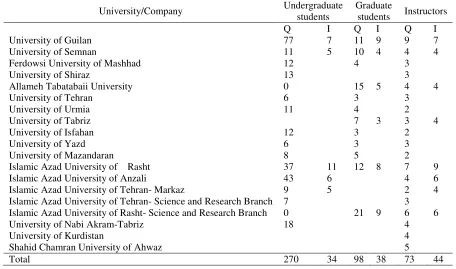
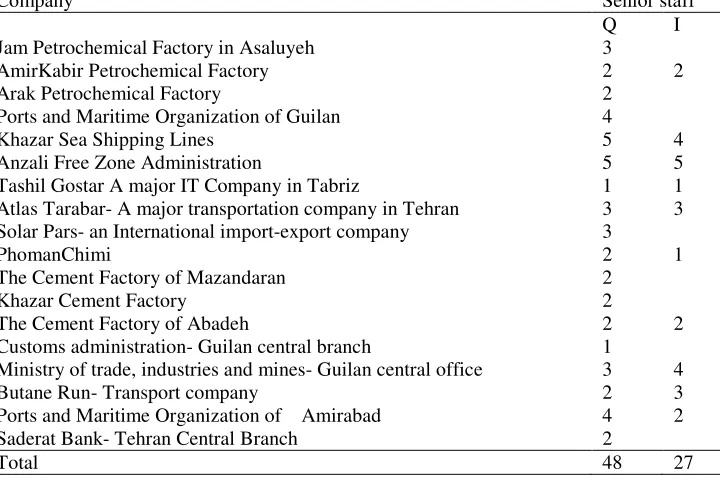
In the interview phase of the study 34 undergraduate students, 38 graduate students, 44 Instructors and 27 senior staff participated. Tables 1a and 1b summarize the distribution of the academic and professional participants (in the respect order) in the questionnaire and interview phases of the study.
Table 1a
Academic participants who took part in the questionnaire (Q) & interview (I) phases of the study
University/Company Undergraduate
students
Graduate
students Instructors
Q I Q I Q I
University of Guilan 77 7 11 9 9 7
University of Semnan 11 5 10 4 4 4
Ferdowsi University of Mashhad 12 4 3
University of Shiraz 13 3
Allameh Tabatabaii University 0 15 5 4 4
University of Tehran 6 3 3
University of Urmia 11 4 2
University of Tabriz 7 3 3 4
University of Isfahan 12 3 2
University of Yazd 6 3 3
University of Mazandaran 8 5 2
Islamic Azad University of Rasht 37 11 12 8 7 9
Islamic Azad University of Anzali 43 6 4 6
Islamic Azad University of Tehran- Markaz 9 5 2 4
Islamic Azad University of Tehran- Science and Research Branch 7 3
Islamic Azad University of Rasht- Science and Research Branch 0 21 9 6 6
University of Nabi Akram-Tabriz 18 4
University of Kurdistan 4
Shahid Chamran University of Ahwaz 5
Table 1b
Professional participants who took part in the questionnaire (Q) & interview (I) phases of the study
Company Senior staff
Q I
Jam Petrochemical Factory in Asaluyeh 3
AmirKabir Petrochemical Factory 2 2
Arak Petrochemical Factory 2
Ports and Maritime Organization of Guilan 4
Khazar Sea Shipping Lines 5 4
Anzali Free Zone Administration 5 5
Tashil Gostar A major IT Company in Tabriz 1 1
Atlas Tarabar- A major transportation company in Tehran 3 3
Solar Pars- an International import-export company 3
PhomanChimi 2 1
The Cement Factory of Mazandaran 2
Khazar Cement Factory 2
The Cement Factory of Abadeh 2 2
Customs administration- Guilan central branch 1
Ministry of trade, industries and mines- Guilan central office 3 4
Butane Run- Transport company 2 3
Ports and Maritime Organization of Amirabad 4 2
Saderat Bank- Tehran Central Branch 2
Total 48 27
2.3 Procedure
One of the researchers personally visited the universities and companies to conduct and tape-record the interviews with participants taking part in this phase of the study. Before starting the visit, the preliminary arrangements for meeting with the officials in charge of the companies were made. As to the academic participants, one of researchers, prior to the interview, met with the instructors in their offices on individual bases to explain the purpose of the interviews. Next, consultation with the students took place in an arranged session before or after their class meetings. At the end of each interview the time for the questionnaire distribution was coordinated.
The data obtained through interviews was analyzed qualitatively and quantitatively. The summarized data were then incorporated in the next step which was the preparation of the first drafts of two sets of questioners: Academic and Occupational. The academic questionnaire was directed to 43 students of the University of Guilan. The results delivered were used to estimate the reliability of different parts of the questionnaire through Cronbach’s alpha measure of reliability. However, the estimated reliabilities were below the minimum acceptable quantity. Then in the course of some discussions held with a number of the participants among whom there were a few Subject-Specific Instructors and EFL teachers, they stated they had found numeral items of the questionnaire ambiguous. Others believed a few items were unnecessary but, on the other hand, several vital ones were missing which should be added to the questionnaire. The questionnaire was finally modified significantly; a new one was constructed then was again forwarded to the same groups of undergraduate and graduate students. The estimated reliability of the questionnaire based on evaluation of the responses received from students for the three sections of the questionnaire was .932, .978, and .892 respectively.
To collect as much information as possible, electronic versions of the questionnaires were also emailed to almost all the subject-specific and ESP instructors engaged in teaching Business Administration of all state universities and several Islamic Azad universities, and a total of 51 major industrial and commercial companies across the country. The instructors were requested, in addition to answering the questions of the questionnaires, also through electronic devises pervade the list to, as many of their students or colleagues as possible.
2.4 Data analysis
The study follows a post-facto design in order to describe the current status of Business Administration students’ Special Language needs and wants and also to investigate the degrees of consistency associated with the ESP courses and the related specified needs. All the data obtained were run through the Statistical Package for Social Sciences (SPSS) along with Microsoft Excel Spread sheet. The transcripts of the interviews were analyzed using descriptive statistics. The responses of the questionnaires were first coded and summarized into a single data set to compare the views expressed by the four groups of respondents. Pearson Chi-square values were computed for each item of the questionnaires. The values indicated that while there were similarities in the response patterns of individual members within each group, the total group responses were, nevertheless, independent of one another for most items. Table 2 shows the Chi-square values for the 8 items of the listening section in the faculty questionnaires and their occupational counterpart items in professional questionnaire.
Table 2
Pearson chi-square test results for the 4 items of listening section
Item# Value df Asymp. Sig.
(2-sided)
Exp. count
Less than 5 Min. expected count
Q1 25.388 10 0.005 0 5.96
Q2 42.006 15 0 0 5.10
Q3a 80.382 10 0 1 4.63
Q3b 24.958 10 0.005 2 3.48
Q4a 56.206 10 0 0 5.30
Q4b 41.03 10 0 3 2.48
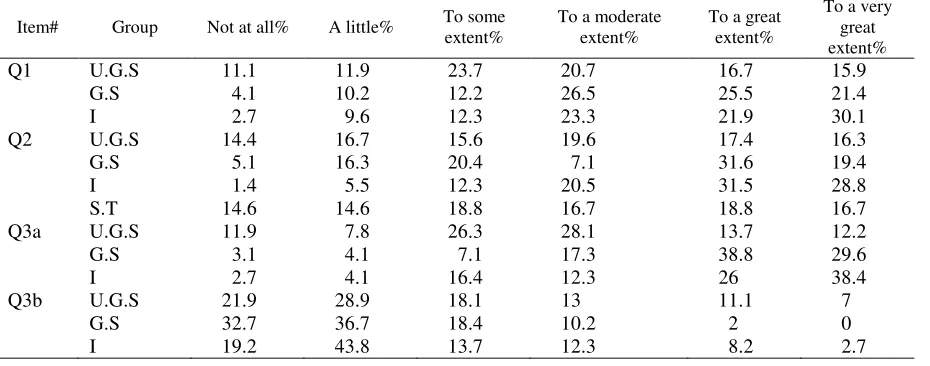
The responses of four group participants were then cross-tabulated for each item. To aid display of the comparisons between the group responses, the data was summarized. Table 3 presents the percentile frequencies of the first five items of part B of faculty questionnaires and their counterpart items in occupational questionnaire.
Table 3
Cross-tabulation results of the three items of the questionnaires for the four groups
Item# Group Not at all% A little% To some
extent%
To a moderate extent%
To a great extent%
To a very great extent%
Q1 U.G.S 11.1 11.9 23.7 20.7 16.7 15.9
G.S 4.1 10.2 12.2 26.5 25.5 21.4
I 2.7 9.6 12.3 23.3 21.9 30.1
Q2 U.G.S 14.4 16.7 15.6 19.6 17.4 16.3
G.S 5.1 16.3 20.4 7.1 31.6 19.4
I 1.4 5.5 12.3 20.5 31.5 28.8
S.T 14.6 14.6 18.8 16.7 18.8 16.7
Q3a U.G.S 11.9 7.8 26.3 28.1 13.7 12.2
G.S 3.1 4.1 7.1 17.3 38.8 29.6
I 2.7 4.1 16.4 12.3 26 38.4
Q3b U.G.S 21.9 28.9 18.1 13 11.1 7
G.S 32.7 36.7 18.4 10.2 2 0
In the next section, the appropriate outcome of each item, along with the explanations for each which were achieved throughout the interviews are furnished in details.
3. Results
3.1 General language proficiency
Concerning the foreign language general skills, many academic participants (ranging from 62% to 86%) believed that the students’ productive language skills, namely speaking and writing are to be greatly improved. Many graduate students reported that they lacked the experience or confidence to speak in group discussions or class presentations as they hardly ever had the opportunity to prepare for such tasks. Some under-graduate students also reported that they had a great desire to develop their communicative abilities, however; they were either too late to undertake the task or too confused to realize how to go about doing it.
Regarding the reading ability, although 48% to 52% of the students rated their own ability as good or very good, but, 67% of the instructors believed that the students’ reading ability was poor or very poor. 56% of undergraduate and 63% of graduate students asserted their listening skill as good or very good. In average, 71% of the ESP instructors assessed the students’ listening (audio comprehension) capabilities as being undesirable or totally disappointing. Many students reported they spent a considerable time period watching quite a few movies, T.V shows, internet clips, news and similar entertainments, or getting involved in the related correspondence, mainly for the improvement of their listening skills; but apparently these reports by the students either didn’t satisfy the instructors’ expectations of the task or the time consumed for the effort was not sufficient enough to produce convincing results.
3.2 Listening:
From 77% to 87% of the students and instructors believed that listening skills are greatly important in students’ academic and professional success. Some subject-specific instructors pointed out that it was essential for the students to understand “educational multimedia materials”. Most undergraduate students reported that they rarely had the chance to attend seminars, at which English is spoken rather than Persian; and furthermore, the class presentations and lectures were all conducted in Persian rather than in English.
There was a great desire among many of the interviewed students to develop their ability to “understand conversations on general topics”. Some senior staff, similarly, stated that, because of being in continuous contact with foreign businesses, it was necessary for them to have a good understanding of general and every day conversations. About 70% to 90% of the respondents believed that “understanding English mass media” is not very beneficial for the students. Many ESP instructors stated that the skill is definitely beyond the scope of most students whose general language ability is not adequate enough to grasp much simpler connections; furthermore, it would be impossible to improve the required skill by taking only a limited number of ESP courses.
The majority of the respondents from all the three groups believed that no, or very little, effective instruction is provided during ESP courses to improve students’ listening skills in the areas already reviewed.
3.3 Reading:
the need to refer to professional journals. Some added that journals normally reflect a foreign system of management which is, in most cases, significantly different from our national managerial system. Some subject-specific instructors indicated that the students should learn the principles contributing to preparation of business contracts and agreements, due to the extent of a large variety of contracts and agreements. Some senior staff members, proclaimed as a part of their job requirements, they were expected to read, summarize and interpret business contracts and agreements. From 74.1% to 85.4% of all four groups of participants rated the related item as being either “moderately” or “greatly important”.
From 41.9% to 71.2 % of three academic groups of participants maintained that “reading texts on the internet” was crucially important. Among the four groups of participants, most of the instructors and a few of the other three groups rated the item “reading English newspapers and magazine” as very important as the importance of “reading international rules and regulations” was more for the senior staff group rather than the academic group.
Regarding the effectiveness of the ESP courses in improving students’ reading skills, the responses of the participants followed a very similar pattern. While the importance of the reading skill, particularly for academic purposes, was greatly emphasized by all the academic groups, the amount of time designated to reading instructions, and the effectiveness of such pretention derived very little attention involving the views of the same respondents.
3.4 Speaking:
The participants’ responses to the items on the role of speaking skill in students’ academic study followed a relatively similar pattern among the three academic groups, 42% to 44 % of them considered the skill “moderately” important. Most ESP instructors argued that neither was the students’ speaking skill adequate enough to get themselves orally involved in class activities, nor was there enough time in ESP courses to practice speaking. In short, the priority in these classes was not given to oral skills.
Regarding the importance of the speaking skill in occupational environments, the three academic groups and senior staff members had relatively similar opinions. From 38% to 53% of them rated this item as “highly important”. However, the same pattern of similarity for the responses of academic groups and senior staff did not exist for the sub-skills of speaking. 54% of the senior staff of the companies and 48% of the instructors ranked “having telephone conversations at work” as “greatly important”, while most graduate and undergraduate students did not support this view. Some of senior staff (particularly those working in private sector) reported that business-related international telephone conversations (especially over the internet) was an indispensable part of their everyday work routines.
Many of the senior staff reported that they had almost never had the experience or the need of conducting their job-related presentations in English and the same was true about half of the academic participants in all three groups .
While “job interview in English” was regarded as being “greatly important” by most of the graduate students and subject-specific (from 53.5% to 55.1%), only a few of the undergraduate and senior staff members (from 20.8% to 31.1%) found it highly important. A few senior Staff reported that major governmental companies in Iran do not conduct job interviews in English. 58.7% of the senior staff members and just a few of academic groups regarded “Asking and answering job related questions” as highly important and all four groups of participants stated “talking with professional in valid situations” as being “greatly important”.
3.5 Writing:
From 54.1% to 63% of the members of each three chosen academic groups believed that writing skill is of immense importance to the Business Administration students’ academic prosperity. Among the academic sub-skills of writing, “writing academic articles” received the highest degree of significance. According to the assumptions expressed by many subject-specific instructors in the interview phase: for the higher education system of Iran, movement from passive knowledge to an active engagement requires crucially vital efforts by all interested entities, governmental or else, to encourage the students, particularly those enrolling in graduate schools to improve their writing.
Some graduate students also reported that they were desperately in need of reliable translators, familiar with Business Administration plans and terminologies to translate their articles into English. Some also mentioned that their written articles had repeatedly been rejected by many professional journals because of poor writing. From 38% to 63% of participants emphasized the need for “taking notes during class or business presentations or lectures” and also on “taking notes from reading books and articles”. A large number of graduate students stated that they were in need of consulting several articles, reviewing notes extracted from those articles, and summarizing them all before feeling ready for organizing the “review of literature” sections of their own articles. 71.3% of the instructors regarded “answering questions in written exams” as “greatly important”. Some believed that students were likely to become motivated to improve their writing skills if they had to answer a few questions in their midterm or final exams in English.
Concerning the importance of occupational writing skills from 43% to 56% of the participants of all four groups regarded this item as “to a great extent” or “to a very great extent” important. 60.4% of the senior staff believed that “business correspondence” is of great importance. Some members of this group also reported writing business letters was an “indispensable” part of their everyday job routine. Most senior staff of the companies regarded the two items of “writing resumes” and “writing job application” as “moderately important”. These skills, however, received a superior attention from the members of the academic groups (varied from 34% to 56%). A few graduate students reported that several major private companies required the applicants to submit an English version of their resumes and that some companies assessed the applicants writing abilities through their English job applications.
Some of the interviewed senior staff members stressed that they had the obligation of preparing their companies sales contracts by the assistance of the legal department of the company. They added that these contracts varied from case to case, depending on the transactions taking place. Moreover, some pointed out that translation of business contracts is not highly recommended mainly because of the variations in the legal complication and also due to the cultural misunderstanding of the contents subject to translation. Setting “writing performance, invoices and certificate of origin and other business documents” as a separate item in the script section was due to the high attention allocated by many senior staff. Most participants regarded the writing instruction in ESP courses ineffective. Many graduate students reported that they had received no or very little meticulous writing instructions in class sessions throughout the period of the courses.
3.6 ESP courses
therefore, their classes apparently were almost the same as those of general English classes.
Regarding the items about the ESP books and material used in ESP courses, from 91.8% to 95.9% of the members of the academic groups reported that they made no, or very little, use of the multimedia materials in their ESP courses, mostly because the universities did not provide enough multimedia equipment. Most of the instructors interviewed, particularly, subject-specific instructors, showed strong agreement about using some English textbooks. The majority of the respondents noted that the ESP courses were neither in accordance with the students’ language proficiency nor do they encompass the expertise to accomplish their proficient language requirements. From 48.9% to 83.7% of the academic groups of participants, reported that the topics selected for ESP books were not updated but recklessly simplified and that they were not offered sufficient time to fully cover the ESP books during the course.
77.1% of the undergraduate and 50% of the graduate students respectively believed that there were excessive numbers of students in ESP classes, whereas 75.4% of the instructors believed that the classes were moderately crowded and most of the three groups (varied from 40.8% to 65.8%) stated that students had a moderate chance to benefit from the class participation. While 64.4% of the instructors were strongly in favor of increasing the designated ESP score of the specific language associated with entrance exam for graduate studies, very few of the two students (9.3% to 12.2%) agreed with the statement. On the other hand, while 76.2% of the undergraduate and 71.4% of the graduate students believed that the course duration for the special language during the undergraduate studies was not sufficient to prepare the students for the English section of the entrance exam of graduate schools, 61.6% of the instructors admitted that the course duration was adequate to prepare the volunteers only to an average level of proficiency, not to a high level.
4. Conclusion and discussion
This study was conducted to develop a comprehensive profile of Specific Language needs of Business Administration from all the stakeholders’ perspectives- students (graduates and undergraduates), instructors (subject-specific and EFL teachers) and some senior staff members of the commercial as well as promotional sectors of some of the largest industrial and service-providing companies of Iran.
The first two research questions explored the prospective and attitudes of the participants regarding the EAP and EOP needs of the students:
The findings of the study revealed that, along the conventional emphases on the role of reading proficiency in students’ academic success, there was a growing need toward the other three related skills as well. The overwhelming majority of the participants emphasized the significant role of listening, speaking and writing based-tasks items in the questionnaire. Students, particularly those at graduate level, demanded that a sufficiently proactive type of instructions ought to be presented to prepare them for real-life language connected activities. Proficiency is only one rephrase; therefore; it cannot, by itself, suffice in achieving the objectives. This finding is in accordance with what has already been reverberated in ESP literature within Iranian settings (Eslami, 2010; Eslami-Resekh & Valizade, 2004; Alavi&Tahririan, 1996; Atai, 2002).
The majority of the participants tend to learn and convey knowledge, along with conventional methods, through more interactive procedures including, “multimedia materials, class presentations and class discussions”. Many students also preferred learned-centered classes as well as more participation in class activities. Besides, students expect to develop their occupational language skills before graduating from college and starting their career. In some cases, students even gave the priority to professional language requirements (long-termed needs) than academic language needs (immediate needs). This view stresses that specific English courses offered in Business Administration schools are not sufficient to cover the occupational English needs of the students.
The findings of the study revealed that the students were in “great” need of increasing their general language proficiency in English, particularly their writing and speaking skills. These results seem to be supported by the findings of the studies by Eslami (2010), Mazdayasna& Tahririan (2008) and Atai& Nazari (2011). Improvements of language skills of spoken, listening and writing in both academic and work- related surroundings were badly needed. According to the answers of different groups of participants it seems that none of these skills are effectively facilitated during ESP courses. Although almost the whole class time in most higher education institutions was spent on reading-based activities, most participants did not regard the ESP courses to improve their reading skills effectively. The use of traditional grammar translation method still prevails in Iranian universities. (Farhady & Hedayati, 2009).
It was also reported that there was little emphasis on pre or post reading activities, summarizing, note taking, inferring, guessing the meaning of the words in context, scanning and skimming. Instead the mere use of bilingual dictionaries was reported to take a large portion of class time. It seems that participation in ESP classes does not necessarily make the student an efficient reader in their specific field. In fact, most of the students just have the ability of performing the tasks of translating some simple texts of their assignments into Farsi. This is also consistent with the conclusion drawn in the study by Atai & Nazari, 2003.
A significant modification of ESP books and materials seems to be unavoidable. The majority of the participants were dissatisfied with the inappropriate level of the ESP books. Moreover, most of them believed that the topics and the contents of the books were drastically outdated. Even though the Iranian center for studying and compiling University Books (SAMT) has published a series of textbooks for the students of management, as the participant ESP instructors teaching in different universities reported, the university instructors use materials of their own choice, assign dissimilar materials, not consistent with SMAT’s publications, a considerable number of them even compile their self-selected sources to teach. Therefore, as indicated in this study, materials presented without an overall supervisory coordination might not be consistent with at least many students’ needs, nor could it promote their proficiency level. Finally, as most graduate and ESP instructors pointed out, it was not possible to fully cover all the chapters in the textbooks during the course.
Most participants were dissatisfied with class size in ESP classes. Some ESP instructors reported that there were so many students in the class that there was no time for any individual learner-centered activities. The results of this study revealed that the ESP courses designed for Business Administration were conducted without the collaboration of or consultation with the specific discipline departments and without determining the students’ practical needs in syllabus development for Specific language purposes. The results of the study further indicated that the courses are inadequate to prepare the students to practically utilize their language capabilities to succeed in their academic or occupational outlook.
5. References
Alavi, S., & Tahririan, M. H. (1996). EFL learners’ proficiency and their performance on GPE and ESP collocations. Indian Journal of Applied Linguistics, 22(2), 91-101.
Atai, M. R. (2000). ESP revisited: a Reappraisal Study of Discipline-based EAP in Iran. Esfahan: Unpublished Doctoral Dissertation, University of Esfahan.
Atai, M. R. (2002). EAP curriculum planning in Iran: an incoherent educational experience. Journal of Faculty of Letters and Humanities, 9(3), 17-34.
Atai, M. R., & Nazari, O. (2011). Exploring reading comprehension needs of Iranian EAP students of health information management (HIM): A triangulated approach. System, 39, 30-43.
http://dx.doi.org/10.1016/j.system.2011.01.015
Atai, M. R., & Tahririan, M. (2003). Assessment of the status of ESP in the current Iranian higher educational system. LSP, Communication, Culture, and Knowledge Conference. Guilford: University of Surrey. Azizifar, A., Koosha, M., & Lotfi, A. R. (2010). An analytical evaluation of Iranian high school ELT textbooks
http://dx.doi.org/10.1016/j.sbspro.2010.07.010
Cohen, L., & Manion, L. (1994). Research Methods in Education (4th ed.). London: Routledge. Delshad, S. (2005). Teaching writing for academic purposes. Proceedings of the first national ESP/EAP
conference (Vol. II, pp. 154-166). Tehran: The center for research and development in humanities of SAMT.
Dudley-Evans, T., & Jo St John, M. (1998). Developments in English for Specific Purposes: A multi-disciplinary approach. Cambridge: Canbridge University Press.
Eslami Rasekh, Z. (2010). Teachers’ voice vs. students’ voice: A needs analysis approach to English for Acadmic Purposes (EAP) in Iran. English Language Teaching, 3(1), 3-11.
Eslami-Rasekh, Z., & Valizadeh, K. (2004). Classroom activities viewed from different perspectives: Learners’ voice vs. teachers’ voice. TESL EJ, 8(3), 1-13.
Farhady, H., & Hedayati, H. (2009). Language assessment policy in Iran. Annual Review of Applied Linguistics, 29, 132-141. http://dx.doi.org/10.1017/S0267190509090114
Hamp-Lyons, L. (2001). Fourth generation writing assessment. In T. Silva, & P. K. Matsuda, On second language writing (pp. 117-128 ). Mahwah, NJ: Lawrence Erlbaum Associates.
Hashemi, S. M. (2005). EAP materials evaluation in Iran: English for students of civil engineering. Proceedings of the first national ESP/EAP conference (Vol. II, pp. 218-249). Tehran: The center for research and development in humanities of SAMT.
Mahdavi Zafarghandi, A. (2005). Failure of meeting EST objectives. Proceedings of the First National ESP/EAP Conference (Vol. II, pp. 144-153). Tehran: The center for Research and Development in Humanities of SAMT.
Mazdayasna, G., & Tahririan, M. (2008). Developing a profile of the ESP needs of Iranian students: The case of students of nursing and midwifery. Journal of English for Academic Purposes, 277-289.
http://dx.doi.org/10.1016/j.jeap.2008.10.008
Moradi, F. (1996). An Investigation into the Problems of Teaching & Learning English in Tehran Province.
Shiraz: Unpublished Masteral Thesis, Shiraz University.
Rahimi, M. (1996). The study of English Language Instruction at the Secondary Schools of the Isfahan Province.
Shiraz: Unpublished Masteral Thesis, Shiraz University.
Rahimian, M. (2005). Developing communicative syllabus in ESP/EAP classes and how to deal with it in EFL situations. Proceedings of the first national ESP/EAP conference (Vol. II, pp. 86-98). Tehran: The center for research and development in humanities of SAMT.
Robinson, P. (1991). ESP today: A practitioner's guide. Hemel Hempstead: Prentice Hall.
Saadat, M. (1995). An investigation into the problems of teaching and learning English in the guidance and high schools of Fars Province. Shiraz: Unpublished Masteral Thesis, Shiraz University.
Yarmohammadi, L. (2000). Reflections on the Treatment and Contextualization of Pronunciation Practices and Language Functions in the Pre-university textbooks in Iran. Journal of Teaching Languages, 1(3), 1-21. Yarmohammadi, L. (2005). ESP in iran from language planning perspective. Proceedings of the first national
Appendix A
(Students’ Questionnaire)
Part A: Background Information
Level of Education: B.A ( ) M.A ( )
The name of the university: _____ Year of entrance: _____ Gender: Male ( ) Female ( ) Age: _____
Which of the following specialized English courses, you have passed? 1, 2 ( ) 3, 4( ) Your ESP instructor(s) was a subject- specific instructors ( ) and/or an EFL teacher ( )
Part B: Please check (√) the relevant choice for each question.
I. How do you evaluate your own proficiency concerning The English Language Listening Skill? ( ) very poor ( ) poor ( ) average ( ) good ( ) very good
II. How do you evaluate your own proficiency concerning The English Language Reading Skill? ( ) very poor ( ) poor ( ) average ( ) good ( ) very good
III. How do you evaluate your own proficiency concerning The English Language Speaking Skill? ( ) very poor ( ) poor ( ) average ( ) good ( ) very good
IV. How do you evaluate your own proficiency concerning The English Language Writing Skill? ( ) very poor ( ) poor ( ) average ( ) good ( ) very good
Please check (√) the relevant choice for each of the following questions.
(The values of the answers are as follow: 1=Not at all, 2= A little, 3= To some extent, 4= To a moderate extent, 5= To a great extent, 6= To a
very great extent)
Part C: In each table, column ‘a’ deals with English language requirements of management students, whereas column ‘b’ deals with the evaluation of the current ESP courses.
Listening
1. How important do you think Listening Skill is regarding the students' academic success? 1 2 3 4 5 6 2. How important do you think listening skill is regarding the students' (future)
occupational status? 1 2 3 4 5 6
Listening sub skills a) importance of the skill b) amount of efficient instruction that you received during ESP courses 3. Understanding educational multimedia
materials 1 2 3 4 5 6 1 2 3 4 5 6
4. Understanding academic lectures and
presentations 1 2 3 4 5 6 1 2 3 4 5 6
5. Understanding conversations on general
topics 1 2 3 4 5 6 1 2 3 4 5 6
6. Understanding meetings and
presentations at work 1 2 3 4 5 6 1 2 3 4 5 6
7. Understanding instructions at work 1 2 3 4 5 6 1 2 3 4 5 6
8. Understanding English mass media 1 2 3 4 5 6 1 2 3 4 5 6
Reading
9. How important do you think Reading Skill is regarding the students' academic success? 1 2 3 4 5 6 10. How important do you think Reading skill is regarding the students' (future)
occupational status? 1 2 3 4 5 6
Reading subs kills a) importance of the skill b) amount of efficient instruction that you received during ESP courses
11. Reading textbooks 1 2 3 4 5 6 1 2 3 4 5 6
12. Reading articles in professional journals 1 2 3 4 5 6 1 2 3 4 5 6
13. Reading texts on the internet 1 2 3 4 5 6 1 2 3 4 5 6
14. Reading business corresponding 1 2 3 4 5 6 1 2 3 4 5 6
15. Reading English newspaper and
magazine 1 2 3 4 5 6 1 2 3 4 5 6
16. Reading contracts 1 2 3 4 5 6 1 2 3 4 5 6
17. Reading about international trade rules
and regulations 1 2 3 4 5 6 1 2 3 4 5 6
Other skills (please specify)
Speaking
18. How important do you think Speaking Skill is regarding the students' academic
success? 1 2 3 4 5 6
19. How important do you think Speaking skill is regarding the students' (future)
occupational status? 1 2 3 4 5 6
Speaking subs kills a) importance of the skill b) amount of efficient instruction that you received during ESP courses 20. Participating in academic discussions 1 2 3 4 5 6 1 2 3 4 5 6 21. Asking and answering questions in
class 1 2 3 4 5 6 1 2 3 4 5 6
22. Speaking at seminars and class
presentations 1 2 3 4 5 6 1 2 3 4 5 6
23. Conducting job interviews 1 2 3 4 5 6 1 2 3 4 5 6
24. Having telephone conversations at work 1 2 3 4 5 6 1 2 3 4 5 6 25. Speaking at job presentations and
meetings 1 2 3 4 5 6 1 2 3 4 5 6
26. Asking and answering job
corresponding questions 1 2 3 4 5 6 1 2 3 4 5 6
27. Talking with professionals in valid
situations 1 2 3 4 5 6 1 2 3 4 5 6
Other skills (please specify)
Writing
28. How important do you think Writing Skill is regarding the students' academic success? 1 2 3 4 5 6 29. How important do you think Writing skill is regarding the students' (future)
occupational status? 1 2 3 4 5 6
Writing subs kills a) importance of the skill b) amount of efficient instruction that you received during ESP courses 30. Taking notes during lectures and
presentations 1 2 3 4 5 6 1 2 3 4 5 6
31. Taking notes from textbooks and
articles 1 2 3 4 5 6 1 2 3 4 5 6
32. Answering questions in written exams 1 2 3 4 5 6 1 2 3 4 5 6
33. Writing professional articles 1 2 3 4 5 6 1 2 3 4 5 6
34. Writing business corresponding (letters,
emails) 1 2 3 4 5 6 1 2 3 4 5 6
35. Writing CVs and resumes 1 2 3 4 5 6 1 2 3 4 5 6
36. Writing job applications 1 2 3 4 5 6 1 2 3 4 5 6
37. Designing and administrating contracts 1 2 3 4 5 6 1 2 3 4 5 6
38. Writing reports 1 2 3 4 5 6 1 2 3 4 5 6
39. Preparing Performa, invoice, certificate
of origin, etc. 1 2 3 4 5 6 1 2 3 4 5 6
Part D:
40. Subject teachers as ESP instructors ought to be management school graduates. 1 2 3 4 5 6 41. Subject teachers as ESP instructors ought to be EFL graduates familiar with managerial
perceptions. 1 2 3 4 5 6
42. Some of the essential management textbooks ought to be both published and also
taught in English. 1 2 3 4 5 6
43. ESP courses ought to be presented and demonstrated in English. 1 2 3 4 5 6 44. ESP score should be increased regarding MA entrance exam. 1 2 3 4 5 6 45. ESP courses presented in university fulfill the needs of students' prospective
occupational status. 1 2 3 4 5 6
46. ESP courses fulfill students' Academic language needs. 1 2 3 4 5 6 47. ESP materials are in shape with students' language capacity. 1 2 3 4 5 6 48. The content of ESP text books selected is in accordance with the students' needs. 1 2 3 4 5 6 49. ESP text books are updated and profoundly satisfactory. 1 2 3 4 5 6 50. It has been possible for students' to get actively and effectively involved in ESP classes. 1 2 3 4 5 6 51. ESP Instructors seemed to poses the proper linguistic knowledge required to teach the
courses. 1 2 3 4 5 6
52. ESP Instructors were sufficiently familiar with managerial perceptions. 1 2 3 4 5 6 53. There was enough time to cover the whole ESP text books presented in the course. 1 2 3 4 5 6 54. Multimedia materials were provided sufficiently to fulfill the needs. 1 2 3 4 5 6 55. There were a suitable number of students in every class (classes were not
overcrowded). 1 2 3 4 5 6
56. Passing ESP courses was sufficient to get successfully prepared for the graduate