The Effect of Induced Positive and Negative
Mood on Creativity
Masomeh Rahimi, MA
Department of Psychology Semnan University, Semnan, Iran
Parviz Sabahi, PhD*
Department of Psychology Semnan University, Semnan, Iran
Iman-allah Bigdeli, PhD
Department of Psychology Ferdowsi University, Mashhad, Iran
Doi: 10.24200/ijpb.2018.115424
Received: 28/ 12/ 2016 Revised: 23/ 5/ 2018 Accepted: 13/ 6/ 2018 Mood has a significant effect on interpersonal and intrapersonal output. Among the intrapersonal outputs, creativity can be mentioned. Presently, one of the principle purposes of educational systems is to enhance and promote creativity in people. The aim of this study is to examine the effect of inducing positive and negative moods on the creativity of university students. A sample including 20 female participants was randomly chosen from Semnan University using the simple random sampling method. A combination of vignette and music were used for mood induction. Each participant was evaluated in three stages: induction of neutral mood, induction of positive mood, and, finally, induction of negative mood. To control the effect of intervention transfer, the order of interventions was counterbalanced. For manipulation, checking the mood of PANAS was used. To assess creativity, the TORRENCE scale (Form B) was used. Multivariate analysis of variance with repeated measures was utilized for data analysis. The results showed that positive mood induction has a significant effect on creativity components that involve flexibility, elaboration, fluency, and originality. The results of this research were consistent with other findings, demonstrating that inducing a positive mood had an effect on creativity. These findings were explained with a consideration of theatrical and empirical basics.
IPA
International Journal of Psychology Vol. 13, No. 1, Winter & Spring 2019
PP. 5-21
Keywords: induced mood, positive mood, negative mood, creativity.
Man, as a socio-emotional being, is constantly adapting himself to the environment. In this respect, interpersonal emotions are very important in social perception and generating
interpersonal relationships (Dalgleish & Power, 1999). Mood can
be divided into two positive and negative categories. A positive mood involves states such as happiness and joy; a negative mood,
on the other hand, involves anger and fear (Langley, 2011). In
terms of performance, it is said that sadness and grief increase stress and anxiety levels in people and the pressure of that stress
can reduce performance level (Robinson, Overstreet, Letkiewicz
& Grillon, 2012). Furthermore, it has been mentioned that a positive mood enhances an individual's adaptability, cognitive
processing, and problem-solving capacities (Langley, 2011).
Mood has a significant effect on intrapersonal outputs such as
creativity and decision-making (Dalgleish & Power, 1999). The
improvement of the mood of a student can increase the creativity
and flexibility of a student (Biss, Hasher & Thomas, 2010; Biss
& Hasher, 2010). When a person’s attention level is low, positive mood can affect a wide range of cognitive processes, such as
creativity, talent, problem-solving, and language skills (Biss &
Hasher, 2010). Positive mood avoids processing redundant cognitive materials and increases cognitive flexibility, which
leads to the increase of novelty and originality (Baas, Dreu &
Nijstad, 2008; Davis, 2009). Different forms of creativity have
been proposed in recent years (Colton, Charnley & Pease, 2011).
For certain people, creativity involves producing something novel (Andreasen, 2011), which has a mental value, such as a joke, a
painting, or a music composition (Biss, Hasher & Thomas, 2010;
problems in the most novel very possible (Williamson, 2011). The concept of creativity demonstrates the differences that people show while providing new solutions from older solutions (Hennessey & Amabile, 2010).
Creativity in knowledge is the way to solve problems and
generate new and novel solutions (Newton & Donkin, 2011). The
concept of creativity focuses on the three following aspects: 1)
process, 2) unique characteristics, and 3) the product (Babalisa,
Xanthakoub, Kailac & Stavroud, 2012). To grasp the concept of creativity, we should have a better understanding of the cognitive
processes involved in creative thinking (Silvia, Wigert,
Reiter-Palmon, James & Kaufman, 2012). Creativity enables people to solve difficult problems in various fields and to generate new and novel solutions. Characteristics such as mental flexibility, curiosity, broad imagination, interest in finding solutions, creating metaphors, and goal-based thinking lead to development
of creative thinking (Aizikovitsh-Udi & Amit, 2011).
Numerous methods are used for enhancing creativity. For instance, in one method, students were challenged to find and resolve problems. The prerequisite for the growth of creativity in individuals is that they both have the motivation and the ability
for executing new ideas (Byrge & Hanson, 2009). When
knowledge and ability are low, there is a negative correlation between creativity and execution. The relationship between creativity, ideas, and executing ideas may be lower than the relationship between the quality of ideas and their execution (Baer, 2012).
seems that creativity is connected with mood. Slight negative feelings can increase creativity by producing powerful thinking
and building up perseverance (Baas et al., 2008). Even within a
short span of time, mood affects both cognitive and emotional creativity. It has been mentioned that negative mood leads to an improvement in creative thinking and originality. On the other hand, positive mood enhances creative thinking by enhancing
cognitive flexibility (Daviesa, Jindal-Snapeb, Collier, Digbya,
Haya & Howea, 2013).
Furthermore, it has been shown that happy music, by inducing
a positive mood, leads to increased cognitive capacity (Langley,
2011). In learning environments, mood can help one creatively
solve problems (Norman, 2003). Developing an individual’s
capability to generate new ideas has an important role in
education (Daviesa et al. 2013). In addition, it is obvious that
learning environments (including schools, institutions, and universities) are places where a wide range of emotions are experienced.
Method
Instrument
Inducing Positive and Negative Mood
For inducing mood, a combination of two mood-induction methods, the guided imagery based on vignette and music, were used for positive and negative mood induction. The combination of imagery and music practices is the most effective method for inducing mood. In order to induce any mood state, participants either read the positive or negative events described in the vignette while they listen to music and imagine themselves experiencing the events described. This method was previously
applied by Rafieinia, Azadfallah, Fathi-Ashtiani &
Rasoulzade-Tabaei (2007). Two examples of vignettes that were used are as follows:
- Joyful text with Joyful Music (You will win 50 million in
a lottery and take a wonderful trip).
- Sad text with Sad Music (Doctors have diagnosed one of
your close relatives with cancer and said that she/he will live for a short time).
Rafieinia et al. (2007) explain that in order to produce the desired musical pieces, first, certain happy and sad pieces of Iranian
music were selected, and then, 10 students evaluated the
emotional content of the pieces of music; then, both the happy and sad pieces of music which had the highest assessments were selected.
Torrance Test for Creative Thinking (TTCT-B)
The Torrance test for creative thinking (Form B) was used for measuring the creativity of students. This test is widely used for
evaluating creative thinking (Kerr & Gagliardi, 2006). The
between .75 and .80 through the test-retest method (Pear-khaefe, Burj-ali, Delavar & Eskandari, 2011).
Positive and Negative Affect Scale (PANAS)
For the manipulation check, the moods of the participants were measured before and after the test by the Positive and Negative Affect Scale. The scale consists of 10 items related to positive mood and 10 items related to negative mood. A significant difference between the moods of participants was found by
comparing the scores of after and before intervention. Watson,
Clark, and Tellegen (1988) reported the validity and reliability of the scale as .90 for positive affect and .84 for negative effect. In
the research of Rafeienia et al. (2007), Cronbach's alpha was
reported as .93 for positive affect and .95 for negative affect. The results of manipulation-checking are presented in Table 1.
Table1
Results of Manipulation-Checking
Before Mood Induction
After Mood Induction Mean
Difference sig
Negative Negative mood after negative
induction
-8.15 .014
Positive Positive mood after negative
induction
9.15 .041
Negative Negative mood after positive
induction
2.22 .0001
Positive Positive mood after positive
induction
-3.92 .002
Procedure
The participants were invited to the Psychology Department lab and while explaining the process of the experiment, informed consent was obtained. Initially, the participants took a pre-test, involving the PANAS and the Torrance scale for assessing their creativity. After a day, the second stage was executed. In this stage, with the use of the counterbalancing method for controlling the intervention transmission effect, positive mood was induced in 10 participants and negative mood was induced in 10 other participants. Then, while the participants were listening to music, the Torrance scale and PANAS measurements were taken. The next stage was executed after a day; in this stage, positive mood was induced in the participants, who were previously induced with a negative mood. A negative mood was induced in the participants that were previously induced with a positive mood. Then, while participants were listening to music, the Torrance scale and PANAS measurements were taken. To analyse the data, descriptive and inferential statistics (MANOVA with repeated measures) were used.
Results
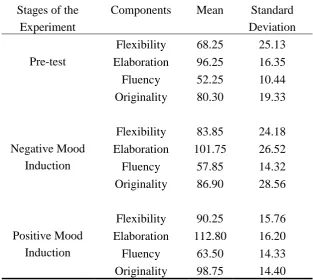
The descriptive results, including the mean and standard deviation of the research variables, are presented in Table 2.
Table 2
Descriptive Results of the Research Variables
Stages of the Experiment
Components Mean Standard
Deviation
Pre-test
Flexibility 68.25 25.13
Elaboration 96.25 16.35
Fluency 52.25 10.44
Originality 80.30 19.33
Negative Mood Induction
Flexibility 83.85 24.18
Elaboration 101.75 26.52
Fluency 57.85 14.32
Originality 86.90 28.56
Positive Mood Induction
Flexibility 90.25 15.76
Elaboration 112.80 16.20
Fluency 63.50 14.33
Originality 98.75 14.40
Table 3
Mauchly's Test for Assessing the Assumption of the Equality of the Covariance Matrix
Within Subjects
Effect
Components Mauchley's W Chi-squared Test
df Sig
Mood
Flexibility .72 5.73 2 .57
Elaboration .85 4.61 2 .51
Fluency .89 2.06 2 .35
As indicated in Table 3, the assumption of the equality of the covariance matrix is validated.
Table 4
Multivariate Analysis of Variance for Assessing the Effect of Mood Induction on Creativity
Effect Test Value F Sig Partial Eta
Square
Power
Within subjects
Pillai's trace
.86 9.80 .0001 .86 .99
As indicated in Table 4, the F-value is significant at the p<.0001 level. This fact demonstrates the effects of positive- and negative-mood induction on creativity processes. Considering Eta square, mood induction explains 86 percent of variance between creativity processes.
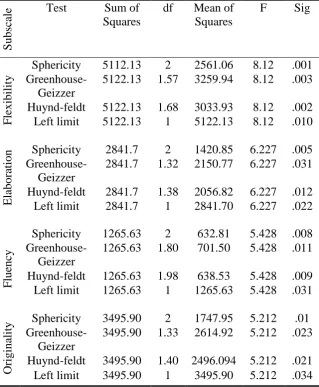
As presented in Table 5, the F-value of each of the creativity components, including flexibility, elaboration, fluency, and originality is significant for univariate tests. Thus, positive and negative mood induction had a significant effect.
Table 5
Univariate Analysis of Variance for Assessing the Effect of Mood Induction on Creativity
S
ubsc
ale Test Squares Sum of df Mean of Squares F Sig
F
lexibil
it
y
Sphericity 5112.13 2 2561.06 8.12 .001
Greenhouse-Geizzer
5122.13 1.57 3259.94 8.12 .003
Huynd-feldt 5122.13 1.68 3033.93 8.12 .002
Left limit 5122.13 1 5122.13 8.12 .010
Ela
bora
ti
on Sphericity 2841.7 2 1420.85 6.227 .005
Greenhouse-Geizzer
2841.7 1.32 2150.77 6.227 .031
Huynd-feldt 2841.7 1.38 2056.82 6.227 .012
Left limit 2841.7 1 2841.70 6.227 .022
F
luenc
y
Sphericity 1265.63 2 632.81 5.428 .008
Greenhouse-Geizzer
1265.63 1.80 701.50 5.428 .011
Huynd-feldt 1265.63 1.98 638.53 5.428 .009
Left limit 1265.63 1 1265.63 5.428 .031
Or
igi
na
li
ty Greenhouse-Sphericity 3495.90 2 1747.95 5.212 .01
Geizzer
3495.90 1.33 2614.92 5.212 .023
Huynd-feldt 3495.90 1.40 2496.094 5.212 .021
Table 6
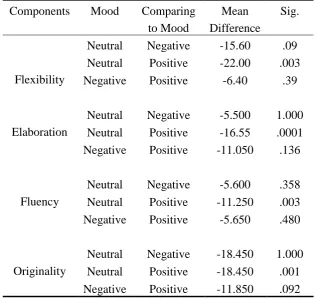
Pair-wise Comparisons of Creativity Processes in Neutral, Positive, and Negative Moods
Components Mood Comparing
to Mood
Mean Difference
Sig.
Flexibility
Neutral Negative -15.60 .09
Neutral Positive -22.00 .003
Negative Positive -6.40 .39
Elaboration
Neutral Negative -5.500 1.000
Neutral Positive -16.55 .0001
Negative Positive -11.050 .136
Fluency
Neutral Negative -5.600 .358
Neutral Positive -11.250 .003
Negative Positive -5.650 .480
Originality
Neutral Negative -18.450 1.000
Neutral Positive -18.450 .001
Negative Positive -11.850 .092
Discussion
The current study results show that positive mood has a significant effect on the components of creativity, involving elaboration, flexibility, fluency, and originality. In this context, Newton (2012); Lewis, Havilland & Barrett (2013); Davis (2009); Norman (2003); and Daviesa et al. (2013) can be mentioned as study results that are coordinated with the findings
determined that music can enhance creative abilities by generating special mental states and cognitive abilities.
Positive mood can lead to the generation of greater motivation, attention, and new ideas. Positive moods also lead to the production of creative solutions and these creative solutions help
a person by using useful strategies for learning (Van Kleef, De
Dreu & Manstead, 2010; Van Kleef, Homan, Beersma, van Knippenberg, van Knippenberg, Damen, 2009). Positive mood leads to rationality and generates pleasant feeling in calling for challenges and problems with initiatives in hand; through the creativity that it induces, positive mood provides the necessary
qualifications for the deployment of issues (Baas et al., 2008). As
mentioned earlier, positive mood leads to growth in creative
thinking through increased mental flexibility (Biss & Hasher,
2010). In addition to creativity, positive mood also facilitates
problem-solving (Zenasni & Lubart, 2008; Rowe, Hirsh &
Anderson, 2007).
Positive mood also facilitates divergent thinking. Divergent thinking causes enhancement and development of creativity components, such as flexibility and originality, and prepares circumstances for more creativity and generating new ideas. The development of divergent thinking is needed for the development of creativity. Positive mood causes individuals to have a joyful mood and feel less disappointed; as a result, they exhibit
flexibility in judgment and decision-making (Sa´nchez-Ruiz,
Herna´ndez-Torrano, Pe´rez-Gonza´lez, Batey & Petrides, 2011). Positive moods cause people to show pattern of thinking that are unusual, flexible, and creative. They also cause the expansion of think-act resources, and the expansion of thinking and acting ranges that come to mind. Positive mood can also facilitate
reasoning. It also can promote an individual's ability for gathering innovative ideas and make the individual to look at the different
aspects of a problem to come to a proper solution (Hutton &
Sundar, 2010). A positive mood is effective in nurturing creative thinking. A positive mood adds motivation through the alternation of mental aspects; as a result, it releases the mind and thinking from problems and deficits, and leads to novel and
original thinking as well as finding new solutions (Newton &
Donkin, 2011). The results show that negative mood does not have a significant effect on creativity components. Although it improves performance, this improvement is not significant.
Norman (2005) mentioned that joy and peace lead to an increase in creativity, imagination, thinking vastness, and seeking diversity. It should be noted that a positive mood leads to cognitive flexibility; those who feel happy can make more associations between their thoughts and observe different relations existing between different stimuli in comparison to
periods when they feel neutral (Mahon, Yarcheski & Yarcheski,
2005). Individuals that have a positive experience of moods can have access to more details and investigate the different aspects of various topics as well as establish more associations related to
those topics (Van Kleef & De Dreu, 2010).
It should be noted that this study was conducted only on female students. For a wider perspective, it is suggested that this research be conducted on men as well as on different age groups to compare the impact of creativity on a wider range of participants.
References
Aizikovitsh-Udi, E., & Amit, M. (2011). Developing the skills of critical and creative thinking by probability teaching.
Andreasen, N. C. (2011). A journey into chaos: creativity and the
unconscious. Men’s Sana Monographs, 9(1), 42-53.
Baas, M., De Dreu, C. K. W., & Nijstad, B. A. (2008). A meta-analysis of 25 years of mood-creativity research: Hedonic
tone, activation, or regulatory focus? Psychological Bulletin,
134(6), 779–806.
Babalisa, T., Xanthakoub, Y., Kailac, M., & Stavroud, N. (2012).
Research attitude and innovative-creative thinking:
Differences between undergraduate male and female
students. Procedia Social and Behavioural Sciences, 69,
1452 – 1461.
Baer, M. (2012). Putting creativity to Work: The Implementation
of creative Ideas in organizations. Academy of Management
Journal, 55(5), 1102–1119.
Biss, R. K., & Hasher, L. (2010). Delighted and distracted: Positive affect increases priming for irrelevant information.
Emotion, 11(6), 1474-1478.
Biss, R. K., Hasher, L., & Thomas R. C. (2010). Positive mood is
associated with the implicit use of distraction. Motivation and
Emotion,34, 73–77.
Byrge, C., & Hanson S. (2009). The creative platform: A new
paradigm for teaching creativity. Problems of Education in
the 21st Century, 18, 33–50.
Colton, S., Charnley, J., & Pease A. (2011). Computational
creativity theory: The face and idea descriptive models. In
Ventura et al., 90–95.
Dalgleish, T., & Power, T. (1999). The Handbook of Cognition
and Emotion. Sussex, U. K., John Wiley & Sons, Ltd.
education—a systematic literature review. Thinking Skills
and Creativity, 8, 80– 91
Davis, M. A. (2009). Understanding the relationship between
mood and creativity: A meta-analysis. Organizational
Behavior and Human Decision Processes,108, 25–38.
Hennessey, B. A., & Amabile, T. M. (2010). Creativity. Annual
Review of Psychology, 61, 569–598.
Hutton, E., & Sundar, S. S. (2010). Can video games enhance creativity? Effects of Emotion Generated by Dance: Dance
Revolution. Creativity Research Journal, 22(3), 294–303.
Kerr, B., & Gagliardi, C. (2006). Measuring creativity in research
and practice, Arizona state university.
Langley, J. (2011). The impact of emotions on creative thinking:
can induced mood change people level of creativity. Journal
of Personality and Social Psychology, 81, 1001‐1013.
Lewis, M., Haviland-Jones, J. M., & Barrett, L. F. (2013).
Handbook of Emotions, (3th Ed). New York: Guilford Press.
Mahon, N. E., Yarcheski, A., & Yarcheski, T. J. (2005). Happiness as related to gender and health in early
adolescents. Clinical Nurse Research, 14(2), 175-190.
Newton, D. P. (2012). Teaching for understanding. London:
Routledge.
Newton, D. P., & Donkin, H. (2011). Some notions of artistic creativity among history of art students acquired through
incidental learning. International Journal of Education
through Art, 7(3), 283–298.
Norman, F. (2003). Analyzing Discourse: Textual Analysis for
Social Research. London: Rutledge.
components of creative thinking. Journal of Educational
Leadership and Management, 3(2), 51-61. {Persian}
Rafienia, P., Azad-Fallah, P., Fathi-Ashtiani, A., & Rasoulzade-Tabatabaei, K. (2007). the role of extraversion, neuroticism and positive and negative mood in processing of emotional
information. Journal of psychology,6, 53-81. {Persian}
Robinson, O. J., Overstreet, C., Letkiewicz, A., & Grillon, C. (2012). Depressed mood enhances unpredictable threat.
Psychological Medicine, 42(7), 1397-1407.
Rowe, G., Hirsh, J. B., & Anderson, A. K. (2007). Positive affect
increases the breadth of attention selection. Proceedings of
the National Academy of Sciences USA, 104, 383–388.
Sa´nchez-Ruiz, M. J., Herna´ndez-Torrano, D., Pe´rez-Gonza´lez, J. C., Batey, M., & Petrides, K. V. (2011). The relationship between trait emotional intelligence and
creativity across subject domains. Motivation and Emotion,
35, 461-473.
Shore, B. M., Birlean, C., Walker, C. L., Ritchie, K. C., LaBanca, F., & Aulls, M. W. (2009). Inquiry literacy: A proposal for a
neologism. Learning Landscapes, 3(1), 139–155
Silvia, P. J., Wigert, B., Reiter-Palmon, R., James, C., & Kaufman, J. C. (2012). Assessing creativity with self-report
scales: A review and empirical evaluation. Psychology of
Aesthetics, Creativity and the Arts, 6, 19-34.
Van Kleef, G. A., De Dreu, C. W., & Manstead, A. R. (2010). An interpersonal approach to emotion in social decision making:
The emotions as social information model. Advances in
Experimental Social Psychology, 42, 45−96.
displays on team performance depend on follower epistemic
motivation. Academy of Management Journal, 52, 562−580.
Watson, D., Clark, L. A., & Tellegen, A. (1988) Development and validation of brief measures of positive and negative affect:
the PANAS scales. Journal of Personality and Social
Psychology, 54(6), 1063-70.
Williamson, P. K. (2011). The creative problem solving skills of arts and science students—the two cultures debate revisited.
Thinking Skills & Creativity, 6(1), 31–43.
Zenasni, F., & Lubart, T. I. (2008). Emotion-Related Traits Moderate the Impact of Emotional State on Creative
Performances. Journal of Individual Differences, 29(3), 157–