A Graph-based Approach to Named Entity Categorization in Wikipedia
Using Conditional Random Fields
Yotaro Watanabe, Masayuki Asahara and Yuji Matsumoto
Graduate School of Information Science Nara Institute of Science and Technology 8916-5 Takayama, Ikoma, Nara, 630-0192, Japan
{yotaro-w,masayu-a,matsu}@is.naist.jp
Abstract
This paper presents a method for catego-rizing named entities in Wikipedia. In Wikipedia, an anchor text is glossed in a linked HTML text. We formalize named en-tity categorization as a task of categorizing anchor texts with linked HTML texts which glosses a named entity. Using this repre-sentation, we introduce a graph structure in which anchor texts are regarded as nodes. In order to incorporate HTML structure on the graph, three types of cliques are defined based on the HTML tree structure. We pro-pose a method with Conditional Random Fields (CRFs) to categorize the nodes on the graph. Since the defined graph may in-clude cycles, the exact inference of CRFs is computationally expensive. We introduce an approximate inference method using Tree-based Reparameterization (TRP) to reduce computational cost. In experiments, our pro-posed model obtained significant improve-ments compare to baseline models that use Support Vector Machines.
1 Introduction
Named and Numeric Entities (NEs) refer to proper nouns (e.g. PERSON, LOCATION and ORGANI-ZATION), time expressions, date expressions and so on. Since a large number of NEs exist in the world, unknown expressions appear frequently in texts, and they become hindrance to real-world text analysis. To cope with the problem, one effective ways to add a large number of NEs to gazetteers.
In recent years, NE extraction has been performed with machine learning based methods. However, such methods cannot cover all of NEs in texts. Therefore, it is necessary to extract NEs from ex-isting resources and use them to identify more NEs. There are many useful resources on the Web. We fo-cus on Wikipedia1as the resource for acquiring NEs.
Wikipedia is a free multilingual online encyclope-dia and a rapidly growing resource. In Wikipeencyclope-dia, a large number of NEs are described in titles of ar-ticles with useful information such as HTML tree structures and categories. Each article links to other related articles. According to these characteristics, they could be an appropriate resource for extracting NEs.
Since a specific entity or concept is glossed in a Wikipedia article, we can regard the NE extraction problem as a document classification problem of the Wikipedia article. In traditional approaches for doc-ument classification, in many cases, docdoc-uments are classified independently. However, the Wikipedia articles are hypertexts and they have a rich structure that is useful for categorization. For example, hyper-linked mentions (we call themanchor texts) which are enumerated in a list tend to refer to the articles that describe other NEs belonging to the same class. It is expected that improved NE categorization is ac-complished by capturing such dependencies.
We structure anchor texts and dependencies be-tween them into a graph, and train graph-based CRFs to obtain probabilistic models to estimate cat-egories for NEs in Wikipedia.
So far, several statistical models that can
cap-1
http://wikipedia.org/
ture dependencies between examples have been pro-posed. There are two types of classification meth-ods that can capture dependencies: iterative classi-fication methods (Neville and Jensen, 2000; Lu and Getoor, 2003b) and collective classification methods (Getoor et al., 2001; Taskar et al., 2002). In this paper, we use Conditional Random Fields (CRFs) (Lafferty et al., 2001) for NE categorization in Wikipedia.
The rest of the paper is structured as follows. Sec-tion 2 describes the general framework of CRFs. Section 3 describes a graph-based CRFs for NE cat-egorization in Wikipedia. In section 4, we show the experimental results. Section 5 describes related work. We conclude in section 6.
2 Conditional Random Fields
Conditional Random Fields (CRFs) (Lafferty et al., 2001) are undirected graphical models that give a conditional probability distributionp(y|x)in a form of exponential model.
CRFs are formalized as follows. LetG={V, E}
be an undirected graph over random variablesyand x, where V is a set of vertices, and E is a set of edges in the graph G. When a set of cliques
C = {{yc,xc}} are given, CRFs define the con-ditional probability of a state assignment given an observation set.
p(y|x) = 1 Z(x)
c∈C
Φ(xc,yc) (1)
where Φ(xc,yc) is a potential function defined over cliques, and Z(x) = yc∈CΦ(xc,yc) is the partition function.
The potentials are factorized according to the set of features{fk}.
Φ(xc,yc) = exp
k
λkfk(xc,yc)
(2)
whereF ={f1, ..., fK}are feature functions on the cliques, Λ = {λ1, ..., λK ∈ R}are the model parameters. The parametersΛ are estimated itera-tive scaling or quasi-Newton method from labeled data.
The original paper (Lafferty et al., 2001) fo-cused on linear-chain CRFs, and applied them to
part-of-speech tagging problem. McCallum et al. (2003), Sutton et al (2004) proposed Dynamic Con-ditional Random Fields (DCRFs), the generaliza-tion of linear-chain CRFs, that have complex graph structure (include cycles). Since DCRFs model structure contains cycles, it is necessary to use ap-proximate inference methods to calculate marginal probability. Tree-based Reparameterization (TRP) (Wainwright et al., 2003), a schedule for loopy be-lief propagation, is used for approximate inference in these papers.
3 Graph-based CRFs for NE Categorization in Wikipedia
In this section we describe how to apply CRFs for NE categorization in Wikipedia.
Each Wikipedia article describes a specific entity or concept by a heading word, a definition, and one or more categories. One possible approach is to clas-sify each NE described in an article into an appropri-ate cappropri-ategory by exploiting the definition of the arti-cle. This process can be done one by one without considering the relationship with other articles.
On the other hand, articles in Wikipedia are semi-structured texts. Especially lists (<UL> or <OL>)and tables (<TABLE>)have an important characteristics, that is, occurrence of elements in them have some sort of dependencies. Structural characteristics, such as lists(<UL> or <OL>)or tables (<TABLE>), are useful becase their ele-ments have some sort of dependencies.
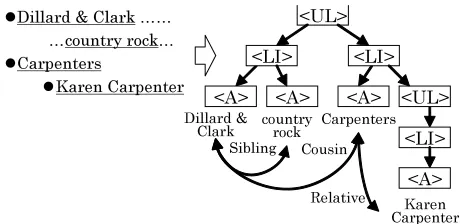
Figure 2 shows an example of an HTML segment and the corresponding tree structure. The first an-chor texts in each list tag (<LI>) tend to be in the same NE category. Such characteristics are useful feature for the categorization task. In this paper we focus on lists which appear frequently in Wikipedia. Furthermore, there are anchor texts in articles. Anchor texts are glossed entity or concept described with links to other pages. With this in mind, our NE categorization problem can be regarded as NE cat-egory labeling problem for anchor texts in articles. Exploiting dependencies of anchor texts that are in-duced by the HTML structure is expected to improve categorization performance.
de-Sibling ES={(viT, vjT)|viT, vjT ∈VT, d(viT, ca(viT, vTj)) =d(vjT, ca(vTi , vjT)) = 1, vjT =ch(pa(vTj,1), k), viT =ch(pa(vTi ,1), max{l|l < k})}
Cousin EC={(vTi , vTj)|viT, vTj ∈VT, d(vTi , ca(vTi , vjT)) =d(vTj, ca(vTi , vTj))≥2, viT =ch(pa(viT), k), vjT =ch(pa(vTj), k), pa(vjT, d(vjT, ca(vTi , vTj))−1) =ch(pa(vTj, d(vjT, ca(vTi , vTj))), k),
pa(viT, d(vTi , ca(viT, vTj))−1) =ch(pa(viT, ca(viT, vjT)),max{l|l < k})}
[image:3.612.318.548.224.336.2]Relative ER={(vTi , vTj)|vTi , vTj ∈VT, d(vTi , ca(viT, vTj)) = 1, d(vTj, ca(viT, vTj)) = 3, pa(vjT,2) =ch(pa(vTj,3), k), viT =ch(pa(viT,1),max{l|l < k})}
Figure 1: The definitions of sibling, cousin and relative cliques, whereES,EC,ERcorrespond to sets which consist of anchor text pairs that have sibling, cousin and relative relations respectively.
pendencies between anchor texts are treated as edges
EinG. In the next section, we describe the concrete way to construct graphs.
3.1 Constructing a graph from an HTML tree
An HTML document is an ordered tree. We de-fine a graph G = (VG, EG) on an HTML tree THT M L = (VT, ET): the verticesVG are anchor texts in the HTML text; the edges E are limited to cliques of Sibling, Cousin, and Relative, which we will describe later in the section. These cliques are intended to encode a NE label dependency between anchor texts where the two NEs tend to be in the same or related class, or one NE affects the other NE label.
Let us consider dependent anchor text pairs in Figure 2. First, “Dillard & Clark” and “country rock” have a sibling relation over the tree structure, and appearing the same element of the list. The latter element in this relation tends to be an attribute or a concept of the other element in the relation. Second, “Dillard & Clark” and “Carpenters” have a cousin relation over the tree structure, and they tend to have a common attribute such as “Artist”. The elements in this relation tend to belong to the same class. Third, “Carpenters” and “Karen Carpenter” have a relation in which “Karen Carpenter” is a sibling’s grandchild in relation to “Carpenters” over the tree structure. The latter elements in this relation tends to be a con-stituent part of the other element in the relation. We can say that the model can capture dependencies by dealing with anchor texts that depend on each other as cliques. Based on the observations as above, we treat a pair of anchor texts as cliques which satisfy the condtions in Figure 1.
<UL>
<LI> <A>
<LI> <LI>
<A>
<A> <UL> <A>
Dillard &
Clark country rock Carpenters
Karen Carpenter Sibling Cousin
Relative
Dillard & Clark …… …country rock… Carpenters
Karen Carpenter
Figure 2: Correspondence between tree structure and defined cliques.
Now, we define the three sorts of edges given an HTML tree. Consider an HTML tree THT M L =
(VT, ET), whereVT andET are nodes and edges over the tree. Letd(vTi , vjT)be the number of edges betweenviT andvjT whereviT, vjT ∈VT,pa(vTi , k)
be k-th generation ancestor of viT, ch(viT, k) be
vTi ’s k-th child, ca(vTi , vjT) be a common ances-tor ofviT, vTj ∈ VT. Precise definitions of cliques, namely Sibling, Cousin, and Relative, are given in Figure 1. A set of cliques used in our graph-based CRFs are edges defined in Figure 1 and vertices, i.e.
C = ES ∪EC ∪ER∪V. Note that they are re-stricted to pairs of the nearest vertices to keep the graph simple.
3.2 Model
ob-servation setxis defined as:
p(y|x) = 1 Z(x)
⎛
⎝
(vi,vj)∈ES∪EC∪ER
ΦSCR(yi, yj)
⎞ ⎠
⎛
⎝
vi∈V
ΦV(yi,x)
⎞
⎠ (3)
where ΦSCR(yi, yj) is the potential over sibling, cousin and relative edges,ΦV(yi,x)is the potential over the nodes, and Z(x) is the partition function. The potentials ΦSCR(yi, yj) and ΦV(yi,x) factor-ize according to the featuresfkand weightsλkas:
ΦSCR(yi, yj) = exp
k
λkfk(yi, yj)
(4)
ΦV (yi,x) = exp
k
λkfk(yi,x)
(5)
fk(yi, yj) captures co-occurrences between labels, wherek∈ {(yi, yj)|Y × Y}corresponds to the par-ticular element of the Cartesian product of the label set Y. fk(yi,x) captures co-occurrences between
labelyi∈ Y and observation features, wherek cor-responds to the particular element of the label set and observed features.
The weights of a CRF, Λ = {λk, . . . , λk, . . .}
are estimated to maximize the conditional log-likelihood of the graph in a training dataset D = {x(1), y(1),x(2), y(2), . . . ,x(N), y(N)} The log-likelihood function can be defined as fol-lows:
Lλ = N
d=1
[
(vi,vj)∈ES(d)∪EC(d)∪E(Rd)
k
λkfk(yi, yj)
+
vi∈V(d)
k
λkfk(yi,x(d))−logZ(x(d))]
−
k
λ2k
2σ2 −
k
λ2k
2σ2 (6)
where the last two terms are due to the Gaussian prior (Chen and Rosenfeld, 1999) used to reduce overfitting. Quasi-Newton methods, such as L-BFGS (Liu and Nocedal, 1989) can be used for max-imizing the function.
3.3 Tree-based Reparameterization
Since the proposed model may include loops, it is necessary to introduce an approximation to calculate mariginal probabilities. For this, we use Tree-based Reparameterization (TRP) (Wainwright et al., 2003) for approximate inference. TRP enumerates a set of spanning trees from the graph. Then, inference is performed by applying an exact inference algorithm such as Belief Propagation to each of the spanning trees, and updates of marginal probabilities are con-tinued until they converge.
4 Experiments
4.1 Dataset
Our dataset is a random selection of 2300 articles from the Japanese version of Wikipedia as of Octo-ber 2005. All anchor texts appearing under HTML
<LI> tags are hand-annotated with NE class la-bel. We use the Extended Named Entity Hierar-chy (Sekine et al., 2002) as the NE class labeling guideline, but reduce the number of classes to 13 from the original 200+ by ignoring fine-grained cat-egories and nearby catcat-egories in order to avoid data sparseness. We eliminate examples that consist of less than two nodes in the SCR model. There are 16136 anchor texts with 14285 NEs. The number of Sibling, Cousin and Relative edges in the dataset are|ES| = 4925, |EC| =13134 and |ER| = 746 respectively.
4.2 Experimental settings
The aims of experiments are the two-fold. Firstly, we investigate the effect of each cliques. The sev-eral graphs are composed with the three sorts of edges. We also compare the graph-based models with a node-wise method – just MaxEnt method not using any edge dependency. Secondly, we com-pare the proposed method by CRFs with a baseline method by Support Vector Machines (SVMs) (Vap-nik, 1998).
The experimental settings of CRFs and SVMs are as follows.
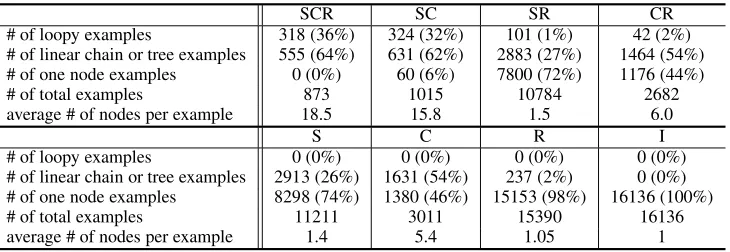
Re-SCR SC SR CR
# of loopy examples 318 (36%) 324 (32%) 101 (1%) 42 (2%)
# of linear chain or tree examples 555 (64%) 631 (62%) 2883 (27%) 1464 (54%)
# of one node examples 0 (0%) 60 (6%) 7800 (72%) 1176 (44%)
# of total examples 873 1015 10784 2682
average # of nodes per example 18.5 15.8 1.5 6.0
S C R I
# of loopy examples 0 (0%) 0 (0%) 0 (0%) 0 (0%)
# of linear chain or tree examples 2913 (26%) 1631 (54%) 237 (2%) 0 (0%)
# of one node examples 8298 (74%) 1380 (46%) 15153 (98%) 16136 (100%)
# of total examples 11211 3011 15390 16136
[image:5.612.126.491.59.185.2]average # of nodes per example 1.4 5.4 1.05 1
Table 1: The dataset details constructed from each model.
sulting models of CRFs evaluated on this experi-ments are SCR, SC, SR, CR, S, C, R and I (indepen-dent). Figure 3 shows representative graphs of the eight models. When the graph are disconnected by reducing the edges, the classification is performed on each connected subgraph. We call it anexample. We name the examplesaccording the graph struc-ture: ”loopy examples” are subgraphs including at least one cycle; ”linear chain or tree examples” are subgraphs including not a cycle but at least an edge; ”one node examples” are subgraphs without edges. Table 1 shows the distribution of the examples of each model. Since SCR, SC, SR and CR model have loopy examples, TRP approximate inference is nec-essary. To perform training and testing with CRFs, we use GRMM (Sutton, 2006) with TRP. We set the Gaussian Prior variances for weights asσ2 = 10in all models.
SC model C
C
C C S S
S S C SCR model C
C
C C S S
S S R
R C
SR model S S
S S R
R
CR model C
C
C C
R R
C
S model S S
S S
C model C
C
C C C
R model R
R
I model
Figure 3: An example of graphs constructed by combination of defined cliques. S, C, R in the model names mean that corresponding model has Sibling, Cousin, Relative cliques respectively. In each model, classification is performed on each con-nected subgraph.
SVMs We introduce two models by SVMs (model I and model P). In model I, each anchor text is clas-sified independently. In model P, we ordered the anchor texts in a linear-chain sequence. Then, we perform a history-based classification along the se-quence, in which j − 1-th classification result is used in j-th classification. We use TinySVM with a linear-kernel. One-versus-rest method is used for multi-class classification. To perform training and testing with SVMs, we use TinySVM2with a linear-kernel, and one-versus-rest is used for multi-class classification. We used the cost of constraint vio-lationC = 1.
Features for CRFs and SVMs The features used
in the classification with CRFs and SVMs are shown in Table 2. Japanese morphological analyzer MeCab
3is used to obtain morphemes.
4.3 Evaluation
We evaluate the models by 5 fold cross-validation. Since the number of examples are different in each model, the datasets are divided taking the examples – namely, connected subgraphs – in SCR model. The size of divided five sub-data are roughly equal. We evaluate per-class and total extraction perfor-mance by F1-value.
[image:5.612.73.298.499.589.2]4.4 Results and discussion
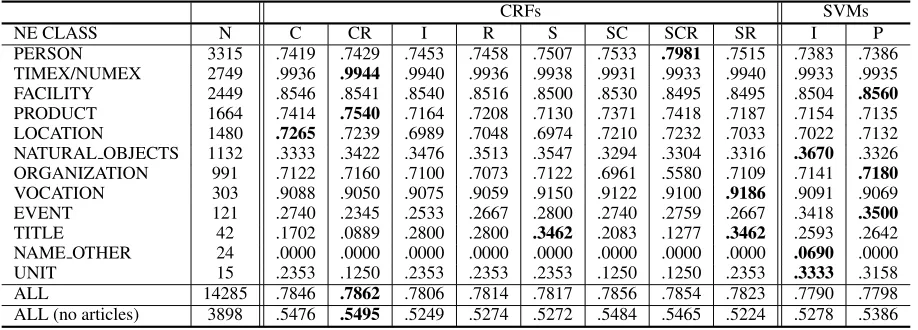
Table 3 shows the classification accuracy of each model. The second column “N” stands for the num-ber of nodes in the gold data. The second last row “ALL” stands for the F1-value of all NE classes.
2http://www.chasen.org/˜taku/software/
TinySVM/ 3
types feature SVMs CRFs
observation definition (bag-of-words) √ √(V)
features heading of articles √ √(V)
heading of articles (morphemes) √ √(V)
categories articles √ √(V)
categories articles (morphemes) √ √(V)
anchor texts √ √(V)
anchor texts (morphemes) √ √(V)
parent tags of anchor texts √ √(V)
text included in the last header of anchor texts √ √(V)
text included in the last header of anchor texts(morphemes) √ √(V)
label features between-label feature √(S, C, R)
[image:6.612.119.494.124.259.2]previous label √
Table 2: Features used in experiments. ”√” means that the corresponding features are used in classification. TheV,S,CandRin CRFs column corresponds to the node, sibling edges, cousin edges and relative edges respectively.
CRFs SVMs
NE CLASS N C CR I R S SC SCR SR I P
PERSON 3315 .7419 .7429 .7453 .7458 .7507 .7533 .7981 .7515 .7383 .7386
TIMEX/NUMEX 2749 .9936 .9944 .9940 .9936 .9938 .9931 .9933 .9940 .9933 .9935
FACILITY 2449 .8546 .8541 .8540 .8516 .8500 .8530 .8495 .8495 .8504 .8560
PRODUCT 1664 .7414 .7540 .7164 .7208 .7130 .7371 .7418 .7187 .7154 .7135
LOCATION 1480 .7265 .7239 .6989 .7048 .6974 .7210 .7232 .7033 .7022 .7132
NATURAL OBJECTS 1132 .3333 .3422 .3476 .3513 .3547 .3294 .3304 .3316 .3670 .3326
ORGANIZATION 991 .7122 .7160 .7100 .7073 .7122 .6961 .5580 .7109 .7141 .7180
VOCATION 303 .9088 .9050 .9075 .9059 .9150 .9122 .9100 .9186 .9091 .9069
EVENT 121 .2740 .2345 .2533 .2667 .2800 .2740 .2759 .2667 .3418 .3500
TITLE 42 .1702 .0889 .2800 .2800 .3462 .2083 .1277 .3462 .2593 .2642
NAME OTHER 24 .0000 .0000 .0000 .0000 .0000 .0000 .0000 .0000 .0690 .0000
UNIT 15 .2353 .1250 .2353 .2353 .2353 .1250 .1250 .2353 .3333 .3158
ALL 14285 .7846 .7862 .7806 .7814 .7817 .7856 .7854 .7823 .7790 .7798
ALL (no articles) 3898 .5476 .5495 .5249 .5274 .5272 .5484 .5465 .5224 .5278 .5386
[image:6.612.78.537.453.618.2]The last row “ALL (no article)” stands for the F1-value of all NE classes which have no gloss texts in Wikipedia.
Relational vs. Independent Among the models
constructed by combination of defined cliques, the best F1-value is achieved by CR model, followed by SC, SCR, C, SR, S, R and I. We performed McNe-mar paired test on labeling disagreements between CR model of CRFs and I model of CRFs. The difference was significant (p < 0.01). These re-sults show that considering dependencies work pos-itively in obtaining better accuracy than classify-ing independently. The Cousin cliques provide the highest accuracy improvement among the three de-fined cliques. The reason may be that the Cousin cliques appear frequently in comparison with the other cliques, and also possess strong dependencies among anchor texts. As for PERSON, better accu-racy is achieved in SC and SCR models. In fact, the PERSON-PERSON pairs frequently appear in Sibling cliques (435 out of 4925) and in Cousin cliques (2557 out of 13125) in the dataset. Also, as for PRODUCT and LOCATION, better accuracy is achieved in the models that contain Cousin cliques (C, CR, SC and SCR model). 1072 PRODUCT-PRODUCT pairs and 738 LOCATION-LOCATION pairs appear in Cousin cliques. “All (no article)” row in Table 3 shows the F1-value of nodes which have no gloss texts. The F1-value difference be-tween CR and I model of CRF in “ALL (no article)” row is larger than the difference in “All” row. The fact means that the dependency information helps to extract NEs without gloss texts in Wikipedia. We attempted a different parameter tying in which the SCR potential functions are tied with a particular ob-servation feature. This parameter tying is introduced by Ghamrawi and McCallum (2005). However, we did not get any improved accuracy.
CRFs vs. SVMs The best model of CRFs (CR
model) outperforms the best model of SVMs (P model). We performed McNemar paired test on la-beling disagreements between CR model of CRFs and P model of SVMs. The difference was signifi-cant (p < 0.01). In the classes having larger num-ber of examples, models of CRFs achieve better F1-values than models of SVMs. However, in several classes having smaller number of examples such as
0.4 0.5 0.6 0.7 0.8
0.80
0.85
0.90
0.95
Recall
Precision
[image:7.612.316.536.85.293.2]CR model of CRFs
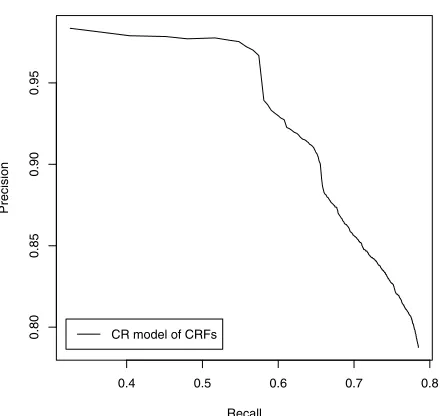
Figure 4: Precision-Recall curve obtained by vary-ing the thresholdτ of marginal probability from 1.0 to 0.0.
EVENT and UNIT, models of SVMs achieve signif-icantly better F1-values than models of CRFs.
Filtering NE Candidates using Marginal
Prob-ability The precision-recall curve obtained by
thresholding the marginal probability of the MAP estimation in the CR models is shown in Figure 4. The curve reaches a peak at 0.57 in recall, and the precision value at that point is 0.97. This preci-sion and recall values mean that 57% of all NEs can be classified with approximately 97% accuracy on a particular thresholding of marginal probability. This results suggest that the extracted NE candidates can be filtered with fewer cost by exploiting the marginal probability.
Training Time The total training times of all
CRFs SVMs
C CR I R S SC SCR SR I P
Training Time (minutes) 207 255 97 90 138 305 316 157 28 29
Table 4: Training Time (minutes)
vs. Java, differences of feature extraction modules, and so on. So, the comparing these two is not the important issue in this experiment.
5 Related Work
Wikipedia has become a popular resource for NLP. Bunescu and Pasca used Wikipedia for detecting and disambiguating NEs in open domain texts (2006). Strube and Ponzetto explored the use of Wikipedia for measuring Semantic Relatedness between two concepts (2006), and for Coreference Resolution (2006).
Several CRFs have been explored for informa-tion extracinforma-tion from the web. Tang et al. pro-posed Tree-structured Conditional Random Fields (TCRFs) (2006) that capture hierarchical structure of web documents. Zhu et al. proposed Hierar-chical Conditional Random Fields (HCRFs) (2006) for product information extraction from Web docu-ments. TCRFs and HCRFs are similar to our ap-proach described in section 4 in that the model struc-ture is induced by page strucstruc-ture. However, the model structures of these models are different from our model.
There are statistical models that capture depen-dencies between examples. There are two types of classification approaches: iterative (Lu and Getoor, 2003b; Lu and Getoor, 2003a) or collective (Getoor et al., 2001; Taskar et al., 2002). Lu et al. (2003a; 2003b) proposed link-based classification method based on logistic regression. This model iterates lo-cal classification until label assignments converge. The results vary from the ordering strategy of lo-cal classification. In contrast to iterative classifica-tion methods, collective classificaclassifica-tion methods di-rectly estimate most likely assignments. Getoor et al. proposed Probabilistic Relational Models (PRMs) (2001) which are built upon Bayesian Net-works. Since Bayesian Networks are directed graph-ical models, PRMs cannot model directly the cases where instantiated graph contains cycles. Taskar et al. proposed Relational Markov Networks (RMNs)
(2002). RMNs are the special case of Conditional Markov Networks (or Conditional Random Fields) in which graph structure and parameter tying are de-termined by SQL-like form.
As for the marginal probability to use as a confi-dence measure shown in Figure 4, Peng et al. (2004) has applied linear-chain CRFs to Chinese word seg-mentation. It is calculated by constrained forward-backward algorithm (Culotta and McCallum, 2004), and confident segments are added to the dictionary in order to improve segmentation accuracy.
6 Conclusion
In this paper, we proposed a method for categorizing NEs in Wikipedia. We defined three types of cliques that are constitute dependent anchor texts in con-struct CRFs graph con-structure, and introduced poten-tial functions for them to reflect classification. The experimental results show that the effectiveness of capturing dependencies, and proposed CRFs model can achieve significant improvements compare to baseline methods with SVMs. The results also show that the dependency information from the HTML tree helps to categorize entities without gloss texts in Wikipedia. The marginal probability of MAP as-signments can be used as confidence measure of the entity categorization. We can control the precision by filtering the confidence measure as PR curve in Figure 4. The measure can be also used as a con-fidence estimator in active learning in CRFs (Kim et al., 2006), where examples with the most uncer-tainty are selected for presentation to human anno-tators.
References
Razvan Bunescu and Marius Pasca. 2006. Using ency-clopedic knowledge for named entity disambiguation. InProceedings of the 11th Conference of the European Chapter of the Association for Computational Linguis-tics.
Stanley F. Chen and Ronald Rosenfeld. 1999. A gaussian prior for smoothing maximum entropy models. Tech-nical report, Carnegie Mellon University.
Aron Culotta and Andrew McCallum. 2004. Confi-dence estimation for information extraction. In Pro-ceedings of Human Language Technology Conference and North American Chapter of the Association for Computational Linguistics (HLT-NAACL).
Lise Getoor, Eran Segal, Ben Taskar, and Daphne Koller. 2001. Probabilistic models of text and link structure for hypertext classification. InIJCAI Workshop on Text Learning: Beyond Supervision, 2001.
Nadia Ghamrawi and Andrew McCallum. 2005. Col-lective multi-label classification. InFourteenth Con-ference on Information and Knowledge Management (CIKM).
Juanzi Li Jie Tang, Mingcai Hong and Bangyong Liang. 2006. Tree-structured conditional random fields for semantic annotation. InProceedings of 5th Interna-tional Conference of Semantic Web (ISWC-06).
Seokhwan Kim, Yu Song, Kyungduk Kim, Jeong-Won Cha, and Gary Geunbae Lee. 2006. MMR-based ac-tive machine learning for bio named entity recogni-tion. InProceedings of the Human Language Technol-ogy Conference/North American chapter of the Asso-ciation for Computational Linguistics annual meeting (HLT-NAACL06).
John Lafferty, Andrew McCallum, and Fernando Pereira. 2001. Conditional random fields: Probabilistic mod-els for segmenting and labeling sequence data. In Pro-ceedings of the 18th International Conference on Ma-chine Learning, pages 282–289. Morgan Kaufmann, San Francisco, CA.
Dong C. Liu and Jorge Nocedal. 1989. The limited mem-ory BFGS methods for large scale optimization. In
Mathematical Programming 45.
Qing Lu and Lise Getoor. 2003a. Link-based classifica-tion using labeled and unlabeled data. InProceedings of the International Conference On Machine Learning, Washington DC, August.
Qing Lu and Lise Getoor. 2003b. Link-based text clas-sification. In Proceedings of the International Joint Conference on Artificial Intelligence.
Andrew McCallum, Khashayar Rohanimanesh, and Charles Sutton. 2003. Dynamic conditional random fields for jointly labeling multiple sequences. InNIPS Workshop on Syntax, Semantics, and Statistics, De-cember.
J. Neville and D. Jensen. 2000. Iterative classification in relational data. InProceedings of AAAI-2000 Work-shop on Learning Statistical Models from Relational Data, pages 13–20. AAAI Press.
Fuchun Peng, Fangfang Feng, and Andrew McCallum. 2004. Chinese segmentation and new word detection using conditional random fields. In Proceedings of The 20th International Conference on Computational Linguistics (COLING).
Simone Paolo Ponzetto and Michael Strube. 2006. Ex-ploiting semantic role labeling, wordnet and wikipedia for coreference resolution. InProceedings of the Hu-man Language Technology Conference of the North American Chapter of the Association for Computa-tional Linguistics.
Satoshi Sekine, Kiyoshi Sudo, and Chikashi Nobata. 2002. Extended named entity hierarchy. In Proceed-ings of the LREC-2002.
Michael Strube and Simone Paolo Ponzetto. 2006. Wikirelate! computing semantic relatedness using wikipedia. InProceedings of the 21st National Con-ference on Artificial Intelligence (AAAI-06).
Charles Sutton, Khashayar Rohanimanesh, and Andrew McCallum. 2004. Dynamic conditional random fields: Factorized probabilistic models for labeling and segmenting sequence data. InProceedings of the 21th International Conference on Machine Learning.
Charles Sutton. 2006. GRMM: A graphical models toolkit. http://mallet.cs.umass.edu.
Ben Taskar, Pieter Abbeel, and Daphne Koller. 2002. Discriminative probabilistic models for relational data. InProceedings of the 18th Conference on Uncertainty in Artificial Intelligence. Morgan Kaufmann.
Vladimir Vapnik. 1998. Statistical Learning Theory. Wiley Interscience.
Martin Wainwright, Tommi Jaakkola, and Alan Will-sky. 2003. Tree-based reparameterization frame-work for analysis of sum-product and related algo-rithms. IEEE Transactions on Information Theory, 45(9):1120–1146.