http: // www.ijrtsm.com© International Journal of Recent Technology Science & Management 17
ISSN : 2455-9679
[Sumit et al. , 4(4), Apr 2019] Impact Factor : 2.865
IJRTSM
INTERNATIONAL JOURNAL OF RECENT TECHNOLOGY SCIENCE & MANAGEMENT
“DESIGN & STATIC ANALYSIS OF LEAF SPRING USING FEA METHOD BY ANSYS”
Sumit Nandmer
1, Arun Patel
21 M.Tech. Scholar, Dept. of Mechanical Engineering, NIIST, Bhopal, Mp, India 2
Associate Professor, Dept. of Mechanical Engineering, NIIST, Bhopal, Mp, India
ABSTRACT
In this research work an attempt has been made to check the suitability of composite materials like Carbon Fiber /EN 45 Spring Steel for light commercial vehicle leaf spring. First the static analysis is carried out for steel and different composite leaf spring using FE solver ANSYS V19.2 and modeling has done by CATIA V5R20 The obtained results are compared with theoretical values and observed that they have good agreement with each other. From the results it can be concluded that Carbon Fiber materials are best suitable composite material for leaf spring.
Keyword: EN45, Carbon Fiber, ANSYS, CATIA, Leaf spring, Steel
I.
I
NTRODUCTIONMechanical framework which comprises of springs and safeguards. The car suspension is mounted on the axles, not coordinate but rather some type of springs. This is done to separate the vehicle body from the street stuns, which might be as bob, pitch, roll or influence. These inclinations offer ascent to an uncomfortable ride furthermore cause extra stretch in the vehicles outline anyone. In suspension framework the vitality of street stun cause the spring sway. These motions are limited to a sensible level by damper which is all the more ordinarily called a safeguard.
A leaf spring is a straightforward type of spring regularly utilized for the suspension as a part of wheeled vehicles initially called a covered or carriage spring, and here and there alluded to as a semi – curved spring or truck spring or level plate. The configuration of leaf spring should be possible in two ways one the mono leaf spring or the multi leaf spring.
II.
PROBLEM
IDENTIFICATION
As weight plays an important role in deciding the efficiency of an automobile. The leaf spring used generally is made of steel which are quite bulky and one of the potential items for weight reduction in automobiles because it accounts 10-20% spring weight carried by its own. To avoid this disadvantage and comfort riding qualities an attempt is to be made in replacing the material with advanced materials like composite materials. This work is mainly focused on the implementation of Thermoplastic polyimide with 30% carbon fiber reinforced (composite material) by replacing steel En 45 in conventional leaf springs of a suspension system to reduce product weight, improving the safety, comfort and durability.
http: // www.ijrtsm.com© International Journal of Recent Technology Science & Management 18
ISSN : 2455-9679
[Sumit et al. , 4(4), Apr 2019] Impact Factor : 2.865
III.
OBJECTIVES
The main objective of present work is to investigate the best suitable composite material for automobile leaf spring application.
• To compare the load carrying capacity, stresses, deflection and weight saving at same load applied to composite leaf spring with that of conventional leaf spring.
• The present work also concentrate on the implementation of composite material by replacing steel in conventional leaf springs of a suspension system to reduce weight, improving safety, comfort and durability. • To design and evaluate the composite leaf spring for automobile suspension system under the condition of
static load
IV.
SPECIFICATIONS
4.1
Tavera Car Specifications
Figure 4.1 Tavera Car
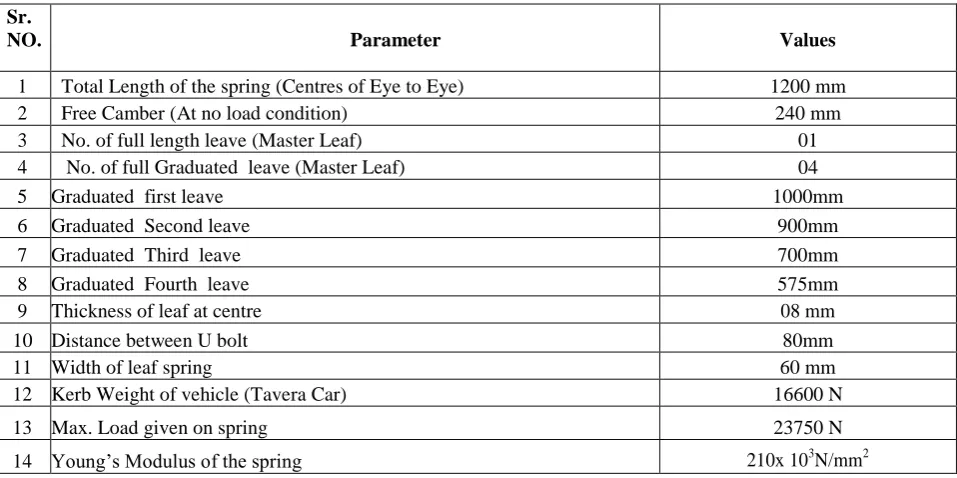
Table 4.1 Specifications Sr.
NO. Parameter Values
1 Total Length of the spring (Centres of Eye to Eye) 1200 mm
2 Free Camber (At no load condition) 240 mm
3 No. of full length leave (Master Leaf) 01
4 No. of full Graduated leave (Master Leaf) 04
5 Graduated first leave 1000mm
6 Graduated Second leave 900mm
7 Graduated Third leave 700mm
8 Graduated Fourth leave 575mm
9 Thickness of leaf at centre 08 mm
10 Distance between U bolt 80mm
11 Width of leaf spring 60 mm
12 Kerb Weight of vehicle (Tavera Car) 16600 N
13 Max. Load given on spring 23750 N
http: // www.ijrtsm.com© International Journal of Recent Technology Science & Management 19
ISSN : 2455-9679
[Sumit et al. , 4(4), Apr 2019] Impact Factor : 2.865
4.2 Materials properties of conventional Leaf Spring
Table 4.2 Materials Properties (EN 45 springs steel 55 Si2Mn90)
Parameters Specification
Material EN 45 (55 Si2Mn90)
Tensile Ultimate Strength 2000Mpa
Tensile Yield Strength 1500 Mpa
Density 7860 kg/m3
Poisson’s Ratio 0.3
Young’s Modulus 210 x 103 Mpa
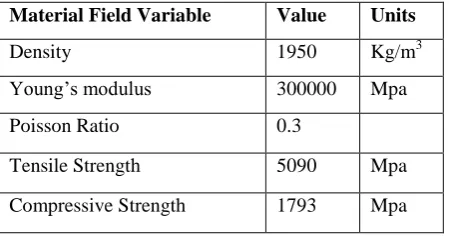
Table 4.3 New materials Carbon Fiber Mechanical properties Mechanical properties
Material Field Variable Value Units
Density 1950 Kg/m3
Young’s modulus 300000 Mpa
Poisson Ratio 0.3
Tensile Strength 5090 Mpa
Compressive Strength 1793 Mpa
V.
ANALYTICAL
CALCULATIONS
Our specification
Full length leaf (n1) = 1200 mm,
First graduated leaf ( n2) = 1000mm,
Second graduated leaf (n3) = 900mm,
Third graduated leaf (n4)= 700mm ,
Fourth graduated leave (n5)= 575mm
Thickness of leaves (t) = 8 mm Width of leaf (b) = 60mm
“U” bolt centre distance (l) = 80mm Young modulus (E) = 210 GPa
Car Gross weight ( Tavera Car) = 2375 kg = 2375 x 9.81 = 23298 N Centre load = Total load/ No. of Spring
2W = Gross weight/ No. of Springs 2W = 23298/5
W = 4750 N Now
2L (Span) = Length of master leaf - 2/3 x U bolt centre distance 2L = 1200 – 2/3 x 80
2L = 1146 L = 574 mm
(ϭ) = 18 x 2375 x 574/ 60x (8)2 [2x4 + 3x1]
http: // www.ijrtsm.com© International Journal of Recent Technology Science & Management 20
ISSN : 2455-9679
[Sumit et al. , 4(4), Apr 2019] Impact Factor : 2.865
Ϩ = 12WL3/ Enbt3 [2ng+3nf]
Ϩ = 12x 2329x (574)2/ 210x103x60x(8)3[ 2x4 + 3x1]
Ϩ =74mm
Radius of curvature (R ) = (L1)2/2y
R = (600)2/ 2x240 = 750 mm R = 750 mm
VI.
MODELING
&
SIMULATION
Figure6.2 Model import in ANSYS for simulation
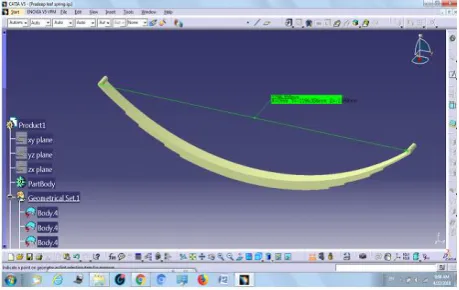
Figure6.1 CATIA Modeling leaf spring
Figure6.4 Boundary condition applied
Figure6.3 Meshing Leaf spring model
http: // www.ijrtsm.com© International Journal of Recent Technology Science & Management 21
ISSN : 2455-9679
[Sumit et al. , 4(4), Apr 2019] Impact Factor : 2.865
VI.
RESULT
&
DISCUSSION
In our study we take exiting model materials Spring steel EN 45 which is using cars and we take here Tavera Cars spring with 2375Kg gross load. Those load centre of spring is mounted 4750N. Then we take our results for two materials EN45 and Carbon Fibre.
For EN 45 spring steel – the mean deflection developed in the master leaf spring at load of 4750 N is 0.46752 mm deflection and maximum stress is 419.63 Mpa, and stress is safe in all respect and when we used new materials a Carbon Fibre 0.32726 mm deflection and maximum stress is 419.63 Mpa, and stress is safe in all respect and but the weight of the this material will be light weight, hence design is safe expect weight.
VII.
CONCLUSION
&
FUTURE
SCOPE
1. For EN 45 spring steel – the mean deflection developed in the master leaf spring at load of 4750 N is 0.46752
mm and maximum stress is 419.63 Mpa, the deflection and stress is safe in all respect.
2. Carbon Fiber with 20% glass fiber the max. Deflection developing is 0.32726 mm which are too low and the
max. stress is 419.63 MPa which is also too low and this material can sustain the load as the conventional spring material but are thing is positive regarding weight because Carbon Fiber is light weight to steel 2/3 weight of steel.
Figure 6.8 Deformations for Carbon Fiber
materials
Figure 6.7 Von misses stresses for Carbon Fiber
materials
Figure 6.10 Stresses comparison between
materials
http: // www.ijrtsm.com© International Journal of Recent Technology Science & Management 22
ISSN : 2455-9679
[Sumit et al. , 4(4), Apr 2019] Impact Factor : 2.865
FUTURE SCOPE OF WORK
• Other new composites can be tested in a similar way to have more alternatives for the manufacturing of leaf
spring.
• This work can be extended by analyzing leaf spring under dynamic conditions, since only static loading case is considered here.
• The design of leaf spring can also be optimized by using either “Constant width and varying thickness design”
or “Constant thickness and varying width design” as well as in Multiple leaf spring.
• In future this kind of spring can be used in the vehicles, which are more efficient and responsive.
REFERENCES
1. Mouleeswaran Senthil Kumar, Sabapathy Vijayarangan, “Analytical and Experimental Studies on Fatigue Life
Prediction of Steel and Composite Multi-leaf Spring for Light Passenger Vehicles Using Life Data Analysis”, ISSN 1392–1320 MATERIALSSCIENCE (MEDŽIAGOTYRA). Vol. 13, No. 2. 2007
2. Gulur Siddaramanna Shiva Shankar And Sambagam Vijayarangan, “Mono Composite Leaf Spring for Light
Weight Vehicle – Design, End Joint Analysis and Testing” , ISSN 1392–1320 MATERIALS SCIENCE (MEDŽIAGOTYRA). Vol. 12, No. 3. 2006
3. Malaga. Anil Kumar , T.N.Charyulu And Ch.Ramesh , “Design Optimization Of Leaf Spring”, International
Journal of Engineering Research and Applications (IJERA) ISSN: 2248-9622, Vol. 2, Issue 6, November- December 2012, pp.759-765
4. H. A. Al-Qureshi (2001), “Automobile leaf springs from composite materials”, Journal of Material Processing
Technology, vol- 118,p.p 58-61.
5. M. Raghavedra , Syed Altaf Hussain , V. Pandurangadu and K. PalaniKumar, “Modeling and Analysis of Laminated Composite Leaf Spring under the Static Load Condition by using FEA”, International Journal of Modern Engineering Research (IJMER) Vol.2, Issue.4, July-Aug. 2012 pp-1875-1879 ISSN: 2249-6645
6. Smita C. Saddu, Vikas V. Shinde, “Modelling and Analysis of Composite as an Alternative Material for Leaf
Spring”, IOSR Journal of Mechanical and Civil Engineering (IOSR-JMCE) e-ISSN: 2278-1684,p-ISSN: 2320-334X, Volume 11, Issue 3 Ver. IV (May- Jun. 2014), PP 39-44
7. M.Venkatesan ,D.Helmen Devaraj, “DESIGN AND ANALYSIS OF COMPOSITE LEAF SPRING IN
LIGHT VEHICLE” , International Journal of Modern Engineering Research (IJMER) Vol.2, Issue.1, Jan-Feb 2012 pp-213-218 ISSN: 2249-6645
8. Pankaj Saini, Ashish Goel & Dushyant Kumar, “Design and Analysis of composite leaf spring for light vehicles”, international journal of innovative research in science, engineering and technology, vol. 2, issue-5, 2013
9. Shishay Amare Gebremeskel, “Design, Simulation, and Prototyping of Single Composite Leaf Spring for Light Weight Vehicle”, Global Journals Inc. (US) , Vol 12, No 7-A (2012)
10. M. M. Patunkar, D. R. Dolas, “Modelling and Analysis of Composite Leaf Spring under the Static Load Condition by using FEA”, International Journal of Mechanical & Industrial Engineering, Volume 1 Issue 1-2011
11. Amrita Srivastava and Sanjay Choudhary, “Design and Structural Analysis 1of Jute/E-glass Woven Fiber Reinforced Epoxy Based Hybrid Composite Leaf Spring under Static Loading”. International Journal of Mechanical Engineering and Research, ISSN 2249-0019, Volume 3, Number 6 (2013), pp. 573-582.
12. ML Aggarwal, PS Chawla, “Issues in fretting fatigue design of shot peened leaf springs”, Indian Journal of
http: // www.ijrtsm.com© International Journal of Recent Technology Science & Management 23
ISSN : 2455-9679
[Sumit et al. , 4(4), Apr 2019] Impact Factor : 2.865
13. M.L. Aggrawal and V.P. Aggrawal, “A stress approach model for predictions of fatigue life by shot peening of
EN45A spring steel”, Received 2 September 2004, Revised 19 September 2005, Accepted 8 December 2005, Available online 7 March 2006
14. B.Vijaya Lakshmi, I. Satyanarayana, “STATIC AND DYNAMIC ANALYSIS ON COMPOSITE LEAF
SPRING IN HEAVY VEHICLE” , , International Journal of Advanced Engineering Research and Studies E-ISSN2249–8974
15. Ashish V. Amrute, Edward Nikhil karlus, R.K.Rathore, “Design and assessment of multi leaf spring” , International journal of research in aeronautical and mechanical engineering,
16. Minoru Iwata, “Premature Fracture in Automobile Leaf Springs” Journal of Science Direct, Engineering Failure Analysis Vol. 16 (2009) Pg. No. 648-655