Sexual Dysfunction Questionnaire: scale development and psychometric
validation
Questionario sulle Disfunzioni Sessuali: sviluppo e validazione psicometrica della scala
R. Infrasca
Psychiatric Department, ASL 5 La Spezia, Italy
Summary
Objective
Sexual activity is an important dimension within quality of life. The fundamental psychological needs of an individual are rep-resented by four psychodynamic factors: attachment, autonomy, sexual identity, and self-esteem. Sexual disorders are common in psychiatric patients and include desire, arousal, orgasmic, and pain disorders. Along with the positive aspects of human sexuali-ty, however, mental illnesses can also affect an individual’s sexual health. We believe that this area of research lacks standard tools to highlight the presence of sexual problems and the associated personality traits in psychiatric patients (men and women). For these reasons, we developed a brief, practical, and simple self-reported questionnaire that would address most of the common sexual problems in psychiatric patients.
Methods
Following the methodology used in many research studies, we chose a list of items. The resulting 31-item questionnaire was ad-ministered to a sample of psychiatric patients (149 men and 333 women), to verify internal consistency and validity. We used fac-tor analysis to identify underlying variables (or facfac-tors) that ex-plain the pattern of correlation within a set of observed variables. Internal consistency of the questionnaire was assessed through Cronbach’s alpha coefficient. Twelve questions were shown to have no statistical significance. The final instrument consisted of 19 questions on a 5-point Likert scale: Always, Often, Some-times, Rarely, and Never (see Appendix 1). Subjects were re-quired to fill the 19-item questionnaire based on experiences from the previous 12 months. All subjects completed the MMPI, from which we obtained special scales for Low Self-esteem, Neu-roticism, Anxiety Index, Ego Strength, Extroversion, and Sex
Prob-lems Scale (I-SP). The subjects were also required to complete the Toronto Alexithymia Scale (TAS-26), and the Eating Attitude Test (EAT- 26), an instrument used for the analysis of eating dis-orders.
Results
The Sexual Dysfunction Questionnaire (SDQ) displayed excellent internal consistency, with a Cronbach alpha of 0.85. Kendall tau-b ranged from 0.19 to 0.38. The analysis of 19 items was run with Varimax rotation. In these results (Table I), the cumulative percent-ages show that the first two factors account for 99.58% of the vari-ation. Multiple regression (Table II) highlighted that the personality involved in sexual problems is introverted, passive, or suspicious, with high anxiety, low self-esteem, and a high rate of neuroticism. Logistic regression (Table III) indicated that the probability of find-ing a sexual dysfunction increases 1.16 times for every point of increase in the score scale. Moreover, when the value of the scale is ≥ 45 the probability of observing sexual issues is 8.16 times greater than when the scale values are < 44. A cut-off score of 45 matches a sensitivity of 88.4% and a specificity of 79.1%.
Conclusions
The psychometric data indicate that the SDQ is a valid, reliable, and satisfactory measure for describing sexual dysfunction in Psychiatric patients (men and women). Moreover, it is a brief self-report inventory, typically requiring 5 min of the patient’s time for completion and is well suited for use in both clinical and research settings.
Key words
Psychiatric patients • Sexual dysfunctions • Measurement and assess-ment • Questionnaire
Correspondence
Roberto Infrasca, Dipartimento di Psichiatria, ASL5, via Nino Bixio 56a, 19122 La Spezia, Italy • Tel. +39 0187 604457 • E-mail: roberto.infrasca@ asl5.liguria.it
Riassunto
Obiettivo
L’attività sessuale è una dimensione importante nella qualità della vita. I bisogni psicologici fondamentali dell’individuo sono rappresentati da quattro fattori psicodinamici: attacca-mento, autonomia, identità sessuale e autostima. I disturbi sessuali sono comuni nei pazienti psichiatrici e comprendo-no il desiderio, l’eccitazione, l’orgasmo, dispaurenia e
Introduction
The sexual dimension is a primary factor used to define and assess an individual’s maturity. The World Health Or-ganization defined Sexual health as: “The integration of the physical, emotional, intellectual and social aspects of sexual being in ways that are positively enriching and that enhance personality, communication, and love. Eve-ry person has a right to receive sexual information and to consider sexual relationships for pleasure as well as for procreation” (WHO Technical Report, Series 572). Sexuality is an integral part of being human, a complex mix of mental, emotional, and physical signals. Love, af-fection, and sexual intimacy contribute to healthy rela-tionships and individual well-being. Along with the posi-tive aspects of human sexuality, however, illnesses can also affect an individual’s sexual health.
We also must remember that the fundamental psycho-logical needs of an individual are represented by four psychodynamic factors: attachment, autonomy, sexual identity, and self-esteem. These structures usually have a strong interdependence and a stable and mutual relation-ship. However, the dynamics among them can become dysfunctional. An important consequence is that a prob-lem in one area can grow to involve other areas. Disor-ders that affect any of these factors can affect a person’s physical and emotional health, as well as interpersonal relationships and self-image.
Sexual disorders are common in the general population and include desire, arousal, orgasmic, and pain disorders
(dyspareunia and vaginismus). The most important disor-ders are loss of desire, sexual aversion disorder, anorgas-mia, dyspareunia, and vaginismus.
Loss of desire for sexual activity is the most common
pre-senting female sexual dysfunction 1-3. The American
Psy-chiatric Association’s Diagnostic and Statistical Manual of Mental Disorders - DSM-IV 4, which gives a working
classification of psychosexual dysfunction, would clas-sify it as hypoactive sexual desire disorder and sexual aversion disorder.
Sexual aversion disorder is an intense aversion to sexual
contact or related experiences. The aversion to sex is an extreme form of disorders in the sexual arousal category and is often combined with a reduced interest in mak-ing love.
Anorgasmia is the medical term for regular difficulty
reaching orgasm after ample sexual stimulation, which causes personal distress. Anorgasmia is actually a com-mon occurrence: 24% of women reported an orgasmic dysfunction 5.
Dyspareunia and vaginismus (sex pain disorders) are
two common and extremely frustrating sexual dysfunc-tions for women. Vaginismus is a sexual disorder that is characterized by the outer third of the vaginal mus-cles tightening, often painfully. Dyspareunia is painful sexual intercourse 6.
Surveys of the general population in the United States 7
found that many women occasionally have sexual prob-lems and worries, including: Concerns about sexuality (6
Metodo
Seguendo la metodologia utilizzata in molte ricerche, sono sta-ti scelsta-ti una serie di item. Il quessta-tionario risultante, composto da 31 item, è stato somministrato ad un campione di pazienti psichiatrici (149 uomini e 333 donne), per verificare la coeren-za interna e la validità. L’analisi fattoriale è stata utilizcoeren-zata per identificare le variabili di base (o fattori) in grado di spiegare il modello di correlazione tra le variabili osservate. La consi-stenza interna del questionario è stata valutata mediante l’alfa di Cronbach. Dodici domande sono state eliminate non dimo-strando una significatività statistica. Lo strumento finale risulta composto da 19 domande su una scala Likert a 5 punti: sempre, spesso, qualche volta, raramente e mai (vedi Appendice 1). I soggetti hanno compilato il questionario di 19 item sulla base delle esperienze dei 12 mesi precedenti. Tutti i soggetti han-no completato il MMPI, dal quale sohan-no state ottenute le scale speciali che misurano la bassa autostima, il nevroticismo, l’an-sia, la forza dell’Io, l’estroversione, e i problemi sessuali (I-SP). Inoltre, hanno anche completato la Toronto Alexithymia Scale (TAS-26), e l’Eating Attitude Test (EAT-26), strumento utilizzato per analizzare i disturbi alimentari.
Risultati
I risultati dimostrano che il Questionario per le Disfunzioni Ses-suali (QDS) presenta un’eccellente consistenza interna, con un alfa di Cronbach di 0,85. Il tau b di Kendall mostra un intervallo
di valori tra 0,19-0,38. L’analisi dei 19 item è stato eseguita con rotazione di Varimax. Nei risultati (Tab. I) le percentuali cumula-tive dimostrano che i primi due fattori spiegano il 99,58% della varianza. I risultati ottenuti con la regressione multipla (Tab. II) evidenziano come la personalità che presenta problemi sessuali è introversa, passiva, sospettosa, con elevati livelli di ansia, scar-sa autostima, e un alto tasso di nevroticismo. I risultati ottenuti dalla regressione logistica (Tab. III) indicano che la probabilità di trovare una sessualità disfunzionale aumenta di 1,16 volte per ogni punto di crescita della scala. Inoltre, quando il valore della scala è ≥ 45 la probabilità di osservare problemi sessuali è 8,16 volte maggiore rispetto a valori della scala ≤ 44. Un cut-off di 45 dimostra una sensibilità del 88,4% ed una specificità del 79,1%.
Conclusioni
I dati psicometrici indicano che il QDS è un questionario va-lido, affidabile e soddisfacente per la descrizione delle disfun-zioni sessuali nei pazienti psichiatrici (uomini e donne). Inoltre, è un breve strumento self-report, di solito richiede 5 minuti di tempo per il completamento, ed è adatto per essere utilizzato sia in ambito clinico che di ricerca.
Parole chiave
Methods
The sample included 333 women (mean age, 33.1 ± 12.1 years) and 149 men (mean age, 32.9 ± 11.7 years), out-patients at the Department of Psychiatry ASL 5-La Spe-zia (Italy). The patients were recruited from consecutive admissions to the Department of Psychiatry. In the sam-ple, the diagnoses were: personality disorders (10.4%), anxiety disorders (26.7%), eating disorders (10.4%), de-pressive disorders (34.6%), psychotic disorders (5.2%), and somatoform disorders (12.7%). All diagnoses were made using the DSM-IV criteria (1994). The inclusion criterion was to have a stable partner relationship for at least 12 months. The exclusion criterion was having a partner with significant sexual problems (e.g., impo-tence, erectile dysfunction, hypoactive desire, serious sexual aversion).
Following the methodology used in many research stud-ies 24 28-30 and, after an extensive review of the literature,
we chose 31 items related to sexual functioning to be tested. This phase was designed also to assess compre-hension and to improve the wording of selected items. Two psychiatrists and two clinical psychologists assessed and confirmed its content validity.
The test was administered to verify internal consistency and validity, which would avoid duplication and elimi-nate questions. We used factor analysis to identify un-derlying variables (or factors) that explain the pattern of correlation within a set of observed variables. The inter-nal consistency of scale was used to verify whether some elements of scale are not consistent with others. Inter-nal consistency of the questionnaire was assessed by the Cronbach alpha coefficient 31. According to Nunnelly &
Bernstien 32, the alpha value of scale should be > 0.70.
We adopted Kendall’s tau-b, a nonparametric measure of association based on the number of concordances and discordances in paired observations 33.
At this stage, 12 questions were determined to have no statistical significance (factor analysis, c2, Cronbach
al-pha, Kendall’s tau-b). The final instrument had 19 ques-tions on a 5-point Likert scale: Always, Often, Sometimes, Rarely, and Never (see Appendix 1). The total score can vary from 19 (minimum) to 95 points (maximum). Items 7, 9, 10, 11, 12, 13, and 18 have the inverted score in comparison to the “weight” of the answer.
Subjects were required to fill the 19-item questionnaire based on experiences from the previous 12 months. All subjects completed the Minnesota Multiphasic Per-sonality Inventory (MMPI) including the MMPI special scales for Low Self-esteem, Neuroticism, Anxiety Index, Ego Strength, Extroversion 34, and Sex Problems Scale
(I-SP) 35. The subjects were also required to complete
the Toronto Alexithymia Scale (TAS-26), an instrument that measures the presence or absence of alexithymia, of 10 women); Lack of interest in sex (3 of 10 women);
Sex not always being pleasurable (2 of 10 women); Pain with intercourse (1-2 of 10 women); Difficulty becoming aroused (5 of 10 women); Difficulty reaching orgasm (5
of 10 women); Not being able to have an orgasm (2-3 of 10 women).
A recent study highlighted that erectile dysfunction was reported by 30% of men. Proxy measures of other sexual problems in men revealed a 28% prevalence of dissat-isfaction with sex life, a 28% prevalence of problems controlling ejaculation, an 11% prevalence of orgasmic dysfunction, and a 6% prevalence of low sexual desire. Based on validated FSFI scoring, 63% of women were at high risk of sexual dysfunction 8. Other research surveys
reported that 42% of women between the ages of 18 and 59 have some sort of sexual health problem 9.
In addition, the estimated prevalence of sexual dysfunc-tion in the general populadysfunc-tion is as high as 52% in men and 63% in women 10-12. Sexual concerns have been
re-ported in 75% of couples seeking marital therapy 13 and
are nearly universal in women seeking routine gyneco-logic care 14.
The data highlight the wide occurrence of sexual problems and their importance in clinical practice. The majority of sexual dysfunctions are mostly related to personality psy-chological problems. In this field, anxiety disorders 15 16,
depression 17 18, neuroticism 19, and low self-esteem 20
rep-resent the most frequent psychopathologic characteristics associated with sexual dysfunction. Furthermore, some studies support a link between alexithymia and sexual dysfunction 21 22. The associations between personality
psychological problems, alexithymia dimensions, and sexual dysfunction will be verified in the research. Assessment tools for sexual dysfunctions have been de-veloped and validated but are separately specific for men (e.g. erectile dysfunction, and premature ejaculation) or women (e.g. low sexual desire, and sexual arousal disor-der), as verified in numerous studies 23-27.
(p > 0.000000), and Kendall’s tau-b ranging from 0.19 to 0.38.
The critical value (cut-off) was established at a score of 45 (corresponding to a probability of 0.5 of being in the dysfunctional group), above which the subject has characteristics of sexuality problems, of growing im-portance, thus increasing the score. In addition, a sta-tistical survey was performed by multiple regression, aimed at highlighting the links of the test scores with other clinical variables (MMPI scales and special indi-ces, TAS). To obtain more reliable results we set the al-pha level at 0.005 for all inferential statistical analyses to reduce the risk of inflating the probability of type 1 errors. Following are the statistically significant results of this investigation:
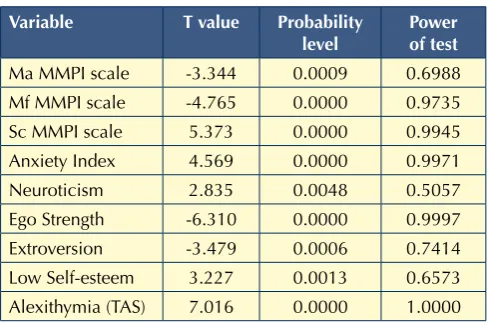
The results obtained by multiple regression (Table II) highlight how the personality traits involved in sexual problems provide a link to a personality that is intro-verted, passive, or suspicious, with high anxiety, low self-esteem, and a high rate of neuroticism, as verified in previous studies 38.
Logistic regression analysis highlighted other proper-ties of the SDQ scale. The parameter estimates can be used to calculate the probability of a subject with a certain score being in the dysfunctional group or the functional group. Table III shows the results of logistics regression between the presence of sexual problems and the total score on the scale (the first is the numeri-cal snumeri-cale, the second snumeri-cale is dichotomous: scoring scale ≤ 44 = 0; ≥ 45 = 1).
The first results indicate that the probability of finding a sexual dysfunction increases 1.16 times for every point of increase in the score scale. The second results show that when the value of the scale is ≥ 45 the probability of a multidimensional construct that describes a
constella-tion of personality features characterized by difficulties in differentiating, identifying, and communicating emo-tions 36. Finally, the subjects completed the Eating
Atti-tude Test (EAT- 26) 37, an instrument used for the analysis
of eating disorders.
Test-retest reliability was conducted on the sample after a period of 2 months to verify the stability of the SDQ scores. The convergent validity of the questionnaire was determined by comparing the SDQ with the Sex Prob-lems Scale (I-SP). The discriminant validity of the ques-tionnaire was obtained by comparing the SDQ with the EAT-26.
Results
In the overall sample, the SDQ questionnaire revealed that 52.4% of the subjects had sexual problems. The re-sults showed a statistical difference between men and women: women had a higher mean SDQ score of 54.5 compared to 47.9 for men (F = 33.19, p = 0.000000). The questionnaire had a high test-retest reliability (Pearson’s correlation coefficient of 0.76). The correlation between SDQ and Sex Problems Scale (I-SP) confirmed the con-vergent validity of the questionnaire (Pearson’s correla-tion coefficient of 0.63). The non-significant correlacorrela-tion between measures of different constructs – SDQ versus EAT – (Pearson’s correlation coefficient of 0.16, p = 0.18) provided a verification of the discriminant validity of the questionnaire.
The Factor Loadings after Varimax rotation were: Factor 1 from 0.38 to 0.73 and Factor 2 from 0.31 to 0.64 (for overall data see Appendix 2). Reliability statistics (includ-ing inter-item correlation) are presented in Appendix 3. The analysis of 19 items was run with Varimax rotation. The results of Varimax rotation are shown in Table I. In these results, the first factor retains the information contained in 3.8 of the original variables. The cumulative percentages show that the first two factors account for 99.58% of the variation.
Factor 1 is linked to sexual arousal, whereas Factor 2 is related to sexual desire. The internal consistency of the instrument, measured using Cronbach’s alpha, showed a high level of internal reliability (0.851). c2 analysis
among the items revealed a high statistical significance
Table I.
Result of Varimax rotation. Risultati della rotazione Varimax.
Factor eigen value Individual
Percent CumulativePercent
Factor 1 3.802934 58.27 58.27
Factor 2 2.696349 41.31 99.58
Table II.
Multiple regression among total score SDQ and MMPI scales, clinical indices, and TAS. Regressione multipla tra punteggio
SDQ, scale MMPI, indici clinici e TAS.
Variable T value Probability
level Power of test
Ma MMPI scale -3.344 0.0009 0.6988
Mf MMPI scale -4.765 0.0000 0.9735
Sc MMPI scale 5.373 0.0000 0.9945
Anxiety Index 4.569 0.0000 0.9971
Neuroticism 2.835 0.0048 0.5057
Ego Strength -6.310 0.0000 0.9997
Extroversion -3.479 0.0006 0.7414
Low Self-esteem 3.227 0.0013 0.6573
are similar to those in the literature (cited above), a similarity that confirms the reliability of the SDQ scale in the measurement of some personality problems in-volved in sexual dysfunction.
In fact, sexual arousal disorders (Factor 1) correlate with inhibition and introversion (preoccupation with oneself, with reduction of interest in the outside world, wariness, social avoidance, personal and social disaf-fection). Hypoactive sexual desire disorders (Factor 2) are mainly linked to neuroticism, a core personality trait that refers to one’s tendency to experience nega-tive feelings. Moreover, healthy individuals with high levels of neuroticism are at an increased risk for devel-oping depressive and anxiety disorders 40 41.
Based on data obtained through the SDQ, sexual dys-functions occur frequently in both men and women. The 19-item self-administered scale SDQ shows excel-lent psychometric properties to assess sexual dysfunc-tions (convergent validity, discriminant validity, and test-retest reliability). The discriminant validity and the ability of the questionnaire to predict the presence or absence of sexual complaints was good. We found an SDQ total score of 45 to be the optimal cut-off score for differentiating both women and men with and with-out sexual dysfunction. Moreover, findings of this study were similar to those reported in the literature.
This instrument has face validity, internal consistency, and reliability and shows associations with indicators of psychological and psychopathologic personality traits. Unlike other reliable questionnaires that reveal specific sexual dysfunctions, the SDQ has the ability to verify the presence of sexual problems in the individual. The SDQ addresses all aspects of the sexual response, including the more recently developed classifications 42.
Our research has shown that the questionnaire can also detect a possible change in sexual function (from nor-mal to dysfunctional and otherwise) using the cut-off of 45. The psychometric ability highlighted by the SDQ can be easily used in diagnostic and therapeutic work of the clinician. The statistical correlations highlighted with some personality problems of the individual and links consistently discussed in the literature on the top-ic largely confirm the reliability of the results obtained in our research.
observing sexual issues is 8.16 times greater than when the scale values are < 45. A cut-off score of 45 matches a sensitivity of 88.4% and a specificity of 79.1%. A fi-nal afi-nalysis conducted through linear regression reveals other aspects of the two factors. Primarily, Factor 1 and Factor 2 showed a significant correlation (r = 0.3975; p = 0.000000). Sexual arousal (Factor 1) is linked to hopelessness (r = 0.3913, p = 0.000000) and introversion (r = 0.2654, p = 0.000004). Sexual desire (Factor 2) is re-lated to the L-MMPI scale (tendency to create a favourable impression as a response bias, conventional, rigid, moral-istic, repression, denial, and lack of insight) (r = 0.2123, p = 0.000009) and to the D-MMPI scale (depression: r = 0.3126, p = 0.000000). Moreover, Factor 2 correlated with factor R-MMPI (r = 0.2925, p = 0.000000), which is related to inhibition or control over the expression of psy-chopathology. High scores on this scale correlated with depressive tendencies, submissiveness, conformism, and lack of insight 39. Finally, we found a correlation between
Factor 2 and neuroticism (r = 0.4523, p = 0.000000), a construct that includes such traits as nervousness, tense-ness, mooditense-ness, and temperament, that is, at the oppo-site extreme of emotional stability.
Discussion
Qualitative testing revealed adequate comprehension and content validity of the items. The SDQ showed good validity (degree of accuracy with which a test measures what it is designed to measure). Cronbach al-pha values > 0.85 indicated excellent internal consist-ency reliability. Additional analyses (sensitivity, specif-icity, logistic regression analyses, c2 analyses, and
Ken-dall’s tau-b) indicated that the scores on the SDQ are highly indicative of the presence (or absence) of sexual dysfunction in clinical samples. For example, women and men with an SDQ score ≥ 45 have a risk eight times higher to have sexual problems than those with scores ≤ 44. In addition, statistical analyses showed that the link between the subjects who reported sexual problems and those identified as such by the test is ex-tremely high (c2 =81.88; df = 1; p = 0.000000).
When analyzed by different statistical methods, the two factors were related to specific personality traits linked to the sexual dysfunction. This study’s findings
Table III.
Logistic regression between sexual problems and the SDQ score. Regressione logistica tra problemi sessuali e punteggio SDQ.
Parameter Regression coefficient
(b or beta) Odds Ratioexp (b) Confidence limitlower 95% Confidence limitUpper 95%
1) Total score SDQ 0.15282 1.16512 1.12958 1.20178
function in women: results of a survey study of 329 wom-en in an outpatiwom-ent gynecological clinic. J Sex Marital Ther
1993;19:171-88.
12 Read S, King M, Watson J. Sexual dysfunction in primary
medi-cal care: prevalence, characteristics and detection by the gen-eral practitioner. J Public Health Med 1997;19:387-91.
13 Moore JT, Goldstein Y. Sexual problems among family
medi-cine patients. J Fam Pract 1980;10:243-7.
14 Nusbaum MR, Gamble G, Skinner B, et al. The high
prev-alence of sexual concerns among women seeking routine gynecological care. J Fam Pract 2000;49:229-32.
15 Kaplan HS. Anxiety and sexual dysfunction. J Clin Psychiatry
1988;49:21-5.
16 Figueira I, Possidente E, Marques C, et al. Sexual
dysfunc-tion: a neglected complication of panic disorder and social phobia. Arch Sex Behav 2001;30:369-77.
17 Angst J. Sexual problems in healthy and depressed persons.
Int Clin Psychopharmacol 1988;13(Suppl 6):S1-4.
18 Baldwin DS. Depression and sexual dysfunction. Br Med
Bull 2001;57:81-99.
19 Jupp JJ, McCabeM. Sexual desire, general arousability, and
sexual dysfunction. Arch Sex Behav 1989;18:509-16.
20 Jannetti AJ. Self Esteem and Depression in men who present
with Erectile Dysfunction. Urol Nurs 1998;18:185-7.
21 Madioni F, Mammana LA. Toronto Alexithymia Scale in
outpa-tients with sexual disorders. Psychopathology 2001;34:95-8.
22 Wise TN, Osborne C, Strand J, et al. Alexithymia in
pa-tients attending a sexual disorders clinic. J Sex Marital Ther
2002;28:445-50.
23 Althof AE, Corty EW, Levine SB, et al. EDITS: Development
of questionnaires for evaluating satisfaction with treatments for erectile dysfunction. Urology 1999;53:793-9.
24 Rosen R, Brown C, Heiman J, et al. The female sexual
func-tion index (FSFI): a multidimensional self-report instrument for the assessment of female sexual function. J Sex Marital
Ther 2000;26:191-208.
25 Labbate LA, Lare SB. Sexual dysfunction in male psychiatric
outpatients: validity of the Massachusetts General Hospital Sexual Functioning Questionnaire. Psychother Psychosom
2001;70:221-5.
26 Quirk F, Haughie S, Symonds T. The use of the sexual
func-tion quesfunc-tionnaire as a screening tool for women with sexual dysfunction. J Sex Med 2005;2:469-77.
27 Althof S, Rosen R, Symonds T, et al. Development and
vali-dation of a new questionnaire to assess sexual satisfaction, control, and distress associated with premature ejaculation.
J Sex Med 2006;3:465-75.
28 Quirk FH, Heiman JR, Rosen RC, et al. Development of
a sexual function questionnaire for clinical trials of female sexual dysfunction. J Womens Health Gend Based Med
2002;11:277-89.
29 Rosen RC, Catania J, Pollack L, et al. Male Sexual Health
Questionnaire (MSHQ): scale development and psycho-metric validation. Urology 2004;64:777-82.
Conclusions
In this report, we describe the development and valida-tion of a new quesvalida-tionnaire (SDQ). The results of our study have shown that the SDQ has excellent psychomet-ric properties, including high levels of internal consist-ency and test-retest reliability, and should be a useful in-strument for assessing sexual dysfunctions in psychiatric patients. The findings support the use of the instrument both in routine clinical practice and in clinical research, together with its ease of administration and interpreta-tion, and the discretion of questions (increase of “com-pliance” and reduction of defenses). Moreover, it is a brief self-report inventory, typically requiring 5 min of the patient’s time for completion and is well suited for use in both clinical and research settings. Furthermore, its simplicity should facilitate easy cultural adaptation and validation into other languages. The results suggest that the SDQ may be a valuable new tool for evaluating and diagnosing subsets of sexual dysfunctions in psychi-atric patients (men and women), particularly with regard to arousal and desire sexual problems. Finally, since the psychometric validation of the questionnaire was done in a psychiatric sample, the instrument can not be used to test the general population.
References
1 Gayle Beck J. Hypoactive sexual desire disorder: an
over-view. J Consult Clin Psychol 1995;63:915-27.
2 Hawton K. Treatment of sexual dysfunctions by sex therapy
and other approaches. Br J Psychiatry 1995;167:307-14.
3 Butcher J. Female sexual problems I: Loss of desire-what
about the fun? BMJ 1999;318:41-3.
4 American Psychiatric Association. DSM IV: Diagnostic and
Statistical Manual for Mental Disorders. 4th edn.
Washing-ton, DC: American Psychiatric Press 1994.
5 Meston CM, Hull E, Levin RJ, et al. Disorders of orgasm in
women. J Sex Med 2004;1:66-8.
6 Phillips NA. Female sexual dysfunction: evaluation and
treatment. Am Fam Physician 2000;62:127-36.
7 Baram DA. Sexuality, sexual dysfunction, and sexual assault.
In: Berek JS, editor. Novak’s Gynecology. 13th edn.
Philadel-phia, PA: Lippincott Williams and Wilkins 2002.
8 Shindel AW, Ferguson GG, Nelson CJ, et al. The sexual lives
of medical students: a single institution survey. J Sex Med
2008;5:796-803.
9 Laumann EO, Paik A, Rosen RC. Sexual dysfunction
in the United States. Prevalence and predictors. JAMA
1999;281:537-44.
10 Spector IP, Carey MP. Incidence and prevalence of the
sex-ual dysfunctions: a critical review of the empirical literature.
Arch Sex Behav 1990;19:389-408.
dys-37 Garner DM, Olmsted MP, Bohr Y, et al. The Eating Attitudes
Test: psychometric features and clinical correlates. Psychol
Med 1982;12:871-8.
38 Hartmann U, Heiser K, Rüffer-Hesse C, et al. Female sexual
desire disorders: subtypes, classification, personality factors and new directions for treatment. World J Urol
2002;20:79-88.
39 Welsh GS. MMPI profiles and factor scale A and R. J Clin
Psychol 1965;21:43-7.
40 Kendler KS, Neale MC, Kessler RC, et al. A longitudinal twin
study of personality and major depression in women. Arch
Gen Psychiatry 1993;50:853-62.
41 Bienvenu OJ, Stein MB. Personality and anxiety disorders: a
review. J Personal Disord 2003;17:139-51.
42 Basson R, Berman J, Burnett A, et al. Report of the
Inter-national Consensus Development Conference on Female Sexual Dysfunction: Definitions and classifications. J Urol
2000;163:888-93.
30 Moreira ED Jr, Brock G, Glasser DB, et al. GSSAB
Invetiga-tors’ Group. Help-seeking behaviour for sexual problems: the global study of sexual attitudes and behaviors. Int J Clin
Prac 2005;59:6-16.
31 Garson GD. 1999: http://www2.chass.ncsu.edu/garson/
pa765/reliab.htm#intraclass.
32 Nunnally JC, Bernstien ICH. Psychometric Theory. 3rd edn.
New York: McGraw-Hill 1994.
33 Spiegel S, Castellan NJ. Nonparametric Statistics for the
Be-havioral Sciences. New York: McGraw-Hill 1988.
34 Dahlstrom WG, Welsh GS, Dahlstrom LE. An MMPI
Hand-book. Vol. 2. Research application. Revised Edition.
Min-neapolis, MS: University of Minnesota 1975.
35 Levitt EE. The clinical application of MMPI special scales.
Hillsdale, NJ: Lawrence Erlbaum 1989.
36 Taylor GJ, Bagby RM, Parker J. Factorial validity of the
Toron-to Alexithymia Scale with a large clinical sample. Psychosom
Med 1988;50:205-6.
aPPenDIx 1
Sexual Dysfunction Questionnaire (SDQ). Questionario sulle Disfunzioni Sessuali (QDS).
Gender M F Education Age Date / /
always Often Sometimes Rarely never
1) I am satisfied with my sex life 1 2 3 4 5
2) I have sexual fantasies 1 2 3 4 5
3) I have sexual dreams 1 2 3 4 5
4) I like to talk about things that concern sexuality 1 2 3 4 5
5) I like to tell jokes involving sex 1 2 3 4 5
6) I feel uninhibited towards sexuality 1 2 3 4 5
7) I like to keep sexuality hidden 5 4 3 2 1
8) I speak about sexuality with my partner 1 2 3 4 5
9) I live sexuality in rigid manner 5 4 3 2 1
10) I would live better without sexuality 5 4 3 2 1
11) My sex life is planned 5 4 3 2 1
12) I avoid situations that arouse my sexuality 5 4 3 2 1
13) Sexuality creates worry for me 5 4 3 2 1
14) I like watching movies or scenes involving sex 1 2 3 4 5
15) I like to talk during sex 1 2 3 4 5
16) I reach orgasm during sex 1 2 3 4 5
17) During sex I “let go” 1 2 3 4 5
18) Sexuality scares me 5 4 3 2 1
aPPenDIx 2
Factor loadings after Varimax rotation. Fattori di carico dopo
la rotazione Varimax.
Factors
Variables Factor 1 Factor 2
1 -0.71
2 -0.69
3 -0.50
4 -0.63
5 -0.40
6 -0.47
7 -0.31
8 -0.38 -0.36
9 -0.72
10 -0.60
11
12 -0.48
13 -0.74
14 -0.64
15 -0.38
16 -0.47
17 -0.38
18 -0.73
19 -0.47
Eigenvalue 3.802 2.696
Variance explained 58.27 41.31
aPPenDIx 3
Reliability statistics. Statistiche di affidabilità.
If this Item is omitted Variable Cronbach’s
alpha correlationItem-total correlationInter-item
1 0.84 0.56 0.52
2 0.84 0.44 0.43
3 0.85 0.28 0.29
4 0.84 0.52 0.41
5 0.85 0.27 0.20
6 0.84 0.52 0.36
7 0.85 0.24 0.16
8 0.84 0.49 0.35
9 0.83 0.70 0.57
10 0.84 0.62 0.45
11 0.85 0.19 0.14
12 0.84 0.49 0.31
13 0.84 0.49 0.52
14 0.85 0.34 0.34
15 0.84 0.39 0.26
16 0.84 0.46 0.32
17 0.85 0.29 0.20
18 0.84 0.58 0.52
19 0.84 0.54 0.37