Journal of Applied Biotechnology Reports Original Article
Journal of Applied Biotechnology Reports, Volume 4, Issue 3, Summer 2017; 639-643
All rights reserved for official publication of Baqiyatallah university of medical sciences©
Assessment of Changes in Expression of the 5- HT
2Aand GABA
AReceptor Genes in Peripheral
Blood Mononuclear Cells of Gas Station Workers, Tehran, Iran
Sheyda Bahiraii1*, Ghasem Ahangari2, Abbas Mirshafiey3, Mehdi Razazian1,
Farkhondeh Mohammadi3,
Abstract
Introduction
At a gas station during delivery, storage, and dispensing the fuel to customers, unburned fuel can be released to the environment in either liquid or vapor form. Fuel is a com-plex mixture of chemicals especially aromatic compounds such as benzene, xylene, toluene and ethylbenzene which are the most dangerous agents with toxic and carcinogenic effects. For instance, occupational studies have linked benzene exposures to numerous cancers, including acute myeloid leukemia and acute non-lymphocytic leukemia. Based on scientific reports, concerns have been raised that gasoline vapor exposure at the gas station by attendants and also tanker truck drivers may result in health risks [1, 2]. Accordingly, evaporation of the fuel and its organic matters can be caused physiological damage, including damage to the nervous system, eye irritation, nose and throat, genetic mutation, the birth of premature infants, and so on. Also, harmful environmental effects, including acid rain production, photochemical smell phenomena, global climate change, damage to the ozone layer, rise in global
warming, and so on [3, 4]. A study in Canada showed that in 2009 the amount of evaporative losses at gas stations was 58,300,000 L. With a population of about 34 million, they estimated that about 1.7 L of gasoline was released per capita per year in Canada from evaporative losses, without counting the liquid spills [1] which, of course, seems to be more widespread in developing countries. Since gasoline vapor condensation is higher at gas stations so worker in these places are people with greatest exposure to organic compounds originating from gasoline which increases the risk of health for them [2]. These people spend most of their time in these places, approximately 40 h per week for years, where vapors from the pump are at their highest concentrations, with benzene concentra-tions measuring between 30 and 230 ppb in the breathing zone [5, 6]. Generally, different quantitative toxicity me-trics exist for gasoline inhalation. According to the EPA Integrated Risk Information System (IRIS) [7], 0.03 mg/m3 (about 9.4 ppb) is considered as a reference concentration, corresponding to decreased lymphocyte Gasoline containing different chemical compounds especially aromatic compounds
such as benzene, xylene, toluene and ethylbenzene which are the most dangerous compounds. Gas station workers have the highest potential for exposure to gasoline evaporation. Many studies have investigated the effect of gasoline vapors and cause of death in people working in gas stations. According to reports, the cause of death of these people is mainly due to cardiovascular disease, lung cancer, leukemia and other cancers in the world. With regard to the harmful effects of gasoline vapors on health and the importance of the relationship between the immune system and nervous, in this study we investigated alternations in gene expression pattern of the serotonin 5-Hydroxytryptamine 2A (5-HT2A) receptor and type A
gamma-aminobutyric acid (GABAA) receptor in peripheral blood mononuclear cells
(PBMCs) of people working in gas stations, Tehran. For this purpose, The PBMCs were separated from whole blood of 30 gas station workers and 30 normal by Fi-coll-hypaque. The total RNA was extracted and the cDNA was synthesized. This process was followed by Real-time PCR using specific primers for 5-HT2A and
GABAA receptor mRNAs. Results have shown a significant increase (P = 0.001) in
relative gene expression of 5-HT2A receptor whereas relative expression of GABAA
receptor was significantly decreased (P = 0.004) in PBMC compared with normal control peoples. According to the role of the serotonin in asthma and due to the importance of the activity of this neurotransmitter through 5HT2A receptor which
has a significant increase in patients with allergic asthma it can be concluded that workers in the gas station may be more susceptible to developing allergic asthma. On the other hand, low expression of GABAA receptor is associated with mental
health problems such as depression, so it can also be concluded that people working at the gas station are more exposed to these health problems in comparison to nor-mal people.
Keywords: Gasoline, Gas Station, Gene Expression, 5-HT2A Receptor, GABAA
receptor, Real-time
1. Department of Molecular Biology, University of Vienna, Vienna, Austria
2. Department of Medical Genetics, National Insti-tute of Genetic Engineering and Biotechnology, Tehran, Iran
3. Department of Immunology, School of Public Health, Tehran University of Medical Sciences, Tehran, Iran
* Corresponding Author Sheyda Bahiraii
Department of Molecular Biology, University of Vienna, Vienna, Austria
E-mail: [email protected]
counts, whereas based on the National Institute for Occu-pational Safety and Health (NIOSH) standards, recom-mended exposure limit (REL) is a time-weighted average concentration (for up to a 10-hour workday during a 40-hour workweek) of 0.319 mg/m3 or about 100 ppb [8] which represent high risks for health. Based on these topics, in recent years many studies have been done on harmful effects of gasoline but most of these studies focused on petrol vapors after combustion. In this study, we investigated the effects of gasoline vapors prior to combustion on workers at the gas station by assessment of alterations in gene expression pattern of the 5-HT2A and
type A γ-aminobutyric acid receptor genes in PBMCs which can be used as molecular markers in order to identi-fy potential health risks.Between the immune system, the nervous system and the endocrine is a close connection by cytokines, secretion factors from immune cells, hormones and neurotransmitters. Serotonin is one of the keys and most important neurotransmitters that has been shown to have different receptors on different tissues of the body as a peripheral hormone and can thus control the immune system by the nervous system. Most of the body’s seroto-nin is circulating in the bloodstream, transported by blood platelets that during it by binding to immune cell surface receptors like 5-HT2A, can lead to a change in their
function [9]. In recent years, a number of immunoregulato-ry functions have been described for serotonin. For the instant, serotonin modulates cytokine secretion in mono-cytes/macrophages or can also suppress the release of tumor necrosis factor-α (TNF-α) and interleukin-1β by activating serotonin receptors. Furthermore, neutrophil recruitment and T-cell activation can both be mediated by serotonin [10]. On the other hand, it is proven that seroto-nin 5-HT2A receptor function as a contributing factor to
both neuropsychiatric cardiovascular and disorders. Stu-dies have been showed that 5-HT2A receptor can cause
some neuropsychiatric disorder such as Schizophrenia and Depression/anxiety [11]. Also, γ-aminobutyric acid (GABA) is the most important inhibitory neurotransmitter in the central nervous system (CNS) and plays an impor-tant role as a trophic factor to modulate several essential developmental processes including neuronal proliferation, migration, and differentiation. Studies showed that GABA inhibits or reduces the activity of the neurons or nerve cells in CNS and plays an important role in behavior, cognition, and the body's response to stress. Accordingly, lower-than-normal levels of GABA in the brain have been linked to schizophrenia, depression, anxiety, and sleep disorders [12, 13]. Molecular and biochemical studies have led to identification three major GABA receptors, termed GABAA, GABAB and GABAC receptors [14]. Based on
biomedical reports, GABAA receptors are of great clinical
significance in several disorders, including epilepsy, anxie-ty, and alcoholism [15-17]. Therefore, as noted above, the expression level of this receptor can be used as molecular markers to assess the probability of related disorders.
Materials and Methods
Recruitment of subjects
Thirty healthy male volunteers, between 23 and 55 y of age, were randomly selected from among the workers at
the gas station (Tehran, Iran), who even worked for 6 months at the station. Selection was based on some exclu-sion criteria including tobacco smoking, history of mental illness or taking psychosocial drugs, having asthma and any allergies. Controls were also selected among people who lived in a normal weather zone. Subjects were in-formed about the design and purpose of the study and pro-vided full informed written consent. Also, this case-control study was approved by National Institute of Genetic Engi-neering and Biotechnology (NIGEB) Ethics Committee.
Isolation of peripheral blood mononuclear cells (PBMCs) using Ficol-Hypaque
Peripheral blood is the primary source for investigation of the human immune system. A rapid and simple method of purifying PBMCs is Ficoll-Hypaque density gradient cen-trifugation based on the density differences between mo-nonuclear cells and other elements in the blood sample [18]. For this purpose, the peripheral blood should not be older than 8 h and supplemented with anticoagulants such as EDTA. Accordingly, the venous blood sample was col-lected from all participants and aliquoted into tubes con-taining EDTA to separate PBMCs. In the following, PBMCs were isolated from fresh blood using Ficoll-Hypaque (Lympholyte-H; Cedarlane Laboratories, Horn-by, ON, Canada) gradients centrifugation. After washing with PBS at 4°C, isolated PBMCs were counted and via-bility was tested using the Naebaur counting chamber after staining with Trypan blue.
Total mRNA extraction and cDNA synthesis
To analysis mRNA expression, total RNA was extracted from PBMCs using a Total RNA Extraction Miniprep kit (Takara, Japan) according to the manufacturer’s instruc-tion. DNA was eliminated during RNA extraction utilizing DNase I. The concentration of RNA was quantified with a NanoDrop ND-1000 (Thermo Fisher Scientific) and RNA purity was determined by the 260/280 nm absorbance ra-tio, and also RNA integrity was assessed by agarose gel electrophoresis. Finally, the complementary DNA (cDNA) was synthesized using One-Step RT-PCR Kit (Takara, Japan). At first, cDNA was used for qualitative assessment of expression of 5- HT2A and Type A γ-aminobutyric acid
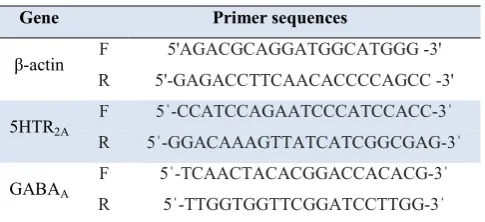
receptors with primers which synthesized by Macrogen, Korea (Table 1). An Eppendorf thermocycler (Germany) was used for all reactions.
Table 1. Primer sequences.
Gene Primer sequences
β-actin F 5'AGACGCAGGATGGCATGGG -3'
R 5'-GAGACCTTCAACACCCCAGCC -3'
5HTR2A
F 5ˈ-CCATCCAGAATCCCATCCACC-3ˈ R 5ˈ-GGACAAAGTTATCATCGGCGAG-3ˈ
GABAA
F 5ˈ-TCAACTACACGGACCACACG-3ˈ R 5ˈ-TTGGTGGTTCGGATCCTTGG-3ˈ
F: Forward; R: Reverse
Quantitative real-time PCR
Sheyda Bahiraii, et al. Assessment of Changes in Expression of the 5- HT2A and GABAA Receptor Genes
Journal of Applied Biotechnology Reports, Volume 4, Issue 3, Summer 2017 177 changes in expression of 5-HT2A and Type A
γ-aminobutyric acid receptors with specific synthesized pri-mers (Table 1). All reactions were carried out in duplicate, and each reaction was contained 20 μl of mixture solution consisting of 10 μl of SYBR PCR Master Mix (Applied Biosystems, USA), 1 nM concentration of each primer, 3.5 μl of sterilized deionized water and 4.5 μl of cDNA. Also, β-actin was used as a calibrator control to evaluate expres-sion and mRNA level of target genes. The cycling condi-tions were as follows: one cycle of 95°C for 10 min as the holding time, 95 °C for 45 s for denaturation, and 55°C for 45 s as annealing/extension time. To evaluate of gene ex-pression 40 cycles was set as a cycle cut-off point for no detection. During the annealing/extension time amplifica-tion data were collected. Melting curve analysis was per-formed as follows: reactions were heated to 95°C for 15 s, followed by cooling to 60°C and stepwise heating to 95°C with a ramp rate of 0.3°C. Finally, the comparative thre-shold cycle (CT) method (using the formula 2−ΔΔ(CT)) was used to analyze the data obtained. A Corbett thermocycler (Australia) was used for all reactions.
Statistical Analysis
The statistical significance of the differences between the control and test values was evaluated using one-way ANOVA t-test using SPSS 19 software (SPSS Inc., Chica-go, IL, USA). Statistical significance was considered at a p-value <0.05.
Results
The mRNA level of 5-HT2A and Type A γ-aminobutyric
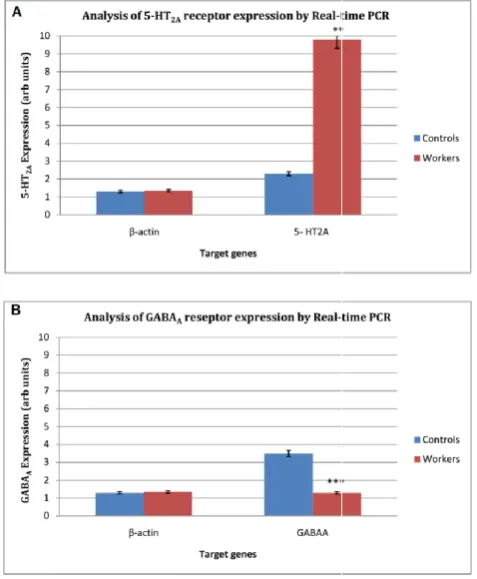
acid receptors in PBMCs of workers and control subjects is shown in Fig. 1 & 2. As depicted in these figures, the difference between the expression of two markers in work-er subjects and controls wwork-ere statistically significant (P<0.05). Accordingly, expression level of the 5-HT2A
receptor in worker subjects was significantly (P=0.001) increase compared with controls (Fig. 1). By contrast, rela-tive expression of GABAA receptor was significantly
(P=0.004) decreased in their PBMCs compared with nor-mal control peoples (Fig. 2). Based on our results, 5- HT2A
receptor expression in PBMCs isolated from the blood of workers showed a 5-fold increase compared with control people while GABAA receptor expression in PBMCs
de-creased about 3-fold in comparison to PBMCs isolated from the blood of normal people.
Discussion
Environmental pollution is one of the problems that humankind faced since the beginning of the industrial rev-olution to today. Among various types of pollution, air pollution is one of the most important environmental and public health issues especially in large cities [19]. Gener-ally, this type of contamination is the result of fossil fuels, which are escaped in the air before or after combustion. According to many studies, exposure to ambient air pollu-tion has been associated with a series of adverse health effects such as physiological changes in pulmonary func-tions and the cardiovascular system. Also, more recently, associations have been demonstrated between chronic exposure to air pollution and negative neurological effects
[20]. In recent decades, reasons such an increase in popula-tion growth of the world, industrial development, urban population growth and the promotion of social welfare have led to increased energy consumption in the world. As a result, demand for fossil fuels especially gasoline has been increasing every day [21] which can lead to produc-tion a large number of chemical particles and vapors in the air with devastating effects on health and environment. As mentioned above, gasoline has two types of vapors which are produced before combustion, which is related to its volatility, and after combustion. Previous studies fo-cused on gasoline vapors after combustion, but in this study for the first time we examined the effects of vapors from evaporative emissions of gasoline on workers at the gas stations because they are the main group exposed to these vapors. Generally, gasoline emission due to fuel handling and storage at gas stations is as a major problem for people working in these stations. Due to gasoline vola-tility, many chemical particles as volatile organic com-pounds (VOCs) are easily released in the gas station envi-ronment. According to reports typical gasoline mainly consists of volatile organic hydrocarbon and aromatic compounds such as Benzene, Toluene, Xylene (BTX), C8 -, C9 -, methanol, 5 MTBE, butenes and pentenes [22]. A study by Eisaei et al. (2015) in Tehran, showed that the average concentrations of BTX and total VOCs at gas sta-tions are 161.22, 200.81, 229 and 647.01 ppm, respective-ly, higher than the World Health Organisation (WHO) guidelines [23]. VOCs such as BTX are known as predo-minant pollutants and have adverse effects human health [24, 25]. Studies have been demonstrated that short-term (acute) exposure to high VOC concentrations can cause dizziness, tremors, nausea, or other health problems. Also, long-term (chronic) exposure to some VOCs especially Benzene may cause cancer related to liver, kidney, lung, heart and the brain caused by DNA strand breaks, chromo-somal damage, etc [23, 26, 27]. On the other hand, various studies have shown the relationship between these com-pounds and the occurrence of various diseases, including allergies [28, 29] and neuropsychological symptoms espe-cially by BTX [30]. Accordingly, in a study by Gordian et al., (2010), the relationship between gasoline emissions and Asthma symptoms was investigated [29]. They meas-ured the indoor air Benzene, Toluene, Ethylbenzene and Xylenes (BTEX) in over 500 houses with attached garages in Anchorage, Alaska. Based on their report, BTEX com-pounds especially Benzene can be effective in developing Asthma. Thetkathuek et al., (2015) investigated neuropsy-chological effects of the Toluene and Xylene among work-ers which exposed to them in two paint manufacturing factories. Based on their reports high amounts of these compounds can cause neuropsychological effects, espe-cially psychosomatic symptoms, and sleep disturbances [30]. In molecular level, some studies have been shown that high concentration of blood serotonin is associated with the intensity and exacerbation of asthma disease. Other studies showed that 5-HT2A can enhance T-cell
blas-togenesis and production of pro-inflammatory cytokines such as IFNγ [31]. On the other hand, some reports dis-cussed the role of 5-HT receptors in airway smooth muscle
contraction. Cazzola and Matera reported that four groups of 5-HT receptors including 5-HT1A, 5-HT
5-HT7 are important in controlling airway fu
serotonin directly has its contractile effect through 5 receptor on smooth muscle cells [32-34]. Accordingly, in a study we investigated the expression level of
in PBMCs of patients with allergic Asthma
Figure 1. Quantitative analysis of the expression level of 5 (A), and GABAA (B) receptor genes in PBMCs
from workers at gas stations and control subjects shows that the expression level of 5-HT2A and GABA
significantly increased and decreased, respectively, in compar son with control. Data are presented as mean ± SEM (error bars) from three independent experiments (**P=0.001 & ***P<0.004). Our results indicated that gene expression is significantly increased in PBMCs of asthma patients in comparison with the normal group. Therefore we suggested that the expre sion level of 5-HT2A gene in PBMCs could be considered as a biomarker of asthma. As previously mentioned, exp sure to air pollutants can lead to lung inflammatory re ponses such as allergic asthma. Based this topic and our results in the previous study, we analyzed gene expre level of the 5-HT2A receptor in PBMCs of people who had
been exposed to air pollution in the highly polluted area compared to allergic asthmatic patients [35
sion level of 5-HT2A gene in PBMCs of both exposed ind viduals and allergic asthmatic patients was significantly increased in comparison with control group. These results indicate that there may be an association between increase expression level of 5-HT2A receptor gene and exposure to air pollution as well as asthma incidence. Along with our studies, Amidfar et al., (2017) investigated expression l vels of the 5-HT2A receptor in PBMCs of patients with the contraction. Cazzola and Matera reported that four groups HT2A, 5-HT3A, and
are important in controlling airway functions and serotonin directly has its contractile effect through 5-HT2A
. Accordingly, in a study we investigated the expression level of 5-HT2A gene in PBMCs of patients with allergic Asthma [31].
. Quantitative analysis of the expression level of 5-HT2A
in PBMCs which isolated from workers at gas stations and control subjects. qPCR analysis and GABAA genes
significantly increased and decreased, respectively, in compari-son with control. Data are presented as mean ± SEM (error bars) from three independent experiments (**P=0.001 & ***P<0.004). Our results indicated that gene expression is significantly increased in PBMCs of asthma patients in comparison with the normal group. Therefore we suggested that the
expres-gene in PBMCs could be considered as a biomarker of asthma. As previously mentioned, expo-sure to air pollutants can lead to lung inflammatory res-ponses such as allergic asthma. Based this topic and our results in the previous study, we analyzed gene expression receptor in PBMCs of people who had been exposed to air pollution in the highly polluted area 35]. The expres-gene in PBMCs of both exposed indi-viduals and allergic asthmatic patients was significantly increased in comparison with control group. These results association between increase ceptor gene and exposure to air pollution as well as asthma incidence. Along with our (2017) investigated expression le-HT2A receptor in PBMCs of patients with the
major depressive disorder (MDD) results, mRNA expression of 5
cantly higher in PBMCs of all patients in comparison with healthy controls.
They showed that 5-HTR2A
MDD patients could be associated with the severity of depression and the duration of the illness. Similar to these reports, many studies have shown that GABA
are also involved in the pathology of several neur
and psychiatric diseases such as epilepsy, anxiety, autism, depression, sleep disorders and Alzheimer’s disease For example, according to investigations, a signi decrease in the expression level of GABA receptors has been determined in the brains of individuals with autism. Related results show that GABA
the brain regions that have been associated with the path genesis of autism [38]. Also, studies have demonstrated a relationship between reductions in specific subtypes of the GABAA receptor and incidence fragile X syndrome
40]. Based these topics, in current study we hypothesized that alterations in gene expression pattern of the 5 and type A γ-aminobutyric acid receptor genes in PBMCs can be used as diagnostic molecular markers in order to identify potential health risks such as allergic Asthma and neurological and psychiatric diseases especially for atte dants at gas stations which are exposed
gasoil and VOCs.
Conclusion
Our results showed that there is a significant relationship between the gasoline vapor level and the change in expre sion level of 5-HT2A and GABA
line pump workers have a higher risk of developing some diseases such as allergic Asthma and psychiatric diseases compared to normal people but this requires further studies on a larger number of patients.
Acknowledgements This study is extracted from
approved and supported by National Institute
Engineering and Biotechnology, Iran, and School of Public Health, Tehran University of Medical Sciences, Iran. The authors would like to thank colleagues in this institute their kind and generous assistance.
References
1. Hilpert, M., Mora, B.A., Ni, J., Rule, A.M., Nachman, K.E., Hydrocarbon release during fuel storage and transfer at gas st tions: Environmental and health effects
Rep, 2015, Vol. 2, pp. 412-422.
2. Karakitsios, S.P., Papaloukas, C.L., Kassomenos, P.A., Pilidis, G.A., Assessment and prediction of exposure to benzene of fil ing station employees.Atmos Environ
9569.
3. Ahmed, F.E., Toxicology and human health effects following exposure to oxygenated or reformulated gasoline
2001, Vol. 123, pp. 89-113.
4. Parish, E.S., Kline, K.L., Dale, V.H., Efroymson, R.A., McBride, A.C., Johnson, T.L., Hilliard, M.R., Bielicki, J.M., Comparing scales of environmental effects from gasoline and ethanol production.Environ manage
5. van Wijngaarden, E., Stewart, P.A., Critical literature review of determinants and levels of occupational benzene exposure for major depressive disorder (MDD) [36]. According to their results, mRNA expression of 5-HT2A receptor was
signifi-cantly higher in PBMCs of all patients in comparison with
2A mRNA levels in PBMCs of
MDD patients could be associated with the severity of depression and the duration of the illness. Similar to these reports, many studies have shown that GABAA receptors
are also involved in the pathology of several neurological and psychiatric diseases such as epilepsy, anxiety, autism, depression, sleep disorders and Alzheimer’s disease [37]. For example, according to investigations, a significant decrease in the expression level of GABA receptors has been determined in the brains of individuals with autism. Related results show that GABAA receptors are reduced in
the brain regions that have been associated with the patho-lso, studies have demonstrated a relationship between reductions in specific subtypes of the receptor and incidence fragile X syndrome [39, . Based these topics, in current study we hypothesized that alterations in gene expression pattern of the 5-HT2A
aminobutyric acid receptor genes in PBMCs can be used as diagnostic molecular markers in order to identify potential health risks such as allergic Asthma and neurological and psychiatric diseases especially for atten-dants at gas stations which are exposed to high level of
Our results showed that there is a significant relationship between the gasoline vapor level and the change in
expres-and GABAA receptor genes. So,
gaso-line pump workers have a higher risk of developing some diseases such as allergic Asthma and psychiatric diseases compared to normal people but this requires further studies on a larger number of patients.
This study is extracted from a master's thesis which was approved and supported by National Institute of Genetic Engineering and Biotechnology, Iran, and School of Public Health, Tehran University of Medical Sciences, Iran. The authors would like to thank colleagues in this institute for their kind and generous assistance.
Hilpert, M., Mora, B.A., Ni, J., Rule, A.M., Nachman, K.E., Hydrocarbon release during fuel storage and transfer at gas sta-tions: Environmental and health effects. Curr Environ Health
Karakitsios, S.P., Papaloukas, C.L., Kassomenos, P.A., Pilidis, G.A., Assessment and prediction of exposure to benzene of
Sheyda Bahiraii, et al. Assessment of Changes in Expression of the 5- HT2A and GABAA Receptor Genes
Journal of Applied Biotechnology Reports, Volume 4, Issue 3, Summer 2017 177 United States community-based case-control studies.Appl Occup
Environ Hyg, 2003, Vol. 18, pp. 678-693.
6. Periago, J., Zambudio, A., Prado, C., Evaluation of environ-mental levels of aromatic hydrocarbons in gasoline service sta-tions by gas chromatography.J Chromatogr A, 1997, Vol. 778, pp. 263-268.
7. EPA, U., Integrated Risk Information System (IRIS), 1999, EPA.
8. Safety, N.I.f.O., NIOSH pocket guide to chemical hazards. 2000: DIANE Publishing.
9. Herr, N., Bode, C., Duerschmied, D., The effects of Serotonin in immune Cells.Front Cardiovasc Med, 2017, Vol. 4, pp. 48. 10. Arreola, R., Becerril-Villanueva, E., Cruz-Fuentes, C., Velas-co-Velázquez, M.A., Garcés-Alvarez, M.E., Hurtado-Alvarado, G., Quintero-Fabian, S., Pavón, L., Immunomodulatory effects mediated by serotonin.J Immunol Res, 2015, Vol. 2015, pp. 1-7. 11. Raote, I., Bhattacharya, A., Panicker, M.M., Serotonin 2A (5-HT2A) receptor function: ligand-dependent mechanisms and pathways.Front Neurosci, 2007, Vol. pp. 1-17.
12. Luscher, B., Shen, Q., Sahir, N., The GABAergic deficit hypo-thesis of major depressive disorder, 2011, Nature Publishing Group.
13. Kantrowitz, J., Citrome, L., Javitt, D., GABAB receptors, Schizophrenia and sleep dysfunction.CNS Drugs, 2009, Vol. 23, pp. 681-691.
14. Chebib, M., Johnston, G.A., The ‘ABC’of GABA receptors: a brief review. Clin Exp Pharmacol Physiol, 1999, Vol. 26, pp. 937-940.
15. Enoch, M.-A., The role of GABA A receptors in the devel-opment of alcoholism. Pharmacol Biochem and Behav, 2008, Vol. 90, pp. 95-104.
16. Brailowsky, S., Garcı́a, O., Ethanol, GABA and epilepsy. Arch Med Res, 1999, Vol. 30, pp. 3-9.
17. Crestani, F., Lorez, M., Baer, K., Essrich, C., Benke, D., Lau-rent, J.P., Belzung, C., Fritschy, J.-M., Lüscher, B., Mohler, H., Decreased GABAA-receptor clustering results in enhanced an-xiety and a bias for threat cues. Nature Neurosci, 1999, Vol. 2, pp. 833-839.
18. Fuss, I.J., Kanof, M.E., Smith, P.D., Zola, H., Isolation of whole mononuclear cells from peripheral blood and cord blood. 2009: Wiley Online Library.
19. Chen, B., Kan, H., Air pollution and population health: a global challenge. Environ Health Prev Med, 2008, vol. 13, pp. 94-101.
20. Bos, I., De Boever, P., Vanparijs, J., Pattyn, N., Panis, L.I., Meeusen, R., Subclinical effects of aerobic training in urban environment.Med Sci Sports Exerc, 2013, Vol. 45, pp. 439-47. 21. Chu, S., Majumdar, A., Opportunities and challenges for a sustainable energy future.Nature, 2012, Vol. 488, pp. 294-303. 22. Zheng, J., Zhu, T., Zhang, R., Wang, M., Chang, C.-C., Shao, M., Hu, M., Characterization of gas station emissions during the CAREBeijing 2008 field study.Atmos Chem Phys Discuss, 2011, Vol. 11, pp. 14719-14746.
23. Eisaei, H.R., Dehrashid, A., Shaho, S., Khani, M.R., Hashe-mi, S.M., Assessment and control of VOCs emitted from gas stations in Tehran, Iran.Pollution, 2015, Vol. 1, pp. 363-371. 24. Franco, M., Chairez, I., Poznyak, T., Poznyak, A., BTEX decomposition by ozone in gaseous phase. J Environ manage, 2012, Vol. 95, pp. S55-S60.
25. D’Andrea, M.A., Reddy, G.K., Adverse Health Complaints of Adults Exposed to Benzene After a Flaring Disaster at the BP Refinery Facility in Texas City, Texas. Disaster Med Public Health Prep, 2017, Vol. pp. 1-9.
26. Loh, M.M., Levy, J.I., Spengler, J.D., Houseman, E.A., Ben-nett, D.H., Ranking cancer risks of organic hazardous air pollu-tants in the United States. EnvironHealth Perspect, 2007, Vol. 115, pp. 1160.
27. McMichael, A., Carcinogenicity of benzene, toluene and xylene: epidemiological and experimental evidence. IARC Sci publ, 1988, Vol. pp. 3-18.
28. Nurmatov, U.B., Tagiyeva, N., Semple, S., Devereux, G., Sheikh, A., Volatile organic compounds and risk of asthma and allergy: a systematic review.Eur Respir Rev, 2015, Vol. 24, pp. 92-101.
29. Gordian, M.E., Stewart, A.W., Morris, S.S., Evaporative gasoline emissions and asthma symptoms. Int J Environ Res Public Health, 2010, Vol. 7, pp. 3051-3062.
30. Thetkathuek, A., Jaidee, W., Saowakhontha, S., Ekburanawat, W., Neuropsychological symptoms among workers exposed to toluene and xylene in two paint manufacturing factories in eastern Thailand.Adv Prev Med, 2015, Vol. 2015, pp. 31. Ahangari, G., Emadi Koochak, S., Mohammadi Amirabad, L., Derkhshan Deilami, G., Investigation of 5-HT2A gene expression in PBMCs of patients with allergic asthma. Inflamm Allergy Drug Targets, 2015, Vol. 14, pp. 60-64. 32. Shin, S.W., Oh, T.J., Park, S.-M., Park, J.S., Jang, A.S., Park, S.W., Uh, S.T., An, S., Park, C.-S., Asthma-predictive genetic markers in gene expression profiling of peripheral blood mononuclear cells. Allergy Asthma Immunol Res, 2011, Vol. 3, pp. 265-272.
33. Yang, G.-B., Qiu, C.-L., Zhao, H., Liu, Q., Shao, Y., Expression of mRNA for multiple serotonin (5-HT) receptor types/subtypes by the peripheral blood mononuclear cells of rhesus macaques.J Neuroimmunol, 2006, Vol. 178, pp. 24-29. 34. Cazzola, M., Matera, M.G., 5-HT modifiers as a potential treatment of asthma.Trends Pharmacol Sci, 2000, Vol. 21, pp. 13-16.
35. Sheikhha, H., Emadi, S., Jorbozedar, S., D Deilami, G., Ahangari, G., Investigation of Gene Expression Pattern of 5HTR2a and MAO-A in PBMCs of Individuals Who Had Been Exposed to Air Pollution in Highly Polluted Area. Recent pat Inflamm Allergy Drug Discov, 2014, Vol. 8, pp. 203-210. 36. Amidfar, M., Kim, Y.-K., Colic, L., Arbabi, M., Mobaraki, G., Hassanzadeh, G., Walter, M., Increased levels of 5HT2A receptor mRNA expression in peripheral blood mononuclear cells of patients with major depression: correlations with severity and duration of illness.Nordic J Psychiatry, 2017, Vol. 71, pp. 282-288.
37. Esmaeili, A., Ghaedi, K., GABAA receptors as novel drug targets for treatment of mental disorders. J Paramed Sci, 2010, Vol. 1, pp.
38. Schmunk, G., Gargus, J.J., Channelopathy pathogenesis in autism spectrum disorders.Front Genet, 2013, vol. 4, pp. 39. D'Hulst, C., De Geest, N., Reeve, S.P., Van Dam, D., De Deyn, P.P., Hassan, B.A., Kooy, R.F., Decreased expression of the GABA A receptor in fragile X syndrome. Brain Res, 2006, Vol. 1121, pp. 238-245.
40. Braat, S., D'Hulst, C., Heulens, I., De Rubeis, S., Mientjes, E., Nelson, D.L., Willemsen, R., Bagni, C., Van Dam, D., De Deyn, P.P., The GABAA receptor is an FMRP target with therapeutic potential in fragile X syndrome. Cell Cycle, 2015, Vol. 14, pp. 2985-2995.