Volume 2
Issue 1 Information and Communication Technology (ICT) for Development - Special Issue
Article 4
2015
Patterns of Indigenous Learning: An Ethnographic Study on How
Patterns of Indigenous Learning: An Ethnographic Study on How
Kindergartners Learn in Mana, Fiji
Kindergartners Learn in Mana, Fiji
Jeffrey Chih-Yih Lee
Brandman University, [email protected]
Paul Sparks
Pepperdine University, [email protected]
Follow this and additional works at: https://preserve.lehigh.edu/fire
Part of the International and Comparative Education Commons, Science and Technology Studies Commons, and the Social and Cultural Anthropology Commons
Recommended Citation Recommended Citation
Lee, J. C., & Sparks, P. (2015). Patterns of Indigenous Learning: An Ethnographic Study on How Kindergartners Learn in Mana, Fiji. FIRE: Forum for International Research in Education, 2(1). http://dx.doi.org/10.18275/fire201502011048
Learn in Mana, Fiji Learn in Mana, Fiji
Abstract Abstract
Technology has greatly impacted educational systems around the world, even in the most geographically isolated places. This study utilizes an ethnographic approach to examine the patterns of learning in a kindergarten in Mana, Fiji. Data comprised of interviews, observations and examination of related
artifacts. The results provide baseline data for a larger study examining the evolution of learning patterns after iPads were introduced to the Mana school. Data were examined through two frameworks: Multiple Intelligence and 21st Century Skills during the baseline study; the same two frameworks will be utilized in the next round of data analysis. A comparative analysis will finally be conducted after the summer of 2015. Approval and support from three Fijian ministries was acquired for this study.
Keywords Keywords
Education, Technology, Culture, Fiji and Indigenous Learning
PATTERNS OF INDIGENOUS LEARNING: AN
ETHNOGRAPHIC STUDY ON HOW
KINDERGARTNERS LEARN IN MANA, FIJI
Jeffrey Chih-Yih Lee
1Brandman University, USA
Paul Sparks
Pepperdine University, USA
Introduction
As technology makes its way into communities around the world, even the most isolated communities are being impacted. The effects of globalization have influenced the lives of such communities. Some communities have even leapfrogged quickly into the 21st century.
For example, many isolated communities today regularly use mobile phones, despite the fact that landlines were never used; digital cameras are prevalent when the users have never used a film camera (Lee, 2004). The volume of research done on the impact of technology on culture in developed nations is growing (Grunfeld & Ng, 2013; Guemide & Benachaiba, 2012; Pool, Reitsma, & Mentz, 2013; Primmer & Linxen, 2012; Zuniga, 2002) while research in developing nations is lacking. Therefore, there is an urgent need to investigate the impact of technology in developing nations. This ethnographic study investigates the impact of technology on a kindergarten in Mana, Fiji. It is the first part of a longitudinal study that provides baseline data for what learning was like in 2014 in this village without technology.
The nature of the study is qualitative due to the need for a deep understanding of culture, which can only be discovered through observations, interviews, and an examination of artifacts (Patton, 2002). An ethnographic approach was ultimately identified as the most appropriate method because it directs focus on the lived experience of the subjects of the study (Van Maanen, 1988). To best prepare to conduct the study, it was important for the researcher to acculturate to the local customs and to report accurately so local cultures can accurately be described. For this study, mapping out learning patterns was a collaborative effort, which involved the participation of local stakeholders. Additionally, the Department of Ministry of Culture and Heritage suggested that the researcher acculturate to Fijian research norms by reading about Fijian ways of conducting research. One prominent author is Nabolo-Baba (2006), who highlights this in an interview with chief Rate Sikeli of the Savu village.
1Correspondence: Jeffrey Chih-Yih Lee, 318 North Malgren Ave., San Pedro, CA 90732, USA; Email:
FIRE - Forum for International Research in Education
Bula na maku!... io mo na vola rawa na vi ka baleti keda na kui Vugalei… me kua na ni mai vola e duatani…
Greetings grandchild! Yes, write about us, about what is important to us… do it so that others from the outside do not do it for us…
The study echoes the sentiments of chief Rate Sikeli. It was designed and conducted alongside local teachers, parents, and school administrators. Additionally, the research methodology, interview questions, and the researcher’s acculturation process were reviewed and approved by Fijian Ministries of Education, Communication and Technology and the Department of Culture. Ideally, an emic approach is preferred. However when etic approaches must be used, it is customary to be inclusive of locals in the design and execution of the study Nabolo-Baba (2006).
After meeting with these ministries and departments, each branch of the local government took an interest in this study because it intersects the interests of each respective ministry and department. After twelve months of collaboration with three Fijian ministries, the researcher acquired governmental support for this study. The Ministry of Education launched a One Laptop per Child program in 2012 and is interested in the infusion of technology in teaching and learning (Fijian Government, 2013). The Ministry of Communication and Technology recently launched a series of telecenters and is interested in sustainable technology initiatives (Fijian Government, 2015). The Department of Culture and Heritage is also interested in this study, specifically in the heritage preservation aspect of the findings (Department of Culture and Heritage Fiji, 2013). In July 2014, the researcher met with these ministries and departments, who all voiced strong support for a successful study. As major stakeholders, these ministries and departments were interested in the published findings as a source of information to make data-driven decisions. Additionally, this study aims at filling an identified gap in the research, a gap that lies in the intersection of technology, education, and developing countries.
The research project was divided into three phases. For the baseline study, the researcher spent two weeks observing learning patterns in the Mana kindergarten, totaling 60 hours of observation in the summer of 2014. In addition to observing interactions inside the school, data were collected through interviews of parents, teachers, and the school headmaster. Furthermore, artifacts such as lesson plans and curriculum have been examined in an effort to triangulate the data for reliability and validity. Data were coded using two frameworks: Multiple Intelligence and 21st Century Skills. These two frameworks were identified as
appropriate frameworks for investigating teaching, learning, and technology use. The Multiple Intelligence Framework describes best learning modalities for students and the 21st Century
Skills Framework details learning skills that students must master to be successful in the 21st
century.
FIRE - Forum for International Research in Education
In 2015, the researcher will return to Mana, Fiji to conduct second round of data collection, replicating the data collection process that was completed during the baseline study. The data will then be coded again using the Multiple Intelligence and 21st Century Skills
frameworks.
After the second round of data collection, analysis of the data will be conducted through a comparative lens. The results will reveal implications for stakeholders as technology is rapidly infiltrating all corners of the world, especially in communities like Mana where indigenous cultures have remained relatively untouched. Data from just the baseline study will be discussed in this article.
Background and Purpose
Fiji’s physical geography creates major obstacles for delivery and diffusion of information. Geographical challenges also impact education; disparities are especially concentrated in rural areas (Colle & Raul, 2003). According to Ravuvu (1988), “the rural area is increasingly hard-pressed, both by transfers of resources from it and by costs turned against it. Continued dependence on some outside resource is inevitable” (p. ix). Hon Ratu Epeli Nailatikau, Speaker House of Representatives, Parliament of Fiji, recently claimed, “As a developing country, Fiji is going through a difficult period of rapid change- demographically, economically and culturally.” In order for Fiji to move ahead, fundamental problems must be addressed (Nailatikau, 4/17/2010).
Nevertheless, several Fijian governmental agencies as well and nongovernmental agencies have responded to the needs of the rural. For example, the Fijian Prime Minister, Commodore Voreque Bainimarama, responded to rural education and technological needs by creating 10 community telecenters in 2013. A telecenter is a public place where people can access computers, the Internet and other digital technologies that enable them to get information, create, learn, and communicate with others while they develop essential digital skills. Commodore Bainimarama wants to increase Internet access to Fijians by building 20 additional telecenters across Fiji (Loanakadavu, June 13, 2013). With the proliferation of telecenters, the Fijian government is responding to the technological needs of the local people.
In the area of education, there is a lack of early childhood education. Early childhood education programs were described as watered down curriculum that was not intentionally designed to meet the needs of the learners (Brison, 2011). In 2008, the Fiji Kinde Project responded to local needs by launching a nonprofit organization that builds sustainable kindergartens throughout Fiji. By 2014, 76 kindergartens were operating (Cooper, 2014. By launching new kindergartens the Fiji Kinde Project is responding to a local need for early childhood education.
Cultural changes in modern times influence the long-lasting traditions of Fiji. The Fiji Visitor’s Bureau slogan in 1987 was ‘Fiji, the way the world should be.’ In his book chapter titled Fiji’s Move to the 21st Century, Taylor (2005) highlights the appropriateness of this slogan
as a result of a successful transition from a British colonized state to an independent country with a harmonious connection within local Fijian multi-cultural societies. The Fijian Visitor’s Bureau’s slogan parallels the work of the Department of Culture and Heritage and points to a local need for cultural preservation.
FIRE - Forum for International Research in Education
Partnership for 21st Century Learning’s 21st Century Learning Framework. After the baseline
data were collected in the summer of 2014, the Mana kindergarten was provided six iPads to be used as part of their learning. Additionally, professional development for parents, teachers and administrators was a significant part of the induction process.
Theoretical Framework
Data from this study were coded and analyzed through two theoretical frameworks. These two frameworks have been identified as appropriate frameworks that are widely used to describe and understand the related factors of this study: teaching, learning, technology, and 21st Century skills. These frameworks are appropriate for this study because they are
frameworks commonly used in examining education and are appropriate for mapping out learning patterns.
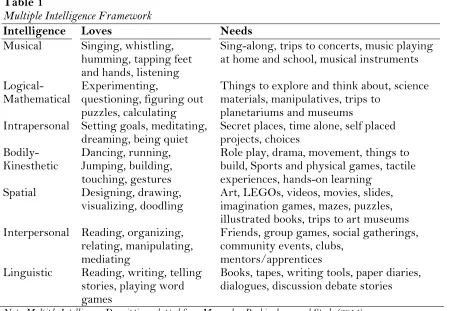
Multiple Intelligence Framework. The Multiple Intelligence Framework has been widely adopted by the education community as a framework for understanding learning patterns (Gardner, 1993). Gardner emphasized that we are all “different largely because we all have different combinations of intelligences” (Gardner, 2006, p. 24). Table 1 details the various components of the framework.
Table 1
Multiple Intelligence Framework
Intelligence Loves Needs
Musical Singing, whistling,
humming, tapping feet and hands, listening
Sing-along, trips to concerts, music playing at home and school, musical instruments
Logical- Mathematical
Experimenting,
questioning, figuring out puzzles, calculating
Things to explore and think about, science materials, manipulatives, trips to
planetariums and museums Intrapersonal Setting goals, meditating,
dreaming, being quiet
Secret places, time alone, self placed projects, choices Bodily-Kinesthetic Dancing, running, Jumping, building, touching, gestures
Role play, drama, movement, things to build, Sports and physical games, tactile experiences, hands-on learning
Spatial Designing, drawing,
visualizing, doodling
Art, LEGOs, videos, movies, slides, imagination games, mazes, puzzles, illustrated books, trips to art museums Interpersonal Reading, organizing,
relating, manipulating, mediating
Friends, group games, social gatherings, community events, clubs,
mentors/apprentices
Linguistic Reading, writing, telling
stories, playing word games
Books, tapes, writing tools, paper diaries, dialogues, discussion debate stories
Note: Multiple Intelligence Description adapted from Magruder, Buckingham, and Steele (2014).
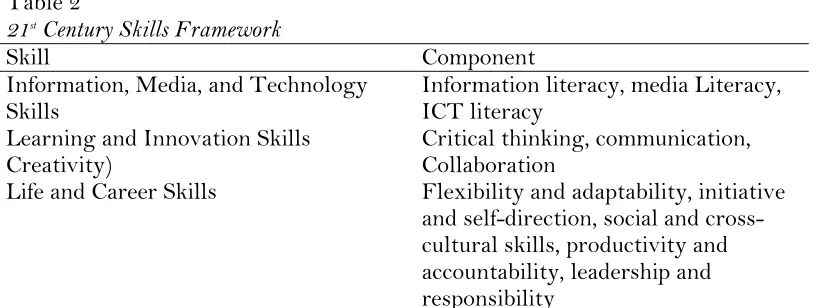
21st Century Skills Framework. A more contemporary framework for mapping out
FIRE - Forum for International Research in Education Table 2
21st Century Skills Framework
Skill Component
Information, Media, and Technology Skills
Information literacy, media Literacy, ICT literacy
Learning and Innovation Skills Creativity)
Critical thinking, communication, Collaboration
Life and Career Skills Flexibility and adaptability, initiative
and self-direction, social and cross-cultural skills, productivity and accountability, leadership and responsibility
Note: 21st Century Skills Framework (Adopted with permission from the Partnership for 21st
Century Learning).
The timing of a study using these two frameworks is critical in the following ways: 1) The Fiji Kinde Project continues to launch more kindergartens in Fiji, 2) The Ministry of Education is deeply interested in long-term sustainable kindergartens, 3) The Prime Minister of Fiji, through the recent creation of 10 telecenters in rural communities, recognizes and values technology as a tool for advancement; and 4) research on patterns of indigenous learning in Fiji focusing on technology, education, and culture has never been done before.
Methods
Through this study, we investigated patterns of learning in the Mana kindergarten. These patterns are culturally unique and localized specifically to the societal norms of the Mana Island. To fully understand and describe these unique details, a qualitative approach was necessary. Several qualitative methods were considered; one of which is ethnography, “a social scientific description of a people and a cultural basis of their peoplehood” (Patton, 2002, p. 100). Understanding how kindergartners learn requires a deep understanding of culture (Spradley, 1979). Ethnography emerged as the most appropriate method for this study.
Population and Sample. The population considered for this study involved all kindergartens participating in the Fiji Kinde Project. Fiji Kinde maintains 76 kindergartens servicing over 4,800 children throughout Fiji. The sample of this study is the Mana Kindergarten. There is only one kindergarten classroom at the Mana School. This class has one teacher and eight students who consistently attend. An additional four students sporadically attend school as a result of their parents’ work schedules.
Site Selection. Careful consideration was taken in regards to site selection. The criteria for selection were rigorous and involved over 76 sites in the initial stage. The criteria are as follows:
1) The community needed to have some knowledge of and skills with technology.
2) The community needed to have Internet access.
3) The community needed to lack ownership of technology, yet desired more technology for the use of education.
FIRE - Forum for International Research in Education
Based on the above criteria, the Mana kindergarten was selected from a list of five acceptable sites. This site was selected because the Mana community had strong leadership, embraced technology, and yet lacked direct ownership of the technology. One of the final factors in site selection was a series of videos made by the children at the school. The children borrowed iPads from visitors to the island and made a series of videos welcoming visitors to their island. The video series demonstrated a sense of pride. Through their actions, students embraced the potential of technology despite the fact that villagers lacked ownership of the technology. As a result, Mana was determined to be an ideal location for this study.
It is important to note that this study is an ethnographic study focusing on one kindergarten in Fiji and is not intended to be generalizable to all kindergartens in Fiji. Due to the various differences between the 76 locations, comparative studies may be more difficult due to drastically different cultural norms from one indigenous community to another.
Results
Data from this study were coded using NVIVO. An initial scan of potential themes was conducted, followed by a constant comparative coding process. When additional themes emerged, the entire data set was recoded to ensure the new themes were accounted for. This process of coding for themes, axial and hierarchical in nature, was done for each of the respective frameworks. After the themes were identified, the data were analyzed accordingly. When a particular theme was more frequent in the data, that theme was identified as a pattern that was prevalent in the Mana kindergarten.
Learning Patterns in the Multiple Intelligence Framework. Examining learning through the framework of Multiple Intelligence, it was observed that during each of the eight days of observations, three learning modalities (visual, verbal, and bodily-kinesthetic) were consistently evident. Kindergarteners learned through songs, choral chants, and used body motions and hand gestures throughout the day. The classroom environment was full of noise and energy. Children drew imaginary objects with their hands in the air, passed balls around to each other as they took turns reciting the alphabet, and used manipulatives when learning math.
The next two dominant intelligences were interpersonal and musical. These two approaches to learning were very natural to students. The teacher often had students talk to each other and reinforced working together. Music seemed quite natural to the classroom environment. On some occasions, students even began singing out loud during independent work.
Table 3
Multiple Intelligence Frequency
Intelligence Days Observed
Visual 8
Verbal 8
Bodily – Kinesthetic 8
Musical 7
Interpersonal 6
Intrapersonal 2
Naturalistic 2
Existential 1
FIRE - Forum for International Research in Education
Of the intelligences, four appeared to have less significance. Intrapersonal, naturalistic, existential, and logical intelligences were less evident during the school day. There may be some natural explanations, such as logical intelligences may not fit the cognitive developmental needs of kindergarteners. However, the results are case specific and descriptive of what the researcher observed, aligning with the research goal of the ethnographic tradition. Table 3 showcases the frequencies of days the various intelligences appeared.
Learning Patterns in the 21st Century Skills Framework. Examining learning
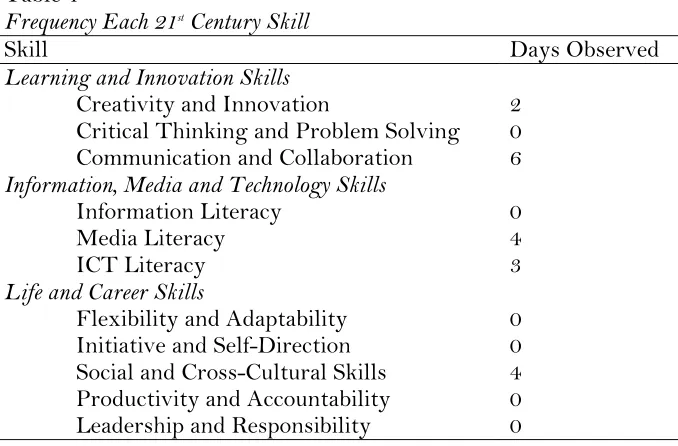
through the lens of the 21st Century Skills Framework, two prominent skills were observed: 1)
communication and collaboration; and 2) social and cross-cultural skills. Communication and collaboration happened throughout the learning day and were reinforced by the teacher. Students entered the classroom and immediately went to a corner of the classroom where the math manipulatives are stored. They played with them together until the teacher was ready for the first lesson. Throughout the day, they openly shared and helped each other
Culturally, the kindergarteners were aware of the outside world. The teacher sometimes showed pictures of items not found on the island. For example, the teacher showed a picture of a sunflower and explained that this flower is beautiful, but not found on Mana Island. Students marveled at pictures of the Eiffel Tower and the Pyramids of Egypt, as pictures of significant places around the world were openly shared. Sometimes foreigners visiting the island walked through the classroom and the students freely interacted with them. There did not seem to be a sense of outsiders vs. insiders.
Table 4
Frequency Each 21st Century Skill
Skill Days Observed
Learning and Innovation Skills
Creativity and Innovation 2
Critical Thinking and Problem Solving 0
Communication and Collaboration 6
Information, Media and Technology Skills
Information Literacy 0
Media Literacy 4
ICT Literacy 3
Life and Career Skills
Flexibility and Adaptability 0
Initiative and Self-Direction 0
Social and Cross-Cultural Skills 4
Productivity and Accountability 0
Leadership and Responsibility 0
FIRE - Forum for International Research in Education
Leadership and Responsibility. Table 4 showcases the frequencies of the days various 21st
Century Skills appeared.
Discussion
This study provided baseline data for a longitudinal study focusing on patterns of indigenous learning impacted by technology. It is important to note that ethnography was the method used for this study in order to gain a deep understanding of how culture, learning, and technology intersect. More importantly the study explored if certain technologies, such as iPads, can potentially change indigenous learning patterns or if such technologies enhance indigenous learning patterns that are already in existence. This study also took into consideration the need for culturally appropriate education methodologies such a storytelling.
Ethnography. Using an ethnographic approach to conduct culturally sensitive research has been done throughout history. However, research that focuses on technology typically involves quantitative methods. Research in the intersection of technology, education, and culture is unique and new, warranting a careful consideration of appropriate research methods. After completing the baseline study, it was clear that a qualitative paradigm such as ethnography was most appropriate to address the research questions in the current study. This reinforces the need for using ethnography in conducting technology research, which is a fairly new approach in the field.
By offering an ethnographic perspective on technology, data can potentially shed light on how technology is impacting cultures and societal norms. Ethnographies are descriptive in nature and not predictive. Therefore, it is important to clarify that this study does not seek to test a hypothesis or to find correlations in variables. Rather, this study is a description of current patterns of learning, as they relate to the theoretical frameworks.
Technology. Communication technology can provide access to resources and knowledge with a click of a button, making the world flat (Friedman, 2006). Such global access can be both a blessing and a curse for any population, especially emerging ones that are geographically isolated. As such, developing the appropriate skills and attitudes will be key to more positive outcomes for Fijians. Efforts to proactively guide the development using applicable frameworks such as the 21st Century Skills and Multiple Intelligences, can be
valuable ways to help measure that progress.
Mastery of 21st Century skills, for example, would position Fijian youth favorably for
appropriate and responsible use of technology. Because the 21st Century Skills Framework has
broad acceptance, it can be considered a useful framework to track progress of technology use. Indeed observations yielded many occurrences of 21st Century skill. While this study is only
descriptive in nature, providing a longitudinal perspective might offer insight on the evolution of technology use in Fiji. Similarly, the Multiple Intelligence Framework was employed to get a second point of reference for illuminating learning trends as technology is introduced to rural Mana population.
Early Childhood Education. According to Otunuku (2014), “teachers play a pivotal role as agents of social change; in the early years children are encouraged to become socially and culturally literate. A sociocultural perspective highlights the significance of ensuring early childhood programs are contextually appropriate and that teaching is culturally sensitive and appropriate” (p. 125). This study focuses on patterns of learning at the kindergarten in an attempt to address the significance and importance of culturally sensitive education at the earliest stages of formal education.
FIRE - Forum for International Research in Education
of the students this makes sense. Interpersonal interactions were recorded as well and matched with the 21st Century skills of communication and collaboration. The remaining intelligences
were observed less often. Interestingly, the naturalistic intelligence might be more expected in the island environment, was rarely observed. Perhaps this is because the observations were made in the classroom and not outside on the beach or in the village where the children spend most of their time.
21st Century skills were not as evident in the observations. Perhaps the conception of
these items as skill did not quite fit the level of facility observed in the children. In other words ‘skill’ did not seem to describe the students’ behavior. Nevertheless skills from the 21st Century
Framework were observed and noted. The dominant skill noted was communication and collaboration, which fits with the verbal learning mobility from Multiple Intelligences Framework. Media literacy, social, and cross-cultural skills were observed as well. While social skills were understandable it was not entirely understood how media literacy and cross-cultural skills were developed. Perhaps this will be explained when a second round of the observations made in 2015.
Culturally Appropriate Education. In the 1980’s, postcolonial education was beginning to be challenged in Fiji. “In the field of education…there was a big push for education that was ‘relevant’, and subjects and courses were re-written so as to reflect life in the islands” (Nabobo-Baba, 2006, p. 6). In the design phase of the current research project, the researcher collaborated with the Fijian Department of Culture and Heritage. With significant input from the Ministry, the research design took into consideration local customs. Furthermore, a major goal of this study was to provide relevant and appropriate data to inform issues of cultural preservation in schools, a top priority for the ministry. The baseline data provided a benchmark for describing what the learning patterns were like before iPads were introduced. It will be interesting to see if the dominant domains such as visual, verbal, and bodily-kinesthetic have changed or remained the same over time with the integration of iPads.
Storytelling was observed to be the most natural medium for teaching. The teacher frequently told stories that engaged the students. The stories seemed to always highlight a major point the teacher was trying to make. When asked about these stories, the teacher shared that Fijian culture has always been taught through dramatic stories of gods, fables and creatures, which parallels the work of Reed and Hames (1967). A question arises from this observation and warrants deeper investigation: How will storytelling be affected by the introduction of technology? Storytelling is a natural way of learning in Fijian villages and is a dominant teaching pedagogy in the Mana kindergarten. The longitudinal data can foster insights into whether this approach has changed or remained the same after iPads were introduced.
It is important to also note that it was the original intent to give kindergarten students their own iPad at the end of the observations. Through ongoing discussions with school leaders and parents, it became obvious that child ownership of such a device was a foreign concept. Ultimately a compromise was reached regarding actual ownership of the devices in that the school would own the iPads and members of the community could use the iPads after school hours. This dynamic speaks to the cultural norms of the Mana community and potentially is impactful in how iPads will function as a tool for learning.
Conclusion
FIRE - Forum for International Research in Education
valuable as technology is penetrating the most remote places around the world. This study provides the following three conclusions.
First, while technology has potential to shape the education of young Fijians, it is currently largely absent in the classroom. The one observed occurrence was when teacher used a laptop to play a DVD on the ecology of corals. There was plenty of awareness of technology because children see tourist on cell phones and using laptops on the beach. The children know it is possible to play games, see videos, talk with friends on cell phones and mobile devices, despite never having done it themselves. However, only two village members have computers thus their access, as a whole, is severely limited.
Second, as technology becomes more available, culturally sensitive approaches like storytelling need to be considered. As evidenced by the baseline data, interpersonal, auditory, and visual learning are the most natural learning modalities in the Mana kindergarten. These types of learning parallel the storytelling approach to teaching, native to the Fijian culture. These traditional approaches to teaching are prevalent today and have been prevalent for generations (Reed & Hames, 1967). The Department of Culture and Heritage plays a pivotal role in the preservation of Fijian culture and needs to be a major stakeholder in Fijian education. Ultimately when technology bridges cultures around the world, careful attention must be given to preserve Fijian cultures through the use technology.
Third, a framework for using technology is needed. As evidenced by the 21st Century
Skills framework, there are major gaps in meeting the skills needed to work in the 21st century.
Although it could be easily argued that these skill sets are not geographically appropriate or significant to a small island such as Mana, it is nevertheless a reality of working and living in a globalized world. By adopting a framework such as the 21st Century Skills or Multiple
Intelligences, there might be uniform approach to curriculum design, teacher training, and teaching.
FIRE - Forum for International Research in Education References
Altbach, P. K., & Kelly, G. P. (1978). Education and colonialism. Pacific Affairs, 51(4), 709-711. Brison, K. (2011). Producing "confident" children: Negotiating childhood in Fijian
kindergartens. Anthropology & Education Quarterly, 42(3), 230-244.
Buckingham, M, & Steele, J. (August 2014). We Are proud Bulldog learners, united we succeed! Retrieved from http://changemakers5thgrade.blogspot.com/
Colle, R. D., & Raul, R. (2003). ICT4D: A frontier for higher education in developing nations. African and Asian Studies, 2(4), 39.
Cooper, D. (2014). The Fiji Kinde Project. Retrieved from http://fijikindeproject.com
Department of Culture and Heritage, Fiji. (2013). Vision and mission objective. Retrieved from http://www.culture.gov.fj/
Fijian Government (2013). Minister launches OLPC for Nadarivatu Primary School [Press release]. Retrieved from
http://www.fiji.gov.fj/Media-Center/Press- Releases/MINISTER-LAUNCHES-OLPC-FOR-NADARIVATU-PRIMARY-SCHO.aspx
Fijian Government (2015). Government community telecentre programme nominated for World Summit on the Information Society Project Prize [Press release]. Retrieved from http://www.fiji.gov.fj/Media-Center/Press-Releases/GOVERNMENT-COMMUNITY-TELECENTRE-PROGRAMME-NOMINATE.aspx
Friedman, T. (2006). The world is flat: A brief history of the twenty-first century. New York, NY: Farrar, Straus and Giroux.
Gardner, H. (1993). Frames of mind: The theory of multiple intelligence. New York, NY: Basic Books.
Gardner, H. (2006). Multiple intelligences: New horizons. New York, NY: Basic Books.
Grunfeld, H., & Ng, M. L. H. (2013). A multimedia approach to ODL for agricultural training in Cambodia. International Review of Research in Open and Distance Learning, 14(1), 222-238.
Guemide, B., & Benachaiba, C. (2012). Exploiting ICT and e-learning in teacher's professional development in Algeria: The case of English secondary school teachers. Turkish Online Journal of Distance Education, 13(3), 33-49.
Lee, J. (2004). CDN field notes. Kathmandu: Community Development Network.
Loanakadavu, N. (June 13, 2013). Telecentre links Lomaivuna to the world. Retrieved from http://www.fijitimes.com/story.aspx?id=236773
Nabobo-Baba, U. (2006). Knowling and learning: An indigenous Fijian approach. Suva, Fiji: IPS Publications, University of the South Pacific.
Nailatikau, H. R. E. (4/17/2010). New directions for the parliment of Fiji. Suva, Fiji: Parliament of Fiji.
Otunuku, M. a. N.-B., Unaisi & Fua, Seu'ula Johansson. (2014). Development of early childhood education curriculum in the Solomon Islands: Valium Smol Pikinini Blong lumi. Suva, Fiji: University of South Pacific.
Partnership For 21st Century Learning. (August 2014) Framework for 21st Century Learning.
Retrieved from: http://www.p21.org/about-us/p21-framework.
Patton, M. (2002). Qualitative research & evaluation methods. Thousand Oaks, CA: Sage.
FIRE - Forum for International Research in Education
Primmer, C., & Linxen S. (2012). Facebook as a learning tool? A case study on the
appropriation of social network sites from mobile phones in developing countries. The British Journal of Educational Technology, 43(5), 726-738.
Ravuvu, A. (1988). Development or dependence: The pattern of change in a Fijian village. Suva, Fiji: University of the South Pacific.
Reed, A. W., & Hames, A. I. (1967). Myths & legends of Fiji & Rotuma. Suva, Fiji: Reeds Publishing.
Spradley, J. P. (1979). The ethnographic interview. Fort Worth, TX: Holt, Rinehart and Winston, Inc.
Taylor, R. (2005). Fiji's move into the 21st Century. In S. US (Ed.), Social change and psychosocial adaptation in the Pacific Islands (pp. 107). New York, NY: Springer.
Van Maanen, J. (1988). Tales of the field: On writing ethnography. Chicago, IL: University of Chicago Press.
Voogt, J., & Roblin, N. P. (2010). 21st Century skills: Discussion paper. Retrieved from
http://opite.pbworks.com/w/file/fetch/61995295/White%20Paper%2021stCS_Final_ Zuniga, S. (2002). A comparative analysis of computer technology organizational factors and
implementation levels of distinguished Title I schools and non-distinguished Title I schools of South Texas. (Unplublished dissrtation) Texas A&M Universiy, Kingsville, TX.
About the Authors
Jeffrey Chih-Yih Lee possesses more than 10 years of project and research experience in developing countries. He has published research and presented his work in more than 20 national and international settings. He is the co-chair of the Comparative and International Education Society’s special interest group, ICT4Development, which represents a community of international scholars, researchers and practitioners focused on the interaction between information and communication technology and development. As an ethnographer, he has already build relationships with local community members and acculturated to the local setting.
FIRE - Forum for International Research in Education Appendix A
Observation Log
Date: Time: Name: Multiple Intelligence
• Musical
• Visual – Spatial
• Verbal – linguistic
• Logical – mathematical
• Bodily – kinesthetic
• Interpersonal
• Intrapersonal
• Naturalistic
• Existential
21st Century Skills
Learning and Innovation Skills
• Creativity and Innovation
• Critical thinking and Problem Solving
• Communication and collaboration
Information, Media and Technology Skills
• Information Literacy
• Media Literacy
• ICT Literacy
Life and Career Skills
• Flexibility and adaptability
• Initiative and Self-Direction
• Social and Cross-Cultural Skills
• Productivity and Accountability
• Leadership and Responsibility
FIRE - Forum for International Research in Education Appendix B
Interview Questions
Teacher
1. Can you share with me what drives your teaching and instruction?
2. How do you plan a lesson?
3. What do you focus on when you are teaching your students?
4. What are you preparing your students for?
5. How do you work with parents?
Parents
1. How does your child learn best? Can you share some examples?
2. How do you help your child learn?
3. Describe the communication that happens between you and the teacher. What do you talk about? How frequent?
4. What concerns (if any) do you have about your child’s learning?
Administrator
1. What standards or curriculum drives the instruction in the kindergarten classroom?
2. Who created these standards or curriculum?