IJIRST –International Journal for Innovative Research in Science & Technology| Volume 1 | Issue 9 | February 2015 ISSN (online): 2349-6010
On The Security of An Efficient Dynamic
Auditing Protocol in Cloud Storage
S.Adhikesavan N.Sathish
Assistant Professor Assistant Professor
Department of Information Technology Department of Information Technology Ganadipathy Tulsi’s Jain Engineering College, Vellore Panimalar Engineering College, Chennai
Abstract
Automated teller machines (ATMs) are well known devices typically used by individuals to carry out a variety of personal and business financial transactions and/or banking functions. ATMs have become very popular with the general public for their availability and general user friendliness. ATMs are now found in many locations having a regular or high volume of consumer traffic. For example, ATMs are typically found in restaurants, supermarkets, Convenience stores, malls, schools, gas stations, hotels, work locations, banking centers, airports, entertainment establishments, transportation facilities and a myriad of other locations. ATMs are typically available to consumers on a continuous basis such that consumers have the ability to carry out their ATM financial transactions and/or banking functions at any time of the day and on any day of the week. Access card authentication is critical and essential for many modern access control systems, which have been widely deployed in various government, commercial, and residential environments. However, due to the static identification information exchange among the access cards and access control clients.
Keywords: Authentication, Sensory Data, Access Control System, Wireless Rechargeable Sensor
_______________________________________________________________________________________________________
I.
I
NTRODUCTIONAccess control is a mechanism that enables an authority to control access to restricted areas and resources at a given physical facility or computer-based information system. In general, authentication methods in access control systems can be divided into two broad categories. The first category is based on mechanical matching, such as keys and combination locks. Individuals are authenticated in these access control systems if and only if the blade of the key matches the keyway of the lock or the correct numerical sequence for combination lock has been dialed. Due to the physical constraints of mechanical matching systems, they are insufficient to meet the demanding requirements of access control authentication for critical infrastructures. On the other hand, it is also very hard to frequently change the interior structure of such matching mechanisms for security enhancement.
The other category of authentication for access control systems is electronic authentication including barcode, magnetic stripe, biometrics, and so on. Compared with mechanical matching authentications, the electronic authentications such as RFID-based smart card offer much more convenience and flexibility for both administrators and users of access control systems. However, it still suffers from similar problem of key loss because authentication is only based on the encoded identification data on the card. Anyone who carries the card will be granted the access and the security of the system still can be compromised.
To further enhance the security of access control systems, various biometric authentication mechanisms have been introduced to identify the authorized personnel. Although these biometric authentication methods such as fingerprint, iris, and voice recognitions are able to provide personal identification, they have high infrastructure cost and access privileges cannot be transferred among trusted users.
In this work, we aim at bridging the gap between insufficiency of existing electronic authentication solutions and the increasing demand of high-security guarantee for access control systems. We design a novel electronic proximity authentication framework that enhances the security level of existing RFID-based access control systems with backward compatibility. Specifically, we add dynamic data into the traditional authentication information by using sensors such as accelerometer, gyroscope, and so on. This authentication framework is adaptive to the change of encryption complexity of the access control systems and could be adopted with minor modification of existing infrastructure. In summary, on top of the previous conference paper [1], our contributions in this work are as follows:
We design and implement a dynamic authentication framework with sensory information for the access control systems. Our design is backward compatible with existing, deployed RFID or access card readers.
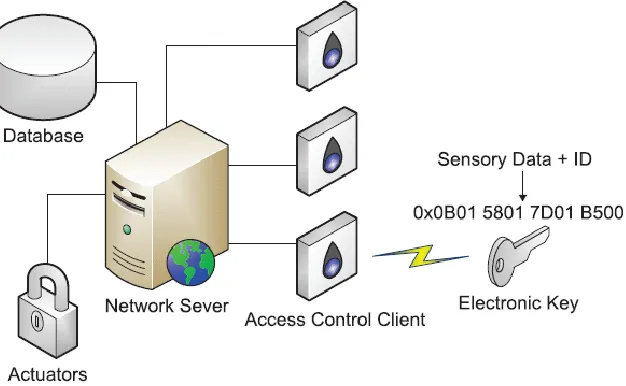
Fig. 1: System Function DIAGRAM
The remainder of this paper is organized as follows: First we propose the dynamic authentication framework with sensory information in Section 2. We then provide authentication algorithms of our system in Section 3. System working performance and simulations of the authentication method are shown in Sections 4 and 5. Comparison between the proposed two reference designs is given in Section 6. We discuss related work in Section 7 and conclude in Section 8.
II.
D
ESIGN OF THE DYNAMIC AUTHENTICATION WITH SENSORY INFORMATIONThe existing electronic proximity authentication of access control systems is mainly based on the exchange of encoded identification information stored on the access card. The security and integrity of such static and passive authentication mechanisms suffer from problems such as access card loss and unauthorized duplications. In this work, we propose to use sensory information obtained from wireless rechargeable sensors on access cards to further enhance the security and robustness of existing electronic proximity authentication systems. The main idea of our system design is shown in Fig. 1. When an access card integrated with wireless rechargeable sensors enters the communication range of an access control client, the access card piggybacks its sensory data to conventional identification information and transmits it (i.e., the electronic key) to the access control client. The information received by the access control client is then forwarded to the network server for authentication. If both sensory data and identification match a valid record in the authentication database, the network server then instruments the actuator and grants the card holder the access to the system. In this way, even an authentic access card is in possession of an unauthorized personnel or has been illegally duplicated, as long as the unauthorized card holder does not know how to generate the correct sensory data, he or she still cannot access the system. Moreover, we successfully remove the system vulnerable period between loss/stolen of access card and the deactivation of the card after users’ report. On the contrary, trusted users can share the cards and predefined actions with each other, which is unavailable in biometric authentication systems.
Different from existing authentication methods such as combining RFID and an additional keypad near the reader, we propose an orthogonal design in this paper and the new authentication framework only revises authentication algorithm on the network server without any modification of access clients. In fact, because we piggyback sensory data to ID information before transmitting them to the reader, most existing works on communication encryption for RFID system can be easily adopted into our authentication method [2], [3], [4], and therefore deal with several security vulnerabilities such as replay attack and eavesdropping.
On The Security of An Efficient Dynamic Auditing Protocol in Cloud Storage
(IJIRST/ Volume 1 / Issue 9 / 003)
Accelerometer-Based Reference Design A.
Two-Dimensional Rotation 1)
For an accelerometer, if it is being rotated, the static acceleration of gravity on its three axes will change accordingly. For a two-dimensional rotation, we can calculate the tilt angle alpha of an accelerometer from static acceleration of gravity on its X- and Y -axes to determine the position of the accelerometer in a two-dimensional plane.
In Fig. 2, we illustrate a simple example on how to determine the position of an accelerometer. In Fig. 2, Ax and Ay are acceleration components of gravity on X- and Y - axes, respectively. The tilt angle _ can then be calculated by equation Ax ¼ Gcos_ and Ay ¼ Gsin_, where G is the static acceleration of gravity. We define the most basic rules and parameters for two-dimensional rotations, which can be used to express more complex rotation actions:
Basic rotation rules:
For all rotations, they are two dimensional.
The basic rotation is omnidirectional, either clockwise or counterclockwise. The new rotation starts from the end position of the previous one.
Any single basic rotation does not exceed 2_degrees.
Fig. 2: Accelerometer Rotation Example Basic rotation parameters:
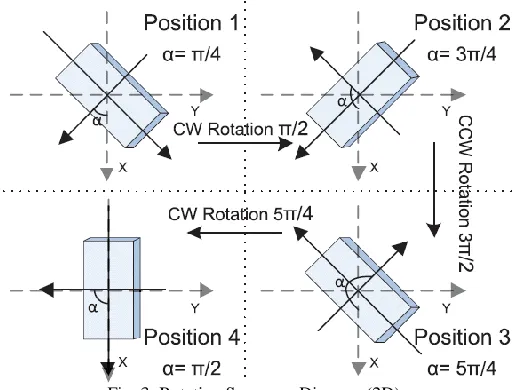
The Number of Basic Rotations k. The number of basic actions performed in one rotation sequence. Basic rotation number reveals the complexity of encryption.
Fig. 3: Rotation Sequence Diagram (2D)
Fig. 4: Rotation Sequence Diagram (3D)
Three-Dimensional Rotation 2)
In this part, we extend our design to rotations in three-dimensional space. Since determining the attitude of sensor solely based upon static acceleration of gravity is impossible (imagine standing and holding your cell phone face to you, the values of accelerometer at cell phone will not change if you turn from the west to the north). Based on the relative positions of the accelerometer and the ground, we extend the basic two-dimensional rotation rules for three-dimensional rotations: 1) During the whole rotation process, either plane XY, YZ or XZ under the coordinate of accelerometer is perpendicular to the ground 2) Accelerometer only rotates in one plane under its own coordinate (XY, XZ or YZ) during one basic rotation; 3) Rotation in a different plane is allowed if one axis among _X, _Y or _Z of the accelerometer is perpendicular to the ground at the end of the previous basic rotation.
Fig. 4a demonstrates an example of a 3D rotation sequence follows the rules above with k ¼ 3 basic rotations. We coplot the coordinate of the accelerometer to illustrate 3D rotations. In Fig. 4a, each action between two con-secutive positions is a plane rotation, and rotation plane could changes only when the direction of static acceleration of gravity is consistent with the direction of axes in accelerometer’s coordinate. For example, Position 2 rotates to Position 3 in Fig. 4b is prohibited while Position 1 rotates to Position 2 in Fig. 4a is likely to happen if the granularity of the rotation recognition n ¼ 4.
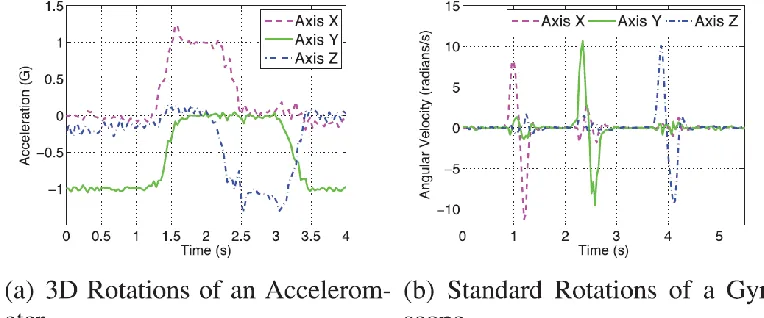
Fig. 5: Sample Data of Rotations of Accelerometer And Gyroscope
On The Security of An Efficient Dynamic Auditing Protocol in Cloud Storage
(IJIRST/ Volume 1 / Issue 9 / 003)
Fig. 6: Standard Rotations of A Gyroscope
Gyroscope-Based Reference Design B.
Gyroscope is a device for measuring change of orientation. Therefore, it is also possible to utilize the action of rotation of a gyroscope in a three-dimensional space because it returns the angular velocity on each axis simultaneous when rotating. Imaging there is a ball with center of O, Fig. 6 depicts six standard rotations of the ball using vectors. Corresponding sensory data of the six basic rotations of a typical three-axis gyroscope is shown in Fig. 5b.
Different from accelerometer-based design that relies on precise rotations, higher rotation speed of the gyroscope leads to a higher output value that make it easier for authentication. It can be seen in Fig. 5b that different standard rotations of a gyroscope can be easily differen-tiated from when the gyroscope remains standstill through the amplitude of the angular velocity. In this gyroscope-based reference design, we only use such binary rotation information (whether rotated) at each axis to perform sensory-data-based authentication.
III.
R
OTATION RECOGNITIONIn the previous section, we discuss the potential of large key space increase for our dynamic authentication with sensory information design. In this section, we further elaborate on the detailed sensor rotation recognition algorithms.
By comparing the sample data of accelerometer (Fig. 5a) and gyroscope (Fig. 5b), we find that output of the accelerometer exhibits a more complex behavior. This is because gyroscope measures the angular velocity and tends to generate impulses during one single basic rotation, which could be treated as a special case of the output of the accelerometer. Therefore, in this section, we use the sensory data of accelerometer to illustrate the whole rotation recognition algorithms and discuss how to deal with the sensory data of gyroscope in Section 3.4.
One complete dynamic authentication process consists of a sequence of basic rotations. To accurately identify each individual basic rotation from raw accelerometer data, we perform following three operations in the network server.
Data Preprocessing A.
The first step of rotation recognition is data preprocessing. The main goals are to separate and filter each individual basic rotation from a series of raw accelerometer data.
Fig. 7: Example Sensory Data of A 3D Rotation
After identifying pauses between basic rotations, we then use least square estimation to fit the raw readings for each individual basic rotation from the accelerometer.
Feature Vector Extraction B.
After separating basic rotations for one single authentica-tion, we match them with standard feature vectors. As feature-based classification of time-series data has a simple model and lower computation, we choose this method for rotation recognitions. First, feature vectors (F-vectors) for each individual basic rotations are extracted based on their fitting functions created in the previous section. Specifi-cally, we extract the start and end sensory data, the maximal and minimal sensor readings, and the corre-sponding time of these events within one basic rotation. Then, for a three-axis accelerometer, we can represent their feature vectors using the following set of equations:
F-Vectors Matching C.
After extracting feature vectors, we then try to match them with standard feature vectors in the database to recognize a specific basic rotation. Standard feature vectors with given n could be mathematically calculated and automatically generated since the acceleration components on three axes represent a trigonometric relationship with acceleration of gravity.
Discussion of Gyroscope-Based Design D.
Since a rotation process in gyroscope-based design also consists of several basic rotations, the first operation of data pre-processing presented in Section 3.1 can be used without any modification. In feature vector extraction, we only need to extract the maximal sensor readings on each axis because there is only one impulse during a basic rotation. After constructing the standard feature vectors of limited rotations of the gyroscope (e.g., six standard rotations), F-vector matching can be accomplished identically to the accelerometer based design.
Note that methodology of rotation recognition is not limited to the feature-based classification. For example, one can calculate distance between sensory measurements and sensory data of standard rotations through dynamic time warping to recognize basic rotations, and online learning of the timing parameters in the data preprocessing step could also use to improve the recognition performance. In addition, methodologies used in gesture recognition can also be borrowed [5], [6], [7], [8]. Although they may have higher computation complexity, they will not affect the essence of the dynamic authentication framework.
IV.
T
ESTBED EVALUATIONOn The Security of An Efficient Dynamic Auditing Protocol in Cloud Storage
(IJIRST/ Volume 1 / Issue 9 / 003)
conduct experiments on an iPhone 4 to evaluate the gyroscope-based design and summarize the authentication results in Appendix B, available in the online supplemental material.
Fig. 8: Antenna – Reshaped WISP Tag And Reader
Evaluation of the Accelerometer-Based Design A.
Both authentication accuracy and delay are two most essential factors for practical access control systems. In this section, we comprehensively study the accuracy of our rotation recognition algorithm on identifying a series of basic rotations performed by users for system authentication with one single accelerometer. Specifically, we define accuracy rate of the system authentication as the percentage of complex rotations that have been correctly recognized for system authentication algorithm. During the experiment, we also record rotation delay which refers to the duration of a complete action and the accuracy rate of authentication with varying number of basic rotations k under two different granularity of recognition n. In experiments, predefined rotations are randomly generated by the computer and then performed by users. Due to the space constraint, we only present two-dimensional authentication evaluation and analysis in the main file. Experimental results of three-dimensional rotations can be found in Appendix C, available in the online supplemental material.
V.
C
OMPARISON BETWEEN THE TWO REFERENCE DESIGNSDifferent from accelerometer-based design that relies on precise rotations, gyroscope-based design adopts the impulse of the amplitude of the angular velocity (see Section 2.2). Compared with accelerometer-based design, gyroscope-based design owns a higher authentication accuracy and smaller authentication delay (see Section 4). However, the accelerometer-based design is more robust under changing environmental conditions as the gyroscope-based design is more sensitive to data loss (see Section 5). Both of these two designs have large key space.
VI.
C
ONCLUSIONSIn this paper, we propose a dynamic authentication with sensory information for the access control systems. Different from existing schemes of authentication in access control systems, which mainly based on static information on cards, our dynamic authentication method combines sensory information from onboard sensors and conventional static ID information. Two case studies of the dynamic authentication are proposed. We theoretically analyze their highly increased key space, which exponentially multiplied static key space in existing authentication methods. To evaluate performance of our design, we built a prototype system and validate authentication mechanism experimentally. In experiments, the proposed authentication algorithm showed a 95 percent high accuracy rate among different users. In the simulation part, we comprehensively study the impact of sensory data sample size and sensory data loss, which found to be critical factors from experiments on authentication algorithm. Most simulation results validate our algorithm effectively. Growing popularity of electronically based authentication in proximity access control systems calls for a higher security level and greater ubiquity. We believe that authentication bound with dynamic sensory information can effectively enhanced security level of access control systems and will take an important step toward electronically access authentication in the future.
[4] M. Burmester, T.V. Le, B.D. Medeiros, and G. Tsudik, “Uni-versally Composable RFID Identification and Authentication Protocols,” ACM Trans. Information and System Security, vol. 12, no. 4, article 21, 2009.
[5] J. Kong, H. Wang, and G. Zhang, “Gesture Recognition Model Based on 3D Accelerations,” Proc. IEEE Fourth Int’l Conf. Computer Science & Education (ICCSE), 2009.
[6] S. Mitra and T. Acharya, “Gesture Recognition: A Survey,” IEEE Trans. Systems, Man and Cybernetics, vol. 37, no. 3, pp. 311-324, May 2007.
[7] S. Zhou, Q. Shan, F. Fei, W.J. Li, C.P. Kwong, P.C.K. Wu, B. Meng, C.K.H. Chan, and J.Y.J. Liou, “Gesture Recognition for Interactive Controllers Using MEMS Motion Sensors,” Proc. IEEE Fourth Int’l Conf. Nano/Micro Engineered Molecular Systems (NEMS), 2009.
[8] T. Park, J. Lee, I. Hwang, C. Yoo, L. Nachman, and J. Song, “E-Gesture: A Collaborative Architecture for Energy-Efficient Gesture Recognition with Hand-Worn Sensor and Mobile Devices,” Proc. Ninth ACM Conf. Embedded Networked Sensor Systems (SenSys), 2011.
[9] A.P. Sample, D.J. Yeager, P.S. Powledge, A.V. Mamishev, and J.R. Smith, “Design of an RFID-Based Battery-Free Program-mable Sensing Platform,” IEEE Trans. Instrumentation and Measurement, vol. 57, no. 11, pp. 2608-2615, Nov. 2008.
[10] M. Buettner and D. Wetherall, “An Empirical Study of UHF RFID Performance,” Proc. ACM MobiCom, 2008.
[11] A.P. Sample, D.J. Yeager, and J.R. Smith, “A Capacitive Touch Interface for Passive RFID Tags,” Proc. IEEE Int’l Conf. RFID, 2009.
[12] N. Saxena and J. Voris, “Still and Silent: Motion Detection for Enhanced RFID Security and Privacy without Changing the Usage Model,” Proc. Sixth Int’l Conf. Radio Frequency Identification: Security and Privacy Issues, vol. 6370, pp. 2-21, 2010.
[13] D. Ma and N. Saxena, “A Context-Aware Approach to Defend against Unauthorized Reading and Relay Attacks in RFID Systems,” Security and Comm. Networks, doi: 10.1002/sec.404, Dec. 2011.
[14] N. Lane, E. Miluzzo, H. Lu, D. Peebles, T. Choudhury, and A. Campbell, “A Survey of Mobile Phone Sensing,” IEEE Comm. Magazine, vol. 48, no. 9, pp. 140-150, Sept. 2010.
[15] P. Kannan, P. Seshadri, M.-C. Chan, A.L. Ananda, and L.-S. Peh, “Low Cost Crowd Counting Using Audio Tones,” Proc. 10th ACM Conf. Embedded Network Sensor Systems (SenSys), 2012.
[16] J. Chung, M. Donahoe, C. Schmandt, I.-J. Kim, P. Razavai, and M. Wiseman, “Indoor Location Sensing Using Geo-Magnet-ism,” Proc. ACM Ninth Int’l Conf. Mobile Systems, Applications, Services (MobiSys), 2011.