Vol. 11, 2017, 155-162
ISSN: 2349-0632 (P), 2349-0640 (online) Published 11 December 2017
www.researchmathsci.org
DOI: http://dx.doi.org/10.22457/jmi.v11a20
155
Journal of
Content Based Image Retrieval System Using Clustering
Technique
S.Vadivel Murugan1 and R. Chithra2
Department of Computer Science, PEVR College, Trichy-23, Tamilnadu, India 1
email: [email protected]; 2email: [email protected]
Received 28 November 2017; accepted 7 December 2017
Abstract. Content Based Image Retrieval (CBIR) is a technique for retrieving images on the basis of automatically-derived features such as color, texture and shape. In this proposed work CBIR system presented that uses Wavelet Transform and the color feature as a visual feature to represent the images. Wavelet Transform is proposed as a pre-processing step to make the image enhancement operations. Then the K-means clustering algorithm is used to cluster the images according to their features.
Keywords: K-means algorithm, metadata, clustering technique, query by image, retrieval, similarity.
AMS Mathematics Subject Classification (2010): 91C20, 94A08 1. Introduction
Imaging has played an important role in our life. "Content-based" means that the search analyzes the contents of the image rather than the metadata such as keywords, tags, or descriptions associated with the image. The term "content" in this context might refer to colors, shapes, textures, or any other information that can be derived from the image itself. CBIR is desirable because searches that rely purely on metadata are dependent on annotation quality and completeness. Humans manually annotate images by entering keywords or metadata in a large database which can be time consuming and may not capture the keywords desired to describe the image. The evaluation of the effectiveness of keyword image search is subjective and has not been well-defined. Image retrieval is a challenging topic that has been a research focus from many years. The retrieval system presents similar images. The user should define what the similarity between images has to be. Color histogram (GCH) is used for representing images by their histograms, and the similarity between two images will be determined by the distance between their color histogram. Furthermore, this approach is sensitive to intensity variations, color distortions, and cropping.
2. Preliminaries
156
157
image mining[12]. Smeulders et al proposed a new local density score to represent the importance of each returned image [13].
3. Methodology
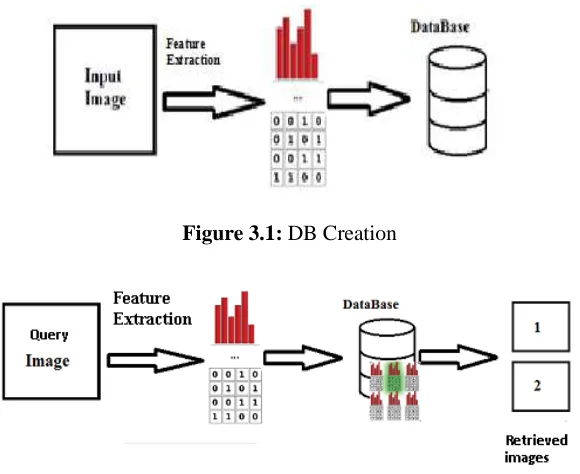
The proposed CBIR system consists of Database (DB) creation and Image Retrieval. Figure 3.1 shows the diagram of DB creation and Figure 3.2 shows the flow diagram of DB evaluation.
Figure 3.1: DB Creation
Figure 3.2: DB Evaluation
The various steps used in proposed algorithm works as follows: Step-1: Collect the images from which one wants to retrieve the images
Step-2: Change the original RGB color space to grayscale;
Step-3: Find Image histogram. An image histogram is a chart that shows the distribution of intensities in an indexed or intensity image
Step-4: Read the images from database one by one and extract the color and
shape features from the image. Prepare the feature database that contains the features of all images.
Step-5: Apply k-means clustering algorithm to the feature database.
158
Step-7: Compute similarity between query image features and clustered database by Euclidean distance and find the cluster closest to query image.
Step-8: Display the required no. of images from the selected cluster.
K-means Clustering Algorithm
The K-means algorithm takes the input parameter, k, and partitions a set of n objects into k clusters so that the resulting intra cluster similarity is high but the inter cluster similarity is low. Cluster similarity is measured in regard to the mean value of the objects in a cluster, which can be viewed as the cluster’s centroid. It is fast, robust and easier to understand. It gives best result when data set are distinct or well separated from each other. The algorithm for most popular K-means algorithm as
Algorithm
Given the data set X, choose the number of clusters 1 < c < N. Initialize with random cluster centres chosen from the data set. Repeat for l = 1, 2,…
Step 1: Compute the distances
D2ik = xk − v i T xk − v i , 1 ≤ i ≤ c, 1 ≤ k ≤ N. Step 2: Select the points for a cluster with the minimal distances, they belong to that cluster.
Step 3: Calculate cluster centers
v(l)i =∑ x i N i Until
max v(l) − v(l − 1) !
≠ 0
Ending calculate the partition matrix.
4.Experimental results
159
Table 4.1: Categories of own image dataset
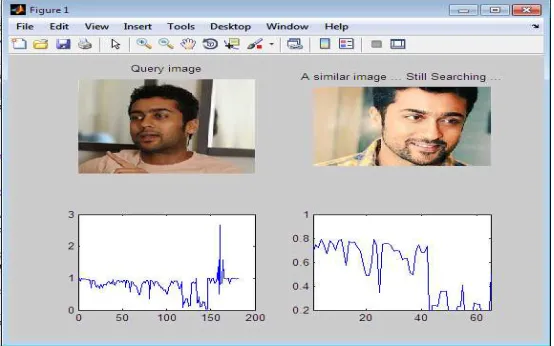
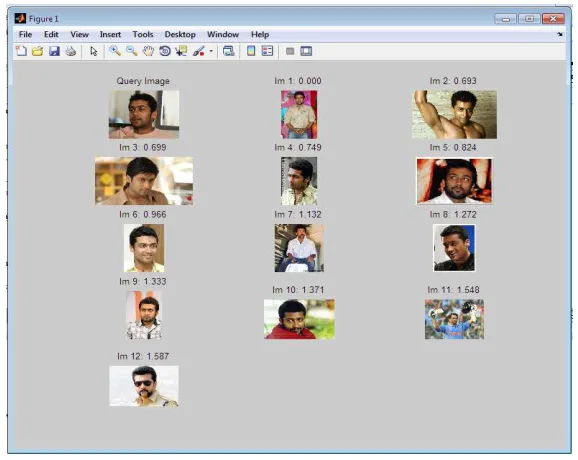
The evaluation of CBIR system is implemented in MATLAB using the above proposed algorithm. The image retrieval system combining clustering algorithm is shown as Figure 3.1. First, extract the image features of each image in image database and apply the clustering algorithm to analysis the similarities of images in the database for constructing the images clustering database. Figure 4.1 shows the output of the proposed CBIR system for the input image using histogram equalization. Figure 4.1 and Figure 4.2 show the retrieval results with and without K-means clustering algorithm. The upper left image is the query image. The right part is the retrieved images. Figure 4.1 displays the retrieval results without K-means clustering algorithm, while Figure 4.2 displays the results with K-means clustering algorithm that images similar to each other and to query.
Figure 4.1: Analyzing the input S.
No. Categories Images S.
No. Categories Images
1. Suriya 6. Food
2. Sachin 7. River
3. Beach 8. African
4. House 9. Horse
160
Figure 4.2: Retrieval Results for Suriya Query image
Table 4.2: Accuracy of CBIR with 3-D color image
S.No. Query Image
Images in Database
Matching Image
Un Matching
Image
Accuracy (%)
1. Suriya 12 11 1 92%
2. Foods 12 10 2 83%
3. Houses 12 8 4 67%
4. Mountain 12 8 4 67%
Average 77%
Figure 4.3: Performance Evaluation of CBIR method based on Accuracy
The pictorial representation of Table efficiency of proposed method based on accuracy.
5. Conclusion
In this work, an attempt has been made to retrieve the similar images from the database based on content based image retrieval method by supplying a query image. Clustering technique is working in a real sense as it is again reducing the time, the color feature is used to form the clusters here K=2 is specified for this current CBIR system. The resul are improved by using the K
this method is 77% tested on different images.
Acknowledgement. I would like to thank my professor throughout writing this thesis and my life in general.
1. Dipak D. Tayade and Dipak
Mining Weakly Labeled Web facial Images in Engineering and Research
2. Krishna Prasanth I B and Search Based Face Anno
Computer Science and Information Technologies 3. Dayong Wang, Steven C.
Web Facial Images f
Knowledge And Data Engineering 4. Hongmei He and Richard M Guest,
Systems Based on Performanc
Conference on Technologies for Homeland Security,
0% 20% 40% 60% 80% 100% Suriya
Accuracy (%) 92%
161
Performance Evaluation of CBIR method based on Accuracy
The pictorial representation of Table 4.2 is shown on the Figure 4.3 efficiency of proposed method based on accuracy.
In this work, an attempt has been made to retrieve the similar images from the database based on content based image retrieval method by supplying a query image. Clustering ue is working in a real sense as it is again reducing the time, the color feature is used to form the clusters here K=2 is specified for this current CBIR system. The resul are improved by using the K-means clustering concept. The average accuracy value
% tested on different images.
I would like to thank my professor for supporting me research throughout writing this thesis and my life in general.
REFERENCES
Dipak D. Tayade and Dipak Pardhi, Search based face annotation Approach for abeled Web facial Images, International Journal of Modern Trends in Engineering and Research, 2(2015) 2393-8161.
shna Prasanth I B and S.Anoop, A Review on Content Based Image Retrieval and Search Based Face Annotation on Weakly Labeled Images, International Journal of Computer Science and Information Technologies, 5(6) (2014) 8269-8271.
Dayong Wang, Steven C.H.Hoi, Ying He and Jianke Zhu, Mining Weakly Labeled Web Facial Images for Search-Based Face Annotation, IEEE Transa
Knowledge And Data Engineering, 26 (2014) 166-179.
d Richard M Guest, A Framework of Configurable Multi
Systems Based on Performance Matrices for Face Recognition, IEEE International Technologies for Homeland Security,12-14 (2013) 1-50.
Suriya Foods Houses Mounta in
Average
92% 83% 67% 67% 77% 92%
83%
67% 67%
77%
Accuracy of CBIR
Performance Evaluation of CBIR method based on Accuracy
Figure 4.3. It shows the
In this work, an attempt has been made to retrieve the similar images from the database based on content based image retrieval method by supplying a query image. Clustering ue is working in a real sense as it is again reducing the time, the color feature is used to form the clusters here K=2 is specified for this current CBIR system. The results eans clustering concept. The average accuracy value of
for supporting me research
on Approach for International Journal of Modern Trends
A Review on Content Based Image Retrieval and International Journal of
8271.
Mining Weakly Labeled IEEE Transactions On
A Framework of Configurable Multi-Engine IEEE International
162
5. Xiao Zhang, LeiZhang, Xin-JingWang and H.Y.Shum, Finding Celebrities in Billions of Web Images, IEEE Transactions on Multimedia, 14 (2012) 995-1007. 6. D. Wang, S.C.H.Hoi, Y.He and J. Zhu, Retrieval-Based Face Annotation by Weak
Label Regularized Local Coordinate Coding, Proc. 19th ACM Int’l Conf. Multimedia(Multimedia), 1 (2011) 353-362.
7. Rajshree S. Dubey, Niket Bhargava and Rajnish Choubey, Image Mining using Content Based Image Retrieval System, International Journal on Computer Science and Engineering, 02 (2010) 2353-2356.
8. S.C.H. Hoi, R.Jin, J.Zhu and M.R. Lyu, Semi Supervised SVM Batch Mode Active Learning with Applications to Image Retrieval, ACM Trans. Information Systems, 27 (2009) 1-29.
9. Ricardo da S. Torres, Alexandre X.Falcãoa, Marcos A.Gonçalves b, João P.Papaa, Baoping Zhangc, Weiguo Fanc and Edward A. Foxc, A genetic programming framework for content-based image retrieval, Pattern Recognition(ELSEVIER), 42 (2009) 283-292.
10. Dong Xu, Dacheng Tao and Stephen Lin, Marginal Fisher Analysis and Its Variants for Human Gait Recognition and Content-Based Image Retrieval, IEEE Transactions on Image Processing, 16 (2007) 2811-2821.
11. X.J. Wang, L.Zhang, F.Jing and W.Y. Ma, Anno Search: Image Auto-Annotation by Search, Proc. IEEE Computer Science Conference Computer Vision and Pattern Recognition(CVPR), 06 (2006) 1483-1490.
12. Ji Zhang, WynneHsu and Mong Li Lee, Image Mining: Trends and Developments, Journal of Intelligent Information Systems, 19 (2002) 7-23.