The Open Journal of Occupational Therapy
The Open Journal of Occupational Therapy
Volume 3
Issue 4 Fall 2015 Article 2
October 2015
Executive Functioning: Relationship with High School Student
Executive Functioning: Relationship with High School Student
Role Performance
Role Performance
Donna P. Mann
Eastern Washington University - USA, [email protected]
Roberta Snover
Eastern Washington University - USA, [email protected]
James R. Boyd
Eastern Washington University - USA, [email protected]
Andrea J. List
Eastern Washington University - USA, [email protected]
Aaron J. Kuhn
Eastern Washington University - USA, [email protected]
See next page for additional authors
Follow this and additional works at: https://scholarworks.wmich.edu/ojot
Part of the Occupational Therapy Commons
Recommended Citation Recommended Citation
Mann, D. P., Snover, R., Boyd, J. R., List, A. J., Kuhn, A. J., Devereaux, B. N., Chenoweth, S. M., & Middaugh, G. L. (2015). Executive Functioning: Relationship with High School Student Role Performance. The Open Journal of Occupational Therapy, 3(4). https://doi.org/10.15453/2168-6408.1153
This document has been accepted for inclusion in The Open Journal of Occupational Therapy by the editors. Free, open access is provided by ScholarWorks at WMU. For more information, please contact
Executive Functioning: Relationship with High School Student Role Performance Executive Functioning: Relationship with High School Student Role Performance
Abstract Abstract
BACKGROUND.
BACKGROUND. Student role performance for academic success in secondary education is under
represented in the occupational therapy literature, despite the persistently high dropout rate in the United States (Stillwell & Sable, 2013). Executive dysfunction is one of many possible contributors to difficulties in the classroom (Dirette & Kolak, 2004) and is a better indicator of school performance than IQ
(Diamond, 2012). This research examined executive functioning of both alternative and traditional high school students to determine if there is a relationship between executive function and academic success as measured by cumulative grade point average.
METHOD.
METHOD. 132 high school students from three different school settings were given the Behavioral Rating Inventory of Executive Function-Self Report (BRIEF-SR). The Global Executive Composite (GEC) and individual subscale scores were compared to GPA.
RESULTS.
RESULTS. No significant difference in GEC scores was found among settings. Subscale scores for “inhibition” and “task completion” were significantly different in the alternative school setting. A weak negative correlation was seen between the GEC and GPA. However, academically unsuccessful students scored statistically lower on the GEC.
CONCLUSION.
CONCLUSION. Global executive dysfunction was not predicted by setting but was seen in academically unsuccessful students.
Keywords Keywords
executive function, high school, adolescent, academic success, role performance
Cover Page Footnote Cover Page Footnote
The authors would like to acknowledge the high school personnel who supported this project by allowing us access to GPA data, thus making this research possible: Kerri Ames and Barker High School, Spokane Valley, Washington; Troy Heuett and Cheney Alternative High School-Three Springs, Cheney, Washington; and Aaron Fletcher and Liberty High School, Spangle, Washington.
Complete Author List Complete Author List
Donna P. Mann, Roberta Snover, James R. Boyd, Andrea J. List, Aaron J. Kuhn, Bridget N. Devereaux, Susan M. Chenoweth, and Gina L. Middaugh
Credentials Display
Donna P. Mann, OTD, MED, BSOT, OT/L; Roberta Snover, Dr. OT, OTR/L; James R. Boyd, MSOT; Andrea J. List, MOTS; Aaron J. Kuhn, MOTS; Bridget N. Devereaux, MOTS; Susan M. Chenoweth, MOTS; Gina L. Middaugh, MOTS
Copyright transfer agreements are not obtained by The Open Journal of Occupational Therapy (OJOT). Reprint permission for this Applied Research should be obtained from the
corresponding author(s). Click here to view our open access statement regarding user rights and distribution of this Applied Research.
DOI: 10.15453/2168-6408.1153
High school graduation rates have been a societal focus in recent years, resulting in Public Law 107-110, commonly referred to as the No Child Left Behind Act of 2001 (NCLB). The NCLB Act holds public schools and educational agencies accountable for meeting the educational needs of low-achieving children, including those with disabilities. It calls for the elimination of the achievement gap between high- and low-performing children and includes the provision of alternatives to enable students to access appropriate education (U.S. Department of Education, 2002). A free and appropriate education (FAPE) is guaranteed to all individuals with disabilities via Section 504 of the Rehabilitation Act of 1973 and includes the provision of related services (e.g., occupational therapy) for the purposes of meeting this mandate (U.S. Department of Education, 2013).
Traditionally, efforts have been focused on early childhood and physical challenges. Given the concerns with secondary education performance, it is reasonable to consider the role of related services in student role performance among high school students. Because poor academic performance has been identified as a risk factor for dropping out (Garruto, 2010; Ridings, 2010), sufficient regard for client factors underlying academic performance is paramount. Screening or assessment to identify executive dysfunction (EDF) when student role performance is of concern could be a key to supporting academic success.
High school is a period of significant social, emotional, physical, and cognitive growth and change. This tumultuous period of development coincides with identity formation, which, in turn, is
influenced by performance patterns (including role performance) and how they support or interfere with occupational performance (American Occupational Therapy Association, 2014). Role performance in the complex high school
environment is critical for academic success; poor role performance in academic and social
participation creates high risk for student dropout (Hammond, Linton, Smink, & Drew, 2007). Further, a student who experiences a higher
incidence of failure than success begins to shape an identity as a poor student, thus creating risk for reducing volition in student role performance and enhancing volition for behaviors not supportive of academic participation. This sets the stage for potentially dropping out of high school. A dropout is defined as “a student enrolled at any time during the previous school year who is not enrolled at the beginning of the current school year and who has not successfully completed school” (Stillwell & Sable, 2013, p. 2).
Morison, 2006; Ekstrom, Goertz, Pollack, & Rock, 1986; Jordan, Lara, & McPartland, 1994). Quality of life is reduced, and high dropout rates result in societal burden as a consequence of loss of
productive workers and higher costs associated with increases in incarceration, health care, and social services (Bridgeland et al., 2006; Carver & Lewis, 2010).
In the 2007-2008 school year, 645,500 students were reported to be attending alternative schools in the United States (Carver & Lewis, 2010). Reasons for alternative placement, which can be voluntary, include disruptive behavior, continual academic failure, pregnancy, and mental health needs (Carver & Lewis, 2010). Forty-one percent of these students requested to transfer out of a traditional school and into an alternative program. Parents or district administrators referred the
others. Unfortunately, referrals to alternative schools exceeded the resources; one-third of districts reported they had to deny new alternative school enrollments due to space limitations (Carver & Lewis, 2010).
EDF is one of many possible contributors to difficulties in the classroom (Dirette & Kolak, 2004). Executive function is commonly defined as the cognitive process that regulates an individual’s ability to organize thoughts and activities, prioritize tasks, manage time efficiently, and make decisions (executive function, n.d.). Experts accept the following definition: “the ability to maintain an appropriate problem solving set for attainment of a future goal” (Welsh & Pennington, 1988, p. 201). Identified factors of EDF include difficulty in areas such as initiation and termination, higher-level
thinking, self-control, coping skills (anger management), sequencing, short-term memory, attention span, time management, and multitasking. Disruptive physical and verbal behaviors are often reported (Barton, 2005; Carver & Lewis, 2010; Katsiyannis & Williams, 1998; Kleiner, Porch, & Farris, 2002). There is reciprocal influence between executive functions and emotional regulation (Blair & Diamond, 2008).
Executive function is an essential
component to learning. Through the facilitation of complex problem solving, the productive
relationship between executive function and learning is realized (Best & Miller, 2010; Best, Miller, & Jones, 2009; Checa, Rodríguez-Bailón, & Rueda, 2008; Jarvis & Gathercole, 2003; St Clair-Thompson & Gathercole, 2006). However, intelligence quotient (IQ) has traditionally been used for a variety of assessment purposes, such as ascertaining the correlation between capacity and performance (Weinberg, 1989). Executive function differs from IQ in that executive function is a broad measurement of one’s global ability to function, while IQ is only a measure of one’s cognitive ability or intelligence (Diamond, 2012; Plomin, 1999). Thus, IQ is less effective in predicting a student’s readiness for school, grades, or success in college (Diamond, 2012), and executive function may provide a more holistic picture of a student’s capacity and needs. Executive functioning has been strongly associated with learning and education, and it is believed to be foundational to the successful performance of a variety of roles, including student, worker, parent, and homemaker. Occupational therapists, because of their background in neurology
and expertise in identifying strategies for improving occupational performance, may be uniquely
qualified to meet the cognitive and developmental needs of students and adolescents with EDF (Toglia & Berg, 2013).
Welsh and Pennington (1988) noted that executive function entails mental processes across the domain of frontal lobe functions and also includes gating of attention and memory functions for task performance. Hence, executive function is the collaboration among several areas of the brain: dorsolateral prefrontal cortex, orbitofrontal cortex, anterior cingulate cortex, and parietotemporal association areas (Lundy-Ekman, 2007). Ultimately, executive functioning is a highly complex brain process that eludes an easy operational definition (Barkley, 2012).
Regardless of the inability of experts to agree on an exact definition of executive function, individuals present to clinicians for help with EDF (Maeir et al., 2014; Miranda, Presentación,
Siegenthaler, & Jara, 2013; Williamson Weiner, Toglia, & Berg, 2012). A lack of specificity in the definition of executive function is of particular interest to occupational therapists since the deficits in daily performance are a cornerstone to the identification of EDF and effective treatment. According to Barkley (2012):
people with [prefrontal cortex] disorders and injuries have [executive function] deficits in their daily life activities even if the
[executive function] tests do not detect them . . . it is the deficits occurring in daily life, not those manifested on tests, that are the
most important to understand and to
clinically assess and rehabilitate or manage. (p. 10)
Three foundational functions are accepted as common in assessments for EDF: inhibition,
working memory, and shifting (Miyake et al., 2000). Additionally, planning is postulated as a fourth essential function used for task completion (Anderson, 2002), and it can be argued that planning is the overarching skill in executive functioning.
Inhibition is the ability to suppress a dominant or automatic action or thought as related to cognitive, emotional, and motor control (Cooper-Kahn & Dietzel, 2008; Nigg, 2000). It continues to develop with age and experience, and inhibition is important in order to subvert behaviors that may interfere with task performance and goal
achievement (Best et al., 2009). Working memory is the ability to maintain and manipulate
information over brief periods of time (Alloway, Gathercole, & Pickering, 2006) and gradually improves from 4 to 15 years of age (Gathercole, Pickering, Ambridge, & Wearing, 2004). Shifting is the ability to shift between mental states,
operations, or tasks (Miyake et al., 2000). Planning is the ability to formulate actions in advance and to approach a task in an organized, strategic, and efficient manner (Anderson, 2002).
Development of Executive Functions
outcomes of executive functions (Jansiewicz, 2008). Metacognition refers to an awareness of personal knowledge coupled with an ability to understand, control, and manipulate that knowledge for deeper understanding (Arslan & Akin, 2014).
Metacognition lays the foundation for successful occupational performance.
As the developing brain matures, executive functions improve in response to teaching and intervention strategies (Lodico, Ghatala, Levin, Pressley, & Bell, 1983). Several brain regions begin to process information synergistically and in greater capacities starting in infancy and continuing well into adulthood (Anderson, Jacobs, & Anderson, 2008). Inhibition shows the most improvement during the preschool years and less change as the child moves into adolescence and adulthood. Working memory and shifting emerge in the preschool years. Planning develops primarily in late childhood and adolescence. Task shifting continues to mature into adulthood (Rubia et al., 2006).
This study examined how executive functions influence student role performance as measured by academic performance. Academic performance (GPA) is considered to be an outcome influenced by executive functioning as expressed through student role performance. Varied academic environments are included in order to identify executive functions more accurately as the
distinguishing element in academic performance. The hypotheses are: (a) There will be a relationship between executive functioning and traditional, alternative, and independent learning students; (b) there will be a correlation between GPA and
executive functioning; and (c) there will be a difference in executive functioning between
academically successful and unsuccessful students.
Method
This study used a quantitative descriptive multi-subject case study to examine the
relationships between executive function, school placement, and a measure of academic role
performance. Descriptive case studies describe the behaviors of individuals, facilitate understanding of causal factors in performance, and are a beginning step in theory development (Kielhofner, 2006; Yin, 1994). This design allows for exploring the role of executive functions across diverse high school environments and functions.
Procedures and Participants
Following Eastern Washington University’s Internal Review Board approval, the researchers recruited participants using a convenience sampling procedure (Dickerson, 2006). Based on a power analysis for 80%, the desired number of participants for this study was 168. A total of 175 students were recruited across three school settings: one
traditional high school, one alternative high school, and one independent learning program. Alternative schools are any schools that are separate from, and alternative to, the traditional high school (Dirette & Kolak, 2004). Independent learning programs, a subset of alternative schools, are designed to tailor learning to individual needs while studying off campus (California Department of Education, 2013). Inclusion criteria for the study included age (14 to 18 years of age) and current enrollment in high school with a reading level of fifth grade or above (to maintain compliance with the Behavioral
Rating Inventory of Executive Function-Self Report). Exclusion criteria included enrollment in special education and/or having an individualized education program (IEP) in place. Missing demographic or GPA data resulted in exclusion from the study.
The researchers categorized the population in two ways: school setting and academic success. The school setting category consisted of three groups based on the sample sites. The academic success category consisted of two groups:
successful academic group and unsuccessful academic group. For the purposes of this study, academic success was defined as a GPA of 2.0 or higher.
Assessment Tool
The Behavioral Rating Inventory of Executive Function-Self Report (BRIEF-SR) is a standardized 80-item questionnaire designed to assess an individual’s perception of his or her own executive functioning skills (Guy, Isquith, & Gioia, 2004). The researchers selected this tool for the following reasons: affordability, ease of
administration, presence in the literature, general acceptance of validity, and inclusion of the foundational skills common in EDF assessments (inhibition, working memory, shifting, and
planning). Data is derived from the perspective of the participant and, therefore, might be considered less than ideal. However, assessment of
performance in natural environments often uncovers difficulties not identified through narrow testing parameters (Barkley, 2012), and the self-reporting nature of this data facilitates insights into
performance of daily routines. Ideally, the
BRIEF-SR is administered in addition to the BRIEF-Parent Report and/or the BRIEF-Teacher Report, thereby enhancing data rigor. However, the participant schools declined to assist in eliciting parent and teacher participation. Inclusion of these reports would significantly add to the impact of this study; however, the BRIEF-SR represents the lived experience from the students’ perspectives and thus constitutes meaningful data.
The BRIEF-SR generates an overall
executive functioning score or the Global Executive Composite (GEC). The GEC is comprised of eight non-overlapping subscales of executive function: Inhibition, Shifting, Emotional Control, Task Completion, Working Memory, Planning, Organization, and Self-Monitoring. A Behavior Rating Index score and a Metacognition Index score are also included in the BRIEF-SR. These scores are useful as individual behaviors are considered to influence metacognitive skill performance, which is dependent upon executive functioning skills. Examination of these scores can lend insights useful to the evaluator seeking to help an individual
improve executive functioning. Because this study is not looking at intervention, these scores were used in a limited capacity to lend insight into data
interpretation.
The tool is standardized and normed for gender and age from 11 to 18 years; responders must have a reading level of fifth grade or above. The assessment contains two inherent validity scales, Inconsistency and Negativity, used to
full assessment (r or α= .96; Guy et al., 2004). The BRIEF-SR asks participants to estimate the frequency of certain behaviors over the last six months as “Often,” “Sometimes,” or “Never” for each of the 80 questions. The participants of this study completed the survey in 10 to 20 min in the classroom setting with at least one researcher present. The researchers encouraged the
participants to ask for clarification when needed and monitored the participants to assure that they each completed the assessment independently. The researchers collected and scored the completed forms. Each raw score was converted to a t-score and percentile rank. Higher t-scores are associated with lower executive function skills. The data was entered into version 20 of the Statistical Package for the Social Sciences (SPSS) for analysis.
To test the reliability of the assessment specific to the population in this study, the internal consistency was calculated using Chronbach’s α
Coefficient. To test the first hypothesis (there will be a difference in executive functioning between traditional, alternative, and independent learning students) a one-way Analysis of Variance
(ANOVA) was used to compare mean GEC scores among setting groups (Salkind, 2014). For
additional analysis, a two-way ANOVA was used to compare the GEC among setting groups while controlling for the covariate, academic group.
Further analysis was completed using multiple one-way ANOVAs to compare the eight subscales of the GEC among the setting groups. A final two-way ANOVA compared GPA among setting groups while controlling for the covariate, GEC. To test the second hypothesis (there will be a correlation between GPA and executive functioning), a Pearson’s Product Moment Correlation (Pearson’s r) was run to identify the relationship between the GEC score and GPA (Salkind, 2014). To test the third hypothesis (there will be a difference in executive functioning between academically successful and unsuccessful students), a student’s t-test was used to compare the GEC scores between the two academic groups for each setting group (Salkind, 2014).
Results Demographics
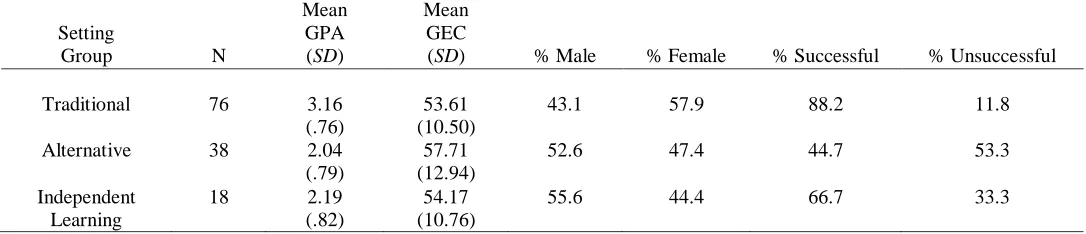
Of the 175 recruited students, 132 students across the three school settings met the inclusion and exclusion criteria and were included in this study. One traditional high school did not report individual numeric GPAs, and therefore that student was excluded from the study. The average GPA across all groups was x=2.71 (SD = 0.94), and the average GEC score across all groups was x=54.87 (SD = 11.35). Group characteristics are reported in Table 1.
Table 1
Participant Characteristics
Setting
Group N
Mean GPA (SD)
Mean GEC
(SD) % Male % Female % Successful % Unsuccessful
Traditional 76 3.16
(.76)
53.61 (10.50)
43.1 57.9 88.2 11.8
Alternative 38 2.04
(.79)
57.71 (12.94)
52.6 47.4 44.7 53.3
Independent Learning
18 2.19
(.82)
54.17 (10.76)
55.6 44.4 66.7 33.3
Note. GPA = grade point average; GEC = global executive composite
Internal Consistency
Internal consistency of the BRIEF-SR assessment for the sample population was determined using Chronbach’s α Coefficient. Results indicated that the assessment was highly internally consistent (α = .91) across all setting groups. Internal consistency for the traditional, alternative, and independent learning groups was α
= .90, .93, and .89, respectively.
Difference Between GEC and Setting Group
Global executive composite mean scores
were compared among settings using a one-way ANOVA. Results of the ANOVA, F(2, 131) = 1.71, p = .19, indicated no significant difference among the groups.
A two-way ANOVA comparing GEC and setting group while controlling for academic group as a covariate also indicated no significant
difference, F(2, 131) = .78, p = .46, among setting groups. Visual plotting for the independent learning group showed an inverse relationship between the GEC and academic group when compared to the traditional and alternative groups (see Figure 1).
Setting
Figure 1. Mean GEC scores among setting groups and based on academic group ANOVA results indicating no significant difference in GEC scores among setting groups (p = .46).
Alternative Independent Learning Traditional
Successful Unsuccessful
M
ea
n G
E
C
Next, the eight subscales (Inhibition, Shifting, Emotional Control, Task Completion, Working Memory, Planning, Organization, and Self-Monitoring) were compared by setting group. Multiple one-way ANOVAs were used to compare the subscales for each setting group.
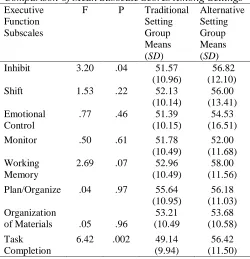
Significance was found for Inhibition, F(2, 131) = 3.20, p = .04, and Task Completion, F(2, 131) = 6.42, p = .002 (see Table 2). Post-hoc analysis was done using Fisher’s test of Least Significant Difference (LSD). Inhibition was significantly different between the traditional and alternative setting groups (p = .04). Task
Completion was also significantly different between the traditional setting and alternative setting groups (p = .002).
Table 2
Comparison of Mean Subscale Scores Among Settings Executive
Function Subscales
F P Traditional
Setting Group Means (SD) Alternative Setting Group Means (SD)
Inhibit 3.20 .04 51.57
(10.96)
56.82 (12.10)
Shift 1.53 .22 52.13
(10.14)
56.00 (13.41) Emotional
Control
.77 .46 51.39
(10.15)
54.53 (16.51)
Monitor .50 .61 51.78
(10.49)
52.00 (11.68) Working
Memory
2.69 .07 52.96
(10.49)
58.00 (11.56)
Plan/Organize .04 .97 55.64
(10.95)
56.18 (11.03) Organization
of Materials .05 .96
53.21 (10.49 53.68 (10.58) Task Completion
6.42 .002 49.14
(9.94)
56.42 (11.50)
A two-way ANOVA was used to compare GPA and setting group while controlling for the GEC as a covariate. Results, F(2, 131) = 29.31, p <
.001, indicated a significant difference among the groups. Fisher’s LSD results demonstrated a significant difference between the traditional and alternative setting groups (p < .001) and between the traditional and independent learning groups (p < .001), indicating the traditional setting group had the highest mean GPA (see Table 1 for the mean values for each setting group).
Relation Between GEC and GPA
Results, r = -.33, p < .001, indicated a medium negative correlation between GEC and GPA.
Difference Between GEC and Academic Group
The student’s t-tests indicated there was a significant difference in GEC scores between the successful and unsuccessful academic groups, t = -3.63, p < .001.
Discussion
Significant deficits in global executive functions may or may not be the driving factor for alternative high school placement as no statistical differences among the various student groups were found. Composite executive function scores (GEC) were not specific to academic setting. The BRIEF-SR scores specific to inhibition and task completion in the alternative school group, when compared to the traditional school group, were lower, suggesting executive functions may be a driving factor in alternative school placement.
Poor executive functioning was associated with low GPA regardless of setting as a correlation between GPA and executive function was
statistically represented. This supports findings in the literature (Blair & Diamond, 2008).
A difference in executive functioning
between academically successful and unsuccessful students was substantiated by the data. As
expected, differences in executive function among groups are significant, particularly in the areas of inhibition and task completion. Seven of the participants demonstrated a discrepancy of greater than 12 t-score points between the Behavior Rating Index Score and the Metacognition Index Score, which may obscure GEC scores (Guy et al., 2004). We do not believe including these participants in data analysis significantly impacted outcomes; however, this should be considered in future studies.
The importance of considering behaviors exhibited by low-achieving students must be highlighted for two primary reasons. First, it is natural to develop coping strategies when faced with environmental demands that are difficult to meet. Second, it is natural for those observing these coping strategies to interpret their meaning based on their ability to understand them. Together, these items create a missed opportunity between students and teachers for improving student role
performance. Behaviors reported by teachers are accurate; their interpretation of the meaning of these behaviors and what to do about them is lacking (Mann & Burwash, 2014). Adding to this difficulty, low-achieving students engage in behaviors
designed to provide short-term relief from an uncomfortable situation lived out in front of peers. In adolescence, motivation for successful
management of social consequences can often trump motivation for successful academic performance.
Difficulties with inhibition may result in behaviors interpreted as interruptive and impulsive.
Students with difficulties in these areas are often labeled as oppositional or having problem behaviors (Dirette & Kolak, 2004). Difficulties with task completion may be present as missing homework assignments, poor test performance, needing extra time for assignments, or lack of follow through. Adults may interpret poor student role performance as “poor motivation, laziness, lack of responsibility, or some other behavioral (or moral) deficit, as opposed to a skill deficit within the child” (Dawson & Guare, 2010, p. 162).
Misconceptions and inaccurate labeling of adolescents represents a form of occupational injustice for a sub-set of students with EDF, which is essentially an invisible disability. Students with unrecognized EDF may not struggle until
performance demands increase and environmental supports decrease based on age rather than ability (Dawson & Guare, 2010). Marginalization occurs as a result of external behaviors and is associated with a failure to address salient client factors that disrupt role performance.
Implications for Occupational Therapy Practice
2013) without regard for performance. The
contemporary version of IDEA fails to reflect
advances in medical care and improved birth
outcomes. The evidence of these advances
demonstrates a decline in physical dysfunction
outcomes and an increase in cognitive dysfunction
outcomes (Ruiz et al., 2003). The changes in
hallmark negative birth outcomes are difficult to identify because of a lack of clarity and consistency in the collection of morbidity data related to
developmental conditions; however, physicians note a decrease in the number of patients they see with cerebral palsy (Edelson, 2007). Caseloads among pediatric therapists reflect a change from a caseload dominated by children with marked cerebral palsy to those with essentially normal motor function, IQ in the normal range, and challenges with executive functions often manifesting as behavioral
difficulties. This includes children with diagnoses that fall on the pervasive developmental delay continuum. The pediatric medical community is becoming more sensitive to the need to address developmental-behavioral conditions (Sheldrick, Merchant, & Perrin, 2011). As such, access to a free and appropriate education is no longer about the physical environment; it is about the learning
environment and how effectively EDF is supported. Just as advances in EI in the 0 to 3 age population has successfully improved functional outcomes, early intervention for EDF in the pre-adolescent and adolescent population demands equivalent attention. Occupational therapy can contribute to meeting this need by:
• Identifying critical developmental periods for EDF screening and establishing
screening protocols
• Screening for EDF in Child-Find activities at the elementary, middle, and high school levels
• Establishing Response to Intervention programs for students identified as at-risk
• Providing continuing education to occupational therapists on EDF and its relevance to access to a free and appropriate education
• Developing practice expertise specific to the needs of this population
• Expanding private sector options
• Advocating at the policy level for
mandatory inclusion of screening for EDF as part of child-find activities
• Providingprogram development at the population health level to improve consumer awareness and facilitate advocacy
Limitations and Future Research
Geographical diversity is not represented by this study and reflects a community of middle-class Caucasian individuals. Over half of the participants were 15 years of age (ninthgrade) resulting in disparities of age representation across the study. Executive functions continue to improve via neurologic maturation into early adulthood and greater representation of older adolescents should be included in future studies. Finally, the BRIEF-SR was completed without accompanying Parent and/or Teacher versions and administered in a group setting, limiting privacy and possibly creating a sense of urgency to complete the assessment. Future studies should consider individualized
administration of assessment tools. Whenever possible, the BRIEF-SR should be administered in tandem with the BRIEF-Parent Report and/or BRIEF-Teacher Report to enhance rigor and validity of findings. Considerations for future studies include (a) incorporating the parent and/or teacher forms of the BRIEF, (b) isolating the eight subscales on which academically unsuccessful students scored low, and (c) further exploring independent learning programs in relation to academic success.
Incorporating the parent and teacher form would provide a broader perspective and more accurate indication of executive function (Guy et al., 2004). Isolating the eight subscales based on academic success would provide a clearer picture of the nature of student difficulties and, more
important, determine where the educational system needs to implement additional resources in order to support student learning. Although not significantly different, visual data analysis revealed that the independent learning students had an inverse relationship between GPA and executive functioning (see Figure 1). In this setting, academically unsuccessful students had higher executive functioning skills than their academically successful counterparts. Further exploration may
provide insight into this phenomenon.
Researchers should also consider exploring the current participants’ personal environments to determine any environmental factors of
significance. Finally, using a performance-based assessment of executive function rather than a response-based assessment would provide more detailed information with regard to how executive function deficits impact performance (Williamson Weiner et al., 2012).
Conclusion
Executive function is not dictated by setting but is related to GPA. Poor academic performance is a strong indicator of deficits in executive
References
Alexander, K. L., Entwisle, D. R., & Horsey, C. S. (1997). From first grade forward: Early foundations of high school dropout. Sociology of Education, 70(2), 87-107.
http://dx.doi.org/10.2307/2673158
Alloway, T. P., Gathercole, S. E., & Pickering, S. J. (2006). Verbal and visuospatial short-term and working memory in children: Are they separable? Child Development, 77(6), 1698-1716. http://dx.doi.org/10.1111/j.1467-8624.2006.00968.x
American Occupational Therapy Association. (2014). Occupational therapy practice
framework: Domain & process (3rd ed.). The American Journal of Occupational
Therapy, 68 (Supplement 1).
Anderson, P. (2002). Assessment and development of executive function (EF) during childhood.
Child Neuropsychology, 8(2), 71-82. http://dx.doi.org/10.1076/chin.8.2.71.8724
Anderson, V., Jacobs, R., & Anderson, P. J. (Eds.). (2008). Executive functions and the frontal lobes: A lifespan perspective. New York, NY: Psychology Press.
Arslan, S., & Akin, A. (2014). Metacognition: As a predictor of one's academic locus of control. Educational Sciences: Theory & Practice, 14(1), 33-39.
http://dx.doi.org/10.12738/estp.2014.1.1805
Barkley, R. A. (2012). Executive functions: What they are, how they work, and why they evolved. New York, NY: Guilford Press.
Barton, P. E. (2005). One-third of a nation: Rising dropout rates and declining opportunities.
Education Testing Services (Policy Information Report).
Battin-Pearson, S., Newcomb, M. D., Abbott, R. D., Hill, K. G., Catalano, R. F., & Hawkins, J. D. (2000). Predictors of early high school dropout: A test of five theories. Journal of Educational Psychology, 92(3), 568-582. http://dx.doi.org/10.1037/0022-0663.92.3.568
Best, J. R., & Miller, P. H. (2010). A developmental perspective on executive function. Child Development, 81(6), 1641–1660. Retrieved from
http://www.ncbi.nlm.nih.gov/pmc/articles/PMC3058827/pdf/nihms230971.pdf
Best, J. R., Miller, P. H., & Jones, L. L. (2009). Executive function after age 5: Changes and correlates. Developmental Review, 29(3), 180-200.
http://dx.doi.org/10.1016/j.dr.2009.05.002
Blair, C., & Diamond, A. (2008). Biological processes in prevention and intervention: The
promotion of self-regulation as a means of preventing school failure. Development and Psychopathology, 20(3), 899-911. http://dx.doi.org/10.1017/S0954579408000436
Bridgeland, J. M., DiIulio, J. J., & Burke Morison, K. (2006). The silent epidemic: Perspectives of high school dropouts. Civic Enterprises. Retrieved from
http://www.ignitelearning.com/pdf/TheSilentEpidemic3-06FINAL.pdf
Cairns, R. B., Cairns, B. D., & Neckerman, H. J. (1989). Early school dropout: Configurations and determinants. Child Development, 60(6), 1437-1452.
http://dx.doi.org/10.2307/1130933
California Department of Education. (2013). Independent Study. Retrieved from
www.cde.ca.gov/sp/eo/is
Carver, P. R., & Lewis, L. (2010). Alternative schools and programs for public school students at risk of educational failure: 2007–08 (NCES Report No. 2010-026). Washington, DC: Government Printing Office.
Checa, P., Rodríguez-Bailón, R., & Rueda, M. R. (2008). Neurocognitive and temperamental systems of self-regulation and early adolescents’ social and academic outcomes. Mind, Brain, and Education, 2(4), 177-187.
http://dx.doi.org/10.1111/j.1751-228X.2008.00052.x
Cooper-Kahn, J., & Dietzel, L. (2008). Late, lost, and unprepared: A parents' guide to helping children with executive functioning. Bethesda, MD: Woodbine House.
Dawson, P., & Guare, R. (2010). Executive skills in children and adolescents: A practical guide to assessment and intervention. New York, NY: The Guilford Press.
Diamond, R. A. (2012). Nourishing the body, spirit and mind: How to improve self-control, creativity and problem-solving in children. Retrieved from http://dalailamacenter.org/ media-release/january-26-nourish-your-body-spirit-and-mind-adele-diamond
Dickerson, A. E. (2006). Securing samples for effective research across research designs. In G. Kielhofner (Ed.), Research in occupational therapy: Methods of inquiry for enhancing practice (pp. 515-529). Philadelphia, PA: F. A. Davis Company.
Dirette, D., & Kolak, L. (2004). Occupational performance needs of adolescents in alternative education programs. American Journal of Occupational Therapy, 58(3), 337-341.
http://dx.doi.org/10.5014/ajot.58.3.337
Retrieved from: http://www.washingtonpost.com/wp-dyn/content/article/2007/01/05/AR2007010500943.html
Ekstrom, R. B., Goertz, M. E., Pollack, J. M., & Rock, D. A. (1986). Who drops out of high school and why? Findings of a national study. Teachers College Record, 87(3), 356-373. Ensminger, M. E., & Slusarcick, A. L. (1992). Paths to high school graduation or dropout: A
longitudinal study of a first-grade cohort. Sociology of Education, 65(2), 95-113.
http://dx.doi.org/10.2307/2112677
Executive function. (n.d.). In The American Heritage® Medical Dictionary.
Retrieved from http://medical-dictionary.thefreedictionary.com/executive+function
Garruto, J. M. (2010). Difficulty versus disability? A student struggling with math. In N. Mather & L. E. Jaffe (Eds.), Comprehensive evaluations: Case reports for psychologists,
diagnosticians, and special educators (pp. 233-242). Hoboken, NJ: John Wiley & Sons, Inc.
Gathercole, S. E., Pickering, S. J., Ambridge, B., & Wearing, H. (2004). The structure of working memory from 4 to 15 years of age. Developmental Psychology, 40(2), 177-190.
http://dx.doi.org/10.1037/0012-1649.40.2.177
Guy, S. C., Isquith, P. K., & Gioia, G. A. (2004). Behavior Rating Inventory of Executive Function-Self Report Version professional manual. Lutz, FL: Psychological Assessment Resources.
Hammond, C., Linton, D., Smink, J., & Drew, S. (2007). Dropout risk factors and exemplary programs: A technical report. Clemson, SC: National Dropout Prevention Center, Communities in Schools, Inc.
Jansiewicz, E. (2008). The relationship between executive functions and metacognitive
strategy learning and application (Doctoral Dissertation, Georgia State
University). ISBN: 978-0-549-56432-4
Jarvis, H. L., & Gathercole, S. E. (2003). Verbal and non-verbal working memory and achievements on national curriculum tests at 11 and 14 years of age. Educational and Child Psychology, 20(3), 123-140.
Jordan, W. J., Lara, J., & McPartland, J. M. (1994). Exploring the complexity of early dropout causal structures (Report No. 48). Baltimore, MD: Center for Research on Effective Schooling for Disadvantaged Students, Johns Hopkins University.
Katsiyannis, A., & Williams, B. (1998). A national survey of state initiatives on alternative education. Remedial & Special Education, 19(5), 276-284.
http://dx.doi.org/10.1177/074193259801900503
Katz, N., & Hartman-Maeir, A. (1997). Occupational performance and metacognition. Canadian Journal of Occupational Therapy, 64(2), 53-62.
http://dx.doi.org/10.1177/000841749706400201
Kielhofner, G. (2006). Research in occupational therapy: Methods of inquiry for enhancing practice. Philadelphia, PA: F. A. Davis Company.
Kleiner, B., Porch, R., & Farris, E. (2002). Public alternative schools and programs for students at risk of education failure: 2000-01 (NCES 2002-004). Washington, DC: National Center for Education Statistics.
Lodico, M. G., Ghatala, E. S., Levin, J. R., Pressley, M., & Bell, J. A. (1983). The effects of strategy—Monitoring training on children’s selection of effective memory strategies.
Journal of Experimental Child Psychology, 35(2), 263-277.
http://dx.doi.org/10.1016/0022-0965(83)90083-8
Lundy-Ekman, L. (2007). Neuroscience: Fundamentals for rehabilitation (3rd ed.). St. Louis, MO: W.B. Saunders Company.
Maeir, A., Fisher, O., Bar-Ilan, R. T., Boas, N., Berger, I., & Landau, Y. E. (2014). Effectiveness of cognitive-functional (cog-fun) occupational therapy intervention for young children with attention deficit hyperactivity disorder: A controlled study. American Journal of Occupational Therapy, 68(3), 260-267. http://dx.doi.org/10.5014/ajot.2014.011700
Mann, D., & Burwash, S. (2014). The importance of teacher perceptions of the academically unsuccessful adolescent student in the context of the new learning disability definition. Unpublished manuscript, Eastern Washington University, Spokane, WA.
Miranda, A., Presentación, M. J., Siegenthaler, R., & Jara, P. (2013). Effects of a psychosocial intervention on the executive functioning in children with ADHD. Journal of Learning Disabilities, 46(4), 363-376. http://dx.doi.org/10.1177/0022219411427349
Miyake, A., Friedman, N. P., Emerson, M. J., Witzki, A. H., Howerter, A., & Wager, T. D. (2000). The unity and diversity of executive functions and their contributions to complex ‘‘frontal lobe’’ tasks: A latent variable analysis. Cognitive Psychology, 41(1), 49–100.
Nigg, J. T. (2000). On inhibition/disinhibition in developmental psychopathology: Views from cognitive and personality psychology and a working inhibition taxonomy. Psychological Bulletin, 126(2), 220-246. http://dx.doi.org/10.1037/0033-2909.126.2.220
Plomin, R. (1999). IQ and human intelligence. American Journal of Human Genetics, 65(5), 1476–1477. http://dx.doi.org/10.1086/302632
Ridings, K. R. (2010). The place of at-risk factors among students graduating or dropping out of high school: A study of path analyses (Doctoral dissertation, New Mexico State University). Available from ProQuest LLC. (Accession Number: ED521726)
Rubia, K., Smith, A. B., Woolley, J., Nosarti, C., Heyman, I., Taylor, E., & Brammer, M. (2006). Progressive increase of frontostriatal brain activation from childhood to adulthood during event-related tasks of cognitive control. Human Brain Mapping, 27(12), 973-993.
http://dx.doi.org/10.1002/hbm.20237
Ruiz, L. M., Graupera, J. L., Gutiérrez, M., & Miyahara, M. (2003). The assessment of motor coordination in children with the Movement ABC test: A comparative study among Japan, USA, and Spain. International Journal of Applied Sport Sciences, 15(1), 22-35. Rumberger, R. W. (2011). Dropping out: Why students drop out of school and what can be done
about it. Cambridge, MA: Harvard University Press. Retrieved from http://mina.education.ucsb.edu/rumberger/book/ch1.pdf
Salkind, N. J. (2014). Statistics for people who (think they) hate statistics (5thed.). Thousand Oaks, CA: SAGE Publications.
Sheldrick, R. C., Merchant, S., & Perrin, E. C. (2011). Identification of developmental-
behavioral problems in primary care: A systematic review. Pediatrics, 128(2), 356-363.
St Clair-Thompson, H. L., & Gathercole, S. E. (2006). Executive functions and achievements in school: Shifting, updating, inhibition, and working memory. The Quarterly Journal of Experimental Psychology, 59(4), 745–759.
http://dx.doi.org/10.1080/17470210500162854
Suhyun, S., Jingyo, S., & Houston, I. (2007). Predictors of categorical at-risk high school dropouts. Journal of Counseling & Development, 85(2), 196-203.
http://dx.doi.org/10.1002/j.1556-6678.2007.tb00463.x
Stillwell, R., & Sable, J. (2013). Public school graduates and dropouts from the common core of data: School year 2009–10 (NCES 2013-309rev). Retrieved from National Center for
Education Statistics, Institute of Education Sciences, U. S. Department of Education website http://nces.ed.gov/pubs2013/2013309rev.pdf
Toglia, J., & Berg, C. (2013). Performance-based measure of executive function: Comparison of community and at-risk youth. American Journal of Occupational Therapy, 67(5), 515-523. http://dx.doi.org/10.5014/ajot.2013.008482
U.S. Department of Education. (2002). Public Law 107–110—Jan. 8, 2002 115 STAT. 1425. Retrieved from http://www2.ed.gov/policy/elsec/leg/esea02/107-110.pdf.
U.S. Department of Education. (2013). Building the legacy: IDEA 2004. Retrieved from
idea.ed.gov/explore/home
Weinberg, R. A. (1989). Intelligence and IQ: Landmark issues and great debates. American Psychologist, 44(2). http://dx.doi.org/10.1037/0003-066X.44.2.98
Welsh, M. C., & Pennington, B. F. (1988). Assessing frontal lobe functioning in children: Views from developmental psychology. Development in Neuropsychology, 4(3), 199-230.
http://dx.doi.org/10.1080/87565648809540405
Williamson Weiner, N., Toglia, J., & Berg, C. (2012). Weekly Calendar Planning Activity (WCPA): A performance-based assessment of executive function piloted with at-risk adolescents. American Journal of Occupational Therapy, 66(6), 699-708.
http://dx.doi.org/10.5014/ajot.2012.004754