A STUDY ON VIDEO RATE WEIGHTED ESTIMATION
CONTROL ALGORITHM
1ZHONG XIAN, 2HAN KAIHONG
1CS, Department of Computer Science, Huazhong University of Science and Technology, CHINA 2
CAT, Department of Computer Science & Technology, Wuhan University of Technology, CHINA
E-mail: [email protected], [email protected]
ABSTRACT
In order to make up for the deficiency of the MAD prediction scheme of G012 rate control algorithm, we propose a weighted budget method based on image luminance difference. To improve the BU(basic unit) rate control, we put forward a method to distribute coding bits based on PSNR(peak signal to noise ratio). The experimental results show that, compared with G012 algorithm using the new algorithm should get better video quality. At the same time, when encoding rate control for video sequences of faster scenes changes by using our algorithm, the advantages are particularly prominent.
Keywords: H.264, BU Rate Control, MAD, Brightness Gradient, Weighted Estimation
1. INTRODUCTION
As an important part of video coding, the primary task of rate control is to effectively control the output code flow of video encoder, in order to obtain the optimal video decoding quality on decoding end as far as possible, so video rate control is always a hot spot in the video coding. Experts at domestic and overseas proposed many corresponding rate control schemes, of which more classic schemes are MPEG - 2 TM5, MPEG - 4 VM8 and H.263 TMN8, etc.
H.264 is so far the most common use of video coding international standards. Compared to the previous video compression standards, H.264 standard can realize coding of high quality and low bit rate.The corresponding rate control schemes are JVT - F086 and JVT - G012[1] etc, in which JVT - F086 is improved on the basis of TM5 algorithm, and the effect of JVT - G012 in H.264 rate control is very ideal. But the shortage of JVT - G012 is that when video sequence moves rapidly or the scene changes, the fluctuation of MAD between each frame is very big; the MAD that G012 get using linear MAD prediction model is highly different from the actual value, which will cause the failure of the model after irregular frame data involved in parameters update of the prediction model. In addition, the algorithm in dealing with the bit allocation of the basic unit in p frame, distributes averagely to all uncoded basic unit, without
considering the size of each basic unit complexity, which can cause the fluctuation of the image in the frame aptly. Kim etc.[2] used frame complexity to predict MAD, which made the bit allocation of each frame involve in frame rate and the frame complexity; C.J. Hou etc.[3] predicted MAD through the method of correlation prediction between adjacent macro blocks. Experiments show that their methods in prediction accuracy have very good effect, but they are all rely on certain algorithm complexity exchanged. Y. Wu etc.[4] adopted a bit allocation scheme of linear model and the second model, improving the validity of the rate distortion modeling. As the image content transformation is very large, the allocation scheme of G012 algorithm can lead to the error between estimated target bit number and actual output very largely, and even make the image quality occur severe fluctuation which between the adjacent two frames images will seriously affect video subjective quality[5]. In order to effectively solve the problem, this paper puts forward a rate control algorithm based on intensity gradient weighted, a good solution to the problem of the decline in the video coding and decoding quality caused by the sharp fluctuations in images.
2. THE TRADITIONAL G012 ALGORITHM
Because coding code flow and decoding method in H.264 draft standard occupy the central position, rate control is not well studied. In H.264, QP is used to rate control algorithm and RDO(rate - distortion optimization)[6], as shown in Figure 1.
Figure 1: Macro Block Level Code Flow Chart
From Figure 1, we can see, one must first receive the QP value in order to proceed the RDO for the current macro block when to execute rate control, and we need the MAD value of the current macro block to find out its QP value, however the MAD of the current macro block can only be based on the RDO of the current macro block, which forms a typical hens paradox.
G012 algorithm solves the above problem by the method of predicting MAD value. It uses a linear model to predict the MAD value of the basic unit in the current frame, whose reference quantity is the MAD value of the basic unit in the corresponding position of the previous frame. Assume that the MAD value of the basic unit in the current frame is MADcb, and the MAD value of the
basic unit in the corresponding position of the previous frame is MADpb, then the linear prediction
model can be expressed as follows:
2
1 MAD a
a
MADcb= × pb+ (1) where α1 and α2 are two parameters of the
prediction model, whose initial values are set to 1 and 0 separately. After each basic unit code ends, the value of α1 and α2 can be updated accordingly.
On the basis of the concept of the basic unit and the linear prediction model based on the MAD, the specific steps of G012 algorithm are as follows:
(1)Calculate the goal digit of the current frame;
(2)Distribute the residual digits averagely for the uncoded basic unit of the current frame;
(3)According to the actual MAD value in the basic unit of the previous frame reference position, predict the current MAD value of the basic unit in the current frame by the linear prediction model based on the MAD value.
(4)Calculate the corresponding parameter value using binary R - D model[7]-[8];
(5)Use the parameter value from the Step (4) to realize the RDO[9]-[10] of the each MB(macro block) in the current basic unit.
3. PREDICTION MODEL IMPROVEMENT
BASED ON MAD
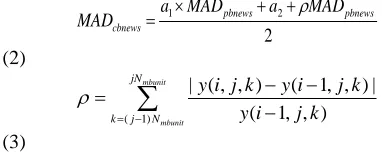
When the MAD prediction scheme of G012 rate control algorithm deals with some video sequence where the scene changes faster, the forecast MAD value has a big difference from the actual MAD value, so we propose a weighted budget method based on image luminance difference, whose basic idea is first to calculate the brightness gradient value of the current coding frame and the previous frame as weights, and then to predict MAD value through the Equation 2 together:
2
2
1 pbnews pbnews
cbnews
MAD a MAD a
MAD = × + +ρ
(2)
∑
− = − − − = mbunit mbunit jN N jk yi j k
k j i y k j i y ) 1
( ( 1, , )
| ) , , 1 ( ) , , ( | ρ (3)
Equations: ρ is the brightness gradient value of the kth macro block of the jth BU of the ith
P frame in the current GOP which is the same position macro block of the previous frame; y(i,j,k) is the brightness value of the current position; MADcbnews is the MAD value of the current basic
unit; MADpbnews is the MAD value of the
corresponding position in the previous frame; Nmbunit will be defined below in detail. ρ reflects the
brightness change degree of the current BU layer between the two adjacent frames. The greater it changes, the bigger the difference between the frame is.
4. BU LAYER DISTRIBUTION
ALGORITHM BASED ON THE PSNR
Assume that a frame consists of Nmbpic
macro blocks, and a basic unit is a set of Nmbunit
continuous macro blocks, where Nmbunit is a part of
Nmbpic and the total number of the basic unit in a
frame is Nunit, so there are:
mbunit mbpic unit
N
N
N
=
(4)The basic unit can be a macro block, a slice, a field or a frame. For example, consider a
video sequence of QCIF size, and Nmbpic is 99.
From the image structure it is known that Nmbunit
can be 1,3,9,11,33 or 99, and the corresponding Nunit can be 99,33,11,9,3 or 1 respectively.
G012 algorithm adopts the method of average distribution when distributing the basic unit bits, without considering the complexity between images. Thus we put forward a kind of peak signal to noise ratio distribution method based on the previous frame. It takes PSNR as a parameter measuring image complexity, uses the PSNR value of each basic unit in the previous frame to estimate each basic unit complexity of the current frame, then distributes bits to the corresponding basic unit of the current frame, and the specific algorithm described as follows:
(1)Compute the mean peak signal-to-noise ratio PSNRav in the previous frame image of
the current coding frame through Equation 5, where
k i
PSNR
−1 is the PSNR value of kth basic unit in i-1th frame; unit N k k i avN
PSNR
PSNR
unit∑
= −=
1 1 (5) (2)Compute αi-1 by Equation 6. αi-1 is a coefficient of fluctuation of basic unit PSNR in i-1th frame image, andPSNR
ik−1 is the PSNR value of kth basic unit in i-1th frame, namely:unit av N k av k i i
N
PSNR
PSNR
PSNR
unit⋅
−
=
∑
= − − 1 1 1|
|
α
(6) (3)Compute the number of bits assigned by each basic unit, and the number of bits assigned by the current basic unit according to the PSNRavvalue calculated by the step(1). When
av k
i
PSNR
PSNR
−1>
, the kth basic unit distributes the number of bit in accordance with the formulaunit i
k
bu
T
N
R
=
(
1
+
α
−1)
; whenav k
i
PSNR
PSNR
−1<
, the kth basic unit distributes the number of bit in accordance with the formulaunit i
k
bu
T
N
R
=
(
1
−
α
−1)
;when
PSNR
ik−1=
PSNR
av, the kth basic unit distributes the number of bit in accordance with the formulaR
buk=
T
N
unit , whereR
buk is the bitnumber distributed by the kth basic unit of the current frame.
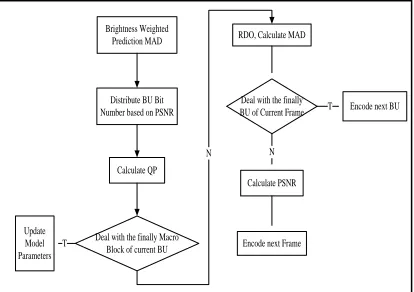
[image:3.612.315.522.186.332.2]Combined with brightness gradient weighted prediction MAD value and BU layer bit allocation scheme based on PSNR, improved rate control flow is shown in Figure 2.
Figure 2: Frame Level Rate Control Flow
5. EXPERIMENT AND ANALYSIS
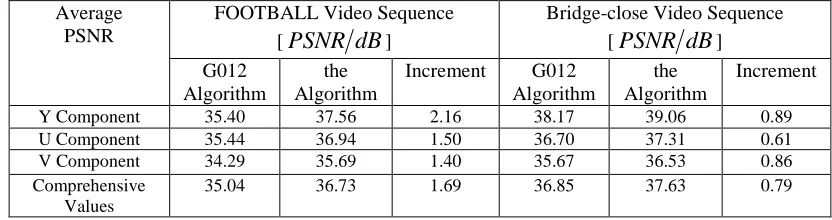
We realize the proposed algorithm on the Verification Model JM86 of JVT, and compare it with the G012 rate control algorithm in the proposed standards. The test sequence are standard QCIF video sequence of FOOTBALL and bridge-close separately, whose video scene change speed is very different. Sequence structure is IPPP..., code 100 frame totally, and frame rate is 30 frames per second. FOOTBALL sequence is a game scene, where the scene changes faster; bridge - close is the description scene of a bridge, where the graphic changes is relatively slower. The contrast test results of the algorithm and the G012 algorithm is shown in Table 1.
From test results of Table 1 we can see, average PSNR get from video sequence coding for this paper's algorithm is respectively higher 2.16, 1.50, 1.40 (FOOTBALL video sequence) and 0.89, 0.61, and 0.86 (bridge - close video sequence) than Y, U, V quantitatively in G012 algorithm. The average PSNR get from coding bridge-close video sequence is higher 0.79 than from G012 algorithm, while in FOOTBALL video sequence of change faster scene is high 1.69. PSNR is one of main measures in evaluation video objective quality. From the experiment data, we can find that compared with G012 algorithm, encoding rate control for video by using the algorithm should get better video quality. At the same time, select 9
Brightness Weighted Prediction MAD
Distribute BU Bit Number based on PSNR
Calculate QP
Deal with the finally Macro Block of current BU Update
Model Parameters
RDO, Calculate MAD
Deal with the finally BU of Current Frame
Calculate PSNR
Encode next Frame
Encode next BU
N N T
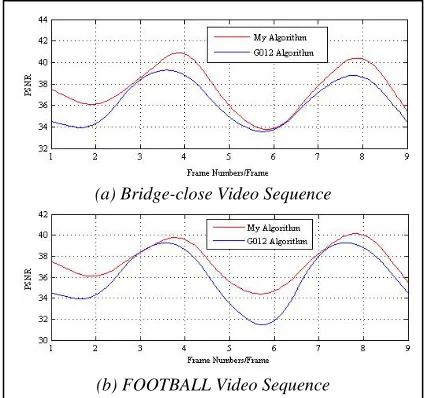
frames coding data randomly to have a contrast analysis in the test sequence(as shown in Figure 3), the PSNR get from the algorithm encoding is higher than from G012 algorithm commonly, and the PSNR fluctuation get from G012 algorithm in FOOTBALL video sequence of faster changes scenes is higher, which causes video acuteness wave easily, so when encoding rate control for video sequences of faster scenes changes by using the algorithm, the advantages are particularly prominent.
Figure 3: Coding Results Comparison
6. CONCLUSION
Through the analysis of the standard G012 rate control algorithm and the improvement of MAD linear prediction model, we design a kind of weighted prediction model based on brightness, make full use of space and time correlation of the image sequence, and improve the accuracy of the predictions. In the basic unit layer number of bits distribution, we put forward a method based on distribution plan of the previous frame PSNR, effectively avoiding image fluctuation caused by the uneven frame image complexity. From the test results, we can see that when video structure is complex and change rapidly, the average PSNR of improved algorithm are larger than G012 algorithm. After the algorithm is applied in bit allocation of BU layer, the PSNR value of coding is higher than G012 algorithm.
REFERENCES:
[1] Z.G. Li, F. Pan, K.P. Lim, “Adaptive basic unit layer rate control for JVT”, JVT Meeting, 2003, pp.7-14.
[2] M.J. Kim, M.C. Hong, “Adaptive rate control in frame-layer for real-time H.264/AVC”,
Proceedings of APCC, 2008, pp.1-5.
[3] C.J. Hou, X.H. He, “Optimized H.264/AVC rate control algorithm”, Computer Engineering and
Application, 2009, pp.159-161.
[4] Y. Wu, S.X. Lin, Z.D. Niu, “H.264/AVC rate control optimization algorithm”, Computer Science. Vol. 31, 2008, pp. 329-339.
[5] X.Q. Yang, X.Y. Ji, “Rate control based on H.264”, Computer Engineering and
Application. Vol. 47, 2011, pp. 186-187.
[6] Y. Moses, S. Ullman, “Limitations of non model-base recognition schemes”, ECCV-92, 1992, pp. 820-828.
[7] H.J. Lee, T.H. Chiang, Y.Q. Zhang, “Scalable rate control for MPEG-4 video”, IEEE Trans
Circuit Syst Video Technology, 2000, pp.
878-894.
[8] A. Vetro, H. Sun, Y. Wang, “MPEG-4 rate control for multiple video objects”, IEEE Trans
Circuit Syst Video Technology, 1999, pp.
186-199.
[9] H.X. Ma, L. Zhang, “H.264/AVC rate distortion optimization technology overview”, Journal of Digital Video, 2010, pp. 19-22.
[10] X.X. Ge, Y. Wang, “H.264/AVC rate distortion optimization strategy study”, Wireless
Communication Technology, 2006, pp. 14-17.
[11] W. Thomas, G. Bernd, “Parameter selection in Lagrangian Hybrid Video Coder Control”,
ICIP, 2001.
(a) Bridge-close Video Sequence
Table 1: Two Algorithm Test Results
Average PSNR
FOOTBALL Video Sequence [
PSNR
dB
]Bridge-close Video Sequence [
PSNR
dB
] G012Algorithm
the Algorithm
Increment G012 Algorithm
the Algorithm
Increment
Y Component 35.40 37.56 2.16 38.17 39.06 0.89
U Component 35.44 36.94 1.50 36.70 37.31 0.61
V Component 34.29 35.69 1.40 35.67 36.53 0.86
Comprehensive Values