Vol. 12, No. 2, 2017, 67-73
ISSN: 2320 –3242 (P), 2320 –3250 (online) Published on 30 June 2017
www.researchmathsci.org
DOI: http://dx.doi.org/10.22457/ijfma.v12n2a3
67
International Journal of
Computing Certain Degree Based Topological Indices and
Coindices of E-graphs
Keerthi G. Mirajkar1 and Pooja B2
Department of Mathematics, Karnatak University’s Karnatak Arts College Dharwad-580 001, Karnataka, India.
1
Email: [email protected], Corresponding author. Email: [email protected]
Received 20 June 2017; accepted 30 June 2017
Abstract. In this paper, we obtain the explicit formulae for general sum-connectivity index,
general product-connectivity index, general Zagreb index and coindices of G-networks, extended G-networks and -networks.
Keywords: degree, G-networks, extended G-networks and -networks.
AMS Mathematics Subject Classification (2010): 05C76, 05C07
1. Introduction
Let be a graph with vertex set (), |()| = , and edge set (), | ()| = . As usual, is order and is size of . If and are two adjacent vertices of , then the edge connecting them will be denoted by . The degree of a vertex ∈ () is the number of vertices adjacent to and is denoted by (). Any unexplained graph theoretical terminology and notation may be found in [6] or [8].
The first and second Zagreb indices, respectively, defined
() =
∈()
()=
∈()
[() + ()]
and () = ∑∈()()()
are widely studied degree-based topological indices, that were introduced by Gutman and Trinajsti′ [5] in 1972.
Noticing that contribution of non adjacent vertex pairs should be taken into account when computing the weighted Wiener polynomials of certain composite graphs (see [3]) Ashrafi et al. [1], defined the first Zagreb coindex and second Zagreb coindex as
() = ∑∈() [() + ()] and () = ∑∈()()(),
respectively.
The vertex-degree-based graph invariant
() = ∑∈()()! = ∑∈() [()+ ()]
was encountered in [5]. Recently there has been some interest to , called forgotten topological index or F-index [4].
Keerthi G. Mirajkar and Pooja B
68 "() =
∈()
(() + ()).
Recently, Veylaki et al.[12] defined the hyper-Zagreb coindex as
"() = ∑∈()(() + ()).
Li and Zhao [9] introduced the first general Zagreb index as follows
$() =
∈()
[()]$.
It is easy to write that
$() =
∈()
[(())$%+ (())$%].
The general sum connectivity index [15] was introduced by Zhou et al. and is defined as
&$() =
∈()
[() + ()]$.
The general product connectivity index [2] is defined as
'$() =
∈()
[()()]$.
Su et al.[13] introduced the general sum-connectivity coindex as
&$() =
∉()
[() + ()]$.
The general product connectivity coindex is defined as
'$() =
∉()
[()()]$.
Here we note that, &() = (), &() = (), &() = "(), &() =
"(), '() = (), '() = (), () = (), !() = ().
2.E-graphs
Let and " be two graphs. Designate two nodes ) and ), )≠ ) in H as e-nodes such that there is an automorphism +: (") → (") with the property +()) = ); +()) = ). Then the symmetric edge replacement of by " written as |", is the -graph got by replacing every edge of with a copy of " identifying and with ) and ) respectively [7].
Figure1: E-graph |".
The -graph ./
the e-nodes is called as the extended G
The -graph called as the -network [10].
on hypercubes 2/. So we consider here
69
Figure 2: G–network .1|01.
/|34 where two nonadjacent vertices of degree three in
nodes is called as the extended G-network [14].
Figure 3: Extended G–network .!|34.
|01 where the e-nodes are two nonadjacent vertices of network [10].The architecture of majority of computer networks is based
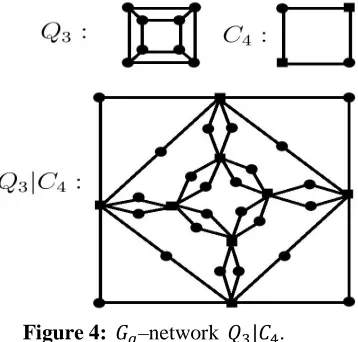
. So we consider here -network 2/|01.
Figure 4: –network 2!|01.
where two nonadjacent vertices of degree three in "′ are
Keerthi G. Mirajkar and Pooja B
70
3.Topological indices of G-networks, extended G-networks and 56-network Theorem 3.1. 7 $.
/|01) = ( − 1)$2$+ ( − 1)2$.
(77)&$(./|01) = ( − 1)(2)$;.
(777)'$(./|01) = ( − 1)$;2$;.
Proof: The −network ./|01 contains vertices, out of which ( − 1) vertices are of degree 2 and remaining vertices of degree 2( − 1). So the $−value of ./|01 is equal to ( − 1)$2$+ ( − 1)2$. This completes the proof of (i).
The −network ./|01 contains 2( − 1) edges whose end vertices have degree 2 and 2( − 1). Hence, &$ and '$− values of ./|01 are ( − 1)(2)$;
and ( − 1)$;2$; respectively. This completes the proof of (ii) and (iii). □
By putting < = 2,3 in Theorem 3.1 (i), < = 2 in Theorem 3.1 (ii) and < = 1 in Theorem 3.1 (iii), we get the following corollary.
Corollary 3.2. (7) (./|01) = 4( − 1).
(77) (./|01) = 8( − 1)(− 2 + 2).
(777) "(./|01) = 8!( − 1).
(7)(./|01) = 8( − 1).
Theorem 3.3. (7) &$(./|01) = A( − 1)
2 B 4$+ A2B4$( − 1)$+/
C%D/E;1/
(2)$.
(77) '$(./|01) = A( − 1) 2 B 4$+ A2B4$( − 1)$+2
!− 7+ 4
2 (4( − 1))$.
Proof: The −network ./|01 contains A
2 B − 2( − 1) non adjacent pairs of
vertices, out of which A( − 1)
2 B pairs of vertices of degree 2 and 2, A2B pairs of vertices of degree 2( − 1) and 2( − 1) and remaining /C%D/E;1/ pairs of vertices of degree 2 and 2( − 1).
Hence, &$(./|01) = A( − 1)
2 B 4$+ A2B4$( − 1)$+/
C%D/E;1/
(2)$ and
'$(./|01) = A( − 1) 2 B 4$+ A2B4$( − 1)$+/C%D/E;1/(4( − 1))$. □
By putting < = 1,2 in Theorem 3.3 (i) and < = 1 in Theorem 3.3 (ii), we get the following corollary.
Corollary 3.4. (i) (./|01) = A( − 1)
2 B 4 + A2B4( − 1) + (2!− 7+ 4).
(ii) "(./|01) = A( − 1)
2 B 16 + A2B16( − 1)+ (2!− 7+ 4)2.
(iii) (./|01) = A( − 1)
71 Theorem 3.5. i $.
/|34) = 3$( − 1)$ + 3$( − 1) + 2$%( − 1).
(ii) &$(./|34) = 2( − 1)(3)$+ (3 + 1)$( − 1) + 7$( − 1).
(iii) '$(./|34) = 29$( − 1)$;+ 12$( − 1)$;+ ( − 1)12$.
Proof: The extended −network ./|34 contains /(!/%) vertices, out of which
vertices are of degree 3( − 1), ( − 1) vertices of degree 3 and the remaining /(/%) vertices of degree 4. So the $−value of ./|34 is equal to 3$( − 1)$ + 3$( −
1) + 2$%( − 1). This completes the proof of (i).
The extended −network ./|34 contains 4( − 1) adjacent pair vertices, out of which 2( − 1) pair of vertices of degree 3 and 3( − 1), ( − 1) pair of vertices of degree 4 and 3( − 1), and ( − 1) pair of vertices of degree 3 and 4. Hence, &$ and '$− values of ./|34 are 2( − 1)(3)$+ (3 + 1)$( − 1) +
7$( − 1) and 29$( − 1)$;+ 12$( − 1)$;+ ( − 1)12$ respectively.
This completes the proof of (ii) and (iii). □
By putting < = 2,3 in Theorem 3.5 (i), < = 2 in Theorem 3.5 (ii) and < = 1 in Theorem 3.5 (iii), we get the following corollary.
Corollary 3.6. (i) (./|34) = 9( − 1)+ 17( − 1).
(ii) (./|34) = 27( − 1)!+ 59( − 1).
(iii)"(./|34) = 18!( − 1) + ( − 1)(3 + 1)+ 49( − 1).
(iv)(./|34) = 30( − 1)+ 12( − 1).
Theorem 3.7.
(7) &$(./|34) =( − 1)2 6$( − 1)$+
( − 1)− ( − 1)
2 6$
+( − 1)8− 2( − 1)8$+ ( − 1)( − 2)(3)$
+( − 1)( − 2)2 (3 + 1)$+( − 1)(( − 1) − 2)
2 7$.
(77) '$(./|34) =( − 1)2 9$( − 1)$+
( − 1)− ( − 1)
2 9$
+( − 1)8− 2( − 1)16$+ ( − 1)( − 2)9$( − 1)$
+( − 1)( − 2)2 12$( − 1)$+( − 1)(( − 1) − 2)
2 12$.
Proof: The extended −network ./|34 contains L /(!/%)
2 M − 4( − 1) non adjacent
pairs of vertices, out of which /(/%) pairs of vertices of degree 3( − 1) and 3( − 1), /E(/%)E%/(/%)
pairs of vertices of degree 3 and 3, /
E(/%)E%/(/%)
N pairs of vertices of degree 4 and 4, ( − 1)( − 2) pairs of vertices of degree 3 and 3( − 1), /(/%)(/%)
Keerthi G. Mirajkar and Pooja B
72
/E/%E%//%
6
$+/E/%E%//%
N 8
$+ − 1 − 23$+//%/%
3 +
1$+//%//%%
7
$ and
'$./|34) =/(/%) 9$( − 1)$+/E(/%)E%/(/%)9$+/E(/%)EN%/(/%)16$+
( − 1)( − 2)9$( − 1)$+/(/%)(/%)
12$( − 1)$+/(/%)(/(/%)%) 12$. □
By putting < = 1,2 in Theorem 3.7 (i) and < = 1 in Theorem 3.7 (ii), we get the following corollary.
Corollary 3.8. (7) (./|34) = 3( − 1)+ 4( − 1)− 5( − 1) + 3( −
1)( − 2) +/(/%)(/%)(!/;) +D/(/%)(/(/%)%) .
(77)"(./|34)
= 18( − 1)!+ 26( − 1)− 34( − 1) + 9!( − 1)( − 2)
+( − 1)( − 2)(3 + 1)2 +49( − 1)[( − 1) − 2]2 .
(777)(./|34) =9( − 1)
!
2 +25
( − 1)
2 −41( − 1)2 + 15( − 1)( − 2).
Theorem 3.9. (7) $(2/|01) = 2/;$($+ ). (77) &$(2/|01) = 2/;$;( + 1)$.
(777)'$(2/|01) = 2$;/;$;.
Proof: The −network 2/|01 contains 2/( + 1) vertices, out of which 2/ vertices are of degree 2, and remaining 2/ vertices of degree 2. So the $−value of 2/|01 is equal to 2/;$($+ ). This completes the proof of (i).
The −network 2/|01 contains 2/; edges whose end vertices have degree 2 and 2. Hence, &$ and '$− values of 2/|01 are 2/;$;( + 1)$ and 2$;/;$; respectively. This completes the proof of (ii) and (iii). □ By putting < = 2,3 in Theorem 3.9 (i), < = 2 in Theorem 3.9 (ii) and < = 1 in Theorem 3.9 (iii), we get the following corollary.
Corollary 3.10. (7) (2/|01) = 2/;(+ ). (77) (2/|01) = 2/;!(!+ ).
(777) "(2/|01) = 2/;!( + 1). (7)(2/|01) = 2/;!.
Theorem 3.11. (7)&$(2/|01) = 2$;A2/%
2 B + 4$$A2
/
2 B + 2$;/;( + 1)$.
(77)'$(2/|01) = 2$;A2 2/%B + 4$$A2 /
2 B + 2$;/;$;.
Proof: The −network 2/|01 contains A2/( + 1)
2 B − 2/; non adjacent pairs of
vertices, out of which 2 A2/%
2 B pairs of vertices of degree 2 and 2, A2 /
73 2 . Hence, &$2/|01) = 2$;A2/%
2 B + 4$$A2
/
2 B + 2$;/;( + 1)$ and
'$(2/|01) = 2$;A2 2/%B + 4$$A2 /
2 B + 2$;/;$;. □
By putting < = 1,2 in Theorem 3.11 (i) and < = 1 in Theorem 3.11 (ii), we get the following corollary.
Corollary 3.12. (7)(2/|01) = 8 A2/%
2 B + 4 A2
/
2 B + 2/;( + 1).
(77)"(2/|01) = 32 A2 2/%B + 16A2 /
2 B + 2/;!( + 1).
(777)(2/|01) = 8 A2 2/%B + 4A22 B + 2/ /;!.
REFERENCES
1. R.Ashrafi, T.DoŎli′ and A.Hamzeh, The Zagreb coindices of graph operations, Discrete Appl. Math.,158 (2010) 1571–1578.
2. B.Bollabas and P.Erdos, Graphs of extremal weights, Ars Combin., 50(1998) 225–233. 3. T.DoŎli′, Vertex-weighted Wiener polynomials for composite graphs, Ars Math.
Contemp., 1 (2008) 66–80.
4. F.Furtula and I.Gutman, A forgotten topological index, J. Math. Chem., 53 (2015) 1184–1190.
5. I.Gutman and N.Trinajsti′, Graph theory and molecular orbitals: Total Q-electron energy of alternant hydrocarbons, Chem. Phys. Lett., 17 (1972) 535–538.
6. F. Harary, Graph Theory, Addison-Wesley, Reading, Mass 1969.
7. T.W.Haynes and L.M.Lawson, Applications of E-graphs in network design, Networks, 23 (1993) 473–479.
8. V.R.Kulli, College Graph Theory, Vishwa International Publications, Gulbarga, India (2012).
9. X.Li and H.Zhao, Trees with the first three smallest and largest generalized topological indices, MATCH Commun. Math. Comput. Chem., 50 (2004) 57–62.
10. D.Sarkar and W.Tong, The −network: A new linear-cost computer network, Congress Number, 74 (1990) 76–92.
11. G.H.Shirdel, H.Rezapour and A.M.Sayadi, The hyper-Zagreb index of graph operations, Iranian J. Math. Chem., 4(2) (2013) 213–220.
12. M.Veylaki, M.J.Nikmehr and H.A.Tavallaee, The third and hyper-Zagreb coindices of graph operations, J. Appl. Math. Comput., 50(1) (2016) 315-325.
13. G.Su and L.Xu, On the general sum-connectivity coindex of graphs, Iranian J. Math. Chem., 2 (2011) 89–98.
14. J.Wu and E.B.Fernandez, Fault-Tolerant Multiprocessor networks through an extended −network. Proceedings of Parabase-9u, International conference on Databases, Parallel Architectures, and Their Applications. (N. Risha, S. Navathe, and D. Tal Eds.) (1990) 216–220.