Vol. 7, No. 1, 2015, 27-33
ISSN: 2320 –3242 (P), 2320 –3250 (online) Published on 22 January 2015
www.researchmathsci.org
27
International Journal of
Different Algorithmic Approach for Type 2 Fuzzy
Shortest Path Problem on a Network
V.Anusuya1 and R.Sathya2 1
PG & Research Department of Mathematics, Seethalakshmi Ramaswami College Tiruchirappalli – 620 002, TamilNadu, India. e-mail: [email protected]
2
Department of Mathematics, K.S.Rangasamy College of Arts & Science Tiruchengode – 637 215, TamilNadu, India. e-mail: [email protected]
Corresponding Author
Received 2 November 2014; accepted 4 December 2014
Abstract. In this paper we present the fuzzy shortest path and shortest path length with Type-2 fuzzy number. To solve this problem we proposed an algorithm from a specified node to other nodes in a network and we have compared the results with other distance measures like Hamming, Normalized Hamming, Exponential type distance measures also. Our proposed algorithm is illustrated with the help of numerical example.
Keywords: Type-2 fuzzy number, type-1 fuzzy number, distance measure, similarity measure, extension principle
AMS Mathematics Subject Classification (2010): 94D05 1. Introduction
28
set”. Similarity is an important tool to provide the foundation for analogical reasoning between two fuzzy concepts and has widespread applications. The most obvious way of calculating similarity of fuzzy sets is based on their distance. Various distance measures are present in literature. In this paper we have proposed one distance measure and made comparison is made with other measures.This paper is organized as follows: In section 2, we have some basic concepts required for analysis. In section 3, an algorithm is proposed to find the fuzzy shortest path and shortest path length combined with distance based similarity measure. A comparative study is made with the help of various distances like Hamming, Normalized Hamming and Normalized exponential type distance. Section 4, gives the network terminology. To illustrative the proposed algorithm the numerical example is solved in section5.
2. Concepts
2.1. Type-2 fuzzy set
A Type-2 fuzzy set denotedA%, is characterized by a Type-2 membership function ( , )
A x u
µ
% where x∈
X and u∈
Jx⊆[0,1].ie., A% = { ((x,u),
µ
A%( , )x u ) / ∀ x∈
X, ∀ u∈
Jx⊆[0,1] } in which 0 ≤µ
A%( , )x u ≤ 1.A%can be expressed as A% = ( , ) /( , )
x A x X u J
x u x u
µ
∈ ∈
∫ ∫
% Jx⊆[0,1], where
∫ ∫
denotes union overall admissible x and u. For discrete universe of discourse
∫
is replaced by∑.2.2. Discrete type-2 fuzzy number
The discrete type-2 fuzzy number A% can be defined as follows:
(x) / x
A x X
A µ
∈ =
∑
%% where (x) (u) / u
x x A
u J
f
µ
∈ =
∑
% whereJx is the primary membership.
2.3. Extension principle
Let A1, A2, . . . . , Ar be type-1 fuzzy sets in X1, X2, . . . ,.Xr, respectively. Then, Zadeh’s Extension Principle allows us to induce from the type-1 fuzzy sets A1, A2, . . , Ar a type-1 fuzzy setB on Y, through f, i.e,B = f(A1, . . . .,Ar), such that
1 1
1 2
1 1
, ,... ( )
( ) sup min{ ( ),..., ( ) ( )
n n
B A A n
x x x f y
y x x iff y
µ µ µ φ
−
− ∈
= ≠
0, f−1( )y =
φ
2.4. Addition on type-2 fuzzy numbers
Let A% and B%be two discrete type-2 fuzzy number be A%=
∑
µA%( ) / xx and(y) / y
B
B%=
∑
µ% where µA%( )x =∑
fx(u) / uandµB%( )x =∑
gy(w) / w. The addition of thesetwo types-2 fuzzy numbers
A
%
⊕
B
%
is defined as(z) ( (x) B(y))
A B A
z x y
µ ⊕ µ µ
= +
=
% %
U
%I
% (( f (u ) / u )x i i ( y(w ) / w ))j ji j
z x y
g
= +
=
U
∑
I
∑
,
(z) (( (f (u )x i y(w )) / (uj i w ))j A B
i j z x y
g
µ ⊕
= +
==
∑
∧ ∧% %
U
29
2.5. Minimum of two discrete type-2 fuzzy number
Let A% and B% be two discrete type-2 fuzzy number then minimum of two type-2 fuzzy
sets is denoted as Min(A%,B%) is given by
( , )
( , )( ) ( x( )i y( j)) / (ui j) z Min x y
Min A B z Sup f u g w w
=
= ∧ ∧
% %
whereA%=
∑
fx(u) / u/ xandB=∑
gy(w) / w/ y% .
2.6. Similarity measure
If d is the distance measure between two fuzzy sets A and B on the universe X, then the following measures of similarity is presented respectively.
S(A,B) = 1
1+d A B( , )
; S(A,B) = 1 – dN(A,B); Se(A,B) = 1 – de(A,B)
2.7. Distance based similarity measures for fuzzy sets
Various distance measures are available in literature. Here we are using the following distance measures for the proposed algorithm.
1. The Hamming distance:
1
( , ) ( ) ( )
n
i i
i
d A B A x B x
=
=
∑
−2. Normalized Hamming distance: dN(A,B) = d(A,B)/n
3. Normalized Exponential type distance: de(A,B) = 1 exp( ( , )
1 exp( 1) N
d A B
− − − −
4. Proposed distance:
(
)
{
( ) ( )
}
( ,y)
, ( )z i - i
z Min x
d A B Sup B y A x
=
= ∀ ∈z
2.8. Centroid of type-2 fuzzy sets
Suppose that A% is a type-2 fuzzy set in the discrete caase. The centroid of A% can be defined as follows:
1 2
1 1 2 2
1 2
1
1 . ... [ ( ). ( )... ( )
( )
( ) R
x x R xR
x x x R
J J J
R A
j A j j
R
A j j
f f f
C
x x
x
θ θ θ
θ θ θ
µ
µ
∈ ∈ ∈
=
=
=
∫ ∫
∫
∑
∑
%
, where 1
(u) / u / x j
x j
R
x j
j u J
A f
= ∈
=
∑ ∑
%
3. Algorithm
Algorithm for fuzzy shortest path length Step 1: Find the path length for the required paths.
Step 2: Reduce the Type-2 fuzzy path length to Type-1 fuzzy path length using typereduction method.
Step 3: If path length is single then that path length is the shortest path length CL% andthat path is the shortest path p%. Stop the procedure. Otherwise go to step 4.
Step 4: Compute the minimum path length CL% using def 2.8.
30
Step 6: Compute the similarity measure for all distance measures using def 2.6 Step 7: Choose the shortest path p%with the highest similarity measure.
Step 8: The shortest path length is CL% and the shortest path isp%.
Algorithm for fuzzy shortest path from source node to all other node in a network Step 1: Letnode 1 be the source node in the given network.
Step 2: Find the collection of nodes S1 in the network which are adjacent to node 1. Step 3: If S1 is empty, then go to step 10. Otherwise go to the step 4.
Step 4: Compute the minimum path length at each node of S1 from node 1 using path length algorithm.
Step 5: Find the collection of nodes S2 in the network which are adjacent to S1. Step 6: If S2 is empty, then go to step 10. Otherwise go to step 7.
Step 7: Compute the minimum path length at each node of S2 from n0 using result 1. Step 8: Repeat step 2 to step 7 until to obtain the set of collection of nodes in the network which are adjacent to each of the shortest path node is empty.
Step 9: Compute the shortest path from node 1 to each of nodes in the network in step 8.Stop the procedure.
Step 10: There is no path from the node 1 to the specified node. 3.1. Network terminology
Consider a directed network G(V,E) consisting of a finite set of nodes V = {1,2, . . .n} and a set of m directed edges E⊆VXV. Each edge is denoted by an ordered pair (i,j), where i,j
∈
V and i≠j. In this network, we specify two nodes, denoted by s and t, which are the source node and the destination node, respectively. We define a path Pij as a sequence Pij = {i = i1, (i1,i2),i2,. . . ., il-1, (il-1,il), il = j} of alternating nodes and edges. The existence of at least one path Psi in G(V,E) is assumed for every node i∈
V – {s}.ij
d% denotes a Type-2 Fuzzy Number associated with the edge (i,j), corresponding to the length necessary to transverse (i,j) from i to j. The fuzzy distance along the path P is
denoted as d P%( )is defined as
( , )
( ) ij
i j P
d P d
∈
= ∑
% %
3.2. Numerical example
The problem is to find the shortest path and shortest path length from source node to all other nodes in the network having 6 vertices and 7 edges with the association of type-2 fuzzy number.
R% P%
U%
S
%
Q% V%
T%
Figure 5.1: Solution:
1
2
3
4
5
31 The edge weights are
P%= (0.5/0.2+0.4/0.3)/2 + (0.4/0.2)/3
Q%= (0.3/0.2 + 0.8/0.3)/1 + (0.2/0.8)/3
R% = (0.7/0.2)/2 + (0.9/0.4 +0.7/0.5)/4
S
%
= (0.6/0.2)/4T% = (0.9/0.4 +0.7/0.5)/3 + (0.4/0.7)/5
U% = (0.8/0.3 + 0.4/0.5)/2
V% = (0.6/0.4)/2 +(0.7/0.5+ 0.5/0.6)/4 Illustration to find shortest path
Step 1: Let node 1 be the source node in the given network.
Step 2: S1 = {2,3} and using step 3 and step 4 of the proposed algorithm we have the following:
Table 5.1:
Step 5: S2 = {4,5} using step 6 and step 7 of the proposed algorithm we have the following:
End node
Possible paths
Path Length Minimum path
Length
Shortest Path
4 1-2-4
1-3-4
(0.5/0.2)/4+(0.4/0.2)/5+(0.5/0.2+0.4/0.3) /6 + ( 0.4/0.2)/7
(0.6/0.2)/5 + (0.2/0.2)/7
(0.6/0.2)/5+(0.2/0.2)/7 1-3 – 4
5 1-3-5 0.3/0.2+0.8/0.3)/4+(0.2/0.4)/6+(0.2/0.7)/ 8
0.3/0.2+0.8/0.3)/4+(0. 2/0.4)/6+(0.2/0.7)/8
1-3-5
Table 5.2:
Step 8 :S3 = {6} using step 6 and step 7 of the proposed algorithm we have the following:
End node
Possible paths
Path Length Minimum path
Length
Shortest Path
6 1-3-4-6
1-3-5-6
(0.6/0.2)/7 + (0.2/0.2)/9
(0.3/0.2+0.6/0.3)/6+(0.2/0.4)/8+(0.2/0.4) /10+(0.2/0.5+0.2/0.6)/12
(0.6/0.2)/7+ (0.2/0.2)/9 1-3 – 4-6
Table 5.3:
By the proposed method, the fuzzy shortest path and shortest path length from the node 1 to each other nodes is given below:
End node
Possible paths
Path Length Minimum path Length Shortest
Path
2 1-2 (0.5/0.2+0.4/0.3)/2+(0.4/0.2)/3) 0
(0.5/0.2+0.4/0.3)/2+(0.4/0.2)/3) 1-2
32
End node
Possible paths
Path Length Minimum path
Length
Shortest Path
2 1-2 (0.5/0.2+0.4/0.3)/2+(0.4/0.2)/3) (0.5/0.2+0.4/0.3)/2+(0. 4/0.2)/3
1-2
3 1-3 0.3/0.2+0.8/0.3)/1+(0.2/0.8)/3 0.3/0.2+0.8/0.3)/1+(0.2 /0.8)/3
1-3
4 1-2-4
1-3-4
(0.5/0.2)/4+(0.4/0.2)/5+(0.5/0.2 + 0.4/0.3 )/6 + ( 0.4/0.2)/7
(0.6/0.2)/5 + (0.2/0.2)/7
(0.6/0.2)/5+ (0.2/0.2)/7 1-3 – 4
5 1-3-5 0.3/0.2+0.8/0.3)/4+(0.2/0.4)/6+(0.2/0.7)/ 8
(0.3/0.2+0.8/0.3)/4+(0. 2/0.4)/6 + (0.2/0.7)/8
1-3-5
6 1-3-4-6
1-3-5-6
(0.6/0.2)/7 + (0.2/0.2)/9
(0.3/0.2+0.6/0.3)/6+(0.2/0.4)/8+(0.2/0.4) /10+(0.2/0.5+0.2/0.6)/12
(0.6/0.2)/7+ (0.2/0.2)/9 1-3 – 4-6
Table 5.4:
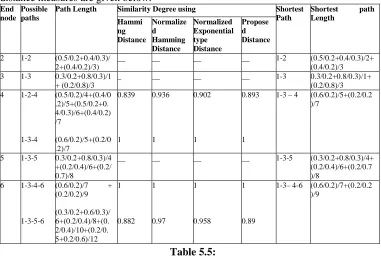
The Fuzzy Shortest path and the corresponding path length using proposed and existing distance measures are given below.
End node
Possible paths
Path Length Similarity Degree using Shortest
Path
Shortest path Length Hammi ng Distance Normalize d Hamming Distance Normalized Exponential type Distance Propose d Distance
2 1-2 (0.5/0.2+0.4/0.3)/ 2+(0.4/0.2)/3)
__ __ __ __ 1-2 (0.5/0.2+0.4/0.3)/2+ (0.4/0.2)/3 3 1-3 0.3/0.2+0.8/0.3)/1
+ (0.2/0.8)/3
_ __ __ __ 1-3 0.3/0.2+0.8/0.3)/1+ (0.2/0.8)/3 4 1-2-4
1-3-4 (0.5/0.2)/4+(0.4/0 .2)/5+(0.5/0.2+0. 4/0.3)/6+(0.4/0.2) /7 (0.6/0.2)/5+(0.2/0 .2)/7 0.839 1 0.936 1 0.902 1 0.893 1
1-3 – 4 (0.6/0.2)/5+(0.2/0.2 )/7
5 1-3-5 0.3/0.2+0.8/0.3)/4 +(0.2/0.4)/6+(0.2/ 0.7)/8
__ __ __ __ 1-3-5 (0.3/0.2+0.8/0.3)/4+ (0.2/0.4)/6+(0.2/0.7 )/8
6 1-3-4-6
1-3-5-6
(0.6/0.2)/7 + (0.2/0.2)/9 (0.3/0.2+0.6/0.3)/ 6+(0.2/0.4)/8+(0. 2/0.4)/10+(0.2/0. 5+0.2/0.6)/12 1 0.882 1 0.97 1 0.958 1 0.89
1-3– 4-6 (0.6/0.2)/7+(0.2/0.2 )/9
Table 5.5: 4. Conclusion
33
node to all other nodes, is same in the case of proposed method and all other existing methods.
REFERENCES
1. V.Anusuya and R.Sathya, Type-2 fuzzy shortest path, International Journal of fuzzy mathematical Archive, 2 (2013) 36-42.
2. T.N.Chuang and J.Y.Kung, The Fuzzy shortest path length and the corresponding shortest path in a network, Computers and Operations Research, 32 (2005) 1409-1428.
3. E.W.Dijkstra, A note on two problems in connection with graphs, Numerische Mathematik, 1 (1959) 269-271.
4. S.Dreyfus, An Appraisal of some shortest paths algorithms, Operations Research, 17 (1969) 395-412.
5. D.Dubois and H.Prade, Fuzzy Sets and Systems: Theory and Applications, Academic Press, New York, 1980.
6. N.Karnik and M.Mendel, Type-2 fuzzy logic systems: Type – reduction, in IEEE Syst., Man, cybern. Conf., San Diego, CA, oct. 1998.
7. N.Karnik and M.Mendel, An introduction to type-2 fuzzy logic systems, USC Report, http://sipi.usc.edu/~mendel/report, oct. 1998.
8. N.Karnik and M.Mendel, Type-2 fuzzy logic systems, IEEE Trans. Fuzzy Syst., 7 (1999) 643-658.
9. C.M. Klein, Fuzzy Shortest Paths, Fuzzy Sets and Systems, 39 (1991) 27-41.
10. J.Y.Kung and T.N.Chuang, The shortest path problems with discrete fuzzy arc lengths, Computers and mathematics with applications, 49 (2005) 263-270.
11. K.Lin and M.Chen, The fuzzy shortest path problem and its most vital arcs, Fuzzy Sets and Systems, 58 (1994) 343 – 353.
12. S.Okada and T.Soper, A shortest path problem on a network with fuzzy arc lengths, Fuzzy sets and systems, 109 (2000) 129-140.
13. P.Pandian and P.Rajendran, A new algorithm for minimum path in a network,
Applied Mathematical Sciences, 4(54) (2010) 2697-2710.