Optimizing Dependency Parsing Throughput
Albert Weichselbraun and Norman S¨usstrunk
Department of Information, University of Applied Sciences Chur, Pulverm¨uhlestrasse 57, Chur, Switzerland {albert.weichselbraun, norman.suesstrunk}@htwchur.ch
Keywords: natural language processing, dependency parsing, performance optimization, throughput
Abstract: Dependency parsing is considered a key technology for improving information extraction tasks. Research indicates that dependency parsers spend more than 95% of their total runtime on feature computations. Based on this insight, this paper investigates the potential of improving parsing throughput by designing feature representations which are optimized for combining single features to more complex feature templates and by optimizing parser constraints. Applying these techniques toMDParserincreased its throughput four fold, yieldingSyntactic Parser, a dependency parser that outperforms comparable approaches by factor 25 to 400.
1
INTRODUCTION
Dependency parsing is considered a key technol-ogy for improving natural language processing. Al-though information extraction tasks such as named entity linking, named entity recognition, opinion min-ing and coreference resolution would benefit from de-pendency parsing, throughput has been one of the mayor obstacles towards its deployment for big data and Web intelligence applications.
Therefore, researchers have put more attention to parsing throughput in recent years which led to sig-nificant speed improvements. The latest version of the Stanford parser (Chen and Manning, 2014), for instance, is able to process on average more than 900 sentences per second, a number which is even ex-ceeded by MDParser (Volokh, 2013) with a through-put of approximately 5200 sentences per second.
In contrast to related work which primarily fo-cuses on the parsing and feature selection strategy, this paper puts its emphasis on feature extraction and the optimization of parsing constraints. The sug-gested methods, therefore, complement related work, i.e. they can easily be applied on top of them.
A major motivator for applying dependency pars-ing is its potential to enable a more sophisticated text processing for information extraction tasks such as opinion mining. Qiu et al., for example, define syn-tactic rules that draw upon dependency trees to extract opinion targets from text documents. Afterwards, their approach propagates the value from opinion-bearing words to their targets based on a set of pre-defined dependency rules, connecting the targets with
further terms within the sentence (Qiu et al., 2011). Targets can transfer their sentiment to other terms which can either be new sentiment terms or targets. While Qiu et al. focused on identifying unknown sentiment terms, Gindl et al. apply this approach to the extraction of sentiment aspects and targets (Gindl et al., 2013). Poria et al. use dependency parsing for decomposing text into concepts based on the de-pendency relations between clauses. Their approach is domain-independent and extracts concepts with an accuracy of 92%, obtains a precision of 85% for sen-timent analysis, and a precision of 63% for emo-tion recogniemo-tion (anger, sadness, disgust, fear, sur-prise and joy), therefore, outperforming approaches which solely relied on N-grams or part-of-speech tag-ging (Poria et al., 2014).
These improvements and the potential to facili-tate more advance text understanding for information extraction and text mining tasks in big data environ-ments have been major drivers for developing and evaluating the methods discussed in this paper.
2
RELATED WORK
Most current dependency parsers are either graph-based or transition-graph-based (Nivre and McDonald, 2008). Graph-based dependency parsers learn a model for scoring dependency graphs from training sentences and choose the highest scoring dependency graph for unknown sentences. This strategy requires the parser to create and score a large number of de-pendency graphs which is a time consuming task. Transition-based parsers, in contrast, only optimize the transitions between parser states, i.e. the decision on whether to create a dependency with the label l between two nodesni and nj. They derive the
de-pendency graph by performing such transitions for all words in the sentence using a parsing strategy which determines the set of possible transitions. Popular parsing strategies are based on the transition system by Nivre for projective and non-projective parsing (Nivre, 2009), or on the Covington algorithm (Cov-ington, 2001). Parsers which are based on Nivre’s transition system have a parsing complexity ofO(n) for projective, andO(n2) for non-projective parsing (Nivre, 2008). Since the fraction of non-projective dependencies is usually very low even non-projective dependency parsers that use Nivre’s transition system have a close to linear time complexity (Nivre, 2009). The Covington algorithm, in contrast, has a time com-plexity ofO(n2)in the worst case (Volokh and
Neu-mann, 2012).
Clearparser, which is now part of the ClearNLP project (https://github.com/clearnlp), extends Nivre’s algorithm (Nivre and McDonald, 2008) with a tran-sition which determines whether the parser continues with projective or non-projective parsing, cutting the average parsing speed by 20% compared to the origi-nal implementation (Choi and Palmer, 2011).
Although the importance of the parsing strat-egy for parser throughput is well researched and undisputed, feature extraction seems to play an even more important role in optimizing dependency pars-ing since it has not received much attention yet. Re-cent research by He et al. suggests that many state of the art dependency parsers spend most of their time in the feature extraction step (He et al., 2013). Chen and Manning observed that more than 95% of the parser’s runtime is consumed by feature extraction, a number which is even surpassed by the baseline parser used by Bohnet (Chen and Manning, 2014; Bohnet, 2010). The baseline evaluated in his paper uses the archi-tecture of McDonald and Pereira and spends 99% of its total runtime on feature extraction (McDonald and Pereira, 2006).
He et al. address this problem by improving
fea-ture selection. Their parsing framework dynamically selects features for each edge, achieving average ac-curacies comparable to parsers which use the full fea-ture set with less then 30% of the feafea-ture templates (He et al., 2013).
Chen and Manning, in contrast, use dense features which embed high dimensional sparse indicator fea-tures into a low-dimensional model (Chen and Man-ning, 2014). This approach does not only reduce fea-ture extraction cost but also addresses common prob-lems of traditional feature templates such as sparsity, and incompleteness (i.e. the selected feature tem-plates do not cover every useful feature combination) (Chen and Manning, 2014).
3
METHOD
3.1
Feature Design
Syntactic Parser mitigates the problem of feature sparseness by performing a frequency analysis of lex-ical word forms, replacing words with a very low fre-quency with the labelunknown. Optimizing the fea-ture design by replacing infrequent word forms with
the unknownlabel did not only improve the parser’s
throughput and memory consumption but also posi-tively affected the parsing accuracy since it enabled the classifier to learn strategies for handling infre-quent features.
We also systematically scanned for feature tem-plates which do not significantly improve parsing per-formance and identified four combined features used by MDParser as candidates for removal from the pars-ing process.
3.2
Feature Representation
be too time intensive to provide an overall benefit (Volokh and Neumann, 2012).
Based on this analysis, an efficient feature repre-sentation would not only need to be more efficient for combining features but is also required to minimize the number of transformations.
MDParser transforms String features to integer values since the used liblinear classifier operates on numerical values. This step requires a total of 27 transformations for every word, since MDParser computes 27 different features templates. Syntac-tic Parser, in contrast, transforms elementary features to integer values before the features are combined, requiring only three transformations (part-of-speech, word form and dependency) for every word in a sen-tence.
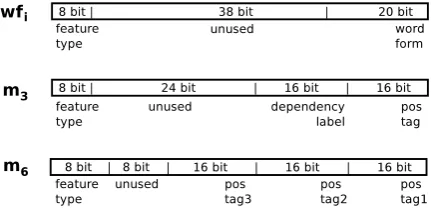
Syntactic Parser represents its numerical features n as 64-bit integers (Java long type) which consist of (i) an 8 bit value indicating the feature type, and (ii) one or more of the following elementary features: word forms (20 bit), part-of-speech tag (16 bit) or de-pendency label (16 bit). The feature type is always stored in the last eight bits, while the position of ele-mentary features depends on the feature type.
We, therefore, replace the mapping
M
:F
→Nof parser feature strings fi∈F
to integer valuesn∈N with three mappings that translate word formswi ∈W
(M
word f orm :W
→ {0, ...,1 048 575}),part-of-speech tagsposi∈
P
(M
pos:P
→ {0, ...,65 535}) anddependency labelsdi∈
D
(M
dep:D
→ {0, ...65 535})to integer values. The numerical feature valuen is then derived by performing bit operations on these el-ementary features.
Figure 1 illustrate the binary encoding for the fea-turesw fi,m3, andm6. Combining and encoding
fea-tures is very fast, since it only involves bit operations on 64 bit values which can be performed directly in the CPU’s registers. We use hash maps which have a time complexity ofO(1) to translate between the string features extracted from the input text and their internal numerical representation. Another potential optimization is replacing these maps with hash val-ues obtained by calls to String’shashCode()method or to high throughput non-cryptographic hash func-tions such as Murmur31. Our experiments showed that Java’s hash maps are very effective and no sig-nificant speed improvement could be obtained by re-placing hash maps with the hash functions mentioned above.
1https://code.google.com/p/smhasher/
Figure 1: Binary feature encoding for single (w fi), binary
(m3) and ternary features (m6).
3.3
Constraint Checking
The dependency parser needs to ensure that the cre-ated dependency tree does not contain single heads, reflexive nodes, improper roots, or cycles. MD-Parser and Syntactic MD-Parser perform projective pars-ing and, therefore, also eliminate non-projective de-pendencies. The parser tests for every combination of two nodes, whether one of the above conditions is met, before it even considers a dependency between these nodes. This strategy has considerable speed and accuracy benefits, since these tests are less expensive than querying the machine learning component for the existence of a dependency.
Considering that (i) the test for cycles and projec-tiveness traverse the dependency tree2and are, there-fore, much more expensive than tests for single heads, reflexive nodes and improper roots, and that (ii) tests are called n·(n2−1) times for a sentence withnwords, optimizing the order of these tests has the potential to considerably improve the performance of the de-pendency parsing algorithm. This is also reflected in the performance improvement obtained by chang-ing the original test sequence (schang-ingle heads, reflex-ive nodes, cycles, improper roots, projectreflex-iveness) to an optimized one (single heads, reflexive nodes, im-proper roots, cycles, projectiveness). We also con-sider that projectiveness is a symmetric property and, therefore, compute it only once rather than twice (for the potential dependencyni→nj and for the
depen-dencynj→ni).
The results summarized in Table 1 show a perfor-mance boost of factor three for numerical features and factor four for combining numerical features with op-timized constraint checking over the original imple-mentation. The computations required for optimizing
2Nivre introduces an algorithm that does not require
the feature representation have been performed on an Intel Core i3-2310M CPU at 2.10 GHz using a single thread and the OpenJDK virtual machine in version 1.7.0 75 on the Ubuntu 14.04 operating system. The presented results have been computed as the average of three runs which have been performed after parsing of 50,000 sentences to warm up the virtual machine. In all experiments the standard deviation of the run-time between the experiments has been below 1.5%.
Table 1: Comparison of the feature encoding speed for string and numerical feature representations.
feature number of processing
representation sentences time (ms)
string 1,000 16
10,000 161
100,000 1,577 1,000,000 16,827
numerical 1,000 6
10,000 55
100,000 532
1,000,000 5,414
numerical & 1,000 4
optimized 10,000 41
constraints 100,000 405
checking 1,000,000 4,077
3.4
Parser Model
Based on performance evaluations with different model optimization strategies, we decided to adopt the strategy deployed by MDParser. MDParser di-vides the parser model into several smaller mod-els. For every distinct part-of-speech tag feature (pi-feature), a separate model is trained. All feature sets that are generated in one transition are grouped to-gether according to this pi-feature. Table 2 illustrates the structure of this composite parser model. This separation has the following advantages:
• The models are comparably small and more spe-cific which leads to faster predictions and better accuracy.
• Every model can be optimized according to the pi feature. This is important since the pi-feature considerably influences the optimal prediction for the next parser step.
We also perform a final optimization step on the trained model which eliminates features with a weight of zero. This step reduces the model size and im-proves the estimation speed, since only a few percent-ages of the total feature set gets non-zero weights due to the high number of sparse features.
Table 2: Composite parser model based on the part-of-speech tag (pi-feature).
Feature pi Model
pi=VB model1 pi=NN model2
... ...
4
EVALUATION
4.1
Evaluation Setting
The experiments in this section compare Syntactic Parser’s accuracy and throughput with four publicly available, well known dependency parsers: (i) Malt-Parser3, a transition based-parser which supports
mul-tiple transition systems, including arc-standard and arc-eager (Nivre et al., 2010), (ii) MSTParser4, a two-stage multilingual dependency parser created by Mc-Donald et al. (McMc-Donald et al., 2006), (iii) the latest version of the Stanford dependency parser (Chen and Manning, 2014), and (iv) MDParser which has been the target of the optimizations described in this paper. The evaluations have been performed on a sin-gle thread of a Ubuntu 14.04 LTS server with two 16 core Intel Xeon E5-2650 CPUs at 2.0 GHz and 128 GB RAM using the 64-bit Java HotSpot in ver-sion 1.8.0 31 and uses the universal dependency tree-bank v2.05, a publicly available collection of
tree-banks with syntactic dependency annotations. The evaluation framework ran all parsers in their default configuration using the train files enclosed in the cor-pora for training and the test files for testing accu-racy and throughput. We did not perform any opti-mizations such as runningMaltOptimizer, optimizing command line parameters or the feature design for any of these parsers (including syntactic parser).
4.2
Results
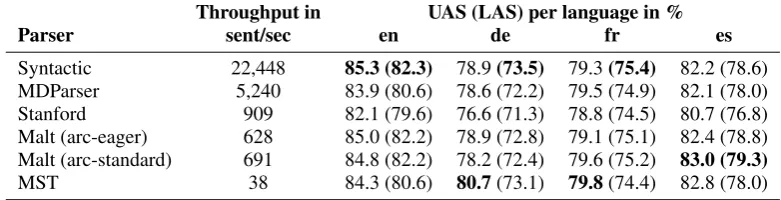
Table 3 compares the parsers’ throughput and accu-racy for the English universal dependencies corpus. The experiments report parsing accuracy in terms of correctly assigned head (unlabeled attachment score; UAS) and the fraction of heads and types which have been correctly identified (labeled attachment score; LAS). Bold number indicate the best results for a particular experiment. The results show that Syntac-tic Parser provides a significantly higher throughput
3maltparser.org
Table 3: Throughput and accuracy on the universal dependency treebank.
Throughput in UAS (LAS) per language in %
Parser sent/sec en de fr es
Syntactic 22,448 85.3 (82.3) 78.9(73.5) 79.3(75.4) 82.2 (78.6) MDParser 5,240 83.9 (80.6) 78.6 (72.2) 79.5 (74.9) 82.1 (78.0) Stanford 909 82.1 (79.6) 76.6 (71.3) 78.8 (74.5) 80.7 (76.8) Malt (arc-eager) 628 85.0 (82.2) 78.9 (72.8) 79.1 (75.1) 82.4 (78.8) Malt (arc-standard) 691 84.8 (82.2) 78.2 (72.4) 79.6 (75.2) 83.0 (79.3)
MST 38 84.3 (80.6) 80.7(73.1) 79.8(74.4) 82.8 (78.0)
than any other parser. The differences between MD-Parser and Syntactic MD-Parser are particularly interest-ing since Syntactic Parser is based on MDParser and, therefore, employs the same parsing algorithm, indi-cating that a more than four-fold improvement has been solely achieved by applying the optimizations discussed in this paper. The evaluation also demon-strates that these enhancements did not come at the cost of accuracy, on the contrary, Syntactic Parser out-performs MDParser in three out of four evaluations according to the UAS measure and in all experiments for the LAS metric.
The results presented in Table 3 indicate that Malt-Parser, MSTParser and Syntactic Parser are very close in terms of accuracy. Syntactic Parser provides the best UAS for English, MaltParser outperforms its competition for Spanish, and MST performs best for German and French. Syntactic Parser also yields the best LAS for English, French and German. MDParser does particularly well for French dependencies, but provides considerably lower scores for the other lan-guages. These differences have been caused by the changes to the feature set and the introduction of a placeholder label for low frequency terms in Syntac-tic Parser (Section 3.1).
5
OUTLOOK AND
CONCLUSIONS
Many big data information extraction approaches still apply lightweight natural language processing techniques since more sophisticated methods do not yet meet their requirements in terms of throughput and scalability. The presented research addresses this problem by optimizing the feature representation and constraint handling of dependency parsers yielding significant speed improvements.
The main contributions of this work are (i) sug-gesting a method to address common performance bottlenecks in dependency parsers (ii) introducing
Syntactic Parser6, a dependency parser which has been optimized based on the techniques presented in this paper, and (iii) conducting comprehensive exper-iments which outline the performance impact of the proposed techniques, and compare the created parser to other state of the art approaches.
The presented methodology yielded Syntactic Parser, a dependency parser which provides state of the art parsing accuracy and excels in throughput and performance. Implementing the proposed op-timizations increased the parsing performance more than four-fold and also yielded a better overall ac-curacy when compared to MDParser although both parsers implement the same parsing strategy. Syn-tactic Parser clearly outperforms all other parsers in terms of throughput although it yields a comparable UAS and LAS at the English, French, German and Spanish universal dependency treebank.
ACKNOWLEDGEMENTS
The research presented in this paper has been con-ducted as part of the COMET project (www.htw-chur.ch/comet), funded by the Swiss Commission for Technology and Innovation (CTI), and the Radar Media Criticism Switzerland project (medienkri-tik.semanticlab.net/about) funded by the Swiss Na-tional Science Foundation (SNSF).
REFERENCES
Bohnet, B. (2010). Very High Accuracy and Fast Depen-dency Parsing is Not a Contradiction. In Proceed-ings of the 23rd International Conference on Com-putational Linguistics, COLING ’10, pages 89–97,
6A Web demo of Syntactic Parser is available at
Stroudsburg, PA, USA. Association for Computa-tional Linguistics.
Chen, D. and Manning, C. (2014). A Fast and Accurate De-pendency Parser using Neural Networks. In Proceed-ings of the 2014 Conference on Empirical Methods in Natural Language Processing (EMNLP 2014), pages 740–750, Doha, Qatar. Association for Computational Linguistics.
Choi, J. D. and Palmer, M. (2011). Getting the Most out of Transition-based Dependency Parsing. In Pro-ceedings of the 49th Annual Meeting of the Associa-tion for ComputaAssocia-tional Linguistics: Human Language Technologies: Short Papers - Volume 2, HLT ’11, pages 687–692, Stroudsburg, PA, USA. Association for Computational Linguistics.
Covington, M. A. (2001). A fundamental algorithm for de-pendency parsing. InIn Proceedings of the 39th An-nual ACM Southeast Conference, pages 95–102. Gindl, S., Weichselbraun, A., and Scharl, A. (2013).
Rule-based opinion target and aspect extraction to ac-quire affective knowledge. InFirst WWW Workshop on Multidisciplinary Approaches to Big Social Data Analysis (MABSDA 2013), Rio de Janeiro, Brazil. He, H., III, H. D., and Eisner, J. (2013). Dynamic
Fea-ture Selection for Dependency Parsing. InEmpirical Methods in Natural Language Processing (EMNLP 2013).
McDonald, R., Lerman, K., and Pereira, F. (2006). Multilin-gual Dependency Parsing with a Two-Stage Discrimi-native Parser. InTenth Conference on Computational Natural Language Learning (CoNLL-X).
McDonald, R. and Pereira, F. (2006). Online learning of approximate dependency parsing algorithms. In Pro-ceedings of 11th Conference of the European Chap-ter of the Association for Computational Linguistics (EACL-2006)), volume 6, pages 81–88.
Nivre, J. (2008). Algorithms for Deterministic Incre-mental Dependency Parsing. Computer Linguistics, 34(4):513–553.
Nivre, J. (2009). Non-projective Dependency Parsing in Expected Linear Time. In Proceedings of the Joint Conference of the 47th Annual Meeting of the ACL and the 4th International Joint Conference on Natural Language Processing of the AFNLP: Volume 1 -Volume 1, ACL ’09, pages 351–359, Stroudsburg, PA, USA. Association for Computational Linguistics. Nivre, J. and McDonald, R. (2008). Integrating
Graph-Based and Transition-Graph-Based Dependency Parsers. In Proceedings of ACL-08: HLT, pages 950–958, Columbus, Ohio. Association for Computational Lin-guistics.
Nivre, J., Rimell, L., McDonald, R., and G´omez-Rodr´ıguez, C. (2010). Evaluation of Dependency Parsers on Un-bounded Dependencies. InProceedings of the 23rd International Conference on Computational Linguis-tics, COLING ’10, pages 833–841, Stroudsburg, PA, USA. Association for Computational Linguistics. Poria, S., Agarwal, B., Gelbukh, A., Hussain, A., and
Howard, N. (2014). Dependency-based semantic pars-ing for concept-level text analysis. In Gelbukh, A., editor,Computational Linguistics and Intelligent Text Processing, number 8403 in Lecture Notes in Com-puter Science, pages 113–127. Springer Berlin Hei-delberg.
Qiu, G., Liu, B., Bu, J., and Chen, C. (2011). Opinion Word Expansion and Target Extraction through Dou-ble Propagation.Computational Linguistics, 37(1):9– 27.
Volokh, A. (2013).Performance-oriented dependency pars-ing. PhD Thesis, Saarland University.