ISSN: 2374-2380 (Print), 2374-2399 (Online) Copyright © The Author(s). 2015. All Rights Reserved. Published by American Research Institute for Policy Development DOI: 10.15640/jpbs.v4n1a1 URL: https://doi.org/10.15640/jpbs.v4n1a1
The Role of Individual Differences and Emotion in Facebook Activity
Crystal M. Kreitler
1, Cheryl K. Stenmark
2, Jessica Serrate
3, & Nicolette Winn
4Abstract
Facebook has become a common means for self-representation and social interaction. We conducted two studies to examine more closely how individuals’ personality traits and emotion are associated with their Facebook activity. Using both participant self-report and content coding, Study 1 revealed that, contrary to some previous studies, individuals higher in narcissism were less likely to share certain content on Facebook than those lower on narcissism. Study 2 revealed that individuals were more likely to share content on Facebook in response to a vignette describing a happy life event, as opposed to a sad or anxious life event. These studies are the first to demonstrate these results utilizing such vignettes as stimuli for Facebook activity for all participants.
Key Words: Effects, self-management technique, test anxiety, secondary school students
Introduction
According to Facebook’s quarter report (2015), over 1.44 billion users were active as of March 2015.As Facebook usage becomes an increasingly ubiquitous part of American culture, it becomes more important to understand when and what people share on Facebook. People are using electronic communication more than ever. For example, spontaneous self-disclosure is more likely to occur when people are communicating over the Internet as opposed to face-to-face (Joinson, 2001; Boyd & Ellison, 2007).Some studies have shown that users’ Facebook profiles are indicative of their true selves (Gosling, Augustine, Vazire, 2011; Back et al., 2010). Another study suggested that Facebook users are more likely to represent their emotional well-being more positively on Facebook than it reflected in real life (Qui et al., 2012).
A rich area of investigation into the dynamics regarding what and when people post on Facebook is the examination of personality traits, such as narcissism. Narcissistic individuals tend to believe that they are interesting and unique, and expect special treatment from others. These characteristics of narcissistic individuals are likely to lend themselves to the use of social networking sites.
1
Angelo State University, Department of Psychology, Sociology, and Social Work, Angelo State University, San Angelo, TX, 76909, USA.
Angelo State University, Department of Psychology, Sociology, and Social Work, Angelo State University, San Angelo, TX, 76909, USA. 3
Angelo State University, Department of Psychology, Sociology, and Social Work, Angelo State University, San Angelo, TX, 76909, USA. 4
Interestingly, while many studies have found narcissism to be related to Facebook activity (e.g., Buffardi & Campbell, 2008; Carpenter, 2012; Marshall, Lefringhausen, & Ferenczi, 2015; Winter et al., 2014), while others found no such link (Chen, 2014; Deters, Mehl, & Eid, 2014).Thus, the role of narcissism in Facebook activity is not entirely clear.
Differences in findings regarding narcissism and social media could be related to the methods used to study this link. Some studies have assessed the relationship between narcissism and Facebook utilizing self-report measures (e.g., Bergman etal., 2011; Carpenter, 2014; Panek, Nardis, & Konrath, 2013). Another method of evaluating the relationships between individual differences and Facebook use is to examine users’ actual Facebook content (e.g., Buffardi & Campbell, 2008; Choi, Panek, Nardis, & Toma, 2015; Deters, Mehl, & Eid, 2014; 2014; Winter et al., 2014).
Each method of studying the relationship between Facebook and narcissism has its strengths and weaknesses. While self-reports of Facebook use are easier to access than users’ real Facebook content, they may be inaccurate. Coding participants’ actual Facebook profile is likely to be a more accurate reflection of their actual Facebook use. The present studies used a unique method which allows participants to simulate Facebook use, with all participants responding to the same stimulus. Study 1 was designed to identify Facebook activity correlates and explore potential conditions under which one is more or less likely to post a status on Facebook. The primary objective of Study 1 was to examine the relationship between Facebook activity and narcissism.
Study 1: Method
Participants
There were 110 undergraduate psychology students (72 females; average age = 19.26, SD = 2.13) from a mid-sized public university in southwestern US that participated in the study. Participants volunteered for this research as an optional means of fulfilling a course requirement or to receive extra credit for a class.
Measures
Demographic Data. A questionnaire requesting information about each participant’s age, race, and gender was
administered to participants.
Narcissism. Participants completed the 16-item Narcissistic Personality Inventory (NPI-16; Ames, Rose, &
Anderson, 2006) to measure levels of subclinical narcissism. Participants indicated which statements were more like them by placing an “X” by the items (e.g., “I really like to be the center of attention” vs. “It makes me uncomfortable to be the center of attention.”).
Facebook activity scale (FAS). A questionnaire created by the authors was given to the participants. Preceding
Those participants who would not have either posted a status wrote “I would not post a status” or left this field blank. Because they measured different types of posting behaviors on Facebook, we measured the questionnaire
items separately. This questionnaire demonstrated moderate to high internal consistency (α = .85).
Content analysis. In order to elicit a hypothetical Facebook status for the birthday dinner event, the final
question on the Facebook activity scale was open-ended: What would your status say? Four trained raters, all of whom were Masters students evaluated the qualitative data. Prior to making these ratings, the raters completed a 10-hour training program, during which they were initially familiarized with the nature of the material and the definitions of the dimensions to be rated. The following dimensions were rated as being either present or absent: mentions emotion, mentions self, and mentions another person. Infraclass correlation coefficients were .87, .98, and .86, respectively.
Procedure
After informed consent was obtained, participants completed the demographic questionnaire followed by the NPI-16. Next participants read the scenario regarding a friend’s birthday dinner (described above) and then completed the FAS, followed by the debriefing.
Results
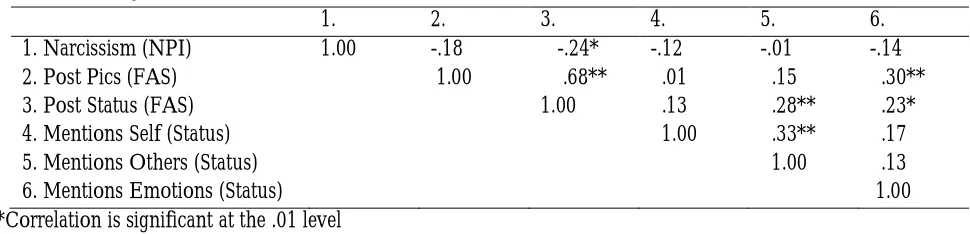
A bivariate co relational analysis was conducted on the content-coded variables along with narcissism, and the FAS variables (see Table 1). There was a positive correlation between the likelihood of posting a status and mentioning emotion in the status, r = .23, p < .05; participants who reported that they would post a status on Facebook were also likely to note emotion in the status update. There was a positive correlation between mentioning emotion in the status and picture posting, r = .30, p <.01; participants who noted emotion in their Facebook status were also likely to report that they would share pictures. There was a negative correlation between narcissism and the likelihood of posting a status, r = -.24, p <.05; participants who were higher in narcissism were less likely to report that they would post a status.
Discussion
This study did not reveal the expected findings regarding Facebook activity and narcissism. We expected that people higher in narcissism would be more likely to post information about their lives, as posting on Facebook can be viewed as an avenue for people high in narcissism to acquire the external approval they seek to affirm their own self-worth (Campbell & Foster, 2002). Indeed, multiple empirical studies have found narcissism to be related to increased Facebook activity (e.g., Buffardi & Campbell, 2008; Mehdizadeh, 2010; Ong et al., 2011; Winter et al., 2014). The results of the present study indicated a number of null relationships between Facebook use indicators and narcissism. These results are consistent with other studies which found that narcissism was not significantly related to Facebook use (e.g., Chen, 2014; Deters, Mehl, & Eid, 2014; Skues, Williams, & Wise, 2012).
While some research has suggested that narcissists are generally more active on social networking sites (Ljepava, Orr, Lock, & Ross, 2013; Ryan & Xenos, 2011), and thus would be more expected to post statuses, other research linking narcissism to Facebook activity demonstrates narcissists as being more likely to post self-related (e.g., Mehdizadeh, 2010; Winter et al., 2014).
Despite the lack of significant results with regard to narcissism in Study 1, we found some interesting results with regard to the presence of emotion in Facebook posts. People who reported that they would post a status update for the event were also more likely to mention emotions in that status. Additionally, people who were more likely to post a picture commemorating the event were more likely to mention emotions in their status. Taken together, these findings suggest that emotion plays an important role in at least two of the main uses of social media. Thus, we conducted Study 2 in order to examine the differential role of events evoking different emotions in posting activity and content and to examine how other personality traits (i.e., the Big Five) might be related to Facebook activity.
Study 2
Based on the results revealed in Study 1, we designed a second study to examine the potential role of emotions and individuals differences (narcissism and the Big Five personality traits) in Facebook activity based on vignettes reflective of 4 different emotions. For example, individuals respond and share differently when experiencing positive versus negative (Rime, 2009; Diener, 2000; Gable, Reis, Impett, & Asher, 2004). Sharing positive emotions allows one to extend the positive feelings and fosters social exchanges among loved ones (Rime, 2009; 2007; Diener, 2000; Augustine, Mehl, & Larsen, 2001). Moreover, when individuals share negative emotions, it may also lead to positive outcomes such as reduced feelings of depression (Greenberg & Stone; Pennebaker, 1997). Some research, however, shows that sharing negative emotion may be maladaptive (e.g., Siedlecka, Capper, & Denson, 2015).
Few studies have investigated the role of emotion with online platforms such as Facebook. A small body of recent research has shown that individuals are more likely to share more positive emotions on social media as opposed to negative emotions (Choi & Toma, 2014; Qiu, Lin, Leung, & Tov, 2012; Lin, Tov, & Oiu, 2014).These data were obtained by utilizing self-report and counting individuals’ social media diary entry words. While recent research has begun to provide information about Facebook activity and its relation to emotion and personality correlates, many questions remain unanswered. We sought to undertake the open venue for exploration utilizing a unique method. Prior studies have not addressed Facebook activity utilizing emotion-evoking vignettes. Based on the noted literature above and the findings from Study 1, we constructed the hypothesis below:
H1: Individuals who read a happy vignette will be more likely to post a status about that event on Facebook than individuals who read a sad, angry, or anxious scenario.
Because of the interesting findings regarding narcissism in Study 1, we also sought to examine the relationship between other individual differences and Facebook activity in Study 2. A number of studies have examined the Big Five personality characteristics and their relationship with Facebook activity. For example, Lee, Ahn, and Kim (2014) conducted an online survey of Facebook users and they found that people high in extraversion posted more photos, updated their status more frequently, and had more friends than introverts. Other studies have found that extraversion, openness, and agreeableness predict having more friends (Chen, 2014; Skues et al., 2012). Thus, based on the research on narcissism, our findings from Study 1, and the research on the Big Five, we proposed the following Research Question:
Method
Participants
There were 153 undergraduate students (96 females; average age=18.94, SD=2.08) from a mid-sized public university in southwestern US who participated in the study. Participants volunteered for this research as an optional means of fulfilling a course requirement or to receive extra credit for a class.
Measures
Demographic Data. A questionnaire requesting information about each participant’s age, race, and gender was
administered to participants.
Personality. The Big Five Inventory (BFI; Benet-Martinez &John, 1998; John & Srivastava, 1999) was
administered to participants. The BFI has 44-items that assess the Big Five (neuroticism, extraversion, openness, agreeableness, and conscientiousness).The items (e.g., “I see myself as someone who is talkative”) are scored using a 5-point, Likert scale that ranges from disagree strongly to agree strongly. BFI scales include 8-10 items each and have
demonstrated moderate to high internal consistency reliability (α = .79 to .88; median = .82).
Narcissism. Participants were presented with the 16-item Narcissistic Personality Inventory (NPI-16; Ames,
Rose, & Anderson, 2006) to measure levels of subclinical narcissism. Each question (e.g., “I really to be the center of attention”) was answered on a scale response in which participants indicated which of two statements was more like them.
Content analysis. In order to elicit a hypothetical Facebook status for the hypothetical event, the final question
of the Facebook activity scale asked an open-ended question: What would your status say? Four trained raters evaluated the qualitative data. The following dimensions were rated as being either present or absent: mentions self, mentions others, and mentions emotions. The following dimensions were rated on a 1-5 scale (1- lowest, 5-highest): specificity of the status and emotions reflected in the status (happy, anxious, angry, sad, each rated on a 1-5 scale). Infraclass correlation coefficients ranged from .97 to .99.
Materials
Facebook activity scale (FAS). The questionnaire items were exactly the same as described above in Study 1. The
questionnaire showed moderate to high internal consistency (α = .81).
Manipulation. Preceding the FAS, participants were randomly assigned to read a vignette that was indicative of
a situation that would make a person happy, anxious, angry, or sad. For example, the happy vignette read, “You have been studying really hard for a test that is worth 60% of your grade. Today, your teacher returned your exam, and you learned that you earned an A. This means that you now earned an A for the class.”
Procedure
Each participant was randomly assigned to 1 of 4 different conditions: Happy (n=41), Sad (n=38), Angry (n=38), or Anxious (n=36). After informed consent was obtained, participants read the vignette based on group assignment on the computer screen followed by completing the FAS, NPI, BFI, a demographic questionnaire, and the debriefing.
Results
Manipulation Check
We performed a MANOVA, with emotion as the independent variable and the ratings of the emotional content of the statuses to determine if the participants in the different emotional conditions produced statuses which were rated consistently with the relevant emotion. This analysis revealed that participants in the Happy condition produced statuses that were rated as significantly Happier than all others (F (3, 149) = 145.00, p < .001; Happy M = 4.40, SD = .94; Sad M = .99, SD = .17; Angry M = 1.00, SD = .18; Anxious M = 1.00, SD = .18). Participants in the Sad condition produced statuses that were significantly Sadder than all others (F (3, 149) = 28.99, p < .001; Happy M = 1.22, SD = .56; Sad M = 2.96, SD = 1.37; Angry M = .95, SD = .42; Anxious M = 1.62, SD = .83). Participants in the Angry condition produced statuses that were rated as significantly more Angry than all others (F (3, 149) = 20.93, p < .001; Happy M = 1.35, SD = .94; Sad M = 1.44, SD = .94; Angry M = 2.32, SD = 1.35; Anxious M = 1.14, SD = .83). Finally, participants in the Anxious condition produced statuses that were significantly more Anxious than all others were (F (3, 149) = 26.56, p < .001; Happy M = 1.26, SD = .76; Sad M = 2.23, SD = 1.18; Angry M = 1.61, SD = 1.05; Anxious M = 2.60, SD = 1.29).
Facebook Activity
Due to the exploratory nature of the vignettes, a one-way (Happy vs. Sad vs. Angry vs. Anxious) MANOVA (see Table 2) was performed on the FAS variables. The main effect for experimental condition was significant, F (12, 149) = 4.67 p < .001. Significant univariate main effects were obtained for picture posting, F (3, 149) = 16.64, p < .001, status posting, F (3, 149) = 3.75, p < .01, and mentioning an emotion, F (3, 149) = 2.77, p <.05. Post hoc tests identified participants who read the Happy vignette (M = 2.98, SD = 1.08) as more likely to report they would post pictures than were those who read the sad scenario (M = 2.4, SD = 1.15). Those who read the happy vignette were also more likely to post pictures than those who read the Angry and Anxious vignettes (M = .77, SD = .09; M = .55, SD = .09, respectively). Participants who read the Happy vignette (M = 3.15, SD = 1.06) were also more likely to report a status update than were those who read the Angry and Anxious vignettes (M = 2.47, SD = 1.40; M = 2.25, SD = 1.23, respectively).
MANOVA on Rated Variables
A one-way (Happy vs. Sad vs. Angry vs. Anxious) MANOVA (see Table 3) was performed on the rated dimensions Mentions Self, Mentions Others, Mentions Emotions, and Specificity of Status.
Additionally, participants who read the Happy vignette (M = 3.79, SD = .21)wrote statuses that were significantly more Specific than participants who read the Sad, Angry, and Anxious vignettes (M = 3.01, SD = .22; M = 2.11, SD = .22, M = 2.51, SD = .23, respectively), and participants who read the Sad vignette (M = 3.01, SD = .22) wrote statuses that were significantly more Specific than participants who read the Angry vignette (M = 2.11, SD = .22).
Correlation Analysis
With regard to the Big Five personality characteristics, Agreeableness was significantly correlated with Mentioning Emotions (r = .19, p < .05). Neuroticism was significantly correlated with Mentioning the Self (r = .20, p < .05). Openness was significantly correlated with Mentioning Emotions (r = .19, p < .05). Narcissism was significantly correlated with posting a selfie (r = .16, p < .05), and tagging friends (r = .20, p < .05). Additionally, Narcissism was significantly correlated with having a status rated as Happy (r = .19, p < .05).
Discussion
The present studies examined Facebook posting style, narcissism, and frequency of individuals’ Facebook activity after reading a vignette that was happy, sad, angry, or anxious. By examining participants’ responses to the same hypothetical stimulus, rather than examining the widely varied content on their actual pages, the present study was able to more directly compare how people with various individual differences are likely to post on Facebook.
For Study 2, we predicted that individuals would be more likely to post on Facebook when they read the happy scenario as opposed to the sad, angry, or anxious vignette. Secondly, we investigated the relationships among individual differences as they relate to Facebook activity. The results showed moderate support for our hypothesis.
According to the results of Study 2, individuals were more likely to report that they would share a picture on Facebook after reading a happy vignette as opposed to the other scenarios. Participants were also more likely to report they would post an update on Facebook and, in fact, note an emotion in their status, after they read a happy vignette. These results are consistent with prior research regarding positive emotion on Facebook (Lin, Tov, & Oiu, 2014; Qiu, Lin, Leung, & Tov, 2012; Choi & Toma, 2014). Participants who read a happy vignette did not respond significantly differently than did those who read a sad vignette. It is possible that individuals were likely to self-disclose the sad event because writing about sad or tragic events can be cathartic (Pennebaker, 1997).
Furthermore, there were differences among the conditions in the content of participants’ statuses. Participants who read the Happy and Anxious vignettes mentioned others in their statuses less frequently than participants who read the Sad and Angry vignettes. This finding is consistent with research suggesting that people are more likely to share positive emotions than negative emotions on social media (Choi &Toma, 2014; Lin et al., 2014; Qiu et al., 2012). Additionally, this finding could be the result of responding to a sad or angry situation compelling people to be more focused on the targets of their sadness and anger, rather than themselves.
Several limitations should be noted. The present research utilized a college student sample, so it would be beneficial to extend our work to other populations. Because the “happy” vignette proposed a vignette in which a student received an A on an important exam, a student sample, as opposed to other populations, may not have perceived the vignette as happy as did participants in Study 2. Moreover, since a majority of the data consisted of self-reported variables, participant biases such as exaggeration and image management may have occurred. Utilizing trained raters as we did for the ostensible Facebook status updates however, is a step in the right direction toward analyzing the actual content of Facebook statuses, to determine what people post about, under what conditions.
As social media usage and integration levels continue to rise, it may become increasingly important to understand when and why people share updates on social media outlets. Some companies have turned to analyzing social media accounts as a means to assess potential job candidates’ personalities, thus a better understanding of Facebook activity may lead to improved personality assessment and more accurate information in evaluating potential employees (Bart, Bechtel, & Autmn, 2012; Karl & Peluchette, 2009). In turn, this may lead to more efficient teams and increase overall workplace production.
Taken together, these findings enrich the growing body of literature that examines social media and how it relates to individual differences and emotion. As opposed to only self-report findings, our studies provided more objective and precise data by coding ostensible status updates. In addition to the interesting correlations revealed, multiple trained raters confirmed that individuals are indeed more likely to share positive emotion on social media and highlighted that narcissistic individuals are more likely to mention the self in updates.
References
Augustine, A. A., Mehl, M. R., & Larsen, R. J. (2011).A positivity bias in written and spoken English and its moderation by personality and gender. Social Psychological and Personality Science, 2(5), 508–515
Back, M. D., Stopfer, J. M., Vazire, S., Gaddis, S., Schmukle, S. C., Egloff, B., & Gosling, S. D. (2010). Facebook profiles reflect actual personality, not self-idealization. Psychological Science 21(3), 372-374.
Bergman, S. M., Fearrington, M. E., Davenport, S. W., & Bergman, J. Z. (2011).Millenials, narcissism, and social networking: What narcissists do on social networking sites and why. Personality and Individual Differences, 50, 706-711.
Buffardi, L. E., & Campbell, W. K. (2008). Narcissism and social networking web sites. Personality and Social Psychology
Bulletin, 34(10), 1308-1314.
Campbell, W. K., & Foster, C. A. (2002). Narcissism and commitment in romantic relationships: An investment model analysis. Personality and Social Psychology Bulletin, 28, 449-484.
Carpenter, C. J. (2012). Narcissism on Facebook: Self-promotional and anti-social behavior. Personality and Individual
Differences, 52, 482-486.
Choi, M., Panek, E. T., Nardis, Y., &Toma, C. L. (2015).When social media isn’t social: Friends’ responsiveness to narcissists on Facebook. Personality and Individual Differences, 77, 209-214.
Choi, M., &Toma, C. L. (2014). Social sharing through interpersonal media: Patterns and effects on emotional well-being. Computers in Human Behavior, 36, 530-541. doi:10.1016/j.chb.2014.04.026
Deters, F. G., Mehl, M. R., &Eid, M. (2014).Narcissistic power poster? On the relationship between narcissism and status updating activity on Facebook. Journal of Research in Personality, 53, 166-174.
Diener, E. (2000). Subjective well-being: The science of happiness and a proposal for a national index (Vol. 55, No. 1, p. 34). American Psychological Association.
Diener, E., Emmons, R. A., Larsen, R. J., & Griffin, S. (1985). The satisfaction with life scale.Journal of Personality
Assessment, 49, 71–75.
Facebook Reports First Quarter 2015 Results, May13, 2015. Retrieved May 13, 2015.
Gable, S. L., Reis, H. T., Impett, E. A., & Asher, E. R. (2004). What do you do when things go right? The intrapersonal and interpersonal benefits of sharing positive events. Journal of Personality and Social
Psychology, 87(2), 228-245.
Gosling, S. D., Augustine, A. A., Vazire, S., (2011). Manifestations of personality in online social networks: Self-reported Facebook-related behaviors and observable profile information. Cyber psychology, Behavior, and Social
Networking, 14, 483-488.
Greenberg, M. A., & Stone, A. A. (1992). Emotional disclosure about traumas and its relation to health: Effects of previous disclosure and trauma severity. Journal of Personality and Social Psychology, 63(1), 75-84.
Joinson, A. N. (2001). Self-disclosure in computer-mediated communication: The role of self-awareness and visual anonymity. European Journal of Social Psychology, 31(2), 177-192.
Karl, K. &Peluchette, J. (2009). Facebook follies: Who suffers most? In C. Romm Livermore & K. Setzekorn (Eds.), Social Networking Communities and E-Dating Services: Concepts and Implications (pp. 212-224). Hershey, PA: IGI Global.
Ljepava, N., Orr, R. R., Locke, S., & Ross, C. (2013). Personality and social characteristics of Facebook non-users and frequent users. Computers in Human Behavior, 29, 1602-1607.
Lin, H., Tov, W., &Qiu, L. (2014). Emotional disclosure on social networking sites: The role of network structure and psychological needs. Computers in Human Behavior, 41, 342-350.
Marshall, T. C., Lefringhausen, K., & Ferenczi, N. (2015). The Big Five, self-esteem, and narcissism as predictors of the topics people write about in Facebook status updates. Personality and Individual Differences, 85, 35-40.
Mehdizadeh, S. (2010). Self-presentation 2.0: Narcissism and self-esteem on Facebook. Cyberpsychology, Behavior & Social
Networking, 13(4), 357-364.
Panek, E. T., Nardis, Y., & Konrath, S. (2013). Mirror or megaphone? How relationships between narcissism and social networking site use differ on Facebook and Twitter. Computers in Human Behavior, 29(5), 2004-2012. Pennebaker, J. W. (1997). Writing about emotional experiences as a therapeutic process. Psychological Science, 8(3),
162-166.
Qiu, L., Lin, H., Leung, A. K., & Tov, W. (2012).Putting their best foot forward: Emotional disclosure on Facebook.
Cyber psychology, Behavior & Social Networking, 15(10), 569-572.
Rimé, B. (2009). Emotion elicits the social sharing of emotion: Theory and empirical review. Emotion Review, 1(1), 60-85.
Ryan, T., & Xenos, S. (2011). Who uses Facebook? An investigation into the relationship between the Big Five, shyness, narcissism, loneliness, and Facebook usage. Computers in Human Behavior, 27, 1658-1664.
Skues, J. L., Williams, B., & Wise, L. (2012).The effects of personality traits, self-esteem, loneliness, and narcissism on Facebook use among university students. Computers in Human Behavior, 28, 2414-2419.
Winter, S., Neubaum, G., Eimler, S. C., Gordon, V., Theil, V., Herrmann, J., Meinert, J., & Kramer, N. C. (2014). Another brick in the Facebook wall – How personality traits relate to the content of status updates. Computers
in Human Behavior, 34, 194-202.
Table 1: Correlations among Study 1 variables
*Correlation is significant at the .05 level
**Correlation is significant at the .01 level
Table 2: One-way MANOVA for Facebook Activity Variables
Source df F p
Picture posting 3 16.64** .00
Status posting 3 3.75** .01
Mentioning an emotion 3 2.77* .02
Wilks' Lambda 12 4.67** .00
Note. *p<.05. **p <.01.
Table 3: One-way MANOVA for Rated Variables
Source df F p
Mentions self 3 0.73 0.54
Mentioning others 3 15.39** .00
Mentions emotion 3 2.21 .09
Specificity of status 3 11.08** .01
Wilks' Lambda 12 38.62** .00
Note. *p<.05. **p <.01.
1. 2. 3. 4. 5. 6.
1. Narcissism (NPI) 1.00 -.18 -.24* -.12 -.01 -.14
2. Post Pics (FAS) 1.00 .68** .01 .15 .30**
3. Post Status (FAS) 1.00 .13 .28** .23*
4. Mentions Self (Status) 1.00 .33** .17
5. Mentions Others (Status) 1.00 .13