VOLUME 1, ISSUE 1
International Journal of Management Sciences and Business Research (ISSN-2226-8253) VOLUME 1, ISSUE 1
Management and providing Solutions
Ali sheikh azmat
Associate professor, University of Isfahan
jabran khan
Assistant professor, University of Isfahan
Abstract
Management is increasingly transforming to Knowledge management. This means that we manage Knowledge of people not themselves, and leadership means providing good
condition for producing valued Knowledge by human and accomplishing this by the way that persuade people to accountability. Contemporary clear sighted says that Knowledge is considered as the main source of competitive advantage, and for the organizations to achieve such advantage.
This paper seeks for Amount of Paying Attention to Knowledge Management in Automobile Industry of Iran. The results indicate that there has been attention to creating, maintaining, and disseminating and applying knowledge management in Automobile Industry Findings of data analysis show that in Iran’s automobile industry, attention paid to creating, maintaining, sharing, applying and generally knowledge management has been lower than the intended amount
Keywords: Knowledge management, Automobile Industry, Iran, Create Knowledge,
Maintain Knowledge, Disseminate Knowledge, Apply Knowledge
Introduction
In an economy that the only stable case is instability, knowledge is a confident and durable source of competitive benefit. In such situation those organizations are successful that create new knowledge, dissipate it extensively all throughout the organization and show it quickly in the form of new
VOLUME 1, ISSUE 1
International Journal of Management Sciences and Business Research (ISSN-2226-8253) VOLUME 1, ISSUE 1
technology and products (Eueng, 1999). Creating of knowledge has been the most important source of competition for Japanese companies internationally. Japanese companies have achieved such successes because of skill and expertise in organizational knowledge creating (Gupta & Govindarajan,2000).
The main concept of knowledge management is represented in the way that each individual knows what all of us know and apply it and all know what every individual knows and apply it and all know what we don’t know and learn it (Havens & Knapp,1999). Knowledge management is
considered as a process through which organizational knowledge is created from knowledge of the organization’s members (Zarraga & Saa ,2006).
Contemporary clear-sighted state that knowledge is the main source for achieving constant competitive benefit and process of knowledge management could be considered as a strategic opportunity in order to obtain such benefit on the part of organizations (Lajevardi & Khanbabaee, 2007).
Industrial organizations generally and automobile industry especially are not excluded from this principle. Automobile industry has a specific importance because of its extensive nature that is
partially reflecting of human’s collection of achievements in different industries and also because of being stimulus for various industries and general need of consumers, too.
Literature View
Knowledge management is defined in the framework of processes of creating (identification,
acquisition, creating and developing) of knowledge, maintaining (keeping and saving) of knowledge, sharing (propagation, distribution, conveyance and exchanging) of knowledge and applying of it.
Studies about Knowledge management have been considered increasingly in 1990’s and it is about ten years that field of Knowledge management has been proposed in the scope of management. Unlike information and data, knowledge is created in human’s mind and is a social subject . Data is crude sizes, realities and statistics. Information is the result of analysis, processing and organizing of data in a meaningful way. Data and information are just shapes that should be received, conveyed or saved outside of the brain. Knowledge exists just in brain. It is the result of interpretation of
information based on personal understanding. Information is received through sensory organs and is processed in mind and by processing of them new knowledge is formed. Therefore, this knowledge is influenced by the owner of it, since it is based on intuition and judgment. Knowledge relates beliefs, attitudes and behaviors to each other (Lee & Yang,2000). It is resulted from interaction of insight (past experience, intuition and attitude), information and imaginative faculty (creating of ideas and
predicting of future) (Iske & Boersma, 2005).
Wisdom that constitutes the fourth level of knowledge management is defined lexically as knowledge, deep thinking, capacity of accurate judgment in states related to life and behavior, accuracy and strength of judgment in selecting of tools and purposes (Small,2004). Values and feelings have a basic importance in wisdom (Baltes & Kubzmann,2003). Wisdom is a process through which correct is distinguished from incorrect and it is judged between good and bad. Wisdom is exclusively a human characteristic (Rowley,2006). It is understood in the best manner through moral model of spiritual virtues, because it is a virtue by itself or is the product of such virtues (Small,2004).
Another issue that some of the clear-sighted have mentioned as one of the levels of knowledge management is proficiency. Proficiency is the result of experience, education and instruction that is created in human from the beginning and gradually during a long period of time (Binder & Fish,2002).
We can refer to the following issues as benefits of knowledge management:
Developing of possession: capability of the organization in investment in legal protection of spiritual ownership.
VOLUME 1, ISSUE 1
International Journal of Management Sciences and Business Research (ISSN-2226-8253) VOLUME 1, ISSUE 1
Applying of investments in the sector of human capital: through empowering to share the learned lessons (Rading,2004).
Preventing of knowledge decreasing: it allows the organization to preserve its vital technical specialty.
Improving of decision making: accessibility to the required knowledge for effective decision making.
Flexibility and adaptation: it allows employees to have a better understanding from their performance and propose innovative solutions.
Competitive benefit: it allows organizations to understand customers, viewpoints, market and competition.
Savings and efficiencies: processes are performed with more efficiency. New opportunities: new markets and opportunities are determined.
Transition and innovation: the organization can identify changes and show reaction towards them.
Better implementing of human resources: the organization does a more efficient exploitation from human resources.
Nonaka names two kinds of knowledge and differentiates between them. Implicit knowledge is objective and can be stated formally and in the form of systematic language. This kind of knowledge is independent of employees and exists in books, documentations, computerized information systems, organizational documents and so on. Implicit or hidden knowledge is an abstract knowledge that its resources and content are hidden in mind. It is not accessible easily and is not structured. In fact this kind of knowledge is the unwritten knowledge of the organization (Nonaka & Takeuchi,2006).
Knowledge is disorganized and unsystematic. This characteristic originates from the
abstractness of knowledge. However, despite of such disorganization, knowledge seeks a kind of unity and cohesion. Unlike data and information, it has the ability to build itself and is like a creature that grows while interacting with the environment. Language is the most important tool for knowledge transfer. This characteristic of knowledge reveals importance of face to face interactions, team making and working interactions for success of knowledge management programs. Knowledge is
multi-dimensional. The above characteristic has been resulted in more complexity of this concept. In order to understand knowledge, we should consider various aspects of it such as personal, group,
organizational, technical, implicit and explicit. Knowledge is a social phenomenon before being a technical and technological phenomenon. It means that human beings are the most constituent factor of it. Possibility of losing of knowledge is high. If the organization can not identify implicit knowledge of individuals and convert it to explicit knowledge, it would be forgotten by passing of time . What is achieved from thousand of experiences in the organizations is that knowledge management doesn’t require more tools for collecting of more data and information; rather it needs a new viewpoint for connecting of separate information that causes to improving of individuals’ insight and accelerates performance (Liebowitz,2003). Knowledge management is a technology that solves problems in a system by concentrating and emphasizing on knowledge in situations of difficulty (Spector &
Edmonds,2002). Knowledge management is a structured and programmed approach for management of creating, sharing, exploitating and influencing of knowledge as an organizational possession that reinforces capability, speed and effectiveness of the corporation in delivering of goods and services for customers’ satisfaction in alignment with business strategy (Plessis & Boon,2004).
Purposes of Research
In this research the gap between the current and ideal state of knowledge management in Iran’s automobile industry will be studied with the following purposes.
VOLUME 1, ISSUE 1
International Journal of Management Sciences and Business Research (ISSN-2226-8253) VOLUME 1, ISSUE 1
1.2 determining of the current state of knowledge maintaining in automobile industry 1.3 determining of the current state of knowledge sharing in automobile industry 1.4 determining of the current state of knowledge applying in automobile industry 2. Determining of the ideal state of knowledge management in automobile industry
2.1 determining of the ideal state of knowledge creating in automobile industry 2.2 determining of the ideal state of knowledge maintaining in automobile industry 2.3 determining of the ideal state of knowledge sharing in automobile industry 2.4 determining of the ideal state of knowledge applying in automobile industry
Research Background
Several researches and studies have been performed in the field of knowledge management. In this section some cases of the most important and newest studies performed about knowledge management in Iran and other countries will be reviewed more precisely.
Lai and Lee have studied the relations of organizational culture with knowledge activities in a study. They have paid attention to the effective factors on performing of knowledge activities in organizations that have selected knowledge management programs. The main purpose of this research is evaluating of importance of organizational culture in an institution and determining of it that how organizational culture could be ensure of durability and proportionality of knowledge activities. Three hypotheses of research are according to the following: entrepreneurial culture will affect knowledge activities positively. Departmental culture will affect knowledge activities tranquilly and culture of implementing of purposes and duties will affect it negatively. An empirical study in 154 Taiwanese companies has been performed in order to perceive organizational cultures of that institutions and determining of facilitative factors and obstacles of performing of knowledge activities. The obtained results show that those institutions that select knowledge activities should have entrepreneurial culture (Lai & Lee,2007).
Marsh and Jones have studied knowledge management in defensive organizations in Australia. In this research 60 voluntary participants were asked to state their opinion about the manner of
creating, organizing, making accessible, sharing and applying of knowledge in the organization.
Interpretations of volunteers have been classified in the framework of four basic categories of cultural, organizational, technological and learning. In cultural dimension, resistance against change is
identified as one of the main obstacles on the way of executing of knowledge management. In
structural dimension, developing of strategy of employment based on programmed job proficiency and specialty and studying of long term consequences of providing of resources from outside are
determined. In learning dimension, improving of informal learning as a tool for developing of
knowledge management has been identified. And in technological dimension, using of technology in cultural context and organizational processes for implementing of knowledge management program and also creating of conversation rooms and discussion groups with obvious purposes are
recommended (Marsh & Jones,2002).
In a research entitled the relation between knowledge management and organizational culture which has been done in one of the universities, cultural factors supporting current of knowledge
management have been studied. Method of this research is in the form of analysis of content, so that all performed studies in the field of organizational culture and knowledge management have been
reviewed from 1998 to 2002. Results of this research demonstrate that confidence in members of the organization, giving freedom of action, encouraging of individuals to innovation and supporting from risk acceptation on behalf of the organization’s managers cause to more attempts of individuals for creating, acquiring, developing and sharing of knowledge in the organization (Holowzki,2002).
VOLUME 1, ISSUE 1
International Journal of Management Sciences and Business Research (ISSN-2226-8253) VOLUME 1, ISSUE 1
been considered just as one of the existing challenges in executing of knowledge management. Results of this research are as the following: common cultures in organizations don’t propagate knowledge management. There is no accurate recognition of knowledge management and its resources.
Organizations don’t have the essential capability in testing of financial interests. Required processes for knowledge management are not designed. Managers don’t have the necessary commitments in executing of knowledge management (Dyer & Donough,2001).
Delong and Fahey have studied cultural obstacles in effective implementing of knowledge management. In this study 24 organizations that have executed projects related to knowledge have been covered. Method of research is in the form of doing of interviews with knowledge managers of various sections of production and services in the above organizations. In this research indicators of
organizational culture and main processes of knowledge management are not studied specifically. Results of data analyses of the performed interviews show that effective organizational
communications play the key role in executing and maintaining of knowledge management in the organization. Supporting of individuals and on-time encouraging of them on behalf of high-order hierarchy of organization has a significant role in executing of knowledge management. In
organizations where employees are encouraged to innovation and representing of new ideas, individuals have more tendency to share their knowledge with others (Delong & Fahey,2000).
Gupta and Govindarajan have done a case study in one of steel corporations. They have studied the gap between knowledge management in theory and action with regard to the role of organizational culture in knowledge management. This research puts more emphasis on knowledge management and doesn’t study the role of organizational culture separately and totally. It is just observed as one of the effective variables along other variables. Some of the results of these two researchers are mentioned below: flexible organizational structure helps knowledge management to be flexible and allows developing of it without paying attention to the role of individuals, performance of jobs and other traditional obstacles. Existing of a safe and precise reward system in encouraging of individuals for creating, acquiring, sharing and propagating of knowledge has a necessary and undeniable role. Attracting of individuals’ confidence in knowledge management is the most important element. If confidence and relation are not supported by organizational culture, technology could never have the ideal result (Gupta & Govindarajan,2000).
Lajevardi and Khanbabaee have studied facilitative factors of knowledge management in
working groups in Keshavarzi Bank. Findings of this research show that existing of confidence space is the most important factor that affects the total process of management among six particulars in
working groups (Soltan Mohammadi,2002).
Research hypotheses
The situation of knowledge management in automobile industry is studied in this research with the following hypotheses.
1. Knowledge management has been considered in the current state in automobile industry. 1.1 knowledge creating has been considered in the current state in automobile industry. 1.2 knowledge maintaining has been considered in the current state in automobile industry. 1.3 knowledge sharing has been considered in the current state in automobile industry. 1.4 knowledge applying has been considered in the current state in automobile industry. 2. Knowledge management must be considered in the ideal state in automobile industry.
VOLUME 1, ISSUE 1
International Journal of Management Sciences and Business Research (ISSN-2226-8253) VOLUME 1, ISSUE 1
Research Method
With regard to purpose this research is functional and with regard to nature and method is descriptive-metrical. This research has been performed in the time period from autumn 2008 to autumn 2010 in Iran. Collecting of information has generally been through field study. The major tool of data
collection is ascertained questionnaire of answer package that has been regulated based on theoretical principles of subject. Its Cronbach’ alpha coefficient is calculated to 0.972 which reveals internal reliability and similarity of the questionnaire. In order to ensure of the content validity of the
questionnaire, its primary edition has been distributed among advisor and consulting professors and some professors of the university to offer the essential recommendations about its content and capability of testing of intended indicators. Likert five-choice spectrum is used for quantifying of qualitative questions of the questionnaire. The statistical population of this research includes different classes of employees and managers of Iran’s automobile industry.
Classified sampling is applied that is one of the probable samplings. It is in the way that among different classes of workers and employees, supervisors and authorities and managers of automobile industry, some of them have been selected to answer to the questions. For determining of the sample volume, a primary study has been performed by distributing of questionnaire among 30 employees of automobile industry. This has been calculated through estimating of primary sample variance on confidence level of 99 percent and percent of permissible error of 6 percent by the following formula.
z2 S2 a /2
n=
d2
n= minimum sample volume
z= confidence level of 99 percent=2.08 d= percent of permissible error= 0.06 s2= primary sample variance= 0.062
(2 /58 )2 × 0 /062
n = = 114 /64 ˜ 115
(0/06 )2
One-sample t has been used for testing of research hypotheses in data analysis. Friedman test is used for prioritation of components and indicators of knowledge management and independent t-test and SPSS software are used to Amount of Paying Attention to Knowledge Management.
In spite of several performed studies and researches in the field of knowledge management, no unique concept has been represented of knowledge management and the clear-sighted observe it from various viewpoints. A large portion of the current inconsistencies are resulted from ambiguities that are hidden in knowledge definition (Abtahi & Salavati, 2005). The researcher has selected the following components for studying in automobile industry through studying and reviewing of them.
Creating of knowledge (creating and acquiring of knowledge): all activities that cause the entrance of knowledge in to the organization and improve learning capacity of individuals
Maintaining of knowledge (keeping, organizing, saving): activities that monumentalize
knowledge in the organization and cause to convert unwritten and mental knowledge into written and compiled knowledge (Davenport & Prusac, 2000).
Sharing of knowledge (propagation, distribution, transition and exchange of knowledge): activities that are related to the flow of knowledge from one shape to another shape, or from one individual or group to another individual and group (Davenport & Prusac,2000)
Applying of knowledge (implementing and exploitating of knowledge): observing of effects of knowledge in macro programs and daily activities of the organization and appearance of it in
VOLUME 1, ISSUE 1
International Journal of Management Sciences and Business Research (ISSN-2226-8253) VOLUME 1, ISSUE 1
Findings of Research
1. Testing of Research Hypotheses
With due attention to table 1 and the observed t on significance level of 0.01, hypotheses H1 is rejected about the subordinate hypothesis related to main first and fourth hypotheses. And about the main
second and fourth hypotheses, the subordinate hypothesis related to that is confirmed. Thus, on
significance level of 0.01 we can say that no attention is paid to knowledge management in the current state in automobile industry and in ideal state it must be considered.
Table 1: One sample t-test of paying attention to knowledge management in the current and ideal state
Components of kno wledge average t Degree of
management Current state Ideal state Current state Ideal state freedom P
Creating of knowledge 2.49 4.26 -6.44 26.47 119 0.000 Maintaining of knowledge 2.62 4.21 -5.31 22.42 119 0.000 Sharing of knowledge 2.60 4.17 -5.10 22.11 119 0.000 Applying of knowledge 2.48 4.14 -6.20 22.58 119 0.000 Knowledge management 2.55 4.19 -6.25 26.55 119 0.000
Friedman test is used for rating of components and indicators of knowledge management in this research. Results obtained from this test show the significance of rating on 0.01 level about
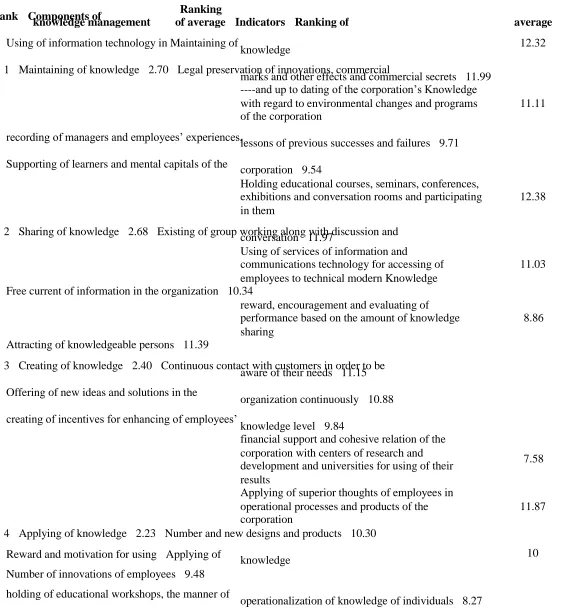
components and indicators of knowledge management in current state. Ratings of indicators of knowledge management in ideal state are significant on 0.01 level, but rating of indicators of knowledge management on 0.01 level is not significant. The obtained results show that the lowest attention is paid to applying and creating of knowledge among indicators of knowledge management and in turn the highest attention is given to maintaining of knowledge in proportion to other
components. Among indicators of knowledge creating, the lowest attention is paid to financial support and cohesive relation of the corporation with centers of research and development and universities for using of their results and creating of incentives for enhancing of employees’ knowledge level. About component of knowledge maintaining, the lowest attention is given to supporting from learners and mental capitals of the corporation and recording of managers and employees’ experiences, lessons of previous successes and failures, sharing of knowledge, reward, encouragement and evaluating of performance based on the amount of knowledge sharing and free current of information in the
organization. With regard to indicators of knowledge applying component, the lowest attention is given to indicators of holding of educational workshops, the manner of operationalization of knowledge of individuals and number of employees’ innovation.
VOLUME 1, ISSUE 1
International Journal of Management Sciences and Business Research (ISSN-2226-8253) VOLUME 1, ISSUE 1
Table 2: Rating of components of knowledge management and their indicators in current state
Ranking
rank Components ofknowledge management of average Indicators Ranking of average
Using of information technology in Maintaining of 12.32
knowledge
1 Maintaining of knowledge 2.70 Legal preservation of innovations, commercial
marks and other effects and commercial secrets 11.99 ----and up to dating of the corporation’s Knowledge
with regard to environmental changes and programs 11.11 of the corporation
recording of managers and employees’ experiences,
lessons of previous successes and failures 9.71
Supporting of learners and mental capitals of the
corporation 9.54
Holding educational courses, seminars, conferences,
exhibitions and conversation rooms and participating 12.38 in them
2 Sharing of knowledge 2.68 Existing of group working along with discussion andconversation 11.97
Using of services of information and
communications technology for accessing of 11.03 employees to technical modern Knowledge
Free current of information in the organization 10.34
reward, encouragement and evaluating of
performance based on the amount of knowledge 8.86 sharing
Attracting of knowledgeable persons 11.39
3 Creating of knowledge 2.40 Continuous contact with customers in order to be aware of their needs 11.15
Offering of new ideas and solutions in the
organization continuously 10.88 creating of incentives for enhancing of employees’
knowledge level 9.84
financial support and cohesive relation of the
corporation with centers of research and 7.58 development and universities for using of their
results
Applying of superior thoughts of employees in
operational processes and products of the 11.87 corporation
4 Applying of knowledge 2.23 Number and new designs and products 10.30
10 Reward and motivation for using Applying of
knowledge Number of innovations of employees 9.48
holding of educational workshops, the manner of
VOLUME 1, ISSUE 1
International Journal of Management Sciences and Business Research (ISSN-2226-8253) VOLUME 1, ISSUE 1
Table 3: Rating of indicators of knowledge management in ideal state
Indicators of knowledge
Components of knowledge management Ranking of average management
Attracting of knowledgeable persons 12.05 Creating of knowledge creating of incentives for enhancing of employees’ knowledge level 11.30 Offering of new ideas and solutions in the organization continuously 11.05 Continuous contact with customers in order to be aware of their needs 11.02 financial support and cohesive relation of the corporation with centers of research and development and un iversities for using of their results 9.51 Supporting of learners and mental capitals of the corporation, association
11.39 and up to dating of the corporation’s Knowledge with regard to
11.10 Maintaining of knowledge environmental changes and programs of the corporation
recording of managers and employees’ experiences, lessons of previous
10.60 successes and failures
Using of information technology in Maintaining of knowledge 10.49 Legal preservation of innovations, commercial marks and other effects
9.95 and commercial secrets
Using of services of information and communications technology for
accessing of employees to technical modern Knowledge 11.71 Sharing of knowledge reward, encouragement and evaluating of performance based on the
10.90 amount of knowledge sharing
Existing of group working along with discussion and conversation 10.21 Holding educational courses, seminars, conferences, exhibitions and conversation rooms and participating in them 9.55
Free current of information in the organization 9.25
Reward and motivation for using Applying of knowledge 11.38 Applying of knowledge Number and new designs and products 10.36
Number of innovations of employees 10
holding of educational workshops, the manner of operationalization of
9.32 knowledge of individuals
Applying of superior thoughts of employees in operational processes and
8.84 products of the corporation
Summary, Conclusion, Recommendations Providing Solutions
In this study the state of knowledge management is studied in Iran’s automobile industry. Therefore, after citing of main components of knowledge management through studying of literature, the amount of attention to these components are studied in two current and ideal states of automobile industry.
Findings of data analysis show that in Iran’s automobile industry, attention paid to creating, maintaining, sharing, applying and generally knowledge management has been lower than the intended amount. In automobile industry the lowest attention is paid to applying and creating of knowledge components, respectively. And among indicators of knowledge applying the lowest attention is paid respectively to holding of educational workshops, the manner of operationalization of knowledge of individuals and number of employees’ innovation. Among indicators of knowledge creating the lowest attention is focused on indicators of financial support and cohesive relation of the corporation with centers of research and development and universities for using of their results and creating of incentives for enhancing of employees’ knowledge level.
On the other hand, the highest attention about applying of knowledge must be paid to indicators of motivation and reward for applying of knowledge and number of new designs and products and about creating of knowledge the highest attention is given to indicators of attracting of knowledgeable individuals and creating of incentives in order to enhance employees’ knowledge level. About
VOLUME 1, ISSUE 1
International Journal of Management Sciences and Business Research (ISSN-2226-8253) VOLUME 1, ISSUE 1
knowledge, attention should be given to reward, encouragement and evaluating of performance based on the amount of knowledge sharing while the lowest attention has been paid to this indicator.
Limiting of the statistical population of this research to employees and managers of automobile industry, using of questionnaires in spite of other qualitative methods for data collection and disturbing of the proportion of the classified sampling through proportional attribution because of humility and courtesy of some of respondents or self-esteem of many of them in responding to the question related to direction are the restrictions of this research.
With due attention to the above results and restrictions, the main following recommendations are represented.
Paying attention to creating, sharing, applying and generally knowledge management in
automobile industry, creating of incentives for enhancing of employees’ knowledge level, attracting of knowledgeable persons in the organization along with creating of knowledge in the organization,
establishing of motivation and reward for using of knowledge and increasing of number of new designs and products in the organization along with applying of knowledge, supporting from learners and mental capitals of the corporation along with maintaining of knowledge in the organization, encouragement and evaluating of performance based on the amount of knowledge sharing in the organization and special attention to creating and applying of knowledge in automobile industry with due regard to the high gap between the current and ideal state among components of knowledge management, adopting of policies for more sharing of knowledge in the organization.
With regard to the point that knowledge is a social issue and depends more on human factors, it appears that insignificant and unsystematic attitudes will encounter success of knowledge management programs with serious challenges. Educating of employees for creating, sharing and applying of
knowledge, adding on value of knowledge through edition, classification and summation of it,
developing of approaches for classification and distribution of knowledge in modern form, developing of information technology and applying of it for knowledge distribution, coding of knowledge and forming of knowledge exchange teams for better changing and conveying of knowledge in the organization, financial support from research institutions or universities in lieu of gaining a right of using of research results immediately after having access to them, creating of informal structures and communications for knowledge distribution in the organization, non-distribution of some kinds of knowledge that have been confidential and are considered as secrets and determining of them, up-to-dating of stored knowledge in the organization, starting of teacher-student instructions, taking part in seminars and conferences and constituting of working groups for enhancing of social acceptability in the organization, documentation of managers and employees ‘ experiences, creating of a suitable space for explicit and open exchanging of views, encouraging of employees to participate their ideas,
creating of an environment based on participation in knowledge, informatics about specialty of each of the employees in the organization, instructions for establishing of accurate communications among employees, changing of organizational purposes and values in high levels of organization proportional with knowledge, creating of relation and confidence through face to face meetings, creating of a
common basis among employees through education, discussion, publications, team working and job circulation, forecasting of times and places for transferring of knowledge like exhibitions, conversation rooms, reports and conferences, evaluating of performance according to amount of sharing of
knowledge and creating of incentives for it, accepting and giving reward to creative spaces and cooperation of individuals, preparing and organizing of supporting programs from the organization’ changing of culture to an organizational culture supportive of knowledge management, including of ideas and values related to knowledge in the form of educational programs, developing of employment strategy of employees based on programmed job specialty and proficiency are the other general
recommendations exploited from the research.
VOLUME 1, ISSUE 1
International Journal of Management Sciences and Business Research (ISSN-2226-8253) VOLUME 1, ISSUE 1
employees; attempt for building of confidence, group building, creating of organizational commitment on the organization’s level, omitting of complicated regulations and rules, additional methods of working and complicated and long hierarchy for decreasing of bureaucracy level in the organization; trying for creating of a supportive culture of knowledge management through designing of encouraging systems and motivation for reinforcing of creativity and innovation, learning and developing of human forces of the organization; adopting of procedures for entering of new knowledge in to the
organization, selecting of knowledge with value of maintaining and preserving, persuading of a non-hierarchical attitude towards knowledge, paying attention to the more importance of quality of thoughts from the position of the donor, designing of supporting and encouraging system of superior ideas of employees in order to on-time implementing of them in operational processes of the organization; adopting of policies and strategies that could help free stating of ideas and opinions, open and honest contact of members, effective solving of conflict, collaboration and participation, mutual belief and respect and understanding of each other’s opinions in the organization.
Finally, comparative studying of knowledge management and its components in this research with one or more countries or other organizations and also designing of knowledge-oriented
organizational culture for automobile industry are recommended to the future researchers.
References
[1] Al- Alawi , A. I., Al- Marzooqi, N. Y.,& Mohammed, Y. F. (2007). organizational culture and
knowledge sharing: Critical success factors. Journal of Knowledge Management, 11 (2), 22-42.
[2] Alavi, M., & Leidner, D. E. (2001). Review: Knowledge management and knowledge
management systems: Conceptual foundations and research issues. MIS Quarterly, 25 (1),107-136
[3] Baltes, P., & Kubzmann, U. (2003). Wisdom. The Pyschologist, 16 (3), 131- 133.
[4] Davenport,T.,& rusak,L.(1998). Working knowledge: How organizations manage what
know.Boston, MA; Harvard Business School Press.
[5] Davenport, Tee., & Prusac, E.L., (2000). knowledge management ( Hossein Rahman Seresht, translator). Tehran: Sapco publications (date of printing of the main work, 1954).
[6] Binder, Slike., & Fish, Alen. (2002).knowledge conveyance and preserving of proficiency.
Continous need of globalization (Jahanshah Mirza beigi, translator). Manager Building
Magazine,12.
[7] Delong, D.W., & Fahey, L. (2000). Diagnostic cultural barriers to knowledge management.
Academy of Management Executive, 14 (4),40-51.
[8] Dyer, G., & Donough, M.B. (2001). The state of KM. Knowledge Management , (5), 31-36. It,s available on: http://www.destination crm.com/km/dcrm – km (Accessed 2004/8/12).
[9] Eueng, A. (1999). Organizational learning capability . NewYork: Oxford University Press Inc.
[10] Gupta,A.K., & Govindarajan, V. (2000). Knowledge management social dimension: Lessons from Nucor Steel. Sloan Management Review ,42(1), 71-81.
[11] Havens, c. & Knapp, E. (1999). Easing into knowledge management. Strategy & Leadership, 24(2) ,4-10.
[12] Holowzki, A. (2002). The relationship between knowledge management and organizational
culture. University of Oregon: Applied Information Management Program.
VOLUME 1, ISSUE 1
International Journal of Management Sciences and Business Research (ISSN-2226-8253) VOLUME 1, ISSUE 1
[14] Iske, p., & Boersma, W. (2005). Connected brains-question and answer systems for knowledge sharing: concepts, implementation and return on investment. Journal of Knowledge
Management, 9(1),126-145.
[15] Lai, M. F., & Lee, G. G.(2007). Relationships of organizational culture toward knowledge activities. Business Process Management Journal, 13 (2), 306-322.
[16] Lajevardi, SJalil & Khanbabaee, Ali.(2007).Studying of facilitative factors of knowledge
management in working groups (case study: Keshavarzi Bank). Knowledge of Management
Magazine, 20(76), 97-116.
[17] Lee, C., & Yang, J. (2000). knowledge value chain. The Journal of Management
Development, 19 (9), 783-794.
[18] Liebowitz, J. (2003). Knowledge Management Learning from Knowledge. CRC Press.
[19] Marsh, G, & Jones, R. (2002). The path to collaboration: A study of Knowledge Management in Australian Defence Organization.
[20] Nonaka, I., & Takeuchi, H. (1995). The knowledge creating company: How the Japanese companies create the dynamics of innovation. New York, NY: Oxford University Press.
[21] Nonaka, I., & Takeuchi, H. (2006). knowledge management: entrepreneurial corporations
*Ali Atafar, Jabar Eslami, Anahita Kaveh and Saeid Analuee, translators) Ghom: Sama
Ghalam publications. (date of printing of the main work, 1995).
[22] Plessis, M. D., & Boon, J. A. (2004). Knowledge management in ebusiness and customer
relationship management: South African case study findings. International Journal of
Information Management, (24), 73-86.
[23] Rading, E., (2004). Knowledge Management (Mohammad Hossein Lotfi, translator). Tehran: Samt publications.
[24] Rowley, J. (2006). What do we need to know about wisdom? Management Decision, 44 (9), 1246- 1257.
[25] Small, M. W. (2004). Wisdom and now managerial wisdom: do they have a place in
management development programs? Journal of Management Development, 23 (8), 761-774.
[26] Spector, J. M., & Edmonds, G. S. (2002). Knowledge management in instructional design.
Retrieved November, 2004, from http://www.eric.ed.gov
[27] Zarraga _ Oberty, C., & Saa- Perez P. D. (2006). Work teams to favor knowledge management.