Ames Laboratory Publications
Ames Laboratory
3-18-2013
Magnetoelastic coupling and charge correlation
lengths in a twin domain of Ba(Fe1−xCox)2As2
(x=0.047): A high-resolution x-ray diffraction study
Qiang Zhang
Iowa State University, [email protected]
Wenjie Wang
Iowa State University, [email protected]
Jong-Woo Kim
Argonne National Laboratory
Benjamin Hansen
Iowa State UniversityNi Ni
Iowa State University
See next page for additional authors
Follow this and additional works at:
http://lib.dr.iastate.edu/ameslab_pubs
Part of the
Condensed Matter Physics Commons
The complete bibliographic information for this item can be found at
http://lib.dr.iastate.edu/
ameslab_pubs/189
. For information on how to cite this item, please visit
http://lib.dr.iastate.edu/
howtocite.html
.
Magnetoelastic coupling and charge correlation lengths in a twin domain
of Ba(Fe1−xCox)2As2 (x=0.047): A high-resolution x-ray diffraction study
Abstract
The interplay between structure, magnetism, and superconductivity in single crystal Ba(Fe1−xCox)2As2
(x=0.047) has been studied using high-resolution x-ray diffraction by monitoring charge Bragg reflections in
each twin domain separately. The emergence of the superconducting state is correlated with the suppression
of the orthorhombic distortion around TC, exhibiting competition between orthorhombicity and
superconductivity. Above TS, the in-plane charge correlation length increases with the decrease of
temperature, possibly induced by nematic fluctuations in the paramagnetic tetragonal phase. Upon cooling,
anomalies in the in-plane charge correlation lengths along a (ξa) and baxes (ξb) are observed at TS and also at
TN indicative of strong magnetoelastic coupling. The in-plane charge correlation lengths are found to exhibit
anisotropic behavior along and perpendicular to the in-plane component of stripe-type AFM wave vector
(101)O below around TN. The temperature dependence of the out-of-plane charge correlation length shows
a single anomaly at TN, reflecting the connection between Fe-As distance and Fe local moment. The origin of
the anisotropic in-plane charge correlation lengths ξa and ξb is discussed on the basis of the antiphase
magnetic domains and their dynamic fluctuations.
Keywords
Physics and Astronomy
Disciplines
Condensed Matter Physics
Comments
This article is from
Physical Review B
87 (2013): 094510, doi:
10.1103/PhysRevB.87.094510
. Posted with
permission.
Authors
Qiang Zhang, Wenjie Wang, Jong-Woo Kim, Benjamin Hansen, Ni Ni, Sergey L. Bud'ko, Paul C. Canfield,
Robert J. McQueeney, and David Vaknin
PHYSICAL REVIEW B87, 094510 (2013)
Magnetoelastic coupling and charge correlation lengths in a twin domain of Ba(Fe
1−xCo
x)
2As
2(
x
=
0
.
047): A high-resolution x-ray diffraction study
Qiang Zhang,1,*Wenjie Wang,1Jong-Woo Kim,2Benjamin Hansen,1Ni Ni,1Sergey L. Bud’ko,1Paul C. Canfield,1 Robert J. McQueeney,1and David Vaknin1,†
1Ames Laboratory and Department of Physics and Astronomy, Iowa State University, Ames, Iowa 50011, USA 2Advanced Photon Source, Argonne National Laboratory, Argonne, Illinois 60439, USA
(Received 16 February 2013; revised manuscript received 4 March 2013; published 18 March 2013)
The interplay between structure, magnetism, and superconductivity in single crystal Ba(Fe1−xCox)2As2
(x=0.047) has been studied using high-resolution x-ray diffraction by monitoring charge Bragg reflections in each twin domain separately. The emergence of the superconducting state is correlated with the suppression of the orthorhombic distortion aroundTC, exhibiting competition between orthorhombicity and superconductivity.
AboveTS, the in-plane charge correlation length increases with the decrease of temperature, possibly induced by
nematic fluctuations in the paramagnetic tetragonal phase. Upon cooling, anomalies in the in-plane charge correlation lengths along a (ξa) and b axes (ξb) are observed at TS and also at TN indicative of strong
magnetoelastic coupling. The in-plane charge correlation lengths are found to exhibit anisotropic behavior along and perpendicular to the in-plane component of stripe-type AFM wave vector (101)Obelow aroundTN. The
temperature dependence of the out-of-plane charge correlation length shows a single anomaly atTN, reflecting
the connection between Fe-As distance and Fe local moment. The origin of the anisotropic in-plane charge correlation lengthsξa and ξb is discussed on the basis of the antiphase magnetic domains and their dynamic fluctuations.
DOI:10.1103/PhysRevB.87.094510 PACS number(s): 74.25.Ha, 74.70.Xa, 75.50.Ee, 83.85.Hf
I. INTRODUCTION
In the recently discovered iron-based superconductors,1,2 the superconducting temperatures are found to be in close proximity to an antiferromagnetic (AFM) and a tetragonal-orthorhombic (T-O) structural transition. It turns out that the suppression of both the AFM and the T-O structural transitions, by doping or by pressure, eventually induces superconductivity. These phenomena beg the question about the role of spin and lattice degrees-of-freedom in the emer-gence of superconductivity.2,3Several theoretical descriptions have been proposed to interpret the relationship between the structural and AFM transitions on the basis of orbital ordering or by introducing an intermediate spin-nematic phase resulting from an effectiveJ1−J2 local-spin model or from
an itinerant model both with equivalent consequences.3–6
Although different in details, these descriptions emphasize the importance of the magnetoelastic coupling in driving the two transitions simultaneously or separately. Canoet al.5 studied
the interplay between the elastic and spin degrees-of-freedom in iron pnictide superconductors using a Ginzburg-Landau ap-proach, indicating that the magnetoelastic coupling can bring about the particular features of the structural and magnetic transitions in these systems including the emergence of the collinear stripe-type AFM ordering. Recently, a microscopic study7 of a simple symmetry-allowed model Hamiltonian
demonstrated that due to the effect of magnetoelastic coupling, the considerable orthorhombic elastic softening is caused by critical spin fluctuations present in the system before magnetic order occurs. This may explain why the AFM transition is often preceded by the T-O structural transition. It should be pointed out that this picture is similar to the nematic phase model.3,6To date, there are very few experimental reports on
the magnetoelastic coupling in iron pnictides and such reports investigated the role that magnetoelastic coupling plays in
the structural and magnetic transitions under the application of external driving forces. Magnetoelastic couplings have been demonstrated by applying pressure to CaFe2As2 and
inducing O-T and AFM-to-nonmagnetic transitions,8 or by applying shear stress to BaFe2(As1−xPx)2 that shifts the
magnetic transition and superconducting critical temperatures significantly.9Therefore, it is of interest to study the possibly
intrinsic magnetoelastic coupling in iron-based superconduc-tors, without introducing any external driving force.
The Co-doped BaFe2As2 system exhibits a rich phase
diagram with a complex interplay between the structural, magnetic, and superconducting phases.10–13 In the parent BaFe2As2 compound, the AFM ordering transition at TN
coincides with a T-O structural transition atTS. Upon doping
both transitions gradually separate, such that TS > TN,
accompanied with the appearance of superconductivity above x=0.03 in Ba(Fe1−xCox)2As2. It is interesting to point out
that the orthorhombic distortionδ in Ba(Fe1−xCox)2As2with
lower Co content (x=0.018) shows one clear anomaly at the magnetic transition temperature TN, but it is absent at
TN for the x=0.047 superconductor with intermediate Co
content. Forx higher than ∼0.066, both the magnetic and structural transitions are completely suppressed and super-conducting transition is the only transition observed. Only in an intermediate composition region of 0.03x 0.066 does Ba(Fe1−xCox)2As2exhibit a coexistence of superconductivity,
O-structure, and AFM phases providing potential candidates to investigate the effects of the magnetoelastic coupling. However, the tendency of these crystals to form twinned orthorhombic domains has hampered definitive determination of inherent features of the intermediate phase between TS
andTNwhere the presumed nematic phase exists. Therefore,
there have been extensive efforts to de-twin these crystals14
to establish the underlying electronic, structural, and mag-netic anisotropies that characterize this intermediate phase.
094510-1
QIANG ZHANGet al. PHYSICAL REVIEW B87, 094510 (2013)
Motivated by these issues, we set out to investigate anisotropic features of the crystal structure and domain formation over a wide range of temperatures using high resolution x-ray diffraction methods that reveal the intrinsic magnetoelastic coupling in the Ba(Fe1−xCox)2As2(x =0.047)
superconduc-tor. The high resolution allows us to separately monitor Bragg reflections of different orthorhombic twin domains and study their temperature evolution, as has been done recently on CeFeAsO.15
II. EXPERIMENTAL DETAILS
The Ba(Fe1−xCox)2As2 (x =0.047) crystal was grown
using a self-flux solution method as described previously.12,16
The crystal has been characterized by x-ray diffraction, neutron scattering, magnetization, resistivity, and heat capacity, iden-tifying three transitions: structural at TS60 K, magnetic
at TN47 K, and SC at TC17 K.11,16 A platelike piece
of crystal with its c axis perpendicular to its surface was chosen for investigations by high-resolution x-ray scattering technique using the six-circle diffractometer of the 6-ID-B beamline at the Advanced Photon Source (APS), Argonne National Laboratory (x-ray energy kept at 8 keV). The scattering geometry of our experiment is similar to that used previously by Liet al.15We use orthorhombic indices (hkl)
O
at all temperatures so that the tetragonal (HKL)Tindices are
provided in terms of the twin domains in the orthorhombic structure with the following conversion (H+K,H −K,L)O
and (H−K,H+K,L)O. The crystal was mounted at the end
of the cold-finger of a Displex cryogenic refrigerator with access to (00l)O and high index (hkl)O Bragg reflections.
Flux intensity on the sample was optimized to eliminate beam heating effects of the sample while maintaining a reasonable signal to noise ratio. To achieve that, slit setups and attenuations yielding Bragg reflection intensities that scaled with beam attenuations were chosen. In this regard, it should be noted that the low thermal conductivity in the SC state required a significant increase of beam attenuation to prevent sample heating during measurements. These considerations limited the choice of setups, i.e., resolution, but as discussed below, by adequate analytical tools we captured the intrinsic behavior (i.e., charge correlation lengths, in particular) of this system. As demonstrated on CeFeAsO,15 the twin domains
are uniformly rotated and separated in reciprocal space by a microscopic shear angle enabling the characterization of each domain. Figure1shows schematically a limited in-plane reciprocal zone with the (110)T of the untwinned crystal (a)
that transforms to the (200)Oand (020)Oin the orthorhombic
symmetry notation (b). The misfit angle between the two domains is determined by the orthorhombic distortion (δ≡
a−b a+b).
15 The arrows in Fig. 1 show typical scans performed
at Bragg reflections. In the present study, we monitored the (208)O/(028)Osystematically (corresponding to (118)Tat high
temperatures) and also the (008)O, as a function of temperature.
III. RESULTS AND DISCUSSION
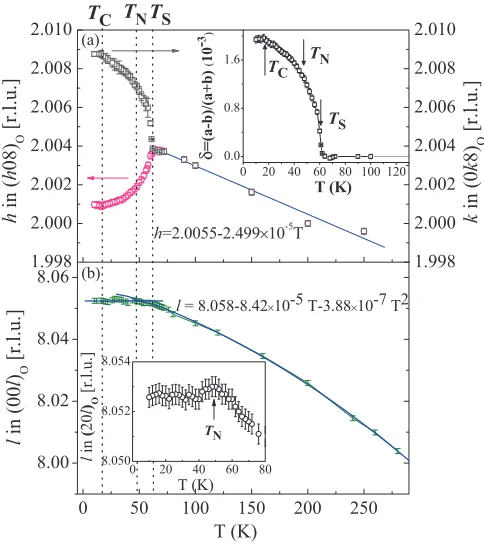
Figure 2(a) shows the evolution of the orthorhombicity as the temperature decreases with a sharp splitting of the (118)T into the (208)O and (028)O at TS=60 K. With
FIG. 1. (Color online) Schematic illustration in reciprocal space of (a) untwinned crystal in the (HK0)Tplane at the high-temperature
tetragonal phase and (b) uniformly rotated and separated anisotropic twin domains in the (hk0)O plane at the orthorhombic phase. The
arrows show typical scans performed at Bragg reflections.
further decrease in temperature, the orthorhombicity increases without displaying an anomaly atTN=47 K [see the inset
of Fig. 2(a)], which is consistent with the report by Kim et al.16A slight decrease in the splitting is observed below the
SC temperatureTC, indicating that superconductivity and the
orthorhombic distortion are coupled.10Note that for higher Co
substitution, the suppression of orthorhombic order parameters
1.998 2.000 2.002 2.004 2.006 2.008 2.010 1.998 2.000 2.002 2.004 2.006 2.008 2.010
0 50 100 150 200 250
8.00 8.02 8.04 8.06
0 20 40 60 80
8.050 8.052 8.054
0 20 40 60 80 100 120
[image:4.608.315.556.70.192.2] [image:4.608.314.556.376.648.2]0.0 0.8 1.6 T (K) TC l in (00 l ) O [r.l.u.] h in ( h 08) O [r.l.u.] k in (0 k 8) O [r.l.u.] TS (a)
h=2.0055-2.499×10⁻⁵T
δ = (a-b)/(a+b) ( 10 -3)
l= 8.058-8.42×10⁻⁵ T-3.88×10⁻⁷ T2
TN l in ( 20 l )O [r.l.u.] T (K) (b) TN T (K) TN TC TS
FIG. 2. (Color online) The temperature dependence of peak positions extracted from (a) (h08)O (hdomain, circles) and (0k8)O
(k domain, squares) scans, and (b) thelscan for (00l)O reflection.
The inset of (a) shows the orthorhombic distortionδas a function of temperature. The inset of (b) shows the zoomed view onlscan for (20l)Oreflection. Linear and quadratic fits to the data aboveTS
are included as solid lines. The dashed lines in (a) and (b) indicate the locations of structural, magnetic, and superconducting transition temperaturesTS,TN, andTC.
MAGNETOELASTIC COUPLING AND CHARGE. . . PHYSICAL REVIEW B87, 094510 (2013)
10-4
10-3
10-2
10-1
100
0
1.996 2 2.004
50 100 150 200 250 300
4 5 6 7 8
(a) 46 K
150 K
T (K)
Normalized Intensity
h in (h08)O (208)O
(b)
TS
2
(
10
-4
Å
-1 )
TN
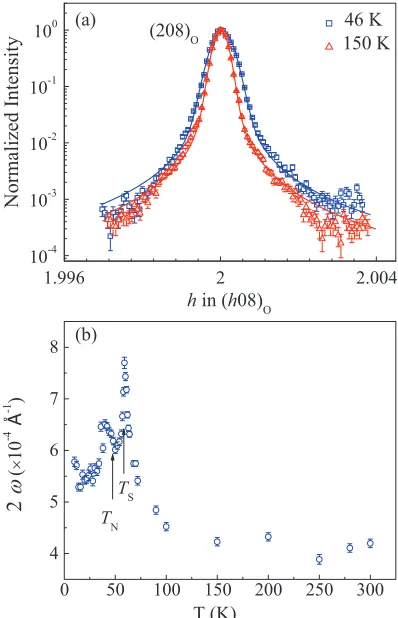
FIG. 3. (Color online) (a) A representative longitudinal scan of Q=(h08)Oat 150 K (aboveTS) and 46 K (belowTS). TheQvalues
and intensity were normalized for comparison. It can be seen that the peak widths broaden significantly belowTS. (b) The temperature
evolution of FWHM of the Gaussian function (2ω) for the longitudinal scan of (h08)O(hdomain).
becomes larger. For example, the orthorhombic distortion in x =0.063 is completely suppressed and the reentrant transition to tetragonal structure occurs below TC. When
x increases to 0.066, the orthorhombic distortion vanishes and no T-O transition is observed.10 From Fig. 2(a), we
point out that the in-plane lattice constant shrinks linearly in the tetragonal phase of Ba(Fe1−xCox)2As2with decreasing
temperature at a rate of 1.4×10⁻⁵ A˚/K per unit cell (linear thermal expansion parameterα∼2.5×10⁻⁶/K). By contrast,
the thermal expansion along the c axis is weakly quadratic [Fig. 2(b)] with no abrupt anomaly at TS and displays a
deviation from the quadratic form nearTN[a weak minimum
is observed in thec-axis lattice parameter for (20l)Oreflection
as shown in the inset of Fig.2(b)]. The effect of magnetic transition atTNon the lattice parametercimplies a coupling
between them, which will be discussed below.
Figure3(a)shows representative in-plane scans alonghfor the (208)O Bragg reflection at 150 K (aboveTS) and 46 K
(below TS). It is clear that the full width at half maximum
(FWHM) of the Bragg peak is broader below TS. Variation
in the line broadening can be due to changes in coherence length, domain size, mosaic distributions, and more likely a combination of all three. To obtain quantitative evaluation of peak linewidths, these and other scans were initially modeled
as a Gaussian, a Lorentzian, their linear combination, or Pseudo-Voigt line shapes, but none of these line shapes yielded satisfactory agreement with the data. We therefore adopted a standard convolution method by systematically folding a Gaussian resolution function and a Lorentzian function that reflects an exponentially decaying charge (chemical) coherence length as follows:
I(q)=
∞
−∞
G(q)L(q−q)dq, (1)
whereG(x)=ω√1 πln 2e
−(ln 2)(x)2/ω2
andL(x)=1+(Cx/ν)2, such
that 2ωand 2νare the FWHM of the Gaussian and Lorentzian functions, respectively. Our resolution was high enough to resolve the twin domains separately, i.e., optimizing peak intensity of the (208)Ofrom one twin domain and that of the
(028)Oof the other domain required sample rotation between
the two peaks as has been done for CeFeAsO.15 While the
FWHM of the Lorentzian function (2ν) represents the intrinsic width κ of the sample, we should note that the Gaussian function in Eq.(1)has two contributions: one from geometrical setup (i.e., incident and scattered beam divergence) and the other from the mosaic spread of the studied crystal (see a detailed discussion in resolution function in Ref.17). It is by now well established that the mosaic spread of typical pnictides undergoing shear induced O-T transition exhibit mosaic spread changes due to stresses during the transitions. We therefore attribute the temperature dependence of the Gaussian width as arising primarily from the variation in the mosaic distributions. Figure3(b)shows the FWHM of the Gaussian function for the (208)O along h as a function of temperature indicating
anomalies that can be related to the stresses introduced by the structural and magnetic transitions in the system.
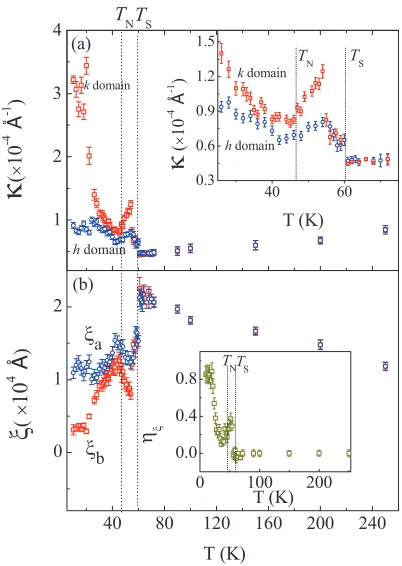
The temperature evolutions of the intrinsic widthκ (=2ν) extracted from the Lorentzian functions of (208)Oand (028)O
Bragg peaks are shown in Fig.4(a). It is evident that anomalies are observed at bothTSandTN. Similar observation by using
high-resolution x-ray diffraction was reported in different systems TbV1−xAsxO4 (x=0 and 1),18 where the intrinsic
width of the Bragg peaks shows a clear peak at their TC
that is reminiscent of λ anomalies in the heat capacity. Note that the intrinsic width κ in unit of ˚A−1, i.e., the FWHM of the Lorentzian profiles from x-ray scattering in reciprocal space corresponds to the inverse charge correlation lengthξ:15,18–20
ξ =1/κ. (2)
Thus, the temperature dependence of the in-plane charge cor-relation lengths along and normal to the in-plane component of AFM propagation wave vector (101)O, i.e., longitudinal
charge correlation length ξa (along the AFM bond
direc-tion) and transverse charge correlation length ξb (along the
effective ferromagnetic bond direction), can be derived from the intrinsic widths of (208)O and (028)O Bragg peaks. As
illustrated in Fig.4(b), bothξaandξbshow two clear peaks at TSandTN, respectively. With the decrease of temperature to
TS, the in-plane charge correlation lengths increase gradually,
followed by a rapid decrease belowTS. When the temperature
approachesTN, the in-plane charge correlation lengths increase
again. It is worth emphasizing that the Bragg reflections used
[image:5.608.73.272.70.379.2]QIANG ZHANGet al. PHYSICAL REVIEW B87, 094510 (2013)
1 2 3 4
40 60
0.3 0.6 0.9 1.2 1.5
40 80 120 160 200 240
0 1 2
0 100 200
0.0 0.4 0.8
(
10
-4
Å
-1 )
k domain
T (K)
T (K)
(
10
-4
Å
-1 )
TNTS
h domain
(a)
10
4
Å
k domain
h domain
TN TS
(b)
b a
T (K)
TS TN
FIG. 4. (Color online) The temperature dependence of (a) the intrinsic widthκof the longitudinal scans of (h08)O(hdomain) and
(0k8)O(kdomain) obtained from the Lorentzian function and (b) the
in-plane charge correlation lengths along theaaxis (ξa) andbaxis (ξb). The inset of (a) shows a detailed view ofκaroundTNandTS. The
anisotropy of the correlation lengthηξ as a function of temperature is shown in the inset of (b). The dashed lines mark the locations of structural and magnetic transition temperaturesTSandTN.
to extract these data are not allowed by the symmetry of the magnetic structure of the ordered iron moments and they are strictly the results of charge (nuclei) ordering. Interestingly, the intrinsic width κ and charge correlation length obtained from the high-resolution x-ray data show a clear anomaly at the magnetic transition temperature, suggesting these charge Bragg reflections are sensitive to the spin structure and fluc-tuations. This is presumably due to the strong magnetoelastic coupling that exerts secondary effects on charge correlations, domain formation, and their shape.
Below around TN, we notice that the charge correlation
lengths along and normal to the in-plane component of the AFM propagation wave vector (101)Oare different (ξa > ξb),
displaying an anisotropic behavior. The anisotropy in charge correlation length is defined as21
ηξ = ξ2
a −ξb2 ξ2
a +ξb2
. (3)
ηξ =0 indicates isotropic correlations (ξa=ξb), whereas ηξ =1 (ηξ = −1) corresponds to the extreme case ofξaξb
(ξa ξb) for structural domains consisting of long linear
stripes. Based on this equation, we have derived the anisotropy of the charge correlation length as a function of temperature, as shown in the inset of Fig. 4. The anisotropy is most
b
a
(a)
(b)
J2
A
B J1
J2
J1
FIG. 5. (Color online) Schematic pictures of two kinds of the antiphase magnetic domains, with boundaries along the (a)a axis and (b)b axis, respectively. The antiphase domains are pinned at T<TNbut show the dynamic behavior in the region ofTN<T< TS. The pink lines show the antiphase boundaries. J1 represents
the nearest-neighbor exchange couplings along theaorbdirection, whereasJ2represents the next-nearest-neighbor exchange couplings.
pronounced belowTN, with values ranging from 0.1 to 0.8
as the temperature is lowered.
A possible scenario to interpret the anisotropic charge correlation lengths alongaandbbelow aroundTNinx=0.047
may be related to the presence of the antiphase magnetic domains.22–24Mazin and Johannes22 proposed that antiphase
domains and their dynamic fluctuations are central for under-standing the high-TCferropnictides. Very recently, Liet al.24
observed surface-pinned antiphase domains in BaFe2As2using
high-resolution scanning tunneling microscopy. Since the energy differences between the AFM stripe magnetic structure and other AFM patterns are small,22 it is highly possible
that many antiphase magnetic boundaries are formed. The antiphase domains are pinned atT<TN, and show dynamic
fluctuations in the region of TN < T < TS. There are two
kinds of simple antiphase domains (labeled A and B) with boundaries along the a and b axes, as shown in Fig. 5. Due to the same magnetoelastic interactions that lead to a difference in the ferromagnetic and AFM bond lengths in the orthorhombic structure, we propose that the formation of such antiphase domains are accompanied by elastic distortions at their boundaries. The antiphase boundaries along thea axis influence the magnitude of transverse charge correlation length ξb, whereas the antiphase boundaries along thebaxis affect
the longitudinal charge correlation lengthξa. Differences in
[image:6.608.73.274.69.352.2] [image:6.608.333.536.75.358.2]MAGNETOELASTIC COUPLING AND CHARGE. . . PHYSICAL REVIEW B87, 094510 (2013)
the density of antiphase boundaries in the two directions eventually lead to the anisotropy in ξa and ξb below TN.
The dynamic fluctuations of the antiphase domains may be responsible for the anisotropy in charge correlation lengths in the small temperature region aboveTN(but lower thanTS), as
shown in the inset of Fig.4(b).
Based on such antiphase magnetic domain scenario and theJ1−J2 model, the anisotropic charge correlation lengths
can be used to estimate the ratio of the magnetic exchange parametersJ1 andJ2. As shown in Fig. 5, the energies per spin (S) for forming these two kinds of antiphase boundaries are given by
EA=(2J2−J1)S2 (4)
EB =(2J2+J1)S2. (5)
SinceJ1is AFM, the number of antiphase domain boundaries NAandNB should scale inversely with the magnetic energy
of the domain wall so that NA NB
= EB EA
= 2J2+J1
2J2−J1. (6)
The charge correlation length scales inversely proportional to the number of boundaries, i.e.,ξa∝ N1
B. Thus,
ξa ξb
=NA NB
= 2J2+J1
2J2−J1
. (7)
In Fig. 4(b)we observeξa/ξb ≈3 at low temperatures, and
from Eq.(6)we can getJ2≈J1, which is consistent with the
previous calculations or experiments on other iron pnictides, such as LaFeAsO25 and Ba(Fe
1−xCox)2As2 (x =0.074).26
This is also reasonable for producing a stripe-type AFM structure that requiresJ2> J21.
It is worthwhile noting that the in-plane charge correlation lengths show gradual changes at temperatures significantly above TS, probably due to magnetic fluctuations that are
known to persist aboveTSin similar pnictides.27,28 We point
out that this feature may support the nematic model. In the nematic model,3,6 the nematic order coincides with the structural transition with the notion that the driving force for the T-O transition is not elastic in origin but magneti-cally driven by Ising-like interpenetrating AFM domains.3,7
Nematic (magnetic) fluctuations remain at higher tempera-ture above TS, which has been suggested by various
tech-niques, such as susceptibility anisotropy,29 shear modulus,3
inelastic neutron scattering,30 and anisotropic in-plane
resistivity.14
We now turn to a discussion of thec-axis charge correlation length. Figures6(a)and6(b)show the temperature dependence of the intrinsic width of the (008)OBragg reflection and the
corresponding out-of-plane charge correlation length along thecaxis (ξc), respectively. A single anomaly at the magnetic
transition temperature TN and a gradual change above and
throughTSare observed. The absence of sharp anomaly atTSin
ξcsuggests that atomic distortions resulting from the T-O
struc-tural transition mainly occur in theabplane. This is consistent with the fact that the in-plane lattice parametersaandbchange significantly, but c changes weakly around TS, as can also
be seen from Fig.2. Both the out-of-plane charge correlation lengthξcand lattice parametercshow an anomaly atTN,
show-0.8 1.2 1.6 2.0
0 50 100 150 200 250 300
0.6 0.8 1.0 1.2
TS
(a)
(
10
-4
Å -1 )
T (K)
TN
(008)O reflection
c
10
4
Å
(b)
FIG. 6. (Color online) Temperature dependence of (a) the intrin-sic widthκ of thel scan for (008)O obtained from the Lorentzian
function and (b) the out-of-plane charge correlation length along the caxis (ξc).The dashed line indicates the locations ofTNandTS.
ing close correlation between the AFM magnetic transition and the modification of structure along thecaxis. Recent experi-ments and calculations reveal that the Fe local moment is very sensitive to the Fe-As distance in iron pnictides. Yinet al.31 performed density functional theory (DFT) calculations within the generalized gradient approximation and found the Fe-Fe transverse exchange coupling is strongly dependent on both the AFM symmetry and the Fe-As distance. Belashchenko et al.32demonstrated that in layered iron-pnictide compounds,
as the Fe-As distance is decreased, the degree of itinerancy of Fe moments increases. Moreover, the coupling between the local moment and the Fe-As distance is controlled by strong covalent Fe-As bonding. Recently, neutron diffraction studies of CeFeAs1−xPxO33and DFT calculations34demonstrated that
a decrease in Fe-As distance induces strong hybridization between Fe 3d and As 4p orbitals, leading to quenched Fe magnetic moments. Therefore, the AFM transition atTNis
cou-pled to the change of Fe-As distance, which leads to the anoma-lies in the out-of-plane charge correlation length and lattice parameterc.
In summary, high resolution x-ray diffraction stud-ies on structural Bragg reflections of the SC and AFM Ba(Fe1−xCox)2As2 (x =0.047) single crystal reveal a
sec-ondary effect stemming from the magnetic properties of the system, which is understood to result from intrinsic and strong magnetoelastic coupling. In addition to showing anomalies around the structural and magnetic transitions, the in-plane charge correlation lengths along the a and b axes
[image:7.608.329.538.71.359.2]QIANG ZHANGet al. PHYSICAL REVIEW B87, 094510 (2013)
show anisotropy below around TN, which probably results
from the effect of antiphase boundaries formed along the a andb axes. Employing our anisotropic charge correlation lengths, we are able to estimate the ratio of J2/J1 to be around 1 on the basis of such an antiphase magnetic domain scenario andJ1−J2model. The out-of-plane charge
correlation lengthξcand lattice parametercexhibit a single
anomaly atTN, which can be associated with the modification
of Fe-As distance when the AFM transition occurs. Our results also show gradual evolution of the Bragg peak widths and in-plane charge correlation length above TS, which is
presumably induced by the nematic magnetic fluctuations up to almost 200 K.
ACKNOWLEDGMENTS
Research at Ames Laboratory is supported by the US De-partment of Energy, Office of Basic Energy Sciences, Division of Materials Sciences and Engineering under Contract No. DE-AC02-07CH11358. Use of the Advanced Photon Source at Argonne National Laboratory was supported by the US Department of Energy, Office of Science, Office of Basic Energy Sciences, under Contract No. DE-AC02-06CH11357.
1Y. Kamihara, Y. Kamihara, T. Watanabe, M. Hirano, and H. Hosono,
J. Am. Chem. Soc.130, 3296 (2008).
2P. M. Aswathy, J. B. Anooja, P. M. Sarun, and U. Syamaprasad,
Supercond. Sci. Technol.23, 073001 (2010).
3R. M. Fernandes, L. H. VanBebber, S. Bhattacharya, P. Chandra,
V. Keppens, D. Mandrus, M. A. McGuire, B. C. Sales, A. S. Sefat, and J. Schmalian,Phys. Rev. Lett.105, 157003 (2010).
4V. Barzykin and L. P. Gor’kov, Phys. Rev. B 79, 134510
(2009).
5A. Cano, M. Civelli, I. Eremin, and I. Paul,Phys. Rev. B82, 020408
(2010).
6R. Fernandes and J. Schmalian, Supercond. Sci. Technol. 25,
084005 (2012).
7I. Paul,Phys. Rev. Lett.107, 047004 (2011).
8A. Kreyssig, M. A. Green, Y. Lee, G. D. Samolyuk, P. Zajdel, J. W.
Lynn, S. L. Bud’ko, M. S. Torikachvili, N. Ni, S. Nandi, J. B. Leao, S. J. Poulton, D. N. Argyriou, B. N. Harmon, R. J. McQueeney, P. C. Canfield, and A. I. Goldman,Phys. Rev. B78, 184517 (2008). 9H-.H. Kuo, James G. Analytis, J.-H. Chu, R. M. Fernandes, J.
Schmalian, and I. R. Fisher,Phys. Rev. B86, 134507 (2012). 10S. Nandi, M. G. Kim, A. Kreyssig, R. M. Fernandes, D. K. Pratt,
A. Thaler, N. Ni, S. L. Bud’ko, P. C. Canfield, J. Schmalian, R. J. McQueeney, and A. I. Goldman,Phys. Rev. Lett.104, 057006 (2010).
11D. K. Pratt, W. Tian, A. Kreyssig, J. L. Zarestky, S. Nandi, N. Ni,
S. L. Bud’ko, P. C. Canfield, A. I. Goldman, and R. J. McQueeney,
Phys. Rev. Lett.103, 087001 (2009).
12N. Ni, M. E. Tillman, J. Q. Yan, A. Kracher, S. T. Hannahs, S. L.
Bud’ko, and P. C. Canfield,Phys. Rev. B78, 214515 (2008). 13J.-H. Chu, J. G. Analytis, C. Kucharczyk, and I. R. Fisher,Phys.
Rev. B79, 014506 (2009).
14J.-H. Chu, J. G. Analytis, D. Press, K. DeGreve, T. D. Ladd,
Y. Yamamoto, and I. R. Fisher,Science329, 824 (2010).
15H.-F. Li, J.-Q. Yan, J. W. Kim, R. W. McCallum, T. A. Lograsso,
and D. Vaknin,Phys. Rev. B84, 220501(R) (2011).
16M. G. Kim, R. M. Fernandes, A. Kreyssig, J. W. Kim, A. Thaler,
S. L. Bud’ko, P. C. Canfield, R. J. McQueeney, J. Schmalian, and A. I. Goldman,Phys. Rev. B83, 134522 (2011).
17R. A. Cowley, Acta Crystallogr. Sect. A 43, 825
(1987).
18K. C. Rule, M. J. Lewis, H. A. Dabkowska, D. R. Taylor, and B. D.
Gaulin,Phys. Rev. B77, 134116 (2008).
19Yejun Feng, Jiyang Wang, R. Jaramillo, Jasper van Wezel,
S. Haravifard, G. Srajer, Y. Liu, Z.-A. Xu, P. B. Littlewood, and T. F. Rosenbaum,Proc. Nat. Acad. Sci.109, 7224 (2012). 20J. E. Lorenzo, C. Mazzoli, N. Jaouen, C. Detlefs, D. Mannix, S.
Grenier, Y. Joly, and C. Marin,Phys. Rev. Lett.101, 226401 (2008). 21G. S. Tucker, R. M. Fernandes, H.-F. Li, V. Thampy, N. Ni, D. L.
Abernathy, S. L. Bud’ko, P. C. Canfield, D. Vaknin, J. Schmalian, and R. J. McQueeney,Phys. Rev. B86, 024505 (2012).
22I. I. Mazin and M. D. Johannes,Nat. Phys.5, 141 (2009). 23Z. P. Yin and W. E. Pickett,Phys. Rev. B80, 144522 (2009). 24Guorong Li, Xiaobo He, Jiandi Zhang, Rongying Jin, A. S. Sefat,
M. A. McGuire, D. G. Mandrus, B. C. Sales, and E. W. Plummer,
Phys. Rev. B86, 060512(R) (2012).
25F. Ma, Z.-Y. Lu, and T. Xiang,Phys. Rev. B78, 224517 (2008).
26H.-F. Li, C. Broholm, D. Vaknin, R. M. Fernandes, D. L. Abernathy,
M. B. Stone, D. K. Pratt, W. Tian, Y. Qiu, N. Ni, S. O. Diallo, J. L. Zarestky, S. L. Budko, P. C. Canfield, and R. J. McQueeney,Phys. Rev. B82, 140503 (2010).
27H.-F. Li, W. Tian, J. L. Zarestky, A. Kreyssig, N. Ni, S. L. Bud’ko,
P. C. Canfield, A. I. Goldman, R. J. McQueeney, and D. Vaknin,
Phys. Rev. B80, 054407 (2009).
28S. O. Diallo, D. K. Pratt, R. M. Fernandes, W. Tian, J. L. Zarestky,
M. Lumsden, T. G. Perring, C. L. Broholm, N. Ni, S. L. Bud’ko, P. C. Canfield, H.-F. Li, D. Vaknin, A. Kreyssig, A. I. Goldman, and R. J. McQueeney,Phys. Rev. B81, 214407 (2010).
29S. Kasahara, H. J. Shi, K. Hashimoto, S. Tonegawa, Y. Mizukami,
T. Shibauchi, K. Sugimoto, T. Fukuda, T. Terashima, Andriy H. Nevidomskyy, and Y. Matsuda,Nature (London)486, 382 (2010). 30L. W. Harriger, H. Q. Luo, M. S. Liu, C. Frost, J.-P. Hu, M. R.
Norman, and P. Dai,Phys. Rev. B84, 054544 (2011).
31Z. P. Yin, S. Lebe‘gue, M. J. Han, B. P. Neal, S. Y. Savrasov, and
W. E. Pickett,Phys. Rev. Lett.101, 047001 (2008).
32K. D. Belashchenko and V. P. Antropov,Phys. Rev. B78, 212505
(2008).
33C. de la Cruz, W. Z. Hu, Shiliang Li, Q. Huang, J. W. Lynn, M. A.
Green, G. F. Chen, N. L. Wang, H. A. Mook, Qimiao Si, and P. Dai,
Phys. Rev. Lett.104, 017204 (2010).
34Y. Lee, D. Vaknin, H.-F. Li, W. Tian, J. L. Zarestky, N. Ni, S. L.
Bud’ko, P. C. Canfield, R. J. McQueeney, and B. N. Harmon,Phys. Rev. B81, 060406 (2010).