Institute of Parallel and Distributed Systems University of Stuttgart
Universitätsstraße 38 D–70569 Stuttgart
Master’s Thesis Nr.
Design and Implementation of a
QoS-Aware Communication
Protocol for Named Data
Networks
Mustafa Karadeniz
Course of Study: Computer Science
Examiner: Prof. Dr. Kurt Rothermel Supervisor: Dr.-Ing. Mohamed Abdelaal
Commenced: 2018-11-02 Completed: 2019-05-02
Abstract
In the recent decade, a significant discrepancy has been identified between the IP-based In-ternet architecture and its primary use. Despite being fundamentally designed for facilitating ubiquitous interconnectivity between communication endpoints, the TCP/IP protocol suite is overwhelmingly used for content distribution. In fact, the IP-based architecture has several limitations when dealing with large-scale content distribution, including multicasting effi-ciency, handshaking overhead, mobility, routing scalability, and security. These limitations, facing the IP paradigm, have fostered the design of novel Internet architectures to meet the accelerating expansion in consumer Internet traffic.
Named Data Networking (NDN) is a data-centric Internet architecture solution. It has re-cently received much attention as an efficient alternative Internet architecture to the IP-based Internet architecture. Generally, NDN represents a clean-slate receiver-oriented design which utilizes the Interest/Data model to retrieve data from possible source nodes [ZAB+14]. NDN architecture is based on four main concepts: content forwarding, in-network caching, multi-casting, and built-in security at the data level. In-network caching and multipath forwarding strategies are the two significant features of NDN architecture. Content forwarding directly leverages data names—that carry application semantics—to exchange two types of packets, i.e. Interest and Data.
In fact, the current routing algorithms of NDN networks do not make use of the unique NDN primitives, such as in-network caching and multipath forwarding. Therefore, this thesis is devoted to the development of a novel routing algorithm that improves the performance of NDN networking in terms of overall network resource-usage efficiency, data retrieval delay, and bandwidth. Aside from routing, the caching strategy of NDN networks completely ignores the topology structure of the network, thus the cache memories are exhausted in vain. Accordingly, a challenge of improving the routing strategy together with increasing the caching efficiency emgeres.
To tackle this challenge, three different methods to optimize the performance of the current caching capability and the forwarding mechanism of NDN are proposed, namely the Hop Dis-tance Aware Caching (HDAC) strategy, the Segmented Data Aware Routers (SDAR) method, and the Knowledge Sharing-Based Forwarding (KSBF) strategy. The purposed KSBF strategy employs statistical information shared by neighbor routers and makes a forwarding decision for an Interest packet based on this knowledge. In other words, each NDN router selects the next hop based on what is called the “most probable path” rather than the best path determined by computing the Dijkstra algorithm. The process of sharing of statistical infor-mation is mainly controlled by the NDN forwarding mechanism. The SDAR method focuses on reducing the segmented data retrieval latency. In addition, a novel caching policy, i.e.
HDAC strategy, is proposed to make a decision of whether to store the incoming packets in the memory based on the distance between the various NDN routers. Through evaluating the performance of the proposed methods, it is found that they significantly reduce the data retrieval time, the total resource usage and the overall bandwidth consumption.
Contents
Abstract i 1 Introduction 1 1.1 Motivation . . . 1 1.2 Problem Statement . . . 3 1.3 Contributions . . . 4 1.4 Thesis Overview . . . 5 2 Background 7 2.1 Content-Centric Networking . . . 72.2 Named Data Networking . . . 8
2.3 Related Work . . . 15
3 Overview of The Purposed System 19 3.1 The Hop Distance Aware Caching . . . 19
3.2 Segmented Data Aware Routers . . . 20
3.3 Knowledge Sharing Based Forwarding . . . 22
4 Design and Implementation 29 4.1 CS Hop Distance Aware Caching Approach . . . 29
4.2 A New Policy For Segmented Data . . . 31
4.3 Dynamic Forwarding Unit: Most Probable Path . . . 33
5 Evaluation and Results 39 5.1 HDAR Policy . . . 41
5.2 Segment Locality Performance Results . . . 43
5.3 Performance of MPP Model . . . 45 5.4 Results Discussion . . . 48 6 Conclusion 51 6.1 Conclusion . . . 51 6.2 Future Work . . . 52 Bibliography 53
List of Figures
1.1 The fundamental problem of the current Internet Architecture [23] . . . 2
1.2 Mesh Topology . . . 3
2.1 General Idea for Network Protocol based on Named Data [6]. . . 7
2.2 Interest and Data Forwarding Process in NDN [14]. . . 9
2.3 Two Packet Types of NDN [5]. . . 10
2.4 Tables and Packets in NDN [7]. . . 11
2.5 The IP and NDN Protocol Stacks [1]. . . 12
2.6 Hierarchical Name Structure . . . 13
2.7 NLSR vs. MUCA Forwarding Architecture [13]. . . 16
2.8 The main design of purposed NameTrie data structure [24]. . . 17
3.1 Cache Saving Activity for NDN and HDAC. (t1< t2 =t5< t4< t3) . . . 20
3.2 NDN Forwarding Plane [13] . . . 22
3.3 NFD Incoming Interest Processing [15] . . . 23
3.4 NFD Incoming Data Processing [15] . . . 24
3.5 NDN Forwarding Example: Router R1 request data "A". The upper link L1 (from R8 to R1) is the lowest-cost path for the router R1 and the bottom link L2 (from R8 to R2) is the lowest-cost route for the router R2. . . 25
3.6 NDN Forwarding Example: Router R2 request data "A". . . 25
3.7 NLSR vs. KSBF Route Lists . . . 26
4.1 ϕFunction Example . . . 35
5.1 Mini-NDN Components and Relationship [17] . . . 40
5.2 Topology 1: NDN Custom Topology . . . 40
5.3 Topology 2: NDN Testbed Topology . . . 41
5.4 NDN Testbed Topology on World Map [18] . . . 41
5.5 HDAR vs. NDN: Number Of Cache Activity . . . 42
5.6 SDAR vs. NDN : Total Delay Time For Content Retrieval, Topology 1. Data priority affects the number of segment to be sent back to the requester . . . 43
5.7 SDAR vs. NDN: Total Delay Time For Content Retrieval: Topology 2. Data priority affects the number of segment to be sent back to the requester . . . 44
5.8 SDAR vs. NDN: Bandwidth Loss when the consumer does not want to get the rest of data segments: Topology 1 . . . 45
5.9 SDAR vs. NDN: Bandwidth Loss when the consumer does not want to get the rest of data segments: Topology 2 . . . 46
List of Figures
5.11 MPP vs. NDN: Router and Link Utilization Percentage . . . 47 5.12 MPP vs. NDN: Bandwidth Usage Percentage . . . 48 5.13 MPP Node Failure Test Case, Topology 1 . . . 49
List of Tables
5.1 Distance-based Caching Performance Overview, Percentage of Reduced Caching Activity . . . 49 5.2 Segmented Data Policy Maximum and Minimum Delay Reduction in Seconds . 50 5.3 MPP Resource Utilization Decrease . . . 50 5.4 MPP Overall Saved Bandwidth Consumption Percentage . . . 50
List of Abbreviations
NDN Named Data Networking
CCN Content-Centric Networking
QoS Quality of Service
NFD Named Data Networking Forwarding Daemon
NLSR Named-data Link State Routing Protocol
PIT Pending Interest Table
CS Content Store
FIB Forwarding Information Base
MPP Most Probable Path
NAT Network Address Translation
BRS Best Route Strategy
NACK Negative Acknowledgement
HDAC Hop Distance Aware Caching
SDAR Segmented Data Aware Routers
Chapter 1
Introduction
In this chapter, a brief information about Named Data Networking is given first. Then, the problem statement explains the problems of the current NDN implementation.
1.1 Motivation
Named Data Networking (NDN) is a new network architecture based on naming the ex-changed data in network communication. Today’s IP-based network is built on where the data is located. In other words, the location of the data is a major consideration to exchange information. The IP-based network packet includes a destination address and a source address to request a data. These address fields are necessary information in order to forward a data exchange request.
About 20 years ago, IP-based communication architecture has been very successful to supply global -scale communication, like point-to-point communication or basic Internet usage over the world. However, by the huge improvement and development in today digital world, we produce globally 50,000 GB data per second [9] in 2018. Although it was just 100 GB data in 2002. That means the amount of data that we have is increased so the amount of data exchange is increased. For example, in 2018, the number of videos watched per day is 5 billion [16]. The statistical information belongs to one of the popular video sharing websites, YouTube. Therefore, the IP-based communication architecture is entirely focus on the location of data, on the other hand, people in today’s world just want to access the content itself as fast as possible.
Nowadays, consumers are more interested in what data they want instead of where it is located. In other words, people care most about the content rather than the location of the content. Thus, the location of data is no longer important to them. In Figure 1.1, the problem of IP-based networks is represented with a simple scenario. In this scenario, To satisfy the desired content X, the current network, first of all, has to establish a stable connection between the application and the providerY. However, the only desire for the application side is to retrieve the content asap, not having a stable connection or other protocols. For this reason, NDN provides an efficient solution than the location-centric IP-based network for this kind of communication model [1].
1 Introduction
Figure 1.1: The fundamental problem of the current Internet Architecture [23]
First of all, the network packet in NDN only carries a unique name to identify the requested data. There is no source or destination address inside the packet. The routing and forwarding of the network packets are done completely by the NDN architecture itself. The User needs to specify what data they want and NDN takes care of searching, finding and delivering that data back to the user. Aside from the addressability, NDN also provides an efficient solution for data security. All data in NDN is signed by producers before publishing the data to the network. Later, the consumers verify the signed data to make sure it is original data. However, IP-based networks focus on securing the communication channels instead of data itself.
IoT (Internet Of Things) applications are one of the examples which faces inefficient solutions due to the use of the IP-based protocols [22]. IoT consists of multiple different interconnected computing devices to supply valuable information for the monitor and control applications. Smart home automation and smart traffic control system are popular examples of IoT appli-cations. These applications contain many sensors and actuators to process various tasks like monitoring or controlling the ambient environment parameters (temperature, lights, heating system, etc.).
There are several problems to use the IP-based model in IoT applications. The first one is that the embedded devices of an IoT application may generally go into the sleeping mode so that they can save energy and last longer. To realize this scenario in the IP-based network, the data consumer and the data provider must be active at the same time in order to exchange information. However, in IoT applications, it is sometimes hard to keep the communication stable due to the mentioned above reasons. On the other hand, NDN offers in-network caching capability which temporarily stores the received contents and each interim routers may
pro-1.2 Problem Statement
Figure 1.2: Mesh Topology
vide those contents to the user. Therefore, the client does not need to establish an explicit connection with a router to ask for a piece of information.
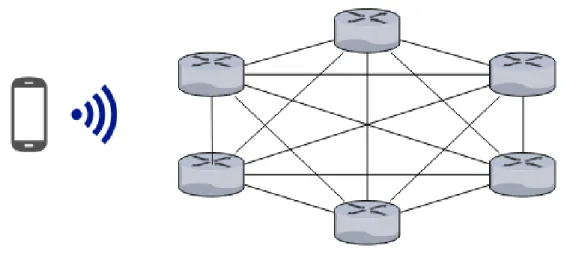
Another problem of using IP-based protocols in IoT applications is the routing protocol in IoT mesh networks (which is shown in Figure 1.2) which are one of the topologies of typical IoT networks. The routing information must be maintained for each host in mesh topologies. For example, with IP-based routing protocols, the address allocation process may have to be repeated when the topology has some changes such as adding new nodes into the topology. The routing system must handle the address allocation to forward the requests. Maintaining the routing configuration in every node in mesh topology consumes significant memory. However, in NDN there is no need for the address allocation process because it is not used in NDN.
The following section continues to present the overview of the NDN architecture in more detail.
1.2 Problem Statement
Although NDN networks have better efficiency in terms of data delivery than IP-Networks [1], the current implementation of in-network caching and routing algorithm in NDN networks has overheads and resource usage limitations such as the way of using routers’ cache and the routing algorithm decision to forward network packets. To improve the efficiency of routing algorithm and in-network caching capability in NDN, three different ideas were implemented and will be explained in this thesis.
First, the current implementation of NDN forwarding mechanism allows every node—along the reverse path of a request packet—to store the incoming data based on theContent Store admissionand thereplacement algorithm. This property of NDN is called in-network caching. Indeed, the reason for keeping a copy of the requested data in every node is to increase the chance of data hit in these nodes for incoming interests and this design is implemented
1 Introduction
taking into consideration an optimistic assumption that cached data will be requested in the future before it is removed from the cache. The problem is that the current adopted Caching Strategy in NDN does not consider the Network Topology. This might cause useless work and unnecessary caching activities. However, the in-network caching capability can be improved and used more efficiently by considering the latency between hops. To address this issue, the idea is to save incoming data when only the data is far enough from the previously cached node. The distance to decide will be more explained in the later section.
Second, there is a separate field at the end of the name convention in NDN to tag segment number for large data. A large data can be divided into multiple chunks and each chunk has own unique name. Then, each segment is retrieved individually by sending an Interest having its name. When a segment is requested from the network, especially for the segmented video data, the requester most probably will wish to get the rest of the segments. However, she/he has to send a separate Interest for each segment one by one to get the entire video. This means extra Interest bandwidth on the network just to obtain one data. Based on this knowledge, the simple idea was presented to overcome this unnecessary bandwidth usage. The design is that the related segments can be sent to the client without a request when the client sends an Interest for an individual segment. Therefore, the interests of the remaining segments will not come along the same path to the data producer and they will satisfied in early routers.
The last point is the routing and forwarding unit. NDN uses the Named-data Link State Routing protocol (NLSR) as a routing protocol. NLSR computes the best path for each data to its destination. Routers always follow the best path to forward incoming interest and if that path does not work to get the data, then NLSR chooses the second best-path to achieve its goal. In fact, the data might be around that router but not on the route of the best path,therefore if the same data requested from some other clients, the interest to request the data needs to go along the best path to get the data from its origin router The problem is here, the current implementation of NLSR does not exploit the unique features of NDN, such as in-Network Caching. Multi-Path forwarding. The new approach is here that if routers share their knowledge about their content store with their neighbors, then this knowledge can be used for forwarding interests. Therefore, these three points are valuable for us to investigate and research.
1.3 Contributions
To tackle the problems discussed in the previous section, we dedicate the work in this thesis to develop innovative solutions that improve the performance of NDN networks. Specifically, the thesis provides three different contributions: namely,distance-aware caching strategy, seg-mented data policy, anddynamic forwarding. The first contribution of this thesis is developing a novel in-networking caching strategy through which less caching activities for the overall network are required. During the return of a data packet, instead of caching the data packet in every hop, it is cached in hops which are 100 ms far from the previous node that have the copy of the data. As a result, the less number of caching activities will cause less process
1.4 Thesis Overview
overhead and less power consumption. The future chapters show the details about the design, implementation and the result of this architecture.
The second contribution of this thesis is new policy for large segmented data. In NDN, each segmented data has own unique name prefix and to get each segment, one has to send a separate interest for every segment. The idea is here to predict the user intention for the requested segment based on the data type, size, and priority and then the decision algorithm running on each router sends blindly rest of segments which are belong to the same data. The design technique is similar to SpatialLocality in CPU architecture design. That is, if consumer wants to get the some segments of a data, the decision algorithm checks data details like type, size and then it decides to send other segments of the data to the consumer after sending the requested segment. The evaluation for this study will in the following chapters.
The last contribution is the design and implementation of a new routing algorithm on the top of the current routing algorithm. This new routing is based on the data statistics and sharing of these statistics with neighbors. In fact, the forwarding decision is made according to those statistics. If, however, the requested data could not found, then the default routing algorithm is used to search the data from the network. To apply this routing policy, every router creates a new major statistic table for the incoming data. The name prefix of each processed data going downstream is saved with some detailed information in this table 4.1. Then, the information which is gathered sends to the neighbor router. Moreover, each router calculates a probability value based on the MPP table entries for an incoming interest to forward it to the the next hop. Performance and overheads will be discussed more in the following sections.
1.4 Thesis Overview
The thesis is organized as follow:
Chapter 1 provides an overview of the tackled problem and the contributions developed throughout the thesis.
Chapter 2 provides background information about NDN. The chapter explains how NDN com-munication architecture works and which parts of it are different than the IP-based network. NDN benefits will be also presented in this chapter. In addition, the overview of the previous studies in the same field will be discussed in this section. Their strategies and some results will be discussed in more detail.
Chapter 3 presents the purposed three new ideas and how they will be integrated into existing NDN architecture. This chapter explains how the existing design works and what are the new methods to change or modify the existing system. The three models which are Caching Strategy, Segmented Data Aware Routers, and Forwarding Strategy will be presented and explained in more detail.
1 Introduction
Chapter 4 presents the design and implementation details of the system. The three new methods are showed how they are designed and implemented by providing pseudocodes for the major algorithms and data structures. One can easily understand the design and imple-mentation details of these new system by reading this chapter.
Chapter 5 provides the evaluation and results and shows the outcomes of the new design. The chapter begins with the environmental setup. The setup section presents which simulation environment is used and which kind of tools are used to test the newly developed features. Then, each model is investigated one by one by showing the result graphics and outcomes. Of course, the drawbacks of the each model are also mentioned in this chapter.
Chapter 6 summarizes the thesis and gives possible future extensions in the NDN architec-ture.
Chapter 2
Background
In this chapter, the necessary background knowledge and important details about the NDN ar-chitecture are presented. There are several major benefits in NDN and they are also mentioned in this part. In addition, related studies will be investigated by explaining their methods and drawbacks at the end of this chapter.
2.1 Content-Centric Networking
Content-Centric Networking is a communication architecture which is based on named data rather than IP address [1]. It is an alternative option for Today’s IP Networking. The Internet which we use currently is mostly the host-centric networking and every host in that network is identified by a unique address. A network packet in CCN, on the other hand, is represented by a unique name. A consumer requests the content by sending its name to the network. The network is responsible for searching, finding and returning the content back to the consumer. The simple representation of this method is shown in Figure 2.1. The data exchanged is done by using two special network packets which are called Interest and Data. The user simply presents the name of desired content in Interest packet and send it to the network. Then, CCN returns a Data packet containing the requested content back to the user.
2 Background
The content can be found any location in the network thanks to network caching capability. The network caching technique is a new feature in CCN and one of the major advantages of this [3] is to reduce the transmission of the data, which is requested by multiple consumers over the network. A network element having in-network caching capability can store the received content for the future requests. Another point of CCN is that the same requests from multiple consumers can be aggregated in a router to send only one request to the network. Thus, it contributes to the network by decreasing the number of requests for the same content. When these points are considered, CCN seems significant importance over the current IP host-centric communication architecture.
2.2 Named Data Networking
Named Data Networking [1] is a primary research area among the present CCN architectures. NDN is a content-centric and receiver initiated communication architecture based on named data. The main focus of this type of network is the name of the content. The user only presents the name of the content and the desired content will be automatically returned back to the user. There are no other restrictions like providing a destination address. Moreover, the name of the content can be any type of data such as a video file, PDF file and any type of pictures.
NDN presents a different logic in network service. In the current host-centric network service packets are delivered to a given destination address, whereas in NDN packets are fetched according to a given name. It names data itself rather than the container that has the data. Thus, you can only express what you want from the network, and the rest will be handled by the NDN architecture.
Simple communication flow in NDN is listed below and also it is shwon in Figure 2.2:
1. A consumer sends out an Interest packet containing the name for the desired data to the network.
2. A router, first, takes the Interest packet and saves the requester interface information so that it can return the data back to the requester.
3. Then it checks its content store (cache storage) to decide whether the data already exists or not.
4. If the data is not available inside its content store, then it forwards the Interest packet to the next router. Forwarding strategy decides the next hop to which the Interest should be forwarded based on the routing protocol.
5. The Interest is carried and forwarded through the network until a router has the re-quested data in its content store.
2.2 Named Data Networking
by using the reverse path.
During this entire communication process, IP address or any host address are not used.
Figure 2.2: Interest and Data Forwarding Process in NDN [14].
There are two packet types in NDN. They areInterestandDatapackets which are shown in Figure 2.3. AInterestpacket contains a unique name to identify the requested data. A Data packet has also the same name. Hence, the network element can match the request packet with the corresponding data packet by comparing their names. N once field in Interest packet is a random number which uniquely identify the Interest packet together with N ame. It is used to detect looping interests. Signatureis used as a digital signature of the content which provides a secure communication.
To accomplish the implementation of this new communication architecture, NDN requires several important data structures like Content Store, Pending Interest Table, and Forwarding Information Base. These tables are essential during the packet processing logic in NDN. The following part explains more about these data structures which are currently used in NDN implementation.
• Pending Interest Table (PIT) The routers save all incoming interests which are waiting for the requested data and also their incoming interface in a special table called
2 Background
Figure 2.3: Two Packet Types of NDN [5].
P ending Interest T able(P IT). The beauty of the PIT table is that only one interest is sent upstream if a router receives multiple interests for the same data. This feature leads to less interest traffic in the network, and so less bandwidth usage. Moreover, the PIT table does not remove the recently satisfied Interests immediately from its records [15]. But, it keeps them for some time. There are two reason for this. The first one is to detect loops which might be caused multiple same requests. The second purpose is because of measurements.
There are two major fields in a PIT table which are the name of the interest and the set of interfaces which belong to the consumers want to get the same data. Once the router receives the data, it finds the corresponding PIT entry and then forwards the data to all interfaces stored in the interface list. Later the router removes the satisfied PIT entry from the list.
• Content Store (CS) The Content Store is a cache memory for the Data packets in NDN. Every node contains the CS table in NDN. The router temporarily keeps the incoming data inside its content store table to satisfy future interests. This is called
in−networkcachingin NDN. A router stores the incoming data into the CS table after it finds a satisfied a PIT entry for that data. This is the way how the CS table of the router is populated. Later, when the router receives an incoming Interest it searches its CS by comparing the Interest name with the names in CS entries to satisfy the Interest before actually passing the Interest to the forwarding unit.
In addition, because CS has a limited storage, there is a replacement policy to replace an entry with a new incoming entry. The overall performance of network can be sig-nificantly effected by CS performance [15]. Therefore, the efficient usage of the CS operations like looking up a data, inserting an entry, deleting an entry, and cache re-placement policy is very important in this manner.
2.2 Named Data Networking
• Forwarding Information Base (FIB)F orwardingInf ormationBase(F IB) is used to forward Interest packets to the next potential hop based on the router forwarding strategy. A FIB table consists of a name prefix and N extHop records which must contain at least one record. The NextHop field contains the interface information and the route-cost of that interface in order to reach the potential data provider. The router which wants to forward an interest performs a longest prefix match operation on the FIB to find the outgoing interface. The Longest P ref ix M atch operation is an algorithm which takes the name in a Interest packet as an input and returns a FIB entry that satisfies the longest string matching condition.
The FIB table is updated and managed by the FIB manager in NFD module. The FIB manager controls the route information updates coming from NLSR side. it is responsible to deploy new static or dynamic routing information into the FIB table. In this way, the forwarding strategy can use the shortest path to forward an Interest packet.
The high-level diagrams of each table are also shown in Figure 2.4 with an example of a network packet. Necessary column labels are also given in that diagram for each table. In fact, the below diagram shows the NFD forwarding model together with these tables.
Figure 2.4: Tables and Packets in NDN [7].
In order to understand why the NDN methodology is more suitable for the current Internet needs than IP-based networks, we need to investigate the NDN architecture differences. These
2 Background
Figure 2.5: The IP and NDN Protocol Stacks [1].
differences will be explained step by step in the following part. There are six major points in this manner which are Name, Routing and Forwarding, Data Security, In-network caching, Intelligent Data Plane and Transport.
1. Name
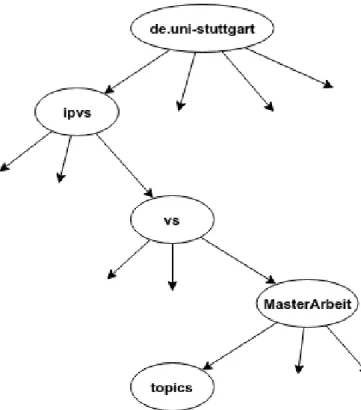
NDN uses semantically meaningful and hierarchical names to represent a data packet as shown in Figure 2.6. There is no other unique address used for identify the network packet in NDN. For example, source and destination addresses used in IP-based network packets are not used in NDN. The elements of NDN packets can also be seen in Figure 2.3. There are several advantages of naming data. First, it enables to have caching capability in routers. Because contents in NDN are requested by a unique name, so it does not matter where the content is located as long as the network find the requested content in somewhere and returns it back to the consumer. Therefore, contents can be cached in internal routers to satisfy any request in the future.
Secondly, The NDN network packets, Interest and Data, do not carry any specific in-formation about the router which might be private inin-formation. This contributes the secure communication and it will be more explained in future sections. Lastly, naming data allows the system to multicast data delivery. In IP-based networks, the multi-cast data delivery is a challenging task because more than one packets carry the same data to forward to multiple consumers due to host-centric forwarding mechanism. How-ever, in NDN one data package is used to satisfy the multiple requester at the same time.
2.2 Named Data Networking
Figure 2.6: Hierarchical Name Structure
2. Routing and Forwarding
Routing and Forwarding in NDN are done by using names. Routers use names to forward Interests and keeps those names in PIT to match the corresponding data that arrives at the router. This name-based forwarding has important advantages such that there is no need to handle Network Address Translation (NAT) operation or address management. Because there is no source or destination address in NDN network packets, so NDN does not require NAT conversion. Moreover, there is also no need to address assignment and management in local networks. This especially brings an advantage for the sensor networks.
Routing security is another significant point in this section. In NDN all data and also routing messages are signed and this prevents NDN from malicious attacks. As mentioned before, network packets in NDN do not carry any information about source and destination. This supplies more privacy and also one cannot send a malicious attack to a specific target because there is no such address.
3. Data Security
In NDN every data packet is digitally signed and the signature is located inside the data packet as shown in Figure 2.3. The name, the content and the metadata are signed and kept bind together securely during the transportation of the data. The security
2 Background
is built on the content itself rather than host or channel centric security such as IP-Network. Moreover, NDN Interest and Data packets contains only unique name and this is the only field in the network packet that routers can identify the packet. There is no requester or destination addresses in the network packet. Therefore one can not track or find the client or provider information by using the network packet or accessing a router database. In fact, routers do not contain any information about the consumer or content provider. As a result, clients and data providers are kept as private and secure.
4. In-Network Caching
In-network caching is a powerful feature in NDN. Each router has a special data buffer called the content store to cache incoming data for a limited time. The aim is here to satisfy future requests. The procedure of the caching method works as follow. For each incoming interest packet, the router first queries its content store to match the requested interest name with any data name inside the content store. If there is a match, the router sends the data back to the requester immediately.
Routers in Network also buffer data for a short time. The difference between IP-routers caching and NDN IP-routers caching is that IP IP-routers cannot reuse those data because the forwarding mechanism is based on the host address and they can only check packet destination address and forwards the data to the destination. However, NDN identifies the data packet by the data names, therefore routers in NDN can reuse the data in the content store to satisfy a request.
5. Intelligent Data Plane The PIT data structure allows NDN to have a stateful data plane whereas the data plane in IP-based networks is stateless. First of all, all in-coming Interest packets and their inin-coming interface information are stored in the PIT table. Then, these pending Interest packets are removed from the PIT table after the corresponding Data is retrieved or the timeout occurs. There are several important advantages of having stateful data plane in NDN.
First, a router in NDN can easily collect statistical information about incoming data and timeout cases. These knowledge allows NDN to measure the performance of the different interfaces and detect packet loss information thanks to the PIT table. Secondly, together with the PIT entry information and N once field in an Interest packet, the local router can detect Interest and Data loops. This causes loop-free data plane. Moreover, the local routers can take smart decision to forward an Interest based on the feedback and the performance information collected from the data plane. In fact, forwarding strategy can be changed according to load balancing, multiple interface services or detected problems. In this way, adaptive and error handling forwarding logic can be implemented in NDN.
6. Transport
Transport layer in IP-based networks is separate and necessary layer in order to establish a stable end-to-end connection. IP and Transport layer together act like a virtual pipe
2.3 Related Work
between two IP-based endpoints. However, in NDN there is no such separate transport layer to handle data exchange procedure. Internet applications have to maintain the functionality of transport layer protocols.
Application side must control data delivery process by itself. For example, a consumer must re-transmit the Interest which is not satisfied in certain time for timeout or any other reasons if the consumer still wants to get that data. Another point is that the traffic load management is under routers’ control. Thus, routers must handle the Interest forwarding rate and checks the overloaded hops.
Lastly, according to the NDN Project [19], NDN protocol design principles follow briefly. the first deisgn priciple is Universality. Based on this principle, "NDN should be a common net-work protocol for all applications and netnet-work environments". Secondly, "Data-Centricity and Data Immutability: NDN should fetch uniquely named, immutable ’data packets’ requested using ’interest packets’". Third one is Securing Data Directly which explains that "security should be the property of data packets, staying the same whether the packets are in motion or at rest". Hierarchical Naming is another pronciple which says that packets should carry hierarchical names to enable demultiplexing and provide structured context". The next one is In-Network Name Discovery and according to this principle, "interests should be able use incomplete names to retrieve data packets". The last principle is Hop-by-Hop Flow Balance. Based on this, "ver each link, one interest packet should bring back no more than one data packet".
In the next section, after explaining and presenting background information about the NDN architecture and design, related studies will be investigated in this subject.
2.3 Related Work
Named Data Networking attracts more researchers nowadays to study this field [19]. Because NDN provides more efficient solutions than IP-based networks to supply Internet usage in today’s smart and connected world in terms of forwarding mechanism, naming data directly and secure communication. Therefore, there are several studies on caching strategy and routing and forwarding strategy in NDN.
The first study [20] is about in-network caching usage of NDN. The article presents a cache management system to reduce content access latency, and minimize the bandwidth cost and network congestion. The purposed approach is based on distributed cache manager devices which control the items in every content store. The cache manager devices are located near routers as separate hardware modules and they communicate with each other to exchange the necessary information to control caching activities. The control mechanism uses the user demand patterns in real-time to develop a cache replacement policy. Moreover, the overall network bandwidth gain is also considered during the decision of item replacement in a cache.
2 Background
This coordinated and distributed cache management system could be installed in every router having the in-network caching capability. The control managers on each router can determine the cache allocation and replacement strategy. In fact, they can exchange the configuration information and the item demand pattern among themselves. In addition, The item demand is obtained by listening to the PIT by observing the forwarded Interests.
There are some drawbacks of this purposed systems. First of all, it requires external hardware module for every router in the network to achieve its goal. This causes additional hardware cost as well as the increased maintenance and operating cost. The other point is the In-terest/Data message exchange between the cache manager devices for sharing the necessary information. It will possibly affect the overall bandwidth usage and cause the traffic overhead due to flooding of Interests to search for cache managers.
Figure 2.7: NLSR vs. MUCA Forwarding Architecture [13].
The second study [13] purposes a new routing design for NDN. This study has the same name strategy for forwarding as M ostP robableP ath (MPP) with the MPP policy in this thesis, but the design and implementation are quite different. The objective of their purposed MPP design is also to forward similar Interests over the same route to use the cache resources more efficiently. The method aims to merge the Interests coming from different consumers for the same content as early as possible in the network. By doing this, they desire to increase the cache hit ratio.
In this design, the network is divided into areas and each area has some border routers which reside in more than one areas as shown in Figure 2.7. In fact, they are like a communication
2.3 Related Work
bridge between two entities. The aim is to forward similar network traffic over the same border router so that resource usage will be utilized efficiently. Moreover, the additional fields in the NDN data header have been created to realize their MPP method. These are
AreaID,BorderRouterInf o, and M odif iedT ime. These fields are modified only when the requested data at the border router during the return path. Internal nodes do not change these parameters.
The parameters are changed according to the current area, border node and the arrival time of the data. As a result, the forwarding decision is made based on these fields and all similar Interests follow the same route through the same border router. The border routers update theM odif iedT imefield when a data name is advertised or updated by NLSR. When internal nodes receive an Interest packet having those name prefix, they use the modified time field to forward the Interest packet towards the border router. The purposed method for forwarding is practical and has significant performance results. However, the forwarding depends on partially static information. Because data names are advertised only when they have some update such as the first time data publishing and version number change. Moreover, there is need for a configuration setup for area and border router.
A diffusive name-based routing protocol (DNRP) was also proposed in [21] which computes the shortest paths to the nearest copies of name prefixes without requiring the network topology information. The shortest-path computation is based on distance information. In this method, the routing information such as the list of all active neighbor and the cost of the links are stored in a table for each router. Every known name prefix is also stored in this table with the distance to the nearest instance of that prefix. Then, each router exchanges this information between each other to compute the shortest paths for those name prefixes. Moreover, the purposed system updates the routing information when any change occurs in the network like a failure of a node/link, a cost change for a link or deletion of a name prefix. The study aims to have efficient name-based routing for the content-centric networks by using only distance information. However, DNRP does not implement in-network caching capability in its design although content store is an important element in the NDN implementation.
Figure 2.8: The main design of purposed NameTrie data structure [24].
There is another study which purposes a fast and memory efficient data structure [24] for storing the forwarding table entries. In this research, the objective is to improve name lookups performance and contribute to have a fast and memory efficient packet processing logic. N ameT rie is designed and implemented as a new data structure for forwarding
ta-2 Background
ble entries by the authors of this study. The design presents a new character scheme and also optimized version of the Trie structure for solving the major problems of the Trie such as traversing a trie and slow child node access. The system model of the NameTrie data structure is also shown in Figure 2.8.
The purposed NameTrie data structure presents a low memory usage to store the forwarding table entries and also decrease the time for name lookups. However, the functionality of the purposed design requires additional encoding and tree structure conversion operations. This may lead to processing overheads.
Chapter 3
Overview of The Purposed System
In this chapter, the model of the three different techniques which are to improve the efficiency and resource usage of the existing NDN implementation will be described. Moreover, it includes the assumptions which have been made during the design solution for the NDN efficiency and resource usage problem. I have collected these three forms under one name which is called The Hop Distance Aware Caching and Knowledge Sharing Based Forwarding Unit. It includes The Hop Distance Aware Caching Strategy, Segmented Data Locality Policy, and The Knowledge Sharing Based Forwarding Unit.
3.1 The Hop Distance Aware Caching
Before starting, I would like to explain how the related modules of the existing NDN implemen-tation work. The first major module in NDN is NDN Forwarding Daemon. "NDN Forwarding Daemon (NFD) is a network forwarder that implements and evolves together with the Named Data Networking (NDN) protocol [15]". It is responsible for forwarding Interest and returning Data packets back to the consumers. To do this, it maintains basic data structures such as CS, PIT, and FIB with the implementation of the network packet processing logic unit.
The current caching policy in NFD is straightforward. For incoming data, the first step of the NFD module is to check the Interest table to see if there are PIT entries that can be satisfied by this Data packet. If there are valid PIT entries to satisfy this Data, then immediately the NFD module insert the Data into the router’s CS and forwards the Data to the downstream for all the matched PIT entries. If there is no PIT entry to satisfy that Data packet, the data is sent to unsolicited data processing logic and it is dropped. NFD does not have any other advanced caching policy to decide whether it should store the incoming data or not. It just saves all incoming data which have at least one matched PIT entry.
In this method, the goal is to use the cache resources of routers efficiently and possibly to reduce power consumption caused by cache activities. As mentioned above, the current implementation of cache policy in NDN requires to process the caching logic for every incoming data. Is it really necessary to store every data in every router along the downstream path of that data? This question deserves to have more investigation. Therefore, the basic solution for this problem is to save the incoming data periodically in terms of latency between routers.
3 Overview of The Purposed System
Figure 3.1 shows an example of caching saving activity for both NDN architecture and the new method presented in this thesis. The distance threshold has been taken as 100 ms. Because of the acceptable delay impact for most of the real-time application [12] is around 150 - 200 ms. This distance value can be changed for different applications. The value of 100 ms was used in this thesis during the evaluations.
Figure 3.1: Cache Saving Activity for NDN and HDAC. (t1< t2 =t5< t4< t3)
To employ this new method, a new field was defined in the data header. This field is a simple travel cost counter. It starts with 0 value on a data provider point, and along with each transportation, the respective link cost is added into this counter. Each router on the reversed path checks this value to decide to save the incoming data into their CS. if the delay counter is bigger than or equal to 100 ms, then the respective router which is R4 in example figure caches the content and resets the travel cost counter to 0 value again. This is the basic functional logic for this method.
The significant point is in this method when the consumer wants to get the same data for the second time or more, the closest router having the data will be R4 and it will cost an additional 2t1 + 2t2 ms delay. In fact, the overhead delay can be between 0 and 200ms. This can be seen as a trade-off between resource usage and performance.
3.2 Segmented Data Aware Routers
Segmentation is sometimes required to store large data in multiple chunks. Because the content of a large data cannot fit into a network packet, so it needs to split into several pieces [11]. Segmentation is additionally useful for re-transmission of broken packets. In this way, it is convenient to re-transmit the individual segment of the data instead of sending the entire data block again. This helps to reduce bandwidth loss and delay when any failure occurs such as timeout and node failure in content retrieval.
According to the NDN Naming Conventions [10] each segment is represented by its own unique name as shown below example: In the example, the content called video1 consists of more than one segments and the name prefix of each segment is created by adding the segment number at the end of original content name.
3.2 Segmented Data Aware Routers
/U ni/Stuttgart/ipvs/lecture/video1/1
/U ni/Stuttgart/ipvs/lecture/video1/2
/U ni/Stuttgart/ipvs/lecture/video1/3
...
Segment number is located at the end of the name prefix [10]. It starts at 0 value and incremented one by one. Each segment can be requested or retrieved individually. In fact, the content consisting of multiple data segments has to be requested by sending a sequence of interests for all segments and this is under consumer responsibility. For example. if a network element wants to download a big video frame split into data segments, it must generate interests for each data segments and at the same time, it should control the sequence of the segments whether they have arrived or not.
The goal of the segmentation locality is to reduce the total delay (latency) for retrieving a segmented data. I assume that a client who has requested the first segment of a data will most probably want to get the rest of the segments of that data. Based on this assumption, I implemented a decision algorithm to send the rest of the segments which are without being requested. The functionality of the method is triggered if a segmented data requested by a consumer. The data provider for that specific segment, first, send the requested segment back to the client. Then, it runs the decision algorithm to determine the number of segments to be sent to the client.
There are three different data features playing a role in making a decision. Those are data type, priority and size. These three parameters are used as inputs to the decision algorithm. The aim of these parameters is to decrease the bandwidth loss in case the client does not want to request the rest of the data. This will be explained in the evaluation part in more details. After that, the provider router checks its own content store to search for other segments belong to the same data. If there are some segments, it collects them and sends them back to the client one by one until the decision count comes from the decision algorithm. As a result of this operation, the unsolicited data are cached during the reversed path of the first segment. When the client presents other interests for the remaining segments to the network, thanks to this new method, the requested segments will be already at the closest hop. Therefore, the client gets the data faster. Moreover, the interests for the rest of the segments will not be forwarded to the network. This will contribute to having low-interest bandwidth over the network.
To keep track of the reversed paths for the segmented data, the NFD module needs to have a similar table like PIT. But it is a small and special to the segmented interests only. The reason for having such an additional table is that after sending the requested first segment to the client, the forwarding mechanism of NDN automatically removes the corresponding PIT entry from its PIT table. Then, we lost the reverse path going back to the client or possibly more than one client. Therefore, we need another special table for the interests which want to request segments. The table records name prefix for the originally requested segment and
3 Overview of The Purposed System
the list of interfaces which the interest comes from. The table is populated when an incoming and segmented data arrives at the router and if the router does not have that segment in its content store. The detailed design and implementation are shown in the next chapter.
3.3 Knowledge Sharing Based Forwarding
In NDN, the routing plane is separated from the forwarding plane. the current implementation of the routing plane is called the Named-data Link State Routing protocol (NLSR). The NLSR module only calculates the shortest path from each node towards each data provider for every published data. Alternative secondary shortest paths are also calculated. Then this information is sent to the forwarding plane. The forwarding plane has all the responsibility about forwarding the interests. Moreover, the information coming from NLSR is updated continuously if there is any change in the network topology.
There are three major tables in the NDN forwarding plane as shown in Figure 3.2. These are Content Store table, Pending Interest Table (PIT), and Forwarding Information Base (FIB). CS is temporary storage for incoming data. PIT is used for keep tracking of unsatisfied interests with their downstream interfaces. Finally, FIB table has the list of published data names and with their path cost towards to data provider.
Figure 3.2: NDN Forwarding Plane [13]
The current processing logic of the implementation of the forwarding unit is shown in Figure 2.2. A consumer initiates the process by sending an Interest packet to the network. Then, a router receives the Interest packet and it, first of all, searches its CS table for the requested interest name. If the searched content exists in the CS, then the content of the desired name is returned back to the client. If it does not, then the router looks for a PIT entry to match with the interest. If PIT has an entry having the same name with the interest, this means that the same content has been requested from some other consumers and the corresponding
3.3 Knowledge Sharing Based Forwarding
interest had been already forwarded to the upstream and currently the router is waiting for the desired content from the network. Thus, there is no need to create a new entry in PIT. Instead, the existing PIT entry is modified by adding the incoming interface into the list so that once the requested data arrives, the router can forward the data to all downstream hops which are on the PIT entry list. But, if the interest does not match a PIT entry, then a new entry is created for the interest in PIT and the interest is forwarded to the next hop.
The Figure 3.3 summarizes the steps up to the forwarding stage. The forwarding is done by forwarding strategy and the forwarding strategy uses FIB to decide the next hop. The current default forwarding strategy in NDN is the Best Route Strategy [15] which is based on the lowest routing cost to forward an Interest to the upstream.
Figure 3.3: NFD Incoming Interest Processing [15]
The Best Route strategy starts with the lowest-cost next hop to forward a new interest. If the transmission fails and the consumer sends the same interest again, the forwarding strategy chooses the second-lowest-cost next hop to forward the interest. In fact, the strategy tries to use all hops (except the downstream hop) one by one if re-transmission occurs. The order is determined by the lowest-cost path. If the router uses all hops, then it starts with the first one again.
Although the Best Route strategy guarantees the lowest-cost to the data provider, the outcome does not mean that it is optimal when we consider the overall topology. For example, we can look at the scenario in Figures 3.5 and 3.6 to understand the disadvantages of the BRS. The known parameters and information in this example are given below.
3 Overview of The Purposed System
Figure 3.4: NFD Incoming Data Processing [15]
• The costs of each link are represented by t1 andt2.
• The value of t2 is higher thant1 (t1<< t2).
• The router R8 is the publisher for the data "A" and the router R1 and R2 want to receive the data "A".
• The lowest-cost paths for the router R1 and R2 are shown the reversed and thick links respectively on the figure.
• R1 presents the interest for the data "A" and then R2 send the same interest for the same data.
The router R1 starts the transmission by sending a interest packet for the data "A" to the network. The interest packet follows the lowest-cost path (R1−> R3−> R5−> R7−> R8) to reach to the data publisher router R8. The total cost for this path is 3t1 +t2. After the interest has reached the router R8, the requested content is found in CS of R8. Then R8 sends the data back to the consumer router and the data follows the reversed path to reach the requester node R1. The content "A" is cached by each router on the reverse path.
When the node R2 presents the same interest for the data "A", the forwarding strategy of NDN chooses the lowest-cost route for this data. In this case, it followsR2−> R4−> R6−>
3.3 Knowledge Sharing Based Forwarding
Figure 3.5: NDN Forwarding Example: Router R1 request data "A". The upper link L1 (from R8 to R1) is the lowest-cost path for the router R1 and the bottom link L2 (from R8 to R2) is the lowest-cost route for the router R2.
Figure 3.6: NDN Forwarding Example: Router R2 request data "A".
R7−> R8. The total cost for this route is also the same as 3t1 +t2. The desired content will follow the reverse path and will reach the router R2. The only difference is here, the content will be already in the node R7 and it will be returned by this router immediately. Therefore, the total cost will bet1 time unit less than the total cost.
The problem in this scenario is that although the content "A" is located in the node R3 which is near than R8 as shown in Figure 3.6, the current forwarding strategy (BRS) is not smart enough to know this information. Therefore, the interest is forwarded towards the router R8. The new method is constructed based on this fact. The main goal of this new forwarding mechanism is to reduce data latency and bandwidth usage of the overall network.
The knowledge sharing based forwarding unit consists of two parts. The first one is to share the content name with all neighbors (except downstream neighbor which is the one who has sent data). This information is sent to the entire network. Each router stores the content
3 Overview of The Purposed System
name and the incoming interface. in a special table which is called Most Probable Path table (MPP table). Then if a router receives the same interest for that specific data, it simply checks its MPP table and forwards the interest to the corresponding interface instead of using the lowest-cost route. This operation is done for all incoming content.
The below shows some important use cases.
• A new entry is created for an incoming content name if the same content name does not exist inside the MPP table.
• The same content name might come to a router more than one. The new forwarding mechanism has a comparison function which uses two parameters specific to the shared content name. These are the total cost and the total hop count. Every shared content also carries these two parameters and if a router has already the same content name in its MPP table, it uses these two parameters to decide to update its record with the new shared information.
• During forwarding an Interest to the upstream, the first routing choice should be MPP.
• If MPP does not have enough knowledge to forward an Interest, the second routing policy which is probability path should be used.
• If the probability value is not enough to decide forwarding, then the default route, best-path, should be selected.
• In case of getting NACK message after an interest packet has been forwarded by using MPP table, the forwarding switch the default forwarding strategy which is the BSR. After the next successful transmission of the same content, the forwarding strategy goes back to the knowledge sharing based forwarding strategy again.
Figure 3.7: NLSR vs. KSBF Route Lists
The second part of the knowledge shared based forwarding is to calculate a probability value based on the records in the MPP table. The assumption is that for an incoming interest we can extract a relation value by using the existing content names in the MPP table. This value
3.3 Knowledge Sharing Based Forwarding
can be used to forward the incoming interest to the related interface. The probability value is calculated by using the relation between the incoming interest name and the existing content names in the table. The probability value must be bigger than the threshold value which is 0.6 so that the related interface can be used for forwarding.
As a result, the knowledge sharing based forwarding module presents two new forwarding routes on the top the default forwarding strategy (BSR). The new list of forwarding paths is shown in Figure 3.7
Chapter 4
Design and Implementation
In this chapter, the design, and implementation of three methods are described. The section also presents some high-level code snippets when it is necessary for each method.
4.1 CS Hop Distance Aware Caching Approach
This section describes the design of the Hop Distance Aware Caching method and how it is implemented and integrated into existing NDN platform. There are two modules which need to be modified in order to achieve the HDAC approach. The first one is NDN-CXX module. NDN-CXX is a C++ library which implements NDN primitives. It is used for developing different NDN applications and projects such as NFD and NLSR. The HDAC needs to have an additional field in data header to keep track of the reverse path cost. The related code files for this operation are in ndn-cxx library. First of all, aunsigned integervalue is defined inT agsheader file of the ndn-cxx library. Moreover, this value must be individually decoded and encoded before sending and receiving the data packet respectively. This is done in NFD Generic Link Service source file. The information about related function and the algorithm are shown in Algorithm 1 for both decoding and encoding of a field for data header.
This new field allows data to carry its own individual path cost in itself. The cost starts with 0 value and incremented by adding the cost of each link in which is used during data delivery on the reverse path. In this way, a router can check the value of this field and understand the total cost of the data until that point. If the traveling cost is bigger than or equal to 100ms, then it reset it to 0ms and saves the content into its own CS. If it is not, the hop does not cache the content and simply forwards the data to the downstream.
The second part is to use this new data header field to implement the functionality of the HDAC method. The logic is straightforward. The travel cost field should be controlled by comparing with the threshold value for every incoming data. After that, the decision is made for caching the content or not. The related algorithm is given in Algorithm 2.
The process of the HDAC does not require intensive processing as can be seen as the above code piece. Because it consists of a simple value reading and writing into the data field as well as an if-condition statement. This small patch is used to determine whether an incoming
4 Design and Implementation
Algorithm 1 Encoding and Decoding Of A New Data Field
1: Input: NetworkPacket, LinkServicePacket
2: /*Encoding*/
3: travelCost←N etworkP acket.getF ield(DAT AP AT HCOST F IELD)
4: if travelCostis not NULLthen
5: travelCost←Encode(travelCost)
6: InsertN etworkP acket(travelCost)
7: else
8: travelCost←0
9: InsertN etworkP acket(travelCost)
10: end if
11: /*Decoding*/
12: data←newData()
13: travelCost←LinkServiceP acket.getF ield(DAT AP AT HCOST F IELD)
14: if travelCostis not NULLthen
15: data.addT ag(travelCost)
16: end if
17: return
Algorithm 2 Caching Decision Procedure
1: Input: inFace, data
2: linkCost←inF ace.getCost()
3: dataSavingP olicyF lag ←F ALSE
4: travelCost←data.getT ag(DAT AP AT HCOST F IELD)
5: if data−travel−costis not NULLthen
6: travelCost←travelCost+linkCost 7: if travelCost >100then
8: dataSavingP olicyF lag←T RU E
9: travelCost←0
10: end if
11: data.setT ag(travelCost)
12: end if
13: ...
14: if dataSavingP olicyF lag=T RU E then
15: ContentStore.insert(data)
16: end if
4.2 A New Policy For Segmented Data
data should be saved into content store or not. The outcomes and analysis of this new caching policy will be presented in the next chapter.
4.2 A New Policy For Segmented Data
The design and implementation of the Segmented Data Aware Routers method are presented in this section. The design of the method can be divided into three steps. The first part is the detection of segmented data when data in a router is discovered in the content store for an incoming interest. This step triggers the initial process of the SDAR functionality. A new function, processHitDataSegment, is called at the end of the primitive function of NFD module which isF orwarder::onContentStoreHit. The original desired content is sent back to requester first. Then, the function processHitDataSegment is executed to start to understand whether the requested data is a segment of a data block or not. if the determined amount of the segments are found in the content store, they are shifted to the downstream pipeline. The Algorithm 3 shows the related pseudocode for this operation. The three new fields have been added into the data header. They are a data type, data priority, and data size. They are used during the decision operation for the number of segments to be sent to the downstream. This also requires ndn-cxx library modification as mentioned in the previous section.
Algorithm 3 Processing Data Segments After Sending the First Segment
1: Input: outFace, data
2: if isSegmented(data) =F ALSE then
3: return
4: end if
5: nameP ref ix←data.getN ame()
6: segmentN o←data.getSegmentN o()
7: N ←decideN uberOf Segment(data)
8: segmentList←getSegmentsF romCS(data, N, segmentN o)
9: whilei < segmentList.size()do 10: s←segmentList[i] 11: sendData(s) 12: i←i+ 1 13: end while 14: return
The first step starts the process by sending the unsolicited segments to the downstream. The second step follows. The data comes to the incoming data pipeline. However, the data has not been requested and there is no PIT entry for it. Hence, the incoming data pipeline process is terminated by sending the data to the method which is calledF orwarder::
onDataU nsolicited. In this method before we exit the process, I injected another algorithm to check whether the name of the incoming data is segmented or not. Thus, we can understand it is our data segment.
4 Design and Implementation
This is done by a new function which is called processIncomingDataSegments. It is de-fined in NFD forwarder module and executed inside the primitive function of NFD which is
F orwarder :: onDataU nsolicited. The important steps in procedure is shown in Algorithm 4. The incoming data pipeline sends the data which do not have any corresponding PIT entry (that means ’unsolicited’) to the F orwarder :: onDataU nsolicited method and here the process for the incoming data ends. Therefore, the segments that we have sent to the downstream fall into this method. Because they have not been requested, so there is no PIT entry for them.
As a result, the function collects these data and checks whether they are segmented or not. If it is segmented, then we can understand that it is our segment. Now the forwarding information is needed to send the segment to the downstream. That is, we need the list of downstream hops which have previously requested the first segment of the related data block. The third step is used for this purpose. As mentioned earlier, a simple table is created to keep track of the incoming segmented data name and interface information. The table structure is defined as below code snippet.
1 /∗s t r u c t u r e f o r t h e s e g m e n t e d d a t a∗/
2 s t ru c t S e g m e n t e d _ I n t e r e s t _ T a b l e {
3 Name ; //Name o f t h e i n c o m i n g i n t e r e s t
4 F a c e I d ; // I n t e r f a c e I d e n t i f i c a t i o n
5 Original_Segment_No ; //The r e q u e s t e d segment number
6 Nonce ; // Nonce o f t h e I n t e r e s t
7 S e g m e n t L i s t ; // Segment L i s t f o r downstream
8 Entry_Creation_Time ; // Used f o r d e l e t i n g t h e Timeout } ;
Algorithm 4 Processing Incoming Unsolicited Data Segments
1: Input: data
2: if isSegmented(data) = FALSEthen
3: return
4: end if
5: nameP ref ix←data.getN ame()
6: f aceList←getF aceList(SegmentedInterestT able, nameP ref ix)
7: if f aceListis not NULLthen
8: i←0
9: whilei < f aceList.size()do
10: outF ace←f aceList[i]
11: outF ace.sendData(data)
12: i←i+ 1
13: end while
14: end if
15: return
The third step also requires an additional method to populate the table. This method must be called from the original function of forwarder in NFD which is onContentStoreM iss. The
![Figure 1.1: The fundamental problem of the current Internet Architecture [23]](https://thumb-us.123doks.com/thumbv2/123dok_us/10135369.2914546/14.892.301.654.166.521/figure-fundamental-problem-current-internet-architecture.webp)
![Figure 2.1: General Idea for Network Protocol based on Named Data [6].](https://thumb-us.123doks.com/thumbv2/123dok_us/10135369.2914546/19.892.175.650.792.1023/figure-general-idea-network-protocol-based-named-data.webp)
![Figure 2.2: Interest and Data Forwarding Process in NDN [14].](https://thumb-us.123doks.com/thumbv2/123dok_us/10135369.2914546/21.892.90.733.247.703/figure-data-forwarding-process-ndn.webp)
![Figure 2.3: Two Packet Types of NDN [5].](https://thumb-us.123doks.com/thumbv2/123dok_us/10135369.2914546/22.892.134.814.154.421/figure-two-packet-types-of-ndn.webp)
![Figure 2.4: Tables and Packets in NDN [7].](https://thumb-us.123doks.com/thumbv2/123dok_us/10135369.2914546/23.892.81.748.564.973/figure-tables-and-packets-in-ndn.webp)
![Figure 2.5: The IP and NDN Protocol Stacks [1].](https://thumb-us.123doks.com/thumbv2/123dok_us/10135369.2914546/24.892.146.806.165.495/figure-ip-ndn-protocol-stacks.webp)
![Figure 2.7: NLSR vs. MUCA Forwarding Architecture [13].](https://thumb-us.123doks.com/thumbv2/123dok_us/10135369.2914546/28.892.242.728.435.814/figure-nlsr-vs-muca-forwarding-architecture.webp)