Kent Academic Repository
Full text document (pdf)
Copyright & reuse
Content in the Kent Academic Repository is made available for research purposes. Unless otherwise stated all
content is protected by copyright and in the absence of an open licence (eg Creative Commons), permissions
for further reuse of content should be sought from the publisher, author or other copyright holder.
Versions of research
The version in the Kent Academic Repository may differ from the final published version.
Users are advised to check http://kar.kent.ac.uk for the status of the paper. Users should always cite the
published version of record.
Enquiries
For any further enquiries regarding the licence status of this document, please contact:
[email protected]
If you believe this document infringes copyright then please contact the KAR admin team with the take-down
information provided at http://kar.kent.ac.uk/contact.html
Citation for published version
Grimmer, Matthias and Marr, Stefan and Kahlhofer, Mario and Wimmer, Christian and Würthinger,
Thomas and Mössenböck, Hanspeter (2017) Applying Optimizations for Dynamically-typed
Languages to Java. In: 14th International Conference on Managed Languages and Runtimes.
DOI
https://doi.org/10.1145/3132190.3132202
Link to record in KAR
http://kar.kent.ac.uk/63809/
Document Version
Author's Accepted Manuscript
Dynamically-typed Languages to Java
Matthias Grimmer
Oracle Labs Austria [email protected]Stefan Marr
Institute for System Software Johannes Kepler University, Linz
Mario Kahlhofer
Institute for System Software Johannes Kepler University, Linz
Christian Wimmer
Oracle Labs United States [email protected]Thomas Würthinger
Oracle Labs Switzerland [email protected]Hanspeter Mössenböck
Institute for System Software Johannes Kepler University, Linz [email protected]
ABSTRACT
While Java is a statically-typed language, some of its features make it behave like a dynamically-typed language at run time. This in-cludes Java’s boxing of primitive values as well as generics, which rely on type erasure.
This paper investigates how runtime technology for dynamic-ally-typed languages such as JavaScript and Python can be used for Java bytecode. Using optimistic optimizations, we specialize bytecode instructions that access references in such a way, that they can handle primitive data directly and also specialize data structures in order to avoid boxing for primitive types. Our evalu-ation shows that these optimizevalu-ations can be successfully applied to a statically-typed language such as Java and can also improve performance signiicantly. With this approach, we get an eicient implementation of Java’s generics, avoid changes to the Java lan-guage, and maintain backwards compatibility, allowing existing code to beneit from our optimization transparently.
CCS CONCEPTS
·Software and its engineering→Compilers;Interpreters; Dy-namic compilers;Runtime environments;Object oriented languages;
KEYWORDS
Java; bytecode interpreter; dynamic compilation; virtual machine; language implementation; optimization
ACM Reference Format:
Matthias Grimmer, Stefan Marr, Mario Kahlhofer, Christian Wimmer, Thomas Würthinger, and Hanspeter Mössenböck. 2017. Applying Optimizations for Dynamically-typed Languages to Java. InProceedings of ManLang 2017, Prague, Czech Republic, September 27ś29, 2017,11 pages.
https:⁄⁄doi.org⁄10.1145⁄3132190.3132202
ManLang 2017, September 27ś29, 2017, Prague, Czech Republic © 2017 Association for Computing Machinery.
This is the author’s version of the work. It is posted here for your personal use. Not
for redistribution. The deinitive Version of Record was published inProceedings of
ManLang 2017, September 27ś29, 2017, https:⁄⁄doi.org⁄10.1145⁄3132190.3132202.
1
INTRODUCTION
Java is a statically-typed programming language that is executed by highly eicient and mature virtual machines. Despite its success, various issues have been identiied with Java’s design including its type-erasure approach to generics, its missing compound value types, and the fact that primitives and arrays are treated diferently from other objects.
Java implements generics by erasing type parameters to their bound (Object) when transforming source code to Java bytecode. In contrast, C++ uses compile-time template expansion for generics and generates native code that is separately optimized for each ex-pansion. While this approach allows for type-speciic optimizations and avoids issues with respect to primitive type parameters and generic arrays, code is not shared between separate expansions, which has a negative efect on the footprint of applications.
Also, Java distinguishes primitive types from references types, which requires it to use boxed representations for primitives in the context of generics. To ease their use at the language level, Java automatically boxes and unboxes primitives where necessary. This so-called autoboxing comes with a memory and performance overhead caused by the wrapper objects for the primitive values. In order to overcome these issues, the project Valhalla1explores the approach of generating diferent bytecodes depending on whether the generic type parameter is a primitive type or a reference type, which is a restricted version of C++’s approach. Project Valhalla’s requirement is to maintain compatibility with existing bytecode. Another requirement is to avoid imposing Java semantics on the Java Virtual Machine (JVM). However, Project Valhalla’s approach has implications for Java itself: primitive types and reference types do not have a common super type, hence, the wildcard operator (?) has to be deprecated and cannot be used anymore in this scenario. In this paper, we present an alternative solution. We demon-strate a novel approach to executing JVM bytecode and show that optimizations designed for dynamically-typed languages can be used to implement Java’s generics more eiciently. Furthermore, our approach avoids changes to the Java bytecode and the Java lan-guage itself, which makes it a completely transparent and backward-compatible solution.
1Project Valhalla, http:⁄⁄openjdk.java.net⁄projects⁄valhalla⁄
To demonstrate our approach, we use Trule [30, 31], a language implementation framework that was designed for the implementa-tion of dynamically-typed languages on top of a JVM, and use it to implement a Java bytecode interpreter, which we call TruleBC. Our performance evaluation shows that it is possible to outper-form state of the art JVMs by applying code and data optimizations designed for dynamically-typed languages to a statically-typed language such as Java. To summarize, our contributions are:
•We use VM and compiler technology originally designed for dynamically-typed languages to eiciently execute Java byte-code. Speciically, we introduce a Trule-based Java bytecode interpreter and show that dynamic compilation techniques can be applied to statically-typed languages such as Java to improve their performance signiicantly.
•We use Java’s generics as a case study and demonstrate how data structure specialization and type specialization of Java bytecode can improve the performance of Java programs. •We provide a performance evaluation (peak performance
and start-up performance) that compares TruleBC to Ora-cle’s HotSpot VM, which conirms our claim that dynamic-language VM technology can be eiciently used for Java.
2
BACKGROUND AND PROBLEM
STATEMENT
The Java Virtual Machine (JVM) is a multi-language platform that supports executing various programming languages that compile to JVM bytecode. As a background for the remainder of the paper, we briely explain Java bytecode and how it is normally executed by a JVM. Based on that, we describe how Java generics are currently implemented and outline the issues with the current approach. Fi-nally, we explain Trule and Graal, a language implementation framework that we use to implement an alternative execution envi-ronment for Java bytecode.
2.1
The Java Virtual Machine and Java
Bytecode
Java bytecode is an instruction set for a virtual stack machine. This means that the operations are generally designed to consume operands from the stack and to push results back onto it. More speciically, the JVM distinguishes between three locations where data is stored: the operand stack of the stack machine, a method-local frame that contains method-local variables, and the Java heap where objects are stored. Java handles primitive types diferently from ref-erence types, which is also relected in the bytecode. Java bytecode deines diferent instructions for working with primitives and with references. The instructions have preixes and⁄or suixes that refer to the types of their operands. For example, theiload instruc-tion is of typeint; it loads anintvariable and pushes it onto the operand stack. In contrast, thealoadinstruction is of type
reference; it loads a local reference variable and pushes it onto the operand stack.
2.2
Problem Statement
As sketched in the introduction, Java’s design of handling primitive values and references diferently poses problems for optimizing generics.
While Java generics are type checked at compile time, type pa-rameters are then removed (type erasure) so that they are not avail-able at the JVM level anymore. Thus,ArrayList<Integer>
is compiled to the raw typeArrayListand the type
parame-terIntegeris erased to its bound, namelyObject. Inside the
raw type all occurrences of the type parameter are represented as
Object, so that the classArrayList(see Listing 1) internally
uses anObject[]to store its values.
Since only reference types can be mapped toObject, type pa-rameters must be reference types in Java. Primitive types have to be boxed before they can be used as type parameters. Java’s auto-boxing makes it convenient to use generics also with primitives (see Listing 1). However, autoboxing causes a signiicant perfor-mance and memory overhead: it creates extra work for the garbage collector and requires an additional indirection during access. In particular,Object[]are less eicient to use thanint[]. Our goal is to eliminate this overhead with dynamic compilation tech-nology, which is normally used for dynamically-typed languages. We describe our approach in more detail in Section 4.
2.3
Trufle and Graal
For our case study, we use the Trule [31] language implementation framework and build an interpreter for Java bytecode. We do not extend or modify an existing state-of-the-art JVM (e.g. Oracle’s HotSpot VM) because this would require a complex re-engineering of this VM. We would need to adapt the interpreter, at least one of the two just-in-time compilers, the object representation in memory, and the garbage collector to experiment with our optimizations. Using Trule allows us to easily implement our optimizations and also to reuse all other VM components (dynamic compilers, garbage collector, etc.) without modiication.
Truleis a platform for building high-performance language implementations in Java. Trule language implementations are interpreters, running on top of a Java Virtual Machine. Source code (or any other code representation - in our case Java bytecode) is transformed to a graph of nodes (e.g. an abstract syntax tree), which can then be executed and is eventually dynamically compiled by the Trule framework. Nodes within this graph represent instructions of the guest language, which can be evaluated. All nodes extend a commonNodeclass and have a method that evaluates them. The whole graph is evaluated by executing these methods on the nodes recursively, starting with the root node. Note, for most purposes the graph has a tree structure. Thus, in the remainder of the paper we consider it to be a tree, even if it might technically not be one in the strict sense.
An important characteristic of Trule trees is that they are self-optimizing[32]. Self-optimizations (we will also call them special-ization) are typically based on proile information (e.g., type in-formation) collected during execution. Based on this information, Trule languages try to use the most speciic operation possible in the context of an executing program to avoid the overhead of a more general solution. For example, Trule trees specialize as
1 List<Integer> list = new ArrayList<>(10); // Internally backed by an Object[]
2 list.set(0, 42); // auto-box 42 to an Integer object
3 // ...
4 int i = list.get(0); // auto-unbox 42
Listing 1: Java application using anArrayList.
a reaction to type feedback, replacing a dynamically-typed add operation node (with diferent semantics depending on the types of the operands) that receives two integers with a node that only per-forms integer addition and is thus simpler. The Trule framework encourages the optimistic specialization of trees, where nodes can be replaced with a more specialized (and thus more eicient) node. If the assumptions on which the specialization was based turn out to be wrong during further execution, a specialized node has to be reverted back to a form that provides more general functionality. Specialization via tree rewriting is a general mechanism for dynam-ically optimizing code at run time. This technique is the foundation for our optimization of bytecodes for reference types at run time.
To represent method activations, the Trule framework has the notion of aFrame. It is essentially an array holding local variables and other data of a method, which provides support for specializing its values to primitive types to avoid boxing. Similarly, to implement dynamic data structures eiciently, Trule provides an object stor-age model [29], which is based on a type calledDynamicObject.
TheDynamicObjectsupports dynamic resizing of objects and
allows adding and removing members at run time, which is opti-mized using maps [4]. Both mechanisms are used by us to represent method activations and objects eiciently and to enable our opti-mizations.
To achieve high performance, Trule partially evaluates [30, 31] the trees and dynamically compiles them to optimized machine code. For dynamic compilation it uses theGraalcompiler [9, 10, 12, 24ś 26]. Partial evaluation means that the Graal compiler inlines all node execution methods of a tree into a single method and hereby assumes that the tree remains stable. The compiler inserts so-called guards that check if the speculative assumptions still hold at run time. If one of the guards would fail (i.e., a node or a subtree would rewrite), then the machine codedeoptimizes[15]. Deoptimization transfers the control back from compiled code to the interpreted tree, at which specialized nodes are reverted to a more general version. Trule and the Graal compiler are part of the Graal VM, a modiication of the HotSpot VM: it adds the Graal compiler and Trule, but reuses all other parts of the HotSpot VM, including the garbage collector and the interpreter.
3
JAVA BYTECODE EXECUTION ON TOP OF
TRUFFLE
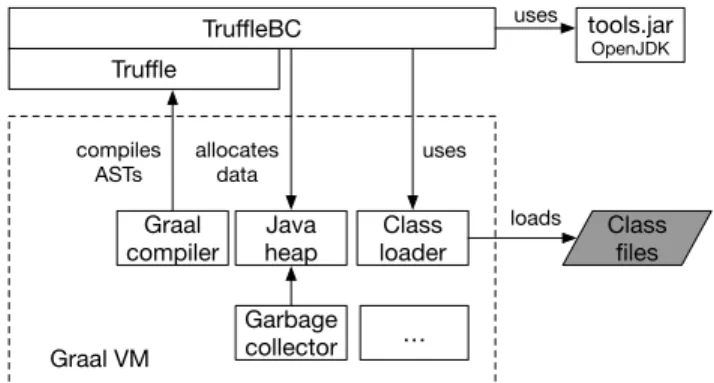
This section describes the implementation of TruleBC. It details our approach to implement an eicient execution system for Java bytecode with techniques for dynamic languages on top of Trule. A high-level overview of the architecture is given in Figure 1. TruleBC is running on the Graal VM. To load bytecode into Truf-leBC, we use the JVM class loader. However, bytecode is not directly executed on the JVM. Instead, TruleBC parses the bytecode and
Graal VM Graal compiler Garbage collector Class loader É Truffle Class Þles TruffleBC uses Java heap allocates data loads tools.jar OpenJDK uses compiles ASTs
Figure 1: Layers of a Trufle language implementation: Truf-leJava is hosted by the Trufle framework on top of the Graal VM.
transforms it to a diferent representation (see Section 2.3) which is then interpreted.
To represent Java objects, we use Trule’sDynamicObject
type (cf. Section 2.3). The stack for local variables and the operand stack are represented with Trule’sFrameobjects. Objects of type
DynamicObjectandFrameare regular Java objects that are
allocated on the heap. Hence, TruleBC reuses the garbage collector of the underlying Graal VM.
3.1
Local Variables, Operand Stack, Object
Allocations
In Java bytecode, the number of local variables as well as the maxi-mum size of the operand stack can be determined statically from the bytecode. Therefore, TruleBC allocates aFrameobject for every method invocation which is large enough to hold the local variables of this method as well as the operand stack. Taking Listing 2 and Listing 3 as an example, TruleBC allocates one slot in theFrame
to store the local variableiand another two slots for the operand stack, which has a maximum size of 2 to represent the comparison ofiand1000.
To represent a Java object as aDynamicObject, we add a slot for every ield of the object as well as a slot for its class, which is also represented as aDynamicObject. UsingDynamicObjects in-stead of a direct mapping to Java objects allows us to change the type of ields at run time, which we need in order to specialize data at run time (see Section 4).
1 public static void foo() { 2 int i = 0; 3 do { 4 i++; 5 } while(i < 1000); 6 }
Listing 2: Java function foo with a counter variable incremented in a loop. 1 iconst_0 2 istore_0 3 iinc 0, 1 4 iload_0 5 sipush 1000 6 if_icmplt 2 7 return
Listing 3: Java Bytecode of functionfoo.
1 int bci = 1; 2 while (bci != -1) {
3 int next = bcNodes[bci].execute(frame); 4 bci = bcNodes[bci].successors[next];
5 }
Listing 4: The bytecode dispatch node.
3.2
Interpretation of Java Bytecode
TruleBC provides a TruleNodeimplementation for all 198 Java bytecodes, where each node implements the semantics of the corre-sponding bytecode in itsexecutemethod. TheFrameobject of a Java function is passed as an argument to theexecutemethods, which allows them to access local variables as well as the operand stack.
To support any unstructured control low [20] that can be ex-pressed with Java bytecodes, TruleBC uses a so-calledbytecode dispatch node. This node is the root node in each function. A byte-code dispatch node has an array of nodes calledbcNodesto hold all bytecode nodes of a function. As sketched in Listing 4, the
executemethod of the bytecode dispatch node has a loop, which
executes one of the bytecode nodes in each iteration, starting from bytecode index one (bci = 1).
Each bytecode node has asuccessorsarray of indexes iden-tifying its possible successor bytecodes. Most nodes have only one successor, hence theint[]has usually only one element. Using Listing 3 as an example, the bytecodesiconst_0,istore_0,
iinc,iload_0, andsipushhave just a single unconditional
successor. In contrast to that,if_icmplthas two possible suc-cessors. Depending on the result of the comparison, the control low can be transferred to bytecode index 3 or index 7. Hence, the
successorsarray forif_icmpltis[3, 7]. The array of
successors is important for dynamic compilation (see Section 3.3); it allows the compiler to determine all possible successor bytecodes. When executing a bytecode node, theexecutemethod returns an index to thesuccessorsarray, which is then used to retrieve the successorbci. Execution continues untilbci = -1, which indicates a return statement.
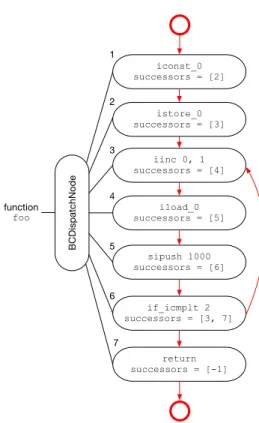
With respect to the example in Listing 3, the bytecode dispatch node transfers execution between the seven bytecode nodes with
iconst_0 successors = [2] istore_0 successors = [3] iinc 0, 1 successors = [4] iload_0 successors = [5] sipush 1000 successors = [6] return successors = [-1] BCDispatchNode function foo 1 2 3 4 5 6 7 if_icmplt 2 successors = [3, 7]
Figure 2: Trufle Graph for functionfooof Listing 3.
indices[1, 2, 3, 4, 5, 6, 7]. Figure 2 shows the byte-code dispatch node for the bytebyte-code in Listing 3 and illustrates the control low with red arrows.
Execution starts withbci = 1:iconst_0is executed. The
iconst_0node has a direct successor (bci = 2, hence the
sucessors = [2]). The bytecodes are consecutively executed
until theif_icmpltnode is reached. This node has two possible successors (sucessors = [3, 7], the loop body atbci = 3
and the loop exit atbci = 7). The bytecode dispatch node exe-cutes theif_icmpltnode and sets thebcito either 3 or 7 after accessing thesuccessorsarray. The successor of thereturn
node isbci = -1, which signals a return from the function.
3.3
Compilation
If a method has been executed for a certain number of times, Trule triggers its compilation by the Graal compiler, which inlines all
executemethods of the graph nodes and all methods they call
into a single compilation unit. When compiling the bytecode dis-patch node, Graal unrolls the loop (while (bci != -1), see Listing 4) until all paths through a function are expanded.
For the function in Figure 3, the compiler starts atbci = 1
and determines the successor of the irst node (iconst_0), which is the nodeistore_0. It then peels the irst iterations and moves the execution oficonst_0andistore_0out of the loop. List-ing 5 shows the loop after this peelList-ing. Next, the compiler peels the execution ofiinc,iload_0, andsipushout of the loop. At bytecodeif_icmpltthe compiler sees that this bytecode has two possible successors, namelybci = 3 (i.e., the loop body)
1 bcNodes[1].execute(frame); // iconst_0
2 int next = bcNodes[2].execute(frame); // istore_0
3 int bci = bcNodes[2].successors[next]; 4 while (bci != -1) {
5 next = bcNodes[bci].execute(frame); 6 bci = bcNodes[bci].successors[next];
7 }
Listing 5: Step 1: Unrolling the loop of the basic block dispatch node. 1 bcNodes[1].execute(frame); // iconst_0 2 bcNodes[2].execute(frame); // istore_0 3 merge_bci_3: 4 bcNodes[3].execute(frame); // iinc 0, 1 5 bcNodes[4].execute(frame); // iload_0 6 bcNodes[5].execute(frame); // sipush 1000
7 int next = bcNodes[6].execute(frame);// if_icmplt 2
8 int bci = bcNodes[6].successors[next]; 9 if (bci == 3) { 10 goto merge_bci_3; 11 } else if (bci == 7) { 12 while (bci != -1) { 13 next = bcNodes[bci].execute(frame); 14 bci = bcNodes[bci].successors[next]; 15 } 16 }
Listing 6: Step 2: Unrolled loop of the basic block dispatch node. 1 bcNodes[2].execute(frame); // iconst_0 2 bcNodes[3].execute(frame); // istore_0 3 merge_bci_3: 4 bcNodes[3].execute(frame); // iinc 0, 1 5 bcNodes[4].execute(frame); // iload_0 6 bcNodes[5].execute(frame); // sipush 1000
7 int next = bcNodes[6].execute(frame);// if_icmplt 2
8 int bci = bcNodes[6].successors[next]; 9 if (bci == 3) { 10 goto merge_bci_3; 11 } else if (bci == 7) { 12 bcNodes[7].execute(frame); // return 13 return; 14 }
Listing 7: Final stage: Unrolled loop of the basic block dispatch node.
andbci = 7(i.e., the loop exit). The compiler always checks if a
path has already been expanded (which is the case for successor
bci = 3). In that case it merges this path with the existing path
by inserting a backjump (goto merge_bci_3), which guaran-tees that the loop expansion terminates. Listing 6 shows the loop after peelingif_icmplt. Finally, the compiler peels thereturn
bytecode out of the loop. This bytecode node does not have any successors (indicated by a successor withbci = -1), which ter-minates the loop and the compiler inishes loop unrolling because all paths are expanded (see Listing 7). After unrolling this loop, the compiler further optimizes the code and eventually produces machine code.
3.4
Completeness
TruleBC does not yet support all Java features. Our focus was on core features of Java, which are relevant to evaluate the specializa-tion of bytecode and data at run time. Currently, TruleBC does not support:
• Relection:Java’s relection API is not yet implemented. We do not foresee any diiculties with it with respect to the focus of this paper, since solutions have already been shown for dynamic languages such as Python and JavaScript, which have similar relective capabilities.
• Multi-threading:Threading is not yet supported. While thread-safety is a major concern for optimizations as dis-cussed by Daloze et al. [7], we consider it out of scope for this paper.
• JNI:Native calls to C⁄C++ code via JNI are not yet fully supported. The C⁄C++ code is executed by Sulong [22], an implementation of C⁄C++ on top of Trule. The native in-terface itself is implemented using Trule’s cross-language interoperability mechanism [13, 14].
• Security and Serialization:In contrast to a production JVM, TruleBC does not yet implement a security manager as a production JVM does. It also does not yet support object serialization that is compatible with normal JVM semantics. However, we consider both aspects orthogonal to the ideas discussed in this paper.
4
SELF-OPTIMIZING JAVA BYTECODE
EXECUTION
A Trule language implementation uses two diferent levels of op-timization: language implementersoptimize at the graph level(i.e., they specialize nodes and data by implementing possible optimiza-tions), while the Trule framework itself providespartial evaluation and dynamic compilation of Trule trees. Optimizations at graph level allow us to apply optimizations that go beyond the current level of optimizations for statically-typed languages.
This section describes the three optimizations that we apply to Java bytecode: data specialization, specialization of reference bytecodes, and removal of autoboxing and autounboxing. To better illustrate these optimizations we use the example in Listing 1 and decompose it into the following parts:
• Listing 8: The example shows theArrayListconstructor, which allocates a newObject[]using theanewarray
bytecode.
• Listing 9: Because of type erasure,ArrayList::set re-quires anObjectargument. Hence, the Java compiler au-tomatically boxes the value42by inserting an invoke of
Integer.valueOf, which returns the boxed object
rep-resentation of42.
• Listing 10: The methodArrayList::setcontains an
aastoreinstruction that writes the value to theObject[].
• Listing 11: The methodArrayList::getcontains an
aaloadinstruction that loads the value from theObject[].
• Listing 12: The call toArrayList::getreturns a boxed integer value, which is automatically unboxed. The compiler inserts a call tointValue()on the boxed receiver value. The primitive value is then stored to variablei.
1 iload_1 // push size onto the operand stack
2 anewarray // allocate a java/lang/Object array
Listing 8: ArrayList constructor.
1 bipush 42
2 invokestatic // Method Integer.valueOf
Listing 9: Auto-boxing of argument 42 for
ArrayList::set.
1 getfield // elementData
2 iload_1 // push index argument onto the stack
3 aload_2 // push value argument onto the stack
4 aastore // store value into array
Listing 10: Array store in methodArrayList::set.
1 getfield // elementData
2 iload_1 // push index argument onto the stack
3 aaload // load element from array
Listing 11: Array load in methodArrayList::get.
1 checkcast // check if result is Integer object
2 invokevirtual // Integer.intValue
3 istore_1 // store restult into variable i
Listing 12: Auto-unboxing of return value and storing it to variablei.
4.1
Data specialization
To specialize the representation of a variable, an object ield, or an element of anObject[], we use run-time information to conirm that all previous accesses to this item have seen it as being of a speciic primitive type. If that is the case, we specialize its represen-tation and store the unboxed primitive value rather than the boxed version. TruleBC applies this specialization to all data (local vari-ables, array elements, and object ields) with a reference type. For local variables, we specialize the slots of the correspondingFrame
object according to the types of values that are written to them. For
object ields, we specialize the slots of theDynamicObjectthat is created whenever a class is instantiated. If a ield or a variable is used for diferent primitive types and⁄or reference types, we re-vert the specialization and use typeObjectinstead. This prevents re-specialization cycles and ensures that the optimization reaches a ixpoint. This strategy is identical to the one used by dynamic languages on top of Trule [29]. UninitializedFrameslots as well as uninitialized ields of aDynamicObjectare marked, which allows us to returnnullif an uninitialized value is read.
We also optimizearrayswhose element type is a reference type. The optimization is based on a simple storage strategy, similar to the approach of Bolz et al. [2] for dynamic languages. To minimize transitions between diferent storage strategies, we usetype me-mentos[6] and record the types of all values that have been stored into an array object. This type information is fed back to the allo-cation site (in our case to theanewarraybytecode, Listing 8) of the array and if it indicates that all allocated arrays only contained primitive values of the same type, new array allocations at that site will use a primitive array instead of anObject[]. We apply this specialization per allocation site. Compiler optimizations like
method inlining and splitting duplicate these allocation sites such that the specialization is performed locally for each replicated allo-cation site. For example, we aggressively inline the constructor of
ArrayList, such that diferentArrayListinstances can
spe-cialize on diferent element types. If the Java program attempts to store a value with a diferent (possibly non-primitive) type into the array later on, the array will be reverted to anObject[]. We also deoptimize toObject[]if the user program attempts to store an explicitly boxed primitive value (e.g.java.lang.Integer), i.e., a boxed value that was explicitly allocated using thenewkeyword rather than by Java’s autoboxing mechanism2. TruleBC can alter the representation of arrays at runtime by wrapping an array into a
DynamicObject. TheDynamicObjectwraps the array data
(e.g., anObject[]or anint[]in the specialized case) includ-ing type information and the initialization state of all elements in order to be able to provide the same functionality as normal Java arrays (e.g., support for type checks). Again, to prevent re-specialization cycles, we pessimistically allocateObject[]once an array specialization was reverted.
TruleBC ensures correct Java semantics by tracking whether the data has been initialized. For example, if TruleBC specializes
anObject[]to anint[], it is necessary to keep track of
unini-tialized elements because reading an uniniunini-tialized array element must returnnullrather than an integer value 0.
4.2
Specialization of reference bytecodes
We also specialize reference bytecodes so that they can work with primitive values as well. We specialize such bytecodes to a ver-sion that uses the primitive types that we observe at run time. For example, if the element value of anaastorebytecode has the primitive typeint, we specialize the instruction such that it can store the primitiveintvalue directly into an array. If the behavior of the program changes during later execution in the sense that the value of theaastoreinstruction is not primitive anymore, we revert the bytecode specialization back to the generic case that can deal with both, reference types and primitive types. TruleBC can specialize the following bytecodes to primitive types:• Array accesses viaaastoreandaaload. • Local variable accesses viaastoreandaload. • Field accesses viaputfieldorputstatic
andgetfieldorgetstatic.
• The return instructionareturn.
• The type check viacheckcastorinstanceoftreats primitive values like their boxed counterpart.
• The instructionif_acmpfor performing a reference
comparison3
2We distinguish between auto-boxing (implicit; Java inserts e.g.
java.lang.Integer.valueOf) and an allocation of an object that boxes a
prim-itive value (explicit; the Java developer writes e.g.new java.lang.Integer):
We only specialize implicitly boxed primitives to primitive values. Our optimizations do not trigger for explicitly allocated boxed primitive values.
3Regarding the object identity of boxed primitives, the Java Language Speciication
discourages ł[...] any assumptions about the identity of the boxed values on the programmer’s partž [16]. The speciication also states, that ł[...] the value p being boxed is an integer literal of type int between -128 and 127 inclusive (ğ3.10.1), [...] then let a and b be the results of any two boxing conversions of p. It is always the case that a == b.ž [16], i.e. boxed integers between -128 and 127 are cached. Moreover, the speciication mentions, that łThe implementation may cache these [boxed primitive 6
•Theisnonnullalways returnsfalseif the instruction is specialized on primitive values. Vice versa forifnull.
4.3
Removing autoboxing and autounboxing
As a last step we remove the automatic boxing of primitive val-ues. To remove autoboxing and autounboxing we substitute every function call to a boxing method (e.g.Integer.valueOf) by an identity function that directly returns the primitive argument value. Vice versa, if an unbox operation is performed on an object that has been specialized to a primitive value, we simply ignore the function call and continue with the primitive value. For example,aninvokebytecode, which would call an unboxing method (e.g.
Integer::intValue) on a specialized primitive value, will be
ignored by TruleBC. If a method (e.g.toString) is invoked on a specialized primitive value, we lazily box this value and perform a regular method call.
After data specialization, bytecode specialization, and the re-moval of autoboxing⁄autounboxing, TruleBC allows primitive values to low through a program and to be used everywhere a ref-erence is expected. These optimizations work nicely together in the
ArrayListexample of Listing 1; boxing⁄unboxing is completely
removed, reference bytecodes specialize on primitiveintvalues, and theObject[]of theArrayListinstance is specialized to
anint[].
5
EVALUATION
The main goal of the evaluation is to show that a statically-typed lan-guage like Java can beneit from optimizations originally conceived for dynamically-typed languages. For this, we focus on assessing whether specializing operations and optimizing data representation can improve the performance for code that uses Java generics.
TruleBC cannot yet run large-scale benchmark suites like SPEC-jvm or DaCapo. Hence, we decided to use smaller benchmarks and focus the evaluation on programs that heavily use generics in performance-sensitive code where the boxing of primitives causes signiicant overhead. For a fair assessment, we further want to compare benchmarks that use generics with versions of the same benchmarks that use primitive arrays directly. Benchmarks that heavily use primitive arrays (e.g. the SciMark benchmarks) it this requirement best. These benchmarks allow us to provide an al-ternative version where we replace the primitive arrays by Java’s generic collections. With these two versions of each benchmark, we can evaluate whether dynamic optimizations improve peak performance of Java code that use generics.
Benchmarks.We use benchmarks from the SciMark benchmark suite,4benchmarks from the Are We Fast Yet suite [18] and others. More speciically, our benchmarks consist of a micro benchmark that uses a bubble-sort algorithm and larger benchmarks including a Fast Fourier Transformation (FFT), a dense LU matrix factorization (LU), array permutations (Permute,Fannkuch), an n-queens problem solver (Queens), a Jacobi successive overrelaxation (SOR), and a sparse matrix multiplication (SparseMatMult). We use two diferent
values], lazily or eagerlyž [16], which is what we are doing, caching all boxed primitive values.
4SciMark 2.0, Roldan Pozo and Bruce R Miller, access date: 2015, http:⁄⁄math.nist.gov⁄
scimark2⁄index.html
versions of these benchmarks: theArraySuiteconsists of the default implementations using primitive arrays; theListSuiteconsists of modiied versions of the benchmarks usingArrayLists instead of primitive arrays.
Experimental Setup.The benchmarks were executed on an Intel Core i7-4770 quad-core 3.4GHz CPU running 64 Bit Ubuntu 16.04.1 LTS with 16 GB of memory. We base the TruleBC implementations on the Graal and Trule version that is contained in the GraalVM 0.19 release. In this evaluation we compare three conigurations
TruleBCis the Trule-based bytecode interpreter as described in this paper. However, in this coniguration we do not special-ize data or bytecodes, nor do we remove automatic boxing and unboxing. Also, in this coniguration, TruleBC does not use Trule’sDynamicObjectfor object allocations. It allocates regular Java objects and arrays and uses the
sun.misc.UnsafeAPI to access members of an object.5
TruleBC optis the same Trule-based bytecode interpreter as for TruleBC. However, in this coniguration we use Trule’s
DynamicObjectfor object allocations, we specialize data
(local variables, object members, and arrays), we specialize bytecode instructions, and also remove automatic boxing and unboxing.
HotSpot C2is a regular Java HotSpot VM 1.8.0_92 using the server compiler.
Our benchmark harness reports execution time (lower is better) for each benchmark and its coniguration. Whenever we report peak performance we executed the benchmark 1000 times with the same parameters to arrive at a stable peak performance. After these warm-up iterations (an iteration is a full run of a single benchmark), every benchmark has reached a steady state such that subsequent iterations are identically and independently distributed. This was veriied informally using lag plots [17]. After warm-up, we executed every benchmark for another 1000 iterations and calculated the average using the arithmetic mean [11]. Where we report an error interval we show the standard deviation. Where we summarize across diferent benchmarks we report a geometric mean [11].
5.1
Micro benchmark
In the irst part of our evaluation we use a micro benchmark, which sorts integer values using the bubble-sort algorithm. We evaluate two versions of this algorithm: irst we sort anint[], and then an
ArrayList<Integer>. Figure 3 compares HotSpot C2,
Truf-leBC, and TruleBC opt. We normalized the six conigurations (HotSpot C2, TruleBC, and TruleBC opt running the array ver-sion as well as the list verver-sion) to the HotSpot C2 performance running the array version of the benchmark. The x-axis of the chart shows the diferent conigurations; the y-axis shows the normalized average execution time (lower is better).
Replacing theint[]byArrayList<Integer>makes the HotSpot C2 performance 4.5x slower and TruleBC 4.2x slower. Using a generic class here introduces autoboxing⁄unboxing and stores the primitive values in anObject[]rather than anint[],
5By investigating the IR of the Graal compiler we veriied that object accesses using
sun.misc.Unsafeget compiled to the same machine code operations as a regular Java object access.
0 1 2 3 4 Arr a y Arr a yList Runtime F actor , nor maliz ed to C2 on Arr a ySuite (lo w er is better) VM Hotspot C2 TruffleBC TruffleBC opt
Figure 3: Micro benchmark (sorting an int[] and an
ArrayList<Integer>) peak performance.
which causes a signiicant performance overhead. However, Truf-leBC opt can remove this overhead almost completely and executes the version using anArrayList<Integer>almost as fast as the version using a primitiveint[]. TruleBC opt is 3.6x faster than HotSpot C2 on the list version of the benchmark. The dy-namic optimizations of TruleBC remove boxing and unboxing, specialize the reference bytecodes to the primitiveinttype, and also ensure that theArrayListis backed by anint[]rather than anObject[]. These performance numbers provide empirical evidence that the overhead, introduced by Java’s generics imple-mentation, can be removed by dynamic optimizations.
5.2
Peak Performance
In this evaluation we investigate the performance diference be-tween TruleBC and TruleBC opt on a larger set of benchmarks. We also compare them to the peak performance of HotSpot C2. For that, we use theArraySuiteand theListSuite; within each suite, we normalize numbers to HotSpot C2 performance. Figure 4 summa-rizes the individual benchmarks using box-plots; the bottom and the top of the box are the irst and third quartiles, the band inside the box is the median. The×denotes the geometric mean. Figure 5 shows the individual benchmarks; the y-axis of the charts show the average execution time (lower is better) normalized to the HotSpot C2 performance.
Let us irst consider theArraySuite; on these benchmarks the dynamic optimizations do not trigger. TruleBC opt is on average 8% slower than TruleBC. UsingDynamicObjects instead of reg-ular Java objects or arrays introduces additional indirections when accessing data. The Graal compiler applies partial escape analysis with scalar replacement [26], which aims to remove most of these indirections. If an object does not escape the compilation scope and
ArraySuite ListSuite
1 2 3 1 2 3
TruffleBC TruffleBC opt Hotspot C2
Runtime Factor, normalized to Java (lower is better)
Figure 4: Peak performance benchmark evaluation sum-mary (lower is better) of TrufleBC and T rufleBC opt, rela-tive to HotSpot C2. ArraySuite ListSuite F annkuch FFT LU P er m ute Queens SOR SparseMatMult F annkuch FFT LU P er m ute Queens SOR SparseMatMult 0 1 2 3 4 Runtime F actor , nor maliz ed to C2 on Arr a ySuite (lo w er is better) VM TruffleBC TruffleBC opt
Figure 5: Peak performance benchmark evaluation (lower is better) of TrufleBC and TrufleBC opt, relative to HotSpot C2.
can hence be removed, there is no diference in performance (e.g. Fannkuch, FFT, LU, and SOR).
However, if we consider theListSuitewhere all dynamic op-timizations trigger, TruleBC opt is 54% faster compared to the base version of TruleBC. We measure the biggest speedup on benchmarks where data access contributes signiicantly to the per-formance of an application (e.g. Fannkuch, FFT, LU, Permute, SOR). On the other hand, we measure no performance diference between TruleBC and TruleBC opt on benchmarks where data access plays a minor role (e.g. Queens or SparsematMult).
The performance numbers indicate that dynamic optimizations come with a trade-of. In the evaluation’s worst-case scenario (the ArraySuite), TruleBC opt introduces an overhead of 8% compared to TruleBC. However, in the evaluation’s best-case scenario (the ListSuite), TruleBC opt is 54% faster than TruleBC.
In order to set our numbers in relation to an industry standard JVM we also compare TruleBC and TruleBC opt to HotSpot C2. Compared to HotSpot C2, TruleBC is on average 57% (Truf-leBC) and 69% (TruleBC opt) slower on the benchmarks of the ArraySuite. A signiicant part of this overhead is caused by expen-sive method calls in Trule, which are not yet optimized by the framework. Currently, Trule method calls useObjectarrays for parameter passing, which requires allocation and boxing and is thus more expensive than method calls in HotSpot C2. Work is under way to resolve this issue, and we expect the peak performance gap between TruleBC and HotSpot C2 to be closed. This assumption is supported by benchmarks where Trule inlines all methods of the benchmark into a single compilation unit (e.g. Fannkuch, Queens, or SOR). For these benchmarks, the performance overhead is 36% in the worst case.
If we consider the benchmarks of the ListSuite, TruleBC (with-out dynamic optimizations) is slower on every individual bench-mark compared to HotSpot C2. However, TruleBC opt is able to outperform HotSpot C2 on Fannkuch (28%), LU (65%), and SOR (12%). On average, TruleBC opt is 1% faster than HotSpot C2 on the ListSuite.
5.3
Warm-up Performance
Finally, we investigate the warm-up performance of TruleBC and TruleBC opt and analyze the impact of dynamic optimizations there. We are interested in the irst 25 iterations because these iterations contain the specialization of bytecode instructions, the data specializations, and the elimination of autoboxing⁄unboxing. After 25 iterations our benchmarks are compiled and have reached their peak performance, which we informally veriied using lag plots. The charts in Figure 6 show the warm-up of TruleBC, Truf-leBC opt, and HotSpot C2 for every individual benchmark. The x-axis shows the iterations. The y-axis shows the performance of thei-th iteration normalized to the peak performance (e.g., we use TruleBCiteration=3/TruleBCpeakto compute the third value).
Data and bytecode specialization of TruleBC opt introduce an additional overhead in the irst iterations compared to TruleBC. To quantify this additional overhead, we cumulate the relative over-head to peak performance within the irst 25 iterations for each benchmark for all conigurations (TruleBC, TruleBC opt, and HotSpot C2): Warmupbench= 1 25 25 X i=1 TruleBCiteration=i TruleBCpeak
TruleBC TruleBC opt HotSpot C2 Warmupgeom 16.2x 20.5x 1.8x
Table 1: Average overhead to peak performance.
Table 1 summarizes the average overhead to peak performance on the irst 25 iterations, which is caused by warm-up. Dynamic optimizations of TruleBC opt come with a trade-of; the Truf-leBC opt warm-up overhead in the irst 25 iterations is 26% higher than that of TruleBC. The Trule framework currently focuses on
peak performance; language implementations are built on a JVM, and Trule trees start execution in HotSpot’s interpreter, which in-creases the warm-up time. Also, the Graal compiler (used to compile Trule trees to machine code) is designed to be a top-tier compiler optimizing for peak performance, which makes it comparably slow. Hence, HotSpot C2 (green line in Figure 6) has a signiicantly better start-up performance than TruleBC. All benchmarks reach their peak performance within the irst 5 iterations on HotSpot C2. For a more detailed discussion about Trule warm-up performance, we would like to refer the reader to [19].
6
RELATED WORK
Applying optimization techniques for dynamically-typed languages to statically-typed languages has a long-standing tradition [1]. The just-in-time compilation technology for SELF [27] was the founda-tion for what eventually became the HotSpot JVM [21]. In the same vein, the work presented here explores how techniques that are currently used in JavaScript and Python VMs can be used in Java. Speciically, we rely on the work on SELF’s maps [4], the Trule object storage model [29], storage strategies [2], and mementos [6]. The Trule object storage model provides the foundation for rep-resenting objects in TruleBC in such a way that type-specialization of ields can be applied at run time. Variations of this technique and SELF’s maps are widely used in JavaScript engines [5] and, for instance, in PyPy [3]. To the best of our knowledge, however, they have not been applied to statically-typed languages such as Java before. With Java’s particular design interaction of primitives and generics, Java is a language where type parameters are checked at compile time, but are absent at run time, which leaves room for dynamic optimizations.
In addition to optimizing objects, collections are of great interest, because collections are the area where Java’s generics are widely used. Storage strategies for collections provide the foundation for optimizations and have been explored for Python in PyPy [2]. They also have been applied to JavaScript, for instance in V8, where they are used in combination with type-feedback to the allocation site [6] in order to achieve optimal performance.
Approaches such as Miniboxing [28] use compiler optimizations and additional type information to generate specialized representa-tions that encode generic data structures without boxing. However, since this is a static approach it is less lexible than our dynamic approach proposed here. Furthermore, Scala uses a@miniboxed
annotation since the semantics are not transparent.
Work such as [33] and Chameleon [23] is more speciically tar-geted towards collections and provides either online or oline means to optimize them more for operations on collections in gen-eral, and thus goes beyond the type specializations demonstrated here. However, such more advanced optimizations and also the notion of just-in-time data structures [8] could be combined with the optimizations presented here.
Another aspect to be considered in our optimizations is, for instance, thread safety [7]. However, our work focused irst on the performance potential for single threaded code, and we will investigate thread safety in future work.
SparseMatMult
Queens
SOR
LU
Permute
Fannkuch
FFT
Array
ArrayList
0
5
10
15
20
25
0
5
10
15
20
25
0
5
10
15
20
25
0
5
10
15
20
25
0
5
10
15
20
25
0
5
10
15
20
25
0
5
10
15
20
25
IterationIter
ation
Time
nor
maliz
ed
to
P
eak
P
erf
or
mance
per
VM
Hotspot C2
TruffleBC
TruffleBC opt
Figure 6: Warm-up plots of ListSuite benchmarks on the irst 25 iterations.
7
CONCLUSION
In this paper we presented TruleBC, a self-optimizing Trule inter-preter, which applies dynamic optimizations to Java bytecode. We applied dynamic compilation techniques designed for dynamically-typed languages and showed that they can be successfully used for Java, e.g., to implement Java’s generics more eiciently. These optimizations include the specialization of reference bytecode in-structions to primitive types, data specialization, and the removal of automatic boxing and unboxing.
We have seen that dynamic optimizations make the interpreter more complicated. Data structures as well as the implementation of bytecode instructions must be more lexible such that they can be adapted at run time, which increases the pressure on the dy-namic compiler. Whenever the dydy-namic compiler can optimize and remove this additional complexity, we do not see a performance dif-ference between a TruleBC version without dynamic optimization and a TruleBC version with dynamic optimizations. Overall, we measured a performance overhead of 8% of TruleBC with dynamic optimizations on benchmarks where these optimizations did not trigger. However, on benchmarks where the dynamic optimizations trigger and data and bytecode can be specialized for primitive types, we measure an average speedup of 54%. On these benchmarks, Truf-leBC also outperforms HotSpot C2 by 1% on average and is up to 65% faster in certain cases.
From our work we can conclude that dynamic language im-plementation frameworks like Trule can be used to eiciently implement statically-typed languages like Java. Based on this im-plementation, we successfully demonstrated that Java programs using lexible typing (e.g., generic data types or the compatibility between primitive data types andObject) can be efectively opti-mized using compiler techniques that were originally designed for dynamically-typed languages.
ACKNOWLEDGMENTS
We thank all members of the Virtual Machine Research Group at Oracle Labs and the Institute of System Software at the Johannes Kepler University Linz for their valuable feedback on this work and on this paper. Oracle, Java, and HotSpot are trademarks of Oracle and⁄or its ailiates. Other names may be trademarks of their respective owners.
REFERENCES
[1] John Aycock. 2003. A Brief History of Just-In-Time.ACM Comput. Surv.35, 2
(June 2003), 97ś113. https:⁄⁄doi.org⁄10.1145⁄857076.857077
[2] Carl Friedrich Bolz, Lukas Diekmann, and Laurence Tratt. 2013. Storage Strategies
for Collections in Dynamically Typed Languages. InProc. OOPSLA. 167ś182.
https:⁄⁄doi.org⁄10.1145⁄2509136.2509531
[3] Carl Friedrich Bolz and Laurence Tratt. 2013. The Impact of Meta-Tracing
on VM Design and Implementation.Science of Computer Programming(2013).
https:⁄⁄doi.org⁄10.1016⁄j.scico.2013.02.001
[4] Craig Chambers, David Ungar, and Elgin Lee. 1989. An Eicient Implementation of SELF a Dynamically-Typed Object-Oriented Language Based on Prototypes. In Proceedings on Object-Oriented Programming Systems, Languages and Applications (OOPSLA). ACM, 49ś70. https:⁄⁄doi.org⁄10.1145⁄74878.74884
[5] Maxime Chevalier-Boisvert and Marc Feeley. 2016. Interprocedural Type
Spe-cialization of JavaScript Programs Without Type Analysis. In30th European
Conference on Object-Oriented Programming (ECOOP 2016) (Leibniz International Proceedings in Informatics (LIPIcs)), Vol. 56. Schloss DagstuhlśLeibniz-Zentrum fuer Informatik, Dagstuhl, Germany, 7:1ś7:24. https:⁄⁄doi.org⁄10.4230⁄LIPIcs. ECOOP.2016.7
[6] Daniel Cliford, Hannes Payer, Michael Stanton, and Ben L. Titzer. 2015. Memento
Mori: Dynamic Allocation-site-based Optimizations. InProceedings of the 2015
International Symposium on Memory Management (ISMM ’15). ACM, 105ś117. https:⁄⁄doi.org⁄10.1145⁄2754169.2754181
[7] Benoit Daloze, Stefan Marr, Daniele Bonetta, and Hanspeter Mössenböck. 2016.
Eicient and Thread-Safe Objects for Dynamically-Typed Languages. In
Proceed-ings of the 2016 ACM International Conference on Object Oriented Programming Systems Languages & Applications (OOPSLA ’16). ACM, 18.
[8] Mattias De Wael, Stefan Marr, Joeri De Koster, Jennifer B. Sartor, and
Wolf-gang De Meuter. 2015. Just-in-Time Data Structures. InProceedings of the 2015
ACM International Symposium on New Ideas, New Paradigms, and Relections on Programming & Software (Onward! ’15). ACM, 61ś75. https:⁄⁄doi.org⁄10.1145⁄ 2814228.2814231
[9] Gilles Duboscq, Thomas Würthinger, and Hanspeter Mössenböck. 2014. Specula-tion Without Regret: Reducing DeoptimizaSpecula-tion Meta-data in the Graal Compiler. InProceedings of the 2014 International Conference on Principles and Practices of Programming on the Java Platform: Virtual Machines, Languages, and Tools (PPPJ ’14). ACM, 187ś193. https:⁄⁄doi.org⁄10.1145⁄2647508.2647521
[10] Gilles Duboscq, Thomas Würthinger, Lukas Stadler, Christian Wimmer, Doug Simon, and Hanspeter Mössenböck. 2013. An Intermediate Representation for
Speculative Optimizations in a Dynamic Compiler. InProceedings of the 7th ACM
Workshop on Virtual Machines and Intermediate Languages (VMIL ’13). ACM, 1ś10. https:⁄⁄doi.org⁄10.1145⁄2542142.2542143
[11] Philip J. Fleming and John J. Wallace. 1986. How Not to Lie with Statistics: The
Correct Way to Summarize Benchmark Results.Commun. ACM29, 3 (March
1986), 218ś221. https:⁄⁄doi.org⁄10.1145⁄5666.5673
[12] Matthias Grimmer, Manuel Rigger, Lukas Stadler, Roland Schatz, and Hanspeter
Mössenböck. 2013. An Eicient Native Function Interface for Java. InProceedings
of the 2013 International Conference on Principles and Practices of Programming on the Java Platform: Virtual Machines, Languages, and Tools (PPPJ ’13). ACM, 35ś44. https:⁄⁄doi.org⁄10.1145⁄2500828.2500832
[13] Matthias Grimmer, Chris Seaton, Roland Schatz, Würthinger, and Hanspeter Mössenböck. 2015. High-Performance Cross-Language Interoperability in a
Multi-Language Runtime. InProceedings of the 11th Symposium on Dynamic
Languages (DLS ’15). ACM.
[14] Matthias Grimmer, Chris Seaton, Thomas Würthinger, and Hanspeter Mössen-böck. 2015. Dynamically Composing Languages in a Modular Way:
Support-ing C Extensions for Dynamic Languages. InProceedings of the 14th
Inter-national Conference on Modularity (MODULARITY 2015). ACM, 1ś13. https: ⁄⁄doi.org⁄10.1145⁄2724525.2728790
[15] Urs Hölzle, Craig Chambers, and David Ungar. 1992. Debugging Optimized
Code with Dynamic Deoptimization. InProceedings of the ACM SIGPLAN 1992
Conference on Programming Language Design and Implementation (PLDI ’92). ACM, 32ś43. https:⁄⁄doi.org⁄10.1145⁄143095.143114
[16] Bill Joy, Guy Steele, James Gosling, and Gilad Bracha. 2000. The Java language speciication. (2000), 768 pages.
[17] Tomas Kalibera and Richard Jones. 2013. Rigorous Benchmarking in Reasonable
Time. InProceedings of the 2013 ACM SIGPLAN International Symposium on
Memory Management (ISMM).
[18] Stefan Marr, Benoit Daloze, and Hanspeter Mössenböck. 2016. Cross-Language
Compiler BenchmarkingÐAre We Fast Yet?. InProceedings of the 12th
Sympo-sium on Dynamic Languages (DLS’16). ACM, 12. https:⁄⁄doi.org⁄10.1145⁄2989225. 2989232
[19] Stefan Marr and Stephane Ducasse. [n. d.]. Tracing vs. Partial Evaluation:
Com-paring Meta-Compilation Approaches for Self-Optimizing Interpreters. In
Pro-ceedings of the 2015 ACM International Conference on Object Oriented Programming Systems Languages; Applications (OOPSLA ’15). ACM.
[20] Jerome Miecznikowski and Laurie Hendren. 2002. Decompiling Java bytecode:
Problems, traps and pitfalls. InInternational Conference on Compiler Construction.
Springer, 111ś127.
[21] Michael Paleczny, Christopher Vick, and Clif Click. 2001. The Java Hotspot(TM)
Server Compiler. InJVM’01: Proceedings of the 2001 Symposium on JavaTM Virtual
Machine Research and Technology Symposium. USENIX Association, 12. [22] Manuel Rigger, Matthias Grimmer, Christian Wimmer, Thomas Würthinger,
and Hanspeter Mössenböck. 2016. Bringing Low-Level Languages to the JVM:
Eicient Execution of LLVM IR on Trule. InProceedings of Workshop on Virtual
Machines and Intermediate Languages (VMIL ’16). 10. https:⁄⁄doi.org⁄10.1145⁄ 2998415.2998416
[23] Ohad Shacham, Martin Vechev, and Eran Yahav. 2009. Chameleon: Adaptive
Selection of Collections. InProceedings of the 30th ACM SIGPLAN Conference on
Programming Language Design and Implementation (PLDI ’09), Vol. 44. 408ś418. https:⁄⁄doi.org⁄10.1145⁄1543135.1542522
[24] Lukas Stadler, Gilles Duboscq, Hanspeter Mössenböck, and Thomas Würthinger. 2012. Compilation Queuing and Graph Caching for Dynamic Compilers. In Proceedings of the Sixth ACM Workshop on Virtual Machines and Intermediate Languages (VMIL ’12). ACM, 49ś58. https:⁄⁄doi.org⁄10.1145⁄2414740.2414750 [25] Lukas Stadler, Gilles Duboscq, Hanspeter Mössenböck, Thomas Würthinger, and
Doug Simon. 2013. An Experimental Study of the Inluence of Dynamic Compiler
Optimizations on Scala Performance. InProceedings of the 4th Workshop on Scala
(SCALA ’13). ACM, Article 9, 8 pages. https:⁄⁄doi.org⁄10.1145⁄2489837.2489846 [26] Lukas Stadler, Thomas Würthinger, and Hanspeter Mössenböck. 2014.
Par-tial Escape Analysis and Scalar Replacement for Java. InProceedings of Annual
IEEE/ACM International Symposium on Code Generation and Optimization (CGO ’14). ACM, Article 165, 10 pages. https:⁄⁄doi.org⁄10.1145⁄2544137.2544157 [27] David Ungar and Randall B. Smith. 1987. Self: The Power of Simplicity. In
Conference Proceedings on Object-oriented Programming Systems, Languages and Applications (OOPSLA ’87). ACM, 227ś242. https:⁄⁄doi.org⁄10.1145⁄38765.38828 [28] Vlad Ureche, Cristian Talau, and Martin Odersky. 2013. Miniboxing: Improving the Speed to Code Size Tradeof in Parametric Polymorphism Translations. In Proceedings of the 2013 ACM SIGPLAN International Conference on Object Oriented Programming Systems Languages & Applications (OOPSLA ’13). ACM, 73ś92. https:⁄⁄doi.org⁄10.1145⁄2509136.2509537
[29] Andreas Wöß, Christian Wirth, Daniele Bonetta, Chris Seaton, Christian Humer, and Hanspeter Mössenböck. 2014. An Object Storage Model for the Trule
Language Implementation Framework. InProceedings of the 2014 International
Conference on Principles and Practices of Programming on the Java Platform: Virtual Machines, Languages, and Tools (PPPJ ’14). ACM, 133ś144. https:⁄⁄doi.org⁄10. 1145⁄2647508.2647517
[30] Thomas Würthinger, Christian Wimmer, Christian Humer, Andreas Wöß, Lukas Stadler, Chris Seaton, Gilles Duboscq, Doug Simon, and Matthias Grimmer. 2017. Practical Partial Evaluation for High-performance Dynamic Language Runtimes. InProceedings of the 38th ACM SIGPLAN Conference on Programming Language Design and Implementation (PLDI 2017). ACM, 662ś676. https:⁄⁄doi.org⁄10.1145⁄ 3062341.3062381
[31] Thomas Würthinger, Christian Wimmer, Andreas Wöß, Lukas Stadler, Gilles Duboscq, Christian Humer, Gregor Richards, Doug Simon, and Mario Wolczko.
2013. One VM to Rule Them All. InProceedings of the 2013 ACM International
Symposium on New Ideas, New Paradigms, and Relections on Programming & Software (Onward! 2013). ACM, 187ś204. https:⁄⁄doi.org⁄10.1145⁄2509578.2509581 [32] Thomas Würthinger, Andreas Wöß, Lukas Stadler, Gilles Duboscq, Doug Simon,
and Christian Wimmer. 2012. Self-optimizing AST Interpreters. InProceedings
of the 8th Symposium on Dynamic Languages (DLS ’12). ACM, 73ś82. https: ⁄⁄doi.org⁄10.1145⁄2384577.2384587
[33] Guoqing Xu. 2013. CoCo: Sound and Adaptive Replacement of Java Collections. InECOOP 2013 ś Object-Oriented Programming: 27th European Conference, Mont-pellier, France, July 1-5, 2013. Proceedings, Giuseppe Castagna (Ed.). Springer, 1ś26. https:⁄⁄doi.org⁄10.1007⁄978-3-642-39038-8_1