The Integration of Design Thinking and Lean
Software Development from the Perspective of
Product Owners and Scrum Masters
Master of Science Thesis
in the Management and Economics of Innovation Programme
ULRICH FRYE
TINA INGE
Department of Technology Management and Economics Division of Innovation Engineering and Management CHALMERS UNIVERSITY OF TECHNOLOGY Göteborg, Sweden, 2013
MASTER’S THESIS E 2013:089
The Integration of Design Thinking and Lean Software
Development from the Perspective of Product Owners and
Scrum Masters
ULRICH FRYE TINA INGE
Supervisor: INGO RAUTH
Examiner: MARIA ELMQUIST
Department of Technology Management and Economics Division of Innovation Engineering and Management
CHALMERS UNIVERSITY OF TECHNOLOGY Göteborg, Sweden 2013
The Integration of Design Thinking and Lean Software Development from the Perspective of
Product Owners and Scrum Masters
Ulrich Frye, Tina Inge
© Ulrich Frye, Tina Inge 2013
Master’s Thesis E 2013:089
Department of Technology Management and Economics
Division of Innovation Engineering and ManagementChalmers University of Technology
SE-412 96 Göteborg, Sweden
Telephone: + 46 (0)31-772 1000
Chalmers Reproservice
Göteborg, Sweden 2013
Abstract
Design Thinking as a managerial concept is being adopted by an increasing number of companies in various industries to boost their output of innovative products and services in order to gain a competitive edge on the market. This thesis presents an exploratory case study that was conducted at the global enterprise software producer,Software Co, who introduced Design Thinking in their software development organization in 2011. Since 2009, software development atSoftware Cohas routinely been carried out according to Lean Software Development and the Agile software
development method of Scrum.
The software development teams atSoftware Coare typically assembled in accordance with the Scrum methodology and comprise two managers, an architect, and a number of developers. The two managers have specific roles and responsibilities and are assigned the titles of Product Owner and Scrum Master. The success of integrating Design Thinking with the existing approach to develop software critically hinges on the managerial staff of these development teams. This qualitative study explored how Product Owners and Scrum Masters perceive the integration of Design Thinking with Lean Software Development and Scrum. Specific focus was placed on how Design Thinking practices integrate with Lean Software Development principles and Scrum practices.
Theoretical misalignments were identified between Design Thinking practice elements, Lean Software Development principles and Scrum practices. When investigated in practice, these
theoretical misalignments were not perceived very strongly by Product Owners and Scrum Masters. Nonetheless, practical challenges were seen to arise from the integration of Design Thinking with Lean Software Development and Scrum. By exploring theoretical disaccords in a practical setting, this thesis serves as an early step towards the development of theory regarding the successful integration of Design Thinking, Lean Software Development and Scrum.
Key words:
Design Thinking, Lean Software Development, Agile Software Development, Scrum, Product Owners, Scrum Masters
Acknowledgements
This research was conducted with the support and guidance from several individuals to whom we are truly appreciative. Our supervisor, Ingo Rauth, provided on going guidance, critical feedback, and encouragement throughout this thesis. Also, we would like to extend our gratitude toSoftware Cofor their collaboration and granting us access to conduct our interviews.
A special thank you goes to LPS and TH fromSoftware Co. LPS provided early insights which formed the foundation of this study, and established initial contacts with interviewees in India for which we are extremely grateful. TH shared his experiences about Design Thinking atSoftware Cowhich greatly enhanced our understanding of the study’s context, and we also acknowledge his efforts to connect us with potential interviewees.
Last but not least, we are very thankful to the employees within the software development
organization at
Software Co
who gave their support to our thesis by taking time to
participate in our interviews.
Göteborg, 2013 Ulrich Frye Tina Inge
Table of Contents
Abstract ... i Acknowledgements ...ii 1 Introduction... 3 1.1 Case Company ... 3 1.2 Background... 4 1.3 Purpose... 6 1.4 Research Question ... 6 1.5 Delimitations ... 6 2 Literature Review ... 6 2.1 Design Thinking ... 7 2.2 Lean Thinking ... 10 2.3 Agile... 112.4 Lean Software Development... 13
2.5 Synthesis of Design Thinking, Lean Software Development, and Scrum ... 14
2.6 Theoretical Framework ... 16
3 Methodology ... 17
3.1 Research Approach ... 17
3.2 Research Strategy... 17
3.3 Research Design: Exploratory Case Study ... 18
3.4 Sampling ... 19 3.5 Research Methods... 20 3.6 Data Collection ... 20 3.7 Quality Criteria ... 22 4 Empirical Results ... 23 4.1 Exploratory ... 24
4.2 Profile of Product Owner and Scrum Master ... 27
4.3 Perception of DT... 30
4.4 Design Thinking vs. Lean Software Development ... 32
4.5 Challenges to Design Thinking... 42
5 Analysis... 45
5.1 Lean Software Development, Scrum, and Design Thinking ... 45
6 Discussion of Results ... 50
6.2 Visualization ... 51
6.3 Synthesis... 51
7 Conclusion ... 52
8 Areas for Further Research ... 53
9 Sources ... 54
1
Introduction
Companies in all industries around the world are under immense pressure to create innovative products and services in order to be competitive in the market. The software industry is no exception to this and some companies have taken to adopting alternative approaches to traditional product development with the goal to develop more desirable offers.Software Cois one of the leading enterprise software vendors worldwide and in 2011 began to formally introduce Design Thinking (DT) into their development organization. Although applied for over two years to the software
development context atSoftware Co, the understanding of DT and its addition to traditional
approaches to software development is still in its infant phase. Thus,Software Cowas chosen as the organization to study because it is an early adopter of DT in the software industry.
Hildenbrand and Meyer (2012) conducted a pilot case study to understand, primarily, the synergies involved in intertwining DT with Lean Software Development (LSD) and the Scrum process framework mostly from a process perspective. However, a gap in this research was identified as any
misalignments between the approaches from an individual Scrum team member’s perspective were not studied. Given the influence a Product Owner (PO) and Scrum Master (SM) possess as leaders on a Scrum team in software development companies, it is valuable to understand their perception of how DT integrates with LSD and the Scrum process framework.
The main contribution of this thesis is to provide a theoretical and empirical analysis on how DT, LSD, and the Scrum process framework align from the PO’s and SM’s perspective. This specific area might be useful for researchers interested in the overall understanding of how DT can migrate from the design industry into the software development industry, similar to how Lean and Agile migrated from the manufacturing industry to the software development industry.
1.1
Case Company
Software Cois a global leader in enterprise software development and associated services with more than 50,000 employees located in multiple countries. Software development takes place in their development labs which are distributed in various countries globally. Their software products are used by more than 200,000 customers around the world.
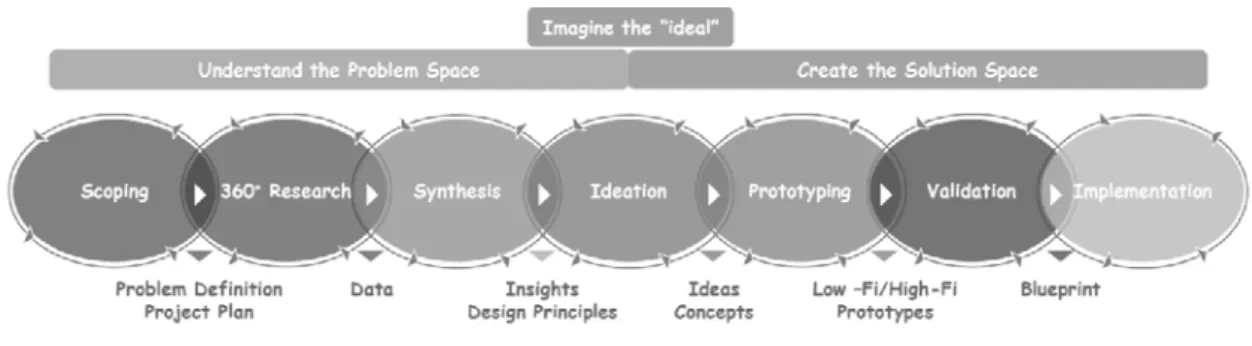
To create innovative products to serve their global customer base,Software Cohas adopted DT. DT is defined onSoftware Co’s website as a routine innovation methodology that enables the two halves of the human brain to act in synergy, effectively combining its creative and analytical capabilities. In terms of practical execution, the general DT approach as practiced atSoftware Cois shown in Figure 1 below. The approach illustrated below is highly iterative and allows returning to previous activities or phases should the need be identified based on insights gained at any stage.
Figure 1: DT process
DT was rolled out atSoftware Coin three different waves. The first wave of DT projects started in 2011 atSoftware Co’sfacilities in Germany, while the second wave of DT projects commenced in 2012 and primarily involvedSoftware Cooffices in Germany, India, and China. Finally, the third wave of DT projects started at the end of 2012 and is ongoing.
1.2
Background
DT has risen as a management concept promising increased innovativeness through a user centered approach to innovation. DT has its origins in the design realm but has entered the management realm and gained considerable acceptance as an approach to product development and problem solving (Hassi & Laakso, 2011). Various companies in different industries have taken to using DT in their product development practices to complement and enhance their existing approaches. The concept of Lean Thinking originated in the automotive industry and described the production management system at Toyota along with manufacturing techniques (Stone, 2012). It has since penetrated into all areas of management and is primarily concerned with waste and value in organizational operations, with the goal of minimizing the former and only retaining activities contributing to the latter (Poppendieck & Cusumano, 2012; Stone, 2012).
Just as Lean Thinking, the term Agile also came from the manufacturing sector and refers to a producer’s flexibility to respond to changes in an unstable environment and customer needs (DeVor, Graves, & Mills, 1997; Poppendieck & Cusumano, 2012). The need for increased flexibility and responsiveness to customer requests was subsequently identified in software development settings and a group of developers created a manifesto based upon a number of agile principles that were specifically adapted to software development (Beck et al., 2001; Highsmith, 2001). Within Agile several methods have been created that aim at making the development process more responsive and flexible (Wölbling et al., 2012).
One specific method of Agile is the process framework of Scrum. The Scrum process framework prescribes the composition of development teams, events in the process, and tangible objects (Schwaber & Sutherland, 2011). Two roles within the Scrum team are of particular interest: the SM and the PO. Individuals filling these roles have specific managerial duties to carry out and principles to adhere to; the primary responsibility of the PO is the functionality of the product and the value it creates for all stakeholders, while the SM is concerned with the execution of the project and smooth running of the process (Schwaber & Sutherland, 2011).
LSD and Scrum have been combined successfully within the software development industry and have become common practice. DT has grown from the design discipline into the management disciple.
These approaches, as separate entities, have been implemented and documented from practitioners’ perspectives but there is little evidence of their detailed study in academic literature. There is even less literature, from either a practitioner or academic perspective that focuses on understanding the combination of DT, LSD, Scrum approaches in product development.
Approximately four years ago,Software Cointroduced an approach to their software development that is founded upon LSD principles, and is executed through the Scrum process framework and in 2011,Software Costarted an initiative to roll out DT throughout its development organization. Hildenbrand and Meyer (2012) investigated DT and LSD in combination on Scrum teams, but other previous studies on the topic were not evident from a thorough literature search. In their book chapter,Intertwining Lean and Design Thinking,Hildenbrand and Meyer (2012) take a holistic perspective to understand if and how these approaches to software development can be combined or whether DT is simply a substitute for LSD on a Scrum team. The authors concluded that these approaches to software development can be intertwined, as opposed to DT becoming a substitute or replacement and suggested a process showing how DT can be intertwined with LSD on a Scrum team. While the work of Hildenbrand and Meyer (2012) is a valuable early contribution to gain
understanding towards the combination of DT and LSD on a Scrum team in software development projects, there are aspects in the study that raise questions and warrant further investigation. The book chapter in question describes the study of a single software development project within a global enterprise software company. First, one single case is only a starting point in understanding if the combination of DT and LSD on Scrum teams are indeed complementary approaches as they were claimed to be. It is therefore questionable if the findings can be considered valid for any other, let alone all, software development projects that utilize these approaches, both within their case company and the wider industry. Second, the investigated case itself does not appear to be quite representative of a real development project as it would generally be carried out within software development companies, because the customer here was a sailing team sponsored by the developing company itself, for a specific event. Naturally, that specific company had a great interest in the success of the project:“Besides the classical support of a sponsor, SAP is particularly interested in showcasing its technology...”(Hildenbrand & Meyer, 2012, p. 221). Since the project was a showcase, it may be considered limited in its comparability to software development projects for industry customers within the software industry at large.
Besides the limitations outlined above, Hildenbrand and Meyer (2012) mostly took a process perspective of the combined approaches and the methods within. Whilst this angle is entirely legitimate, it leaves room for expansion. Another interesting aspect for investigation concerns the individuals that are working on the software development Scrum teams and their perception of the combined approaches. In particular, team members with managerial duties and responsibilities for the success of the projects and their understanding of the combined approaches appear to be worthwhile studying because the success of the integration of DT hinges critically on those. As outlined earlier, these individuals in question are POs and SMs.
Based upon working within the LSD and Scrum approach atSoftware Co, experienced SMs and POs are likely to have acquired certain ways of working and gained experience according to the
asSoftware Cois rolling out DT throughout their software development with the goal of creating more desirable and innovative software products.
This thesis investigated the combination of LSD and DT on Scrum teams in software development projects, as perceived by managerial staff composed of POs and SMs. Particular emphasis is put on the alignment of underlying LSD principles and Scrum practices with the DT practice elements. Thus, a case study was conducted withinSoftware Coto initially explore the topic; the study and its findings are described in the following chapters.
1.3
Purpose
The purpose of this thesis is to contribute to the academic understanding of the combination of LSD and DT on Scrum teams. Given the limited research on the subject, this study primarily builds upon the DT work by Hildenbrand and Meyer (2012). It contributes by investigating the integration of the above approaches from the perspective of managerial staff on Scrum teams who are responsible for the success of software development projects.
1.4
Research Question
Based on the current state of academic literature concerning LSD and DT a need has been identified to further study the combination of these in a practical setting such as software development. This need for understanding is particularly obvious when considering individuals who have significant experience in managing software development projects according to LSD principles on Scrum teams, and are responsible for the integration of DT into this existing approach. In order to explore the topic and gain an initial understanding from the perspective of these individuals leading the LSD and DT activities on Scrum teams atSoftware Co, the following research question is answered by this study:
How do the DT practice elements of end user empathy, visualization, and synthesis integrate with LSD and the Agile method of Scrum from the perspective of Product Owners and Scrum Masters?
1.5
Delimitations
This study investigated the use of DT on software development projects atSoftware Co. Thus, the scope of the study was limited to only cover a single company; within the company, only the
software development organization was studied even though DT is being utilized in other parts of the company as well. This was deemed appropriate because this thesis contributes to the general field of innovation management, and DT in the software development organization atSoftware Cowas introduced to improve the innovativeness of their software products.
The development organization atSoftware Cois dispersed globally; for the reason of access provided, this investigation only covered development labs in India and Germany. Cultural aspects, both organizational and ethnical, were not considered in this research. The units of analysis were individuals filling managerial roles on software development teams, other team members or staff outside these teams were not considered.
2
Literature Review
This chapter introduces the literature and theories pertaining to this exploratory case study. Overviews are provided about the history and current states of knowledge and practice about DT,
Lean Thinking, Agile, and LSD approaches as well as the Scrum process framework for software development. The above approaches are utilized bySoftware Coin their software development activities, with DT being the latest addition.
2.1
Design Thinking
Herbert A. Simon applied the notion of design as a way of thinking to the design realm in the 1960s, more recently it has been applied to the management realm by both academics and practitioners (Hassi & Laakso, 2011; Simon, 1969). Within the academic realm, DT in terms of how designers think has been discussed and described for over thirty years (Johansson, Woodilla, & Çetinkaya, 2011). However, the application of the way designers think to the management realm is fairly new but growing in importance, partially due to the view that“design has become too important to be left to designers”(Brown & Katz, 2011, p. 381).
Johansson Sköldberg, Woodilla, and Çetinkaya (2013) argue there are the following two discourses on DT: scholarly and management. The scholarly discourse refers to designerly thinking theory to practice and is academically founded in the field of design whereas the management discourse applies to design practices and competences outside of the design field (Johansson Sköldberg et al., 2013). This study focused on DT elements applied to management roles within the software
development industry. Therefore, only the management discourse on DT is discussed as the designerly thinking discourse is outside the scope of this research. However, it is important to note that there are discourses in the design realm that concentrates on the skills and abilities of designers, for example (Simon, 1969), that could be used to further investigate but given the choice to focus on the management realm this is also outside of the scope for this thesis.
2.1.1 Definitions
The term DT does not have a well defined meaning but is used in a variety of ways and multiple contexts. Moreover, the term is becoming increasingly ubiquitous (Kimbell, 2011). In general terms, DT is thought of as having two main aspects: a user centric philosophy or approach to problem solving (Brown, 2008; Dunne & Martin, 2006; Hassi & Laakso, 2011; Kimbell, 2011; Seidel & Fixson, 2012).
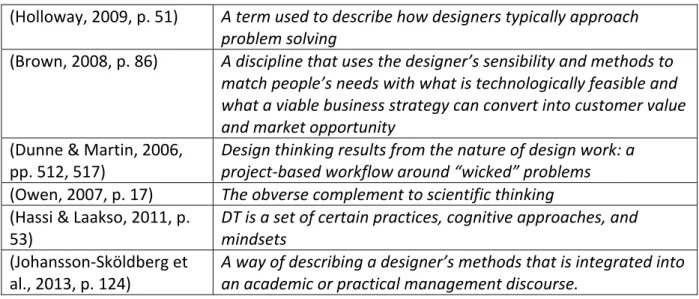
Table 1 lists a selection of definitions given in literature for DT. However, it is important to note that defining DT into a singular definition can be considered a futile effort because there are many different discourses on design and it is inherently individualistic based on the designer as eloquently stated by Johansson Sköldberg et al. (2013, p. 14)“to talk about design and leaving the designer out is like talking about music and leaving the musicians out.”
Table 1: Design Thinking Definitions
(Holloway, 2009, p. 51)
A term used to describe how designers typically approach
problem solving
(Brown, 2008, p. 86)
A discipline that uses the designer’s sensibility and methods to
match people’s needs with what is technologically feasible and
what a viable business strategy can convert into customer value
and market opportunity
(Dunne & Martin, 2006,
pp. 512, 517)
Design thinking results from the nature of design work: a
project based workflow around “wicked” problems
(Owen, 2007, p. 17)
The obverse complement to scientific thinking
(Hassi & Laakso, 2011, p.
53)
DT is a set of certain practices, cognitive approaches, and
mindsets
(Johansson Sköldberg et
al., 2013, p. 124)
A way of describing a designer’s methods that is integrated into
an academic or practical management discourse.
2.1.2 Processes
As stated above, DT can be described in a general sense, rather than a singular specific definition, as using a user centric approach to solve problems (Dunne & Martin, 2006). However, in both academia and practice, there is attention given to understanding the specific process associated to DT but similar to the definition there is not a singular universal process for DT but rather there seems to be underlying commonalities or elements associated to these processes. While it is important to have a general understanding of processes associated with DT, for this thesis the underlying commonalities or elements of DT mentioned below are the main lens used in answering the research question.
2.1.3 Elements
Hassi and Laakso (2011) conducted an extensive DT literature study of 50 books or articles, of which they used 31, to create a three dimensional framework for the different elements associated to DT. This framework assigned three main DT categories that have related DT elements. These categories arePractices, Cognitive Approach, and Mindset(Hassi & Laakso, 2011). This research will focus on the practice category as opposed to the cognitive approach or mind set categories since this is the most relevant category for answering the research question. This exploratory case study is concerned with looking at how individuals work and the tangible approaches they use, as given in the practice category, rather than different styles or ways of thinking given in either the cognitive or mindset categories (Hassi & Laakso, 2011).
Moreover, as stated in the below literature section for LSD and Scrum, these two approaches to software development focus more on the tangible ways of working, activities, and use of specific artifacts. As a result, using the elements given in the below section for the DT practice category was a comparable level of analysis.
2.1.4 Practices
DT practices can be described as“tangible approaches, ways of working, activities, and the use of specific tools”(Hassi & Laakso, 2011, p. 55). There are five main elements that are considered by Hassi and Laakso (2011) to be DT practices: human centered approach, thinking by doing, visualizing, synthesis, and collaborative work style. These are further elaborated on below.
1. Human Centered
The human centered approach puts people first by developing empathy for and understanding of the customer and/or users. Observation and ethnography are the key methods used in developing the emphatic understanding. DT is often referred to as customer, user or human centric design as this is one of the most prominent issues highlighted in DT literature (Hassi & Laakso, 2011).
2. Thinking by doing
Thinking by doing is a tangible and iterative approach that creates knowledge in a practical manner by a rapid, systematic, and iterative process. Thinking by doing involves creating continuous prototyping that helps in ideation. Prototypes are seen as a tool to help both develop and explore ideas instead of being direct representations of the product (Hassi & Laakso, 2011).
3. Visualizing
Visualizing is how one expresses and makes sense of things in DT by using any media outside of words and symbols. Visualizing allows a common understanding of ideas so that they can be discussed and shared (Hassi & Laakso, 2011).
4. Synthesis
A divergent and convergent approach or sometimes referred to as synthesis involves coming to a solution by broadening the scope and then narrowing it by using selection and synthesis. DT typically starts using a divergent approach to allow for multiple alternatives or ideas to be considered instead of taking the initially best idea. The divergent approach is not limited to the beginning but can be used throughout DT. The convergent approach then allows for patterns and relationships to be discovered (Hassi & Laakso, 2011).
5. Collaborative work style
Hassi and Laakso (2011) noted that virtually all DT authors place an emphasis having a collaborative work style in DT. A collaborative work style involves having a wide range of stakeholders. Moreover, collaborative thinking is by thinking outside of your own head by interacting with others (Hassi & Laakso, 2011).
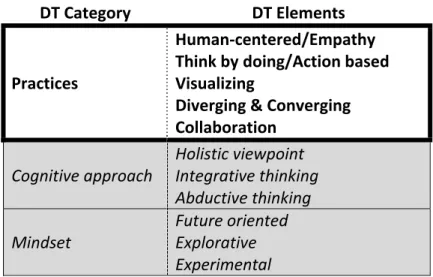
As stated above, DT has started to diffuse into the management discourse from the design world. The basics of DT include empathy and understanding toward the user and a human centered
philosophy. The elements of DT can be classified into three categories: practices, cognitive approach, and mindset (Hassi & Laakso, 2011). These DT categories along with the related elements are
Table 2: DT Elements and Categories according to Hassi and Laakso (2011)
DT Category
DT Elements
Practices
Human centered/Empathy
Think by doing/Action based
Visualizing
Diverging & Converging
Collaboration
Cognitive approach
Holistic viewpoint
Integrative thinking
Abductive thinking
Mindset
Future oriented
Explorative
Experimental
2.1.5 SummaryAs explained above and illustrated in Table 2, this paper’s focus is on the DT elements in the practices category as summarized in the extensive literature review conducted by Hassi and Laakso (2011). This viewpoint will allow the study to have the tangible ways that POs and SMs work as the level of analysis and to look at their perception of DT from a practice perspective, rather than make a comparison of the associated DT processes or methods.
2.2
Lean Thinking
Lean Thinking has its origin in the automotive production industry in Japan. The termLeanwas first used in connection with production management practiced at Toyota and has continued to evolve for several decades (Hines, Holwe, & Rich, 2004; Poppendieck & Cusumano, 2012; Stone, 2012). The more specific termLean Productionoriginally described manufacturing techniques (Stone, 2012) and was then expanded to describe“any efficient management practice that minimized waste, including in product development”(Poppendieck & Cusumano, 2012, p. 26).
On the most basic level, Lean Thinking distinguishes between waste and value in an organization’s operations. As defined by Womack and Jones (1996) in Stone (2012, p. 114), waste is“any human activity which absorbs resources but creates no value”and value denotes“a capability provided to a customer at the right time at an appropriate price, as defined in each case by the customer”.
Moreover, the most basic premise of Lean Thinking is to actively identify and eliminate waste from the firm’s processes with the goal of only retaining activities that add value (Stone, 2012). All in all, five basic principles of Lean Thinking were proposed by Womack and Jones (1996) and are listed by Haque and James Moore (2004, p. 3) as:
Specify value: define value precisely from the perspective of the end customer in terms of a specific product with specific capabilities offered at a specific price and time.
Identify the value stream and eliminate waste: identify the entire value stream for each product or product family and eliminate waste.
Make the value flow: make the remaining value creating steps flow.
Let the customer pull the (value) process: design and provide what the customer wants only when the customer wants it.
Pursue perfection: strive for perfection by continually removing successive layers of waste as they are uncovered.
Poppendieck and Cusumano (2012) elaborate further that Lean Thinking emphasizes foremost the decrease in waste related to resources in terms of time and staff and at the same time promotes the creation of value for the customer and the company through products. Additional benefits of Lean Thinking are those associated with a“more flexible, iterative, lightweight development process”(p. 27). Furthermore, value is also increased by adding features or services that are valued by customers but do not contribute to the internal waste, e.g. shortened delivery times (Hines et al., 2004).
2.3
Agile
Similar to Lean Thinking, Agile also has its origins in the manufacturing industry (Poppendieck & Cusumano, 2012) and basically describes a producer’s ability to be flexible in order to be successful in an environment of continuous change (DeVor et al., 1997). This need for the ability to respond to changes was identified for and applied to a software development setting when seventeen software experts draftedThe agile software development manifesto(Highsmith, 2001), which was founded upon twelve underlying principles.
2.3.1 Agile Software Development Principles
The agile software development manifesto was built on the following twelve principles (Beck et al., 2001):
“Our highest priority is to satisfy the customer through early and continuous delivery of valuable software.”
“Welcome changing requirements, even late in development. Agile processes harness change for the customer's competitive advantage.”
“Deliver working software frequently, from a couple of weeks to a couple of months, with a preference to the shorter timescale.”
“Business people and developers must work together daily throughout the project.” “Build projects around motivated individuals. Give them the environment and support they need, and trust them to get the job done.”
“The most efficient and effective method of conveying information to and within a development team is face to face conversation.”
“Working software is the primary measure of progress.”
“Agile processes promote sustainable development. The sponsors, developers, and users should be able to maintain a constant pace indefinitely.”
“Continuous attention to technical excellence and good design enhances agility.” “Simplicity the art of maximizing the amount of work not done is essential.”
“The best architectures, requirements, and designs emerge from self organizing teams.” “At regular intervals, the team reflects on how to become more effective, then tunes and adjusts its behavior accordingly.”
2.3.2 Agile Software Development Methods
Within the overall agile software development approach, several specific methods such as Scrum and Extreme Programming have emerged with the goal of making the software development process more responsive and flexible (Wölbling et al., 2012). In the following section, Scrum is further
elaborated on because it is one of the most used agile methodologies in software development (del Nuevo, Piattini, & Pino, 2011) and has managerial aspects attached to it (e.g. Pries & Quigley, 2011). The Scrum method is utilized bySoftware Coin their development activities.
Scrum
Scrum is defined by its creators as“a process framework ... used to manage complex product development”(Schwaber & Sutherland, 2011, p. 3), and has also been described as a method to manage projects that is focused on immediate objectives and deliverables of involved people (Pries & Quigley, 2011). As such, it is not a process or technique for building products but rather a
management framework to develop and sustain complex products such as software by employing an iterative and incremental approach (Schwaber & Sutherland, 2011). Scrum is also not a complete methodology since it does not include specific practices. Instead, it aims to optimize the process of software development within the overall value stream (Poppendieck & Cusumano, 2012). The Scrum process framework encompasses various events, roles of members in Scrum teams, and artifacts. Scrum events are sprints, spring planning meetings, daily scrums, sprint reviews and sprint retrospectives. The primary events are the sprints, which are blocks of time lasting four weeks or less, in which programming takes place and aim to result in working software releases which can be inspected and tested by end users (Maylor, 2010; Schwaber & Sutherland, 2011). These releases are typically presented at sprint reviews that follow each sprint and allow frequent customer feedback on functionality, which in turn influences subsequent priorities (Rising & Janoff, 2000).
A Scrum team is typically cross functional and comprised of the development team, the PO, and the SM. The development team is self organizing with members possessing the necessary skills to deliver the final product. Recommended team size ranges between three and nine members, not counting the PO and SM (Schwaber & Sutherland, 2011).
The PO is responsible and accountable for deciding what needs to be done, i.e. managing the product backlog. By performing his/her duties, the PO’s main undertaking is to maximize the value of both the product and the development team (Poppendieck & Cusumano, 2012; Schwaber & Sutherland, 2011). As such, in a larger organizational context, the PO can be seen as the link between the
development organization, the wider organization, and external entities. The SM’s role is to make the process run as smoothly as possible and continuously improve it along the way by, for example leading meetings and tracking progress.(Rising & Janoff, 2000). Specifically, the SM provides his/her services to the PO, the development team and the organization at large (Schwaber & Sutherland, 2011).
Scrum artifacts serve to make the development process more transparent, make key information visible and thus allow inspection and adaptation. The three types of artifacts are product backlog, sprint backlog and increments. An artifact of key importance is the product backlog which is defined as“an ordered list of everything that might be needed in the product and is the single source of requirements for any changes to be made to the product”(Schwaber & Sutherland, 2011, p. 12). The product backlog is continuously evolving and as such is never complete. It is the sole responsibility of the PO to manage the product backlog, prioritize items in it and ensure they are addressed by the team (Schwaber & Sutherland, 2011).
2.3.3 Summary of Lean Thinking and Agile
As stated above, both Lean Thinking and Agile have their origin in the manufacturing industries and have subsequently made their way into different settings which include the software development industry. The main premise of Lean Thinking is to make the value stream more efficient by
eliminating any processes that do not add value. The main idea behind Agile is for an organization to be more responsive in continuously changing environments.
Simply put, both Lean Thinking and Agile put the customers and their satisfaction first but they do so in different manners. While Lean Thinking emphasizes efficiency and planning, Agile builds upon customization resulting from close customer contact and interaction. But as proven in practice, it is possible to optimize Agile operations based on Lean Thinking, especially in the software development industry where this combination has been practiced since the early 2000s. By operating in short and iterative cycles that produce working software, users can be involved frequently to enable
identification of customer value and respond to updated requests (Wölbling et al., 2012).
2.4
Lean Software Development
In the early 2000s, Lean Thinking started to diffuse into areas outside of the manufacturing industry such as logistics, military, construction and services. As a result, this delivered proof that in practice Lean Thinking is applicable across various fields (Hines et al., 2004; Poppendieck, 2002). Although Lean Thinking originally related to practices particular to the automotive manufacturing industry, it could be transferred into other settings by viewing it as a set of principles or concepts rather than specific practices (Poppendieck & Cusumano, 2012). Based on this view, Lean Thinking entered the software development via Agile practices (Hildenbrand & Meyer, 2012), because there are many similarities and analogies between their respective elements (Poppendieck & Cusumano, 2012). By integrating Agile and Lean Thinking, seven principles for LSD were proposed in 2003 and have since become popular in the software industry (Poppendieck & Cusumano, 2012). The seven principles for LSD are (Poppendieck & Cusumano, 2012; Poppendieck.LCC, 2010):
1. Optimize the whole: LSD should be founded on a deep understanding of a job that customers would like done and how this job might be mediated by software.
2. Eliminate waste: waste is anything that doesn’t either add customer value directly or add knowledge about how to deliver that value more effectively.
3. Build quality in: continuously integrate small units of software into larger systems to avoid finding defects in the final verification.
4. Learn constantly: development is all about creating knowledge and embedding that knowledge in a product; delay irreversible decisions to the last responsible moment, based on best available knowledge.
5. Deliver fast: think of software as a flow system where software is designed, developed, and delivered in a steady flow of small changes based on deep understanding of what
stakeholders’ value.
6. Engage everyone: empowering people, encouraging teamwork, and moving decision making to the lowest possible level by composing multidisciplinary teams encompassing the
complete value stream.
7. Keep getting better: failure is a learning opportunity and should be used to challenge and improve existing standards based on the scientific method.
These seven principles for LSD do not offer much in the sense of particular roles and responsibilities of individuals. Instead, they focus on how to operate in an organizational setting of software development, while the Agile method of Scrum gives clearly defined roles including the PO and SM. To summarize, LSD focus is on practices, or how to operate in an organizational setting for software development, again this makes the practice category for DT the appropriate category for
comparison.
2.5
Synthesis of Design Thinking, Lean Software Development, and Scrum
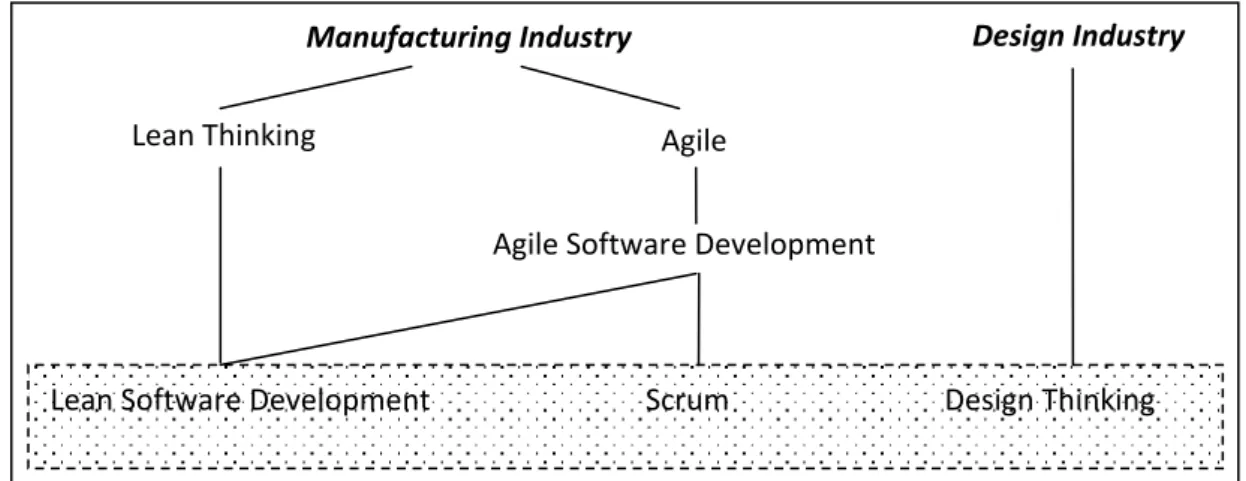
A visual representation of the above descriptions for the development of Lean Thinking and Agile into the software development industry is shown in Figure 2. The context studied in this thesis project is concerned with DT being integrated with LSD and Scrum.
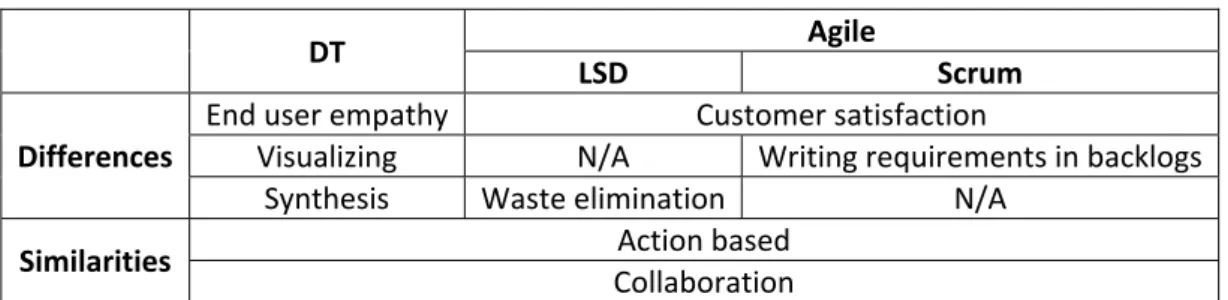
To understand the integration of LSD, Scrum, and DT, the five DT practice elements as given by Hassi and Laakso (2011) are compared below with the seven LSD principles and the Scrum practice of writing backlogs and engaging customers. The comparison is done to identify any synergies and discrepancies between those.
Lean Thinking Agile
Agile Software Development
Lean Software Development Scrum Design Thinking
Manufacturing Industry Design Industry
Figure 2: Context of study (shaded area investigated atSoftware Co)
DT has a clear human focus which is practiced by deeply empathizing with the user of the final product. On the surface this aligns well with LSD and Scrum. The first principle of LSD, optimizing the whole, requires a thorough understanding of what job the customer is trying to accomplish. As stated, Scrum is an Agile method and is therefore build on the premise of being flexible and responsive. This requires a good knowledge of what the customer values, which is to be gained through frequent testing of working software releases by end users. However, a discrepancy exists in that DT focuses on empathy to find latent needs while LSD’s and Scrum’s focus is on the customer satisfaction. A second discrepancy is that when taken at face value, it seems that LSD and Scrum are focused on the customer rather than the end user. Whilst no specific mention of end users is apparent in LSD, Scrum does mention the end user for testing of software releases, but only for the purpose of gaining customer feedback, judging customer satisfaction and adjust priorities for subsequent development which are arguably very different notions than empathizing with humans using a product or service. Nevertheless, owing to a lack of clear definition of the term customer, end users may be included in it. However, the customer and user are rarely the same in the enterprise software development industry and the customer may be unaware of what the actual user does value. Therefore, a potential misalignment exists in that DT places emphasis on finding latent needs
of end users, while LSD and Scrum are focused on customer satisfaction and do not explicitly mention end user empathy.
Collaboration in DT refers to working in multi disciplinary teams to achieve the desired outcome. This practice matches well with Scrum which calls for self organizing teams composed of members that bring all necessary skills to the project, and value is put on individuals and interactions. The LSD principle of engaging everyone in the entire value stream to deliver the product is also quite easily equated with the meaning of collaboration in DT, but could be interpreted as having a wider scope. The DT practice element of visualizing facilitates easier communication, for example through
storyboards. On the contrary, Scrum calls for product backlogs as written lists of all requirements and specifications for the product being developed. If DT precedes the actual software development phase according to the Scrum framework, the generated storyboards could be considered a precursor or foundation for the product backlogs. Even though the backlog may build on, or evolve from a storyboard, the process of generating each is quite different. None of the LSD principles is in agreement or in discrepancy with visualizing in DT.
DT is an action based approach, including the rapid creation of prototypes throughout the process. Two of the goals of prototyping are to learn and fail quickly and cheaply. These two are in perfect alignment with the LSD principles of delivering fast, learning constantly, and continuously getting better by considering failure as a learning opportunity. Although it could be argued that failure is waste and as such opposes the second principle of LSD, it reasons that early and cheap failure is still less wasteful than later failures which are more costly. The Scrum methodology aims at producing working software releases, which requires the action of programming. Thus, if working software is analogous to prototypes, then Scrum is also an action based approach and this practice aligns well with DT.
Perhaps the biggest conflict exists between DT and LSD when the DT practice of converging and diverging is considered. It is most apparent during the ideation mode of DT, where the primary objective is to create large amounts of ideas. A large amount of ideas implies by necessity that some, if not most, of those ideas will be discarded. When thinking in Lean terms, discarding anything is a waste and thus the ideation mode in DT violates the underlying fundamental premise of LSD – eliminating waste. Moreover, it can be questioned to what extent the iterative DT practice of converging and diverging ultimately adds value to any stakeholders. Converging and diverging may occur to some extent during the execution in Scrum mode; however, here any changes usually originate from external sources, i.e. the customers, while in DT the internal team itself is required to converge and diverge on their own accord and based on their own research. The comparison of DT, LSD, and Scrum discussed above are summarized in Table 3 for clarity.
Table 3: Summary of DT, LSD, and Scrum
DT Agile
LSD Scrum
Differences
End user empathy Customer satisfaction
Visualizing N/A Writing requirements in backlogs
Synthesis Waste elimination N/A
Similarities Action based
Hildenbrand and Meyer (2012) have investigated the combination of DT with LSD on Scrum teams and have found a number of commonalities in fundamental values. As outlined above, these include the collaboration of multi disciplinary teams, value for both the business and customers, and their iterative nature. Further, the authors argue that DT and LSD address“different challenges and aspects in a development project lifecycle”(Hildenbrand & Meyer, 2012, p. 219). Quite correctly they point out that LSD is concerned with execution aspects such as delivering high quality in a timely fashion. DT on the other hand is focused on what to execute or deliver, i.e. ensuring that the product is indeed of value to the customer.
A next logical step to build upon the study is to critically assess and investigate any challenges that arise from the combination of DT and LSD on Scrum teams, particularly to the individuals, POs and SMs, which are in charge of running these Scrum teams. Based on their experience in carrying out these roles, they have attained certain practices and ways of working. With the introduction of DT in addition to LSD on Scrum teams, these individuals are potentially facing challenges that originate from the contradicting requirements as outlined above. While the elements may not be mutually exclusive, there could nonetheless be difficulties in adapting to DT and integrating it with LSD on Scrum teams.
2.6
Theoretical Framework
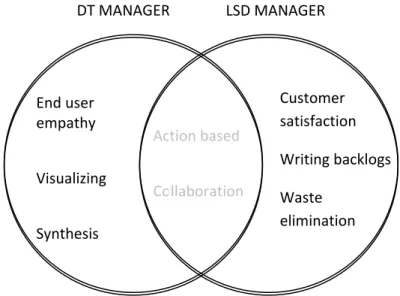
Following the investigation and analysis of the literature, the theoretical framework presented in Figure 3 below has been developed. The focus of the framework lies with individuals rather than the processes or approaches. The individuals of concern are those that take on the roles of SM and PO according to the Scrum process framework. In the previous LSD only approach, they are referred to as LSD manager. With the addition of DT to development projects, they should also adopt the elements included in the DT manager role. The focus of this thesis was placed on the identified misalignments; therefore, the overlapping elements of action based and collaboration were not specifically addressed during the data collection.
Based on the above theoretical framework, the following study investigates the addition of DT to the existing LSD approach on Scrum teams atSoftware Cofrom the perspective of POs and SMs. The
Customer satisfaction Writing backlogs Waste elimination Action based Collaboration End user empathy Visualizing Synthesis DT MANAGER LSD MANAGER
investigation is concerned with how these individuals perceive the addition of DT and its effect on their way of working. Studied in detail are the theoretical misalignments between the following DT practice elements and LSD principles and Scrum practices: (1) End User Empathy vs. Customer Satisfaction (2) Visualizing vs. Writing Backlogs (3) Synthesis vs. Eliminating Waste
3
Methodology
This chapter aims to explain the design and methods used to answer the research question.
Moreover, the purpose of the method and sampling structure will be discussed. Also, a description is provided on how data was collected and the validity and reliability of the gathered information is discussed.
3.1
Research Approach
The first step in research is typically to decide between two types of reasoning, deductive and inductive, that are then used to gain a better understanding of the relationship between theory and research (Bryman & Bell, 2011; Saunders, Lewis, & Thornhill, 2007). Deductive reasoning starts with a very broad spectrum of information and converges to a specific conclusion. Wilson defines deductive reasoning as“developing a hypothesis (or hypotheses) based on existing theory, and then designing a research strategy to test the hypothesis”(Wilson, 2010, p. 7). Inductive reasoning, on the other hand, is the opposite of deductive reasoning in that the theory is generated out of the research (Bryman & Bell, 2011). Inductive research can be thought of as a “bottom up” approach to building knowledge; the researcher is required to use observations and data to find patterns and regularities to develop a tentative hypothesis that will lead to general conclusion or theory (Babbie, 2001).
This study used inductive reasoning since the main focus was on DT and its relationship with LSD principles and the Scrum process framework, which is not yet widely covered in academic literature. An advantage of using inductive reasoning in a research study that is exploring a new area is that it is an iterative process that allows the flexibility to go back and forth between the research and theory (Bryman & Bell, 2011). However, there is a risk that an inductive research approach may require time beyond the planned scope of a study and lead away from a narrow and focused study and result in general and broad results that are superficial (Bryman & Bell, 2011). The inductive approach, in contrast to the deductive approach, has a high level of uncertainty since it requires the researcher to generate theories and conclusions out of specific observations and data (Saunders et al., 2007). These risks were mitigated by creating a schedule that included time for iterative work and continuous assessments to insure that the research was not deviating far from the answering the research question.
3.2
Research Strategy
A research strategy is described as the general orientation of the conduct of business research and can be quantitative, qualitative or a mixture of both. Quantitative research focuses on quantification and analysis of data and is more aligned to deductive reasoning, whereas qualitative research
focuses on words in order to generate theories and is more aligned to inductive reasoning (Bryman & Bell, 2011). In order to answer the research question for this study, a qualitative strategy was used because the purpose of the study was to contribute to the academic understanding of the
3.2.1 Qualitative Research
Qualitative research is, for the most part, inductive with the aim of generating theory or meanings from data collected in the field (Creswell, Hanson, Plano, & Morales, 2007). DT is a relatively new area of study and this research study is focused on understanding how SMs and POs adapt to DT in a specific department at a specific company at a specific point in time. Qualitative research, as
opposed to quantitative research, is more aligned to this focus since it takes a more interpretive and naturalistic approach (Denzin & Lincoln, 2005). This makes qualitative research a suitable strategy for this study since there is limited amount of theory to build a hypothesis that could be quantitatively tested.
Qualitative research presents some risks, such as misunderstandings. It is critical in qualitative research that the interviewers ensure they have the interviewees’ response instead of depending on their own assumption (Britten, Jones, Murphy, & Stacy, 1995). This was addressed by having two researchers with varied background listen to the interviews, followed by a discussion, and transcription that was reviewed by both researchers.
3.3
Research Design: Exploratory Case Study
The research design selected for this investigation was an exploratory case study. A case study research design allows detailed analysis of a single case. In general, a case can refer to either of a single organization, location, person, or event (Bryman & Bell, 2011). Importantly, a case study should be conducted within its real life context (Yin, 2003). A succinct definition of a case study is given by Dul and Hak (2008, p. 4):“A case study is a study in which (a) one case (single case study) or a small number of cases (comparative case study) in their real life context are selected, and (b) scores obtained from these cases are analyzed in a qualitative manner”. The qualitative manner here implies that no statistical analysis is carried out, but it does not refer to the methods of data collection or measurement (Dul & Hak, 2008).
The type of basic design for this case study is a single case (as opposed to multiple cases) with a single unit of analysis (instead of multiple units). A valid rationale for selecting a single case is when the researchers have access to a previously inaccessible situation which was the case withSoftware Co; in this instance the case is revelatory and a single case is appropriate (Yin, 2003). Further, many business researchers advocate using case study designs for exploratory research where there is a limited amount of theory available and the context is important (Dul & Hak, 2008).
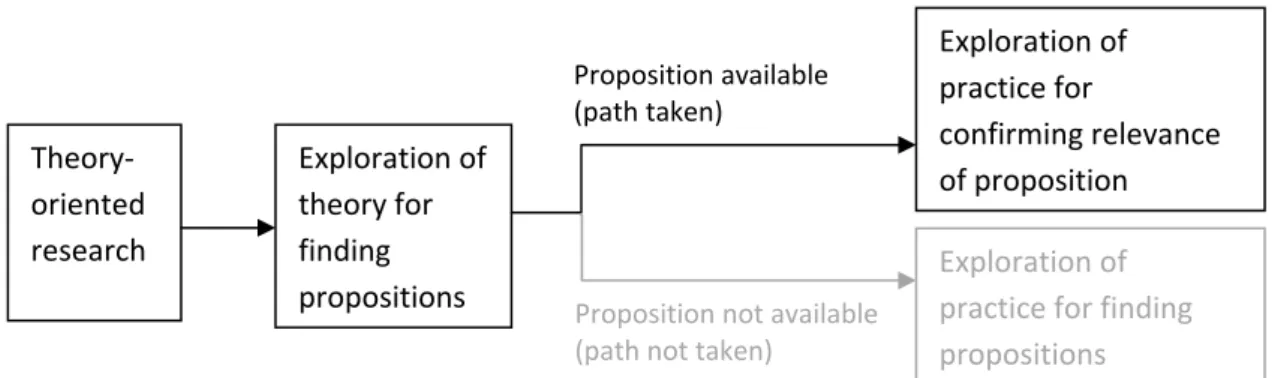
This study was theory oriented, which means that the objective was to contribute to theory development, rather than to contribute to the knowledge of one or more specified practitioners. Within theory oriented research, Dul and Hak (2008) distinguish between three types of activities: exploration, theory building, and theory testing, which are to be carried out in sequence. Due to time limitations, this study focused only on the initial activity of exploration, of both theory and practice as illustrated in Figure 4.
In this thesis, both the theory and practice pertaining to the combination and integration of DT elements and LSD principles were explored. The unit of analysis was individuals acting in certain roles within the development organization atSoftware Co. In order to allow an initial understanding of the topic, the exploratory case study design was selected because it allows a detailed investigation of the topic and to answer the research question. Since the research question is about the perception of individuals in relation to a specific topic, a case study is an appropriate research design as it allows a thorough exploration of the issue. A single case study rather than comparative was chosen due to having gained access to a single company,Software Co, early on in the project as well as resource and time limitations. Moreover,Software Coprovided a unique setting to investigate the integration of DT, LSD and Scrum.
3.4
Sampling
In order to achieve the purpose and address the research question of this study, a purposive sampling strategy was employed within the case. Purposive sampling refers to sampling that is not carried out randomly but rather with the aim to sample participants that are relevant to the research question, and is most commonly used in qualitative research (Bryman & Bell, 2011).
The population for the study’s sample was defined as follows: the units in the population had to be experienced in carrying out the role of either SM or PO in the development organization atSoftware Co. In addition, these individuals were required to have been involved in at least one project where DT was used. This minimum criterion of a single DT project was not set to a higher number because DT was introduced atSoftware Codevelopment organization two years prior to this study. Since most development projects have duration in excess of one year, the available pool of respondents who have worked on more than one DT project would have been too small to reach a meaningful sample size.
Once the population of the study was established, snowball sampling was conducted. This strategy was used for two reasons. First, the extent of the entire population was unknown to the researchers, and hence no accurate sampling frame could be determined. Second, initial access to the case was provided by two individuals, who the subsequent sampling was contingent on. Thus, the sampling for this study commenced with two initial contacts with which exploratory interviews were held; one of these two interviewees provided a list of individuals within the population. Further on, interviewees in the population provided further contacts.
Theory oriented research Exploration of theory for finding propositions Exploration of practice for confirming relevance of proposition Proposition available (path taken) Exploration of practice for finding propositions
Proposition not available (path not taken)
3.5
Research Methods
Employing a qualitative strategy implies that the methods used for this study were mainly of a qualitative nature. The one qualitative research method was the semi structured interview; it is explained along with a description of how they were conducted in the following subsections.
3.5.1 Semi structured Interview
Semi structured interviews are a widely utilized method in qualitative research. Since they cover questions relating to specific topics, which are asked in a similar manner to all interviewees in the sample, they provide reasonable comparability of responses. At the same time, the flexibility of semi structured interviews also allows for new aspects to be discussed as they emerge in the course of an individual interview. Furthermore, emerging aspects can be carried over to subsequent interviews. The emphasis of qualitative interviews in general is to capture the view of the interviewees relating to the topic (Bryman & Bell, 2011).
In the case of this thesis, semi structured interviews were given preference over unstructured interviews because there was a fairly clear focus, thus allowing the researchers to address more specific issues. Also, semi structured interviews allow for new themes to emerge that may be considered important by the interviewees. Thus, this method was chosen rather than structured interviews because they were considered too rigid. Thirteen interviews were conducted over the phone with interviewees located either in India or in Germany, while the researchers were based in Sweden. An additional three respondents were interviewed in person during the researchers’ visit of theSoftware Codevelopment labs in India. Of a total of sixteen interviews, fourteen were conducted with both researchers present, with usually one leading the interview and the other taking notes and asking additional questions as they arose. Further, all interviews were recorded and transcribed within 24 hours of the interview. The routine employed for interview transcriptions was that each researcher transcribed one half of the interview and then cross checked the transcription of the other half in order to ensure the quality of the transcription. In three cases, one researcher transcribed an entire interview which was subsequently checked by the other researcher.
3.6
Data Collection
As briefly mentioned above, the data collection for this study started with two exploratory interviews with DT experts atSoftware Co, one in India and one in Germany. These exploratory interviews served two purposes; one being to narrow the topic of the study and the second was to provide some contextual information about the case in terms of the organization and its practices. These two exploratory interviews were semi structured, and the second one was founded on the first. While these initial interviews mainly informed the researchers about the context and background of the case, knowledge was also gained that contributed towards addressing the research question.
Therefore, some aspects of the exploratory interviews are also included in the results presented later on in this thesis.
Following the exploratory interviews, a series of semi structured interviews was conducted with POs and SMs that matched the criteria for the study’s population. In total, fourteen of these interviews were held with three respondents located in Germany and the other eleven in India. Moreover, preliminary findings were presented to and discussed with a group of DT stakeholders at the
Software Codevelopment labs in India. The outcome from the discussions served as a triangulation means.
3.6.1 Interview Guide
Interview guides were used and complemented with ad hoc questions as needed for both the exploratory and primary data collection interviews. By necessity, the guides for the exploratory interviews differed considerably from those for the actual data collection because a different goal was pursued in each phase. Even the interview guides for the two exploratory interviews were similar only to a limited extent because the second largely evolved from the findings of the first interview.
The interview guide for the primary data collection evolved somewhat after the first interview was held, but no major changes were made. The final interview guide is included in the Appendix and is representative for the majority of the primary data collection interviews, albeit exact phrasing and the order of questions differed between interviews.
When designing the interview guides (for both phases), recommended guidelines regarding the order of questions, type of questions and amount of questions were adhered to. With respect to the creation of semi structured interview guides, Bryman and Bell (2011) provide the following recommendations, which were adopted by the researchers: logical flow in order of questions, avoiding leading questions, language that is easily understood by the interviewees but not too simple, questions were designed in a way that they can inform the research question without being too specific. The guide was structured into five overall sections as follows:!
1. Introduction of the researchers and the study, assurance of anonymity 2. Factual questions about professional experience
3. Perceptual questions about DT
4. Perceptual questions about the role before and after the introduction of DT
5. Concluding section with an opportunity for the interviewees to raise issues related to the topics that were not covered during the interview
Each section was structured such that questions were arranged in decreasing order of importance, flowed from more factual to more perceptual questions, and also progressed from open towards specific questions. This structuring was done according to the perception of the researchers, which may not necessarily reflect that of interviewees. Furthermore, compromises had to be made where e.g. perceptual questions were deemed very important. In order to keep the interviews flexible, the exact questions and their order varied to some extent between individual interviews; also,
spontaneous follow up and probing questions were asked as they arose during a course of an
interview. The interview guide was reviewed and pre tested with this thesis’ supervisor at the Center for Business Innovation, Chalmers University of Technology.
3.6.2 Data Analysis
The collected data were coded and analyzed using the online software Dedoose (SocioCultural Research Consultants, 2013). This particular software was chosen because it allowed real time online collaboration between the authors and was available free of charge for a limited time. All interview transcripts were imported into the software and codes were applied to relevant excerpts. The first top level code section “Profile & Perception of DT” contains responses that were used to build a context and general understanding of the interviewees’ background and perception of DT. The codes under the second top level code of “Differences between DT and LSD” specifically address the main differences identified in the literature that constitute the theoretical framework, and responses
within these codes were used to address the research question. The third top level code “Challenges” was used to identify responses that addressed practical challenges that were mentioned by the respondents to arise from the integration of DT with LSD and Scrum. The code structure is presented below.
Profile & Perception of DT Definition
Opinion
Most important aspect Roles & responsibilities
Differences between DT and LSD (addresses research question) End user empathy vs. customer satisfaction
Visualizing vs. backlogs
Synthesis vs. waste elimination Integration Challenges
3.7
Quality Criteria
Quality criteria are of particular concern in quantitative research. Regarding qualitative research, no clear consent appears to exist amongst researchers about the relevance or exact definition of reliability (Bryman & Bell, 2011). Nonetheless, the main quality criteria pertaining to the conducted study are discussed in the following subsections. In detail described are issues of the study’s reliability and various types of validity.
3.7.1 Reliability
In a general sense, reliability in the context of a research study is referred to as whether its results are repeatable. Reliability for qualitative studies can be considered to be either external or internal. External reliability refers to the extent a study can be replicated and internal reliability is concerned with the level of agreement amongst researchers within a team regarding their observations (Bryman & Bell, 2011).
The researchers acknowledge that, due to the nature of the case study, the external reliability is very low. Despite this awareness, there was little though that could be done to improve the external reliability. This is owed to the transient nature of the social setting that was studied at a particular point in time and the single case approach. A replication of the study with the same sample will likely yield different results because the respondents will have made additional experiences regarding the research topic which almost invariably change their perception. Nonetheless, the clear research question and systematic approach should improve the external reliability as much as possible, given the circumstances.
In addressing the internal reliability, the pair of researchers discussed immediately after each interview the main points covered and impressions received. Documenting the main points of these discussions ensured a common viewpoint of the outcome of each interview, especially for later analysis.
3.7.2 Validity
Validity is concerned with the integrity of the outcome of research studies, and various types of validity exist which should be addressed for any business research study.
Measurement/construct Validity
Measurement or construct validity is of primary concern for quantitative studies and refers to whether correct operational measures were chosen for measuring a particular concept. Possible ways to improve the construct validity are to utilize multiple sources of evidence (triangulation) and have respondents review the research findings (Bryman & Bell, 2011). The researchers in this study attempted both methods to improve the construct validity. However, due to the scope of access granted to the case, no other information source than personal interviews could be secured.
Furthermore, owing to time restrictions both for the researchers and the respondents, validation by the interviewees could not be secured before the finalization of the study.
Internal Validity
Internal validity refers to the validity of a found causal relationship in quantitative research, i.e. whether an assumed independent variable causes change in the dependent variable (Bryman & Bell, 2011). Since this study was exploratory only and qualitative in nature, no dependencies between variables were devised. Therefore, internal validity in this sense is of no concern for this thesis. In particular for qualitative research, internal validity can be viewed as the level of agreement between theoretical concepts and observations made. Internal validity viewed in this way can be improved by prolonged exposure of the researchers amongst the subjects being studied (Bryman & Bell, 2011). Whilst undoubtedly desirable, this exposure to increase internal validity was not feasible due to the spatial separation of the researchers and the actual social setting of the study.
External Validity
The concept of external validity addresses the generalizability of the study outside its specific context. External validity can typically be enhanced by using representative samples, which requires careful sampling techniques. For qualitative research, the external validity is usually weak due to the use of case studies and small samples (Bryman & Bell, 2011). This weakness applies equally to the case study presented in this thesis because of the relatively small sample size, and its unique contextual setting. But since the study is exploratory, the goal is not for the findings to be generalizable but rather serve as a first step towards a more thorough investigation of the topic. Further, in the view of the researchers, this study could serve as one part in a larger, comparative case study for which the results would achieve a higher external validity.
Ecological Validity
The ecological validity of a research study is concerned with the applicability of its findings to
people’s everyday reality. Ecological validity is typically compromised by researchers interfering with their respondents’ natural environment or routines (Bryman & Bell, 2011). We cannot accurately assess to what extent the interviews carried out for this study have affected the natural settings the interviewees normally work in, since we do not know what they are. However, since the interviews were exclusively concerned with past experiences and the respondents were guaranteed anonymity, we believe that the ecological validity has not been negatively affected by our research design and methods.
4
Empirical Results
The empirical results presented here are the summarized findings from two exploratory interviews and eleven semi structured interviews with POs and SMs. The exploratory interviews are presented
separately because each covered slightly different topics, and the second interview built on the findings from the first. The remainder of the chapter is presented according to the structured analysis and coding structure presented in Section 3.6.2 and includes aggregated findings from the sample of POs and SMs.
4.1
Exploratory
An initial exploratory interview was conducted with a DT expert fromSoftware Co’s consulting organization. This expert has worked as both a DT coach and facilitator atSoftware Coand is a key person in the implementation of DT at theSoftware Codevelopment labs in India. This first
exploratory interview was conducted to gain an overview of DT activities atSoftware Coand to build a general foundation of knowledge on the topic. A second exploratory interview was held with another DT expert who is currently building up a DT team atSoftware Cowhich will be providing DT consultancy services to customer organizations. This second interview was conducted to further explore the topics and issues that had emerged from the first interview and to narrow the focus of the research, which was deemed too broad after the first interview.
4.1.1 First Exploratory Interview
The DT expert first confirmed that the DT projects included in the roll out waves are carried out in the development organization ofSoftware Coonly by stating very clearly that“the projects are from the development organization”,whereas“I come from a different organization, the consulting organization”. As a result, the focus of the research was narrowed to include only the development organization atSoftware Coand specifically focus on Wave 2 DT projects that were conducted in either India or Germany.
The interviewee then elaborated on the team structure for DT projects that were run at theSoftware Codevelopment labs in India. The teams are typically composed of six to seven members with varying roles. The roles were then explained as