Mechanistic Understanding as a Driving Force for Developments in Nickel-Catalyzed Coupling Methods
by
Martyn Taylor Haynes
A dissertation submitted in partial fulfillment of the requirements for the degree of
Doctor of Philosophy (Chemistry)
in the University of Michigan 2014
Doctoral Committee:
Professor John Montgomery, Chair Professor Anne J. McNeil
Professor Phillip E. Savage Professor John P. Wolfe
DEDICATION
This work is dedicated to Amanda Haynes. I know that the last decade of our lives is only a hint of what is to come. Without you, I would be a tenth the man I am today.
ACKNOWLEDGEMENTS
I would first like to thank my advisor John Montgomery for his guidance and support over the years. Working in the Lab has helped me become an independent thinker, and has provided ample opportunities to develop as a leader among my peers. I would also like to thank my committee: Anne McNeil, John Wolfe, and Phil Savage, for their direction in my research endeavors, as well as their flexibility in coordinating numerous meetings.
I would like to thank my colleagues in the Montgomery Lab, for all of the day-to-day help and direction. No matter how insane the idea, someone in the lab was always willing to listen. I would especially like to thank Evan and Zach for editing my thesis, helping me greatly in this final stretch.
From a young age I was interested in science and engineering, and I have my family to thank for their encouragement and support through the years. My parents taught me how to be compassionate for others, and pushed me to always do my best. Thank you for all that you have done for me!
way. My community group has been a family for us here, and given us something to look forward to every week. Being involved with the church has also been amazing as a reminder of why I work and live as a part of this world.
TABLE OF CONTENTS
DEDICATION ... ii
ACKNOWLEDGEMENTS ... iii
LIST OF TABLES ... x
LIST OF SCHEMES ... xii
LIST OF FIGURES ... xvi
LIST OF ABBREVIATIONS ... xix
ABSTRACT ... xxi
Chapter 1: Nickel Catalysis in Organic Synthesis ... 1
1.0.0 Nickel Catalysis in Organic Synthesis ... 1
1.1.0 Ligand Classes for Nickel-‐Catalysis ... 2
1.2.0 N-‐Heterocyclic Carbenes as a Ligand Class ... 2
1.2.1 Arduengo Carbenes, Isolation and Characterization ... 3
1.3.1 Allylic Alcohols, Utility and Synthesis ... 4
1.3.2 Development of Nickel-‐Catalyzed, Three Component Reductive Coupling ... 8
1.3.7 Reductive Coupling in Divergent Total Syntheses ... 14
1.4.0 Nickel Cross-‐Coupling Reactions ... 15
1.4.1 Nickel-‐NHC Catalysis in Kumada Coupling ... 15
1.4.2 Nickel-NHC Catalysis in Buchwald-Hartwig Coupling ... 18
1.5.0 Nickel-NHC Systems as a Catalyst for Related Coupling Reactions ... 19
1.6.0 Directions for the Development and Application of Nickel Catalysis ... 22
Chapter 2: An Experimental and Theoretical Mechanistic Evaluation of Silane-Mediated, Nickel-Catalyzed Aldehyde-Alkyne Reductive Couplings ... 24
2.0.0 Reductive Coupling Mechanistic Developments ... 24
2.0.1 Double-‐Labeling Experiments Used to Understand Organometallic Reaction Mechanisms ... 24
2.0.2 Mechanistic Disparity in the Results of Double-Labeling Experiments for Nickel-Catalyzed Reductive Coupling ... 26
2.0.3 Synthesis of Dimeric Metallacycle ... 29
2.0.4 Kinetic Profile of Intramolecular Reductive Coupling ... 31
2.1.0 Unified Mechanistic Proposal ... 32
2.1.1 Proposed Catalytic Cycle for Nickel-Catalyzed Reductive Coupling of Aldehydes and Alkynes ... 32
2.1.2 Double-Labeling Study as a means to Understand Post-Rate Limiting Factors ... 33
2.1.3 Utility of Mass Spectrometry Methods over Traditional Methods in Analysis of Double-Labeling Study ... 35
2.2.2 Double-‐Labeling changes arising from changes in catalyst loading ... 38
2.3.0 System alteration effects on stability of dimeric metallacyle ... 39
2.3.1 Substrate/Ligand Interactions ... 39
2.3.2 Silane Concentration Effects on Double-‐Labeling Experiments ... 42
2.3.3 Temperature Effects on Double-‐Labeling Experiments ... 43
2.4.0 Computational Evaluation of Dimeric Metallacycle ... 44
2.5.0 Kinetics Profile of N-Heterocyclic Carbene Ligated Reductive Coupling ... 47
2.5.1 Initial Rate Analysis ... 48
2.5.2 Derivation of Rate Law Governing the Intermolecular Reductive Coupling of Aldehydes and Alkynes ... 51
2.5.3 Reciprocal Plot Analysis and Implications on Reactivity ... 52
2.6.0 Chapter 2 Summary ... 53
Chapter 3: Isolation and Application of Air-‐Stable Discrete NHC-‐Ni Complexes Stabilized by Fumarate Ligands ... 55
3.0.0 N-‐Heterocyclic Carbene Nickel complexes refined for Organic Synthesis ... 55
3.0.1 Discrete nickel(0)-‐NHC catalysts ... 55
3.0.2 Differences in reactivity for the in situ preparation of nickel-‐NHC catalysts and the application of discrete pre-‐formed catalysts ... 56
3.0.3 Isolation of NHC-‐Ni Catalysts Stabilized by Fumarate Ligands ... 57
3.1.0 Synthesis Employing Nickel Cyclooctadiene as a Nickel Source ... 60
3.1.2 Synthesis Employing Nickel Acetylacetonate as a Nickel Source ... 61
3.2.0 Use of Air-‐Stable Nickel Catalysts for Kumada Cross-‐Coupling ... 64
3.2.1 Substrate Scope for Kumada Cross-‐Coupling ... 64
3.3.1 Substrate Scope and Limitations ... 66
3.4.0 Use of Nickel-‐Fumarate Catalysts for Reductive Coupling of Aldehydes and Alkynes ... 67
3.5.0 Summary ... 69
Chapter 4: Concluding Remarks and Future Directions ... 70
4.0.0 Research Directions Arising from Mechanistic Investigation Studies ... 70
4.0.1 Detailed Kinetics Analysis for the Reductive Coupling of Aldehydes and Alkynes ... 70
4.0.2 Advances in Hydroacylation using a nickel catalyst ... 73
4.1.0 Discrete Catalyst Studies ... 74
4.1.1 Catalyst isolation to Investigate Factors related to reductive coupling ... 74
4.1.2 Catalyst Variation for Synthetic Utility ... 74
4.2.0 Mechanistic Understanding as a Driving Force for Reaction Development ... 75
Chapter 5: Supporting Information ... 76
5.1 General Experimental Information ... 76
5.2.0 Chapter 2 Experimental Data ... 77
5.2.1 General Procedures for Chapter 2 ... 77
5.2.1 Authentic Sample Characterization ... 78
5.2.2 Equation and Explanation for Calculation of Double-‐Labeling Data ... 93
5.2.3 Double-‐Labeling Experiments ... 94
5.2.4 Kinetics Data Collection and Analysis ... 124
5.2.4.1 Initial Rate dependence on concentration of nickel catalyst ... 128
5.2.4.4 Reciprocal Plot ... 131
5.3.0 Chapter 3 Experimental Data ... 132
5.3.1 General Procedures for Chapter 3 ... 132
5.3.2 Catalyst Synthesis Experimentals ... 133
5.3.3 Kumada Cross-‐Coupling Experimentals ... 136
5.3.4 Buchwald-‐Hartwig Cross-‐Coupling Experimentals ... 139
5.3.5 Reductive Coupling Experimentals ... 142
5.4.0 NMR Spectra ... 144
5.4.1 Chapter 2 NMR Spectra ... 144
5.4.2 Chapter 3 NMR Spectra ... 167
LIST OF TABLES
Table 2.01 – Double-‐labeling results comparing phosphine and NHC catalyst systems ... 27 Table 2.02 – Alteration of ring size on double-‐labeling experiments ... 37 Table 2.03 – Molecularity changes to oxidative cyclization ... 38 Table 2.04 – Catalyst concentration effects on double-‐labeling experiments . 39 Table 2.05 – Alkyne substitution effects on intramolecular double-‐labeling experiments ... 41 Table 2.06 – Ligand substitution effects on double-‐labeling experiments ... 42 Table 2.07 – Silane concentration effects on double-‐labeling experiments ... 43 Table 2.08 – Temperature effects on double-‐labeling experiments,
intramolecular reductive coupling ... 44 Table 2.09 – Temperature effects on double-‐labeling experiments,
Table 2.10 – Ligand substituent effects on the energetics of dimerization ... 47
Table 2.11 – Alkyne substituent effects on the energetics of dimerization ... 47
Table 3.01 – Catalyst Loading Reduction for Kumada Coupling ... 66
Table 3.02 – Optimization of Buchwald-‐Hartwig coupling ... 67
LIST OF SCHEMES
Scheme 1.01 – Mechanism of Wilke ethene dimerization ... 2 Scheme 1.02 – Initial report of a carbene stabilized by neighboring nitrogen .. 3 Scheme 1.03 – Isolation of stable carbene intermediates ... 4 Scheme 1.04 – The Wharton olefin synthesis as an access to allylic alcohols ... 5 Scheme 1.05 – The Prins reaction in the synthesis of allylic alcohols and
related hydroxylated products ... 6 Scheme 1.06 – Guillemonat variation of the Riley oxidation ... 6 Scheme 1.07 – The Nozaki-‐Hiyama-‐Kishi reaction ... 8 Scheme 1.08 – Changes in product synthesis based upon presence of ligand .... 9 Scheme 1.09 – Early reductive coupling of aldehydes and alkynes, reduced by alkyl-‐zinc ... 10 Scheme 1.10 – Allopumiliotoxin 267A retrosynthetic scheme ... 10
Scheme 1.11 – Silane used as reducing agent in the synthesis of
Allopumiliotoxin ... 11
Scheme 1.12 – Siloxanes leading to the production of deoxygenated products ... 11
Scheme 1.13 – Use of dialkylsilanes in the synthesis of silacycles ... 12
Scheme 1.14 – Initial application of Ni-‐NHC catalysis to reductive coupling ... 12
Scheme 1.15 – Synthesis of macrocycle YC-‐17 and the exocyclic alkene homologue ... 15
Scheme 1.16 – Kumada coupling catalyzed by a nickel-‐NHC complex ... 16
Scheme 1.17 – Use of sulfamates in Kumada couplings ... 17
Scheme 1.18 – Nickel(I)-‐NHC complexes; potential intermediates in Kumada couplings ... 18
Scheme 1.19 – Nickel-‐catalyzed haloarene amination ... 19
Scheme 1.20 – Nickel catalyzed carbon-‐sulfur bond formation ... 20
Scheme 1.21 – Oxidation of alcohols catalyzed by nickel ... 21
Scheme 1.22 – Ketone hydrosilylation for the regioselective synthesis of functionalized carbohydrates ... 21
Scheme 2.01 – Double-‐labeling Organometallic Experiment ... 25
Scheme 2.04 – Reactivity of Dimeric Metallacycle with dimethyl-‐zinc ... 30
Scheme 2.05 – Thermal degradation of dimeric nickel metallacycle ... 30
Scheme 2.06 – Hydroacylation development from the Montgomery Laboratory ... 31
Scheme 2.07 – Silane consumption experiments ... 32
Scheme 2.08 – Potential energy surface of Monomeric and Dimeric metallacycle pathways ... 45
Scheme 2.09 – Rate dependence on concentration of Catalyst ... 49
Scheme 2.10 – Rate dependence on concentration of alkyne ... 50
Scheme 2.11 – Rate dependence on concentration of aldehyde ... 50
Scheme 2.12 – Rate law derivation for simplified equilibrium proposed mechanism ... 52
Scheme 2.13 – Derivation and plotting of reciprocal equation ... 53
Scheme 3.01 – Synthesis of Pd fumarate catalyst by Cavell ... 58
Scheme 3.02 – Synthesis of (IMes)Ni(dmfu)2 ... 58
Scheme 3.03 – Synthesis of (IMes)2Ni(dmfu) ... 59
Scheme 3.04 – Synthesis of [(IMes)Ni(dmfu)]2 ... 59
Scheme 3.05 – IPrNi(dmfu)2 in Nickel-‐catalyze oxidation of secondary alcohols ... 60
Scheme 3.07 – Stability of (IMes)Ni(dmfu)2 to additional dmfu ... 61 Scheme 3.08 – Synthesis of saturated NHC catalyst, (SIMes)Ni(dmfu)2 ... 61 Scheme 3.09 – Reduction of Ni(acac)2 using sodium hydride ... 62 Scheme 3.10 – in situ reduction of Ni(acac)2 using silane and alkoxide base .. 63 Scheme 3.11 – Synthesis of (IMes)Ni(dmfu)2 originating from air-‐stable
Ni(acac)2 ... 64 Scheme 3.12 – Substrate Scope of Nickel-‐Catalyzed Kumada Couplings ... 65 Scheme 3.13 – Substrate scope for the nickel-‐catalyzed Buchwald-‐Hartwig Coupling ... 67 Scheme 3.14 – Substrate Scope and Selectivities for reductive coupling of aldehydes and alkynes ... 68
LIST OF FIGURES
Figure 1.01 – General Methods for the synthesis of Allylic Alcohols ... 5 Figure 1.02 – Reduction of alkynes to generate vinyl-‐zinc species for the
reduction of aldehydes ... 7 Figure 1.03 – Metal catalyzed reductive coupling methods ... 8 Figure 1.04 – Selectivity difference in the use of phosphine and NHC ligands in reductive coupling ... 13 Figure 1.05 – Model for selectivity using NHC ligands for reductive coupling 14 Figure 1.06 –NHC-‐Ni complexes used for various Kumada couplings ... 16 Figure 1.07 – Catalysts developed to lower loading required ... 17 Figure 1.08 – Other electrophilic components used in C-‐N bond formations .. 19 Figure 1.09 – Nickel catalyzed [2+2+2] cycloaddition ... 22 Figure 2.01 – Double-‐labeling Experiment ... 25
Figure 2.02 – Proposed pathways resulting in no crossover product formation ... 28 Figure 2.03 – Proposed pathways resulting in the formation of crossover
products ... 29 Figure 2.04 – Kinetic profile for intramolecular reductive coupling ... 31 Figure 2.05 – Unified Mechanism, unifying kinetics profile with dimeric
metallacycle ... 33 Figure 2.06 – Divergent routes leading to crossover products or non-‐crossover products ... 34 Figure 2.07 – Altering proposed steps effects on the generation of crossover products ... 35 Figure 2.08 – Altering the effective concentration of the metallacycle by
altering factors related to the rate limiting step ... 36 Figure 2.09 – Effect of ring size on energy of oxidative cyclization ... 37 Figure 2.10 – Measuring crossover changes through altering equilibrium of metallacycles ... 39 Figure 2.11 – Impact of alterations to substrate or ligand structure on the dimerization of metallacycle ... 40 Figure 2.12 – Representative ReactIR Reaction Analysis ... 48 Figure 2.13 – System for investigating the kinetic profile of nickel-‐NHC
Figure 2.14 – Proposed mechanism to account for kinetics profile ... 51
Figure 3.01 – Nickel(0)-‐NHC catalyst systems ... 56
Figure 3.02 – Methods to generate Nickel-‐NHC complexes in solution ... 57
Figure 3.03 – Reduction of NiCl2 using allyl Grignard ... 63
Figure 3.04 – Proposed activation of dmfu catalysts by Grignard reagents ... 64
Figure 4.01 – Mechanism proposed based upon Kinetics Study ... 70
Figure 4.02 – Potential ligand effects on nickel complex equilibrium ... 71
Figure 4.03 – Mechanism proposal, exploring role of silane in determining regioisomers formed ... 72
Figure 4.04 – New NHC-‐Ni complexes that would benefit catalysis ... 74
Figure 4.05 – Variations in stabilizing ligands to access catalysts bearing unique NHC structures ... 75
Figure 5.01 – Calibration curve to derive correlation constant for benzaldehyde carbonyl stretching frequency ... 126
LIST OF ABBREVIATIONS
nBu n-butyl
tBu tert-butyl
tBuOK potassium tertbutoxide
oC degrees celcius COD cyclooctadiene d.r. diastereomeric ratio dmfu dimethylfumarate Equiv. equivalent Et ethyl Et3SiH triethylsilane Et3SiD triethylsilyl-deuteride Pr3SiH tripropylsilane
GC/MS gas chromatography mass spectrometry
cHex cyclohexyl
nHex n-hexyl
hr. hour(s)
min. minute(s)
d day(s)
IMes·HCl 1,3-bis(2,6-diisopropylphenyl)-imidazolium chloride IPr·HCl 1,3-bis(2,4,6-trimethylphenyl)-imidazolium chloride SIMes·HCl 1,3-bis(2,4,6-trimethylphenyl)-imidazolinium chloride
NHC N-Heterocyclic Carbene PCC pyridinium chlorochromate Ph phenyl i-pr isopropyl n-pr n-propyl r.t. room temperature
ret. time retention time
THF tetrahydrofuran
ABSTRACT
Investigating the mechanism of nickel-catalyzed reductive couplings of aldehydes and alkynes has provided evidence of several potential metallacycle intermediates. Through a series of double-labeling experiments employing deutero-triethylsilane and tripropylsilane, the influence of multiple organometallic intermediates along the reactive pathway was investigated. The nature of both the catalyst structure and the reactant structure were found to directly effect the formation of complex metallacycles.
To further refine the mechanistic hypothesis for the reductive coupling of aldehydes and alkynes, a preliminary kinetics profile was compiled using a series of initial rate studies. From these investigations, a mechanism is proposed beginning with a stable bis-aldehyde nickel complex in equilibrium with the active mixed π-component species.
The application of an air-stable nickel-NHC catalyst system was explored in a number of coupling reactions. The catalyst system was found to be a versatile catalyst for a range of Kumada-Corriu coupling reactions, but found limited applicability to Buchwald-Hartwig couplings and the reductive coupling of aldehydes and alkynes. The
reported, as well as the synthesis of a functionalized nickel catalyst from commercially available and bench-stable starting materials.
Chapter 1: Nickel Catalysis in Organic Synthesis
1.0.0 Nickel Catalysis in Organic Synthesis
Transition metal catalyzed transformations have been shown to be both robust and versatile in the synthesis of a variety of structural moieties. The incredible scope of cross-coupling reactions catalyzed by transition metal catalysis earned the Nobel Prize in 2010, awarded to the creation of the field and further developments by Heck, Suzuki, and Negishi.1 Although many different transition metals have been explored for their reactivity and versatility in organometallic transformations, the work utilizing nickel, an inexpensive and versatile catalyst, will be further explored in this work.
An early investigation into the catalytic activity of nickel in organometallic transformations comes from the work of Wilke on ethene polymerization.2 A nickel catalyst was used to dimerize ethene to 1-butene (Scheme 1.01). The report shows one of the first effective nickel-catalyzed processes reported and also exhibits selectivity for the synthesis of 1-butene. Further oligomers of ethylene were formed in minor amounts, control over which is still an area of development for modern methods. Further
for the development of related reaction providing higher carbon chains or control over the formation of linear or branched hydrocarbons.
Scheme 1.01 – Mechanism of Wilke ethene dimerization 1.1.0 Ligand Classes for Nickel-‐Catalysis
Intricately linked to the development of catalytic systems and metal-mediated processes is the development and growth of ligand classes. Many ligands have been employed in tandem with nickel organometallic catalysis, with amino groups, phosphines, and recently N-heterocyclic carbenes4 (NHC) finding the most application. The strong σ donation of these ligands allows for stabilization of the metal in solution as well as altering the electronics of the metal center dramatically, imparting reactivity and selectivity for a number of reactions.
1.2.0 N-‐Heterocyclic Carbenes as a Ligand Class
Initial reports into stabilized carbenes come from the work of Ofele5 and X NiEt L X NiEt L X Ni L X NiH L X NiH L Et Et Et
in solution, and subsequently binds to form a mercury salt in the form of a stable bis-carbene complex (Scheme 1.02). The strongly σ-donating character of the NHC allowed for the formation of the stable catalyst in solution; however, the free carbene itself was not isolable.
Scheme 1.02 – Initial report of a carbene stabilized by neighboring nitrogen 1.2.1 Arduengo Carbenes, Isolation and Characterization
The use of NHCs as ligands saw little development until the report of the stable IAd carbene by Arduengo7 (Scheme 1.03). The bis-adamantyl substitution of the
imidazolium created a steric environment hindering further reactivity, coupled with the stabilization of the carbene through the aromaticity of the imidazolium ring, allowed for the observation of the free carbene. Further study expanded the class of stable carbenes that could be isolated, and the ability of less sterically hindered carbenes to dimerize in solution. These dimeric carbene species could fragment under thermal conditions back to the corresponding free carbene.
N N Ph Ph ClO4 -2 + Hg(OAc)2 - 2 AcOH + H2S - HgS N N Ph Ph Hg N N Ph Ph 2+ 2 ClO4
-Scheme 1.03 – Isolation of stable carbene intermediates 1.2.2 Metal Complexes of Arduengo Carbenes
Manganese metal centers stabilized by NHC ligands were among the first reported metal-NHC systems.8 The use of carbene ligands has also been shown to impart dramatically increased reactivity on different metal catalyst systems. One such example is the activation of technetium catalyst,9 which was found to activate siloxane grease, a notoriously unreactive species. The strong binding of the NHC, coupled with the corresponding changes to catalyst stability and reactivity, have led to the widespread development of NHCs as a ligand class for transition metal catalysis.
1.3.0 Nickel Catalyzed Reductive Couplings in Organic Synthesis 1.3.1 Allylic Alcohols, Utility and Synthesis
The allylic alcohol functional moiety serves as a starting material for a number of versatile transformations that have seen wide application in synthesis. Molecular complexity can be rapidly generated from the use of allylic alcohols through a number of divergent mechanisms such as directed epoxidation,10 nucleophilic displacement reactions, generation of π-allyl metal complexes, and Claisen rearrangements.11 This utility in the synthesis of complex small molecules has generated interest into a robust
N N H NaH THF/DMSO N N H2 NaCl + + Cl
-synthesis of allylic alcohols are derived from either the 1,2 reduction of α,β-unsaturated
ketones or from the coupling of aldehydes with nucleophilic vinyl surrogates (Figure 1.01).
Figure 1.01 – General Methods for the synthesis of Allylic Alcohols
One of the earliest reported synthetic routes to allylic alcohols is the Wharton olefin synthesis (Scheme 1.04).12 Utilizing the same reagents as in the Wolff-Kishner reaction,13 the decomposition of α,β-epoxy ketones provides reliable access to allylic
alcohols. The main limitation of the method is the highly reactive nature of the epoxy ketone starting materials, which limits the applicability as well as the scope of the reaction.
Scheme 1.04 – The Wharton olefin synthesis as an access to allylic alcohols
Beginning from terminal alkenes and formaldehyde, the Prins reaction provides access to allylic alcohols in addition to other hydroxylation products from simple starting materials (Scheme 1.05).14 Careful manipulation of the reaction conditions allows for selectivity in the formation of specific products. Developments focused on controlling the Prins reaction have crafted a versatile method in the synthesis of different products that are fundamentally related to allylic alcohols. Variants of the Prins reaction employing organometallic transformations have been developed that further extend the
R1 O R2 [1,2] Reduction R1 OH R2 Aldehyde Reduction R1 H O R2 R2 M + or R1 O R2 O NH2NH2 -H2O R 1 N R2 O NH2 R1 N R2 NH OH -N2 R1 R2 OH
reaction methodology into different classes of starting materials including the use of aldehydes and more complex alkene components.15
Scheme 1.05 – The Prins reaction in the synthesis of allylic alcohols and related hydroxylated products
Utilizing pericyclic rearrangements has provided another route to allylic alcohols from simple starting materials and common functional groups. The Guillemonat variation of the Riley oxidation uses a selenium reagent to oxidize the allylic position of a hydrocarbon chain.16 The resulting allylic selenium-oxide undergoes a rearrangement, which upon hydrolysis provides the unprotected allylic alcohol (Scheme 1.06). This allylic oxidation method has been employed in a number of small molecule syntheses, including work by Corey17 and Furstner.18 In a related process, the activation of allylic sulfoxides in the Mislow Evans reaction allows for the synthesis of allylic alcohols,19 however the synthesis of allylic sulfoxides can also prove to be non-trivial.
Scheme 1.06 – Guillemonat variation of the Riley oxidation
Numerous reductive methods have been developed for the synthesis of allylic alcohols. The Luche reduction is selective for the 1,2 reduction of α,β-unsaturated ketones providing the corresponding allylic alcohols.20 The reduction of aldehydes by different nucleophilic species also serves as a route to the allylic alcohol structural
H H O R H+/H 2O R O O R OH OH R OH + + + R1 R2 SeO2 tBuOOH R1 R2 Se HO O [2,3] sigmatropic R1 R2 O HOSe hydrolysis R1 R2 OH
generate the corresponding allylic alcohol under mild reaction conditions.21 The generation and use of a wide variety of vinyl metal species can also serve to reduce aldehydes to generate allylic alcohols. Methods have been developed for the selective reduction of terminal alkynes, which generate vinyl boron22 or zirconium23 species. These intermediates can undergo transmetallation with dialkyl zinc to generate an active vinyl zinc reagent, which can be used in reducing an aldehyde (Figure 1.02). These methods can also be carried out in the presence of a chiral promoter, providing access to an array of enantiomerically enriched allylic alcohols.
Figure 1.02 – Reduction of alkynes to generate vinyl-zinc species for the reduction of aldehydes
Transition-metal-mediated reactions are also prevalent and highly selective in the synthesis of allylic alcohols through multicomponent coupling reactions. The use of titanium,24 rhodium,25,26 and ruthenium27 catalysts in the reductive coupling of aldehydes and alkynes provides convenient access to the allylic alcohol functional group (Figure 1.03). While robust methods have been developed, each metal catalyst comes with a limiting set of conditions. The most versatile methods employing titanium in the reductive coupling process require stoichiometric quantities of the metal complex. Methods have been developed that are catalytic in titanium, however these systems show a more restricted substrate scope.28 Similarly, rhodium and ruthenium catalysts are
limited in the cost and rarity of the metal used in catalysis.
R M R MeZn R R H O Me2Zn M-H M = BR2, ZrXR2 R R OH
Figure 1.03 – Metal catalyzed reductive coupling methods
The most versatile and widely employed method for the synthesis of allylic alcohols is the Nozaki-Hiyama-Kishi reaction.29 Utilizing vinyl iodides with nickel and chromium, the stereospecific formation of allylic alcohols can be enacted (Scheme 1.07).
30 This reaction exhibits an extensive substrate scope, tolerating a variety of aldehydes
and vinyl iodides. However, the need for stereodefined vinyl iodides can limit the applicability in synthesis. Recent developments have allowed for the use of allylic halides,31 however the synthesis of these molecules and their storage can also be non-trivial.
Scheme 1.07 – The Nozaki-‐Hiyama-‐Kishi reaction
Developments in the Montgomery laboratory have aimed to improve reductive coupling methods to provide a robust synthetic method in the formation of allylic alcohols. The use of a nickel catalyst benefits from being a readily available and inexpensive metal catalyst, and the simple substrates employed provide a versatile method in the synthesis of various allylic alcohols.
1.3.2 Development of Nickel-‐Catalyzed, Three Component Reductive Coupling
Early work in the Montgomery laboratory served to develop the reductive
R1 H O R2 R3 Metal Catalyst Reducing Agent R1 R3 R2 OH + R H O R2 R1 X CrCl2 Catalytic NiCl2 R2 R1 OH R +
reaction where product selectivity is largely controlled based upon the ligand used in conjunction with a nickel catalyst (Scheme 1.08). Without the addition of a phosphine ligand, the nickel catalyst was found to perform the alkylative coupling after transmetallation with diethyl zinc to provide the functionalized tetrasubstituted olefin. However, when triphenylphosphine was added to the reaction, the nickel was found to undergo β-hydride elimination to generate the reductive coupling product.
Scheme 1.08 – Changes in product synthesis based upon presence of ligand
The use of nickel catalysis in the reductive coupling of π-systems continued with the development of a reductive coupling of aldehydes and alkynes to provide access to allylic alcohols.33 Expanding on the coupling of enones and alkynes, both the alkylative and reductive formation of allylic alcohol products can be accessed in good conversion for a variety of substrate systems (Scheme 1.09).
R1 O R2 Bu2Zn/BuZnCl Ni(COD)2 R2 R1 BuZnO LnNi Ln = THF Ln = PPh3 R2 R1 BuZnO LnNi H R2 R1 BuZnO R2 R1 HO nBu
Scheme 1.09 – Early reductive coupling of aldehydes and alkynes, reduced by alkyl-‐zinc
A number of natural products contain the allylic alcohol structural motif, expanding the utility of reductive coupling in the synthesis of many small molecules. One such series of compounds is the allopumiliotoxin family, where a late stage reductive coupling serves to close a key ring-juncture (Scheme 1.10).34 The coupling of an aldehyde and alkyne was later applied to the synthesis of a number of structures in the allopumiliotoxin family beyond the initial report on allopumiliotoxin 267A.35
Scheme 1.10 – Allopumiliotoxin 267A retrosynthetic scheme
Substrate sensitivity in the synthesis of the allopumiliotoxin series required the use of a milder reducing agent than diethyl zinc. Using silanes as a reducing agent proved to be mild enough for the synthesis, and provides a conveniently protected allylic alcohol (Scheme 1.11). Easily deprotected under a variety of conditions, the use of silanes provides an attractive method for reductive coupling.
R1 H O R2 R3 Ni(COD)2 + L Ni L O R3 R2 R1 ZnBu2 R1 R3 R2 [Zn]O NiBu L = PBu3 R1 R3 R2 OH L = THF R1 R3 R2 OH Bu N OH H3C OH CH3 H3C allopumiliotoxin 267A N CHO H OBn H3C CH3 H3C N H O O CH3 OPG Br CH3 CH3 H
Scheme 1.11 – Silane used as reducing agent in the synthesis of Allopumiliotoxin
In addition to use as a protecting group, silicon-carbon bonds are attractive precursors to a variety of cross-coupling reactions. The use of a dialkylsilane in a reductive coupling allows for access to highly functionalized silacycles as well as access to deoxygenated products.36 The formation of deoxygenated products was enacted through a decomposition of siloxane intermediates isolated in the reductive coupling of aldehydes and alkynes using dialkylsilanes (Scheme 1.12). However, initial difficulties in the synthesis of the silacycle products, coupled with advances in the use of NHC ligands within the Montgomery laboratory, led to the optimization of a method to synthesize a variety of silacycles (Scheme 1.13).
Scheme 1.12 – Siloxanes leading to the production of deoxygenated products N CHO Ph Ni(COD)2 PBu3 Et3SiH N H H Ph OSiEt3 N H Ph OSiEt3 + A B 90% Yield A:B = 98:2 Ph Ph CH3 OSi H tBu tBu TMS-OTf -78oC to r.t. Ph Ph CH3 OSi H tBu tBu Nu Ph Ph CH3 60% Yield
Scheme 1.13 – Use of dialkylsilanes in the synthesis of silacycles
As a ligand class gaining traction in organometallic transformations, the use of NHC ligands with nickel in the reductive coupling of aldehydes and alkynes proved to be a robust catalyst system (Scheme 1.14).37 In addition to high turnovers and a wide substrate scope, the use of NHC ligands exhibited divergent mechanistic behavior, giving drastically different results in a series of double-labeling experiments. At the time, these discrepancies led to the hypothesis that the mechanistic pathways of the phosphine and NHC ligated systems were fundamentally different. The relationship of the proposed mechanistic pathways will be further explored in Chapter 2.
Scheme 1.14 – Initial application of Ni-‐NHC catalysis to reductive coupling
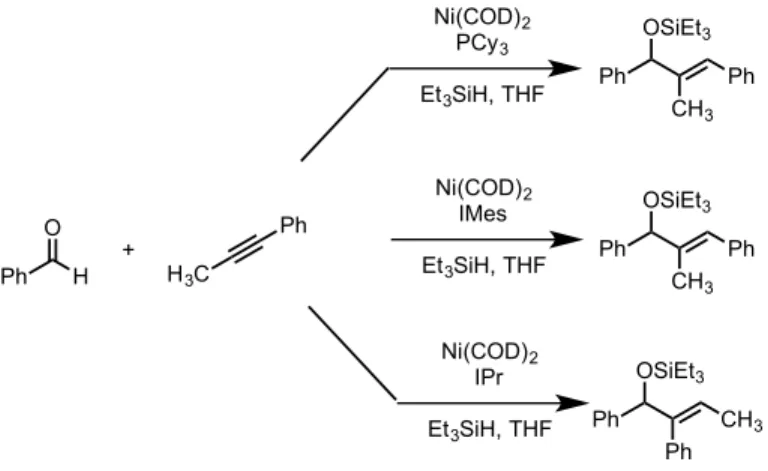
The continued development of NHCs as ligands in the reductive coupling led to a steric-controlled coupling reaction that proved to be exceptionally regioselective (Figure 1.04).38 The use of a ligand that places a large steric group proximate to the nickel center
H3C Ph Cy O H Et2SiH2 Ni(COD)2 (10 mol%) IMesHCl (10 mol%) KOtBu (10 mol%) Al(O-iPr)3 (1.5 equiv.) THF/Tol 8:1 + + O Si Et Et Ph CH3 Cy R Si Ph CH3 Et Et + 65% 22% R1 H O R2 R3 Ni(COD)2 (10 mol%) IMes HCl (10 mol%) KOtBu (10 mol%) Et3SiH (2.0 equiv.), THF R1 R3 R2 OSiEt3 + nHex Ph CH3 OSiEt3 Ph Ph OSiEt3 Ph nBu CH3 OSiEt3 84% Yield >98:2 72% Yield>98:2 84% Yield1.3:1
extremely general, even allowing for the selective synthesis of a single regioisomer, over-riding the innate bias of the substrates. Computational studies were performed to provide further insight into the role of steric encumberance on product selectivity in the NHC-Ni catalyzed system.39
Figure 1.04 – Selectivity difference in the use of phosphine and NHC ligands in reductive coupling
The selectivity is predicted to arise from the steric bulk of the NHC ligand interacting with the aldehyde and alkyne bound to the nickel center (Figure 1.05). As the bulk is increased, the selectivity shifts towards the internally substituted products. These regioisomers would be difficult to synthesize using phosphine catalysts, but due to the nature of the bond between the nickel center and the NHC, good regioselectivities can be observed. Ph H O H3C Ph Ni(COD)2 PCy3 Et3SiH, THF Ph CH3 Ph OSiEt3 + Ni(COD)2 IPr Et3SiH, THF Ph Ph CH3 OSiEt3 Ph CH3 Ph OSiEt3 Ni(COD)2 IMes Et3SiH, THF
Figure 1.05 – Model for selectivity using NHC ligands for reductive coupling 1.3.7 Reductive Coupling in Divergent Total Syntheses
After the development of the nickel-NHC reductive coupling method, the synthesis of structurally related natural products was carried out, differing from a late-stage cyclization of an ynal substrate. Natural product YC-17 is a known partner in PikC oxidations, which has been extensively studied and modified. By diverting into the exocyclic alkene homologue of YC-17, specific structural considerations can be probed in the oxidation catalyzed by PikC. The use of a very large NHC, DP-IPr, allowed for the selective synthesis of this homologue as well as the application of a smaller NHC to synthesize the natural product (Scheme 1.15).40
Ni LLarge O R RL RS RL RS Ni LSmall O R R RLarge RSmall OSiEt3 R RSmall RLarge OSiEt3
Scheme 1.15 – Synthesis of macrocycle YC-‐17 and the exocyclic alkene homologue 1.4.0 Nickel Cross-‐Coupling Reactions
In addition to reductive couplings, the use of nickel in a variety of well-known transition metal-catalyzed processes has been developed. Many methods developed using palladium catalysis have been found to transfer well to the use of nickel catalysts, with unique challenges and applications arising as a part of changing the identity of the metal center. Despite these challenges, the versatility and control imparted by developments in the use of NHC ligands have transformed nickel into a viable catalyst for numerous coupling reactions.
1.4.1 Nickel-‐NHC Catalysis in Kumada Coupling
An efficient method for the synthesis of carbon-carbon bonds utilizing nickel catalysis is the Kumada-Corriu coupling, first pioneered by Herrmann using a nickel-NHC catalyst (Scheme 1.16).41 In the seminal report, Herrmann reports on the effective coupling of numerous aryl chlorides with various aryl Grignard reagents to yield biaryl products. Later development expanded the methodology to include the use of aryl
H O O CH3 CH3 OTBS CH3 CH3 O O CH3 CH3 OTBS CH3 O H3C OSiEt3 Ni(COD)2 Et3SiH IMes HCl KOtBu, THF Ni(COD)2 Et3SiH DP-IPr BF4 KOtBu, THF O O H2C H3C OTBS CH3 CH3 OSiEt3 H3C CH3 N N mes mes Cl -IMes HCl N N BF4 -DP-IPr BF4 Ph Ph ipr ipr ipr ipr
fluorides as coupling partner.42 A preformed nickel-NHC catalyst also provided analogous results compared with in situ generation of the catalyst.
Scheme 1.16 – Kumada coupling catalyzed by a nickel-‐NHC complex
The scope of nickel-catalyzed Kumada couplings was further expanded to include heteroaryl halides in the work of Fürstner.43 The substrate scope was expanded by the use of a new class of isolable nickel-NHC complexes bearing different ligand frameworks (Figure 1.06). These variations in ligand composition proved to increase the scope of nickel-catalyzed Kumada couplings.
Figure 1.06 –NHC-Ni complexes used for various Kumada couplings
Aryl sulfamates are another class of electrophiles utilized in various cross-coupling reactions, expanding the scope of substrate classes productive in the formation of biaryl compounds (Scheme 1.17).44
Ni N N 2 Ni(IPr)2 X XMg [Ni]-L (3 mol%) X = Cl, Br, F THF, r.t., 18 h - MgXCl + tBu tBu X = F [Ni]-L = Ni(IPr)2 83% Yield [Ni]-L = Ni(acac)2, IPr-BF4 86% Yield Ni Ph3P PPh3 Cl N N PF6 Et Ni 3P PEt3 Cl N N PF6 Ph Ni 3P PPh3 Cl N N PF6
Scheme 1.17 – Use of sulfamates in Kumada couplings
New catalyst structures continued to drive the development of nickel-catalyzed Kumada couplings (Figure 1.07). An interesting catalyst bearing both an NHC as well as a triphenylphosphine ligand was developed for use in Kumada couplings.45 The enhanced reactivity observed was credited to the lability of the phosphine ligand in solution, while serving to stabilize the catalyst outside of the catalytic cycle. Other catalysts developed by Inamoto46 and Chen47,48,49 allowed for a catalyst loading as low as 0.5%.
Figure 1.07 – Catalysts developed to lower loading required
Mechanistic understanding of the Kumada coupling was expanded by the isolation of a nickel(I) intermediate by Matsubara (Scheme 1.18),50 and further
investigated by Louie.51 A number of experiments support the mechanistic hypothesis involving the generation of a nickel(I) species in the reaction between nickel(0)-NHC complexes with aryl-halides. Further studies show that this proposed species can serve to
Ni Cl N N NiClCpIMes OSO2NEt2 NiClCpIMes (4 mol%) p-TolylMgBr (4 equiv) Et2O, 40oC, 24 h p-Tolyl 99% Yield Ni PPh3Cl Cl N N Matsubara N N N N N Bu Bu Ni Br Br Inamoto Ni N N N N N N Chen
catalyze a number of carbon-carbon bond-forming reactions, suggesting it to be a viable intermediate in a number of Kumada couplings.
Scheme 1.18 – Nickel(I)-‐NHC complexes; potential intermediates in Kumada couplings 1.4.2 Nickel-NHC Catalysis in Buchwald-Hartwig Coupling
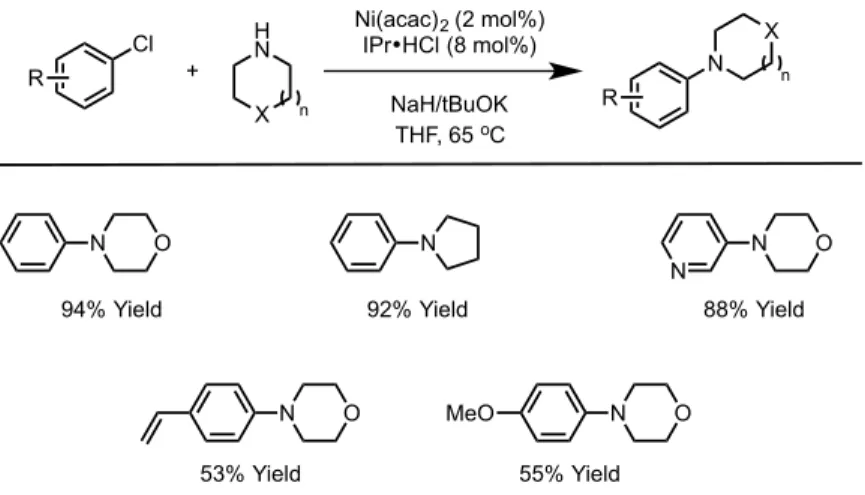
The first report of using nickel catalysis in the formation of carbon-nitrogen bonds came from the work of Fort.52 Following the initial report, an expansion of scope and
reactivity was described, which explored the viability of a number of NHC ligands employed in the reaction.53 This study showed the effective coupling of numerous
secondary and aryl amines with aryl chlorides (Scheme 1.19). An intramolecular variant was also explored in the synthesis of various heterocycles.54 Spectroscopic studies were
carried out by Schneider, which elucidated the resting state of the nickel catalyst in the proposed reactions as having two NHC units bound to the nickel center.55
Ni N N N N Ar Ar Ar Ar Ar = 2,6-diisopropylphenyl Cl Ni N N N N Ar Ar Ar Ar Cl +
Scheme 1.19 – Nickel-‐catalyzed haloarene amination
The scope of N-arylation reactions was greatly expanded through the exploration of different coupling partners (Figure 1.08). Utilizing carbamates56 as the electrophilic
coupling partner allowed for the cleavage of a carbon-oxygen bond in the process of forming the carbon nitrogen bond. In addition to carbamates, a wide range of sulfamates,57,58 tosylates,59 and phosphates have also been reported as effective coupling
partners.
Figure 1.08 – Other electrophilic components used in C-N bond formations
1.5.0 Nickel-NHC Systems as a Catalyst for Related Coupling Reactions
The synthesis of thioethers has been developed using various nickel-NHC complexes. The first report by Ying60 highlighted the ability of a nickel catalyst to
couple thiophenol with a variety of aryl bromides and iodides, producing high yields of diaryl thioethers. The use of a recyclable nickel-NHC catalyst was also used in the
Cl X H N Ni(acac)2 (2 mol%) IPr•HCl (8 mol%) NaH/tBuOK THF, 65 oC + N X R R n n N N N N N N O 88% Yield O 92% Yield 94% Yield O 53% Yield MeO O 55% Yield X R' HN R' [NiLn] base, solvent 60-100 oC X = Cl, Br, OCONEt2, OSO2NMe2, OTs, OP(OAr)2
R N
R
R' R' +
formation of carbon-sulfur bonds, but was still restricted to the synthesis of diaryl thioethers.61 Well-defined allyl nickel complexes were shown to be efficient for both the
formation of carbon-sulfur and carbon-nitrogen bonds.62 However, in situ catalyst
generation allowed for the synthesis of a wide range of aryl thioethers, including the use of benzyl and aliphatic thiols (Scheme 1.20).63
Scheme 1.20 – Nickel catalyzed carbon-‐sulfur bond formation
The oxidation of alcohols to the corresponding aldehyde or ketone has also been established. In a related process to the dehalogenation of arenes, secondary alcohols can be oxidized to the corresponding ketone using an aryl chloride as the oxidant.64,65
Notably, a bench-stable nickel(0) catalyst could be used in the reaction, although reaction times increased (Scheme 1.21). Use of primary alcohols was reported by Itami and co-workers in a one pot sequence in which a primary alcohol could be oxidized and then consumed by 1,2-addition of an organoboronate ester, resulting in either the ketone from primary alcohols or tertiary alcohols starting from secondary alcohols.66 This sequence
Br HS Y Ni(acac)2 (10 mol%) IPr (5 mol%) KOtBu, DMF, 70oC 2 hr + S Y S H3C O CH3 CH3 95% Yield S H3C O n-Oct 95% Yield S MeO 77% Yield S CN 82% Yield S F3C 85% Yield R R
Scheme 1.21 – Oxidation of alcohols catalyzed by nickel
In parallel with the reductive coupling of aldehydes and alkynes, nickel catalysis has been shown to be effective in the hydrosilylation of alkynes67 as well as allenes,68 allowing for the highly selective formation of allyl and vinyl silanes. The use of a nickel catalyst has allowed for the highly selective hydrosilylation of ketones,69 using a
carbohydrate based silane, which allows for the synthesis of functionalized carbohydrates (Scheme 1.22). This process is tolerant of orthogonal functional groups, which can be manipulated using different metal catalyst systems for further functionalization.
Scheme 1.22 – Ketone hydrosilylation for the regioselective synthesis of functionalized carbohydrates
Nickel has been shown to be effective in an array of cycloaddition reactions. The use of CO270,71 or an aldehyde72,73 in a [2+2+2] cycloaddition has been established as an
effective route in the synthesis of highly substituted polycycles (Figure 1.09). Related
Ni N N Ar Ar E E E E 5 mol% OH KOtBu (1.1 equiv.) 2,4-dichlorotoluene O + 69% yield OH H H H H O Ni(COD)2 (10 mol%) IMes (10 mol%) Ti(OiPr)4 (2.2 equiv.) O SEt BnO BnO BnO O SiH + OH H H H H O O SEt BnO BnO BnO O Si 89% Yield 5:1 r.s. NIS Me2SiOTf 2,6-DTBMP OH H H H H O O BnO BnO BnO HO 95% Yield >97:3 r.s.
methods have been developed for the synthesis of heterocycles, arising from the analogous cyclization involving isocyanate,74,75, cyano,76 or cyanamide77 functionalities.
Figure 1.09 – Nickel catalyzed [2+2+2] cycloaddition
1.6.0 Directions for the Development and Application of Nickel Catalysis
Applications of nickel catalysis to a wide variety of reductive couplings have created a powerful method capable of synthesizing different structural variations from simple starting materials. Through the process of development, a number of interesting mechanistic details have been reported, but a comprehensive understanding of the factors related to reductive coupling has not been proposed. The mechanistic investigation of reductive couplings would provide insight into the details pertinent to the transformation, and subsequently allow for the further development and application as a synthetic tool. An investigation into the various substrate and catalyst factors that influence the mechanism for reductive coupling will be presented in Chapter 2.
Along with developments in reductive coupling, the use of NHC ligands in nickel-catalyzed processes has been greatly developed and expanded. The use of highly functionalized and tailored ligands has allowed for excellent selectivity and reactivity in a
X CH3 CH3 R CN Ni(COD)2 (3 mol%) SIPR (6 mol%) Tol, r.t. + X N CH3 CH3 R CH3 CH3 Ni(COD)2 (3 mol%) SIPR (6 mol%) Tol, r.t. + CO2 O O CH3 CH3
require the generation of the active catalyst in situ, leaving a myriad of potential activation steps in the formation of the catalyst unknown. Further developments into the synthesis and application of functionalized discrete nickel catalysts will allow for the creation of a more general method for nickel-catalyzed transformations, these efforts will be presented in Chapter 3.
Chapter 2: An Experimental and Theoretical Mechanistic
Evaluation of Silane-Mediated, Nickel-Catalyzed
Aldehyde-Alkyne Reductive Couplings
2.0.0 Reductive Coupling Mechanistic Developments
2.0.1 Double-‐Labeling Experiments Used to Understand Organometallic Reaction Mechanisms
The use of double-labeling experiments is a common practice to probe mechanisms where fragmentation may occur; it can provide insight into the molecularity of intermediates as well as distinguish dissociation events in metal-catalyzed reactions. At the core of a double-labeling, or “crossover”, experiment is the use of similar materials that are each labeled to follow the respective components throughout the course of a reaction (Figure 2.01). By analyzing the product ratios, information about the mechanism can be deduced.
Figure 2.01 – Double-labeling Experiment
The use of double-labeling experiments can provide deeper mechanistic understanding for organometallic transformations, where dissociation and transmetallation steps can complicate proposed mechanisms of reaction. One investigation utilizing double-labeling experiments is the investigation into the reductive elimination of a platinum catalyst in the generation of methane (Scheme 2.01).78 To determine the ability of the platinum catalyst to exchange hydrides, a double labeling study was performed. It was found that almost no crossover products were observed, providing support for a reaction mechanism proceeding through a unimolecular pathway without opportunity for exchange between metal centers.
Scheme 2.01 – Double-‐labeling Organometallic Experiment
In addition to organometallic transformations, double-labeling experiments can provide insight into the possible fragmentation of reactants in the reactive pathway. To understand reductions of organic peroxides to the corresponding alcohols, a double-labeling study was constructed to follow the silyl protecting group through the course of the reaction (Scheme 2.02).79 No significant formation of crossover products was
observed, indicating that fragmentation and dissociation of the peroxide was not a reasonable mechanism. As with all evidence regarding reaction mechanisms, crossover
X X Y X Y X Y X Y X Y + + + + Pt Ph3P CH3 Ph3P H Pt Ph3P CD3 Ph3P D CH 4 CD4 CH3D CD3H + + + + 40 : 40 : 1 : 1
experiments are capable of providing insight into potential mechanistic pathways and excluding proposed mechanisms but cannot provide prove a single pathway to be correct.
Scheme 2.02 – Substrate-‐based Double-‐Labeling Experiment
2.0.2 Mechanistic Disparity in the Results of Double-Labeling Experiments for Nickel-Catalyzed Reductive Coupling
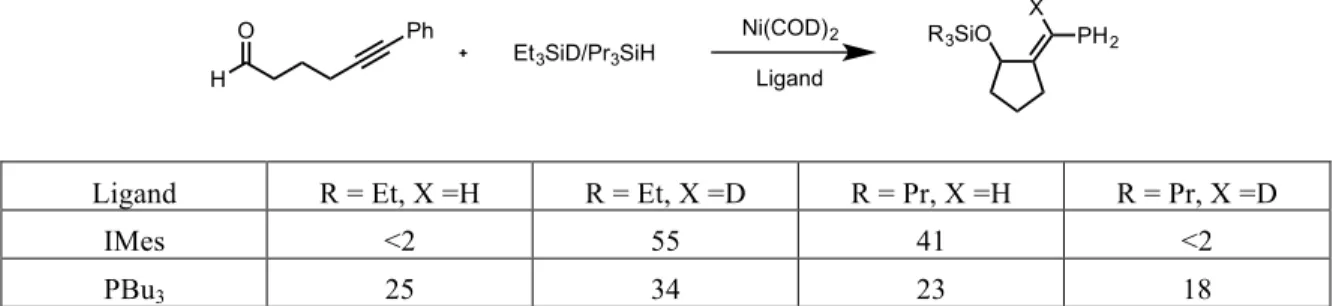
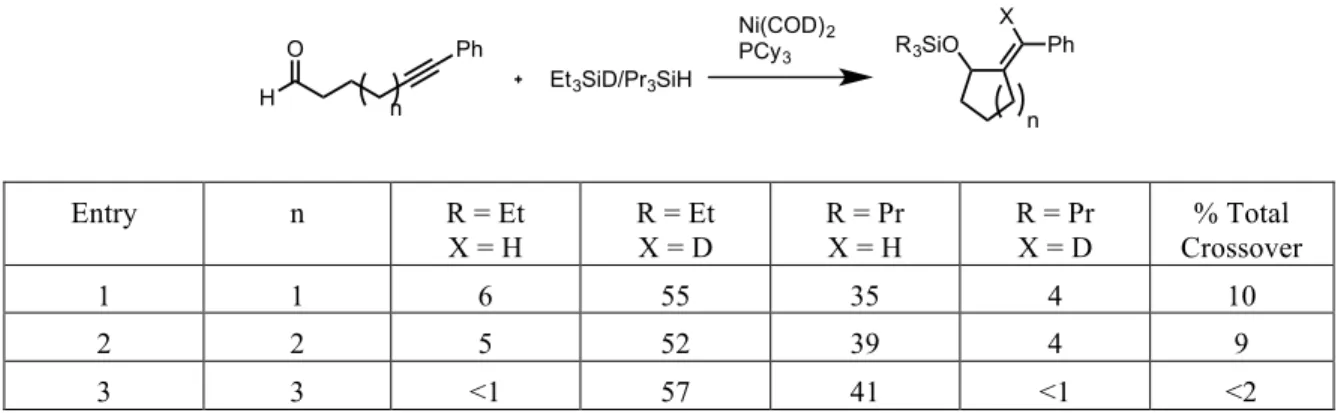
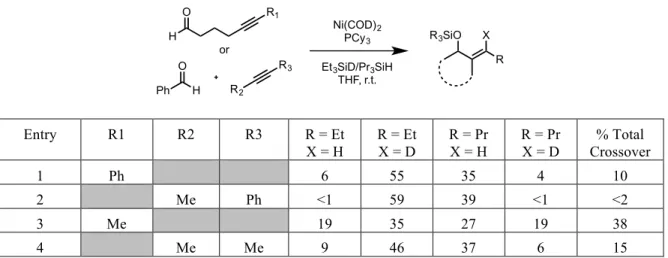
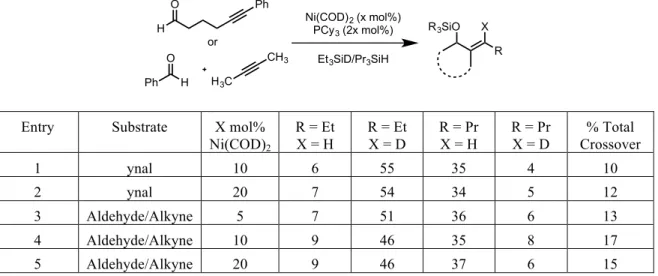
During the initial investigation into the use of NHC’s as potential ligands for nickel-catalyzed reductive couplings, an interesting disparity was observed in the results of a series of double-labeling experiments between phosphine-ligated systems and NHC-ligated systems. In the presence of triethylsilyl-deuteride and tripropylsilane, a reductive coupling mediated by a phosphine-nickel complex gave a near statistical mixture of all four possible products, however the use of an NHC-nickel catalyst system provided no noticeable presence of the crossover products (Table 2.01).
H3C CH3 iPr OOSiEt3 CH3 OOSi(nPr)3 PPh3 Toluene, 70 oC + H3C CH3 iPr OSiEt3 CH3 OSi(nPr)3 + H3C CH3 iPr OSi(nPr)3 CH3 OSiEt3 + Full Conversion Not Observed
Ligand R = Et, X =H R = Et, X =D R = Pr, X =H R = Pr, X =D
IMes <2 55 41 <2
PBu3 25 34 23 18
Table 2.01 – Double-‐labeling results comparing phosphine and NHC catalyst systems
With mechanistic evaluation being difficult, a working hypothesis was developed that, while the products are identical for most reductive coupling, the reactive pathways for the NHC and phosphine system must be fundamentally different. Four potential pathways were described that could account for the observed results from the double – labeling experiments and be consistent with data gathered for similar systems. The key difference proposed between pathways lies in the interaction of the nickel catalyst and the silane reducing agent.
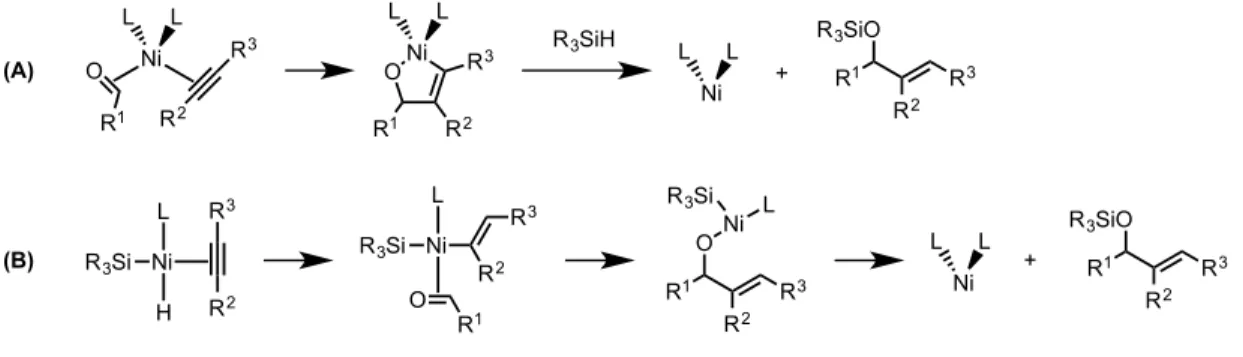
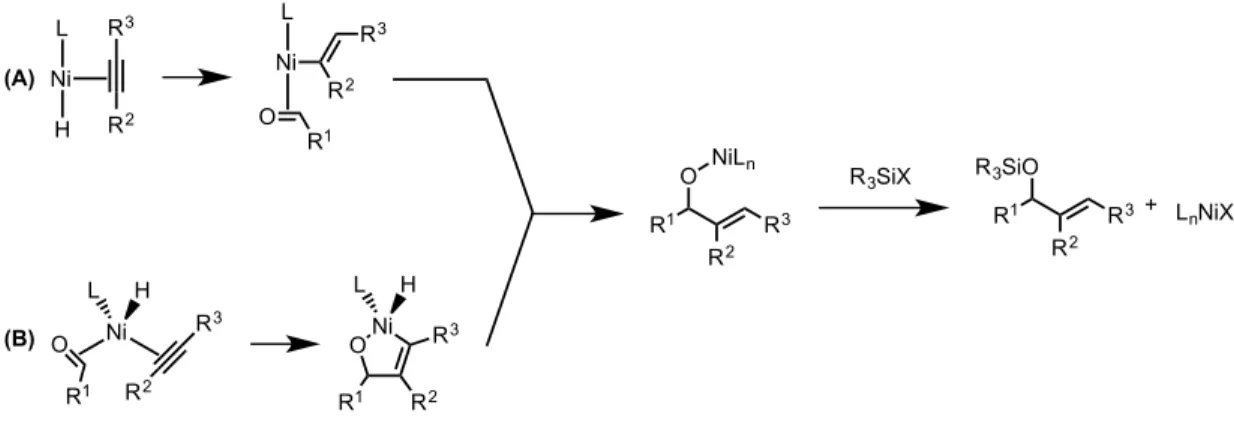
For pathways that could provide significant amounts of crossover products, the active catalyst would either be a nickel(0) complex or a formal nickel(II) complex resulting from a formal insertion into the silicon-hydride bond of the silane (Figure 2.02). In pathway A, the nickel(0) would undergo an oxidative cyclization yielding a metallacycle which would subsequently undergo a σ-bond metathesis with the silane, liberating the silyl-protected allylic alcohol and regenerating the catalyst. Proposed pathway B would begin with an insertion into the silicon-hydride bond, followed by insertion into the alkyne, analogous to previously reported hydrosilylations catalyzed by nickel. This insertion product would then coordinate and subsequently insert into the carbonyl of an aldehyde in solution, liberating a nickel(0) catalyst which would re-enter the catalytic cycle upon insertion into the silicon-hydride bond of the silane. Both
H O Ph Ni(COD)2 Ligand Et3SiD/Pr3SiH PH2 X R3SiO
mechanisms show the incorporation of the silane and the corresponding hydride or deuteride into a single molecule of product.
Figure 2.02 – Proposed pathways resulting in no crossover product formation
Analogous to the previously proposed pathways, pathways that would generate crossover products were proposed (Figure 2.03). These pathways begin from potential nickel(I) species that can be envisioned to form in solution under the reaction conditions. In the first pathway, either a neutral nickel(I) species or a cationic nickel(I) would undergo an insertion into an alkyne. This vinyl nickel complex would then subsequently react with a unit of aldehyde generating the common alkoxy-nickel intermediate. An alternative proposed pathway also begins with a nickel(I) catalyst bound to a both an aldehyde and alkyne unit, before undergoing an oxidative cyclization in a proposed nickel(I) to nickel(III) cycle. This metallacycle would reductively eliminate the hydrogen atom to the vinyl position to arrive at the common nickel species. This alkoxy-nickel complex could react with a new unit of either silane to regenerate the corresponding silyl-protected allylic alcohol and the nickel-hydride catalyst. The proposed mechanism pathways show the separation of a silyl group and the corresponding hydride or deuteride, leading to incorporation of each fragment into different molecules of product.
Ni L L O R1 R3 R2 Ni L L O R3 R2 R1 R3SiH Ni L L R1 R3 R2 R3SiO + (A) (B) L Ni R3Si H R3 R2 L Ni R3Si R3 R2 O R1 R1 R3 R2 ONi R3Si L Ni L L R1 R3 R2 R3SiO +
Figure 2.03 – Proposed pathways resulting in the formation of crossover products 2.0.3 Synthesis of Dimeric Metallacycle
In 2008, Ogoshi and coworkers isolated a dimeric metallacycle intermediate under conditions analogous to those used in the reductive coupling of aldehydes and alkynes (Scheme 2.03).80 Derived from the cyclization of benzaldehyde and 2-butyne in
the absence of a reducing agent, the resulting metallacycle can dimerize to a stable metallacycle.
Scheme 2.03 – Synthesis of Dimeric Metallacycle
The dimeric metallacycle was shown to undergo reduction using dialkyl zinc as the reducing agent (Scheme 2.04). However, in contrast to known methodology, the reduction requires forcing conditions including a large excess of aldehyde and additional phosphine ligand. When the dimeric metallacycle was treated with dimethylzinc directly, no reduction was observed. The need for additional phosphine and aldehyde was not
Ni H L O R1 R3 R2 Ni H L O R3 R2 R1 (A) (B) L Ni H R3 R2 L Ni R3 R2 O R1 R1 R3 R2 O NiLn R3SiX R1 R3 R2 R3SiO LnNiX + Ph O H3C CH3 Ni(COD)2PCy3 C6H6 + tol/hexanes -20oC Ni O CH3 CH3 Ph PCy3 NiO H3C H3C Ph Cy3P
explained, but presumably serves to coordinate to the complex in solution and dissociate larger aggregate structures of the metallacycle to undergo further reactivity.
Scheme 2.04 – Reactivity of Dimeric Metallacycle with dimethyl-‐zinc
In addition to reduction by alkylzinc reagents, the dimeric metallacycle was found to undergo carbonylation under an atmosphere of carbon monoxide, as well as a thermal degradation pathway providing α,β-unsaturated carbonyl complexes (Scheme 2.05).
Scheme 2.05 – Thermal degradation of dimeric nickel metallacycle
A synthetic approach for the use of the thermal degradation pathway was proposed and investigated by Dr. Ryan Baxter in the Montgomery research group in a series of hydroacylation reactions (Scheme 2.06). It was found that outside of a few specific examples, the formation of desired products required the use of a microwave reactor. These intense reaction conditions are not tolerant of more delicate functionality, limiting the applicability of the method to organic synthesis.
Ni O CH3 CH3 Ph PCy3 NiO H3C H3C Ph Cy3P ZnMe2 Ph CH3 CH3 OH CH3 + PhCHO (20 equiv.) PCy3 (2 equiv.) THF, -20oC to rt 70% Yield Ph CH3 CH3 MeZnO Ni PCy3 CH3 H+ Ni O CH3 CH3 Ph PCy3 NiO H3C H3C Ph Cy3P H H Δ Ph CH3 CH3 O Ph CH3 CH3 O Ni H PCy3
Scheme 2.06 – Hydroacylation development from the Montgomery Laboratory 2.0.4 Kinetic Profile of Intramolecular Reductive Coupling
Mechanistic studies into the reductive cyclization of ynal substrates were reported in 2012.81 Using a ReactIR to follow the reaction progress, it was found that there was a
first order dependence on both the ynal substrate as well as the catalyst employed (Figure 2.04). The reaction was found to also have a zero-order dependence on silane concentration. This led to the proposal of a mechanism where the oxidative cyclization of ynal was the rate-limiting step, followed by coordination and σ-bond metathesis with the silane.
Figure 2.04 – Kinetic profile for intramolecular reductive coupling
Alternative mechanisms were proposed consistent with the kinetic profile constructed for the reagents in the reductive coupling that involved the silane in different capacities. To address these potential pathways, a series of silane consumption experiments were performed (Scheme 2.07). It was found that the silane was unaffected by the presence of the nickel catalyst in solution, ruling out the initial insertion of the nickel catalyst into the silicon-hydride bond of the silane, resulting in a formal nickel(II)
H Ph
O Ni(COD)2 (10 mol%)PCy3 (20 mol%)
THF, 0.05M, 45oC 60-min syringe drive
of substrate 18 hr O Ph 70% Yield H O Ph Et3SiH Ni(COD)2 (10 mol%) PCy3 (20 mol%) + Ph Et3SiO
intermediate as the resting state. Further experiments showed that hydrosilylation of either the aldehyde, alkyne, or ynal substrates were not operating in the reaction conditions. All of the consumption experiments provide evidence for a mechanism supporting a rate-limiting oxidative cyclization for ynal substrates employing a nickel-phosphine catalyst system.
Scheme 2.07 – Silane consumption experiments 2.1.0 Unified Mechanistic Proposal
2.1.1 Proposed Catalytic Cycle for Nickel-Catalyzed Reductive Coupling of Aldehydes and Alkynes
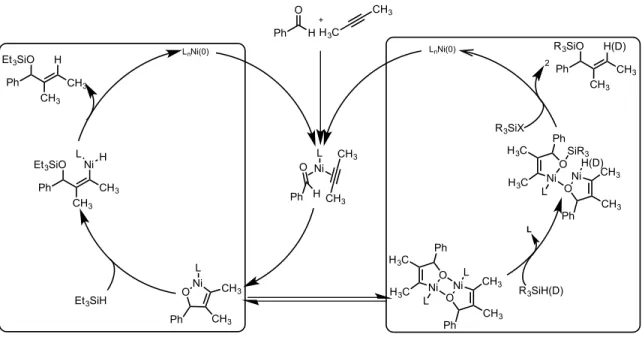
Combining the evidence put forth by kinetic analysis with the isolation and characterization of the dimeric metallacycle species by Ogoshi, a unified mechanistic picture can be constructed that provides insight into the reductive coupling of aldehydes
H
O Ph
cyclization to generate a monomeric nickel metallacycle, which exists in equilibrium with the dimeric metallacycle. From either metallacycle, association with silane and subsequent σ-bond metathesis will generate the observed silyl protected allylic alcohols, and liberate the catalyst to re-enter the catalytic cycle.
Figure 2.05 – Unified Mechanism, unifying kinetics profile with dimeric metallacycle 2.1.2 Double-Labeling Study as a means to Understand Post-Rate Limiting Factors
Recent mechanistic developments into the reductive coupling of aldehydes and alkynes allow for a single mechanistic proposal for both the phosphine-ligated pathway and the NHC-ligated pathway. Where the initial report proposed fundamentally different pathways to explain changes in product distribution, the existence of the dimeric metallacycle provides an explanation for the disparity. The mechanistic picture consists of two fundamental pathways, where the monomeric metallacycle pathway will
Ph CH3 Ni O CH3 Ph H3C NiO H3C L L H3C CH3 Ni L Ph H O CH3 CH3 Et3SiH LnNi(0) Ph CH3 Ni O CH3 L Ph CH3 Ni O CH3 Ph H3C Ni H3C H(D) L O SiR3 Ph CH3 CH3 Et3SiO LNi H Ph CH3 CH3 Et3SiO H Ph CH3 CH3 R3SiO H(D) 2 R3SiX Ph H O + LnNi(0) L R3SiH(D)
molecule of product resulting in no formation of crossover products, or an alternative pathway where the dimeric metallacycle will allow for the separation of the silyl component and the corresponding hydride or deuteride into different molecules of product (Figure 2.06). With this operating mechanism, the steric bulk and strong binding affinity of NHC ligands would prevent dimerization of the metallacycle, forcing the reaction to only occur via the monomeric metallacycle pathway. In contrast, the smaller and more labile phosphine ligated systems can dimerize depending on a number of substrate factors. However, directly analyzing the effects of potential metallacycle dimerization is made difficult because these intermediates are proposed to occur after the rate-limiting step of the reaction.
Figure 2.06 – Divergent routes leading to crossover products or non-crossover products
Double-labeling experiments can be used to understand the implications of dimerization of the metallacycle in solution, despite occurring after the rate-limiting step.
Ph CH3 Ni O CH3 Ph H3C NiO H3C L L H3C CH3 Ni L Ph H O CH3 CH3 Et3SiH LnNi(0) Ph CH3 Ni O CH3 L Ph CH3 Ni O CH3 Ph H3C Ni H3C H(D) L O SiR3 Ph CH3 CH3 Et3SiO Ni H L Ph CH3 CH3 Et3SiO H Ph CH3 CH3 R3SiO H(D) 2 R3SiX Ph H O + LnNi(0) L R3SiH(D)