The copyright © of this thesis belongs to its rightful author and/or other copyright owner. Copies can be accessed and downloaded for non-commercial or learning purposes without any charge and permission. The thesis cannot be reproduced or quoted as a whole without the permission from its rightful owner. No alteration or changes in format is allowed without permission from its rightful owner.
STUDENT ENGAGEMENT, STUDENT INTERACTIONS
AND 'QUALITY
OF
USE' IN BLENDED LEARNING
USING FLIPPED CLASSROOM
NORAINI BINTI NASIRUNBHIRUN
DOCTOR OF PHILOSOPHY
WNIVERSITI UTARA MALAYSIA
STUDENT ENGAGEMENT, STUDENT INTERACTIONS AND 'QUALITY OF USE' IN BLENDED LEARNING USING FLIPPED
CLASSROOM
BY
NORAINI BINTI NASIRUN@HIRUN
Thesis Submitted to
School of Technology Management and Logistics, Universiti Utara Malaysia,
PERMISSION TO USE
In presenting this thesis in hlfillment of the requirements for a Post Graduate degree from the Universiti Utara Malaysia (UUM), I agree that the Library of this university may make it freely available for inspection. I hrther agree that permission for copying this thesis in any manner, in whole or in part, for scholarly purposes may be granted by my supervisor(s) or in their absence, by the Dean of School of Technology Management and Logistics where I did my thesis. It is understood that any copying or publication or use of this thesis or parts of it for financial gain shall not be allowed without my written permission. It is also understood that due recognition shall be given to me and to the UUM in any scholarly use which may be made of any material in my thesis.
Request for permission to copy or to make other use of materials in this thesis in whole or in part should be addressed to:
Dean of School of Technology Management and Logistics Universiti Utara Malaysia
060 1 0 UUM Sintok Kedah Daryl Aman
ABSTRACT
The research ofblended learning using flipped classroom is still at the early stage, hence the fundamental issues still unclear. Therefore, this study has examined the quality of use, by incorporating the quality constructs for entrepreneurship education. The framework was developed base on 'Quality of Use' Model underpinned by Luhmann's System Theory, Model of Online Learning and Social Learning Theory: Groups Nets and Sets. There were five variables tested in this study, namely satisfaction, efficiency, effectiveness, student interactions and student engagement. This study was conducted in two phases, firstly this study examined whether blended learning provide impacts on the studied variables. Later this study tested the relationship between variables based on the research framework. Data for the first stage were obtained through quasi- experimental among 90 students of entrepreneurship education for the Semester 201 54 in the Universiti Teknologi MARA Perlis. The results reveals that there were significant differences between treatment group and control group for all variables tested. Data for the second stage were collected through a self-administered survey questionnaires among 281 students of entrepreneurship education for Semester 20162 in the same university. This result reveals that student interactions have a significant relationship with satisfaction, efficiency, effectiveness. However, student engagement exhibits a significant influence to satisfaction, but insignificant influence to efficiency and effectiveness. Further analysis reveals that student interactions provides a partial mediation between student engagement and satisfaction and full mediation between student engagement and efficiency, as well as effectiveness. This study contributes to the development of quality framework for large enrollment in flipped classroom, a multi-method of data collection to ensure the appropriateness of variables selected, and a quality measure of blended learning in entrepreneurship education, as well as business management disciplines. Conclusions, limitation and suggestions for future studies are also highlighted.
Keywords: Quality of Use, blended learning, flipped classroom, entrepreneurship education, quasi-experimental.
ABSTRAK
Penyelidikan berkaitan pembelajaran gabungan menggunakan kaedah flipped classroom masih di peringkat awal, menyebabkan isu-isu asas seperti kerangka kualiti perlu di kaji secara berterusan. Untuk itu, kajian ini dijalankan bagi mendalami kualiti penggunaan melalui pembolehubah kualiti di dalam kontek pendidikan keusahawanan. Kajian dijalankan berasaskan Model 'Kualiti Penggunaan' dan disokong oleh Sistem Teori Luhman, Model Pmebelajaran atas Talian dan Teori Pembelajaran Sosial: Kumpulan Rangkaian dan Set Lima pembolehubah telah dikaji iaitu kadar puashati, efisyen, keberkesanan, interaksi pelajar dan penglibatan pelajar. Kajian ini dijalankan dalam dua fasa, di mana fasa pertama ialah untuk memastikan pembelajaran gabungan memberi kesan kepada pemboleh-pembolehubah yang dikaji dan fasa kedua ialah untuk menguji hubungan antara pernbolehubah mengikut kerangka kajian. Fasa pertama menggunakan kuasi eksperimen yang melibatkan 90 pelajar asas keusahawanan bagi Semester 201 54 di Universiti Teknologi MARA Perlis. Dapatan kajian menunjukkan terdapat perbezaan yang signifikan di antara kumpulan rawatan dengan kumpulan kawalan untuk semua pembolehubah kajian. Manakala data untuk fasa kedua dikumpul melalui kaedah bancian soalselidik kendiri yang melibatkan 281 pelajar asas keusahawanan bagi Semester 20162 di universiti yang sama. Dapatan kajian menunjukkan interaksi pelajar mempunyai hubungan yang signifikan di antara pembolehubah 'kualiti penggunaan' (kadar puashati, efisyen, keberkesanan). Demikian juga, penglibatan pelajar mempunyai hubungan yang signifikan dengan kadar puashati, tetapi tidak menunjukkan hubungan yang signifikan dengan pembolehubah efisyen dan keberkesanan. Analisis lanjutan menunjukkan interaksi pelajar menjadi pengantara separa di antara penglibatan pelajar dengan kadar puashati dan pengantara penuh di antara penglibatan pelajar dengan efisyen serta keberkesanan. Kajian ini menyumbang kepada pembangunan kerangka kualitiflipped classroom berskala besar menggunakan konsep kualiti penggunaan, menggunakan kaedah berperingkat pengumpulan data bagi memastikan ketepatan penggunaan pembolehubah-pembolehubah kajian, serta pengukuran kualiti flipped classroom dalam kontek pembelajaran asas keusahawanan khususnya, dan disiplin pengurusan perniagaan umumnya. Kajian ini juga turut membincangkan batasan kajian dan cadangan untuk kajian masa hadapan.
Keywords: ' Kualiti penggunaan' , pembelaj aran gabungan, flipped classroom, kuasi-eksperimen.
ACKNOWLEDGEMENT
In the name of Allah S.W.T, the Most Gracious and the Most Merciful, I thank you for giving me the strength to complete this thesis. First and foremost, my sincere gratitude and appreciation to my supervisors, Dr. Abdul Aziz Othman, Dr. Sarina Muhamad Noor, and Prof Dr. Rushami Zen Yusoff for their constructive ideas, guidance, and patience throughout the duration of preparing this thesis. They have successfully guided me through some stressful times and always willing to sharpen my understanding of the thesis and to other academic writings.
I would also like to thank to all the staff at School of Technology Management and Logistics, Universiti Utara Malaysia (UUM) for their invaluable helps throughout my study. My gratitude also goes to Universiti Teknologi MARA (UiTM), for awarding me the scholarship and study leave to pursue this PhD degree. A note of thanks also goes to all my beloved fiends at UiTM and Universiti Utara Malaysia, Hasyeilla Abdul Mutalib, Sarah Mardhiah Selamat, Noor Azura Mohd Noor, Abdulsatar Abduljabbar Sultan, Nadratul Fasihah Abdul Wahab and many others for their moral support, guidance, encouragement and fiendship.
Finally, I would like to extend my affection to my husband, Zor Mat Nor and children, IVur Liyana and Nur Athifah. Thank you for providing me with overwhelming patience, love, encouragement, and inspiration that have greatly facilitated the completion of this challenging work.
I TABLE OF CONTENTS PERMISSION TO USE
...
i . . ABSTRACT...
ii...
ABSTRAK...
iii ACKNOWLEDGEMENT...
iv...
TABLE OF CONTENTS...
: v LIST OF TABLES...
x. .
LIST OF FIGURES...
xi1LIST OF EQUATIONS
...
xivLIST OF ABBREVIATIONS
...
xvCHAPTER ONE INTRODUCTION
...
11.1 Background of the Study
...
11.2 Problem Statement
...
71.3 Research Questions
...
13...
1.4 Research Objectives 14...
1.5 Scope of the Study 14. .
1.6 Significance of the study...
15. .
1.7 Definition of Terms...
17 1.6.1.
Blended Learning...
17 1.6.2. Quality of Use...
18 1.6.3. Student Interactions...
1 8 1.6.4. Student Engagement...
1 9 1.8 Organization of the Thesis...
19CHAPTER TWO LITERATURE REVIEW
...
202.1 Introduction
...
202.2 Technology Innovation in Education
...
202.3 Blended Learning ... 25
2.3.1 Online Learning, E-Learning and Blended Learning
...
..
..
262.3.2 Models of Blended Learning
...
282.3.3 Previous Literatures in Blended Learning
...
29...
2.4 Online Learning in Malaysia
...
.
.
45...
2.4.1 Overview 45 2.4.2 Reviews of Blended Learning and Flipped Classroom in Malaysian Universities...
47...
2.5 Entrepreneurship Education in Malaysia 52 .... 2.5.1 Reviews of Entrepreneurship Education in Malaysian Universities 52 2.5.2 Flipped Classroom and Entrepreneurship Education in Universiti Teknologi MARA (UiTM) Perlis...
54...
2.6 Research Methodologies in Blended Learning 60 ... 2.7 Synthesis of Literatures in Blended Learning and Flipped Classroom 64 2.7.1. Reviews of Literatures in Blended Learning in Business and...
Management Disciplines 64 2.7.2. Synthesis of Issues in Blended Learning and Flipped Classroom...
662.7.3. Synthesis of Issues in Blended Learning and Flipped Classroom in Malaysia 69 2.7.4. Synthesis of Issues in Blended Learning for Entrepreneurship . .
...
Education in Malaysia 71...
2.7.5. Blended Learning Model among Malaysian Universities 73 2.7.5.1. Stage 1 : Awareness/Exploration...
742.7.5.2. Stage 2: AdoptiodEarly Implementation
...
752.7.5.3. Stage 3: Mature Implementation/Growth
...
772.8 Summary of the Chapter
...
79CHAPTER THREE CONCEPTUAL FRAMEWORK AND HYPOTHESES DEVELOPMENT
...
80...
3.1 Introduction 80 3.2 Underpinning Theories...
80...
3.2.1. 'Quality of Use'...
.
.
803.2.1 . 1. Understanding the 'Quality of Use' Concept
...
813.2.1.2. International Standards Related to Usability
...
843.2.1.3. Previous Literatures in Usability
...
86...
3.2.1.4. Conceptualization Quality of Use for This Study 88...
3.2.2. Luhrnann' s System Theory 90...
3.2.3. Social Learning Theory: Groups Nets and Sets 93 3.2.4. Model of Online Learning ... 98...
3.3 Development of Conceptual Framework 101
... . 3.3.1 Satisfaction 101
...
3.3.2. Efficiency 104...
3.3.3. Effectiveness 1 0 6...
3.3.4. Student Interactions 108 3.3.5. Student Engagement ... 112...
3.4 Conceptual Framework 115 ...3.5 Summary of Hypotheses for the Study 117
...
3.6 Summary of the Chapter 118
CHAPTER FOUR RESEARCH METHODOLOGY
...
119...
4.1 Research Design: Overview and Preliminary Activities 119...
4.1
.
1 Research Setting 122...
4.1.2 Measurement Design 128
4.1.2.1 Operationalization of Variable and Measurement: Student
...
Engagement 128
4.1.2.2 Operationalization of Variable and Measurement: Student
...
interactions 132
4.1.2.3 Operationalization of Variable and Measurement:
...
Satisfaction 134
4.1.2.4 Operationalization of Variable and Measurement: Efficiency
...
136 4.1.2.5 Operationalization of Variable and Measurement:...
Effectiveness 137
4.1.2.6 Pilotstudy
...
138...
4.1.2.7 Finalizing Measurement for the Study 140...
4.1.3 Unit of Analysis 141
4.1.4 Timeline of Data Collection
...
144 4.1.5 Approvals, Consents and Ethical Considerations...
146... 4.2 Research Design for Stage 1 : Quasi Experimental 146
...
4.2.1 Selection of Participants 147
4.2.2 Validity Issues in Quasi Experiment ... 148
...
4.2.3 Treatments 156
4.2.4 Procedures and Data Collection ... 165
...
4.3 Research Design for Stage 2: Survey
...
1694.3.1 Selection of Respondents
...
169...
4.3.2 Student Interactions in ENT300 Flipped Classroom 170 4.3.3 Data Collection...
1724.3.4 Method of Data Analysis
...
1724.4 Summary of the Chapter
...
173CHAPTER FIVE DATA ANALYSIS AND FINDINGS
...
1745.1 Introduction
...
174...
5.2 Data Analysis and Findings for Stage 1 : Quasi-Experimental 177 5.2.1 Preliminary Analysis...
1775.2.2 Profiles of Participants
...
1775.2.3 Descriptive Analysis
...
1785.2.4 Hypotheses Testing for Stage 1
...
1825.3 Data Analysis and Findings for Stage 2: Survey
...
1845.3.1 Preliminary Analysis
...
1845.3.2 Profiles of Respondents
...
1855.3.3 Assessment of Models
...
1865.3.4 Assessment of Measurement Model
...
1875.3.5 Assessment of Structural Model
...
1935.3.6 Testing Mediating Effects
...
2035.4 Summary of Hypotheses Testing
...
2075.5 Summary of the Chapter
...
208CHAPTER SIX DISCUSSIONS. CONCLUSIONS AND RECOMMENDATIONS
...
2106.1 Introduction
...
2 10 6.2 Recapitulation of the Study...
2106.3 Discussions
...
2146.3.1 Research Objective 1
...
2146.3.1.1. The Difference in Satisfaction between Blended Learner Group and Web Facilitated Group
...
.
.
....
-215 6.3.1.2. The Difference in Efficiency between Blended Learner6.3.1.3. The Difference in Effectiveness between Blended Learner Group and Web Facilitated Group ... 220 6.3.1.4. The Difference in Student interactions between Blended
Learner Group and Web Facilitated Group
...
223 6.3.1.5. The Difference in Student Engagement between BlendedLearner Group and Web Facilitated Group
...
225...
6.3.2 Research Objective 2 2 2 8
6.3.2.1. The Relationship between Student Engagement and
...
Satisfaction 229
6.3.2.2. The Relationship between Student Engagement and
...
Efficiency 230
6.3.2.3. The Relationship between Student Engagement and
...
Effectiveness 2 3 1
6.3.2.4. The Relationship between Student Engagement and Student
...
Interactions 233
6.3.2.5. The Relationship between Student Interactions and
...
Satisfaction 234
6.3.2.6. The Relationship between Student Interactions and
...
...
Efficiency
.
.
.
2356.3.2.7. The Relationship between Student Interactions and
...
...
Effectiveness
.
.
2376.3.2.8. Student Interactions as Mediator
...
239 6.4 Implication of the Study...
241...
6.4.1 Theoretical Implication 242 6.4.2 Methodological Implication...
246...
6.4.3 Managerial Implication 247...
6.5 Limitations of the Study 250
6.6 Suggestions for Future Studies
...
252 6.7 Conclusions...
2 5 3LIST OF TABLES Table 2
.
1 Table 2 . 2 Table 2 . 3 Table 2 . 4 Table 2 . 5 Table 2.
6 Table 2 . 7 Table 2 . 8 Table 2.
9 Table 2 . 10 Table 2 . 1 l Table 2 . 12 Table 2.
13 Table 2 . 14 Table 3.
1 Table 3.
2 Table 4.
1 Table 4 . 2 Table 4 . 3 Table 4 . 4 Table 4 . 5 Table 4 . 6Descriptions of Online Learning Adapted from Allen & Seaman
(201 1)
...
27 Blended Learning Models...
28 Main Articles' Reviews for This Study...
30...
Summary of Articles by Year. Country. Journal and Area of Study 40 Summary of Articles by Research Methodology. Duration of Data Collection and Platforms in Flipped Classroom...
41 Summary of Articles by Research Theories. Measurements and Data...
Analysis 43
Articles Review: Blended Learning and Flipped Classroom in
Malaysian Universities
...
.
.
.
...
48 Student Enrolment for ENTlETR300 Subject for Semester 201 0Session 2 to Semester 2016 Session 2
...
56 Student Enrolment and Results for ENTlETR300 for Semester 2010 Session 2 to Semester 2016 Session 2 ... 58 Efficiency Targets and Efficiency Achievements for Tasks andAssessments for ENT300
...
.
.
.
...
59 Synthesis of Issues in Blended Learning for Business and Management Discipline...
65...
Synthesis of Issues in Blended Learning in Flipped Classroom 67 Synthesis of Issues in Blended Learning for Business and Management Discipline and Literatures in Blended Learning and Flipped Classroom
...
in Malaysia 69
Synthesis of Issues in Blended Learning Entrepreneurship Education in Malaysia
...
72 Latest I S 0 Standards for Usability. Usability Reports and Usability Measures...
85 Hypotheses for the Study...
117 Types of Learners...
1 24 NSSE 2008 Online Learning Experimental Items (Chen. Lambert. & Guidry. 2010)...
130 Online Student Engagement Scale (OSE) by Dixson (201 0)...
131 The Final Items Representing Student Engagement for the Study....
132 Dimensions of Student Interactions by Kuo et a1.
(2014)...
133 The Final Dimensions and Items Representing Student Interaction for the Study...
134Table 4
.
7 Student Satisfaction Items by Kuo et al.. (2014) ... 135Table 4
.
8 The Final Items Representing Satisfaction for the Study...
135Table 4
.
9 Table 4.
10 Table 4.
11 Table 4.
12 Table 4.
13 Table 4.
14 Table 4.
15 Table 4.
16 Table 4.
17 Table 5.
1 Table 5.
2 Table 5.
3 Table 5 . 4 Table 5 . 5 Table 5.
6 Table 5.
7 Table 5.
8 Table 5.
9 Table 5.
10 Table 5.
11 Table 5.
12 Table 5.
13 Table 5.
14 Table 5.
15 Table 5.
16 Table 5.
17 Table 5.
18 Efficiency Items by Finstad (201 0) ... 137...
The Final Items Representing Efficiency for This Study 137 Effectiveness Items by Finstad (20 10) ... 138...
The Final Items Representing Effectiveness for This Study 138...
Reliability Result for Pilot Testing and Management Decisions 140 Finalized Items for Actual Study...
140Participants and Timeline of Data Collection
...
145Stages for Valid Experimentation as Suggested by Kumar. Abdul - Talib. & Ramayah (20 13)
...
150Activities of Flipped Classroom in Quasi Experimental
...
167Profile of Respondents for Quasi Experimental
...
178Descriptive Analysis for Items in this Study for Blended Learner and Web Facilitated
...
179Descriptive Analysis and Effect Size for Variables in this Study
...
181Descriptive Analysis for Variables in this Study
...
182Independent t-test Results for Web Enhancer Learners and Blended Learners
...
1 83 Hypotheses Results for Stage 1...
183Demographic Factors for Stage 2 Data Collection using Survey-based Method
...
185Results Summary of Measurement Model
...
190Discriminant Validity: Fornell-Larcker Criterion ... 192
Discriminant Validity: Cross Loading for Measurement Model
...
192Collinearity Assessment
...
194Significance Testing Results of the Structural Model Path Coefficient
...
199Results of Coefficient of Determination ( R ~ ) and Predictive Relevance ( Q ~ )
...
-200Results of effect sizesf
...
-201Results of effect sizes q2
...
203Mediator Analysis for Direct and Indirect Effects
...
206Variance Accounted For (VAF) and Hypotheses Testing ... 206
LIST OF FIGURES Figure 2
.
1 Figure 2.
2 Figure 3.
1 Figure 3.
2 Figure 3 . 4 Figure 3 . 5 Figure 3 . 6 Figure 3 . 7 Figure 3.
3 Figure 3.
8 Figure 3.
9 Figure 4.
1 Figure 4 . 2 Figure 4.
3 Figure 4 . 4 Figure 4.
5 Figure 4.
6 Figure 4.
7 Figure 4.
8 Figure 4.
9 Figure 4.
10The Disruptive Innovation Model
...
23A Progressive Model of Research Types and Stages of Adoption in Blended Learning
...
78Quality of Use Measure Determine by Context of Use
...
82Quality of Use Measure for this Study
...
90A Venn Diagram Shows a Typology of Groups. Nets and Sets
...
94Social Forms for Learning Based on Groups. Nets and Sets
...
95A Venn Diagram Shows a Typology of Groups. Nets and Sets in ENT300 Flipped Classroom
...
97Social Forms for Learning Based on Groups. Nets and Sets in ENT300 Flipped Classroom
...
98Educational Interactions
...
.
.
...
100Theoretical Framework for the Study ... 116
Research Framework for the Study ... 116
Summary of the Research Methodology
...
121Example of Student-Student Interactions from Facebook and It's Translation
...
157Example of Student-Instructor Interaction from Facebook and It's Translation
...
158Example of Student-Instructor Interaction from WhatsApp and It's Translation
...
1 6 0 Example of Student-Instructor Interaction : Dissemination of Information from Instructor...
162Notification Received by Instructor Who Registered for Blended Learning
...
163Content Provided by Instructor for Fundamentals of Entrepreneurship
. .
in I-Learn...
164Example of Student-Instructor Interaction : Information from Student List of Content Provided by Instructor for Fundamentals of Entrepreneurship in i-Learn
...
1 7 1 Sample Content Provided by Instructor for Fundamentals of Entrepreneurship in i-Learn...
171Figure 5 . 1 Summary of the Data Analysis and Findings
...
176Figure 5
.
2 PLS Path Model Estimation Diagram...
196Figure 5 . 3 PLS Structural Model Path Coefficient and p-Values
...
198LIST OF EQUATIONS
Equation 4 . 1 Percentage of Online Interaction
...
126Equation 5 . 1 Equation for Cohen's d and Interpretation of Cohen's d Value
...
181Equation 5
.
2 Equation for Calculation of?...
201LIST OF ABBREVIATIONS ENT300 UiTM (Perlis) MOHE OBE SCL MQA PSPTN MEIPTA MOE ICU-JPM TVET MOOC PO LO CO SLT I S 0 ICT IS SOW i-CREATE LMS Fundamentals of Entrepreneurships
Universiti Teknologi MARA (Perlis), Malaysia Ministry of Higher Education, Malaysia
Outcome Based Education Student Centered Learning Malaysian Qualification Agency
Pelan Strategik Pengajian Tinggi Negara (National Higher Education Strategic Plan) Majlis e-Pembelajaran IPTA Malaysia Ministry of Education, Malaysia
Implementation Coordination Unit- Prime Minister's Office Technical Vocational Education and Training
Massive Open Online Courses Program Outcome
Learning Outcome Course Outcome Student Learning Time
International Organization for Standardization Information Communication Technology Information System
Scheme of Work
Instructional Model for ENT300 in UiTM (Perlis) Learning Management System
CHAPTER ONE INTRODUCTION
1.1 Background of the Study
Electronic learning or e-learning, is widely use in various organizations including
higher learning institutions or universities. Statistics by Docebo (2016) reported that e-learning market will continue to grow approximately 5% yearly between 2016 and
2023, with expected revenue exceeding US 240 billion in 2024. Moreover, Asia region
was reported as the second highest expenditure related to e-learning products and
services after North America. The report further highlights that subjects related with
business and management contribute 16.8%, the highest percentage of course
distribution in e-learning (Docebo, 2016). Report by Docebo (2016) also pulled
together insights from various sources and pointed out that among some important characteristics in the future e-learning are social learning (collaborative tools, virtual
classroom and content management), personalized learning, and micro learning (bit-
sized content). These characteristics also align with the online learning trends for 2017
that predicted efficiency, measures of usability, virtual classroom, personalized and
micro learning as important factors that require more attention by institutions that offer
blended learning in their teaching and learning activities (Black, 2017).
Furthermore, in the universities, it is known that e-learning provides benefits not only
to the institutions, but also to the students and faculties. Study conducted by Education
Centre for Analysis and Research (ECAR) in 201 3 found that e-learning offers benefits
and streamline the universities' curriculum. Most of e-learning in the universities are
conducted using blended learning in the classroom setting. Scholar such as Arbaugh
(2014) identifies that flipped classroom is one of the approaches of blended learning
that is suitable for classroom setting.Tthis regard, the flipped classroom also identified
as one of teaching and learning trends in the universities around the globe (Baepler,
Walker, & Driessen, 2014; Hao & Lee, 2016; Lindernan et al., 2015; Raihanah, 2014;
UOREGON, 20 16).
In Malaysia, the government is very serious in producing quality human and intellectual
capital. Because of that, Ministry of Higher Education (MOHE) in 2007 introduced
National Higher Education Strategic Plan (PSPTN) (MOHE, 201 1). This plan was
developed as one of a strategic moves to transform the nation into a high-income nation
by 2020. PSPTN is supported by 23 Critical Agenda Projects (CAPS), where e-learning
is one of the CAPS in PSPTN (MOHE, 2011). It is used as the driver to support
traditional learning (Mohamed Amin Embi, 201 I), which encourages instructors to
adopt blended learning approach in teaching and learning activities. A study related to
the blended learning and flipped classroom readiness in Malaysia revealed that
currently respondents are ready to adopt blended learning and flipped classroom
(Mohamed Amin Embi, Hussain, & Panah, 2014; Mohammad Amin Embi, Mohd
Norsin, & Panah, 2014). Moreover, the flipped classroom approach is widely used in
various universities in Malaysia (Alsagof, Baloch, & Hashim, 2014; Mohamed Amin
Embi et al., 2014; Raihanah, 2014; Salam, Bakar, Mohd Asarani, & Mohamed Saki,
Blended learning integrates the use of Information Communication and Technology
(ICT) in education. Currently, the technology associated with education is at infancy
stage (High, 2013) thus requires a lot of attentions from scholars to gain more
knowledge and understandings about this area. With the integrations of the ICT
technologies, this area offers plenty of research opportunities such as fundamental
issues related with blended learning, quality measurement, comparison of delivery
methods in learning and instruction models related with blended learning (Arbaugh,
2014; Arbaugh & Hwang, 2015; Drysdale, Graham, Spring, & Halverson, 2013;
Halverson, Graham, Spring, Drysdale, & Henrie, 2014; Ladhari, 201 0).
Since blended learning is considered a new research area, there are some disagreements
in terminology used in publications, which contribute to the difficulties in developing
suitable measurements (Graham, Woodfield, & Harrison, 201 3). The problem related
to measurements not only occur in blended learning but also in other online application
platforms including commercial applications. Scholar such as Ladhari (2010),
highlighted the issue of difficulties in measuring quality in online applications as
compared to traditional service quality. Similarly with online applications in education,
scholars of e-learning suggested that more studies need to be done to explore and
confirm the quality dimensions for online education (Martinez-argiielles & Callejo,
2013; Shelton, 2010; Teo, 2010). These suggestions were supported by scholars of
blended learning that urged the need of having a substantive discussions about theory,
developing new theoretical framework and accompanied by empirical research in order
to increase the understanding in this area (Drysdale et al., 201 3; Halverson et al., 2014).
inquiry is the only framework that is widely used in the study of blended learning so
far.
Currently, majority of researches related with quality of online education focuses on
student satisfaction as the research attention (Chen, 201 0; Gilbert, Morton, & Rowley,
2007; Kuo, Walker, Schroder, & Belland, 2014; Wu, Tennyson, & Hsia, 2010).
Students satisfaction is widely used in previous researches due to its capabilities to
improve students retentions as well as assisting the institutions to formulate the strategic
planning for online learning (Kuo et al., 2014). However, in the context of using a
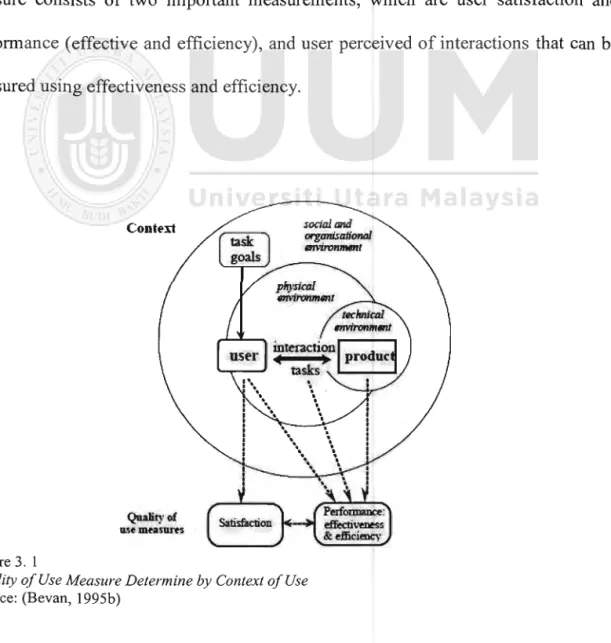
system, Bevan, (1 995b) had coined a term known as 'quality of use' to capture the user
experiences based on the usage of the system. 'Quality of use' can be measured using
effectiveness, efficiency and satisfaction in online applications (Bevan, 1995b; Renner,
Laumer, & Weitzel, 2014; Sultan & Wong, 2013). The 'quality of use' is known as
outcome of the interactions between the user and the experience of using the product in
the specified environment (Bevan, 1995b).
Besides quality of use, student interactions and student engagement issues captures
attentions among scholars among online learning (Bigatel, 2016). As reported by
Elearning and Government Elearning Magazines (2014)' interactions among users in
corporate online learning promote engagement and collaboration, thus provide benefits
such as the increment of innovations and profits in an organizations. Similarly, in
education, the integrations of technology in teaching and learning activities promotes
student interactions (Kuo et al., 201 4) and student engagements (Junco, Heibergert, &
Loken, 201 I), and improved student performance (Bradford & Wyatt, 201 0; Kuo et al.,
quality related to student interactions (Drysdale et al., 2013; Kuo et al., 2014) and
student engagement (Dixson, 2010) in online learning context, including blended
learning. As for that, researchers of blended learning are encouraged to include
variables related to students interactions and student engagement in their future studies
(Drysdale et al., 2013; Halverson et al., 2014).
In Malaysia, blended learning has been used as a driver of the e-learning
implementation. Thus, most of universities in Malaysia utilize the blended learning in
their teaching and learning activities. However, the intensity of implementation varies
from one institutions to another. Blended learning instructional model has been used
widely to handle a large and diverse enrollments (McKenzie et al., 201 3). Similarly, in
this country, there are several subjects such as Introductions to Entrepreneurship and
Information Communications and Technology (ICT) competency that is offered
through open learning via Massive Open Online Courses (MOOCs). This approach has
been introduced with the aim to reduce face to face hours and enhance the learning
experience among tertiary students. Even though Malaysian universities adopted the
latest technology in education, one main issue that needs to be addressed here is the
quality and effective measurement in blended learning. Unfortunately, there is no
standard measurements that is introduced by the government to measure this area
(Mohamed Amin Embi, 201 1). Recently, Ministry of Higher Education Malaysia
(MOHE) published e-Learning Guidelines for Malaysian HEIs, highlighted the importance of ensuring student interactions (students, instructors and content) in
blended learning environment, student engagement, quality of online pedagogy, and
A review of research methodologies choices conducted by Bliuc, Goodyear, & Ellis
(2007) categorizes the research methodologies into four general categories namely case
study, survey based, a comparative studies in a specific context and a comparative
studies in a holistic context. Case study method is widely used in research related to
information system (Esyutina, Fearon, & Leatherbarrow, 2013; Gao, 2013;
Triantafyllou & Timcenko, 2014), as it offers an insight of the situations (Bliuc et al.,
2007)
.
However, case study method received criticisms because it is embedded in thecontext, making it hard to generalize (Bliuc et al., 2007).
Another research methodology as highlighted by Bliuc et al. (2007) is survey based
research. Most of the studies related with blended learning applied a survey methods
to gather the data (Ahmed, 201 0; Bradford & Wyatt, 201 0; Kuo et al., 2014; Ramayah,
Wai, & Lee, 2012; Rubin, Fernandes, & Avgerinou, 2013). The evidence from these
studies showed a positive impact to the leaners outcome, however these studies were
not able to conclude 'why' it works (Drysdale et al., 2013). However, survey based
research focuses more on exploring the causal effect in the research, thus neglected the
richness descriptions offers in the research setting (Bliuc et al., 2007). A study related
with blended learning may include the comparison of the technology used in the
research setting. Subsequently, research methodology such as experimentation can be
employed to capture the different preferences of learning activities in different
modalities (Halverson et al., 2014).
Additionally, a research methodology in blended learning normally was embedded with
the research setting. Blended learning research requires an instructional model as a basis
et al., 2014). Because of this situation, instructional designers were inspired to leverage the ICT technology in their method of delivery as drivers to handle challenges offered by education in the 21 century. The teaching approaches such as massive open online courses (MOOCs) and flipped classroom have been exploited in handling a large and diverse enrollment (Findlay-thompson, Saint, & Mombourquette, 2014; Margaryan, Bianco, & Littlejohn, 2014; McKenzie et al., 2013). Thus, more studies related with instructional model and blended learning approaches are beneficial to understand the suitable approaches to handle specified environments (Drysdale et al., 201 3; Halverson et al., 2014).
From the above discussion, it can be concluded that blended learning, particularly flipped classroom approach is a new research area, thus more attention to the fundamental issues must be addressed. Unlike, the traditional learning, blended learning requires careful research planning and research design to ensure the quality of the research as a whole. These fundamental issues such as development of measurement that integrates it with the research setting including methods to be used in collecting data, the comparison approach in different modalities related to teaching and learning and instructional model to be used in developing the measurement, enable measuring quality of blended learning suitable in the specified context. This measurement will serve as a standard quality measurement to evaluate the effective of e-learning implementation for the nation.
1.2 Problem Statement
The emergence of technology in ICT gives a huge impact to teaching and learning activities. The integration of ICT in education creates multi-modalities in learning and
teaching approach such as blended learning using flipped classroom. According to
Graham et al. (201 3), the growth of adoption in blended learning will lead to the need
of revising the strategy, structure, as well as support to strengthen the quality of learning
and teaching in the universities. The researcher also suggests that future researchers in
blended learning investigate the processes and interventions that contribute to the
success of institutionalizing of this approach. Therefore, issues such as underpinning
theories and framework (Arbaugh, 2014; Drysdale et al., 2013; Halverson, Graham,
Spring, & Drysdale, 2012; Halverson et al., 2014), research methodology (Ahmad &
Buchanan, 2015; Arbaugh, 2014; A. Zainuddin, Kamaluddin, & Hassan, 2012) and
research design, and data analysis in blended learning must be addressed (Arbaugh &
Hwang, 2012; Halverson et al., 2014).
Until now, scholars in the quality of online learning have been unable to confirm the
dimensions for the area. As mentioned by Ladhari (2010), currently most of the
variables related to the e-service quality are developed for commercial context. In
education, although there are several measurements related to online learning
(Martinez-argiielles & Callejo, 20 13; Shelton, 20 10; Teo, 20 1 O), however the
measurement are not comprehensive. These studies suggest that future researches need
to be conducted to confirm and enhance the dimensions of e-service quality in
education.
One of the reasons that contributes to this matter is due to the disagreement in the
definition, as well as ambiguous definitions terminologies for online learning, and
blended learning in the publications, thus, making this area difficult to be measured
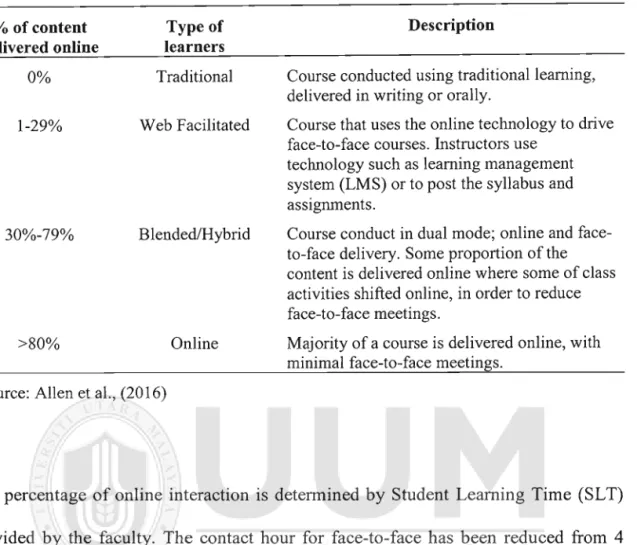
(201 l), where online learning, blended learning (web facilitated, and blended or hybrid
learning) and traditional learning could be classified through the percentage of course
content delivered online. However, scholars of blended learning pointed out that
blended learning area requires framework, including conceptual framework, and
theories that is accompanied by empirical findings specifically developed for this area
(Arbaugh, 2014; Drysdale et al., 2013; Halverson et al., 2012,2014).
Moreover, measuring the quality elements for technologies in education is complex. It
seems that, quality is not an absolute property of the system; rather, it depends on the
context where it is implemented (Bevan, 1999) thus makes the quality metrics vary
from one context to another. As for blended learning, scholars pointed out that at
minimum blended learning approach should be as effective as teaching in other
methods (Drysdale et al., 2013). This situation indicates that, in any blended learning
exercise, institutions should not only focus on the satisfaction of its implementation but
also on the efficiency (knowledge gain) and effectiveness (task completion) during and
after the blended learning session (Renner et al., 2014; Tullis & Albert, 2012). These
important quality factors have been defined earlier through 'quality of use' concept that includes effectiveness, efficiency and satisfaction in the technology mediated
environments (Bevan, 1995b; Renner et al., 2014; Sultan & Wong, 2013). Putting these
arguments together, it can be concluded that future studies must not separate these three
quality variables (satisfaction, efficiency and effectiveness) in any research related with
blended learning, particularly in the education setting.
Furthermore, blended learning approach integrates different education technologies
to support teaching and learning in higher learning institution making it harder to conduct the blended learning research (Par, 2004). However, previous scholars of blended learning highlighted that little studies put their attention on technologies used to facilitate online learning (Drysdale et al., 201 3). Hence, this issue must be addressed in the future studies of blended learning.
Until recently, studies on blended learning give more attention to student satisfactions and effectiveness as measured variables (Drysdale et al., 2013; Halverson et al., 2014). Thus, less attention is given to efficiency measures as compared to effectiveness measure in blended learning (Renner et al., 2014) even though in universities, efficiency is one of the important measures that reflects service quality of the institution (Sultan & Wong, 2013). Apparently, this is due to the issue of ambiguity between efficiency measure and efficiency drivers with technology in learning environment (Renner et al., 2014). Previous literature recognized quality of use or usability measures as the dimension of satisfaction, efficiency and effectiveness (Bevan, 1995) of user interface for information technology products and system quality. In this regard, future scholars have the opportunities to investigate on quality measurement by incorporating effectiveness, efficiency and satisfaction, as a quality of use in blended learning studies.
Other than quality of use, there are some quality issues which are related with technology in learning environment. Scholars of blended learning using flipped classroom suggest that future researchers should include some quality variables such as, student engagement and interactions in their study (Drysdale et al., 201 3; Halverson et al., 2014; Z. Zainuddin, Halili, Aceh, & Lumpur, 2016). Moreover, the quality
interactions between the user and the experience (participation) in a technology
mediated environment (Bevan, 1995b). Seemingly, these issues are not only discussed
in education, but are also identified as the contemporary issues of e-learning at
corporate level (Elearning & Government Elearning Magazines, 2014). Future
researchers therefore must not only emphasize the direct effects of some variables to
the learning outcomes, but to understand how the technology influences the quality of
learning through a well-planned research design (Ginns & Ellis, 2007; 2. Zainuddin et
al., 2016).
Furthermore, in blended learning, attention also must be given to the research
methodologies and research design, as it will capture the influence of quality elements
in its implementation (Ginns & Ellis, 2007). Currently, there are various types of
research methodologies used in blended learning. However, previous scholar found that
little studies related to comparative blends were conducted, particularly comparative in
fidelity of blending in the area of business and management (Arbaugh, 2014).
Moreover, Arbaugh (2014) also highlighted that little studies of blended learning were
conducted in the classroom setting and he suggested flipped classroom as one of the
approaches that can be utilized in order to conduct a research in the classroom setting.
Moreover, previous studies also reported that less attention on technologies used to
facilitate the activities related with online teaching and learning activities were
conducted in this area (Drysdale et al., 2013). This is due to the fact that various
adoption levels of blended learning in the higher learning institutions affect the intensity
of technology involved in learning activities (Graham et al., 201 3). Previous literatures show that instructional model is one of the topmost focuses in blended learning
environment (Drysdale et al., 2013; Halverson et al., 2014), where the design process
is a core activity in the knowledge creation. A design process such as innovation in
pedagogy can be tailored to the specific needs of the students (Halverson et al., 2014),
as well as blended learning strategies (Halverson et al., 2012; O'Flaherty & Phillips,
2015; Z. Zainuddin et al., 2016). Hence, blended learning using flipped classroom
offers a variety of research methodologies and research designs that can be conducted
in the future.
Another important matter that requires attention for future studies is data analysis for
blended learning research. Majority of previous studies in business and management
area did not use a sophisticated data analysis such as path analysis in their data analysis
and did not report the effect size (Arbaugh & Hwang, 2012; Halverson et al., 2014).
Therefore future studies must ensure that future studies focus on the latest data analysis
methods available at a particular time to ensure that the results reported are
comprehensive.
From the above discussions, it can be concluded that quality in online setting including
education is one of the issues that need to be addressed because the context is very
different from traditional setting. In blended learning, this issue becomes critical due to
the inconsistency of definitions used to define terms by various scholars, which make
this area hard to measure. Because of this, the measurements available now are not
comprehensive. Furthermore, blended learning is considered as a new research area,
thus the fundamental discussions are limited. The research setting for blended learning
comparison settings and specific research methodology to observe the cause and effect
of variables used in the study.
Thus, this study will focus on the development of a quality of use measurement in
blended learning by extending the quality of use concept, and underpinned by
Luhmann's System Theory, Model of Online Learning and Social Learning Theory:
Groups Nets and Sets. The variables for quality of use are effectiveness, efficiency and
satisfaction as the main attention of this study. Other variables incorporated in this study
are student engagement as the predictor variable and student interactions a mediator
variable.
The instructional model of innovation of pedagogy via flipped classroom was used as
a platform of the data gathering. This instructional model standardized the learning
outcomes and course assessments for the same course taught in different modalities.
This study was conducted using a multimethod quantitative data collection methods,
namely quasi-experimental and survey. Firstly, data were collected using quasi-
experimental, where a homogenous test was conducted to identi@ the eligibility of
groups involved in this study through background information derived fi-om Student
Information Management System (SIMM). Data were analyzed using an independent
t-test. Secondly, a survey was conducted to develop a quality of use model for blended
learning environment. For this stage, data was analyzed using Structures Equation
Model SmartPLS.
1.3 Research Questions
RQ1: What is the impact of blended learning on student engagement, student
interactions and quality of use variable (satisfaction, efficiency and
effectiveness) in a flipped classroom?
RQ2: Do student engagement and student interactions have any relationship with
quality of use variable (satisfaction, efficiency and effectiveness) in blended
learning using flipped classroom?
1.4 Research Objectives
Hence, the this study consists of two main objectives.
R01: To investigate a significant difference between groups in student engagement,
student interactions and quality of use variables (satisfaction, efficiency and
effectiveness) in blended learning using flipped classroom.
R02: To examine whether student engagement and student interactions have
relationships with quality of use variables (satisfaction, efficiency and
effectiveness) in blended learning using flipped classroom.
1.5 Scope of the Study
This study investigated two main objectives associated with blended learning using
flipped classroom in the Malaysian context. The study investigated the impact of
blended learning on student engagement, student interactions and quality of use in a
flipped classroom and examined whether student engagement and student interactions
Therefore this study was conducted in two stages of data collection: in the first stage of
this study the researcher confirmed the level of blended learning for this setting, and at
the second stage the researcher investigated the relationship between student
engagement and student interactions with quality of use.
Moreover, this study was conducted in the blended learning environment using flipped
classroom for entrepreneurship education (ENT300) subject, where the blended
learning was used as the delivery method for this subject. The technologies incorporated
in this study were learning management system (LMS), Facebook and WhatsApp. The
exposure of the online activities were limited to the activities planned for teaching and
learning of the subject based on the control documents (such as syllabus, student
learning time, rubrics and test specification table) provided by the university. The
instructional model for this subject (i-CREATE) was used to guide the setting for this
study. The samples for this study were students who enrolled this subject for Semester
201 54 and Semester 20162 in Universiti Teknologi MARA (Perlis). The measurement
was adapted from previous studies that represent five constructs, namely satisfaction,
efficiency, effectiveness, student interactions and student engagements.
1.6 Significance of the study
The study provides significance to theoretical, methodological and managerial aspects.
From a theoretical perspective, this study offers a quality framework based on quality
of use concept proposed by Nigel Baven (1995b) where user perspective can be
measured based on satisfaction efficiency and effectiveness. Additional variables
context of use had been translated as the blended learning using flipped classroom for
the entrepreneurship education. Furthermore, this study has empirically explained
Luhmann's System Theory, through its binary situation, where in order for students to
be active in the education system, students have a choice whether the students get
themselves engaged or not engaged in the teaching and learning activities related to the
subjects they are taking at a particular semester. Moreover, this study verifies three
dimensions of student interactions as proposed by Model of Online Learning (Anderson
& Garrison, 1998). Since the unit of analysis for this study was student, therefore only
three main dimensions had been included namely, student-student, student-instructor
and student-content. Another contribution on the theoretical implication from this study
is the inclusion of Social Learning Theory: Groups Nets and Sets introduced by Dron
and Anderson in 2014 to explain the research setting. This theory has been included
because this is one of the learning theories that focus on the presence of social software
as medium of communication. For this study, this theory has been conceptualized to
explain the research setting and how the interactions happen in the flipped classroom
for ENT300 subjects. Finally, this study contributes to the development of quality
framework for blended learning in the context of entrepreneurship educating using
flipped classroom.
For methodological perspective, the study answer the call of research of blended
learning related with the use of generic online learning as research setting, fidelity of
blending and the use of flipped classroom for blended learning setting. The study was
conducted in the specific context (entrepreneurship education) in the flipped classroom
using multi-method data collection approach namely quasi experimental and survey.
method and the development of framework was conducted using survey. By using this
multi method approach, this study offers not only a comprehensive framework, but also
variables that are truly impacted by the blended learning activities and which represents
a quality of use model in the research setting.
Also from managerial perspectives, the study offers a guideline to develop a course
design and online content to ensure the success flipped classroom implementation.
Furthermore, the study proved that flipped classroom also suitable for large enrollment
subjects including entrepreneurship education. Also, the technologies used for blending
is not only limited to the learning management system (LMS), but also the social
software that are freely available in the market.
1.7 Definition of Terms
This section provides the definition of terms for blended learning, flipped classroom,
and quality of use (satisfaction, efficiency and effectiveness), student interactions and
student engagement.
1.6.1. Blended Learning
Blended learning refers to the hybrid learning method (traditional and online) with 30
to 80 percent of its instructions use online method of delivery (Bart, 2014)
Flipped classroom is one that inverts the typical cycle of content acquisition and
students to actively clarify and apply that knowledge during class (Triantafyllou &
Timcenko, 201 4)
1.6.2. Quality of Use
Quality of use refers to the state to measure the extent to which the product can be used
with effectiveness, efficiency and satisfaction in a particular context (Bevan, 1995b).
Satisfaction refers to the users' perception of comfort and acceptable to use, so that if
users perceive the product as comfort and acceptable to use, they are assumed to be
satisfied (Bevan, 2009).
Effectiveness refers to the state of being able to complete the task (Tullis & Albert,
2012).
Efficiency refers to the learning outcome or knowledge gained in relation to learning
time (Renner et al., 2014).
1.6.3. Student Interactions
Student interactions are describd as actions among individuals in the systems including
individual interactions with other individuals, instructors and content (R. M. Bernard et
1.6.4. Student Engagement
Student Engagement is concerned as the interaction of the time, effort and other
relevant resources invested by both students and their institutions intended to optimize
the student experience and enhance the learning outcomes and development of students
and the performance, and reputation of the institution (Trowler, 201 0).
1.8 Organization of the Thesis
This study is organized in the following format: Chapter one focuses on the background
of the study, problem statement, research objectives and research questions, and scope
of the study, limitations of the study and definition of terms that are used in this report.
In chapter two, the discussion is focused more on the reviews of past literatures of
blended learning, flipped classroom, entrepreneurship education, international
standards related with education systems and relevant theories. Chapter three discusses
about the development of the conceptual framework and chapter four provides
information related to the research methodology. Findings are discussed in chapter
five. Finally chapter six presents the discussions, contributions, limitation, conclusions
CHAPTER TWO LITERATURE REVIEW
2.1 Introduction
This chapter reviews from previous scholars of blended learning. The discussions relate
with the technology innovation and education, followed by reviews of past literatures
from mainstream of blended learning and flipped classroom, situations of online
learning in Malaysia. In doing so, the chapter presents discussions on technology
innovation, blended learning, and flipped classroom situation in institutions. This
chapter also highlights entrepreneurship education and the research methodologies used
in blended learning. It also reviews the concept of quality of use and underpinning
theories for this study
2.2 Technology Innovation in Education
Until now, innovation has been studied at various contents: namely industry,
organization, as well as individual (Huizer, 2016). Moreover, Damanpour (1996)
believed that innovation at the level of organization involves, generation, development
or implementation of new ideas to react to changes in external environment for
sustainability in the industry. Study by Johannessen, Olsen, and Lumpkin (2001),
highlighted that innovation is influenced by internal and external factors in the industry,
hence the understanding of these factors may foster the innovation strategies that
Moreover, there is a tremendous evolution of information technology and
communication (ICT) that has a huge impact on our life. ICT shifts the world from the
information age to the interaction age (Milne, 2007). As elaborated further by Milne
(2007), in the Information Age, the attention has been given more to the media of
delivery and methods of accessing digital content. However, as the world step into the
Interaction Age, the technology emphasizes more about how information facilitate
people to interact. The emergence of internet for example, changes how people live
their life today. ICT appears in many forms (products or services): influences every
facets of our life, either positively and negatively. As emphasized by Huizer (2016),
ICT has several advantages, such as benefits of online transaction that helps business
to foster and remains competitive in the respective industries. However, the ugly sides
of the technology such as cybercrime and cyberbullying requires further attention in
order to ensure the safety of the community.
Further, the diversification of innovations through technology, particularly, has
attracted many scholars to explore better explanation on its development in various
contexts through the introduction of new theory. The Disruptive Theory, for instance,
introduces by Clayton Christensen in 1997 through his book The Innovator's Dilemma
(Adams, 2016), is a theory that explains how the offering of cheaper and simpler
products and services is able to compete and win over big companies such as Xerox
and Digital Equipment. In another word, this theory is seen as a way to explain why the
established companies were defeated by doing everything right but ignoring the signal
made through the changing of the environments in a particular industry (The Current,
2016). During the interview between The Current and Clayton Christensen on the
then they get better and better. And as disruptive innovation is a particular type of
innovation that transforms a product, which historically was complicated and expensive
.
.
.
make it so much more affordable and accessible that many more people able to own and use products that historically had been beyond their reach'. This situation clearlydescribes that, those incumbents in the industries are doing everything is right, however,
the technology was disrupted by competitors through a new business model that can
offer similar products or services at an affordable price. For example, the airline
industry previously offered a package of premium service, meals and baggage
checking, however, new business model offers it with affordable price and no h l l
especially for domestics and short haul routes (Markides, 2006). The above example
utilized the new offering to the previously non-customers, or the niche that had been
neglected by the incumbents in a particular industries (Waters, 201 5).
Generally the Theory of Disruptive Innovation consists of four elements, namely (1)
sustaining the innovation, (2) the increments of customer needs, (3) the progressing of a disruptive innovation to satisfy the customers' need, and (4) incumbent firms
stumbling as they are disrupted. At the beginning, the disruptors started below the
mainstream technology offered by the incumbents. However, as the technology
evolved, the products and services offered by disruptors become better and able to hlfill the customer needs hence the incumbents will be disrupted (at the intersection
between disruptive innovation and customer needs) , or in some cases, make them
Performance
k ,are disrupted
Incumbents improving and flounder
Disruptive
Sustaining
o
innovation toinnwation which incumbents
wers hoots have ability to
customer needs respond
Customer needs
Time
Figure 2. 1
The Disruptive Innovation Model Source: (King & Baatartogtokh, 20 15)
At the early stage of this theory, Christensen use the term disruptive technology to
explain the phenomenon effected by disruptive technology. However in 2003, through
The Innovator's Solution, Christensen switched the term disruptive technology with
disruptive innovation because of the application of the theory that is not limited to
radical product innovation only but also to the area of services and business models
(Markides, 2006; Yu & Hang, 2008). The widen application of disruptive innovation
received critics from innovation scholars. Scholars of innovation disagree about the
application of the concept of disruptive innovation for technology and business models
(Markides, 2006) because the concept for both applications are distinct. Markides
(2006) in his review about this theory explains that disruptive innovation truly represent
the radical product innovation However, for business model, there is a need to refine
the definition of innovation, since there is an ambiguous definition between the
improvement ofbusiness process such as Amazon.com, that selling books over internet,
Thus, the needs for innovation is not only limited to profit oriented setting, but also to
the non-profit organization. Hence, the discussion about disruptive innovation not only
limited to the business context (King & Baatartogtokh, 201 5), but also in education
setting (Christensen, Raynor, & McDonald, 201 5). There were debates about whether
technology that is related to education such as online learning or blended learning could
be referred as a disruptive technology in education. A report by Christensen, Horn,
Caldera, and Soares (201 1) claimed that education sector is one of the sectors that has
immune from disruption in the past, however the online learning has a huge potential
to provide disruptive in the future through offering of courses by low-cost universities
that may exist in the future.
The evolution of ICT creates more opportunities to improve the teaching and learning
in the higher institution. Indiana University Bloomington (IU Bloomington) for
instance, through Center for Innovative Teaching and Learning (CITL) recognized the
importance of innovation in their teaching and learning activities (Seiring, 201 1). As
for that, CITL of IU Bloomington encouraged their instructors to adopt several
innovations for teaching activities such as flipped classroom, learning analytics and
electronic textbook (Siering, 20 12) to complement their existing traditional teaching
and learning activities.
Clearly, online learning is undeniable innovation that disrupts the existing learning at
universities around the globe. As technology, particularly, ICT evolved, it brings more
opportunities to innovate the activities related with teaching and learning suitable with
the existing education systems and learning style of the new generations. It is hope that
institutions are able to ensure that the cost involved is affordable without scarifying the quality of services offers to students. As for this study, the researcher decided not to include Theory of Disruptive Innovation as the underpinning theory because this study focus on developing a 'quality of use' model in blended learning using flipped classroom. In this regard, the researcher is more interested in developing a conceptual framework based on the disruptive technology in its pedagogy, flipped classroom, from the perspective of user experience.
From the above discussion, it can be concluded that blended learning, including flipped classroom is one of the distruptive technology in eduction. Therefore it is important to understand how to management this technology in this context. Hence, this study was conducted on the technology management using blended learning in the context of higher learning education. The following section discussed about past literatures in blended learning and flipped classroom.
2.3 Blended Learning
This section discusses about the concept of blended learning. The discussion includes the ambiguous definition of terminologies in blend learning and model of blended learning. This subsection explains various definitions related with blended learning and concluded with the definition used for the study. In order to ensure that issues that have been presented in the previous chapter are relevant, the researcher reviews previous literatures in blended learning and flipped classroom from a selected database. The reviews confirm that, the issues that have been discussed in the problem statement are relevant and requires more understanding through empirical reseacheres.