Zurich Open Repository and Archive University of Zurich Main Library Strickhofstrasse 39 CH-8057 Zurich www.zora.uzh.ch Year: 2018
Why Self-Attention? A Targeted Evaluation of Neural Machine Translation Architectures
Tang, Gongbo ; Müller, Mathias ; Rios, Annette ; Sennrich, Rico
Abstract: Recently, non-recurrent architectures (convolutional, self-attentional) have outperformed RNNs in neural machine translation. CNNs and self-attentional networks can connect distant words via shorter network paths than RNNs, and it has been speculated that this improves their ability to model long-range dependencies. However, this theoretical argument has not been tested empirically, nor have alternative explanations for their strong performance been explored in-depth. We hypothesize that the strong perfor-mance of CNNs and self-attentional networks could also be due to their ability to extract semantic features from the source text, and we evaluate RNNs, CNNs and self-attention networks on two tasks: subject-verb agreement (where capturing long-range dependencies is required) and word sense disambiguation (where semantic feature extraction is required). Our experimental results show that: 1) self-attentional networks and CNNs do not outperform RNNs in modeling subject-verb agreement over long distances; 2) self-attentional networks perform distinctly better than RNNs and CNNs on word sense disambiguation.
Posted at the Zurich Open Repository and Archive, University of Zurich ZORA URL: https://doi.org/10.5167/uzh-156781
Conference or Workshop Item Published Version
Originally published at:
Tang, Gongbo; Müller, Mathias; Rios, Annette; Sennrich, Rico (2018). Why Self-Attention? A Targeted Evaluation of Neural Machine Translation Architectures. In: Conference on Empirical Methods in Natural Language Processing (EMNLP), Brussels, 2 November 2018 - 4 November 2018.
Why Self-Attention?
A Targeted Evaluation of Neural Machine Translation Architectures
Gongbo Tang1∗ Mathias M ¨uller2Annette Rios2
Rico Sennrich2,3 1
Department of Linguistics and Philology, Uppsala University 2
Institute of Computational Linguistics, University of Zurich 3
School of Informatics, University of Edinburgh
Abstract
Recently, non-recurrent architectures (convo-lutional, self-attentional) have outperformed RNNs in neural machine translation. CNNs and self-attentional networks can connect dis-tant words via shorter network paths than RNNs, and it has been speculated that this im-proves their ability to model long-range de-pendencies. However, this theoretical argu-ment has not been tested empirically, nor have alternative explanations for their strong perfor-mance been explored in-depth. We hypoth-esize that the strong performance of CNNs and self-attentional networks could also be due to their ability to extract semantic fea-tures from the source text, and we evaluate RNNs, CNNs and self-attention networks on two tasks: subject-verb agreement (where cap-turing long-range dependencies is required) and word sense disambiguation (where seman-tic feature extraction is required). Our exper-imental results show that: 1) self-attentional networks and CNNs do not outperform RNNs in modeling subject-verb agreement over long distances; 2) self-attentional networks perform distinctly better than RNNs and CNNs on word sense disambiguation.
1 Introduction
Different architectures have been shown to be effective for neural machine translation (NMT), ranging from recurrent architectures (Kalchbren-ner and Blunsom, 2013; Bahdanau et al., 2015; Sutskever et al., 2014; Luong et al., 2015) to convolutional (Kalchbrenner and Blunsom,2013; Gehring et al.,2017) and, most recently, fully self-attentional (Transformer) models (Vaswani et al., 2017). Since comparisons (Gehring et al., 2017; Vaswani et al., 2017; Hieber et al., 2017) are mainly carried out via BLEU (Papineni et al.,
∗Work carried out during a visit to the machine transla-tion group at the University of Edinburgh.
2002), it is inherently difficult to attribute gains in BLEU to architectural properties.
Recurrent neural networks (RNNs) (Elman, 1990) can easily deal with variable-length input sentences and thus are a natural choice for the encoder and decoder of NMT systems. Mod-ern variants of RNNs, such as GRUs (Cho et al., 2014) and LSTMs (Hochreiter and Schmidhuber, 1997), address the difficulty of training recurrent networks with long-range dependencies. Gehring et al.(2017) introduce a neural architecture where both the encoder and decoder are based on CNNs, and report better BLEU scores than RNN-based NMT models. Moreover, the computation over all tokens can be fully parallelized during training, which increases efficiency. Vaswani et al. (2017) propose Transformer models, which are built en-tirely with attention layers, without convolution or recurrence. They report new state-of-art BLEU scores for EN→DE and EN→FR. Yet, the BLEU metric is quite coarse-grained, and offers no in-sight as to which aspects of translation are im-proved by different architectures.
To explain the observed improvements in BLEU, previous work has drawn on theoretical ar-guments. BothGehring et al.(2017) andVaswani et al.(2017) argue that the length of the paths in neural networks between co-dependent elements affects the ability to learn these dependencies: the shorter the path, the easier the model learns such dependencies. The papers argue that Transformers and CNNs are better suited than RNNs to capture long-range dependencies.
However, this claim is based on a theoreti-cal argument and has not been empiritheoreti-cally tested. We argue other abilities of non-recurrent networks could be responsible for their strong performance. Specifically, we hypothesize that the improve-ments in BLEU are due to CNNs and Transform-ers being strong semantic feature extractors.
In this paper, we evaluate all three popular NMT architectures: models based on RNNs (re-ferred to as RNNS2S in the remainder of the pa-per), based on CNNs (referred to asConvS2S) and self-attentional models (referred to as Transform-ers). Motivated by the aforementioned theoreti-cal claims regarding path length and semantic fea-ture extraction, we evaluate their performance on a subject-verb agreement task (that requires mod-eling long-range dependencies) and a word sense disambiguation (WSD) task (that requires extract-ing semantic features). Both tasks build on test sets of contrastive translation pairs, Lingeval97
(Sennrich, 2017) and ContraWSD (Rios et al., 2017).
The main contributions of this paper can be summarized as follows:
• We test the theoretical claims that architec-tures with shorter paths through networks are better at capturing long-range dependen-cies. Our experimental results on modeling subject-verb agreement over long distances do not show any evidence that Transformers or CNNs are superior to RNNs in this regard.
• We empirically show that the number of at-tention heads in Transformers impacts their ability to capture long-distance dependen-cies. Specifically, many-headed multi-head attention is essential for modeling long-distance phenomena with only self-attention.
• We empirically show that Transformers excel at WSD, indicating that they are strong se-mantic feature extractors.
2 Related work
Yin et al. (2017) are the first to compare CNNs, LSTMs and GRUs on several NLP tasks. They find that CNNs are better at tasks related to se-mantics, while RNNs are better at syntax-related tasks, especially for longer sentences.
Based on the work of Linzen et al. (2016), Bernardy and Lappin(2017) find that RNNs per-form better than CNNs on a subject-verb agree-ment task, which is a good proxy for how well long-range dependencies are captured. Tran et al. (2018) find that a Transformer language model performs worse than an RNN language model on a subject-verb agreement task. They, too, note that this is especially true as the distance between sub-ject and verb grows, even if RNNs resulted in a
higher perplexity on the validation set. This result ofTran et al. (2018) is clearly in contrast to the general finding that Transformers are better than RNNs for NMT tasks.
Bai et al. (2018) evaluate CNNs and LSTMs on several sequence modeling tasks. They con-clude that CNNs are better than RNNs for se-quence modeling. However, their CNN models perform much worse than the state-of-art LSTM models on some sequence modeling tasks, as they themselves state in the appendix.
Tang et al. (2018) evaluate different RNN ar-chitectures and Transformer models on the task of historical spelling normalization which translates a historical spelling into its modern form. They find that Transformer models surpass RNN mod-els only in high-resource conditions.
In contrast to previous studies, we focus on the machine translation task, where architecture com-parisons so far are mostly based on BLEU.
3 Background
3.1 NMT Architectures
We evaluate three different NMT architectures: RNN-based models, CNN-based models, and Transformer-based models. All of them have a bi-partite structure in the sense that they consist of an encoder and a decoder. The encoder and the decoder interact via a soft-attention mechanism (Bahdanau et al.,2015;Luong et al., 2015), with one or multiple attention layers.
In the following sections,hli is the hidden state at stepiof layerl,hli−1represents the hidden state at the previous step of layerl,hli−1means the hid-den state at i of l− 1 layer, Exi represents the
embedding ofxi, andepos,idenotes the positional
embedding at positioni. 3.1.1 RNN-based NMT
RNNs are stateful networks that change as new in-puts are fed to them, and each state has a direct connection only to the previous state. Thus, the path length of any two tokens with a distance of
n in RNNs is exactly n. Figure 1 (a) shows an illustration of RNNs.
hli =hli−1+frnn(hli−1, hli−1) (1)
In deep architectures, two adjacent layers are com-monly connected with residual connections. In the
lth encoder layer, hl
x1 x2 x3 x4 x5 (a) RNN x1 x2 x3 x4 x5 padding padding (b) CNN x1 x2 x3 x4 x5 (c) Self-attention
Figure 1: Architectures of different neural networks in NMT.
wherefrnnis the RNN (GRU or LSTM) function.
In the first layer,h0
i =frnn(Exi, h
0
i−1).
In addition to the connection between the en-coder and deen-coder via attention, the initial state of the decoder is usually initialized with the average of the hidden states or the last hidden state of the encoder.
3.1.2 CNN-based NMT
CNNs are hierarchical networks, in that convolu-tion layers capture local correlaconvolu-tions. The local context size depends on the size of the kernel and the number of layers. In order to keep the out-put the same length as the inout-put, CNN models add padding symbols to input sequences. Given anL -layer CNN with a kernel sizek, the largest context size isL(k−1). For any two tokens in a local con-text with a distance ofn, the path between them is only⌈n/(k−1)⌉.
As Figure1(b) shows, a 2-layer CNN with ker-nel size 3 “sees” an effective local context of 5 to-kens. The path between the first token and the fifth token is only 2 convolutions.1Since CNNs do not have a means to infer the position of elements in a sequence, positional embeddings are introduced.
hli =hli−1+fcnn(Wl[hli−−⌊1k/2⌋;...;h l−1
i+⌊k/2⌋]
+bl) (2)
The hidden statehlishown in Equation2is related to the hidden states in the same convolution and the hidden state hli−1 from the previous layer. k
denotes the kernel size of CNNs andfcnnis a
non-linearity. ConvS2S chooses Gated Linear Units (GLU) which can be viewed as a gated variation of ReLUs. Wlare called convolutional filters. In the input layer,h0
i =Exi+epos,i.
1Note that the decoder employs masking to avoid
condi-tioning the model on future information, which reduces the effective context size toLk−1
2 .
3.1.3 Transformer-based NMT
Transformers rely heavily on self-attention net-works. Each token is connected to any other token in the same sentence directly via self-attention. Moreover, Transformers feature at-tention networks with multiple attention heads. Multi-head attention is more fine-grained, com-pared to conventional 1-head attention mecha-nisms. Figure 1 (c) illustrates that any two to-kens are connected directly: the path length be-tween the first and the fifth tokens is1. Similar to CNNs, positional information is also preserved in positional embeddings.
The hidden state in the Transformer encoder is calculated from all hidden states of the previous layer. The hidden statehl
i in a self-attention
net-work is computed as in Equation3.
hli=hl−1
i +f(self-attention(hl−
1
i )) (3)
where f represents a feedforward network with ReLU as the activation function and layer normal-ization. In the input layer, h0
i = Exi + epos,i.
The decoder additionally has a multi-head atten-tion over the encoder hidden states.
3.2 Contrastive Evaluation of Machine Translation
Since we evaluate different NMT architectures explicitly on subject-verb agreement and WSD (both happen implicitly during machine transla-tion), BLEU as a measure of overall translation quality is not helpful. In order to conduct these targeted evaluations, we use contrastive test sets.
Sets of contrastive translations can be used to analyze specific types of errors. Human refer-ence translations are paired with one or more con-trastive variants, where a specific type of error is introduced automatically.
The evaluation procedure then exploits the fact that NMT models are conditional language mod-els. By virtue of this, given any source sentenceS
and target sentenceT, any NMT model can assign to them a probabilityP(T|S). If a model assigns a higher score to the correct target sentence than to a contrastive variant that contains an error, we consider it a correct decision. The accuracy of a model on such a test set is simply the percentage of cases where the correct target sentence is scored higher than all contrastive variants.
Contrastive evaluation tests the sensitivity of NMT models to specific translation errors. The contrastive examples are designed to capture spe-cific translation errors rather than evaluating the global quality of NMT models. Although they do not replace metrics such as BLEU, they give fur-ther insights into the performance of models, on specific linguistic phenomena.
3.2.1 Lingeval97
Lingeval97 has over 97,000 English→German
contrastive translation pairs featuring different lin-guistic phenomena, including subject-verb agree-ment, noun phrase agreeagree-ment, separable verb-particle constructions, transliterations and polar-ity. In this paper, we are interested in evaluat-ing the performance on long-range dependencies. Thus, we focus on the subject-verb agreement cat-egory which consists of 35,105 instances.
In German, verbs must agree with their subjects in both grammatical number and person. There-fore, in a contrastive translation, the grammatical number of a verb is swapped. Table 1 gives an example.
English: [...] plan will be approved German: [...]Planverabschiedetwird Contrast: [...]Planverabschiedetwerden
Table 1: An example of a contrastive pair in the subject-verb agreement category.
3.2.2 ContraWSD
InContraWSD, given an ambiguous word in the source sentence, the correct translation is replaced by another meaning of the ambiguous word which is incorrect. For example, in a case where the En-glish wordlineis the correct translation of the Ger-man source wordSchlange, ContraWSDreplaces
linewith the other translations ofSchlange, such assnake, serpent, to generate contrastive transla-tions.
For German→English,ContraWSDcontains 84 different German word senses. It has 7,200
German→English lexical ambiguities, each lexi-cal ambiguity instance has 3.5 contrastive transla-tions on average. For German→French, it consists of 71 different German word senses. There are 6,700 German→French lexical ambiguities, with an average of 2.2 contrastive translations each lex-ical ambiguity instance. All the ambiguous words are nouns so that the disambiguation is not possi-ble simply based on syntactic context.
4 Subject-verb Agreement
The subject-verb agreement task is the most pop-ular choice for evaluating the ability to capture long-range dependencies and has been used in many studies (Linzen et al., 2016; Bernardy and Lappin,2017;Sennrich,2017;Tran et al.,2018). Thus, we also use this task to evaluate different NMT architectures on long-range dependencies. 4.1 Experimental Settings
Different architectures are hard to compare fairly because many factors affect performance. We aim to create a level playing field for the comparison by training with the same toolkit,Sockeye(Hieber et al.,2017) which is based on MXNet (Chen et al., 2015). In addition, different hyperparameters and training techniques (such as label smoothing or layer normalization) have been found to affect the performance (Chen et al., 2018). We apply the same hyperparameters and techniques for all ar-chitectures except the parameters of each specific architecture. Since the best hyperparameters for different architectures may be diverse, we verify our hyperparameter choice by comparing our re-sults to those published previously. Our models achieve similar performance to that reported by Hieber et al. (2017) with the best available set-tings. In addition, we extend Sockeye with an interface that enables scoring of existing transla-tions, which is required for contrastive evaluation. All the models are trained with 2 GPUs. Dur-ing trainDur-ing, each mini-batch contains 4096 to-kens. A model checkpoint is saved every 4,000 updates. We use Adam (Kingma and Ba, 2015) as the optimizer. The initial learning rate is set to 0.0002. If the performance on the validation set has not improved for 8 checkpoints, the learn-ing rate is multiplied by 0.7. We set the early stopping patience to 32 checkpoints. All the neu-ral networks have 8 layers. For RNNS2S, the en-coder has 1 bi-directional LSTM and 6 stacked
uni-directional LSTMs, and the decoder is a stack of 8 uni-directional LSTMs. The size of embed-dings and hidden states is 512. We apply layer nor-malization and label smoothing (0.1) in all mod-els. We tie the source and target embeddings. The dropout rate of embeddings and Transformer blocks is set to 0.1. The dropout rate of RNNs and CNNs is 0.2. The kernel size of CNNs is 3. Trans-formers have an 8-head attention mechanism.
To test the robustness of our findings, we also test a different style of RNN architecture, from a different toolkit. We evaluate bi-deep transi-tional RNNs (Miceli Barone et al., 2017) which are state-of-art RNNs in machine translation. We use the bi-deep RNN-based model (RNN-bideep) implemented inMarian(Junczys-Dowmunt et al., 2018). Different from the previous settings, we use the Adam optimizer with β1 = 0.9, β2 = 0.98, ǫ = 10−9
. The initial learning rate is 0.0003. We tie target embeddings and output em-beddings. Both the encoder and decoder have 4 layers of LSTM units, only the encoder layers are bi-directional. LSTM units consist of several cells (deep transition): 4 in the first layer of the decoder, 2 cells everywhere else.
We use training data from the WMT17 shared task.2 We usenewstest2013as the validation set, and usenewstest2014andnewstest2017as the test sets. All BLEU scores are computed with Sacre-BLEU (Post, 2018). There are about 5.9 million sentence pairs in the training set after preprocess-ing with Moses scripts. We learn a joint BPE model with 32,000 subword units (Sennrich et al., 2016). We employ the model that has the best per-plexity on the validation set for the evaluation. 4.2 Overall Results
Table2reports the BLEU scores onnewstest2014
and newstest2017, the perplexity on the valida-tion set, and the accuracy on long-range depen-dencies.3 Transformerachieves the highest accu-racy on this task and the highest BLEU scores on both newstest2014and newstest2017. Compared toRNNS2S,ConvS2Shas slightly better results re-garding BLEU scores, but a much lower accuracy on long-range dependencies. The RNN-bideep
model achieves distinctly better BLEU scores and a higher accuracy on long-range dependencies.
2http://www.statmt.org/wmt17/
translation-task.html
3We report average accuracy on instances where the
dis-tance between subject and verb is longer than 10 words.
However, it still cannot outperform Transformers on any of the tasks.
Model 2014 2017 PPL Acc(%)
RNNS2S 23.3 25.1 6.1 95.1
ConvS2S 23.9 25.2 7.0 84.9
Transformer 26.7 27.5 4.5 97.1
RNN-bideep 24.7 26.1 5.7 96.3
Table 2: The results of different NMT models, in-cluding the BLEU scores on newstest2014 and new-stest2017, the perplexity on the validation set, and the accuracy of long-range dependencies.
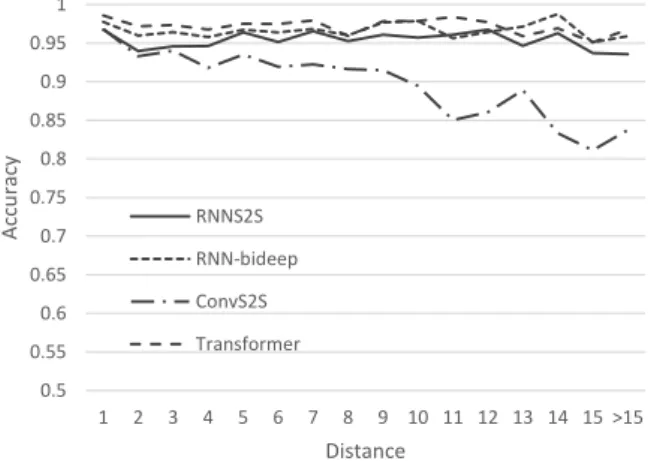
Figure 2 shows the performance of different ar-chitectures on the subject-verb agreement task. It is evident that Transformer, RNNS2S, and
RNN-bideep perform much better than ConvS2S on
long-range dependencies. However,Transformer,
RNNS2S, andRNN-bideepare all robust over long distances. Transformer outperformsRNN-bideep
for distances 11-12, but RNN-bideep performs equally or better for distance 13 or higher. Thus, we cannot conclude that Transformer models are particularly stronger than RNN models for long distances, despite achieving higher average accu-racy on distances above 10.
0.5 0.55 0.6 0.65 0.7 0.75 0.8 0.85 0.9 0.95 1 1 2 3 4 5 6 7 8 9 10 11 12 13 14 15 >15 A cc u racy Distance RNNS2S RNN-bideep ConvS2S Transformer
Figure 2: Accuracy of different NMT models on the subject-verb agreement task.
4.2.1 CNNs
Theoretically, the performance of CNNs will drop when the distance between the subject and the verb exceeds the local context size. However,ConvS2S
is also clearly worse thanRNNS2Sfor subject-verb agreement within the local context size.
In order to explore how the ability ofConvS2S
to capture long-range dependencies depends on the local context size, we train additional systems,
varying the number of layers and kernel size. Ta-ble3shows the performance of differentConvS2S
models. Figure3displays the performance of two 8-layer CNNs with kernel size 3 and 7, a 6-layer CNN with kernel size 3, andRNNS2S. The results indicate that the accuracy increases when the local context size becomes larger, but the BLEU score does not. Moreover, ConvS2Sis still not as good asRNNS2Sfor subject-verb agreement.
Layer K Ctx 2014 2017 Acc(%) 4 3 4 22.9 24.2 81.1 6 3 6 23.6 25.0 82.5 8 3 8 23.9 25.2 84.9 8 5 16 23.5 24.7 89.7 8 7 24 23.3 24.6 91.3
Table 3: The performance ofConvS2Swith different settings. Kmeans the kernel size. Thectx column is the theoretical largest local context size in the masked decoder. 0.5 0.55 0.6 0.65 0.7 0.75 0.8 0.85 0.9 0.95 1 1 2 3 4 5 6 7 8 9 10 11 12 13 14 15 >15 A cc u racy Distance RNNS2S ConvS2S-d8k7 ConvS2S-d8k3 ConvS2S-d6k3
Figure 3: Results ofConvS2Smodels and theRNNS2S model at different distances.
Regarding the explanation for the poor perfor-mance ofConvS2S, we identify the limited context size as a major problem. One assumption to ex-plain the remaining difference is that, scale invari-ance of CNNs is relatively poor (Xu et al.,2014). Scale-invariance is important in NLP, where the distance between arguments is flexible, and cur-rent recurcur-rent or attentional architectures are better suited to handle this variance.
Our empirical results do not confirm the theoret-ical arguments inGehring et al.(2017) that CNNs can capture long-range dependencies better with a shorter path. The BLEU score does not corre-late well with the targeted evaluation of long-range distance interactions. This is due to the locality
of BLEU, which only measures on the level of n-grams, but it may also indicate that there are other trade-offs between the modeling of different phe-nomena depending on hyperparameters. If we aim to get better performance on long-range dependen-cies, we can take this into account when optimiz-ing hyperparameters.
4.2.2 RNNs vs.Transformer
Even though Transformer achieves much better BLEU scores thanRNNS2SandRNN-bideep, the accuracies of these architectures on long-range de-pendencies are close to each other in Figure2.
Our experimental result contrasts with the result fromTran et al.(2018). They find that Transform-ers perform worse than LSTMs on the subject-verb agreement task, especially when the distance between the subject and the verb becomes longer. We perform several experiments to analyze this discrepancy withTran et al.(2018).
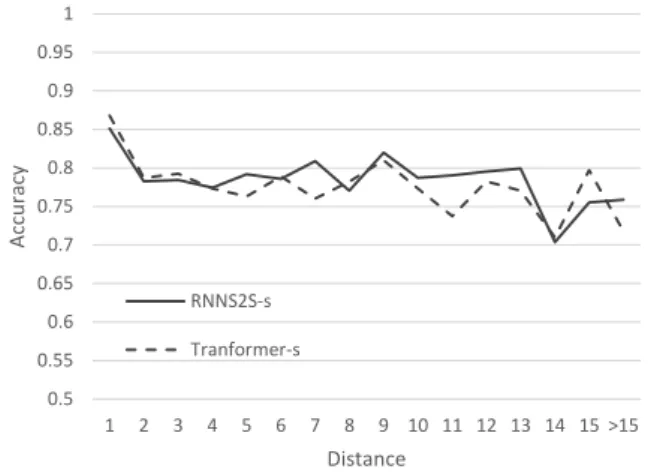
A first hypothesis is that this is caused by the amount of training data, since we used much larger datasets thanTran et al.(2018). We retrain all the models with a small amount of training data simi-lar to the amount used byTran et al.(2018), about 135K sentence pairs. The other training settings are the same as in Section4.1. We do not see the expected degradation ofTransformer-s, compared toRNNS2S-s(see Figure4). In Table4, the perfor-mance ofRNNS2S-sandTransformer-sis similar, including the BLEU scores onnewstest2014, new-stest2017, the perplexity on the validation set, and the accuracy on the long-range dependencies.
0.5 0.55 0.6 0.65 0.7 0.75 0.8 0.85 0.9 0.95 1 1 2 3 4 5 6 7 8 9 10 11 12 13 14 15 >15 Ac cur acy Distance RNNS2S-s Tranformer-s
Figure 4: Results of a Transformer andRNNS2Smodel trained on a small dataset.
A second hypothesis is that the experimental set-tings lead to the different results. In order to inves-tigate this, we do not only use a small training set,
but also replicate the experimental settings ofTran et al.(2018). The main changes are neural network layers (8→4); embedding size (512→128); multi-head size (8→2); dropout rate (0.1→0.2); check-point save frequency (4,000→1,000), and initial learning rate (0.0002→0.001). Model 2014 2017 PPL Acc(%) RNNS2S-s 7.3 7.8 47.8 77.3 Trans-s 7.2 8.0 44.6 74.6 RNNS2S-re 9.2 10.5 39.2 77.7 Trans-re-h2 9.6 10.7 36.9 71.9 Trans-re-h4 9.5 11.9 35.8 73.8 Trans-re-h8 9.4 10.4 36.0 75.3
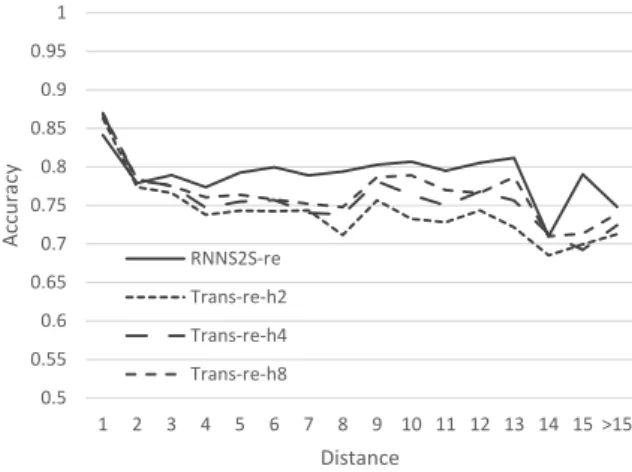
Table 4: The results of different models with small training data and replicate settings. Transis short for Transformer. Models with the suffix “-s” are models trained with small data set. Models with the suffix “-re” are models trained with replicate settings. “h2, h4, h8” indicates the number of attention heads for Transformer models. 0.5 0.55 0.6 0.65 0.7 0.75 0.8 0.85 0.9 0.95 1 1 2 3 4 5 6 7 8 9 10 11 12 13 14 15 >15 Accura cy Distance RNNS2S-re Trans-re-h2 Trans-re-h4 Trans-re-h8
Figure 5: Results of the models with replicate settings, varying the number of attention heads for the Trans-former models.
In the end, we get a result that is similar toTran et al. (2018). In Figure 5, Transformer-re-h2
performs clearly worse thanRNNS2S-reon long-range dependencies. By increasing the number of heads in multi-head attention, subject-verb ac-curacy over long distances can be improved sub-stantially, even though it remains below that of
RNNS2S-re. Also, the effect on BLEU is small. Our results suggest that the importance of multi-head attention with a large number of multi-heads is larger than BLEU would suggest, especially for the modeling of long-distance phenomena, since multi-head attention provides a way for the model
to attend to both local and distant context, whereas distant context may be overshadowed by local context in an attention mechanism with a single or few heads.
Although our study is not a replication ofTran et al. (2018), who work on a different task and a different test set, our results do suggest an al-ternative interpretation of their findings, namely that the poor performance of the Transformer in their experiments is due to hyperparameter choice. Rather than concluding that RNNs are superior to Transformers for the modeling of long-range de-pendency phenomena, we find that the number of heads in multi-head attention affects the ability of Transformers to model long-range dependencies in subject-verb agreement.
5 WSD
Our experimental results on the subject-verb agreement task demonstrate that CNNs and Trans-former are not better at capturing long-range de-pendencies compared to RNNs, even though the paths in CNNs and Transformers are shorter. This finding is not in accord with the theoretical argu-ment in both Gehring et al. (2017) and Vaswani et al. (2017). However, these architectures per-form well empirically according to BLEU. Thus, we further evaluate these architectures on WSD, to test our hypothesis that non-recurrent architec-tures are better at extracting semantic feaarchitec-tures. 5.1 Experimental settings
We evaluate all architectures on ContraWSD on both DE→EN and DE→FR. We reuse the param-eter settings in Section4.1, except that: the initial learning rate ofConvS2S is reduced from 0.0003 to 0.0002 in DE→EN; the checkpoint saving fre-quency is changed from 4,000 to 1,000 in DE→FR because of the training data size.
For DE→EN, the training set, validation set, and test set are as same as the other direction EN→DE. For DE→FR, we use around 2.1 million sentence pairs from Europarl (v7) (Tiedemann, 2012)4 and News Commentary (v11) cleaned by Rios et al. (2017)5 as our training set. We use
newstest2013as the evaluation set, and use new-stest2012 as the test set. All the data is prepro-cessed with Moses scripts.
4http://opus.nlpl.eu/Europarl.php 5http://data.statmt.org/ContraWSD/
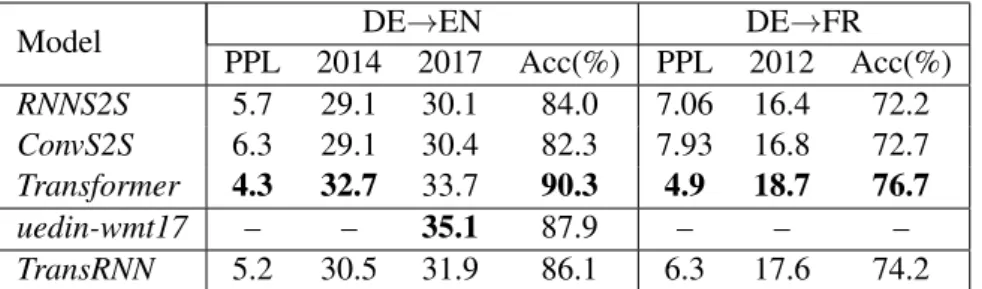
Model DE→EN DE→FR PPL 2014 2017 Acc(%) PPL 2012 Acc(%) RNNS2S 5.7 29.1 30.1 84.0 7.06 16.4 72.2 ConvS2S 6.3 29.1 30.4 82.3 7.93 16.8 72.7 Transformer 4.3 32.7 33.7 90.3 4.9 18.7 76.7 uedin-wmt17 – – 35.1 87.9 – – – TransRNN 5.2 30.5 31.9 86.1 6.3 17.6 74.2
Table 5: The results of different architectures onnewstest sets and ContraWSD.PPLis the perplexity on the validation set.Accmeans accuracy on the test set.
In addition, we also compare to the best result reported for DE→EN, achieved by uedin-wmt17
(Sennrich et al., 2017), which is an ensemble of 4 different models and reranked with right-to-left models.6 uedin-wmt17 is based on the bi-deep RNNs (Miceli Barone et al., 2017) that we men-tioned before. To the original 5.9 million sentence pairs in the training set, they add 10 million syn-thetic pairs with back-translation.
5.2 Overall Results
Table5gives the performance of all the architec-tures, including the perplexity on validation sets, the BLEU scores on newstest, and the accuracy on ContraWSD. Transformers distinctly
outper-formRNNS2S and ConvS2S models on DE→EN
and DE→FR. Moreover, the Transformer model on DE→EN also achieves higher accuracy than
uedin-wmt17, although the BLEU score on new-stest2017 is 1.4 lower thanuedin-wmt17. We at-tribute this discrepancy between BLEU and WSD performance to the use of synthetic news training data inuedin-wmt17, which causes a large boost in BLEU due to better domain adaptation tonewstest, but which is less helpful for ContraWSD, whose test set is drawn from a variety of domains.
For DE→EN, RNNS2S and ConvS2S have the same BLEU score onnewstest2014,ConvS2S has a higher score on newstest2017. However, the WSD accuracy of ConvS2S is 1.7% lower than
RNNS2S. For DE→FR,ConvS2Sachieves slightly better results on both BLEU scores and accuracy thanRNNS2S.
The Transformer model strongly outperforms the other architectures on this WSD task, with a gap of 4–8 percentage points. This affirms our hypothesis that Transformers are strong semantic features extractors.
6https://github.com/a-rios/ContraWSD/
tree/master/baselines
5.3 Hybrid Encoder-Decoder Model
In recent work,Chen et al.(2018) find that hybrid architectures with a Transformer encoder and an RNN decoder can outperform a pure Transformer model. They speculate that the Transformer en-coder is better at encoding or extracting features than the RNN encoder, whereas the RNN is better at conditional language modeling.
For WSD, it is unclear whether the most im-portant component is the encoder, the decoder, or both. Following the hypothesis that Transformer encoders excel as semantic feature extractors, we train a hybrid encoder-decoder model (TransRNN) with a Transformer encoder and an RNN decoder. The results (in Table 5) show that TransRNN
performs better thanRNNS2S, but worse than the pure Transformer, both in terms of BLEU and WSD accuracy. This indicates that WSD is not only done in the encoder, but that the decoder also affects WSD performance. We note that Chen et al.(2018); Domhan(2018) introduce the tech-niques in Transformers into RNN-based models, with reportedly higher BLEU. Thus, it would be interesting to see if the same result holds true with their architectures.
6 Conclusion
In this paper, we evaluate three popular NMT ar-chitectures,RNNS2S,ConvS2S, and Transformers, on subject-verb agreement and WSD by scoring contrastive translation pairs.
We test the theoretical claims that shorter path lengths make models better capture long-range de-pendencies. Our experimental results show that:
• There is no evidence that CNNs and Trans-formers, which have shorter paths through networks, are empirically superior to RNNs in modeling subject-verb agreement over long distances.
• The number of heads in multi-head attention affects the ability of a Transformer to model long-range dependencies in the subject-verb agreement task.
• Transformer models excel at another task, WSD, compared to the CNN and RNN archi-tectures we tested.
Lastly, our findings suggest that assessing the per-formance of NMT architectures means finding their inherent trade-offs, rather than simply com-puting their overall BLEU score. A clear under-standing of those strengths and weaknesses is im-portant to guide further work. Specifically, given the idiosyncratic limitations of recurrent and self-attentional models, combining them is an exciting line of research. The apparent weakness of CNN architectures on long-distance phenomena is also a problem worth tackling, and we can find inspi-ration from related work in computer vision (Xu et al.,2014).
Acknowledgments
We thank all the anonymous reviews and Joakim Nivre who give a lot of valuable and insight-ful comments. We appreciate the grants pro-vided by Erasmus+ Programme and Anna Maria Lundin’s scholarship committee. GT is funded by the Chinese Scholarship Council (grant num-ber201607110016). MM, AR and RS have re-ceived funding from the Swiss National Science Foundation (grant number105212 169888).
References
Dzmitry Bahdanau, Kyunghyun Cho, and Yoshua Ben-gio. 2015. Neural Machine Translation by Jointly Learning to Align and Translate. InProceedings of the 3rd International Conference on Learning Rep-resentations, San Diego, California, USA.
Shaojie Bai, J Zico Kolter, and Vladlen Koltun. 2018. An empirical evaluation of generic convolu-tional and recurrent networks for sequence model-ing. arXiv preprint arXiv:1803.01271.
Jean-Philippe Bernardy and Shalom Lappin. 2017. Using Deep Neural Networks to Learn Syntactic Agreement. LiLT (Linguistic Issues in Language Technology), 15(2):1–15.
Mia Xu Chen, Orhan Firat, Ankur Bapna, Melvin Johnson, Wolfgang Macherey, George Foster, Llion Jones, Mike Schuster, Noam Shazeer, Niki Parmar, Ashish Vaswani, Jakob Uszkoreit, Lukasz Kaiser,
Zhifeng Chen, Yonghui Wu, and Macduff Hughes. 2018. The best of both worlds: Combining recent advances in neural machine translation. In Proceed-ings of the 56th Annual Meeting of the Association for Computational Linguistics (Volume 1: Long Pa-pers), pages 76–86. Association for Computational Linguistics.
Tianqi Chen, Mu Li, Yutian Li, Min Lin, Naiyan Wang, Minjie Wang, Tianjun Xiao, Bing Xu, Chiyuan Zhang, and Zheng Zhang. 2015. Mxnet: A flex-ible and efficient machine learning library for het-erogeneous distributed systems. arXiv preprint arXiv:1512.01274.
Kyunghyun Cho, Bart van Merrienboer, Caglar Gul-cehre, Dzmitry Bahdanau, Fethi Bougares, Hol-ger Schwenk, and Yoshua Bengio. 2014. Learn-ing Phrase Representations usLearn-ing RNN Encoder– Decoder for Statistical Machine Translation. In Pro-ceedings of the 2014 Conference on Empirical Meth-ods in Natural Language Processing, pages 1724– 1734, Doha, Qatar. Association for Computational Linguistics.
Tobias Domhan. 2018. How much attention do you need? a granular analysis of neural machine trans-lation architectures. InProceedings of the 56th An-nual Meeting of the Association for Computational Linguistics (Volume 1: Long Papers), pages 1799– 1808. Association for Computational Linguistics. Jeffrey L Elman. 1990. Finding structure in time.
Cog-nitive science, 14(2):179–211.
Jonas Gehring, Michael Auli, David Grangier, De-nis Yarats, and Yann N. Dauphin. 2017. Convolu-tional sequence to sequence learning. In Proceed-ings of the 34th International Conference on Ma-chine Learning, pages 1243–1252, Sydney, Aus-tralia. PMLR.
Felix Hieber, Tobias Domhan, Michael Denkowski, David Vilar, Artem Sokolov, Ann Clifton, and Matt Post. 2017. Sockeye: A Toolkit for Neural Machine Translation.arXiv preprint arXiv:1712.05690. Sepp Hochreiter and J¨urgen Schmidhuber. 1997.
Long short-term memory. Neural computation, 9(8):1735–1780.
Marcin Junczys-Dowmunt, Roman Grundkiewicz, Tomasz Dwojak, Hieu Hoang, Kenneth Heafield, Tom Neckermann, Frank Seide, Ulrich Germann, Alham Fikri Aji, Nikolay Bogoychev, Andr´e F. T. Martins, and Alexandra Birch. 2018. Marian: Fast Neural Machine Translation in C++. arXiv preprint arXiv:1804.00344.
Nal Kalchbrenner and Phil Blunsom. 2013. Recurrent Continuous Translation Models. InProceedings of the 2013 Conference on Empirical Methods in Natu-ral Language Processing, pages 1700–1709, Seattle, Washington, USA. Association for Computational Linguistics.
Diederik P. Kingma and Jimmy Ba. 2015. Adam: A Method for Stochastic Optimization. In Proceed-ings of the 3rd International Conference on Learn-ing Representations, San Diego, California, USA. Tal Linzen, Emmanuel Dupoux, and Yoav Goldberg.
2016. Assessing the Ability of LSTMs to Learn Syntax-Sensitive Dependencies. Transactions of the Association for Computational Linguistics, 4:521– 535.
Thang Luong, Hieu Pham, and Christopher D. Man-ning. 2015. Effective Approaches to Attention-based Neural Machine Translation. In Proceed-ings of the 2015 Conference on Empirical Meth-ods in Natural Language Processing, pages 1412– 1421, Lisbon, Portugal. Association for Computa-tional Linguistics.
Antonio Valerio Miceli Barone, Jindˇrich Helcl, Rico Sennrich, Barry Haddow, and Alexandra Birch. 2017.Deep architectures for Neural Machine Trans-lation. InProceedings of the Second Conference on Machine Translation, pages 99–107, Copenhagen, Denmark. Association for Computational Linguis-tics.
Kishore Papineni, Salim Roukos, Todd Ward, and Wei-Jing Zhu. 2002. BLEU: a Method for Automatic Evaluation of Machine Translation. InProceedings of 40th Annual Meeting of the Association for Com-putational Linguistics, pages 311–318, Philadelphia, Pennsylvania, USA. Association for Computational Linguistics.
Matt Post. 2018. A call for clarity in reporting bleu scores.arXiv preprint arXiv:1804.08771.
Annette Rios, Laura Mascarell, and Rico Sennrich. 2017. Improving Word Sense Disambiguation in Neural Machine Translation with Sense Embed-dings. In Proceedings of the Second Conference on Machine Translation, pages 11–19, Copenhagen, Denmark. Association for Computational Linguis-tics.
Rico Sennrich. 2017. How Grammatical is Character-level Neural Machine Translation? Assessing MT Quality with Contrastive Translation Pairs. In Pro-ceedings of the 15th Conference of the European Chapter of the Association for Computational Lin-guistics: Volume 2, Short Papers, pages 376–382, Valencia, Spain. Association for Computational Lin-guistics.
Rico Sennrich, Alexandra Birch, Anna Currey, Ulrich Germann, Barry Haddow, Kenneth Heafield, An-tonio Valerio Miceli Barone, and Philip Williams. 2017. The University of Edinburgh’s Neural MT Systems for WMT17. InProceedings of the Second Conference on Machine Translation, pages 389– 399, Copenhagen, Denmark. Association for Com-putational Linguistics.
Rico Sennrich, Barry Haddow, and Alexandra Birch. 2016. Neural Machine Translation of Rare Words with Subword Units. InProceedings of the 54th An-nual Meeting of the Association for Computational Linguistics (Volume 1: Long Papers), pages 1715– 1725, Berlin, Germany. Association for Computa-tional Linguistics.
Ilya Sutskever, Oriol Vinyals, and Quoc V Le. 2014. Sequence to Sequence Learning with Neural Net-works. In Advances in Neural Information Pro-cessing Systems 27, pages 3104–3112. Curran As-sociates, Inc., Montr´eal, Canada.
Gongbo Tang, Fabienne Cap, Eva Pettersson, and Joakim Nivre. 2018. An evaluation of neural ma-chine translation models on historical spelling nor-malization. InProceedings of the 27th International Conference on Computational Linguistics, pages 1320–1331. Association for Computational Linguis-tics.
J¨org Tiedemann. 2012. Parallel Data, Tools and Inter-faces in OPUS. In Proceedings of the Eighth In-ternational Conference on Language Resources and Evaluation (LREC-2012), pages 2214–2218, Istan-bul, Turkey. European Language Resources Associ-ation (ELRA).
Ke Tran, Arianna Bisazza, and Christof Monz. 2018. The Importance of Being Recurrent for Modeling Hierarchical Structure. arXiv preprint arXiv:1803.03585.
Ashish Vaswani, Noam Shazeer, Niki Parmar, Jakob Uszkoreit, Llion Jones, Aidan N Gomez, Łukasz Kaiser, and Illia Polosukhin. 2017. Attention is All you Need. InAdvances in Neural Information Pro-cessing Systems 30, pages 6000–6010. Curran Asso-ciates, Inc.
Yichong Xu, Tianjun Xiao, Jiaxing Zhang, Kuiyuan Yang, and Zheng Zhang. 2014. Scale-invariant convolutional neural networks. arXiv preprint arXiv:1411.6369.
Wenpeng Yin, Katharina Kann, Mo Yu, and Hinrich Sch¨utze. 2017. Comparative study of cnn and rnn for natural language processing. arXiv preprint arXiv:1702.01923.