Scholarship at UWindsor
Scholarship at UWindsor
Electronic Theses and Dissertations Theses, Dissertations, and Major Papers
3-12-2020
An Approach of QoS Evaluation for Web Services Design With
An Approach of QoS Evaluation for Web Services Design With
Optimized Avoidance of SLA Violations
Optimized Avoidance of SLA Violations
Peng Cheng
University of Windsor
Follow this and additional works at: https://scholar.uwindsor.ca/etd Recommended Citation
Recommended Citation
Cheng, Peng, "An Approach of QoS Evaluation for Web Services Design With Optimized Avoidance of SLA Violations" (2020). Electronic Theses and Dissertations. 8317.
https://scholar.uwindsor.ca/etd/8317
This online database contains the full-text of PhD dissertations and Masters’ theses of University of Windsor students from 1954 forward. These documents are made available for personal study and research purposes only, in accordance with the Canadian Copyright Act and the Creative Commons license—CC BY-NC-ND (Attribution, Non-Commercial, No Derivative Works). Under this license, works must always be attributed to the copyright holder (original author), cannot be used for any commercial purposes, and may not be altered. Any other use would require the permission of the copyright holder. Students may inquire about withdrawing their dissertation and/or thesis from this database. For additional inquiries, please contact the repository administrator via email
An Approach of QoS Evaluation for Web
Services Design with Optimized Avoidance
of SLA Violations
By Peng Cheng
A Dissertation
Submitted to the Faculty of Graduate Studies through the School of Computer Science in Partial Fulllment of the Requirements for
the Degree of Doctor of Philosophy at the University of Windsor
Windsor, Ontario, Canada 2020
c
of SLA Violations by
Peng Cheng
APPROVED BY:
H. Lutyya, External Examiner University of Western Ontario
H. Wu
Department of Electrical and Computer Engineering
A. Ngom
School of Computer Science
D. Wu
School of Computer Science
X. Yuan, Advisor School of Computer Science
I thereby certify that this dissertation incorporates material that is the result of my research conducted under the supervision of my advisor Dr Xiaobu Yuan. Parts of Chapter 3 and 4 of the dissertation was co-authored with Dr Xiaobu Yuan. In all cases, the key ideas, primary contributions, justications of the methodologies, the design of the experiments, data analysis and interpretations, were performed by myself with the guidance of Dr Xiaobu Yuan.
I am aware of the University of Windsor Senate Policy on Authorship and I certify that I have properly acknowledged the contribution of other researchers to my thesis, and have obtained written permission from each of the co-author(s) to include the above material(s) in my thesis.
I certify that, with the above qualication, this thesis, and the research to which it refers, is the product of my own work.
This thesis includes two original papers that have been previously published / submitted for publication in peer reviewed journals, as follows:
1. Xiaobu Yuan, Peng Cheng. 2019. An Approach of Sensitivity and Metamodel-Based Analyses for SLA Violation Prediction. 2019 IEEE Canadian Conference of Electrical and Computer Engineering (CCECE). Copyright 2019, IEEE. Pub-lished.
2. Xiaobu Yuan, Peng Cheng. 2019. A Strategy of QoS Optimization for Web Ser-vices. 2019 IEEE Canadian Conference of Electrical and Computer Engineering (CCECE). Copyright 2019, IEEE. Published.
I certify that I have obtained a written permission from the copyright owner(s) to include the above published material(s) in my thesis. I certify that the above
the University of Windsor.
I declare that, to the best of my knowledge, my thesis does not infringe upon anyone's copyright nor violate any proprietary rights and that any ideas, techniques, quotations, or any other material from the work of other people included in my thesis, published or otherwise, are fully acknowledged in accordance with the standard referencing practices. Furthermore, to the extent that I have included copyrighted material that surpasses the bounds of fair dealing within the meaning of the Canada Copyright Act, I certify that I have obtained a written permission from the copyright owner(s) to include such material(s) in my thesis.
I declare that this is a true copy of my thesis, including any nal revisions, as approved by my thesis committee and the Graduate Studies oce, and that this thesis has not been submitted for a higher degree to any other University or Institution.
Quality of service (QoS) is an ocial agreement that governs the contractual commitments between service providers and consumers in respect to various non-functional requirements, such as performance, dependability, and security. While more Web services are available for the construction of software systems based upon service-oriented architecture (SOA), QoS has become a decisive factor for service con-sumers to choose from service providers who provide similar services. QoS is usually documented on a service-level agreement (SLA) to ensure the functionality and qual-ity of services and to dene monetary penalties in case of any violation of the written agreement. Consequently, service providers have a strong interest in keeping their commitments to avoid and reduce the situations that may cause SLA violations.
However, there is a noticeable shortage of tools that can be used by service providers to either quantitively evaluate QoS of their services for the predication of SLA violations or actively adjust their design for the avoidance of SLA violations with optimized service recongurations. Developed in this dissertation research is an innovative framework that tackles the problem of SLA violations in three separated yet connected phases. For a given SOA system under examination, the framework employs sensitivity analysis in the rst phase to identify factors that are inuential to system performance, and the impact of inuential factors on QoS is then quantita-tively measured with a metamodel-based analysis in the second phase. The results of analyses are then used in the third phase to search both globally and locally for opti-mal solutions via a controlled number of experiments. In addition to technical details, this dissertation includes experiment results to demonstrate that this new approach can help service providers not only predicting SLA violations but also avoiding the unnecessary increase of the operational cost during service optimization.
This dissertation is dedicated to my wife, Juan Fan, and to my parents, Maidi Su and Xiaoxin Cheng, for their endless love, support, and encouragement.
It gives me immense pleasure to thank a few very important people who have helped me a lot during the whole process of my graduate studies.
First and foremost, I would like to present my gratitude to my supervisor Dr. Xiaobu Yuan for his valuable assistance and support during the past fours years. This work could not have been achieved without his continuous encouragement, valuable advices, suggestions and cooperation.
I would also like to thank my committee members, Dr. Huapeng Wu, Dr. Alioune Ngom and Dr. Dan Wu for their encouragement, insightful comments, and advice.
Finally, I want to thank my wife and parents for their love and support through-out my life.
Declaration of Co-Authorship/Previous Publication III
Abstract V
Dedication VI
Acknowledgements VII
List of Tables XI
List of Figures XIII
1 Introduction 1
1.1 Background . . . 1
1.2 Research Contributions . . . 5
1.3 Overview of the Unied Framework . . . 6
1.4 Dissertation Organization . . . 8
2 Background and Literature Review 9 2.1 Service-Oriented Architecture (SOA) . . . 9
2.2 Service Level Agreement (SLA) . . . 12
2.3 SLA Violation Prediction . . . 16
2.4 QoS Optimization . . . 19
2.5 The Design and Analysis of Experiments . . . 24
2.5.1 Motivation: Why the Design and Analysis of Experiments . . 24 2.5.2 The Basic Concept Of the Design and Analysis of Experiments 25
2.5.4 Performance Optimization via the Design and Analysis of
Ex-periments . . . 30
3 Sensitivity and Metamodel-Based Analyses for Services Design 32 3.1 Introduction . . . 32
3.2 Metamodeling for Prediction of SLA Violation . . . 33
3.2.1 Multi-Factor Sensitivity Analysis . . . 34
3.2.2 Metamodel-based Performance Analysis . . . 37
3.3 Experiments . . . 40
3.3.1 Experiments Setup . . . 40
3.3.2 Design and Perform Experiemnts . . . 40
3.3.3 Perform Screen Design . . . 42
3.3.4 Specify One Appropriate Type of Metamodel . . . 43
3.3.5 Specify a Series of Candidate Forms for the Metamodel and Construct These Surrogate Models . . . 43
3.3.6 Check Model Adequacy . . . 45
3.3.7 Verify the Fitted Model . . . 47
3.3.8 Analyse the Eects of Factors and their Interaction on Response Time . . . 48
3.3.9 Prediction Accuracy Comparison . . . 51
3.4 Summary . . . 55
4 A Strategy of QoS Optimization for Web Services 56 4.1 Introduction . . . 56
4.2 Denition of the Optimization Problem and Related Conceptual Models 57 4.2.1 Optimization Context Model . . . 57
4.2.3 Factor Model . . . 58
4.2.4 SLA Model . . . 59
4.2.5 Service Model . . . 59
4.2.6 Global Search Model . . . 60
4.2.7 Local Search Model . . . 60
4.2.8 Optimization Problem . . . 61
4.3 SLA Violation Prevention with Optimization . . . 62
4.3.1 A Unied Framework of QoS Optimization . . . 62
4.3.2 Global Search Algorithm . . . 64
4.3.3 Local Search Algorithm . . . 67
4.4 Experiments . . . 71
4.4.1 Experiments with Benchmark Functions . . . 71
4.4.2 Experiments with A Web Service . . . 83
4.5 Summary . . . 86
5 Conclusions and Future Works 88 5.1 Conclusions . . . 88
5.2 Future Works . . . 89
Bibliography 91
2.1 Risk Assessment-based Methods . . . 14
2.2 SLA Management-based Methods . . . 15
2.3 Collaborative Filtering (CF)-based Methods . . . 17
2.4 Methods of SLA Violation Prediction . . . 20
2.5 QoS Optimization Methods Based on Service Composition . . . 21
2.6 QoS Optimization Methods Based on Resource Provisioning . . . 22
3.1 Data Collection . . . 41
3.2 Variance Table . . . 42
3.3 Data Collection . . . 43
3.4 R2 ,R2 adj and R2pdt of tted models . . . 44
3.5 Results of Verifying Experiments . . . 49
3.6 Comparison Based on Dierent Number of Factors . . . 53
3.7 Comparison Based on Dierent Models . . . 54
4.1 M-Factor Variance Table . . . 63
4.2 Result of Experiment for Global Search Algorithm . . . 73
4.3 The Fitted Mars Model for the Benchmark Function . . . 74
4.6 Comparison of Approximation and Prediction Accuracy of Fitted Global
Models) . . . 78
4.7 Optimization Results by Using Response Surface Methodology . . . 80
4.8 Optimization Results by Using Global Metamodel-based Optimization Methodology . . . 81
4.9 Robustness Comparison of Approximation Models . . . 82
4.10 Details of the Four Additional Functions . . . 82
4.11 Response Time of Web Service . . . 85
4.12 Fitted Mars Model for the Web Service . . . 85
1.1 Three Web Service Roles . . . 2
1.2 A Unied Framework of QoS Optimization . . . 8
2.1 General model of a process or system . . . 26
3.1 A Unied Framework of Sensitivity and Metamodel-Based Analyses . 34 3.2 Normal Plot Of Residuals. . . 45
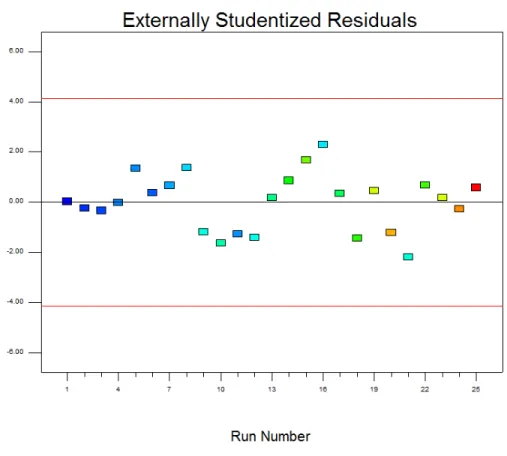
3.3 Externally Studentized Residuals. . . 46
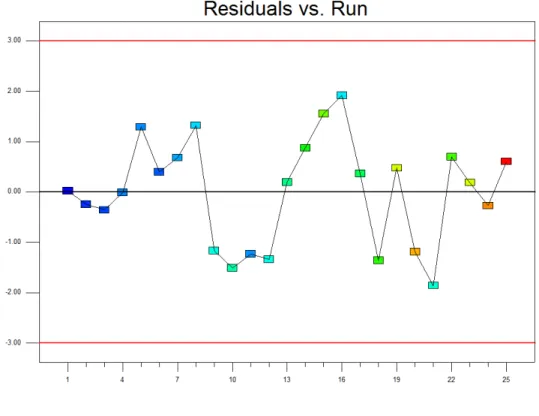
3.4 Residuals VS. Run. . . 47
3.5 Predicted VS. Actual. . . 48
3.6 Three-dimensional Response Surface Plot of the tted model. . . 50
3.7 Interaction between the Number of Sources and the Number of Prod-ucts with Respect to Response Time. . . 51
3.8 Contour plot between the number of sources and the number of prod-ucts with respect to response time. . . 52
4.1 A Unied Framework of QoS Optimization . . . 62
4.2 The GRAMACY-LEE (2012) function. . . 72
4.3 The Comparison between All Fitted Global Models . . . 78
Chapter 1
Introduction
1.1 Background
The dramatically increased software complexity has made productivity and time-to-market two of the major concerns of software industry. Traditional approaches of software development failed to cope with sophisticated computer applications. In comparison, Service-Oriented Architecture (SOA) has emerged as a new technology that helps organizations to deal with the interoperability of software systems in het-erogeneous environments. An SOA system consists of a collection of services that interact with each other, and its inter-service infrastructure focuses on Web services when services communicate via the Internet. SOA promises added benets of eas-ier components reuse, increased reliability, and reduced development and deployment costs [46].
More recently, Web services have become the technology of choice for realizing Service-Oriented Architecture and its associated set of strategic goals [1]. Web ser-vices are considered as self-contained, self-descriptive, modular applications that can be published, located, and invoked across the Web [2]. The communication between Web services is done via standards-based technologies that give users the opportunity
to access dierent Web services, independent of their hardware, operating system, or even programming environment. This supports organizations with a technology to create services that can be easily discovered and consumed by external users [1]. Soft-ware can be redelivered and paid for as streams of services as opposed to packaged products, thus making it possible to achieve automatic and dynamic interoperability between systems while accomplishing business tasks [6]. Businesses can be released from the burden of complex, low, and expensive software integration and focus instead on the value of their mission and critical tasks. Consequently, the Internet becomes a global common platform where organizations and individuals communicate with each other to carry out various commercial activities and to provide value-added services [6]. The rest of this section briey presents the main concepts, principles and research problems relevant to Service-Oriented Architecture. In Chapter 2, the background and literature review of Service-Oriented Architecture will be discussed in more details.
As shown in Fig. 1.1, Web services play three major roles in an SOA system. With service registry acting as a centralized directory, service providers publish the information of their Web services for service consumers to select according to their needs of software development. The selected Web services are then bound at run time and invoked during the operation of software systems. Usually, Web services are third-party software made available by service providers, which means that these distributed applications based on Web services rely on these providers to ensure that their ser-vices comply with the agreed Quality of Service(QoS) [3]. Meanwhile, with tens of thousands of Web services available on the Internet, many of which are of
equiva-lent functions, QoS values are important criteria for service consumers to choose the web services that meet their requirements [5]. Many investigations have been carried out focusing on dierent kinds of QoS-related issues, such as Web service selection, Web service composition, SOA failure prediction, SOA performance prediction, fault tolerance, resiliency quantication, service searching, resource consistency, resource allocation, workload balance, as well as dynamically resource management [10]. As a result, QoS is currently a leading research topic in the eld of SOA [3].
QoS is widely employed for describing non-functional characteristics of Web ser-vices. With the increasing number of Web services, QoS has become an important dierentiating point of dierent functionally equivalent Web services. A Web ser-vice's QoS includes a number of properties, such as response time, throughput, failure probability, availability, price, popularity, and so on [4]. As a service-level agreement (SLA), QoS is documented to guarantee that services fulll their ocial commitments in terms of both functionality and quality. While service consumers focus on suitabil-ity when selecting from a pool of similar candidates, service providers compete with each other to oer not only the anticipated functionality but also attractive quality. If service provider fails to ensure SLA for service consumers, this will have negative impact on customer satisfaction and even lead to a disaster. For instance, when Amazon Elastic Cloud crashed in 2011 in terms of availability, it faced an outage and many big customers such as Quora and Reddit were down for more than a day. Such crashes aects service providers and service consumers. As SLA also denes monetary penalties in case of any violation of the written agreement, service providers have a strong interest in keeping their commitments to avoid and reduce the situations that may cause SLA violations.
Nevertheless, avoidance of SLA violations has been proven to be a challenging task as QoS is inuenced by a variety of factors [29]. Because of variations in workload, computing resources, and even network conditions, it is common for Web services to exhibit uctuations in performance, leading to the possibility of violating SLA. Any service provider who does not take action to prevent SLA violation will have to face
monetary penalties and lost revenue due to damaged relationships with clients [38]. Therefore, service providers are in desperate need of such tools that can not only help them predict if their service design provokes SLA violations but also guide them to optimize service design and prevent SLA violations from happening. When SLA violations are predicted, service providers can always optimize QoS of Web services by conguring dierent contextual factors, such as CPU, storage, distributed computing, or data cache though at the risk of increased operational cost due to over provision [38].
The extraordinary potential of SOA in software development has stimulated con-tinuous research in the academic community and explorations in the software industry, as to be discussed in the next chapter of the literature survey. To improve the de-sign of Web services, encouraging progress has been achieved for the evaluation of QoS, prediction of SLA violations, and QoS optimization. For example, most of the approaches use the technique of collaborative ltering to evaluate SOA systems with historical datasets obtained from other systems running a similar application and to predict the possibility of SLA violations based upon the calculation of QoS values for existing services [12, 13, 15, 16, 17, 74]. For QoS optimization, some approaches work for groups of services by maximizing aggregated utility values [89, 90, 91, 92] and others for individual services by allocating more resources [87, 88]. However, current methods still lack objective evaluation of software operating in dierent application domains, and their separation of related processes has resulted in limited success in practice.
In this dissertation, the avoidance of SLA violation is divided into two subprob-lems: QoS evaluation and optimization. For QoS evaluation, the dissertation research rst applies the principle of design of experiments to analyze how sensitive a system is inuenced by uncontrollable factors of a Web service and to nd the inuential factors that dominate the service's performance. The identication of inuential factors then helps to develop an algorithm that constructs a surrogate model for the Web service
optimization is necessary only when SLA violations are supposed to happen, and it is carried out in the dissertation research by a guided search to globally identify sub-regions with local optima and to locally locate the best optimum with constraints to minimize operational cost. In such a way, the three normally separated processes of sensitivity analysis, SLA violations predication, and QoS optimization are integrated into a unied framework to help service providers to analyze, predict, and prevent SLA violations.
1.2 Research Contributions
This dissertation makes the following contributions in QoS evaluation for Web services design with optimized avoidance of SLA violations:
1. Multi-factor sensitivity analysis:
(a) Created a general multi-factor model of sensitivity analysis that decom-poses the total sensitivity measure into several sensitivity measures for each of individual factors and for all their joint eects in dierent combinations. (b) Based upon this general model, developed a new algorithm of sensitivity analysis for the identication of inuential factors. As the algorithm cal-culates the inuence of dierent input parameters on the model's output and identies the most inuential parameters, it can be used to improve model quality and to reduce parametrization and computational costs. In addition, this algorithm requires a relatively small number of experiments with high accuracy and robustness.
2. Metamodel-based performance analysis:
(a) The identication of inuential factors helps to overcome the problem of over-parameterization and allows the development of a novel algorithm to create a tted metamodel for quantitative analysis of QoS.
(b) This algorithm of performance analysis uses the metamodel for quantita-tive analysis of service performance and for the prediction of SLA violations without domain limits.
3. QoS optimization:
(a) Created a formal model with inuential controllable factors for the problem of QoS optimization.
(b) Developed a search algorithm to t a global surrogate model with multi-variate adaptive regression splines and to identify sub-regions with poten-tial local optima.
(c) Extended the response surface methodology to allow the search algorithm nding the global optima among the local optimum in the identied sub-regions. Furthermore, the algorithm takes minimizing operational costs into consideration to prevent over-provisioning resources.
1.3 Overview of the Unied Framework
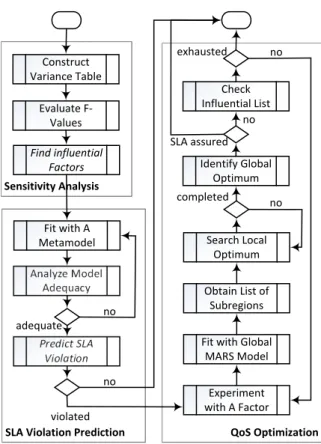
Sensitivity analysis, SLA violation prediction, and design optimization are three important yet normally separated techniques for QoS evaluation and optimization [67]. As illustrated in Fig. 1.2, this dissertation research proposes an innovative framework to tackle the main issues of SLA violation by joining these three techniques into a unied framework to analyze, predict, and prevent SLA violations. Based upon a newly invented multi-factor model, the process of sensitivity analysis in this framework initiates the construction of a variance table with a chosen experimental strategy, e.g. Taguchi's orthogonal arrays [68], by calculating the F-distribution values to determine the impact of factors, both individually and jointly, that are beyond the control of a service on a Web service's performance. Among all the uncontrollable factors, those whose individual or joint F-distribution values exceed the threshold
With the number of uncontrollable factors being reduced to only those inuential to the service's performance, the second process treats the Web service under exam-ination as a black box, use these identied inuential uncontrollable factors as input variables and ts it with a surrogate model, or metamodel. The development of a metamodel starts with a candidate in a specic type and form, such as a quadratic model in polynomial regression, from a pool of choices. The process of SLA violation prediction then checks the adequacy of this chosen candidate with new experiments and veries that the observable performance merits of the metamodel are within the 90% prediction interval at a residual error rate less than 10%. Unless a rejection results in the choice of another candidate, the metamodel is ready to be used for quantitative analysis of service quality and for the prediction of situations when SLA violations could take place. Meanwhile, the metamodel can help service provider better understand the performance of a service and identify performance bottlenecks caused by inuential factors, which can help service provider choose the eective controllable factors to optimize performance in the next phase.
The last process of QoS optimization becomes inevitable to avoid the predicted SLA violations by adjusting the values of controllable factors by service providers, such as CPU, storage, and cache. This process includes ve steps as below:
1. Identify the most inuential controllable factor; 2. Conduct experiments and collect observation data;
3. Fit the collected dataset with the model of multivariate adaptive regression splines (MARS);
4. Search globally and create a list of subregions in which potential local optima exist;
5. Identify global optimum by searching local optima.
Sensitivity Analysis Construct Variance Table Find influential Factors Predict SLA Violation Analyze Model Adequacy SLA Violation Prediction adequate no QoS Optimization Experiment with A Factor Fit with Global MARS Model Obtain List of Subregions Search Local Optimum Identify Global Optimum Check Influential List Evaluate F‐ Values Fit with A Metamodel SLA assured exhausted no no no completed no violated
Figure 1.2: A Unied Framework of QoS Optimization
list of controllable factors is exhausted. In the latter case, a redesign of the Web service by the provider becomes a sensible recommendation.
1.4 Dissertation Organization
The rest of this dissertation is organized as follows. Chapter 2 introduces the background of SOA and the latest literature reviews related to SLA violation, SLA violation prediction, QoS optimization and the design and analysis of experiments. After presenting the rst and second phases of the proposed framework on SLA violation prediction in Chapter 3, Chapter 4 presents the third phase of the proposed framework on QoS optimization for Web services. Finally, conclusions with some suggestions for future works are given in Chapter 5.
Chapter 2
Background and Literature Review
2.1 Service-Oriented Architecture (SOA)
The dramatically increased complexity of software systems in the past decades has made traditional approaches of software development inadequate for the soft-ware industry to handle sophisticated computer applications. In the demand of new technologies, SOA has has emerged as an ecient way to help organizations dealing with the interoperability of software systems in heterogeneous environments. SOA oers the much-needed benets of easier components reuse, increased productivity, improved reliability, shorter time-to-market, and reduced deployment costs. It is one of the most successful architectural styles in which applications make use of reusable services via internet. In the next decade, the SOA principles will be at the core of a new era of business engagements that transact at Internet scale across locations, devices, people, processes and information [1].
An SOA system consists of a collection of services that interact with each other, and its inter-service infrastructure focuses on Web services when services communicate via the Internet. It is based on some key principles listed as follows [69]:
1. Loose coupling: Services maintain a relationship that minimizes dependencies and only maintain an awareness of each other. This principle advocates the creation of a specic type of relationship within and outside of service bound-aries, with a constant emphasis on reducing loosening dependencies between the service contract, its implementation, and its service consumers.
2. Service contract: Services adhere to a communicative agreement as dened collectively by one or more service description documents. Services express their purpose and capabilities via a service contract.
3. Service abstraction: Beyond what is described in the service contract, services hide logic from the outside world. Abstraction ties into many aspects of service-orientation. On a fundamental level, this principle emphasizes the need to hide as much of the underlying details of a service as possible.
4. Service reusability: Services provide specic functionality with the intention of promoting reuse. Reuse is strongly advocated within service-orientation; so much so, that it becomes a core part of typical service analysis and design processes, and also forms the basis for key service models. The advent of mature, non-proprietary service technology has provided the opportunity to maximize the reuse potential of multi-purpose logic on an unprecedented level.
5. Service composability: Collections of services can be coordinated and assembled to form composite services. As the sophistication of service-oriented solutions continues to grow, so does the complexity of underlying service composition congurations.
6. Service autonomy: Services have control over the logic they encapsulate. For services to carry out their capabilities consistently and reliably, their underlying solution logic needs to have a signicant degree of control over its environment and resources.
com-Services are therefore ideally designed to remain stateful only when required. 8. Service discoverability: Services are designed to be outwardly descriptive so
that they can be found and assessed via available discovery mechanisms. Each service can be provided by dierent providers and used by one or multiple consumers. A service consumer can be an application or a service that reuses other services. According to the SOA systems that service consumers are developing, they choose the most suitable services from dierent candidates with similar functionality and use them to compose their application. A service provider, on the other hand, can be an individual or an organization that develops and maintains reusable services. These services are available for service consumers to reuse. Competition is extremely erce between dierent service providers as there are always others with the same features. If a service is not capable of satisfying service consumers in terms of quality and functionality, service consumers may abandon this service and choose another service provider.
Web services oer a potential solution for developing distributed business pro-cesses and applications that can be accessed via the Internet. The use of Web services in SOA systems have have many benets for the development of new applications [76]. While QoS encompasses various non-functional issues, such as performance, depend-ability, and security, SLA as an ocial document of QoS is in place to assure service consumers that they get the services paid for by obligating service providers to fulll contractual promises. As more competitive Web services become available for service consumers to choose, QoS has become a decisive factor to distinguish the reputation of service providers [77]. In the next section, QoS and SLA will be discussed in detail.
2.2 Service Level Agreement (SLA)
As QoS tells the ability of a service to meet certain requirements for dierent aspects of the service, such as performance, availability, reliability, and cost, it plays an important role in the selection and composition of services for the development of SOA systems. For qualitative and quantitative QoS evaluation, service providers and customers negotiate the QoS attributes they mutually agree on, including rejection rate, mean time between failures, response time, throughput, nancial cost, or energy consumption. As part of the contract between service consumers and providers that denes the level of service, all SLAs need to formally describe both the dierent Service Level Objectives (SLO) in terms of values for QoS metrics and penalties if the objectives have not been accomplished [70]. For instance, the following specications could be in an SLA for a Web service that generates a list of top ten webpages linking to dierent e-commerce websites with the lowest prices for certain products.
1. The average response time for the operation of this Web service should be less than 50 milliseconds.
2. This service must be available from 6:00 AM to 8:00 PM, Monday through Sunday.
3. The service provider should seek 100% availability during working hours for this Web service.
4. A penalty may be applied upon the service provider if the fault lies on the side of the service provider. The penalty can also be waived if both parties reach an agreement to do so. If applied, the penalty will be: Penalty = Amount * Times. In this equation, the penalty is the total compensation service consumer will receive from the service provider for SLA violation in one year; Amount is the penalty for each SLA violation; Times is the total number of SLA violations taking place in one year.
SLA helps service consumers and providers understand the trade-os inherent among cost, schedule, and quality with explicitly documented contracts, but the fulllment of contracts has proven to be dicult. A report published by Forrester Consulting indicates that service providers fail to meet the expected outcomes for service consumers 26% of the time, directly resulting in 57% of the service providers noticing a decrease in revenue and negative impact on customer satisfaction due to their failure in meeting SLA requirements [71]. As a result, the avoidance of SLA violation for SOA has become an import topic of research that attracts interest from both the academic environment and the software industry.
By introducing a utility model for contract-based service provisioning, a method was developed in [34] to help service providers establish an optimal service provision contract under uncertainty. Based on the idea of risk assessment, this work focuses on SLA criteria formation and evaluation, instead of the quantitative measurement. Sim-ilarly, the authors of [84] proposed an optimal SLA formation architecture, enabling service providers to consider consumers' reliability in their commitment to SLA. The authors classify existing consumers into three categories based on their reliability or trustworthiness value and use that knowledge to ascertain whether to accept a consumer request for resource allocation and then to determine the extent of the al-location. Their approach enables service providers to monitor the behavior of service consumers in the post-interaction time phase and to minimize service violations by using the information of consumer behavior to form viable SLAs in the pre-interaction time phase. From a risk management perspective, another paper proposed a process of SLA violation detection and suggested service providers to consider abatement of SLA violations with SLA monitoring, violation prediction, and recommendations for risk reduction [35].
Meanwhile, some SLA management-based methods have been proposed to pre-vent the violation of SLA. By introducing a mechanism for contract renegotiation and modication, a method was developed in [36] to revise the current format of SLA specications and allows the involved parties of an SLA to renegotiate at run-time. It
Table 2.1: Risk Assessment-based Methods
Publication Contributions Mitigating provider uncertainty in service
pro-vision contracts by C Smith and A Van Moorsel(2010) [34]
- Introduce a utility model for contract-based service provisioning. - Help service providers establish an optimal service provision contract un-der uncertainty.
Provider-based optimized personalized viable SLA (OPV-SLA) framework to prevent SLA violation by W Hussain, FK Hussain, OK Hussain and E Chang(2016) [84]
- Introduce a novel optimal SLA for-mation architecture.
- Help the service provider monitor the behavior of service consumers in the post-interaction time phase.
Risk-based framework for SLA violation abatement from the cloud service provider's perspective by W Hussain, FK Hussain and O Hussain(2018) [35]
- Introduce a risk management-based Framework for SLA violation abate-ment.
- Help the service provider to form an SLA which comprises SLA monitoring, violation prediction and decision rec-ommendation.
avoids both the suspension of service provisioning and the brutal termination of the contract. After examining how Service Level Agreement management(SLAM) deals with the dynamic nature of cloud and inspecting issues concerning SLAM, the au-thors of [37] suggested SLA renegotiation as an ecient way of managing SLA within a cloud-based system. To guarantee SLA for cloud services, a recent paper proposed a cloud model [70] that used a new language to formally describe cloud-oriented SLAs and to dene dierent Service Level Objectives with utility functions. It developed several online controlling algorithms to monitor and ensure the SLOs for the objective of achieving a systematic and transparent integration of SLAs in the cloud.
Table 2.2: SLA Management-based Methods
Publication Contributions Dynamic SLAs management in service
ori-ented environments by G Di Modica and O Tomarchio, L Vita(2009) [36]
- Enhance the current WS-Agreement specication.
- Allow the involved parties of an SLA to renegotiate at run-time.
- Avoid both the suspension of service provisioning and the brutal termina-tion of the contract.
Renegotiation in service level agreeent man-agement for a cloud-based system by AFM Hani, IV Paputungan and MF Hassan(2015) [37]
- Propose the approach managing Ser-vice Level Agreement within a cloud-based system.
- Use SLA renegotiation as an ecient way of managing SLA within a cloud-based system.
SLA guarantees for cloud services by D Ser-rano, S Bouchenak and Y Kouki(2016) [70]
- Formally describe cloud-oriented SLAs.
- Proposed a model to guarantee SLA for cloud services.
- Develop several online controlling al-gorithms to monitor and ensure the SLOs.
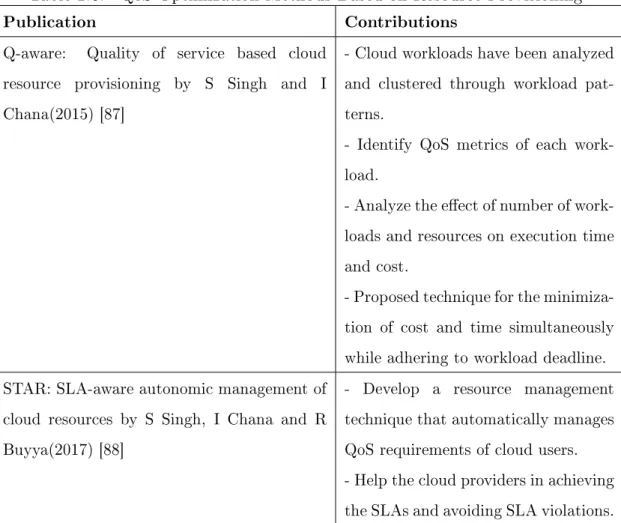
Listed in Table 2.1 and Table 2.2 are two groups of publications surveyed in this section, with highlights of their contributions. While both risk assessment-based and SLA management-based methods can help service providers reduce or minimize SLA violations, existing approaches in these directions lack the capability of optimizing QoS according to SLA requirements when SLA violations are predicted or take place. As discussed in Section 1.1 on background, service providers who do not take action to optimize the performance when SLA violation occurred will not only face monetary penalties but also results in lost revenue due to their damaged relationship with service
consumers [38]. Meanwhile, QoS is largely impacted by a variety of factors in the real-world service invocation. The typical number of controllable and uncontrollable factors that service providers need to deal with ranges from one to eight factors. Therefore, service providers need eective tools to help them analyze how dierent factors aect the QoS, to predict the situations in which these factor's inuence cause SLA violations, and to optimize performance when an SLA violation is predicted or happens.
2.3 SLA Violation Prediction
In recent years, SLA violation prediction has become a popular topic in the study of cloud services. This subject can be viewed either from the perspective of the service consumer or from that of the service provider.
For SLA violation prediction from the perspective of the service consumer, most of the existing works focus on using or extending approaches based on collaborative ltering(CF), which encompasses techniques for matching people with similar inter-ests and making recommendations on this basis. Generally, collaborative ltering algorithms can be divided into two main categories: memory-based and model-based algorithms. Memory-based methods employ similarity computation with past usage experiences to nd similar users and services for making the performance prediction and, include user-based approaches, item-based approaches, and their fusion [14]. Memory-based CF algorithms are easy to implement and highly eective, but they suer from a fundamental problem: the inability to scale-up. To address the scalabil-ity issue, model-based methods were proposed to utilize the models(such as clustering models, latent factor models, aspect models, and so on) to recognize complex patterns by seeking users for the recommendation within smaller and highly similar clusters, rather than within the entire database [29]. However, model-based methods are often time-consuming to build and update. Listed in Table 2.3 are publications surveyed
Table 2.3: Collaborative Filtering (CF)-based Methods
Publication Contributions Qos-aware Web service recommendation by
collaborative tering by Z Zheng, H Ma, MR Lyu and I King(2011) [12]
- Present a user-collaborative mecha-nism to predict QoS values of Web ser-vices.
Collaborative Web service qos prediction via neighborhood integrated matrix factorization by Z Zheng, H Ma, MR Lyu and I King(2013) [13]
- Solve the issue of the expensive and time-consuming invocations of Web services.
TAP: a personalized trust-aware QoS predic-tion approach for Web service recommenda-tion by K. Su, B. Xiao, B. Liu, H. Zhang and Z. Zhang(2017) [15]
- Present a trust-aware approach for reliable personalized QoS prediction. - Address the data credibility prob-lem that most existing CF-based ap-proaches ignore.
New QoS-Aware Web Service Recommenda-tion System based on Contextual Feature Recognition at Server-Side by S Li, J Wen, F Luo, M Gao and J Zeng(2017) [16]
- Propose an improved prediction ap-proach by considering the contextual feature similarities of dierent ser-vices.
Online QoS Prediction for Runtime Service Adaptation via Adaptive Matrix Factorization by J Zhu, P He, Z Zheng and MR Lyu(2017) [17]
- Propose an adaptive matrix factor-ization approach for runtime QoS pre-diction with high accuracy, eciency, and robustness.
in the direction of CF-based methods, with highlights of their contributions. After presenting a user-collaborative mechanism for past QoS information that are collected from dierent users, a collaborative ltering approach is proposed in [12] to predict QoS value of Web services and make Web service recommendation by taking advan-tages of past usage experiences of service users. To avoid the issue of the expensive and time-consuming invocation of Web services in [12], a neighborhood-integrated approach is designed in [13] for QoS prediction of personalized Web services. Based on the fact that the quality of Web service is aected by its context feature, the
au-thors of [16] proposes a new QoS-aware Web service recommendation system, which considers the contextual feature similarities of dierent services. To address the data credibility problem that most existing approaches ignore, the authors of [15] propose a trust-aware approach for reliable personalized QoS prediction. Meanwhile, to sup-port timely and accurate adaptation decisions, the authors of [17] proposed an adap-tive matrix factorization approach to perform online QoS prediction for candidate services. The approaches based on collaborative ltering operate on a common as-sumption that multiple applications are likely to support similar functionalities when the evaluation is conducted similarly for a large part of their services, and, there-fore, their remaining services can be evaluated similarly [24]. However, when the new systems under development are for dierent application domains, their design involves signicant structural or contextual changes and thus destroys the applicabil-ity of collaborative-ltering-based approaches. As a result, there is a demand for a more general approach that is capable of predicting the quality of services without the constraints on application domains.
For SLA violation prediction from the perspective of the service provider, several approaches have been proposed in recent years. Listed in Table 2.4 are publications surveyed in this direction, with highlights of their contributions. To guarantee the business requirements of service providers and maximize their prot, the authors of [83] proposed an intelligent and prole-based model of SLA violation prediction. This prediction model intelligently predicts the consumer's likely resource usage by consid-ering the consumer's reputation from its previous transaction history and determines the level of required resources based on their reliability. While this method can help service providers make decisions about whether to form SLA and recommends how to mitigate those violations to avoid any penalties, it lacks the capability of predict-ing SLA violation in post-interaction time phase when the SLA contract has already been made between the service provider and the service consumer. To achieve service level agreements, a prediction method based on Bayes model was designed in [72] to predict the mean load over a long-term time interval, as well as the mean load in
consecutive future time intervals by identifying novel predictive features of host load that capture the expectation, predictability, trends and patterns of host load. This prediction model of the workload can help service provider estimate the possibility of whether SLA violation will occur. Meanwhile, the authors of [73] proposed to use the SVM model to predict possible SLA violation before any issue emerges so then remedial action can be taken. While the approaches in [72] and [73] can help the service provider know beforehand whether SLA violation will take place, it lacks the capability of helping service provider evaluate QoS quantitatively. However, service providers need an eective approach to measure and analyze the impact of inuential factors on system performance. As a result, this dissertation will develop a novel ap-proach to help service providers evaluate QoS by using techniques of the design and analysis of experiments. As part of the proposed unied framework, this approach uses sensitivity analysis to identify inuential input factors of services, produces a tted model to approximate the relationship between factors and QoS, and uses this tted model to analyze and predict QoS values. In Chapter 3, this approach will be discussed in more details.
2.4 QoS Optimization
The subject of QoS optimization can be either composite or individual services. For composite services, several approaches that are listed in Table 2.5 suggested to calculate aggregated QoS values of all possible service combinations and choose the one that maximizes the aggregated utility value while satisfying global constraints [89, 90, 91, 92]. While most of these approaches in this direction are proved to be able to optimize QoS of the composite services eectively and eciently, they become inapplicable for the individual service.
For individual services, resource provision has been utilized in [87] to analyze workloads, to categorize them on the basis of common patterns, and to plan for
Table 2.4: Methods of SLA Violation Prediction
Publication Contributions Prole-based viable service level
agree-ment(SLA) violation prediction model in the cloud by W Hussain, FK Hussain and O Hus-sain(2015) [83]
- Introduce an ecient system that predicts SLA violation before it oc-curs and recommends how to mitigate those violations to avoid any penalties. - Propose a prole-based model of SLA violation prediction from the provider's perspective.
- Help service providers in making de-cisions about whether to form SLA and avoiding SLA violations.
Host load prediction in a Google compute cloud with a Bayesian model by Di Sheng, Derrick Kondo, and Walfredo Cirne(2012) [72]
- Use a Bayesian model to predict the mean workload.
- Help service providers judge whether there is a possibility that SLA will be violated.
A machine learning model for detection and prediction of cloud quality of service violation by TS Wong, GY Chan and FF Chua(2018) [73]
- Use SVM model to help the cloud service provider know before-hand whether SLA violation will take place.
workloads before actual scheduling. The authors of [87] later enhanced their work with automated processing in the [88]. Although these methods are able to optimize QoS by allocating more resources, no attention has been given to resource over-provision, which is a serious issue for Web services as it wastes resources and causes the increase of operational cost [38].
In this dissertation, optimization techniques are used to optimize QoS. Good optimization algorithms should possess the properties[97] listed below and should be taken into consideration when designing approaches for QoS optimization.
Table 2.5: QoS Optimization Methods Based on Service Composition
Publication Contributions Optimal service selection and composition or
service-oriented manufacturing network by S Huang, S Zeng, Y Fan and GQ Huang(2011) [89]
- Propose a performance evaluation model to analyse the local and global performance.
- Realise the optimal service selection and composition.
Two-stage approach for reliable dynamic Web service composition by ZZ Liu, DH Chu, ZP Jia, JQ Shen and L Wang(2016) [90]
- Proposes a two-stage method for re-liable dynamic Web service composi-tion.
- Improves the reliability of dynamic Web service composition.
Support timely and accurate adaptation A exible QoS-aware Web service composition method by multi-objective optimization in cloud manufacturing by F Chen, R Dou, M Li and H Wu(2016) [91]
- Optimize the QoS-aware service com-position based on multi-objective op-timization.
A Multi-Objective Optimization of Cloud Based SLA-Violation Prediction and Adapta-tion by V Gaur, P Dhyani and OP Rishi(2016) [92]
- Use a GA-Tabu based approach for optimal cloud service composition se-lection.
1. Robustness: They should perform well on a wide variety of problems in their class, for all reasonable values of the starting point.
2. Eciency: They should not require excessive computer time or storage.
3. Accuracy: They should be able to identify a solution with precision, without being overly sensitive to errors in the data or to the arithmetic rounding errors that occur when the algorithm is implemented on a computer.
Various types of optimization techniques are used to solve research problems in dierent elds. These approaches can be broadly classied into two strategies: direct
Table 2.6: QoS Optimization Methods Based on Resource Provisioning
Publication Contributions Q-aware: Quality of service based cloud
resource provisioning by S Singh and I Chana(2015) [87]
- Cloud workloads have been analyzed and clustered through workload pat-terns.
- Identify QoS metrics of each work-load.
- Analyze the eect of number of work-loads and resources on execution time and cost.
- Proposed technique for the minimiza-tion of cost and time simultaneously while adhering to workload deadline. STAR: SLA-aware autonomic management of
cloud resources by S Singh, I Chana and R Buyya(2017) [88]
- Develop a resource management technique that automatically manages QoS requirements of cloud users. - Help the cloud providers in achieving the SLAs and avoiding SLA violations.
and metamodel-based optimization.
For direct optimization, it is performed by evaluating real objective function. For the Service-Oriented system, the real objective function between inuential factors and the performance is usually unknown, which means that the real performance model is regarded as a black box. Each evaluation of the real objective function typically involves the following steps: perform one experiment by conguring values of contextual factors, execute the designed Web services and collect the experimental data. As a result, the evaluation of real objective function for the Service-Oriented system is computationally expensive and involves cost. Meanwhile, when the formula of the real objective function is unknown, the heuristic optimization methods, such as genetic algorithms [98] and simulated annealing [99], are usually used to search the
optimum. These methods have fewer restrictions on the mathematical characteristics of the function, and do not require any gradient information. However, many objective function evaluations are usually needed for heuristic optimization methods, which means that a huge amount of time will be spent on performing these experiments. As a result, the strategy of direct optimization is inapplicable when optimizing the performance of the Service-Oriented system.
For Metamodel-based optimization, it makes use of some surrogate models to provide an ecient representation of the costly true model. When a surrogate model is used for this purpose, it is called a metamodel. This process is called metamodel-based design optimization(MBDO) [94, 95, 96] when metamodels are utilized for the evaluations during the optimization process. Metamodel-based design optimization usually includes three steps as below:
1. Perform a small or modest number of experiments and collect the experimental data;
2. Use these experimental data to t a set of mathematical surrogate models that are used to approximate the real unknown function;
3. Identify the optimum by searching on the most appropriate surrogate model. Since these surrogate models are mathematical functions with a specic formula, evaluation on these functions are ecient. As a result, the strategy of metamodel-based optimization will be used to optimize the performance of the Service-Oriented system in this dissertation. Because metamodel-based design optimization originates from techniques of the design and analysis of experiments, the relevant literature review will be discussed in the next subsection : design and analysis of experiments.
2.5 The Design and Analysis of Experiments
2.5.1 Motivation: Why the Design and Analysis of
Experi-ments
In essence, QoS dened in the SLA is the quality attribute requirement for Web services. Whether a system will be able to exhibit its desired quality attributes is substantially determined by its architecture. In other words, quality attribute requirements are satised by the various structures designed into the architecture, and the behaviors and interactions of the elements that populate those structures [78]. As a result, a well-designed architecture can help service providers ensure SLA when designing Web services.
When performing architectural design, the architecture should be evaluated for its ability to deliver the system's important quality attributes. This should occur early in the life cycle, when it returns the most benet, and repeated as appropri-ate, to ensure that changes to the architecture (or the environment for which it is intended) have not rendered the design obsolete [78]. Meanwhile, there are various architectural tactics that can be used to achieve the requirement of quality attributes, such as provisioning more resources, caching and maintaining multiple copies of com-putation [79][80]. Service designers need to compare alternative architectural tactics and, hence, make well-informed design decisions when making trade-os between cost, quality, and performance[33]. For example, when doing performance-driven architec-tural design for Web services, service designers may make dierent design decisions based on dierent environments in which Web services execute. Service designers usually need to ask some questions about the contextual information of Web services.
1. Will SLA be violated in the future?
3. How is the performance impacted by uncontrollable factors?
4. What are the performance bottlenecks that are caused by variations of dierent uncontrollable factors?
5. Which controllable factors can be used to improve performance eectively? 6. Which architectural tactics related to controllable factors can be used to improve
the performance?
To answer these questions, service designers need to gain insight into the perfor-mance model and then can make the right design decisions based on this knowledge. Otherwise, a long time will be spent and wasted on the implementation of archi-tectural tactics that will only give us a small percent performance boost. However, most of the answers to these questions are usually unknown during the architectural design stage. As a result, this kind of decision-making process for designing archi-tecture is empirical and need to make use of techniques of the design and analysis of experiments(DAAE) to investigate the performance model.
2.5.2 The Basic Concept Of the Design and Analysis of
Ex-periments
In general, the design and analysis of experiments(DAOE) is to use statistical techniques to analyze the results from designed experiments in an iterative manner. Specically, we may want to determine which input variables are responsible for the observed changes in the response, develop a model relating the response to the impor-tant input variables and to use this model for system analysis, system improvement or other decision-making [8]. Because the results and conclusions that can be drawn from the experiment depend to a large extent on how the data were collected, the experiment is needed to be well-designed via the design of experiments. Design of experiments(DOE) is a test or series of tests in which changes are made on purpose
to the input variables of a process or system so that the causes for changes in the output response can be observed and identied. After data are collected from the well-designed experiment, some statistical techniques will be used to analyze these results to gain insight into the unknown system, to decide how to optimize the system or to make some other decision [8].
The motivation of design and analysis can be traced back to Fisher's work on data analysis for agriculture experiments[75]. Since then, over thousands of activities and publications on it have been conducted and reported to characterize a system or prod-uct, to optimizing a product or process, and to design a product. Its applications cover a wide range of disciplines, including biology, agriculture, medicine and pharmacy, electronic and mechanics, and even social and human management[19, 104, 26, 27, 28]. The most commonly used terms in the design and analysis of experiments include controllable input factors, uncontrollable input factors, responses, hypothesis testing, and interaction.
1. Controllable input factors are those input parameters that can be controlled or congured, such as CPU, storage, cache, etc.
such as workload, network environment or the requirements of services con-sumer.
3. Responses or output measures are the elements of the process outcome.
4. Hypothesis testing helps determine the signicant factors using statistical meth-ods.
5. An interaction is a situation in which the simultaneous inuence of two variables on a third is not additive when an experiment has three or more variables. In general, experiments are used to study the performance of processes and sys-tems. The process or system can be represented by the model shown in Fig. 2.1. The process can be visualized as a combination of operations, machines, methods, people, and other resources that transforms some input into an output that has one or more observable response variables. Some of the process variables [x1,x2,...xn] are control-lable, whereas other variables [z1,z2,...zn] are uncontrollable. The overall objectives of the experiment include[8]:
1. Understanding: two main objectives of the design and analysis of experiments is to learn which factors have the most inuence on the response(s) of interest and to understand the behavior of a system. Specically, in order to avoid wast-ing valuable resources, to reduce the total number of experiments and to get a surrogate model with better quality, the service designer may be interested in understanding whether some factors, such as workload, CPU, memory, cache, etc, inuence the performance of a service and get a list of important factors that have signicant impact on the performance. They can apply techniques of DOAE to do sensitivity analysis to screen factors. Meanwhile, the service designer is interested in understanding the performance model that reects the cause-eects relationship between inuential factors and the response time. Af-ter constructing one surrogate model approximating the true performance model by using data from the well-designed experiments, it can be explored to help
service designers better understand the performance of Web services and predict SLA violation.
2. Optimization: after the system has been better understood, the next objective is usually optimization. That is to nd the settings or levels of the important factors that result in desirable values of the response. An optimization exper-iment is usually a follow-up after the screening experexper-iment, surrogate model tting and exploration on this model.
3. Conrmation: in a conrmation experiment, the experimenter is usually trying to verify that the system operates or behaves in a manner that is consistent with some theory or experience.
2.5.3 Performance Analysis via the Design and Analysis of
Experiments
To investigate the unknown system, several sensitivity analysis methods relying upon DOE were proposed to perform the factor screen. Sensitivity in this context is a measure of the contribution of an independent variable to the total variance of the dependent data. They can help us nd how dierent model input parameters inuence the model output, what are the most inuential parameters and how to evaluate such eects quantitatively [39]. Meanwhile, when working with new systems or technologies, valuable resources will not be wasted by focusing on important factors and ignore unimportant ones [8].
By deriving measures of global sensitivity from a set of local derivatives or ele-mentary eects, and sampling on a grid throughout the parameter space, a method of sensitivity analysis was proposed in the [40] to identify the main eects. In this paper, the proposed experimental plans are composed of individually randomized one-factor-at-a-time designs and data analysis is based on the resulting random sample
eects, it becomes inapplicable in terms of interaction eects. Similiarly, the authors of [41] later use metamodeling approaches to estimate sensitivity indices. Instead of evaluating real model or performing the real experiment, this method rst perform several experiments, then t a surrogate model and nally calculate the sensitivity indices by using the data coming from the evaluation on the tted surrogate model. Although this method can reduce the number of the experiment, its accuracy depends on the surrogate model. If the tted model is not accurate enough, the sensitivity indices will be not capable of providing useful information to make decision. To overcome the issues of lack of eciency and accuracy, the authors of [60] and [21] present the investigation on performance analysis with sensitivity analysis and a gen-eralization for the statistical method to handle two or three factors. The approach in these two papers can be used to analyze main and interaction eects, and require a relatively small number of experiments. However, the eects models and algorithms can only be used to analyze two or three factors. As a result, the research in this dissertaion will enhance and extend the models and algorithms in [60] and [21] to improve its robustness.
In order to gain a deeper insight into the behavior of a system, many papers in a variety of elds use metamodeling techniques to further explore the unknown system and predict the system behavior. Meanwhile, Complex computational models often suer from over-parameterization that can reduce model quality and increase com-putational costs [42]. As a result, before using metamodeling techniques to further explore the behavior of a system, sensitivity analysis can be used to exclude unimpor-tant parameters to potentially improve model quality and to reduce parametrization. In recent years, many papers [19, 104, 26, 27, 28] covering a wide range of elds, including intelligent manufacturing, civil engineering, powder technology, electronic and mechanics, use techniques combing metamodel-based analysis with sensitivity analysis to evaluate the performance model. As a result, techniques of the design and analysis of experiments have already been proven to be an eective way to model the cause-eects relationship between inuential factors and the performance, to explore
unknown performance system, and to optimize the performance. In this disserta-tion, sensitivity analysis combined with the metamodel technique will be employed to evaluate the performance model of Web services. In Chapter 3, this approach will be discussed in more details.
2.5.4 Performance Optimization via the Design and Analysis
of Experiments
For optimization, many metamodel-based design optimization (MBDO) methods that rely upon DOE were proposed. Response surface methodology is the most pop-ular metamodel-based optimization method used in recent years [100]. It has been studied and used for optimization in a variety of dierent elds [101, 102, 103, 104, 105] due to its eciency and accuracy for nding the optimum. However, RSM uses the linear and quadratic model to approximate the real response model and can only guarantee to nd a local optimum. When the real response model of the system is complex and has multiple local minimum or maximum optima, the global optimum can not be obtained in some cases. As a result, the global metamodel-based opti-mization approaches [106, 107, 108, 109, 110] are used to overcome this issue of being trapped by the local optimum and have a better chance of pinpointing the global optimum. These methods t one or more global metamodels following by searching global optimum on those global models. When the global metamodel is used to ap-proximate the true unknown model, it need to accurately capture the real model of the system to ensure the searching eciency and accuracy. However, it is dicult to build a highly accurate global model because the error occurring in the global surro-gate model will usually become larger than that in the local surrosurro-gate model when the global region becomes large. As a result, the global and local metamodel-based optimization approaches should be combined to take advantage of their merits. In this dissertation, QoS optimization is carried out by a guided search to globally identify subregions with local optima and to locally locate the best optimum with constraints
to minimize operational cost. In Chapter 4, this approach will be discussed in more details.
Chapter 3
Sensitivity and Metamodel-Based
Analyses for Services Design
3.1 Introduction
In support of software development based upon Service-Oriented Architecture, service providers use quality of service (QoS) to guide their design of services. By utilizing historical information of QoS collected from service consumers operating similar software systems, a group of approaches [12, 13, 15, 16, 17, 74] has recently been developed to analyze and predict QoS values for new systems with impressive accuracy as long as these systems fall into the same category of application domain, e.g., for buying, watching, or listening online [61]. Based upon collaborative ltering, those approaches rely on a common assumption that multiple software systems are likely to support similar functionality. After evaluating QoS for a large part of their services, the results are valid for the remaining services [62]. However, when the new systems under development are for dierent application domains, their design involves signicant structural or contextual changes and thus destroys the applicability of collaborative-ltering-based approaches.
In the demand for a more general approach that is capable of predicting quality of services without the constraints on application domains, this chapter proposes a framework to use sensitivity analysis for the identication of inuential factors with dominating impacts on the quality of services and use metamodel-based analysis to select a tted surrogate model for the prediction of potential violation of SLA. In the remaining of this chapter, Section 3.2 provides details of sensitivity analysis and metamodel-based analysis after introducing a unied framework to integrate the two processes together. Afterwards, Section 3.3 goes through the main steps with experiment results on a real Web service and uses it as an example to illustrate the use of this framework for service design. Finally, this chapter concludes with discussions and future work in Section 3.4.
3.2 Metamodeling for Prediction of SLA Violation
Every service in an SOA system has a number of parameters as input variables, whose values can be either discrete or dividable into discrete segments. Assuming the true performance model of a service can be expressed as a function in (3.1),
Y =f(A(1), A(2),· · · , A(m)) (3.1) where Y is the performance of service under the inuence of m input factors A(v),
1 ≤ v ≤ m. As the true functional relationship between performance and factors is
unknown, the prediction of SLA violation needs an approximation model g(·), or a metamodel, to imitate the behavior of f(·).
ˆ
Y =g(A(1), A(2),· · · , A(m)) (3.2) In practice, the metamodel will be dierent from the real model in most cases, i.e.,
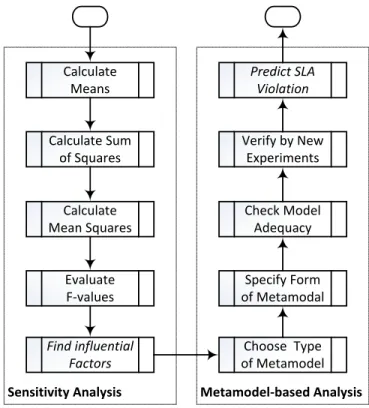
Sensitivity Analysis Calculate Means Calculate Sum of Squares Calculate Mean Squares Evaluate F‐values Find influential Factors Predict SLA Violation Verify by New Experiments Check Model Adequacy Specify Form of Metamodal Choose Type of Metamodel Metamodel‐based Analysis
Figure 3.1: A Unied Framework of Sensitivity and Metamodel-Based Analyses
Y = ˆY +ε, but g(·) is an adequately tted model if the dierence ε is less than a
predetermined threshold. Presented in this section is a unied framework (Fig. 3.1) that integrates the processes of sensitivity analysis for the identication of inuential factors and metamodel-based analysis for the prediction of SLA violation.
3.2.1 Multi-Factor Sensitivity Analysis
Sensitivity analysis is the study of how the uncertainty in the output of a system or mathematical model can be apportioned to dierent sources of uncertainty in its inputs [18]. As illustrated in (3.3) for a service withm input factorsA(v),1≤v ≤m,
the observation of an experiment with each factor taking a specic value indexed at
iv, 1 ≤ iv ≤ av, is the system's output Yi1···ml collected with a performance metric,