AID EFFECTIVENESS IN EDUCATION:
A CASE STUDY OF PAKISTAN FROM
2005-2015
Fawad Shams
UCL
Declaration
I, Fawad Shams, hereby declare that, except where explicit attribution is made, the work presented in this thesis is entirely my own.
Word count (exclusive of appendices, the list of references and bibliographies but including footnotes, endnotes, glossary, maps, diagrams and tables):
Abstract
This study reviews the effectiveness of international aid in improving the performance of government school education sector in the four provinces of Pakistan with a focus on key education indicators from 2005-2015.
There has been a steady flow of foreign aid to Pakistan since the 1990s to help the state to assure universalisation of public education delivery. This influx has followed several international agreements that aim at ensuring Education for all. It picked up further momentum after the tragic events of 9-11-2001. While the donors have used different strategies to deliver their aid, all of them have attempted to increase the enrolment, retention, and the quality of learning imparted to children in classrooms. However, the impact of aid on any of these indicators remains unclear as no systematic analyses have been done in this regard that look at the performance of education indicators over a substantial time period in light of international aid.
The study findings, reviewed in light of the concept of Steiner-Khamsi’s (2012) policy borrowing and lending and Habermas’ (1964) concept of public sphere in alignment with the Paris Declaration principles (2005) show that the performance of key education indicators in the four provinces during the decade under review has not been satisfactory despite substantial international aid being provided. There have been marginal gains made in some indicators, more in some
provinces than others, but the overall performance of the government education sector has remained much below the desired level.
CONTENTS
Declaration 1
Abstract 2
List of Tables 6
Acknowledgements 7
The 2000-Word Statement 8
1. Introduction 13
Background and Context Setting 13
Research Rationale and Research Questions 17
Significance of the Research 19
Mapping Policies and Practices in Pakistan – The 18th 20 Amendment
2. Research Design, Methodology and Ethical Issues 24
Research Design and Methodology 24
Data Sources 26
Research Tools 26
Sampling and Research Participants 27
Ethical Issues 30
3. Literature Review and Theoretical Framework 32
Literature Review 32
Theoretical Framework 38
Policy Borrowing 38
Public Sphere 40
Discussion 43
4. Provincial Data and Analysis 48
Balochistan 48
Background 48
Provincial Data Analysis 51
Schools, Enrolment, Teachers 51
Missing Facilities 53
Student Dropout 55
Student Assessment under ASER 57
Resource Allocation for Education 59
Stakeholder Perspective 60
Khyber Pakhtunkhwa 67
Background 67
Provincial Data Analysis 69
Schools, Enrolment, Teachers 69
Missing Facilities 71
Student Dropout 73
Student Assessment under ASER 74
Resource Allocation for Education 76
Stakeholder Perspective 78
Overall Analysis 81
Punjab 85
Background 85
Provincial Data Analysis 87
Schools, Enrolment, Teachers 87
Missing Facilities 89
Student Dropout 91
Student Assessment under ASER 93
Resource Allocation for Education 95
Stakeholder Perspective 97
Overall Analysis 99
Sindh 102
Background 102
Provincial Data Analysis 106
Schools, Enrolment, Teachers 106
Missing Facilities 108
Student Dropout 110
Student Assessment under ASER 112
Resource Allocation for Education 114
Stakeholder Perspective 116
Overall Analysis 121
5. Discussion on Data and Interview Findings 124
Overall Data Analysis 124
Dropouts 124
Access to Education 124
Enrolment and Teacher Shortage 124
Missing Facilities 125
Education Financing 125
Aid Alignment with Paris Declaration 126
Stakeholder Perspective 127
Public Sphere 128
Policy Borrowing 131
6. Conclusion 140
Performance in Key Education Indicators 140
Public Sphere and Policy Borrowing 142
7. Bibliography 144
8. Appendices 155
Interview Questionnaire 155
Acronyms 158
LIST OF TABLES
Number Table Heading Page Number
1 Key Education Indicators of Pakistan 13
2 International Aid for Education to Pakistan – 2014-2015 (US$ Million)
17
3 List of interviewees and FGD participants 28
4 Schools, Enrolment and Teachers in Balochistan 52
5 Missing Facilities in Schools in Balochistan 54
6 Primary Level Dropout between Classes 1 and 5 in Balochistan 55
7 Dropout between Classes 5 and 6 in Balochistan 56
8 Dropout between Classes 1 and 10 in Balochistan 57
9 ASER Balochistan Learning Levels in Urdu 57
10 ASER Balochistan Learning Levels in English 58
11 ASER Balochistan Learning Levels in Arithmetic 58
12 Breakdown of Total Government Education Expenditure by Educational Level - (Rs. Million)
59 13 Breakdown of Government Development Expenditure by
Educational Level (Rs. Million)
60
14 Schools, Enrolment and Teachers in KP 70
15 Missing Facilities in Schools in KP 72
16 Primary Level Dropout between Classes 1 and 5 in KP 73
17 Dropout between Classes 5 and 6 in KP 73
18 ASER KP Learning Levels in Urdu and Pashto 74
19 ASER KP Learning Levels in English 75
20 ASER KP Learning Levels in Arithmetic 75
21 KP Development Budget 2005-2006 to 2014-15 (Rs. in millions) 77 22 Current Budget KP Government Education Department
2005-2006 to 2014-2015 (Rs. in millions)
78
23 Schools, Enrolment and Teachers in Punjab 87
24 Missing Facilities in Schools in Punjab 90
25 Primary Level Dropout between Classes 1 and 5 in Punjab 92
26 Dropout between Classes 5 and 6 in Punjab 92
27 ASER Punjab Learning Levels in Urdu 93
28 ASER Punjab Learning Levels in English 94
29 ASER Punjab Learning Levels in Arithmetic 94
30 Government School Education Budget in Punjab (Rs. in millions)
96
31 Schools, Enrolment and Teachers in Sindh 107
32 Missing Facilities in Schools in Sindh 109
33 Primary Level Dropout between Classes 1 and 5 in Sindh 110
34 Dropout between Classes 5 and 6 in Sindh 111
35 ASER Sindh Learning Levels in Urdu and Sindhi 113
36 ASER Sindh Learning Levels in English 113
37 ASER Sindh Learning Levels in Arithmetic 114
38 Sindh Government Education Sector Budget Allocations 115 39 Variance between Education Budget and Actual Expenditures
in Sindh
Acknowledgements
I would like to acknowledge the efforts of all those who provided support to me during the course of this thesis. First, I would like to thank my supervisor Dr. Marie Lall who guided me in all aspects of the development of my thesis. She read through numerous drafts, suggested changes, and most importantly encouraged me throughout this time to finish the job. Without her knowledgeable guidance, this work would not have been possible.
I would also like to thank Dr. Carew Treffgarne for reading my draft as an internal reader and providing very useful feedback and comments, that helped me make the necessary revisions. Thanks are also due to the course leaders and faculty members for the four core courses that I completed as part of the EdD.
I would also like to specially thank two of my esteemed colleagues, Dr. Irfan Muzaffar and Dr. Salman Humayun for taking their time out to read through my drafts and hold discussions with me, providing several very useful ideas and suggestions that I used in my writing. I am also grateful to the Institute of Social and Policy Sciences (I-SAPS) and Mr. Abdullah Alam for providing necessary data for my thesis.
And finally, I would also like to thank my wife Uzma and children Zainab and Salman for providing all the peace and support in the house, without which I could not have completed this work.
I would like to dedicate this thesis to my mother and father, without whose support I would not be where I am today.
The 2000-Word Statement: My learning experience under the EdD programme and how this learning has contributed to my professional growth
Introduction
In this note I will describe how the EdD has contributed to my professional development through its various elements during the course of the programme, and how the courses are systematically aligned to enhance my learning
experience.
I have been working in the education sector in Pakistan and in some other countries for more than 22 years. Right from the start of my career in 1994 I was exposed to the world of international donors and aid, and have since worked regularly with large and small programmes and projects, and consulting assignments funded by international aid agencies. I was always intrigued by international aid, its motives, its design and the way it was
managed. I used to come up with hypothetical explanations, such as aid being a foreign policy hegemony tool with a political agenda, or some donors being more apolitical than others.
My professional life provided opportunities to engage with designing and conducting research and doing reports for projects and consultancies. As I progressed through my career I realized that I needed to develop a good repertoire of research methods, identify and use the right theoretical frameworks, and my writing should be more critical and less descriptive. In pursuit of my questions about international aid, and with the need to polish my research and writing skills I started the IOE EdD programme in 2006. My Learning Experiences in the Programme
At the IOE the courses that I took were aimed at developing critical insights based on sound theoretical frameworks with which to make sense of the international aid for education and its effects. I had entered the EdD
programme with the motive to inform myself more systematically about some of the key questions on international aid and its effectiveness for improving education performance in Pakistan. But the answers to questions about international aid and its effectiveness were going to be possible only once I
had acquired skills for conducting research, use relevant theoretical frameworks, and carry out critical analyses.
The four core courses provided necessary insights to various theories and ideas, each one followed by an assignment that provided the opportunity to examine areas that one is interested to investigate in light of the theoretical, political, social and cultural underpinnings that each course had to offer.
During some of initial courses I took up assignments that were broadly focused and ambitious in their scope, resulting in compromises made with the relevant literature review and developing the necessary theoretical insights as I tried to fit in information within the stipulated word limit. Later however, I narrowed down the research focus, identified theoretical frameworks and interrogated relevant literature.
I had more than 12 years of professional experience when I joined the EdD, and this professional practice focus showed up very prominently in my
assignments, but the theoretical context was weak. My initial research designs lacked necessary information; for instance, why did I choose certain methods, or how were the interviewees selected, and through which sampling technique. The writings lacked critical analysis and were descriptive, and at times with assertions without evidence.
The courses were very useful for clarifying the challenges mentioned above; I learned how to systematically design research, choose a methodology, identify research methods and come up with key questions. I learned about sampling techniques for selection of research participants, and how to position myself given my background as a development practitioner.
The core courses were followed by the institutional focused study (IFS). The Institutions Focused Study provided a very useful opportunity to design and conduct a research study immediately following the four taught courses to provide a useful linkage between the learnings from the courses and the research study. It took me about two years to complete the IFS - first going through the proposal stage, then developing a research design for the study, identifying the relevant theoretical framework, selection of interviewees, collection and analysis of data, and in between continuous feedback from my
supervisor on a number of drafts. The IFS helped polish skills on the design of research, methodology, the use of methods, collection of data and analysis and the actual writing. I was continuously reminded to use the theoretical framework when reporting findings, to be more analytical and less descriptive in my writing, and to be more conclusive when doing the final analysis. The use of dependency and modernisation theories as a theoretical framework provided an excellent opportunity on how to inform field data and report findings from the theory and vice versa.
I further developed the research done under the IFS and took it forward to my thesis for the EdD. The scope of IFS was geographically expanded and the theoretical part was modified to help with the analysis. The learnings from the IFS have been most useful in helping with the research design for the thesis, its methodology and approach, and identify relevant theories. The IFS has almost served as a pilot study for the thesis in that it looked at the aid and education data in a single province of Pakistan, whereas the thesis expanded the scope to include all the four provinces, with amendments to the research design and the use of theories.
The structure of the EdD to provide two back-to-back opportunities for
conducting medium and large scale research studies (the IFS and the thesis) has helped polish my research and writing skills to a great deal, and has provided an opportunity to further develop myself to pursue a career in the academics.
I learned specifically how to use the conceptual and theoretical frameworks for guiding and reviewing the data findings, learned about the research methods and techniques, and learned about challenges and issues relating to aid effectiveness for education in Pakistan, and how an independent and dynamic public sphere is crucial to effective policy borrowing for improving education. Linkages between Courses
The four core courses were sequenced very systematically, building upon key knowledge and information gradually. All courses emphasised on engaging with and interrogating relevant literature to inform myself about the current and recent work on the topic of assignment. Similarly, all courses emphasised on
the need to identify and use a theoretical framework and to inform findings from the field with the relevant theory. Professional positioning of oneself within the assignment was an important piece, and as I learned later, did have ethical implications in my case, being an insider researcher. Aspects relating to
empirical research were introduced systematically, initially through design of a research proposal followed by two small scale research studies in two
separate courses.
Following on from the core courses, the IFS was designed to draw upon knowledge in the core courses and further build on it. The learnings from the core courses were essential to develop the IFS research design, gather field data and do the analysis. However, the IFS provided a much more
comprehensive opportunity to conduct a field based research study.
The feedback, initial as well as final, provided in the core courses as well as the IFS was extremely useful in continuously correcting the course and taking the required direction.
The thesis, presented here, builds upon the IFS and the core courses conceptually, but with a much larger scope. Nevertheless, without the systematic process of learning acquired through core courses and the IFS it would not have been possible to develop this thesis.
The contribution of EdD to my Professional Career
The focus of this thesis as well as the IFS and one core course has been on the effectiveness of international aid and the performance of key education indicators in different provinces of Pakistan. This has been a key learning area for me, as I continue to work with donors on education projects in Pakistan. The theoretical framework on policy borrowing and public sphere has been a tremendous learning opportunity, allowing me to relate the framework directly to my experiences in the practical field and immediately see a relationship, with some issues becoming more clear than others.
Prior to the EdD, even though I did see issues and challenges in the donor funded projects, in the absence of any research, and no exposure to any theoretical framework, I used to hypothesise, coming up with explanations that largely identified issues with the government sector, the apathy of public sector
officials, their poor systems and lack of commitment. However, having gone through the EdD programme, I am now able to look at donor funded projects from both theoretical and practical stand points. Theoretically, I can see my findings validating the importance of a public sphere, the absence or weak presence of which results in ineffective policy borrowing. Practically, I can see the performance of key education indicators, having used robust research methods for collection of data.
EdD’s contribution has also been paramount in terms of developing an understanding about key aspects of qualitative and quantitative research, an insight into different education and development theories, and improved writing skills that take into account aspects to make writing coherent, analytical, clear and balanced.
While pursuing the EdD I have had opportunities to work as a lead researcher and consultant in many countries and in different continents. The learnings from the EdD courses have been most useful in designing and conducting assignments, and reporting on the findings. My professional exposure has taken me to conflict and post-conflict states in fragile situations to review and assess education situations. The insights from my academic preparation through the EdD programme have helped me look at issues and challenges in education from different theoretical lenses, engaging with relevant literature to inform myself about past and emerging practices, and inform findings in light of various socio-cultural and political milieu.
The EdD may also open an academic career for me, with a premium university in Pakistan who is in the process of setting up a school of education. I have been invited by the organisers of their school of education to contribute in different discussions forums, and have also been asked to conduct a seminar for the students on my research findings.
The research done in the IFS and thesis will build upon work already done on aid and education in Pakistan, and will provide an opportunity to the donors as well as the government to inform their existing practices in light of the research findings, and to help them possibly revisit their approaches for designing and implementing aid projects for education in Pakistan.
1.
Introduction
1.1 Background and Context Setting
The education sector in Pakistan faces tremendous challenges in the areas of access, quality, and availability of financial resources. Around 25 million children of school going age are out of school; a large number of public schools in the country run with single classrooms and single teachers (Alif Ailaan 2014). A major contributor to the problems faced by Pakistan’s education sector is the lack of available resources for education. Pakistan is currently spending around 2.14 % of its Gross Domestic Product (GDP) on education (I-SAPS 2015). While the
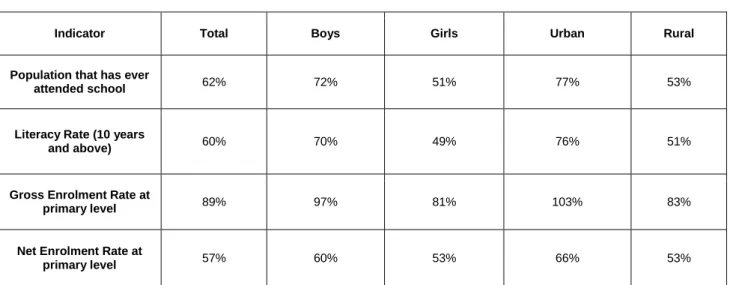
provinces are spending significant portion of their budgets on education, the problem still remains owing to the quantum of challenge faced by the education sector in Pakistan. Pakistan has therefore been relying on international donors for grant assistance and loans for improving access and quality of education in the country. Table 1 provides a summary of some key education indicators for Pakistan.
Table 1 – Key Education Indicators of Pakistan
Indicator Total Boys Girls Urban Rural
Population that has ever
attended school 62% 72% 51% 77% 53%
Literacy Rate (10 years
and above) 60% 70% 49% 76% 51%
Gross Enrolment Rate at
primary level 89% 97% 81% 103% 83%
Net Enrolment Rate at
primary level 57% 60% 53% 66% 53%
Source: PSLM Survey 2014-15
Enrolment and number of schools fall down sharply as we go up the educational levels. According to Pakistan Education Statistics report for 2014-15, compared with 124,070 government primary schools in Pakistan, only 16,418 middle and 12,116 high schools exist. Looking at the enrolment, in comparison with 15.4 million students at pre-primary and primary level in public schools, only 4 million and 2 million children are enrolled at middle and high level.
International aid for education has been a palpable feature of the government school education process in Pakistan since its inception, getting momentum in the last two decades. The supply of aid has continued unabated since the early 1990s in the wake of the Jomtien declaration of Education for All(1990). Aid provided by international donors does not just consist of financial assistance whether through grants or loans, but also includes human resources for technical assistance, policy level plans and recommendations under ‘best practices’, and specific
implementation level strategies for improving the overall education system of recipient countries.
However, even after two decades of almost uninterrupted supply of international aid for education in the public sector, Pakistan’s performance is still far from satisfactory. Pakistan still lags behind on a number of access and quality
indicators. For example, Pakistan was ranked 106th out of 113 countries on EFA
Development Index (EDI) in 2012, a composite index used to evaluate overall progress towards education for all (UNESCO 2015). With an EDI score of 0.654, Pakistan was one of the 18 countries considered to be far from achievement of education for all. Pakistan’s score marginally improved to 0.660 in 2015. In both 2012 and 2015, Pakistan had the lowest EDI scores in South Asia.
With the challenges of access and quality persisting in Pakistan, questions are raised towards lack of aid effectiveness for the education sector in Pakistan. This lack of effectiveness stems from issues related to both host and the donor countries. Donors and the government are both accountable to each other and to the citizens as the beneficiaries of the aid. There is sufficient evidence available that points towards a lack of participation of citizens and civil society organizations in
education programme designing and monitoring (I-SAPS, 2012). Therefore, there is a need to view aid effectiveness in light of accountability mechanisms that are in place in all the provinces, as well as planning and management capabilities of the provincial education departments for utilisation of aid successfully. The lack or absence of participation of citizens also points towards a weaker public sphere in Pakistan. Borrowing of policies and ideas and implementing them without
adequate debate and adaptation is also a symptom of the absence of an effective public sphere. It is therefore important to see what kind of public sphere exists in
Pakistan and to what extent is it beneficial in informing the debate and discourse on education.
Reviewing aid effectiveness in light of Paris Declaration will make a lot of sense since the key principles of the Paris Declaration cover aspects of ownership, partnership, harmonisation, and accountability.
The OECD Paris Declaration (2005) brought together developing and developed countries and multilateral and bi-lateral institutions to reform the ways in which aid is delivered and managed. It was agreed that while the volumes of aid and other development resources must increase to achieve these goals, much more importantly aid effectiveness must increase significantly to support the recipient countries to enhance their efforts to strengthen governance and improve development performance. This will be all the more important if existing and new bilateral and multilateral initiatives lead to significant further increases in aid. Key principles were agreed upon to strengthen partnership mechanisms between donors and recipient countries; these included:
Ownership – Issues and challenges relating to ownership of donor funded initiatives at the province and sub-province level have been rife as reported in interviews and focus group discussions in all the provinces. The absence or lack of ownership can be seen to be an outcome of absence of public spheres, and a contributing factor for ineffective policy borrowing. In rare cases where we have seen organisation of stakeholders into a professional development forum in some districts of Sindh and Balochistan under the USAID funded ESRA project, the ownership of project activities increased, but only temporarily and faded as soon as the forums were dissolved following an end to the project.
Alignment – During the period under review alignment of donor interventions with government policy frameworks and institutions have gradually improved and the donors as well as their implementing partners have increased their coordination with government programmes. However, such alignment was more prominent at the provincial level, and where government officials were more actively involved. Successful alignment of programmes with government institutions and policy frameworks is a necessary step for ensuring that only the best policies and practices are borrowed and are implemented to pursue improvement efforts. As in case of
ownership, the presence of a public sphere can almost be seen as a pre-condition to effective alignment of donor interventions with the government.
Harmonisation – In the presence of multiple donors in the education sector in Pakistan, their harmonised efforts are crucial to effective service delivery by avoiding duplication and poor management of resources. While each province has created its own donor management unit to organise donor interventions, in some cases the donors have not coordinated their interventions with each other resulting in duplication of interventions, and management challenges for the government. Smaller implementing partners and non-government organisations (NGOs) operating through donor funds are also a challenge for harmonising their initiatives resulting in multiple initiatives implemneted in the same districts and schools, causing disruption and mismanagement for the teachers and education officials. Mutual Accountability – The implementation of accountability mechanisms is a challenge in government systems; no one is answerable on why the performance of education indicators is declining, or why is aid not contributing sufficiently, or being utilized to its maximum. Similarly, no one is held accountable if a donor funded project fails to achieve its objectives. Partnership covenants under aid programmes do not focus upon accountability based conditions for either side, allowing everyone to get away without being answerable. The absence of public spheres further contributes to an absence of accountability systems as there are no forums or platforms where people can debate, review and hold office bearers accountable. Table 1 provides figures for international aid for education received by Pakistan under development and economic assistance from bilateral and multilateral donors every year since 1996. The aid constituted both loans as well as grants.
Table 2 – International Aid for Education to Pakistan (US$ Million)
Year Aid for Education % share of Education in Total Aid
1996 112.7 12.8% 1997 83.1 13.9% 1998 80.8 7.7% 1999 84.2 11.5% 2000 71.6 10.3% 2001 59.6 3.1% 2002 43.0 2.0% 2003 52.3 4.9% 2004 47.5 3.3% 2005 194.6 12.0% 2006 16.8 0.5% 2007 411.3 11.2% 2008 241.1 5.1% 2009 820.1 22.3% 2010 521.5 19.9% 2011 129.8 7.8% 2012 267.0 8.8% 2013 200.9 7.0% 2014 456.2 6.7% 2015 426.2 7.4%
Source: Calculated from I-SAPS (2012) and Economic Affairs Division ODA Statistics reports
1.2 Research Rationale and Research Questions
I have worked on international education projects with the World Bank (2007, 2010-2011), USAID (2003-2010) and DFID (2012-2015)1 in all the four provinces
of Pakistan during the decade under review, assisting the provincial governments in their reforms of school education through utilisation of international aid. I have
1 In KP with the DFID funded KPESP, in Sindh and Balochistan with the USAID funded ESRA and
had the opportunity to closely observe the processes of programme design and planning, management and implementation of activities, as well as reviewing the impact of interventions from the donor side. My experience suggests that prima facie aid has not been able to achieve the desired results for the education sector in Pakistan, and therefore there is a need to carry out research to establish this notion so that current and future initiatives can be better informed by findings of this study.
Pakistan receives large amounts of international aid under development and economic assistance from bilateral and multilateral donors every year as shown in table 2 above. The aid constitutes both loans as well as grants, and with each passing year the amount of international loans is increasing for Pakistan, currently at US$ 65.1 billion (State Bank of Pakistan Annual Report 2014-2015).A
significant portion of this aid is used to improve the education sector, and
therefore requires an evidence-based understanding of whether aid is achieving its objectives.
This study will review the effectiveness of aid for education in the four provinces of Pakistan from 2005-2006 to 2014-2015, specifically looking at the performance of government school education sector in Pakistan. The review process will report results and findings in light of the following questions:
1. How have the provinces performed during the period under review with a reference to key education indicators in access, quality and governance? 2. How are the five principles of OECD’s Paris Declaration (2005) applied by
donors and host government when designing and implementing interventions focusing upon the key education indicators?
3. Do public spheres exist in Pakistan, and how beneficial are they in improving aid effectiveness?
4. How has international policy borrowing contributed to the improvement of the government education sector during the decade under review?
It is important to see how the international aid interventions have aligned with the demands and priorities set out by the federal and provincial governments in the area of education. A review of the Government’s policies and plans during the past decade will help in understanding the government's development agenda and
priorities; alignment of international interventions with these policy frameworks serves as a first step towards developing an ownership of the government. Lack of alignment with these policy frameworks on the part of donors can lead to reduced ownership and commitment on the part of government towards aid programmes. There has also been an influx of ‘best practices’ through policy borrowing or travelling reforms under various donor funded programmes - schemes and strategies promoting public-private partnerships, voucher schemes, lesson plans for teachers, to name some. A case in point is the strengthening of provincial education foundations that are mandated to increase public-private partnerships for improving access and quality, but have essentially promoted development of low-fee private schools - utilizing public funds to promote private education.
1.3 Significance of the Research
The contribution of this research is both theoretical and practical. On theoretical front, the study looks at education aid effectiveness in Pakistan using Habermas’ concept of the public sphere (1964) in order to see whether public spheres exist in Pakistan, and if they do what kind of role are they able to play in effective policy borrowing (Steiner-Khamsi, 2012). On practical lines, the study reviews the effectiveness of aid against the performance of the public education sector in the four provinces of Pakistan in light of a number of important questions at the policy and implementation level.
The OECD’s Paris Declaration and the Accra Agenda (2005/2008)emphasize the importance of ownership, partnership, alignment, results, accountability and harmonization of aid between donors and recipient countries. The Declaration and the Agenda both serve as key drivers for promoting the ownership and partnership of recipient country in all aid programmes and projects, and for increasing accountability for the government as well as donor organization. This study will look at the five principles of the Paris Declaration (2005) in light of the aid context in Pakistan and see if these principles are considered while designing and implementing aid interventions.
An important aspect in the debate on aid effectiveness is the mechanism under which aid programmes are implemented and decisions made by the beneficiary country’s civil servants and public sector organizations. This study utilizes
Habermas’ concept of the public sphere (1964) to understand the prevalent culture of communication and participation in decision making in Pakistan, along with an engagement (or lack) of private stakeholders (parents, civil society) in planning, decision making and accountability matters.
In the current foreign aid environment, funds are not simply transferred from the donor to recipient country. The entire package consists of both funds as well as policy ideas and reform practices, with the aim to uplift and modernise the education sector of the recipient country. Existing solutions to policy problems, which are preferred by the donors, also travel with funds to the recipient countries. Recipient countries increasingly import reforms, at times coercively as a condition for receiving aid, or as 'best practices' – under a perception to use them as a tool to accelerate local education reforms. Policy and reform borrowing can play an important role in establishing or giving up ownership and partnership in aided interventions.
The research will also contribute to the existing knowledge about effectiveness of international aid for education to Pakistan in as far as analysis of the key data in education in the four provinces is concerned. Some of the more recent works on international aid for Pakistan have included Altaf (2011) focusing more on health and the social action programme (SAP), Malik (2007) on the evolution of
education policy and the role of donors, and I-SAPS (2012) on aid effectiveness for education seen in light of the Paris Declaration and Accra Agenda between 2009 and 2011. The analysis of province-wise education data from 2005-2015 will be a useful contribution to the existing knowledge on education and aid in
Pakistan as such extensive provincial data analysis has not been done for education in Pakistan.
1.4 Mapping Policies and Practices in Pakistan – The 18th Amendment
The following section outlines education-related developments in the pre-18th
amendment period and as a result of the 18th amendment.
Pre-18th Amendment Period (1947-2010)
Education exclusively remained a provincial subject until the 1973 Constitution of Pakistan. In the 1956 Constitution of Pakistan, education was placed under
provincial legislative list through entries 20 and 23. These entries provided provinces the autonomy over school and higher education.
The 1962 Constitution of Pakistan provided a single Federal Legislative list of 49 subjects over which the Federal government had autonomy. Education was not part of this part; highlighting the fact that education remained a provincial subject as per the 1962 Constitution.
The 1973 Constitution of Pakistan made major changes in the educational setup and gave the Federal government the autonomy to devise education policies and plans while the provincial government only had the role of implementing these policies. When the current constitution of Pakistan was adopted in 1973, education functions were divided between the Federal and provincial governments in Pakistan. Ministry of Education (MoE) was primarily in charge of the education policy-making and planning. The Policy and Planning Wing of the MoE was mandated with policy-making and planning in education. The Wing was also assigned the function of preparing, implementing and monitoring of development plans for education in consultation with the provincial governments. The Curriculum Wing of the MoE, assisted by the provincial Curriculum Bureaus, was assigned the charge of curriculum for public education sector and also approved the textbooks developed by the provincial Textbook boards. At provincial level, education departments existed; the provincial minister being the executive head and Secretary as the administrative head. The provincial education departments executed education policies and plans devised by the Federal MoE.
Musharraf’s Devolution Plan in 2000 transferred powers to elected representatives at local level. Education was one of the twelve departments answerable to the District Nazim (elected head of the district government). School education, its planning and budgeting were devolved to the district governments as per the Plan. However, this system was reverted in 2009 with the powers transferred back to the provinces.
Education Devolution under the 18th Amendment (2011 onwards) During the summer of 2011 under an act of Parliament the constitution was amended to decentralise education entirely to the provinces2. Decentralization of
education created many challenges for the provinces, and it is important to see how the provinces utilise international aid to seek support for effective
implementation of the constitutional amendment. It would be pertinent here to understand how does the 18th amendment impact education in the provinces.
The 18th Constitutional Amendment has impacted education in two ways: Devolution to the provinces and access to free education for all children aged 5-16. The pre-18th Amendment Constitution contained two legislative lists that
divided functions between the federal and provincial governments in the country. These were the Concurrent Legislative List and the Federal Legislative List respectively. Under the Concurrent Legislative list both the federal and provincial governments could undertake executive functions and also legislate on the
subjects. However, in case of a conflict the federal law would prevail. The Federal Legislative List was the exclusive domain of the Federal Government. Under the Concurrent Legislative List, the following entries were on education:
Curriculum, syllabus, planning, policy, centres of excellence and standards of education, and Islamic education.
In 1976 the Federal legislature promulgated the ‘Federal Supervision of Curricula, Textbooks and Maintenance and Standards Act 1976’. The law gave the federal government exclusive powers to develop and notify national curriculum and approve textbooks. With the repeal of the Concurrent Legislative List, the law’s impediments on provinces for curriculum development and textbook approval were also rendered redundant. The legal status for all other areas listed in the Concurrent List remained unaffected.
In addition to the purely legal implications a number of policy and implementation issues have also arisen. These have resulted from decisions of the Implementation Committee on the 18th Amendment. The Committee abolished the Ministry of
Education as a consequence of the amendment. The Ministry, in addition to being
2 Article 25-A of the 18th Amendment devolved education in its entirety to the provinces in 2011, revoking
the previously existing concurrent list that had items like curriculum, policy and planning under the ambit of the federal MOE with input sought from the provinces
responsible for the development of national curriculum and approval of textbooks, also developed national education policies and performed the role of coordination across provinces. The above vacuum would need to be considered carefully including federal funding in certain areas.
2.
Research Design, Methodology and Ethical Issues
2.1 Research Design and Methodology
This research reviews the effectiveness of aid against the performance of the government education sector in the four provinces of Pakistan in light of a number of important questions (research questions) at the policy and implementation level. I have looked for causal relationships (Miles and Huberman, 1994) and attribution factors between international aid and its effectiveness in the education sector through studying the performance of key education indicators at the school level in light of the research questions. Causal relationships show how various dependent (in this case student learning levels, teacher behaviour, school enrolment and drop out, school facilities) and independent variables (in this case aid design and distribution process – policy borrowing, government accountability and ownership of the programmes – public spheres) in a field study behave with regards to the influence of one over other(s). Causal analyses allow identifying factors that are influencing key indicators, and will also be helpful in quantifying their effect within a given causal model. I have also looked at the coefficient of correlation (Brown and Dowling, 2009) to see if there are trends and patterns that indicate a
relationship between aid and education performance in light of the research questions, regardless of whether the relationship is causal. The coefficient of correlation indicates an association between different variables within international aid and key performance indicators, and is of particular use when answering the research questions.
The study uses a mixed methods approach for answering the research questions, including case studies of various donor funded programmes (Robson, 2002; Brown and Dowling, 2009; Yin 2009), doing systematic desk reviews of the aid data and education indicators for all four provinces, reviewing covenants and partnership documents between the government and aid agencies, looking at government policy framework documents, carrying out interviews, and holding discussions with stakeholders. A case study approach helps focus upon donor funded programmes and projects, using multiple methods of data collection and an evaluative approach for establishing a correlation between aid data and key performance indicators. A case by case analysis of the province also helps
the differentiating results. I have used ex-post facto research method (Brown and Dowling, 2009) for reviewing the performance of key education indicators against the backdrop of international aid for a baseline year (2005-2006), a middle year (2009-2010) and the final year (2014-2015). Ex-post facto is relevant because it refers to a situation in which the researcher, rather than making the intervention, examines the effect of an intervention after it has occurred.
Research question 1 is answered through review of the education and aid data, and for investigating research questions 2, 3, and 4, I have carried out interviews and held discussions with different stakeholders in all four provincial governments, and have also looked at the partnership agreements and other strategic
documents between the government of Pakistan and donor agencies. A review of the agreements and other strategic documents is useful for understanding the design of the aid programmes, the terms of partnership between the government and donors, and the alignment of aid programmes with the government education frameworks.
Based on a review of government school education data, aid data, and relevant reports and documents, this research provides a performance summary of
selected education indicators for all school levels (grades 1-12) in the government sector in all the four provinces where different donor funded programmes have been implemented. A review of the base year (2005), middle year (2009), and the final year (2015) provides a useful comparison between performance of key education indicators over these years in the backdrop of theoretical frameworks used in this research. The research is focusing on four broad areas and specific indicators that are relevant to the scope of all donors and government. The proposed areas and indictors for the focus of this research will include:
1. Access to Education - including enrolment, dropout, school environment and facilities - information available with provincial education departments - relates to research question 1.
2. Quality in Education - including student assessment and examinations, school environment and facilities, and support to in-service teachers through mentoring and training - information available with provincial education departments - relates to research question 1.
3. Governance in Education - including decision making processes, communication processes, accountability procedures - information to be
extrapolated from government policy documents, and through discussions with key stakeholders - relates to research questions 2, 3 and 4.
4. Aid Covenants and Procedures - including specific partnership indicators, aid alignment with government policy frameworks, monitoring of aid programmes, coordination mechanisms among donors - information to be extrapolated from grant documents, partnership agreements, programme proposals, various government policy frameworks - relates to research questions 2, 3 and 4.
2.2 Data Sources
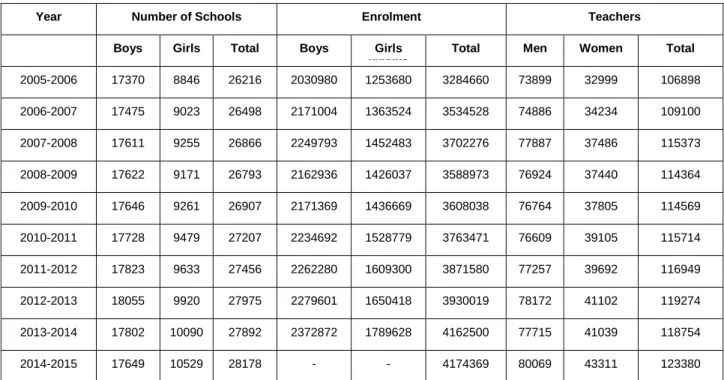
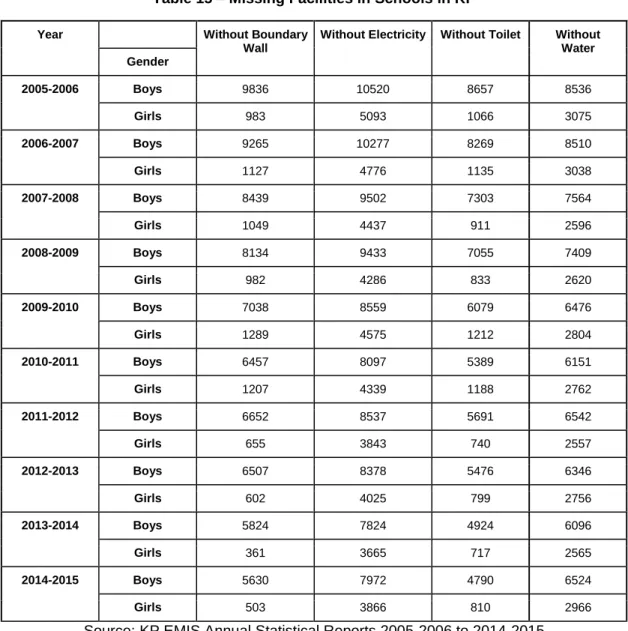
For access indicators, the Education Management Information System (EMIS) data for all four provinces has been used in this study. For learning outcomes, data from the Annual Status of Education Report (ASER) has been utilized. Budget data has been used from various reports on public education financing by Institute of Social and Policy Sciences (I-SAPS). In addition to these sources, data and reports from different donor agencies including the USAID, the World Bank, and DFID have been used. Pakistan Social and Living Standards Measurement (PSLM) survey reports have also been analyzed for the purpose of this research.
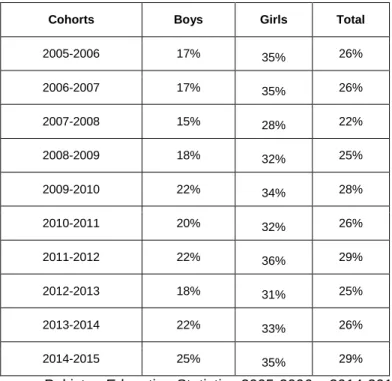
Data from EMIS, Finance, and PSLM is available annually, but for the requirements for this research it had to be collated from ten annual reports between 2005-2015 to prepare the tables appearing in the sections below. Similarly, data on school drop outs required doing cohort analysis on a year-to-year basis for each province to attain drop out figures.
The process of collation and analysis was time consuming in that it required going through each year’s data separately, doing manual calculations, and then reporting all this in a cumulative table as seen later in the report.
2.3 Research Tools
The research tools include structured interview questionnaire and unstructured guidelines for focus group discussions. The tools, which had earlier been tested and used as part of the IFS were modified to include the broadened scope of the current study.
2.4 Sampling and Research Participants
Participants for interviews and discussions were selected using a mix of purposive and simple random sampling from among key officials at the provincial and district education departments, teachers in all the provinces, and from the NGOs and aid agencies. The criteria included randomly selecting two to three mid to senior level officials in the provincial government and two mid to senior level district education officials. The interviewees mostly constituted deputy/additional secretaries at the provincial level or heads of attached departments, and executive and deputy district education officers (EDOs and D-EDOs) at the district level.
Selected teachers and head teachers were also invited for discussions for seeking their feedback on school level facilities, enrolment and drop out, and their
perception of quality in education. Teachers were either interviewed in schools or invited from the district headquarter to avoid travel from long distances and
included roughly half men and half women in case of Punjab and Sindh3, from the
primary as well as high school level. Altogether 65 teachers and 21 head teachers were engaged for discussions in three provinces.4 29 interviews (5-6 in each of
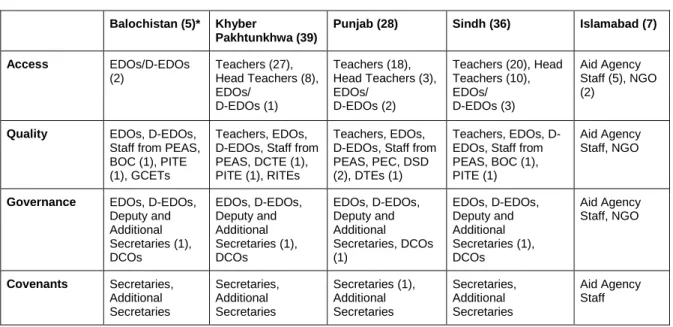
the four provinces and Islamabad) were also conducted covering government departments and aid agencies. The table below provides a list of interviewees and focus group discussants province and area/indicator wise with the actual numbers in parentheses.
3 In KP very few women teachers turned up for the focus group discussion
4 Focus groups in the province of Balochistan could not be held due to poor security conditions that did not
Table 3 – List of interviewees and FGD participants
Balochistan (5)* Khyber
Pakhtunkhwa (39)
Punjab (28) Sindh (36) Islamabad (7)
Access EDOs/D-EDOs (2) Teachers (27), Head Teachers (8), EDOs/ D-EDOs (1) Teachers (18), Head Teachers (3), EDOs/ D-EDOs (2) Teachers (20), Head Teachers (10), EDOs/ D-EDOs (3) Aid Agency Staff (5), NGO (2)
Quality EDOs, D-EDOs,
Staff from PEAS, BOC (1), PITE (1), GCETs
Teachers, EDOs, D-EDOs, Staff from PEAS, DCTE (1), PITE (1), RITEs
Teachers, EDOs, D-EDOs, Staff from PEAS, PEC, DSD (2), DTEs (1)
Teachers, EDOs, D-EDOs, Staff from PEAS, BOC (1), PITE (1)
Aid Agency Staff, NGO
Governance EDOs, D-EDOs,
Deputy and Additional Secretaries (1), DCOs EDOs, D-EDOs, Deputy and Additional Secretaries (1), DCOs EDOs, D-EDOs, Deputy and Additional Secretaries, DCOs (1) EDOs, D-EDOs, Deputy and Additional Secretaries (1), DCOs Aid Agency Staff, NGO Covenants Secretaries, Additional Secretaries Secretaries, Additional Secretaries Secretaries (1), Additional Secretaries Secretaries, Additional Secretaries Aid Agency Staff
* In Balochistan no teacher or head teachers could be interviewed due to ongoing poor security in the province.
For selection of teachers, whether for interviews or focus group discussions, I approached the concerned district EDOs and informed them about my research and its purpose. The EDOs were first interviewed, covering aspects of access, quality and governance and then I provided them with criteria for nominating teachers for the interviews and focus group discussions. The criteria included equal number of men and women teachers, coming from rural as well as urban schools, and representing primary as well as secondary school levels. At the time of actual interviews and focus groups I learned that the nomination criteria were not entirely followed by the EDOs, but the participants were still representative of the criterion except nomination of equal number of females in case of the KP province.
At the time of interviews and focus group discussions I explained in detail the background and purpose of my research and asked if any participant was not willing to participate. No one refused to participate in the discussions and
interviews. I took down notes in my notebook during the focus group discussions and used the templates for noting down information from the interviews.
In KP 23 teachers and 8 head teachers were invited for discussions from the districts of Charsadda and Mardan, and school based discussions were held with 4 teachers in Peshawar. Due to various security related issues teachers were not invited from far flung districts in KP.
In Punjab school based discussion and interviews were done with 3 head teachers and 18 teachers in the districts of Rahimyar Khan, Lahore and Rawalpindi,
covering the south central and northern parts of the province to ensure representation from all parts of the province that are diverse not just geographically but also in terms of the education performance levels. The participants included 9 men and 12 women.
In Sindh, school based discussions and interviews were conducted with 10 head teachers and 20 teachers (12 women and 18 men) in 10 different government school. The teachers and schools represented the southern district of Umerkot, central district of Mirpurkhas and northern districts of Sukkur and Sanghar, providing a good representative sample across the province.
The interview participants also included representatives from different aid agencies including World Bank, Asian Development Bank, United Nations Development Programme (UNDP), DFID, USAID and the German Development Agency (GIZ). The reason for selecting these agencies is because they represent the largest bilateral and multilateral donors for Pakistan and fund the largest education programmes in the four provinces.
Other interview participants included representatives of international and national NGOs who have been involve with implementation of education programmes and projects funded by the aid agencies mentioned above. The NGOs included AKU-IED, SAHE and I-SAPS and the project staff of USAID funded ESRA, EDLINKS and CMP projects representing various international NGOs.
Government participants included representatives from various attached
departments of the provincial education departments in all the provinces – these involved the provincial institutes for teacher education in all the provinces, curriculum departments, donor coordination and reform support units within the education departments, and district level officials. The officials and departments were selected on the basis of their level of understanding of and involvement with the aid agencies and their projects so that they could be effectively engaged and provide necessary information.
2.5 Ethical Issues
I have worked as an education consultant with various aid agencies, supporting their work with the four provincial education departments and the federal ministry of education. I am therefore seen as an external consultant and evaluator within government departments. At the same time, I have worked as a staff member in donor funded projects, working as a colleague with people who still work with projects, or with aid agencies, and who I was going to interview for my research. I am therefore carrying out insider research and seen as an insider researcher when conducting interviews and focus group discussions for this study.
Insider research has its advantages and disadvantages, and by its very nature it also raises ethical issues; being an insider I am aware of many issues, but am also a stakeholder by virtue of being a consultant or project worker and therefore likely to be protective of sensitive information. At the same time as an independent researcher I have to report the findings honestly as they are interpreted by me, but which may be in total contrast to how people sitting on the other side of the table see them.
I addressed the issues of insider researcher by resorting to the use of secondary quantitative data. The quantitative data sets used in this study are compiled by independent sources and are publicly available; therefore, the data is not affected in anyway by my position as an insider researcher. However, my location can have a limiting effect on the analysis of data and its interpretation. I address this issues by critically setting the goals of my study. Is the goal of this study to
generate objective and generalisable knowledge about aid effectiveness? Or is it to develop new insights and use them to raise provocative questions about this subject in order to push the boundaries of the discourse on aid effectiveness? If I limit myself to the latter the problem of objectivity is no longer as limiting as it is when the goal is the former. Since I do not position myself as an objective observer, this study should be read not as presenting objective truths. This work will have achieved its purpose if the questions it raises are able to make aid practitioners critically reflect on their work.
The key ethical issue to be managed is that of confidentiality as people have provided sensitive information privately to me, and I have gathered this information by assuring them of anonymity when reporting results.
When gathering information from the government departments there could be possibilities that I may have not been provided with the most up to date or accurate information, being seen by the participants as a former evaluator.
Robson (2002) notes challenges in objectivity given the researchers’ previous and present contact with the institution, or access to confidential information that may impact relationships with colleagues at the institution. Therefore, at the outset I clarified my current position to the officials, indicating that the present research has a purely academic agenda, and the findings will have no direct bearing on the performance of the departmental staff and officials.
I also assured the participants that their responses will be kept in confidence and anonymous (BERA, 2004), and not shared with anyone unless they have given their consent, and shall be destroyed once the research is completed. I have used the principle of informed consent (Oliver, 2003) and have informed interviewees and discussants in detail about the research before seeking their consent to participate.
For purposes of confidentiality I will not use names of any officials that I have interacted with, except mentioning names of their institutions.
3.
Literature Review and Theoretical Framework
3.1 Literature Review
I have divided this section into two main parts. In the first part, I have summarised the literature on broad aspects of foreign aid and the discourse concerning its effectiveness or lack thereof. In the second part, I have discussed the main theoretical ideas that will undergird the subsequent analysis of the data in this study.
Investigations of the politics, role, impact, challenges and promises of the foreign aid abound. In this section, I attempt to provide an overview of various arguments about foreign aid. In doing so, I also trace some of the theoretical perspectives that provide analytical tools for the analysis of the effectiveness of aid for education inasmuch as it pertains to shaping the capacities of the provincial School Education Departments.
Today we take the concept of foreign aid for granted. However, as Morgenthau argues, it is quite an ‘innovation which the modern age has introduced into the practice of foreign policy.” (Morgenthau, 1962, p. 5). As such foreign aid and foreign policy are interrelated. Foreign aid, as we know it, did not exist until the end of the Second World War (Lancaster, 2007). The introduction of foreign aid into the field of international relations between the states, especially in the
relations between the donors and recipient states has created a whole new field of possibilities inviting both policy analysis as well as radical critique.
The arguments for and against foreign aid in general, and aid for education in particular, have proliferated. Those who favour aid justify it with reference to existence of insufficient resources, lack of technical capacity on the part of institutions within the recipient nations to implement the reforms, which will put them squarely on the track of development already beaten by the developed states. These arguments are also grounded within a widely accepted narrative of development for which the Western industrial and post-industrial societies are seen as the models and the telos of development. Development, in this narrative, entails setting up of a democratic polity, a liberal or neoliberal economic regime, backed up by a universal education system paid for by the taxes and supported by
the state (Rist, 1990, 2002). Some even refer to this idea of development as a Western myth (Gana, 1996; Oswaldo de Rivero & De Rivero, 2001).
As such, then, the foreign aid is conceived within an international system
consisting of the so-called developed and developing or less-developed countries. While the politics of foreign aid is more complicated and its total value depends on the internal politics of the donor countries it is usually justified as adding value and pace to the development process of developing countries. Yet, there is little
consensus on whether foreign aid actually achieves development and growth in the recipient countries (Wright & Winters, 2010).
There is an emerging and compelling argument about the failure of aid in
achieving its objective of facilitating the development of less developed countries (See, for example, Alesina & Dollar, 2000; Moyo, 2008, 2009a, 2009b; Moyo & Tantor Media, 2011). Many scholars argue that a large portion of foreign aid is wasted. Easterly (2006), for instance, regards this wastage as bordering on tragic. According to him, the West has wasted over $2.3 trillion over the last five decades and this hefty sum has been unable to prevent even the malarial deaths that cost only twelve cents per malarial tablet. Millions of children continue to be out of school despite the aid for education (Easterly, 2006, p. 4).
The critique of foreign aid is sometimes rooted into the use of aid as a tool of foreign policy, used to coerce and control recipient or host country policies. Inasmuch as aid as a tool of foreign policy critiques are concerned, the US government aid to Pakistan is frequently offered as an example (Fair, 2009; Ibrahim, Science, & Affairs, 2009; Rashid, 2009). The US Government provided massive economic and military assistance to a military-led dictatorial regime in Pakistan after the latter’s decision to join the US led alliance in the war against terror, discreetly ignoring an antidemocratic regime and nuclear proliferation, two reasons for which Pakistan was put under various sanctions from 1998 (Easterly, 2006; Kronstadt, 2010). Whenever Pakistani civilian governments were toppled by the military, the ensuing military regimes were legitimised by the US and West.5
5 The examples are of General Zia in 1979 after joining the USA against the Soviet invasion of Afghanistan,
Massive aid funds were provided to both the military regimes for years following their legitimisation.
It was hard to hold the regimes accountable for the aid funds and the funds were utilised at times to suppress democratic regimes.6 Thus, Moyo’s (2009) argument
about the rise of corruption due to easy availability of aid money though made in the context of Africa may also applicable in the case of Pakistan, but it would need more investigation.
An example of the kind of corruption that accompanies aid is provided by Easterly (2006) who notes that mosquito nets given as aid to certain African countries appeared in the local markets for 50 cents apiece instead of reaching the intended beneficiaries. A similar story may be told for the aid provided to Afghan refugees in 1980s and for the Internally Displaced People (IDPs) in 2009 in Pakistan. On both occasions the blankets, pillows, school bags and other aid items found their way to local markets and were available to consumers who could pay for them (Fleck & Kilby, 2010).
Ferguson (1994) argues that aid projects are typically designed and implemented without considering the political and historical context and realities. Little can be achieved, Ferguson argues, by a-politicizing and de-historicizing the development interventions. The recent account of aid implementation in Pakistan by Altaf (2011) also validates this concern. While reviewing the effectiveness of aid and donor funded programmes, Altaf focuses on the role of international consultants and contractors within aid agencies which appears to be central to all international aid programmes and projects. Altaf argues that the technical experts working for aid agencies and usually trained from Europe or US education institutions have little or no knowledge of the local context, but are given charge of designing programmes for countries like Pakistan. They are mostly oblivious to the local constraints, and, therefore, come up with strategies that guarantee failure in terms of real improvements in ground realities (Altaf, 2011). In case of donor
programmes for education, the consultants are a mixed bag, some with sound
6A case in point are recent allegations made against the Pakistan Army for distributing money to various
political parties to suppress the rise to power of a popular regime. See, http://paktribune.com/news/Asghar-Khan-case-Supreme-Court-seeks-govt-reply-248165.html - though it is not established whether the funds used to suppress democracy were part of the aid money
knowledge and expertise but many without knowledge of the local context, and there are quite a few who lack on quality and related skills.
Ferguson’s, and to some extent Altaf’s, critique constructs aid as serving the interests of self-serving state bureaucracies instead of the intended beneficiaries. While Ferguson draws his conclusions from a development project in Lesotho, it could very well be applied, much like Moyo’s analysis of aid in African context, to Pakistan as well. Ferguson’s arguments seen in the context of Pakistan draw a good parallel where two army regimes that had destroyed political institutions and the process of democratisation were provided with large sums of aid for economic assistance; no mention of dictatorial decision making or procedures appears in the donor reports and documents. Even in case of democratic governments,
processes that are based on nepotism and cronyism and marred with corruption do not make leading highlights in donor reports; non-performing officers and systems are simply termed as issues of capacity and capability, and not linked up with systemic faults in recruitment and political interference. Issues like the ones mentioned here will need to be further examined in light of the OECD Paris Declaration (2005) principle relating to mutual accountability.
Altaf (2011) also discusses the role of civil bureaucracy and other government officials impeding the progress of interventions made through international aid due to their attitude and work style. Ferguson (1994) looks at this issue slightly
differently, implicating donors and aid money for further extending the politically self-serving state bureaucracies in the case of Lesotho. Civil servants and bureaucrats in the context of Pakistan get strengthened as political processes weaken with the intermittent intrusion of military, and every time the political process is destabilised the aid agencies have poured in money and resources, strengthening the bureaucratic and autocratic regimes.
In the case of Pakistan, flood gates of international aid opened during the Soviet-Afghan war (1979-1989), and then during the USA-Soviet-Afghan war (2001-present), and on both occasions Pakistan was showered by aid from the West and from the financial institutions such as the World Bank and the Asian Development Bank. As such, largely because the aid was provided due to political exigencies, the
much as may be needed for its effective utilisation.7 The effectiveness of politically
driven foreign aid is placed under a question mark and the answers are not very encouraging (Dreher, München, Wirtschaftsforschung, & CESifo, 2010; OECD, 2011). The supply of aid during international political crises, such as the ones mentioned above, is seen by Wood (2005) as a security driven motive by donor agencies to pursue their own security agenda rather than a development agenda. Notwithstanding the frequent documentation of corruption and associated wastage of aid funds, there are also some silver linings. The pessimism regarding the failure of aid to produce the desire effects is matched by cautious optimism of some, who claim that development aid has also had some positive effect on many development indicators8. Stiglitz (2002) argues that foreign aid has succeeded in
bringing benefits to millions of people despite many of its faults. As he puts it, ‘…guerrillas in the Philippines were provided jobs by a World Bank-financed project as they laid down their arms; irrigation projects have more than doubled the incomes of farmers lucky enough to get water; education projects have brought literacy to the rural areas; in a few countries AIDS projects have helped contain the spread of this deadly disease’ (Stiglitz, 2002, p. 5).
Also, when aid is accompanied by effective accountability devices the results are sometime as intended. The case of microfinance is usually presented as an example of this. Small loans under microfinance (using donor funds) have been given out to hundreds of thousands of individuals and groups across Pakistan and elsewhere in the developing countries have been utilised effectively and loaned amounts returned along with the accrued bank interest (Latif, Nazar, Mehmood, Shaikh, & Shah, 2011; Nawai & Bashir, 2009). If individuals and groups are made accountable and given responsibility, better results on aid utilisation may be obtained as opposed to providing direct assistance to the Governments, and return on aid obtained through conditionalities and compliances. Adding greater ownership, responsibility and better aid management is likely to increase aid effectiveness (Riddell, 2007).
7 This is similar to Moyo’s (1990) observations in the case of Africa
8See, for example, the case studies compiled by the Overseas Development Institute (ODI) at http://www.developmentprogress.org/