Expectations for nursing care in
newborn units in Kenya: moving from
implicit to explicit standards
Georgina A V Murphy,1,2 Gregory B Omondi,2 David Gathara,2 Nancy Abuya,2,3
Jacintah Mwachiro,2 Rose Kuria,4 Edna Tallam-Kimaiyo,4,5 Mike English,1,2 On
behalf of the Nursing Tasks Advisory Group
To cite: Murphy GAV, Omondi GB, Gathara D, et al. Expectations for nursing care in newborn units in Kenya: moving from implicit to explicit standards. BMJ Glob Health 2018;3:e000645. doi:10.1136/ bmjgh-2017-000645
Handling editor Seye Abimbola Received 13 November 2017 Revised 29 January 2018 Accepted 30 January 2018
1Centre for Tropical Medicine and Global Health, Nuffield Department of Medicine, University of Oxford, Oxford, UK 2Health Services Unit, KEMRI – Wellcome Trust Research Programme, Nairobi, Kenya 3Nairobi City County Government, Nairobi, Kenya 4Ministry of Health, Nairobi, Kenya
5Nursing Council of Kenya, Nairobi, Kenya
Correspondence to
Dr Georgina A V Murphy; murphygina@ gmail. com
AbstrACt
Neonatal mortality currently accounts for 45% of all child mortality in Kenya, standing at 22 per 1000 live births. Access to basic but high quality inpatient neonatal services for small and sick newborns will be key in reducing neonatal mortality. Neonatal inpatient care is reliant on nursing care, yet explicit nursing standards for such care do not currently exist in Kenya. We reviewed the Nursing Council of Kenya ‘Manual of Clinical Procedures’ to identify tasks relevant for the care of inpatient neonates. An expert advisory group comprising major stakeholders, policy-makers, trainers, and frontline health-workers was invited to a workshop with the purpose of defining tasks for which nurses are responsible and the minimum standard with which these tasks should be delivered to inpatient neonates in Kenyan hospitals. Despite differences in opinions at the beginning of the process, consensus was reached on the minimum standards of neonatal nursing. The key outcome was a comprehensive list and grouping of neonatal nursing task and the minimum frequency with which these tasks should be performed. Second, a simple categorisation of neonatal patients based on care needs was agreed. In addition, acceptable forms of task sharing with other cadres and the patient’s family for the neonatal nursing tasks were agreed and described. The process was found to be acceptable to policy-makers and practitioners, who recognised the value of standards in neonatal nursing to improve the quality of neonatal inpatient care. Such standards could form the basis for audit and quality evaluation.
IntroduCtIon
The need to reduce neonatal mortality has become a priority internationally, with the Sustainable Development Goal (SDG) three targeting to reduce mortality to 12/1000 live births or lower.1 In Kenya, substantial efforts
will be needed to reduce the current neonatal mortality of 22/1000 live births to reach this SDG target by 2030. Access to basic but high quality inpatient neonatal services for small and sick newborns will be key if progress is to be made.2 3 Sick newborns require continual
supportive care and observation, with
repeated and often multiple interventions delivered 24 hours a day, and their condition can change rapidly. Good outcomes for this patient population are, therefore, particularly dependent on nursing care.
The WHO has helped lead efforts to set standards for neonatal care, including recent indicators on all aspects of peripartum care.4
A number of these indicators touch on quality of the nursing process; many of these implic-itly require high quality nursing care provi-sion. High income countries, such as the UK have produced valuable detailed guidance on neonatal nursing.5 6 Equivalent standards
Key questions
What is already known about this topic? ► Access to essential inpatient services with adequate
nursing care for small and sick newborns will be key if progress is to be made in reducing neonatal mortality in low- and middle-income countries. ► Although the performance of key nursing tasks is
described in detail in nursing manuals, there are currently no agreed written standards to guide the delivery of nursing care for neonatal patients in Kenya.
► Instead, standards are implicitly defined as historical practice norms that vary, often quite markedly, from one facility to the next. What are the new findings?
► An expert group comprising major stakeholder organisations, policy-makers, nursing trainers, and frontline workers spanning private and public sectors can work together, respecting the challenges of varying contexts, to reach consensus on defining minimum standards of neonatal nursing care. ► Levels of dependency of neonatal patients were
defined with the recognition that different patients may require different standards of care depending on the severity of their condition and dependency on nursing care.
do not currently exist in many low-resourced setting, including Kenya.
To complement these ongoing international efforts to define standards for and indicators of care for small and sick newborns, we set out to consider specifically defining minimum standards of neonatal nursing care in Kenya. In doing this, we aimed to initiate a discussion on explicit nursing care standards. We aimed to provide locally agreed benchmarks that can support evaluations of the quality of inpatient neonatal nursing care.
ExplorIng stAndArds of nEonAtAl nursIng In KEnyA the setting
Nursing care within the newborn unit is predominantly provided by registered nurses. Diploma and degree level registered nurses receive 2 and 4 weeks of training in newborn care, respectively. Since 2012, a specialist 1 year post-basic training in neonatal nursing was approved by the Nursing Council of Kenya; however, the number of nurses trained so far at national level is only approx-imately 100 nurses. Thus, the vast majority of nurses providing neonatal care in Kenyan hospitals learn their skills during practice, where there are no nurses with specialist neonatal nursing qualifications. Nurse training and practice in Kenya is regulated by the Nursing Council of Kenya (NCK). The National Nurses Association of Kenya is a national professional association representing nurses’ views and interests, with sub-chapters for nursing specialities.
Our particular focus was inpatient care for small and sick newborns. This is typically delivered through a newborn unit that aims to provide a minimum package of essential interventions, for example: feeding support with nasogastric tubes and intravenous fluids; infection prevention and management, including antibiotics; oxygen provision and (less often) continuous positive airway pressure (CPAP); and phototherapy for jaun-dice.3 4 The role of nurses in the delivery of such care is
central.7 However, there are extreme staff shortages in
many facilities in Kenya.8–10 Neonatal patient to nurse
ratios as high as 15:1 have been previously described. Such ratios are in extreme contrast to the internation-ally recommended ratios of newborns to nurses of: 4:1 for basic or continuing care; 2-3:1 for stable babies requiring intervention; and 1:1 for high-dependency care.11 Quality of care for neonatal patients varies widely
between health facilities and across sectors (private and public) in terms of their structural capacity to provide care and indicators of the process of care. Although, indicators capturing key nursing processes are typically lacking.
Identifying key neonatal nursing tasks
We began by trying to identify nursing standards docu-ments in Kenya by reaching out to experts, the Ministry of Health, and the Nursing Council of Kenya (NCK). The only document that emerged as being relevant was the NCK ‘Manual of Clinical Procedures’.12 The manual
applies to all areas of nursing and is a key reference text for nurse training institutions in Kenya. While the manual offers detailed standard operating procedures on many nursing procedures, it does not offer guidance on how often tasks should be done nor by whom. Instead, such operational decisions are made at each facility and are often implicitly rather than explicitly defined. We are not aware of the availability of such neonatal nursing stand-ards from any sub-Saharan African countries.
Drawing on this manual, medical and nursing team members identified tasks relevant for inpatient neonatal care and organised these into domains (eg, vital signs and monitoring, oxygen treatment, etc). We sought to present these to an expert advisory group for more detailed consideration.
Expert advisory group
We constituted an expert advisory group (n=12; see Nursing Tasks Advisory Group in the author list below) made up of individuals responsible for: delivery of neonatal care in major public and private hospitals; neonatal nurse training; and child health and nursing services policy in the Ministry of Health and a County Government. This group also included major nursing stakeholder groups, the National Nurses Association of Kenya and NCK. These members of the expert advisory group were selected based on their first-hand experience of providing neonatal nursing care, neonatal medical care, training nurses, and designing and implementing nursing policy in Kenya.
The group was invited to a daylong workshop with the purpose of defining (1) what tasks are regarded as the responsibility of nurses providing inpatient neonatal care and (2) the minimum frequency of tasks (where rele-vant). We aimed to move from implicit knowledge, where nurses are socialised into ‘how to do’ things on the wards and have an implicit understanding of what is an accept-able minimum standard of care, to making this expert knowledge more explicit. In doing so, we also aimed to explore whether we could achieve consensus on explicit
Key questions
recommendations for policy
► Minimum standards of neonatal nursing care could be used as benchmarks for quality evaluation across private and public sector facilities.
► Highly practical operational research priorities were identified, these included the need to identify/design more structured nursing notes (cardex) and better tools to document nursing observations to facilitate more rapid, accurate, and informative documentation and communication between nurses and with other professionals as part of improving quality of care.
► Clearly defining expectations of neonatal nursing care may support discussions on the role of different health worker cadre in providing neonatal care, task-shifting policy, neonatal nursing training needs, and setting appropriate nurse to patient ratios.
minimum standards that could be useful in improving quality of care going forward.
The expert advisory group began by reviewing the compiled list of neonatal nursing tasks. Missing tasks were added and tasks deemed to be outside of the remit of nurses were removed. Four groups were formed with a facilitator supporting each group. Each group focused on a subset of tasks (domains). Employing a nominal group strategy, each group discussed i) the minimum frequency with which these tasks should be done, ii) who else might reasonably do these tasks, and iii) how operationally sensible it was to ‘bundle’ tasks during care delivery. Once within-group consensus was reached, cross-group consensus was sought through discussion across all expert advisors. Facilitation was provided by a senior researcher, with consensus positions reached by show of hands.
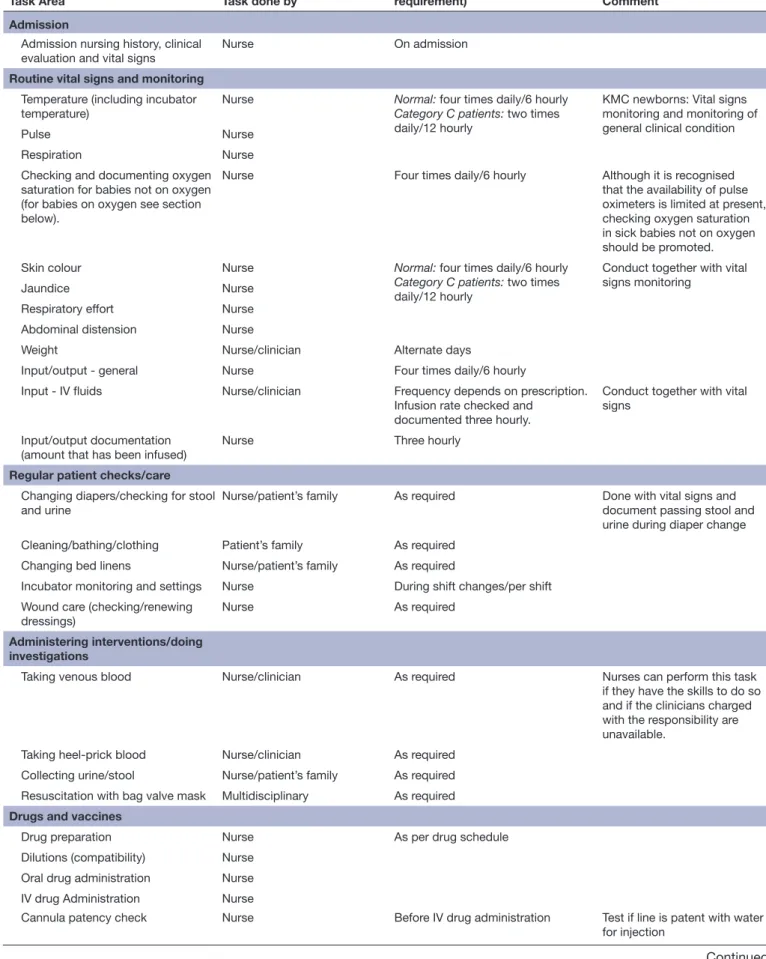
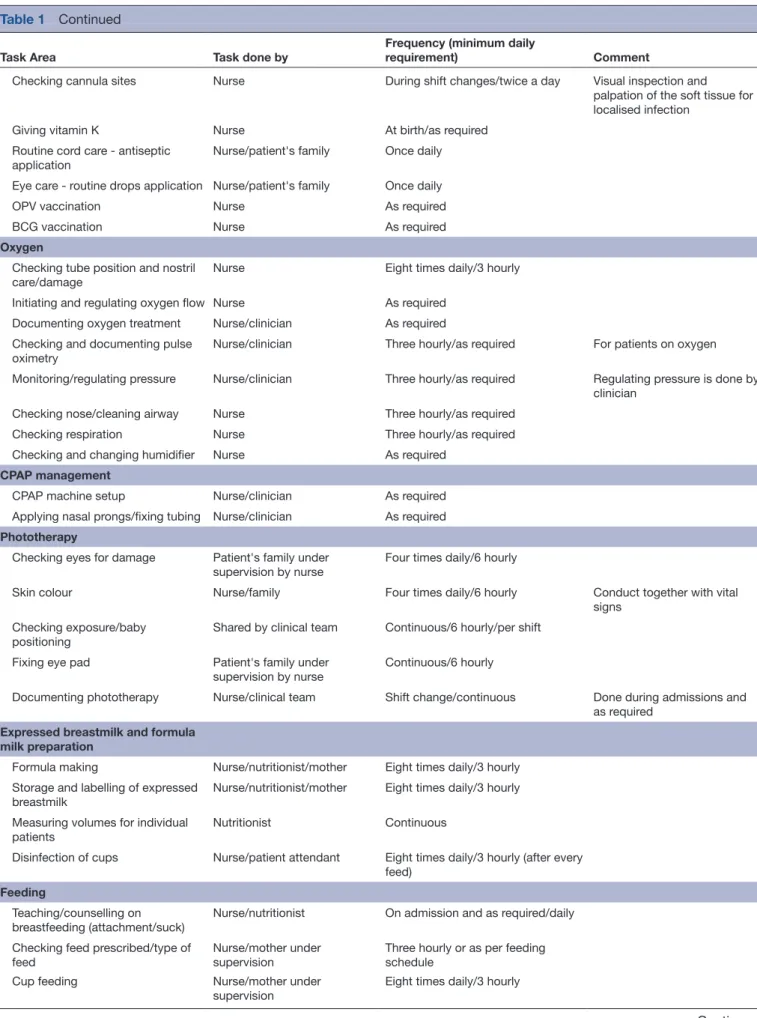
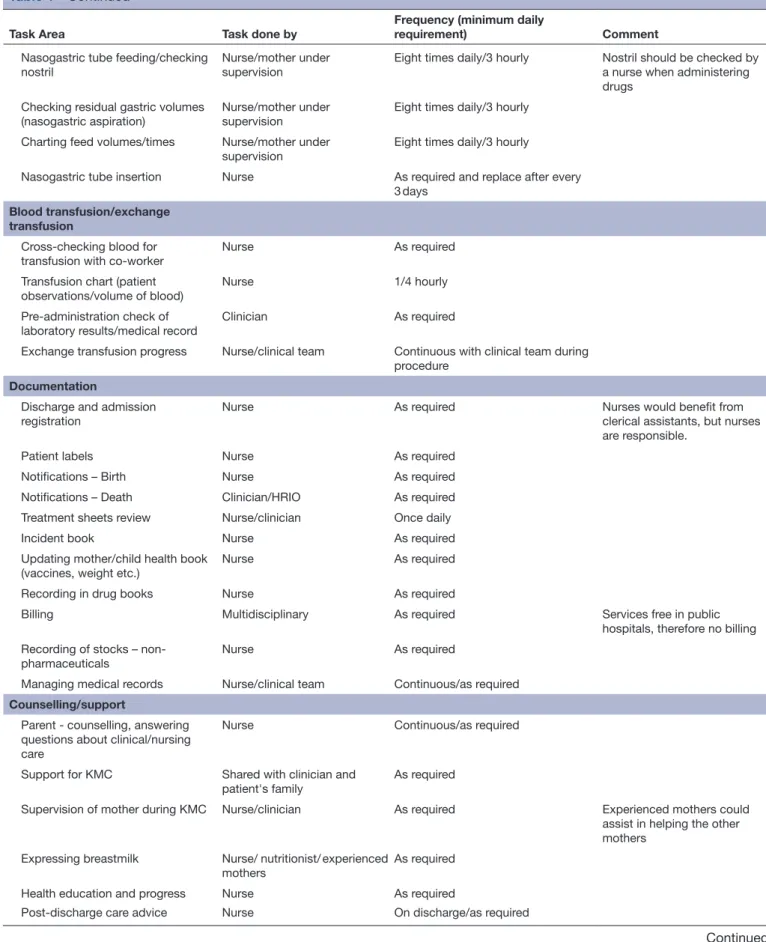
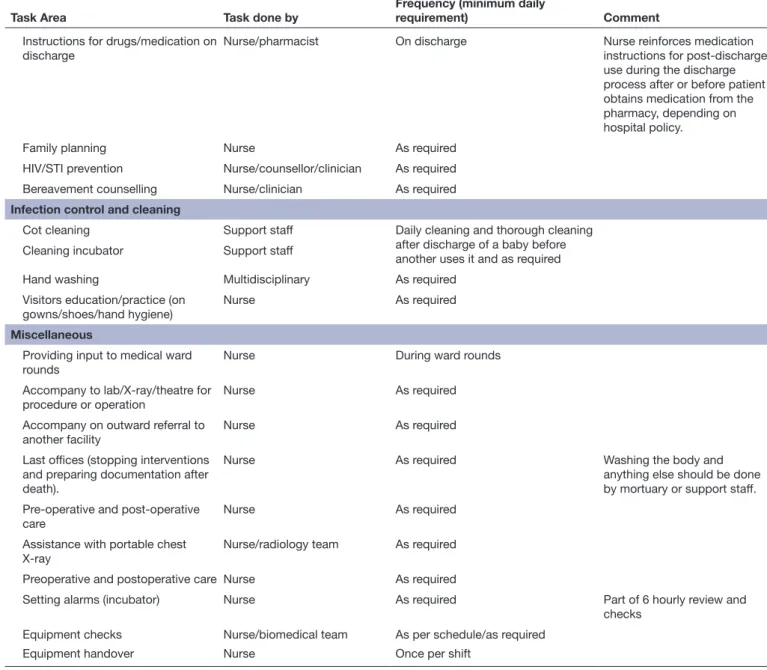
rECommEndAtIons of tHE ExpErt AdvIsory group The final standards proposed are described in table 1. All of the tasks listed were deemed currently done by nurses. However, it was noted that some of these tasks (such as preparing feeds) would not be the responsi-bility of nurses in a well-resourced environment. These tasks should instead be done by specialised staff, such as nutritionists or clinicians (either a non-specialist physi-cian or a clinical officer (non-physiphysi-cian cliniphysi-cian) with specialist training in paediatrics), as relevant. Addition-ally, some tasks were considered best carried out by the patient’s family (eg, cleaning/bathing/clothing of baby) or support staff (eg, cot cleaning) but overseeing these tasks was endorsed as remaining the responsibility of the nursing team. It should be noted that developmental care and positioning tasks were not highlighted or discussed by the expert advisory group. These tasks, traditionally done by a physiotherapist or nurse, are important for the long-term healthy development of neonates. The absence of these tasks from the recommendations may have been due to the framing of the working group discussions or may reflect an apparent lack of prioritisation of these roles in Kenya at the moment.
Supervision of students was also discussed, as they carry out some of the tasks. The range of tasks delegated varied by institution and type of student. Yet, there was agreement that it should be an explicit standard that: if a qualified nurse staff delegates a task to a student or other carer, the nurse retains responsibility for ensuring such tasks are performed correctly and safely, including providing appropriate supervision.
Defining level of dependency of neonatal inpatients, for which there were previously no widely agreed criteria, was recognised as essential to defining standards for the frequency of performance of nursing tasks. Recommen-dations on levels of dependency focused on facilities typical of the public sector, with proposed simple cate-gories described in box 1. This categorisation reflects the lack of neonatal intensive care in most Kenyan
hospitals; a fourth category that encompasses expen-sive and complex neonatal intenexpen-sive care provided in high income setting might be relevant in some settings, such as large costly private sector facilities. Further work is needed to more clearly and precisely define levels of neonatal care in Kenya. In doing so, these categories of dependency should also be refined.
rEflECtIons of tHE ExpErt AdvIsory group
At the beginning of the discussion there were disagree-ments between experts on the appropriate standards of care. Policy-makers or representatives of professional bodies tended to propose higher, more aspirational standards. Front-line workers argued that these ignored the reality of providing care. Differences in opinion were also expressed between health-workers providing care in public versus private sector facilities due to differences in resources. For example, experts working in the private, high-resource sector suggested observations in higher dependency babies should be done 4 hourly. Though, they accepted that this was only realistic in a small number of private facilities. Accepting the need for minimum standards, the group was able to reach consensus span-ning all parties.
A number of discussion points that highlighted chal-lenges faced by nurses in neonatal care were raised during the process. These challenges might be helped by disseminating agreed standards. It was recognised by the group that nurses often take on multiple additional roles, which should ideally be done by nutritionists, clini-cians, and/or radiologists, in the interest of the care and well-being of the baby. For example, nurses may need to prepare feeds or take blood specimens because of short-ages of other professional staff. Recognising this de facto
task sharing, and to protect nurses legally, recent policy changes have expanded the role of nurses through the Kenyan Task Sharing Policy Guidelines 2017–2030.13
The formal standards of care proposed were seen by the expert group as a way to improve the professionalism within neonatal nursing. It was also noted that such stan-dards may be a helpful means to lobby managers and governments for the resources and personnel neces-sary to achieve minimum standards of care. Overall, the process of creating these recommendations was found to be acceptable to policy-makers and practitioners. They recognised the value of standards as a means to improve the quality of neonatal inpatient care in Kenya. The expert group also felt that it was reasonable to evaluate service delivery against the recommended standards.
A number of important issues that would benefit from local operational research also arose. These particularly concerned the importance of documentation of nursing care, which can occupy a considerable proportion of nursing time. It was recognised that documentation was often fragmented, rather than systematic. Experts suggested that there would be benefits from devel-oping more structured nursing notes with better tools
Table 1 Neonatal nursing tasks
Task Area Task done by Frequency (minimum daily requirement) Comment Admission
Admission nursing history, clinical evaluation and vital signs
Nurse On admission
Routine vital signs and monitoring
Temperature (including incubator
temperature) Nurse Normal:Category C patients: four times daily/6 hourly two times daily/12 hourly
KMC newborns: Vital signs monitoring and monitoring of general clinical condition
Pulse Nurse
Respiration Nurse Checking and documenting oxygen
saturation for babies not on oxygen (for babies on oxygen see section below).
Nurse Four times daily/6 hourly Although it is recognised
that the availability of pulse oximeters is limited at present, checking oxygen saturation in sick babies not on oxygen should be promoted.
Skin colour Nurse Normal: four times daily/6 hourly
Category C patients: two times daily/12 hourly
Conduct together with vital signs monitoring
Jaundice Nurse Respiratory effort Nurse Abdominal distension Nurse
Weight Nurse/clinician Alternate days
Input/output - general Nurse Four times daily/6 hourly
Input - IV fluids Nurse/clinician Frequency depends on prescription. Infusion rate checked and
documented three hourly.
Conduct together with vital signs
Input/output documentation (amount that has been infused)
Nurse Three hourly
Regular patient checks/care
Changing diapers/checking for stool
and urine Nurse/patient’s family As required Done with vital signs and document passing stool and urine during diaper change Cleaning/bathing/clothing Patient’s family As required
Changing bed linens Nurse/patient’s family As required
Incubator monitoring and settings Nurse During shift changes/per shift Wound care (checking/renewing
dressings) Nurse As required
Administering interventions/doing investigations
Taking venous blood Nurse/clinician As required Nurses can perform this task if they have the skills to do so and if the clinicians charged with the responsibility are unavailable.
Taking heel-prick blood Nurse/clinician As required Collecting urine/stool Nurse/patient’s family As required Resuscitation with bag valve mask Multidisciplinary As required
Drugs and vaccines
Drug preparation Nurse As per drug schedule
Dilutions (compatibility) Nurse Oral drug administration Nurse IV drug Administration Nurse
Cannula patency check Nurse Before IV drug administration Test if line is patent with water for injection
Task Area Task done by
Frequency (minimum daily
requirement) Comment
Checking cannula sites Nurse During shift changes/twice a day Visual inspection and palpation of the soft tissue for localised infection
Giving vitamin K Nurse At birth/as required
Routine cord care - antiseptic application
Nurse/patient's family Once daily Eye care - routine drops application Nurse/patient's family Once daily
OPV vaccination Nurse As required
BCG vaccination Nurse As required
Oxygen
Checking tube position and nostril
care/damage Nurse Eight times daily/3 hourly
Initiating and regulating oxygen flow Nurse As required Documenting oxygen treatment Nurse/clinician As required Checking and documenting pulse
oximetry Nurse/clinician Three hourly/as required For patients on oxygen
Monitoring/regulating pressure Nurse/clinician Three hourly/as required Regulating pressure is done by clinician
Checking nose/cleaning airway Nurse Three hourly/as required
Checking respiration Nurse Three hourly/as required
Checking and changing humidifier Nurse As required
CPAP management
CPAP machine setup Nurse/clinician As required Applying nasal prongs/fixing tubing Nurse/clinician As required
Phototherapy
Checking eyes for damage Patient's family under
supervision by nurse Four times daily/6 hourly
Skin colour Nurse/family Four times daily/6 hourly Conduct together with vital
signs Checking exposure/baby
positioning Shared by clinical team Continuous/6 hourly/per shift
Fixing eye pad Patient's family under supervision by nurse
Continuous/6 hourly
Documenting phototherapy Nurse/clinical team Shift change/continuous Done during admissions and as required
Expressed breastmilk and formula milk preparation
Formula making Nurse/nutritionist/mother Eight times daily/3 hourly Storage and labelling of expressed
breastmilk Nurse/nutritionist/mother Eight times daily/3 hourly
Measuring volumes for individual
patients Nutritionist Continuous
Disinfection of cups Nurse/patient attendant Eight times daily/3 hourly (after every feed)
Feeding
Teaching/counselling on breastfeeding (attachment/suck)
Nurse/nutritionist On admission and as required/daily Checking feed prescribed/type of
feed
Nurse/mother under supervision
Three hourly or as per feeding schedule
Cup feeding Nurse/mother under
supervision Eight times daily/3 hourly
Table 1 Continued
Task Area Task done by
Frequency (minimum daily
requirement) Comment
Nasogastric tube feeding/checking nostril
Nurse/mother under supervision
Eight times daily/3 hourly Nostril should be checked by a nurse when administering drugs
Checking residual gastric volumes
(nasogastric aspiration) Nurse/mother under supervision Eight times daily/3 hourly Charting feed volumes/times Nurse/mother under
supervision Eight times daily/3 hourly
Nasogastric tube insertion Nurse As required and replace after every 3 days
Blood transfusion/exchange transfusion
Cross-checking blood for
transfusion with co-worker Nurse As required
Transfusion chart (patient
observations/volume of blood) Nurse 1/4 hourly
Pre-administration check of
laboratory results/medical record Clinician As required
Exchange transfusion progress Nurse/clinical team Continuous with clinical team during procedure
Documentation
Discharge and admission
registration Nurse As required Nurses would benefit from clerical assistants, but nurses
are responsible.
Patient labels Nurse As required
Notifications – Birth Nurse As required
Notifications – Death Clinician/HRIO As required Treatment sheets review Nurse/clinician Once daily
Incident book Nurse As required
Updating mother/child health book (vaccines, weight etc.)
Nurse As required
Recording in drug books Nurse As required
Billing Multidisciplinary As required Services free in public
hospitals, therefore no billing Recording of stocks –
non-pharmaceuticals Nurse As required
Managing medical records Nurse/clinical team Continuous/as required
Counselling/support
Parent - counselling, answering questions about clinical/nursing care
Nurse Continuous/as required
Support for KMC Shared with clinician and patient's family
As required
Supervision of mother during KMC Nurse/clinician As required Experienced mothers could assist in helping the other mothers
Expressing breastmilk Nurse/ nutritionist/ experienced
mothers As required
Health education and progress Nurse As required
Post-discharge care advice Nurse On discharge/as required
Table 1 Continued
for recording nursing observations. It was felt that these might improve communication between nurses and with other professionals, and reduce the time burden of unnecessary and unhelpful documentation, with the potential to considerably improve the quality of care. ConClusIon
There is currently a distinct lack of detailed practical guidance for neonatal nursing standards in many resource-limited settings. In this paper, we describe a process of working with experts to develop locally rele-vant and acceptable recommendations for minimum
standards of neonatal nursing care in Kenya. We hope that our efforts to more clearly define standards help health-workers and policy-makers to operationalise their aspirations for better care. Moving standards from being part of location specific, tacit knowledge to becoming commonly accepted and explicit provides some basis for developing credible audit criteria. Such criteria may help ensure that all facilities, across the public and private sectors, provide inpatient neonatal care services to at least a minimum standard of care. Furthermore, such standards may be helpful for discussions on health-worker shortages, including defining the role of nurses in
Task Area Task done by
Frequency (minimum daily
requirement) Comment
Instructions for drugs/medication on discharge
Nurse/pharmacist On discharge Nurse reinforces medication
instructions for post-discharge use during the discharge process after or before patient obtains medication from the pharmacy, depending on hospital policy.
Family planning Nurse As required
HIV/STI prevention Nurse/counsellor/clinician As required Bereavement counselling Nurse/clinician As required
Infection control and cleaning
Cot cleaning Support staff Daily cleaning and thorough cleaning
after discharge of a baby before another uses it and as required Cleaning incubator Support staff
Hand washing Multidisciplinary As required
Visitors education/practice (on
gowns/shoes/hand hygiene) Nurse As required
Miscellaneous
Providing input to medical ward
rounds Nurse During ward rounds
Accompany to lab/X-ray/theatre for
procedure or operation Nurse As required
Accompany on outward referral to
another facility Nurse As required
Last offices (stopping interventions and preparing documentation after death).
Nurse As required Washing the body and
anything else should be done by mortuary or support staff. Pre-operative and post-operative
care
Nurse As required
Assistance with portable chest X-ray
Nurse/radiology team As required Preoperative and postoperative care Nurse As required
Setting alarms (incubator) Nurse As required Part of 6 hourly review and
checks Equipment checks Nurse/biomedical team As per schedule/as required
Equipment handover Nurse Once per shift
Tasks listed as being done by nurses can also be done by students under supervision of a qualified nurse, who is responsible for confirming that the task has been done correctly and as per hospital policy. However, students are not to carry out any tasks for category A patients. Clinician refers to either a generally trained (non-specialist) physician or a clinical officer (non- physician clinician) with specialist training in paediatrics.
HRIO, health records and information officer; IV, intravenous; KMC, kangaroo mother care; STI, sexually transmitted infection; OPV, oral polio vaccine; BCG, Bacillus Calmette–Guérin.
neonatal care,14 15 exploring task-sharing and task-shifting
policy,13 16 understanding nursing training needs,17 and
setting appropriate nurse to patient ratios.11 18 An
agree-ment on minimum standards creates a baseline for discus-sion on how to both clearly define the role of nurses and improve neonatal care in this low-resource, high-burden setting. Such standards also form a platform for further discussions to refine definitions of levels of care and to develop wider guidance spanning the multi-professional nature of neonatal care.
Collaborators Nursing Tasks Advisory Group: Dorothy Agedo (Neonatal nurse and Neonatal Nursing Trainer, Kenyatta National Hospital), Perez A Obonyo (Principal, Gertrude’s Children Hospital), Anne Kawira (Neonatal Nurse, Mama Lucy Kibaki Hospital), Leah Mbuya (Program Assistant, National Nurses Association of Kenya), Fredrick Ochieno (Officer, Nursing Council of Kenya), Diana M Sammy (Assistant Chief Nursing Officer, Kitui County Government), Agnes Mwikali (Director Nursing Services Offices, Ministry of Health), Rachel Musoke (Paediatrician, University of Nairobi), Rachel Nyamai (Paediatrician, Ministry of Health), Rose Kuria (Acting Director of Nursing Services, Ministry of Health), Bridget Wesonga (Nurse, Pumwani Maternity Hospital) and Judith N Mokua (Nurse, Kisii Teaching and Referral Hospital).
Contributors ME, RK, ET-K and GAVM: designed the study, with input from NA, JM and DG. RK, ET-K and the Nursing Task Advisory Group: participated in the expert group meeting, hence providing the information for the manuscript. GBO, JM, NA, DG and ME: facilitated the expert group meeting and drafted the output of the recommendations. GAVM: wrote the manuscript, with support from ME. All authors reviewed and provided input into the final version of the manuscript.
funding This work was supported by a Health Systems Research Initiative joint grant provided by the Department for International Development, UK (DFID), Economic and Social Research Council (ESRC), Medical Research Council (MRC), and Wellcome Trust, grant number MR/M015386/1. ME is supported by a Wellcome Trust Senior Fellowship (#097170).
Competing interests None declared.
provenance and peer review Not commissioned; externally peer reviewed.
data sharing statement No additional data are available.
open Access This is an Open Access article distributed in accordance with the terms of the Creative Commons Attribution (CC BY 4.0) license, which permits others to distribute, remix, adapt and build upon this work, for commercial use, provided the original work is properly cited. See: http:// creativecommons. org/ licenses/ by/ 4. 0/
© Article author(s) (or their employer(s) unless otherwise stated in the text of the article) 2018. All rights reserved. No commercial use is permitted unless otherwise expressly granted.
RefeRences
1. Sustainable Development Knowledge Platform. Sustainable development goal 3: Ensure healthy lives and promote well-being for all at all ages. ht tps:// sustainabledevelop ment . un . or g/ sdg3 (accessed 26 May 2017).
2. Bhutta ZA, Das JK, Bahl R, et al. Can available interventions end preventable deaths in mothers, newborn babies, and stillbirths, and at what cost? Lancet 2014;384:347–70.
3. Moxon SG, Lawn JE, Dickson KE, et al. Inpatient care of small and sick newborns: a multi-country analysis of health system bottlenecks and potential solutions. BMC Pregnancy Childbirth 2015;15(Suppl 2):S7.
4. World Health Organization. Standards for improving quality of maternal and newborn care in health facilities. Gevena, Switzerland: World Health Organization, 2016.
5. Royal College of Nursing. Career, education and competence framework for neonatal nursing in the UK. London, UK: Royal College of Nursing, 2015.
6. NHS London Neonatal Operational Delivery Network. Pan London neonatal nurse competency document. London, UK: Homerton Hospital NHS Foundation Trust, 2014.
7. All-Party Parliamentary Group on Global Health. Triple Impact: How developing nursing will improve health, promote gender equality and support economic growth. London, UK: All-Party Parliamentary Group on Global Health, 2016.
8. Wakaba M, Mbindyo P, Ochieng J, et al. The public sector nursing workforce in Kenya: a county-level analysis. Hum Resour Health
2014;12:6.
9. Kenyan Ministry of Health, Nursing Council of Kenya, Kenya Health Workforce Project. Kenya Nursing Workforce Report: The Status of Nursing in Kenya, 2012.
10. Ministry of Health. Kenya Health Workforce Report: The Status of Healthcare Professionals in Kenya, 2015.
11. American Academy of Pediatrics. Guidelines for Perinatal Care. Inpatient Perinatal Care Services. Washington: American Academy of Pediatrics, 2017:49–52.
12. M.C.A W Mutinda. Nursing Council of Kenya Manual of Clinical Procedures. 3rd Edn, 2009.
13. Republic of Kenya Ministry of Health. Task Sharing Policy 2017-2030. Nairobi, Kenya: Republic of Kenya Ministry of Health, 2017. 14. Pillay T, Nightingale P, Owen S, et al. Neonatal nurse staffing and delivery of clinical care in the SSBC Newborn Network. Arch Dis Child Fetal Neonatal Ed 2012;97:F174–F178.
15. Premji SS, Spence K, Kenner C. Call for neonatal nursing
specialization in developing countries. MCN Am J Matern Child Nurs
2013;38:336–42. quiz 43-4.
16. World Health Organisation. Task-shifting: rational redistribution of tasks among health workforce teams: global recommendations and guidelines. Geneva: World Health Organisation, 2008.
17. Ministry of Health. A report on the training needs assessment for the ministry of health. Kenya: Ministry of Health, 2015.
18. British Association of Perinatal Medicine. Service Standards For Hospitals Providing Neonatal Intensive And High Dependency Care. 3rd edn. London, UK: British Association of Perinatal Medicine, 2010.
Box 1 Categorisation of neonatal patients
Category A babies
► Babies on oxygen/continuous positive airway pressure (CPAP) or intravenous fluids, who are acutely ill and unstable and require the closest monitoring and a higher level of care. For such babies, delegation of tasks to students or others would need to be done only under very close supervision.
Category b babies
► Babies who have stabilised but may still be ill and receiving, for example, assisted feeding (e.g. nasogastric feeds) and intravenous drugs or who require close monitoring, for example a baby on double phototherapy, with intermittent convulsions or at risk of apnoea. Category C babies
► Babies who are stable requiring only monitoring or oral
medications often after stepping down from category A or B care. Many of these should be receiving kangaroo mother care (KMC) or, for example, may be stable abandoned babies or term babies requiring phototherapy only or accommodation because of severe maternal illness. These babies may require regular feeding and changing – done by parents wherever possible – but limited care in terms of nursing observations.