Integrating Static Scenario Comparison and
Dynamic Simulation: A combined methodology
for Supply Chain Design
Thomas Seidel
4flow AG, Hallerstr. 1, 10587 Berlin, Germany, [email protected]
Abstract
Supply Chain Design configures network structures and processes and thus determines an overwhelming portion of the cost and performance that subsequently occur during the operation of the supply network. Therefore there is a need for decision making methodologies that allow for the reliable, quick and efficient generation of valid key performance indicators (KPI). This paper outlines the current methodologies and tools widely applied for Supply Chain Design and appraises their suitability for modelling and decision making. On this basis an integrated approach of Static Scenario Comparison and Dynamic Simulation is proposed to overcome current shortfalls of individual methodologies. It is demonstrated that this combined methodology provides advantages regarding both modelling time and effort necessary as well as increased quality of the analysis results.
Keywords
Decomposition methods, Decision support systems, Dynamic models, Static models
1 Introduction
Modelling for Supply Chain Design offers a wide range of methodologies and related software products to the supply chain designer. The decision on which of them to choose and how to apply them to the individual task at hand is a big challenge. In fact this decision is vitally important as Supply Chain Design defines the framework for all subsequent planning processes in Supply Chain Planning and Supply Chain Execution [Hellingrath, Laakmann, Nayabi, 2004], [Beckmann, 2004], [Persson, Olhager, 2002]. Structural or process related decisions determine major shares of the cost occurring and performance available in supply chain operation. Decisions in Supply Chain Design have a long-term scope and are not reversed easily without major efforts. Thus, designing value creation networks has to provide valid performance measures as a basis for decision making, but at the same time effective and simultaneously efficient, i.e. quick and affordable, evaluation methodologies.
2 Goals of Supply Chain Design
Supply Chain Design is the design and planning of the logistics network and addresses the configuration of the Supply Chain structure as well as the planning and allocation of processes in the Supply Chain.
The objective of Supply Chain Design is the cost-efficient design of the entire logistics network in co-ordination with the Supply Chain Management strategy and its associated goals, i.e. the efficient, quick and reliable satisfaction of customer demand. Supply Chain Design supports the decision making process regarding the optimal costs and service levels that satisfy customers. The application of standardized methodologies supported by IT systems allows the continuous redesign and coordination of supply chains. This prevents the increase of supply chain costs in-between planning cycles in the course of time caused by missing coordination of capacities and demand. Thus, cost growth can be reduced by continuous Supply Chain Design (cf. figure 1).
time [years] Supply
Chain Cost
Cost increase within planning cycle
time [years] Supply
Chain Cost
Cost increase within planning cycle
time [years] Supply
Chain Cost
Cost increase within planning cycle
time [years] Supply
Chain Cost
Cost increase within planning cycle
time [years] Supply
Chain Cost
Cost increase within planning cycle
time [years] Supply
Chain Cost
Cost increase within planning cycle
Figure 1: Reduction of Supply Chain Cost through continuous Supply Chain Design. Source: [Wolff, 2005, p. 7].
3 System Analysis and Modelling
The application of system analysis is a precursor to the depiction and analysis of supply networks due to their structural and relational characteristics. “Systems are a set of elements intercon-nected through a set of relations. The system boundary encompasses the entire system and confines it from the environment. The influence of a system on its environment is called output, the environment’s influence is called input” [Krallmann, Frank, Gronau, 2002], [Berta-lanfy, 1975]. Thus, the parallels to supply networks’ characteristics become apparent, with corporations and corporate departments representing system elements interrelated by physical, informational and financial exchange processes.
Preceding system modelling is imperative in most cases to conduct system analysis. One motivation is that the magnitude of system structures is prohibitive to a comprehensive permea-tion and analysis. Furthermore it is not possible or sensible in many cases to gain results from the direct observation of the system. Possible reasons are the time or financial means necessary or the risks involved [Stachowiak, 1973]. The transition of the real system into a mental manipu-lable model is known as modelling. Models should always satisfy the criteria of representation, abbreviation and pragmatism [Stachowiak, 1973]. Thus insights gained from experiments performed on the model should be transferable to reality.
4 Methods in Supply Chain Design
The existence of an overall and valid best practice for Strategic Network Design is problematic due to the various environmental influences affecting a company and therefore its decisions on the Supply Chain Design parameters [Isermann, 1994], [Diruf, 1989].
Against this background a wide range of methodologies for modelling and analysing supply networks has been developed. Concepts such as Logistics Function Deployment and Process Chain FMEA focus on qualitative aspects and preventive measures for supply systems. Complexity Science approaches the subject from the mathematical base of graph theory. The field of Business Dynamics brought forward the insights on the Bullwhip Effect and considera-tion of feedback loops in modelling the dynamic behaviour of supply networks. A wide range of reference models are available that focus on the analysis of process chains. Among the most popular are the Supply Chain Operations Reference model (SCOR), Unified Modeling Language (UML) and Architecture of Integrated Information Systems (ARIS).
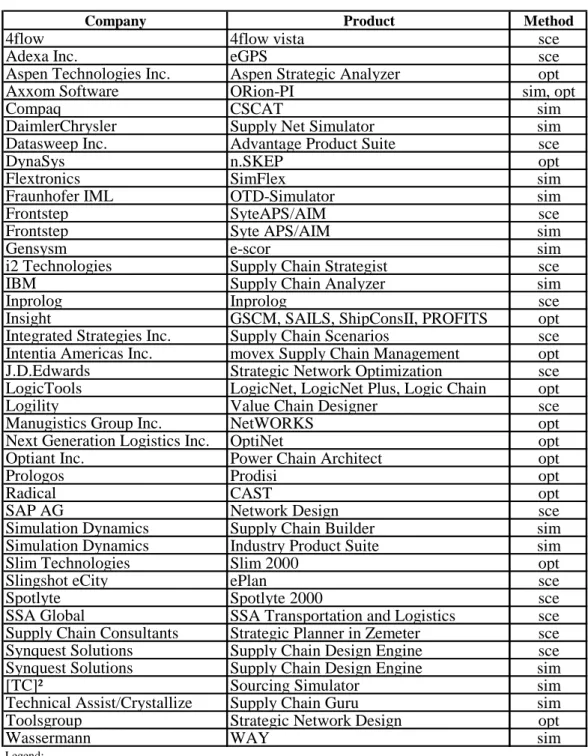
Static Scenario Comparison, Dynamic Simulation and Mathematical Optimization have been identified as widely applied in logistics planning today, serving the purpose of generating quantitative data on supply chain cost and performance for decision making. Table 1 presents a classification of currently available software products for Supply Chain Design into these three categories according to the products’ methodological focus.
Company Product Method
4flow 4flow vista sce
Adexa Inc. eGPS sce
Aspen Technologies Inc. Aspen Strategic Analyzer opt Axxom Software ORion-PI sim, opt
Compaq CSCAT sim
DaimlerChrysler Supply Net Simulator sim Datasweep Inc. Advantage Product Suite sce
DynaSys n.SKEP opt
Flextronics SimFlex sim
Fraunhofer IML OTD-Simulator sim Frontstep SyteAPS/AIM sce Frontstep Syte APS/AIM sim
Gensysm e-scor sim
i2 Technologies Supply Chain Strategist sce IBM Supply Chain Analyzer sim
Inprolog Inprolog sce
Insight GSCM, SAILS, ShipConsII, PROFITS opt Integrated Strategies Inc. Supply Chain Scenarios sce Intentia Americas Inc. movex Supply Chain Management opt J.D.Edwards Strategic Network Optimization sce LogicTools LogicNet, LogicNet Plus, Logic Chain opt Logility Value Chain Designer sce Manugistics Group Inc. NetWORKS opt Next Generation Logistics Inc. OptiNet opt Optiant Inc. Power Chain Architect opt
Prologos Prodisi opt
Radical CAST opt
SAP AG Network Design sce Simulation Dynamics Supply Chain Builder sim Simulation Dynamics Industry Product Suite sim Slim Technologies Slim 2000 opt Slingshot eCity ePlan sce Spotlyte Spotlyte 2000 sce SSA Global SSA Transportation and Logistics sce Supply Chain Consultants Strategic Planner in Zemeter sce Synquest Solutions Supply Chain Design Engine sce Synquest Solutions Supply Chain Design Engine sim [TC]² Sourcing Simulator sim Technical Assist/Crystallize Supply Chain Guru sim Toolsgroup Strategic Network Design opt
Wassermann WAY sim
Legend:
sim Dynamic Simulation
sce Static Scenario Comparison
opt Mathematical Optimization
The classification presents the softwares' focus, an integration of more than one method notwithstanding.
Table 1: Classification of software for Supply Chain Design. Source: [Seidel et al., 2005, p. 34].
These methodologies are differently suited for Supply Chain Design when taking into account the systemic properties of supply networks and the requirements regarding the degree of realism of the models
Static Scenario Comparison can be interpreted as an automation of calculations on supply chain data in order to analyze supply chains. These are static, i.e., do not take into account the variation in time, except for fixed time periods. They are also deterministic in their nature, i.e., do not take into account the variability of the parameters [Chwif, Barretto, Saliby, 2002]. The effort for data collection and modelling is moderate compared to Dynamic Simulation [Rall, 1998]. Static Scenario Comparison grew very popular through the diffusion of spreadsheet applications. This fostered the quick, static-deterministic modelling and analysis of alternative scenarios. However, the approach lacked a comprehensible methodology and validity. Therefore it did not assure the
transferability of models and results. This has led to the development of standard software suites that have overcome these weaknesses [Guedes, Saw, Waller, 1995], [Seidel et al., 2005].
Dynamic Simulation depicts system behaviour over the course of time. The planning horizon spans several planning periods and allows for the description of inter-period influences. Stochastic effects are represented and enhance the degree of realism of the model. Efforts for data collection and modelling can be significant as not only information about structural and material flow processes is necessary, but also about information flow and planning logic. Dynamic Simulation has its origins in the simulation of material flow processes in production environments. This was the starting point for the expansion towards the modelling and analysis of inter-company logistics systems. The available spectrum of simulation software reflects this development as well, with classic material flow simulation packages being supplemented with applications for Supply Chain Simulation [Seidel et al., 2005].
Mathematical optimization focuses on modelling and analyzing network structures. Models can be both single-period and multi-period with a greater diffusion of multi-period models and a strong focus on deterministic depiction [Seidel et al., 2005]. Mathematical optimization depicts the network and its restrictions in a system of equations and applies algorithms and/or heuristics to solve this system with the purpose of finding the analytically optimal solution of the posed problem. Solutions have been provided for widely discussed models, such as the Travelling Salesman Problem, Centre of Gravity, etc. These have been made available in software applications and extend to standard business suites allowing for the optimization of large scale networks [Seidel et al., 2005].
5 Methodological advantages and disadvantages
Static Scenario Comparison is suitable for the quick evaluation of alternative scenarios in an early phase of the Supply Chain Design process. Valid results are available in relatively short time due to the little effort necessary in data collection and modelling. The KPIs generated are of low granularity, as the model neglects dynamic system behaviour. Most often in early planning stages no detailed information is available and any further detailing would demand a number of assumptions. Furthermore the KPI requested often do not need to be more granular to come to sensible and feasible alternatives. Static Scenario Comparison does not aim for the analytically optimal solutions. Solution enhancement is reached by the iterative adaptation and evaluation of scenarios. Thereby the modeller and his experience in network design are the prime source of improvement potentials.
Dynamic Simulation provides the capabilities to represent systems’ real life behaviour in the course of time and under stochastic conditions. This results in KPIs of very high granularity that allow the most specific statements on system performance. In the following this paper focuses on Dynamic Event-driven Simulation as opposed to Dynamic Continuous Simulation. They differ in the principle that determines the progress through time during the Simulation. While the former is based on a finite number of events over time, the latter continuously progresses in time based on an infinite number of state changes represented by differential equations. Dynamic Event-driven Simulation is a widely used method for studying the design and operations of manufacturing systems for the following three reasons. Firstly, because Dynamic Event-driven Simulation has the ability to describe the most complex manufacturing systems and to include stochastic elements, which cannot be described easily by Static Scenario Comparison or Mathematic Optimization. Secondly, Dynamic Event-driven Simulation allows the modeller to track the status of individual entities and resources in the system and calculate performance measures associated with those entities under a wide range of projected operating conditions. Thirdly, alternative network designs or operation policies can be compared via Dynamic Event-driven Simulation to see which one meets best a specified performance goal [Rabelo et al., 2003].
Mathematical Optimization has the potential to find the analytically best solution for a stated problem. For the underlying target equation that formulates the priorities of the planner regarding the network’s performance all free variables will be computed and the restrictions posed will be considered to fit the optimal solution. The results provide the planner with prescribed parameters for the configuration of the network.
Yet these methodologies have intrinsic shortfalls that limit their spectrum of application in Supply Chain Design. Static Scenario Comparison lacks the modelling of dynamic system behaviour. This leads to limitations in the granularity and therefore degree of realism of the KPI generated. Static Scenario Comparison does not aim for the analytically optimal solution. Solution enhancement is reached by the iterative adaptation and evaluation of scenarios.
Dynamic Simulation relies on statistics. The modeller can only establish correlations among variables and performance measures using statistical models. Furthermore Dynamic Simulation demands a high level of modelling and analysis effort [Rabelo et al., 2003], [Rall, 1998], [Simchi-Levi, Kaminsky, Simchi-Levi, 2000], [Sterman, 1991]. In fact simulating a supply chain can be very complex, because a model must mimic several key processes [Ingalls, Kasales, 1999]. This leads to higher investments in the planning task and longer planning periods necessary. Thus, fewer alternative scenarios can be assessed with a certain budget and time frame compared to Static Scenario Comparison. Dynamic Simulation also provides no analyti-cally optimal solution. Enhancement is once again dependent on iteratively modelling scenarios with promising adaptations.
Mathematical Optimization models describe the relationships among decisions, constraints, and objectives. These are expressed in the form of mathematical equations. The model must represent the important aspects of the supply chain in order to provide a useful solution. But often Mathematical Optimization has to reduce the degree of detail in its models to allow for reasonable computation efforts and times [Rabelo et al., 2003]. Once an optimization problem is formulated, a solver determines the best solution. A solver can develop three types of solutions. Firstly, a feasible solution that satisfies all the constraints of the problem. Secondly, the optimum solution that is the best feasible solution achieving the objective of the optimization problem. Thirdly, an optimized solution - a solution that partially achieves the objective of the optimiza-tion problem. It is not the optimum or best soluoptimiza-tion, but it is a satisfying or reasonable one. [Lapide, 1999].While an optimum solution is intuitively appealing in most cases, it is unattain-able in very complex problems. Unless a problem has a very specific structure, an optimized rather than an optimum solution is the best that can be generated. Additionally the solution process is often hard to comprehend and therefore acceptance problems arise among practitio-ners [Labadie, Fontane, 2003].
6 Overcoming the shortfalls: A combined methodology
Considering the size and complexity of corporate networks, the author considers Mathematical Optimization rather unfavourable for the challenges at hand. The modelling of networks in most cases cannot stop at a highly aggregated level of data, but has to consider detailed characteristics of value creation networks.
The possibility to rapidly model large scale networks represents a strong argument for the application of Static Scenario Comparison. In order to gain the ability of thorough performance assessment and for feasibility studies in a dynamic environment the application of Dynamic Simulation provides valuable capabilities.
Therefore the application of these methodologies proves to be suitable for the challenges at hand in modelling and analyzing for Supply Chain Design.
In an early phase of Supply Chain Design Static Scenario Comparison provides the possibility to rapidly model a large number of alternative scenarios and evaluate these generating low
granularity KPI. The number of models is being reduced drastically by this assessment and a small group of feasible and economically efficient alternatives remains. In a later phase of the Supply Chain Design process these few are assessed through Dynamic Simulation and high granularity KPI are generated. By this approach the logistics planner has the opportunity to thoroughly check the models for their validity and feasibility. This rationale and the derivation of the scope of application of Supply Chain Design methodologies are illustrated in figure 2.
early late
low
high Static Scenario Comparison
Supply Chain Design process Dynamic Simulation N u m b e r o f sc e n a ri o s G ra n u la ri ty o f K P Is Num ber of s cen arios Gra nula rity o f KPI early late low
high Static Scenario Comparison
Supply Chain Design process Dynamic Simulation N u m b e r o f sc e n a ri o s G ra n u la ri ty o f K P Is Num ber of s cen arios Gra nula rity o f KPI
Figure 2: Granularity of KPI and number of scenarios in Supply Chain Design process. Source: [Author].
This combined methodology provides essential advantages in the implementation of Supply Chain Design projects. The first advantage refers to the time necessary for modelling and evaluating network alternatives (cf. figure 3). The application of Static Scenario Comparison is significantly faster in modelling and evaluation than Dynamic Simulation (∆tSCC + ∆tDS). Thus, the modeller will receive a low number of feasible scenarios as basis for further decision making on supply chain cost and performance in the shortest time possible in the early phase of Supply Chain Design. The subsequent application of Dynamic Simulation will therefore require the analysis of only these few feasible scenarios. Thus, modelling the dynamic behaviour of the networks will require less time for the evaluation of alternatives than it would without the preceding static evaluation. The overall Supply Chain Design process therefore takes longer than for Static Scenario Comparison alone (∆tSCC), but significantly less time than for Dynamic Simulation alone (∆tDS). time effort SCC DS CM ∆∆∆∆ tSCC ∆∆∆∆ tDS ∆∆∆∆ eSCC ∆∆∆∆ eDS time effort SCC DS CM ∆∆∆∆ tSCC ∆∆∆∆ tDS ∆∆∆∆ eSCC ∆∆∆∆ eDS
Figure 3: Qualitative comparison of modelling time and effort for Static Scenario Comparison (SCC), Dynamic Simulation (DS) and the Combined Methodology (CM). Source: [Author].
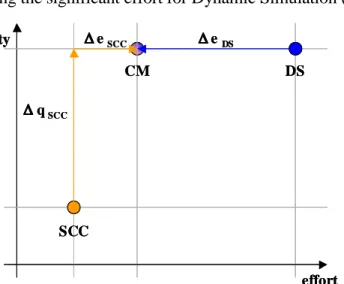
The second advantage concerns the effort necessary for assessing network alternatives (cf. figure 4). The effort for evaluating network alternatives is least for the application of Static
Scenario Comparison. The effort for assessing the same network alternatives with Dynamic Simulation is significantly higher due to modelling the dynamic and stochastic network behaviour (∆eSCC + ∆eDS). The combined methodology will require the same effort for statically assessing the network alternatives plus the additional effort necessary for dynamically simulating the few feasible scenarios left after the static evaluation. Thus, with a rather little share of additional effort (∆eSCC) the modeller can achieve the qualitative advantages of the combined methodology, while avoiding the significant effort for Dynamic Simulation (∆eDS).
effort quality SCC DS CM ∆ ∆∆ ∆ eSCC ∆∆∆∆ eDS ∆ ∆∆ ∆ qSCC effort quality SCC DS CM ∆ ∆∆ ∆ eSCC ∆∆∆∆ eDS ∆ ∆∆ ∆ qSCC
Figure 4: Qualitative comparison of modelling effort and final model quality for Static Scenario Comparison (SCC), Dynamic Simulation (DS) and the Combined Methodology (CM). Source: [Author].
Assessing the quality of the KPI generated by the methodologies reveals another advantage of the combined methodology (cf. figure 4). While the KPI from Static Scenario Comparison are of relatively low granularity due to the systemic restrictions of the modelling approach, the KPI from Dynamic Simulation provide the most detailed insight into the network’s behaviour down to the observation of single objects and their course in time. While most of the initially consid-ered network alternatives remain on the granularity level of Static Scenario Comparison, the ones assessed as most promising and feasible will advance to the level of quality provided by Dynamic Simulation (∆qSCC). Thus, the finally presented network alternatives for decision making are of the high quality that Dynamic Simulation can provide.
Furthermore Supply Chain Design projects have transformed from a task performed in intervals of several years to a continuous challenge of ongoing improvements [Sebastian, 2002]. Therefore the results of a network assessment project are most often the input for a subsequent evaluation cycle. With the combined approach the modeller will be provided with high granular-ity model parameters stemming from Dynamic Simulation that can be applied in Static Scenario Comparison. Thus, subsequent Supply Chain Design cycles conducted with Static Scenario Comparison will start out on a higher level of parameter and KPI quality.
7 Conclusion and Real-life application
Supply Chain Design is a vital task in Supply Chain Management that not only offers great cost optimization potential for companies collaborating in value creation networks, but also provides the prospect of improved customer satisfaction through enhanced supply chain performance. Modelling methodologies allow the planning of these value creation networks. Their characteris-tics prove to be differently suited for Supply Chain Design. Having selected Static Scenario Comparison and Dynamic Simulation as the most promising due to their complementary features, an enhanced combined methodology has been developed. It has been shown to provide advantages in the time and effort necessary for modelling as well as in the quality of the resulting KPIs.
Its applicability has been tested in a case study at a first tier supplier of an automotive OEM. The software applied were 4flow vista by 4flow AG for Static Scenario Comparison and OTD-NET by Fraunhofer IML for Dynamic Simulation. Interfacing these applications and the results of the case study have proven so promising that this innovative approach will be further pursued. Thus, the combined methodology is a convincing new approach to future Supply Chain Design.
Acknowledgement
This work has been partly funded by the European Commission through IST Project ILIPT: Intelligent Logistics for
Innovative Product Technologies (No. IST-2002-507592-ILIPT). The author wishes to acknowledge the
Commis-sion for their support.
References
Beckmann, H. (2004): Supply Chain Management: Grundlagen, Konzept und Strategien. In: Beckmann, H. (editor): Supply-Chain-Management - Strategien und Entwicklungstendenzen in Spitzenunternehmen, Sprin-ger-Verlag, Berlin et al. 2004; pp. 1-97.
Bertalanfy, L.v. (1975): The History and Development of General System Theory. In: Tschadjian, E./Braziller, G. (editors): Perspectives on General System Theory: Scientific-Philosophical Studies, New York 1975; pp. 149-169.
Chwif, L./Barretto, M./Saliby, E. (2002): Supply Chain Analysis: Spreadsheet or Simulation? In: Yücesan, E. et al. (editors): Proceedings of the 2002 Winter Simulation Conference, pp. 59-66.
Diruf, G. (1989): Logistik. In: Chmielewicz, K./Eichhorn, P. (editors): Handwörterbuch der öffentlichen Betriebswirtschaft, Schäffer-Poechel, Stuttgart 1989, col. 926 – 934.
Guedes, P./Saw, R.J./Waller, A.G. (1995): Logistics Strategy Planning. In: The International Journal of Logistics Management, Vol. 6. (1995) No. 1; pp. 37-50.
Hellingrath, B./Laakmann, F./Nayabi, K. (2004): Auswahl und Einführung von SCM-Softwaresystemen. In: Beckmann, H. (editor): Supply-Chain-Management - Strategien und Entwicklungstendenzen in Spitzenunter-nehmen, Springer-Verlag, Berlin et al. 2004; pp. 99-122.
Ingalls, R.G/Kasales, C. (1999): CSCAT: The Compaq supply chain analysis tool. In: Farrington, P.A. et al. (editors): Proceedings of the 1999 Winter Simulation Conference, pp. 1201-1206.
Isermann, H. (1994): Logistik im Unternehmen - eine Einführung. In: Isermann, H. (editor): Logistik - Beschaf-fung, Produktion, Distribution; Moderne Industrie, Landsberg am Lech 1994, pp. 21-43.
Krallmann, H./Frank, H./Gronau, N. (2002): Systemanalyse im Unternehmen. Vorgehensmodelle, Modellierungs-verfahren und Gestaltungsoptionen. 4. Aufl., Oldenbourg Wissenschaftsverlag, München, Wien 2002. Labadie, J.W./Fontane, D.G. (2003): Optimal operation of multi-reservoir systems. State-of-the-Art Review.
Department of Civil Engineering, Colorado State University 2003.
Lapide, L. (1999): Supply Chain Optimization: Just the Facts. In: Ascet, Vol. 1 (1999).
Persson, F./Olhager, J. (2002):Performance simulation of supply chain designs. In: International Journal of Production Economics, Vol. 77 (2002) No. 3; pp. 231-245.
Rabelo, L. et al. (2003): A hybrid approach to manufacturing enterprise simulation. In: Chick, S./Sánchez, P.J./Fer-rin, D./Morrice, D.J. (editors): Proceedings of the 2003 Winter Simulation Conference, pp. 1125-1133. Rall, B. (1998): Analyse und Dimensionierung von Materialflußsystemen mittels geschlossener
Warteschlangen-netze. Institut für Fördertechnik und Logistiksysteme (Wissenschaftliche Berichte des Institutes für Förder-technik und Logistiksysteme der Universität Karlsruhe (TH) ; 46), Karlsruhe 1998.
Sebastian, H.-J. (2002): Erfolgreiche Logistikplanung. Eine Marktstudie im Auftrag der Rheinisch-Westfälischen Technischen Hochschule RWTH-Aachen, Aachen/Berlin 2002.
Seidel, T. et al. (2005): BTO Network Design Methodologies and Tools. Internal research paper of the project ILIPT – Intelligent Logistics for Innovative Product Technologies.
Simchi-Levi, D./Kaminsky, P./Simchi-Levi, E. (2000): Designing and Managing the Supply Chain; McGraw-Hill, Boston et. al. 2000.
Stachowiak, H. (1973): Allgemeine Modelltheorie. Springer-Verlag, Wien, New York 1973.
Sterman, J.D. (1991): A Skeptic’s Guide to Computer Models. In: Barney, G. O. et al. (editors.): Managing a Nation: The Microcomputer Software Catalog. Boulder, CO. Westview Press 1991, pp. 209-229. Wolff, S. (2005): Methoden und Werkzeuge der Netzwerkplanung. Presentation. 23. Dortmunder Gespräche;
![Figure 2: Granularity of KPI and number of scenarios in Supply Chain Design process. Source: [Author]](https://thumb-us.123doks.com/thumbv2/123dok_us/10622950.2949644/6.892.276.657.253.488/figure-granularity-scenarios-supply-design-process-source-author.webp)