June 2020
The interactive effects of associative response priming and
The interactive effects of associative response priming and
personality traits on insight problem solving over time
personality traits on insight problem solving over time
Yu-Chu YehNational Chengchi University, [email protected] Pei-Hsin Li
National Chengchi University, [email protected] Chung-Wei Lin
Testing Center for Technological and Vocational, [email protected]
Follow this and additional works at: https://scholarcommons.usf.edu/jger
Part of the Educational Psychology Commons, and the Experimental Analysis of Behavior Commons
This Refereed Article is brought to you for free and open access by the M3 Center at the University of South Florida Sarasota-Manatee at Scholar Commons. It has been accepted for inclusion in Journal of Global Education and Research by an authorized editor of Scholar Commons. For more information, please contact [email protected].
Recommended Citation Recommended Citation
Yeh, Y., Li, P., & Lin, C. (2020). The interactive effects of associative response priming and personality traits on insight problem solving over time. Journal of Global Education and Research, 4(1), 14-32. https://www.doi.org/10.5038/2577-509X.4.1.1023
Corresponding Author
Yu-Chu Yeh, Institute of Teacher Education, National Chengchi University, No. 64, Zhinan Road, Section 2, Taipei 116, Taiwan
Revisions
Submission date: Aug. 11, 2018; 1st Revision: Mar. 16, 2019; 2nd Revision: May 28, 2019; 3rd Revision: Jul. 31, 2019; 4th Revision: Dec. 14, 2019; 6th Revision: Mar. 3, 2020; Acceptance: Mar. 24, 2020
The Interactive Effects of Associative
Response Priming and Personality Traits on
Insight Problem Solving Over Time
Yu-Chu Yeh
1, Pei-Hsin Li
2, and Chung-Wei Lin
3Institute of Teacher Education; Research Center for Mind, Brain & Learning National Chengchi University, Taiwan
Department of Education, National Chengchi University, Taiwan
Department of Education, University of Oxford, UK
Testing Center for Technological and Vocational, Taiwan
Abstract
Priming effect is, in a great part, an implicit learning mechanism; it may influence insight problem solving both consciously and unconsciously. The present study investigates interactions between personality traits and priming effects in insight problem solving involving novel object associations in complex situations over time. Based on the findings of past literature, a two-path (conscious vs. unconscious process) model exploring the moderation effects of two personality traits (emotional creativity and Big Five personality traits) were analyzed in this study. One hundred and fifteen college students participated in a randomized block design experiment (non-primed vs. (non-primed) which included three runs of insight problem solving. During the experiment, the participants were exposed to partially direct priming with recognition memory tasks that associated novel objects (associative response priming) and then were challenged by situation-based insight problems; the interaction effects of priming manipulation and personality traits on insight problem solving were analyzed. The results showed that emotional creativity as well as extraversion, openness to experience, neuroticism, and conscientiousness play important moderating roles during the processes of insight problem solving when associative response priming was offered. Overall, the priming effects as well as the moderating effects of these personality traits on insight problem solving grew over time. The findings suggest that insight problem solving, although largely governed by an implicit learning mechanism, involves both conscious and unconscious cognitive processes; moreover, mindfulness, focused attention, persistence, positive emotion, and flexible thinking can be important mechanisms that facilitate insight problem solving in primed situations.
Introduction
Priming effect is regarded an implicit learning mechanism; it may influence insight problem solving both consciously and unconsciously. Insight problem solving involves breaking an impasse produced through the reinterpretation or restructuring of a problem to reveal a new solution (Kounios & Beeman, 2014; Lai et al., 2017). Many studies on insight problem solving have been conducted since the advent of the creative cognition approach (e.g., Abraham & Windmann, 2007; Yeh et al., 2014). Although the findings are fruitful, few studies have been conducted to examine how priming effects, especially those which emphasize novel object associations, may interact with personality traits during insight problem solving when multiple objects are presented in a complex situation over time.
The priming effect is modulated by working memory (Carlisle & Kristjánsson, 2019; De Belder et al., 2019; Korovkin et al., 2018; Szuhany et al., 2018). According to the viewpoints of the cue-priming mechanism (Siefert et al., 1995), the embedded-processes model of working memory (Cowan, 1999), theories of creative insight (Dietrich, 2004), and eye-movement studies of creative insight (Yeh et al., 2014), introducing relative priming stimuli into an insight problem may help activate memory and modulate attention focus, thereby contributing to insight problem solving. Notably, these processes are closely related to working memory. Working memory is regarded as an online cognitive process through which learners acquire and process information to solve the encountered problem (Yeh et al., 2014); it is essential to cognitive flexibility, strategy use, strategic planning, and holding in mind knowledge that is relevant to solving a particular problem (Baddeley, 2000; Cowan, 1999; Hammerstein et al., 2019). Two common types of priming were: semantic priming and direct response priming (Klapp, 2015). This study employed the associative response priming of direct response priming, in which priming with associations of novel objects (e.g., clock + screwdriver; a battery in the clock can supply electrical power to the screwdriver) was employed and its effects on the following situation-based insight problems were examined. In addition, past findings suggest personality traits interact with priming and influence one’s working memory efficiency and attention control (Chein & Weisberg, 2013; Dubey et al., 2014), which further carries effects on insight problem solving performance. In this study, we included two types of personality traits which share certain characteristics in common, namely, emotional creativity (EC) and Big Five personality traits. Specifically, this study aimed to explore how emotional creativity and Big Five personality traits would interact with associative response priming (primed vs. non-primed) and then influence situation-based insight problem solving involving associations of novel objects over time.
Literature Review
Priming Effect and Insight Problem Solving
Insight is the distinct feeling of sudden and unexpected understanding, which may accompany attempts to solve a problem. While some researchers suggest insight problem solving involves a sudden certainty of a correct response, with little or no conscious access to the processing of the solution, some researchers believe insight problem solving involves a deliberate and systematic evaluation of the problem, emphasizing logical deduction and strategic thinking (Webb et al., 2016). Although growing evidence has suggested dissociations between conscious and
unconscious processing in insight problem solving, it has been suggested the process of insight problem solving is largely governed by an implicit learning mechanism (Orita & Hattori, 2019; Suzuki & Fukuda, 2013). It has also been found that priming, which is a type of implicit learning, has a great impact on insight problem solving; individuals in a primed condition perform better than individuals in an unprimed condition in creative problem solving (Minas et al., 2018; Mumford et al., 2001).
Priming is the influence of one event on performance during a second event. According to Klapp (2015), there are two types of priming. The first type of priming is known as semantic priming, which influences the interpretation of the subsequent stimulus; the second type of priming is called direct response priming which triggers responding directly without semantic mediation. Klapp further suggested the two types of direct response priming can be distinguished: explicit priming, which requires awareness of the prime, and associative response priming, which occurs even without awareness of the prime stimulus. Ochsner et al. (1994) found repetition priming as another type of direct response priming; it is an implicit or nonconscious form of memory; participants did not have conscious or intentional recollection of their prior exposure. This study employed the associative response priming of direct response priming.
In studies of direct response priming, recognition tasks are commonly employed (e.g. Chang et al., 2018; Gilmore et al., 2019; Gomes et al., 2016). Recognition tasks can be individual items or associations between items. Item recognition tasks are typically tested by requiring participants to identify which items had been presented in an earlier study session. In contrast, associative recognition memory tasks are tested by asking participants what items were encountered together in an earlier study session (Gomes et al., 2016). Notably, research on cue-priming mechanisms suggests priming stimuli facilitate creative insight and the effect can still exist even when an individual consciously forgets (Bowden, 1997). In the same vein, Howe et al. (2010) found, even when only half of the problems were primed, the insight problems were solved more often and significantly faster than those that were not primed. Therefore, direct response priming involves implicit memory. However, priming may carry effects on both response time and accuracy in insight problem solving with different patterns. For example, Xing et al. (2018) found providing gesture guidance as priming effect not only facilitated response accuracy, but also shortened reaction time to solve matchstick problems, even if the participants did not realize the connection between guidances and solutions. In a 2-step experiment, Bowden (1997) found participants’ solving time shortened because of the hint in both experiments, but the solving rate benefited from hints only in the second stage. Accordingly, implicit learning in primed situations can be gradually improved with practice.
Personality Traits, Priming, and Insight Problem Solving
Emotional Creativity, Priming, and Insight Problem Solving
Over the last few decades, systematic studies have examined the relationships between emotions and creative cognition. Emotional creativity (EC) is a type of ability to experience and express original, appropriate, and authentic combinations of emotions in a special way (Averill, 2004, 2009; Ivcevic et al., 2007; Fuchs et al., 2007); it is related to one’s ability to express and regulate emotions as well as implicit judgment and decision-making, plays an important regulation role in frustrating problem solving situations. A person with high emotional creativity will live a complex
and richly emotional life. In other words, individuals with high emotional creativity can produce new, different, and effective emotional responses and can reflect on someone’s true values and beliefs. Empirical studies have suggested emotional creativity plays an important role in creativity. Ivcevic et al. (2007) found emotional creativity was significantly correlated with participants’ creativity performance on poem writing. Although it is claimed emotional creativity plays an important role in behavioral creativity (Ivcevic et al., 2007), no studies have been conducted to investigate the relationships among emotional creativity, priming, and insight problem solving. According to Averill (1999), emotional creativity requires a divergent thinking process and a generation of appropriate and original responses. It can involve a manipulation and transformation of experience that leads to problem solving in the domain of emotions. In a related study, Zemack-Rugar et al. (2007) demonstrated valanced emotion concepts could be unconsciously activated, but remained inaccessible to conscious awareness and affected behavior in an emotionally specific way. The affect-as-information theory, which assumes emotional processes occur without conscious awareness, provides a framework for a cognitive approach to understanding the unconscious influence of emotion on behavior; affective feelings allow people to explicitly learn about their implicit judgments and decisions (Skandrani-Marzouki & Marzouki, 2010). Broaden-and-build theory (Fredrickson, 1998) also suggests positive emotions can extend a person’s thought-action repertoires. These findings suggest emotional creativity may interact with priming and, further, influence insight problem solving.
Big Five Personality Traits, Priming, and Insight Problem Solving
The Big Five personality traits include extraversion, agreeableness, conscientiousness, neuroticism, and openness to experience (Rammstedt & John, 2007). Extraversion refers to dispositions to be sociable and to experience positive emotions; agreeableness refers to tendencies to be compliant and empathetic; conscientiousness refers to the quality of being self-disciplined and persistent; neuroticism is measured by the likelihood of experiencing negative emotions; and openness to experience refers to preferences to be intellectually engaged and to seek novel experiences (Kushner et al., 2017). The Big five theory has been commonly studied in divergent-thinking creativity research (e.g., Batey et al., 2010; James & Taylor, 2010; Stanciu & Papasteri, 2018). Few studies, however, have investigated the interactive influences of Big Five personality traits and priming on insight problem solving.
Although when applying different scales, the impact of Big Five personality on insight problem solving may differ (e.g., Stanciu & Papasteri, 2018), the importance of Big Five personality are worth noting. Results of insight problem solving studies have revealed extraversion and openness are significantly correlated with creative problem solving in insight tasks, whereas neuroticism is negatively correlated with creative problem solving when participants are under evaluation stress (Chamorro-Premuzic & Reichenbacher, 2008). Openness to experience is assumed to be related to the richness of ideas, which facilitates insight problem solving (Batey et al., 2010). Moreover, it has been revealed insight problem solving is negatively related to emotionality and positively correlated with agreeableness (Lin et al., 2013).
When priming is considered, will the influence of the Big Five personality traits on insight problem solving be different? Augustine and Larsen (2011) suggested priming and personality would influence decision processes during problem solving. Insight problem solving can be frustrating
and stressful, extraversion is related to positive emotion and coping with stress (Jach et al., 2018; Uliaszek et al., 2012); conscientiousness is associated with persistence (Sava et al., 2012). These two personality traits should contribute to insight problem solving during primed situations. A recent study found that while conscientiousness, extraversion, openness to experience, and agreeableness were positively related to mindful learning, neuroticism was negatively related to mindfulness (Spinhoven et al., 2017). In the same vein, it was found that conscientiousness was related to mindfulness (Giluk, 2009; Rau & Williams, 2016). Mindfulness is characterized by an open and receptive attitude toward experience (Spinhoven et al., 2017). The Big Five personality traits may moderate the effect of priming on insight problem solving through mindfulness. Notably, neuroticism was found to be related to depressive symptoms (Barnhofer et al., 2011) as well as a low ability in self-awareness and self-regulation (Spinhoven et al., 2017). Therefore, neuroticism may carry negative effects on primed insight problem solving.
The Present Study
This study proposed a new paradigm for investigating the interaction effects of priming and personality traits on insight problem solving over time. The aforementioned literature review suggests the priming effect is, in a great part, an implicit learning mechanism; it may influence insight problem solving both consciously and unconsciously (e.g., Suzuki & Fukuda, 2013; Webb et al., 2016). During the primed insight problem solving, the conscious process may be more related to the use of appropriate strategies, whereas the unconscious process may be more related to insightful thoughts (e.g., Dietrich, 2004; Suzuki & Fukuda, 2013; Yeh et al., 2014). Moreover, emotional creativity and the Big-five personality traits may consciously and unconsciously interact with priming, which may then influence one’s implicit judgments, focused attention, persistence, mindfulness, positive emotion, flexible thinking, and further, carry effects on insight problem solving (e.g., Jach et al., 2018; Skandrani-Marzouki & Marzouki, 2010). Notably, neuroticism may carry negative effects in such interactions (Spinhoven et al., 2017).
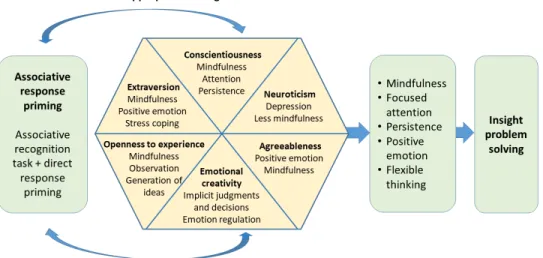
This study employed the associative response priming of direct response priming (Gomes et al., 2016; Klapp, 2015). Three pairs of novel objects were presented to prime the subsequent situation-based insight problem solving. Notably, only one pair of associative stimuli helped solve the subsequent insight problems, and this association was not intuitively visible in the insight problem solving task, as shown in the priming session. Similar to Howe et al.’s design (2010), only half of the insight problems were primed in the situation-based insight problem solving task. In addition, based on previous findings (Bowden, 1997), we cogitate that the implicit learning effects of the priming would be gradually increased under the moderation of emotional creativity and the Big-five personality traits. A two-path (conscious vs. unconscious process) hypothesized model is shown in Figure 1.
Figure 1: The Hypothesized Model of Priming and Personality Traits Interactions During Insight Problem Solving
Since related studies are seldom seen, we proposed the following hypotheses in a rather exploratory manner:
• H1: Associative response priming would contribute to both the accuracy rate and the response speed in situation-based insight problem solving that involved the association of novel objects. Moreover, the strength of priming effect would become stronger over time.
• H2: Emotional creativity would interact with priming and incrementally enhance insight problem solving in the primed situation. In contrast, no such facilitation effect would appear in the non-primed situation.
• H3: Extraversion would interact with priming and incrementally enhance insight problem solving in the primed situation. In contrast, no such facilitation effect would appear in the non-primed situation.
• H4: Agreeableness would interact with priming and incrementally enhance insight problem solving in the primed situation. In contrast, no such facilitation effect would appear in the non-primed situation.
• H5: Conscientiousness would interact with priming and incrementally enhance insight problem solving in the primed situation. In contrast, no such facilitation effect would appear in the non-primed situation.
• H6: Neuroticism would interact with priming and incrementally hinder insight problem solving in the primed situation. In contrast, no such facilitation effect would appear in the non-primed situation.
• H7: Openness to experience would interact with priming and incrementally enhance insight problem solving in the primed situation. In contrast, no such facilitation effect would appear in the non-primed situation.
Method
Participants
Participants were 115 college students (15 males and 100 females) ranging from 18 to 35 years old (M = 20.38; SD = 2.26). This study was approved by a Research Ethical Committee in Taiwan. All participants completed a written informed consent form prior to the experiment and received compensation of $10 USD for their participation.
Measures
This study attempted to understand whether priming and personality traits influence situation-based insight problem solving that involves the association of novel objects. Past studies have
seldom used situation-based insight tasks in priming studies. The insight tasks and priming stimuli employed in this study were adapted from the Situation-Based Creativity Tasks (SCT) and the Situation-Based WM Tasks (SWMT) instruments. The two instruments have been shown to be a good vehicle for understanding the cognitive process of insight problem solving (Lai et al., 2017; Yeh et al., 2014; Yeh et al., 2015).
Insight Problem Solving Tasks
The adapted SCT (Yeh et al., 2014), in which participants aim to escape from certain situations, was composed of three runs of situation-based insight tasks: the living room, the kitchen, and the bathroom. Each run included 8 trials. In each trial, an insight problem was displayed for 60 seconds (s); the participants were asked to solve the problem through combining two instruments provided in the situation. See Figure 2 for an example of insight problem solving task. To confirm whether the participants correctly solved the problem, the question Did you come up with the answer? was posted (3 s). If the participant clicked the answer Yes, the correct answer was displayed with a combination of tools, and the question Is this your answer? (6 s) followed. If the participant clicked the answer Yes, 1 point would be recorded on this task. If the participant clicked the answer No, a correct answer would be displayed, and 0 points would be recorded for this task. The selected answers were recorded in the E-Prime database. The highest possible total score was 24 points in the insight problem solving tasks.
Figure 2: An Example of Insight Problem Solving Task
Note. The correct answer was clock + screwdriver. The answer was provided in the priming session. There are batteries in the back of the clock. To get the insight, the participant had to make a connection between power and batteries.
Priming Manipulations and Working Memory Tasks
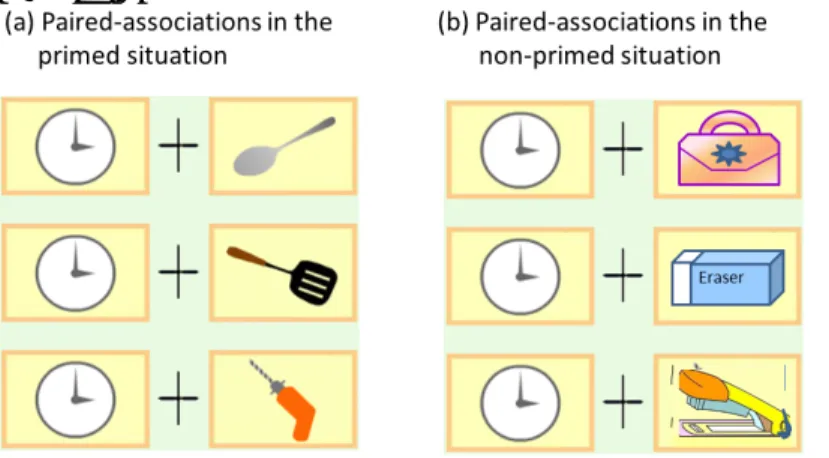
Based on theories of cue-priming mechanisms (Siefert et al., 1995) and the embedded-process model (Cowan, 1999), we developed two types of priming tasks, which were embedded in working memory tasks: priming and non-priming. The priming tasks, adapted from the SWMT, involved perceptual, repetition, and novel object association priming; they were mainly designed to stimulate participants’ creative thinking in insight problem solving. To match the insight problem, the adapted SWMT also included three runs, with four trials of priming tasks and four trials of non-priming tasks in each run. In each trial, three pairs of a key instrument and an accessory instrument (e.g., clock + spoon; clock + spatula; clock + screwdriver) were displayed on the screen for 5 s. See Figure 3a for the example of paired association in the primed situation. Then, the
question Did you see the combination? and a pair of instruments were displayed. The participants were requested to press Yes or No. A total of six pairs were displayed to test the participants’ working memory (5 s for each and 30 s in total). Among the six pairs, three had been shown (correct answers), and three had not been shown (incorrect answers). The selected answers were recorded in the E-Prime database. A correct answer of working memory tasks was scored as 1 point, and a wrong answer was scored as 0 point. The highest possible total score was 72 points (12 points in the priming tasks and 12 points in the non-priming tasks in each run).
To compare the primed effect with the non-primed effect in this study, we also developed three runs of non-primed tasks with the same format and procedure as those in the priming tasks, with the difference that the non-priming tasks were not related to the following insight problem solving tasks. See Figure 3b for the paired association in the non-primed situation.
Big Five Personality
A short version of the Big Five Inventory with 10 items (BFI-10) was used to measure the Big Five personality traits (Rammstedt & John, 2007). The BFI-10 measures five personality traits: extraversion, agreeableness, conscientiousness, neuroticism, and openness to experience. The test-retest reliability of 6 weeks was .78, and the correlation between BFI-10 and BFI-44 (Big Five Inventory, 44-item) was .74 to .89. The BFI-10 contains a 5-point Likert scale with response options ranging from totally disagree to totally agree.
Figure 3: An Example of the Paired Associations Presented in the Primed- and Non-Primed Manipulations
Emotional Creativity
The Emotional Creativity Inventory for College Students (ECI-CS) (Lee & Yeh, 2009), revised based on Averill’s (1999) Emotional Creativity Inventory, was used to assess participants’ emotional creativity. The ECI-CS contains a 5-point Likert scale with response options ranging from totally disagree to totally agree. With a total of 17 items, the ECI-CS consisted of four factors: emotional preparedness (5 items), novelty resources (5 items), effectiveness (3 items), and novelty responses (4 items). The test items included statements such as I can simultaneously experience different types of emotions and I can reflect on my past emotional experiences to help me deal with current emotional problems.
The Cronbach’s α coefficients were .813, .758, .717, and .667 for the factor of emotional preparedness, novelty resources, effectiveness, and novelty responses, respectively. The
Cronbach’s α coefficient for the total ECI-CS was .764. Moreover, confirmatory factor analysis indicated that the ECI-CS had good construct validity: Goodness of Fit = .95, Adjusted Goodness of Fit = .93, Root-Mean-Square Error of Approximation = .049, Normed Fit Index = .97, Comparative Fit Index = .96, and Incremental Fit Index = .97.
Procedures
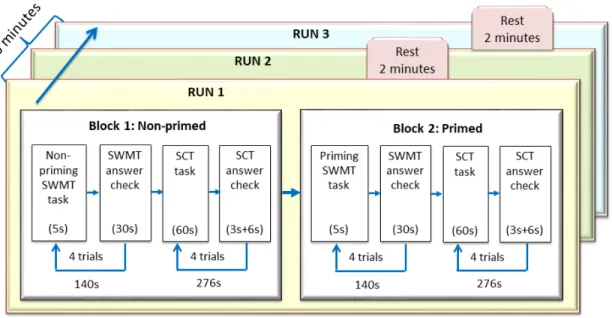
The participants completed the experiment individually in a computer lab. The complete experiment included instruction, inventory, insight problem solving, and debriefing sessions. The entire procedure took approximately 70 minutes with the insight problem solving tasks lasting approximately 46 minutes. After instructions, the participants provided personal information and completed the BFI-10 and the ECI-CS. Then, the participants were assigned to one of the randomized block designs (non-primed + primed or primed + non-primed) and were instructed to engage in the insight problem-solving session. In both conditions, the participants were exposed to recognition memory tasks that associated novel objects (associative response priming) and then were challenged by situation-based insight problems. This session included three runs and 12 situation-based insight tasks adapted from the SCT, which were randomized to avoid confounding effects. Each run comprised two blocks (non-primed and primed), and each block was composed of four trials of the SWMT tasks (140 s) and the SCT tasks (276 s). To prevent respondents from simply memorizing the primed answer for the insight problem solving and to test the implicit learning effect, an insight task did not immediately follow a trial of the SWMT task. Rather, the insight problem-solving task was administered after the completion of 4 trials of the SWMT tasks, in which 12 combinations of instruments had to be memorized and 24 combinations were shown to test working memory. The processes of the experimental design are depicted in Figure 4.
Figure 4: Experimental Procedures of the Insight Problem Solving Session
In the primed block, the participants were informed the combinations of instruments in the SWMT could be the answers for the following insight problem-solving tasks. Notably, only half of the insight problems were primed in our situation-based insight problem solving. In the non-primed block, however, the participants were informed the combinations of instruments in the SWMT
were not related to the following insight problem-solving tasks, which was an accurate depiction of the procedures.
Results
Priming Effect on Insight Problem Solving
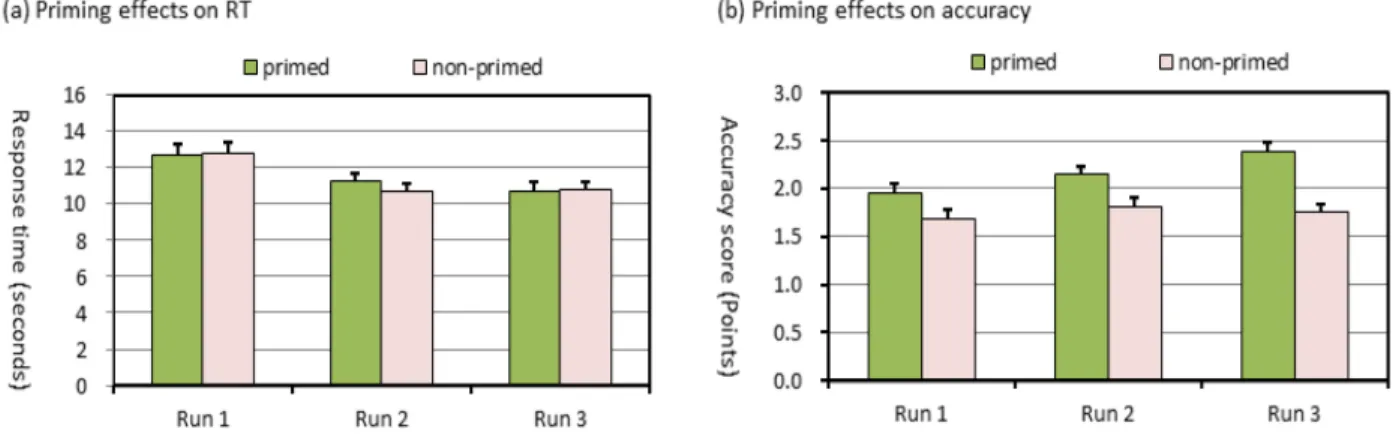
The priming effects on the response time (RT) of insight problem solving was first examined through a 3 (run 1 vs. run 2 vs. run 3) × 2 (primed vs. non-primed) repeated-measures ANOVA. The results showed a significant main effect of runs, F(2, 113) = 12.767, p < .001, ηp2 = .184.
Specifically, the RT of the first run was higher than that of the second run and the third run, suggesting a practice effect. However, no interaction effect or main effect of priming was found on the RT, F(2, 113) = .605, p = .548, ηp2 = .011 and F(1, 114) = .355, p = .553, ηp2 = .003,
respectively. See Figure 5 for means and standard errors (SEs) for priming effect.
Figure 5: The Means and SEs of Insight Problem Solving for Priming Effect
The priming effects of insight problem solving on the accuracy of insight problem solving were also examined through a 3 (run 1 vs. run 2 vs. run 3) × 2 (primed vs. non-primed) repeated-measures ANOVA. The means and SEs for the RT and accuracy of insight problem solving in each run are displayed in Figure 5a and Figure 5b. The results showed a significant main effect of runs, F(2, 113) = 4.058, p = .020, ηp2 = .067. Specifically, the insight problem solving score of the
third run was higher than that of the first run, suggesting a practice effect. A significant main effect of priming was also found, F(1, 114) = 46.630, p < .001, ηp2 = .290. A pairwise comparison
revealed participants performed better on insight problem solving in the primed situation than in the non-primed situation.
As for interaction effects, an examination of the primed versus non-primed insight scores in each run found the primed group outperformed the non-primed group across the runs and that the group differences became stronger over time. Run 1: F(1, 114) = 4.127, p = .045, ηp2 = .035; run 2: F(1,
114) = 7.862, p = .006, ηp2 = .065; and run 3: F(1, 114) = 21.951, p < .001, ηp2 = .161. In addition,
the performance of the primed group improved steadily, F(2, 113) = 4.800, p < .010, ηp2 = .078.
In the non-primed group, participants did not perform differently across the three runs, F(2, 113) = 0.478, p < .621, ηp2 = .008.
Effects of Emotional Creativity (EC) on Insight Problem Solving
We conducted a 3 (run 1 vs. run 2 vs. run 3) × 2 (primed vs. non-primed) × 2 (high EC vs. low EC) repeated-measures ANOVA to examine the influence of EC on the accuracy of insight problem solving. The high vs. low EC group was divided by the mean. The results showed a significant main effect of EC, F(1, 113) = 5.615, p = .020, ηp2 = .047, a main effect of runs, F(2,
112) = 4.224, p = .017, ηp2 = .070, and a main effect of priming, F(1, 113) = 46.837, p < .001, ηp2
= .293. Specifically, participants with a higher level of EC outperformed their counterparts; they also obtained higher scores on the third run than on the first run and performed better in the primed situation than in the non-primed situation.
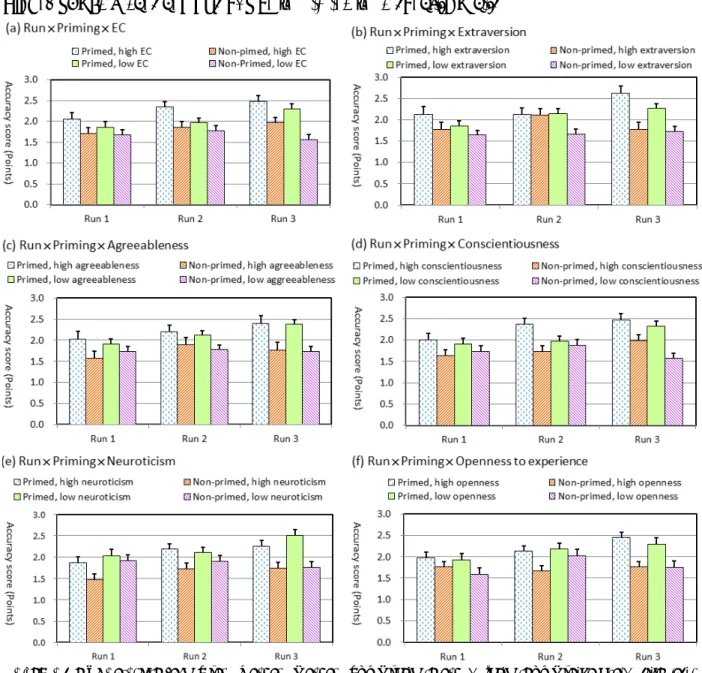
Analyses of simple main effects for run × priming × EC interaction found that both EC groups steadily performed better on insight problem solving across the three runs in the primed situation (ps < .05); no improvements across the three runs were found in the non-primed situation for either group. Moreover, participants with a higher level of EC outperformed their counterparts in the second run of the primed situation (p = .026) and in the third run of the non-primed situation (p = .032). See Figure 6a for means and SEs for emotional creativity.
Effects of Big Five Personality Traits on Insight Problem Solving
Effects of Extraversion on Insight Problem Solving
In analyzing effects of the Big Five personality traits on insight problem solving, we divided each of the personality traits into the high vs. the low group by mean. First of all, a 3 (run 1 vs. run 2 vs. run 3) × 2 (primed vs. non-primed) × 2 (high extraversion vs. low extraversion) repeated-measures ANOVA revealed a significant main effect of extraversion, F(1, 113) = 4.537, p = .035,
ηp2 = .039, a main effect of runs, F(2, 112) = 3.475, p = .034, ηp2 = .058, and a main effect of
priming on the accuracy of insight problem solving, F(1, 113) = 40.030, p < .001, ηp2 = .262.
Specifically, participants with a higher level of extraversion outperformed their counterparts; they also obtained higher scores in the third run than in the first run and performed better in the primed situation than in the non-primed situation.
Analyses of simple main effects for run × priming × extraversion interaction found both extraversion groups steadily performed better on insight problem solving across the three runs in the primed situation; however, the low-extraversion group improved slightly more than the high-extraversion group in the primed situation. No improvements across the three runs were found in the non-primed situation for either group. Moreover, participants with a higher level of extraversion did not outperform their counterparts in any of the three runs of the primed situation, but did so in the second run of the non-primed situation (p = .028). See Figure 6b for means and SEs for extraversion.
Effects of Agreeableness on Insight Problem Solving
A 3 (run 1 vs. run 2 vs. run 3) × 2 (primed vs. non-primed) × 2 (high agreeableness vs. agreeableness) repeated-measures ANOVA revealed a main effect of runs, F(2, 112) = 3.695, p = .028, ηp2 = .062, and a main effect of priming on the accuracy of insight problem solving, F(1,
113) = 42.281, p < .001, ηp2 = .272. Specifically, participants obtained higher scores in the third
situation. However, no significant main effect of agreeableness or interaction effects were found. See Figure 6c for means and SEs for agreeableness.
Figure 6: The Means and SEs of Run × Priming × Personality Traits
Note. Ms and SEs resulted from 3 (run 1 vs. run 2 vs. run 3) × 2 (primed vs. non-primed) × 2 (high personality trait vs. low personality trait) repeated-measures ANOVA. (a) Effects of emotional creativity (EC) on insight problem solving; (b) Effects of extraversion on insight problem solving ; (c) Effects of agreeableness on insight problem solving ; (d) Effects of conscientiousness on insight problem solving; (e) Effects of neuroticism on insight problem solving ; (f) Effects of openness on insight problem solving.
Effects of Conscientiousness on Insight Problem Solving
A 3 (run 1 vs. run 2 vs. run 3) × 2 (primed vs. non-primed) × 2 (high conscientiousness vs. low conscientiousness) repeated-measures ANOVA revealed a significant main effect of runs, F(2, 112) = 4.650, p = .011, ηp2 = .077, and a main effect of priming on the accuracy of insight problem
in the third run than in the first run; they also performed better in the primed situation than in the non-primed situation. See Figure 6d for means and SEs for conscientiousness.
The main effect of conscientiousness was not significant, F(1, 113) = 2.158, p = .145, ηp2 = .019.
However, analyses of simple main effects for run × priming × conscientiousness interaction found in the primed situation revealed the low-conscientiousness group did not have a significant improvement in insight problem solving until the third run (p = .041), whereas the high-conscientious group had a significant improvement in the second run (p = .041). No improvements across the three runs were found in the non-primed situation for either group. However, participants with a higher level of conscientiousness outperformed their counterparts only in the second run of the primed situation (p = .020) and in the third run of the non-primed situation (p = .028).
Effects of Neuroticism on Insight Problem Solving
A 3 (run 1 vs. run 2 vs. run 3) × 2 (primed vs. non-primed) × 2 (high neuroticism vs. low neuroticism) repeated-measures ANOVA revealed a significant main effect of runs, F(2, 112) = 3.837, p = .023, ηp2 = .033, and a main effect of priming on the accuracy of insight problem solving,
F(1, 113) = 46.388, p < .001, ηp2 = .291. Specifically, participants obtained higher scores in the
third run than in the first run; they also performed better in the primed situation than in the non-primed situation.
Analyses of simple main effects for run × priming × neuroticism interaction found both neuroticism groups steadily performed better in insight problem solving across the three runs in the primed situation, but only the low-neuroticism group significantly improved in insight problem solving (p = .020). No improvements across the three runs were found in the non-primed situation for either group. Moreover, participants with a lower level of neuroticism did not outperform their counterparts in either of the runs. See Figure 6e for means and SEs for neuroticism.
Effects of Openness on Insight Problem Solving
A 3 (run 1 vs. run 2 vs. run 3) × 2 (primed vs. non-primed) × 2 (high openness vs. low openness) repeated-measures ANOVA revealed a significant main effect of runs, F(2, 112) = 3.937, p = .022,
ηp2 = .066, and a main effect of priming on the accuracy of insight problem solving, F(1, 113) =
42.200, p < .001, ηp2 = .338. Specifically, participants obtained higher scores in the third run than
in the first run; they also performed better in the primed situation than in the non-primed situation. Analyses of simple main effects for run × priming × conscientiousness interaction found that only the high-openness group significantly improved in insight problem solving across runs in the primed situations (p = .029). See Figure 6f for means and SEs for openness to experience.
Discussion
Manipulation Effects of Priming
This study aimed to understand how personality traits interacted with associative response priming (primed vs. non-primed) and then influenced situation-based insight problem solving involving associations of novel objects. Seven hypotheses were proposed. The first hypothesis was partially supported. The results revealed no RT differences in insight problem solving between the two
priming situations; however, the participants significantly performed better in the primed situation than in the non-primed situation with regard to correct responses of insight problem solving, and such a difference grew stronger over time. Accordingly, the differences of insight problem solving performance in the two priming situations can be attributed to the priming manipulations. These results are in line with previous findings that priming facilitates insight problem solving and that the priming effect is more than stimuli recognition (Moss et al., 2011); it gradually enhances the accuracy of problem solving (Bowden, 1997). The findings suggest that introducing correlated priming stimuli helps activate memory and moderate attention focus and thereby further contributes to the performance of insight problem solving.
Implicit information has considerable influence on an individual’s thoughts and behavior (Eagleman, 2011). The insignificant group differences in RT and gradually enhanced priming effects on accuracy suggest the priming and insight problem solving tasks employed in this study involve implicit learning and that insight problem solving is greatly governed by an implicit learning mechanism. In our study, only half of the insight problem solving tasks were primed; the findings support Howe et al.’s (2010) conclusions that priming can occur with information that has not been physically presented but has been internally generated incidentally and automatically outside of conscious awareness, and such priming effects can facilitate solution-processing rates in insight problem solving tasks. In addition, our findings support subliminally presented priming stimuli significantly enhance subsequent performance on insight problems (e.g., Hattori et al., 2013; Suzuki & Fukuda, 2013).
The Interactive Effects of Personality Traits and Priming on Insight Problem Solving
It has been suggested that the process of insight problem solving is influenced by an implicit learning mechanism that detects the differences between current and goal states and regulates the strengths of the responsible operators (Suzuki & Fukuda, 2013). To date, no study has been conducted to understand how EC and Big Five personality traits interact with priming and then regulate the process of situation-based insight problem solving. We therefore sought to answer these questions in this study.
With regard to the interactive effects of personality traits and priming (hypothesis 2 to hypothesis 7), the analytical results reveal a consistent trend (i.e., the effect of priming on insight problem solving gradually grew as practice and implicit learning increased), regardless of the types of personality traits. Such findings suggest insight problem solving can be trained and when priming is offered, practice can improve performance over time. Moreover, the findings support priming can trigger unaware insightful thoughts and appropriate strategy use during insight problem solving (Hattori et al., 2013). Among the six personality traits (EC and the Big Five personality traits) proposed, EC and extraversion had the strongest interaction effects with priming during insight problem solving, followed by conscientiousness and openness to experience.
With regard to the interaction effects of the Big Five personality traits and priming during insight problem solving, there were several salient findings. Statistically significant differences were found in the non-primed condition of extraversion. Participants with a high disposition of extraversion may have increased levels of mindfulness, positive emotion, and stress coping, relative to those scoring low in extraversion. In the primed condition, salient findings were observed for the personality traits of conscientiousness and neuroticism. Highly conscientious
people may be sensitive and mindful to priming as well as persistent and attentive in problem solving; as a result, they steadily improved their performance during insight problem solving. Participants with a lower level of neuroticism performed better in insight problem solving than those with a higher level of neuroticism. These findings are in line with the results concerning Big Five personality traits, divergent thinking, (e.g., Batey et al., 2010; Lin et al., 2012) and insight problem solving (e.g., Chamorro-Premuzic & Reichenbacher, 2008; Sava et al., 2012). More importantly, the findings suggest participants who scored high in conscientiousness and low in neuroticism may have a higher level of mindfulness during insight problem solving and apply appropriate strategies during challenges. Finally, although agreeableness is related to openness to experience (Lin et al., 2013) and mindfulness (Spinhoven et al., 2017), it may not closely relate to the regulation of emotion in the face of challenges during insight problem solving.
The gradually enhanced priming effect in the high-EC group supports that increased attention correlated positively with recall performance after a positive mood induction (Farb et al., 2013) and emotions influence the spatiotemporal course of overt attention (Kaspar et al., 2015). The findings here also suggest that participants with a high level of emotional creativity were able to integrate the learning feedback into executive processing. Accordingly, emotional creativity, which is related to one’s ability to express and regulate emotions as well as implicit judgment and decision-making, plays an important regulation role in frustrating problem solving situations. Our findings suggest that individuals who are extraverted, conscientious, and open to experience may experience positive emotions as a result of primes, which further contributes to flexible thinking and insight problem solving. On the contrary, those who are higher in neuroticism may fail to engage in positive mood maintenance (Augustine & Larsen, 2011) and, therefore, perform worse during insight problem solving. These findings suggest positive mood contributes to the cognitive process of semantic priming tasks. Personality traits may interact with priming during insight problem solving for two cognitive processes—the unconscious process (which involves emotions, associative and intuitive thinking, and effortless manner without capacity limits) and the conscious process (which involves focused attention, strategic thinking, decision making, and resource-limited processing). While extraversion and openness to experience may be more related to the unconscious process, a high level of conscientiousness and a low level of neuroticism may be more related to the conscious process.
Conclusions, Limitations, Implications, and Future Research
Conclusions
This study proposed a new paradigm for investigating priming and insight problem solving, in which participants were exposed to partially direct priming with recognition memory tasks that associated novel objects (associative response priming) and then were challenged by situation-based insight problems. Based on past findings, a two-path model of how associative response priming interacts with personality traits and carries effects on insight problem solving was proposed, and the interaction effects of priming manipulation and personality traits on insight problem solving over time were analyzed. The results showed emotional creativity as well as extraversion, openness to experience, neuroticism, and conscientiousness play important moderating roles during the processes of insight problem solving when associative response
priming is offered. Overall, the priming effect as well as the moderating effect of personality traits grew over time.
The findings of this study suggest insight problem solving, although largely governed by an implicit learning mechanism, involves both conscious and unconscious cognitive processes. Moreover, the personality traits of emotional creativity, extraversion, agreeableness, openness, and conscientiousness are related to mindfulness, focused attention, persistence, positive emotion, and flexible thinking; these cognitive mechanisms may facilitate insight problem solving in primed situations. Insight problem solving has been regarded as an important strategy for creativity, which is highly deemed at all levels of education. The theoretical model proposed as well as the findings in this study provides valuable references to creativity training when priming strategies are employed.
Limitations
In this study, the insight problem solving was not measured directly. Instead, it was measured by the question Did you come up with the answer? If the participant answered Yes, the correct answer was displayed and the question Is this your answer? followed. Through this process, the correct answer was double checked to avoid false answers. The right answer could have been displayed in a multiple-choice item at the beginning. However, this may give participants chances to guess the answer, which would confound the priming effect. Although the measuring method used was not perfect, the double-check process seemed to be the best way to get the data we wanted owing to the limitation of E-prime. E-prime is not compatible with Flash, so the participants could not click on the answers directly on the insight problem solving screen. Further studies could write the experimental program using other software to overcome this problem.
Implications and Future Research
A few studies in the past decade have tried to investigate the relationship between the Big Five personality traits and two types of creativity, namely, divergent thinking and insight problem solving. However, the results are inconsistent (e.g., Lin et al., 2012; Lin et al., 2013; Puryear et al., 2019). These results suggest divergent thinking and insight problem solving involve different cognitive processes and have a different relationship with personality traits; insight problem solving may involve more conscious cognitive processes than divergent thinking. Moreover, emotional creativity, which involves emotion regulation and implicit decision-making, is seldom studied during insight problem solving. This study developed a new paradigm and focused only on insight problem solving. Future studies can explore whether the interaction patterns of priming manipulation and the Big Five personality traits as well as those of priming manipulation and emotional creativity would be different in insight problem solving and divergent thinking. Finally, the results of this study showed college students’ insight problem solving can be improved by priming and practice, this is partially consistent with the finding of previous research concerning the impact of future-thought priming on insight and analytic problem-solving (Slepian et al., 2010; Truelove-Hill et al., 2018). It is worth noting that different types of priming may generate different levels of impact on insight problem solving. Thus, more research with different mechanisms of priming is needed. Nevertheless, as the associative response priming we employed in this study can facilitate creative insight problem solving and analytical thinking process,
educational trainers can employ this priming approach to facilitate the learning of these higher-order thinking skills. Moreover, cultivating the positive personality traits found in this study can be considered when classroom teaching or training is focused on enhancing the ability of insight problem solving or creativity.
References
Abraham, A., & Windmann, S. (2007). Creative cognition: The diverse operations and the prospect of applying a cognitive neuroscience perspective. Method, 42, 38-48.
Augustine, A. A., & Larsen, R. J. (2011). Affect regulation and temporal discounting: Interactions between primed, state, and trait affect. Emotion, 11(2), 403-412.
Averill, J. R. (1999). Individual differences in creativity: Structure and correlates. Journal of Personality, 67(2), 331-371.
Averill, J. R. (2004). A tale of two snarks: Emotional intelligence and emotional creativity compared. Psychological Inquiry, 15, 228-233.
Averill, J. R. (2009). Emotional creativity: Toward “spiritualizing the passions”. In S. J. Lopez & C. R. Synder (Eds.), The Oxford handbook of positive psychology (pp. 249-257). Oxford University Press.
Baddeley, A. D. (2000). The episodic buffer: A new component of working memory? Trends in Cognitive Sciences, 4, 417-423.
Barnhofer, T., Duggan, D. S., & Griffith, J. W. (2011). Dispositional mindfulness moderates the relation between neuroticism and depressive symptoms. Personality and Individual Differences, 51(8), 958-962.
Batey, M., Furnham, A., & Safiullina, X. (2010). Intelligence, general knowledge and personality as predictors of creativity. Learning and Individual Differences, 20(5), 532-535.
Bowden, E. M. (1997). The effect of reportable and unreportable hints on anagram solution and the aha! experience.
Consciousness and Cognition, 6(4), 545-573.
Carlisle, N. B., & Kristjánsson, A. (2019). How visual working memory contents influence priming of visual attention. Psychological Research, 82(5), 833-839.
Chamorro-Premuzic, T., & Reichenbacher, L. (2008). Effects of personality and threat of evaluation on divergent and convergent thinking. Journal of Research in Personality, 42, 1095-1101.
Chang, Y. C. C., Khan, S., Taulu, S., Kuperberg, G., Brown, E. N., Hämäläinen, M. S., & Temereanca, S. (2018). Left-lateralized contributions of saccades to cortical activity during a one-back word recognition task.
Frontiers in Neural Circuits, 12, 1-16. http://dx.doi.org/10.3389/fncir.2018.00038.
Chein, J. M., & Weisberg, R. W. (2013) Working memory and insight in verbal problems: Analysis of compound remote associates. Memory & Cognition, 42(1), 67-83.
Cowan, N. (1999). An embedded process model of working memory. In A. Miyake & P. Shah (Eds.), Models of working memory (pp. 62-101). Cambridge University Press.
De Belder, M., Abrahamse, E., Kerckhof, M., Fias, W., & van Dijck, J. P. (2019). Correction: “Serial position markers in space: Visuospatial priming of serial order working memory retrieval”. PLoS ONE, 14(3), 1-10. https://doi.org/10.1371/journal.pone.0214762
Dietrich, A. (2004). The cognitive neuroscience of creativity. Psychonomic Bulletin & Review, 11(6), 1011-1026. Dubey, S., Singh, I. L., & Srivastava, S. (2014). Effect of personality on working memory capacity. Indian Journal
of Positive Psychology, 5(2), 150-154.
Eagleman, D. (2011). Incognito: The secret lives of the brain. Pantheon Books.
Farb, N. A., Chapman, H. A., & Anderson, A. K. (2013). Emotions: form follows function. Current Opinion in Neurobiology, 23(3), 393-398.
Fredrickson, B. L. (1998). Cultivated emotions: Parental socialization of positive emotions and self-conscious emotions. Psychological Inquiry, 9(4), 279-281.
Fuchs, G. L., Kumar, V. K., & Porter, J. (2007). Emotional creativity, alexithymia, and styles of creativity.
Creativity Research Journal, 19(2-3), 233-245.
Gilmore, A. W., Kalinowski, S. E., Milleville, S. C., Gotts, S. J., & Martin, A. (2019). Identifying task-general effects of stimulus familiarity in the parietal memory network. Neuropsychologia, 124, 31-43. Giluk, T. L. (2009). Mindfulness, Big Five personality, and affect: A meta-analysis. Personality and Individual
Differences, 47, 805–811.
Gomes, C. A., Figueiredo, P., & Mayes, A. (2016). Priming for novel object associations: Neural differences from object item priming and equivalent forms of recognition. Hippocampus, 26(4), 472-91.
Hammerstein, S., Poloczek, S., Lösche, P., Lemaire, P., & Büttner, G. (2019), Show more effects of working memory updating on children’s arithmetic performance and strategy use: A study in computational estimation. Journal of Experimental Child Psychology, 184, 174-191.
Hattori, M., Sloman, S. A., & Orita, R. (2013). Effects of subliminal hints on insight problem solving. Psychonomic Bulletin & Review, 20, 790-797.
Howe, M. L., Garner, S. R., Dewhurst, S. A., & Ball, L. J. (2010). Can false memories prime problem solutions?
Cognition, 117, 176-181.
Ivcevic, Z., Brackett, M. A., & Mayer, J. D. (2007). Emotional intelligence and emotional creativity. Journal of Personality, 75(2), 199-236.
Jach, H. K., Sun, J., Loton, D., Chin, T. C., & Waters, L. E. (2018). Strengths and subjective wellbeing in
adolescence: Strength-based parenting and the moderating effect of mindset. Journal of Happiness Studies, 19, 567-586.
James, K., & Taylor, A. (2010). Positive creativity and negative creativity (and unintended consequences). In D. H. Cropley, A. J. Cropley, J. C. Kaufman, & M.A. Runco (Eds.), The dark side of creativity (pp. 33–56). Cambridge University Press.
Kaspar, K., Gameiro, R. R., & König, P. (2015). Feeling good, searching the bad: Positive priming increases attention and memory for negative stimuli on webpages. Computers in Human Behavior, 53, 332-343. Klapp, S. T. (2015). One version of direct response priming requires automatization of the relevant associations but
not awareness of the prime. Consciousness and Cognition: An International Journal, 34, 163-175. Korovkin, S., Vladimirov, I., Chistopolskaia, A., & Savinova, A. (2018). How working memory provides
representational change during insight problem solving. Frontiers in Psychology, 9, 1-16.
Kounios, J, & Beeman, M. (2014). The cognitive neuroscience of insight. Annual Review of Psychology, 65, 71–93. Kushner, S. C., Bagby, R. M., & Harkness, K. L., (2017). Stress generation in adolescence: Contributions from
five-factor model (FFM) personality traits and childhood maltreatment. Personality Disorders: Theory, Research, and Treatment, 8, 50-161.
Lai, G. J., Yeh, Y., Lin, C. W, Hsu, W. C., & Wu, J. (2017). The interactive influences of stress, modality of stimuli, and task difficulty on verbal versus visual working memory capacity. Learning and Individual Differences, 56, 19-127.
Lee, J. Y., & Yeh, Y. (2009, October). The revision of “Inventory of Emotional Creativity for College Students” and the individual differences of emotional creativity. Paper presented in Annual Conferences of Association of Chinese Testing, National Taiwan University, Taipei, Taiwan.
Lin, W. L., Hsu, K. Y., Chen, H. C., & Chang, W. Y. (2013). Different attentional traits, different creativities.
Thinking Skills and Creativity, 9, 96-106.
Lin, W. L., Hsu, K. Y., Chen, H. C., & Wang, J. W. (2012). The relations of gender and personality traits on different creativities: A dual-process theory account. Psychology of Aesthetics, Creativity, and the Arts, 6(2), 112.
Minas, R. K., Dennis, A. R., Potter, R. F., & Kamhawi, R. (2018). Triggering insight: Using neuroscience to understand how priming changes individual cognition during electronic brainstorming. Decision Sciences, 49(5), 788-826.
Moss, J., Kotovsky, K., & Cagan, J. (2011). The effect of incidental hints when problems are suspended before, during, or after an impasse. Journal of Experimental Psychology: Learning, Memory, and Cognition, 37(1), 140.
Mumford, M. D., Feldman, J. M., Hein, M. B., & Nagao, D. J. (2001). Tradeoffs between ideas and structure: Individual versus group performance in creative problem solving. Journal of Creative Behavior, 35(1), 1-23.
Ochsner, K. N., Chiu, C. Y. P., & Schacter, D. L. (1994). Varieties of priming. Current Opinion in Neurobiology, 4(2), 189-194.
Orita, R., & Hattori, M. (2019). Positive and negative affects facilitate insight problem-solving in different ways: A study with implicit hints. Japanese Psychological Research, 61(2), 94-106.
Puryear, J. S., Kettler, T., & Rinn, A. N. (2019). Relating personality and creativity: Considering what and how we measure. The Journal of Creative Behavior, 53(2), 232-245.
Rau, H. K., & Williams, P. G. (2016). Dispositional mindfulness: A critical review of construct validation research.
Personality and Individual Differences, 93, 32–43.
Rammstedt, B., & John, O. P. (2007). Measuring personality in one minute or less: A 10-item short version of the Big Five Inventory in English and German. Journal of Research in Personality, 41, 203-212.
Sava, F. A., Maricutoiu, R., Macsinga, L. T. P., Vîrgă, S., Macsinga, I., Cheng, C. M., & Payne, B. K. (2012). An inkblot for the implicit assessment of personality: The semantic misattribution procedure. European Journal of Personality, 26(6), 613-628.
Siefert, C. M., Meyer, D. E., Davidson, N., Patalano, A. L., & Yaniv, I. (1995). Demystification of cognitive insight: Opportunistic assimilation and the prepared-mind perspective. In R. J. Sternberg, & J. E. Davidson (Eds.),
The nature of insight (pp. 65-124). MIT Press.
Skandrani-Marzouki, I., & Marzouki, Y. (2010). Subliminal emotional priming and decision making in a simulated hiring situation. Swiss Journal of Psychology, 69(4), 213–219.
Slepian, M. L., Weisbuch, M., Rutchick, A. M., Newman, L.S., & Ambady, N. (2010). Shedding light on insight: Priming bright ideas. Journal of Experimental Social Psychology, 46(4), 696-700.
Spinhoven, P., Huijbers, M. J., Zheng, Y., Ormel, J., & Speckens, A. E. M. (2017). Mindfulness facets and Big Five personality facets in persons with recurrent depression in remission. Personality and Individual
Differences, 110, 109-114.
Stanciu, M. M., & Papasteri, C. (2018). Intelligence, personality and schizotypy as predictors of insight. Personality and Individual Differences, 134, 43-48.
Suzuki, H., & Fukuda, H. (2013). Unconscious nature of insight problem solving: An analysis using subliminal priming by continuous flash suppression. Cognitive Studies, 20, 353-367.
Szuhany, K. L., MacKenzie, D., & Otto, M. W. (2018). The impact of depressed mood, working memory capacity, and priming on delay discounting. Journal of Behavior Therapy and Experimental Psychiatry, 60, 37-41. Uliaszek, A. A., Zinbarg, R. E., Mineka, S., Craske, M. G. A., Griffith, J. W., Sutton, J. M., Epstein, A., &
Hammen, C. (2012). A longitudinal examination of stress generation in depressive and anxiety disorders.
Journal of Abnormal Psychology, 121(1), 4-15.
Yeh, Y., Tsai, J. L., Hsu, W. C., Lin, C. F. (2014). A model of how working memory capacity influences insight problem solving in situations with multiple visual representations: An eye tracking analysis. Thinking Skills & Creativity, 13, 153-167.
Yeh, Y., Lai, G. J., Lin, C. F., Lin, C. W., & Sun, H. C. (2015). How stress influences creativity in game-based situations: Analysis of stress hormone, negative emotions, and working memory. Computers & Education, 81, 143-153.
Truelove-Hill, M., Erickson, B. A., Anderson, J., Kossoyan, M., & Kounios, J. (2018). A growth-curve analysis of the effects of future-thought priming on insight and analytical problem-solving. Frontiers in Psychology, 9, 1-9.
Webb, M. E., Little, D. R., & Cropper, S. J. (2016). Insight is not in the problem: Investigating insight in problem solving across task types. Frontiers in Psychology, 7, 1-13.
Xing, Q., Rong, C., Lu, Z., Yao, Y., Zhang, Z., & Zhao, X. (2018). The effect of the embodied guidance in the insight problem solving: An eye movement study. Frontiers in Psychology, 9, 1-14.
Zemack-Rugar, Y., Bettman, J. R., & Fitzsimons, G. J. (2007). The effects of nonconsciously priming emotion concepts on behavior. Journal of Personality and Social Psychology, 93(6), 927–939.
Acknowledgements
This study was supported by the Ministry of Science and Technology in Taiwan (Contract Nos. NSC 100-2511-S-004-002-MY3, and MOST 103-2511-S-004 -002-MY3).