Integrated Distributed Authentication Protocol for
Smart Grid Communications
Neetesh Saxena,
Member, IEEE,
and Bong Jun Choi,
Member, IEEE
Abstract—In the smart grid, an integrated distributed authentication protocol is needed to not only securely manage the system but also efficiently authenticate many different entities for the smart grid communications. In addition, a lightweight authentication protocol is required to handle frequent authentications among billions of devices. Unfortunately, in the literature, there is no such integrated protocol that provides mutual authentications among the home environment, energy provider, gateways, and advanced metering infrastructure network. Therefore, in this paper, we propose a lightweight cloud trusted authorities-based integrated (centrally controlled) distributed authentication protocol that provides mutual authentications among various communicated entities in a distributed manner. Based on certificateless cryptography, our protocol is lightweight and efficient even if there are invalid requests contained a batch. Security and performance analysis show that the protocol provides privacy preservation, forward secrecy, semantic security, perfect key ambiguous, and protection against identity thefts while generating lower overheads in comparison with the existing protocols. Also, the protocol is secure against man-in-the-middle attacks, redirection attacks, impersonation attacks, and
denial-of-service attacks. Moreover, our protocol provides a complete resistance against the flood-based denial-of-service attacks in the smart grid.
Index Terms—Authentication, Smart grid, DoS attacks, Redirection attacks, Cloud computing.
F
1
INTRODUCTION
T
HE smart grid (SG) is a critical infrastructure, whoseobjective is to provide more efficient, secure, stable, and reliable power to consumers, operators, and utilities.
The SG system for home environment consists of various
components such as smart meters (SM), home appliances
(HA), energy providers (EP), gateways (GW), and advanced
metering infrastructure (AMI) network. It is generally
as-sumed that home area network (HAN) is wirelessly
con-nected with the Zigbee technology [1], whereas the building
area network (BAN)/neighborhood area network (NAN)
is connected by wide area network (WAN) technologies
and cellular technologies, such as global system for mobile
communication (GSM) and long term evolution (LTE) [2].
Smart meters can be considered to be equipped with two communication interfaces, where one interface works as a
SMand the other works as aHAN-GW. Therefore, theSM
is a central home controller that communicates with all the
HA within a household. Further, BAN-GW/NAN-GW acts
as (or deploy) an aggregator (AG) that receives data from
the SM and forwards it to the respective control center
(CC) via relays and concentrators with via wired/wireless
• N. Saxena is with the Department of Electrical and Computer Engineer-ing, Georgia Institute of Technology, USA.
E-mail: [email protected].
• B.J. Choi is with the Department of Computer Science, State University of New York (SUNY) Korea, Incheon, South Korea and jointly with the Department of Computer Science, Stony Brook University, NY, USA. E-mail: [email protected].
This research was funded by the MSIP (Ministry of Science, ICT and Future Planning), Korea, under the “ICT Consilience Creative Program” (IITP-2015-R0346-15-1007) supervised by the IITP (Institute for Information & Com-munications Technology Promotion) and under the “Basic Science Research Program” (2013R1A1A1010489, 2015R1C1A1A01053788) through the NRF (National Research Foundation).
Manuscript received xxx xx, xxxx; revised xxx xx, xxxx.
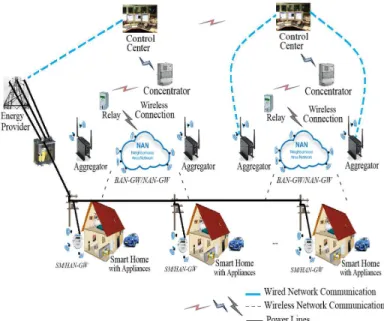
connections. Figure 1 shows the overall architecture of the
SGsystem.
Fig. 1: Overall architecture of the smart grid system.
Two-way communications in the SG enable instant
in-teraction between differentSGentities and help to improve
the overall efficiency of the SG system. However, without
proper authentications, the system resources and entities can be compromised that may result in financial losses
and performance degradation [3], [4]. Therefore, in theSG
system, an integrated, distributed, fast, and lightweight authentication protocol is needed to provide mutual
integrated distributed protocol can maximize the utilization of shared resources while generating low overhead. In the
SGsystem, a fast and lightweight protocol is required as the
authentication process is frequently repeated many times among billions of devices. Further, the security protocol of
the SG system must provide defense against the known
security attacks, including man-in-the-middle (MITM) and
denial-of-service (DoS) attacks [5]. According to the NIST
reports, one of the main security issues in theSGsystem is
that the authentication mechanism does not sufficiently au-thenticate devices or exposes authentication keys. Therefore, a centralized authentication in decentralized environment is required for the centralized security management in terms of event logging/analysis and authentication [6], [7].
There are many different communication protocols used for delivering various commands and control information. These protocols were not designed initially with security
in mind. Today, when Internet is connected to theSG
sys-tem, various organizations, such as ETSI,IEEE, and NIST
are embedding security to the existing protocols as new standards in order to prevent the system against various well known security attacks. However, they need to modify many communication standards for making them security embedded. This creates additional overheads. Furthermore, researchers have not yet focused much on an integrated protocol, rather they have proposed separate protocols for
individual connections between different entities in theSG.
They have not discussed the integration of these protocols for compatible communication among them. This motivates us to propose such an efficient and secure authentication
protocol for theSGsystem. However, there are several
chal-lenges in designing an integrated distributed authentication protocol as we identified below:
• The protocol should not only be controlled by a
central entity, but also by the subsystems of theSG
network in a distributed manner.
• Embedding security solutions in each
communica-tion protocol of theSGnetwork not only are highly
complex but also generate huge overhead and cost. Therefore, it would be more flexible and efficient to instead design a cyber-security layer over the communication network to maintain end-to-end se-curity [8]. This simplifies the integration at the cyber-security layer, rather than integrating different
com-munication protocols in theSGnetwork.
• The protocol should be able to fully utilize the
avail-able system resources.
• The generated overhead by the protocol should be
as low as possible. The protocol should be fast and lightweight, as the authentication process is fre-quently repeated many times among billions of de-vices, especially, when devices receive multiple mes-sages at once, such as when gateways/aggregators authenticate multiple smart meters and gather data from them.
• The protocol must utilize the suitable cryptosystem
(with symmetric and/or asymmetric keys) as recom-mended by various standard organizations, such as
IEEE, ETSI, andNIST. Particularly, NIST report [6]
emphasizes the issues of key exchange in symmetric
key cryptography and the public key infrastructure
(PKI) in asymmetric key cryptography. Hence, key
management issue must be considered in the design of the protocol.
• The protocol should enable consumers to have the
security control over his/her home,i.e., control over
all the home appliances with the smart meter.
• The protocol must support secure communication
over the network with strong encryption. Moreover, the identity of each device should be protected over the network to maintain identity anonymity and untraceability.
• The protocol must be able to defeat various
well-known security attacks, such asMITMattacks,
redi-rection attacks, impersonation attacks, replay attacks,
and flood-basedDoSattacks.
1.1 Research Problem
There are several challenges with the current authentica-tion protocols in terms of efficiency, overhead, cost, delay, privacy, and etc. Also, many vulnerabilities do exist in the available authentication schemes of various communication
protocols for theSG, such as weak encryption and message
digest in the OSGP protocol, security issues in the DNP3
protocol (even in version 5), etc. There is not yet an in-tegrated distributed authentication protocol that provides mutual authentications between the home environment
(HA,SM,HAN-GW), energy provider, gateways (BAN-GW,
NAN-GW), and AMI network (SM, aggregator/collector,
CC). An integrated protocol can provide a common
plat-form for authenticating various devices while efficiently maximizing the utilization of shared resources with low
overhead in theSGsystem. Also, the privacy protection in
theSGsystem is an important requirement, so the protocol
must not reveal the confidential and private information related to any entity involved in the authentication process. Therefore, an end user (consumer) should have a control
over his/her own home environment, such as HA, since
data generated and being sent belong to a particular user. Furthermore, the protocol must be fast and efficient, and should be able to defeat known security attacks.
1.2 Our Contribution
In this paper, we design an integrated distributed
proto-col for the SG network, which meets all aforementioned
challenges discussed in the previous subsection. Note that the proposed protocol may not be suitable for some parts
of the SG system with very low communication latency
requirements, such as for the generic object oriented
substa-tion event (GOOSE) and sampled measured values (SMV)
layer-2 messages within the substation. Here, messages are not encrypted due to the transmission requirements
within 4 milliseconds (ms). In such scenarios, a virtualLAN
(VLAN) with layer-2 capabilities can be used with signed
authenticated values [16], or a simple lightweight protocol can be designed for the authentication with integrity, but
without encryption. Our new SG authentication protocol
• Provides mutual authentications between theEPand
the SM, between the SM/HAN-GW and the
BAN-GW/NAN-GW, between the SM and the HA, and
between theNAN-GWand theCC.
• Provides a secure solution for the consumers to
choose or change the energy provider of their own choice. The protocol provides more satisfaction to the consumer as he/she will have the control over
itsHA(secured with a password shared between the
SMand all theHAand only he/she can change it).
• Defeats various security attacks: defeats the
flood-based DoS attacks targeting transmitted messages
between theSM/HAN-GWand theBAN-GW/
NAN-GW; protects the SM and the EP from redirection
attacks as Zip codes are verified at both ends; pre-serves the privacy of each message as it is encrypted before being transmitted over the network; provides
resistances against ID thefts, MITM attacks, replay
attacks, brute-force attacks, repudiation attacks, and impersonation attacks.
• Lightweight in terms of communication and
com-putation overheads. The execution time of 3.96 s
in Java can be considered fast, as it is for all the
involved entities in the SG network and is within
the requirements (few minutes) set by the standards [6].
• Uses the cloud-based trusted authorities (TA) for key
management, which does not have the key exchange
orPKIissues. Instead, theTAgenerates partial public
and private keys, and the legitimate device generates its actual public and private keys.
1.3 Organization of the Paper
The rest of the paper is organized as follows: Section 2
discusses the related work and Section 3 presents our SG
system model. A new authentication protocol is proposed in Section 4. Security and performance analysis is presented in Section 5, including a formal proof of the protocol. Section 6 presents the conclusion of this work.
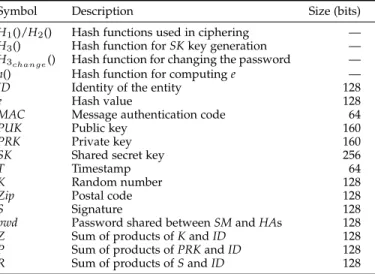
Table 1 summarizes various symbols and abbreviations used in the paper along with their descriptions and sizes. Note that the sizes of public and private keys may depend upon the algorithm used in asymmetric encryption.
2
RELATED
WORK
We first discuss the standardized protocols in SG along with their limitations. Then, we will present existing authentica-tion protocols that provide authenticaauthentica-tions between various entities with lower overhead, and then those that provide protection against various security attacks and preserves the
privacy in theSG.
There are some standardized protocols available in the
literature for theSG, which support authentication process,
such as open smart grid protocol (OSGP) for the smart
meters, distributed network protocol (DNP3) between the
control center and the substations, device language message specification/companion specification for energy metering
(DLMS/COSEM) for the AMI network, and OpenADR for
the demand response program. In addition, some standard-ized authentication protocols also support authentication,
TABLE 1: Symbols And Abbreviations
Symbol Description Size (bits)
H1()/H2() Hash functions used in ciphering —
H3() Hash function forSKkey generation —
H3change() Hash function for changing the password —
h() Hash function for computinge —
ID Identity of the entity 128
e Hash value 128
MAC Message authentication code 64
PUK Public key 160
PRK Private key 160
SK Shared secret key 256
T Timestamp 64
K Random number 128
Zip Postal code 128
S Signature 128
pwd Password shared betweenSMandHAs 128
Z Sum of products ofKandID 128
P Sum of products ofPRKandID 128
R Sum of products ofSandID 128
such as remote authentication dial-in user service (RADIUS)
and Diameter protocols for the 2G, 3G, and 4G cellular
networks [9].
TheOSGPprotocol, which was developed by energy
ser-vice network association (ESNA) and is a standard of the
Eu-ropean telecommunications standards institute (ETSI), was
deployed for providing the authentication and confidential
security to the SG applications. This protocol is expected
to provide reliable and efficient delivery of command and control information between the smart meters, direct load
control modules, gateways, and otherSGdevices. However,
recently, researchers from Germany easily recovered private encryption keys of the smart meters in a system following
OSGPwithout a significant computational effort [10]. Also, a
number of attacks has been performed over theOSGP
proto-col [11], including one with just 13 queries to a homegrown
message authentication code (OMAdigest) oracle, and by
which the protocol further failed to deliver authenticity guarantee and confidentiality (due to using a non-standard
composition of RC4 as weak encryption algorithm) [10].
Similar security issues were found in the DNP3 protocol,
which does not provide authentication, message integrity,
and confidentiality. In 2012, a new version of the DNP3
protocol, namedDNP3secure authentication version 5, was
announced, which provides methods to remotely change user update keys using either symmetric or asymmetric cryptography [12]. However, it considers only spoofing, modification, and replay attacks over the network, and does not provide confidentiality of the message. Also version 5 of the protocol is not backwards compatible with previous versions, which may add a heavy protocol replacement cost. Furthermore, the authentication supports provided by
DLMS/COSEM,OpenADR,RADIUS, andDiameter are not
sufficient and some of these are also very costly [9].
TheDLMS(application layer communication protocol) and
COSEM(data model), together provide an interface model
for metering applications belonging to IEC 62056
stan-dards, such as electricity [13]. Basically, there are three
authentication options inDLMS/COSEM, i.e., no security,
low level security authentication where server identifies client by a password, and high level security authentication
(mutual identification) with exchange challenges. However,
theDLMS/COSEM’s security services are restricted to use
symmetric key encryption. In practice, smart meters need asymmetric key to be used in secure socket layer/transport
layer security (TLS/SSL), butDLMS/COSEMdoes not
sup-portTLS/SSL. In demand response,OpenADR, which is a
standard development effort, supports authentication based on public key cryptography with exchange of certificates [14]. This standard maintains a hierarchy of certified
au-thorities and requires aPKIto use three-tierPKItechnology,
which ultimately results in high development cost.
RADIUSis commonly used protocol to provide remote
user authentication and accounting in cellular networks,
andWLAN interworking andWi-Fioffload situations [15].
It provides centralized services using a central database.
However, the SG requires decentralized solutions, as a
single-point-of-failure can massively affect the centralized
system.RADIUSimplementation supports peer
authentica-tion between communicaauthentica-tion endpoints using a pre-shared key. Hence, it brings some key management issues and is
not suitable for large systems, such as theSG. Furthermore,
RADIUS has poor scalability and uses the user datagram
protocol (UDP), which does not provide reliable data
trans-fer. Therefore, it is not suitable for theSGwhere the
avail-ability of information is extremely important. On the other
hand,Diameterprotocol is an authentication, authorization,
and accounting protocol used in networking, which
sup-ports transmission control protocol (TCP) instead of UDP.
However, its supported capabilities are sometimes more
expansive. Furthermore, RADIUS and Diameter protocols
do not directly protect against DoS attacks carried out by
flooding the target equipment with bogus traffic.
For providing low overhead, a lightweight authenti-cation scheme based on the Diffie-Hellman key exchange protocol and a hash-based message authentication code
(HMAC) was proposed in [1]. However, it provides mutual
authentication only between the HAN-GW and the
BAN-GW. Suleet al. [17] made a change in [1] by using aMAC
between theAMI devices and the controller nodes instead
of HMAC. Although this scheme reduces the verification
time, it also reduces the protocol security provided by the
function. As in [1], the scheme only involves the
HAN-GWand theBAN-GWcommunication. Further, an
authen-tication scheme using a batch signatures verification was proposed in [18]. However, the scheme does not focus on
authentication amongSM,HAN, and HA, rather
authenti-cating data aggregation. A key agreement protocol for SG
is proposed in [19], which reduces the number of hash functions used and the delay caused by the security process. Recently, an identity-based scheme is proposed to provide
authentication between the SM and the AS, and reduce
the total number of exchanged packets, but increases the computation overhead [20].
Many researchers have proposed solutions in order to
re-sist against different attacks in theSGsystem, such as replay,
MITM, impersonation, andDoS. However, in the absence of
authentication, an attacker can easily tamper the message and/or can send a fake message. In this direction, a mutual
authentication scheme between theSMand the data
concen-tration unit (DCU) was proposed to prevent impersonation,
andMITM attacks [21]. However, this scheme neither
dis-cusses the generated overhead nor provides authentication in a home environment. Recently, an authentication scheme using a Merkle hash tree technique was proposed to pre-vent replay, injection and message modification attacks [22].
However, communication only between the HAN and the
NANis considered. A Diffie-Hellman-based secure
aggrega-tion scheme for collecting data was presented in [23], which generates lower computation and communication overhead,
but it does not considerSM’s authentication. Metkeet al.[24]
stated that a strong authentication technique is required for
all users and devices within theSGnetwork. It is expected
that in the near future, due to the increase in the number of devices, the current protocols may not be scalable.
In addition, the privacy of the customers in terms of power usage, billing, and other information must be preserved during the authentication. In this direction, an identity-based authentication protocol is proposed to pro-vide source authentication, data integrity, non-repudiation
services, and privacy preservation inAMI[25]. However, it
does not consider overhead and efficiency. Yanet al.[26]
pro-posed an integrated authentication and confidentiality (IAC)
protocol that provides a mutual authentication between
the SM and the AMI network, and enables data privacy,
integrity, and confidentiality. However, it generates a huge overhead as it performs several encryption/decryption
op-erations. Further, it does not considerEPandHAentities in
their authentication system.
In summary, several standard, lightweight, and privacy-preserved protocols have been proposed by researchers. However, the existing standard protocols do not provide
sufficient security and privacy preservation to the SG
sys-tem. Also, many existing protocols (including privacy-preserved) are inefficient and generate huge overheads. Fur-thermore, the existing lightweight and privacy-preserved protocols are with limited capability of authenticating only few entities (mostly two devices) in the smart grid. In other words, these protocols do not enable authentications among all the entities with optimized resource utilization. More-over, embedding security to the existing protocols generate huge overheads and requires integration to authenticate all
the entities of the SG network, which results in inefficient
and costly solution. Therefore, there is a need of an in-tegrated lightweight authentication protocol that provides mutual authentications from end-to-end and protects the
SG system from known attacks and keeping the privacy
preserved. We tackle this problem in the paper.
3
SYSTEM
MODEL
Currently, in the SG system, security operations are done
independently by each center. However, due to the limited processing capability, they do not support online analysis
and generate high maintenance cost [27]. Further, the SG
requires a powerful platform with effective integration and ubiquitous seamless access to collect and analyze huge data
collected from a variety of sources such asAMI, wide area
measurement system (WAMS), andHA. Recent studies [28],
[29], [30], [31] show that cloud computing is very much
compatible with the SG system because of its several
Fig. 2: Hierarchy of trusted authorities.
agility, and cost effectiveness. Various researchers have pro-posed their solutions by integrating cloud computing in the
SGsystem. Baeket al.[29] designed a big data information
management framework, called Smart-Frame, based on a
cloud computing model. Also, Jiang et al. [32] proposed
a scheme for searchable encryption on the cloud database
in the SG, and Bitzer et al. [33] presented the feasibility
study of monitoring renewable energy in the SG based
on a cloud computing framework retaining SG security.
Developing a secure cloud network is not our goal in this paper. However, we consider that our scheme uses secure cloud servers as discussed in [29], [32], and [33]. We employ
the cloud computing into ourSGsystem, particularly [29],
which builds a hierarchical structure of cloud computing centers. Employing cloud computing in smart grids, not only addresses the issue of large information management, but also provides a high energy and cost saving platform. A roadmap in [34] presents a realistic example of deploying
cloud computing centers in theSGsystem.
We propose to have a cyber-security layer on the top of communication protocols layer that takes care the security issues existing in the communication between any two
entities over the network. Our SG system is divided into
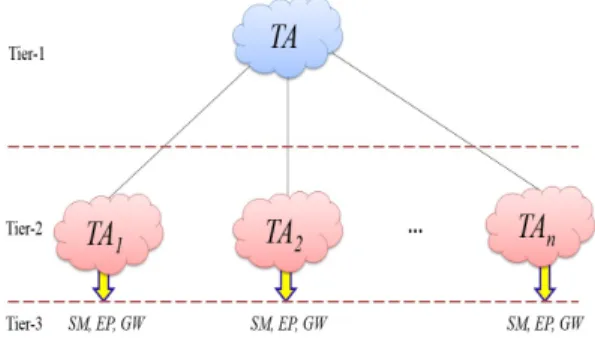
several regions/areas, each of which is managed by either a public or private, but secure cloud computing center [29]. As shown in Figure 2, we consider three different tiers in
ourSGsystem as follows:
• Tier-1: Central cloud computing center
• Tier-2: Distributed cloud computing centers
• Tier-3:SMs,GWs, andEPs
As shown in Fig. 2, there are ndistributed cloud
com-puting centers, also called trusted authorities (TAs). Each
TAmanages a region that includes various SMs,GWs, and
EPs. The tier-1TAprovides inter-TAcommunication among
different entities within the system, while the tier-2 TAs
are responsible for managing the public key repository, and generating partial public and private keys of devices at their ends. The main purpose of enabling cloud environment
in our SG system is to provide an easy and fast access
to the public key repository and to efficiently generate
public and private key pairs. In addition, the SG requires
a powerful computing platform to handle a large scale data analysis and to support complex real-time application
services. In eachTA, various cloud computing services can
be deployed, such as infrastructure-as-a-service (IaaS) forSG
information collection, processing, and storage,
platform-as-a-service (PaaS) for developing and integrating cloud
computing specific security-based applications for the SG
environment, and software-as-a-service (SaaS) for specific
services such as optimization of energy usage.
4
PROPOSED
AUTHENTICATION
PROTOCOL
This section proposes an authentication protocol for theSG
system. We first present an overview of our protocol, then present mutual authentication approaches between different
SG entities. The authentications between EP-SM, SM-GW,
and SM-HA are based on asymmetric key cryptography,
asymmetric key cryptography in batch, and symmetric key cryptography, respectively.
4.1 Overview
Recently, identity-based cryptography (IBC) is considered to
be a good platform for securing grid and cloud computing
environments [35], [36]. However, IBC suffers from the
key escrow problem [37]. Therefore, our protocol is based on a certificateless cryptosystem, which is a combination of identity-based cryptography and traditional public key cryptography [38]. Our approach not only overcomes the
key escrow problem inIBC, but also does not require
tradi-tional PKIthat is costly due to the private key generation
(PKG) inIBC. We instead use a key generation center (KGC).
The security of our scheme is based on the elliptic curve
dis-crete logarithm problem (ECDLP) for the group of points on
an elliptic curve over a finite field under elliptic curve
cryp-tography (ECC). Here, we letEbe an elliptic curve defined
over a finite fieldFp asE :y2=x3+Ax+B;A, B ∈Fp.
Let E1 and E2 be points inE(Fp) and integerxis found
such that E1 = xE2. The best known algorithm to solve
theECDLPis exponential, which is not enough to break its
security. We do not design a pairing based scheme under
ECC, but design a certificateless-based asymmetric
encryp-tion scheme. This is because the multiplicaencryp-tion of points
underECCis more efficient than the pairing operation. For
instance, it takes 0.6 ms for point multiplication and 4.5
msfor a pairing operation under a same setting [39]. The
identity (ID) of each device (EP, SM, GW,HA) in the SG
network is taken from a random point on the elliptic curve overE(Fq).
EachTAgenerates its private and public key pair, known
as a master private key and a master public key, and makes the public key available to its users. Our approach is simpler than the Diffie-Hellman protocol, as it uses one-way hash
functions instead of exponential functions. TheKGC(at each
TA) supplies an entity with a partial private key and a
partial public key. We assume that theKGCsecurely delivers
the partial keys to the intended entities. The entity then combines its partial public and private keys with secret information to generate its actual private and public keys.
In this way, the entity’s private key is not known to theKGC
and the anonymity of the user’s public key is also achieved. This anonymity is useful, when we consider that in order to receive the public key of a device, the requested device
must be verified authentic to the TA using its partial key
credentials.
First, we present generic definitions of various algo-rithms used in our scheme, and then explain each of these
algorithms in detail.
Definition 1.A generic certificateless public key encryption
scheme consists of the following algorithms:
• Setup:TheKGCgenerates a common public
parame-ter (param) and a master secret key (masterKey), and
uses these keys to generate different keys.
• PartialKeyGeneration: TAusesparam,masterKeyand an
identityID(a point of elliptic curve group) received
from a user to generate a partial private key (PPR)
and a partial public key (PPU) as (PPU, PPR) =
PartialKeyExtract (param,masterKey,ID).
• SecretValue:User/device usesparamandIDto
gener-ate a secret valuesID= SecretValue(param,ID).
• GenPrivateKey: User/device uses param, PPR, and
sID to generate private key PRKas PRK =
GenPri-vateKey(param,PPR,sID).
• GenPublicKey:User/device usesparam,PPU,sIDand
IDto generate public key PUK asPUK =
GenPub-licKey(param,PPU,sID,ID).
• Encrypt:The plaintext M is encrypted using param
and PUK to generate a ciphertext C as C =
En-crypt(param,PUK,M).
• Decrypt:The ciphertextC is decrypted using param
and PRK to retrieve the plaintext M as M =
De-crypt(param,PRK,C).
The public key of each entity is available in a public repository of the corresponding tier-2 cloud computing
cen-ter (TA). The private keys are kept secret and stored on the
SMs, theGWs, and theEPs. Since each entity is registered to
a specificTA, it knows the identity and the public key of the
TA. The details of generating different keys are as follows:
• Setup:t ← Z∗q is a random integer with large prime
q, andPis a generator of a large cyclic groupGover
E(Fq). EachTAgenerates its private and public key
pair as (PRKT A=t,PUKT A=tP) . Let us define the
hash functions used in this protocol as H1 : Z∗q →
{0,1}∗,H
2 :{0,1}∗→ {0,1}∗andH3 :Z∗q ×Z∗q → {0,1}∗. Returnsparam= (q,P,PUKT A,H1,H2,H3)
andmasterKey= (q,P,PRKT A,H1,H2,H3).
• PartialKeyGeneration: TA chooses a random s ∈ Z∗q
and computesw = sP and x= s + PRKT AH1(ID).
Note that the ID is first converted from a elliptic
curve point to a bit string [40] in H1() and then
hashed. Returns (PPU,PPR) = (w,x).
• SecretValue: Each device chooses a randomz ∈ Z∗q.
ReturnssID=z.
• GenPrivateKey:Each device computes its private key
PRK= (sID,PPR) = (z,x). ReturnsPRK.
• GenPublicKey: Each device computes its public key
PUK= (PPU,sID,ID) = (w,v), wherev=zP. Returns
PUK.
• Encrypt: Sender device computes r = H2(M||γ),
where M ∈ {0,1}∗ is a plaintext and γ ∈ {0,1}∗.
Furthermore, it computes ciphertextC = (c1, c2, c3)
such thatc1=rP;c2=rv+M||γ;c3=w+u;
whereu=PUKT AH1(ID). ReturnsC.
• Decrypt:Receiver device first applies partial private
key by computingVer1=c3−xP. IfVer1= 0, it
pro-ceeds further, otherwise terminates the connection.
Thereafter, it retrieves the messageM||γasc2−zc1
and verifiesVer2asH2(M||γ)P ?
=c1. ReturnsM.
4.2 Authentication between the EP and the SM
We assume that EP knows the identity of eachSM that it
supplies the electricity to. Similarly, each SM also knows
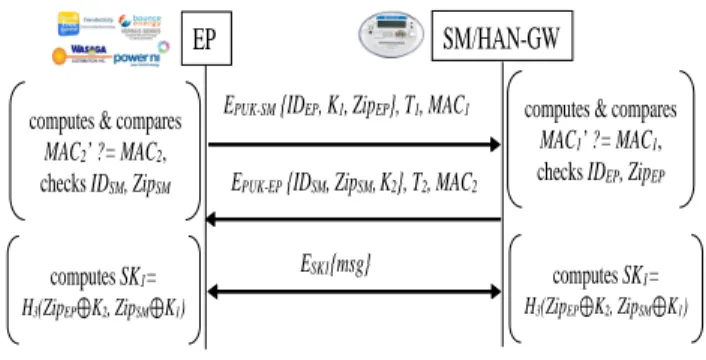
the identity of its EP, as it has a contract with theEP. As
shown in Figure 3, the authentication between theEP and
theSM/HAN-GWis carried out as follows:
Step-1 EP→SM:[EP U KSM{IDEP, K1, ZipEP}, T1,
M AC1]: First, the EP retrieves the public key of the
SM from the repository stored at its tier-2, i.e., PUKSM.
Then, it encrypts its identity IDEP, a nonce K1, and
the location (Zip code) ZipEP with the public key of
the SM and sends it to the SM along with a current
timestamp T1 and a M AC1 (message-1), where MAC1 =
[EP U KSM{IDEP, K1, ZipEP}, T1]. We consider eachMAC
as aHMACfunction,i.e.,HMACSHA256, and a pre-assigned
key, sayK, is used inMAC.
Step-2 SM→EP:[EP U KEP{IDSM, K2, ZipSM}, T2,
M AC2]:On receiving message-1, theSMcomputes MAC
0 1
and checks ifMAC1
?
=MAC01. If it is true, theSM decrypts
the message using its private key. Then, the SM retrieves
the public key of theEP(PUKEP) and verifies the identity
and the location of the EP. If it is true, then the SM
sends IDSM, K2, ZipSM encrypted with PUKEP to the
EP along with T2 andMAC2 (message-2), where MAC2 =
[EP U KEP{IDSM, K2, ZipSM}, T2].
Step-3:On receiving message-2, theEPcomputesMAC02
and checks if MAC2
?
=MAC02. If it is true, the EP decrypts
the received message using its private key, and verifies the
identity and the location of theSM. If both are correct, the
EP computes a secret shared key as SK1 = H3(ZipEP ⊕
K2, ZipSM ⊕K1)and sends message to theSMencrypted
with this shared key. Here,H3()is a one-way hash function.
Similarly, theSMalso computes the same secretSK1key.
4.3 Authentication between the SM and the GW
We assume that a group ofSM sends its metering data to
a specific GW. The GW keeps a record of the identity of
eachSMassociated with it. A number ofSMcommunicates
with a GW simultaneously, so the mutual authentication
is executed in a batch. The authentication process and
EP SM/HAN-GW EPUK-SM {IDEP, K1, ZipEP}, T1, MAC1
EPUK-EP {IDSM, ZipSM,K2}, T2, MAC2
ESK1{msg}
computes & compares MAC1’ ?= MAC1,
checks IDEP, ZipEP
computes & compares MAC2’ ?= MAC2, checks IDSM, ZipSM computes SK1= H3(ZipEPْK2, ZipSMْK1) computes SK1= H3(ZipEPْK2, ZipSMْK1)
SM/HAN-GW BAN-GW/NAN-GW EPUK-GW {IDSMi, Zi}, T3i, MAC3i
EPUK-SMi {IDGW, e}, T4i, MAC4i
EPUK-GW {IDSMi, PSMi, SSMi}, T5i, MAC5i
verifies MAC4i’ ?= MAC4i,
checks IDGW
verifies MAC3i’ ?= MAC3i,
checks IDSMi
MAC5i’ ?= MAC5i,
checks IDSMi,
stores PSMi, SSMi
Fig. 4: Authentication between the SM and the BAN/NAN-GW.
the communication scenario of the proposed authentication
scheme between a group ofSMs and theGWare shown in
Figure 4 and Figure 5, respectively. As shown in Figure 4, the authentication process is carried out as follows:
Step-1 SMi→GW:[EP U KGW{IDSMi, Zi}, T3i, M AC3i]:
First, each SMi retrieves the identity and the public key
of the GW. Then, each SMi sends its identity and Zi
encrypted withPUKGW along with its current timestamp
T3i and MAC3i to the GW (message-1), where MAC3i =
[EP U KGW{IDSMi, Zi}, T3i] and Zi = IDSMiKi. The Ki ∈
[1,q-1] are the random secret values selected by eachSMi.
Step-2 GW→SMi:[EP U KSMi{IDGW, e}, T4i, M AC4i]:
On receiving message-1, the GW computes MAC03i and
checks message integrity. If it is true, theGW compares its
current timestamptm withTthreshold =T3i+, whereis
the maximum allowed delay to transmit the message to the
GW. If tm > Tthreshold, the request is discarded and the
connection is terminated. Otherwise, theGW decrypts the
message using its private key, and verifies the identity of theSMi. If it is true, theGWchecks the number of attempts
by theSMiwithin a specified interval. If it is more than the
assigned limit, the connection is terminated. Otherwise, the
GW sends its identity and a value e encrypted using the
public key of the corresponding SMi along withT4i and
MAC4i (message-2) to theSMi. Here,e=h(Z),his a
one-SM1 SM2 SM3 SMn GW Checks Tthreshold= T3i+ Ɛ
Permits limited number of attempts by each SM in
a specific duration
…
Fig. 5: Communication scenario between a group of SMs and the GW.
way hash function,Z =Pn
i=1Zi, andn is the number of
SMicommunicating with theGW.
Step-3 SMi→GW:[EP U KGW{IDSMi, PSMi, SSMi}, T5i,
M AC5i]: On receiving message-2, each SMi computes
MAC04iand verifies the integrity of each message. If it is true,
SMidecrypts the messages using private keysPRKSMi, and
verifies the received identity of theGW. If it is true, eachSMi
storese, and generates a variablePSMi=PRKSMiIDSMiand
a signatureSSMi = (Ki +ePRKSMi) modn. Note that the
first 128bitsofPP RKSMi are used inPSMi andSSMifor
op-erations’ compatibility. Then, eachSMisendsIDSMi,PSMi,
and SSMi encrypted using public key of the GW along
withT5iandMAC5i=[EP U KGW{IDSMi, PSMi, SSMi}, T5i]
(message-3) to the GW. On receiving message-3, the GW
computesMAC05i and checks message integrity. If it is true,
theGWdecrypts the messages, and verifies the identity of
eachSMi. In a scenario where a group ofSMicommunicates
with aGW, it is possible that some of them perform
flood-basedDoSattacks instead of sending message-3. In order to
prevent these attacks, the identity of each SMi is verified.
For each unresponsive SMi, the GW removes the
corre-spondingZi and re-computes Z. Then, the GW computes
P =Pn
i=1PSMi andR =
Pn
i=1SSMiIDSMi, and verifies
(R-eP=? Z).
Therefore, our scheme is efficient even with the presence
of invalid requests in a batch since the GW only needs to
re-computeZ, which is simply a summation of allZi.
4.4 Authentication between the HA and the SM
Since data generated and sent by all the HA belong to a
particular user, we involve the end user (owner) for authen-ticating the home appliances (at the initial setup) [41]. The energy consumption information can reveal personal details of the consumers, such as their daily routines (including times when they are at home or asleep), what electronic equipment they own and are being used, etc. Consumers expect that the privacy of this information is maintained.
We assume that the SM and all theHA share a password
selected by the user. A secret key SK2 = H3(pwd, T) is
generated every time a HA and the SM communicates,
wherepwd is the shared password,T is a timestamp, and
H3 is a one-way hash function. As shown in Figure 6,
the authentication process between the HA and theSM is
carried out as follows:
HA SM/HAN-GW TIDHA, T6, MAC6
TIDSM, T7, MAC7
ESK2{msg}
TIDHA = ESK2{IDHA} MAC6 ?= MAC6’;
IDHA = DSK2{TIDHA}
MAC7 ?= MAC7’;
IDSM = DSK2{TIDSM} TIDSM = ESK2{IDSM}
Step-1 HA→SM:[T IDHA, T6, M AC6]: First, each HA
generates SK2 from a shared password and uses it to
encrypt the original identity of the HA. Then, it sends a
temporary identityTIDHA, a timestampT6, andMAC6 to
theSM(message-1), whereMAC6=[T IDHA, T6]andSK2
= H3(pwd, T6). The encryption can be performed by any
standard symmetric key algorithm such as AES-CTR or
MAES-CTR[42].
Step-2 SM→HA:[T IDSM, T7, M AC7]: On receiving
message-1, theSMverifiesMAC06with the receivedMAC6. If
it is true, theSMdecrypts and recovers the actual identity of
theHA. If the identity belongs to one of itsHA, it generates
a temporary identity TIDSM and sends its identity to the
HA along withT7 andMAC7 (message-2), whereMAC7 =
[T IDSM, T7].
On receiving message-2, the HA computes MAC07 and
compares it withMAC7, and further decrypts and recovers
the actual identity of the SM. If it is correct, the HA and
theSMcan start communicating using messages encrypted
by SK2. Moreover, the password can be automatically
changed at a regular interval by calculating pwdi+1 =
N ×H3change(d×pwdi), where N is the number of days,
dis a random secret, and H3change is a hash function. For
the password change, the user needs to provide N to the
SM. When, a new password is generated at SM, the SM
encrypts it using last session key and sends it to all theHA
before discarding the previous key.
4.5 Authentication between the NAN-GW and the CC
We assume that theNAN-GWaggregates the received data
from various SM. The CC is assumed to be connected to
theNAN-GWusing wired network and is authenticated. In
case, if it is wireless connected, the scenario similar to
EP-SMprovides mutual authentication.
5
SECURITY AND
PERFORMANCE
ANALYSIS
This section presents the verification proofs, defenses against various security attacks, and security and perfor-mance analysis of our protocol in comparison with the existing lightweight protocols.5.1 Verification Proof
We present the verification proofs for the public decryption of our public encryption scheme, and the correctness of the
protocol betweenSMs and their correspondingGW.
1. Verification of Decryption in Our Encryption Scheme:
V er1=c3−xP =w+u−xP =sP+P U KT AH1(ID)−[s+P RKT AH1(ID)]P =sP+P RKT AH1(ID)P−sP−P RKT AH1(ID)P = 0. V er2=H2(M||γ)P ? =c1 =H2(M||γ)P ? =rP =H2(M||γ)P ? =H2(M||γ)P.
2. Correctness of the Protocol betweenSMi-GW:
L.H.S.=Z = n X i=1 Zi =IDSM1K1+IDSM2K2+...+IDSMnKn. R.H.S.=R−eP = (SSM1IDSM1+SSM2IDSM2+...+SSMn IDSMn)−e(PSM1+PSM2+...+PSMn) = ((K1+e(P RKSM1))IDSM1+ (K2+e (P RKSM2))IDSM2+...+ (Kn+e (P RKSMn))IDSMn)−e(PSM1+PSM2+ ...+PSMn) = (IDSM1K1+IDSM2K2+...+IDSMnKn) +e ((P RKSM1)IDSM1+ (P RKSM2)IDSM2 +...+ (P RKSMn)IDSMn)−e(PSM1+ PSM2+...+PSMn) = (IDSM1K1+IDSM2K2+...+IDSMnKn) +e (PSM1+PSM2+...+PSMn)−e(PSM1+ PSM2+...+PSMn) =IDSM1K1+IDSM2K2+...+IDSMnKn=Z.
5.2 Defenses Against Various Security Attacks
We assume that an adversaryAhas a complete knowledge
about the system topology, as well as the identities and
public keys of the entities. Amay be an internal entity or
an external entity.Amay attempt to launchMITMattacks
on the active connections between any two entities of theSG
network. Since all messages over the network are encrypted,
inherently, the MITM attacks will not be successful. The
replay attacks are also prevented as every message over the network contains a unique timestamp value. As discussed in Section 4.3, the proposed protocol also defeats the
flood-based DoS attacks. In addition, the impersonation attacks
can be prevented, since the fake request is discarded and the
connection is terminated.Adoes not have the actual private
key/shared secret key of the valid entity and cannot decrypt the transmitted message. The key size of each shared secret key and public key/private key is chosen to be longer than
128 bits to resist against brute-force attacks. Furthermore,
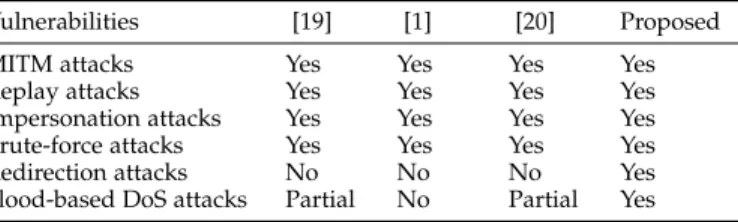
the Zip codes, sent by the devices, are used to overcome the redirection attacks. Table 2 shows the comparison of the security capabilities of the proposed protocol with the existing protocols. Note that [19] and [20] partially protect
DoSattacks by simply limiting the key agreement sessions.
TABLE 2: Behavior of Attacks in Various Authentication Protocols
Vulnerabilities [19] [1] [20] Proposed MITM attacks Yes Yes Yes Yes Replay attacks Yes Yes Yes Yes Impersonation attacks Yes Yes Yes Yes Brute-force attacks Yes Yes Yes Yes Redirection attacks No No No Yes Flood-based DoS attacks Partial No Partial Yes
5.3 Security Analysis
The proposed protocol provides mutual authentications
between the EP and the SM, between the SM and the
GW, and between the SM and the HA. Our protocol also
provides a perfect forward secrecy, since the adversary can
neither retrieve the actual key nor predict any of the fu-ture keys using any shared secret key. Furthermore, our
protocolpreserves the privacyof communicated entities over
the network and overcomes ID thefts, since the
transmit-ted messages are always encryptransmit-ted. Table 3 shows the comparison of security requirements. Note that we have
a system with |K|=|C|=|P|, each of 128 bits (with
AES-CTR) or 256bits(withMAES-CTR) for symmetric encryption
and|K|≥|C|=|P|for asymmetric encryption. Therefore, our
system has perfect secrecy as each key is used with equal
probability 1/|K|, and for every plaintextP and ciphertext
C there is a unique key K such thatEK(P) = C. As well,
our system with at least equal size spaces |P|=|C|=|K| is
perfectly key ambiguousas the keys are picked uniformly, and
for allx∈P,y∈C, there is a unique keyKsuch thaty =
EK(x).
Furthermore, A cannot retrieve the partial and actual
private keys of any device. Even in other scenarios where
A extracts any one of these parameters (i) partial private
key, (ii) partial public key, and (iii) public key, or replaces the public key of the device, our public encryption scheme
is able to defend such attacks, asAcannot retrieve the actual
private key and cannot decrypt the message. Let us consider
two scenarios, in whichAtries to extract some information:
Scenario-1: A does not have access to the masterKey,
but may replace public keys (PUK) of the devices with any
value, and also requests the public key of victim device, ex-tracts the partial private key, and makes decryption queries.
Under this scenario,Ahas following restrictions:
• Acannot extract the partial private key (PPR) of the
challenge deviceIDat any point, as the fakeIDwill
be discarded by theTA.
• Acannot request the private key (PRK) of any
iden-tity, if the respective public key (PUK) has been
replaced.
• Acannot make a decryption query on the challenge
ciphertextCthat was generated by a combination of
(ID,PUK).
Scenario-2: A does have access to the masterKey, but
may not replace public keys (PUK) of the devices. A can
compute partial private key of any device, and also can request public key and make private key extraction and
decryption queries. Under this scenario, A has following
restrictions:
TABLE 3: Summary of Security Requirements Fulfilled by Various Protocols
Requirements [19] [1] [20] Proposed Mutual authentication Yes Yes Yes Yes Forward secrecy Yes Yes Yes Yes Privacy preservation No Yes No Yes Prevents ID thefts No Yes No Yes
• Acannot replace the public key (PUK) of any device
at any time, as the identity and public key
reposito-ries are stored at various trusted authorities (TA).
• Acannot extract the private key (PRK) of the
chal-lenge device at any time, as it is randomly selected by each device.
• Acannot successfully decrypt the challenge
cipher-text C on behalf of the victim device, as it may
generate partial private key (PPR) of the device, but
does not have the actual private key (PRK) of the
device.
Definition 2. A protocol is secure against adaptive
cho-sen plaintext attack (IND-CPA secure), if no polynomially
bounded adversary has a non-negligible advantage.
There-fore, our protocol is secure againstIND-CPA.
Our system is secure in terms of indistinguishability as
Acannot identify the message choice because of a unique
combination ofP and K for each transmitted message C.
Here, Indistinguishability under chosen plaintext attack (
IND-CPA) is equivalent to the property ofsemantic security. In our
protocol, symmetric encryption is performed byAES-CTR,
which isIND-CPAsecure. Also, the asymmetric encryption,
performed by our proposed scheme, is based onECCand is
indistinguishable under chosen ciphertext attack (IND-CCA
secure), considering the hardness of theECDLP[43].
5.4 Performance Analysis
A mutual authentication between the HAN-GW and the
BAN-GW is proposed in [1], a mutual authentication
be-tween theSM and the AS of theDCU-GW is proposed in
[20]. A number of authentication scenarios between SM,
HAN-GW, BAN-GW, NAN-GW, and HA are presented in
[19], whereas our protocol proposes mutual authentications
between EP,SM,HAN-GW,BAN-GW,NAN-GW, and HA.
This subsection computes and compares communication and computation overheads among these four protocols, and evaluates total execution time of our proposed protocol.
The total communication overhead (CMO) and the total
computation overhead (CPO) of the protocol for a single
au-thentication token are calculated, respectively, asCMOtotal=
CMOEP−SM +CMOSM−GW +CMOSM−HAandCPOtotal
=CPOEP−SM +CPOSM−GW +CPOSM−HA+CPOkey−gen.
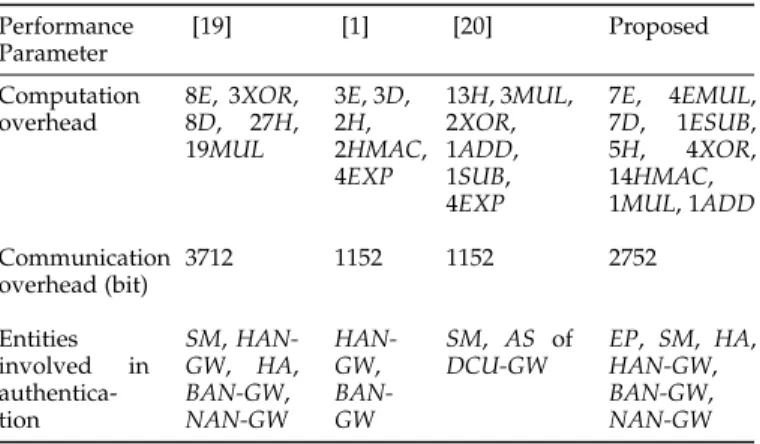
Table 4 shows the comparison of the CMO and CPO of
our protocol with the existing protocols [1], [19], [20]. Out TABLE 4: Performance with Single Authentication Token Performance Parameter [19] [1] [20] Proposed Computation overhead 8E, 3XOR, 8D, 27H, 19MUL 3E, 3D, 2H, 2HMAC, 4EXP 13H, 3MUL, 2XOR, 1ADD, 1SUB, 4EXP 7E, 4EMUL, 7D, 1ESUB, 5H, 4XOR, 14HMAC, 1MUL, 1ADD Communication overhead (bit) 3712 1152 1152 2752 Entities involved in authentica-tion SM, HAN-GW, HA, BAN-GW, NAN-GW HAN-GW, BAN-GW SM, AS of DCU-GW EP, SM, HA, HAN-GW, BAN-GW, NAN-GW
of these three existing protocols, it is fair to compare our protocol with only the protocol in [19], as only this protocol
includes most of the involved entities in the SG, while
only two entities are involved in [1] and [20]. Although, the protocol in [19] and our protocol cover a similar range of entities, our protocol achieves much lower overhead. In
detail, authentication scenario between theEP-SMgenerates
CMO of 1024 bits and prevents MITM, replay,
imperson-ation, and redirection attacks. The scenario between theSM
-GWgenerates 1216bitsofCMOand preventsMITM, replay,
impersonation, repudiation, and flood-basedDoSattacks. In
comparison with the protocol in [1], our protocol is also
re-sistant against the flood-basedDoSattacks while adding just
24bitsofCMO. Furthermore, in the authentication scenario
between theSM-HA, our protocol prevents MITM, replay,
impersonation, and brute-force attacks while generating 512
bitsofCMO.
We also evaluate the performance of our protocol when there are multiple authentication tokens. We
assume that there are m users executing the protocol
simultaneously and each user hasnhome appliances. The
CMO generated by the proposed protocol is calculated as
CM O(m, n) = CM O(EP−SM)m + CM O(SM−GW)m
+CM O(SM−HA)n= 1024m+1216m+512n= 2240m+512n.
TheCPOgenerated by the proposed protocol is calculated
asCP O(m, n)= (5m+2n)E+(5m+2n)D+(3m+n+1)H+(10m+ 4n)MAC+1ESUB+4mEMUL+1MUL+mADD+(2m-2)EADD
+4mXOR. Here, E and D represent encryption and
decryption, respectively; XOR is bit-wise exclusive-OR,
MULandADDare scalar multiplication and addition over
integers/binaries, respectively; EMUL, EADD, and ESUB
are elliptic curve multiplication, addition and subtraction (all three are computed as additions), respectively; and
H and MAC are hash and authentication code functions,
respectively. Furthermore, we assume that there are r
malicious users in a batch. The protocol first removes the invalid requests of the malicious users and then computes other parameters before further executing the protocol. In
such case, the total recalculated CPO is as CP O(m, n, r)
= CP O(m, n) - rMUL - 2rEMUL - rESUB - 2(r-1)EADD.
Since XOR operations are negligible in comparison with
other operations, they are not included in the calculation of
CPO.
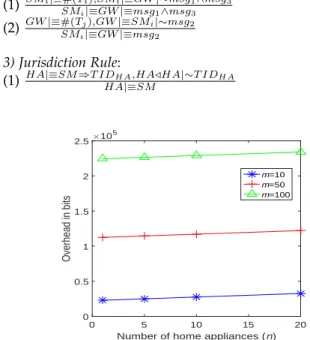
Figure 7 and Figure 8, respectively, show the CMO
andCPO generated by the proposed protocol for different
number of users (m= 10, 50, 100) and the number of home
appliances (n= 1, 5, 10, 20), considering unit value for each
operation. In Figure 7,CM O(10,1)= 2864 andCP O(10,1)
= 38.75 bytes, CM O(100,20) = 29280, and CP O(100,20)
= 397.625 bytes. In Figure 8, CP O(100,5,1) = 380 bytes,
CP O(100,10,50)= 348.875 bytes, and CP O(100,20,99)=
323.375 bytes (worst case). Hence, even if there are some
invalid requestsr(Figure 8(b): 1,m/2, andm-1) in a batch,
our protocol efficiently handles them.
5.5 Simulation Result
We simulated our protocol in Java environment with JDK1.7, 2GB RAM, and Windows7 OS. For a single authentication token, the scalar addition and multiplication operations
over integer/binaries took 0.000933 milliseconds (ms) and
0.00918ms, single addition and doubling over elliptic curve
took 0.6031msand 0.6047 ms, hash function SHA256took
0.9 ms, HMAC function HMACSHA256 took 271.60 ms,
and [encryption, decryption] time of symmetricMAES-CTR
mode with 256 bitskey betweenEP-SM and SM-HA took
(0.97, 0.78) ms. Moreover, the asymmetric encryption (i)
using RSA with 2048 bits key and (ii) using certificateless
public encryption scheme took (30, 16) ms and (12, 7.6)
ms, respectively. The total computation time by our
proto-col using RSA and using proposed scheme is 4041.91 ms
and 3962.71 ms, respectively. This computation time can
be further reduced by using the fast multiplication, where a single addition and doubling takes approximately half
of the ordinary ECCmultiplication, i.e., 0.303 ms[44]. The
total messages (2752bits) transmission time on3Gand 4G
networks [45] by our protocol are 0.000451 and 0.000182ms,
respectively. Hence, the total execution time by our protocol
(with certificateless cipher scheme) on3Gand4Gnetworks
of approximately 3.96sis quite reasonable, considering that
it is the total time for completing authentications for all
involved entities in theSGnetwork. Here, we presented just
one case for the overall protocol execution time. However, if
we encrypt the message withAES-CTR/MAES-CTRfor the
asymmetric encryption, and the symmetric key is encrypted by an asymmetric algorithm, the overall time can be further reduced.
5.6 Formal Proof of the Properties of the Protocol
In order to justify our analysis, we use the BAN-Logic to
provide a formal proof of our scheme. The notations used in BAN-Logic can be referred from [46].
1) Message Meaning Rule:
(1)EP|≡(EP SK1 ↔SM),EP /E{IDM P,K1,ZipEP}P U KSM EP|≡SM|∼E{IDEP,K1,ZipEP}P U KSM (2)SM|≡(SM SK1 ↔EP),SM /E{IDSM,K2,ZipSM}P U KEP SM|≡EP|∼E{IDSM,K2,ZipSM}P U KEP
2) Timestamp Verification Rule:
(1)SMi|≡#(Ti),SMi|≡GW|∼msg1∧msg3 SMi|≡GW|≡msg1∧msg3 (2)GW|≡#(Tj),GW|≡SMi|∼msg2 SMi|≡GW|≡msg2 3) Jurisdiction Rule: (1)HA|≡SM⇒T IDHA,HA/HA|∼T IDHA HA|≡SM
Number of home appliances (n)
0 5 10 15 20 Overhead in bits ×105 0 0.5 1 1.5 2 2.5 m=10 m=50 m=100
Number of home appliances (n) 0 5 10 15 20 Overhead in bits 0 500 1000 1500 2000 2500 3000 3500 m=10 m=50 m=100 (a)m= 10, 50, 100;n= 1, 5, 10, 20.
Number of home appliances (n)
5 10 15 20 Overhead in bits 0 500 1000 1500 2000 2500 3000 3500 m=10, r=1 m=50, r=m/2 m=100, r=m-1 (b)m= 10, 50, 100;n= 5, 10, 20;r= 1,m/2,m-1.
Fig. 8: Computation overhead.
(2)SM|≡HA⇒T IDSM,SM /SM|∼T IDSM
SM|≡HA
4) Protocol Goals:
a. Mutual Authentication: EP|≡SM∧EP→SM|≡EP∧SM.
Thus, mutual authentication holds.
b. Session Key Agreement: Each key SK1 between each EP
and theSMprovides session key agreement.
c. Freshness of messages: SM|≡#(Tj)∧EP|≡#(Ti). Hence,
freshness of messages between theEPand theSMholds.
d. Integrity and Privacy between the EP and the SM:
(1)EP|≡(EP SK↔1SM),EP /HM AC{msg} EP|≡SM|∼msg (2)EP|≡(EP SK↔1SM),EP /E{ID} SK1 EP|≡SM|∼ID
6
CONCLUSION
The proposed protocol, based on hierarchical cloud trusted authorities, provides mutual authentications between the
EP and the SM, between the SM/HAN-GWand the
BAN-GW/NAN-GW, between theSM and theHA, and between
the NAN-GW and the CC. Particularly, the
authentica-tions between EP-SM and GW-CC, SM-GW, and SM-HA
are, respectively, based on asymmetric key cryptography, asymmetric key cryptography in batch, and symmetric key cryptography. Processing requests in batch improves the efficiency of the system, as a large number of smart meters communicate with the gateway simultaneously for mutual authentications. The certificateless scheme in the proposed protocol maintains privacy preservation as the transmitted message is always encrypted over the network. Simula-tion results show that the authenticaSimula-tion scenarios between
the EP-SM, the SM-GW, and the SM-HA generate lower
communication and computation overheads in comparison with existing protocols. Also the overheads generated by our protocol are manageable, even when invalid requests exist in a batch. Through security analysis, we show that our protocol is secure against various existing attacks, such
as MITM attacks, replay attacks, impersonation attacks,
redirection attacks, and flood-based DoS attacks. In sum,
our protocol is lightweight with low execution time and efficiently provides a centralized integrated control in a de-centralized environment. Furthermore, our protocol can be readily integrated with the cloud computing-based trusted
entities to utilize powerful computing services of the cloud
to efficiently manage theSGsystem.
ACKNOWLEDGMENTS
This research was funded by the MSIP (Ministry of Science, ICT and Future Planning), Korea, under the “ICT Consilience Creative Program” (IITP-2015-R0346-15-1007) supervised by the IITP (Institute for Information & Communications Technology Promotion) and under the “Basic Science Research Program” (2013R1A1A1010489, 2015R1C1A1A01053788) through the NRF (National Re-search Foundation).
REFERENCES
[1] M. Fouda, Z. Fadlullah, N. Kato, R. Lu, and X. Shen, “A lightweight message authentication scheme for smart grid communications,”
IEEE Transactions on Smart Grid, vol. 2, no. 4, pp. 675-685, Dec. 2011. [2] M. Balakrishnan, “Smart energy solutions for home area networks and grid-end applications,” inProc. Smart Energy, 2012, pp. 67-73. [3] W. Wang and Z. Lu, “Cyber security in the smart grid: survey and
challenges,”Computer Networks, vol. 57, pp. 1344-1371, 2013. [4] A. Bari, J. Jiang, W. Saad, and A. Jaekel, “Challenges in the smart
grid applications: an overview,”International Journal of Distributed Sensor Networks, vol. 2014, pp. 1-11, 2014.
[5] Smart Grid Cyber Security, Potential Threats, Vulnerabilities and Risks, California State Uni., May 2012. [Online]. www.energy.ca.gov/2012publications/CEC-500-2012-047/CEC-500-2012-047.pdf.
[6] Guidelines for Smart Grid Cyber Security, NISTIR7628, Aug. 2010. [Online]. csrc.nist.gov/publications/nistir/ir7628/nistir-7628 vol3.pdf.
[7] Report to NIST on the Smart Grid Interoperability Stan-dards Roadmap, Electric Power Research Institute, Aug. 2009. [Online]. www.nist.gov/smartgrid/upload/Report to NIST Au-gust10 2.pdf.
[8] A. Al-Majali, A. Vishwanathan, and C. Neuman, “Analyzing re-siliency of the smart grid communication architectures under cyber attack,” inProc. CSET, 2012, pp. 1-8.
[9] N. Saxena and B. J. Choi, “State of the art authentication, access control, and secure integration in smart grid,”Energies, vol. 8, no. 10, pp. 11883-11915, Oct. 2015.
[10] P. Jovanovic and S. Neves, “Dumb crypto in smart grids: practical cryptanalysis of the open smart grid protocol,”IACR, Apr. 2015. [Online]. https://eprint.iacr.org/2015/428.pdf.
[11] K. Kursawe and C. Peters, “Structural weaknesses in the open smart grid protocol,” IACR, June 2015. [Online]. https://eprint.iacr.org/2015/088.pdf.
[12] DNP3 Secure Authentication Version 5, Apr. 2012. [Online]. https://www.dnp.org/Lists/Announcements/Attachments/7/ Secure Authentication v5 2011-11-08.pdf.
[13] IEC 62056-6-2:2013, Electricity Metering Data Exchange - The DLMS/COSEM Suite - Part 6-2: COSEM Interface Classes, 2006. [Online]. https://webstore.iec.ch/publication/6410.
[14] OpenADR and Cyber Security. [Online]. http://www.openadr.org/cyber-security.
[15] Remote Authentication Dial in User Ser-vice - RADIUS, Developing Solutions. [Online]. https://www.developingsolutions.com/products/radius. [16] IEC TS 62351-6:2007, Power Systems Management and
As-sociated Information Exchange - Data and Communica-tions Security - Part 6: Security for IEC 61850. [Online]. https://webstore.iec.ch/publication/6909.
[17] R. Sule, R. S. Katti, and R. G. Kavasseri, “A variable length fast message authentication code for secure communication in smart grids,” inProc. IEEE Power & Energy Society General Meeting, 2012, pp. 1-6.
[18] D. Li, Z. Aung, J. R. Williams, and A. Sanchez, “Efficient au-thentication scheme for data aggregation in smart grid with fault tolerance and fault diagnosis,” inProc. IEEE PES ISGT, 2012, pp. 1-8.
[19] H. Nicanfar and V. C. M. Leung, “Multilayer consensus ECC-based password authentication key-exchange protocol for smart grid system,”IEEE Trans. Smart Grid, vol. 4, no. 1, pp. 253-264, Mar. 2013.
[20] H. Nicanfar, P. Jokar, and V. Leung, “Efficient authentication and key management mechanisms for smart grid communications,”
IEEE Systems Journal, vol. 8, no. 2, pp. 629-640, Jun. 2014.
[21] S. Oh and J. Kwak, “Mutual authentication and key establishment mechanism using DCU certificate in smart grid,”Applied Mathemat-ics & Information Sc., vol. 6, no. 1, pp. 257S-264S, 2012.
[22] H. Li, R. Lu, L. Zhou, B. Yang, and X. Shen, “An efficient merkle-tree-based authentication scheme for smart grid,” IEEE Systems Journal, vol. 8, no. 2, pp. 655-662, 2014.
[23] A. R. Metke and R. L. Ekl, “Smart grid security technology,” in
Proc. Innovative Smart Grid Technologies (ISGT), 2010, pp. 1-7. [24] K. Kursawe, G. Danezis, and M. Kohlweiss, “Privacy-friendly
aggregation for the smart grid,” inProc. PET, 2011, pp. 175-191. [25] C. Bekara, T. Luckenbach, and K. Bekara, “A privacy preserving
and secure authentication protocol for advanced metering infras-tructure with non-repudiation service,” inProc. ENERGY, 2012, pp. 60-68.
[26] Y. Yan, R. Hu, and S. Das, “An efficient security protocol for advanced metering infrastructure in smart grid,”IEEE Network, pp. 64-71, 2013.
[27] F. Luo, Z. Y. Dong, Y. Chen, Y. Xu, and K. P. Wong, “Hybrid cloud computing platform: the next generation IT backbone for smart grid,” in Proc. Power & Energy Society General Meeting, 2012, pp. 1-7.
[28] S. Rusitschka, K. Eger, and C. Gerdes, “Smart grid data cloud: a model for utilizing cloud computing in the smart grid domain,” in
Proc. Internl Conf. on Smart Grid Communications, 2010, pp. 483-488. [29] J. Baek, Q. H. Vu, J. K. Liu, X. Huang, and Y. Xiang, “A secure cloud
computing based framework for big data information management of smart grid,”IEEE Trans. on Cloud Computing, vol. 3, no. 2, pp. 233-244, Jun. 2015.
[30] S. Bera, S. Misra, and J. J. P. C. Rodrigues, “Cloud computing applications for smart grid: a survey,”IEEE Transactions on Parallel & Distributed Systems, vol. 26, no. 5, pp. 1477-1494, May 2015. [31] A. H. Mohsenian-Rad and A. Leon-Garcia, “Coordination of cloud
computing and smart power grids,” in Proc. IEEE International Conference on Smart Grid Communications, 2010, pp. 368-372. [32] Y. Jiang, X. Guo, C. Li,, H. Wen, C. Lei, and Z. Rui, “An efficient
and secure search database scheme for cloud computing in smart grid,” inProc. Conf. on Communications & N/w Security, 2013, pp. 413-414.
[33] B. Bitzer and E. S. Gebretsadik, “Cloud computing framework for smart grid applications,” inProc. 48th International Universities’ Power Engineering Conference (UPEC), 2013, pp. 1-5.
[34] Cyber Security Challenges in Using Cloud Computing in the Electric Utility Industry, Pacific Northwest National Lab-oratory, Prepared for the U.S. Department of Energy under Contract DE-AC05-76RL01830, PNNL-21724, Sept. 2012. [On-line]. http://www.pnnl.gov/main/publications/external/ techni-cal reports/pnnl-21724.pdf.
[35] H. Li, Y. Dai, and H. Yang, “Identity-based authentication for cloud computing,” inProc. CloudCom, LNCS 5931, 2009, pp. 157-166.
[36] H. Lim and K. Paterson, “Identity-based cryptography for grid security,”International Journal of Information Security, vol. 10, pp. 15-32, 2011.
[37] J. H. Oh, K. K. Lee, and S. Moon, “How to solve key escrow and identity revocation in identity-based encryption schemes,” inProc. Information Systems Security, LNCS 3803, 2005, pp. 290-303. [38] J. Baek, R. Safavi-Naini, and W. Susilo, “Certificateless public key
encryption without pairing,” inProc. Info. Security, 2005, pp. 134-148.
[39] M. Scott, “On the efficient implementation of pairing-based proto-cols,”IACR Cryptology, pp. 334-346, 2011.
[40] D. R. L. Brown, SEC 1: Elliptic Curve Cryptography, Standards for Efficient Cryptography. [Online[. http://www.secg.org/sec1-v2.pdf.
[41] Smart Grid System Report, U.S. Depart-ment of Energy, July 2009. [Online]. smart-grid.gov/sites/default/files/resources/systems report.pdf. [42] N. Saxena and N. S. Chaudhari, “EasySMS: a protocol for
end-to-end secure transmission of SMS,”IEEE Transactions on Information Forensics and Security, vol. 9, no. 7, pp. 1157-1168, Jul. 2014. [43] Security Guidelines for Cryptographic Algorithms in the W3C
Web Cryptography API, W3C/MIT Cryptosense/INRIA, Nov. 2015. [Online]. https://www.w3.org/2012/webcrypto/draft-irtf-cfrg-webcrypto-algorithms-00#ECDSA.
[44] R. P. Gallant, R. J. Lambert, and S. A. Vanstone, “Faster point multiplication on elliptic curves with efficient endomorphisms,” IACR, 2001. [Online]. https://www.iacr.org/archive/crypto2001/21390189.pdf. [45] Measuring mobile broadband performance in the UK,
13 Nov. 2014. [Online]. http://stakeholders.ofcom.org.uk/ binaries/research/broadband-research/mbb-nov14.pdf.
[46] J. Wessels, Applications of BAN-logic, CMG Finance, Apr. 2001. [Online]. win.tue.nl/ipa/archive/springdays2001/banwessels.pdf.
Netesh Saxena (S’10-M’14) is working as a Post-Doctoral Researcher at Georgia Institute of Technology, USA. Prior to this, he was with the State University of New York Korea as a Post-Doctoral Researcher and a Visiting Scholar at Stony Brook University, USA. He earned his Ph.D. in Computer Science & Engineering from the IIT Indore, India. In 2013-14, he was a Vis-iting Research Student and a DAAD Scholar at B-IT, Rheinische-Friedrich-Wilhelms Univer-sitt, Bonn, Germany. He was also a TCS Re-search Scholar during Jan. 2012 - Apr. 2014. He works in the area of security and privacy. His current research interests include smart grid security, vehicle-to-grid security and privacy, cryptography, security and privacy in the cellular networks, and secure mobile applications. He has published several papers in various international peer-reviewed journals and conferences. He is a member of IEEE, ACM, and CSI.
Bong Jun Choi (S’09-M’11)received his B.Sc. and M.Sc. degrees from Yonsei University, Ko-rea, both in electrical and electronics engineer-ing, and the Ph.D. degree from University of Wa-terloo, Canada, in electrical and computer engi-neering. He is currently an assistant professor at the Department of Computer Science, State University of New York Korea, Korea, and jointly a research assistant professor at the Depart-ment of Computer Science, Stony Brook Uni-versity, USA. His current research focuses on energy efficient networks, distributed mobile wireless networks, smart grid communications, and network security. He serves as an editor of KSII Transactions on Internet and Information Systems and a member of the Smart Grid Core Security Technology Development Steering Committee, Korea. He also serves on the technical program committees for many international conferences such as IEEE PECON, IFIP NTMS, and IEEE CMC. He is a member of the IEEE and the ACM.