Contribution to
Rowena Barrett (ed.) Reality Bytes: managing the Labour Process of Software Development
Organisational Commitment among Software Developers
Chris Baldry, Dora Scholarios and Jeff Hyman
Chris Baldry is Professor Human Resource Management in the Department of Management and Organisation at the University of Stirling, Scotland, UK
Dora Scholarios is Reader in Organisational Behaviour in the Department of Human Resource Management at the University of Strathclyde, Scotland UK
Jeff Hyman is Professor of Management Studies in the Department of Management Studies, University of Aberdeen, Scotland, UK
Contact details:
Chris Baldry,
Department of Management and Organisation, University of Stirling,
Stirling FK9 4LA Scotland, UK
ORGANIZATIONAL COMMITMENT AMONG SOFTWARE
DEVELOPERS
Chris Baldry (University of Stirling), Dora Scholarios (University of Strathclyde) and Jeff Hyman (University of Aberdeen)1
INTRODUCTION
If software developers are to be taken as prototypes of the new knowledge worker, we need look no further for working hypotheses about their attachment to their work and their employing organization than those contained in the human resource management agenda. For the diffusion of information and communication technologies (ICTs) as the supposed base of the knowledge economy has been synchronous with the launch and promotion of human resource management (HRM) as the new orthodoxy in employment practice and many of the assumptions and values within each model are shared. Indeed, HRM is often portrayed as if it were in some way a reflection of the shift to non-adversarial work relationships in the new information-based service society (Baldry 2003).
The popular stereotype of the knowledge worker closely corresponds to the ideal subject under an HRM regime. S/he is usually portrayed as young, personally committed to the job and the organization, prepared to work long hours in an empowered job, and with an individualistic view of their career path in which they see themselves as an autonomous ‘professional’ rather than a conventional employee. Thus, Alvesson (2000: 1104) states, ‘In many ways knowledge-intensive workers form the ideal subordinates, the employer’s dream in terms of work motivation and compliance’.
Moreover, proponents of the information society such as Zuboff (1988) often portray the technology itself as a cause of heightened commitment so that, while conventional production systems could be associated with the necessity for top down control systems, the creation of flatter post-bureaucratic and more open organizations will engender more integrated and committed employees. Castells (1996) sees the new networked organization as requiring the two major components of organizational commitment – discretionary effort and employment continuance. Much higher levels of employee involvement are needed ‘so that they [employees] do not keep their tacit knowledge solely for their own benefit’ (Castells 1996: 160) and there must be stability of employment ‘because only then does it become rational for the individual to transfer his/her knowledge to the company and for the company to diffuse explicit knowledge among its workers’ (Castells 1996: 160).
The empirical study reported in this chapter is based on five Scottish software development organizations and combines case study, interview and survey data. We begin with a consideration of the dominant perspectives on commitment followed by the presentation of predictions based on these models. These predictions are then examined using a combination of survey data and qualitative data from employee interviews.
THE GOAL OF HIGH COMMITMENT
Recent management literature has been dominated by attempts to identify those people management practices, which in combination, may serve to enhance some measure of performance through a raised level of employee commitment to the organization. Such bundles of practices are termed either high commitment work practices (HCWP) or high performance work systems (HPWS), the former tending to be UK nomenclature and the latter US derived (see Legge 2001: 25). Whilst management texts remain vague about what is meant by ‘commitment’ and about the causal mechanics which link it to performance, this gap has been more than filled by the other main perspective studying commitment, that of organizational psychology.
Within this componential framework, commitment is regarded as a positive employee response to progressive employment practices, such as team working, training provision or employee share schemes. Studies show the affective dimension of commitment to be related to generally positive employee perceptions of the organization and management; for instance, perceived organizational support (Eisenberger, Fasolo and Davis-Lamastro 1990; Rhoades and Eisenberger 2002); management trust (Gopinath and Becker 2000; Pearce 1993); procedural fairness or fair treatment (Folger and Konovsky 1989; Podsakoff, MacKenzie and Bomer 1996); and particularly to ‘climate’ factors such as being kept informed, equal opportunities, and family-friendly practice (Guest 2002).
and claims to demonstrate positive links between a cluster of designated HCWP and broad organizational indicators such as financial performance or productivity, although questions persist concerning the mechanisms by which employee-focussed initiatives can impact upon organizational level outcomes. From an empirical perspective therefore, there are considerable doubts about the extent and depth, either of the coverage of purported commitment-inducing practices or the depth of employee response to these practices. Some of these reservations are of particular relevance to the study of software professionals as non-union workplaces in particular have been conspicuous by their lack of coverage of such practices (Kessler and Purcell 2003: 331).
The above discussion is underpinned by what we call a ‘direct commitment’ model which has three underlying assumptions. First, commitment is a unitary set of attitudes, with a single focus – the organization. Second, commitment is voluntary, and third, high commitment to the organization will be directly reflected in enhanced performance (through the exercise of discretionary effort) and long service. We identify two sub-models of this direct commitment model.
1) The Right Stuff model, where the attitudes and behaviours congruent with organizational commitment are detected through appropriate recruitment and selection practices. This places the locus of commitment with the individual’s attributes (including, personality, age, and gender).
2) The HCWP model, where commitment can be imbued, developed and rewarded through adoption of appropriate people management and culture change policies. This places the responsibility for commitment on applying the correct policies and instituting an appropriate combination of organizational structures.
state of un-committedness, via the application of high commitment work practices and culture change, to a new state of committedness.
An indirect process model of commitment
One goal of HCWP models is to maximize internalisation of values through the development of a unitary and ‘strong’ culture (Peters and Waterman 1982) so that the organization becomes a unitary organization (Fox 1974) with a uniform and widely diffused culture and no rival bond objects. In such a strong culture individuals may satisfy their personal values through striving to meet those of the organization. Guest (2002) realistically points out that this narrow unitarist view of the merging of corporate and individual goals may make some limited sense in a US context but does not really resonate in more pluralist employment systems such as Europe, Australia or even the unionized parts of the US labour market. More usually the organization is going to be a pluralist entity in which individuals can simultaneously be members of a team or workgroup, a department, a trade union, and an organization.
Recognising this, Reichers (1985) proposes a multiple constituencies model of organizational commitment which accepts the possibility of multiple foci of commitment (such as work-team, project group, union, supervisor, colleagues, customers) which may be reinforcing or competing (see also Becker and Billings 1993; Becker 1992). There is after all no reason to believe that these multiple loyalties will always be complementary: the ‘discovery’ that launched the whole human relations movement in the late 1920s was that commitment to the norms of the workgroup could be more immediate and influencing on behaviour than the values of the wider organization.
approach allows a more theoretical understanding of the different levels of attachment to the organization. Organizational identification is distinct from organizational commitment (Ashforth and Mael 1989; Mael and Tetrick 1992) as the latter, as usually described, implies an internalisation of values. Thus you can identify yourself with an organization in the sense that this identification provides a label for a significant part of who you are (‘I work for Beta’) but this does not necessarily mean you take its values as your own. Employees will most strongly identify with the unit with the greatest salience for them and this in turn will result in affective commitment directed to that unit. Mueller and Lawler (1999) specified three key conditions which will result in commitment to a particular unit: a unit’s ‘distance’ from an employee, whether proximate units produce positive emotions, and whether this positive emotion is perceived to be caused by that unit. Hunt and Morgan (1994) further suggest that commitment to a subgroup can also facilitate a more global commitment to the organization generally, which implies the existence of nested identities within an organization (Ashforth and Mael 1989) and nested levels of commitment.
Sociological perspectives have a longer tradition of extending the parameters beyond the confines of the workplace and identifying additional external foci of employee commitment, for example to occupation or profession. An external occupational community in the sense of ‘software professionals’ can function as a psychological group in just the same way as the organization: i.e. as a collection of people who share the same social identification but with whom the individual does not necessarily have to interact personally. Alvesson (2000) suggests, in a discussion of IT professionals, that the possibility of a professional identity makes it likely that ties to the organization may be weaker, as belonging to the latter is less essential for one’s self-identity (see also Marks and Lockyer this volume).
turbulence at the end of the 1990s has resulted in a shift towards this indirect form of commitment, as employers broke the long-term commitment understanding they had previously held with their employees. Downsizing, flatter organizations and corporate relocations negatively affected employment continuity and internal promotion prospects, causing firms to construct a new contract with employees no longer based on long-term commitment, but on offering employees the means and opportunities to develop their own skills in ways that enhance their professional and occupational careers, external to the organization if need be. Organizations do not expect employees to stay with them for life-long employment but aim to become ‘employers of choice’ by offering professional development and training. This changing psychological contract can be seen as a ‘new deal’ in which high commitment and trust can only be generated through a negotiated process of reciprocity.
structures and policies, the state of the labour market and family and household circumstances. This calculative dimension of commitment displays far less distance from the supposedly traditional attitude set of compliance than the direct high commitment model outlined earlier.
Two alternative models summarized
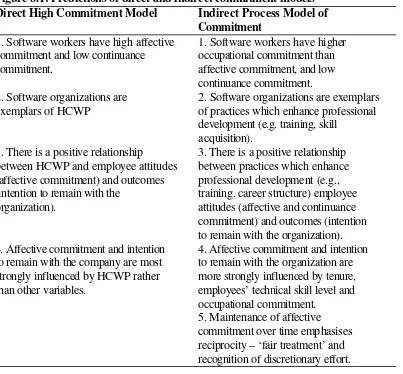
How do general theories of commitment apply to software workers? The discussion above identifies two possibilities concerning the employment relationship and commitment of software workers and these are contrasted in Figure 8.1.
Insert Figure 8.1 about here
The direct high commitment model views software workers as a prototype of the new knowledge worker engaged in high-trust employment relationships where the job and the organizations in which they are employed provide high intrinsic satisfaction and autonomy. If this is the case, then software organizations will be exemplars of the high commitment management organization and will show: (1) high levels of affective commitment amongst software workers; continuance commitment will be low because employees wish to stay with the organization even if there are other opportunities elsewhere; (2) high perceived levels of job control, decision influence, fair treatment, satisfaction with pay, skills, training and career prospects, which are commonly associated with HCWP; and (3) a relationship between HCWP and affective commitment which is (4) stronger than any other potential predictor (e.g., tenure).
take them to other organizations. If this model applies, then software organizations will be exemplars of a different type of organization where the emphasis is on certain types of management practices which reinforce professional values and enhance professional development.
Thus, in terms of the predictions represented in Figure 8.1: (1) affective organizational commitment will be lower than occupational commitment, and continuance commitment will again be low as software workers are likely to have options for other employment; (2) the practices which matter most will be those perceived to enhance professional development or reciprocate for employees’ effort (e.g., fair treatment, satisfaction with pay, training, employability enhancement), but the model does not necessarily predict that HCWP will be absent; (3) only that these practices will have a direct relationship with affective commitment, continuance commitment and intention to remain with the organization; and (4) other key factors may be stronger predictors of these attitudes and outcomes; i.e., tenure with the organization, technical complexity of the job (indicating higher skilled software developers), and the degree of occupational commitment. The fourth prediction is based on the expectation that the importance of professional advancement (which this model sees as the main basis of organizational commitment) is likely to decline with longer tenure, but increase for more technically skilled and occupationally committed software workers. Finally, the indirect model also suggests (5) that affective commitment to these groups will be strongly related to perceptions of reciprocity and this may vary over time. Low affective organizational commitment will not necessarily result in low discretionary effort but the latter may be driven by the norms and mores of the (external) professional group.
THE CASE STUDIES AND STUDY DESIGN
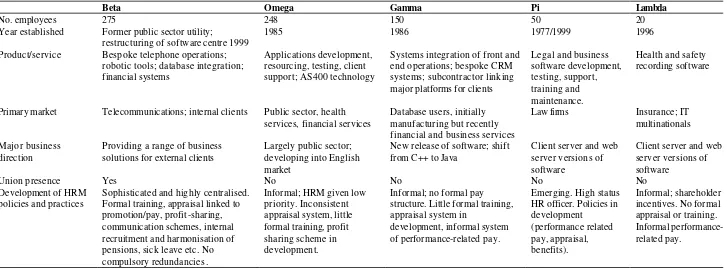
still run by the founder or founders while the fifth, Beta, was part of an ex-public sector utility. Table 8.1 illustrates the differences between the case study organizations with respect to size, year established, current and expected business orientation and development of HRM practices and policies. Beta, a software division within a large telecommunications organization, can be distinguished from the other four smaller start-ups in all respects, particularly in its size, more conventional bureaucratic structure, the apparent sophistication of HRM policies, such as provision of training, formal performance appraisals, formal communication mechanisms, recognition of a union, and harmonisation of practices. Because of these corresponding differences in organization and management, it has been found useful in the following analysis to compare Beta with the other four independent organizations.
Insert Table 8.1 about here
A mixed method design (Tashakkori and Teddlie 1998) was used to allow both a hypothesis testing and explorative approach. This involves the use of different methods sequentially and/or in parallel to study the same phenomenon at different levels within the organization. All data was collected over a period of four to six months in each organization between 1999 and 2002. As well as contextual case study data (such as company documents, management interviews, and observation of management meetings), data was collected from employees using three approaches.
1. A self-report questionnaire was distributed to all workers and management over a period of two to three weeks in each organization in order to capture employee perceptions and attitudes towards their job, the organization, and management, as well as biographical details.
3. In-depth semi-structured interviews were conducted with a sample of employees conducted at the workplace and in their home-community locality to explore issues of commitment and identity in and beyond the workplace.
Quantitative and qualitative data were gathered simultaneously.
The questionnaire included the following control variables: gender, age, temporary staff/contractors, tenure with the organization (measured in months), number of hours paid and unpaid overtime per week, and skill level of the job. The latter was determined by six items measuring the degree of importance on a scale from 1 ‘Not too important’ to 4 ‘Absolutely essential’ of software programming, systems analysis, business analysis, testing, software design and user/application support in employees’ jobs. The mean of these items formed a measure of technical skill complexity of respondents’ jobs (α=0.83).
1968); and the normative dimension was examined using a single item (‘I am proud to tell others that I am employed in the software sector’) from Vandenberg and Scarpello’s (1994) modification of the Occupational Commitment
Questionnaire (Mowday et al. 1979). The mean of these items formed a single
composite score (α=0.55). Commitment to colleagues was measured with a single item – ‘I feel a strong sense of loyalty to my fellow employees’.
Intention to remain with the organization was measured by a closed-ended question asking how respondents viewed their current job in the company. The measure was coded 1 if this was a long-term job they would stay in or if they saw the job as an opportunity for career advancement in the present company. If the job was not part of a career in this organization, or part of a career in other organizations the measure was coded 0.
A representative group of employees in each organization (according to gender, age, job type and job/organizational level) were selected for the semi-structured work interviews. These explored three themes in greater depth: (a) previous work and educational history and how it led to their present job; (b) experiences of working in the present organization (including commitment to company/peers/job/customers); and (c) work-life linkages and the future (perceptions of job risk/uncertainty, relative importance of work, perceptions of society/class/status). A total of 75 semi-structured employee interviews were obtained from the five cases, distributed in proportion to organizational size. A smaller subsection of these employees was contacted again for interviews in their home or community to explore commitment more broadly beyond the workplace.
THE CONTOURS OF COMMITMENT
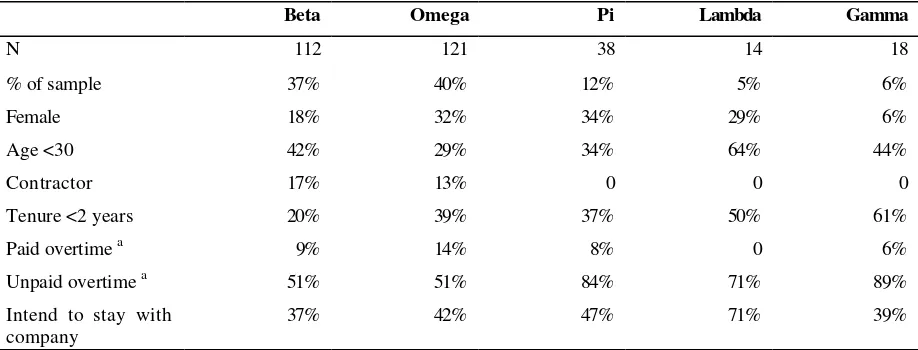
The questionnaire respondents were predominantly male with Omega and Pi having the largest proportions of females (approximately one third) (see Table 8.2). Half the sample was under 30 years of age and a sizeable proportion had less than two years tenure – tenure was longer only in the former public sector utility Beta. There was a relatively low proportion of contractors (only 17 and 13 per cent in Beta and Omega respectively) and low levels of paid overtime, although, as will be shown, there was a significant amount of unpaid overtime worked in all case studies, particularly in the independent organizations.
Insert Table 8.2 about here
Discretionary effort and the willingness to stay
If one index of commitment is a willingness to expend discretionary rather than prescribed effort (Fox 1974: 16), then the fact that half the employees in the two larger organizations and sizable majorities in the three smaller organizations claimed to work 10 or more hours per week unpaid overtime seems to suggest a high degree of commitment. The survey responses gave the primary reason for working extra hours as meeting project deadlines or to get work done, with a smaller percentage citing not wanting to let down clients or colleagues.
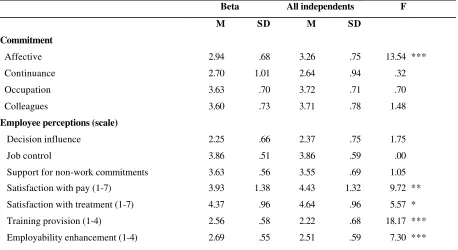
However, when we tested for the first prediction in Figure 8.1 by examining the mean ratings of different foci of commitment, shown in the top half of Table 8.3, these first impressions had to be qualified. While the image of the knowledge worker identifying with the goals of their organization found more support in the independent organizations than in Beta (t(296)=3.77, p<.001) it was clear that in both types of organizations, commitment to the occupation and to colleagues was higher than affective organizational commitment. Paired t-tests found all these differences to be significant at the 95 per cent level of confidence.
Insert Table 8.3 about here
For many of the developers we interviewed it was the job that drove their effort, rather than the organization:
…I think in development most of us are committed more to the job than to
the company because we are all in it because we enjoy programming and
that’s the first thing, the second thing is what company you work for and
what sort of work you get to do....
(Pi interview 10, female software programmer)
So, if you like, the commitment’s to Beta in as much as they are paying me
(Beta interview 11, male applications project analyst)
The salience of immediate identity groups was indicated in this comment from a developer in Beta when asked about the direction of her commitment:
To the project yes…(since the changes) we don’t actually see much about
where our place is in the whole company. So I’ve probably got more
commitment to the project than I have to the Centre or the company, if that
makes any sense…because I know what’s happening with the project more
than I do about anything else that is happening outside the project.
(Beta interview 17, female software engineer)
From the interviews, it was clear there was a difference between the extra effort which some managers put in for the sake of the organization (we can call this ‘discretionary organization effort’) and the long hours, working nights and weekends which were seen to be part of the job of software - you do the hours to get the project delivered because that is part of the identity of being a software professional - (we can call this ‘discretionary job effort’). This difference, between a general and a particular commitment emphasis, can be seen in the following extracts from interviews with a sales manager at Pi, a Beta developer and an Omega analyst, when asked about their commitment to their organization.
Director of Sales: [Commitment] from me to the company? Absolutely, yes. Interviewer: How is this expressed?
Director of Sales: Just my general attitude to work and what I’m prepared to do, when I’m prepared to do it. Whether that’s working beyond standard
hours or picking up on things for colleagues, getting involved in the social
things we do, being involved in pretty much every element around Pi. I
mean after five years that’s a bit easier because I’ve got a lot of friends and
a lot of social things revolve around Pi as well, but in general just getting
(Pi interview 3, male Director of Sales)
If I have to, I’ll work late. I’ll work late for every night for a month to get a
release out but I’d rather estimate properly ... because I don’t think I can do
my job properly if I’m going (flat) out every night…
(Beta interview 3, female software engineer)
At the beginning of the project I would say I was working maybe 50-52
hours a week…Weekends, not both days, normally a Saturday or something
or I would take work home and do some work at home.
(Omega interview 4, female software engineer and team leader)
The other main index of organizational commitment is a willingness to stay with the organization. In all organizations, continuance commitment was lower than affective commitment, as predicted in both models, but again the respondents indicated that this was more likely to be due to their awareness of their positive labour market position rather a desire to stay. In terms of intentions toward their current employer, less than half viewed their current jobs as long term, and only 42 per cent across organizations felt that their jobs were part of a long term career with the organization, although the proportion was notably higher in Lambda, the smallest organization in this sample. A Beta developer was asked if he would leave for a pay increase elsewhere and he said:
.. I would leave. If I stayed I guess it wouldn’t be through commitment to the
company, it would be because I enjoyed the work, which isn’t the same
thing. No, I don’t think I would (stay). I’ll defend them, but not to that
extent, not where it’s causing me personal injury.
(Beta interview 19, male technical architect)
I try to keep in touch with my peer group from University days, in fact we
are still all in pretty regular contact and we generally are in fairly good
knowledge of the positions that everybody else is in… and it’s good for me
because it means I can keep in touch with what is happening in the industry
and where I sit in terms of what the industry average is and that kind of
stuff.
(Beta interview 10, male applications support analyst)
This orientation towards the profession or occupation on the part of the developers was recognized by some of the managers who, on the whole, were more likely to state a high commitment case for themselves. A male service manager in Pi compared his own commitment to what he saw as the more freewheeling style of the developers:
I can see the young lads that come and go, the developers in the software
side tend to come and go. There is very few of them will actually stay to be
long term, but my approach is, if I’m happy in a job I’m not looking in the
papers for jobs. I think that’s a sense of commitment and basically, if people
are asking me to do anything, I’ll do it for the company, it doesn’t matter if
it’s not in my remit or if it’s not making [money] for the company, if it needs
to be done, I’ll do it.
(Pi interview 6, male technical services manager)
The existence and perceptions of high commitment practices
The second prediction of the direct high commitment model was that software firms, and particularly recent start-ups would, as knowledge organizations, have adopted practices consistent with the highly autonomous and intrinsically motivated nature of software jobs. Our case study evidence suggested that this was not the case, with only Beta showing evidence of such practices existing formally (see Table 8.1). It might be argued that the reason for lower affective commitment across our cases was due to this, as yet, underdeveloped nature of commitment raising HRM practices, in which case we would expect that affective commitment would be higher in Beta than the independents. Table 8.3 shows the reverse to be the case: in the one organization with formalized HRM practices, there was lower affective commitment than in the independent organizations which utilized a variety of informal paternalist and owner-manager initiatives. An examination of employee perceptions of the different organizations’ practices (see Table 8.3) confirmed differences in the management styles of Beta compared to the independent organizations, but not necessarily in Beta’s favour.
Decision influence and job control
Table 8.3 shows that the independent organizations allowed software employees slightly greater influence in organizational level issues but scores for perceived job control were uniformly higher across both types of organizations. The nature of software work suggests that personal job control will be esteemed relatively highly, regardless of the organizational context and an important aspect of the job was that it was performed in a high-trust atmosphere which was only partly a consequence of management style:
I guess the phrase I would use is that you are responsible for your own
hours. There is nobody looking over your shoulder and saying what, is he
leaving at 3.45 pm? So you are trusted to work your own hours and I think
that is probably better.
Applications Project Analyst: There’s the conditions that we work under within Beta… we are allowed to get on with our job without any real
interference. We are allowed to take decisions…
Interviewer: So you’ve got autonomy?
Applications Project Analyst: Yes and I think that’s important that your employer looks on you in that way, that you can be trusted to do these sort
of things and take these decisions, whether they be right or wrong…
(Beta interview 11, male applications project analyst)
Support for non-work commitments
Table 8.3 shows that organizational support for non-work commitments was also rated fairly highly and interviews provided some evidence of positive responses to such HRM practices as family-friendly policies:
I feel the working atmosphere overall over the seven years has been pretty
good. It is quite a relaxed place to work and sort of most managers I’ve
worked with have been flexible. They understand that you’ve got personal
commitments as well as working commitments and for me that is
important.…
(Beta interview 4, male software engineer)
Interviewer: Why haven’t you changed job?
Software developer: Well one of the things they’ve been good at here, I asked to go part-time and I am now part-time just now and they said that
is ok….That’s a huge bonus for me, as an employer is able to do that – I
think it’s good to be able to give you the flexibility.
Satisfaction with pay
Satisfaction with pay was generally high (see Table 8.3), perhaps reflecting the buoyant state of the occupational labour market, with employees in the independent organizations reporting higher levels of satisfaction and Beta employees indicating that their organization’s more formalized HRM practices may have had some success in generating ‘side bets’ of non-salary remuneration:
Interviewer: Why does Beta get away with relatively lower pay than others?
Applications support analyst: They get largely away with it because Beta has some halfway decent fringe benefits. Certainly the annual share
allocations that we get, the share-save schemes, some of the discounts we
receive make a difference…
(Beta interview 10, male applications support analyst)
Satisfaction with treatment
Overall satisfaction with the organizations’ treatment of employees was generally high (see Table 8.3), particularly in the independent organizations and it is this category that seems to encompass the notion of fairness and reciprocity:
I think if they are willing to put in the same commitment, yes then I am.
(Pi interview 7, female technical author)
So I do have that commitment – I hope it’s a two-way thing. The company
has invested in me and I’ve invested in the company and … the
commitment’s, I think, got to be there.
(Gamma interview 1, male product development manager)
…I have made a conscious decision that when I get home now that that’s an
end of it, because I get no reward for working when I’m at home in my own
time and I think I give the company enough because I tend to work extra
hours almost every day, and I’ve had periods working for the company
when several of us have worked for months without a day off, including
weekends, and worked stupidly long hours, and a few weeks ago we were in
until 4 o’clock in the morning to try to complete a demo, an internal demo
of all things, not even for a customer, and I don’t feel that’s appreciated the
way it used to be. I think, when we were a small company, it was very much
all hands to the wheel as it were and it was appreciated….I think that core
of people who were there at the start have worked very, very hard, as I think
I’ve just described, to get the company to where it is and again, to be blunt,
I don’t think there has been any reward for that.
(Gamma interview 11, male IT consultant and team leader)
I regret that I have spent so much time on work in the past, because there
have been times in the past when I have worked until two o’clock in the
morning and so on, and it’s not like you’re ever going to get promoted for it.
(Pi interview 8, male software programmer)
Management also identified a breakdown in reciprocity as was forcefully stated by the senior manager at Pi in an almost textbook exposition of the Capelli argument.
Interviewer: [Do you have a] commitment to Pi?
Chief Operations Officer: I do, yes, but then I’ve got reason to be committed to it. I don’t expect that from anybody else. I think the company has got to
earn that commitment from people and there are a lot of committed people
and a lot of people who are here 9 to 5 and I’ve got no problem with any of
that. I mean, commitment is something that’s earned and it’s something
when I was in a company like Hewlett Packard or Burroughs, the
commitment was expected, but there was a commitment back the way as
well. It was a two way process of commitment, but when I was in Hewlett
Packard, a company that was absolutely dedicated to the notion of a job for
life, they themselves broke that unwritten agreement between employee and
employer and subsequently every company’s broken that, Burroughs,
Digital, whoever you go to, they’ve all broken that, made people redundant,
got rid of good people, so that’s broken - the business world no longer has
that, you can’t expect commitment from anybody and I don’t. If you get it,
it’s great…….It’s a concept that’s had its day, I feel.
(Pi interview 2, Chief Operations Officer)
Training provision and employability enhancement
Beta, as a larger organization, was a better provider of HCWP practices associated with professional development (training, employability enhancement). Although in both types of organization, these practices did not score so highly in terms of employee perception (see Table 8.3), it was apparent in the interviews that there was a sense of reciprocity or obligation following from professional enhancement. For example, when asked whether he has a sense of commitment, one Gamma interviewee replied:
Product consultant: Yes I do. I do feel a sense of commitment, I wouldn’t say if a great opportunity came along somewhere else with the right opportunity
that I wouldn’t consider it, but it would have to be very good.
Interviewer: What would you miss?
Product consultant: ….the fact that you have got some sort of control over your career path here, so you can switch across different department more
easily I think than most organizations…
Software organizations, then, did display some of the characteristics of high commitment management but are less conscientious about the ‘new deal’ practices which enhance professional development. The indirect model suggests that this may be a contributory factor to lower affective commitment.
The effects of high commitment work practices
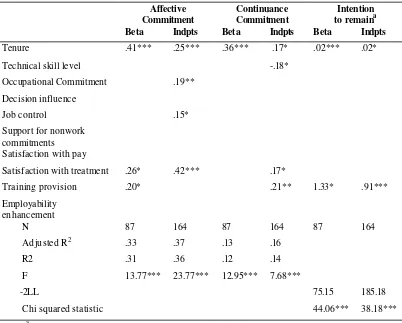
Whether the presence of HCWP had either a positive or negative effect on attitudes and intentions towards the organization (predictions 3 and 4) was tested by regressing employee perceptions of practices on each of the key employee attitudes and outcomes (affective commitment, continuance commitment, intention to remain with the organization) while controlling for tenure, technical skill level of the job and occupational commitment. Table 8.4 shows these regressions for Beta and the independent organizations separately.
Insert Table 8.4 about here
They pay my wages, I should be defending them. …Beta has put a lot of
money into my development especially over the last year or so and I do feel
to slag the company off to external people is wrong. It’s ok if it’s internal.
(Beta interview 7, male software engineer)
In the independent organizations, fair treatment and greater job control were positively related to affective commitment, and training to intention to remain. For these organizations more than Beta, then, elements of the direct high commitment model appeared to be operating. Our qualitative data illustrated these relationships both for those directly involved in software development and other staff in supporting roles.
I do feel committed here. I feel they have invested a lot of training, time and
development in me, so I do feel that I owe that back to the company but,
then, if an excellent opportunity arose elsewhere I would be inclined to take
up another opportunity…..
(Lambda interview 1, female PA to Financial Director)
Interviewer: Commitment to the company?
Senior software engineer: Yes, pretty much so. …. ideally (another job) would have to offer, in the same way as this current job offered me, the
prospects of being more involved with the design, making of the designs as
well as money. This company being relatively small, if you get in at this
stage, as it grows the people who are in roughly senior positions are likely
to be taken with it and move up through the ranks; if in two years time there
is 300 employees rather than 100 employees, someone like that might find it
harder because there is more people vying for that one position. So, if I get
in at this early stage I think I could benefit from it.
The final predictions related to the possible effects of other factors. Table 8.4 shows that tenure was a strong predictor of all outcomes in both types of organization and that for independents affective commitment was also influenced by occupational commitment.
This may show that in the independent organizations, which had a higher proportion of workers at the lower technical skill levels, identifying with the organization cultivated identification with the occupation, while in the case of the more highly skilled Beta workers the two foci of identification came from different sources (e.g., the organization versus professional qualifications).3 This speculation is given further support by the finding that continuance commitment in the independents was inversely related to technical skill level, which means that the higher their skill level, the less likely employees were to stay with the organization because of no other choices. Thus, there is evidence to support the third prediction of the direct commitment model in both types of organizations, and some evidence for the indirect model in Beta, although the influence of training in Beta seemed to be internally orientated with respect to the organization (hence its relationship to affective commitment) rather than externally orientated towards enhancing employability in the industry.
CONCLUSIONS
Similarly the assumption that knowledge-based organisations such as software houses will lead the field in developing direct high commitment management policies has been found wanting in the companies in this sample. Only the more bureaucratic former utility, Beta, had any formalised HCWPs, the other smaller, more organic, enterprises relying on the mix of paternalism and informal arrangements more typical of SMEs. On a wider note, these findings from the Scottish software industry offer endorsement to the repeated observations of large scale UK studies such as the 1992 Workplace Industrial Relations Survey (WIRS), the 1998 UK WERS, and a recent ESRC study by Guest and colleagues, that the development and diffusion of high-commitment management practices in general remains extremely sparse (Cully et al. 1999: 295; Taylor 2002: 25). We would suggest that their absence in the very sector where it has been widely hypothesized such practices would be most appropriate does not lend support to the view that we are witnessing the gestation of a new high-trust, high commitment knowledge economy. .
Thus it would seem that software developers’ commitment to their organisation is markedly indirect and is sustained only in so far as:
a) the organisation expresses the values, such as autonomy, of the professional community,
b) the organisation offers the prospect of enhancing personal development and labour market leverage,
c) the expenditure of discretionary job effort is recognised and reciprocated by the above and by levels of pay.
imply a discrete allegiance to that particular organization – it may mean rather ‘to all organizations which are like this’ or which ‘embody my professional values and identity’.
It would seem therefore that software organizations could influence workers’ attachment to the organization by providing the conditions for professional development (such as levels of pay, autonomy and skill acquisition) and these norms may promote high commitment to the work and identification with the organizational goals (Kunda 1992) because of the perceived gains of staying with that organization.
Finally we should be reminded of the contextual parameters for reciprocity. Western employers, as demonstrated elsewhere (see Sennett 1998; Thompson 2003), have only offered the prospect of long-term employment when continued growth, labour market shortages and other economic conditions favour such an approach. Their commitment to employees is, and always has been, founded on economic pragmatism. Employees are not slow to recognize the limited and conditional commitment offered to them by their employers and many vulnerable employees traditionally turn to trade unions for at least minimal protection. Those professional and highly skilled employees who enjoy specific labour market leverage may be expected to take advantage of their scarcity by seeking optimisation of income and employment conditions with their current employer or by skimming the labour market to the best of what may be their short-term advantage. This is the sort of reciprocal behaviour predicted by equity theory (Adams 1963), which owes little to conceptualisations of organizational commitment, but more to the realities of fluctuating labour market dynamics and rational responses to employer behaviour.
REFERENCES
Adams, J. S. (1963) ‘Towards an understanding of inequity’, Journal of Abnormal
Allen, N. J., and Meyer, J. P. (1990) ‘Organizational socialization tactics: A longitudinal analysis of links to newcomers’ commitment and role orientation’, Academy of Management Journal, 33: 847-58.
Alvesson, M. (2000) ‘Social identity and the problem of loyalty in knowledge-intensive companies’, Journal of Management Studies, 37, 8: 1101-123
Ashforth, B., and Mael, F. (1989) ‘Social identity theory and the organisation’,
Academy of Management Review, 14, 1: 20-39
Baldry, C. (2003) ‘Employment relations in the information society’, in B. Towers (ed.) A Handbook of Employment Relations and Law, London, Kogan Page.
Barrett, R. (2001) ‘Labouring under an illusion? The labour process of software development in the Australian information industry’, New Technology Work
and Employment, 16, 1: 18-34.
Becker, H. (1960) ‘Notes on the concept of commitment’, American Journal of
Sociology, 66, 1: 32-40
Becker, H. (1992) ‘Foci and bases of commitment: Are they distinctions worth making?’ Academy of Management Journal, 35: 232-44.
Becker, T. E., and Billings, R. S. (1993) ‘Profiles of commitment: An empirical test’, Journal of Organizational Behavior, 14, 2: 177-90.
Blau, G. J. (1985) ‘The measurement and prediction of career commitment’,
Journal of Occupational Psychology, 58: 277-88.
Capelli, P. (1999) The New Deal at Work: Managing the Market-Driven
Workforce, Boston: Harvard Business School Press.
Capelli, P. (2000) ‘Managing without commitment’, Organizational Dynamics, 28, 4: 11-24
Castells, M. (1996) The Rise of the Networked Society, Oxford: Blackwell.
Cully, M., Woodland, S., O’Reilly, A., and Dix, G. (1999) Britain at Work: as
Depicted by the 1998 Workplace Employee Relations Survey, London:
Eisenberger, R., Fasolo, P. M., and Davis-Lamastro, V. (1990) ‘Effects of perceived organisational support on employee diligence, innovation, and commitment’, Journal of Applied Psychology, 53: 51-59.
Folger, R., and Konovsky, M. K. (1989) ‘Effects of procedural and distributive justice on reactions to pay raise decisions’, Academy of Management
Journal, 32: 115-130.
Fox, A. (1974) Beyond Contract: Work, Power and Trust Relations, London: Faber and Faber.
Gopinath, C., and Becker, T. E. (2000) ‘Communication, procedural justice, and employee attitudes: Relationships under conditions of divestiture’, Journal
of Management, 26: 63-83.
Guest, D. (2002) ‘Human resource management, corporate performance and employee wellbeing: Building the worker into HRM’, Journal of Industrial
Relations, 44, 3: 335-58
Hall, R. H. (1968) ‘Professionalization and bureaucratization’, American
Sociological Review, 33: 92-104.
Hunt, S., and Morgan, R. (1994) ‘Organizational commitment: One of many commitments or key mediating construct?’ Academy of Management
Journal, 37, 6: 1568-588.
Huselid, M. A. (1995) ‘The impact of human resource management practices on turnover, productivity, and corporate financial performance’, Academy of
Management Journal, 38: 635-72.
Hyman, J., Lockyer, C., Marks, A., and Scholarios, D. (2004) ‘Needing a new program? Why is union membership so low among software workers?’ in W. Brown, G. Healy, E. Heery and P. Taylor (eds.) The Future of Worker
Representation, London: Palgrave.
Kessler, I., and Purcell, J. (2003), ‘Individualism and Collectivism in Industrial Relations’, in: Edwards, P. (ed.) (2nd ed., 2003), Industrial Relations
Theory and Practice in Britain, Oxford, Blackwell.
Kunda, G. (1992) Engineering Culture, Control and Commitment in a High-Tech
Legge, K. (2001) ‘Silver bullet or spent round? Assessing the meaning of the “high commitment management”/performance relationship’ in J. Storey (ed)
Human Resource Management: A Critical Text, London: Thomson.
Mael, F. A., and Tetrick, L. E. (1992) ‘Identifying organizational identification’,
Educational and Psychological Measurement, 52, 4: 813-25.
Meyer, J. P., Allen, N. J., and Smith, C. A. (1993) ‘Commitment to organizations and occupations: Extension and test of a three-component conceptualization’, Journal of Applied Psychology, 78: 538-51.
Meyer, J. P., AND Allen, N. J. (1997) Commitment in the Workplace: Theory,
Research and Application, Thousand Oaks, Ca.: Sage.
Mowday, R.T., Steers, R.M., and Porter, L. W. (1979) ‘The measurement of organizational commitment’, Journal of Vocational Behavior, 14: 224-47. Mueller, C. W. and Lawler, E. D. (1999) ‘Commitment to nested organizational
units: Some basic principles and preliminary findings’, Social Psychology
Quarterly, 62, 4: 325-47.
Pearce, J. L. (1993) ‘Toward an organizational behavior of contract laborers: Their psychological involvement and effects on employee co-workers’,
Academy of Management Journal, 36: 1082-1096.
Peters, T., and Waterman, R. (1982) In Search of Excellence: Lessons From
America’s Best-Run Companies, New York: Harper and Row.
Podsakoff, P. M., MacKenzie, S. B., and Bomer, W. H. (1996) ‘Transformational leader behaviours and substitutes for leadership as determinants of employee satisfaction, commitment, trust and organizational citizenship behaviours’, Journal of Management, 22: 259-98.
Ramsay, H., Scholarios, D. and Harley, B. (2000) ‘Employees and high performance work systems: Testing inside the black box’, British Journal of
Industrial Relations, 38, 4: 501-31.
Reichers, A. E. (1985) ‘A review and reconceptualization of organizational commitment’, Academy of Management Review, 10: 465-76.
Sennett, R, (1998) The Corrosion of Character, New York: Norton.
Tashakkori, A., and Teddlie, C. (1998) Mixed Methodology: Combining
Qualitative and Quantitative Approaches, Thousand Oaks, CA: Sage.
Taylor, R. (2002) ‘Britain’s world of work – Myths and realities’, ESRC Future of
Work Commentary Series, Swindon: Economic and Social Research
Council.
Thompson, P. (2003) ‘Disconnected capitalism, or why employers can’t keep their side of the bargain’, Work, Employment and Society 17, 2: 359-78. Van Dick, R. (2001) ‘Identification and self-categorization processes in
organizational contexts: Linking theory and research from social and organizational psychology’, International Journal of Management Reviews, 3: 265-83.
Vandeberg, R. J. and Scarpello, V. (1994) ‘A longitudinal assessment of the determinant relationship between employee commitments to occupation and the organization’, Journal of Organizational Behavior, 15: 535-47
Walton, R. E. (1985) ‘From control to commitment in the workplace’, Harvard
Business Review, March-April: 77-84
Zuboff, S. (1988) In the Age of the Smart Machine: The Future of Work and
Figure 8.1: Predictions of direct and indirect commitment models Direct High Commitment Model Indirect Process Model of
Commitment 1. Software workers have high affective
commitment and low continuance commitment.
1. Software workers have higher occupational commitment than affective commitment, and low continuance commitment. 2. Software organizations are
exemplars of HCWP
2. Software organizations are exemplars of practices which enhance professional development (e.g. training, skill
acquisition). 3. There is a positive relationship
between HCWP and employee attitudes (affective commitment) and outcomes (intention to remain with the
organization).
3. There is a positive relationship between practices which enhance professional development (e.g., training, career structure) employee attitudes (affective and continuance commitment) and outcomes (intention to remain with the organization). 4. Affective commitment and intention
to remain with the company are most strongly influenced by HCWP rather than other variables.
4. Affective commitment and intention to remain with the organization are more strongly influenced by tenure, employees’ technical skill level and occupational commitment.
Table 8.1: Description of case studies
Beta Omega Gamma Pi Lambda
No. employees 275 248 150 50 20
Year established Former public sector utility;
restructuring of software centre 1999
1985 1986 1977/1999 1996
Product/service Bespoke telephone operations; robotic tools; database integration; financial systems
Applications development, resourcing, testing, client support; AS400 technology
Systems integration of front and end operations; bespoke CRM systems; subcontractor linking major platforms for clients
Legal and business software development, testing, support, training and maintenance.
Health and safety recording software
Primary market Telecommunications; internal clients Public sector, health services, financial services
Database users, initially manufacturing but recently financial and business services
Law firms Insurance; IT multinationals
Major business direction
Providing a range of business solutions for external clients
Largely public sector; developing into English market
New release of software; shift from C++ to Java
Client server and web server versions of software
Client server and web server versions of software
Union presence Yes No No No No
Development of HRM policies and practices
Sophisticated and highly centralised. Formal training, appraisal linked to promotion/pay, profit-sharing, communication schemes, internal recruitment and harmonisation of pensions, sick leave etc. No compulsory redundancies.
Informal; HRM given low priority. Inconsistent appraisal system, little formal training, profit sharing scheme in development.
Informal; no formal pay structure. Little formal training, appraisal system in
development, informal system of performance-related pay.
Emerging. High status HR officer. Policies in development
(performance related pay, appraisal, benefits).
Table 8.2: Sample characteristics for each case study organization
Beta Omega Pi Lambda Gamma
N 112 121 38 14 18
% of sample 37% 40% 12% 5% 6%
Female 18% 32% 34% 29% 6%
Age <30 42% 29% 34% 64% 44%
Contractor 17% 13% 0 0 0
Tenure <2 years 20% 39% 37% 50% 61%
Paid overtime a 9% 14% 8% 0 6%
Unpaid overtime a 51% 51% 84% 71% 89%
Intend to stay with company
37% 42% 47% 71% 39%
Table 8.3: Comparison of means for Beta versus the four independent organizations
Beta All independents F
M SD M SD
Commitment
Affective 2.94 .68 3.26 .75 13.54 ***
Continuance 2.70 1.01 2.64 .94 .32
Occupation 3.63 .70 3.72 .71 .70
Colleagues 3.60 .73 3.71 .78 1.48
Employee perceptions (scale)
Decision influence 2.25 .66 2.37 .75 1.75
Job control 3.86 .51 3.86 .59 .00
Support for non-work commitments 3.63 .56 3.55 .69 1.05 Satisfaction with pay (1-7) 3.93 1.38 4.43 1.32 9.72 ** Satisfaction with treatment (1-7) 4.37 .96 4.64 .96 5.57 * Training provision (1-4) 2.56 .58 2.22 .68 18.17 *** Employability enhancement (1-4) 2.69 .55 2.51 .59 7.30 *** Note:
Beta N=109-112
All independent organizations N=181-187
Table 8.4: Regressions predicting employee outcomes: Beta compared to the four independent oganizations
Affective Commitment
Continuance Commitment
Intention to remaina Beta Indpts Beta Indpts Beta Indpts Tenure .41*** .25*** .36*** .17* .02*** .02*
Technical skill level -.18*
Occupational Commitment .19** Decision influence
Job control .15*
Support for nonwork commitments Satisfaction with pay
Satisfaction with treatment .26* .42*** .17*
Training provision .20* .21** 1.33* .91***
Employability enhancement
N 87 164 87 164 87 164
Adjusted R2 .33 .37 .13 .16
R2 .31 .36 .12 .14
F 13.77*** 23.77*** 12.95*** 7.68***
-2LL 75.15 185.18
Chi squared statistic 44.06*** 38.18*** Note: a Logistic regression – coefficients are unstandardised
CHAPTER 8 NOTES
1 This chapter is based on data collected as part of an ESRC research project funded under the
Future of Work initiative (award number L212252006) ‘Employment and Working Life beyond the Year 2000: Two Emerging Employment Sectors’ (1999-2001). The full research team at Strathclyde, Stirling, Aberdeen and Heriot-Watt Universities is: Peter Bain, Chris Baldry, Nick Bozionelos, Dirk Bunzel, Gregor Gall, Kay Gilbert, Jeff Hyman, Cliff Lockyer, Abigail Marks, Gereth Mulvey, the late Harvie Ramsay, Dora Scholarios, Philip Taylor and Aileen Watson. 2
A background aspect of commitment that can also be considered is trade union identification which can be seen as an alternative and potentially competing source of worker loyalty and values. Rejection of trade union membership might be associated with closer affiliation to the employing organisation and its objectives. In our study, over two -thirds of the sample of software developers, including nearly half of the union members, did not see union membership as being appropriate to their work and labour market situation, confirming the general position on the
individualistic/collectivist spectrum reported of software workers elsewhere (Barrett 2001; Hyman J, Lockyer, Marks and Scholarios 2004). This view was typified by the Beta software engineer who stated ‘I wouldn’t trust a union to represent my vie ws to Beta. I’d rather represent my views myself’ (Beta Interview 4, male, software engineer).
3