Line Based Multi-range Asymmetric Conditional Random
Field for Terrestrial Laser Scanning Data Classification
Chao Luo
A DISSERTATION SUBMITTED TO THE FACULTY OF GRADUATE STUDIES
IN PARTIAL FULFILLMENT OF THE REQUIREMENTS FOR THE DEGREE OFDOCTOR OF PHILOSOPHY
GRADUATE PROGRAM IN EARTH AND SPACE SCIENCE
YORK UNIVERSITY
TORONTO, ONTARIO
DECEMBER, 2015
Abstract
Terrestrial Laser Scanning (TLS) is a ground-based, active imaging method that rapidly
acquires accurate, highly dense three-dimensional point cloud of object surfaces by laser
range finding. For fully utilizing its benefits, developing a robust method to classify
many objects of interests from huge amounts of laser point clouds is urgently required.
However, classifying massive TLS data faces many challenges, such as complex urban
scene, partial data acquisition from occlusion. To make an automatic, accurate and robust
TLS data classification, we present a line-based multi-range asymmetric Conditional
Random Field algorithm.
The first contribution is to propose a line-base TLS data classification method.
In this thesis, we are interested in seven classes: building, roof, pedestrian road (PR), tree,
low man-made object (LMO), vehicle road (VR), and low vegetation (LV). The
line-based classification is implemented in each scan profile, which follows the line profiling
nature of laser scanning mechanism. It is rather straightforward to extract lines in each
scan profile, and the appearance of scanned objects can be characterized using lines. Ten
conventional local classifiers are tested, including popular generative and discriminative
classifiers, and experimental results validate that the line-based method can achieve
satisfying classification performance. However, local classifiers implement labeling task
on individual line independently of its neighborhood, the inference of which often suffers
uses object context as post-classification to improve the performance of a local generative
classifier. The maCRF incorporates appearance, local smoothness constraint, and global
scene layout regularity together into a probabilistic graphical model. The local
smoothness enforces that lines in a local area to have the same class label, while scene
layout favours an asymmetric regularity of spatial arrangement between different object
classes within long-range, which is considered both in vertical (“above-bellow” relation)
and horizontal (“front-behind”) directions. The asymmetric regularity allows capturing
directional spatial arrangement between pairwise objects (e.g. it allows ground is lower
than building, not vice-versa). The third contribution is to extend the maCRF model by
adding across scan profile context, which is called Across scan profile Multi-range
Asymmetric Conditional Random Field (amaCRF) model. Due to the sweeping nature of
laser scanning, the sequentially acquired TLS data has strong spatial dependency, and the
across scan profile context can provide more contextual information. The final
contribution is to propose a sequential classification strategy. Along the sweeping
direction of laser scanning, amaCRF models were sequentially constructed. By
dynamically updating posterior probability of common scan profiles, contextual
information propagates through adjacent scan profiles.
The proposed methods are finally evaluated using datasets collected at two
different sites, York Village and York Blvd. And the experimental results validated the
advantage using multi-range contexts and sequential processing. As line extraction is
implemented in each scan profile, the line-based method has great potential on real-time
algorithm in a real-time environment is not available. Thus we simulate the line-based
Acknowledgements
I would like to extend my sincere gratitude to all of the people who supported and
helped me in the past six and half years.
At first, a very special word of appreciation gives to Dr. Gunho Sohn, my
supervisor, for his clear guidance, insightful suggestions, and challenging discussions that
I finished my PhD research on Machine Learning topic with a total different academic
background, Geographic Information System. His continuous encouragement and
supports created a stimulating academic environment that I appreciated.
I would like to thank Dr. Costas Armenakis (York University, GeoICT), and Dr.
James Elder (York University, GeoICT), the supervision committee members, for their
scientific suggestions, valuable advices, and encouragements which significantly speed
up my research progress. Particular gratitude to Dr. James Elder, who opened the door of
statistical machine learning to me, and guided me to solve the real world problem using
probabilistic models. I also thank my previous supervisors (Master degree), Dr. Huayi
Wu (Wuhan Univeristy, China) and MS. Aihong Song (Wuhan Univeristy, China), for
their continuous encouragements and helps.
Many individuals have contributed in different ways to my PhD research. I would
like to appreciate Dr. Yooseok Jwa (GeoICT, York University) for helping me to design
the framework of object recognition from mobile railway laser scanning data; Dr.
Heungsik Kim (GeoICT, York University) for helping me to explore potential application
line extraction, feature extraction; Mr. Jaewook Jung (GeoICT, York University) for
helping me to develop features and providing me visualization tool of TLS data; and Dr.
Mojgan Jadidi (GeoICT, York University), who gave me many suggestions on thesis
writing.
I wish to thank GEOmaticsfor Informed DEcisions (GEOIDE), Ontario Centres of
Excellence (OCE), Natural Sciences and Engineering Research Council of Canada
(NSERC) Discovery, Hyundai, and China Scholarship Council (CSC) for arranging the
financial support for this PhD research. Thank all my research partners from GeoICT,
Langyue Wang and Ravi Persad, and partners from CVR at York University, Eduardo
Corral-Soto and Ron Tal. Warm thanks to all other student members and visiting scholars
at GeoICT of York University, who helped me in my research, such as Dr. Yawen Liu,
Dr. Jili Li, Dr. Connie Ko, Dr. Junjie Zhang, Julien Lee-Chee-Ming.
Finally, I deeply thank my parents, Guixian Chen and Fuhua Luo, for their
endless love and continuous encouragement. They gave me support through their
Table of
Contents
Abstract ... ii
Acknowledgements ... v
Table of Contents ... vii
List of Tables ... xii
List of Figures ... xiv
List of Abbreviations ... xvi
Chapter 1: Introduction ... 1 1.1 Problem Domain ... 1 1.1.1 Research Context ... 1 1.1.2 Problem Statement ... 4 1.2 Research Objectives ... 9 1.3 Methodology Overview ... 10 1.4 Outline... 13 Chapter2: Background ... 15
2.1 Terrestrial Laser Scanning Technology ... 15
2.1.1 Laser Scanning Mapping ... 15
2.1.3 Terrestrial Laser Scanning Data Classification... 19
2.1.3.1 Rule Based Classification ... 21
2.1.3.2 Machine Learning ... 22
2.2 Context Based Object Recognition ... 25
2.2.1 Object Context ... 26
2.2.2 Scene Layout Prior ... 28
2.3 Probabilistic Graphical Model ... 30
2.3.1 Probabilistic Graphical Model ... 30
2.3.2 Markov Random Field ... 31
2.3.3 Conditional Random Field ... 34
2.4 Chapter Summary ... 36
Chapter3: Line-based TLS Data Classification... 37
3.1 Line-based Classification ... 38
3.1.1 Motivation of Line-based Classification ... 38
3.1.2 Scan Profile Generation ... 40
3.1.3 Line Segment Extraction... 41
3.2 Linear Feature Extraction ... 44
3.2.1 Local Features ... 44
3.2.2 Contextual Features ... 45
3.2.3 Feature Selection ... 46
3.3.1 Naïve Bayes(NB) ... 49
3.3.2 Multivariate Gaussian (MG) ... 52
3.3.3 Gaussian Mixture Model (GMM) ... 53
3.4 Discriminative Classifiers ... 56
3.4.1 K-Nearest Neighbors (KNN) ... 57
3.4.2 Logistic Regression (LR) ... 59
3.4.3 Support Vector Machine (SVM) ... 61
3.4.4 Artificial Neural Networks (ANN) ... 64
3.4.5 Decision Tree (DT) ... 66
3.4.6 Random Forest (RF) ... 68
3.4.7 Adaptive Boosting (AdaBoost) ... 70
3.5 Experiment Results ... 72
3.5.1 Experimental Data ... 73
3.5.2 Qualitative Analysis ... 76
3.5.3 Quantitative Analysis ... 78
3.6 Chapter Summary ... 84
Chapter4: Along Scan Profile Conditional Random Field ... 85
4.1 Methodology Overview ... 86
4.2 Line Adjacent Graph ... 89
4.3 Short Range CRF (srCRF) ... 92
4.3.2 Association Potential ... 93
4.3.3 Interaction Potential ... 94
4.4 Long Range CRF ... 94
4.4.1 Scene Layout ... 95
4.4.2 Long Range Vertical CRF (lrCRF(V)) ... 97
4.4.2.1 Graph Construction ... 97
4.4.2.2 Association and Interaction Potential ... 98
4.4.3 Long Range Horizontal CRF (lrCRF(H)) ... 102
4.4.3.1 Graph Construction ... 102
4.4.3.2 Association and Interaction Potential ... 103
4.5 Multi-Range CRF... 105
4.5.1 Product Combination of Multiple CRF Classifiers ... 105
4.5.2 Single Integrated Model ... 107
4.6 Training and Inference of CRF ... 109
4.6.1 Training the Association and Interaction Potentials ... 111
4.6.2 Training the Weight of Potential Terms ... 112
4.6.3 Inference ... 114
4.7 Experiment Results ... 117
4.7.1 Qualitative Analysis ... 120
4.7.2 Quantitative Analysis ... 128
Chapter5: Across Scan Profile Conditional Random Field... 134
5.1 Context between Scan Profile ... 135
5.2 Across Scan Profile CRF Model ... 136
5.2.1 Graph Construction ... 137
5.2.2 Potential Design ... 140
5.2.3 Parameter Learning and Inference ... 140
5.3 Context Propagation through Adjacent Scan Profile ... 142
5.4 Experiments of Across Scan Profiles CRF models... 146
5.5 Additional Experiments ... 149
5.5.1 SVM Based CRFs ... 149
5.5.2 York Blvd Datasets ... 152
5.5.3 Train Classifiers using York Village Dataset and Test on York Blvd Dataset ………..157 5.6 Chapter Summary ... 163 Chapter6: Discussions ... 165 6.1 Conclusions ... 166 6.2 Future Work ... 170 Bibliography ... 173
List of Tables
Table 2.1: Technical specifications of RIEGL LMS Z-390i ... 19
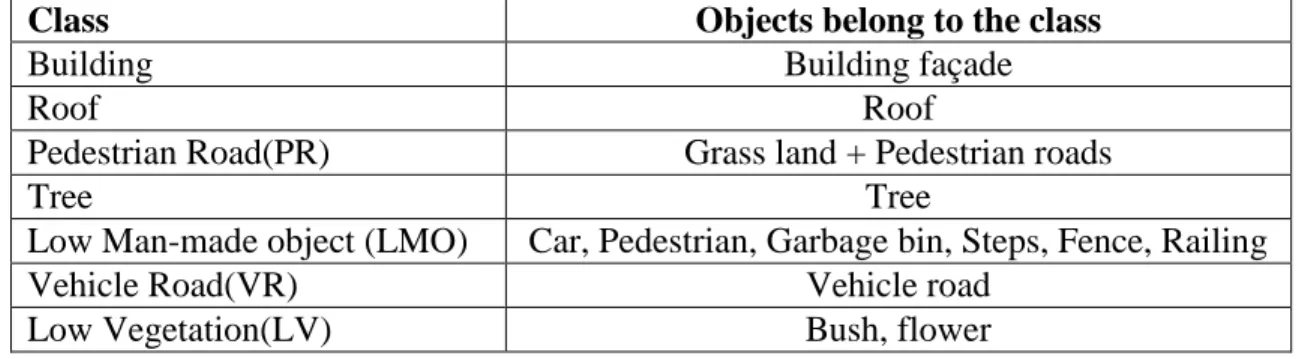
Table 3.1: Object categorization of experimental dataset. ... 74
Table 3.2: Number of laser point, scan profile, line segment in York Village dataset. .... 75
Table 3.3: Confusion matrix of GMM classifier of data YV2. ... 79
Table 3.4: Confusion matrix of SVM classifier of data YV2. ... 79
Table 3.5: Precision of each class in ten classifiers. ... 82
Table 3.6: Recall of each class in ten classifiers. ... 82
Table 3.7: F1 score of each class in 10 classifiers. ... 83
Table 4.1: Total number of the spatial entities extracted from York Village datasets. .. 118
Table 4.2: Positive and negative transition from GMM to each CRF classifier. ... 125
Table 4.3: Test accuracy of GMM and the four CRF models. ... 129
Table 4.4: Confusion matrix of srCRF classifier on data YV2... 129
Table 4.5: Confusion matrix of lrCRF(V) classifier on data YV2. ... 130
Table 4.6: Confusion matrix of lrCRF(H) classifier on data YV2. ... 130
Table 4.7: Confusion matrix of maCRF classifier on data YV2... 130
Table 5.1: Total number of the spatial entities extracted from York Village datasets. .. 146
Table 5.2: Test Accuracy of sequential CRF Models. ... 149
Table 5.3: Test Accuracy of sequential CRF Models. ... 151
List of Figures
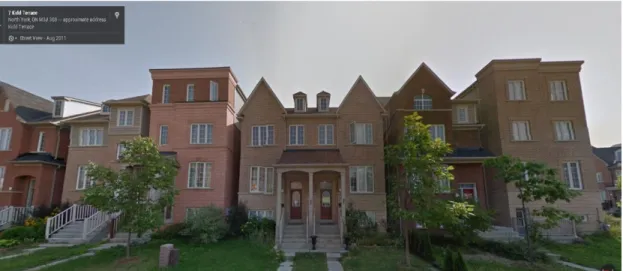
Figure 1.1: Examples of objects in terrestrial laser scanning data. ... 6
Figure 3.1: Examples of line extraction. ... 43
Figure 3.2: Post-processing using the Douglas–Peucker algorithm. ... 44
Figure 3.3: Neighborhood selection for context feature. ... 46
Figure 3.4: Averaged test accuracy over 5-fold cross validation. The value ... 59
Figure 3.5: Typical structure of ANN with three layers. ... 64
Figure 3.6: Averaged test accuracy over 5-fold cross validation as different minimum leaf size was selected. ... 68
Figure 3.7: Real scene of the York Village Data. ... 73
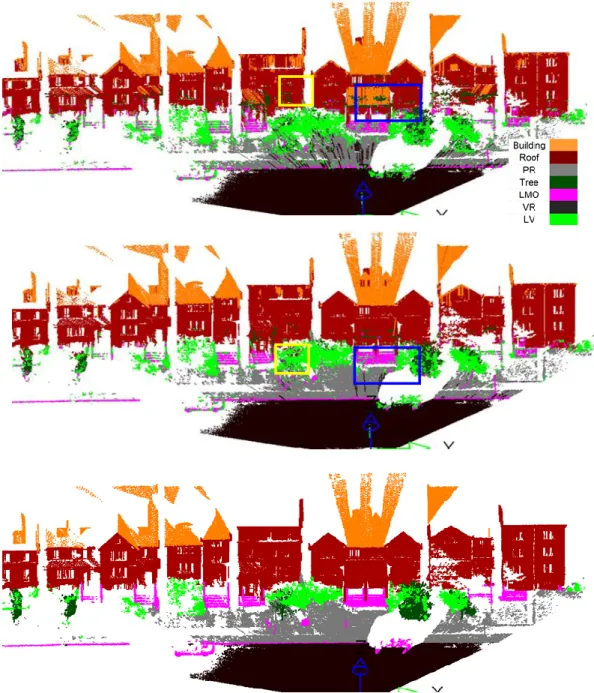
Figure 3.8: Classification result of GMM, SVM and ground truth. ... 77
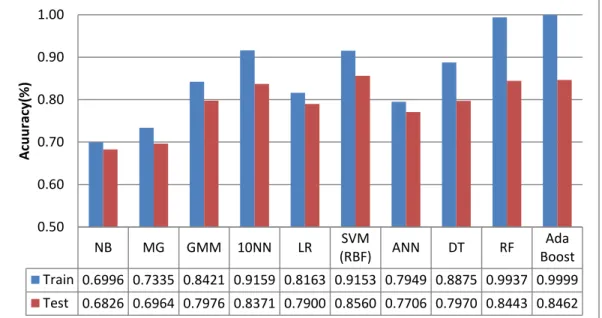
Figure 3.9: Averaged accuracy of ten classifiers. ... 80
Figure 4.1: Height distributions of seven classes... 87
Figure 4.2: Example of grid system and line-cell occupancy relations. ... 90
Figure 4.3: Multi-range neighborhood searching for each cell... 91
Figure 4.4: Prior and likelihood estimation for vertical interaction term. ... 101
Figure 4.5: Prior and likelihood estimation for horizontal interaction term. ... 104
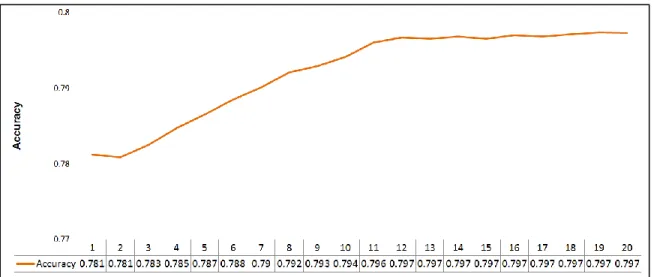
Figure 4.6: Parameter learning of maCRF model using SGD algorithm on data YV1. . 119
Figure 4.7: Classification result of the four CRFs of the data YV2. ... 121
Figure 4.10: Label transition from GMM to lrCRF(V). ... 126
Figure 4.11: Label transition from GMM to lrCRF(H). ... 127
Figure 4.12: Label transition from GMM to maCRF. ... 128
Figure 4.13: Precision of each class in five methods. ... 131
Figure 4.14: Recall of each class in five methods. ... 132
Figure 4.15: F1-Score of each class in five methods. ... 132
Figure 5.1: Across and along scan profile neighborhood. ... 138
Figure 5.2: Example of across/with scan profile multi-range graph. ... 139
Figure 5.3: Each amaCRF model is independent with each other. ... 142
Figure 5.4: Contextual information propagates through adjacent scan profiles. ... 144
Figure 5.5: Parameter learning of maCRF model on data YV1. ... 147
Figure 5.6: Classification result of the amaCRF model and sequential processing on the data YV2. ... 148
Figure 5.7: Parameter learning of the amaCRF model (SVM) on data YV1. …………150
Figure 5.8: Classification result of the SVM-based amaCRF model and sequential processing on the data YV2. ... 152
Figure 5.9: Surveying locations of York Blvd Dataset. ... 153
Figure 5.10: Classification results of the GMM and GMM-based amaCRF model with sequential processing on the data YB2. ... 155
Figure 5.11: Classification results of the SVM and SVM-based amaCRF model with sequential processing on the data YB2. ... 156
List of Abbreviations
AdaBoost Adaptive Boosting
ALS Airborne Laser Scanning
amaCRF Across scan profile Multi-range Asymmetric CRF
amaCRF+ Across scan profile Multi-range Asymmetric CRF with sequential
modeling
AMN Associative Markov network
ANN Artificial Neural Network
BP Belief Propagation
CART Classification And Regression Tree
CRF Conditional Random Field
DLG Digital Linear Graph
DOM Digital Ortho-image Model
DRM Digital Raster graph Model
DT Decision Tree
DTM Digital Terrain Model
EM Expectation Maximization
GLCM Gray-Level Co-occurrence Matrix
GMM Gaussian Mixture Model
IMU Inertial Measurement Unit
KNN K-Nearest Neighbor
LBP Loopy Belief Propagation
LiDAR Light Detection And Ranging
LLF Label Layout Filter
LMO Low Man-made Object
LOD Level of Detail
LR Logistic Regression
LV Low Vegetation
maCRF Multi-range Asymmetric CRF
MG Multivariate Gaussian
MLE Maximum Likelihood Estimation
MRF Markov Random Field
NB Naïve Bayes
PR Pedestrian Road
PS Phase Shift
RANSAC RANdom SAmple Consensus
RBF Radial Basis Function
RF Random Forest
SAMME Stagewise Additive Modeling using a Multi-class Exponential loss
function
SVM Support Vector Machine
TLS Terrestrial Laser Scanning
ToF Time-of-Flight
VR Vehicle Road
YV York Village
Chapter 1
Introduction
1.1 Problem Domain
1.1.1 Research Context
Municipal infrastructure refers to the fundamental facilities and systems that serve for the
public. Typical infrastructures include public buildings, transportation networks, bridges,
train/bus stations, education facilities, and hospital service, etc. Urbanization is the global
trend but the growing urban population brings challenges to municipal infrastructure
management. The “State of World Population 2014”, published by the United Nations
Population Fund (UNPF) that infrastructure shortage is a significant problem in
developing counties, especially those counties with fast population growth (UNPFA,
2014). Every day, new urban infrastructures are built while existing infrastructures
deteriorate, which poses a great demand for a sustainable management of municipal
infrastructure system, including construction, monitoring, and maintenance. A sustainable
municipal infrastructure management system enables city governments and related civic
service provides better services to the residences. Many governments have realized the
significance of a sustainable municipal infrastructure system, and have already taken
actions, such as Canada’s National Guide to Sustainable Municipal Infrastructure
(Boudreau and Brynildsen, 2003), and Singapore’s Future Cities Laboratory (FCL)
Risk assessment of infrastructures is one of the key elements of an infrastructure
management system. A 3D municipal infrastructure system can significantly reduce the
amount of cognitive effort, achieve a rapid response to plausible risks, and improve the
efficiency of the decision-making process (Kolbe et al. 2005, Zlatanova 2008). As one of
essential components of a municipal infrastructure system, 3D urban modeling is a
crucial work. Recently, 3D photo-realistic urban modeling, especially the 3D building
modeling has been attracting much attention from photogrammetric and computer vision
communities as there is an increasing demand for urban modeling applications, such as
urban planning, augmented reality and individual navigation. In 3D city visualization, the
same city object needs to be represented with different geometric complexities according
to users’ request. The Level of Detail (LOD) is usually used to describe the geometric
complexity of a 3D building, and allows the geometry of objects to be represented in
varying accuracies and details (Emgard and Zlatanova, 2008). Lee and Nevatia (2003)
proposed a hierarchical representation structure of 3D building models for 3D urban
reconstruction, in which the visualization quality of the building model increases when
LOD level upgrades. The coarsest LOD0 is essentially a 2.5D Digital Terrain Model
(DTM), and building models in LOD0 do not contain volume. In the LOD1 level,
building models are referred to as a block with flat roof structures. Both the outer facade
and roof of the buildings at LOD2 level can be represented with multiple faces.
Compared with lower-level models, LOD3 goes further by representing more detailed
facade geometries, such as wall, roof, door, window, sidewall, window sill .etc. The
For modeling realistic facilities, capturing digitized 3D geometric and textual
information is the first step. Photogrammetry has been and is still used as the main
method of collecting geo-spatial information of Earth surfaces over the past century.
Photogrammetry is passive remote sensing technology, and recovers 3D geometric and
photogrammetric information of real world by matching stereo pair images (Wolf et al.,
2000). Typical products of photogrammetry-based methods include digital elevation
model (DEM), digital ortho-image model (DOM), digital raster model (DRM), and
digital linear graph (DLG), which have been widely used for urban planning and
management. However, the main drawback of photogrammetric workflow is the low
efficiency in generating dense 3D coordinator from stereoscopic pictures and
somtimes-manual work (Alshawabkeh, Y., 2006). Recently, laser scanning compensates for this
drawback of photogrammetry by providing direct 3D data and has become a standard tool
for 3D data collection.
Airborne laser scanning (ALS) has been used for surveying and mapping since the
1980s, such as forest surveying (Rutzinger et al., 2008; Vehmas et al, 2009; Zhang and
Sohn, 2010; Kantola et al, 2013), digital surface modeling (Kraus and Pfeifer 1998).
Since ALS collects data from bird's-eye perspective, it can capture roofs of buildings
efficiently but only get part of building facade that is essential for LOD3 model. Due to
close range, high accuracy and cost-effectiveness, Terrestrial Laser Scanning (TLS) has
been rapidly adopted for collecting massive urban street-view data. According to the
vehicle based (Mobile TLS). Both of them could provide rich geometric information of
building facades for producing realistic LOD3 city models (Pfeifer and Briese, 2007).
As the TLS is a relative young technology for infrastructure surveying, many
problems on both hardware and software need to be solved. Popular research topics
related with TLS data processing are calibration (Lichti et al., 2005; Schulz, 2007),
multiple station registration (Al-Manasir and Fraser, 2006; Dold and Brenner, 2006;
Barnea and Filin, 2007), geo-referencing (Lichti et al., 2005; Reshetyuk, 2009),
integration of ALS and TLS (Böhm and Haala, 2005; Bremer and Sass, 2012),
segmentation (Boulaassal et al., 2007; Moosmann et al., 2009; Wang and Shan, 2009;
Aijazi et al, 2013), and classification (Belton and Lichti, 2006; Lim and Suter, 2008; Lim
and Suter, 2009; Munoz et al., 2009; Pu and Vosselman, 2009; Brodu and Lague, 2013;
Luo and Sohn, 2013; Luo and Sohn, 2014).
1.1.2 Problem Statement
According to spatial entity to label, classification algorithms for TLS data can be
categorized into three types: point-based (Triebel, et al, 2006; Munoz et al, 2008),
line-based (Manandhar and Shibasaki, 2001; Zhao et al., 2010) and surface-line-based (Belton and
Lichti, 2006; Pu and Vosselman, 2009). The point-based method directly labels
individual laser points. Though both line-based and surface-based methods partition the
point cloud into homogeneous segments, such as line, plane, and cylinder firstly, and then
label these segments. Since single laser point does not provide any semantic information
computational cost by reducing the number of spatial entities to be labeled, it is still
computational expensive in surface segmentation, which requires constructing adjacent
relationship in 3D space. In contrast, line segmentation is implemented in 2D space. This
advantage in computational efficiency of line-based method has been approved by (Jiang
and Bunke, 1994). Indeed, extracting line in profiling data is more straightforward where
the appearance of scanned objects can be well-characterized using lines. Moreover, as a
higher level geometric primitive, lines carry more sematic information than single point
about the scanned objects. Therefore we finally chose lines as geometric primitive for
TLS data classification. The line-based classification method starts with extracting lines
in each scan profile and subsequently labels these lines based on features vector.
Object recognition from massive TLS data still faces many challenges, such as
complex urban scene, appearance variations, occlusions and various point density with
range. For instances, the urban street scene is composed of various objects such as
building facade that can include walls, windows, doors, columns, balconies, etc.
Appearance variations means the same class could have great variation on appearance,
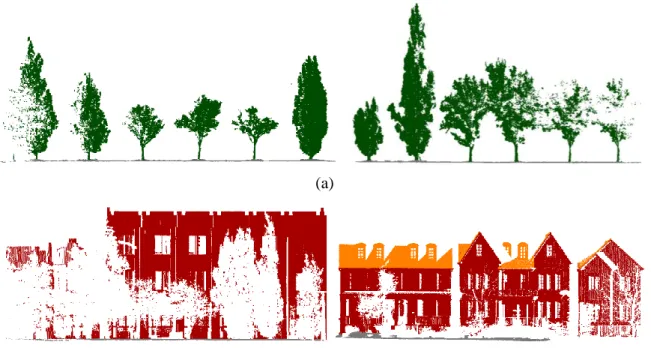
for example, different tree species have different shapes (Figure 1.1(a)) and structures
and building at different locations have different architectural styles (Figure 1.1(b)). In
IQmulus & TerraMobilita mobile laser scanning data, pedestrian class can be further
categorized into seven subdivision such as: still pedestrian, walking pedestrian, running
pedestrian, stroller pedestrian, holding pedestrian, leaning pedestrian and other pedestrian
Figure 1.1: Examples of objects in terrestrial laser scanning data. Color setting:
green-tree; brown-building; orange-roof.
Due to the limit of line-of-sight of static laser scanning, some objects are occluded
by other objects that are closer to the laser scanner, which results in some holes in the
occluded object. It is observed in Figure 1.1(b) that trees are in front of buildings and thus
many tree-shape holes are founded in the building area. Occlusion reduces the
information about the objects of interest and brings problem for further data processing.
The point density varies with the range between laser scanner and objects. The
point density decreases when the distance between the object and the laser scanner
increases. The various point density will make the same type of objects have different
geometric appearance when the distance changes.
(a)
All of problems mentioned above will cause the problem of feature ambiguity,
which is also called feature overlap. Feature distribution of different classes could
overlap in the feature space, which results in a non-linear separable classification
problem(Lalonde et al., 2005). Building classifiers only relying on these features with
serious ambiguity poses risk of misclassification (Trappenberg and Back, 2000).
A popular solution to solve the problem of feature ambiguity is applying object
context, or context for short, which can be defined as dependencies or correlation among
spatial entities (such as points, lines, or surfaces) in a scene. With context, a spatial entity
is perceived associated with its surrounding neighbors rather than independently.
Classifiers that do not consider context are called local classifier and those considering
context are called context based classifiers. Markov Random Field (MRF) was proposed
by Clifford (1990), and is a commonly used context based model. The MRF model has
been approved to be effective on laser scanning data classification (Anguelov et al., 2005;
Triebel et al., 2006; Munoz et al., 2008; Zhang and Sohn; Häselich et al., 2011). However,
MRF can only maximize the local label homogeneity between adjacent entities, but fails
to capture those relations at global level. For example, MRF can model the relations as
“the building is likely to be neighbor with the building”, but is unable to express interactions between different objects, such as “the building is above the ground but
below the roof”. Therefore, a MRF based method is probably to produce an
over-smoothness (minority objects are misclassified as the class that its surrounding majority
To avoid the over-smoothness problem, the global object scene layout is usually
considered. The scene layout corresponds to the relative locations of objects in a scene,
and assumes that image (or a point cloud) is not a random collection of independent
pixels (or points), but follows some rules on spatial arrangement. With the prior
knowledge on scene layout, it is expected to estimate what types of objects could be
above or below building, and so on. The scene layout can be modeled as a co-occurrence
matrix, but it is more frequently modeled as data-dependant interaction potential function
in a CRF model. Many achievements has been made on applying scene layout for object
recognition from images (Winn and Shotton, 2006; Heesch and Petrou, 2010; Jahangiri et
al., 2010; Ding et al., 2014). But just a few publications focus on applying scene layout
on TLS data classification. Pu and Vosselman (2009) applied manually defined scene
layout rules on classifying TLS data. Although such rule-based method is easily
implemented and achieved satisfying classification result, but, it cannot cover all the rules
that govern object layout, let alone conditions behind these rules.
All contexts mentioned above, local smoothness and scene layout provide
contextual information on different scales. Each single context contains partial contextual
information, so relying only on a single context could be risky as “part of the evidence is
spent to specify the model” (Leamer, 1978). It is promising to combine all types of contextual information together in one CRF model.
1.2 Research Objectives
The main objective of this thesis is to develop an automatic, accurate and robust
classification algorithm for TLS data processing. Accordingly, the specific objectives are
as follows:
1. Develop a line-based TLS data classification algorithm. We will explore the
potential of lines as the geometric primitive for TLS data classification. The lines
extraction is based on the “line profiling” nature of laser scanning. Each scan
profile is considered as a stream of sequentially observed laser points, and those
neighboring points that have small range difference were merged into a line. The
line is the highest level geometric primitive that can be extracted from profiling
data, so that the line primitives are expected to be optimal for characterizing street
objects and gaining computational benefits. As line extraction is implemented
within each scan profile, it is also suitable for a real-time point cloud processing.
2. Enhance classification accuracy using multi-range contexts. As mentioned
previously, complex urban scene, appearance variations, occlusions and various
point density with range can result in the problem of features ambiguity. Relying
only on these features with ambiguity, conventional local classifiers cannot
properly identify the boundaries between classes. To improve the classification
performance of local classifier, multi-range (short range and long range) contexts
are introduced. The short range context imposes local smoothness constraint that
neighboring lines are likely to have the same class label. While the long range
arrangements of objects in the space, both in vertical (“above-below” relation)
and horizontal (“front-behind”) directions. Moreover, local smoothness constraint
is also considered between lines at adjacent scan profiles, which makes lines gain
additional contextual information.
3. Enhance classification accuracy using context propagation. The acquisition of
laser scanning data can be regarded as the process that a set of vertical scan
profiles are sequentially obtained along the azimuth direction. Thus, object can be
viewed as “growing” along the direction that laser scanner sweeps, and so the
class label also can be propagated in the spatial domain. To make the contextual
information propagate from one scan profile to other scan profiles that far away, a
sequential processing can be used. Each time, posterior of the previous
multi-range based classifier is used as association term of the next multi-multi-range based, so
that posterior probability is dynamically updated and confidence gets stronger and
stronger.
1.3 Methodology Overview
In this thesis, we are interested in classifying static terrestrial laser scanning data. The
raw data we get from the laser scanner include 3D coordinates (X, Y, Z), range, azimuth
angle and zenith angle. Line is used as the primitive entity of TLS data classification. The
whole TLS data was firstly split into a set of vertical scan profiles according to azimuth
angle. Points in each scan profile were further segmented into a set of lines based on
line, including local appearance, circle- based and column-based features. Then the
Principle Component Analysis (Krzanowski, 2000) was applied to reduce the feature
dimension. To validate the effectiveness of line based TLS data classification, both
generative and discriminative classifiers were tested, including Naïve Bayes (Bishop,
2006), Multivariate Gaussian (Bishop, 2006), Gaussian Mixture Model (Bishop, 2006),
K-Nearest Neighbor (Bishop, 2006), Logistic Regression (Menard, S., 2002), Support
Vector Machine (Burges, 1998), Artificial Neural Network (Bendiktsson et al., 1990),
Decision Tree (Quinlan, 1986), and two Decision Tree based ensembles, Random Forest
(Breiman, 2001) and Adaptive Boosting (Freund et al., 1995).
In order to overcome the problem of feature ambiguities in local classifiers,
multi-range contexts along scan profile were used, including short multi-range context that enforces
local smoothness, as well as the long range vertical and horizontal context that provide
priori information of scene-layout compatibility. The three types of adjacent relations of
lines were defined with the assistant of a grid system. At first, the scan profile was
projected into 2D space (XY-Z) and then the 2D space was quantized in a grid along the
Z and XY directions, with cell size of 0.5m by 0.5m. Neighbor searching of a line is
based on neighboring relations of cells. In particular, we adopted an asymmetric
interaction potential to capture directional scene layout (e.g. ground is lower than
building, not vice-versa). To integrate context into a classification problem, Conditional
Random Filed (Lafferty et al., 2001) was used. Finally all the three different contexts are
effect of different types of contexts and validate the advantage of multi-range context,
three single range CRF models were also constructed.
The maCRF was also extended to across scan profiles, which is called across scan
profile multi-range asymmetric CRF (amaCRF). The amaCRF graph was built on three
consecutive scan profiles; and four types edges are considered, short range, long range
vertical and horizontal, as well as across scan profile edge. To make the contextual
information propagate from one scan profile to other scan profiles that indirectly connect
with it, a sequential processing was used (amaCRF+). Each time, posterior of the
previous amaCRF classifier is used as association term of the next amaCRF, so that
posterior probability is dynamically updated and confidence gets stronger and stronger.
There are two types of parameters in each of the five CRF models: parameters in
each potential term, and parameters weighting the relative influence of potential terms.
Learning all of the parameters simultaneously in each CRF models is still a challenge;
thus, parameter learning was divided into two stages. At first, parameters in association
and each interaction terms were learned individually, following which the weights of
association and interaction terms were learned using Stochastic Gradient Descent
(Vishwanathan et al., 2006). Given learned parameters, the loopy belief propagation (Frey
et al., 1998), a variant of belief propagation (BP), was used for inference; and the final
class label was selected by maxizing node belief.
Finally the proposed classifier was tested on several TLS data collected in York
Village, Toronto. The performance of classification was evaluated both qualitatively and
precision, recall and F1-score. To track how different types of context affect the
classification result, one representative scan profile was selected for comparative analysis.
In order to examine which classes are sensitive to which type of context, label transition
analysis was analyzed, which is based on comparing label change from local classifier to
CRF model.
To test the whether the function of multi-range context is dependent on
association terms, both output of GMM and SVM were used as association term. To
validate that the algorithm is not only work on a specific scene, another TLS data were
tested, collected at York Blvd, Toronto.
1.4 Outline
Chapter 2: We present literature review on mechanism of terrestrial laser scanning
technology and popular classification methods. Comparison of various classification
methods are discussed, including rule-based methods verses machine learning methods,
generative classifiers verses discriminative classifiers, local classifiers verses context
based graphical models, MRFs verses CRFs. In particular, the information loss
challenges in TLS data classification and potential of scene layout for enhancing
classification performance is discussed.
Chapter 3: At first, data prepossessing for line-based classification will be
introduced, including technique characteristics of the experimental laser scanner, data
collection, data preprocessing, line segment extraction, and feature generation. Principle,
are presented. Finally, the ten classifiers are tested on TLS data collected at York Village,
and performances of these classifiers are compared.
Chapter 4: We propose a multi-range asymmetric CRF model (maCRF) to
enhance classification performance. Limitation of local classifier is discussed first using
the experimental result of GMM for example. Then three types of object context within
along scan profile are exploited: short range context that enforces local smoothness, as
well as long range vertical and horizontal context that provide priori information of scene
layout compatibility of objects. Three single range CRF models and the integrated
multi-range asymmetric CRF model are presented. The output of GMM is used as association
term of the four CRF models. Performances of the four CRF models are evaluated using
the same experimental data, and compared with the results of GMM classifier.
Chapter 5: The maCRF model is extended from only along scan profile contexts
to the across scan profile context (amaCRF). Furthermore, a sequential knowledge
propagation method (amaCRF+) is proposed to make contextual information propagate
through adjacent scan profiles. To validate that the multi-range context CRF model is not
sensitive to the association term, output of GMM (generative) was replaced with SVM
(discriminative). To validate that the multi-range context CRF model is not sensitive to
dataset, TLS data collected at a different site, York Blvd, was also tested.
Chapter 2
Background
2.1 Terrestrial Laser Scanning Technology
2.1.1 Laser Scanning Mapping
Since the first laser instrument for distance measurement was invented in 1966, laser
scanning has been the standard for a wide range of applications (Heritage and Large,
2009). LiDAR, which stands for Light Detection and Ranging, is an active remote
sensing technology for detecting the surrounding environment. Laser scanning is an
effective way of capturing surface information of targeted objects. Compared with
traditional surveying and mapping technologies, laser scanning mapping provides
advantages like high accuracy, fast collection and cost-efficiency. It has been widely used
for civil surveying and mapping, such as high-resolution topographic mapping (Kraus
and Pfeifer 1998), various infrastructure modeling (Kim and Sohn, 2010; Shapovalov et
al., 2010) and forest studies (Rutzinger et al., 2008; Vehmas et al, 2009; Zhang and Sohn,
2010) , etc.
A typical laser scanning system consists of a laser scanner, and some additional
onboard equipment for positioning and navigation, such as an onboard Global Position
System (GPS) and Inertial Navigation System (INS) system (Wehr and Lohr, 1999). The
GPS is used to translate laser system coordinates to the global geographic coordinates.
The INS is used to estimate the attitudes of a moving rigid body by measuring the angular
signal reflected by the surface it encounters. By comparing the sending and reflected
signal, the range between laser scanner and the object of interest can be calculated. To get
the 3D coordinates of objects, the range value needs to be combined with position and
orientation, from GPS and INS respectively. This set of points with coordinates is usually
called “point cloud”.
The ranging technologies using a laser can be classified into two groups: phase
comparison and time pulse method (Shan and Toth, 2009). In the phase comparison
method, the scanning system transmits a continuous wave (CW) of laser radiation. The
ranges between the laser scanner and objects are determined by comparing the
transmitted and received wave patterns. The laser ranging system using a CW is usually
used in terrestrial LiDAR systems aiming to measure relatively short distances. The
drawback of the CW system is that the phase difference between reflected and emitted
signals is measured by comparing them, but the integer number of wavelengths cannot be
determined by the signal difference. It is known as the ambiguity resolution problem,
which is similar to the GPS carrier-phase ambiguity problem. In modern systems, the
problem is solved by making many changes to the wavelength (Shan and Toth, 2009).
Second, ‘time pulse method’ transmits discrete pulses instead of the CW and records time difference between transmitted and reflected pulses to determine the distance for the
round trip (Baltsavias, 1999; Wehr and Lohr, 1999). Usually, when the pulse is reflected
from the specific targets such as grounds, buildings, and trees, the received pulses whose
energy is higher than a predetermined threshold value can be detected. The detected pulse
which is known as the waveform. Since the speed of light is accurately known, the
accuracy of the laser range is dominantly affected by the quality of the time
measurement.
In the 1980s, NASA launched the first laser altimetry system, called Airborne
Topographic Mapper, while the first commercial airborne LiDAR system was developed
by 1995 at Optech Incorporation, Canada. In recent years, with the continuing
improvement in accuracy and density of laser measurement, more accurate positioning
and navigation system, as well as more advanced solutions for data processing, laser
scanning has showed its potential in surveying and mapping (Vosselman and Maas,
2010).
2.1.2 Introduction of Terrestrial Laser Scanning
A laser scanner put on the platform of an airplane is called an airborne laser scanner
(ALS). Due to rapid, accurate and dense data acquisition, ALS has been widely applied
for DEM modeling (Kraus and Pfeifer 1998), forest inventory investigation (Rutzinger et
al., 2008; Vehmas et al, 2009; Zhang and Sohn, 2010; Kantola et al, 2013), 3D power
line modeling (Kim and Sohn, 2010), 3D city modeling (Shapovalov et al., 2010). There
is an increasing demand for fine 3D urban object modelling, which aims to capture full
geometric details of objects, such as roof, façade, even the interior structure. However,
ALS collects data from the bird’s eye view, and cannot completely cover details at the ground level, like building facades. Therefore, the ground-based terrestrial laser scanning
(TLS) might be able to provide complementary measurements for ALS, by placing the
surveying accuracy, terrestrial laser scanning is feasible for all kinds of detailed 3D
documentation, such as digital factory, virtual reality, architecture, civic engineering and
culture heritage, plant design and automation systems.
A laser scanner sends out signals toward a specific direction and receives the
reflected signal, so only one point is detected at a time. To capture a broad view, the laser
scanner changes beam emitting direction to sweep through the whole targeted area; laser
beam direction change can be achieved by a system of rotating mirror or rotating the laser
source itself (Vosselman and Maas, 2010). However, due to the limited view of static
laser scanning, the background region is occluded by the foreground objects. This
occlusion prevents the targeted area from being completely scanned, and poses a big
challenge for object recognition.
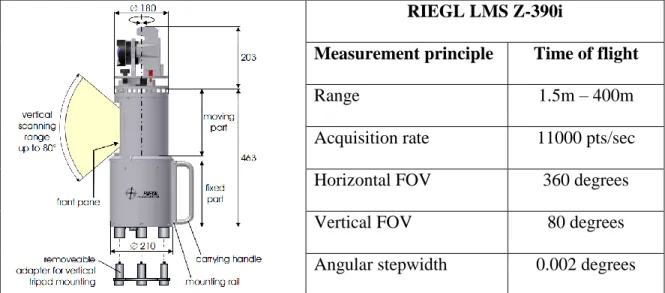
The terrestrial laser scanner used in this research is RIEGL LMS Z-390i, which
uses technology of TOF. RIEGL LMS Z-390i is a long range TLS scanner and its range
varies between 1.5 m to 400 m. The system of rotating mirror is a two-axis system and
allows measurement conducted simultaneously both along vertical and horizontal
direction. The field of view covers 360 degrees horizontally and 80 degrees vertically.
The minimum horizontal and vertical angular stepwidths are both 0.002 degrees. Table
Table 2.1: Technical specifications of RIEGL LMS Z-390i RIEGL LMS Z-390i
Measurement principle Time of flight
Range 1.5m – 400m
Acquisition rate 11000 pts/sec
Horizontal FOV 360 degrees
Vertical FOV 80 degrees
Angular stepwidth 0.002 degrees
The scanner is controlled by RiSCAN PRO software, which provides complete
data collection services, including sensor configuration, data acquisition, visualization,
and manipulation. Direct measurements for each laser return include range, horizontal
angles, and vertical angles. The RiSCAN PRO software is able to automatically calculate
3D coordinates from these direct measurements. Finally, data collected by the sensor is
transferred to a computer via USB connection.
2.1.3 Terrestrial Laser Scanning Data Classification
With the development of laser scanning and related technology, TLS has been rapidly
adopted for urban street data acquisition. Classification is a necessary step for further
application, but classifying such complex urban street scenes in an automated manner
still remains as a challenging vision task. According to the primitive spatial entity, TLS
data classification can be categorized into point-based classification (Triebel, et al, 2006;
al., 2010; Hu and Ye, 2013) and surface-based classification (Belton and Lichti, 2007; Pu
and Vosselman, 2009).
As regard the features used for classification, commonly used features include
spectral features and geometric features. Spectral features provide information on
physical properties of objects. Intensity is typical spectral information; it is dependent on
reflectivity and scattering characteristics of object surface (Pfeifer et al., 2007). Imagery
from an attached camera also can provide additional spectral features; it usually needs to
be registered with the point clouds (Forkuo and King, 2004). However, the laser scanner
we used has a problem of outputting intensity, so this research relies purely on geometric
information that is derived from 3D coordinates of point clouds.
Geometric feature can be extracted based only on a single spatial entity (e.g.,
point, line, and surface) without considering its neighborhood. Another type of feature is
neighborhood-based feature, which provides contextual information. The neighborhood
can be selected by searching neighbors in a pre-defined region (Niemeyer, et al., 2012;
Kim and Sohn, 2010), or k nearest neighbors (Munoz et al., 2008; Niemeyer et al., 2011,
Schmidt et al., 2012) are popular methods. Given the neighborhood, geometric features
can be calculated, such as eigenvalue based features (Belton and Lichti, 2006), hough
transformation based features (Kim and Sohn, 2010), point density based features
(Rutzinger et al, 2008), and features based projected 2D space (Weinmann et al., 2013).
When features extraction is done, classifiers can be built based on these features.
There are two primary classification strategies, rule-based classification and machine
2.1.3.1 Rule Based Classification
Rule based methods usually implement classification by converting prior expert
knowledge to simple “if this, then that” clause (Forlani et al., 2006; Goulette et al., 2006;
Pu and Vosselman, 2009; Lehtomäki et al., 2010; Aijazi et al., 2013). Forlani et al. (2006)
applied a set of hierarchically predefined rules to classify segmented laser scanning data
into bare terrain, building, vegetation, courtyard, and water from ALS data; these rules
were based on geometric and topological properties (e.g., regions exceeding a size of
200000 m2 were classified as terrain). Goulette et al. (2006) detected ground from
vehicle-based TLS data by assuming that ground points correspond to the peak of
histogram of vertical coordinates. After removing ground, building and tree were then
recognized by detecting peaks in the histogram of horizontal coordinates. Pu and
Vosselman (2009) manually defined classification rules based on point segments’
characteristics, such as size, position, orientation, and topological relations. In Lehtomäki
et al. (2010), vertical pole-like objects were detected by fitting circle and arc models from
horizontal slices of point clouds. Candidate circles can be classified as pole only if they
fulfil all requirements on length, shape, orientation, etc. Authors claimed that thresholds
they used need to be adjusted according to the real data. Aijazi et al. (2013) classified
super-voxels into ground and other five non-ground objects using both geometrical
models (e.g., roads represent a low flat plane, while the buildings are represented as large
vertical blocks) and predefined rules (e.g., barycenters of tree and vegetation are greater
These rule based methods have many advantages: they are easily designed and
implemented; the inference rules can be modified and updated according to real data;
they do not require labeled training data. However, classification performance of rule
based methods is highly dependent on the choice of features and thresholds; thus rule
makers should have sufficient prior knowledge about the target classes. Unfortunately,
rule makers often cannot discover all the rules that govern objects, let alone the various
conditions behind these rules. In contrast, machine learning is able to learn classification
rules automatically from labeled data; they also can be implemented and updated easily.
2.1.3.2 Machine Learning
Machine learning based laser scanning classification has attracted more and more
attention over recent years. Supervised classification method is one of the most popular
machine learning strategies and has been widely applied for object recognition.
Supervised methods learn statistical rules automatically from labeled training data, and
then generalize these rules on unseen data (Kotsiantis, 2007). Supervised methods can be
categorized into “generative classifiers” and “discriminative classifiers”. Generative
classifiers model joint distributions of class label and features and provide rigorous
framework to combine prior knowledge and observed data. Generative classifiers can
freely generate new labeled instances according to these joint distributions. Many
generative classifiers have been used for laser scanning data classification, such as Naïve
Bayes (Premebida et al., 2009; Posner et al., 2009), Gaussian Mixture Model (Charaniya
The Naïve Bayes classifier makes the assumption that each attribute of the feature
vector is independent, and the likelihood is modeled as the product of class conditional
probability of each attribute (Premebida et al., 2009), which is often modeled using
Gaussian distribution. However, the class conditional probability is usually very complex,
so single Gaussian distribution cannot fit it well. An alternative is Gaussian Mixture
Model (GMM), which decomposes a distribution using linear combination of several
Gaussian distributions (Charaniya et al., 2004; Lalonde et al., 2006). Parameters in the
GMM are usually estimated using the classic Expectation Maximization (EM) algorithm
(Dempster et al., 1977). If given sufficient expert knowledge on the classification
problem domain, Bayesian Network is a proper choice; it models direct dependencies
and local distributions between variables (Brunn and Weidner, 1997).
On the other hand, the “discriminative classifiers” are concerned with finding the
boundaries between different classes, and directly model the posterior probability.
Discriminative classifiers, such as k-Nearest Neighbour (Vehmas et al., 2009;
Golovinskiy et al., 2009), Logistic Regression (Vehmas et al., 2009; Saxena et al., 2008),
Support Vector Machine (Posner et al., 2007; Nüchter and Hertzberg, 2008; Golovinskiy
et al., 2009; Himmelsbach et al., 2009; Brodu and Lague; 2012), Decision tree
(Matikainen et al, 2007), Neural Network (Nguyen et al., 2005; Priestnall et al., 2000;
Prokhorov, 2009) have been applied for laser scanning data classification.
K-nearest neighbour is a non-parametric method and assigns to a new instance
with the majority class of its k nearest training samples (Cover and Hart, 1967). Nearest
data (Vehmas et al., 2009), and choice of the number of neighbors (Golovinskiy et al.,
2009). Logistic regression is a basic parametric method for binary classification and uses
logistic transformation to make the relationship between the posterior probability and
linear combination of features (Hosmer and Lemeshow, 2004; Saxena et al., 2008). More
recently, Support Vector Machines (SVM) attracts more attention as an alternative for
laser scanning data classification (Posner et al., 2007; Nüchter and Hertzberg, 2008;
Golovinskiy et al., 2009; Himmelsbach et al., 2009; Brodu and Lague; 2012).The
principle of SVM is maximizing the margin, which is defined as the shortest distance
from the separating hyperplane to the closest positive (negative) example (Burges, 1998).
However, the linear decision boundary found by the classic linear SVM has risk of
misclassification if the dataset is not linearly separable, thus kernel function is often used
to find a non-linear separating hyperplane by mapping original features into a new
high-dimension space (Wang, 2005). An Artificial Neural Networks (ANN) is a computational
model inspired by the mechanism of the human neurons. It is comprised of densely
interconnected adaptive simple processing elements (called artificial neurons or nodes),
which are capable of performing massively parallel computations for data processing and
knowledge representation. Variants of ANN, such as Hopfield Neural Network (HNN)
and Recurrent Neural Network (RNN) have shown its potential in classifying laser
scanning data (Basheer and Hajmeer, 2000; Prokhorov, 2009).
Recently, more attention has been turned to ensemble learning (Drucker et al,
1994), which increase the accuracy of single classifier by combining results of some
categorized into bagging and boosting. In Breiman (1996), the concept of bootstrap
aggregation was introduced, and the strategy using bootstrap to generate weak classifiers
is called bagging. Random forest is a typical bagging method that constructs a set of
decision trees using bootstrap. In addition to resampling, candidate features for splitting
at each node are also randomly chosen, which increases independency of trees (Liaw and
Wiener, 2002). Random forest has achieved good prediction result in urban scene
classification (Chehata et al., 2009), power line corridor recognition (Kim and Sohn,
2010), forest type classification (Kantola et al., 2013) from laser scanning data. Instead of
randomly sampling training data and combining classifiers with equal vote as the bagging
method, the boosting method uses a weighted sample to focus learning on those samples
that misclassified by previous weak classifiers, and finally combines results of weak
classifiers using weighted vote (Freund et al., 1999). The adaptive boosting (Adaboost) is
a typical boosting model, and has been applied to classify laser scanning data (Lodha et
al., 2007).
2.2 Context Based Object Recognition
The machine learning based methods mentioned in section 2.1 are called local classifier
because they only use appearance features, without considering relations between objects.
Appearance variation, occlusion, various point density with range, all of which cause the
problem of feature ambiguity. Relying only on these features with ambiguity, local
classifiers have risk of misclassification.
Contextual information, or context for short, has been proved to be able to remove
(1993) defined the context as any and all information that may influence the way a scene
and the objects within it are perceived. Therefore, data collected for the same object using
different sensors, time of data collection, attributes of local region, and global scene
layout of objects are all parts of context. The context can be defined at visual perception
level and objective statistical level. Visual perception is the ability to interpret the
surrounding environment by processing information that is contained in visible light;
illusions (such as the Muller-Lyer illusion) and Stroop phenomenon are typical
modalities of visual perceptual context (Toussaint, 1978). Meanwhile, the statistical
context is defined under an elegant probabilistic framework (Song, 1999). In this
research, we utilized the statistical method to model context.
2.2.1 Object Context
Object context in this research is indicates dependencies or correlations among entities
(line) in a scene. With context, a line is perceived associated with its surrounding
neighbors rather than independently. Galleguillos and Belongie (2010) categorized the
statistical context used for object recognition into three types: semantic (probability),
spatial (position) and scale (size).
Semantic context indicates the occurrence probability that an object can be found
in a specific scene but not others. Early studies on semantic context mainly focused on
manually-made rules, but current research prefers to extract context automatically from
labeled training data. The symmetric, nonnegative co-occurrence matrix is a typical form
Rabinovich et al. (2007) used this type of co-occurrence matrix among segment labels to
enhance classification performance. Soh and Tsatsoulis (1999) defined the gray-level
spatial dependence over pixels using a gray-level co-occurrence matrix (GLCM), where
each entry P(i,j) of the GLCM corresponds with the number of co-occurrence of the pair
of grey level i and j at a distance of d.
Spatial context specifies the likelihood of finding an object at some position. The
spatial context can be defined based on absolute position (Shotton et al., 2006; Shotton et
al., 2009; Bo et al., 2011; Liu et al., 2011; Zitnick et al., 2013) or relative position (Gould
et al., 2013; Zitnick et al., 2013) in a scene. Shotton et al. (2006) encoded the probability
of a class occurs at the specific location in the image as the form of a look-up table.
Gould et al. (2013) used non-parametric relative location maps over super-pixels as a
global feature, which not only allows modeling simple relative location relations (above,
beside, or enclosed), but also complex relationships, such as both sky and car are found
above road, but car tends to be much closer than sky. Zitnick et al. (2013) incorporated
both absolute location prior and relative location prior in their probabilistic model.
Scale context refers to prior information about the most likely sizes at which
objects might appear in the scene (Torralba, 2003). Meta-data (e.g. position, orientation,
geometric horizon, and map) of cameras is able to generate hypothesis about the scene in
which object’s configurations are consistent with a global context (Strat and Fischler, 1991). Scale context is the hardest relation to access, since it requires more detailed
Actually, the boundaries between different types of context are not strictly defined.
Most of publication we reviewed above perhaps used one or two explicit types of context.
A critical contribution of this research is exploiting scene layout of object to improve
classification; the scene layout can be sematic context or spatial context. While images
have scaling problem because object size varies with the focal length, the TLS scanner
captures direct 3D coordinate of target objects; thus, the scaling context is of no benefit
and was not considered.
2.2.2 Scene Layout Prior
The scene layout corresponds to the relative locations of objects in a scene. An image (or
a point cloud) is not a random collection of independent pixels (or points), but follows
some rules on spatial arrangement. The spatial arrangement of objects in urban
environment is rather clear and strict, e.g. roof is on the top of building facade, and
building is behind of tree. With the prior knowledge on scene layout, it is expect to
estimate what types of objects could be above or below building, and so on.
Many achievements have been made on applying scene layout for object
recognition from images (Winn and Shotton, 2006; Heesch and Petrou, 2010; Jahangiri et
al., 2010; Ding et al., 2014). Winn and Shotton (2006) modeled scene layout
(above/bellow/left/right) over pixels using asymmetric pairwise potential. In Gould et al.
(2008), layout of objects was modeled as relative location probability maps over pixels,
which were based on the first-stage classification using appearance-based feature; and the
interested in modeling the probability distribution over labels for a segmented region
given labels of its six local neighboring regions: above, bellow, left, right, as well as
regions containing and being contained by the current region. Jahangiri et al. (2010)
incorporated five different scene layout relations between segmented region pairs in one
probabilistic model, including relative vertical and horizontal orientation, containment
relation, and the ratio of width and height. In Desai et al. (2011), an image was
represented as a collection of overlapping windows at multiple scales, and spatial relation
between these windows was considered, such as above, below, overlapping, next-to, near,
and far. Label layout filter (LLF) was proposed by Ding et al. (2014) to model the class
distribution behavior and visual context appearance of labels over multi-scale segmented
regions, such as location distribution of each class in the image, or the relative distance
and orientation between two classes. The LLF combines label compatibility, spatial
closeness (distance), and feature similarity on all pairs of pixels from the image scene in
one potential term in forms of appearance kernel and smoothness kernel.
However, not too many was done on applying scene-layout to classify laser point
cloud. Pu and Vosselman (2009) manually defined object’s layout based on size,
position, orientation, etc., from human knowledge and then apply these predefined rules
on classifying TLS data. As it is mentioned above, although such rule based method is
easily implemented and achieved satisfying classification result, it cannot cover all the
rules that govern object layout, let alone conditions behind these rules. Instead, we used
In this research, the scene layout specifies the relative location of lines in both the
vertical and horizontal directions. The vertical scene layout was considered an
“above-below” relation, such as building is bellow roof but above the pedestrian road. The
horizontal scene layout was modeled as a “front-behind” relation, with respect to the
distance between lines and laser scanner center, such as tree is in front of building, but
behind of vehicle road.
2.3 Probabilistic Graphical Model
There exist two methods to utilize contextual information in a classification, contextual
features and contextual classifiers. Contextual features are usually derived from a local or
global neighborhood surrounding the interest region that is being analyzed (Haralick et
al., 2013). Contextual features could be extracted directly from unlabeled data (Kim and
Sohn, 2010; Niemeyer, et al., 2012), or based on an initial classification result that relies
only on appearance features (Gould et al., 2008; Jahangiri et al., 2010). Contextual
features are finally combined with appearance features to make a final decision using any
classifier. Instead of modeling contextual information as features, contextual classifiers
incorporate contextual information directly into a probabilistic graphical model.
2.3.1 Probabilistic Graphical Model
Probabilistic graphical model, or graphical model in short, gives a multivariate statistical
modeling based on both the graph theory and probability theory (Koller and Friedman,
2009). By considering dependency of variables, the graphical model greatly simplifies