iF
luor™ F
luor
esc
en
t Labeling D
yes
Dyes
FRET Building Blocks
Quenchers
Peptide Labeling Reagents
Peptide Labeling Reagents
2014-2015
2014-2015
Our Mission
AAT Bioquest® is committed to constantly meet or exceed its customer’s requirements by
providing consistently high quality products and services, and by encouraging continuous
improvements in its long-term and daily operations. Our core value is Innovation and Customer
Satisfaction.
Our Story
AAT Bioquest®, Inc. (formerly ABD Bioquest, Inc.) develops, manufactures and markets bioanalytical research reagents and kits to life sciences research, diagnostic R&D and drug discovery. We specialize in photometric detections including absorption (color), fluorescence and luminescence technologies. The Company's superior products enable life science researchers to better under-stand biochemistry, immunology, cell biology and molecular biology. AAT Bioquest offers a rapidly expanding list of enabling products. Besides the standard catalog products, we also offer custom services to meet the distinct needs of each customer. Our current services include custom synthesis of biological detection probes, custom development of biochemical, cell-based and diagnostic assays and custom high throughput screening of drug discovery targets.
It is my greatest pleasure to welcome you to AAT Bioquest. We greatly appreciate the constant support of our valuable customers. While we continue to rapidly expand, our core value remains the same: Innovation and Customer Satisfaction. We are committed to being the leading provider of novel biological detection solutions. We promise to extend these values to you during the course of our service and to continue to support you with our new products and services. It is our greatest honor to receive valuable feedbacks and suggestions from you so that we can better serve your projects.
Very truly yours,
Zhenjun Diwu, Ph.D. President
Table of Contents
Dye Amines ...27
Fluorescent Dye Carboxylic Acids & Their Succinimidyl Esters ... ...22
Fluorescent Dye Sulfonyl Chlorides ...24
Fluorescent Dye Isothiocyanates ...25
Alphabetical Index ...40
Catalog Number Index...43
Selection of a Fluorescent Dye for Labeling Peptides... ...6
Coumarin Dyes ...6
Fluorescein Dyes ...7
Rhodamine Dyes ...8
California Red™ and SunRed™, Superior Replacements for Texas Red® and Texas Red®-X...9
Cyanine Dyes ...10
Tide Fluor™ Dyes, Optimized for Labeling Peptides ...12
Other Dyes ...15
FRET Peptide Substrates ...17
Non-Fluorescent DABCYL Dyes ...17
Tide Quencher™Dyes, Optimized for Maximizing FRET Efficiency ...17
Dye Azides ...34
Dye Alkynes ...35
Dye Selection Guide for Preparing Fluorescent Peptides ...37
Dye Selection Guide for Preparing FRET Peptides ...38
Section 1 General Information ...2
Section 2 Fluorescent Dyes for Labeling Peptides ...5
Section 3 Non-Fluorescent Quenchers for Labeling Peptides ... 16
Section 4 Label N-Terminal Amino Acid & Lys Residues Using Amine-Reactive Dyes ... 21
Section 5 Label C-Terminal Amino Acid, Asp & Glu Residues Using Amine-Containing Dyes ... 26
Section 8 Clickable Dyes for Labeling Peptides ... 33
Section 9 Dye Selection Guides for Labeling Peptides ... 36
Section 10 Index ... 39
Dye Maleimides... ...29
Section 6 Label Cysteine Residue Using Fluorescent Dye Maleimides ... 28
FMOC-Asp(Dye)-OH ...31
FMOC-Glu(Dye)-OH ...31
FMOC-Lys(Dye)-OH ...32
1
G
ener
al I
nf
or
ma
tion
General Information
www.aatbio.com
Trademarks of AAT Bioquest
AAT Bioquest®
Bodi Fluor™
California Red™
iFluor™
LRB Red™
mFluor™
SunRed™
Tide Fluor™
Tide Quencher™
Trademarks of Other Companies
Alexa Fluor® (Invitrogen)
BHQ® (Biosearch Technologies)
Bodipy® (Invitrogen)
Cy2®, Cy3®, Cy5®, Cy5.5®, Cy7® and Cy7.5® (GE Healthcare)
DyLight™ (ThermoFisher)
IRDye® (LI-COR)
QSY® (Life Technologies)
QXL™ (AnaSpec)
Texas Red® (Invitrogen)
Other Abbreviations Used in This Catalog
Ab: Absorption
CF: Correction factor
DMF: Dimethylformamide
DMSO: Dimethylsulfoxide
EC: Extinction coefficient
Em: Emission
Ex: Excitation
FAM: Carboxyfluorescein
FITC: Fluorescein isothiocyanate
FRET: Fluorescence resonance energy transfer
SE: Succinimidyl ester
TF: Tide Fluor™
TRF: Time resolved fluorescence
TQ: Tide Quencher™
Amino Acid Symbols:
Ala (A): Alanine
Arg (R): Arginine
Asn (N): Asparagine
Asp (D): Aspartic acid
Cys (C): Cysteine
Glu (E): Glutamic acid
Gln (Q): Glutamine
Gly (G): Glycine
His (H): Histidine
IIe (I): Isoleucine
Leu (L): Leucine
Lys (K): Lysine
Met (M): Methionine
Phe (F): Phenylalanine
Pro (P): Proline
Ser (S): Serine
Thr (T): Threonine
Trp (W): Tryptophan
Tyr (Y): Tyrosine
Val (V): Valine
CUSTOMER SERVICE & ORDERING INFORMATION
AAT Bioquest Corporate Headquarter:
520 Mercury Drive
Sunnyvale, CA 94085, USA
Phone: 800-990-8053 (US and Canada)
408-733-1055 (International)
Fax: 408-733-1304
Website: www.aatbio.com
E-mails: [email protected] (inquire)
[email protected] (quote request)
[email protected] (technical support)
International Distributors:
See Back Cover
www.aatbio.com
General Information
G
ener
al I
nf
or
ma
tion
1
TERMS AND CONDITIONS OF SALE
1. Prices, Orders and Changes: Prices shown are in US currency. Please call us for current prices if you require this information prior to placing your order. We guarantee our written quotations for 60 days. You may not cancel purchase orders unless such cancellation is expressly agreed by us. In such event, you will be advised of the total charge for such cancellation. You agree to pay such charges, including, but not limited to, storage and shipment costs, costs of producing standard materials, costs of purchasing non-returnable materials, cancellation costs imposed on us by our suppliers, and any other cost resulting from cancellation of this order.
2. Delivery: In most cases, we use standard overnight or two-day Federal Express delivery (or equivalent). All shipping charges billed are the responsibility of the customer and are normally prepaid by AAT Bioquest, Inc. and added to the invoice. We reserve the right to make delivery in installments, all such installments to be separately invoiced and paid for when due per invoice, without regard to subsequent deliveries. Partial shipments of available items are made when another item is backordered. Please inspect your packages upon receipt. If the goods have been damaged in transit, we can assist you in filing a claim with the carrier. You shall notify us in writing of any claims for shortages, defects or damages and shall hold the goods for our written instructions concerning disposition. Any claims for such errors must be made within 10 business days. If it is our error, we will do whatever is necessary to ship the correct products as soon as possible. If you shall fail to notify us any defects within 10 days after the goods have been received, such goods shall conclusively be deemed to conform to the terms and conditions and to have been irrevocably accepted by the buyer.
3. Payment: Terms of sale are net 30 days of date of invoice that is sent to you within 24 hours of shipping the order. The amount received must be sufficient to cover both the invoiced amount and any bank charges that may be incurred. Late charges may be added to invoices not paid within the 30-day time period. Late charges must be paid before subsequent orders can be shipped.
4. Warranties: The products shipped by AAT Bioquest are warranted to conform to the chemical or biological descriptions provided in our publications. This warranty is exclusive, and we makes no other warranty, express or implied, including any implied warranty of merchantability or fitness for any particular purpose. Our sole and exclusive liability and your exclusive remedy with respect to products proved to our satisfaction to be defective or nonconforming shall be replacement of such products without charge or refund of the purchase price, in our sole discretion, upon the return of such products in accordance with our instructions. We will not be liable for any incidental, consequential or contingent damages involving their use.
5. Returns: We must authorize any returns. We will not accept return shipments unless we have given prior written permission and shipping instructions. Goods may not be returned for credit except with our permission, and then only in strict compliance with our return shipment instructions. Any returned items may be subject to a 20% restocking fee. In many cases, items ordered in error cannot be returned because of the sensitive nature of many of our products and the difficulty and expense of requalifying returned items. If items are accepted for return, they must be in new, unopened, unused and undamaged condition, and you will be charged a per-unit 20% restocking charge.
6. Use of Our Products: Our products are used ONLY for laboratory research and develop-ment purposes. We realize that, since our products are, unless otherwise stated, intended primarily for research purposes, they may not be on the Toxic Substances Control Act (TSCA) inventory. You assume responsibility to assure that the products purchased from us are approved for use under TSCA, if applicable. You have the responsibility to verify the hazards and to conduct any further research necessary to learn the hazards involved in using products purchased from us. You also have the duty to warn your customers and any auxiliary personnel (such as freight handlers, etc.) of any risks involved in using or handling the products.
7. Patent Disclaimer: We do not warrant that the use or sale of our products will not infringe the claims of any United States or other patents covering the product itself or the use thereof in combination with other products or in the operation of any process. 8. Miscellaneous: We reserve the right to discontinue our products or change specifications or prices of our products and to correct any errors or omissions at any time without incurring obligations.
General Information
www.aatbio.com
1
G
ener
al I
nf
or
ma
tion
Custom Products and Services
Our Technologies
Amplite™ enzyme-based detection platform is optimized for
measuring horseradish peroxidase (HRP), alkaline phosphates, luciferase, beta-galactosidase, lactamase, oxidase, protein kinases, protein phosphatases, phosphodiesterases, proteases, cytochrome P450, histone deacetylase (HDAC) and cell signaling molecules such as NAD/NADH, NADP/NADPH, IP3, cAMP and cGMP etc.
Cell Explorer™ cell labeling platform is a complete set of tools
for tracking live cells. This platform is also widely used for sorting mixed populations of cells.
Cell Navigator™ cell staining platform is a complete set of
tools for selective labeling subcellular structures of live, fixed and dead cells.
Cell Meter™ cellular functional assay platform is a complete set
of tools for functional analysis of cellular events and real time-monitoring of cell functions.
iFluor™ superior fluorescent labeling dyes are optimized for
labeling proteins and nucleic acids. This group of dyes span from UV to infrared wavelength with good photostability and brightness.
mFluor™ superior fluorescent labeling dyes are optimized for
flow cytometry applications.
PhosphoWorks™ detection platform is a set of tools for
detection of ATP, ADP, AMP, phosphate, pyrophosphate, phosphoproteins and phosphopeptides.
Quest View™ colorimetric protease platform is a sensitive and
robust tool for rapid detection of protease and glycosidase biomarkers. This technology platform has been licensed by a few diagnostic companies for developing rapid diagnostic tests.
RatioWorks™ superior cellular dyes are a sensitive and robust
tool set for ratio imaging and real time monitoring of cellular functions (such as pH and ions) in live cells.
Screen Quest™ assay kits are a set of HTS-ready tools for high
throughput screening of biochemical and cellular targets such as protein kinases, proteases, HDAC, cell apoptosis and cytotoxicity, GPCR, ion channels, ADME and transporters.
Tide Fluor™ and Tide Quencher™ superior labeling dyes are
specially optimized for labeling nucleotides and peptides. This platform offers the best value in the industry. It is second to none in terms of performance and cost. This technology platform has been licensed by a few diagnostic companies for developing IVD diagnostic tests.
trFluor™ superior fluorescent labeling dyes are optimized for
developing time-resolved fluorescence-based assays. It has been used for developing HTS assay technologies for many drug discovery targets.
Our Services
Besides the catalog products we also offer custom services to meet the distinct needs of each customer. Our current services include custom synthesis of biological detection probes, custom development of biochemical, cell-based and diagnostic assays, custom bioconjugation and custom high throughput screening of drug discovery targets.
Custom Assay Design and Development
At AAT Bioquest we not only make probes and assay kits, but also use them extensively ourselves. Scientists at AAT Bioquest are experts on assay design and have developed a wide variety of tests that range from biochemical detection to cellular functions. Our assay options include:
• Enzyme activities • Binding assays • Cell-based assays • Microplate assays • Flow cytometric analysis • Fluorescence imaging
Custom Conjugation
AAT Bioquest offers the best and the most rapid bioconjuga-tion service in the industry.
• Biotinylation
• Fluorescence labeling (iFluorTM, mFluor™, APC, RPE and
PerCP)
• Enzyme labeling (AP and HRP) • Small molecule conjugation
Custom Screening
AAT Bioquest offers on-demand high-throughput screening and pharmacology profiling assays with multiple
methodologies. Functional assays are designed, validated and customized to the needs of our pharmaceutical and
biotechnology industry clients. These assays are aimed at assessing and monitoring the efficacy, tolerability and safety parameters of candidate compounds for treating and/or diagnosing cancer, infectious disease, autoimmunity and transplantation. Our screening options include:
• Full assay development for a target of your choice • Optimization of your assay protocol for HTS • Multiple assay platforms and detection methods • Custom data analysis
Custom Synthesis of Fluorophores and Luminophores
AAT Bioquest is recognized by the top pharmaceutical companies and diagnostic companies as a key provider of novel fluorescent dyes and luminescent probes. Over the years we have developed and synthesized many enabling
fluorescent and luminescent probes for running a variety of challenging biological detection tasks.
Fluorescent Dyes for Labeling Peptides
2
Fluor
esc
en
t D
yes f
or Labeling P
eptides
Dye-labeled peptides are important tools in biochemical and cel-lular studies. Fluorescent peptides have been extensively used in fluorescence fluorimetry, fluorescence microscopy, fluorescence polarization spectroscopy, time-resolved fluorescence (TRF) and fluorescence resonance energy transfer (FRET). Fluorescent peptides participating in peptide-receptor interactions can be monitored to determine the location of receptors in cells or tissues, to allow quantification of receptors, to determine receptor affin-ity for various unknown ligands (drug screening), and to identify various populations of cells endowed with peptide receptors. FRET peptides are widely used for detecting the activities of proteases and protein kinases. Other applications include receptor sorting using fluorescence-associated cell sorting and the measurement of serum peptide levels using fluorescent immunoassays either in vivo
or in vitro for research and diagnostic purposes. The most impor-tant characteristics of fluorescent peptides are high sensitivity and non-radioactive detection.
2.1 Selection of a Fluorescent Dye for Labeling Peptides
A fluorescent dye can be attached to a peptide at a specific point through a covalent bond depending on the sequence of peptide. The linkage between dye and peptide is a covalent bond, which is stable and not destructive under most biological conditions. In some cases, a functional linker is introduced between dye and peptide to minimize the alteration of peptide biological activity. For all the peptide labelings, the dye need be attached at a defined position: N-terminus, C-terminus, or in the middle of sequence.
Figure 2.1. The chemical structures of AMCA acid (Cat# 501, left) and 7-methoxycou-marin-3-carboxylic acid (Cat# 560, right), the two most common coumarin dyes for labeling peptides.
2.2 Coumarin Dyes
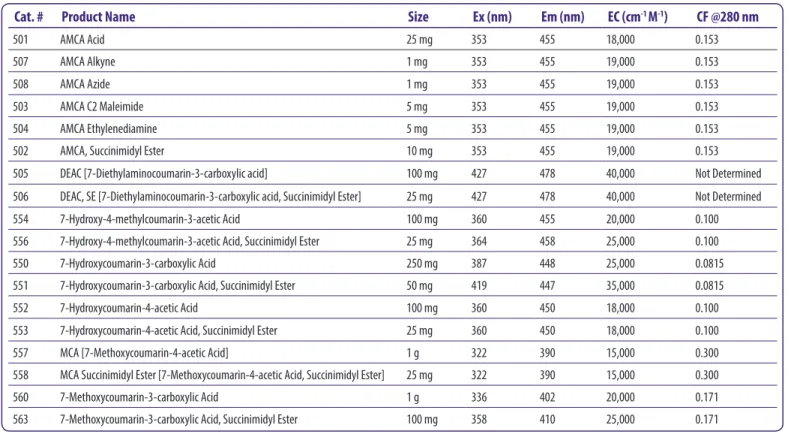
Coumarin dyes are predominantly used for preparing blue fluorescent peptides. Among them, 7-hydroxy, 7-alkoxy and 7-aminocoumarin dyes are more frequently used. AMCA might be the best blue fluorescent dye for labeling peptides due to its high fluorescence quantum yield and pH-insensitivity. Our Tide Flour™ 1 (TF1) is a water-soluble derivative of AMCA, and can be used for improving peptide water solubility if the labeling of a peptide by AMCA significantly decreases its water solubility. AMCA and TF1 have almost identical spectral properties. Besides AMCA and TF1, AAT Bioquest also offers other coumarin dyes for labeling peptides.
Cat. #
Product Name
Size
Ex (nm)
Em (nm)
EC (cm
-1M
-1)
CF @280 nm
501 AMCA Acid 25 mg 353 455 18,000 0.153
507 AMCA Alkyne 1 mg 353 455 19,000 0.153
508 AMCA Azide 1 mg 353 455 19,000 0.153
503 AMCA C2 Maleimide 5 mg 353 455 19,000 0.153
504 AMCA Ethylenediamine 5 mg 353 455 19,000 0.153
502 AMCA, Succinimidyl Ester 10 mg 353 455 19,000 0.153
505 DEAC [7-Diethylaminocoumarin-3-carboxylic acid] 100 mg 427 478 40,000 Not Determined
506 DEAC, SE [7-Diethylaminocoumarin-3-carboxylic acid, Succinimidyl Ester] 25 mg 427 478 40,000 Not Determined
554 7-Hydroxy-4-methylcoumarin-3-acetic Acid 100 mg 360 455 20,000 0.100
556 7-Hydroxy-4-methylcoumarin-3-acetic Acid, Succinimidyl Ester 25 mg 364 458 25,000 0.100
550 7-Hydroxycoumarin-3-carboxylic Acid 250 mg 387 448 25,000 0.0815
551 7-Hydroxycoumarin-3-carboxylic Acid, Succinimidyl Ester 50 mg 419 447 35,000 0.0815
552 7-Hydroxycoumarin-4-acetic Acid 100 mg 360 450 18,000 0.100
553 7-Hydroxycoumarin-4-acetic Acid, Succinimidyl Ester 25 mg 360 450 18,000 0.100
557 MCA [7-Methoxycoumarin-4-acetic Acid] 1 g 322 390 15,000 0.300
558 MCA Succinimidyl Ester [7-Methoxycoumarin-4-acetic Acid, Succinimidyl Ester] 25 mg 322 390 15,000 0.300
560 7-Methoxycoumarin-3-carboxylic Acid 1 g 336 402 20,000 0.171
563 7-Methoxycoumarin-3-carboxylic Acid, Succinimidyl Ester 100 mg 358 410 25,000 0.171
Table 2.1 Coumarin Dyes for Labeling Peptides
2
Fluor
esc
en
t D
yes f
or Labeling P
eptides
Coumarin Dyes
www.aatbio.com
In general, the preferred fluorescent labels should have high fluorescence quantum yields and retain the biological activities of the unlabeled biomolecules. AAT Bioquest offers a variety of fluorescent labeling reagents for facilitating the conjugation of dyes to peptides that are used for a variety of biological studies.
Cat. # Product Name
Size
Ex
(nm)
Em
(nm)
EC
(cm
-1M
-1)
CF
@280 nm
103 5-FAM [5-Carboxyfluorescein] *Single Isomer* 100 mg 494 521 75,000 0.178
105 5-FAM [5-Carboxyfluorescein] *Validated for Labeling Peptides* 5 g 494 521 75,000 0.178
113 5-FAM, SE [5-Carboxyfluorescein, Succinimidyl Ester] *Single Isomer* 10 mg 494 521 75,000 0.178
115 5-FAM, SE [5-Carboxyfluorescein, Succinimidyl Ester] *Validated for Labeling Peptides* 1 g 494 521 75,000 0.178
132 5-FAM Alkyne 10 mg 494 521 75,000 0.178
131 5-FAM Azide 10 mg 494 521 75,000 0.178
128 5-FAM Cadaverine 100 mg 494 521 75,000 0.178
124 5-FAM Ethylenediamine 100 mg 494 521 75,000 0.178
119 5-FAM-X, SE 5 mg 494 521 75,000 0.178
100 5(6)-FAM [5-(and-6)-Carboxyfluorescein] *Mixed Isomers* 1 g 494 519 75,000 0.172
101 5(6)-FAM [5-(and-6)-Carboxyfluorescein] *Validated for Labeling Peptides and Oligos* 10 g 494 519 75,000 0.172
110 5(6)-FAM, SE [5-(and-6)-Carboxyfluorescein, Succinimidyl Ester] *Mixed Isomers* 25 mg 494 519 75,000 0.172
112 5(6)-FAM, SE [5-(and-6)-Carboxyfluorescein, Succinimidyl Ester] *Validated for Labeling Peptides and Oligos* 1 g 494 519 75,000 0.172
127 5(6)-FAM Cadaverine 100 mg 494 519 75,000 0.172
123 5(6)-FAM Ethylenediamine 100 mg 494 519 75,000 0.172
120 5-FITC [FITC Isomer I; Fluorescein-5-isothiocyanate] *UltraPure Grade* 100 mg 492 515 76,000 0.254
121 5-FITC [FITC Isomer I; Fluorescein-5-isothiocyanate] *UltraPure Grade* 1 g 492 515 76,000 0.254
130 Fluorescein-5-maleimide 25 mg 491 514 74,000 0.275
Table 2.2 Fluorescein Dyes for Labeling Peptides
Figure 2.2. The chemical structures of typical fluorescein dyes for labeling peptides
2.3 Fluorescein Dyes
Fluorescein derivatives are the most common fluorescent derivatization reagents for covalently labeling peptides. In addition to their high absorptivity, excellent fluorescence quantum yields and good water solubility, fluorescein derivatives have an excitation maximum (494 nm) that closely matches the 488 nm spectral line of the argon-ion laser, making them important fluorophores for fluorescence microscopy and flow cytometry applications. 5-FAM derivatives have been predominantly used for labeling peptides. AAT Bioquest offers the most complete product line of FAM for labeling peptides.
Fluor
esc
en
t D
yes f
or Labeling P
eptides
2
www.aatbio.com
Fluorescein Dyes
113 119 120 124
Cat. # Product Name
Size
Ex
(nm)
Em
(nm)
EC
(cm
-1M
-1)
CF
@280 nm
473 California Red™, SE 5 mg 583 603 100,000 0.360
322 5-CR110 [5-Carboxyrhodamine 110] *Single Isomer* 5 mg 498 521 75,000 0.091
351 5-CR110, SE [5-Carboxyrhodamine 110, Succinimidyl Ester] *Single Isomer* 5 mg 498 521 80,000 0.091
331 5-CR6G [5-Carboxyrhodamine 6G] *Single Isomer* 10 mg 518 544 80,000 0.214
341 5-CR6G, SE [5-Carboxyrhodamine 6G, Succinimidyl Ester] *Single Isomer* 1 mg 524 556 80,000 0.214
320 5(6)-CR110 [5-(and 6)-Carboxyrhodamine 110] *Mixed Isomers* 100 mg 498 521 75,000 0.091
350 5(6)-CR110, SE [5-(and 6)-Carboxyrhodamine 110, succinimidyl ester ] *Mixed isomers* 5 mg 498 521 78,000 0.091
330 5(6)-CR6G [5-(and 6)-Carboxyrhodamine 6G] 25 mg 519 544 80,000 0.214
340 5(6)-CR6G, SE [5-(and 6)-Carboxyrhodamine 6G, Succinimidyl Ester] *Mixed Isomers* 10 mg 522 550 86,000 0.214
470 Lissamine Rhodamine B Sulfonyl Chloride [Sulforhodamine B Sulfonyl Chloride] 100 mg 568 583 85,000 0.171
381 5-ROX [5-Carboxy-X-rhodamine] *Single Isomer* 5 g 567 591 86,000 0.168
391 5-ROX, SE [5-Carboxy-X-rhodamine, Succinimidyl Ester] *Single Isomer* 100 mg 573 602 95,000 0.168
380 5(6)-ROX [5-(and 6)-Carboxy-X-rhodamine] *Mixed Isomers* 100 mg 568 591 85,000 0.168
390 5(6)-ROX, SE [5-(and-6)-Carboxy-X-rhodamine, Succinimidyl Ester] 25 mg 576 601 93,000 0.168
480 Sulforhodamine 101 Sulfonyl Chloride [Also known as *Texas Red®*] 10 mg 588 601 100,000 0.360
363 5-TAMRA [5-Carboxytetramethylrhodamine] *Single Isomer* 10 mg 541 568 75,000 0.178
365 5-TAMRA [5-Carboxytetramethylrhodamine] *Validated for Labeling Peptides* 1 g 541 568 75,000 0.178
373 5-TAMRA, SE [5-Carboxytetramethylrhodamine, Succinimidyl Ester] *Single Isomer* 5 mg 547 575 78,000 0.178
375 5-TAMRA, SE [5-Carboxytetramethylrhodamine, Succinimidyl Ester] *Validated for Labeling Peptides* 1 g 547 575 78,000 0.178
360 5(6)-TAMRA [5-(and-6)-Carboxytetramethylrhodamine] *Mixed Isomers* 100 mg 541 565 75,000 0.187
362 5(6)-TAMRA [5-(and-6)-Carboxytetramethylrhodamine] *Mixed Isomers* 5 g 541 565 75,000 0.187
370 5(6)-TAMRA, SE [5-(and-6)-Carboxytetramethylrhodamine, Succinimidyl Ester] *Mixed Isomers* 25 mg 546 575 77,000 0.187
372 5(6)-TAMRA, SE [5-(and-6)-Carboxytetramethylrhodamine, Succinimidyl Ester] *Mixed Isomers* 1 g 546 575 77,000 0.187
485 Texas Red® Alkyne [TR Alkyne]*Single Isomer* 5 mg 588 601 95,000 0.360
484 Texas Red® Azide [TR Azide]*Single Isomer* 5 mg 588 601 95,000 0.360
Table 2.3 Rhodamine Dyes for Labeling Peptides
2.4 Rhodamine Dyes
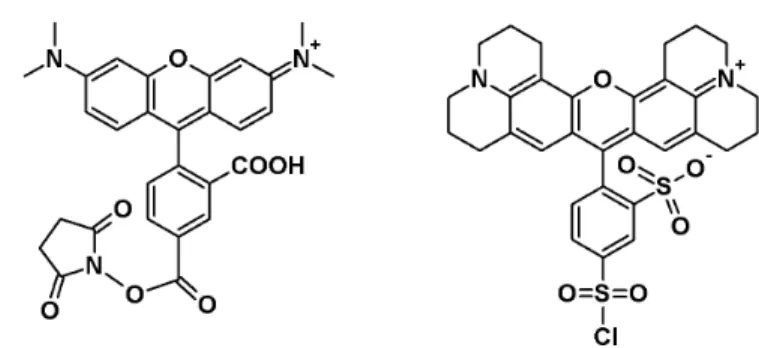
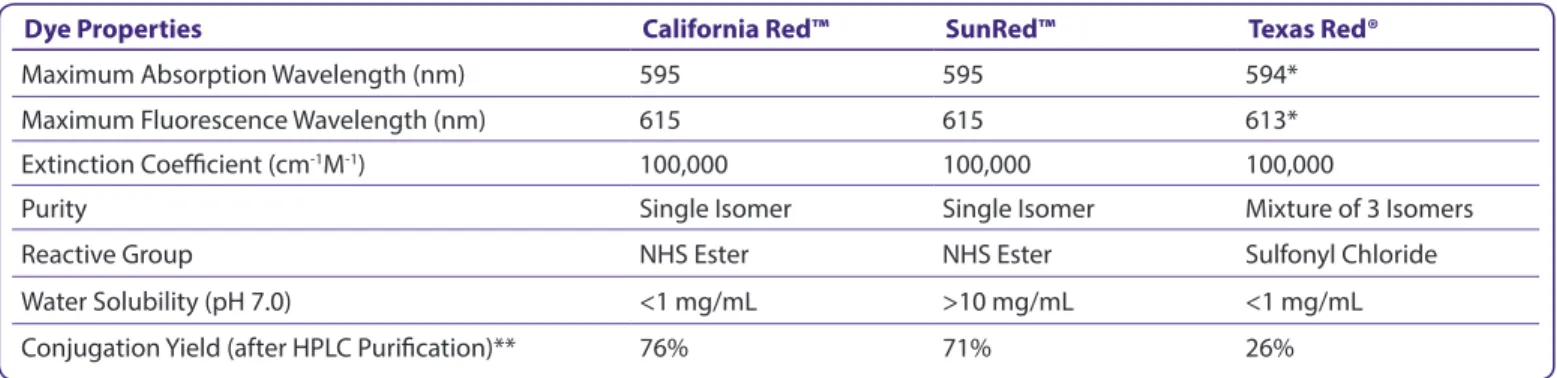
Rhodamine dyes are supplements to fluoresceins as they offer longer wavelength emission maxima and provide opportunities for multicolor labeling and staining. Rhodamines exhibit much higher photostability than fluoresceins and coumarins. Carboxytetra-methylrhodamine (TAMRA) is a common fluorophore for preparing peptide conjugates. Sulforhodamine 101 sulfonyl chloride (Texas Red®) is another popular peptide labeling dye. However, Texas Red® is unstable and gives much lower coupling yield than other carboxyrhodamine dyes (such as 5-TAMRA, SE). AAT Bioquest has recently developed California Red™, a replacement superior to Texas Red®. California Red™ has the spectral properties almost identical to those of Texas Red® and similar water solubility. However, California Red™ is much more stable and gives much
higher conjugation yield than Texas Red® (See Table 2.4 on page 9). Figure 2.3.(Cat# 480, right). The chemical structures of 5-TAMRA, SE (Cat# 373, left) and Texas Red®
Rhodamine Dyes
www.aatbio.com
2
Fluor
esc
en
t D
yes f
or Labeling P
eptides
Figure 2.4. Spectral comparison of California Red™ and Texas Red® conjugated to Gly-Gly-Sor-Ser-Arg-Trp (Red: Texas Red®; Blue: California Red™).
Dye Properties California Red™ SunRed™ Texas Red®
Maximum Absorption Wavelength (nm) 595 595 594* Maximum Fluorescence Wavelength (nm) 615 615 613* Extinction Coefficient (cm-1M-1) 100,000 100,000 100,000
Purity Single Isomer Single Isomer Mixture of 3 Isomers Reactive Group NHS Ester NHS Ester Sulfonyl Chloride Water Solubility (pH 7.0) <1 mg/mL >10 mg/mL <1 mg/mL Conjugation Yield (after HPLC Purification)** 76% 71% 26%
Table 2.4 Comparison of California Red™ and SunRed™ with Texas Red®
2.5 California Red™ and SunRed™, Superior Replacements for Texas Red® and Texas Red®-X for Labeling Peptides
Although sulforhodamine 101 acid chloride (also called TexasRed®) is the most popular labeling reagent of sulfonyl chloride, it is quite unstable in water, especially at the higher pH required for reaction with aliphatic amines. Texas Red® reacts with both aliphatic amines and aromatic amines indiscriminately. In addition, the labeling efficiency of Texas Red® is extremely low compared to dye succinimidyl esters. California Red™ SE is a succinimidyl ester. It is an excellent replacement for Texas Red®. California Red™ reacts with amine compounds such as amino acids, peptides and proteins to give bright red fluorescent conjugates that are extremely stable. Compared to Texas Red®, California Red™ has much higher labeling efficiency, and more importantly, the resulted conjugates are more fluorescent than the corresponding Texas Red® conjugates for long peptides. The conjugates of California Red™ have the identical excitation and emission wavelengths to those of Texas Red®. Our in-house studies indicated that California Red™ is more stable than Texas Red® under the same labeling conditions.
SunRed™ has even better water solubility than Texas Red®, Texas Red®-X and California Red™. It is extremely useful for labeling hydrophobic peptides that are often poorly labeled by Texas Red® or Texas Red®-X. The conjugates of hydrophobic peptides with Texas Red® are difficult to use for measuring biological activity assays due to their poor water solubility.
Cat. # Product Name Size Ex (nm) Em(nm) EC(cm-1 M-1) CF@280 nm
473 California Red™, SE 5 mg 583 603 100,000 0.360 480 Sulforhodamine 101 Sulfonyl Chloride [also known as Texas Red®] 10 mg 588 601 100,000 0.360 472 SunRed™, SE 5 mg 583 603 98,000 0.366 485 Texas Red® Alkyne *Single Isomer* 5 mg 588 601 95,000 0.360 484 Texas Red® Azide *Single Isomer* 5 mg 588 601 95,000 0.360 482 Texas Red® Cadaverine *Single Isomer* 5 mg 582 602 95,000 0.360 481 Texas Red® Hydrazide *Single Isomer* 5 mg 582 602 95,000 0.360 483 Texas Red® Maleimide *Single Isomer* 5 mg 588 601 95,000 0.360
Table 2.5 Superior Replacement Dyes for Texas Red®
www.aatbio.com
California Red™ and SunRed™
Fluor
esc
en
t D
yes f
or Labeling P
eptides
2
Features and Benefits of California Red™ and SunRed™
•
Spectral properties almost identical to those of Texas Red®• Fluorescence less-quenched on proteins than Texas Red®
• More stable than Texas Red®
• Higher conjugation yield
2.6 Cyanine Dyes
As fluorescent dyes, cyanine dyes have many uses, particularly in biomedical imaging. Depending on the structures, they cover the visible and IR portion of the spectrum. Cy3®, Cy5® and Cy7® are the most popular cyanine dyes. Cy3® has orange fluorescence (~550/570 nm), while Cy5® is fluorescent in the red region (~650/670 nm). Cy3® and Cy5® are typically combined for 2- color detection. They are usually synthesized with reactive groups on either one or both of the nitrogen side chains so that they can be chemically linked to either nucleic acids or protein molecules. Labeling is done for visualization and quantification purposes. Cy3® and Cy5® are used in a wide variety of biological applications including comparative genomic hybridization and gene chips, which are used in transcriptomics. They are also used to label proteins and nucleic acids for various studies including proteomics and RNA localization.
Caution must be exercised when selecting a cyanine dye. In general, Cy3®, Cy5®, Cy5.5® and Cy7® are all referred as the sulfonated cyanine dyes (Figure 2.6 on page 11) in the literature. However, some vendors offer the less expensive non-sulfonated cyanines (Figure 2.5) as replacements for the Cy3®, Cy5®, Cy5.5® and Cy7® (sulfonated) cited in the literature. The widely used sulfonated cyanine dyes (known as Cy3®, Cy5®, Cy5.5® and Cy7®) should not
be exchanged with the less expensive non-sulfonated cyanine dyes due to the drastically different properties. The sulfonated
Figure 2.5a. The chemical structures of typical non-sulfonated cyanine dyes for labeling peptides (Cy3NS: n=1; Cy5NS: n=2; Cy7NS: n=3).
cyanine dyes have much higher fluorescence quantum yield than the non-sulfonated cyanines (Table 2.6) in aqueous solutions. The sulfonated cyanine dyes are highly water-soluble while the non-sulfonated cyanines are difficult to be dissolved in water.
Cyanine Dyes
www.aatbio.com
2
Fluor
esc
en
t D
yes f
or Labeling P
eptides
Product Name Ex (nm) Em (nm) EC (cm-1 M-1) Quantum Yield
Cy3® (Sulfonated) 555 565 150,000 0.10 Cy3NS (Non-Sulfonated) 549 565 145,000 0.07 Cy5® (Sulfonated) 649 664 250,000 0.25 Cy5NS (Non-Sulfonated) 644 665 230,000 0.16 Cy5.5® (Sulfonated) 676 695 250,000 0.18
Cy5.5NS (Non-Sulfonated) 675 697 230,000 Not Determined Cy7® (Sulfonated) 749 775 275,000 0.12
Cy7NS (Non-Sulfonated) 750 780 250,000 0.02
Table 2.6 Spectral Comparison of Cyanine Dyes
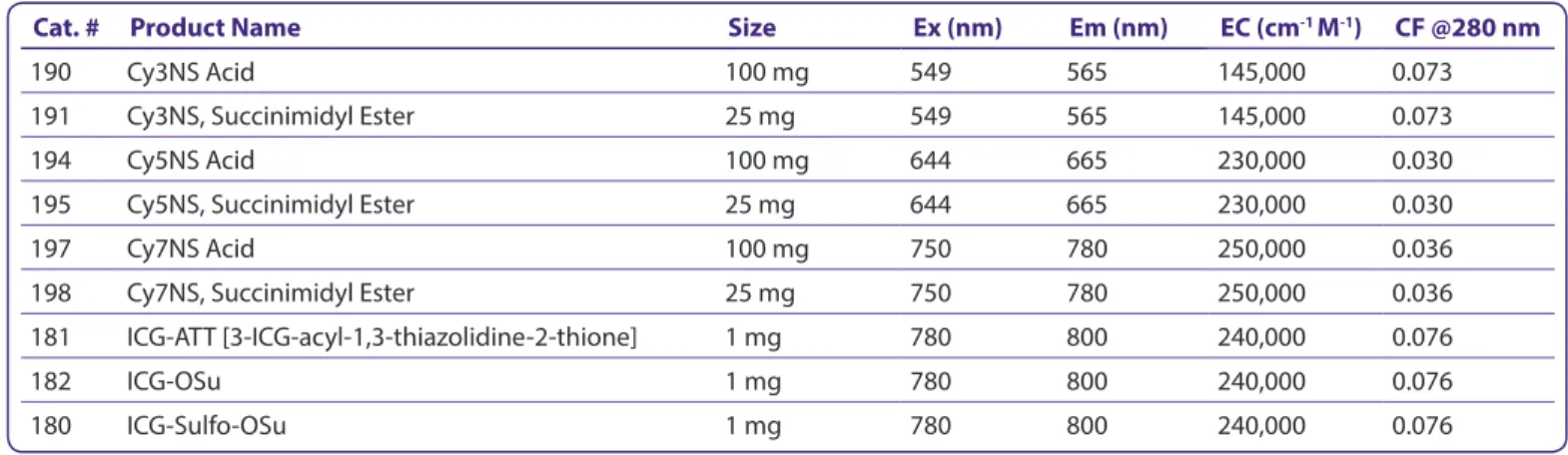
Cat. # Product Name Size Ex (nm) Em (nm) EC (cm-1 M-1) CF @280 nm
190 Cy3NS Acid 100 mg 549 565 145,000 0.073 191 Cy3NS, Succinimidyl Ester 25 mg 549 565 145,000 0.073 194 Cy5NS Acid 100 mg 644 665 230,000 0.030 195 Cy5NS, Succinimidyl Ester 25 mg 644 665 230,000 0.030 197 Cy7NS Acid 100 mg 750 780 250,000 0.036 198 Cy7NS, Succinimidyl Ester 25 mg 750 780 250,000 0.036 181 ICG-ATT [3-ICG-acyl-1,3-thiazolidine-2-thione] 1 mg 780 800 240,000 0.076
182 ICG-OSu 1 mg 780 800 240,000 0.076
180 ICG-Sulfo-OSu 1 mg 780 800 240,000 0.076
Table 2.7 Non-Sulfonated Cyanine Dyes for Labeling Peptides
Figure 2.5b. The chemical structures of typical non-sulfonated cyanine dyes for labeling peptides (Cy3.5NS: n=1; Cy5.5NS: n=2; Cy7.5NS: n=3).
Cat. # Product Name Size Ex (nm) Em(nm) EC(cm-1 M-1) CF@280 nm
144 Cyanine 3 Alkyne [equivalent to Cy3® Alkyne] 1 mg 555 565 150,000 0.073 145 Cyanine 3 Amine [equivalent to Cy3® Amine] 1 mg 555 565 150,000 0.073 143 Cyanine 3 Azide [equivalent to Cy3® Azide] 1 mg 555 565 150,000 0.073 146 Cyanine 3 Hydrazide [equivalent to Cy3® Hydrazide] 1 mg 555 565 150,000 0.073 142 Cyanine 3 Maleimide [equivalent to Cy3® Maleimide] 1 mg 555 565 150,000 0.073 140 Cyanine 3 Monoacid [equivalent to Cy3® Acid] 5 mg 555 565 150,000 0.073 141 Cyanine 3, Monosuccinimidyl Ester [equivalent to Cy3® NHS Ester] 1 mg 555 565 150,000 0.073 139 Cyanine 3.5 Amine [equivalent to Cy3.5® Amine] 1 mg 581 596 125,000 0.178 149 Cyanine 3.5 Maleimide [equivalent to Cy3.5® Maleimide] 1 mg 581 596 125,000 0.178 148 Cyanine 3.5, Monosuccinimidyl Ester [equivalent to Cy3.5® NHS Ester] 1 mg 581 596 125,000 0.178 154 Cyanine 5 Alkyne [equivalent to Cy5® Alkyne] 1 mg 649 665 250,000 0.030 155 Cyanine 5 Amine [equivalent to Cy5® Amine] 1 mg 649 665 250,000 0.030 153 Cyanine 5 Azide [equivalent to Cy5® Azide] 1 mg 649 665 250,000 0.030 156 Cyanine 5 Hydrazide [equivalent to Cy5® Hydrazide] 1 mg 649 665 250,000 0.030 152 Cyanine 5 Maleimide [equivalent to Cy5® Maleimide] 1 mg 649 665 250,000 0.030 150 Cyanine 5 Monoacid [equivalent to Cy5® Acid] 5 mg 649 665 250,000 0.030 151 Cyanine 5, Monosuccinimidyl Ester [equivalent to Cy5® NHS Ester] 1 mg 649 665 250,000 0.030 179 Cyanine 5.5 Alkyne [equivalent to Cy5.5® Alkyne] 1 mg 678 701 230,000 0.101 176 Cyanine 5.5 Amine [equivalent to Cy5.5® Amine] 1 mg 678 701 230,000 0.101 178 Cyanine 5.5 Azide [equivalent to Cy5.5® Azide] 1 mg 678 701 230,000 0.101 177 Cyanine 5.5 Hydrazide [equivalent to Cy5.5® Hydrazide] 1 mg 678 701 230,000 0.101 175 Cyanine 5.5 Maleimide [equivalent to Cy5.5® Maleimide] 1 mg 678 701 230,000 0.101 173 Cyanine 5.5 Monoacid [equivalent to Cy5.5® Acid] 5 mg 678 701 230,000 0.101 174 Cyanine 5.5, Monosuccinimidyl Ester [equivalent to Cy5.5® NHS Ester] 1 mg 678 701 230,000 0.101 164 Cyanine 7 Alkyne [equivalent to Cy7® Alkyne] 1 mg 749 776 275,000 0.036 165 Cyanine 7 Amine [equivalent to Cy7® Amine] 1 mg 749 776 275,000 0.036 163 Cyanine 7 Azide [equivalent to Cy7® Azide] 1 mg 749 776 275,000 0.036 166 Cyanine 7 Hydrazide [equivalent to Cy7® Hydrazide] 1 mg 749 776 275,000 0.036 162 Cyanine 7 Maleimide [equivalent to Cy7® Maleimide] 1 mg 749 776 275,000 0.036 160 Cyanine 7 Monoacid [equivalent to Cy7® Acid] 5 mg 749 776 275,000 0.036 161 Cyanine 7, Monosuccinimidyl Ester [equivalent to Cy7® NHS Ester] 1 mg 749 776 275,000 0.036
Table 2.8 Sulfonated Cyanine Dyes for Labeling Peptides
2
www.aatbio.com
Sulfonated Cyanine Dyes
Figure 2.6. The chemical structures of sulfonated cyanine dyes for labeling peptides. (Left: Cy3: n=1; Cy5: n=2; Cy7: n=3. Right: Cy3.5: n=1; Cy5.5: n= 2; Cy7.5: n=3).
Fluor
esc
en
t D
yes f
or Labeling P
eptides
2.7 Tide Fluor™ Dyes Optimized for Labeling Peptides
Although EDANS, FAM, TAMRA, ROX, Cy3® and Cy5® have been widely used to develop a variety of peptide probes, there are still some limitations in the use of these dyes. For example, the weak absorption and environment-sensitive fluorescence of EDANS have severely limited its sensitivity for developing protease assays and nucleic acid detection probes. Compared to EDANS, fluorescein-based probes (such as FAM, HEX, JOE and TET) have stronger absorption and fluorescence. However, the fluorescence of fluorescein-based probes is strongly pH dependent. They only exhibit the strongest fluorescence at higher pH. The pH dependence makes the fluorescein-based fluorescent probes inconvenient for the assays that require low pH. In addition, most of fluorescein-based probes have quite low photostability, which limits their applications in fluorescence imaging.
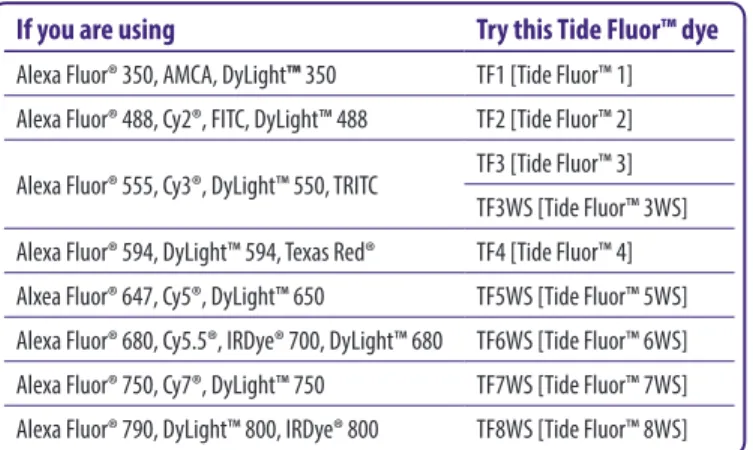
If you are using
Try this Tide Fluor™ dye
Alexa Fluor® 350, AMCA, DyLight™ 350 TF1 [Tide Fluor™ 1] Alexa Fluor® 488, Cy2®, FITC, DyLight™ 488 TF2 [Tide Fluor™ 2] Alexa Fluor® 555, Cy3®, DyLight™ 550, TRITC TF3 [Tide Fluor™ 3]
TF3WS [Tide Fluor™ 3WS]
Alexa Fluor® 594, DyLight™ 594, Texas Red® TF4 [Tide Fluor™ 4] Alxea Fluor® 647, Cy5®, DyLight™ 650 TF5WS [Tide Fluor™ 5WS] Alexa Fluor® 680, Cy5.5®, IRDye® 700, DyLight™ 680 TF6WS [Tide Fluor™ 6WS] Alexa Fluor® 750, Cy7®, DyLight™ 750 TF7WS [Tide Fluor™ 7WS] Alexa Fluor® 790, DyLight™ 800, IRDye® 800 TF8WS [Tide Fluor™ 8WS]
Table 2.9 Tide Fluor™ Dye Equivalents of Common Dyes
Among cyanine dyes, non-sulfonated Cy3® and Cy5® are occasion-ally used for developing a variety of peptide probes, but they have quite low fluorescence quantum yields in aqueous media. The sulfonated Cy3® and Cy5® have improved fluorescence quantum yields. Some Alexa Fluor™ dyes (e.g. Alexa Fluor® 555, 647, 680, 700 and 750) are sulfonated cyanine dyes. However, they are extremely expensive. It's unpractical to use them for preparing peptide conjugates in some cases.
To address these limitations, AAT Bioquest has developed Tide Fluor™ donor dyes that have almost identical spectral properties to those of Alexa Fluor® dyes. They are optimized as building blocks for developing FRET oligonucleotides and peptides for a variety of biological applications. We recommend you try our Tide Fluor™ dyes at much lower cost with comparable performance.
Our Tide Fluor™ dyes (such as TF1, TF2, TF3, TF4, TF5, TF6, TF7 and TF8) have stronger fluorescence and higher photostability than the typical fluorophores such as fluoresceins, rhodamines and cyanines described above. Our TF2 has the similar excitation and emission wavelengths to those of carboxyfluoresceins (FAM), making them readily used for the biological applications that are done with fluoresceins. Compared to FAM probes, TF2 has much stronger fluorescence at physiological conditions, and it is much more
photostable. Compared to other fluorescent dyes alternative to fluoresceins and Cy® dyes (such as Alexa Fluor™ and DyLight® dyes), Tide Fluor™ dyes are much more cost-effective with comparable or even better performance for your desired biological applications. On peptides, TF3 is much brighter and more photostable than Cy3®, Alexa Fluor® 555 and DyLight™ 555, although TF3 has almost identical spectra to those of the three dyes (Figure 2.7).
Figure 2.7. The normalized fluorescence spectra of Tide Fluor™ dyes.
Tide Fluor™ Dyes
www.aatbio.com
Figure 2.8. Fluorescence quantum yield comparison of TF3, Cy3® and Alexa Fluor® 555 on the peptide of Dye-PLSRTLSVAAKK-NH2.
2
Fluor
esc
en
t D
yes f
or Labeling P
eptides
Figure 2.9. Image of HeLa cells. Tublins were stained with mouse anti-tubulin followed with iFluor™ 488 Goat Anti-Mouse IgG (green, Cat# 16448), actin filaments were stained with TF3- Phalloidin Conjugate (red, Cat# 23119), and nuclei were stained with Hoechst 33342 (blue).
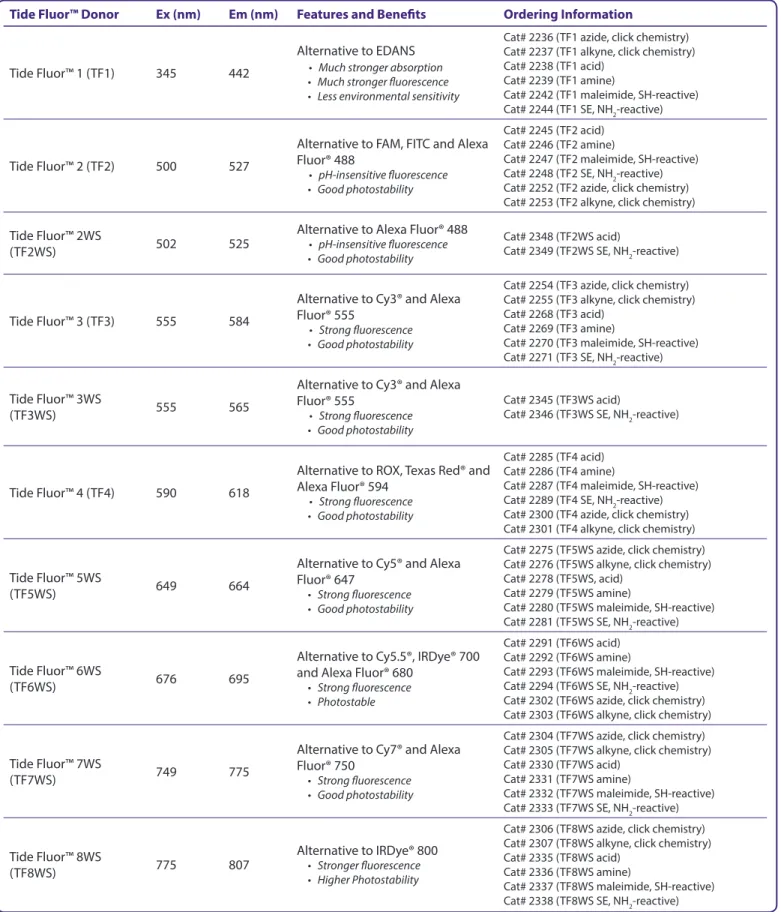
Table 2.10 Tide Fluor™ Dyes, a Full Spectrum of Fluorescent Dyes to Replace Alexa Fluor® Dyes
Tide Fluor™ Donor Ex (nm) Em (nm) Features and Benefits Ordering Information
Tide Fluor™ 1 (TF1) 345 442
Alternative to EDANS
• Much stronger absorption • Much stronger fluorescence • Less environmental sensitivity
Cat# 2236 (TF1 azide, click chemistry) Cat# 2237 (TF1 alkyne, click chemistry) Cat# 2238 (TF1 acid)
Cat# 2239 (TF1 amine)
Cat# 2242 (TF1 maleimide, SH-reactive) Cat# 2244 (TF1 SE, NH2-reactive)
Tide Fluor™ 2 (TF2) 500 527
Alternative to FAM, FITC and Alexa Fluor® 488
• pH-insensitive fluorescence • Good photostability
Cat# 2245 (TF2 acid) Cat# 2246 (TF2 amine)
Cat# 2247 (TF2 maleimide, SH-reactive) Cat# 2248 (TF2 SE, NH2-reactive) Cat# 2252 (TF2 azide, click chemistry) Cat# 2253 (TF2 alkyne, click chemistry)
Tide Fluor™ 2WS
(TF2WS) 502 525
Alternative to Alexa Fluor® 488
• pH-insensitive fluorescence • Good photostability
Cat# 2348 (TF2WS acid)
Cat# 2349 (TF2WS SE, NH2-reactive)
Tide Fluor™ 3 (TF3) 555 584
Alternative to Cy3® and Alexa Fluor® 555
• Strong fluorescence • Good photostability
Cat# 2254 (TF3 azide, click chemistry) Cat# 2255 (TF3 alkyne, click chemistry) Cat# 2268 (TF3 acid)
Cat# 2269 (TF3 amine)
Cat# 2270 (TF3 maleimide, SH-reactive) Cat# 2271 (TF3 SE, NH2-reactive)
Tide Fluor™ 3WS
(TF3WS) 555 565
Alternative to Cy3® and Alexa Fluor® 555
• Strong fluorescence • Good photostability
Cat# 2345 (TF3WS acid)
Cat# 2346 (TF3WS SE, NH2-reactive)
Tide Fluor™ 4 (TF4) 590 618
Alternative to ROX, Texas Red® and Alexa Fluor® 594
• Strong fluorescence • Good photostability
Cat# 2285 (TF4 acid) Cat# 2286 (TF4 amine)
Cat# 2287 (TF4 maleimide, SH-reactive) Cat# 2289 (TF4 SE, NH2-reactive) Cat# 2300 (TF4 azide, click chemistry) Cat# 2301 (TF4 alkyne, click chemistry)
Tide Fluor™ 5WS
(TF5WS) 649 664
Alternative to Cy5® and Alexa Fluor® 647
• Strong fluorescence • Good photostability
Cat# 2275 (TF5WS azide, click chemistry) Cat# 2276 (TF5WS alkyne, click chemistry) Cat# 2278 (TF5WS, acid)
Cat# 2279 (TF5WS amine)
Cat# 2280 (TF5WS maleimide, SH-reactive) Cat# 2281 (TF5WS SE, NH2-reactive)
Tide Fluor™ 6WS
(TF6WS) 676 695
Alternative to Cy5.5®, IRDye® 700 and Alexa Fluor® 680
• Strong fluorescence • Photostable
Cat# 2291 (TF6WS acid) Cat# 2292 (TF6WS amine)
Cat# 2293 (TF6WS maleimide, SH-reactive) Cat# 2294 (TF6WS SE, NH2-reactive) Cat# 2302 (TF6WS azide, click chemistry) Cat# 2303 (TF6WS alkyne, click chemistry)
Tide Fluor™ 7WS
(TF7WS) 749 775
Alternative to Cy7® and Alexa Fluor® 750
• Strong fluorescence • Good photostability
Cat# 2304 (TF7WS azide, click chemistry) Cat# 2305 (TF7WS alkyne, click chemistry) Cat# 2330 (TF7WS acid)
Cat# 2331 (TF7WS amine)
Cat# 2332 (TF7WS maleimide, SH-reactive) Cat# 2333 (TF7WS SE, NH2-reactive)
Tide Fluor™ 8WS
(TF8WS) 775 807
Alternative to IRDye® 800
• Stronger fluorescence • Higher Photostability
Cat# 2306 (TF8WS azide, click chemistry) Cat# 2307 (TF8WS alkyne, click chemistry) Cat# 2335 (TF8WS acid)
Cat# 2336 (TF8WS amine)
Cat# 2337 (TF8WS maleimide, SH-reactive) Cat# 2338 (TF8WS SE, NH2-reactive)
www.aatbio.com
Tide Fluor™ Dyes
Fluor
esc
en
t D
yes f
or Labeling P
eptides
2
2
Fluor
esc
en
t D
yes f
or Labeling P
eptides
Tide Fluor™ Dyes
www.aatbio.com
Cat. #
Product Name
Size
Ex (nm) Em (nm)
EC (cm
-1M
-1) CF @280 nm
2238 Tide Fluor™ 1 Acid [TF1 Acid] *Superior Replacement for EDANS* 100 mg 345 442 20,000 0.187
2237 Tide Fluor™ 1 Alkyne [TF1 Alkyne] *Superior Replacement for EDANS* 5 mg 345 442 20,000 0.187
2239 Tide Fluor™ 1 Amine [TF1 Amine] *Superior Replacement for EDANS* 5 mg 345 442 20,000 0.187
2236 Tide Fluor™ 1 Azide [TF1 Azide] *Superior Replacement for EDANS* 5 mg 345 442 20,000 0.187
2348 Tide Fluor™ 2WS Acid [TF2WS Acid] *Superior Replacement for FITC* 10 mg 502 525 75,000 0.091
2349 Tide Fluor™ 2WS, Succinimidyl Ester [TF2WS, SE] *Superior Replacement for FITC* 5 mg 502 525 75,000 0.091
2345 Tide Fluor™ 3WS Acid [TF3WS Acid] *Superior Replacement for Cy3®* 10 mg 555 565 150,000 0.079
2346 Tide Fluor™ 3WS, Succinimidyl Ester [TF3WS, SE] *Superior Replacement for Cy3®* 5 mg 555 565 150,000 0.079
2285 Tide Fluor™ 4 Acid [TF4 Acid] *Superior Replacement for ROX and Texas Red®* 10 mg 590 618 90,000 0.436
2301 Tide Fluor™ 4 Alkyne [TF4 Alkyne] *Superior Replacement for ROX and Texas Red®* 1 mg 590 618 90,000 0.436
2286 Tide Fluor™ 4 Amine [TF4 Amine] *Superior Replacement for ROX and Texas Red®* 1 mg 590 618 90,000 0.436
2300 Tide Fluor™ 4 Azide [TF4 Azide] *Superior Replacement for ROX and Texas Red®* 1 mg 590 618 90,000 0.436
2287 Tide Fluor™ 4 Maleimide [TF4 Maleimide] *Superior Replacement for ROX and Texas Red®* 1 mg 590 618 90,000 0.436
2289 Tide Fluor™ 4, Succinimidyl Ester [TF4, SE] *Superior Replacement for ROX and Texas Red®* 5 mg 590 618 90,000 0.436
2278 Tide Fluor™ 5WS Acid [TF5WS Acid] *Superior Replacement for Cy5®* 10 mg 649 664 250,000 0.027
2276 Tide Fluor™ 5WS Alkyne [TF5WS Alkyne] *Superior Replacement for Cy5®* 1 mg 649 664 250,000 0.027
2279 Tide Fluor™ 5WS Amine [TF5WS Amine] *Superior Replacement for Cy5®* 1 mg 649 664 250,000 0.027
2275 Tide Fluor™ 5WS Azide [TF5WS Azide] *Superior Replacement for Cy5®* 1 mg 649 664 250,000 0.027
2280 Tide Fluor™ 5WS Maleimide [TF5WS Maleimide] *Superior Replacement for Cy5®* 1 mg 649 664 250,000 0.027
2281 Tide Fluor™ 5WS, Succinimidyl Ester [TF5WS, SE] *Superior Replacement for Cy5®* 5 mg 649 664 250,000 0.027
2291 Tide Fluor™ 6WS Acid [TF6WS Acid] *Superior Replacement for Cy5.5®* 10 mg 676 695 220,000 0.101
2303 Tide Fluor™ 6WS Alkyne [TF6WS Alkyne] *Superior Replacement for Cy5.5®* 1 mg 676 695 220,000 0.101
2292 Tide Fluor™ 6WS Amine [TF6WS Amine] *Superior Replacement for Cy5.5®* 1 mg 676 695 220,000 0.101
2302 Tide Fluor™ 6WS Azide [TF6WS Azide] *Superior Replacement for Cy5.5®* 1 mg 676 695 220,000 0.101
2293 Tide Fluor™ 6WS Maleimide [TF6WS Maleimide] *Superior Replacement for Cy5.5®* 1 mg 676 695 220,000 0.101
2294 Tide Fluor™ 6WS, Succinimidyl Ester [TF6WS, SE] *Superior Replacement for Cy5.5®* 1 mg 676 695 220,000 0.101
2330 Tide Fluor™ 7WS Acid [TF7WS Acid] *Superior Replacement for Cy7®* 10 mg 749 775 275,000 0.049
2305 Tide Fluor™ 7WS Alkyne [TF7WS Alkyne] *Superior Replacement for Cy7®* 1 mg 749 775 275,000 0.049
2331 Tide Fluor™ 7WS Amine [TF7WS Amine] *Superior Replacement for Cy7®* 1 mg 749 775 275,000 0.049
2304 Tide Fluor™ 7WS Azide [TF7WS Azide] *Superior Replacement for Cy7®* 1 mg 749 775 275,000 0.049
2332 Tide Fluor™ 7WS Maleimide [TF7WS Maleimide] *Superior Replacement for Cy7®* 1 mg 749 775 275,000 0.049
2333 Tide Fluor™ 7WS, Succinimidyl Ester [TF7WS, SE] *Superior Replacement for Cy7®* 1 mg 749 775 275,000 0.049
2335 Tide Fluor™ 8WS Acid [TF8WS Acid] *Near Infrared Emission* 10 mg 775 807 250,000 0.109
2307 Tide Fluor™ 8WS Alkyne [TF8WS Alkyne] *Near Infrared Emission* 1 mg 775 807 250,000 0.109
2336 Tide Fluor™ 8WS Amine [TF8WS Amine] *Near Infrared Emission* 1 mg 775 807 250,000 0.109
2306 Tide Fluor™ 8WS Azide [TF8WS Azide] *Near Infrared Emission* 1 mg 775 807 250,000 0.109
2337 Tide Fluor™ 8WS Maleimide [TF8WS Maleimide] *Near Infrared Emission* 1 mg 775 807 250,000 0.109
2338 Tide Fluor™ 8WS, Succinimidyl Ester [TF8WS, SE] *Near Infrared Emission* 1 mg 775 807 250,000 0.109
www.aatbio.com
Other Dyes
Fluor
esc
en
t D
yes f
or Labeling P
eptides
2
2.8 Other Dyes
EDANS dyes are quite useful for preparing fluorescent peptides. They might be the first group of fluorescent dyes used for prepar-ing FRET peptides to analyze a broad range of protease activities. AAT Bioquest offers a variety of EDANS derivatives for preparing FRET peptide substrates.
Cat.
#
Product Name
Size Ex
(nm)
Em
(nm)
EC
(cm
-1M
-1)
CF
@280 nm
700 Bodi Fluor™ 488 Acid 10 mg 505 512 70,000 0.018
701 Bodi Fluor™ 488, SE 5 mg 505 511 70,000 0.018 810 Dansyl Cadaverine 25 mg 333 518 4,000 0.387 811 Dansyl Chloride 100 mg 335 518 4,000 0.387 812 Dansyl-X Acid 5 g 335 518 4,000 0.387 813 Dansyl-X, SE 1 g 335 518 4,000 0.387 610 EDANS Acid 1 g 335 493 5,500 0.107 617 EDANS C2 Maleimide 25 mg 335 493 5,500 0.107 618 EDANS Iodoacetamide 25 mg 335 493 5,500 0.107
615 EDANS, Sodium Salt 1 g 335 493 5,500 0.107
Table 2.12 Bodi Fluor™, Dansyl and EDANS Derivatives for Labeling Peptides
Dansyl dyes are usually used to label peptides for biophysical investigations due to their small sizes and little interference to the binding affinity of peptides. The environmental sensitivity of Dansyl dyes is often used to probe biological microenvironments.Figure 2.10. The chemical structures of EDANS dyes.
Besides the popular fluorescent dyes such as coumarins,
fluoresceins, rhodamines, cyanines and EDANS dyes, AAT Bioquest also offers some fluorescent dyes that are ocassionally used for labeling peptides. Our Bodi Fluor™ dyes are chemically the same as the Bodipy® dyes offered by Invitrogen, e.g., Bodi Fluor™ 488 is equivalent to Bodipy® FL. Bodi Fluor™ 488 is highly fluorescent, and often used as an alternative to fluorescein since its fluorescence is not pH-dependent. The sharper excitation and emission peaks of Bodi Fluor™ 488 make it better suitable for multi-color fluorescence imaging applications.
Figure 2.12. The chemical structures of typical Dansyl dyes.
Figure 2.11. The chemical structures of Bodi Fluor™ 488 acid (Cat# 700, top) and its succinimidyl ester (Cat# 701, bottom).
610 615
617 618
810 811
Non-Fluorescent Quenchers for Labeling Peptides
3
Non-F
luor
esc
en
t Q
uenchers f
or Labeling P
eptides
3.2 Non-Fluorescent DABCYL Dyes
DABCYL dyes are quite useful for preparing FRET peptides. AAT Bioquest offers a variety of DABCYL derivatives for developing FRET peptide substrates. However, DABCYL is not an effective quencher for longer wavelength fluorescent dyes (such as rhodamines and cyanines). We recommend you try our Tide Quencher™ dyes opti-mized for preparing FRET peptides to get superior performance.
Cat. # Product Name Size Ab (nm) EC (cm-1M -1) CF @280 nm
2001 DABCYL Acid 5 g 426 20,000 0.516
2006 DABCYL C2 Amine 100 mg 428 20,000 0.516
2008 DABCYL C2 Maleimide 25 mg 428 20,000 0.516
2004 DABCYL, Succinimidyl Ester 1 g 453 20,000 0.516
2005 DABCYL, Succinimidyl Ester 5 g 453 20,000 0.516
Table 3.1 DABCYL Derivatives for Labeling Peptides
3.3 Tide Quencher™ Dyes Optimized to Maximize FRET Efficiency
Although DABCYL has been used to develop a variety of FRET applications, its low quenching efficiency for longer wavelength dyes (such as fluoresceins, rhodamines and cyanines) has limited its use in the development of sensitive fluorogenic FRET probes. Additionally, the absorption spectrum of DABCYL is environment-sensitive. AAT Bioquest has developed robust Tide Quencher™ acceptor dyes for the development of longer wavelength FRET probes. Tide Quencher™ dyes are a great choice to eliminate the limitations of classic quenchers.
Non-F
luor
esc
en
t Q
uenchers f
or Labeling P
eptides
3
3.1 FRET Peptide Substrates
FRET is a physical phenomenon, that is being used more and more in biomedical research and drug discovery today. FRET is the radia-tionless transmission of energy from a donor molecule to an accep-tor molecule. The donor molecule is the dye or chromophore that initially absorbs the energy and the acceptor is the chromophore to which the energy is subsequently transferred. This resonance interaction occurs over greater than interatomic distances, without conversion to thermal energy and without any molecular collision. The transfer of energy leads to a reduction in the donor’s fluores-cence intensity and excited state lifetime, and an increase in the acceptor’s emission intensity. A pair of molecules that interact in such a manner that FRET occurs is often referred to as a donor/ac-ceptor pair. Due to its sensitivity to distance, FRET has been used to investigate molecular interactions.
While there are many factors that influence FRET, the primary con-ditions that need to be met in order for FRET to occur are relatively few. The donor and acceptor molecules must be in close proximity to one another (typically 10-100 Å). The absorption or excitation spectrum of the acceptor must overlap the fluorescence emission spectrum of the donor. The degree to which they overlap is referred to as the spectral overlap integral (J). The donor and acceptor transition dipole orientations must be approximately parallel. Assuming that the donor acceptor pairs are compatible, the most critical element necessary for FRET to occur is close proximity of the pairs. Förster, demonstrated that the efficiency of the process (E) depends on the inverse sixth power distance between donor and acceptor as expressed with the following equation:
E = Ro6/(R o6 + r6)
Where Ro is the Förster distance at which half the energy is
trans-ferred and r is the actual distance between donor and acceptor. The magnitude of the Ro is dependent on the spectral properties of the donor and the acceptor. Förster distances ranging from 20 to 90 Å are most useful for the studies of biological macromolecules.
Proteases are involved in a number of physiological processes. The detection of proteases and the screening of specific protease inhibitors are essential in the discovery of potential drugs for the treatment and management of protease-related diseases. A variety of donor and acceptor molecules (either fluorescent or non-fluo-rescent) are attached to the peptide/protein (forming the internally quenched conjugates), and are used to detect a protease depend-ing on the sequences of the amino acids. The donor and acceptor molecules are carefully chosen so that the absorption of the accep-tor overlaps with the fluorescence of the donor, thus ensuring that the fluorescence is quenched through resonance energy transfer. Enzyme hydrolysis of the substrate results in spatial separation of the donor and the acceptor molecules, thereby restoring the donor's fluorescence.
www.aatbio.com
DABCYL and Tide Quencher™ Dyes
The Advantages of Tide Quencher
™ Dyes:
•
TQ dyes enable you to explore the FRET potentials that might be impossible with other quenchers.•
Versatile reactive forms are convenient for self-constructing your desired FRET biomolecules.•
Perfectly match your desired fluorescent donors.•
Competitive price with better performance.Tide Quencher™ series of nonfluorescent dyes cover the full visible spectrum with unusually high efficiency. For example, TQ2 has absorption maximum perfectly matching the emission of FAM
+ + + + + Best to use; + + + OK to use; Not recommended to use.
Table 3.3. Recommended FRET Pairs for Developing Molecular Beacon Nucleic Acid Detection and Protease Assays*
DABCYL
TQ1
TQ2
TQ3
TQ4
TQ5
TQ6
TQ7
EDANS + + + + + + + + + + + + + MCA + + + + + + + + + + + + + TF1 + + + + + + + + + + + + + FAM/FITC + + + + + + + + + + + + + + Cy2®/TF2 + + + + + + + + + + + + + + HEX/JOE/TET + + + + + + + + + + + Cy3®/TAMRA/TF3 + + + + + + + + + + + ROX/Texas Red® + + + + + + + + + + + TF4 + + + + + + + + + + + Cy5®/TF5 + + + + + + + + + + + Cy5.5®/TF6 + + + + + + + + + + + Cy7®/TF7 + + + + + + + + *Donors
Acceptors
Figure 3.1. The normalized absorption spectra of TQ1, 2, 3, 4, 5, 6 and 7.
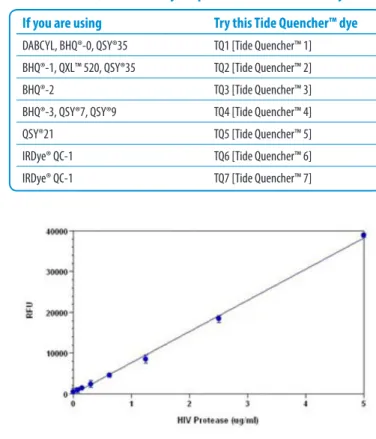
If you are using
Try this Tide Quencher™ dye
DABCYL, BHQ®-0, QSY®35 TQ1 [Tide Quencher™ 1]
BHQ®-1, QXL™ 520, QSY®35 TQ2 [Tide Quencher™ 2]
BHQ®-2 TQ3 [Tide Quencher™ 3]
BHQ®-3, QSY®7, QSY®9 TQ4 [Tide Quencher™ 4]
QSY®21 TQ5 [Tide Quencher™ 5]
IRDye® QC-1 TQ6 [Tide Quencher™ 6]
IRDye® QC-1 TQ7 [Tide Quencher™ 7]
Table 3.2 Tide Quencher™ Dye Equivalents of Common Dyes
Figure 3.2. HIV Protease cleavage of Arg-Glu(5-FAM)-Val-Ser-Phe-Asn-Phe-Pro-Gln-Ile-Thr-Lys(TQ2)-Arg. Upon HIV protease cleavage, the fluorescence of 5-FAM is recovered and monitored at Ex/Em = 490 /520 nm.
Tide Quencher™ Dyes
www.aatbio.com
3
Non-F
luor
esc
en
t Q
uenchers f
or Labeling P
eptides
while TQ3, TQ5 and TQ7 are proven to be the best quenchers for Cy3®, Cy5® and Cy7®. Tide Quencher™ dyes are excellent dark quenchers that are individually optimized to pair with all the popular fluorescent dyes such as fluoresceins, rhodamines and cyanines. These Tide Quencher™ dark FRET acceptors (such as TQ1, TQ2, TQ3, TQ4, TQ5, TQ6 and TQ7) are perfect to pair with our Tide Fluor™ dyes and the classic fluorophores (such as AMCA, EDANS, FAM, TAMRA, HEX, JOE, TET, ROX, Cy3®, Cy5® and Cy7®). Like our Tide Fluor™ donor dyes, our Tide Quencher™ acceptor dyes are much more cost-effective with comparable or even better performance for your desired biological applications than other similar products on the market.
Dark FRET Acceptor λmax (nm) Features and Benefits Ordering Information
Tide Quencher™ 1
(TQ1) 490
Alternative to DABCYL, QSY® 35 and BHQ®-0 • Best paired with Tide Fluor™ 1 (TF1)
• Excellent FRET efficiency with coumarins
Cat# 2188 (TQ1 azide, click chemistry) Cat# 2189 (TQ1 alkyne, click chemistry) Cat# 2190 (TQ1 acid)
Cat# 2192 (TQ1 amine)
Cat# 2193 & 2194 (TQ1 CPG, OH-reactive) Cat# 2196 (TQ1 maleimide, SH-reactive) Cat# 2198 (TQ1 phosphoramidite, OH-reactive) Cat# 2199 (TQ1 SE, NH2-reactive)
Tide Quencher™ 2
(TQ2) 515
Alternative to BHQ®-1
• Best paired with Tide Fluor™ 2 (TF2)
• Better matched with FAM, FITC and Alexa Fluor® 488 than other com-mercial quenchers
Cat# 2211 (TQ2 azide, click chemistry) Cat# 2212 (TQ2 alkyne, click chemistry) Cat# 2200 (TQ2 acid)
Cat# 2202 (TQ2 amine)
Cat# 2203 & 2204 (TQ2 CPG, OH-reactive) Cat# 2206 (TQ2 maleimide, SH-reactive) Cat# 2208 (TQ2 phosphoramidite, OH-reactive) Cat# 2210 (TQ2 SE, NH2-reactive)
Tide Quencher™ 2WS (TQ2WS) 515
Alternative to BHQ®-1
• Best paired with Tide Fluor™ 2 (TF2)
• Better matched with FAM, FITC and Alexa Fluor® 488 than other com-mercial quenchers
Cat# 2050 (TQ2WS acid)
Cat# 2058 (TQ2WS SE, NH2-reactive)
Tide Quencher™ 3
(TQ3) 570
Alternative to QSY® 7, QSY® 9 and BHQ®-2
• Best paired with Tide Fluor™ 3 (TF3)
• Excellent FRET efficiency with Cy3®, Alexa Fluor® 555 and TAMRA
than other commercial quenchers
Cat# 2220 (TQ3 acid) Cat# 2222 (TQ3 amine)
Cat# 2223 & 2224 (TQ3 CPG, OH-reactive) Cat# 2226 (TQ3 maleimide, SH-reactive) Cat# 2228 (TQ3 phosphoramidite, OH-reactive) Cat# 2230 (TQ3 SE, NH2-reactive)
Cat# 2231 (TQ3 azide, click chemistry) Cat# 2232 (TQ3 alkyne, click chemistry)
Tide Quencher™ 3WS (TQ3WS) 578
Alternative to QSY® 7, QSY® 9 and BHQ®-2
• Best paired with Tide Fluor™ 3 (TF3)
• Excellent FRET efficiency with Cy3®, Alexa Fluor® 555 and TAMRA
than other commercial quenchers
Cat# 2227 (TQ3WS acid)
Cat# 2229 (TQ3WS SE, NH2-reactive)
Tide Quencher™ 4
(TQ4) 603
• Strong absorption
• Best paired with Tide Fluor™ 4 (TF4)
• Better FRET efficiency with ROX, Texas Red® and Alexa Fluor® 594 than other commercial quenchers
Cat# 2062 & 2063 (TQ4 CPG, OH-reactive)
Tide Quencher™ 4WS (TQ4WS) ~590
• Strong absorption
• Best paired with Tide Fluor™ 4 (TF4)
• Better FRET efficiency with ROX, Texas Red® and Alexa Fluor® 594 than other commercial quenchers
Cat# 2060 (TQ4WS acid) Cat# 2061 (TQ4WS amine)
Cat# 2064 (TQ4WS maleimide, SH-reactive) Cat# 2067 (TQ4WS SE, NH2-reactive)
Cat# 2068 (TQ4WS azide, click chemistry) Cat# 2069 (TQ4WS alkyne, click chemistry)
Tide Quencher™ 5
(TQ5) ~670
Alternative to QSY® 21 and BHQ®-3 • Best paired with Tide Fluor™ 5 (TF5)
• Excellent FRET efficiency with Cy5®, DyLight® 649 and Alexa luor® 647
Cat# 2077 & 2078 (TQ5 CPG, OH-reactive)
Tide Quencher™ 5WS (TQ5WS) ~670
Alternative to QSY® 21 and BHQ®-3 • Best paired with Tide Fluor™ 5 (TF5)
• Excellent FRET efficiency with Cy5®, DyLight® 649 and Alexa Fluor® 647
Cat# 2075 (TQ5WS acid) Cat# 2076 (TQ5WS amine)
Cat# 2079 (TQ5WS maleimide, SH-reactive) Cat# 2081 (TQ5WS SE, NH2-reactive)
Cat# 2082 (TQ5WS azide, click chemistry) Cat # 2083 (TQ5WS alkyne, click chemistry)
Tide Quencher™ 6WS (TQ6WS) ~700
• Stronger absorption
• Best paired with Tide Fluor™ 6 (TF6)
• Better FRET efficiency with Cy5.5®, IRDye® 700 and Alexa Fluor® 680
than other commercial quenchers
Cat# 2090 (TQ6WS acid) Cat# 2091 (TQ6WS amine)
Cat# 2094 (TQ6WS maleimide, SH-reactive) Cat# 2096 (TQ6WS SE, NH2-reactive)
Cat# 2097 (TQ6WS azide, click chemistry) Cat# 2098 (TQ6WS alkyne, click chemistry)
Tide Quencher™ 7WS (TQ7WS) ~760
• Stronger absorption
• Best paired with Tide Fluor™ 7 (TF7)
• Better FRET efficiency with Cy7® and Alexa Fluor® 750 than other
commercial quenchers
Cat# 2105 (TQ7WS acid) Cat# 2106 (TQ7WS amine)
Cat# 2109 (TQ7WS maleimide, SH-reactive) Cat# 2111 (TQ7WS SE, NH2-reactive)
Cat# 2112 (TQ7WS azide, click chemistry)
Table 3.4 Tide Quencher™ Dyes for Developing FRET Protease Assays
Non-F
luor
esc
en
t Q
uenchers f
or Labeling P
eptides
3
3
Non-F
luor
esc
en
t Q
uenchers f
or Labeling P
eptides
Tide Quencher™ Dyes
www.aatbio.com
Cat. # Product Name Size Ab EC (cm-1 M-1) CF @280 nm
2189 Tide Quencher™ 1 Alkyne [TQ1 Alkyne] 5 mg 490 20,000 0.194 2192 Tide Quencher™ 1 Amine [TQ1 Amine] 5 mg 490 20,000 0.194 2188 Tide Quencher™ 1 Azide [TQ1 Azide] 5 mg 490 20,000 0.194 2196 Tide Quencher™ 1 Maleimide [TQ1 Maleimide] 5 mg 490 20,000 0.194 2199 Tide Quencher™ 1, Succinimidyl Ester [TQ1, SE] 25 mg 490 20,000 0.194 2200 Tide Quencher™ 2 Acid [TQ2 Acid] 100 mg 515 21,000 0.120 2212 Tide Quencher™ 2 Alkyne [TQ2 Alkyne] 100 mg 515 21,000 0.120 2202 Tide Quencher™ 2 Amine [TQ2 Amine] 5 mg 515 21,000 0.120 2211 Tide Quencher™ 2 Azide [TQ2 Azide] 5 mg 515 21,000 0.120 2206 Tide Quencher™ 2 Maleimide [TQ2 Maleimide] 5 mg 515 21,000 0.120 2210 Tide Quencher™ 2, Succinimidyl Ester [TQ2, SE] 25 mg 515 21,000 0.120 2058 Tide Quencher™ 2WS, Succinimidyl Ester [TQ2WS, SE] 5 mg 515 19,000 0.559 2220 Tide Quencher™ 3 Acid [TQ3 Acid] 100 mg 570 22,000 0.091 2232 Tide Quencher™ 3 Alkyne [TQ3 Alkyne] 5 mg 570 22,000 0.091 2222 Tide Quencher™ 3 Amine [TQ3 Amine] 5 mg 570 22,000 0.091 2231 Tide Quencher™ 3 Azide [TQ3 Azide] 5 mg 570 22,000 0.091 2226 Tide Quencher™ 3 Maleimide [TQ3 Maleimide] 5 mg 570 22,000 0.091 2230 Tide Quencher™ 3, Succinimidyl Ester [TQ3, SE] 25 mg 570 22,000 0.091 2229 Tide Quencher™ 3WS, Succinimidyl Ester [TQ3WS, SE] 1 mg 578 90,000 0.205 2060 Tide Quencher™ 4WS Acid [TQ4WS Acid] 5 mg 603 90,000 0.136 2069 Tide Quencher™ 4WS Alkyne [TQ4WS Alkyne] 1 mg 603 90,000 0.136 2061 Tide Quencher™ 4WS Amine [TQ4WS Amine] 1 mg 603 90,000 0.136 2068 Tide Quencher™ 4WS Azide [TQ4WS Azide] 1 mg 603 90,000 0.136 2064 Tide Quencher™ 4WS Maleimide [TQ4WS Maleimide] 1 mg 603 90,000 0.136 2067 Tide Quencher™ 4WS, Succinimidyl Ester [TQ4WS, SE] 1 mg 603 90,000 0.136 2083 Tide Quencher™ 5WS Alkyne [TQ5WS Alkyne] 1 mg 661 130,000 0.082 2076 Tide Quencher™ 5WS Amine [TQ5WS Amine] 1 mg 661 130,000 0.082 2082 Tide Quencher™ 5WS Azide [TQ5WS Azide] 1 mg 661 130,000 0.082 2079 Tide Quencher™ 5WS Maleimide [TQ5WS Maleimide] 1 mg 661 130,000 0.082 2081 Tide Quencher™ 5WS, Succinimidyl Ester [TQ5WS, SE] 1 mg 661 130,000 0.082 2090 Tide Quencher™ 6WS Acid [TQ6WS Acid] 5 mg 704 130,000 0.102 2098 Tide Quencher™ 6WS Alkyne [TQ6WS Alkyne] 1 mg 704 130,000 0.102 2091 Tide Quencher™ 6WS Amine [TQ6WS Amine] 1 mg 704 130,000 0.102 2097 Tide Quencher™ 6WS Azide [TQ6WS Azide] 1 mg 704 130,000 0.102 2094 Tide Quencher™ 6WS Maleimide [TQ6WS Maleimide] 1 mg 704 130,000 0.102 2096 Tide Quencher™ 6WS, Succinimidyl Ester [TQ6WS, SE] 1 mg 704 130,000 0.102 2113 Tide Quencher™ 7WS Alkyne [TQ7WS Alkyne] 1 mg 763 140,000 0.091 2106 Tide Quencher™ 7WS Amine [TQ7WS Amine] 1 mg 763 140,000 0.091 2112 Tide Quencher™ 7WS Azide [TQ7WS Azide] 1 mg 763 140,000 0.091 2109 Tide Quencher™ 7WS Maleimide [TQ7WS Maleimide] 1 mg 763 140,000 0.091 2111 Tide Quencher™ 7WS, Succinimidyl Ester [TQ7WS, SE] 1 mg 763 140,000 0.091