e-ISSN: 2289-2559
Emerging
Economies and
Islamic Research
Journal of Emerging Economies & Islamic Research 8(2) 2020, 73 – 87.www.jeeir.com
The Nexus between Financial Development and Human
Development: The Case of Developing Countries
*
Bilgehan Tekin
a†a Cankiri Karatekin University, Cankiri, TURKEY
A R T I C L E I N F O A B S T R A C T Article history:
Received 9 April 2020 Accepted 13 May 2020 Published 31 May 2020
The purpose of this study is to examine the relationship between financial development and human development from the health and welfare dimensions of developing countries. This study aims to determine whether the financial developments of the countries have an effect on the basic human development of the individuals and whether human development indicators have an impact on financial development. In this study, the relationship between financial development and human development were revealed by using data obtained from developing countries. The financial development levels of countries was measured using the financial development index. The index is calculated by using M3 / GDP, private sector loans / GDP and loans to banks from private sector / GDP ratios. The human development index is calculated by considering various health indicators and GNP per capita. The data includes annual data for the period 1970-2016. Pedroni and Kao cointegration analysis and Dumitrescu and Hurlin panel causality analysis were performed in the study. The results show that there is long-term cointegration relationship and two-way causality between financial and human development in developing countiries.
Keywords:
Human Development, Financial Development, Panel Cointegration, Panel Causality
1. Introduction
Human development is increasingly seen as the ultimate goal of development rather than economic growth. Nevertheless, the link between human development and economic growth remains critical because economic growth seems to be the primary contribution to continuous progress in human development. Moreover, developments in human development are not only a key developmental goal, but human development itself has made a significant contribution to economic growth over time. Therefore, it
* This study was presented at The 3rd International Management and Social Sciences Conference, November 2-4,
2019 İstanbul / Turkey and next developed and regulated. * Corresponding author. E-mail address: [email protected]
is important to explore bidirectional connections between human development and economic growth (Ranis and Stewart, 2005:1). In many studies on human development levels of countries, it is seen that economic growth and Gross Domestic Product are frequently taken as indicators of human development. However, although the concept of development represents economic development in a narrow scope, according to the "Human Development Report", which has been published by the United Nations since 1990, development is defined as improvement in the lives of individuals, including the human factor (Kaya, 2017). On the other hand, some studies draw attention to the conceptual problems of assumptions about the definition of human development with only economic development. Stanton (2007) stated that national income calculations, which are considered as the indicators of development of countries, only record monetary transfers, equate goods with commodities that are not “goods” but “bads” like nuclear weapons, the production of which tends to lower social welfare. Such production reduces social welfare support and environmental pollution containment caused by petroleum products. Statman (2007) criticized the definition of economic development which includes elements such as cleaning costs, considers natural resources as free and unlimited goods, does not value leisure time, ignores freedom and human rights and the distribution of income in society (Stanton, 2007). Filippidis and Katrakilidis (2015) state that human development measures average achievements of three basic dimensions of a country's development: health, knowledge and development (GDP). Therefore, the concept of human development represents a broader concept than the per capita GDP variable that has found widespread application in literature.
Financial development is determined according to the role it plays in effectively directing the savings created within the economic system to investments (Güneş, 2013). The positive effect of human capital on financial development is due to the decrease in information asymmetry (Satrovic, 2017). The role of financial development in reducing information asymmetry and pricing risk is essential for economic growth (Murinde, 2012). Interest rates, investment, savings, and loans play an essential role in human development as they characterize macroeconomic growth (Simplice, 2011). While access to financial resources requires a complicated process in most cases due to risk and transaction costs, this has implications for human development as well. Ease of access to financial resources and financing can contribute to growth by facilitating entrepreneurship and increasing risk management capacity in a society (Pischke, 1997). At the same time, effective resource allocation in a financial system, innovation, productive investment, and human welfare-enhancing effects are seen (Pischke, 1997).
Although the relations between the financial and economic developments of countries are subject to many studies in academic terms, studies that examine the relationship between the development levels of the states and the financial development levels by taking into account the human life standards more than GDP are not encountered. This study examines the relationship between financial development and human development using the Principal Component Analysis, Panel Cointegration and Panel Causality Analysis, based on the data of 15 developing countries whose data are fully available. The aim is to determine the long and short term relationships between the financial and human development levels of the countries and the direction of the relations. In this context, data obtained from the Central Bank, World Bank and OECD were used. The annual data used in the study covers the period between 1970-2016. The countries included in the survey are Africa, Argentina, Brazil, Ecuador, India, Iran, Kenya, Korea, Malaysia, Mexico, Nigeria, Pakistan, Tunisia, Turkey, and Uruguay.
2. Literature Research
Many studies have been carried out to reveal the dynamic, linear and asymmetrical relationships between the financial and economic development levels of countries. t Studies that examine the different dimensions of countries' human development levels other than GDP are many but the study of their relationship with financial development is limited. In this context, the Human Development Index data
that the United Nations started to publish since 1990 is used as an indicator of human development. However, because the UN's human development index data is annual and few, the analysis cannot yield strong results.
The investigation of the relationship between financial development and economic growth, which is accepted as a measure of social welfare and development, goes back to Schumpeter (1911). King and Levine (1993) examined the relationship between financial and economic development indicators between 1960-1989 and concluded that the relationship between financial development and economic growth is linear. Levine (1997), another researcher who mentioned the relationship between these two variables, suggests that there is a strong relationship between the variables. Levine (1997) states that the capital accumulation and technological development of the countries are encouraged by the financial system, and this positively affects economic development.
One of the recent studies about the relationship between economic and financial development belongs to Asteriou and Spanos (2019) they examined the relationship between financial development and economic growth on the face of the recent financial crisis, using a panel dataset of 26 European Union countries from 1990–2016. The empirical approach used multiplicative dummies to compare two distinct sub-periods before/after the crisis. The results showed that before the crisis, financial development promoted the economic growth, while after the crisis it hindered economic activity. Also, their findings suggested that between 2008 and 2009 the capital adequacy of banks protected depositors and promoted the stability of the financial system.
In a another related study Younsi and Bechtini (2018) examined the causal relationship between economic growth, financial development and income inequality of BRICS countries (Brazil, Russia, India, China, and South Africa), using annual panel data covering the period between 1995-2015. They constructed a composite financial sector development index for these countries by applying the principal component method on the four main proxies of financial development, that is, domestic credit to private sector to GDP ratio, domestic credit given by banks sector to GDP ratio, M2/GDP, and stock market capitalization to GDP ratio. The results of Pedroni panel cointegration and Kao residual panel cointegration tests confirmed the valid long-run cointegration relationship between the considered variables. Fixed effect estimation results showed that GDP per capita growth has a positive and significant effect on income inequality, while the coefficient of its squared term has negative and statistically significant effect on income inequality. Similarly, financial development index appeared to have a positive and statistically significant effect on income inequality, while its squared term had negative and statistically significant effect on income inequality. The results of Granger causality test showed that there was a unidirectional causality running from financial development index to income inequality, but a bidirectional causality between inflation and income inequality was found.
Durusu-Ciftci, Ispir and Yetkiner (2017) estimated the long-run relationship for a panel of 40 countries from 1989-2011 by means of Augmented Mean Group and Common-Correlated Effects. While the cross-sectional findings varied across countries, the panel data analyses revealed that both channels had positive long-run effects on steady-state level of GDP per capita, and the contribution of the credit markets was substantially greater. As policy implication, they recommended that policy makers place special emphasis on implementing policies that result in the deepening of financial markets, including institutional and legal measures to strengthen creditor and investor rights and contract enforcement. Thus, by fostering the development of a country’s financial sector, the economic growth will be accelerated.
Sarwar and Akhter (2015) investigated the impact of economic and political reforms on the decisions related to financial sector development both in developed and developing nations. The results revealed that in all cases either for whole panels or for separate developing and developed nations, the process of economic reforms played the most important role in the development of this sector among all other variables and this became more prominent in case of developed nations. While among political factors, role of governance has been observed as positive and strongly significant in its impact on the
development of this sector for all cases. But democracy showed positive effect only for developed nations not for developing nations which highlights the fact that consistency is the most required ingredient in the case of economic development overall.
Tabash and Dhankar (2014) analyzed the relationship between the development of Islamic finance system and the growth of economy in the United Arab Emirates (UAE). They used Islamic banks’ financing credited to private sector through modes of financing as a proxy for the development of Islamic finance system and Gross Domestic Product (GDP), Gross Fixed Capital Formation (GFCF), as proxies for real economic growth. Their empirical results showed that there is a strong positive association between Islamic banks’ financing and economic growth in the UAE, which reinforces the idea that a well-functioning banking system promotes economic growth. However, their results indicate that a causal relationship happens only in one direction, i.e., from Islamic banks’ financing to economic growth. Islamic Banks’ financing was also found to the increase of investment in UAE in the long term and in a positive way.
Some of the studies on the interaction between countries' financial and human development levels, which are relatively few, are summarized below:
Ranis, Stewart, and Ramirez (2000) state that public spending in health and education is essential, especially in the chain of economic growth to human development, and there is a significant two-way relationship. In the chain of human development to economic growth, the critical factors are investment rate and income distribution.
Asongu (2011) assessed the determinants of human development from the financial dynamics of depth, efficiency, size, and activity on data from 38 developing countries. While the importance of financial activity, size, and depth (in decreasing order) are significant for inequality-adjusted human development, financial allocation efficiency significantly undermines welfare. Policy implication results do not support financial allocation efficiency as a driver of human development.
Zaman et. al. (2012) investigated the impact of financial indicators on human development in Pakistan by using annual data from 1975 to 2010. Data was analyzed by cointegration theory, Granger causality test and variance decomposition, etc. The results revealed that financial development indicators act as an important driver for an increase in human capital in Pakistan. Results indicate that causality runs from financial indicators to human capital except credit to private sector (CPS) but not vice versa. Financial indicators were closely associated with economic growth and human development in Pakistan. Variance decomposition analysis showed that among all the financial indicators, broad money supply (M2) made the largest contribution to changes in human capital.
Monacelli, , Iovino and Pascucci (2012) presented a cross-country evidence of the role of the financial system in promoting human development, using data from 68 countries from 1990-2005. . Various measures of financial development concerning both financial market and financial architecture were robustly associated with the Human Development Index, a composite indicator of health, education and income. The analysis also identified the main policy channels through which financial reforms enhancements affect the Human Development Index.
Akhmat, Zaman, and Shukui (2014) investigated the relations among the economic growth, financial development and human development in a sample taken from South Asian Regional Cooperation Organization (SAARC) countries such as, Bangladesh, India, Nepal, Pakistan, and Sri Lanka. According to the results, there is a long-term relationship between financial development and economic growth and human development in the SAARC region.
Sehraqat and Giri (2014) analyzed the relationship between financial development indicators and the human development in India using annual data between 1980-2012. Long-term relationships and short-term dynamics were examined by applying the Autoregressive Distributed Lag Model (ARDL) boundary test approach. Three proxy variables were used in this study to measure the financial development: First,
the ratio of private-sector loans to GDP, second, the share of loans provided by the banking sector in GDP, and the rate of the broad money supply to GDP. Granger causality test and variance decomposition techniques were also used to examine the impact of financial development indicators on human development. The results confirm a long-term relationship between the variables. Granger causality results show that one-way causality is from financial development indicators to the human development index. Variance decomposition analysis reveals that among all financial signs, broad money supply (M3) is the indicator that contributed the most to the changes in human development in India.
Filippidis and Katrakilidis (2015) aimed to examine the role of institutions and human development in financial development in the early and developing stages of the economic growth, using data from 52 emerging economies in a period between 1985-2008. In particular, they have decomposed institutions economically, politically and socially to provide a more comprehensive assessment among financial institutions. According to the result of the studies, institutional quality can explain the international differences in the level of development in the banking sector. Economic institutions and human development are significant for the development of the banking sector. The legal system is the dominant dimension of economic institutions. Unified reforms of economic institutions are more important than separate institutional reforms.
Raichoudhury (2016) attempted to measure financial inclusion using a cross country data set from Financial Access Survey (FAS) and the index of financial inclusion (IFI) developed by Sarma (2012). The author presented an empirical analysis of the relationship between financial inclusion and human development across countries. The author found that the levels of human development and financial inclusion in a country moved closely with each other, although a few exceptions existed. The correlation coefficient between IFI and HDI values and ranks were calculated to be 0.82 and 0.85 respectively implying significant positive correlation between the two indices. The results also showed that income level and financial inclusion in a country moved closely with each other. A majority of the high income countries are the high IFI countries.
Kaya (2017) tried to determine the impact of developments in the financial markets on human development. In his study, the author measured the level of development of financial markets with the Borsa Istanbul 100 Index (BIST) growth rate. It used the UN's Human Development Index to represent the level of human development. In the study, Johansen-Juselius Cointegration test was used to determine the existence of long-term relationship between the variables. Granger Causality test was used to determine causality. As a result of the analysis, it was determined that the variables acted together in the long term and the HDI index is a Granger cause for the BIST index.
Kuloğlu and Ecevit (2017) examined the causal relationships between health and financial variables between 1991-2014. According to the results of his studies, it is a granger cause of the financial development index of the health development index. Health variables affect sub-financial variables in the long run. Income level does not directly affect health indicators. However, the income indicator indirectly affects health indicators through financial sub-variables.
Satrovic (2017), studied the relationship between long-term and short-term financial and human capital development in Turkey from 1986-2015 using the ARDL approach. Financial development was measured using two proxy variables: broad money (% of GDP) and liquid debts (% of GDP). The results showed a significant positive impact of human capital on broad money (% of GDP) and liquid debts (% of GDP) in both short and long terms. Pesaran, Shin and Smith's ARDL boundary test confirmed the existence of a long-term relationship.
Cheshti (2017) examined the relationship between the two and the ways of making it complimentary by analysing the various indices of Human development (as developed by the UNDP) and various indices of the financial development in terms of access, depth, efficiency and stability. It was observed from the
study that the financial development is essential and has got a good prospect for ensuring Human Development.
Dash, Rath and Pati (2018) investigated the impact of financial globalization on human development, across India, Japan and Singapore which have similar stylized features and have gone through the IMF SAP in the recent past. Their study concluded that any country that adopted the process of financial globalization was likely be able to impact its human development indicators. The regression results and the results from the testing of hypothesis have empirically proven the fact that financial globalization definitely has an impact on human development. It is true that financial globalization may not work uniformly in all the countries since the stylized features of the economies differ from country to country.
Kilic and Özcan (2018) analyzed the effect of financial development on human capital in emerging market economies over the years 1990-2015. They constructed two different panel data models including different proxies for human capital. Results from both models indicated that financial development positively affected the human capital level of emerging market economies. Besides, some causality linkages were obtained between financial development and human capital indicators.
Ferraz et. al. (2019) used advanced methods from Data Envelopment Analysis (DEA) to measure absolute capability values and the social efficiency of 129 Brazilian mesoregions, considering their heterogeneous financial means. They presented a new indicator called Capability Index Adjusted by Social Efficiency (CIASE) that evaluated the human development performance of regions based on their absolute levels of deprivations as well as their social efficiency in translating limited financial resources into human development. They also introduced a Deprivation and Financial Responsibility based Prioritization Index (DFRP) that helped to identify priority regions for higher public expenditures in human development. Their results for the case of Brazil showed that several poor regions performed relatively better in terms of social efficiency than in terms of absolute human development. Conversely, several rich regions performed relatively worse in terms of social efficiency than in terms of absolute values.
3. Data and Method
3.1 The Variables
The human development index was calculated for each country by using the Life Expectancy at Birth, Under-5 Mortality Rate, Per Capita National Income, representing different dimensions of human development. The data were obtained from the OECD and the World Bank. Education indicators of countries, which are accepted as other important social development indicators. These could not be included in the study since they could not be obtained in an adequate and regular basis based on the countries subject to this study. The data cover the period between 1970-2016. In this study, the countries where data are fully available and the sample are composed of the following countries; South Africa, Argentina, Brazil, Ecuador, India, Iran, Kenya, Korea, Malaysia, Mexico, Nigeria, Pakistan, Tunisia, Turkey and Uruguay.
Different variables are used to measure the level of financial development in the literature. A summary of the variables used in some studies to measure the level of financial development in Turkey, are shown in Table 1.
Table 1. Financial Development Variables, Data Periods and Analysis Methods
Authors Financial Development
Variables Data Periods Methods
İnançlı, Altıntaş & İnal (2016)
Loans to the private sector 1997-2014 Annual Data Westerlund and Edgerton Panel Cointegration Test,
Delta Test Aslan & Küçükaksoy
(2006)
Private sector loan volume size
1970-2004 Annual Data Granger Causality
Sağlam & Sönmez (2017) Bank liquid reserves / GDP, private sector domestic loans / GDP, domestic loans to the private sector / GDP, interest spread / GDP and M2 / GDP
2001-2014 Annual Data Principal Components Analysis, Durbin-Hausman Westerlund cointegration, Hurlin and Dumetriscu (2012) panel causality, Pesaran Joint Associated Effects Model
Ak, Altıntaş & Şimşek (2016)
Wide-definition money supply, the ratio of the total market value of firms trading in the capital market to the gross domestic product, loans transferred to the private sector, the rate of the trading volume in the stock exchange to GDP
1989-2011 Annual Data Toda-Yamamoto
Principal Components Analysis
Çeştepe & Yıldırım (2016) M1 / GDP, M2 / GDP, total loans by the banking sector / GDP, loans by private sector banks / GDP
1986:1-2015:3 VEC model prediction, Granger causality Toda-Yamamoto, Principal Components
Özcan & Ari (2011) Credit volume provided to the private sector by deposit, development and investment banks
1998:Q1-2009: Q4 VAR Granger Causality Analysis
Katırcıoğlu & Taşpınar (2017)
Banking sector domestic loans, domestic loans to the private sector, broad money supply, the ratio of commercial bank assets to the sum of central bank assets and commercial bank assets and liquid debts.
1960-2010 Annual Data Principal components analysis, Maki cointegration and Granger causality
Based on the studies in the literature, the ratio of broad money supply (M3) to GDP and the ratio of private sector loans to GDP were used as a measure of financial development. The broad money supply represents the overall financial depth or the level of monetization of the economy. Private sector loans represent financial intermediation activities, which are the essential functions of commercial banks and other deposit institutions. The financial development index was created with the analysis of crucial components for each country with these two variables. The natural logarithms of the data were used in the analyzes. The variables are summarized in Table 2.
Table 2. The Variables
Variable Description Data Source
Loans to the private sector
Domestic loans provided by the financial institutions to the private sector, non-equity securities purchases, commercial loans, and other reimbursement accounts
World Bank (2018) Broad Money M1 is the narrowest money supply definition and consists of money in World Bank
Supply (M3) circulation and demand deposits. Broad money supply M3 is obtained by adding term deposits, funds from the repo, money market funds and securities issued for up to 2 years to M1.
(2018)
Life Expectancy at
Birth
Life expectancy at birth is expressed as the average time an individual
survives or a long and healthy life (UNDP, 2016; Bilas et al., 2014: 1). World Bank (2018) Under-five
mortality rate
It is expressed in 1000 live births as the probability of death between birth time and precisely five years of age (UNICEF, 2018).
World Bank (2018) Gross National Product Per Capita
It is calculated by dividing the value of the total goods and services produced by people living in a country and citizens of that country within one year in terms of a currency.
World Bank (2018)
3.2 Principal Component Analysis
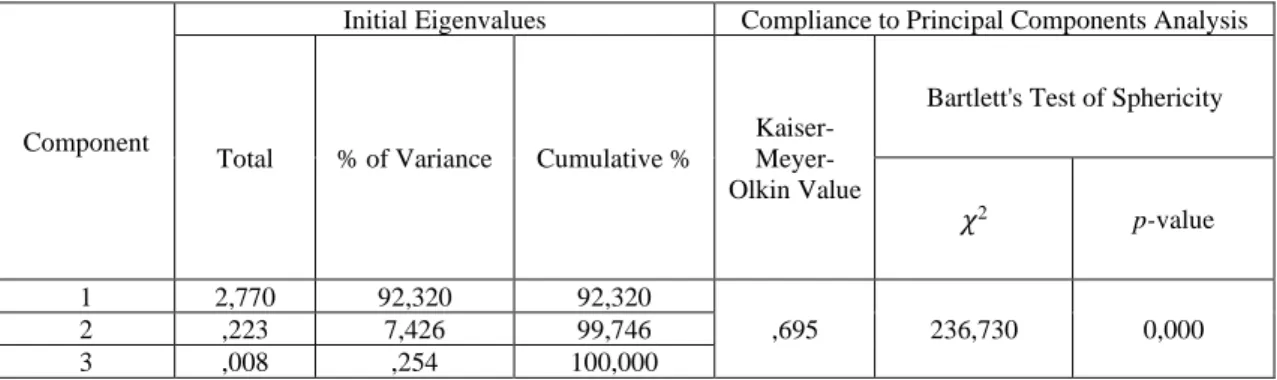
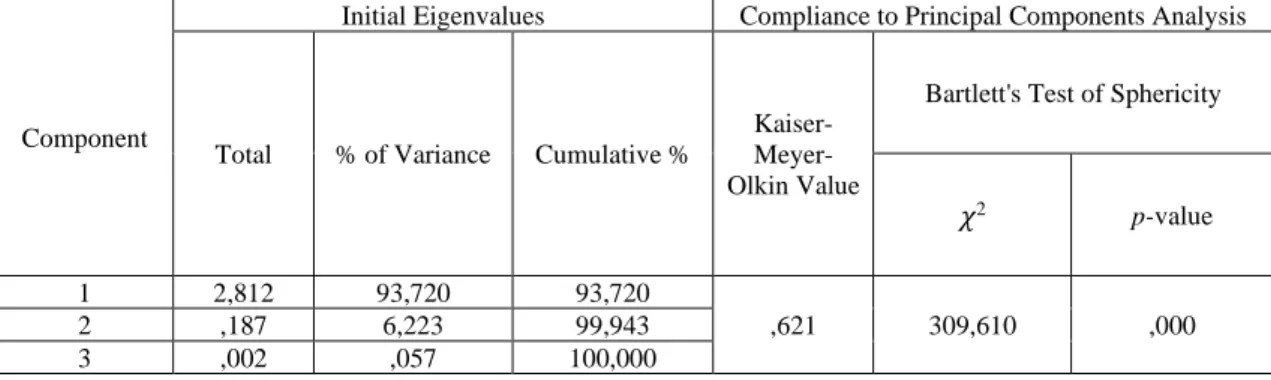
Another name for the principal component analysis (PCA) is the Karhunen-Love method. PCA is a multivariate statistical method that explains the variance-covariance structure of a set of variables using linear combinations of these variables and provides dimension reduction and interpretation (Yıldız, Çamurcu & Doğan, 2010). The PCA method is to find a new dimension set that will best capture the differences of the data (Yıldız, Çamurcu & Doğan, 2010). PCA is used as a size reduction process if some of several variables are believed to be related variables within the same structure (Şengöz & Özdemir, 2016). KMO values were generally above 0.50 in PCA. As a result of the analysis, a single component appeared in general, and factor scores formed according to the regression method were included in the analysis as the time-series data of the relevant variable. The results of the princibal components analysis for some countries are in Table 3 and 4 respectively. Table 3 shows the results of the principal component analysis of Ecuadorian financial data as an example of PCA.
Table 3. Principal Components Analysis Based on Ecuador Finance Data
Component
Initial Eigenvalues Compliance to Principal Components Analysis
Total % of Variance Cumulative %
Kaiser- Meyer-Olkin Value
Bartlett's Test of Sphericity
𝜒2 p-value
1 2,770 92,320 92,320
,695 236,730 0,000
2 ,223 7,426 99,746
3 ,008 ,254 100,000
The Equator financial development index, which is developed by taking into account component load values with basic components analysis, is as follows:
FINANCE = (Loans to the private sector / GDP)*0,983 +Broad Money Supply*0,919
Table 4 shows the results of the main component analysis regarding the Pakistani human development data as an another example of PCA.
Component
Initial Eigenvalues Compliance to Principal Components Analysis
Total % of Variance Cumulative %
Kaiser- Meyer-Olkin Value
Bartlett's Test of Sphericity
𝜒2 p-value
1 2,812 93,720 93,720
,621 309,610 ,000
2 ,187 6,223 99,943
3 ,002 ,057 100,000
Pakistan human development index, which is developed by taking into account component load values with basic components analysis, is as follows:
HUMAN = Under 5 mortality rate *-0,988 + Life Expectancy at Birth *0,982 + Gross National Product Per Capita *0,934
3.3 Panel Unit Root Tests
Panel unit root tests for financial development and human development index series were performed in the study. Before conducting the panel cointegration tests in time series analyses, it is necessary to determine whether all variables have the same time-series properties. The series must have a unit root at level values, and the first order must be stationary at -I (d). The unit root test was carried out with 4 different tests i.e. Levin, Lin, and Chu (2002), Im, Pesaran, and Shin (2003), Fisher-ADF (Maddale & Wu, 1999) and Fisher-PP (Maddala & Wu, 1999). In the unit root test, the optimal lag length was determined to take into account the Schwarz Information Criterion (SIC). The tests used a modification of the following Extended Dickey-Fuller (ADF) regression:
In this equation, ki delay length, zit is a vector of deterministic terms that describe constant effects or individual trends, and φi is the vector corresponding to the coefficients. wi at numbers are substitutions for p-1. Where the time series of the null hypothesis claims to be non-stationary, and the alternative hypothesis claims to be stationary, hypotheses can be written as follows (Stojkoski & Popova, 2016):
H0 hypotheses were accepted according to the unit root tests in the results in Table 5. It was concluded that there is a unit root in the level values in all of the series.
Table 5. Unit Root Test Results at Level
Method FINANCE HUMAN
Stat. Prob. Stat. Prob.
LLC t -0.13598 0.4459 2.32825 0.9901 IPS W-stat 0.27878 0.6098 3.84561 0.9999 ADF - F χ2 38.4921 0.0894 16.8118 0.9522
Then, the first differences of the series were taken, and the stationary test was carried out again. The letter "D" is used to denote the first difference received series. According to the test given in Table 6, the first difference in both series is stationary.
Table 6. Unit Root Test Results in First Differences
Method DFINANCE DİHUMAN
Stat. Prob. Stat. Prob.
LLC t -23.2574 0.0000 -14.7335 0.0000 IPS W-stat -21.9844 0.0000 -23.0420 0.0000 ADF - F χ2
381.620 0.0000 350.057 0.0000 PP - F χ2 483.744 0.0000 380.868 0.0000
3.4 Cross-Sectional Dependence & Second Generation Unit Root Tests
Panel data analysis is based on the assumption that there is no cross-sectional dependency between the series. For this reason, Baltagi (2005) stated that the horizontal cross-section dependence encountered in the long-run series caused the standard fixed effect (FE) and random effect (RE) estimates to be consistent but not effective. Horizontal cross-section dependence also results in the deviation of the estimated standard errors (Alper and Oransay, 2015). In practice, several different tests are used, to test the cross-sectional dependence. In this study, the Pesaran (2004) test, which looks at the correlation between the units, and the non-parametric Friedman (1937) test, which calculates the average value using the rank correlation coefficient of Spearman, was used (Alper and Oransay, 2015). According to the tests given in Table 7, the values in parentheses give probability values. Accordingly, there is a horizontal cross-section dependency between the series. Therefore, the second generation unit root tests are more appropriate.
Table 7: Cross-Sectional Dependence Tests
Tests
Pesaran Friedman
2.433 (0,0146) 52.490 (0.0000)
In the study, Pesaran's CADF unit root test, which is called second-generation unit root tests by the estimators, was applied. CADF test is the extended version of the standard ADF unit root test with the first differences in the individual series and horizontal cross-section averages of delay levels (Transmitted by Aktaş, Kaplan, & Kocaman, 2013). In Table 8, it is seen that the series contain unit root at the level, and the first differences are stationary.
Table 8. Second Generation Unit Root Test
I(0) I(1)
Variable Z (t-bar) Sig. Z (t-bar) Sig.
FINANCE -1.082 0,140 -13.040 0,000
3.5 Panel Cointegration and Panel Causality Analysis Results
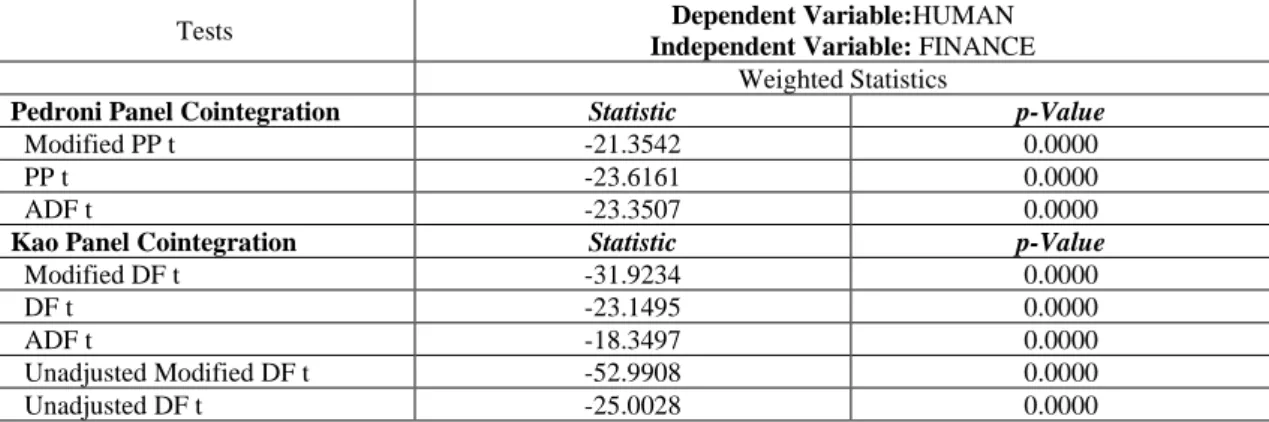
Since the variables of the financial development and human development are stationary at I (1), cointegration tests were initiated. The long-term relationship between these series was investigated by Pedroni and Kao cointegration tests. Accordingly the results in Table 9, show that the H0 hypothesis (there is no cointegration between series) was rejected. All three of the panel statistics from the test results are statistically significant at 1% level. The results of the three tests that constitute the statistics in the Pedroni Cointegration test show a strong cointegration relationship between the series. On the other hand, the Kao cointegration test results in Table 9, the H0 hypothesis (there is no cointegration between the series) was rejected at the 5% significance level. Therefore, the alternative hypothesis (there is cointegration between series) is accepted. In this context, it can be stated that there is a significant long term relationship between Financial Development and Human Development variables.
Table 9. Panel Cointegration Test Results
Tests Dependent Variable:HUMAN
Independent Variable: FINANCE
Weighted Statistics
Pedroni Panel Cointegration Statistic p-Value
Modified PP t -21.3542 0.0000
PP t -23.6161 0.0000
ADF t -23.3507 0.0000
Kao Panel Cointegration Statistic p-Value
Modified DF t -31.9234 0.0000
DF t -23.1495 0.0000
ADF t -18.3497 0.0000
Unadjusted Modified DF t -52.9908 0.0000
Unadjusted DF t -25.0028 0.0000
After determining the cointegration relationship between the variables, next the causality relationship analysis among the variables was examined. In the literature, when it comes to panel data sets, it is seen that a variety of methods are used to investigate causality relationships between series. However, the most frequently used methods in the literature are Panel VECM (2008), Coining and Pedroni (2008), Emirmahmutoğlu and Köse (2011) and Dumitrescu and Hurlin (2012). In this study, the Dumitrescu and Hurlin (2012) tests were chosen. The superiorities of this method are; considering both horizontal cross-section dependency and heterogeneity among the countries that make up the panel, it can be used when the time dimension is smaller than the horizontal cross-section size (N) and can produce effective results in unbalanced panel datasets (Alper and Oransay, 2015).
Table 10: Dumitrescu & Hurlin (2012) Panel Casualty Results
H0: FINANCE does not Granger cause HUMAN H0:HUMAN does not Granger cause FINANCE Wald Z-Bar p-value Decision Wald Z-Bar p-value Decision
22.7204 7.1328 0.0000 Reject (FINANCE is Granger cause of HUMAN) 18.4381 3.9904 0.0001 Reject (HUMAN ise Granger cause of FINANCE)
Note: Optimal delay length number is automatically determined and tested between 1 and 13 according to Akaike Information Criterion.
In Table 10, we see H0 hypotheses that indicates there is no panel granger causality relationship running from the FINANCE variable to the HUMAN significant at 5% significance level, and there is no panel granger causality relationship running from the HUMAN variable to the FINANCE significant at 5% significance level, are rejected. According to the results, we can say that there is a two-way causality relationship from human development to financial development and financial development to human development in developing countries.
4. Conclusion
In an economy and in a financial system, interest rates, investment, savings and loans play an important role in human development, as they characterize macroeconomic growth. The growth and progress of a country largely depends on the contribution of the financial sector to the economy. The literature on the studies on financial development has focused on the relationship between finance and growth. Studies investigating the relationship between financial development and human development are relatively few. However, there are several studies that show that finance can have direct or indirect effects on the level of human development. In these studies, the causal and cointegration relations between financial development and human development were generally examined. Despite the fact that the human capital as well as the financial capital is an important input for economic growth in classical growth models, the number of studies examining the relationship between financial and human development in the literature is quite limited.
When the results of the current studies are evaluated collectively, it is seen that the causality aspect between human and financial development is uncertain. However, in some empirical studies, it is stated that human development can support financial development due to the effects of reducing the information gap of individuals and increasing the demand of some financial instruments (by GDP income increase). A developed financial system affects human development, as it will invest in education and other socio-economic factors. In addition, there are no financial and other liquidity problems in advanced financial systems, and investments in socio-economic factors are increasing in a way to support the development of human capital (Ozpolat & Ozsoy, 2016).
The existence of the relationship between economic growth and financial development has been frequently discussed from the past to the present and has been the subject of numerous studies. However, although a relationship between financial development and human development is envisaged, empirical studies have not been sufficiently conducted. . In classical growth models, it is stated that the human capital, as well as the financial capital, are essential inputs for economic growth, although the number of studies examining the relationship between financial and human development is quite limited in the literature.
The purpose of the study is to empirically investigate the relationship between financial development and human development of the countries by using the annual data from 1970 to 2016. The study explores the influencing directions between the financial development index and the human development index. The purpose of the study is achieved with econometrics techniques, including panel cointegration and panel Granger causality tests. The results reveal that financial indicators have significant long-term equilibrium with human development. On the other hand, panel Granger causality results show a two-way causality relationship between variables. In this study, 15 countries were selected from developing
nations , where data can be accessed entirely. Based on the data of these countries, panel cointegration and causality analyses were conducted, and the short and long term relationships between financial development and human development were examined. The findings of the study are compatible with other studies in the literature such as Kilic and Özcan (2018), Cheshti (2017), Cahyaningsih (2016), Sehrawat & Giri (2014) and Ostojic (2013). It can be stated that the results of the study also show that the development levels of the human capital in these countries contributed to their financial stability.
References
Akhmat, G., Zaman, K., & Shukui, T. (2014). Impact of financial development on SAARC’S human development. Quality & Quantity, 48(5), 2801-2816.
Aktaş, A. P. D. A. R., & Kaplan, F. (2013), Turizm ile Ekonomik Büyüme Arasındaki İlişki: Akdeniz Ülkeleri Üzerine Bir Panel Veri Analizi Relationship between Tourism and Economic Growth: A Panel Data Analysis on Mediterranean Countries.
Alper, A. E., & Oransay, G. (2015). Cari Açık ve Finansal Gelişmişlik İlişkisinin Panel Nedensellik Analizi Ekseninde Değerlendirilmesi. Uluslararası Ekonomi ve Yenilik Dergisi, 1(2), 73-85.
Asongu, S. (2011). Financial determinants of human development in developing countries. African
Governance and Development Institute WP/11/012.
Asteriou, D., & Spanos, K. (2019). The relationship between financial development and economic growth during the recent crisis: Evidence from the EU. Finance Research Letters, 28, 238-245.
Ak, M. Z., Altintaş, N., & Şimşek, A. S. (2016). Türkiye'de Finansal Gelişme Ve Ekonomik Büyüme İlişkisinin Nedensellik Analizi. Dogus University Journal, 17(2).
Baltagi, B. H. (2005), Econometric Analysis of Panel Data, Chichester: John Wiley & Sons Ltd. Bilas, V., Franc, S., & Bošnjak, M. (2014). Determinant factors of life expectancy at birth in the
European Union countries. Collegium antropologicum, 38(1), 1-9.
Cahyaningsih, D. (2016). The Effect Of Human Development On Financial Development: Evidence From Indonesian Provinces (Doctoral dissertation, Universitas Sebelas Maret).
Çeştepe, H., & Yildirim, E. (2016). Türkiye’de finansal gelişme ve ekonomik büyüme ilişkisi. Uluslararası Yönetim İktisat ve İşletme Dergisi, 30, 12-26.
Cheshti, S. (2017), Financial development as an agent of the human development: An economic perspective and prospects of human excellence, International Journal of Advanced Research and Development, 2(4), 212-216)
Dash, S., Rath, S. S., & Pati, U. (2018). Financial Globalization and its Impact on Human Development: A Comparative Analysis of India, Singapore and Japan. Revista ESPACIOS, 39(14).
Durusu-Ciftci, D., Ispir, M. S., & Yetkiner, H. (2017). Financial development and economic growth: Some theory and more evidence. Journal of Policy Modeling, 39(2), 290-306.
Ferraz, D., Mariano, E., Rebelatto, D., & Hartmann, D. (2019). Linking Human Development and the Financial Responsibility of Regions: Combined Index proposals using methods from Data Envelopment Analysis. Available at SSRN 3401374.
Filippidis, I., & Katrakilidis, C. (2015). Finance, institutions and human development: Evidence from developing countries. Economic research-Ekonomska istraživanja, 28(1), 1018-1033.
Gurley, J.G. & Shaw, E.S. (1960) Money in A Theory of Finance, Washington, DC: Brookings Institution. İnançli, S., Altintaş, N., & İnal, V. (2016) Finansal Gelişme ve Ekonomik Büyüme İlişkisi: D-8
Örneği. Kastamonu Üniversitesi İktisadi ve İdari Bilimler Fakültesi Dergisi, 14(4), 36-49.
Katircioğlu, S. T., & Taşpinar, N. (2017). Testing the moderating role of financial development in an environmental Kuznets curve: Empirical evidence from Turkey. Renewable and Sustainable Energy Reviews, 68, 572-586.
Kaya, A. (2017), Finansal Piyasalardaki Gelişmelerin İnsani Gelişmişlik Üzerine Etkisi: Türkiye Örneği. Uluslararası İktisadi ve İdari İncelemeler Dergisi, (20), 169-180.
Kilic, C. & Ozcan, B. (2018). The Impact of Financial Development on Human Capital: Evidence From Emerging Market Economies. International Journal of Economics and Financial Issues, 8(1), 258. King, R.G. & R. Levine (1993) “Finance and Growth: Schumpeter Might Be Right”, Economic Journal,
107, 771–782.
Kuloğlu, A., & Ecevit, E. The Relationship Between Health Development Index And Financial Development Index: Evidence From High-Income Countries. Ekonomi, Politika & Finans Araştırmaları Dergisi, 2(2), 83-95.
Levine, R. (1997) “Financial Development and Economic Growth: Views and Agenda”, Journal of Economic Literature, 35, 688-726.
Madhu Sehrawat A.K. Giri, (2014), "The relationship between financial development indicators and human development in India", International Journal of Social Economics, Vol. 41 Iss 12 pp. 1194 – 1208.
Monacelli, T., Iovino, L., & Pascucci, F. (2012). Financial Development and Human Development Index., https://www.semanticscholar.org/paper/Financial-Development-and-Human-Development-Index-Monacelli-Iovino/903883e1f7c472fe63737e0d98be817110e60eb4
Murinde, V. (2012). Financial development and economic growth: Global and African evidence. Journal of African economies, 21(suppl_1), i10-i56.
Ostojic, S. (2013). Financial development and human development in the European Union. The University of North Dakota.
Özcan, B., & Ari, A. (2011). Finansal Gelisme ve Ekonomik Büyüme Arasindaki Iliskinin Ampirik Bir Analizi: Türkiye Örnegi/An Empirical Analysis of Relationship between Financial Development and Economic Growth: The Turkish Case. Business and Economics Research Journal, 2(1), 121. Ozpolat, A., & Ozsoy, F. N. (2016). The Relationship Between Financial Development And Human
Development In Oecd Countires: A Panel Causality Test. Economic and Social Development: Book of Proceedings, 181.
Raichoudhury, A. (2016). Financial inclusion & human development: a cross country analysis. Asian
Journal of Business Research ISSN, 6(1), 2016.
Ranis, G., Stewart, F., & Ramirez, A. (2000). Economic growth and human development. World development, 28(2), 197-219.
Rogoff, B. (2003), The Cultural Nature of Human Development, Oxford University Press, 13 Şub 2003 448 sayfa
Sağlam, Y. ve Sönmez, F. E. (2017), Finansal Gelişme ve Ekonomik Büyüme Arasındaki İlişki: Avrupa Geçiş Ekonomileri Örneği, Eskişehir Osmangazi Üniversitesi İktisadi ve İdari Bilimler Dergisi 12.1: 121-140.
Sarwar, S., & Akhter, A. J. (2015). Choice Between Economic Reforms And Political Reforms: An Empirical Analysis For Financial Development. Journal of Emerging Economies and Islamic Research, 3(3), 18-29.
Satrovic, E. (2017). Financial Development and Human Capital in Turkey: ARDL Approach. Cappadocia Academic Review, 1(2), 1-15.
Schumpeter, Joseph Alois (1911) The Theory of Economic Development, Massachusetts: Cambridge. Sehrawat, M., & Giri, A. K. (2014). The relationship between financial development indicators and
human development in India. International Journal of Social Economics, 41(12), 1194-1208. Sehrawat, M., & Giri, A. K. (2014). The relationship between financial development indicators and
human development in India. International Journal of Social Economics, 41(12), 1194-1208. Şengöz, N., & Özdemir, G. (2016). Temel Bileşenler Analizi Ve K-Ortalama Kümeleme Yönteminin
Birlikte Kullanımı: Bir Örnek Uygulama, Mehmet Akif Ersoy Üniversitesi Sosyal Bilimler Enstitüsü Dergisi, 8(15), 85-94.
Simplice, A. (2011). Financial determinants of human development in developing countries (No. 33949). University Library of Munich, Germany.
Stanton, E. (2007). The Human Development Index: A History. Political Economy Research Institute, University of Massachusetts at Amherst.
Stanton, E. A. (2007). The human development index: A history. PERI Working Papers, 85.
Stojkoski, V., & Popova, K. (2016). Financial Development and Growth: Panel Cointegration Evidence
from South-Eastern and Central Europe. University Library of Munich, Germany.
Tabash, M. I., & Dhankar, R. S. (2014). Islamic Financial Development and Economic Growth--Empirical Evidence from United Arab Emirates. Journal of Emerging Economies & Islamic Research, 2(3).
Von Pischke, J. D. (1997). Poverty, Human Development and Financial Services (No. HDOCPA-1997-04). Human Development Report Office (HDRO), United Nations Development Programme (UNDP).
Yıldız, K., Çamurcu, Y., & Doğan, B. (2010). Veri Madenciliğinde Temel Bileşenler Analizi ve Negatifsiz Matris Çarpanlarına Ayırma Tekniklerinin Karşılaştırmalı Analizi. Akademik Bilişim.
Younsi, M., & Bechtini, M. (2018). Economic Growth, Financial Development and Income Inequality in BRICS Countries: Evidence from Panel Granger Causality Tests.
Zaman, K., Izhar, Z., Khan, M. M., & Ahmad, M. (2012). RETRACTED: The relationship between financial indicators and human development in Pakistan. Economic Modelling, 5(29), 1515-1523.