Article
Elephant Herding Optimization for Energy-Based
Localization
Sérgio Correia1,2,†, Marko Beko4,5, Luís Cruz1,3and Slavisa Tomic4,6
1 Instituto de Telecomunicações, Portugal
2 Instituto Politécnico de Portalegre, Portugal
3 DEEC, Universidade de Coimbra, Portugal
4 COPELABS, Universidade Lusófona de Humanidades e Tecnologias, Lisbon, Portugal
5 UNINOVA, Monte da Caparica, Portugal
6 ISR/IST, LARSyS, Universidade de Lisboa, Portugal
Abstract: This work addresses the energy-based source localization problem in wireless sensors networks. Instead of circumventing the maximum likelihood (ML) problem by applying convex relaxations and approximations (like all existing approaches do), we here tackle it directly by the use of metaheuristics. To the best of our knowledge, this is the first time that metaheuristics is applied to this type of problems. More specifically an elephant herding optimization (EHO) algorithm is applied. Through extensive simulations, the key parameters of the EHO algorithm are optimized such that they match the energy decay model between two sensor nodes. A detailed analysis of the computational complexity is presented, as well as performance comparison between the proposed algorithm and existing non-metaheuristic ones. Simulation results show that the new approach significantly outperforms the existing solutions in noisy environments, encouraging further improvement and testing of metaheuristic methods.
Keywords: Nature Inspired Algorithms; Swarm Optimization; Elephant Search Algorithm; Energy-based Localization; Acoustic Positioning; Wireless Sensor Networks.
1. Introduction
Localization of a source in wireless sensors networks (WSNs) has been commonly used in several real life applications, such as explorations (deep water, outer space, underground), surveillance, monitoring, etc. [1–4]. In general, source localization algorithms can be categorized as range-free and range-based [5–8]. The former ones consider only information about connectivity and usually require a training phase in which a database is constructed [9,10]. Although less demanding in terms of computational burden, accuracy obtained by range-free methods is generally lower than the accuracy attained by the latter methods [11–15]. Range-based methods make use of the received signal in order to estimate the distance between the source and the receiving sensor node. The distance information can be extracted from different measurements of the received signal, like time of arrival, time difference of arrival and received signal strength, to name a few [16–18]. Nowadays, these different measurements are commonly integrated together, or combined with angle of arrival observations in order to enhance the localization accuracy [19,20].
Recently, energy-based localization has gained much attention in the signal processing community [21–27]. This localization approach considers averaging energy information of received acoustic signal data samples [28]. Energy-based acoustic localization, when considered for targets such as moving objects, has the property of varying slowly with time; thus, the acoustic energy signal can be sampled at
a much lower rate. Therefore, the energy consumption for data transmission on individual sensor nodes will be reduced and the demand of communication bandwidth over wireless channels will also be lower [29]. By modeling the energy decay of an acoustic signal, transmitted within a WSN with one or more sources, a non-convex optimization problem arises. To deal with the non-convexity, several methods have been proposed in the literature. In [24], a weighted direct least-squares method with correction (WDC) was presented. This method is submissive to a correction technique leading to further performance gains, but its performance is degraded in high noise environments as the second-order noise terms are ignored. Wang and Yang showed in [27] that the non-convex problem can be relaxed as a convex semidefinite programming (SDP). Similarly, Beko showed in [22] that the originally non-convex problem can be solved by applying second-order cone programming (SOCP) relaxations. Although the methods in [27] and [22] perform well, even in noisy environments, their main drawback is their high computational complexity which increases significantly with the size of the network.
All of the above algorithms are based on applying certain approximations/relaxations to the original problem, causing discrepancies between the obtained and the true solution. These disparities might be large in the case where the applied relaxations are not sufficiently tight, resulting in high estimation errors. In order to circumvent this issue, this work proposes an entirely different approach. Instead of approximating the original localization problem, we tackle it directly, by resorting to nature-inspired method, called elephant herding optimization algorithm (EHO). This method was initially proposed by Wang et. al [30] applied to several benchmark functions. Essentially, it is a swarm based metaheuristic search method for solving optimization problems. The algorithm emulates the herding behavior of elephants in group. In nature, elephants belonging to different clans live together under the leadership of a matriarch, and the male elephants will leave their family group when reaching adulthood.
Elephant herding optimization algorithm (EHO), initially proposed by Wang et. al [30] is a swarm based metaheuristic search method for solving optimization problems. The algorithm emulates the herding behavior of elephants in group. In nature, elephants belonging to different clans live together under the leadership of a matriarch, and the male elephants will leave their family group when reaching adulthood. EHO has been applied to several optimization benchmark problems [31] and real life applications showing good results in finding optimal solutions [32,33].
EHO has been applied to several optimization benchmark problems [31] and real life applications showing promising results in finding optimal solutions [32,33]. To the best of our knowledge, this method has not been used for solve energy based localization problems. Hence, in this work, EHO is adjusted and applied for energy-based positioning. While the main idea is preserved, optimal parameter tunning is sought through extensive simulations in order to capture the energy decay of acoustic signals between two sensor nodes. In this way, higher convergence rates are achieved together with near-optimal solutions. Since EHO does not resort to any type of relaxations, but rather tackles the original localization problem directly, its performance is less vulnerable to noise; thus, EHO outperforms the state of the art methods in high-level noise environments.
2. Problem Formulation
Consider a 2-dimensional sensor network1, composed of Nsensor nodes and a source node. The true (unknown) location of the source is denoted byx and the true (known) location of the ith sensor
bysi, where i = 1, . . . ,N. Our goal is to determine the unknown location of the source by exploiting energy measurements acquired by sensors. To do so, this work considers the decay model of an acoustic signal [28,29,34]. Each sensor makesMnoisy measurements within a time interval. Thus, according to [28,29,34], the received signal at theithsensor can be modeled as
zi(t) =
√
giϕ(t−τi)
||x−si||β/2
+ωi(t), i=1, . . . ,N (1)
where ϕ(t) is the intensity of the source signal, measured at a given default distance, τi is the time
delay due to propagation from the source to theithsensor, ωi(t) represents an additive error modeled
as Gaussian noise with zero mean and varianceσω2i,√giis the gain of the sensori,ϕ(t)is the transmitted
signal power andβis the path loss exponent that that captures the decay rate of the signal [34]. The value
ofβtypically falls within the interval[2, 4][5] (2 in free space and 4 in adverse indoor environments). In
this work we considerβ = 2, since we consider signal propagation in free space, without reflections or
reverberations .
To obtain the energy observations at the ith sensor, we average the readings over M signal measurements according to (2), i.e.,
yi=
1 M
M−1
∑
m=0
z2i(ts+m
fs
), (2)
wheretsis the starting time and fsthe sampling frequency.
Thus, combining (1) and (2) yields
yi=
giP
||x−si||β
+νi, for i=1, . . . ,N (3)
wherePis the transmitted power [7], andνirepresents the measurement noise. According to the central
limit theorem, for sufficiently largeM, the energy measurement noise of theithsensorνi approximately
obeys a Gaussian distribution, i.e., νi ∼ N(σω2, 2σω4/M) where σω2 is the background noise level.
Consequently we can subtract the meanσω2 from (3), and assumeνi ∼ N(0,σν2i), whereσν2i = 2σω4/M
[23].
By employing the observations in (3), the maximum likelihood (ML) estimator ofxcan be formulated as [35]
b
x=argmin x
N
∑
i=1 1
σν2
yi−
giP
||x−si||2
2
(4)
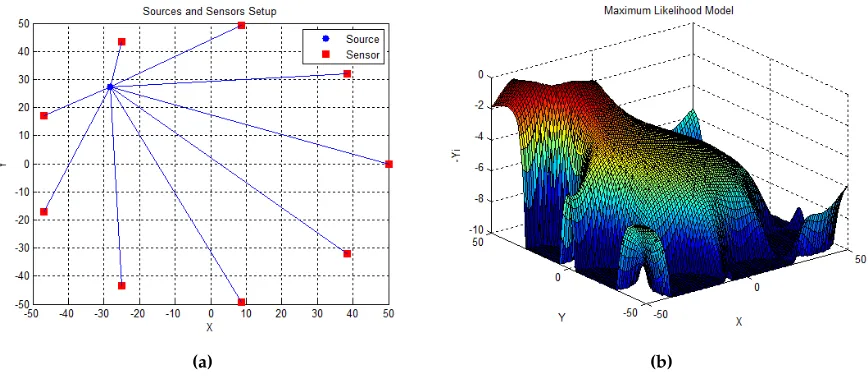
The estimator in (4) is clearly non-convex. An illustration of a possible realization of (4) is given in Figure1b. To plot the objective function in (4), a grid search was applied over the network topology shown in1a. Figure1adepicts a WSN consisting of 9 sensors and a source, deployed over a 100×100 m square region. The sensors are uniformly distributed on a circle, centered at[0, 0]T, with the radius equal to half of the length of the region. The source is placed randomly in the considered space, and its true
location was [-28, 28]. Other model parameters were set asgi = 1(i =1, ...,N),P = 500. We added the
measurements noise withσν2i =−25 dB.
With the goal of improving the visualization and interpretation of the objective function in (4), Figure 1bactually depicts the symmetric of (4). This means that we are now looking for a maximum, instead of a minimum of the function. From Figure1b, it can be seen that the resulting surface is highly non-convex, comprising several local maxima and saddle points. Moreover, one can see that the global maximum is close to the true target’s position, i.e., at[XY,XY]T. Since the singularities would imply a value of infinity at the sensor coordinates, a limit value of−10 for the graphical representation was considered. Due to the non-convexity of (4), finding its global minimum is an extremely difficult task. Therefore, in Section3, we develop a sub-optimal estimator that provides accurate solution to the considered problem, especially in noisy environments.
(a) (b)
Figure 1.Graphic Representation of ML Model. (a) Sensors and Source Setup. (b) Surface representation
3. Elephant Herding Optimization
3.1. Original EHO Algorithm
EHO algorithm was originally proposed by Wang et. al. [30], and is essentially a swarm intelligence algorithm [36]. It is a metaheuristic search method which arises from modeling of herding behavior of elephants in nature. This particular behavior can be summarized as follows. The population of elephants contains a number of subgroups, known as clans, which comprise a number of elephants. Each clan moves under the leadership of a matriarch, while a number of male elephants that reached adulthood leave the clan they belong to and live in solitude. In terms of EHO, these behaviors can be modeled with two operators: clan update (which updates the elephants and matriarch current positions in each clan) and a separation (which enhances the population diversity at the later search phase) [30].
according to4), clan updating operator is applied. Each memberjof theithclan moves according to the elephant matriarch,ci, with the best fitness value, as
xnew,ci,j =xci,j+α(xbest,ci−xci,j)r (5)
wherexnew,ci,jandxci,jare the new and old position of thej
thelephant in theithclan, respectively,α∈[0, 1]
is a tuning parameter that determines the influence ofithmatriarch onxnew,ci,j,xbest,ci represents the fittest
elephant individual in clanci, andr∼ U[0, 1][30].
The position of the fittest elephant in the clan is updated according to
xnew,ci =βxcenter,ci (6)
xcenter,ci,d=
1 nci
nci
∑
j=1
xci,j,d (7)
whereβ∼ U[0, 1]is another tuning parameter which determines the influence ofxcenter,ci onxnew,ci,dis
a reference to thedthdimension, where 1≤d≤DandDbeing the dimension of the considered problem (in our cased=2, considering a two dimension problem), andncithe number of elephants in theithclan
[30].
For elephant with the worst fitness, the separating operator is applied in each interaction, moving the elephant to new positions, and replacing the elephant with the worst fitness in theith clan. This is done as
xworst,ci =xmin+ (xmax−xmin+1)ψ, (8)
wherexmax andxminare respectively the upper and lower bound of the position of elephant individual,
andψ∼ U[0, 1][30].
Therefore, the EHO algorithm implies iteratively applying (5), (6), (7) and (8) for a predefined number of iterations. The parameters like maximum number of iterations and population size are indirectly controlled by the number of clans and clan size, whereasαand βare considered fixed for a
certain application.
The EHO algorithm was tested for several benchmark functions [30,37], and it showed promising results. Moreover, it was also considered in applications such as proportional–integral–derivative control tuning [32] and quality of web service composition [33].
3.2. Tunning of EHO Parameters
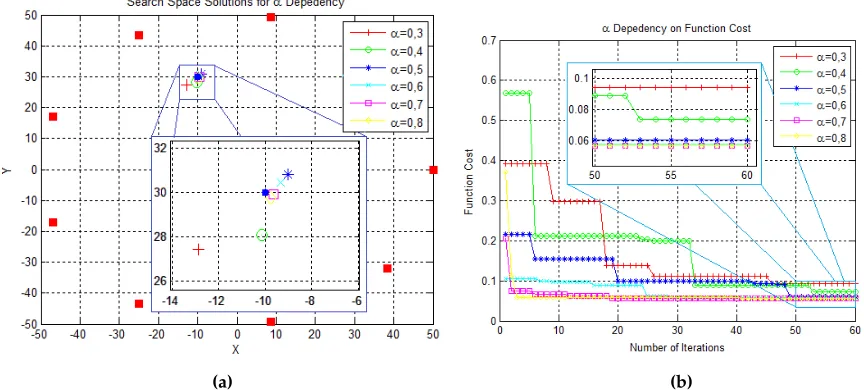
In this section, the EHO algorithm is tested against various values of its key parameters in order to determine their influence on the convergence rate and the localization error, defined as the discrepancy between the true source position and the point fittest for fittest (4)). Firstly, we consider the same setup used in Figure1a, and varyαbetween 0.3 and 0.8 in order to analyze its influence on EHO algorithm.
The results are presented in Figure2.
Figure2aplots the solutions of the proposed strategy for different values ofα, whereas Figure2b
illustrates the dependency of the convergence rate onα. From Figure2a, one can see that the solutions
corresponding to higherα(e.g.,α≥0, 7) result in higher estimation accuracy, suggesting that these values
ofαare preferable for the problem at hand. Furthermore, Figure2bshows that increasingαimproves the
convergence rate.
(a) (b)
Figure 2.ParameterαDependency Analysis. (a) Representation of the final solutions in search space; "•"
denotes the true source location. (b) Convergence dependency onαin function cost.
10000 runs are performed and the root mean square error (RMSE) is considered as the performance metric. The RMSE is defined as
RMSE=
v u u t
Mc
∑
i=1
||x−bxi||2
Mc , (9)
wherebxidenotes the estimate of the true source location,x, in thei
thMonte Carlo run.
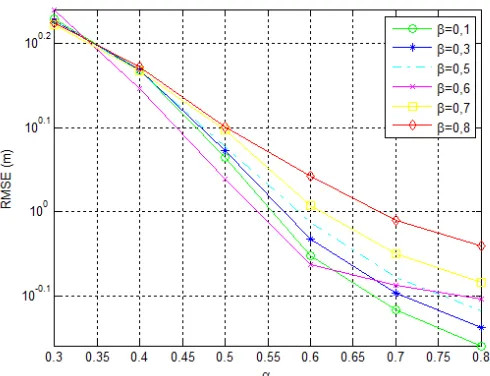
Figure3illustrates the RMSE (m) versusαcomparison, for the case whereσν2=−25 dB andβ=0.1.
The figure shows that as the value ofαincreases, the error decreases, which is in concordance with our
previous indications. Therefore, since in EHO,αis the parameter that determines the influence of the
matriarch and acts as a scale factor, higher values ofαshould be chosen. This implies higher dependency
ofxci,jonxnew,ci,j.
The second object of our study is the parameterβ, i.e., its influence on the RMSE, which is shown
in Figure4. It is worth remembering that this parameter defines the influence ofxcenter,ci onxnew,ci. Low
values ofβwill generate new points far fromxcenter,ci inducing high level of exploration; thus, we expect
to see better accuracy of the algorithm for lower values ofβ in Figure 4. The results presented were
generated by varyingβfrom 0.1 to 0.8 under the same conditions as stated previously.
As we can see from Figure4, although there is no significant variation of error whenαis low (e.g., α≤0.4), in the case of preferable higher values ofα, lower values ofβshould be used. Nevertheless, the
effect ofβon the localization accuracy is marginal.
The second set of parameters that are analyzed here concerns the population of elephants and its organization in clans. In EHO, the elephant population is organized inci clans withnci elephants per
clan; hence, the population size is given by
PopulationSize=ncici. (10)
Figure 3.RMSE (m) as a function ofα, whenσν2=−25 dB andβ=0.1.
elephants) and 300 (10 clans with 30 elephants). The influence of these parameters on the RMSE is depicted in Figure5.
Figure 5.RMSE (m) dependency on the number of clans andnci.
As we can see from Figure5, the increase of the number of elephants in each clan will produce a lower estimation error. However, for higher values of nci the decrease is much slower than for lower
ones. This is because, with the increase ofnci, we are giving more importance to the exploitation of the
regions of interest. Based on Fig. 5 we see that for 15 (and more) elephants per clan is practically sufficient for the algorithm to converge, i.e., adding more clans does not do anything or does very little. The only way we can reduce the error in this case is to add more elephants in each clan.
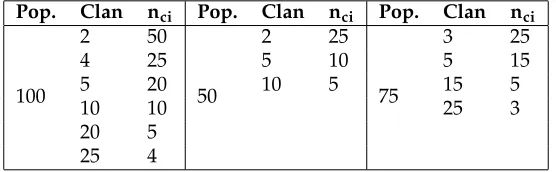
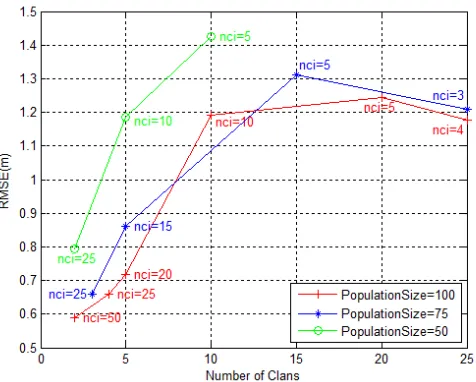
In the second stage, we considered a constant population size of 100, 75 and 50 elephants, and repeated the experiment under the same simulation conditions, but combining the number of clans and nci in order to keep the same population size. A summary of the setting is presented in Table1, and the
results are given in Figure6.
Table 1.The considered simulation setting for constant population size experiment.
Pop. Clan nci Pop. Clan nci Pop. Clan nci
100
2 50
50
2 25
75
3 25
4 25 5 10 5 15
5 20 10 5 15 5
10 10 25 3
20 5
25 4
From Figure 6, one can see that higher population sizes leads to lower RMSE in general, as anticipated. The three curves for different population size indicate that one should give more importance to the exploitation of the regions of interest,nci, than to the exploration of the search space (number of
Figure 6.RMSE (m) dependency on the number of clans andnci, for constant population size.
4. Comparative Results
This section presents a set of results which offer insight to the reader about the performance of the considered localization algorithms. Both computational complexity and estimation accuracy of the algorithms are of interest; hence, the section is divided into its respective subsections.
4.1. Complexity Analysis
For a predefined maximum number of generations, EHO algorithm performs four operations: elephant sorting, update, separation and evaluation of the population. In the present work, elephant sorting was implemented by using MATLABR sort function, which implements Quick Sort algorithm,
of orderO(nlog(n)). Update operator consists of two levels of cyclical operations, depending on the number of clans and the number of elephants in each clan, thus resulting inO(nClannci). The separating
operator performs operations in each clan, rendering its complexity ofO(nClan). Population evaluation
concerns the total number of elephants; hence, the complexity of this operation isO(nClannci). Therefore,
the complexity of solving the EHO algorithm is the junction of the four operations for a total of the maximum number of generations (MaxGen):
O
MaxGennClanncilog(nClannci) +nClannci+nClan+nClannci
(11)
where the four terms of the sum corresponds, respectively, to the four operations of the algorithm. Consequently, the complexity of solving the EHO algorithm is of orderO(MaxGenN)where MaxGen is maximum generation of the population.
Table 2.Summary of the Considered Algorithms
Algorithm Description Complexity
WDC The WDC algorithm in [24] O N2
SDP The SDP algorithm in [27] O N4.5
SOCP The SOCP algorithm in [22] O N3.5
EXACT The bisection algorithm in [38] O(KN) EHO The WLS algorithm in Section3 O(MaxGenN)
4.2. Numerical Results
All algorithms considered in this section were implemented in MATLABR R2009b. The following
experiments were performed on a platform consisting of a clustered computer with seven nodes, each with two Intel cXeon cE5520 processors, 24 GB RAM, running Windows c2008 Server HPC. For the proposed algorithm, we have considered EHO adjusted with its key parameters set according to the conclusions established in section3.2, i.e., α = 0.7 andβ = 0.1. The number of clans were set 5 with
nci = 20 elephants in each clan. A stopping criteria of 5000 function evaluation was used, implying a
maximum of 50 generations (value of MaxGenconsidered in the complexity analysis) for a population size of 100 elephants. The performance of the proposed algorithm was compared with the SDP algorithm in [39], denoted by “SDP”, the bisection algorithm presented in [38], denoted in here by “EXACT”, the WDC algorithm in [40], and the SOCP algorithm in [22]. These algorithms are considered here as the state of the art of non-metaheuristic methods.
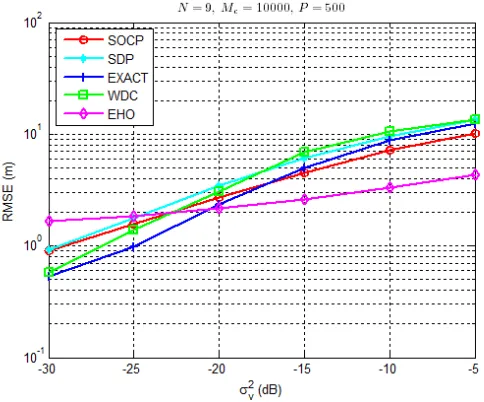
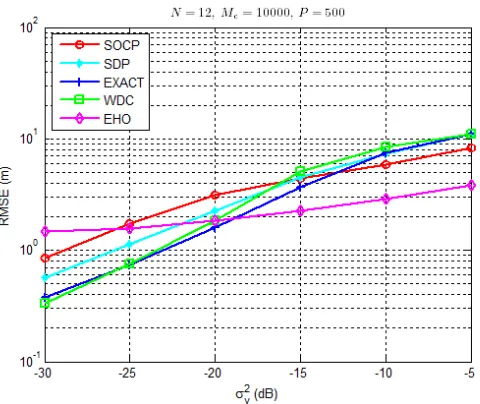
The considered simulation setup includedNsensors uniformly distributed on a circle whose radius was set to 50 m, whereas the source was randomly distributed inside a 100×100m2region. First, we consideredN=9 and studied the influence of the noise power,σνion the estimation error. These results
are plotted in Figure7. Afterwards, N = 12 was considered and the same study was performed. The results are presented in Figure8.
Figure 7.RMSE (m) versusσν2i(dB) performance comparison forN=9.
Figure 8.RMSE (m) versusσν2i(dB) performance comparison forN=12.
outperform the EHO algorithm for lowσν2i. This result can be explained to some extent by the fact that
these algorithms are derived based on the assumption that the noise power is small. Obviously, when this assumption holds, these methods perform well. However, when the noise power gets large, the EHO algorithm shows a significant gain in comparison with the non-metaheuristic methods. To illustrate this fact, we call the readers attention to the results shown in Figures9and8forσν2i =−5 dB. For this setting,
one can see that the gain achieved by EHO is more than 5 m forN =9, Figure9, and more than 4 m for N= 12, Figure10. This is obviously a significant improvement in the estimation accuracy, which leads us to believe that metaheuristic methods have great potential in dealing with the problems of this sort.
5. Conclusions and Future Work
In this work, a new approach for the energy-based positioning problem was presented, based on nature-inspired EHO algorithm. In sharp contrast to the existing algorithms which apply approximations and/or relaxations to reach their final solution, EHO tackles the non-convex ML problem directly. By performing exhaustive simulations and analysis, the key parameters of the EHO algorithm were optimized to match the energy decay of acoustic signals, such that we could apply it to the problem of interest. The performance of the proposed algorithm was compared with the existing ones found in the literature. The simulation results showed that EHO significantly reduces the estimation error in all considered setups, especially in environments with high noise power. Furthermore, EHO represents an excellent trade off between the computational complexity and estimation accuracy, since it is significantly less complex than the optimization-based methods, and somewhat more complex than the linear ones.
This work considered localization of a single source node at a time. Generalizing the presented algorithm for simultaneous localization of multiple sources, possibly in cooperative WSNs, might be an interesting direction for future work. Similarly, integration of filters and Bayesian theory into EHO for its further improvement seems like an appealing and feasible idea. Finally, testing other nature-inspired algorithms deserves our further attention.
Conflicts of Interest:The authors declare no conflict of interest.
Bibliography
1. Hightower, J.; Brumitt, B.; Borriello, G. The location stack: a layered model for location in ubiquitous computing. Proceedings Fourth IEEE Workshop on Mobile Computing Systems and Applications2002, pp. 22–28. 2. Jiang, J.; Guo, Y.; Liao, W.; Li, S.; Xie, X.; Yuan, L.; Nian, L. Research on RTLS-based coordinate guided vehicle
(CGV) for material distribution in discrete manufacturing workshop. Proceedings - 2014 IEEE International Conference on Internet of Things, iThings 2014, 2014 IEEE International Conference on Green Computing and Communications, GreenCom 2014 and 2014 IEEE International Conference on Cyber-Physical-Social Computing, CPS 20142014, pp. 1–8.
3. Micio, R.; Fontanili, F.; Marquès, G.; Bomert, P.; Lauras, M. RTLS-based Process Mining: Towards an automatic process diagnosis in healthcare. IEEE International Conference on Automation Science and Engineering2015, 2015-October, 1397–1402.
4. Moreira, A.; Nicolau, M.J.; Meneses, F.; Costa, A. Wi-Fi fingerprinting in the real world - RTLS@UM at the EvAAL competition. 2015 International Conference on Indoor Positioning and Indoor Navigation, IPIN 20152015, pp. 13–16.
5. Sun, G.; Chen, J.; Guo, W.; Liu, K.J.R. Signal processing techniques in network-aided positioning: A survey of state-of-the-art positioning designs. IEEE Signal Processing Magazine2005,22, 12–23.
6. Fross, D.; Langer, J.; Fross, A.; Roossler, M.; Heinkel, U. Hardware implementation of a Particle Filter for location estimation. International Conference on Indoor Positioning and Indoor Navigation (IPIN), 2010, number September, pp. 1–6.
7. Deng, Z.; Yu, Y.; Yuan, X.; Wan, N.; Yang, L. Situation and development tendency of indoor positioning.China Communications2013,10, 42–55.
8. Dardari, D.; Member, S.; Closas, P.; Member, S.; Djuri, P.M. Indoor Tracking : Theory , Methods , and Technologies.IEEE TRANSACTIONS ON VEHICULAR TECHNOLOGY2015,64, 1263–1278.
9. He, T.; Huang, C.; Blum, B.M.; Stankovic, J.a.; Abdelzaher, T.F. Range-free localization and its impact on large scale sensor networks. ACM Transactions on Embedded Computing Systems2005,4, 877–906.
10. Gui, L.; Wei, A.; Val, T. A Range-Free Localization Protocol for Wireless Sensor Networks. International Symposium on Wireless Communication Systems (ISWCS), 2012, pp. 496–500.
11. Zhang, S.; Wang, J.; Liu, X.; Cao, J. Range-free selective multilateration for anisotropic wireless sensor networks. Annual IEEE Communications Society Conference on Sensor, Mesh and Ad Hoc Communications and Networks workshops2012,1, 299–307.
12. Liu, C.; Wu, K. Performance evaluation of range-free localization methods for wireless sensor networks. 24th IEEE International Performance, Computing, and Communications Conference (PCCC2005), 2005, pp. 1–8. 13. Lee, S.; Kim, K. Determination of communication range for range-free multi-hop localization in wireless
sensor networks. International Conference on Computer Communications and Networks, ICCCN, 2011, pp. 1–4.
14. He, T.; Huang, C.; Blum, B.M.; Stankovic, J.a.; Abdelzaher, T.F. Range-free localization and its impact on large scale sensor networks. ACM Transactions on Embedded Computing Systems2005,4, 877–906.
15. Gui, L.; Wei, A.; Val, T. A Range-Free Localization Protocol for Wireless Sensor Networks. International Symposium on Wireless Communication Systems (ISWCS), 2012, pp. 496–500.
16. Wang, Y.; Susheng, S.; Yang, X.; Ma, A. Bluetooth Indoor Positioning using RSSI and Least Square Estimation. IEEE Consumer Communications and Networking Conference (CCNC2013), 2013.
17. Waadt, A.E.; Kocks, C.; Wang, S.W.S.; Bruck, G.H.; Jung, P. Maximum likelihood localization estimation based on received signal strength. 3rd International Symposium on Applied Sciences in Biomedical and Communication Technologies2010, pp. 1–5.
19. Tomic, S.; Marikj, M.; Beko, M.; Dinis, R.; Orfao, N. Hybrid RSS-AoA technique for 3-D node localization in wireless sensor networks. 2015 International Wireless Communications and Mobile Computing Conference (IWCMC)2015, pp. 1277–1282.
20. Tomic, S.; Beko, M.; Dinis, R.; Gomes, J.P. Target tracking with sensor navigation using coupled RSS and AOA measurements. Sensors (Switzerland)2017,17, 1–26.
21. Beko, M. Energy-based localization in wireless sensor networks using semidefinite relaxation. 2011 IEEE Wireless Communications and Networking Conference, 2011, pp. 1552–1556.
22. Beko, M. Energy-Based Localization in Wireless Sensor Networks Using Second-Order Cone Programming Relaxation.Wireless Personal Communications2014,77, 1847–1857.
23. Ho, K.C.; Sun, M. An accurate algebraic closed-form solution for energy-based source localization. IEEE Transactions on Audio, Speech and Language Processing2007,15, 2542–2550.
24. Meesookho, C.; Mitra, U.; Narayanan, S. On energy-based acoustic source localization for sensor networks. IEEE Transactions on Signal Processing2008,56, 365–377.
25. Wang, G.; Yang, K. A Semidefinite Relaxation Method for Energy-based Source Localization in Sensor Networks. IEEE International Conference on Acoustics, Speech and Signal Processing (ICASSP2009), 2009, number 4, pp. 2257–2260.
26. Rudafshani, M.; Datta, S. Localization in Wireless Sensor Networks. 6th International Symposium on Information Processing in Sensor Networks (IPSN 2007), 2007, pp. 51–60.
27. Wang, G.; Gang, W.; Wang, G. A Semidefinite Relaxation Method for Energy-Based Source Localization in Sensor Networks. IEEE Transactions on Vehicular Technology2011,60, 2293–2301.
28. Li, D.; Hu, Y.H. Energy Based Collaborative Source Localization Using Acoustic Micro-Sensor Array. Applied Signal Processing2003,2003, 321–337.
29. Sheng, X.; Hu, Y.H. Maximum likelihood multiple-source localization using acoustic energy measurements with wireless sensor networks. IEEE Transactions on Signal Processing2005,53, 44–53.
30. Wang, G.G.; Deb, S.; Coelho, L.D.S. Elephant Herding Optimization. 3rd International Symposium on Computational and Business Intelligence (ISCBI2015), 2016, pp. 1–5.
31. Deb, S. Elephant Search Algorithm for Optimization Problems. 10th International Conference on Digital Information Management (ICDIM), 2015, pp. 249–255.
32. Gupta, S.; Singh, V.P.; Singh, S.P.; Prakash, T.; Rathore, N.S. Elephant herding optimization based PID controller tuning.International Journal of Advanced Technology and Engineering Exploration2016,3, 2394–5443. 33. Chibani, S.S.; Tari, A. Elephant Herding Optimization for Service Selection in QoS-Aware Web. International
Journal of Computer and Information Engineering2017,4.
34. Kinsler, L.E.; Frey, A.R.; Coppens, A.B.; Sanders, J.V.Fundamentals of acoustics, 4th ed.; 1999; p. 560.
35. Blatt, D.; Hero, A.O. Energy Based Sensor Network Source Localization via Projection onto Convex Sets ( POCS ).IEEE Transactions on Signal Processing2006,54, 3614–3619.
36. Chawda, B.V.; Patel, J.M. Natural Computing Algorithms – A Survey. International Journal of Emerging Technology and Advanced Engineering2016,6, 221–227.
37. Tuba, M.; Beko, M.; Tuba, V. Performance of Elephant Herding Optimization Algorithm on CEC 2013 real parameter single objective optimization. WSEAS TRANSACTIONS on SYSTEMS2017,16, 100–105.
38. Beck, A.; Stoica, P.; Li, J. Exact and Approximate Solutions of Source Localization Problems 2008. 56, 1770–1778.
39. Wang, G.; Gang, W.; Wang, G. A Semidefinite Relaxation Method for Energy-Based Source Localization in Sensor Networks. IEEE Transactions on Vehicular Technology2011,60, 2293–2301.