Evaluation of ACE Properties of Traditional SQL and NoSQL Big
Data Systems
ABSTRACT
Traditional SQL and NoSQL big data systems are the backbone for managing data in cloud, fog and edge computing. This paper develops a new system and adopts the TPC-DS industry standard benchmark in order to evaluate three key properties, availability, consistency and efficiency (ACE) of SQL and NoSQL systems. The contributions of this work are manifold. It evaluates and analyses the tradeoff between the ACE properties. It provides insight into the NoSQL systems and how they can be improved to be sustainable for a more wide range of applications. The evaluation shows that SQL provides stronger consistency, but at the expense of low efficiency and availability. NoSQL provides better efficiency and availability but lacks support for stronger consistency. In order for NoSQL systems to be more sustainable they need to implement transactional schemes that enforce stronger consistency as well as better efficiency and availability.
CCS Concepts
• Information systems➝Data management systems ➝Database management system engines➝Database transaction processing➝Data locking
Keywords
Big data; SQL; NoSQL; Riak; TPC-DS, Data consistency.
1.
INTRODUCTION
Cloud computing delivers on-demand IT services, such as storage, compute power and servers, over the Internet in order to offer flexibility, scalability and elasticity in service provisioning. Cloud service consumers only pay for the services they use. This reduces their operational and maintenance cost of IT services. The common model of cloud service provisioning is built around data centers where cloud services are centrally stored and managed. In order to alleviate issues of centralized cloud new models of edge and fog computing have been emerged. Edge computing offers users and
developers cloud services and resources at the edge of a network or Internet. It delivers compute, storage and data services much closer to end devices and/or end users [1]. Fog computing model can be defined as an additional layer that provides a bridge between edge computing (resources) and the (centralized) cloud. For example, fog computing can help in cloud resource virtualization in order to dynamically distribute workload across different (edge) computing nodes.
Despite the differences between cloud, fog and edge computing models, they all share the need of storing, processing and analysing data for different types of applications. The work presented in this paper focuses on the traditional SQL and NoSQL big data systems which are used by all the three models, cloud, edge and fog computing. It evaluates the three key properties, availability, consistency and efficiency (ACE). Availability means that data is available. For instance, if one node (of a system) is failed or overloaded (with many requests) then data can be accessed from another node. Consistency means that data must remain in consistent state whenever it is updated. Efficiency refers to the process that data is efficiently accessed and/or updated.
Traditional SQL databases have widely been used for a number of years by various organizations and companies. SQL databases (such as MySQL, Oracle) are built using rigorous theoretical and mathematical models such as relational algebra. They follow the principles of data normalization and integrity constraints in order to maintain strong data consistency. SQL database systems have been used for applications that need strong consistency and data integrity constraints, for example, banking applications, customers and products data, online shopping and so on.
NoSQL big data systems (such as Riak, MongoDB, Couch) are relatively new and they do not generally adopt strong theoretical/mathematical models. They give preference to efficiency and availability over data consistency. They do not follow data normalization principles (as in SQL). Instead they follow weaker or eventual consistency model.
NoSQL systems have been used for applications that need high efficiency and availability but weaker consistency. For instance, NoSQL systems are capable of processing hundreds of thousands of social media messages/per sec. Social media data may tolerate weaker consistency. But applications such as financial transactions or online shopping may not tolerate weaker consistency. In such applications problems caused by inconsistency could be more serious than having lower efficiency or availability.
We believe that the three ACE properties are crucial to different applications that use cloud, fog and/or edge computing. We propose and develop a new system in order to evaluate and analyse
Maria Teresa Gonzalez-Aparicio Department of Computing University of Oviedo Gijón, Spain [email protected] Muhammad Younas School of ECM Oxford Brookes University
Oxford, United Kingdom [email protected] Javier Tuya Department of Computing University of Oviedo Gijón, Spain [email protected] Rubén Casado Accenture Digital Spain [email protected]
t h es e pr o p erti es of S Q L a n d N o S Q L bi g d at a s yst e ms. W e i m pl e m e nt a n o nli n e s h o p pi n g c art as a c as e st u d y a n d us e T P C- D S i n d ustr y st a n d ar d b e n c h mar k [ 2] i n or d er t o e v al u at e t h e A C E pr o p erti es.
T h e pr e mis e b e hi n d i m pl e me nti n g o nli n e s h o p pi n g c art is t h at it is m or e a p pr o pri at e t o e v al u at e a n d a n al ys e t h e A C E pr o p erti es of S Q L a n d N o S Q L bi g d at a s yst e ms (s e e S e cti o n 4). T his w or k is b as e d o n t h e w or k [ 3], w hi c h d e v el o p e d a n e w tr a ns a cti o n al m o d el a n d t est e d t h e eff e cts of v el o cit y o n c o nsist e n c y i n N o S Q L bi g d at a s yst e ms.
T h e c o ntri b uti o ns of t his w or k ar e ma nif ol d:
• It e v al u at es a n d a n al ys es t h e A C E pr o p erti es of S Q L a n d N o S Q L bi g d at a s yst e ms. T his r e v e als t h e str e n gt hs a n d we a k n ess es of S Q L a n d N o S Q L s yst e ms.
• It us es T P C- D S as a b e n c h mar k w hi c h h as b e e n us e d f or e v al u ati n g r e al lif e a n d c o m mer ci al d at a s yst e ms. T P C ( Tr a ns a cti o n Pr o c essi n g C o u n cil) is a n o n- pr ofit c or p or ati o n w hi c h d efi n e b e n c h m ar ks f or tr a ns a cti o n pr o c essi n g a n d d at a b as e s yst e ms w hi c h ar e us e d b y i n d ustr y [ 2].
• T h e r es ults s h o w t h at S Q L pr o vi d es str o n g er c o nsist e n c y b ut at t h e e x p e ns e of l o w effi ci e n c y a n d a v ail a bilit y. N o S Q L bi g d at a s yst e ms pr o vi d e b ett er effi ci e n c y a n d a v ail a bilit y b ut t h e y l a c k s u p p ort f or str o n g er c o nsist e n c y.
• It d e v el o ps a tr a ns a cti o n al s c h e me i n or d er t o i m pr o v e N o S Q L bi g d at a s yst e ms s o t h at t h e y ar e m or e s ust ai n a bl e f or a wi d e r a n g e of a p pli c ati o ns ( e. g., o nli n e s h o p pi n g, fi n a n ci al s yst e ms) t h at n e e d str o n g er c o nsist e n c y.
T h e r e mi n d er of t his p a p er is sr u ct ur e d as f oll o ws. S ecti o n 2 pr es e nts t h e r ati o n al e a n d b a c k gr o u n d of t his r es e ar c h w or k. S ecti o n 3 r e vi e ws a n d a n al ys es r el at e d w or k a n d t ec h n ol o gi es. S ecti o n 4 ill ustr at es t h e c as e st u d y a n d t h e pr o p os e d a p pr o a c h. It als o pr es e nts e x p eri m e nt al r es ults a n d a n al ysis. S e cti o n 5 pr es e nts t h e c o n cl usi o n.
2. R A TI O N A L E A N D B A C K G R O U N D
T h e n u m b er of cl o u d, f o g, a n d e d g e us ers a n d s er vi c es ar e i ncr easi n g at a v er y hi g h s p e e d. As a c o ns e q u e n c e, d at a st or a g e s yst e ms h a v e t o ma n a g e e n or m o us v ol u me of d at a fr o m a wi d e r a n g e of s o ur c es s u c h as o nli n e s o ci al me di a, o nli n e s h o p pi n g, c o m mer c e a n d b usi n ess, w e b s ear c hi n g/ br o wsi n g, cli e nt’s r e vi e ws,a n d s o o n. T his p h e n o m e n o n is f ost eri n g a gi a nt l e a p i n t h e 2 1st
c ent ur y e c o n o m y gr o wt h [ 4], as str at e gi c d ecisi o n ma ki n g i nf or mati o n c a n b e i nf err e d fr o m t h e d at a s ets, usi n g diff er e nt t e c h ni q u es. D at a t h er ef or e pl a y a cr u ci al r ol e i n diff er e nt fi el ds s u c h as c o m m er c e, b usi n ess, h ealt h c ar e, a n d r es e ar c h a m o n g ot h ers [ 5].
T h e l ar g e-s c al e d at a, g e n er at e d fr o m diff er e nt s o ur c es, h as l e d t o t h e cr e ati o n of t h e c o n c e pt of “ bi g d at a ” [ 6], w hi c h is c h ar a ct eri z e d b y 3 Vs, 4 Vs or 5 Vs m o d el [ 7], i. e. V ol u me, V ari et y, V el o cit y, V er a cit y a n d Val u e. V ol u me r ef ers t o t h e m assi v e a m o u nt of d at a w hi c h is g at h er e d fr o m diff er e nt s o ur c es a n d is pr o c ess e d b y s c al a bl e cl o u d s yst e ms. V ari et y is t h e diff er e nt t y p es of d at a g at h er e d, i n cl u di n g, str u ct ur e d, s e mi-str u ct ur e d a n d u nstr u ct ur e d f or mat (i ma g es, t e xt, d at a l o gs, et c.). V el o cit y is t h e s p e e d at w hi c h d at a is cr eat e d, st or e d, a n al ys e d a n d vis u ali z e d. V er a cit y is r el at e d t o q u alit y of d at a s u c h as d at a a c c ur a c y, tr ust, a n d r eli a bilit y. V al u e is t h e pr o c ess of o bt ai ni n g ( m o n et ar y, s o ci al, b usi n ess) v al u e fr o m t h e d at a.
Tr a diti o n al r el ati o n al S Q L d at a b as es ar e n ot w ell- e q ui p p e d t o ma n a g e t h e bi g d at a m o d els. T h us a n e w g e n er ati o n of d at a b as es n a m e d as N o S Q L ( “ N ot o nl y S Q L ” or “ N o S Q L”) h as e m er g e d. I n g e n er al, N o S Q L bi g d at a s yst e ms s u p p ort s c h e m a-fr e e, r e pli c ati o n of d at a a n d d o n ot r e q uir e n or m ali z ati o n of d at a ( as i n tr a diti o n al
S Q L s yst e ms). T h e y us e C R U D ( Cr e at e, R e a d, U p d at e, D ur a bilit y) o p er ati o ns f or d at a ma ni p ul ati o n. T h e y g e n er all y i m pl e me nt “ w e a k c o nsist e n c y ”, m e a ni n g t h at t h er e is n o g u ar a nt e e t h at a n a p pli c ati o n ( or us er) will a c c ess t h e l at est v ersi o n of a s p e cifi c d at a. T h e y ar e b as e d o n t h e c o n c e pt of e v e nt u al c o nsist e n c y w hi c h st at es t h at e v e nt u all y all t h e u p d at es will r e a c h all t h e r e pli c as a n d d at a will e v e nt u all y b e c o me c o nsist e nt.
I n or d er t o ill ustr at e t h e iss u e of e v e nt u al c o nsist e n c y i n N o S Q L d at a b as es, l et’s c o nsi d er t h e c o m m o nl y us e d ar c hit e ct ur e of a N o S Q L d at a b as e, as s h o w n i n Fi g. 1. I n N o S Q L d at a b as es, d at a is g e n er all y r e pli c at e d a cr oss t hr e e n o d es s o as t o pr o vi d e b ett er effi ci e n c y a n d a v ail a bilit y of d at a. W h e n o n e r e pli c a is u p d at e d t h e n, i d eall y, t h e u p d at e s h o ul d b e i nst a ntl y r efl ect e d a cr oss all t h e t hr e e n o d es. T his is t o e ns ur e t h at all t h e r e pli c as ( at diff er e nt n o d es) ar e c o nsist e nt — w hi c h is t h e c as e of str o n g c o nsist e n c y.
H o w e v er, a c c or di n g t o e v e nt u al c o nsist e n c y it is p er missi bl e t h at s o me of t h e r e pli c as ( at s o m e n o d es) ma y n ot b e u p d at e d i nst a ntl y d u e t o n et w or k or s o m e ot h er l at e n c y. It me a ns t h at f or a c ert ai n p eri o d of ti me s o m e r e pli c as r e mai n i n c o nsist e nt a n d diff er e nt a p pli c ati o ns ( or us ers) c o ul d r e a d diff er e nt v al u es aft er a n u p d at e o p er ati o n.
I n s o me a p pli c ati o ns, s u c h as s o ci al m e di a, it is t ol er a bl e if s o m e of t h e r e pli c as ar e n ot u p d at e d i nst a ntl y. F or e x a m pl e, it c o ul d b e a c c e pt a bl e if s o ci al m e di a mess a g es ( e. g., ‘ O ur l u n c h br e a k is at 1 2: 3 0 p m.’ or ‘ W e pl a n t o h a v e grill e d fis h f or l u n c h.’) ar e n ot i nst a ntl y u p d at e d a cr oss all t h e n o d es. Fi g. 1 s h o ws t h e sit u ati o n w h er e s o m e s o ci al m e di a d at a is u p d at e d at N o d e 1 ( R e pli c a 1) a n d N o d e 2 ( R e pli c a 2) b ut n ot at N o d e 3 ( R e pli c a 3). I n t his sit u ati o n, d at a a v ail a bl e fr o m N o d e 3 will n ot b e c o nsist e nt b ut it c o ul d b e t ol er a bl e.
N o w c o nsi d er a n e x a m pl e of a b a n k d at a w hi c h is u p d at e d b y a n o nli n e (s h o p pi n g) a p pli c ati o n or tr a ns a cti o n, as s h o w n i n Fi g. 2. If a c ust o mer h as 5 0 E U R i n t h e a c c o u nt a n d s/ h e b u ys s o m et hi n g f or 2 0 E U R, t h e n all t h e r e pli c as ( at t hr e e n o d es) s h o ul d st or e t h e u p d at e d v al u e of 3 0 E U R. T his is t o mai nt ai n t h e c o nsist e n c y of d at a. I n a d diti o n, a n y ot h er tr a ns a cti o n o v er 2 0 E U R s h o ul d b e r ej e ct e d b y t h e s yst e m. B ut t h e t e c h ni q u e of e v e nt u al c o nsist e n c y m a y n ot pr e v e nt s u c h tr a ns a cti o n as d at a c o ul d n ot b e u p d at e d i nst a ntl y. I n Fi g. 2, d at a r e a d fr o m N o d e 3 ( 5 0 E U R) is n ot c o nsist e nt, as t his n o d e d o es n ot r efl e ct t h e u p d at e d v ersi o n of d at a, w hi c h is 3 0 E U R.
Si mil arl y, i n ot h er e- c o m m er c e s yst e ms s u c h as A m a z o n’s A u cti o ns a n d e B a y it is criti c al t o e ns ur e a n e- c o m mer c e q u alit y [ 8], s u c h as r eli a bilit y, effi ci e n c y a n d pr o d u ct a v ail a bilit y a m o n g ot h ers. B ut at t h e s a m e ti m e, d at a a b o ut pr o d u cts, tr a ns a cti o ns, a n d s h o p pi n g c art, m ust b e st or e d a n d pr o c ess e d c o nsist e ntl y.
It is o bs er v e d fr o m t h e a b o v e dis c ussi o n t h at hi g h effi ci e n c y a n d a v ail a bilit y ar e i m p ort a nt f or bi g d at a s yst e ms, b ut c o nsist e n c y m ust b e d ealt wit h pr o p erl y. If n ot, t h er e ar e s eri o us c o ns e q u e n c es of i n c o nsist e nt d at a as s e e n i n t h e e x a m pl e of b a n k d at a.
3. R E L A T E D W O R K A N D
T E C H N O L O GI E S
T his s ecti o n ill ustr at es t h e S Q L a n d N o S Q L bi g d at a s yst e ms. It al s o e x pl ai ns t h e k e y- v al u e N o S Q L bi g d at a s yst e m, Ri a k, w hi c h is us e d i n t his st u d y. F urt h er it r e vi e ws e xisti n g w or k o n tr a ns a cti o n al s er vi c es i n N o S Q L bi g d at a s yst e ms.
3. 1 N o S Q L d at a b as es
R el ati o n al d at a b as es e nf or c e r el ati o ns hi p b et w e e n d at a t a bl es (rel ati o ns) a n d s u p p ort A CI D ( At o mi cit y, C o nsist e n c y, Is ol ati o n, D ur a bilit y) pr o p erti es t h at g u ar a nt e e str o n g c o nsist e n c y of d at a a n d c o n c urr e n c y of tr a ns a cti o ns. S Q L h as b e e n wi d el y us e d i n r el ati o n al d at a b as es. B ut wit h t h e e m er g e n c e of n e w t ec h n ol o gi es s u c h as s er vi c e- ori e nt e d c o m p uti n g, cl o u d, f o g or e d g e c o m p uti n g, t h er e h as b e e n si g nifi c a n c e i n cr eas e i n t h e a m o u nt of d at a w hi c h is g e n er at e d t hr o u g h a p pli c ati o ns or s er vi c es s u c h as o nli n e s o ci al me di a, w e b s e ar c hi n g/ br o wsi n g, c ust o m ers r e vi e ws, r o a d tr affi c a n d w e at h er d at a. I n s u c h a p pli c ati o ns it is diffi c ult t o mai nt ai n str o n g c o nsist e n c y ( as i n r el ati o n al d at a b as es) as w ell as a v ail a bilit y a n d s c al a bilit y. Ac c or di n g t o t h e C A P t h e or e m [ 9], c o nsist e n c y, a v ail a bilit y a n d p artiti o n t ol er a n c e c a n n ot b e g u ar a nt e e d si m ult a n e o usl y. T his h as l e d t o a n e w tr e n d i n d at a b as es, n a m e d as N o S Q L d at a b as es ( as d es cri b e d a b o v e).
N o S Q L d at a b as es pr o c ess l ar g e v ol u me of d at a a n d g e n er at e r es ults i n r e al ti me s u c h as a n al ysis of milli o ns of t w e ets or pr o c essi n g of li v e r o a d tr affi c d at a. T h er ef or e, s u c h a p pli c ati o ns d e ma n d hi g h effi ci e n c y, r es p o ns e ti me, s c al a bilit y a n d a v ail a bilit y. Diff er e nt N o S Q L d at a b as es f oll o w diff er e nt d at a m o d els a n d pr o vi d e diff er e nt l e v els of c o nsist e n c y, a v ail a bilit y a n d effi ci e n c y. T h e m ost c o m m o n N o S Q L d at a b as es m o d els ar e D o c u me nt d at a b as es, K e y- v al u e d at a b as es, C ol u m n st or e a n d Gr a p h d at a b as es [ 1 0]. T h es e m o d els ar e i m pl e me nt e d i n diff er e nt N o S Q L d at a b as es s u c h as o n g o D B, C ass a n dr a, M e m c a c h e D B, N e o 4J, Ri a k a n d s o o n.
C o m p ari n g t h e diff er e nt N o S Q L d at a b as es is b e y o n d t h e s c o p e of t his p a p er. I n t his p a p er, w e us e Ri a k w hi c h is o n e of t h e m ost wi d el y us e d N o S Q L bi g d at a s yst e ms. Ri a k w or ks as a cl ust er w hi c h is c o m p os e d of m ulti pl e p h ysi c al n o d es. E a c h n o d e is l o gi c all y di vi d e d i nt o virt u al n o d es. Effi ci e n c y a n d a v ail a bilit y ar e a c hi e v e d t hr o u g h d at a p artiti o ni n g a n d r e pli c ati o n. E a c h d at a p air is r e pli c at e d at ‘ N’ virt u al n o d es, w hi c h ar e l o c at e d i n disti n ct p h ysi c al n o d es. M or e o v er, k e y/ v al u e p airs ar e gr o u p e d i nt o a n a m es p a c e c all e d “ b u c k et ”. T his is t o all o w st ori n g diff er e nt p airs wit h t h e s a me k e y b ut i n diff er e nt b u c k ets. B u c k ets ar e gr o u p e d i n a n ot h er n a mes p a c e n a m e d “ b u c k et t y p e ”, w h er e a s et of s yst e m b e h a vi o ur al pr o p erti es c o ul d b e est a blis h e d. F or i nst a n c e, pr o p erti es li k e t h e n u m b er of r e pli c as ( N) a n d t h e l e v el of c o nsist e n c y/ a v ail a bilit y c o ul d b e i niti ali z e d at t h e b u c k et t y p e, i n or d er t o d et er mi n e w h e n a r e a d ( “r ”) or a writ e ( “ w ”) o p er ati o n will b e c o nsi d er e d s u c c essf ul or n ot. I n g e n er al, c o nsist e n c y is m ai nt ai n e d b y a q u or u m t e c h ni q u e a n d a d ec e ntr ali z e d r e pli c a s y n c hr o ni z ati o n pr ot o c ol. T h e s yst e m will pr o vi d e str o n g er c o nsist e n c y if (r + w > N) t h a n if (r + w ≤ N).
3. 2 T r a ns a cti o n al s e r vi c es f o r N o S Q L
d at a b as es
N o S Q L s yst e ms pr o vi d e a v ail a bilit y, s c al a bilit y a n d effi ci e n c y i n a c o m pl et el y diff er e nt w a y i n c o m p aris o n wit h t h e S Q L d at a b as es. T h e k e y- v al u e d at a m o d els d o n ot a d o pt stri ct r el ati o ns hi ps b et w e e n d at a e ntiti es as r el ati o n al d at a b as es d o. M or e o v er, t h e N o S Q L q u er y l a n g u a g e is si m plifi e d t o G et/ P ut o p er ati o ns. A CI D tr a ns a cti o ns ar e n ot g u ar a nt e e d as N o S Q L d at a b as es pri oriti z e effi ci e n c y a n d a v ail a bilit y o v er c o nsist e n c y. E x a m pl es of s u c h N o S Q L d at a b as es ar e Bi g T a bl e [ 9], F a c e b o o k C ass a n dr a [ 1 1], a n d Wi n d o ws A z ur e [ 1 2].
Diff er e nt a p pr o a c h es h a v e b e e n pr o p os e d t o i m pl e me nt tr a ns a cti o ns i n N o S Q L s yst e ms, i n or d er t o pr o vi d e diff er e nt l e v els of c o nsist e n c y w hi c h c a n b e i m pl e me nt e d at t hr e e diff er e nt l a y ers s u c h as d at a st or e, mi d dl e w ar e a n d cli e nt si d e. S yst e ms s u c h as S p a n n er [ 1 3] or C O P S [ 1 4] h a v e b e e n d e v el o p e d t o s u p p ort tr a ns a cti o ns at t h e d at a st or e l e v el. B ut t his met h o d m a y c o m pr o mis e o n s c al a bilit y a n d a v ail a bilit y. Mi d dl e w ar e a p pr o a c h es i n cl u d e G o o gl e M e g ast or e [ 1 5], Cl o u d T P S [ 1 6], or C u m ul o Ni m b o [ 1 7]. S u c h a p pr o a c h es i m pl e m e nt tr a ns a cti o n al s er vi c es at t h e mi d dl e war e l e v el w hi c h is a n i nt erf a c e b et w e e n cli e nts a n d a d at a b as e. It me a ns t h at c o n c urr e n c y c o ntr ol a n d A CI D pr o p erti es ar e ma n a g e d at t h e mi d dl e w ar e l e v el. Fi n all y, i n t h e cli e nt l a y er a p pr o a c h, A PI’s ar e d e v el o p e d t h at s e n d a n d r ec ei v e m et a d at a fr o m cli e nt’s a p pli c ati o ns. E x a m pl es i n cl u d e, P er c ol at or [ 1 8] a n d R e T S O [ 1 9].
E xisti n g r es e ar c h pr o p os es t e c h ni q u es t o a d dr ess t h e iss u e of c o nsist e n c y i n N o S Q L s yst e ms b ut t h e y d o n ot pr o vi d e e v al u ati o n of c o nsist e n c y wit h r es p e ct t o a v ail a bilit y a n d effi ci e n c y.
4. T H E P R O P O S E D A P P R O A C H
T his s ecti o n pr es e nts t h e pr o p os e d a p pr o a c h f or e v al u ati n g t h e S Q L a n d N o S Q L bi g d at a s yst e ms w hi c h ar e c o m m o nl y us e d i n cl o u d, f o g a n d e d g e c o m p uti n g.
4. 1 O nli ne s h o p pi n g c a rt – c as e st u d y
W e first e x pl ai n t h e pr o bl e m of A C E pr o p erti es of S Q L a n d N o S Q L bi g d at a s yst e ms usi n g a c as e st u d y of a n o nli n e p ur c h as e or d er of a s h o p pi n g c art. W e t h e n us e t his c as e st u d y t o e v al u at e t h e eff e cts of c o nsist e n c y ( a n d i n c o nsist e n c y) o n t h e effi ci e n c y a n d a v ail a bilit y of d at a.
As d es cri b e d a b o v e, w e us e t h e T P C b e n c h mar k, T P C- D S [ 2] i n t h e e v al u ati o n. It pr o vi d es a b usi n ess m o d el of a r et ail c o m p a n y Fi g ur e 2. N o S Q L a n d b a n k a c c o u nt d at a.
— i.e., recording client purchases, modifying prices according to promotions, maintaining customer profiles are some of the examples of business processes. In this paper, our study is focused on part of the recording client purchases process.
Specifically, we explore the problem of how concurrently issued purchase orders (or transactions) can affect availability, efficiency and consistency. If multiple (purchase) orders or transactions are concurrently updating the data (e.g., buying same product or unit) then the chances of data inconsistency are also increased. During an update operation data may remain inconsistent for a certain period of time. The inter-arrival time since the update operation has started until it has finished and recorded updated data in the database is referred to as “inconsistency window” [20]. This can happen due to several reasons such as network communication delay, number of replicas or a system load. The issue of inconsistency arises when two or more clients concurrently order the same product/unit and their orders overlap during a purchase process. The issue is illustrated through an example in the Fig. 3. At time t1 and t2 the number of available units (#units) in the database for a specific product (“id_product”) is the same for both client 1 and client 2. Clients place orders independently of each other. The number of available items (in the database) at the time of the clients’s orders, should be: #units_client 1 ≤ #units or #units_client 2 ≤ #units. That is, the
number of units should be equal to or greater than the units specified in client’s order 1 or client order 2.
If client 1 order is completed first, then the number of available items will decrease. Thus it is possible that client 2 may not get sufficient units if (#units_client 2 > #units) after the purchase of client 1.
Therefore, it is necessary to process client requests so that data is consistent while maintaining appropriate level of efficiency and availability.
4.2
The process model of an online shopping
cart
This section explains the process model of an online shopping cart. We use the online shopping cart case study as it is more appropriate to evaluate the ACE properties of the SQL and NoSQL big data systems. For instance, maintaining consistency is crucial in online shopping cart as clients’ orders and product records must be consistently processed and stored in databases. Efficiency is also important as clients requests need to be processed quickly. Availability is important too as sellers want their products to be available to many clients.
The aim of describing the process model is to study the behaviour of an online purchase system which simultaneously manages purchase requests from different clients. When a client makes a purchase request for a specific product the system will display the number of units (or products) available in the database. If there are no units available, the client’s request will be declined, otherwise the system proceeds with the purchase request. The system must manages a client’s request and keeps consistency of the database.
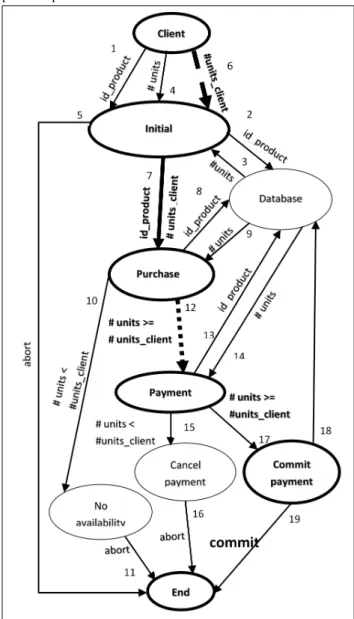
The purchase process used in our study is illustrated in the Fig. 4. Note that there exist various models of implementing the purchase process in online shopping carts. However, comparing different online shopping carts is beyond the scope of this research. In Fig. 4, the flow of different steps is numbered in order to provide a better understanding of how the system carries out the purchase process.
The client’s purchase process comprises the following three main phases:
1. Initial phase: the system receives a client’s request to purchase a product (1). It checks the number of available units (2, 3), and sends the information to the client (4). If there are Figure 4. An online shopping cart purchase process model. Figure 3. A product purchase by two concurrent clients.
Client 1 Server Client 2
t2
t4 t1
no units, then the system discards client’s request (5), otherwise the client should choose number of units which are to be purchased (6), and the purchase will start.
2. Purchase phase: the system receives the number of units chosen by the client (7). However, it has to be taken into account that other clients coexist due to the concurrent nature of the purchase system. Therefore, any client is highly likely to make decisions based on a stale version of a product in their initial phase. For this reason, it is necessary to check if there are still enough number of units available in the database that fulfil client’s needs (8, 9). If there are not enough units available, then the client’s request is declined (10, 11), otherwise the system proceeds with the purchase order. 3. Payment phase: this is the most critical point during the
purchase procedure as during this phase client’s decision will be finalized (and recorded) in the database (commit or abort). This implies that a certain concurrency control technique [21] should be implemented in order to consistently manage data updates in the database. At this stage, the system definitely confirms the availability of units (13, 14). Then, if the check-out is successful the purchase will commit (17, 18, 19), otherwise it will abort (15, 16). The goal is to avoid or reduce the number of database inconsistencies and payment conflicts, especially in a database system that lacks appropriate concurrency control technique.
According to the purchase process model, every client’s request starts at the “Initial” phase. But it is possible that all clients may not be able to finish their purchases successfully due to the level of competitiveness between them – that is, system allows multiple clients at the same time to enable high availability of data (or products). It is possible that some purchase orders are discarded at the beginning of the process as they cannot get sufficient units (i..e, #units_client > #units). Other purchase requests (where #units_client ≤ #units) will pass to the “Purchase” phase. At the
end, only when a client’s request has enough available units along the three phases (“Initial”, “Purchase”, “Payment”) then his/her purchase will complete successfully. Otherwise the client’s request will be cancelled at the specific phase of the purchase process.
4.3
Evaluation and testing
The purchase process model is implemented using Java, SQL and NoSQL big data system. The goal is to analyse how a purchase system works with two different data systems, a traditional SQL database and a NoSQL big data system. We use MySQL and Riak for traditional SQL and NoSQL big data system respectively. Specifically, we analyse how concurrent read-write operations affect the ACE properties. With MySQL we use locks and no locks in the experiments. Riak does not use locks and it lacks appropriate concurrency control mechanisms.
Several experiments have been carried out in order to simulate concurrent client’s requests (or transactions) with different degrees of concurrency. The number of requests (transactions) per experiment varies exponentially from 1 to 2048 (2, 4, 8, 16, …, 2048), so the order of magnitude in the input size changes. Therefore, an experiment with an input size ‘x’ (1 ≤ x ≤ 2048)
means that the system is trying to perform ‘x’ transactions concurrently. Note that from 4096 transactions and onward, the system could not cope with high number of requests due to constraints on hardware resources used in the experiments.
Given a specific number of transactions, each experiment has been run 30 times; which comply with recommended sample in statistical analysis. In our study, the percentage of transactions
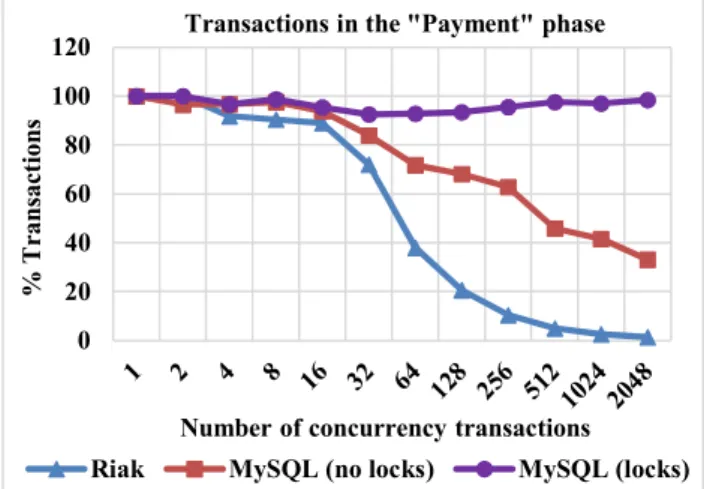
which reach the “Payment” phase is represented in Fig. 5. It is to be noted that there is a big difference in the results between using locks and no locks. In MySQL with locks, most of the transactions have the possibility of reaching the “Payment” phase. But in Riak and MySQL with no locks, the percentage plummet from 32 transactions and onward, i.e. most of the transactions are discarded in the first “Initial” and second “Purchase” phases of the purchase process.
Figure 5. Percentage of transactions in the “Payment” phase. Moreover, the lack of any lock-based concurrency control mechanism leads to the absence of controlling the conflict between transactions. Thus the speed of the database system plays an important role, i.e. how fast the transactions arrive at the system. In summary, the faster the system is, the higher the level of competitiveness (or conflict).
The goal is to establish a global mean time and a mean percentage of transactions that are able to complete successfully per group of transactions. However, any transaction can be discarded at any of the three phases, so the mean execution time and the percentage of successful transactions are worked out for each specific phase, i.e. not all transactions will reach the “Purchase” or the “Payment” phase. In addition, the relation between the number of transactions that arrive at a specific phase divided by the mean execution time of that phase provides a measure in relation to the number of transactions per millisecond (‘tpm’) that the purchase system can cope with. For each specific phase, the combination of the measure ‘tpm’ with the percentage of successful transactions is a plausible way of comparing MySQL and Riak.
The experiments were carried out using the following hardware/software features: a CPU core with 2.4 GHz Intel(R) Core(TM) i7-5500, an operating system Ubuntu 14.04 LST with 64 bits, Eclipse Luna 4.42 as IDE (Integrated Development Environment), Oracle Java 7 as the programming language, a client API supported by MySQL and NoSQL key/value Riak (by Basho) 2.1.1. The simulation run over the SQL store MySQL and the NoSQL key-value Riak with a cluster of five nodes over one CPU.
4.3.1
“Initial” phase
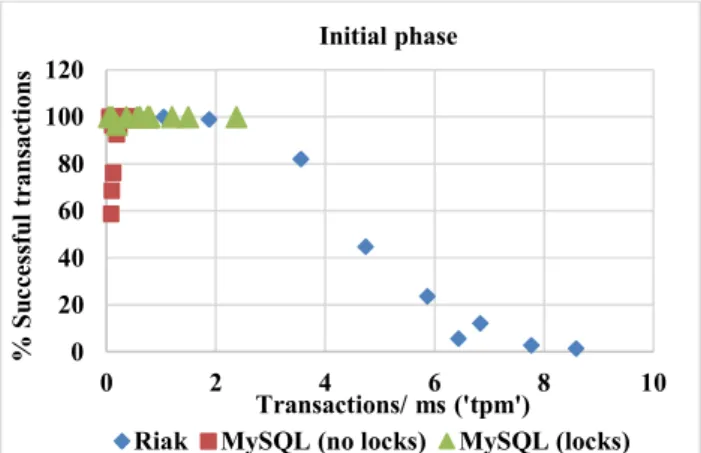
At the beginning of the purchase process, a group of transactions start their execution at the “Initial” phase, but not all will accomplish the next phase for several reasons such as the level of competitiveness (or concurrency) between them and the features of the database management system. The results for this “Initial” phase are shown in the Fig. 6.
0 20 40 60 80 100 120 % T ra ns ac tio ns
Number of concurrency transactions Transactions in the "Payment" phase
Figure 6. MySQL and Riak performance in the “Initial” phase. In MySQL (with no locks) the percentage of successful transactions is always above 58% where the ‘tpm’ varies from 0.05 to 0.5. At the beginning, the ‘tpm’ increases from 0.05 to 0.5 as the number of concurrent transactions increases from 1 to 16, but with 32 and onward the system starts decreasing the ‘tpm’ rate, and it falls from 0.3 to 0.08, and so does the percentage of successful transactions. In MySQL with locks, the ‘tpm’ rate increases from 0.4 to 2.4 as the number of concurrent transactions increases and with a 100% of successful transactions. On the contrary, Riak is able to manage higher ‘tpm’ rates than MySQL in most concurrent transactions. It varies from 0.2 to 8.6.
MySQL with no locks reaches its maximum ‘tpm’ value (0.5) for 16 concurrent transactions. MySQL with locks handles 2048 with 2.4 ‘tpm’. However, the ‘tpm’ in Riak is higher with a value between 1.8 and 3.5 for 16 and 32, and above 4.7 ‘tpm’ for more than 32 concurrent transactions.
According to the results, the level of competition for a specific number of units of the same product is higher in Riak than in MySQL. As a consequence, it has a direct impact on the percentage of successful transactions, especially when the number of concurrent transactions is above 64, then the percentage of successful transactions plummets from 45% to 1%.
4.3.2
“Purchase” phase
Some transactions have already finished (discarded) in the “Initial” phase. Indeed, depending on the database management system, the number of transactions which achieve the “Purchase” phase is different as explained in the previous section. The results of second phase are shown in Fig. 7.
Figure 7. MySQL and Riak performance in the “Purchase” phase.
In Riak, the percentage of transactions which achieve the “Payment” phase falls drastically from 82% to 1% (from 32 concurrent transactions and onwards). This fact implies a decrease in the ‘tpm’ in the “Purchase” phase. For example, the ‘tpm’ in the “Initial” phase for 32 concurrent transactions is 3.5 and in the “Purchase” phase it is 1.6. This is due to the fact that the number of concurrent transactions which reaches the second phase is lower, i.e. 26 out of 32 (82%). This results in an enormous decrease in the number of ‘tpm’ which moves down from 1.5 to 1.3 in comparison with the “Initial” phase which is around 8 ‘tpm’. In MySQL with no locks, as the ‘tpm’ increases from 0.01 to 0.16 the percentage of transactions which pass to the next phase moves from 30% to 100%. Finally, in MySQL with locks the percentage of successful transactions is mainly always above 95% with a ‘tpm’ from 0.04 to 1.4.
In summary, MySQL with locks enable a high percentage of transactions which reach the final stage (Payment), than MySQL with no locks and Riak. Though Riak is faster than both versions of MySQL (with and with no locks), it results in a drastic fall in the number of successful transactions — above 64 concurrent transactions, where the ‘tpm’ decreases from 1.6 to 1.4 due to the high level of competition.
4.3.3
“Payment” phase
Finally, the “Payment” phase will determine the number of transactions which are able to commit or abort at the end of the purchase process, as shown in Fig. 8.
Figure 8. MySQL and Riak performance in the “Purchase” phase. In MySQL the ‘tpm’ is below 0.04 in both cases (with and without locks), and the percentage of transactions which achieve this phase is neither high. In MySQL, the number of successful transactions is lower than 50% with a ‘tpm’ below 0.005 (with locks) and 0.007 (with no locks). On the contrary, Riak is faster than MySQL, where the percentage of successful transactions is below 50% with a ‘tpm’ between 0.8 and 1. Moreover, Riak provides better results than MySQL with locks when ‘tpm’ is lower than 0.6 — with more than 70% of successful transactions. This is because not many transactions are competing, otherwise the percentage will drop when the ‘tpm’ increases from 0.8 to 1 ‘tpm’, i.e. more clients in the system. MySQL with no locks achieves a higher percentage of successful transactions than both MySQL with locks and Riak, with a ‘tpm’ below 0.04 and more than 2 concurrent transactions. 0 2 4 6 8 10 0 20 40 60 80 100 120 Transactions/ ms ('tpm') % S uc ce ss fu l t ra ns ac tio ns Initial phase
Riak MySQL (no locks) MySQL (locks)
0 0.5 1 1.5 2 0 20 40 60 80 100 120 Transactions / ms ('tpm') % S uc ce ss fu l t ra ns ac tio ns Purchase phase
Riak MySQL (no locks) MySQL (locks)
0 0.2 0.4 0.6 0.8 1 1.2 0 20 40 60 80 100 120 Transactions / ms ('tpm') % S uc ce ss fu l t ra ns ac tio ns Payment phase
4.3.4
Consistency versus availability
Since product data is not locked in Riak and MySQL with no locks, it cannot be guaranteed that a purchase request ends up in a consistent state at the “Payment” phase. This fact is highly likely to cause an inconsistent database state. Our approach therefore makes a distinction between transactions which conflict and those which do not. The detection of conflicts is carried out with the read-write conflict rule [22]. Two transactions t1 with (ts1, tc1) and t2 with (ts2, tc2) may lead to consistency breach in the database when their execution time overlap, i.e. (ts1 < tc2) or (ts2 < tc1), and when both are allowed to commit. In our approach, if some transactions are conflicting but there are enough available units (or products), then they are allowed to commit, otherwise they will abort. We therefore differentiate between the following four cases during the “Payment” phase:
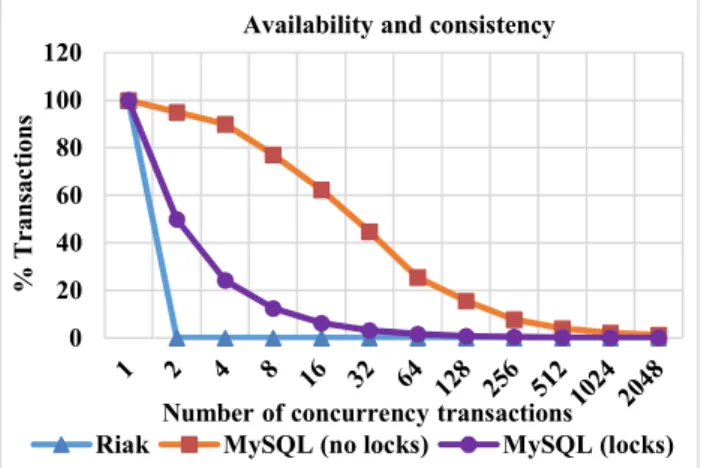
a) Availability (A) and Consistency (C): the number of units in the database is sufficient to fulfil one transaction’s needs (client’s request), and it does not conflict with others. b) Availability (A) and No Consistency (NC): the number of
units in the database is sufficient to fulfil one transaction’s needs, but it conflicts with others.
c) No Availability (NA) and Consistency (C): the number of units in the database is not sufficient to fulfil one transaction’s needs, and it does not conflict with others.
d) No Availability (NA) and No Consistency (NC): the number of units in the database is not sufficient to fulfil one transaction’s needs, and it conflicts with others.
Based on the above cases, different experiments were conducted. The results are explained as follow. In the first case “Availability and Consistency” (AC), Riak is faster than MySQL and all transactions conflict with each other, i.e. there is a complete lack of consistency as it can be observed in the Fig. 9. In MySQL (with locks) there is a complete avoidance of conflicts, so the first transactions to lock the system will be the one to purchase the number of units it requires. Although, in MySQL (with no locks) more transactions can make purchases in comparison to MySQL (with locks), and in Riak, the data in the database is highly likely to end up in an inconsistent state, i.e. negative values. This is due to the lack of an appropriate concurrency control at the beginning and at the end of the “Payment” phase.
Figure 9. AC in MySQL and Riak in the “Payment” phase. Figure 10 shows the results of the “Availability and No Consistency” (ANC) case. In it, when the number of concurrent transactions is very low, there is a high likelihood that their arrival
happens at once. They arrive extremely close to each other, i.e. there is no difference at all, so the system might set the same start time to some of them. Moreover, if there is a lack of concurrency control their commit time can be close to each other too. Therefore, the percentage of transactions which clashes increases. Indeed, in MySQL with no locks and Riak the percentage is bigger than in MySQL with locks. On the contrary, in MySQL with locks the percentage is lower because the implementation of locks imposes an order of execution on the transactions. That is, a transaction has to wait until another one is completed. Thus the commit time between the transactions, which are allowed to commit, are not so close to each other.
Figure 10. ANC in MySQL and Riak in the “Payment” phase. The last two cases “No Availability and Consistency” (NAC) and “No Availability and No Consistency” (NANC) are analyzed together. The results are illustrated in the Fig. 11. It can be observed that in MySQL with locks a high percentage of transactions do not commit because there were not enough available units in the database. Indeed, only those transactions that get the lock first, are able to satisfy their needs and get the required number of units. In MySQL with no locks and in Riak the percentage of transactions that fail due to the shortage of units in the database is very low, because the number of transactions which reach this phase is also low, as it is explained in the Section 4.3.
Figure 11. No availability in MySQL and Riak in the “Payment” phase. 0 20 40 60 80 100 120
Number of concurrency transactions
% T ra ns ac tio ns
Availability and consistency
Riak MySQL (no locks) MySQL (locks)
0 20 40 60 80 100 120
Number of concurrency transactions
% T ra ns ac tio ns
Availability and no consistency
Riak MySQL (no locks) MySQL (locks)
0 20 40 60 80 100 120 % T ra ns ac tio ns
Number of concurrency transactions No availability
5.
CONCLUSIONS
This paper studied the three main ACE properties, availability, consistency and efficiency (or performance) of the traditional SQL and NoSQL data systems which are used in cloud, fog and edge computing for storing and processing data. In it, we developed a new system using real case study of an online shopping cart and the industry standard benchmark of the TPC-DS in our experiments. We also used the widely used MySQL (traditional database system) and Riak (NoSQL big data system) in the design and implementation of the proposed system and experimentation. Our work is first that studied the ACE properties of SQL and NoSQL big data systems. It provided greater insights into the strengths and weaknesses of both SQL and NoSQL big data systems. Our extensive experimentation produced various interesting results which show that MySQL with locks provide better consistency. Thus, it is more appropriate for applications that need strong consistency such as online shopping or banking. However, in terms of efficiency and availability Riak outweighs MySQL. But Riak does not ensure strong consistency. Thus, in its current form Riak is not sustainable to be used for applications (such as online shopping or banking). Our recommendation is that, in order for Riak, to be used in such applications it needs to support appropriate concurrency control and transaction management mechanisms.
6.
REFERENCES
[1] S. Yi, C. Li, and Q. Li, "A survey of fog computing: concepts, applications and issues," in Proceedings of the 2015 workshop on mobile big data, 2015, pp. 37-42.
[2] TPC. (2001-2018). Available: http://www.tpc.org/tpcds/ [3] M.T. González-Aparicio, M. Younas, J. Tuya, and R. Casado,
"Testing of transactional services in NoSQL key-value databases," Future Generation Computer Systems, vol. 80, pp. 384-399, 2018.
[4] M. Chen, S. Mao, and Y. Liu,"Big data: A survey," Mobile Networks and Applications, vol. 19, pp. 171-209, 2014. [5] M. Cecowski, S. Becker, and S. Lehrig,"Cloud computing
applications," in Engineering Scalable, Elastic, and Cost-Efficient Cloud Computing Applications, ed: Springer, 2017, pp. 47-60.
[6] J. Manyika, M. Chui, B. Brown, J. Bughin, R. Dobbs, C. Roxburgh, and A. H. Byers, "Big data: The next frontier for innovation, competition, and productivity," 2011.
[7] I. A. T. Hashem, I. Yaqoob, N. B. Anuar, S. Mokhtar, A. Gani, and S. U. Khan, "The rise of “big data” on cloud computing: Review and open research issues," Information Systems, vol. 47, pp. 98-115, 2015.
[8] L. Jiang, M. Jun, and Z. Yang, "Customer-perceived value and loyalty: how do key service quality dimensions matter in the context of B2C e-commerce?," Service Business, vol. 10, pp. 301-317, 2016.
[9] F. Chang, J. Dean, S. Ghemawat, W. C. Hsieh, D. A. Wallach, M. Burrows, T. Chandra, A. Fikes, and R. E. Gruber, "Bigtable: A Distributed Storage System for Structured Data," ACM Trans. Comput. Syst., vol. 26, pp. 1-26, 2008.
[10] A. Moniruzzaman and S. A. Hossain, "Nosql database: New era of databases for big data analytics-classification, characteristics and comparison," arXiv preprint arXiv:1307.0191, 2013.
[11] A. Lakshman and P. Malik, "Cassandra: a decentralized structured storage system," ACM SIGOPS Operating Systems Review, vol. 44, pp. 35-40 2010.
[12] D. G. Campbell, G. Kakivaya, and N. Ellis, "Extreme scale with full SQL language support in microsoft SQL Azure," presented at the Proceedings of the 2010 ACM SIGMOD International Conference on Management of data, Indianapolis, Indiana, USA, 2010.
[13] J. C. Corbett, J. Dean, M. Epstein, A. Fikes, C. Frost, J. J. Furman, S. Ghemawat, A. Gubarev, C. Heiser, P. Hochschild, W. Hsieh, S. Kanthak, E. Kogan, H. Li, A. Lloyd, S. Melnik, D. Mwaura, D. Nagle, S. Quinlan, R. Rao, L. Rolig, Y. Saito, M. Szymaniak, C. Taylor, R. Wang, and D. Woodford, "Spanner: Google's Globally Distributed Database," ACM Trans. Comput. Syst., vol. 31, pp. 1-22, 2013.
[14] W. Lloyd, M. J. Freedman, M. Kaminsky, and D. G. Andersen, "Don't settle for eventual: scalable causal consistency for wide-area storage with COPS," presented at the Proceedings of the Twenty-Third ACM Symposium on Operating Systems Principles, Cascais, Portugal, 2011. [15] J. Baker, C. Bond, J. C. Corbett, J. J. Furman, A. Khorlin, J.
Larson, J. M. Leon, Y. Li, A. Lloyd, and V. Yushprakh, "Megastore: Providing Scalable, Highly Available Storage for Interactive Services," in CIDR, 2011, pp. 223-234. [16] K. Chitra and B. Jeevarani, "CLOUD TPS: SCALABLE
TRANSACTION IN THE CLOUD COMPUTING," International Journal of Engineering and Computer Science, vol. 2, pp. 2280-2285, July, 2013.
[17] R. Jimenez-Peris, M. Patino-Martinez, B. Kemme, I. Brondino, J. O. Pereira, R. Vilaça, F. Cruz, R. Oliveira, and M. Y. Ahmad, "CumuloNimbo: A Cloud Scalable Multi-tier SQL Database," IEEE Data Eng. Bull., vol. 38, pp. 73-83, 2015.
[18] D. Peng and F. Dabek, "Large-scale Incremental Processing Using Distributed Transactions and Notifications," in OSDI, 2010, pp. 1-15.
[19] F. Junqueira, B. Reed, and M. Yabandeh, "Lock-free transactional support for large-scale storage systems," in Dependable Systems and Networks Workshops (DSN-W), 2011 IEEE/IFIP 41st International Conference on, 2011, pp. 176-181.
[20] W. Vogels. (2008). All things distributed. Available: https://www.allthingsdistributed.com/2008/12/eventually_c onsistent.html
[21] C. G. D. J. K. Tim, Distributed Systems. Concepts and design.: Addison-Wesley 2001.
[22] H. Berenson, P. Bernstein, J. Gray, J. Melton, E. O'Neil, and P. O'Neil, "A critique of ANSI SQL isolation levels," SIGMOD Rec., vol. 24, pp. 1-10, 1995.