ENGLISH LANGUAGE LEARNER AUTONOMY IN THE VIETNAMESE HIGHER EDUCATION CONTEXT: ENABLING FACTORS
AND BARRIERS ARISING FROM ASSESSMENT PRACTICE
HA THI NGOC TRAN
BA, MA (University of Languages and Foreign Studies – VNU)
Thesis submitted in the fulfilment of the requirements for the degree of
DOCTOR OF PHILOSOPHYSchool of Education, Faculty of Arts
The University of Adelaide
i
TABLE OF CONTENTS
Abstract ... viii
Thesis declaration ... x
Acknowledgements ... xi
List of abbreviations ... xii
List of tables ... xiii
List of figures ... xv
Chapter 1: Introduction ... 1
Chapter overview ... 1
1.1. Background to the research ... 1
1.2. Research focus ... 6
1.3. Research question and research objectives ... 8
1.4. Significance of the study ... 9
1.5. Key concepts in relation to learner autonomy ... 9
1.6. Structure of the thesis ... 10
Chapter 2: Context of the study ... 13
Chapter overview ... 13
2.1. Broader research context ... 13
2.1.1. Vietnam in brief ... 13
2.1.2. Vietnamese higher education ... 18
2.1.3. History of foreign language education in Vietnam ... 23
ii
2.2.1. Brief information about the researched university ... 27
2.2.2. English teaching and learning at the researched university ... 27
2.2.3. A2 level of English competency and A2 test ... 34
2.2.4. Assessment policies and assessment framework and practices at the researched university ... 37
Chapter summary ... 40
Chapter 3: Literature review ... 42
Chapter overview ... 42
3.1. Theoretical framework ... 42
3.1.1. Sociocultural theories in brief ... 42
3.1.2. Sociocultural theories and implications for the current study ... 44
3.2. Learner autonomy ... 56
3.2.1. Role of learner autonomy in language learning ... 56
3.2.2. Feasibility of learner autonomy in Asian countries ... 57
3.2.3. Autonomy is a complex concept ... 59
3.2.4. Misconceptions about learner autonomy ... 61
3.2.5. Definitions of learner autonomy ... 64
3.2.6. Learner autonomy in this study ... 73
3.2.7. Characteristics of autonomous language learners ... 74
3.2.8. Versions of learner autonomy ... 76
3.2.9. Levels of learner autonomy ... 80
iii
3.3. Assessment in relation to learner autonomy ... 92
3.3.1. Assessment of learning ... 93
3.3.2. Assessment for learning ... 96
Chapter Summary ... 117
Chapter 4: Research Design ... 119
Chapter overview ... 119
4.1. Research paradigm ... 119
4.2. Case study approach ... 122
4.2.1. Qualitative case study ... 122
4.2.2 Case definition and selection ... 124
4.2.3. Participant selection ... 126 4.3. Research methods ... 130 4.3.1. Participant observations ... 130 4.3.2. Semi-structured interviews ... 132 4.3.3. Document analysis ... 134 4.4. Data analysis ... 135
4.4.1. Qualitative content analysis ... 136
4.4.2. Interview data analysis process ... 138
4.4.3. Observation data analysis process ... 141
4.4.4. Document analysis process ... 152
4.5. Ensuring research quality ... 153
iv
4.5.2. Transferability ... 156
4.5.3. Dependability ... 157
4.5.4. Confirmability ... 157
4.6. Ethical considerations and clearance ... 158
4.6.1. Level of risk ... 158
4.6.2. Measures to minimise risks ... 159
4.6.3. Confidentiality ... 159
4.6.4. Storage of information ... 160
Chapter summary ... 160
Chapter 5: Teachers’ and students’ interview responses... 162
Chapter overview ... 162
5.1. Background information about the three classes ... 162
5.1.1. Profile of the teachers ... 162
5.1.2. Profile of the students ... 164
5.1.3. The classroom ... 164
5.1.4. The module ... 165
5.2. The teachers’ and students’ voices on assessment and autonomy ... 165
5.2.1. The teachers’ and students’ voices on learner autonomy ... 165
5.2.2 Teachers’ and students’ views on assessment ... 183
5.2.3. Teachers’ and students’ perspectives on the relationship between assessment and LA ... 206
v
5.3.1. Demonstration of proactive autonomy ... 214
5.3.2. Demonstration of reactive autonomy ... 217
5.3.3. Demonstration of compliance ... 218
Chapter Summary ... 219
Chapter 6: Observed Assessment practices and Students’ responses ... 221
Chapter overview ... 221
6.1. Assessment tasks and students’ responses ... 222
6.1.1. Tasks for in-class learning ... 223
6.1.2. Tasks for out-of-class learning ... 233
6.2. Assessment techniques and students’ responses ... 240
6.2.1. Questioning ... 241
6.2.2. Observation ... 242
6.2.3. Checking of individual performance/role play ... 243
6.2.4. Self/peer-assessment and students’ responses ... 243
6.3. Assessment feedback and students’ responses ... 245
6.3.1. Mistake identification and correction ... 245
6.3.2. Confirmation of students’ answers ... 246
6.3.3. Self/peer-feedback and students’ responses ... 247
6.3.4. Feedback for future learning ... 249
6.3.5. Student-initiated feedback ... 249
6.4. Assessment-related communication ... 250
vi
6.4.2. Promoting reactive autonomy ... 251
6.4.3. Promoting compliance ... 253
Chapter summary ... 255
Chapter 7: Discussion ... 257
Chapter overview ... 257
7.1. Teachers’ and students’ understandings of learner autonomy ... 257
7. 2. Teachers’ and students’ perspectives on assessment ... 265
7.3. Characterisation of assessment practices in Vietnamese higher education ... 276
7.4. Students’ demonstration of learner autonomy ... 284
Chapter summary ... 290
Chapter 8: conclusion ... 292
Chapter overview ... 292
8.1. Summary of the research ... 292
8.2. Contributions ... 296
8.3. Limitations ... 300
8.4. Recommendations for future research ... 301
8.5. Concluding remarks ... 301
List of References ... 303
List of appendices ... 329
Appendix A: Interview protocols ... 329
Appendix A1: Teacher interview protocol in English and Vietnamese ... 329
vii
Appendix B: Observation protocol ... 339
Appendix C: Survey questionnaire for selecting participants ... 341
Appendix D: Ethics approval ... 350
Appendix E: Participant information sheets ... 351
Appendix E1: Participant information sheet for teachers ... 351
Appendix E2: Participant information sheet for observed students ... 358
Appendix E3: Participant information sheet for interviewed students ... 364
Appendix F: Consent forms ... 370
Appendix F1: Consent form for teachers ... 370
Appendix F2: Consent form for observed students ... 374
Appendix F3: Consent form for interviewed students ... 378
Appendix G: Complaint forms ... 382
Appendix H: Sample assessment grid for CEFR A2 test ... 384
Appendix I: Sample of assessment grid for listening skill in KNLNNVN (Vietnam Framework of Reference for English) A2 test ... 385
viii
ABSTRACT
Learner autonomy has gained particular attention in Vietnamese higher education since a major education reform launched in 2005. Although a number of studies have been conducted to investigate the concept in the Vietnamese higher education context, most of them have focused on exploring teachers’ and students’ perceptions and beliefs around the concept of autonomy (T. V. Nguyen, 2011; Dang, 2012; Humphreys & Wyatt, 2013; T. N. Nguyen, 2014), and on the possibility of promoting it in Vietnamese universities (Trinh, 2005; L. T. C. Nguyen, 2009; Q. X. Le, 2013; Phan, 2015). There appear to be no studies on the demonstration of learner autonomy and the potential factors, including factors relating to assessment practice, that support or inhibit its demonstration in the Vietnamese higher education context.
Building on a social constructivist paradigm and sociocultural theories of learning, this qualitative case study aims to investigate the demonstration of learner autonomy in the context of assessment in English as a foreign language (EFL) classes in a university in Vietnam, and the (potential) factors in assessment that facilitate or constrain the demonstration of learner autonomy in that context. The data were collected through participant observation of teachers’ and students’ practices in three EFL classes at the university during a complete semester, one-on-one semi-structured interviews with three teachers and sixteen students, and post-observation interviews with the three teachers and their students. Additional data which characterised the context of the study were gathered and included documents at the researched university relating to higher education policies, assessment policies, English teaching and learning policies, EFL curriculum and syllabus, test samples, and English teaching textbooks.
ix
The study found that students generally demonstrated a low level of autonomy in the classroom despite their positive attitude towards the concept and their awareness of its role in English learning. Primary contributing factors included negative washback of current assessment systems on teaching and learning practices, prescribed assessment practices in the class, teachers’ and learners’ limited and divergent understanding about the concept of learner autonomy, and their limited understanding about the role of assessment in learning in general and in learner autonomy promotion and development in particular. The study also found that students who stated that English was relevant to their personal needs were generally more autonomous outside of the classroom than inside it. Findings from this study support the view that learner autonomy reflects the relationship between learners and the learning environment, and is an emergent product of the interaction between learners and contextual factors including their teacher, their peers, the learning task, class rules and values, and university values and regulations.
The study’s findings are significant, as they highlight the social dimension of learner autonomy and the importance of facilitating favourable conditions for teachers to provide learner autonomy and for learners to manifest it. The study also highlights the need to reconsider assessment practices to promote learner autonomy.
x
THESIS DECLARATION
I certify that this work contains no material which has been accepted for the award of any other degree or diploma in my name, in any university or other tertiary institution and, to the best of my knowledge and belief, contains no material previously published or written by another person, except where due reference has been made in the text. In addition, I certify that no part of this work will, in the future, be used in a submission in my name, for any other degree or diploma in any university or other tertiary institution without the prior approval of the University of Adelaide and where applicable, any partner institution responsible for the joint-award of this degree.
I give permission for the digital version of my thesis to be made available on the web, via the University’s digital research repository, the Library Search and also
through web search engines, unless permission has been granted by the University to restrict access for a period of time.
Signed:
xi
ACKNOWLEDGEMENTS
I would like to show my gratitude to the following people without whom this thesis would not have been accomplished.
My deepest and sincerest thanks go to my supervisors at the School of
Education, the University of Adelaide – Dr Julia Miller, Associate Professor Edward Palmer, and Dr John Willison for their invaluable guidance, feedback, and support. I am grateful for their knowledge, patience, dedication, tolerance, and timely encouragement, which have made my PhD journey not only more endurable but also more enjoyable.
I would like to acknowledge all the participants who have made this research possible. Thank you for sharing your thoughts with me and allowing me to have a once-in-a-lifetime experience observing your practices.
I am grateful to the Vietnamese Government and the University of Adelaide for providing me with a VIED-Adelaide Scholarship to support my doctoral study. I also wish to thank all the staff at the School of Education, the University of Adelaide for their helpful support.
I also want to express my thanks to Joe Miller for proofreading my thesis. Thank you for your critical comments and feedback.
To my friends and colleagues in room 8.11 of the Nexus 10 building, thank you for your warm and beautiful friendship. Thank you for sharing fun moments with me, encouraging me when I got stuck in my thesis, and spending heaps of late nights with me. You are an unforgettable part of my PhD journey. To Thuy Thi Thu Hoang, thank you for being my colleague, my housemate, and my soulmate. Without you, my life and my PhD journey would have been much duller.
I am especially indebted to my beloved husband Viet Dung Bui and my two dear daughters Ha Anh Bui and Ha Linh Bui. Thank you for being always by my side,
putting up with me without any complaints, comforting me and cheering me up whenever I am down. You are an endless source of motivation for me to try my best.
Finally, this thesis is my gift and my special thank you for my parents who have always loved me unconditionally and supported me wholeheartedly. Thank you very much Mum and Dad for bringing me into this world, raising me up, nurturing all my dreams, and making me who I am today.
xii
LIST OF ABBREVIATIONS
AfL Assessment for Learning
AoL Assessment of Learning
ASEAN Association of South-East Asian Nations
BCE Before Common Era
CD Compact Disc
CE Common Era
CEFR Common European Framework of Reference
EFL English as a Foreign Language
ESP English for Specific Purposes
FA Formative Assessment
GPA Grade Point Average
HEI Higher Education Institution
IELTS International English Language Testing System
KET Key English Test
KNLNNVN Khung Năng Lực Ngoại Ngữ Việt Nam (Vietnam Framework of Reference for English)
LA Learner Autonomy
MOET Ministry of Education and Training
RU Research University
SA Summative Assessment
UN United Nations
VHE Vietnamese Higher Education
WTO World Trade Organization
xiii
LIST OF TABLES
Table 2.1 The general curriculum for English at RU before 2011 ... 28
Table 2.2 The ‘altered’ curriculum for English at RU in 2011 ... 29
Table 2.3 New curriculum for English at RU in 2012 ... 30
Table 2.4 Curriculum for English at the English centre ... 31
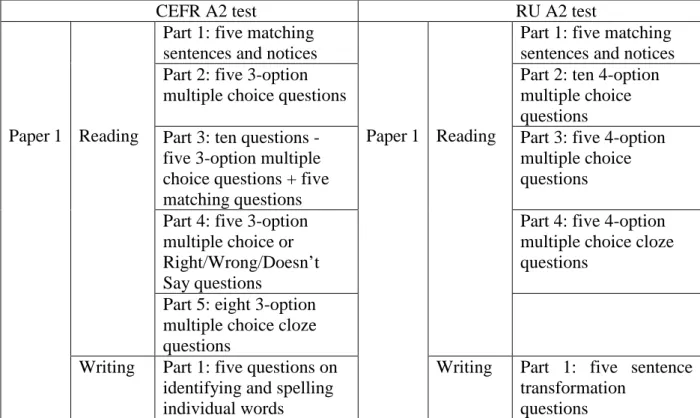
Table 2.5 The CEFR and the RU A2 test format ... 35
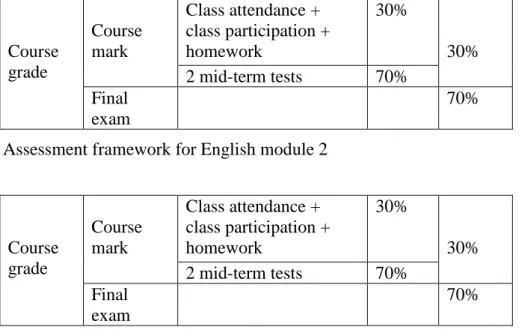
Table 2.6 Assessment framework for English module 1 ... 37
Table 2.7 Assessment framework for English module 2 ... 37
Table 2.8 Assessment framework for altered English module 3 (after 2011) .... 38
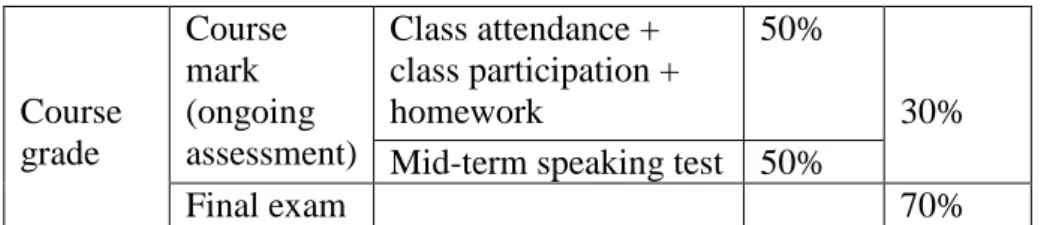
Table 2.9 Assessment framework for English module 1: ... 38
Table 2.10 Assessment framework for English module 2 ... 38
Table 2.11 Assessment framework for English module 3 ... 38
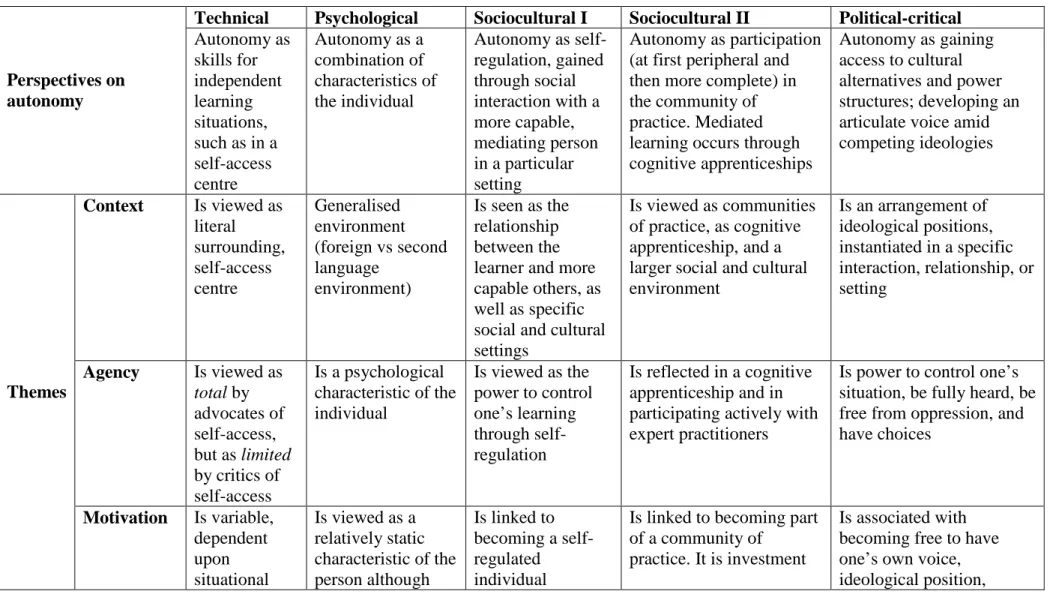
Table 3.1 Summary of perspectives on autonomy - adapted from R. L. Oxford (2003) ... 78
Table 3.2 Nunan’s model of LA (Nunan, 1997, p. 195) ... 80
Table 3.3 Model of autonomy demonstrated ... 82
Table 3.4 Model for autonomy offered ... 83
Table 3.5 Spectrum of autonomy offered in language tasks ... 101
Table 3.6 Summary of different types of questions ... 103
Table 3.7 Level of autonomy in questioning techniques ... 105
Table 3.8 Summary of feedback models and strategies ... 110
Table 3.9 Levels of autonomy offered in feedback practices ... 111
xiv
Table 3.11 Levels of autonomy in self/peer-assessment techniques ... 117
Table 4.1 Participants’ average scores for use of formative assessment and autonomy-supporting activities ... 128
Table 4.2 Teacher participants and their classes ... 129
Table 4.3 Interview student participants ... 130
Table 4.4 Linking research questions and objectives with data collection methods and data sources ... 135
Table 4.5 Examples of code and category development in interview data ... 140
Table 4.6 Codes for interviews with teachers and students ... 140
Table 4.7 Examples of code and category development in observation data ... 143
Table 4.8 Data categorisation and category definition ... 146
Table 4.9 Analytical framework for teachers’ practices ... 147
Table 4.10 Analytical framework for students’ responses ... 147
Table 4.11 Coding frame for teachers’ assessment practices ... 149
Table 4.12 Coding frame for students’ responses ... 151
Table 4.13 Codes for observations ... 152
xv
LIST OF FIGURES
Figure 6.1 Number of prescribed tasks compared to total number of tasks in three classes ... 223 Figure 6.2 Students’ demonstration of autonomy in prescribed tasks ... 224 Figure 6.3 Number of bounded tasks compared to the total number of tasks in
three classes ... 230 Figure 6.4 Students’ responses in bounded tasks ... 231 Figure 6.5 Number of prescribed tasks compared to total number of tasks for
out-of-class learning ... 235 Figure 6.6 Number of bounded tasks compared to the total number of tasks for
out-of-class learning ... 236 Figure 6.7 Assessment techniques utilised in the three classes ... 241 Figure 6.8 Feedback used in the three classes ... 245 Figure 6.9 Levels of autonomy that assessment-related communication might
1
CHAPTER 1: INTRODUCTION
Chapter overview
This introductory chapter presents an overview of the research inquiry. The chapter starts with the background to the research, followed by the focus of the research, research question and objectives, and the introduction of some key concepts. The chapter ends with an outline of the structure of the thesis.
1.1.
Background to the research
English teaching and learning in Vietnam
English has played an important role in Vietnam for many years, especially since 1986 when Vietnam opened its doors to the world, seeking integration and cooperation. The role of English in Vietnam is apparent in many fields, including international relations, employment and education. First, English is now deemed the global language and is used as a means of communication in a number of important international organisations and associations, such as the Association of South-East Asian Nations (ASEAN), the Asia-Pacific Economic Cooperation (APEC), the World Trade Organization (WTO) and the United Nations (UN). Therefore, English can be considered a key for Vietnam to develop and strengthen international relations and economic cooperation. Moreover, English has been recognised as the key to “research and development in all areas of scientific, technological and commercial endeavour” (Denham, 1992, p. 62), so it is believed that English will help Vietnam to make use of the world’s advances in science and technology to catch up with other countries in the region and in the world.
Secondly, since opening its doors to the world, a number of foreign investors and companies have come to Vietnam, and millions of foreign tourists have travelled to
2
Vietnam for their holidays. These factors mean that Vietnamese job seekers need to have good English competence to gain an advantage in the job market, as English has now become the passport to any well-paid job in Vietnam (Hoang, 2010; Phan, Vu, & Bao, 2014). Thirdly, the majority of sources of information on the Internet are in English, so a good command of English allows not only students but also people from all walks of life to approach these rich and invaluable sources of information. Moreover, being competent in English can help open the door for Vietnamese students to advanced education systems and prestigious universities worldwide, because the prerequisite for an offer or scholarship to study abroad in these education systems and universities is English competency (Phan et al., 2014).
The importance of English in the VHE manifests itself in many ways. First, it has been highlighted in several documents issued by the Vietnamese Assembly, the Vietnamese Communist Party, the Vietnamese Government, and the Ministry of Education and Training (MOET). For example, the Government’s Vietnamese Education Strategies document specifies that one of the important attributes that Vietnamese students must possess is English competency (Vietnamese Government [VG], 2005). In addition, it is stated in the Vietnamese Education Law (2005) that the foreign language taught in the national education system must be “widely used in international communication” (Vietnamese National Assembly [VNA], 2005, p. 2). In 2008, the National Foreign Language Project specified English as the foreign language to be taught at all education levels in Vietnam, and stated that Vietnamese students need to acquire a certain level of English after completing each education level in order to be able to communicate and work in a global working environment (VG, 2008). Secondly, the prioritisation of English can also be seen in the curriculum for English at tertiary level. English is compulsory in the curriculum of all higher education programs, and the
3
time allocated to it is greater than the time allotted to any other subject - 240 hours in total for general English, and from 60 to 90 hours in total for English for Specific Purposes (ESP) (H. T. Le, 2013). English is also a prerequisite in the entrance exams to master and doctoral programs in Vietnam (Ministry of Education and Training
[MOET], 2014, 2017). According to the MOET (2015), students must have English competence equivalent to Common European Framework of Reference (CEFR) levels A2, B1 and B2 to receive their university master and doctoral degree, respectively. Thirdly, the approval in 2008 of the national foreign language project entitled
“Teaching and Learning Foreign Languages in the National Education System, Period 2008 – 2020” (with a budget of up to 450 million US dollars) proved that English teaching and learning is one of the priorities in the government’s investment strategies and education policies.
Despite all the efforts made, however, the quality of English teaching and learning at tertiary level is far from adequate (Hoang, 2010; Trinh & Mai, 2018).There is evidence to suggest that the English proficiency of a large number of students is disappointingly low (H. T. Le, 2013; Tran, 2013). For example, according to a report from a conference at Vietnam National University, Ho Chi Minh in 2017, 85% of tertiary students at this university did not meet the required standard for English competency (Phương Trinh, 2017). In addition, students do not seem to be confident with their English, and the majority of non-English major students cannot function properly in English despite years of studying it at school and university (Le, 2011; Tran, 2013; Vietnamese Prime Minister, 2008). As a result, graduates do not meet the English competency requirements of job recruiters. According to the Head of the Human
Resources Department at Panasonic Vietnam, Vietnamese graduates’ English speaking, presentation and writing skills are inadequate (Đ. Nguyen, 2016).
4
Among a series of problems blamed for the poor results of English teaching and learning at higher education levels, the most prominent are the teacher-centred teaching method, the exam-directed curriculum and summative grammar-based assessment (Hoang, 2010; Tran, 2013; Viet Toan, 2013; Trinh & Mai, 2018). The immediate consequences of teacher-centredness are students’ passivity in learning and their dependence on teachers for knowledge. Both of these signal a huge lack of autonomy, influencing the effectiveness of English learning. The use of an exam-directed
curriculum and summative grammar-based assessment methods also lead to a rote learning style, and the neglect of communicative language skills in English teaching (Hoang, 2010; Tran, 2013), both of which also have a negative effect on Learner Autonomy (LA). Yet autonomy in language learning is vital to the success of English learning (Dafei, 2007; Pan & Chen, 2015; Faramarzi, Elekaei, & Tabrizi, 2016). These problems suggest that key potential solutions for the current ineffectiveness of English teaching and learning may include the promotion of LA and a re-evaluation of current assessment methods.
Learner autonomy and assessment in Vietnamese higher education policies
LA, and innovation in assessment (which aims to promote LA), have been made the focus in the Vietnamese Higher Education (VHE) policies. In 2008, the MOET required all universities in Vietnam to adopt a credit-based system before 2010. In this system, students have to be responsible for making autonomous decisions about their own learning consonant with their learning conditions and capabilities (MOET, 2008). This system also requires innovation in the assessment regime so that students’ attendance and class participation are accounted for in the final grade, and ongoing assessment criteria and practices are decided by teachers, rather than by departments or universities (MOET, 2008). In addition, the Vietnamese Communist Party’s Resolution No
29-5
NQ/TW on basic and comprehensive education and training reform emphasised that assessment practices had to be reformed because assessment and testing methods were recognised as being outdated and inauthentic (Vietnamese Communist Party [VCP], 2013) instead of flexible and varied―both criteria which the Vietnamese Communist Party regards as significant attributes of assessment. The assessment of students’ learning should therefore not only be tied to one final end-of term test, but be based on “spoken, written, essays, assignments or all these assessment methods” (Vietnamese Communist Party, 2013, p. 6). It was thought that the assessment focus should move from summative to formative in order to develop students’ initiative, awareness, creativity, self-study and sustainability (VCP, 2013). Moreover, the National Foreign Language Project approved in 2008 emphasised the need to make English teaching more student-centred, moving from language teaching as the conveying of knowledge to learning as the active construction of knowledge. LA thus became a major goal in language teaching. English assessment practices were also substantially modified. As a consequence, a number of conferences, workshops and training sessions have been held in several universities in Vietnam, aiming to include new ideas and methods in
assessment practices in VHE.
The relationship between learner autonomy and assessment
Assessment is widely recognised as having a profound impact on LA (Falchikov & Boud, 1989; Little, 2003a; Black & Wiliam, 2009; Everhard, 2015a), depending on how and why it is used. Assessment is often perceived as serving two purposes: collecting evidence of students’ achievement or level of performance against the specified
standards or objectives, and supporting students’ learning. These two purposes are often referred to as Summative Assessment (SA), or Assessment of Learning (AoL) (Wiliam
6
& Black, 1996; Stiggins, 2005), and Formative Assessment (FA), or Assessment for Learning (AfL) (Black & Wiliam, 1998; Assessment Reform Group, 2002).
AoL is often viewed as not supporting, or even as inhibiting LA (Little, 2003a; Harland, McLean, Wass, Miller, & Sim, 2014; Benson, 2015; Everhard, 2015a; Wass, Harland, McLean, Miller, & Sim, 2015). This is because AoL is underpinned by a behaviourist theory of learning, which perceives knowledge as being transmitted from teachers to students, and characterises students as passive recipients of knowledge and outsiders in the assessment process (James, 2006; Everhard, 2015a).
In contrast, AfL makes LA one of its central aims (Sadler, 1989; Assessment Reform Group, 2002; Gibbs & Simpson, 2004a; Black & Wiliam, 2009; Woods, 2015). However, AfL does not automatically lead to LA. The impacts of AfL on LA can vary depending on many factors, including how AfL is used in the class (Marshall & Drummond, 2006), types of AfL used (Pryor & Crossouard, 2008; Willis, 2011b), and the teacher-student relationship in AfL, especially the teacher-student power
relationship (Gipps, 2002; Pryor & Crossouard, 2008; Willis, 2011a).
According to Gipps (2002) and Marshall and Drummond (2006), the promotion of LA in the context of assessment requires the sharing of power and control with students. That is, students should be involved in making decisions about learning and assessment. Therefore, it is necessary to understand the power-dynamic that exists between teachers and learners in assessment practice in order to identify the assessment-related factors that enable or constrain LA.
1.2. Research focus
As discussed above, innovation in teaching methodology and improvement in assessment methods that would lead to increased LA, have been the focus of the
7
education reforms in Vietnam. However, there seems to be a misalignment between the rhetoric of documents issued by the Government and the MOET and the reality of practice. ‘Learner autonomy’ and a ‘learning society’ (VG, 2005) are far-reaching targets. In a study carried out on LA in the Vietnamese University credit-based system in 2015, A. T. Tran (2015) concludes that in reality, students have yet to take the
initiative in searching for knowledge. They only do what is required by the lecturers and only study what is accounted for in the final grade. Students tend not to do tasks
assigned by the lecturer if the tasks are not assessed and they are not given a mark. Additionally, although LA has been emphasised in many policy documents regarding education in general and higher education in particular, there has been no specific and systematic plan for implementing LA in Vietnamese education (Phan & Hamid, 2017). It seems that the policy goal was “dumped into local contexts” without considering how it would be enacted by other agents involved, such as academic administrators, teachers and learners (Phan & Hamid, 2017, p. 3). The term also has not been systematically and consistently described across these documents, making it challenging for the teachers (let alone learners) to grasp what these terms entail in terms of actual behaviours. This means that these policies display limited effectiveness in practice.
Moreover, assessment practices still focus more on the purposes of certification than on learning purposes (T. H. Nguyen, Warren, & Fehring, 2014; Trinh & Mai, 2018). The important functions of supporting present and future learning through assessment practices (Boud, 2000; Boud & Falchikov, 2006) and supporting students’ autonomy (Sadler, 1989; Black & Wiliam, 2009; Everhard, 2015a; Woods, 2015) are often excluded. Although AfL practices have been adopted by English language teachers, they have not been as effective as expected due to the sociocultural
8
characteristics of Vietnamese students and classrooms (Ho, 2015; Pham & Renshaw, 2015; T. D. Tran, 2015).
In Vietnam, only a few studies have been completed which address LA and how to promote it in higher education. These include studies on the possibility of promoting LA in Vietnamese universities (Trinh, 2005; Nguyen, 2009; Q. X. Le, 2013; Phan, 2015), and studies on the perceptions and beliefs of English language teachers and students (T. V. Nguyen, 2011; Dang, 2012; Humphreys & Wyatt, 2013; T. N. Nguyen, 2014; V. L. Nguyen, 2016). However, there appear to be no studies on assessment and autonomy in the VHE context, and nothing that addresses how the one influences the other, how they are related, and how assessment can be used to promote LA. Therefore, this study was carried out in order to explore the impacts of English as a Foreign
Language (EFL) assessment on the demonstration of LA and the factors in EFL assessment that promote or hinder the demonstration of LA.
1.3. Research question and research objectives
This thesis aims to investigate the following overarching research question: What are the factors in assessment that enable or constrain the demonstration of learner autonomy in learning English as a Foreign Language in the Vietnamese Higher Education context?In order to achieve this aim, the research addresses the following objectives: • Explore English language teachers’ and students’ understandings of the concept
of LA
• Examine English language teachers’ and students’ perspectives on assessment and the relationship between assessment and LA
9
• Investigate students’ demonstration of LA in learning English in the VHE context.
1.4. Significance of the study
Although a large number of studies have been conducted on assessment and autonomy, most focus on the influences of (a) particular assessment technique(s) on promoting LA. There have been studies on self-assessment, peer-assessment and LA (e.g., Berry, 2009; Taras, 2010; Everhard, 2015b; Panadero, Jonsson, & Botella, 2017; Han & Fan, 2019); learning portfolios and LA (Kohonen, 2000; Little, 2004b, 2010; Duong, 2015; T. Q. Tran & Duong, 2018); and formative assessment and LA (Davison, 2011; Willis, 2011b). Everhard (2015a) points out that not much has been done to explore the relationship between assessment and LA in language learning, especially on how the one impacts the other. Therefore, the current research will contribute to the
understanding of assessment-related factors that can support or hinder the demonstration of LA.
This study is also significant because it presents an overarching view of the characterisation of both assessment and LA in practice in the VHE context. This then provides an empirical basis for policy makers and stakeholders in Vietnam to make appropriate interventions in the current assessment regime so that it can promote learning in general and LA in particular.
1.5. Key concepts in relation to learner autonomy
This study distinguishes three concepts of LA, developed further in the literature review: autonomy capacity, autonomy offered, and autonomy demonstrated. Autonomy capacity is conceptualised as learners’ ability to take control of their own learning10
(Benson, 2011). This capacity is conceived as being innate, and can be inhibited or facilitated by different factors making up the learning environment. This capacity includes two components: ‘ability’ (knowledge and skills) and ‘desire’ (Benson, 2013). Autonomy offered is perceived as the level of freedom (e.g., the extent to which students are permitted to control their learning) or opportunities created for learners to exert control over their learning. Autonomy demonstrated is the extent to which students actually exercise their capacity to take control of their learning in different learning situations.
Autonomy offered was categorised into three levels: prescribed, bounded and open. Prescribed refers to a situation where teachers decide all aspects of a task. Bounded refers to a situation where students decide some aspects of a task. Open refers to a situation where students decide all aspects of a task.
Autonomy demonstrated was categorised into three levels: compliant, reactive, and proactive. Compliant describes students who closely followed the teacher’s instruction. Reactive describes students who initiate some actions in order to follow an other-initiated learning agenda. Proactive describes students who initiate an agenda for their learning and actions in order to complete their self-determined goal.
1.6. Structure of the thesis
This thesis is organised into eight chapters. This chapter outlines the background of the study, the research focus, research question, research objectives, the significance of the study, and the structure of the thesis.
Chapter 2 describes the sociocultural and historical features of the research context. It provides brief geographical, historical and cultural information about
11
the history of foreign language education in general and English teaching and learning in particular in Vietnam. Chapter 2 also provides information about the research site, its practice of English teaching and learning, and its practice of assessment of English.
Chapter 3 presents an overview of sociocultural theories of learning that underpin this research, and discusses central concepts and their implications for
conceptualising LA, assessment and the relationship between them. Fundamental issues relating to understanding and implementing LA in practice are also considered. Chapter 3 also discusses two forms of assessment—assessment of learning and assessment for learning—and their relationship with LA.
Chapter 4 describes social constructivism and the relevance of its ontological and epistemological principles to the current research. The chapter then outlines the research design, which uses a qualitative case study approach, and data collection methods, which involve observations, semi-structured interviews and document analysis. Participant selection, data analysis methods, measures to ensure research quality, and ethical considerations are also elucidated in this chapter.
Chapter 5 reports the findings from interviews with three English language teachers and sixteen non-English major students about their understanding of LA and their perspectives on assessment and the relationship between assessment and LA. This chapter also presents the students’ self-report of their English learning outside of the class under the lens of ‘autonomy demonstrated’.
Chapter 6 presents the findings from observations of three English classes. It reports teachers’ assessment practices and the students’ responses to these practices in the light of ‘autonomy offered’ and ‘autonomy demonstrated’.
Chapter 7 discusses the findings from Chapters 5 and 6 in relation to the different research objectives and the overarching research question.
12
Chapter 8 draws together the conclusions, contributions, limitations, and recommendations of the study.
13
CHAPTER 2: CONTEXT OF THE STUDY
Chapter overview
This case study adopted a sociocultural perspective of learning to investigate the demonstration of LA in the context of assessment practices in EFL classes in VHE. Therefore, understanding the sociocultural and historical features of the research context where the practices of English teaching, learning and assessment are happening is crucial. This chapter provides information about Vietnam, its history and cultural values, VHE, and education reforms in Vietnam that offer implications for assessment and LA. It also describes the history of foreign language education in Vietnam in general, and English in particular. It then describes the research site in terms of its background information, the practices of English teaching and learning, and the practices of EFL assessment at the university.
2.1. Broader research context
2.1.1. Vietnam in brief
Vietnam is located in South-eastern Asia and shares its land borders with China, Laos, and Cambodia. Vietnam has an area of 331,210 square kilometres, which makes it the fourth biggest country in this region in terms of area. According to data from the World Fact Book, in June 2018, the population of Vietnam reached approximately 97,040,334 people, making it the third most populous country in the region (Central Intelligence Agency [CIA], 2019). Vietnam has 54 ethnic groups, among which the Kinh Group accounts for 85.7% of the population (CIA, 2019). Hanoi is the capital city, and the biggest city in the country. It is often considered the cultural, political, economic and educational centre of the country. The official language in Vietnam now is Vietnamese.
14
Brief history
The history of Vietnam is characterised by a millennium of Chinese domination, which began in 111 BCE and ended in 938 CE with the victory of Bach Dang. During the next millennium, from 939-1859 CE, the country became independent and was ruled by different Vietnamese feudal dynasties, although it was at times invaded by the Chinese. The country was occupied and colonised by the French from 1858 until the August Revolution of 1945, when the Democratic Republic of Vietnam was born. In 1946, the French reinvaded Vietnam and only withdrew their troops in 1954 when they were totally defeated at Dien Bien Phu. The next twenty years witnessed the North-South Vietnam war and the dividing of the country. In 1975, the war ended, resulting in the reunification of the North and the South and the proclamation of the Socialist Republic of Vietnam. During the first decade after the reunification, Vietnam struggled with its centralised and subsidised mechanism of economic management in the context of war legacies and isolation, forcing the country to opt for an economic reform policy in 1986. Since 1986, Vietnam has been striving to achieve its goals through economic, political, social and educational reforms.
Cultural values
Vietnamese indigenous culture is heavily influenced by the Three Teachings of Taoism, Confucianism and Buddhism (Ministry of Foreign Affairs [MFA], 2016a; Q. H. Vuong et al., 2018). Confucianism and Taoism were imported into Vietnam from China during the Chinese domination from 111 BCE to 938 CE, and Buddhism was imported into Vietnam from India under the Ly dynasty in the 11th century (London, 2011; MFA,
2016b, 2016a; Q. T. N. Nguyen, 2016). These Three Teachings were blended and adapted into Vietnamese indigenous cultures (Le, 2011; Q. H. Vuong et al., 2018), and served as the basis for the nation’s governance, education, social order and moral rules (Q. T. N. Nguyen, 2016). However, among the Three Teachings, Confucianism has the
15
most significant influence on Vietnamese thoughts and culture (He et al., 2011; London, 2011; Q. T. N. Nguyen, 2016; Q. H. Vuong et al., 2018).
Two legacies of Confucianism that have direct implications for the promotion and demonstration of LA in the VHE context are those of collectivism and respect for learning, teachers and knowledge (He et al., 2011).
Collectivist values
Vietnamese culture is a collectivist culture (Hofstede & Bond, 1988; Trần, 2001; Le, 2011; N. T. Nguyen, 2016), in which the desires and needs of individuals are often considered less important than the demands and interests of groups (Wagner III, 1995), and people’s actions, beliefs, and attitudes are regulated by the community they belong to (Hofstede, 1986). Collectivists prioritise well-being of the groups to which they belong, so they often respect harmony in the community and avoid confrontation among people (Hofstede, 1986; Hofstede, Hofstede, & Minkov, 2005).
Collectivist values have significant impacts on teaching and learning in Vietnam. Collectivist students are interdependent and reliant on groups, so they are likely to be more comfortable working in groups or with peers than working
individually (Wagner III, 1995; Nguyen, Terlouw, & Pilot, 2005). Therefore, in order to promote LA among students, cooperative and collaborative learning activities should be used to maximise students’ engagement and participation. Additionally, teachers should pay attention to social or group autonomy rather than individual autonomy, by creating activities or situations for this collective autonomy to be manifested.
As collectivist values promote the avoidance of conflicts and confrontations among members in the community, these values can prevent learners from displaying their initiative and expressing their opinions. For example, collectivist values can discourage students from providing feedback to their colleagues and carrying out
peer-16
assessment, out of a fear that such activities would create conflict with their colleagues (Pham & Gillies, 2010; Ho, 2015). As a result, collectivist values may serve to limit students’ involvement in the assessment process. Additionally, due to the respect for harmony and the hierarchical orders in relationships between superiors and subordinates in a collectivist society, teachers are often considered as having authoritative power in transmitting knowledge and skills to students, making teacher-centred transmission the dominant model of teaching in Vietnamese classes (Le, 2011; Ho, 2015; Kaur & Noman, 2015). This model of teaching underestimates the active role of learners in the learning process, and hence discourages the promotion and demonstration of LA in learning (C. T. Nguyen, 2011)
Face-saving is a prominent feature of collectivist culture, and is defined as “the preserving of one's reputation, credibility, or dignity” (Lexico dictionaries online, 2019). This value manifests in people’s careful choices and thoughtful decisions about what to say to protect their image and avoid hurting others’ feelings (Q. V. Tran, To, Nguyen, Lam, & Tran, 1996; Merkin, 2017). Face-saving facilitates learners’
passiveness and discourages their initiative in learning (Marginson, 2011) because students might not want to risk their face by volunteering their ideas or risk others’ face by criticising or offering conflicting opinions (Nguyen, Terlouw, & Pilot, 2006). In the classroom context, students might avoid questioning their teachers’ knowledge or showing their disagreement with teachers’ opinions. As a result, students may be overly compliant with teachers’ instructions and fail to participate fully (He et al., 2011; Marginson, 2011).
Respect for knowledge and teacher
Vietnamese people have great respect for knowledge and teachers thanks to Confucianist legacy (Nguyen et al., 2006; He et al., 2011; Li et al., 2011; London,
17
2011). Vietnamese people believe in the strength of education and knowledge. They believe that knowledge can change people’s lives, and that investment in education is the most beneficial investment. These beliefs are reflected in several Vietnamese proverbs, such as một kho vàng không bằng một nang chữ [gold is not as precious as knowledge] and người không học như ngọc không mài [people without education are like unpolished gemstones]. According to Ballard and Clanchy (1991), knowledge can be conceptualised along a continuum from conserving to extending—depending on the subject’s attitudes towards, and beliefs about, knowledge, authority and teaching style. The conserving end is characterised by respect for written information and authoritative texts, and the recognition of teachers as knowledge transmitters. The extending end is characterised by the encouragement of self-inquiry for knowledge and criticising, extending, and generating knowledge. Due to Confucianist legacy, Vietnamese attitudes towards knowledge fall on the conserving end (To, 2010; Le, 2011), and students often opt for rote learning, focusing on “repetition, recitation, and
memorisation of factual information from the textbooks” (He et al., 2011, p. 98). Within the Confucianist tradition, teachers are not only educationalists, but also role models of moral conducts (Wang, 2003; Shim, 2008). It is officially stated in the Vietnamese Education Law that teachers must study and improve themselves
constantly, so as to set bright examples for learners (Education law 2005). Teachers are also considered as owners of knowledge and ‘gurus’ who are expected to “satisfy learners in the search for knowledge and virtues” (Nguyen et al., 2006, p. 74; Q. T. N. Nguyen, 2016). The importance of teachers is also reflected in Vietnamese proverbs, such as một chữ cũng là thầy, nửa chữ cũng là thầy [a person who teaches us anything, big or small, is our teacher] and không thầy đố mày làm nên [without teachers, we cannot grow up or be educated properly and successfully] (G. T. Vuong, 2018). Due to
18
the highly respected status of teachers, the teaching job is often considered the ‘noblest among the nobles’, and the teachers are often perceived as the ‘centre’ of the learning process. The respect for teachers may improve the teacher-student relationship, which is believed to be a crucial factor in the promotion of LA in the AfL context (Willis,
2011a). However, this value can make students believe that teachers own knowledge, and what teachers know is unquestionable (Q. T. N. Nguyen, 2016), hindering students’ critical and independent thinking, their initiative in learning, and, in turn, their
demonstration of LA.
2.1.2. Vietnamese higher education
Higher education in Vietnam refers to “academic education at junior college and universities which award diploma, bachelor, master and doctoral degrees” (Đỗ& Đỗ, 2014, p. 46). In order to be admitted to a higher education institution in a collegiate or undergraduate program, students need to have the upper-higher secondary school graduation certificate and meet the admission requirements of that institution. Prior to 2015, students used to take the entrance exam to university and be selected on the basis of their scores (Đỗ& Đỗ, 2014). In 2015, the MOET put an end to the university entrance exam and merged it with the upper-secondary graduation exam to make one National Upper-Secondary Graduation Exam. Since then, the result from the National Upper-Secondary Graduation Exam has been used to determine admission to
universities and colleges (World Education News and Reviews [WENR], 2017). The system of higher education institutions (HEIs) is categorised into public, private and foreign-owned institutions (Đỗ& Đỗ, 2014). Thanks to the Doi Moi policy and the reforms in education, Vietnamese tertiary education has expanded dramatically. The number of public institutions has increased from 103 to 170, and the number of private institutions grew from one to 65 between 1992 and 2017. The number of
19
students enrolled in HEIs also increased more than tenfold, from 162,000 students in the academic year of 1992-1993 to 1,707,025 students in the academic year of 2017-2018 (Hayden & Lam, 2010; MOET, 2018).
Although the MOET is not the sole agency to take responsibility for the
operation of HEIs, HEIs, excluding specialised institutions, universities and schools, are under the direct management of the MOET (Hayden & Lam, 2010; London, 2011). The MOET exerts control over many aspects of higher education. Its responsibilities include drafting education planning strategies for the country, proposing education laws and policies to the National Assembly for approval, administering the national Upper-Secondary Graduation Exam, controlling the national curriculum frameworks, approving curricular frameworks for all tertiary programs, supervising and managing quality assurance, and accreditation (Hayden & Lam, 2010; London, 2011; Đỗ& Đỗ, 2014; WENR, 2017). VHE is still undergoing a reform process. The Vietnamese government is attempting to decentralise management and grant more autonomy to HEIs. HEIs can now enjoy more autonomy in terms of “training, scientific research, organization, personnel, finance and international cooperation” (VNA, 2012, p. 14). For example, they can now determine their curricula and admission quotas (VNA, 2012). Despite some changes and achievements, the management system of higher education in Vietnam is still characterised as ‘top-down hierarchical management’ (WENR, 2017).
Reforms in higher education and implications for assessment practices and learner autonomy
The implementation of the economic reform policy in 1986 entailed reforms in
education (Harman, Hayden, & Nghi, 2010; London, 2011; Pham, 2011). Since the first reforms in education, initiated in the Seventh Congress Meeting in 1991, the
government has introduced many regulations and policies to improve its education system (Bui, 2018). These regulations and policies have direct implications for
20
assessment practices and LA at tertiary level, and include the Higher Education Reform Agenda (2005); Education Law (2005); National Language Project 2020 (2008);
Regulation No. 43 (2008); Higher Education Law (2012); Vietnamese Education Development Strategies for the period 2011-2020 (2012); and the Vietnamese Communist Party’s Resolution No 29-NQ/TW on education reforms.
The first thing to note is that the term learner autonomy is not explicitly used in education policy documents in Vietnam. Instead, it is implicitly embedded in various phrases and terms such as “self-study”, “self-consciousness”, “critical thinking”, “independent learners”, “critical thinking”, and “learner initiative”, which appear to describe different elements and indicators of learner autonomy as discussed in the literature (Phan, 2015; Phan & Hamid, 2017).
LA has been officially declared an objective and a requirement of higher education in Vietnam since 2005, in the Vietnamese Education Law (amended and passed in 2005) and the Higher Education Reform Agenda (HERA) for the period 2006-2020 (Vietnamese Government, 2005; Vietnamese National Assembly, 2005). It is stated in the Vietnamese Education Law that one of the objectives of higher education is to train students so that they have capacity to work independently and creatively (có khả
năng làm việc độc lập, sáng tạo). Within the Law, higher education methods were
required to promote students’ consciousness in study, study and
self-researching ability, and creative thinking (ý thức tự giác trong học tập, năng lực tự học,
tự nghiên cứu cứu, phát triển tư duy sáng tạo” (VNA, 2005). Promoting learner initiative (tính chủ động của người học) was also endorsed as one of the tasks in the innovation of training methods in the Higher Education Reform Agenda, which aimed to substantially and comprehensively reform tertiary education in Vietnam (VG, 2005).
21
The credit-based system put into effect in 2008 (MOET, 2008) also encourages LA. In this system, students are required to take more initiative in their learning. They have to be responsible for making decisions about their own learning in conjunction with their learning conditions and capability. For example, they must manage their time and choose the courses and lecturers that are suitable for their personal preferences, plans, learning styles and methods. All these requirements trigger students’ ability to take control of their learning management, described by Benson as “behaviours involved in the planning, organization and evaluation of learning” (2011, p. 92). Additionally, this system officially includes self-study (tự học) as a compulsory
component of the curriculum. The system requires students to spend twice as much time on self-study (giờ chuẩn bị cá nhân) as on learning inside of the class or working in the laboratory in order tolearn effectively or master a piece of knowledge (VG, 2008).
The objective and requirement of developing LA in VHE was then reinforced in three education policy documents issued during 2012 – 2013: the Vietnamese Higher Education Law, Decision No. 711 regarding the Strategic Plan for Vietnamese
education development in the period of 2011 – 2020, and the Vietnamese Communist Party’s Resolution No 29-NQ/TW on education reforms. For example, the Vietnamese Higher Education Law reiterated that the objective of tertiary education is to train students to work independently and creatively (có khảnăng làm việc độc lập, sáng tạo) (VNA, 2012). Additionally, the Strategic Plan 2012 stressed the need to renovate teaching approaches and assessment methods in order to promote students’ proactivity,
self-consciousness, initiative, creativity, and self-study ability (tích cực, tự giác, chủ
động, sáng tạo và năng lực tự học của người học) (VG, 2012). The Communist Party’s Resolution also affirmed that teaching and learning methods have to be improved substantially to foster learners’ proactivity, initiative, and creativity (tính tích cực, chủ
22
động, sáng tạo), and the one-way transmission teaching approach and rote learning need to be gradually diminished in favour of an approach that encourages self-study (tự học) (VCP, 2013).
In 2008, the Vietnamese Government approved the National Foreign Language Project to comprehensively reform the teaching and learning of foreign languages in the
education system of the nation (đổi mới toàn diện việc dạy và học ngoại ngữ trong hệ
thống giáo dục quốc dân) (VG, 2008). This project emphasised the need to create favourable conditions for autonomous language learning, and to reform current English teaching towards student-centredness. This entails moving from language teaching as the conveying of knowledge to learning as active construction of knowledge, meaning that autonomy is one of the goals in language teaching (Benson & Voller, 1997).
Reforms in assessment have also been emphasised in many policy documents. The implementation of a credit-based system since 2008, for example, indicates a profound change in assessment methods at tertiary education level. In the credit-based system, assessment has become more flexible than in the traditional yearly-based system, because teachers are granted more autonomy regarding assessment practices (MOET, 2008). They can decide on the criteria and format for ongoing assessment, and use formative assessment for summative purposes (i.e., grading students). In this credit-based system, the students’ attendance, homework, class participation and engagement are counted in the final grade, encouraging them to take control of their learning and make an ongoing effort if they want to achieve a good result in a subject. Also, the Vietnamese Communist Party’s Resolution No 29-NQ/TW on fundamental and
comprehensive education and training reform emphasises that assessment practices have to be reformed because assessment and testing methods have been recognised as
23
various. The assessment of students’ learning should not be tied to only one final end-of term test, but be based on “spoken assessment, written assessment, essays, assignments or all these assessment methods” (VCP, 2013, p. 6). The Resolution proposes a
movement away from summative assessment towards more formative methods of assessment in order to develop students’ initiative, awareness, creativity, self-study and sustainability (VCP, 2013).
The National Foreign Language Project emphasises innovation in the assessment of English competency. For example, one of the principal aims of the project is to build up a framework for consistent assessment of English competency across the national education system (VG, 2008). This framework is similar to the Common European Framework of Reference (CEFR), which classifies English competency into six levels and determines each level with “can-do” descriptors for all language skills: listening, speaking, reading and writing. These “can-do” descriptors are intended to help English learners to self-assess their competency and keep track of their English level, signifying that formative assessment has become a concern of the project.
2.1.3. History of foreign language education in Vietnam
Throughout its history, Vietnam has witnessed the emergence, development,
ascendance and also decline of many foreign languages in the country. Among the most prominent and significant of these are Chinese, French, Russian and English (Do, 1999; Phạm, 2014). Vietnamese foreign language policy is therefore closely associated with the socio-political history of the country. The changes in foreign language education mirrored the socio-economic and political changes within the country and its strategic relations with other countries (Denham, 1992; Do, 1999; Phạm, 2014; Phan & Hamid, 2017; Lam & Albright, 2018).
24
The history of foreign languages in Vietnam can be dated back to 111 BCE, which marks the start of the country’s millennium of Chinese domination and the ascendency of the Chinese in Vietnam. During the Chinese occupation from 111 BCE to 938 CE, Chinese language became the official language in Vietnam (Nguyễn, 2006). In 938, Ngo Quyen defeated the Tong invaders in the battle of Bach Dang River and proclaimed the independence of the country from China. Although Vietnam was then ruled by different Vietnamese dynasties, Chinese remained the official language in Vietnamese education, examinations and administration until the thirteenth century (Nguyễn, 2006; Phạm, 2014). The thirteenth century marked a milestone in the development of language in Vietnam with the introduction of Nom—a Vietnamese version of Chinese calligraphy (London, 2011). Nom and Chinese were concurrently used in Vietnam during that time. However, the former was mainly used for Vietnamese culture, while the latter appeared to be the language of the government and law (Lam & Albright, 2018). The development of Nom signified the desire for political and cultural independence from China and for the consolidation of a national Vietnamese identity (Lam & Albright, 2018). Another milestone in the development of language in Vietnam was marked in the seventeenth century by the invention of Quoc Ngu—“a simple Romanised Vietnamese script” (Wright, 2002, cited in Phan et al., 2014; Lam & Albright, 2018). The development of Quoc Ngu was often accredited to Alexandre de Rhodes—a French missionary who came to Vietnam to promote Christianity (Do, 2006).
In 1858, the French invaded and colonised Vietnam. There were then two dominant foreign languages in Vietnam: Chinese and French (Lam & Albright, 2018). When the French came, they banned Chinese calligraphy and replaced it with French or Quoc Ngu (Denham, 1992). However, the French did not intend to promote Quoc Ngu
25
as they only allowed it to be taught in the first grade of school (Denham, 1992; Nguyễn, 2006; Phạm, 2014). Instead, they made French the official language in education and administration (Do, 2006; Nguyễn, 2006). In 1945, Vietnam gained independence from France. The newly-established government made Quoc Ngu the national language of the country and the official language of instructions at all school levels (Do, 2006; Nguyễn, 2006). French became the second language during this short period, and it soon gained official status when the French returned to invade Vietnam again in 1946 (Phạm, 2014). The Dien Bien Phu victory in 1954 officially put an end to both the colonialism of France and the status of French as Vietnam’s official language (Do, 2006; Phạm, 2014; Phan et al., 2014).
After 1954, there were four major foreign languages in Vietnam: Chinese, French, Russian and English. Each foreign language enjoyed its ups and downs,
depending greatly on the diplomatic relations between Vietnam and the countries where these languages are spoken.
From 1954 to 1975, Vietnam was partitioned into two parts: North Vietnam and South Vietnam. The North, which followed a communist model, received a great deal of assistance from the Soviet Union and China. The South adopted a capitalist regime, and therefore received assistance from America and its allies (Denham, 1992). The
separation of the country, which led North and South Vietnam in different political and diplomatic directions, had a huge impact on foreign language education in each part of the country. In the North, Russian and Chinese became the dominant foreign languages in education, while in the South, English and French dominated as foreign languages (Denham, 1992; Do, 2006; Phạm, 2014; Phan et al., 2014).
After reunification in 1975, Vietnam became a communist country. The period from 1975 to 1986 saw the dominance of Russian as a foreign language in the education
26
system nationwide. This reflected the demand of the country to build up and strengthen diplomatic relations with countries in the communist bloc, especially the Soviet Union (Denham, 1992). The period witnessed the decline of English and French in the
education system, because these two languages were often considered to be ‘languages of the enemy’ (Phan, 2008; Phạm, 2014). Chinese later joined this ‘enemy list’ and shrank sharply after the 1979 Northern Border War with Vietnam (Phạm, 2014).
After two decades of struggling with its centralised and subsidised model of economic development under the embargo of America and its allies, the Vietnamese Communist Party decided to implement the Doi Moi (Economic Renovation) policy following the Sixth National Congress in 1986. This policy gave rise to significant changes in foreign language education in Vietnam (Denham, 1992; Do, 2006; Nguyễn, 2006; Phạm, 2014; Phan et al., 2014).
The Doi Moi, or open-door policy, emphasised the expansion of diplomatic
relations with the world regardless of political differences, and the adoption of a market-oriented economy (Do, 2006). This policy “triggered the boom in English as the most important foreign language in Vietnam” (Phạm, 2014, p. 174). The post-Doi Moi period saw the rise of a variety of foreign languages in Vietnam thanks to the influx of foreign investment in Vietnam, the return of the Chinese and French languages, and the dramatic decline of Russian in Vietnam, especially after 1989 when the Soviet Union and the Eastern Bloc collapsed (Do, 2006; Phạm, 2014). Foreign language education, therefore, is now more diverse than ever before. However, the ascendency of English has so far continued, and English is the main foreign language taught in higher education institutions.
27
2.2. Research site
2.2.1. Brief information about the researched university
As a matter of confidentiality, the researched university is coded ‘RU’. RU is a public university founded in 1959. It is under the management of the Ministry of Agriculture and Rural Development and the MOET. RU used to be a technical university which specialised in training engineers in water resources and hydropower. However, in order to meet society’s increasing needs for human resources, the university has become multi-disciplinary. It is currently training students in several majors, including water resources, hydropower, mechanics, transportation, construction, water supply and sewerage, information technology, information systems, software engineering, natural resources, environment, disaster management, economics and climate change, from undergraduate to doctoral level. RU is now conducting twenty-
five undergraduate programs, twenty master’s programs and eleven doctoral programs. The total number of students at the university is approximately 15,000. RU has four different campuses, which cover an area of 80 hectares. The main campus is located in Hanoi. Other campuses are in Ho Chi Minh City, Ninh Thuan province and Hung Yen province. There were about 1,142 researchers, lecturers and staff working at RU at the time of this study.
2.2.2. English teaching and learning at the researched university
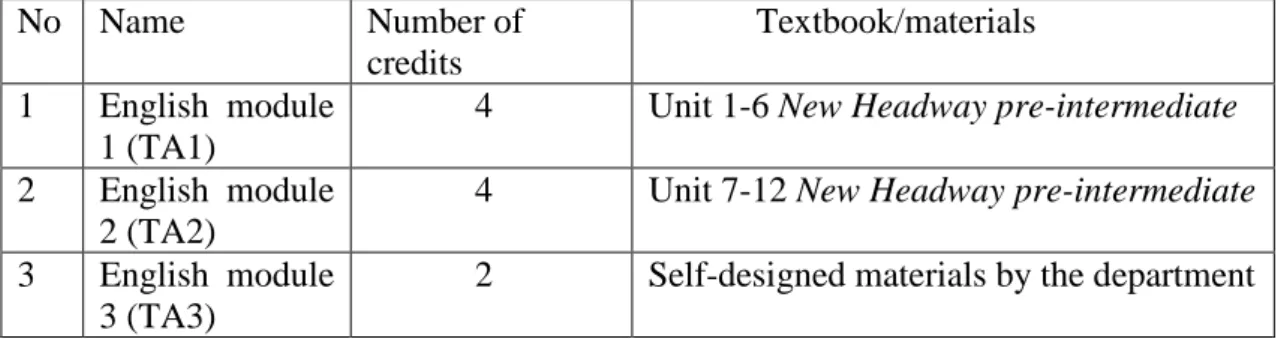
There have been a number of changes in the English curriculum for students at RU since 2011. The time allocated for English used to be ten credits1, which accounted for approximately 8.3% of the total 120 credits required for a four-year undergraduate program. These ten credits were allocated to three modules of English. English modules 1 and 2 were worth four credits each and were intended to help students at RU acquire
28
basic grammar items, vocabulary on various topics, and basic English communication skills. The textbook used for both English module 1 and 2 was New Headway pre-intermediate (Soars & Soars, 2007) with English module 1 covering the first six units in the book and English module 2 covering the remaining six units. English module 3 was granted two credits and focused on ‘English for Water Resources’, which was expected to help students of varied disciplines in the university to have basic vocabulary in their professions and equip them with comprehension and translation skills for reading in their field. The English department adopted ‘self-design’ materials for this module (see table 2.1).
Table 2.1 The general curriculum for English at RU before 2011
No Name Number of
credits
Textbook/materials 1 English module
1 (TA1)
4 Unit 1-6 New Headway pre-intermediate 2 English module
2 (TA2)
4 Unit 7-12 New Headway pre-intermediate 3 English module
3 (TA3)
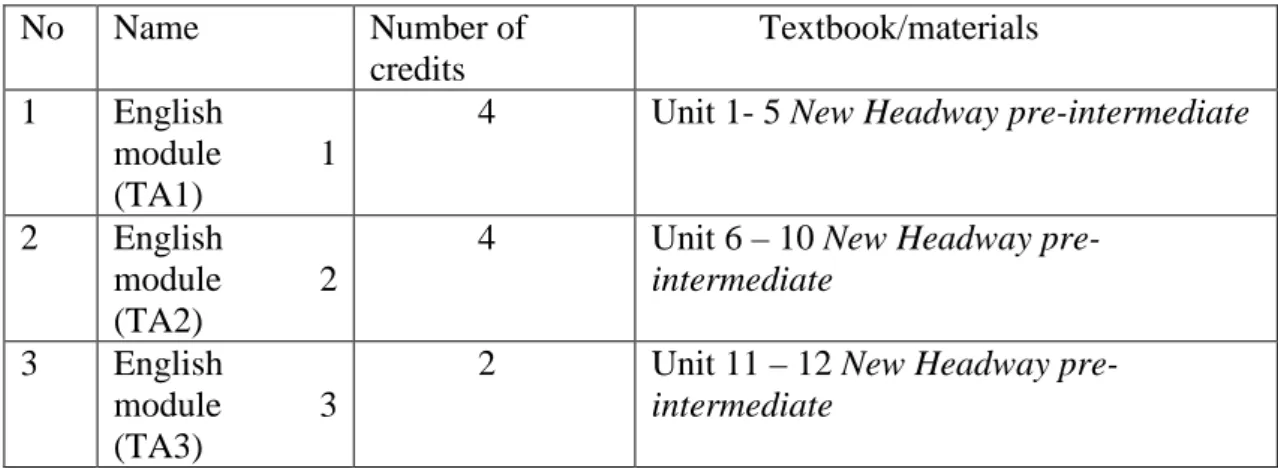
2 Self-designed materials by the department In 2011, the English department made alterations to its English curriculum because English module 3 proved to be ineffective, putting too much pressure on students who found it too difficult. In the ‘altered’ curriculum, ‘English for Water Resources’ was removed from the curriculum and replaced by a new English module 3. English modules 1 and 2 were then modified to cover five units each (one unit fewer) to save the last two units for the new English module 3 (see table 2.2).
29
Table 2.2 The ‘altered’ curriculum for English at RU in 2011
No Name Number of credits Textbook/materials 1 English module 1 (TA1)
4 Unit 1- 5 New Headway pre-intermediate
2 English
module 2 (TA2)
4 Unit 6 – 10 New Headway pre-intermediate
3 English
module 3 (TA3)
2 Unit 11 – 12 New Headway pre-intermediate
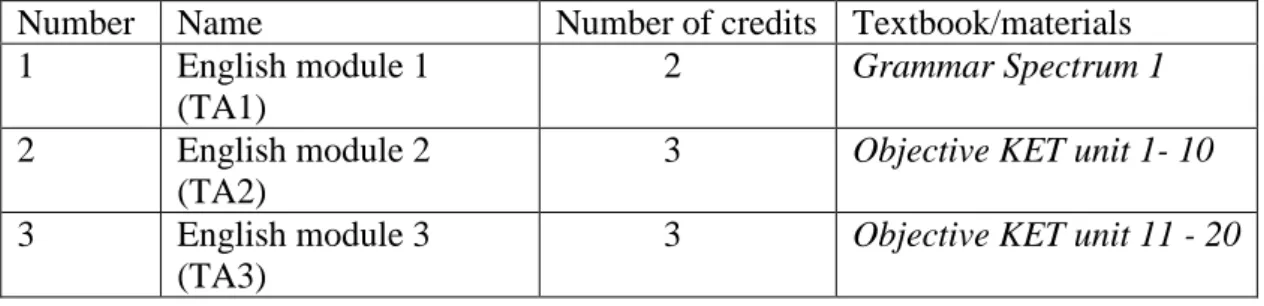
However, the ‘altered’ curriculum for English was not in use for long. In 2012, the university management decided to cut down the credits for English from 10 to 8. In addition, the National Foreign Language Project 2020, which put emphasis on foreign language (mostly English), teaching and learning in all education levels from primary to tertiary level, requested universities to set explicit standards for English competency for their undergraduates. It also required them to develop detailed pathways and curricula that could assist students in reaching the set standard. RU was no exception. Therefore, in response to these emerging requirements, the English department developed a new curriculum for English in 2012. This curriculum was designed to adjust to the decrease in credits allocated for English that the university proposed and the requirement for English competency for undergraduates proposed by ‘The 2020 Project’ of the Ministry of Education and Training. It was stated in the proposed curriculum that English would be taught and assessed in reference to ‘Khung Nang Luc Ngoai Ngu Viet Nam’
(KNLNNVN) (the Vietnam Framework of Reference for English)—an adapted version of the Common European Framework of Reference (CEFR), which comprises six levels from A1 to C2. The requirement for English competency for RU undergraduates is A2.
The new curriculum for English still consisted of three English modules. Two credits were granted for English module 1, and three credits each were granted to