The van der Waals interaction between protein molecules
in an electrolyte solution
Xueyu Songa)and Xuefeng Zhao
Department of Chemistry, Iowa State University, Ames, Iowa 50011
共Received 3 September 2003; accepted 27 October 2003兲
In this report we present a general formulation to calculate the van der Waals interaction between two protein molecules in an electrolyte solution using boundary element method of solving linearized Poisson–Boltzmann equation. Our formulation is based upon an inhomogeneous dielectric model of proteins at the residue level. Our results for bovine pancreatic trypsin inhibitor at various relative orientations indicate that the anisotropy of the interaction can be tens of kBT.
© 2004 American Institute of Physics. 关DOI: 10.1063/1.1634955兴
I. INTRODUCTION
In this report, we present a general formulation to esti-mate the van der Waals interactions between two protein molecules in an electrolyte solution. Since one of the main objectives of this work is to assess the extent of anisotropy of such interactions the formulation is given based upon a coarse-grained model of proteins at the residue level. An application of our formulation to the van der Waals interac-tions between two bovine pancreatic inhibitor 共BPTI兲 mol-ecules in an aqueous solution indicates that the anisotropy can be as large as tens of kBT as a function of relative
ori-entations between two protein molecules.
Because of the ubiquity of van der Waals interaction in physics, chemistry, and biology, theories of such interactions have a long and rich history. The first elucidation of the quantum mechanical nature of such interactions was given by London,1 later by Casimir and Polder,2 taking fully into account the retardation effects. In 1963 McLachlan presented a generalized theory to account for the electronic and nuclear polarizabilty of molecules and the solvent effect on the interaction.3 Along a different line, Lifshitz formulated a general theory for the van der Waals interactions between two macroscopic bodies in a dielectric medium using their dielectric spectra from quantum electrodynamics.4After that a semiclassical formulation of Lifshitz theory using a Drude oscillator model of a dielectric body had been developed and our current formulation is greatly influenced by such a formulation.5 A detailed presentation of these theories and their applications has been given in an authoritative mono-graph by Mahanty and Ninham.6
Up to now, applications of van der Waals theories to proteins have been restricted to simple geometries, essen-tially between two spherical protein molecules characterized by a frequency-dependent dielectric function.7 Recently we have shown that anisotropic interactions between proteins molecules play an important role in forming suitable crystals for the diffraction experiments.8As a first step toward a re-alistic model to assess the anisotropy of protein–protein in-teractions, we have developed a coarse-grained model of a
protein at the residue level.9Based upon this model the van der Waals interaction between two protein molecules in an electrolyte solution is specified by the intrinsic polarizabil-ities of twenty amino acids in nature and the dielectric spec-tra of the electrolyte solution. This report presents a general formulation to estimate such interactions. It should be noted that our formulation is distinctly different from the van der Waals interactions in force field models used in molecular simulations. In that case the van der Waals interaction pa-rameters are obtained from individual atomic electronic po-larizabilities. In order to extract the van der Waals contribu-tion to protein–protein interaccontribu-tion in a solucontribu-tion, detailed atomistic simulations are performed to obtain the potential of mean force. In our case the van der Waals interaction is obtained from the polarizabilities of amino acids and the dielectric spectra of solution without atomistic simulations.
The paper is organized in the following manner: In Sec. II we will present a general formulation of the problem and its relations to previous work. In order to apply our general formulation to the van der Waals interaction between two protein molecules with realistic shape frequency-dependent reaction field at various residue positions are needed. Such calculations are presented in Sec. III based upon boundary element method of solving linearized Poisson–Boltzmann equation. An application of our formulation to simple two-sphere system yields results which agree with analytical re-sults from the literature. In Sec. V applications to the BPTI case is given with details of our implementation. The paper is concluded with a discussion on the future applications of our formulation to protein crystallization.
II. GENERAL FORMULATION
In our coarse-grained model of a protein,9each residue is represented by a sphere located at the geometric center of the residue determined by the protein’s native structure. The di-ameter of the sphere is determined by the molecular volume of the residue. The molecular surface of our model protein is defined as a Richard–Connolly surface spanned by the union of these residue spheres.10,11 Each residue carries a perma-nent dipole moment located at the center of its sphere and the direction of the dipole is given by the amino acid type of a兲Electronic mail: [email protected]
2005
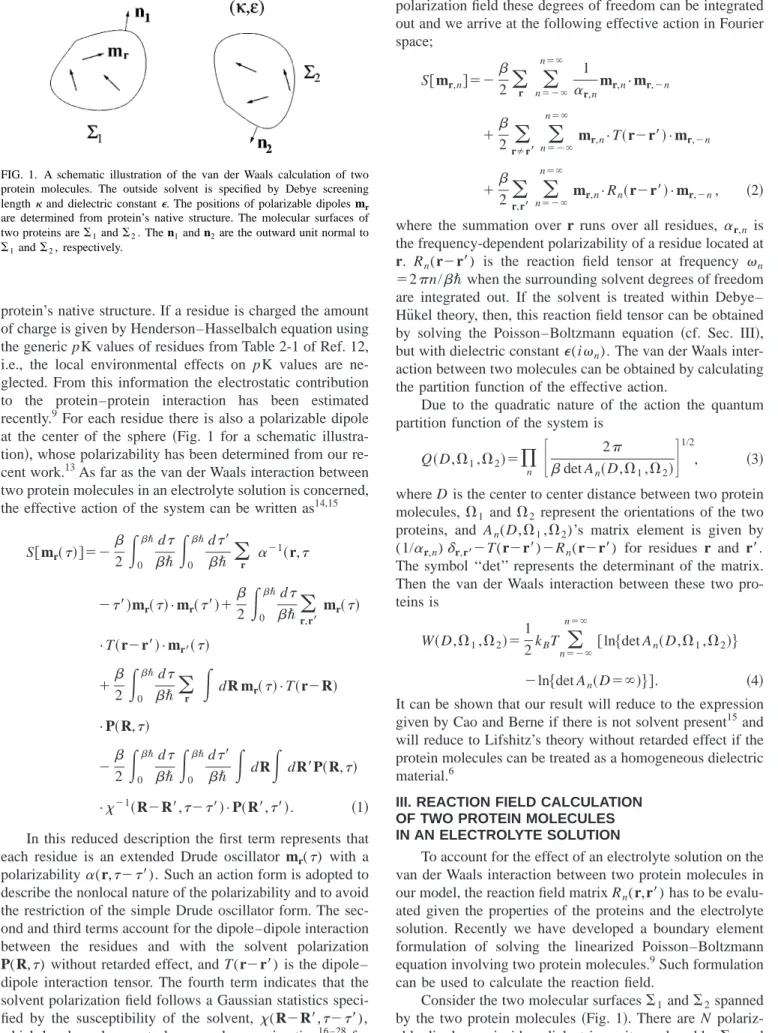
protein’s native structure. If a residue is charged the amount of charge is given by Henderson–Hasselbalch equation using the generic pK values of residues from Table 2-1 of Ref. 12, i.e., the local environmental effects on pK values are ne-glected. From this information the electrostatic contribution to the protein–protein interaction has been estimated recently.9 For each residue there is also a polarizable dipole at the center of the sphere 共Fig. 1 for a schematic illustra-tion兲, whose polarizability has been determined from our re-cent work.13As far as the van der Waals interaction between two protein molecules in an electrolyte solution is concerned, the effective action of the system can be written as14,15
S关mr共兲兴⫽⫺  2
冕
0 បd ប冕
0 បd⬘
ប兺
r ␣ ⫺1共r, ⫺⬘
兲mr共兲•mr共⬘兲
⫹  2冕
0 បd ប兺
r,r⬘ mr共兲 •T共r⫺r⬘兲
•mr⬘共兲 ⫹2冕
0 បd ប兺
r冕
dR mr共兲•T共r⫺R兲 •P共R,兲 ⫺2冕
0 បd ប冕
0 បd⬘
ប冕
dR冕
dR⬘
P共R,兲 •⫺1共R⫺R⬘
,⫺⬘
兲•P共R⬘
,⬘
兲. 共1兲In this reduced description the first term represents that each residue is an extended Drude oscillator mr() with a polarizability␣(r,⫺
⬘
). Such an action form is adopted to describe the nonlocal nature of the polarizability and to avoid the restriction of the simple Drude oscillator form. The sec-ond and third terms account for the dipole–dipole interaction between the residues and with the solvent polarizationP(R,) without retarded effect, and T(r⫺r
⬘
) is the dipole– dipole interaction tensor. The fourth term indicates that the solvent polarization field follows a Gaussian statistics speci-fied by the susceptibility of the solvent, (R⫺R⬘
,⫺⬘
), which has been known to be a good approximation16 –28for polar solvents. Due to the quadratic nature of the solventpolarization field these degrees of freedom can be integrated out and we arrive at the following effective action in Fourier space; S关mr,n兴⫽⫺  2
兺
r n⫽⫺⬁兺
n⫽⬁ 1 ␣r,n mr,n•mr,⫺n ⫹2兺
r⫽r⬘n⫽⫺兺
⬁ n⫽⬁ mr,n•T共r⫺r⬘
兲•mr,⫺n ⫹2兺
r,r⬘ n⫽⫺⬁兺
n⫽⬁ mr,n•Rn共r⫺r⬘兲
•mr,⫺n, 共2兲 where the summation over r runs over all residues, ␣r,n isthe frequency-dependent polarizability of a residue located at
r. Rn(r⫺r
⬘
) is the reaction field tensor at frequency n ⫽2n/ប when the surrounding solvent degrees of freedom are integrated out. If the solvent is treated within Debye– Hu¨kel theory, then, this reaction field tensor can be obtained by solving the Poisson–Boltzmann equation 共cf. Sec. III兲, but with dielectric constant⑀(in). The van der Waals inter-action between two molecules can be obtained by calculating the partition function of the effective action.Due to the quadratic nature of the action the quantum partition function of the system is
Q共D,⍀1,⍀2兲⫽
兿
n冋
2 det An共D,⍀1,⍀2兲册
1/2 , 共3兲where D is the center to center distance between two protein molecules, ⍀1 and⍀2 represent the orientations of the two
proteins, and An(D,⍀1,⍀2)’s matrix element is given by
(1/␣r,n)␦r,r⬘⫺T(r⫺r
⬘
)⫺Rn(r⫺r⬘
) for residues r and r⬘
. The symbol ‘‘det’’ represents the determinant of the matrix. Then the van der Waals interaction between these two pro-teins is W共D,⍀1,⍀2兲⫽1 2kBTn⫽⫺⬁兺
n⫽⬁ 关ln兵det An共D,⍀1,⍀2兲其 ⫺ln兵det An共D⫽⬁兲其兴. 共4兲 It can be shown that our result will reduce to the expression given by Cao and Berne if there is not solvent present15and will reduce to Lifshitz’s theory without retarded effect if the protein molecules can be treated as a homogeneous dielectric material.6III. REACTION FIELD CALCULATION OF TWO PROTEIN MOLECULES IN AN ELECTROLYTE SOLUTION
To account for the effect of an electrolyte solution on the van der Waals interaction between two protein molecules in our model, the reaction field matrix Rn(r,r
⬘
) has to be evalu-ated given the properties of the proteins and the electrolyte solution. Recently we have developed a boundary element formulation of solving the linearized Poisson–Boltzmann equation involving two protein molecules.9Such formulation can be used to calculate the reaction field.Consider the two molecular surfaces⌺1and⌺2 spanned
by the two protein molecules 共Fig. 1兲. There are N polariz-able dipoles mrinside a dielectric cavity enclosed by⌺1and
there are N polarizable dipoles inside a dielectric cavity
en-FIG. 1. A schematic illustration of the van der Waals calculation of two protein molecules. The outside solvent is specified by Debye screening lengthand dielectric constant⑀. The positions of polarizable dipoles mr
are determined from protein’s native structure. The molecular surfaces of two proteins are⌺1and⌺2. The n1and n2are the outward unit normal to ⌺1and⌺2, respectively.
closed by⌺2. Inside the dielectric cavities the dielectric con-stant is one and the dielectric concon-stant of the solution is ⑀. The ionic strength of the solution yields Debye screening length . If we recognize that for the calculation of the po-tential at the molecular surfaces a dipole m at r0 can be described by an effective charge density eff(r)⫽⫺mⵜ␦(r ⫺r0),29 then, the reaction field matrix involving residues ri and rj can be written as
R共ri,rj兲⫽
冕 冕
⌺p 关ⵜiF共ri,rj兲 ⫺ⵜiP共ri,rj兲兴 p np共 rj,rp兲drp ⫹冕 冕
⌺p冋
⫺ⵜi F nj共 ri,rj兲 ⫹ⵜi P nj共 ri,rj兲⑀册
p共rj,rp兲drp ⫹4ⵜiⵜjF共ri,rj兲, 共5兲 where F共ri,rj兲⫽ 1 4兩ri⫺rj兩 , 共6兲 P共ri,rj兲⫽ e⫺兩ri⫺rj兩 4兩ri⫺rj兩, 共7兲and p can be 1 or 2 depending upon rj being in ⌺1 or ⌺2.
p/np andpcan be obtained from solving the following integral equations:9,30 1 2共1⫹⑀兲1共ri,r01兲⫹
冕 冕
⌺ 1 L1共r1,r01兲1共ri,r1兲dr1 ⫹冕 冕
⌺1 L2共r1,r01兲1 n1共 ri,r1兲dr1 ⫺冕 冕
⌺2 L1共r2,r01兲2共ri,r2兲dr2 ⫹冕 冕
⌺2 L2共r2,r01兲 2 n2共 ri,r2兲dr2 ⫽ⵜiF共ri,r01兲, 共8兲 1 2冉
1⫹ 1 ⑀冊
1 n1共 ri,r01兲⫹冕 冕
⌺1 L3共r1,r01兲1共ri,r1兲dr1 ⫹冕 冕
⌺1 L4共r1,r01兲 1 n1共ri,r1兲dr1 ⫺冕 冕
⌺2 L3共r2,r01兲2共ri,r2兲dr2 ⫹冕 冕
⌺2 L4共r2,r01兲 2 n2共ri,r2兲dr2 ⫽ⵜi F n01共 ri,r01兲, 共9兲 1 2共1⫹⑀兲2共ri,r02兲⫺冕 冕
⌺ 1 L1共r1,r02兲1共ri,r1兲dr1 ⫹冕 冕
⌺1 L2共r1,r02兲 1 n1共 ri,r1兲dr1 ⫹冕 冕
⌺2 L1共r2,r02兲2共ri,r2兲dr2 ⫹冕 冕
⌺2 L2共r2,r02兲2 n2共 ri,r2兲dr2 ⫽ⵜiF共ri,r02兲, 共10兲 1 2冉
1⫹ 1 ⑀冊
2 n2共 ri,r02兲⫺冕 冕
⌺1 L3共r1,r02兲1共r1兲dr1 ⫹冕 冕
⌺1 L4共r1,r02兲 1 n1共 ri,r1兲dr1 ⫹冕 冕
⌺2 L3共r2,r02兲2共ri,r2兲dr2 ⫹冕 冕
⌺2 L4共r2,r02兲 2 n2共ri,r2兲dr2 ⫽ⵜi F n02共 ri,r02兲, 共11兲 where L1共r,r1兲⫽ F n共r,r1兲⫺ P n共r,r1兲⑀, 共12兲 L2共r,r1兲⫽P共r,r1兲⫺F共r,r1兲, 共13兲 L3共r,r1兲⫽ 2F nn1共 r,r1兲⫺ 2P nn1共 r,r1兲, 共14兲 L4共r,r1兲⫽⫺ F n共r,r1兲⫹ P n共r,r1兲1/⑀. 共15兲Using the collocation method by Atkinson and co-workers9,31,32the above-mentioned integral equations can be solved and the reaction field matrix elements can be ob-tained from Eq. 共5兲. It should be noted that for each fre-quency n there is a reaction field matrix corresponding to dielectric constant⑀(in).
At room temperature n is the order of 1014rad/s.6,33 For the electrolyte solution of interests, say 0.1 molar, the ion plasma frequency is of the order of 1012rad/s. At frequencies higher than the plasma frequency, the ionic motions can be neglected. Thus, the n⫽0 term in Eq. 共4兲 should be calcu-lated from Poisson–Boltzmann equation, whereas the n⬎0 terms can be calculated from Poisson equation.
IV. VAN DER WAALS INTERACTION BETWEEN TWO POLARIZABLE DIPOLES LOCATED AT THE CENTERS OF TWO SPHERES IN AN ELECTROLYTE SOLUTION
In order to illustrate the application of the above-noted general formation we will calculate the van der Waals
inter-action between two polarizable dipoles at the centers of two spheres. For simplicity we assume the polarizability takes the Drude oscillator form with static polarizability ␣共0兲and the characteristic frequency c, an approximation solution for the n⫽0 term has been obtained
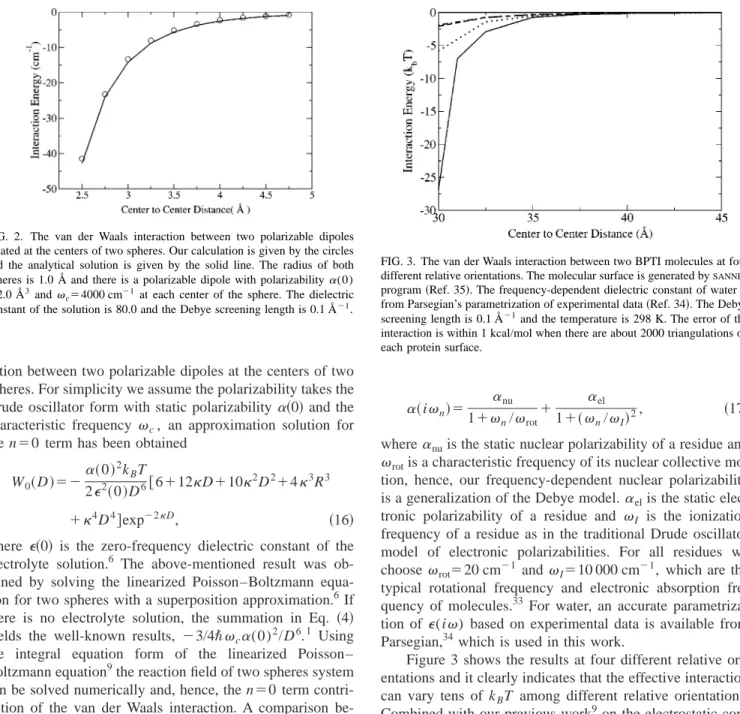
W0共D兲⫽⫺␣共0兲 2k BT 2⑀2共0兲D6关6⫹12D⫹10 2D2⫹43R3 ⫹4D4兴exp⫺2D, 共16兲 where ⑀共0兲 is the zero-frequency dielectric constant of the electrolyte solution.6 The above-mentioned result was ob-tained by solving the linearized Poisson–Boltzmann equa-tion for two spheres with a superposiequa-tion approximaequa-tion.6 If there is no electrolyte solution, the summation in Eq. 共4兲 yields the well-known results, ⫺3/4បc␣(0)2/D6.1 Using the integral equation form of the linearized Poisson– Boltzmann equation9the reaction field of two spheres system can be solved numerically and, hence, the n⫽0 term contri-bution of the van der Waals interaction. A comparison be-tween our numerical calculation and the analytical expres-sion is shown in Fig. 2. Except for some small minor deviations when the two spheres are really close, where the superposition approximation is not accurate anymore, the comparison demonstrates the utility of our approach.
V. THE VAN DER WAALS INTERACTIONS BETWEEN TWO BPTI MOLECULES IN AN ELECTROLYTE SOLUTION
Using the above-mentioned formulation the effective in-teractions between two BPTI molecules can be calculated at various distances and orientations. The static nuclear and electronic polarizabilities of each amino acid are given in Table 1 of Ref. 13. But accurate frequency-dependent polar-izabilities are not available either from theoretical or experi-mental studies. In the work, we adopt a simple model to account for the frequency-dependent polarizability.33 Namely, the total polarizability of a residue can be written as
␣共in兲⫽ ␣nu 1⫹n/rot ⫹ ␣el 1⫹共n/I兲2 , 共17兲
where␣nuis the static nuclear polarizability of a residue and rotis a characteristic frequency of its nuclear collective
mo-tion, hence, our frequency-dependent nuclear polarizability is a generalization of the Debye model.␣elis the static elec-tronic polarizability of a residue and I is the ionization frequency of a residue as in the traditional Drude oscillator model of electronic polarizabilities. For all residues we chooserot⫽20 cm⫺1 and
I⫽10 000 cm⫺1, which are the typical rotational frequency and electronic absorption fre-quency of molecules.33 For water, an accurate parametriza-tion of ⑀(i) based on experimental data is available from Parsegian,34 which is used in this work.
Figure 3 shows the results at four different relative ori-entations and it clearly indicates that the effective interaction can vary tens of kBT among different relative orientations. Combined with our previous work9 on the electrostatic con-tribution to the effective interaction between two protein molecules we now have a reliable way to evaluate protein– protein interactions in an aqueous solution within the frame-work of DLVO theory. Our method can be applied to any realistic shape of protein molecules, thus, an accurate orien-tationally dependent potential between two protein mol-ecules can be obtained. Such a potential will be the first step toward the study of phase behaviors of protein solutions. It should be noted that the estimated anisotropy may change as two protein molecules become really close since the con-tinuum model is adopted in our formulation. Thus, it is worthwhile to explore the effect due to the molecular nature of the solvent on the anisotropy.
ACKNOWLEDGMENTS
The authors are grateful for financial support by a Petro-leum Research Fund, administrated by American Chemical Society共initial stage兲and NSF Grant No. CHE0303758. The calculations in this work were performed in part on an IBM
FIG. 2. The van der Waals interaction between two polarizable dipoles located at the centers of two spheres. Our calculation is given by the circles and the analytical solution is given by the solid line. The radius of both spheres is 1.0 Å and there is a polarizable dipole with polarizability␣(0)
⫽2.0 Å3andc⫽4000 cm⫺1at each center of the sphere. The dielectric constant of the solution is 80.0 and the Debye screening length is 0.1 Å⫺1.
FIG. 3. The van der Waals interaction between two BPTI molecules at four different relative orientations. The molecular surface is generated bySANNER
program共Ref. 35兲. The frequency-dependent dielectric constant of water is from Parsegian’s parametrization of experimental data共Ref. 34兲. The Debye screening length is 0.1 Å⫺1and the temperature is 298 K. The error of the
interaction is within 1 kcal/mol when there are about 2000 triangulations on each protein surface.
workstation cluster made possible by grants from IBM in the form of a Shared University Research grant, the United States Department of Energy, and the United States Air Force Office of Scientific Research.
1
F. London, Trans. Faraday Soc. 33, 8共1937兲.
2H.B. Casimir and D. Polder, Phys. Rev. 73, 360共1948兲. 3A.D. Mclachlan, Proc. R. Soc. London, Ser. A 271, 387共1963兲. 4E.M. Lifshitz, Sov. Phys. JETP 2, 73共1956兲.
5
D. Langbein, ‘‘Theory of van der Waals attraction’’, in Springer Tracts in Modern Physics共Springer, Berlin, 1974兲, 1st ed.
6J. Mahanty and B.W. Ninham, Dispersion Forces共Academic, London,
1976兲.
7C.M. Roth, B.L. Neal, and A.M. Lenhoff, Biophys. J. 70, 977共1996兲. 8
X. Song, Phys. Rev. E 66, 011909共2002兲.
9X. Song, Mol. Simul. 29, 643共2003兲.
10B. Lee and F.M. Richards, J. Mol. Biol. 55, 379共1971兲. 11M.L. Connolly, Science 221, 709共1983兲.
12
L. Stryer, Biochemistry, 3rd ed.共Freeman, New York, 1988兲.
13
X. Song, J. Chem. Phys. 116, 9359共2002兲.
14X. Song, D. Chandler, and R.A. Marcus, J. Phys. Chem. 100, 11954
共1996兲.
15J. Cao and B.J. Berne, J. Chem. Phys. 97, 8628共1992兲. 16
J.D. Simon, Acc. Chem. Res. 21, 128共1988兲.
17G.R. Fleming and P.G. Wolynes, Phys. Today 43, 36共1990兲.
18P.F. Barbara and W. Jarzeba, in Advances in Photochemistry, edited by K.
Gollnick, D.H. Volman, and G.S. Hammond共Wiley, New York, 1990兲.
19
M. Maroncelli, J. Mol. Liq. 57, 75共1993兲.
20J.T. Hynes, in Understanding Chemical Reactivity, Ultrafast Dynamics of
Chemical Systems, Vol. 7共Kluwer Academic, Dordrecht, 1994兲, p. 345.
21P.J. Rossky and J.D. Simon, Nature共London兲370, 263共1994兲. 22G.R. Fleming and M. Cho, Annu. Rev. Phys. Chem. 47, 109共1996兲. 23
R.M. Stratt and M. Maroncelli, J. Phys. Chem. 100, 12981共1996兲.
24
E.W. Castner, Jr. and M. Maroncelli, J. Mol. Liq. 77, 1共1999兲.
25
W.P. De Boeij, M.S. Pshenichnikov, and D.A. Wiersma, Annu. Rev. Phys. Chem. 49, 99共1998兲.
26
S. Mukamel, Principles of Nonlinear Optical Spectroscopy, 1st ed.共 Ox-ford University Press, New York, 1995兲.
27
X. Song, In G. Hummer and L.R. Pratt, editors, Treatment of Electrostatic Interactions in Computer Simulations of Condensed Media, volume关AIP Conf. Proc. 492, 427共1999兲兴.
28N. Nandi, K. Bhattacharyya, and B. Bagchi, Chem. Rev. 100, 2013
共2000兲.
29J.D. Jackson, Classical Electrodynamics, 2nd ed. 共Wiley, New York,
1975兲.
30A.H. Juffer, E.F.F. Botta, B.A.M. van Keulen, A. van der Ploeg, and H.J.C.
Berendsen, J. Comput. Phys. 97, 144共1991兲.
31K. Atkinson, The Numerical Solution of Fredholm Integral Equations of
the Second Kind, 1st ed.共Cambridge University Press, Cambridge, 1997兲.
32
X. Song and D. Chandler, J. Chem. Phys. 108, 2594共1998兲.
33J. Israelachvili, Intermolecular and Surface Forces, 2nd ed.共Academic,
London, 1992兲.
34V.A. Parsegian, in Physical Chemistry: Enriching Topic from Colloid and
Surface Science共Theorex, La Jolia, 1975兲.
35
M.F. Sanner, http://www.scripps.edu/pub/olson-web/people/sanner/html/ msms–home.html