Synthesis of applica on specific processor
architectures for ultra-low energy consump on
Tom J. Kazmierski and Charles Leech
Electronics and Computer Science, Faculty of Physical Sciences and Engineering
University of Southampton, SO17 1BJ, UK
{tjk,cl19g10}@ecs.soton.ac.uk
Abstract—In this paper we suggest that furtheren-ergy savings can be achieved by a new approach to syn-thesis of embedded processor cores, where the architec-ture is tailored to the algorithms that the core executes. In the context of embedded processor synthesis, both single-core and many-core, the types of algorithms and demands on the execution efficiency are usually known at the chip design time. This knowledge can be utilised at the design stage to synthesise architectures opti-mised for energy consumption. Firstly, we present an overview of both traditional energy saving techniques and new developments in architectural approaches to energy-efficient processing. Secondly, we propose a pi-coMIPS architecture that serves as an architectural template for energy-efficient synthesis. As a case study, we show how the picoMIPS architecture can be tailored to an energy efficient execution of the DCT algorithm.
I. Introduction
Much research has been recently devoted to the de-velopment of energy efficient technologies in single-core and many-core processor systems leading to further ings in power consumption. Both traditional power sav-ing techniques as well as novel architectures, includsav-ing heterogeneous many-core architectures and reconfigurable architectures have been developed. The new research has been stimulated largely by the fact that the introduction of multi-core structures to processor architectures caused a significant increase in the power consumption of these systems. In addition, the gap between the average power and peak power has widened as the level of core integration increases [1].
Many energy efficiency and power saving technologies are already integrated into processor architectures in order to reduce power dissipation and extend battery life, espe-cially in mobile devices. A combination of technologies is most commonly implemented to achieve the best energy efficiency whilst still allowing the system to meet perfor-mance targets [2]. Techniques to increase energy efficiency can be applied at many development levels from architec-ture co-design and code compilation to task scheduling, run-time management and application design [3]. Tradi-tional techniques include Dynamic Voltage and Frequency Scaling (DVFS), clock gating and clock distribution and power domains. DVFS is a technique used to control the power consumption of a processor through fine adjustment
of the clock frequency and supply voltage levels [1][2][3][4]. High levels are used when meeting performance targets is a priority and low levels (known as CPU throttling) are used when energy efficiency is most important or high performance is not required. When the supply voltage is lowered and the frequency reduced, the execution of instructions by the processor is slower but performed more energy efficiently due to the extension of delays in the pipeline stages.
Further savings are achieved by the use of power do-mains, where regions of a system or a processor that are controlled from a single supply can be completely powered down in order to minimise power consumption without entirely removing the power supply to the system. Power domains can be used dynamically and in conjunction with clock gating. The ARM Cortex-A15 MPCore processor supports multiple power domains both for the core and for the surrounding logic [6]. Figure 1 shows these domains, labelled Processor and Non-Processor, that allow large parts of the processor to be deactivated. Smaller internal domains, such as CK_GCLKCR, are implemented to allow smaller sections to be deactivated for finer perfor-mance and power variations.
Modelling and simulation of many-core processors is also an important area as it allows to understand better the complex interactions that occur inside a system and cause power and energy consumption [9], [10], [11], [12], [13]. For example, the model created by Basmadjian et al. [10] is tailored for many-core architectures in that it accounts for resource sharing and power saving mechanisms.
In this paper we suggest that further energy savings can be achieved by a new approach to synthesis of em-bedded processor cores, where the architecture is tailored to the algorithms that the core exectutes. In the context of embedded processor synthesis, both single-core and many-core, the types of algorithms and demands on the execution efficiency are usually known at the chip design time. This knowledge can be utilised at the design stage. As a case study, we propose in section III a picoMIPS architecture that can be tailored to an energy efficient execution of the DCT algorithm.
Fig. 1: The ARM Cortex-A15 features multiple power domains for the core and surrounding logic, reprinted from [6].
II. Recent developments in energy efficient architectures
A. Pipeline Balancing
Pipeline balancing (PLB) is now an established tech-nique used to dynamically adjust the resources of the pipeline of a processor such that it retains performance while reducing power consumption [14]. Power balanced pipelines is a concept in which the power disparity of pipeline stages is reduced by assigning different delays to each microarchitectural pipestage while guaranteeing a certain level of performance/throughput ratio [15]. Static power balancing is performed during design time to iden-tify power heavy circuitry in pipestages for which con-sumption remains fairly constant for different programs and reallocate cycle time accordingly. Dynamic power balancing is implemented on top of this to manage power fluctuations within each workload and further reduce the total power cost. Power savings are also greater at lower frequencies. The delay constraints on microarchitectural pipeline stages can be modified in order to make them more power efficient, in a similar way to DVFS, when the performance demand of the application is relaxed [15]. PLB can also operate in response to instruction per cycle (IPC) variations within a program [14]. Here the PLB mechanism dynamically reduces the issue width of the pipeline to save power or increases it to boost throughput.
B. Caches and Interconnects
It is not only the design of the processor’s internal circuitry that is important in maintaining energy effi-ciency. Careful co-design of the interconnect, caches and the processor cores is required to achieve high performance and energy efficiency [16]. High level of integration that is inherent in multiple-processor systems can be utilised to educe the interconnect power consumption by improving cache coherence protocols [17]. An average of 16.3% of L2 cache accesses could be optimised and as every ac-cess consumes time and power, an average 9.3% power reduction is recorded while increasing system performance by 1.4% [17]. Recently a new methodology has been pro-posed [10] for estimating the power consumption of multi-core processors. It takes into account resource sharing and power saving mechanism on top of the power consumption of each core.
C. Energy Efficiency techniques in Heterogeneous Multi-core Architectures
A heterogeneous or asymmetric multi-core architecture is composed of cores of varying size and complexity which are designed to complement each other in terms of per-formance and energy efficiency [8]. A typical system will implement a small core to process simple tasks, in an en-ergy efficient way, while a larger core provides higher per-formance processing for when computationally demanding tasks are presented. The cores represent different points
in the power/performance design space and significant energy efficiency benefits can be achieved by dynamically allocating application execution to the most appropriate core [18]. A task matching or switching system is also implemented to intelligently assign tasks to cores; bal-ancing a performance demand against maintaining system energy efficiency. These systems are particularly good at saving power whilst handling a diverse workload where fluctuations of high and low computational demand are common [19].
A heterogeneous architecture can be created in many different ways and many alternative have been developed due to the heavy research interest in this area. Modifi-cations to general purpose processors, such as asymmetric core sizes [13], custom accelerators [20], varied caches sizes [21] and heterogeneity within each core [22][7], have all been demonstrated to introduce heterogeneous features into a system.
One of the most prominent and successful heterogeneous architectures to date is the ARM big.LITTLE system. This is a production example of a heterogeneous mul-tiprocessor system consisting of a compact and energy efficient “LITTLE” Cortex-A7 processor coupled with a higher performance “big” Cortex-A15 processor [19]. The system is designed with the dynamic usage patterns of modern smart phones in mind where there are typically periods of high intensity processing followed by longer periods of low intensity processing [23]. Low intensity tasks, such as texting and audio, can be handled by the A7 processor enabling a mobile device to save battery life. When a period of high intensity occurs, the A15 processor can be activated to increase the system’s throughput and meet tighter performance deadlines. A power saving of up to 70% is advertised for a light workload, where the A7 processor can handle all of the tasks, and a 50% saving for medium workloads where some tasks will require allocation to the A15 processor.
Kumar et al present an alternative implementation where two architectures from the Alpha family, the EV5 and EV6, are combined to be more energy and area effi-cient than a homogeneous equivalent [8][18]. They demon-strate that a much higher throughput can be achieved due to the ability of a heterogeneous multi-core architecture to better exploit changes in thread-level parallelism as well as inter- and intra- thread diversity [8]. In [18], they evaluate the system in terms of its power efficiency indicating a 39% average energy reduction for only a 3% performance drop [18].
Composite Cores is a microarchitectural design that re-duces the migration overhead of task switching by bringing heterogeneity inside each individual core [22]. The design contains 2 separate backend modules, calledµEngines, one of which features a deeper and more complex out-of-order pipeline, tailored for higher performance, while the other features a smaller, compact in-order pipeline designed with energy efficiency in mind. Figure Due to the high level of
Fig. 2: The microarchitecture for Composite Cores, fea-turing two µEngines, reprinted from [22].
hardware resource sharing and the small µEngine state, the migration overhead is brought down from the order of 20,000 instructions to 2000 instructions. This greatly reduces the energy expenditure associated with migration and also allows more of the task to be run in an efficient mode. Their results show that the system can achieve an energy saving of 18% using dynamic task migration whilst only suffering a 5% performance loss.
Using both a heterogeneous architecture and hardware reconfiguration, a technique called Dynamic Core Mor-phing (DCM) is developed by Rodrigues et al to allow the shared hardware of a few tightly coupled cores to be morphed at run-time [7]. The cores all feature a baseline configuration but reconfiguration can trigger the re-assignment of high performance functional units to different cores to speed up execution. The efficiency of the system can lead to performance per watt gains of up to 43% and an average saving of 16% compared to a homogeneous static architecture.
The energy efficiency benefits of heterogeneity can only be exploited with the correct assignment of tasks or applications to each core [9] [24][25][26][12]. Tasks must be assigned in order to maximise energy efficiency whilst ensuring performance deadlines are met. Awan et al per-form scheduling in two phases to improve energy efficiency; task allocation to minimise active energy consumption and exchange of higher energy states to lower, more energy ef-ficient sleep states [9]. Alternatively, Calcado et al propose division of tasks into m-threads to introduce fine-grain parallelism below thread level [27]. Moreover, Saha et al include power and temperature models into an adaptive task partitioning mechanism in order to allocate task according to their actual utilisations rather than based on a worst case execution time [12]. Simulation results confirm that the mechanism is effective in minimising energy consumption by 55% and reduces task migrations by 60% over alternative task partitioning schemes.
Tasks assignment can also be performed in response to program phases which naturally occur during execution when the resource demands of the application change. Phase detection is used by Jooya and Analoui to dynam-ically re-assigning programs for each phase to improve the performance and power dissipation of heterogeneous multi-core processors [25]. Programs are profiled in dy-namic time intervals in order to detect phase changes. Sawalha et al also propose an online scheduling technique that dynamically adjusts the program-to-core assignment as application behaviour changes between phases with an aim to maximise energy efficiency [26]. Simulated eval-uation of the scheduler shows energy saving of 16% on average and up to 29% reductions in energy-delay product can be achieved as compared to static assignments.
D. Energy Efficiency techniques in Reconfigurable Multi-core Architectures
Reconfigurability is another property that has the po-tential to increase the energy and area efficiency of pro-cessors and systems on chip by introducing adaptability and hardware flexibility into the architecture. Building on the innovations that heterogeneous architectures bring, reconfigurable architectures aim to achieve both energy efficiency and high performance but within the same processor and therefore meet the requirements of many embedded systems. The flexible heterogeneous Multi-Core processor (FMC) is an example of the fusion of these two architectures that can deliver both a high throughput for uniform parallel applications and high performance for fluctuating general purpose workloads [28]. Reconfigurable architectures are dynamic, adjusting their complexity, speed and performance level in response to the currently executing application. With this property in mind, we dis-regard systems that are statically reconfigurable but fixed while operating, such as traditional FPGAs, considering only architectures that are run-time reconfigurable.
E. Dynamic Partial Reconfiguration
FPGA manufacturers such as Xilinx and Altera now offer a mechanism called Dynamic Partial Reconfiguration (DPR) [29] or Self-Reconfiguration (DPSR) [30] to enable reconfiguration during run-time of the circuits within an FPGA, allowing a region of the design to change dynamically while other areas remain active [31]. The FPGA’s architecture is partitioned into a static region consisting of fixed logic, control circuits and an embedded processor that control and monitor the system. The rest of the design space is allocated to a dynamic/reconfigurable region containing a reconfigurable logic fabric that can be formed into any circuit whenever hardware acceleration is required.
PDR/PDSR presents energy efficiency opportunities over fixed architectures. PDR enables the system to react dynamically to changes in the structure or performance and power constraints of the application, allowing it to
address inefficiencies in the allocation of resources and more accurately implement changing software routines as dynamic hardware accelerators [29]. These circuits can then be easily removed or gated when they are no longer required to reduce power consumption [32]. PDR can also increase the performance of an FPGA based system because it permits the continued operation of portions of the dynamic region unaffected by reconfiguration tasks. Therefore, it allows multiple applications to be run in parallel on a single FPGA [30]. This property also im-proves the hardware efficiency of the system as, where separate devices were required, different tasks can now be implemented on a single FPGA, reducing power con-sumption and board dimensions. In addition, PDR reduces reconfiguration times due to the fact that only small modification are made to the bitstream over time and the entire design does not need to be reloaded for each change. A study into the power consumption patterns of DPSR programming was conducted by Bonamy et al[11] to investigate to what degree the sharing of silicon area between multiple accelerators will help to reduce power consumption. However, many parameters must be con-sidered to assess whether the performance improvement outweighs preventative factors such as reconfiguration overhead, accelerator area and idle power consumption and as such any gain can be difficult to evaluate. Their results show complex variations in power usage at different stages during reconfiguration that is dependent on factors like the previous configuration and the contents of the configured circuit. In response to these experiments, three power models are proposed to help analyse the trade-off between implementing tasks as dynamically reconfig-urable, in static configuration or in full software execution. Despite clear benefits, several disadvantages become ap-parent with this form of reconfigurable technology. As was shown above, the power consumption overhead associated with programming new circuits can effectively imposed a minimum size or usage time on circuits for implementation to be validated. In addition, a baseline power and area cost is also always created due to the large static region which continuously consumes power and can contain unnecessary hardware. Finally, the FPGA interconnect reduces the speed and increases the power consumption of the circuit compared to an ASIC implementation because of an in-creased gate count required to give the system flexibility.
F. Composable and Partitionable Architectures
Partitioning and composition are techniques employed by some dynamically reconfigurable systems to provide adaptive parallel granularity [33]. Composition involves synthesising a larger logical processor from smaller pro-cessing elements when higher performance computation or greater instruction or thread level parallelism (ILP or TLP) is required. Partitioning on the other hand will divide up a large design in the most appropriate way and assign shared hardware resources to individual cores to
meet the needs of an application.
Composable Lightweight Processors (CLP) is an exam-ple of a flexible architectural approach to designing a Chip Multiprocessor (CMP) where low-power processor cores can be aggregated together dynamically to form larger single-threaded processors [33]. The system has an advantage over other reconfigurable techniques in that there are no monolithic structure spanning the cores which instead communicate using a microarchitectural protocol. In tests against a fixed-granularity processor, the CLP has been shown to provide a 42% performance improvement whilst being on average 3.4 times as area efficient and 2 times as power efficient.
Core Fusion is a similar technique to CLP in that it allows multiple processors to be dynamically allocated to a single instruction window and operated as if there were one larger processor [34]. The main difference from CLP is that Core Fusion operates on conventional RISC or CISC ISAs giving it an advantage over CLP in terms of compatibility. However, this also requires that the standard structures in these ISAs are present and so can limit the scalability of the architecture.
G. Coarse Grained Reconfigurable Array Architectures
Coarse-Grained Reconfigurable Array (CGRA) archi-tectures represent an important class of programmable system that act as an intermediate state between fixed general purpose processors and fine-grain reconfigurable FPGAs. They are designed to be reconfigurable at a module or block level rather than at the gate level in order to trade-off flexibility for reduced reconfiguration time [35].
One example of a CGRA designed with energy efficiency as the priority is the Ultra Low Power Samsung Reconfig-urable Processor (ULP-SRP) presented by Changmoo et al [36]. Intended for biomedical applications as a mobile healthcare solution, the ULP-SRP is a variation of the ADRES processor [37] and uses 3 run-time switch-able power modes and automatic power gating to optimise the energy consumption of the device. Experimental results when running a low power monitoring application show a 46.1% energy consumption reduction compared to previ-ous works.
III. Case Study - picoMIPS
The picoMIPS architecture proposed here is a RISC microprocessor with a minimised instruction set architec-ture (ISA). Each implementation will contain only the necessary datapath elements in order to maximise area efficiency as the priority. For example, the instruction decoder will only recognise instructions that the user specifies and the ALU will only perform the required logic or arithmetic functions. Due to the correlation between logic gate count and power consumption, energy efficiency is also maximised in the processor therefore the system is
designed to perform a specific task in the most efficient processor-based form.
By synthesising the picoMIPS as a microprocessor, a baseline configuration is established upon which function-ality can be added or removed, in the form of instruc-tions or funcinstruc-tions, while incurring only minimal changes to the area consumption of the design. If the task was implemented as a specific dedicated hardware circuit, any changes to the functionality could have a large influence on the area consumption of the design. Figure 3 shows an example configuration for the picoMIPS which can accom-modate the majority of the simple RISC instructions. It is a Harvard architecture, with separate program and data memories, although the designer may choose to exclude a data memory entirely. The user can also specify the widths of each data bus to avoid unnecessary opcode bits from wasting logic gates.
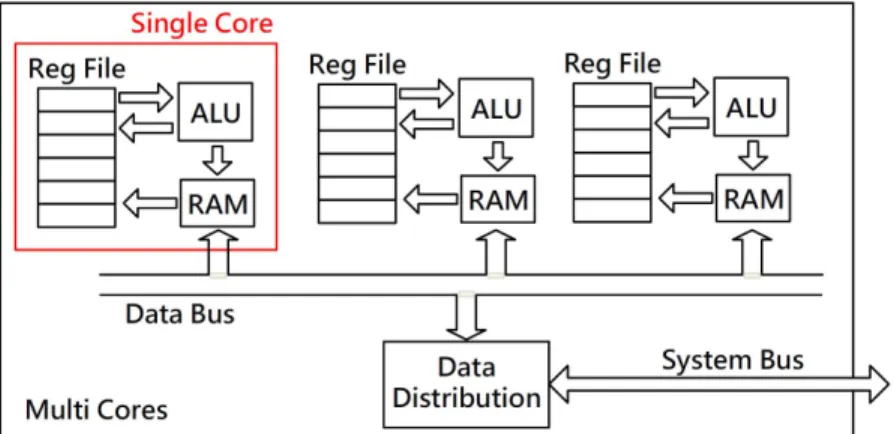
The picoMIPS has also been implemented to perform the DCT and inverse DCT (IDCT) in a multi-core context [38]. A homogeneous architecture was deployed with the same single core structure, as in figure 3, being replicated 3 times. The cores are connected via a data bus to a distribution module as shown in figure 4 where block data is transferred to each core in turn. This structure theoretically triples the throughput of the system as it can process multiple data blocks in parallel.
As a microprocessor architecture, the picoMIPS can implement many of the technologies discussed in the Introduction to improve energy efficiency. Clock gating, power domains and DVFS will all benefit the system however the area overhead of implementing them must first be considered as necessary. Pipeline balancing and caching can be integrated into more complex picoMIPS architectures however these are performance focused im-provements and so are not priorities in the picoMIPS concept. The expansion of the system to multi-core is also one that can be employed to improve performance. Moreover, a heterogeneous architecture could be imple-mented to allow the picoMIPS to process multiple dif-ferent applications simultaneously using several tailored ISAs. Reconfigurability can also be applied to picoMIPS to create an architecture which can be specific to each application that is executed, effectively creating a general purpose yet application specific processor. This property would require run-time synthesis algorithms to detect and develop the instructions and functional units that are required, before executing the application.
IV. Conclusion
The principles of the picoMIPS processor have been im-plemented in a few undergraduate projects to demonstrate the concept of minimal architecture synthesis and how it can be used to produce an application specific, energy efficiency processor. A number of examples were used to demonstrate the validity of this approach in both, single-core and many-single-core designs. In addition to the discrete
Fig. 3: An example implementation of the picoMIPS architecture.
Fig. 4: A Multi-core implementation of the picoMIPS architecture.
cosine transform (DCT) algorithm presented above, a stage in JPEG compression was synthesised for FPGA implementation into a processor architecture based on the picoMIPS concept, as well as various image manipulation algorithms. Evaluation of results from this work still con-tinues but it is evident that resulting processors are more area efficient than corresponding FPGA soft-cores or a GPP due to the removal of unnecessary circuitry. Such synthesised processors can also be compared to a dedicated ASIC hardware implementation. An ASIC implementa-tions are likely to have a much higher performance and throughput of data however this is at the cost of area and energy efficiency. The picoMIPS therefore represents a balance between the two, sacrificing some performance for area and energy efficiency benefits.
References
[1] C. Isci, A. Buyuktosunoglu, C.-Y. Chen, P. Bose, and M. Martonosi, “An Analysis of Efficient Multi-Core Global Power Management Policies: Maximizing Performance for a Given Power Budget,” inMicroarchitecture, 2006. MICRO-39. 39th Annual IEEE/ACM International Symposium on, 2006, pp. 347–358.
[2] V. Hanumaiah and S. Vrudhula, “Energy-efficient Operation of Multi-core Processors by DVFS, Task Migration and Active Cooling,”Computers, IEEE Transactions on, vol. PP, no. 99, pp. 1–1, 2012.
[3] B. de Abreu Silva and V. Bonato, “Power/performance opti-mization in FPGA-based asymmetric multi-core systems,” in Field Programmable Logic and Applications (FPL), 2012 22nd International Conference on, 2012, pp. 473–474.
[4] K. Wonyoung, M. Gupta, G.-Y. Wei, and D. Brooks, “System level analysis of fast, per-core DVFS using on-chip switching regulators,” inHigh Performance Computer Architecture, 2008. HPCA 2008. IEEE 14th International Symposium on, 2008, pp. 123–134.
[5] P. Bassett and M. Saint-Laurent, “Energy efficient design tech-niques for a digital signal processor,” inIC Design Technology (ICICDT), 2012 IEEE International Conference on, 2012, pp. 1–4.
[6] ARM, ARM Cortex-A15 MPCore Processor Technical Reference Manual, ARM, June 2013, pages 53 - 63. [Online]. Available: http://infocenter.arm.com/help/topic/com.arm.doc. ddi0438i/DDI0438I_cortex_a15_r4p0_trm.pdf
[7] R. Rodrigues, A. Annamalai, I. Koren, S. Kundu, and O. Khan, “Performance Per Watt Benefits of Dynamic Core Morphing in Asymmetric Multicores,” inParallel Architectures and Compi-lation Techniques (PACT), 2011 International Conference on, 2011, pp. 121–130.
[8] R. Kumar, D. Tullsen, P. Ranganathan, N. Jouppi, and K. Farkas, “Single-ISA heterogeneous multi-core architectures for multithreaded workload performance,” inComputer Archi-tecture, 2004. Proceedings. 31st Annual International Sympo-sium on, 2004, pp. 64–75.
[9] M. Awan and S. Petters, “Energy-aware partitioning of tasks onto a heterogeneous multi-core platform,” inReal-Time and Embedded Technology and Applications Symposium (RTAS), 2013 IEEE 19th, 2013, pp. 205–214.
[10] R. Basmadjian and H. De Meer, “Evaluating and modeling power consumption of multi-core processors,” inFuture Energy Systems: Where Energy, Computing and Communication Meet (e-Energy), 2012 Third International Conference on, 2012, pp. 1–10. [Online]. Available: http://ieeexplore.ieee.org/xpl/ articleDetails.jsp?arnumber=6221107
[11] R. Bonamy, D. Chillet, S. Bilavarn, and O. Sentieys, “Power consumption model for partial and dynamic reconfiguration,” in Reconfigurable Computing and FPGAs (ReConFig), 2012 International Conference on, 2012, pp. 1–8.
[12] S. Saha, J. Deogun, and Y. Lu, “Adaptive energy-efficient task partitioning for heterogeneous multi-core multiprocessor real-time systems,” inHigh Performance Computing and Simulation (HPCS), 2012 International Conference on, 2012, pp. 147–153. [13] D. . Woo and H.-H. Lee, “Extending Amdahl’s Law for Energy-Efficient Computing in the Many-Core Era,”Computer, vol. 41, no. 12, pp. 24–31, 2008.
[14] R. Bahar and S. Manne, “Power and energy reduction via pipeline balancing,” inComputer Architecture, 2001. Proceed-ings. 28th Annual International Symposium on, 2001, pp. 218–229.
[15] J. Sartori, B. Ahrens, and R. Kumar, “Power balanced pipelines,” in High Performance Computer Architecture (HPCA), 2012 IEEE 18th International Symposium on, 2012, pp. 1–12.
[16] R. Kumar, V. Zyuban, and D. Tullsen, “Interconnections in multi-core architectures: understanding mechanisms, overheads and scaling,” inComputer Architecture, 2005. ISCA ’05. Pro-ceedings. 32nd International Symposium on, 2005, pp. 408–419. [17] H. Zeng, J. Wang, G. Zhang, and W. Hu, “An interconnect-aware power efficient cache coherence protocol for CMPs,” in Parallel and Distributed Processing, 2008. IPDPS 2008. IEEE International Symposium on, 2008, pp. 1–11.
[18] R. Kumar, K. Farkas, N. Jouppi, P. Ranganathan, and D. Tullsen, “Single-ISA heterogeneous multi-core architectures: the potential for processor power reduction,” in Microarchitec-ture, 2003. MICRO-36. Proceedings. 36th Annual IEEE/ACM International Symposium on, 2003, pp. 81–92.
[19] P. Greenhalgh, “big.LITTLE Processing with ARM Cortex-A15 & Cortex-A7,” ARM, Tech. Rep., September 2011.
[20] H. M. Waidyasooriya, Y. Takei, M. Hariyama, and M. Kameyama, “FPGA implementation of heterogeneous multicore platform with SIMD/MIMD custom accelerators,” in Circuits and Systems (ISCAS), 2012 IEEE International Symposium on, 2012, pp. 1339–1342.
[21] B. de Abreu Silva, L. Cuminato, and V. Bonato, “Reducing the overall cache miss rate using different cache sizes for Heteroge-neous Multi-core Processors,” inReconfigurable Computing and FPGAs (ReConFig), 2012 International Conference on, 2012, pp. 1–6.
[22] A. Lukefahr, S. Padmanabha, R. Das, F. Sleiman, R. Dreslinski, T. Wenisch, and S. Mahlke, “Composite Cores: Pushing
Het-erogeneity Into a Core,” inMicroarchitecture (MICRO), 2012 45th Annual IEEE/ACM International Symposium on, 2012, pp. 317–328.
[23] B. Jeff, “Advances in big.LITTLE Technology for Power and Energy Savings,” ARM, Tech. Rep., September 2012.
[24] S. Zhang and K. Chatha, “Automated techniques for energy efficient scheduling on homogeneous and heterogeneous chip multi-processor architectures,” inDesign Automation Confer-ence, 2008. ASPDAC 2008. Asia and South Pacific, 2008, pp. 61–66.
[25] A. Z. Jooya and M. Analoui, “Program phase detection in heterogeneous multi-core processors,” inComputer Conference, 2009. CSICC 2009. 14th International CSI, 2009, pp. 219–224. [26] L. Sawalha and R. Barnes, “Energy-Efficient Phase-Aware Scheduling for Heterogeneous Multicore Processors,” inGreen Technologies Conference, 2012 IEEE, 2012, pp. 1–6.
[27] F. Calcado, S. Louise, V. David, and A. Merigot, “Efficient Use of Processing Cores on Heterogeneous Multicore Architecture,” inComplex, Intelligent and Software Intensive Systems, 2009. CISIS ’09. International Conference on, 2009, pp. 669–674. [28] M. Pericas, A. Cristal, F. Cazorla, R. Gonzalez, D. Jimenez,
and M. Valero, “A Flexible Heterogeneous Multi-Core Archi-tecture,” inParallel Architecture and Compilation Techniques, 2007. PACT 2007. 16th International Conference on, 2007, pp. 13–24.
[29] M. Santambrogio, “From Reconfigurable Architectures to Self-Adaptive Autonomic Systems,” inComputational Science and Engineering, 2009. CSE ’09. International Conference on, vol. 2, 2009, pp. 926–931.
[30] J. Zalke and S. Pandey, “Dynamic Partial Reconfigurable Em-bedded System to Achieve Hardware Flexibility Using 8051 Based RTOS on Xilinx FPGA,” in Advances in Computing, Control, Telecommunication Technologies, 2009. ACT ’09. In-ternational Conference on, 2009, pp. 684–686.
[31] S. Bhandari, S. Subbaraman, S. Pujari, F. Cancare, F. Bruschi, M. Santambrogio, and P. Grassi, “High Speed Dynamic Partial Reconfiguration for Real Time Multimedia Signal Processing,” inDigital System Design (DSD), 2012 15th Euromicro Confer-ence on, 2012, pp. 319–326.
[32] S. Liu, R. Pittman, A. Forin, and J.-L. Gaudiot, “On energy efficiency of reconfigurable systems with run-time partial recon-figuration,” in Application-specific Systems Architectures and Processors (ASAP), 2010 21st IEEE International Conference on, 2010, pp. 265–272.
[33] K. Changkyu, S. Sethumadhavan, M. S. Govindan, N. Ran-ganathan, D. Gulati, D. Burger, and S. Keckler, “Composable Lightweight Processors,” in Microarchitecture, 2007. MICRO 2007. 40th Annual IEEE/ACM International Symposium on, 2007, pp. 381–394.
[34] E. Ipek, M. Kirman, N. Kirman, and J. F. Martinez, “Core fusion: accommodating software diversity in chip multiprocessors,” in Proceedings of the 34th annual international symposium on Computer architecture, ser. ISCA ’07. New York, NY, USA: ACM, 2007, pp. 186–197. [Online]. Available: http://doi.acm.org/10.1145/1250662.1250686 [35] Z. Rakossy, T. Naphade, and A. Chattopadhyay, “Design and
analysis of layered coarse-grained reconfigurable architecture,” in Reconfigurable Computing and FPGAs (ReConFig), 2012 International Conference on, 2012, pp. 1–6.
[36] K. Changmoo, C. Mookyoung, C. Yeongon, M. Konijnenburg, R. Soojung, and K. Jeongwook, “ULP-SRP: Ultra low power Samsung Reconfigurable Processor for biomedical applications,” inField-Programmable Technology (FPT), 2012 International Conference on, 2012, pp. 329–334.
[37] F. J. Veredas, M. Scheppler, W. Moffat, and B. Mei, “Custom implementation of the coarse-grained reconfigurable ADRES architecture for multimedia purposes,” inField Programmable Logic and Applications, 2005. International Conference on, 2005, pp. 106–111.
[38] G. Liu, “Fpga implementation of 2d-dct/idct algorithm using multi-core picomips,” Master’s thesis, University of Southamp-ton, School of Electronics and Computer Science, September 2013.
![Fig. 1: The ARM Cortex-A15 features multiple power domains for the core and surrounding logic, reprinted from [6].](https://thumb-us.123doks.com/thumbv2/123dok_us/10223160.2926188/2.918.173.735.88.502/cortex-features-multiple-power-domains-surrounding-logic-reprinted.webp)
![Fig. 2: The microarchitecture for Composite Cores, fea- fea-turing two µEngines, reprinted from [22].](https://thumb-us.123doks.com/thumbv2/123dok_us/10223160.2926188/3.918.481.846.103.337/fig-microarchitecture-composite-cores-fea-turing-µengines-reprinted.webp)