Applications of Norm and Situation Calculus in the
Semantic Web Service Composition*
Jun Zhao1, Xiaozhu Gu2
1
School of Economics and Management, Ningxia University, Yinchuan, China; 2School of Mathematical and Computer Sciences, Ningxia University, Yinchuan, China.
Email: [email protected], [email protected]
Received June 23rd 2010; revised July 8th 2010; accepted July 24th 2010.
ABSTRACT
Semantic Web service studies are carried out around the OWL-S, however, OWL-S model does not contain the descrip-tion of preferences and constraints when we choose and use them in different organizadescrip-tions, different cultures, different sectors and actors because of OWL capacity limitations in rules. It means that Semantic Web service composition can not compose users’ subjective services from the user requirements. The paper makes up for the semantic shortcoming of OWL-S through using norm semantic scalability, and achieves the formal description of the norm by using the situation calculus. Finally, the paper also takes a tourism composite service as an example how to extend the ability of the se-mantic description of OWL-S, which shows us the combination of the norm and the situation calculus. It is positive sig-nificance for eventually realizing semantic extension of OWL-S.
Keywords: Norm, Situation Calculus, Web Service, Semantic Web, Web Service Composition
1. Introduction
Web services are described using WSDL, but WSDL only from the syntactic layer of the Web service descrip-tion. It does not support the rich semantic descriptions. Semantic Web can be regarded as an extension and ex-pansion of the current Web technology. Web services are an increasingly important resource of web, it require se-mantic to provide wide range sese-mantic support. OWL-S is bridges to connect Web services and semantic Web. Many of the current research on semantic Web services are carried around the OWL-S. However, as the capacity limitations of the rules of OWL, OWL-S model does not include the description of preferences and constraints in users’ selection and use of services, which always mani-fests in the form of rules. The user's preferences and scene constraints can’t be understood and processed well by the computer because of the expression limitations. It also means that intelligent system does not start from user requirements during service composition, and does not assemble more subjective service in accordance with users’ will. Therefore, the article will extend the seman-tic of OWL-S through semanseman-tic capabilities of the norm. However, norm is non-formal and ambiguous. This paper attempts to use situation calculus to formally describe the
norm in order to ensure the correctness of norm and the user correct expression of various scene constraints, and provide more accurate and subjective service in expres-sion of the preferences.
2. Related Researches
Sheila A. McIlraith, Srini Narayanan and others of Stan-ford University apply the theory of situation calculus and Petri net to study the operational semantics of OWL-S. Firstly, they study the conversion relationship between the atomic service description and situation calculus. Then, they use situation calculus to study the formal se-mantics of atomic service descriptions in OWL-S. The situation calculus as an intermediate language is con-verted into the Petri net, and then the Petri net is used to study the implementation reasoning of the operational semantics of semantic Web services [1].
Andrea and Ferrara, who come from DIS-University di Roma use an approach of the process algebra to study the Web service composition, establish mutual mapping between process algebra and Business Process Execution Language for Web Services based on the research of Srini Narayanan and others [2].
SWSI (Semantic Web Services Initiative), mainly by DARPA and the EU (European Union) funded a project to build a combination of Semantic Web and Web vices technology integration framework that enables
vice providers and service requesters in the service dis-covery retrieval, matching, call, monitor and so on to achieve the greatest possible integration of automation and dynamic.
Yongshang Cheng and Zhijian Wangf, who come from College of Computer and Information Engineering, He-hai University have invented formal model of semantic Web services on the basis of colored Petri nets [3] .They formally describes several basic web service composition models in OWL-S, which is constructed to meet the de-mand of service, but it lacks of the expression of services semantic information.
Jun Liao, Hao Tan and Jinde Liu, who come from the University of Electronic Science and Technology, de-scribe the Web service composition by using Pi calculus. The paper introduces an example using Pi calculus to describe the Web service composition [4].
From the above research and projects we can see that researchers have made some valuable results in the se-mantic Web and Web service composition context, and many research problems wait to be solved to provide more powerful semantics services especially in the se-mantic extensions, but the theoretical system of service composition engineering and implementation technology are still immature because the study of history is not long.
This paper introduces norm theory of Organizational Semiotics to solve the problem of semantic deficiency in Web service composition. In order to achieve a deeper level of semantic extension, it achieves the formal de-scription of norm in semantic expansion by the theory of situation calculus in order to ensure the accuracy of se-mantic extension.
3. Applications of Norm and Situation
Calculus in the Semantic Web Service
Composition
Norm is also known as social norms which is the com-mon rules of conduct and standards of every member in a social group or smaller groups, which is in the Oxford Encyclopedia of the explanation.
As rules in expression limitations of the OWL, OWL-S model does not include the users’ the description of preferences and constraints in the selection and use of services. It try to introduce norm to provides a new theo-retical platform in the semantic Web service composition in order to solve Web services Semantic shortage de-scribed by the OWL-S in the semantic Web service composition. This approach considers many the users’ initiative and willingness. It joins the human factor in the service composition to provide a more personalized composition services.
Norm determines whether and when an event occurs, and also decided meeting the particular needs should call the areas of service layer of what services. It can describe
the activities relationship of the system control. The norm detailed description includes the following sections [5].
Whenever< Conditions set >If< State Sets >Then <Agent>Is <Deontic Operator>To< Action sets >Con-sequence< Result Sets>
Conditions Sets specified the conditions when an Agent executed an act. Further instructions can be speci-fied by If < State set>, which show that it happened in what state. <Agent> Refers to the responsibility Agent, Agent may be people here, also may be software. < De-ontic logic operators> including allowing (Permitted), must (Obliged), prohibition (Prohibited)etc. <Action Sets> determined action sets applied in the case of condi-tions to met for Agent. <Result sets> is the results after the successful implementation of the specification, which is also the goals of users implement the act.
We can see that norm is different from the relations of causality [6]. Causality is usually only a brief description, if the conditions are met, then certain behavior could take place. Therefore causality is rigid and limited, and there is not available for human decision. On the contrary, norms are a better reflection of how people activities in the business environment. Therefore it is more suited to the description of user needs in the real business. Changes of user needs in the growing environment can be described through the norm. This required model can fully focus on changes factors. It will help to provide dynamically alternative solutions among the service layer and process layer on user needs.
Situation Calculus is a multi-type and first-order logic language, and has some second-order characteristics. It is a formal planning approach and describes a logical basis for dynamic system. For problem solving of the dynamic field and logic programming, it is first proposed in 1963 by McCarthy who is the master of artificial intelligence. Goal-oriented autonomous behavior reasoning can be carried out in a dynamic environment by situation calcu-lus. In the situation calculus, a scenario is a snapshot of the world, and dynamic changes in the world are all the result of actions. Scenarios class is applied to express Situation Calculus, and the scene change is the results of the actions. In ontology, the action is the basic means to change the state of things. Therefore, a possible world active can be viewed as a string of action series. Situation calculus constitutes by the following three elements: ac-tion, situation and flow.
Action is the basic means to change station of things. All Changes in the state of things are the result of the implementation of the action sequences. A specific pre-dicate Poss is used to indicate that an action is executa-ble.
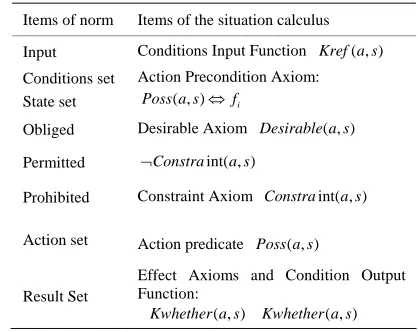
Table 1. Mapping norm to situation calculus
situation
situation. If the action a is implemented un-der the scenario s, then another situation will be got, andthe situation s can be expressed as do (a, s). Items of norm Items of the situation calculus
Input Conditions Input Function Kref a s( , ) Conditions set
State set
Action Precondition Axiom: ( , ) i
Poss a s f
Obliged Desirable Axiom Desirable a s( , ) Permitted Constraint( , )a s
Prohibited Constraint Axiom Constraint( , )a s
Action set Action predicate Poss a s( , )
Result Set
Effect Axioms and Condition Output Function:
( , )Kwhether a s ( , )Kwhether a s Flow is used to represent the properties of things in the
world and the link between them [7]. When an action occurs, the flow will change. Flow F(x, s) takes scene s as its last parameter. The initial situation is expressed as s0. The value of the flow is constantly changing from the initial state of the world to the current world state.
In order to characterize the dynamic changing world, situation calculus theory uses the following actions: Ac-tion PrecondiAc-tion Axiom, Successor State Axiom, Effect Axiom etc.[8].
Action Precondition Axiom: Every action of the field has a corresponding action precondition axioms, de-scribing a prerequisite for action to perform.
( , ) i
Poss a s f fi is a prerequisite sets for the
im-plementation of . a
4. Case Studies
4.1 Example Background
Successor State Axiom: Each flow in field has a corre-sponding Successor State Axiom, which is described the implementation of atomic actions how to affect the flow and state changes.
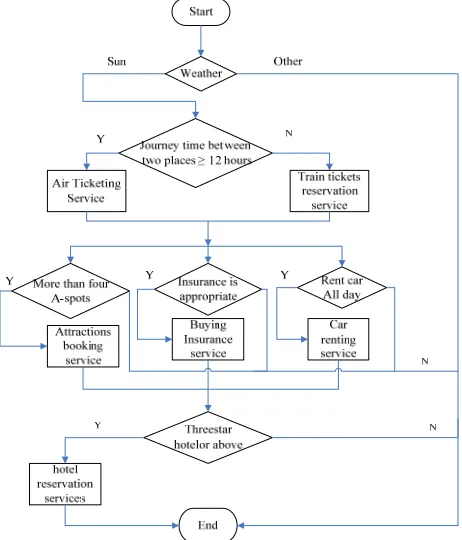
Tourism is an integrated industry which includes food, housing, transportation, travel, shopping and entertain-ment. A trip involves a number of services and tourism resources, and tourist information is rich in space and time content. Travel is the complex process restricted by artificial and natural factors. How to use Web services by the network to provide “personal travel” service and how to design personalized service process according to the needs of our customers become a problem. The problem has plagued further development of the tourism industry and prevented from increasing the overall quality of tourism services to increase tourists’ satisfaction. There-fore the examples will make a combination of the weath-er check, ticket booking, tourist attractions, resweath-ervations and other travel services with personal characters. The service composition flow is shown in Figure 1.
( , ) F( , , ) ( , ( , ))
Poss a s x a s F x do a s
( , ) F( , , ) ( , ( , ))
Poss a s x a s F x do a s
( , )
Poss a s is a special flow and action is
en-forceable under state
a s.
Formula F( , , )x a s
is a positive effect axiom that describes the related collection of actions and conditions to makes the value of flow F true after the execution. Formula F( , , )x a s is a negative effect axiom that de-scribes the related collection of actions and conditions to makes the value of flow F false after the execution.
In addition to the above several axioms, there are other flows that can be used to describe atomic service or a combination of services as formal semantics of services in situation calculus. Other flows are the following types:
The example mainly involves the following web ser-vices:
1)InquireWeather City Date( , ): Weather inquiry ser-vice.
( , )
Kref a s expresses that the value of is known
under the scenario
a
s. 2)InquireDistan (ce Start Destination, ): Check the
dis-tance between the two places. Start is the place of depar-ture. Destination is the sightseeing place.
( , )
Kwhether a s expresses that the true value of is
known under the scenario
a s.
3) : Booking airline
tickets.
( ,
BuyAirPlaneTicket City Date)
)
)
) ( , )
Knows a s expresses that the function value of
is known under the scenario
a s.
4)BuyTrainTicket City Date( , : Booking train tickets. This essay will introduce users Desirable Axiom and
constraint Axiom in order to express the will degree of user requirements in the situation calculus [9-10]. We also attempt to define which action
under the situation
int( , )
Constra a s
a s can be implemented as long as the users’ conditions are not limited [11].
5)BookScenicSpots City( : Attractions reservation. 6)BookInsurance TypesOfInsurance( ): Buy insurance. 7)RentCar CarModel( ): Service of cars on hire. 8)BookHotel City( : Hotel reservation.
A set of items compared norm expression with situa-tion calculus to achieve the service semantic expansion and formal description. It is shown as Table 1.
4.2 Norm Analysis
Figure 1. The chart of reservation service composition flow
Table 2. Weather norm
Norm 1 Searching start In Charge of User Information
Recognition City, Date
User query the weather of sightseeing site Precondition: Enter valid city and date Trigger
Condition
Then: Weather query service returns query results Detailed
Norm
if the input date and destination of users are valid then Weather enquiry service is obliged to return the query results
Table 3. Distance query norm
Norm 2 Searching start In Charge of User Information
Recognition Start, Destination
User queries the distance between the start and destination
Precondition: The query results of norm 1 is sun Trigger
Condition
Then: Return the distance between start and destination
Detailed Norm
Whenever the weather of the indicated Date is sunny in norm1 if the input start and destination of users are valid then distance query service is obliged to return the distance between two places
Table 4. Airline reservation norm
Norm 3 Booking start In Charge of User Information
Recognition Bank Card ID, User ID Users make flight reservations
Precondition: Output is sunny in norm1and the output is greater than or equal 1000 kilometers in norm 2
Trigger Condition
Then: Users input bank card password ,book ticket
Detailed Norm
Whenever Output is sunny in norm1and the output is greater than or equal 1000 kilometers in norm 2 if bank card ID and user ID are valid
[image:4.595.280.532.400.719.2]then user is obliged to input bank card password to transfer
Table 5. Train ticket reservation norm
Norm 4 Booking start In Charge of User Information
Recognition Bank Card ID ,User ID Users book train tickets
Precondition: Output is sunny in norm1and the output is greater than or equal 1000 kilometers in norm 2
Trigger Condition
Then: Users input bank card password ,book ticket Detailed
Norm
Table 6. Attractions reservation norm
Norm 5 Booking start In Charge of User Information Recognition City
Users reserve scenic spot
Precondition: City is valid, the grade of attractions are four A-level or above Trigger
Condition
Then: Return the attractions which are qualified
Detailed Norm
Whenever norn 3 and norm4 are successful if
the grade of attractions are four A-level or above
[image:5.595.63.286.97.401.2]then users permitted input bank card password and transfer reserve attractions if the grade of attractions are below four A-level then norm 3 or norm 4 is prohibited to book
Table 7. Insurance booking norm
Norm 6 Booking start In Charge of User Information Recognition City
Users reserve insurance
Precondition: City is valid, users choose appropriate insurance
Trigger Condition
Then: Users input the bank card password and transfer; Users reserve insurance
Detailed Norm
Whenever norm 3 or norm 4 are successful if
thegrade of attractions are four A-level or above
[image:5.595.65.281.421.723.2]then user is obliged to input bank card password and transfer in order to reserve attraction
Table 8. Car rental reservation norm
Norm 7 Booking start In Charge of User Information Recognition City
Users reserve the car which is rental Precondition: City is valid, the rental car is full-time
Trigger Condition
Then: Users input bank card password in order to reserve rental cars
Detailed Norm
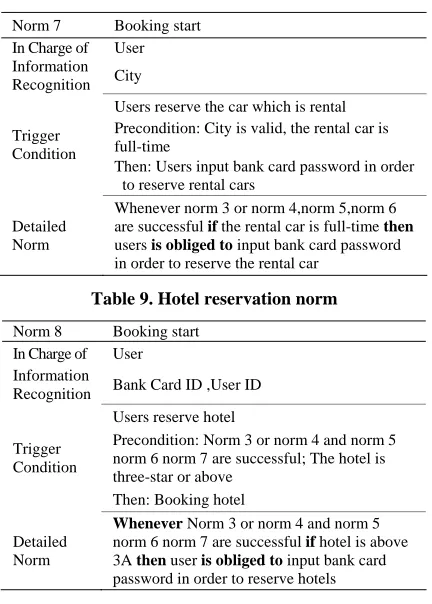
Whenever norm 3 or norm 4,norm 5,norm 6 are successful if the rental car is full-time then
users is obliged to input bank card password in order to reserve the rental car
Table 9. Hotel reservation norm
Norm 8 Booking start In Charge of User Information
Recognition Bank Card ID ,User ID Users reserve hotel
Precondition: Norm 3 or norm 4 and norm 5 norm 6 norm 7 are successful; The hotel is three-star or above
Trigger Condition
Then: Booking hotel Detailed
Norm
Whenever Norm 3 or norm 4 and norm 5 norm 6 norm 7 are successful if hotel is above 3A then user is obliged to input bank card password in order to reserve hotels
4.3 Mapping from Norm to Situation Calculus
1) The Situation Calculus Formally Describes the Atomic Services in Example
a) Weather atomic service: Before the atomic service of Weather is implemented, agency must know the input parameters value which is formalized as the following formula with the situation calculus.
( ( ,
Poss InquireWeather City Date s), )
)
( , ) ( ,
Kref City s Kref Date s
( , )
InquireWeather City Date
ty Date
( , )
is a weather query action, the action on the premise that you need to know the and , which can be represented by flow
Ci
Kref City s and Kref Date s( , ).
Users want to travel as long as the weather was not dust storms and heavy rain. It is formalized as the fol-lowing formula with the situation calculus.
int( , )
Constra Tranvel s
(Weather Equal Storm s( , , )
( , , )
Weather Equal Sadstorm s );
, )
The output of the Weather Service is formalized as the following formula with the situation calculus.
( , ) ( ,
Poss InquireWeather s x InquireWeather s
( / , ( , ))
Knows Sun Other do InquireWeather s
b) The atomic service of distance query: Before the atomic service of Distance Query is implemented, agen-cy must know the input parameters value which is for-malized as the following formula with the situation cal-culus.
( ( , ), )
Poss Distance Start Destination s
( , ) ( , )
Kref Start s Kref Destination s
The output of the Distance Query Service is formal-ized as the following formula with the situation calculus.
( tan , ) ( , tan , )
Poss Dis ce s x Dis ce s
( , ( tan , ))
Knows Figure do Dis ce s
c) Ticket booking atomic services: Before the atomic service of Airline Reservation is implemented, agency must know the input parameters value which is formal-ized as the following formula with the situation calculus.
( ( ,
Poss BuyAirplaneTicket City Date s), )
)
( , ) ( ,
Kref City s Kref Date s
If user wants to buy air tickets must be that the dis-tance between two places is greater than or equal to 1,000 kilometers. It is formalized as the following for-mula with the situation calculus.
( ( ,
Desirable BuyAirplaneTicket City Date s), )
tan (( , ), 1000);
Dis ce Start Destinatin Longer
: (
F a BuyAirplaneTicket City Date
, )
)
( ,
InstockAirplaneTicket City Date
( , ) ( , )
Poss a s a BuyAirplaneTicket City Date
( , )
InstockAirplaneTicket City Date
( ,
own AirplaneTicket do a s( , ))
2) The Situation Calculus Formally describes the Composition Services in Example
The Example involve several combination services: is composed of the Distance Query Service, ticket booking service and ticket reservation service, which implement are controlled mainly by if control operator;
BookTicket
Journey is composed of the Attractions
Res-ervation Service; Insurance Booking Service and Car Rental Reservation Service, which implement are con-trolled mainly by Anyordered
Tranvel BookTicket
control operator; The composition service is composed of the com-position service ; composition service
Journeyand Hotel Reservation Service, which imple-ment are controlled mainly by C control op-erator.
ondition
a) Composition service : Distance Query Service, ticket booking service and ticket reservation service is composed , which implement are controlled mainly by control operator.
BookTicket
okTicket Bo
if
The prerequisite was formalized as the following for-mula in the situation calculus:
(Knows Over( 1000km,
( tan ( , ), ))
do InquireDis ce Start Destination s
( ( ,
Poss BuyAirplaneTicket City Date s), )
( , ( ( , ), )))
Knows Sun do InquireWeather City Date s
(Knows Below( 1000km,
( tan ( , ), ))
do InquireDis ce Start Destination s
( ( ,
Poss BuyTrainTicket City Date s), )
( , ( ( , ), )));
Knows Sun do InquireWeather City Date s Before the composition service of is im-plemented, agency must know the input parameters value which is formalized as the following formula with the situation calculus.
BookTicket
(Knows Over( 1000km,
( tan ( , ), ))
do InquireDis ce Start Destination s
( ( ,
Poss BuyAirplaneTicket City Date s), )
( , ) ( , ))
Kref City s Kref Date s
(Knows Below( 1000km,
( tan ( , ), ))
do InquireDis ce Start Destination s
( ( ,
Poss BuyTrainTicket City Date s), ) )
( , ) ( , )
Kref City s Kref Date s
Based on the above two formulas, we can get the Ac-tion PrecondiAc-tion Axiom.
(Knows Over( 1000km,
( tan ( , ), ))
do InquireDis ce Start Destination s
( ( ,
Poss BuyAirplaneTicket City Date s), )
( , ( ( , ), ))
Knows Sun do InquireWeather City Date s
( , ) ( , ))
Kref City s Kref Date s
(Knows Below( 1000km,
( tan ( , ), ))
do InquireDis ce Start Destination s
( ( ,
Poss BuyTrainTicket City Date s), )
( , ( ( , ), ))
Knows Sun do InquireWeather City Date s
( , ) ( , ))
Kref City s Kref Date s
The effectiveness and output parameters of composi-tion service are formalized as the following Positive Ef-fect Axiom and Negative EfEf-fect Axiom.
1
: (
F a BuyAirplaneTicket City Date
, )
( , )
InstockAirplaneTicket City Date
2 ( , )
a BuyTrainTicket City Date
( , )
InstockTrainTicket City Date
(Knows Over( 1000km,
( ( ,
do InquireDistance Start Destination s), ))
1 1
( , ) F( , , )
Poss a s x a s
1
( , (
Own AirplaneTicket do a s
( ( 1000 ,
, )))
Knows Below km
( ( ,
do InquireDistance Start Destination s), ))
2 2
( , ) F( , , )
Poss a s x a s
2
( , (
Own TrainTicket do a s, )))
, )
1
: (
F a BuyAirplaneTicket City Date
( ,
NoInstockAirplaneTicket City Date)
2 ( , )
a BuyTrainTicket City Date
( ,
NoInstockTrainTicket City Date
( ( 1000 ,
)
Knows Over km
( tan ( , ), ))
do InquireDis ce Start Destination s
1 1
( , ) F( , , )
Poss a s x a s
1
( , (
Own AirplaneTicket do a s, )))
(Knows Below( 1000km,
( tan ( , ), ))
do InquireDis ce Start Destination s
2 2
( , ) F( , , )
Poss a s x a s
2
( , ( , )))
Own TrainTicket do a s
The output of the Composition Service
was formalized as the following formula with the situa-tion calculus.
BookTicket
( tan ( , ), ))
do InquireDis ce Start Destination s
1 1
( , ) ( , , )
Poss a s x a s
1
( , ( , )))
Knows AirplaneTicketMessage do a s
(Knows Below( 1000km,
( tan ( , ), ))
do InquireDis ce Start Destination s
2 2
( , ) ( , , )
Poss a s x a s
2
( , ( , )))
Knows TrainTicketMessage do a s
b) Composition serviceJourney: It is composed with Attractions Reservation Service, Insurance Booking Ser-vice and Car Rental Reservation SerSer-vice. Implement of the service is controlled by Anyordered control opera-tor.
The implementation order of atomic services which are involved in the composition service is not required, so the composition service can be controlled imple-mented Anyordered control operator.
The prerequisite was formalized as the following for-mula with the situation calculus.
( (
Poss BookScenicSpots City s), ) ),
))
)))
( (
Poss BookInsurance TypesOfInsurance
( ,
do BookScenicSpots s
(Re ( ),
Poss ntCar CarModel
( , ( ,
do BookInsurance do BookScenicSpots s
( ,
Knows GreaterFourA do InquireScenicSpots s( , ))
( ,
Knows TypesOfInsurance
( (
do InquireInsurance TypesOfInsurance s, )))
( , ( Re ,
Knows CarModel do Inquire ntCar s))
),
),
))
(Re ( ), )
Poss ntCar CarModel s
( (
Poss BookInsurance TypesOfInsurance
(Re , ))
do ntCar s Poss BookScenicSpots City( (
( , (Re , )))
do BookInsurance do ntCar s
( , ( Re ,
Knows CarModel do Inquire ntCar s
( ,
Knows TypesOfInsurance
( (
do InquireInsurance TypesOfInsurance s, )))
( , ( , ))
Knows GreaterFourA do InquireScenicSpots s Before the composition service of Journey is im-plemented, the agency must know the input parameters value which is formalized as the following formula with the situation calculus.
( (
Poss BookScenicSpots City s), ) ),
))
( (
Poss BookInsurance TypesOfInsurance
( ,
do BookScenicSpots s
(Re ( ), ( ,
Poss ntCar CarModel do BookInsurance
( , )))
do BookScenicSpots s
( , ) ( , )
Kref City s Kref TypesOfInsurance s
( , )
Kref CarModel s Poss(RentCar CarModel s( ), )
( (
Poss BookInsurance TypesOfInsurance),
(Re , ))
do ntCar s Poss BookScenicSpots City( ( ),
)
( , (Re , )))
do BookInsurance do ntCar s
( , ) ( ,
Kref CarModel s Kref TypesOfInsurance s
( , )
Kref City s
The above two formulas, we can get the Action Pre-condition Axiom.
( (
Poss BookScenicSpots City s), ) ),
))
( (
Poss BookInsurance TypesOfInsurance
( ,
do BookScenicSpots s
(Re ( ), ( ,
Poss ntCar CarModel do BookInsurance
( , )))
do BookScenicSpots s
( , (
Knows GreaterFourA do InquireScenicSpots s, ))
( ,
Knows TypesOfInsurance
( (
do InquireInsurance TypesOfInsurance s, )))
( , ( Re ,
Knows CarModel do Inquire ntCar s))
( , ) ( , )
Kref City s Kref TypesOfInsurance s
( , )
Kref CarModel s Poss(RentCar CarModel s( ), )
( (
Poss BookInsurance TypesOfInsurance),
(Re , ))
do ntCar s Poss BookScenicSpots City( ( ),
))
( , (Re , )))
do BookInsurance do ntCar s
( , ( Re ,
Knows CarModel do Inquire ntCar s
( ,
Knows TypesOfInsurance
( (
do InquireInsurance TypesOfInsurance s, )))
( , (
Knows GreaterFourA do InquireScenicSpots s, ))
( , )
Kref CarModel s
( , ) ( , )
Kref TypesOfInsurance s Kref City s
In this combination of services, users require the at-tractions level to be 4A or above and the rental car is full-time on behalf of driving, the above can be mapped to the Desirable Axiom with the situation calculus.
( (
Desirable BookScenicSpots City), )s
Grade(GreaterFourA s, )
(Re ( ), )
Desirable ntCar CarModel s
RentCarModel WholeDay s( , )
The composition service is composed of the composition service . Composition service
Tranvel icket BookT Journey
Condition
and Hotel Reservation Service are controlled by control operator.
Here theBookTicket, Journeyand Hotel Reservation service are seen as the three actions: a1BookTicket,
2
a Journey , a3BookHotel.
1
)
3
a , the implementation of composition service Travel can be controlled by the Condition control operator.
( ookTicket s
( ourney s,
, (
The prerequisite of composition service was formalized as the following formula in the situation cal-culus.
Travel
( , , )
Knows Success do B
3
( , )) ( , )
Knows Success do J Poss a s
( 3 , ))
Knows Greater Star do InquireHotel s
( ookTicket s
( ourney s,
Before the composition service of is imple-mented, the agency must know the input parameters value which is formalized as the following formula with the situation calculus.
Travel
( , , )
Knows Success do B )
)
3
( , )) ( , )
Knows Success do J Poss a s
( ,
Kref City s
The above two formulas, we can get the Action Pre-condition Axiom.
( , , )
Knows Success do B( ookTicket s
( ourney s,
( 3
)
3
( , )) ( , )
Knows Success do J Poss a s
( , ) , ( , ))
Kref City s KnowsGreater Star do InquireHot
)
City Instock
( ookTicket s
( ourney s,
, )s
3
(
do a s
( ookTicket s
( ourney s,
)
el s The effectiveness and output parameters of composi-tion service are formalized as the following Positive Ef-fect Axiom and Negative EfEf-fect Axiom.
3
: ( (
F a BookHotel Room
)
)
)
, ))
)
)
( , , )
Knows Success do B
( , )
Knows Success do J
3 3
( , ) F( ,
Poss a s x a
( ,
Own TanvelMessage
The output of the Composition Service was formalized as the following formula with the situation calculus.
( , , )
Knows Success do B
( , )
Knows Success do J
3 3
( , ) ( , ,
Poss a s x a s
3
( , ( , ))
Knows TanvelMessage do a s
5. Summary
This paper introduces the norm to strengthen the seman-tics from user needs perspective based on the defects of lack of semantics described in OWL-S semantic service
of the semantic web service composition. A new way is provided to increase semantic. However, the norm is non-formal and ambiguous, the situation calculus is ap-plied to realize formal norm in order to ensure the accu-racy of semantic Web service composition.
REFERENCES
[1] S. N. Sheila and S. Mcilraith, “Analysis and Simulation of Web Services,” Computer Networks, Vol. 42, May 2003, pp. 675-693.
[2] A. Ferrara, “Web Services:A Process Algebra Approach,”
Proceedings of the International Conference on Service Oriented Computing, New York, 2004, pp.1-18
[3] Y. S. Cheng and Z. J. Wang, “Research on Formal Description and Verification of Semantic Service Composition,” Computer Science, Vol. 35, No. 4, April 2008, pp. 40-43.
[4] J. Liao, H. Tan and J. D. Liu, “Describing and Verifying Web Service Using Pi-Calculus,” Chinese Journal of Computers, Vol. 28, No. 4, April 2005, pp. 635-643. [5] R.Stamper andK.Liu, “Organisational Dynamics, Social
Norms and Information Norms,” Proceedings of Hawaii International Conference on System Sciences, Hawaii, 1994, pp. (IV)645-654.
[6] H. Q. Yang, S. Z. Li, J. P. Zhao and W. Pu, “Research on Architecture Design and Requirement Modeling Based on Semiotics of Adaptive Healthcare Information System,”
Journal of Computer Engineering and Applications, Vol. 45, No. 9, September 2009, pp. 244-248.
[7] G. Wang, “Research and Implement on the Behaviors of Multiple Intelligent Virtual Human Based on the Si- tuation Calculus,” JiangSu University, Zhenjiang, 2006 [8] D. M. Xu and H. Q. Wang, “Muti-Agent Collabo-Ration
for B2B Workflow Monitoring,” Knowledge-Based System, Vol. 15, No. 8, November 2002, pp. 485-491. [9] S. Liang, “Research on Technology of Automatic
Services Composition Based on Semantic Web,” Chinese Academy of Sciences, Beijing, 2003.
[10] S. McIlraith and T. C. Son, “Adapting Golog for Programming the Semantic Web,” International Con- ference on Knowledge Representation and Reasoning, Toulouse, 2002, pp. 482-493.