The proceedings version of this paper appears inAdvances in Cryptology—CRYPTO ’99 [7]. This is the full version. It is available fromwww.cs.ucdavis.edu/~rogaway/umac/
UMAC: Fast and Secure Message Authentication
J. Black∗ S. Halevi† H. Krawczyk‡ T. Krovetz∗ P. Rogaway∗
August 4, 1999
Abstract
We describe a message authentication algorithm, UMAC, which authenticates messages (in software, on contemporary machines) roughly an order of magnitude faster than current practice (e.g., HMAC-SHA1), and about twice as fast as previously reported times for the universal hash-function familyMMH. To achieve such speeds, UMAC uses a new universal hash-function family, NH, and a design which allows effective exploitation of SIMD parallelism. The “cryptographic” work of UMAC is done using standard primitives of the user’s choice, such as a block cipher or cryptographic hash function; no new heuristic primitives are developed here. Instead, the security of UMAC is rigorously proven, in the sense of giving exact and quantitatively strong results which demonstrate an inability to forge UMAC-authenticated messages assuming an inability to break the underlying cryptographic primitive. Unlike conventional, inherently serial MACs, UMAC is parallelizable, and will have ever-faster implementation speeds as machines offer up increasing amounts of parallelism. We envision UMAC as a practical algorithm for next-generation message authentication.
Key words: Fast software cryptography, Message authentication codes, Provable security, Universal hashing.
∗ Dept. of Computer Science, University of California, Davis, California, 95616, USA. E-mail: {blackj, krovetz, rogaway}@cs.ucdavis.edu WWW:www.cs.ucdavis.edu/~{blackj, krovetz, rogaway}/
†IBM T.J. Watson Research Center, Yorktown Heights, New York, 10598, USA. E-mail: [email protected] ‡ Department of Electrical Engineering, Technion, Haifa, Israel, and IBM T.J. Watson Research Center, New
Contents
1 Introduction 1 1.1 Universal-Hashing Approach . . . 1 1.2 Our Contributions . . . 2 1.3 Related Work . . . 4 2 Overview of UMAC 5 2.1 An Illustrative Special Case . . . 52.2 UMAC Parameters . . . 6
3 UMAC Performance 7 4 The NH Hash Family 10 4.1 Preliminaries . . . 10
4.2 Definition of NH . . . 10
4.3 Analysis . . . 11
4.4 The Signed Construction: NHS . . . 13
5 Reducing the Collision Probability: Toeplitz Extensions 15 5.1 The Toeplitz Approach . . . 15
5.2 The Unsigned Case . . . 15
5.3 The Signed Case . . . 17
5.4 Shorter Keys: T2 . . . 17
6 Arbitrary-Length Messages: Padding, Concatenation, Length Annotation 18 7 Final Extensions: Stride, Endianness, Key Shifts 19 8 From Hash to MAC 20 8.1 Security Definitions . . . 20
8.2 Definition of the PRF(HASH, Nonce) Construction . . . 21
8.3 Discussion . . . 23
8.4 Realizing the PRF . . . 24
9 Directions 25
1
Introduction
This paper describes a new message authentication code, UMAC, and the theory that lies behind it. UMAC has been designed with two main goals in mind:
• Extreme speed. We have aimed to create the fastest MAC ever described, and by a wide margin. We are speaking of speed with respect to software implementations on contemporary general-purpose computers.
• Provable security. We insist that the MAC be demonstrably secure, by virtue of proofs carried out in the sense of provable-security cryptography. Namely, if the underlying cryp-tographic primitives are secure (we use pseudorandom functions) then the MAC is secure, too.
There were of course other goals, avoiding excessive conceptual and implementation complexity being principal among them.
UMAC is certainly fast. On our 350 MHz Pentium II PC, one version of UMAC (where the ad-versary has 2−60chance of forgery) achieves peak-performance of 2.9 Gbits/sec (0.98 cycles/byte). Another version of UMAC (with 2−30chance of forgery) achieves peak performance of 5.6 Gbits/sec (0.51 cycles/byte). For comparison, our SHA-1 implementation runs at 12.6 cycles/byte. Note that SHA-1 speed upper bounds the speed of HMAC-SHA1 [3], a software-oriented MAC represen-tative of the speeds achieved by current practice. The previous speed champion among proposed universal hash functions (the main ingredient for making a fast MAC; see below) was MMH [14], which runs at about 1.2 cycles/byte (for 2−30 chance of forgery) under its originally envisioned implementation.
How has it been possible to achieve these speeds? Interestingly, we have done this with the help of our second goal, provable security. We use the well-known universal-hashing approach to message authentication, introduced by [27], making innovations in its realization. Let us now review this approach and its advantages, and then describe what we have done to make it fly.
1.1 Universal-Hashing Approach
Universal Hashing And Authentication. Our starting point is a universal hash-function
fam-ily [9]. (Indeed the “U” in UMAC is meant to suggest the central role that universal hash-function families play in this MAC.) Remember that a set of hash functions is said to be “-universal” if for any pair of distinct messages, the probability that they collide (hash to the same value) is at most. The probability is over the random choice of hash function.
As described in [27], a universal hash-function family can be used to build a secure MAC. The parties share two things: a secret and randomly chosen hash function from the universal hash-function family, and a secret encryption key. A message is authenticated by hashing it with the shared hash function and then encrypting the resulting hash (using the encryption key). Wegman and Carter showed that when the hash-function family is strongly universal (a similar but stronger property than the one we defined) and the encryption is realized by a one-time pad, the adversary cannot forge with probability better than that obtained by choosing a random string for the MAC.
Why Universal Hashing? As suggested many times before, the above approach is a promising
one for building a highly-secure and ultra-fast MAC [17, 24, 14]. The reasoning is like this. The speed of a universal-hashing MAC depends on the speed of the hashing step and the speed of the encrypting step. But if the hash function compresses messages well (i.e., its output is short) then the encryption shouldn’t take long simply because it is a short string that is being encrypted. On
the other hand, since the combinatorial property of the universal hash-function family is mathe-matically proven (making no cryptographic hardness assumptions), it needs no “over-design” or “safety margin” the way a cryptographic primitive would. Quite the opposite: the hash-function family might as well be the fastest, simplest thing that one can prove universal. And that should be much faster than any sort of “cryptographic” primitive.
Equally important, the above approach makes for desirable security properties. Since the cryp-tographic primitive is applied only to the (much shorter) hashed image of the message, we can select a cryptographically conservative design for this step and pay with only a minor impact on speed. Further, the underlying cryptographic primitive is used only on short and secret messages, elimi-nating the typical avenues of attack. Under this approach security and efficiency are not conflicting requirements—quite to the contrary, they go hand in hand.
The Quest For Fast Universal Hashing. At least in principle, the universal-hashing paradigm
has reduced the problem of fast message authentication to the problem of fast universal hashing. Thus there has been much recent work on the design of fast-to-compute universal hash-function fam-ilies. Here is a brief overview of some of this work; a more complete overview is given in Section 1.3. Krawczyk [17] describes a “cryptographic CRC” construction, which has very fast hardware imple-mentations and reasonably fast software impleimple-mentations; it needs about 6 cycles/byte, as shown by Shoup [25]. Rogaway’s “bucket hashing” construction [24] was the first universal hash-function family explicitly targeted for fast software implementation; it runs in about 1.5–2.5 cycles/byte. Halevi and Krawczyk devised theMMHhash-function family [14], which takes advantage of current CPU trends and hashes at about 1.5–3 cycles/byte on modern CPUs.
With methods now in hand which hash so very quickly, one may ask if the hash-design phase of making a fast MAC is complete; after all, three cycles/byte may already be fast enough to keep up with high-speed network traffic. However, authenticating information at the rate that it is generated or transmitted is not the real goal. The goal is to use the smallest possible fraction of the CPU’s cycles by the simplest possible hash mechanism, and having the best proven bounds. In this way most of the machine’s cycles are available for other work.
1.2 Our Contributions
UMAC represents the next step in the quest for a fast and secure MAC. Here we describe the main contributions associated to its design.
New Hash Function Families And Their Tight Analyses. A hash-function family named
NH underlies hashing in UMAC. It is a simplification of the MMH and NMH families described in [14]. The family NH works like this. The message M to hash is regarded as a sequence of an even number of integers, M = (m1, . . . , m), where each mi ∈ {0, . . . ,2w−1} corresponds to a
w-bit word (e.g., w= 16 or w = 32). A particular hash function is named by a sequence of n≥
w-bit integers K= (k1, . . . , kn). The NHfunction is then computed as
NHK(M) = ⎛ ⎝/2 i=1 ((m2i−1+k2i−1) mod 2w)·((m2i+k2i) mod 2w)) ⎞ ⎠mod 22w . (1)
The novelty of this method is that all the arithmetic is “arithmetic that computers like to do”—no finite fields or non-trivial modular reductions come into the picture.
Despite the non-linearity of this hash function and despite its being defined using two different rings, Z/2w and Z/22w, not a finite field, we manage to obtain a tight and desirable bound on the
collision probability: 2−w. Earlier analyses of related hash-function families had to give up a small constant in the analysis [14]. We give up nothing.
After proving our bounds onNHwe go on and extend the method using the “Toeplitz construc-tion.” This is a well-known approach to reduce the error probability without much lengthening of the key [18, 17]. Prior to our work the Toeplitz construction was known to work only for linear
functions over fields. Somewhat surprisingly, we prove that it also works for NH. Here again our proof achieves a tight bound for the collision probability. We then make further extensions to handle length-issues, and allow other optimizations, finally arriving at the hash-function family actually used in UMAC.
Complete Specification. Previous work on universal-paradigm MACs dealt with fast
hash-ing but did not address in detail the next step of the process—how to embed a fast-to-compute hash function into a concrete, practical, and fully analyzed MAC. For some hash-function constructions (e.g., cryptographic CRCs) this step would be straightforward. But for the fastest hash families it is not, since these hash functions have some unpleasant characteristics, including specialized domains, long key-lengths, long output-lengths, or good performance only on very long messages. It had never been demonstrated that these difficulties could be overcome in a practical way which would deliver on the promised speed. This paper shows that they can. We provide a complete specification of UMAC, a ready-to-use MAC, in a separate specification document [6]). The techni-cal difficulties encountered in embedding our hash-function family into a MAC are not minimized; they are treated with the same care as the hash-function family itself. The construction is fully analyzed, beginning-to-end. What is analyzed is exactly what is specified; there is no “gap” which separates them. This has only been possible by co-developing the specification document and the academic paper.
PRF(HASH, Nonce) Construction. Previous work has assumed that one hashes messages to
some fixed length string (e.g., 64 bits) and then the cryptographic primitive is applied. But using universal hashing to reduce a very long message into a fixed-length one can be complex, require long keys, or reduce the quantitative security. Furthermore, hashing the message down by a factor of 128, say, already provides much of the speed and security benefits. So we reduce the length of the message by some pre-set constant, concatenate a sender-generated nonce, and then apply a pseudorandom function (PRF) to the shorter (but still unbounded-length) string. The nonce is communicated along with the image of the PRF. We call this the PRF(HASH, Nonce)-construction. We analyze it and compare it with alternatives.
Extensive Experimentation. In defining UMAC we have been guided by extensive
experimen-tation. Through this we have identified several parameters that influence the speed which UMAC delivers. Our studies illuminate how these algorithmic details shape performance. Our experi-ments have made clear that while any reasonable version of UMAC (i.e., any reasonable setting of the parameters) should out-perform any conventional MAC, the fastest version of UMAC for one platform will often be different from the fastest version for another platform. We have therefore kept UMAC a parameterized construction, allowing some specific choices to be fine-tuned to the application or platform at hand. In this paper and in [6] we consider a few reasonable settings for these parameters.
SIMD Exploitation. Unlike conventional, inherently serial MACs, UMAC is parallelizable, and
will have ever-faster implementations as machines offer up increasing amounts of parallelism. Our algorithm and our specification were specifically designed to allow implementations to exploit the form of parallelism offered up in current and emerging SIMD architectures (Single Instruction
Multiple Data). These architectures provide some long registers that can, in certain instructions, be treated as vectors of smaller-sized words. ForNHto run well we must be able to quickly multiply
w-bit numbers (w = 16 or w = 32) into their w-bit product. Many modern machines let us do this particularly well since we can re-appropriate instructions for vector dot-products that were primarily intended for multimedia computations. One of our fastest implementations of UMAC runs on a Pentium and makes use of its MMX instructions which treat a 64-bit register as a vector of four 16-bit words. UMAC is the first MAC specifically constructed to exploit SIMD designs. 1.3 Related Work
MMH Paper. Halevi and Krawczyk investigated fast universal hashing in [14]. Their MMH
construction takes advantage of improving CPU support for integer multiplication, particularly the ability to quickly multiply two 32-bit multiplicands into a 64-bit product. Besides MMH, [14] describes a (formerly-unpublished) hash-function family of Carter and Wegman, NMH∗, and a variation of it called NMH. Our NH function, as described in formula (1), is a (bound-improving) simplification of NMH. The difference between NH and NMH is that NMH uses an additional modular reduction by a prime close to 2w, followed by a reduction modulo 2w. Similarly,NMH∗ is the same asNH, as given in formula (1) except the mods are omitted and the arithmetic is in Z/p, wherep is prime.
Other Work On Universal Hashing For MACs. Krawczyk describes a “cryptographic CRC”
which has very fast hardware implementations [17]. Shoup later studied the software performance of this construction, and gave several related ones [25]. In [17] one also finds the Toeplitz construction used in a context similar to ours. An earlier use of the Toeplitz construction, in a different domain, can be found in [18].
A hash-function family specifically targeted for software was Rogaway’s “bucket hashing” [24]. Its peak speed is fast but its long output length makes it suitable only for long messages.
Nevelsteen and Preneel give a performance study of several universal hash functions proposed for MACs [19]. Patel and Ramzan give an MMH-variant that can be more efficient than MMH in certain settings [10].
Bernstein reports he has designed and implemented a polynomial-evaluation style hash-function family that has a collision probability of around 2−96and runs in 4.5 Pentium cycles/byte [5]. Other recent work about universal hashing for authentication includes [1, 15].
Other Types Of MACs. Most concrete MACs have been constructed from other cryptographic
primitives. The most popular choice of cryptographic primitive has been a block cipher, with the most popular construction being the CBC-MAC [2]. This MAC was analyzed by [4]. An extension of this analysis was carried out by [20], this extension being relevant for how we suggest using a block cipher to make a PRF.
More recently, MACs have been constructed from cryptographic hash-functions. It has usually been assumed that this would lead to faster MACs than the CBC-MAC. A few such methods are described in [26, 16], and analysis appears in [21, 22]. An increasingly popular MAC of this cryptographic-hash-function variety is HMAC [3, 13]. In one version of UMAC we suggest using HMAC as the underlying PRF. One can view UMAC as an alternative to HMAC, with UMAC being faster but more complex.
Subkey generation:
Using a PRG, map Key toK =K1K2· · ·K1024, with eachKi a 32-bit word, and toA, where |A|= 512.
Hashing the message Msg to HM =NHXKey(Msg): LetLenbe |Msg|mod 4096, encoded as a 2-byte string.
Append to Msg the minimum number of 0 bits to make |Msg|divisible by 64.
LetMsg =Msg1Msg2 · · · Msgt where eachMsgi is 1024 words except forMsgt, which has between 2 and 1024 words.
LetHM =NHK(Msg1)NHK(Msg2) · · · NHK(Msgt)Len Computing the authentication tag:
The tag isTag= HMAC-SHA1A(NonceHM)
Figure 1: An illustrative special case of UMAC. The algorithm above computes a 160-bit tag given Key, Msg, and Nonce. See the accompanying text for the definition ofNH.
2
Overview of UMAC
Unlike many MACs, our construction isstateful for the sender: when he wants to authenticate some stringMsg he must provide as input to UMAC (along withMsg and the shared keyKey) a 64-bit string Nonce. The sender must not reuse the nonce within the communications session. Typically the nonce would be a counter which the sender increments with each transmitted message.
The UMAC algorithm specifies how the message, key, and nonce determine an authentication tag. The sender will need to provide the receiver with the message, nonce, and tag. The receiver can then compute what “should be” the tag for this particular message and nonce, and see if it matches the tag actually received. The receiver might also wish to verify that the nonce has not been used already; doing this is a way to avoid replay attacks.
Like many modern ciphers, UMAC employs asubkey generation process in which the underlying (convenient-length) key is mapped into UMAC’s internal keys. In typical applications subkey generation is done just once, at the beginning of a long-lived session, and so subkey-generation is usually not performance-critical.
UMAC depends on a few different parameters. We begin by giving a description of UMAC as specialized to one particular setting of these parameters. Then we briefly explore the role of various parameters.
2.1 An Illustrative Special Case
Refer to Figure 1. The underlying key Key (which might be, say, 128 bits) is first expanded into internal keysK and A, whereK is 1024 words (a word being 32-bits) andA is 512 bits. HowKey determines K and A is a rather unimportant and standard detail (it can be handled using any PRG), and so we omit its description.
Figure 1 refers to the hash functionNH, which is applied to each blockMsg1, . . . ,MsgtofMsg. Let M =Msgj be one of these blocks. Regard M as a sequence M = M1· · ·M of 32-bit words, where 2≤≤1024. The hash function is named byK =K1· · ·K1024, whereKi is 32 bits. We let
M1 K1 +32 +32 M2 K2 +32 M3 K3 +32 M4 K4 32 ×64 ×64 +64
64-Bit Hash Result
64 32 32 64 32 M1 +16 K1 16 16 M2 K2 M3 K3 M4 K4 M5 K5 M6 K6 M7 K7 M8 K8 Word Stride
32-Bit Hash Result
16 16 32 32 ×32 ×32 ×32 ×32 +16 +16 +16 +16 +16 +16 +16 +32
Figure 2: Left: The NH hash function in its “basic” form, using a wordsize of w = 32 bits. This type of hashing underlies UMAC-STD-30 and UMAC-STD-60. Right: The “strided” form of NH, using a wordsize of w = 16 bits. This type of hashing underlies UMAC-MMX-30 and UMAC-MMX-60.
NHK(M) be the 64-bit string
NHK(M) = (M1 +32 K1)×64 (M2 +32 K2) +64 · · · +64 (M−1 +32 K−1) ×64 (M +32 K) where +32 is computer addition on 32-bit strings to give their 32-bit sum, +64 is computer addition
on 64-bit strings to give their 64-bit sum, and ×64 is computer multiplication on unsigned
32-bit strings to give their 64-32-bit product. This description of NH is identical to Equation (1) (for
w= 32) but emphasizes that all the operations we are performing directly correspond to machine instructions of modern CPUs. See the left-hand side of Figure 2 for a picture.
Theorem 4.2 says that NH is 2−32-universal with respect to strings of equal and appropriate length. Combining with Proposition 6.1 gives thatNHX(as described in Figure 1) is 2−32-universal, but now for any pair of strings. Now by Theorem 8.2, if an adversary could forge a message with probability 2−32+δ then an adversary of essentially the same computational complexity could break HMAC-SHA1 (as a PRF) with advantage δ−2−160. But analysis in [3] indicates that one can’t break HMAC-SHA1 (as a PRF) given generally-accepted assumptions about SHA-1.
2.2 UMAC Parameters
The full name of the version of NH just described is NH[n, w], where n= 1024 and w = 32: the
wordsize isw= 32 bits and the blocksize is n= 1024 words. The values of nand w are examples of two of UMAC’s parameters. Let us describe a few others.
Naturally enough, the pseudorandom function (PRF) which gets applied to NonceHM is a parameter. We used HMAC-SHA1, but any PRF is allowed. Similarly, it is a parameter of UMAC howKey gets mapped toK and A.
The universal hashing we used in our example had collision probability 2−32. We make provisions for lowering this (e.g., to 2−64). To square the collision probability one could of course hash the message twice, using independent hash keys, and concatenate the results. But an important optimization in UMAC is that the two keys that are used are not independent; rather, one key is the “shift” of the other, with a few new words coming in. This is the well-known “Toeplitz
construction.” We prove in Theorem 5.1 that, forNH, the probability still drops according to the square.
In our example we used a long subkey K—it had 4096 bytes. To get good compression with a shorter subkey we can use two-level (2L) hashing. If a hash key of length n1 gives compression ratio λ1 and a hash key of length n2 gives compression ratio λ2 then using two levels of hashing gives compression ratio λ1λ2 with key size 1 +2. Our specification allows for this. In fact, we allow 2L hashing in which the Toeplitz shift is applied at each level. It turns out that this only loses a factor of two in the collision probability. The analysis is rather complex, and is omitted.
To accommodate SIMD architectures in the computation of NHwe allow slight adjustments in the indexing ofNH. For example, to use the MMX instructions of the Pentium processor, instead of multiplying (M1 +16 K1) by (M2 +16 K2) and (M3 +16 K3) by (M4 +16 K4), we compute
(M1 +16 K1) ×32 (M5 +16 K5) +32 (M2 +16 K2) ×32 (M6 +16 K6) +32 . . .
There are MMX instructions which treat each of two 64-bit words as four 16-bit words, correspond-ing words of which can be added or multiplied to give four 16-bit sums or four 32-bit products. Reading M1M2M3M4 into one MMX register and M5M6M7M8 into another, we are well-positioned to multiplyM1 +16 K1 by M5 +16 K5, notM2 +16 K2. See Figure 2.
There are a few more parameters. The sign parameter indicates whether the arithmetic op-eration ×64 is carried out thinking of the strings as unsigned (non-negative) or signed
(two’s-complement) integers. The signed version of NH requires a slightly different analysis and loses a factor of two in the collision probability. This loss is inherent in the method; our analysis is tight. If the input message is sufficiently short there is no speed savings to be had by hashing it. The
min-length-to-hash parameter specifies the minimum-length message which should be hashed. Anendianparameter indicates if the MAC should favor big-endian or little-endian computation.
Named Parameter Sets. In [6] we suggest five different settings for the vector of
param-eters, giving rise to UMAC-STD-30, UMAC-STD-60, UMAC-MMX-15, UMAC-MMX-30, and UMAC-MMX-60. We summarize their salient features.
UMAC-STD-30 and UMAC-STD-60 use a wordsize of w = 32 bits. They employ 2L hashing with a compression factor of 32 followed by a compression factor of 16. This corresponds to a subkey K of about 400 Bytes. They employ HMAC-SHA1 as the underlying PRF. They use signed arithmetic. The difference between UMAC-STD-30 and UMAC-STD-60 are the collision bounds (and therefore forgery bounds): 2−30 and 2−60, respectively, which are achieved by hashing either once or twice. These two versions of UMAC perform well on a wide range of contemporary processors.
UMAC-MMX-15, UMAC-MMX-30 and UMAC-MMX-60 are well-suited for exploiting the SIMD-parallelism available in the MMX instruction set of Intel processors. They use wordsize w = 16 bits. Hashing is accomplished with a single-level scheme and a hash key of about 4 KBytes, which yields the same overall compression ratio as the 2L scheme used in the UMAC-STD variants. These MACs use the CBC-MAC of a software-efficient block cipher as the basis of the underlying PRF. Our tests were performed using the block cipher RC6 [23]. Arithmetic is again signed. The dif-ference between UMAC-MMX-15, UMAC-MMX-30 and UMAC-MMX-60 is the maximal forgery probability: 2−15, 2−30 and 2−60, respectively.
3
UMAC Performance
Fair performance comparisons are always difficult to make, but they are particularly difficult for UMAC. First, UMAC depends on a number of parameters, and the most desirable setting for these
0.25 1 4 16 64 256 8 32 128 512 2k 8k 32k 128k Message Size (Bytes)
Pentium II PowerPC Alpha
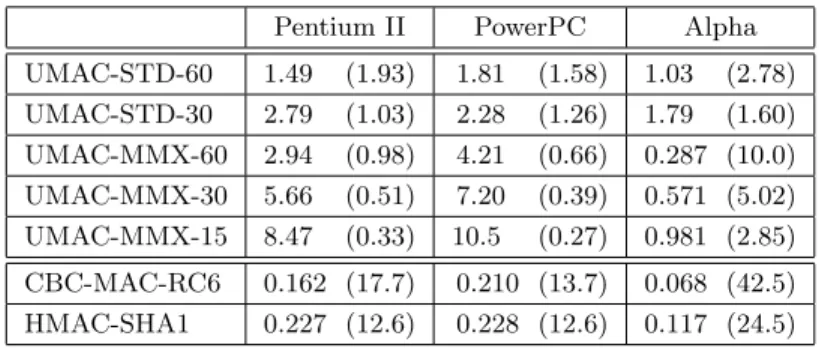
UMAC-STD-60 1.49 (1.93) 1.81 (1.58) 1.03 (2.78) UMAC-STD-30 2.79 (1.03) 2.28 (1.26) 1.79 (1.60) UMAC-MMX-60 2.94 (0.98) 4.21 (0.66) 0.287 (10.0) UMAC-MMX-30 5.66 (0.51) 7.20 (0.39) 0.571 (5.02) UMAC-MMX-15 8.47 (0.33) 10.5 (0.27) 0.981 (2.85) CBC-MAC-RC6 0.162 (17.7) 0.210 (13.7) 0.068 (42.5) HMAC-SHA1 0.227 (12.6) 0.228 (12.6) 0.117 (24.5)
Figure 3: UMAC Performance. Left: Performance over various message lengths on a Pentium II, measured in machine cycles/byte. The lines in the graph correspond to the following MACs (begin-ning at the top-right and moving downward): UMAC-MMX-30,UMAC-MMX-60,UMAC-STD-30, UMAC-STD-60,HMAC-SHA1and CBC-MAC-RC6. Right: Peak performance for three architec-tures measured in Gbits/sec (cycles/byte). The Gbits/sec numbers are normalized to 350 MHz.
parameters differs from platform to platform. In some usage scenarios it is realistic to assume the most desirable set of parameters, though often it is not. Thus it is unclear which parameters should be selected and tested on which platforms. Second, UMAC performance varies with message length. The advantage UMAC delivers over conventional MACs increases as messages get longer. What message lengths should be chosen for performance tests?
To address the first issue we report performance characteristics for a few different parameter choices. To address the second issue we report timing data for a variety of message lengths.
Test Environment. We implemented the four UMAC variants named in Section 2.2 on three
representative hardware platforms: a 350 MHz Intel Pentium II, a 200 MHz IBM/Motorola Pow-erPC 604e, and a 300 MHz DEC Alpha 21164. We also implemented the UMAC-MMX variants on a pre-release PowerPC 7400 equipped with AltiVec SIMD instructions and running at 266 MHz. Performing well on these platforms is important for acceptance of UMAC but also is an indication that the schemes will work well on future architectures. The SIMD operations in the MMX and AltiVec equiped processors and the 64-bit register size of the Alpha are both features we expect to become more prevalent in future processors.
All tests were written in C with a few functions written in assembly. For the Pentium II we wrote assembly for RC6, SHA-1, and the first-levelNH hashes. For the PowerPC 604e we wrote in assembly just the first-levelNH hashes. In both cases, the number of lines of assembly written was small—about 70–90 lines. No assembly code was written for the Alpha or AltiVec implementations. For each combination of options we determined the scheme’s throughput on variously sized mes-sages, eight bytes through 512 KBytes. The experimental setup ensured that messages resided in level-1 cache regardless of their length. For comparison the same tests were run for HMAC-SHA1 [11] and the CBC-MAC of a fast block cipher, RC6 [23].
Results. The graph in Figure 3 shows the throughput of five versions of UMAC, as well as
HMAC-SHA1 and CBC-MAC-RC6, all run on our Pentium II. The table gives peak throughput for the same MACs, but does so for all three architectures. When reporting throughput in Gbits/second the meaning of “Gbit” is 109 bits (as opposed to 230 bits). The performance curves for the Alpha and PowerPC look similar to the Pentium II—they perform better than the reference MACs at around the same message length, and level out at around the same message length.
UMAC performs best on long messages because the hash function is then most effective at reducing the amount of data acted upon by the PRF. For our choice of tested parameters the maximum compression ratio is achieved on messages of 4 KBytes and up, which is why the curves in Figure 3 level out at around 4 KBytes. Still, reasonably short messages (a couple hundred bytes) already see substantial benefit from the hashing. For short messages about half the time spent by UMAC-MMX-60 authenticating is spent in the PRF, but that ratio drops to around 7% for longer messages.
When messages are short the portion of time spent computing the PRF is higher, making the choice of PRF more significant. Our tests show that, all other parameters being the same, an RC6-based UMAC is about 50% faster than one based on SHA-1 for messages of length 32 bytes, but this advantage drops to 10% - 20% for 4 KByte messages and nearly vanishes for 64 KByte messages.
In general, the amount of work spent hashing increases as word size decreases because the number of arithmetic operations needed to hash a fixed-length message is inversely related to word size. The performance of UMAC on the Alpha demonstrates this clearly. On UMAC-MMX-60 (w = 16) it requires 10 cycles per byte to authenticate a long message, while it requires 2.8 for UMAC-STD-60 (w= 32) and only 1.7 for a test version which usesw= 64 bit words1. Perhaps our most surprising experimental finding was how, on some processors, we could dramatically improve performance by going from words ofw= 32 bits to words ofw= 16 bits. Such a reduction in word size might appear to vastly increase the amount of work needed to get to a given collision bound. But a single MMX instruction which UMAC uses heavily can do four 16-bit multiplications and two 32-bit additions, and likewise a single AltiVec instruction can do eight 16-bit multiplications and eight 32-bit additions. This is much more work per instruction than the corresponding 32-bit instructions.
UMAC-STD uses only one-tenth as much hash key as UMAC-MMX to achieve the same com-pression ratio. The penalty for such 2L hashing ranges from 8% on small messages to 15% on long ones. To lower the amount of key material we could have used a one-level hash with a smaller compression ratio, but experiments show this is much less effective: relative to UMAC-MMX-60, which uses about 4 KBytes of hash key, a 2 KBytes scheme goes 85% as fast, a 1 KByte scheme goes 66% as fast, and a 512 bytes scheme goes 47% as fast.
The endian-orientation of the UMAC version being executed has little effect on performance for the PowerPC and Pentium II systems. Both support swapping the endian-orientation of words efficiently. On the Alpha, and most other systems, such reorientation is not part of the architecture and must be done with an expensive series of primitive operations. Key setup on our 350 MHz Pentium II took 450 μs for UMAC-MMX-60 and 130 μs for UMAC-STD-60, or about 158,000 and 46,000 cycles, respectively.
To answer some questions we had about UMAC performance we implemented it with sev-eral variations. In one supplementary experiment we replaced the NH hash function used in UMAC-STD-30 by MMH [14]. Peak performance dropped by 24%. We replaced the NH hash function of UMAC-MMX-30 by a 16-bit MMH (implemented using MMX instructions) and peak performance dropped by 5%. Thus our performance gains (compared to prior art) are due more to SIMD exploitation than the difference betweenNH and MMH.
The hash familyMMHcan be simplified by eliminating its last two modular reductions. We refer to the resulting hash function family asMH, and it is defined byMHK(M) =i=1 miki mod 22w. An MH-version of UMAC-MMX-30 (w = 16) was about 5% slower than (our NH-version of)
1Another reason UMAC-MMX-60 does poorly on non-SIMD processors is because of additional overhead required to load small words into registers and then sign-extend or zero the upper bits of those registers.
UMAC-MMX-30, while an MH-version of UMAC-STD-30 (w = 32) was about 26% slower than (our NH-version of) UMAC-STD-30. Finally, we coded UMAC-STD-30 and UMAC-STD-60 for a Pentium processor which lacked MMX. Peak speeds were 2.2 cycles/byte and 4.3 cycles/byte—still 3 to 6 times faster than methods like HMAC-SHA1. Even though these versions of UMAC do not use MMX instructions, Intel processors without MMX are also slower than the Pentium II at integer multiplication, an important operation in UMAC.
4
The NH Hash Family
We now define and analyzeNH, the hash-function family which underlies UMAC. Recall thatNHis not, by itself, the hash-function family which UMAC uses, but the basic building block from which we construct UMAC’s hash families.
4.1 Preliminaries
Function Families. A family of functions (with domain A ⊆ {0,1}∗ and range B ⊆ {0,1}∗) is
a set of functions H= {h : A → B} endowed with some distribution. When we write h ← Hwe mean to choose a random function h ∈ Haccording to this distribution. A family of functions is also called a family of hash functions or a hash-function family.
Usually we specify a family of functions H by specifying some finite set of strings, Key, and explaining how each string K ∈Key names some functionHK ∈H. We may then think of Hnot as a set of functions from A toB but as a single functionH:Key×A→B, whose first argument we write as a subscript. A random element h∈His determined by selecting uniformly at random a stringK ∈Key and setting h=HK.
Universal Hashing. We are interested in hash-function families in which “collisions” (when
h(M) =h(M) for distinctM, M) are infrequent. The formal definition follows.
Definition 4.1 Let H = {h : A → B} be a family of hash functions and let ≥ 0 be a real number. We say that H is -universal, denoted -AU, if for all distinct M, M ∈ A, we have that Prh←H[h(M) =h(M)]≤. We say that His -universal on equal-length strings if for all distinct, equal-length stringsM, M ∈A, we have that Prh←H[h(M) =h(M)]≤.
4.2 Definition of NH
Fix an even n≥2 (the “blocksize”) and a number w ≥1 (the “wordsize”). We define the family of hash functions NH[n, w] as follows. The domain is A={0,1}2w∪ {0,1}4w∪ · · · ∪ {0,1}nw and the range isB ={0,1}2w. Each function inNH[n, w] is named by a stringK of nwbits; a random function in NH[n, w] is given by a random nw-bit string K. We write the function indicated by stringK asNHK(·).
LetUw andU2w represent the sets{0, . . . ,2w−1}and{0, . . . ,22w−1}, respectively. Arithmetic done modulo 2w returns a result in Uw; arithmetic done modulo 22w returns a result in U2w. We overload the notation introduced in Section 2.1: for integersx, ylet (x +w y) denote (x+y) mod 2w. (Earlier this was an operator from strings to strings, but with analogous semantics.)
Let M ∈ A and denote M = M1· · ·M, where |M1| = · · · = |M| = w. Similarly, let K ∈ {0,1}nw and denote K =K1· · ·Kn, where|K1|=· · ·=|Kn|=w. Then NHK(M) is defined as
NHK(M) =
/2
i=1
where mi ∈ Uw is the number that Mi represents (as an unsigned integer), where ki ∈ Uw is the number thatKi represents (as an unsigned integer), and the right-hand side of the above equation is understood to name the (unique) 2w-bit string which represents (as an unsigned integer) the
U2w-valued integer result. Henceforth we shall refrain from explicitly converting from strings to integers and back, leaving this to the reader’s good sense. (We comment that for everything we do, one could use any bijective map from{0,1}w toUw, and any bijective map from U2w to{0,1}2w.)
When the values of nand ware clear from the context, we writeNH instead ofNH[n, w]. 4.3 Analysis
The following theorem bounds the collision probability of NH.
Theorem 4.2 For any even n≥2 and w≥1,NH[n, w]is2−w-AUon equal-length strings.
Proof:LetM, M be distinct members of the domainAwith|M|=|M|. We are required to show Pr
K←NH
NHK(M) =NHK(M) ≤2−w.
Converting the message and key strings to n-vectors of w-bit words we invoke the definition ofNH
to restate our goal as requiring Pr ⎡ ⎣/2 i=1 (k2i−1 +w m2i−1)(k2i +w m2i) = /2 i=1 (k2i−1 +w m2i−1)(k2i +w m2i) ⎤ ⎦ ≤2−w where the probability is taken over uniform choices of (k1, . . . , kn) with eachki inUw. Above (and for the remainder of the proof) all arithmetic is carried out inZ/22w.
Since M and M are distinct, mi = mi for some 1≤ i≤n. Since addition and multiplication in a ring are commutative, we lose no generality in assuming m2 =m2. We now prove that for any choice ofk2,· · ·, kn we have Pr k1∈Uw (m1 +w k1)(m2 +w k2) + /2 i=2 (m2i−1 +w k2i−1)(m2i +w k2i) = (m1 +w k1)(m2 +w k2) + /2 i=2 (m2i−1 +w k2i−1)(m2i +w k2i) ≤ 2−w which will imply the theorem. Collecting up the summations, let
y= /2 i=2 (m2i−1 +w k2i−1)(m2i +w k2i) − /2 i=2 (m2i−1 +w k2i−1)(m2i +w k2i)
and let c= (m2 +w k2) and c = (m2 +w k2). Note thatc and c are in Uw, and since m2 =m2, we know c=c. We rewrite the above probability as
Pr
k1∈Uw
c(m1 +w k1)−c(m1 +w k1) +y = 0 ≤2−w.
In Lemma 4.3 below, we prove that there can be at most one k1 inUw satisfying c(m1 +w k1)−
c(m
1 +w k1) +y = 0, yielding the desired bound.
The above proof reduced establishing our bound to the following useful lemma, which is used again for Theorem 5.1.
Lemma 4.3 Let cand c be distinct values from Uw. Then for any m, m ∈Uw and any y∈U2w there exists at most onek∈Uw such thatc(k +w m) =c(k +w m) +y inZ/22w.
Proof: We note that it is sufficient to prove the case where m = 0: to see this, notice that if c(k +w m) = c(k +w m) + y, then also c(k∗ +w 0) = c(k∗ +w m∗) +y, where we define
k∗ = (k +w m) and m∗ = (m −w m). If follows that if there exist k1 =k2 satisfying the former equality, then there must also exist k1∗=k2∗ satisfying the latter.
Assuming m = 0, we proceed to therefore prove that for any c, c, m ∈ Uw with c = c and any
y∈U2w there is at most onek∈Uw such that kc= (k +w m)c+y inZ/22w. Since k, m <2w, we know that (k +w m) is either k+m or k+m −2w, depending on whether k+m <2w or
k+m ≥2w respectively. So now we have
k(c−c) =mc+y and k <2w−m (2)
k(c−c) = (m−2w)c+y and k≥2w−m (3) A simple lemma (Lemma 4.4, presented next) shows that there is at most one solution to each of the equations above. The remainder of the proof is devoted to showing there cannot existk=k1∈Uw satisfying (2) and k=k2 ∈Uw satisfying (3) in Z/22w. Suppose such ak1 and k2 did exist. Then we havek1 <2w−m withk1(c−c) =mc+yand k2 ≥2w−m withk2(c−c) = (m−2w)c+y. Subtracting the former from the latter yields
(k2−k1)(c−c) = 2wc (4)
We show (4) has no solutions inZ/22w. To accomplish this, we examine two cases:
Case 1: c > c. Since both (k2−k1) and (c−c) are positive and smaller than 2w, their product
is also positive and smaller than 22w. And since 2wc is also positive and smaller than 22w, it is sufficient to show that (4) has no solutions inZ. But this clearly holds, since (k2−k1) <2w and (c−c)≤c, and so necessarily (k2−k1)(c−c)<2wc.
Case 2: c < c. Here we show (k2−k1)(c−c) =−2wc has no solutions in Z/22w. As before, we
convert toZ, to yield (k2−k1)(c−c) = 22w−2wc. But again (k2−k1)<2w and (c−c)<(2w−c), so (k2−k1)(c−c)<2w(2w−c) = 22w−2wc.
LetDw ={−2w+ 1, . . . ,2w−1}contain the values attainable from a difference of any two elements of Uw. We now prove the following lemma, used in the body of the preceding proof.
Lemma 4.4 Letx∈Dw be nonzero. Then for anyy ∈U2w, there exists at most onea∈Uw such thatax=y inZ/22w.
Proof: Suppose there were two distinct elements a, a ∈ Uw such that ax = y and ax = y. Then ax = ax so x(a−a) = 0. Since x is nonzero and a and a are distinct, the foregoing product is 22wk for nonzero k. But x and (a−a) are in Dw, and therefore their product is in {−22w+ 2w+1−1, . . . ,22w−2w+1+ 1}, which contains no multiples of 22w other than 0.
Remarks. The bound given by Theorem 4.2 is tight: let M = 0w0w and M = 1w0w and note
that any key K =K1K2 with K2 = 0w causes a collision.
Although we do not require any stronger properties than the above, NH is actually 2−w-AΔU under the operation of addition modulo 22w; only trivial modifications to the above proof are required. See [17] for a definition of -AΔU.
Several variants ofNHfail to preserve collision probability= 2−w. In particular, replacing the inner addition or the outer addition with bitwise-XOR increasessubstantially. However, removing the inner moduli retains = 2−w (but significantly degrades performance).
4.4 The Signed Construction: NHS
To this point we have assumed our strings are interpreted as sequences of unsigned integers. But often we will prefer they be signed integers. Surprisingly, the signed version of NH has slightly higher collision probability: we shall now prove that the collision bound increases by a factor of two to 2−w+1-AU on equal-length strings. This helps explain the 2−30 and 2−60 forging probabilities for the four UMAC versions named in Section 2.2 and the performance measured in Section 3; in actuality, all four algorithms use the signed version ofNH.
Let Sw and S2w be the sets {−2w−1, . . . ,2w−1−1} and {−22w−1, . . . ,22w−1−1}, respectively. For this section, assume all arithmetic done modulo 2w returns a result in Sw and all arithmetic done modulo 22w returns a result inS2w. The family of hash functionsNHS is defined exactly like
NH except that each Mi ∈ {0,1}w and K ∈ {0,1}w is bijectively mapped to an mi ∈ Sw and a
ki∈Sw.
Theorem 4.5 For any even n≥2 and w≥1,NHS[n, w]is2−w+1-AUon equal-length strings. The proof of Theorem 4.5 is identical to the proof for Theorem 4.2 with two exceptions: instead of
Uw we take elements from Sw, and in the end we use Lemma 4.7, which guarantees a bound oftwo
on the number of k1 values satisfying c(m1 +w k1)−c(m1 +w k1) +y = 0. To prove Lemma 4.7 we begin by restating Lemma 4.4 for the signed case. Recall thatDw={−2w+ 1, . . . ,2w−1}. Lemma 4.6 Letx∈Dw be nonzero. Then for any y∈S2w, there exists at most onea∈Sw such thatax=y inZ/22w.
Proof: Notice that the set of possible differences of any two elements of Sw is again Dw. (This follows from the fact that the obtainable differences for two elements of any set of j consecutive integers is always the same, namely {−j+ 1, . . . , j−1}.) Since the proof of Lemma 4.4 depends only on Dw, we may recycle the proof without modification.
Lemma 4.7 Let c and c be distinct values fromSw. Then for anym, m ∈Sw and any y∈S2w there exist at most two k∈Sw such that c(k +w m) =c(k +w m) +y inZ/22w.
Proof:As in the proof to Lemma 4.3, we again notice it is sufficient to prove the case wherem= 0. We now consider two cases depending on whetherm<0 orm≥0. We show in either case there can be at most two values of ksatisfying c(k +w m) =c(k +w m) +y inZ/22w.
Case 1: m<0. Sincek∈Sw, we know that (k +w m) is eitherk+m+ 2w (ifk+m<−2w−1),
ork+m (if−2w−1 ≤k+m). Clearly we cannot have k+m ≥2w−1. Substituting these values and movingk to the left yields
k(c−c) = (m+ 2w)c+y and k+m<−2w−1
k(c−c) =mc+y and k+m<2w−1
Case 2: m ≥0. Since k∈ Sw, we now have that (k +w m) is either k+m (if k+m <2w−1)
or k+m−2w (if k+m ≥ 2w−1). Clearly we cannot have k+m <−2w−1. Substituting these values and moving kto the left yields
k(c−c) =mc+y and k+m <2w−1
k(c−c) = (m−2w)c+y and k+m ≥2w−1
But again Lemma 4.6 tells us there can be at most one solution to each of the above equations.
A Lower Bound. We now show that the bound forNHS is nearly tight by exhibiting two
equal-length messages where the probability of collision is very close to 2−w+1.
Theorem 4.8 Fix an evenn≥2and letmi= 0for1≤i≤n. Letm1 =m2=−2w−1 andmi = 0 for3≤i≤n. Then
Pr
K←NHS
NHSK(M) =NHSK(M) ≥ 2−w+1−21−2w where the M andM are mapped in the usual way frommi and mi, respectively.
Proof: As usual, assume henceforth that all arithmetic is in Z/22w. Invoking the definition of
NHS, we will show
(k1 +w m1)(k2 +w m2) = (k1 +w m1)(k2 +w m2) +y
has at least 2w+1 −2 solutions in k1, k2 ∈ Sw. This will imply the theorem. As in the proof to Theorem 4.2, y is the collection of terms for the mi, mi, and ki where i > 2. Since we have
mi =mi= 0 for i >2,y is clearly 0. Therefore we wish to prove
k1k2 = (k1 −w 2w−1)(k2 −w 2w−1)
has at least 2w+1−2 solutions. To remove the inner moduli, we let i1 = 1 if k1 <0 and i1 = 0 otherwise. Define i2= 1 if k2<0 andi2= 0 otherwise. Now we may re-write the above as
k1k2 = (k1−2w−1+i12w)(k2−2w−1+i22w). Multiplying the right side out and rearranging terms we have
2w−1(k1(2i2−1) +k2(2i1−1)) + 22w−2 = 0. Multiplying through by 4, we arrive at
2w+1(k1(2i2−1) +k2(2i1−1)) = 0.
We notice that allk1, k2 ∈Sw such that|k1|+|k2|= 2w−1 will satisfy the above. Now we count the number of k1, k2 which work: we see that for each of the 2w−2 choices of k1 ∈Sw− {0,−2w−1} there are two values of k2 causing |k1|+|k2|= 2w−1, yielding 2w+1−4 solutions. And of course two further solutions are k1 =−2w−1, k2 = 0 andk1 = 0, k2 =−2w−1. And so there are at least 2w+1−2 total solutions.
5
Reducing the Collision Probability: Toeplitz Extensions
The hash-function families NH and NHS are not yet suitable for use in a MAC: they operate only on strings of “convenient” lengths (w-bit strings for even ≤n); their collision probability may be higher than desired (2−w when one may want 2−2w or 2−4w); and they guarantee low collision probability only for strings of equal length. We begin the process of removing these deficiencies, here describing a method to square the collision probability at a cost far less than doubling the key length.
5.1 The Toeplitz Approach
To reduce the collision probability forNH, we have a few options. Increasing the wordsizewyields an improvement, but architectural characteristics dictate the natural values for w. Another well-known technique is to apply several random members of our hash-function family to the message, and concatenate the results. For example, if we concatenate the results from, say, four independent instances of the hash function, the collision probability drops from 2−w to 2−4w. But this solution requires four times as much key material. A superior (and well-known) idea is to use the Toeplitz-extension of our hash-function families: given one key we “left shift” to get another key, and we hash again.
For example, to reduce the collision probability to 2−64 for NH[n,16], we can choose an un-derlying hash keyK =K1 · · · Kn+6 and then hash with the four derived keys K1 · · · Kn,
K3 · · · Kn+2, K5 · · · Kn+4, and K7 · · · Kn+6. This trick not only saves key material but it can also improve performance by reducing memory accesses, increasing locality of memory references, and increasing parallelism.
Since the derived keys are related it is not clear that the collision probability drops to the desired value of 2−64. Although there are established results which yield this bound (e.g., [18]), they only apply to linear hashing schemes over fields. Instead, NHis non-linear and operates over a combination of rings (Z/2w andZ/22w). In Theorem 5.1 we prove that the Toeplitz construction nonetheless achieves the desired bound in the case of NH.
5.2 The Unsigned Case
We define the hash-function family NHT[n, w, t] (“Toeplitz-NH”) as follows. Fix an even n ≥ 2,
w≥1, andt≥1 (the “Toeplitz iteration count”). The domainA={0,1}2w∪{0,1}4w∪· · ·∪{0,1}nw remains as it was forNH, but the range is nowB={0,1}2wt. A function inNH[n, w, t] is named by a stringK of w(n+ 2(t−1)) bits. Let K =K1 · · · Kn+2(t−1) (where each Ki is aw-bit word), and let the notationKi..j represent Ki · · · Kj. Then for anyM ∈Awe define NHTK(M) as
NHT
K(M) =NHK1..n(M)NHK3..n+2(M) · · · NHK(2t−1)..(n+2t−2)(M).
When clear from context we write NHT instead ofNHT[n, w, t].
The following shows that NHT enjoys the best bound that one could hope for.
Theorem 5.1 For any w, t ≥ 1 and any even n ≥ 2, NHT[n, w, t] is 2−wt-AU on equal-length strings.
Proof: We refer to NHT[n, w, t] asNHT and toNH[n, w] asNH, where the parametersn,w, and t are as in the theorem statement.
LetM and M be distinct members of the domainA with|M|=|M|. We are required to show Pr K←NHT NHT K(M) =NHTK(M) ≤2−wt.
As usual, we viewM, M, Kas sequences ofw-bit words,M =M1 · · · M,M =M1 · · · M and K =K1 · · · Kn+2(t−1), where the Mi,Mi and Ki are eachw-bits long. We denote bymi,
m
i,and ki the w-bit integers corresponding toMi,Mi, and Ki, respectively. Again, for this proof assume all arithmetic is carried out in Z/22w. Forj∈ {1, . . . , t}, defineEj as
Ej : /2 i=1 (k2i+2j−3 +w m2i−1)(k2i+2j−2 +w m2i) = /2 i=1 (k2i+2j−3 +w m2i−1)(k2i+2j−2 +w m2i) and invoke the definition of NHT to rewrite the above probability as
Pr
K←NHT
[E1∧E2∧ · · · ∧Et]. (5)
We call each term in the summations of the Ej a “clause” (for example, (k1 +w m1)(k2 +w m2) is a clause). We refer to thejth equality in (5) as Equality Ej.
Without loss of generality, we can assume that M and M disagree in the last clause (i.e., that
m−1 = m−1 or m = m). To see this, observe that if M and M agree in the last few clauses, then each Ej is satisfied by a key K if and only if it is also satisfied when omitting these last few clauses. Hence, we could truncateM and M after the last clause in which they disagree, and still have exactly the same set of keys causing collisions.
Assume now that m−1 =m−1. (The proof may easily be restated if we instead have m =m. This case is symmetric due to the fact we shift the key by two words.) We proceed by proving that for all j∈ {1, . . . , t}, Pr[Ej is true |E1, . . . , Ej−1 are true]≤2−w, implying the theorem.
For E1, the claim is satisfied due to Theorem 4.2. For j >1, notice that Equalities E1 through
Ej−1 depend only on key words k1, . . . , k+2j−4, whereas Equality Ej depends also on key words
k+2j−3 and k+2j−2. Fix k1 through k+2j−4 such that Equalities E1 through Ej−1 are satisfied, and fix any value for k+2j−3. We prove that there is at most one value of k+2j−2 satisfying Ej. To achieve this we follow the same technique used in Theorem 4.2. Let
y = /2−1 i=1 (k2i+2j−3 +w m2i−1)(k2i+2j−2 +w m2i)− /2−1 i=1 (k2i+2j−3 +w m2i−1)(k2i+2j−2 +w m2i) and letc= (k+2j−3 +w m−1) and c = (k+2j−3 +w m−1), and then rewriteEj as
c(k+2j−2 +w m) +y =c(k+2j−2 +w m).
Since we assumed m−1 = m−1 we know c = c; clearly m, m, c, c ∈ Uw so Lemma 4.3 tells us there is at most one value ofk+2j−2 satisfying this equation, which completes the proof.
Comment. With UMAC, we sometimes use shift amounts of more than two words; this clearly
NH
NH
Ka Kb KaNH
KbNH
KaNH
KbNH
NH
La LbNH
M1 M2 M3A
B
Y
K1 K2 K3...
Kn Kn+1Kn+2 Ka Kb L1 L2 L3...
L2m L2m+1L2m+2 La LbFigure 4: The T2 scheme. Each block of the message is hashed twice, first using a keyKa, and then using a key Kb. Key Kb is the shift of key Ka. The outputs of the Ka-hashes are concatenated and La hashed, and the outputs of the Kb-hashes are concatenated and then Lb hashed. Key Lb
is once again the shift of key La.
5.3 The Signed Case
Now we consider the Toeplitz construction onNHS, the signed version of NH. The only significant change in the analysis forNHT will be the effect of the higher collision probability of NHS.
We define the hash family NHST[n, w, t] (“Toeplitz-NHS”) exactly as we did for NH, but we instead useNHSas the underlying hash function. Now we restate Theorem 5.1 for the signed case. Theorem 5.2 For anyw, t≥1 and any even n≥2,NHST[n, w, t]is 2t(−w+1)-AUon equal-length strings.
Proof: The proof is precisely the same as the proof to Theorem 5.1 except we use Theorem 4.5 in place of Theorem 4.2 and Lemma 4.7 in place of Lemma 4.3. Then, using the same notation as Theorem 5.1, PrK←NHST[Ej |E1, . . . , Ej−1]≤2−w+1, and so PrK←NHST[E1∧E2∧ · · · ∧Et]≤ 2t(−w+1), yielding our result.
5.4 Shorter Keys: T2
Fix an even n≥2 and m, w≥1. We describe the family of hash functions NHT2[n, m, w] and the family of hash functionsNHST2[n, m, w]. Both families have domainA={0,1}2w∪ {0,1}4w∪ · · · ∪ {0,1}nmw and rangeB ={0,1}4w. (That is, the input consists of an even number ofw-bit words— at least two words and at mostmw words. The output is four words.) A function NHT2(KL,·) from the family NHT2[n, m, w] is named by a keyKL having (n+ 2)w+ (2m+ 2)w bits. (The part of the key denotedK hasn+ 2 words, and the part of the key denoted Lhas 2m+ 2 words.) We defineNHT2(KL, M) below. See Figure 4 as well.