Study on Stabilization of Soil Using Sea Shell
and Bitumen Emulsion
Maheshwari G.Bisanal
1, Ravikumar Badiger
2Assistant Professor, Department of Civil Engineering, KLES’s C.E.T, Chikodi, Belgaum (KA), India1
U.G. Student, Department of Civil Engineering, KLES’s C.E.T, Chikodi, Belgaum (KA), India2
ABSTRACT: Civil engineers face many difficulties when construction activities to be done in expansive soils such as black cotton soil because of their unconventional behaviour. These soils have large tendency to swell and shrink with respect to variation in moisture content, thus causing serious problem to the structures build on that. Hence, these soils need to be stabilized before constructing on that. The most common methods for stabilizing black cotton soil are using lime, cement, kiln dust, iron slag, cattle waste ash and industrial wastes which cause problems in disposal and create environmental pollution. In the present study an attempt has been made to stabilize the black cotton soil with sea shell and bitumen emulsion. Sea shells are naturally available materials on the sea shores. They are the hard exoskeleton of molluscs. They contain about 90% of calcium carbonate which is a major component in Lime. Bitumen emulsions which are easily available in our country act as a binder between the soils particles and prevent the entry of water within the soil.
KEYWORDS:Black cotton soil, seashell powder, bitumen emulsion Stabilization, Curing, Expansive soil. I. INTRODUCTION
A difficult problem in Civil Engineering work exists when the sub-grade is found to be clay. Soils having high clay content have a tendency to swell when their moisture content is allowed to increase. This moisture may come from rains, floods, leaking sewer lines, or from the reduction of surface evaporation when an area is covered by a building or pavement. Frequently, these clayey soils cause the cracking and breaking up of pavements, railways, highway embankments, roadways, foundations and channel or reservoir linings. The high cost of repairing the damaged structures has drawn attention to the need for morereliable investigation of such soils and necessitates methods to eliminate or at least reduce the effect of volume change in the soil and increase the strength. There are various techniques for improving the soil have been practiced in recent days, some of them in such are:- Surface Compaction, Drainage Methods, Vibration Methods, Pre-compression & consolidation, Grouting and Injection, Chemical Stabilization, Soil Reinforcement, geo-synthetics, other methods etc.
II. RELATED WORK
The expansive soil occurs all over the world. India has a large tracks of expansive soils known as Black Cotton soil (BC soil or clayey soils) and every civil engineer is more familiar to it, covering about 0.8 million sq.km which is about 20% of total area. Theseclayey soils foremost in the states of Gujarat, Madhya Pradesh, Maharashtra, Andhra Pradesh, Karnataka and Tamil Nadu. These soils undergo volumetric changes with the increase in moisture content. This is due to the presence of the mineral montmorillonate. The types of structures likely to get damaged are foundation, retaining walls, Pavements, runway of airport, side walk, canal beds and linings. It is great challenge to civil engineers for the construction of building structures and roads over it.
In past studies many researchers worked in improving the strength of black cotton soil. They used many admixtures which are naturally available with the soil and showed best results. Balasubramaniam et al., (1989), Locat et al., (1990) (1996), Narasimha Rao and Rajasekaran (1996) have found that the strength behaviour of soil greatly improved by adding Lime with it. Laxmikant Yadu, Rajesh Kumar Tripathi and Dharamveer Singh (2011) have studied the effect of Fly Ash and Rice Husk in black cotton soil and showed that the soil attains its optimum strength at 12% and 9% of the admixtures. Oriola, Folagbade and Moses, George (2010) conducted experiments on black cotton soil by adding Ground Nut Shell Ash with them. In this current investigation sea shell powder and bitumen emulsion were added with soil and its unconfined compressive strength characteristics were studied. Sea shells are naturally available materials on the sea shores. They are the hard exoskeleton of molluscs. They contain about 90% of calcium carbonate which is a major component in Lime. Bitumen emulsions which are easily available in our country act as a binder between the soils particles and prevent the entry of water within the soil (Elifas Bunga 2011).
III.MATERIALS AND METHODS
Materials used are: 1.Black Cotton Soil 2.Seashell powder 3.Bitumen emulsion
Black Cotton Soil: Expansive soils are considered to be the most problematic soil all over the world due to their swelling behaviour when in contact with water and shrink on removal of water. Although the phenomenon of swelling and shrinkage is not uncommon with most of the soils it is exhibited to a very marked degree only by certain clayey soils and hence, they are termed as 'Expansive soils'. The sample was collected in the place nearChikodi Taluk, Belagavi District(KARNATAKA)at 2 m depth, which shows following results under various tests. The soil was air
dried and pulverized to pass through IS-425 Micron Sieve and then oven dried at 110ο C before testing.
Table.1:Black cotton soil Properties
S.NO PROPERTY VALUE
1 Specific Gravity 2.16
2 Liquid Limit 60.60%
3 Plastic Limit 20.0%
4 Plasticity Index 40.60%
5 Shrinkage Limit 12.8%
6 Grain size distribution
i)Sand(size>75*10-6mm) 25 %
ii)Silt % & Clay (size < 75 * 10-6mm) 75 %
7 Free swell index 88.89%
8 Optimum Moisture Content 14.0%
9 Dry Density 1.60 g/cm3
10 Unconfined Compressive Strength 120.6 kpa
Sea shell powder: It is derived from natural sea shell. It is a rich source of calcium and has high absorption rate.The sea shells were finely grained and the sea shell powder passes through IS150 Micron sieve and retained on IS75 Micron Sieve was used for this experiment shown in figure 1. And sea shell containing the 90% of calcium carbonate, remaining 10% it contain dust and impurities.
Figure 1: Sea shell powder
Bitumen Emulsion:It consists of three basic ingredients: bitumen, water, and an emulsifying agent. Based on specifications it may contain other additives, such as stabilizers, coating improvers, anti-strips, or break control agents. It is well known that water and asphalt will not mix, except under carefully controlled conditions using highly specialized equipment and chemical additives. Cationic emulsions may be used at ambient temperatures. Emulsions are less hazardous to use and can be applied in a wider range of conditions. The cationic Bitumen Emulsion is obtained, the type of Bitumen Emulsion used for this experiment is Cool tar-CE (Rapid Setting 1), shown in figure 2.Bitumen emulsion consists of known quantity of bitumen with 2% of kerosene oil and it contain water and emulsifier.
Figure 2: Bitumen emulsion
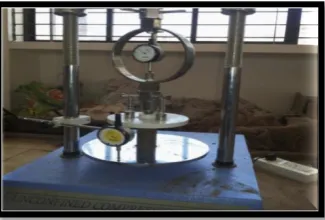
A. Unconfined Compression Test (U.C.S): The unconfined compressive strength-testing machine used to conduct the
test is in accordance with IS: 2720 (part-X) 1973, as shown in figure 3. The U.C.S test is a laboratory test method that is used to determine shear parameters of cohesive soil. It is not always possible to conduct the bearing capacity test in the field. Sometimes it is cheaper to take the undisturbed soil sample and test its strength in the laboratory.
B. California Bearing Ratio Test (C.B.R):(As per IS 2720-1990 (Part 31)): Bearing Ratio (Generally known as C.B.R). The ratio of the force per unit area required to penetrate a soil mass with a standard circular piston at the rate of 1.25 mm/min to that required for corresponding penetration of a standard material as given in Table 2.
Table.2:Standard loads for different penetrations
Penetration of plunger (mm) Standard load (kg)
2.5 5.0 7.5 10.0 12.5
1370 2055 2630 3180 3600
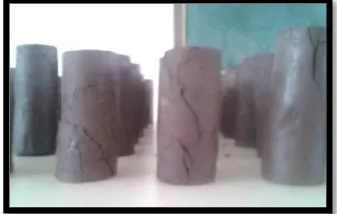
The test may be performed on undisturbed specimens and on remolded specimens which may be compacted either statically or dynamically.C.B.R. = Test load/Standard load x 100.Test samples are shown in figure 4.
Figure 4: Failed samples when subjected to loading
IV.EXPERIMENTAL RESULTS
A. Unconfined compressive strength of normal soil:
The specimen’sinitial length and diameter were measured, then is placed on the U.C.S apparatus. Care should be taken such that both the edges of the specimen are in complete contact with the apparatus. The dial gauge is adjusted to preferable value, Motor is then switched on. The specimen is allowed to compress until a crack occurs in the specimen. When initial crack appears in the specimen, the motor is switched off and the corresponding value on the dial gauge is noted.The results obtained from above test is shown inTable 3.
Table 3: Unconfined compressive strength of normal soil
0 Days 3 Days 7 Days 14 Days 21 Days 28 Days
51.02 71.61 90.35 106.93 108.89 120.66
B. C.B.R value of normal soil:
Table 4: C.B.R value of normal soil
Sl.No. Un-soaked Soaked
1 23.06% 2.34%
C. Unconfined Compressive strength of soil mixed with different Proportions of Sea shell:
The specimen of size 8.9cm length and 3.8cm diameter was made with soil alone. Then the admixture sea shell Powder were added in the proportions 6%, 8%, 10%, 12%, 14%, 16%, 18% and 20% to the soil specimen of same length, diameter where prepared.The following results were obtained from above test and isshown in Table 5.
Table 5: Variation of UCS Values at different Percentage of sea shell
Percentage 0 Days 3 Days 7 Days 14 Days 21 Days 28 Days
6.0 51.01 80.73 91.33 107.9 131.45 243.88
8.0 52.77 86.32 100 115.75 137.34 266.83
10.0 55.91 96.13 106.7 117.7 149.11 335.5
12.0 55.62 121.0 115.75 118.5 159.31 398.28
14.0 53.66 112.81 139.30 142.93 186.39 338.44
16.0 67.68 205.52 185.41 207.08 245.25 441.45
18.0 57.09 156.96 118.21 153.13 129.19 411.03
20.0 53.85 125.56 101.04 128.51 117.72 353.16
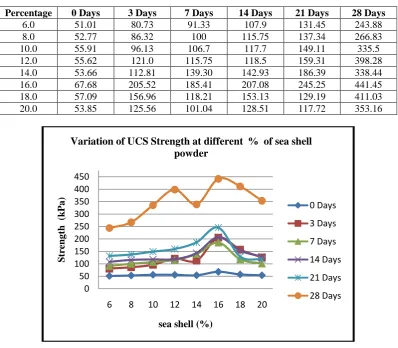
Figure 5:UCS Strengths at different % of sea shell powder
The above graph in figure 5, shows that strength of soil increases with increase in sea shell powder content up to 16% and then decreases. This might be due to disturbance of the soil skeleton and consequent reduction in cohesion. Hence, 16% addition of sea shell powder considered as optimum percentage.
0 50 100 150 200 250 300 350 400 450
6 8 10 12 14 16 18 20
S
treng
th
(
k
Pa
)
sea shell (%)
Variation of UCS Strength at different % of sea shell powder
0 Days
3 Days
7 Days
14 Days
21 Days
D. C.B.R of soil mixed with optimum percentage of 16% of Sea shell:
As per UCS test we conducted for 6%, 8%, 10%, 12%, 14%, 16%, 18% and 20% percentage of sea shell powder was added, the results for 3, 7, 14, 21 and 28days where observed. The maximum variation was obtained and optimum percentage of sea shell taken for the CBR test.The result with 16% Sea Shell are shown in below Table 6.
Table 6: Variation of CBR Values at 16% of sea shell
Sl. No. Un-soaked Soaked
1 27.53% 5.28%
E. Unconfined Compressive strength of soil mixed with different Proportions of bitumen emulsion:
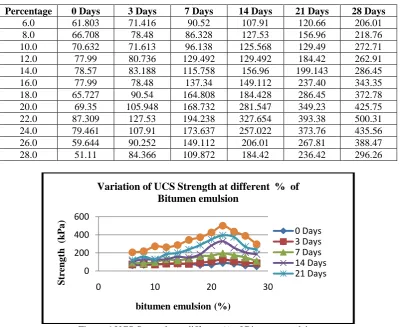
The below graph in figure 6, shows that strength of soil increases with increase in bitumen emulsion content up to 22% and then decreases. This might be due to disturbance of the soil skeleton and consequent reduction in cohesion. Hence, 22% addition of bitumen emulsion considered as optimum percentage.The results are shown in below Table 7.
TABLE 7:VARIATION OF UCSVALUES AT DIFFERENT PERCENTAGE OF BITUMEN EMULSION
Percentage 0 Days 3 Days 7 Days 14 Days 21 Days 28 Days
6.0 61.803 71.416 90.52 107.91 120.66 206.01
8.0 66.708 78.48 86.328 127.53 156.96 218.76
10.0 70.632 71.613 96.138 125.568 129.49 272.71
12.0 77.99 80.736 129.492 129.492 184.42 262.91
14.0 78.57 83.188 115.758 156.96 199.143 286.45
16.0 77.99 78.48 137.34 149.112 237.40 343.35
18.0 65.727 90.54 164.808 184.428 286.45 372.78
20.0 69.35 105.948 168.732 281.547 349.23 425.75
22.0 87.309 127.53 194.238 327.654 393.38 500.31
24.0 79.461 107.91 173.637 257.022 373.76 435.56
26.0 59.644 90.252 149.112 206.01 267.81 388.47
28.0 51.11 84.366 109.872 184.42 236.42 296.26
Figure 6:UCS Strengths at different % of Bitumen emulsion
F. CBR of soil mixed with optimum percentage of 22% of Bitumen emulsion:
As per UCS test we conducted for 6%, 8%, 10%, 12%, 14%, 16%, 18%, 20%, 22%, 24%, 26%and 28% percentage of bitumen emulsion are added andthe results for 3, 7, 14, 21 and 28days where observed. The maximum variation was
0 200 400 600
0 10 20 30
Str
eng
th
(
k
P
a
)
bitumen emulsion (%)
Variation of UCS Strength at different % of Bitumen emulsion
obtained and optimum percentage of bitumen emulsion taken for the CBR test. The result with 22% bitumen emulsion is shown in below Table 8.
Table 8: Variation of UCS Strength at different Percentage of sea shell
Sl. No. Un-soaked Soaked
1 28.63% 7.83%
V. COMPARATIVE STUDY
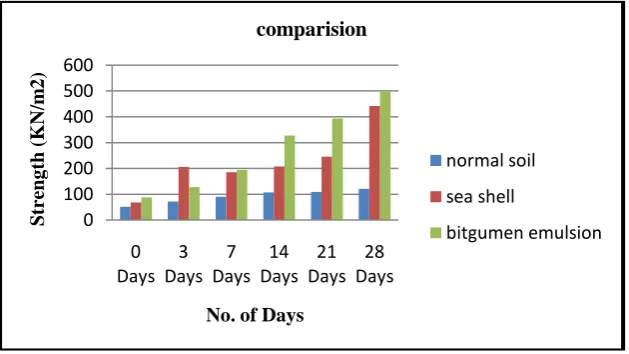
The unconfined compressive strength of black cotton soil showed significant results with the addition of bitumen emulsion 22% added and shown strength of 500.31KN/m2 and the CBR test conducted on black cotton soil showed significant results with the addition of bitumen emulsion, the value is 7.83% for soaked and 28.63% for Un-soaked test for 22% of bitumen emulsion.The unconfined compressive strength of the black cotton soil showed significant results with the addition of sea shell powder 16% added and shown strength of 441.45KN /m2 and the CBR test conducted on black cotton soil showed significant results with the addition of sea shell, the value is 5.28% for soaked and 27.53 % for Un-soaked test for 16% of sea shell powder.
Figure 7: Comparison between sea shell powder and bitumen emulsion
The optimum UCS value is obtained at 22% of addition of bitumen emulsion and at 16% for sea shell powder. From the above graph (figure 7) it is clear that the addition of bitumen emulsion shows highest strength compared to sea shell powder. Obtained UCS value is 500.31KN/m2 and CBR value is 7.83% for soaked and 28.63% for Un-soaked.
VI. CONCLUSION
The following conclusions have been made based on the results obtained from experimental investigations:
The unconfined compressive strength of black cotton soil increased by the addition of admixtures such as bitumen emulsion and sea shell powder.
The optimum UCS value obtained is 500.31KN/m2 for 22% addition of bitumen emulsion and 441.45KN/m2 for 16% addition of sea shell powder.
The addition of 16% sea shell powder gives the CBR values as 5.28% and 27.53% for soaked and un-soaked test respectively.
The addition of 22% bitumen emulsion gives the CBR values as 7.83% and 28.63% for soaked and un-soaked test respectively.
0 100 200 300 400 500 600
0 Days
3 Days
7 Days
14 Days
21 Days
28 Days
Str
eng
th
(K
N/m
2
)
No. of Days
comparision
normal soil
sea shell
Addition of Sea Shell powder with soil reduces their plastic indices significantly. The Un-soaked and soaked CBR values of soil samples increased considerably with the addition of sea shell powder.
The unconfined compressive strength and the California bearing ratio of the black cotton soil increases by stabilizing the soil with bitumen emulsion and sea shell powder.
REFERENCES
[1] IS 2720 (PART 3), Methods of Test for Soils, Determination of Specific Gravity of Soil, 1980.
[2] IS 2720 (PART 5), Methods of Test for Soils, Determination of Liquid Limit and Plastic Limit of Soil, 1980. [3] IS 2720 (PART 7), Determination of Moisture Content - Dry Density Relation using Light Compaction, 1980. [4] IS 2720 (PART 10), Methods of Test for Soils, Determination of Unconfined Compressive Strength, 1980. [5] IS 2720 (PART 16),Methods of Test for Soils, Determination of California Bearing Ratio, 1987.
[6] Dr .B. C. Punmia, Ashok Kumar Jain, Arun Kumar Jain, “Soil Mechanics and Foundation” Laxmi Publications, ISBN 81-7008-081-9, 16th Edition,2005. [7] S. Bhuvaneswari, R. G. Robinson and S. R. Gandhi, “Stabilization of Expansive Soil Using Fly Ash”, Fly Ash Utilization Programme (FAUP), TIFAC, DST, New
Delhi. 2005.
[8] M.Arabani and M.Veis Karami, “Geo Mechanical Properties of Lime Stabilized Clayey Sands”, the Arabian Journal for Science and Engineering, Vol.32, Isssue No.1B, pp 1-25, 2007.
[9] D. Neeraja, “Influence of Lime and Plastic Jute on Strength & CBR Characteristics of Soft Clayey (Expansive) Soil”, Global Journal of Researches in Engineering, Vol.10, Issue 1, pp 16-24(Ver, 1.0), 2010.
[10] Oriola, Folagbade and Moses, George, “Agricultural Wastes As Soil Stabilizers in Black Cotton Soil”, International Journal of Earth Sciences and Engineering, ISSN 0974-5904, Vol.4, Issue6 SPL, pp 50-51, 2011.
[11] Elifas Bunga, H. Muh, Saleh Pallu, Mary Selintung, Arsyad M, and Thaha, “Stabilization Of Sandy Clay With Emulsified Asphalt”, International Journal of Civil & Environmental Engineering, Vol.11, Issue 5, pp 52-58, 2011.
[12] Laxmikant Yadu, Rajesh Kumar Tripathi and Dharamveer Singh, “Comparison of Fly Ash and Rice Husk Ash Stabilized Black Cotton Soil”, International Journal of Earth Sciences and Engineering, ISSN 0974-5904, Vol.4, Issue 6 SPL, pp 42-45, 2011.
[13] Dr. Akshaya Kumar Sabat, “A Study on Geotechnical Properties of Lime Stabilized Expansive Soil-Quarry Dust Mixes”, International Journal of Emerging Trends In Engineering & Development, Vol.2, Issue 2, 2012.
[14] K. Jayaganesh, S. Yuvaraj, D. Yuvaraj, C. Nithesh and G. Karthik,“Effect of bitumen emulsion and sea shell powder in the unconfined compressive strength of black cotton soil”, International Journal of Engineering Research and Applications (IJERA), Vol.2, Issue 3,pp 242-245, 2012.
[15] Mojtaba, Shojaei, Baghini, “Bitumen-cement Stabilized Layer in Pavement Construction Using Indirect Tensile Strength (ITS)”, Method Research Journal of Applied Sciences Engineering and Technology,Vol.5, Issue24, pp 5652-5656, 2013.
[16] Dr. B. Satyanarayana, K. Puneetha Reddy, A. S. S. Sravanthi, I. H. S. Harsha, “Stabilization of Expansive Soils Using Brick Kiln Waste”, International Journal of Applied Sciences, Engineering and ManagementISSN 2320 – 3439, Vol.2, Issue 3, pp 50 – 53, May 2013.
[17] K. Mounika, B. Satya Narayana Reddy, D. Manohar, “Influence of sea shells powder on black cotton soil during stabilization”, International Journal of Advances in Engineering & Technology, Vol.7, Issue 5, pp 1476-1482, 2014.
[18] Olumide Moses and Ogundipe,“Strength and compaction characteristics of bitumen-stabilized granular soil”, International journal of scientific & technology research, Vol.3, Issue 9, pp 2277-8616, 2014.
BIOGRAPHY
1. MAHESHWARI G.BISANAL
Assistant Professor, Department of Civil Engineering,KLES’s C.E.T, Chikodi, Belgaum (KA), India1
Pin code-591201
2. RAVIKUMAR BADIGER
U.G. Student, Department of Civil Engineering, KLES’s C.E.T, Chikodi, Belgaum (KA), India2