Pantanalinema
gen. nov. and
Alkalinema
gen. nov.:
novel pseudanabaenacean genera (Cyanobacteria)
isolated from saline–alkaline lakes
Marcelo Gomes Marc¸al Vieira Vaz,
1Diego Bonaldo Genua´rio,
1Ana Paula Dini Andreote,
1Camila Francieli Silva Malone,
2Ce´lia Leite Sant’Anna,
2Laurent Barbiero
1,3and Marli Fa´tima Fiore
1 CorrespondenceMarli Fa´tima Fiore [email protected]
1University of Sa˜o Paulo, Center for Nuclear Energy in Agriculture, Avenida Centena´rio 303, 13400-970 Piracicaba, SP, Brazil
2Institute of Botany, Phycology Research Center, Sa˜o Paulo, SP, Brazil
3IRD, CNRS, UPS, OMP, Ge´oscience Environnement Toulouse, 19 Av. Edouard Belin, F-31400 Toulouse, France
The genusLeptolyngbyaAnagnostidis & Koma´rek (1988) was described from a set of strains identified as ‘LPP-group B’. The morphology within this group is not particularly informative and underestimates the group’s genetic diversity. In the present study, two new pseudanabaenacean genera related toLeptolyngbyamorphotypes,Pantanalinemagen. nov. andAlkalinemagen. nov., are described under the provisions of the International Code of Nomenclature for Algae, Fungi and Plants, based on a polyphasic approach.Pantanalinemagen. nov. (type speciesPantanalinema rosaneaesp. nov.) has sheaths and trichomes with slight gliding motility, which distinguish this genus fromAlkalinemagen. nov. (type speciesAlkalinema pantanalensesp. nov.), which possesses trichomes arranged in an ornate (interwoven) pattern. 16S rRNA gene sequences of strains ofPantanalinemaandAlkalinemaexhibited low identity to each other (¡91.6 %) and to other sequences from known pseudanabaenacean genera (¡94.3 and 93.7 %, respectively). In a phylogenetic reconstruction, six sequences from strains ofPantanalinemaand four from strains of Alkalinemaformed two separate and robust clades (99 % bootstrap value), with the genera OculatellaandPhormidesmis, respectively, as the closest related groups. 16S–23S rRNA intergenic spacer sequences and secondary structures of strains ofPantanalinemaand Alkalinemadid not correspond to any previous descriptions. The strains ofPantanalinemaand Alkalinemawere able to survive and produce biomass at a range of pH (pH 4–11) and were also able to alter the culture medium to pH values ranging from pH 8.4 to 9.9. These data indicate that cyanobacterial communities in underexplored environments, such as the Pantanal wetlands, are promising sources of novel taxa.
The cyanobacteria constitute a bacterial phylum with great morphological and metabolic diversity and are ubiquitous on Earth, including extreme environments (Castenholz & Waterbury, 1989). The classification of this microbial group has long been based on morphological traits, which are currently insufficient to delimit genera and species (Tatonet al., 2003, 2006; Turicchia et al., 2009; Zammit et al., 2012; Genua´rio et al., 2013; Silva et al., 2014). In
attempting to clarify cyanobacterial classification, many studies have applied a combination of morphological, ecological and molecular data (Perkerson et al., 2011; Hasˇler et al., 2012; Zammit et al., 2012; Andreote et al., 2014; Silvaet al., 2014), and phylogenies based on the 16S rRNA gene have been widely used for generic definitions (Fox et al., 1992; Johansen & Casamata, 2005; Perkerson et al., 2011). Phylogenies based on this gene have demonstrated that some morphologically described genera are well defined in terms of evolutionary relationships (Koma´rek & Kasˇtovsky´, 2003; Willame et al., 2006; Koma´rek, 2010). However, data that have been obtained from 16S rRNA gene phylogenies have also led to the sepa-ration and definition of new genera, such asDesmonostoc (Hrouzeket al., 2013),Oxynema(Chatchawanet al., 2012), Abbreviation:ITS, internal transcribed spacer.
The GenBank/EMBL/DDBJ accession numbers for the 16S–23S rRNA gene sequences of the six strains ofPantanalinemagen. nov. and four strains ofAlkalinemagen. nov. are respectively KF246483, KF246484, KF246488, KF246501, KF246503, HM105583 and KF246494– KF246497.
Nodosilinea (Perkerson et al., 2011) and Oculatella (Zammitet al., 2012), which emerged from strains of the genera Nostoc,Phormidium andLeptolyngbya.
The genus Leptolyngbya Anagnostidis & Koma´rek (1988) was described from a set of strains identified as ‘LPP-group B’ by Rippka et al. (1979). This group includes strains of Lyngbya, Phormidium and Plectonema characterised by straight trichomes with isodiametric or cylindrical cells, variable degrees of constriction between adjacent cells, reproduction by trichome breakage, presence or absence of a sheath and facultatively motile trichomes (Rippka et al., 1979). Koma´rek & Anagnostidis (2005) defined the members of the genus Leptolyngbya as strains with thin trichomes (0.5–3.5mm wide) that are rarely solitary, floating or attached to the substrate, usually not attenuated at the ends and not capitate, facultatively motile with firm, thin, hyaline sheaths, rarely pseudobranched and with parietal thylakoids. However, the morphology of the genus Leptolyngbya is not taxonomically informative, since some morphological traits can overlap among different species/ genera (Johansenet al., 2011). Several reports indicate that the genetic diversity within this group exceeds its morpho-logical diversity (Casamatta et al., 2005; Johansen et al., 2011; Silvaet al., 2014; Andreoteet al., 2014). Furthermore, Leptolyngbyais recognised as clearly polyphyletic (Johansen et al., 2011; Perkerson et al., 2011; Zammit et al., 2012), reinforcing the notion that this genus requires a taxonomic re-evaluation that takes into account more distinguishing characters, such as molecular and ecophysiological data. Consequently, the description of new genera is expected (Albertano & Kova´cˇik, 1994, Tatonet al., 2003, Casamatta et al., 2005, Koma´rek, 2007; Johansenet al., 2011). Several saline–alkaline lakes in the Brazilian Pantanal wetland harbour cyanobacterial communities that have been underexplored (Andreote et al., 2014). The latter researchers isolated a number of homocytous cyanobacter-ial strains that are genetically diverse based on 16S rRNA gene phylogeny, and some of these strains are unrelated to the Leptolyngbya sensu strictocluster. These Leptolyngbya -like strains were thoroughly analysed in the present study and, from this analysis, two new pseudanabaenacean genera emerged. The descriptions of Pantanalinema gen. nov. andAlkalinemagen. nov. were based on a polyphasic approach taking into consideration morphological traits, the phylogeny of the 16S rRNA gene, 16S–23S rRNA intergenic spacer (ITS) secondary structures and growth responses to culture pH.
The cyanobacterial strains investigated in this study were recovered from water of saline–alkaline lakes (Pantanal da Nhecolaˆndia, municipality of Aquidauana, Mato Grosso do Sul State, Brazil). Nine strains were isolated previously and identified as members of the family Pseudanabaenaceae (Andreote et al., 2014) (Table 1). These strains are maintained in the Center for Nuclear Energy in Agriculture Collection/University of Sa˜o Paulo (CENA/ USP), Brazil. One strain was isolated in the current study,
and it is kept in the Culture Collection at the Institute of Botany (CCIBt), Sa˜o Paulo, Brazil (Table 1). Unicyanobacterial cultures were maintained under white fluorescent light (40mmol photons?m22?s21) with a 14 : 10 h light/dark cycle at 25±1uC. Cells from all strains were preserved in formaldehyde and deposited in the Maria Eneyda P. Kauffman Fidalgo Herbarium (SP) of the Institute of Botany, Brazil. Morphological descriptions were obtained according to the systematic scheme proposed by Koma´rek & Anagnostidis (1989, 2005) and revised by Hoffmann et al. (2005) and Koma´rek (2010). Additionally, recent studies dealing with the description of new genera were considered.
Total genomic DNA was obtained using a CTAB method, specific for cyanobacterial strains (Fiore et al., 2000). The 16S–23S rRNA gene sequence from strain CCIBt1046 and the 16S–23S rRNA ITS sequences from the remaining strains were amplified by PCR using the primers 27F1/ 23S30R (Taton et al., 2003). PCR amplifications, cloning and sequencing were performed as described by Genua´rio et al.(2013). The sequenced fragments were assembled into one contig with the software Phred/Phrap/Consed (P. Green, University of Washington, Seattle, USA), and only bases with .20 quality were considered (Ewing & Green, 1998; Ewing et al., 1998; Gordon et al., 1998). The 16S rRNA gene nucleotide sequences available for the nine pseudanabaenacean strains (Andreote et al., 2014), the generated sequence of strain CCIBt1046 and related sequences retrieved from GenBank were aligned, refined (16S rRNA matrix with length of 1491 bp) and used for phylogenetic reconstruction. The maximum-likelihood method was used for phylogenetic inference with the MEGA program package, version 5 (Kimura’s two-para-meter model of sequence evolution) (Tamuraet al., 2011). Robustness of the phylogenetic tree was estimated by bootstrap analysis using 1000 replications. The generated 16S–23S rRNA ITS sequences were used for secondary structure folding analysis. The folding of conserved regions (D1–D19, Box B and V3 regions) was analysed using the Mfold WebServer (Zuker, 2003). Default conditions were used, except for the use of structure draw mode untangle with loop fix. tRNA genes were found using tRNAscan-SEM 1.21 (Schattneret al., 2005).
All strains were tested for their ability to survive and/or grow under different pH conditions. The medium pH was adjusted using 1 M HCl or 2 M NaOH. Initially, each strain was grown for 15 days in 250 ml glass flasks containing 50 ml BG-11 medium under the temperature and light conditions described above. Cyanobacteria trichomes were fragmented via syringe flows and used as pre-inoculum (1 % of biomass, v/v) for the assays. The experiments were conducted in 15 ml glass flasks contain-ing 5 ml liquid BG-11 at pH 4, 5, 7, 9 and 11. Each strain was grown for 14 days, and the final pH was measured at the end of the experiment. The effects of pH were analysed by determining dry weight after cultivation. To determine dry weight, flasks were dried for 7 days or more to obtain
a constant mass. All experiments were conducted in duplicate. Two flasks containing 5 ml liquid BG-11 (pH 7.2) without inoculum were used as controls. The dry weight data were analysed, and the values were compared using the Kruskal–Wallis non-parametric test with a significance level of 5 %. All calculations were performed using the R program (R Core Team, 2012). According to morphological analyses, the ten strains possessed traits related to morphotypes of Leptolyngbya sensu lato. The cells were slightly cylindrical, generally isodiametric and longer/shorter (1.2–4.1mm) than wide (1.1–3.1mm). The trichomes were olive green or reddish brown and could form mats. Necridial cells, false branches and aerotopes were not observed, but irregular scarifying cells (false necridial cells) were observed in some cases. These strains were distinguishable as two groups based on the apical cell, the presence/absence of sheaths and motility. Six strains (CENA516, CENA517, CENA521, CENA537, CENA539 and CCIBt1046) had a rounded to slightly conical apical cell, motile trichomes with sheaths and hormogonium formation via cell disintegration (Fig. 1, Table 1). The remaining strains (CENA528, CENA529, CENA 530 and CENA 531) exhibited a narrowed or rounded-conical apical cell, no sheath and were non-motile (Fig. 2, Table 1). In addition, the trichomes of the second group of strains exhibited an ornate mat (interwoven) pattern and hormo-gonium formation via trichome fragmentation (Fig. 2). Nearly complete 16S rRNA gene sequences (1412–1415 bp) for nine strains were obtained by Andreoteet al. (2014), and one was generated in this study (strain CCIBt1046), which was 1415 bp. Additionally, the 16S–23S rRNA ITS regions of all ten strains were sequenced (474–570 bp), characterized and folded (Table 2).
The 16S rRNA gene sequences of the six strains that had motile trichomes and sheaths exhibited low identities (,94.3 %) to related sequences available in GenBank. Comparative analysis within these six sequences indicated
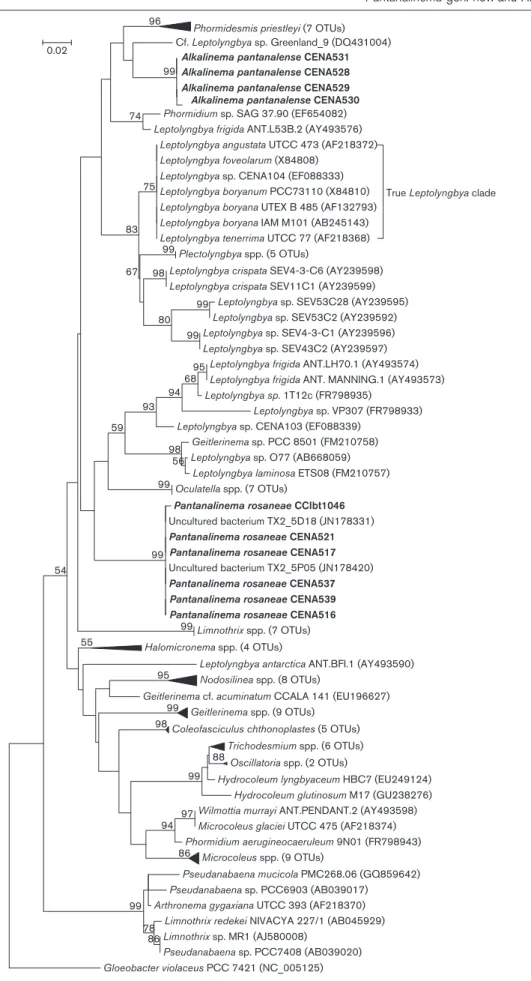
nucleotide identities¢99.5 %. In the phylogenetic recon-struction based on 16S rRNA gene sequences (Fig. 3), the studied strains grouped together in a robust clade (99 % bootstrap value), to which two sequences of uncultured bacteria from saline–alkaline soil also belonged (Valenzuela-Encinaset al., 2009). This clade was related to Oculatella, Leptolyngbya sensu latoandGeitlerinemasp. PCC8501 (Fig. 3). The 16S–23S rRNA ITS sequences from these six strains ranged in length from 474 to 478 bp, and tRNA genes were absent. Four different secondary structures were observed for D1–D19, three for Box-B and two for the V3 region (Table 2, Fig. 4).
The remaining four strains shared 16S rRNA gene sequence identities lower than 93.5 % with those retrieved from GenBank. These four sequences shared identities¢99.6 % and formed a stable clade (99 % bootstrap value). This clade had an external branch consisting of an orphan sequence of cf. Leptolyngbya sp. Greenland-9, which was isolated from alkaline soil (Roeselerset al., 2007). In addition, this clade was related toPhormidesmis,Leptolyngbya frigida ANT.L53B.2 andPhormidiumsp. SAG 37.90 (Fig. 3). The ITS sequences of these four strains were 570 bp long, and both tRNA genes (Ile and Ala) were identified (Table 2, Fig. 4). The low identities of the 16S rRNA gene sequences, the distinct phylogenetic positions and the dissimilarities between the ITS sequences strengthen the differences between these two novel groups and other known genera, such as Leptolyngbya, Oculatella, Phormidesmis and Nodosilinea. Morphological, molecular and ecological data permitted the proposal of two new genera,Pantanalinema gen. nov. andAlkalinemagen. nov., as well as the descrip-tion of the type species for each genus, Pantanalinema rosaneae sp. nov. and Alkalinema pantanalense sp. nov., respectively. No morphological or molecular differences were observed among the strains of each genus and they were therefore named at the same species level; the diagnoses are presented below.
Table 1.Origin and morphological features of strains of novel pseudanabaenacean genera (PantanalinemaandAlkalinema) isolated from water of saline–alkaline lakes of the Pantanal
Strain Origin Length (mm) Width (mm) N S FB M
Pantanalinema rosaneae
CENA516 Salina Verde (19u289130S 56u39220W) 1.2–2.3 1.9–2.1 2 + 2 +
CENA517 As above 1.6–2.4 1.5–2.3 2 + 2 +
CENA521 As above 1.4–2.1 1.6–2.1 2 + 2 +
CENA537 Salina Grande (19u269560S 56u79450W) 1.8–3.1 1.9–2.5 2 + 2 +
CENA539 Salina Verde 1.3–2.9 1.9–2.5 2 + 2 +
CCIBt1046 Salina da Ponta (18u589580S 56u399360W) 1.4–2.9 2.3–3.1 2 + 2 + Alkalinema pantanalense
CENA528 Salina Preta (19u269560S 56u79550W) 2.0–4.1 1.7–2.2 2 2 2 2
CENA529 As above 1.6–2.2 1.2–1.7 2 2 2 2
CENA530 As above 1.7–3.0 1.0–1.7 2 2 2 2
CENA531 As above 1.5–2.8 1.5–2.2 2 2 2 2
The ten strains tolerated the pH values tested (4, 5, 7, 9 and 11) and were able to grow under these conditions. Significant differences were not observed in terms of biomass production for the different treatments (Kruskal– Wallis rank sum test: Kruskal–Wallis x251.3848, d.f.54, P50.8468). After 14 days, the pH of the BG-11 culture medium was 8.4–9.9, demonstrating that these strains were able to induce alkalinization of the culture medium. The pH of the BG-11 culture medium used as a control did not change significantly, ranging from 7.2 to 7.4 (mean values).
Diagnosis forPantanalinemaM. G. M. V. Vazet al.
gen. nov. (Fig. 1)
Pantanalinema (Pan.ta.na.li.ne9ma. N.L. n. Pantanal a Brazilian wetland; Gr. neut. n. nema thread, filament; N.L. neut. n.Pantanalinemaa filament from the Pantanal). In nature, known strains grow in saline–alkaline lakes in the Brazilian Pantanal wetland. The trichomes are microscopic
(a) (b)
(c) (d) (e)
(f)
(g) (h)
Fig. 1. Light photomicrographs of strains of Pantanalinema rosaneaegen. nov., sp. nov. (a–c)P. rosaneaeCENA516; (d)P. rosaneaeCENA517; (e)P. rosaneaeCENA521; (f)P. rosaneae CENA539; (g) P. rosaneae CENA537; (h) P. rosaneae CCIbt1046. Bars, 20mm (a–g), 10mm (h).
(a)
(b) (c)
(d)
(e)
(f)
Fig. 2.Light photomicrographs of strains ofAlkalinema pantana-lense gen. nov., sp. nov. (a)A. pantanalense CENA530; (b) A. pantanalenseCENA528; (c, e)A. pantanalenseCENA529; (d, f) A. pantanalenseCENA531. Bars, 20mm.
and in liquid medium grow attached to the tube bottom and walls. Macroscopically, the colonies are olive green. Filaments are entangled and flexuous. The motile tri-chomes are characterized by a slight gliding motility. The cells are slightly constricted, and the cross wall is quite translucent. The sheath is hyaline, firm, attached to the trichome and always present. Cells are isodiametric or wider than they are long, 1.2–3.1mm long by 1.5–3.1 mm wide. The apical cell is cylindrical with a rounded to slightly conical apex. Cell content is homogeneous and brownish green or olive green. Hormogonium formation occurs via cell disintegration (false necridial cells) or trichome fragmentation.
Type species: Pantanalinema rosaneae (type strain: CENA516).
Diagnosis forPantanalinema rosaneaeM. G. M.
V. Vazet al.sp. nov. (Fig. 1)
Pantanalinema rosaneae(ro.sa9ne.ae. N.L. gen. n.rosaneae of Rosane; named after the late Rosane Aguiar, a Brazilian phycologist and cyanobacterial physiologist,in memoriam). In nature, known strains grow in saline–alkaline water in the Brazilian Pantanal wetland. The trichomes are micro-scopic and, in liquid medium, they grow as olive-green colonies attached to the tube walls. Filaments are entangled and flexuous. The cells are slightly constricted, and the cross wall is quite translucent. The sheath is hyaline, firm, attached to the trichome and always present. Cells are isodiametric or wider than they are long, 1.2–3.1mm long by 1.5–3.1mm wide. The apical cell is cylindrical with a rounded apex. Cell content is homogeneous and brownish green or olive green. Hormogonium formation occurs via trichome disintegration.
Holotype: BRAZIL, Mato Grosso do Sul State, Pantanal wetlands, 27 May 2010, Laurent Barbiero (herbarium
preparation of cultured material CENA516), Herbarium of Institute of Botany (SP428.663).
Reference strain: CENA516.
Type location: grows in water samples collected from Salina Verde in the Pantanal wetlands, Mato Grosso do Sul State, Brazil.
Studied material: BRAZIL, Mato Grosso do Sul State, Pantanal wetland, 27 May 2010, Laurent Barbiero (SP428.664); BRAZIL, Mato Grosso do Sul State, Pantanal wetland, 27 May 2010, Laurent Barbiero (SP428.665); BRAZIL, Mato Grosso do Sul State, Pantanal wetland, 27 May 2010, Laurent Barbiero (SP428.666); BRAZIL, Mato Grosso do Sul State, Pantanal wetland, 27 May 2010,Laurent Barbiero(SP428.667); BRAZIL, Mato Grosso do Sul State, Pantanal wetland, 22 April 2008, Camila F. S. Malone (SP400.858).
Habitat: Grows in water samples collected from Salina Verde in the Pantanal wetlands.
Etymology: Named in honour of Dr Rosane Aguiar (in memoriam), a Brazilian phycologist and cyanobacterial physiologist from the Federal University of Vic¸osa, Minas Gerais state, Brazil.
Diagnosis forAlkalinema M. G. M. V. Vazet al.
gen. nov. (Fig. 2)
Alkalinema (Al.ka.li.ne9ma. N.L. n. alkali alkali, from Arabic n.al qaliy the ashes of saltwort; Gr. neut. n.nema thread, filament; N.L. neut. n.Alkalinema a filament from alkaline lakes).
In nature, known strains grow in saline–alkaline lakes in the Brazilian Pantanal wetland. The trichomes are micro-scopic and, in liquid medium, they grow as free-floating trichomes that are distributed in the culture flask. The trichomes are frequently organised in ornate (interwoven) Table 2.Lengths of 16S–23S rRNA ITS regions of strains ofPantanalinemaandAlkalinema
Strain Length of 16S–23S rRNA ITS region (nt)
D1–D1§ tRNA(Ile) tRNA(Ala) Box-B V3
Pantanalinema rosaneae
CENA516 81 Absent Absent 44 58
CENA517 81 Absent Absent 44 58
CENA521 81 Absent Absent 44 58
CENA537 82 Absent Absent 43 57
CENA539 82 Absent Absent 44 57
CCIBt1046 82 Absent Absent 44 57
Alkalinema pantanalense
CENA528 64 74 73 48 56
CENA529 64 74 73 48 56
CENA530 64 74 73 48 56
99 99 99 99 86 78 99 88 99 99 99 99 99 98 98 56 98 97 95 95 68 94 94 93 86 80 75 67 83 74 59 55 54 0.02
Phormidesmis priestleyi (7 OTUs) Cf. Leptolyngbya sp. Greenland_9 (DQ431004)
Alkalinema pantanalense CENA528 Alkalinema pantanalense CENA529
Alkalinema pantanalense CENA530
True Leptolyngbya clade
Phormidium sp. SAG 37.90 (EF654082)
Leptolyngbya frigida ANT.L53B.2 (AY493576)
Leptolyngbya angustata UTCC 473 (AF218372)
Leptolyngbya foveolarum (X84808)
Leptolyngbya sp. CENA104 (EF088333)
Leptolyngbya boryanum PCC73110 (X84810)
Leptolyngbya boryana UTEX B 485 (AF132793)
Leptolyngbya boryana IAM M101 (AB245143)
Leptolyngbya tenerrima UTCC 77 (AF218368)
Plectolyngbya spp. (5 OTUs)
Leptolyngbya crispata SEV4-3-C6 (AY239598)
Leptolyngbya crispata SEV11C1 (AY239599)
Leptolyngbya sp. SEV53C28 (AY239595)
Leptolyngbya sp. SEV53C2 (AY239592)
Leptolyngbya sp. SEV4-3-C1 (AY239596)
Leptolyngbya sp. SEV43C2 (AY239597)
Leptolyngbya frigida ANT.LH70.1 (AY493574)
Leptolyngbya frigida ANT. MANNING.1 (AY493573)
Leptolyngbya sp. 1T12c (FR798935)
Leptolyngbya sp. VP307 (FR798933)
Leptolyngbya sp. CENA103 (EF088339)
Geitlerinema sp. PCC 8501 (FM210758)
Leptolyngbya sp. O77 (AB668059)
Leptolyngbya laminosa ETS08 (FM210757)
Oculatella spp. (7 OTUs)
Pantanalinema rosaneae CCIbt1046
Uncultured bacterium TX2_5D18 (JN178331)
Pantanalinema rosaneae CENA521 Pantanalinema rosaneae CENA517
Uncultured bacterium TX2_5P05 (JN178420)
Pantanalinema rosaneae CENA537 Pantanalinema rosaneae CENA539 Pantanalinema rosaneae CENA516
Gloeobacter violaceus PCC 7421 (NC_005125)
Pseudanabaena sp. PCC7408 (AB039020)
Limnothrix spp. (7 OTUs)
Halomicronema spp. (4 OTUs)
Leptolyngbya antarctica ANT.BFI.1 (AY493590)
Nodosilinea spp. (8 OTUs)
Geitlerinema cf. acuminatum CCALA 141 (EU196627)
Geitlerinema spp. (9 OTUs)
Coleofasciculus chthonoplastes (5 OTUs)
Trichodesmium spp. (6 OTUs)
Oscillatoria spp. (2 OTUs)
Hydrocoleum lyngbyaceum HBC7 (EU249124)
Hydrocoleum glutinosum M17 (GU238276)
Wilmottia murrayi ANT.PENDANT.2 (AY493598)
Microcoleus glaciei UTCC 475 (AF218374)
Phormidium aerugineocaeruleum 9N01 (FR798943)
Microcoleus spp. (9 OTUs)
Pseudanabaena mucicola PMC268.06 (GQ859642)
Pseudanabaena sp. PCC6903 (AB039017)
Arthronema gygaxiana UTCC 393 (AF218370)
Limnothrix redekei NIVACYA 227/1 (AB045929)
Limnothrix sp. MR1 (AJ580008)
Alkalinema pantanalense CENA531
Fig. 3.Maximum-likelihood phylogenetic tree based on 16S rRNA gene sequences of strains of the Pseudanabaenales and Oscillatoriales. The studied strains ofPantanalinemaandAlkalinemaare shown in bold. A bootstrap test involving 1000 resamplings was performed, and bootstrap values greater than 50 % are noted at the corresponding nodes. Bar, 0.02 substitutions per site.
mats. Macroscopically, the culture has a reddish to brownish colour. Trichomes do not have sheaths but do have a diffluent mucilage and are non-motile. Cells are isodiametric or longer than they are wide, 1.5–4.1mm long
by 1.1–2.2mm wide, with a narrowed or rounded-conical apical cell. Cell content is homogeneous and reddish to brownish. Hormogonium formation occurs via trichome disintegration. (a) CENA539 CENA537, 539, CCIbt1046 CENA530 CENA528, 529, 531 CENA528 CENA529, 530, 531 CENA516, 531, 539, CCIbt1046 D1 – D1 ′ D1 – D1 ′ BO X B BO X B V3 V3 CENA516, 517, 521 CENA537 CENA517 CENA537 CENA521 CENA516, 517 (b)
Type species: Alkalinema pantanalense (type strain: CENA528).
Diagnosis forAlkalinema pantanalenseM. G. M.
V. Vaz et al.sp. nov. (Fig. 2)
Alkalinema pantanalense (pan.ta.na.len9se. N.L. neut. adj. pantanalense pertaining to the Pantanal, a Brazilian wet-land).
The trichomes are microscopic and, in liquid medium, they grow as free-floating trichomes that are evenly distributed in the culture flask. Macroscopically, the culture has a reddish to brownish colour. The trichomes do not have sheaths but do have a diffluent mucilage and are non-motile. They are organized in ornate (interwoven) mats. Cells are isodiametric or longer than they are wide, 2.0– 4.1mm long by 1.7–2.2mm wide, with a narrowed apical cell. Cell content is homogeneous and reddish to brownish. Hormogonium formation occurs via trichome disinteg-ration.
Holotype: BRAZIL, Mato Grosso do Sul State, Pantanal wetlands, 27 May 2010, Laurent Barbiero (SP428.668) (herbarium preparation of cultured material CENA528), Herbarium of Sa˜o Paulo State, Sa˜o Paulo, Brazil.
Reference strain: CENA528.
Type location: Grows in water samples collected from Salina Preta in the Pantanal wetlands, Mato Grosso do Sul State, Brazil.
Studied material: BRAZIL, Mato Grosso do Sul State, Pantanal wetland, 27 May 2010, Laurent Barbiero (SP428.669); BRAZIL, Mato Grosso do Sul State, Pantanal wetland, 27 May 2010, Laurent Barbiero (SP428.670); BRAZIL, Mato Grosso do Sul State, Pantanal wetland, 27 May 2010,Laurent Barbiero(SP428.671).
Habitat: Grows in water samples collected from Salina Preta in the Pantanal wetlands.
Etymology: Named in reference to the sampling site, Pantanal.
The investigation of several pseudanabaenacean strains isolated from saline–alkaline lakes of the Brazilian Pantanal wetlands led to the description of two novel cyanobacterial genera, Pantanalinema and Alkalinema. Morphologically, these two novel genera are similar to strains of Leptolyngbya, a genus that exhibits poor morphological diacritic traits. Furthermore, the genetic diversity within this genus exceeds its morphological diversity, clearly supporting its polyphyletic status (Casamatta et al., 2005; Johansenet al., 2011; Perkersonet al., 2011; Zammitet al., 2012). Therefore, the genus Leptolyngbya requires taxo-nomic re-evaluation and the definition of diacritical features (Koma´rek & Hauer, 2013). Data emerging from a phylogeny based on 16S rRNA gene sequences from Leptolyngbya sensu lato have led to the separation, correction and definition of the new genera Nodosilinea,
Haloleptolyngbya and Oculatella (Perkerson et al., 2011; Dadheech et al., 2012; Zammit et al., 2012). The phylogenetic tree based on 16S rRNA gene sequences generated in this study corroborates reports of the polyphyletic status of the genus Leptolyngbya. The Pantanalinema and Alkalinema clades are not related to each other or to the true Leptolyngbyaclade. In addition, the 16S–23S rRNA gene ITS sequences and secondary structures ofPantanalinemaandAlkalinemaare dissimilar and do not correspond to the related clustersLeptolyngbya and Oculatella. These data support the separation of PantanalinemaandAlkalinemafrom other genera. The Pantanalinema clade consists of sequences of six strains isolated from three saline–alkaline lakes in the Brazilian Pantanal wetlands and two sequences of uncul-tivated bacteria from alkaline soil in Mexico (Valenzuela-Encinas et al., 2009). In the reconstructed phylogenetic tree, this clade was related to the Oculatella and Leptolyngbya sensu lato clusters. However, the sequences included in these two clades exhibited low identity (,93.1 %) to sequences of Pantanalinema. Likewise, the morphological traits ofPantanalinemadiffered from those ofOculatella. The genusPantanalinemais characterized by homogeneous cell content with brownish-green or olive-green colouration, without any spots or granulation. In contrast, the autapomorphic characteristics of Oculatella are the purple–red cell colour and the presence of an orange spot at the tip of the trichome, which contains a rhodopsin-like pigment (Zammit et al., 2012). Furthermore, strains of Oculatella and Leptolyngbya can, albeit rarely, possess false branches, which has not been observed forPantanalinema. Comparing the sequences of the 16S–23S rRNA ITS of thePantanalinemastrains, stable lengths (474–478 bp) and the absence of both tRNA genes were noted. The D1–D19, Box-B and V3 regions of the Pantanalinemastrains were longer (81–82, 43–44 and 57– 58 bp, respectively) than those of strains of Leptolyngbya sensu stricto and other Leptolyngbyamorphotypes (51–65, 11–41 and 23–76 bp, respectively) (Johansenet al., 2011). The D1–D19, Box-B and V3 secondary structures of the Pantanalinema strains demonstrated large differences in terms of the numbers and shapes of these bulges when compared with the respective structures of strains of Leptolyngbya sensu latoandOculatella. However, the basal portions of these structures were conserved in terms of sequence and nucleotide number. The differences observed in the bulges of all regions highlighted the novelty of the Pantanalinema strains when compared with the most related morphotypes, corroborating the results from the phylogenetic reconstruction.
The Alkalinema clade consisted of the sequences of four strains isolated from a saline–alkaline lake in the Brazilian Pantanal wetlands. The most related sequences (from cf. Leptolyngbyasp. Greenland_9 andPhormidesmisspp.) were from strains that were also isolated from alkaline environ-ments, in Greenland (Roeselers et al., 2007) and Belize (Turicchiaet al., 2009), respectively. TheAlkalinemaclade
was distantly related (identities,93.7 %) to theLeptolyngbya sensu stricto cluster and to Leptolyngbya, Phormidium and Plectolyngbya. Morphologically,Alkalinemastrains possessed a particular arrangement of trichomes, designated here as ornate (interwoven) mats, which differed from the trichome arrangement of strains of the genera Leptolyngbya, Phormidesmisand Plectolyngbya. The absence of sheaths is another diacritical feature of this new genus, while their presence is almost obligatory forLeptolyngbya(Rippkaet al., 1979; Koma´rek & Anagnostidis, 2005) and obligatory for the generaPlectolyngbyaandPhormidesmis(Taton et al., 2011; Koma´reket al., 2009). Furthermore, cell size and shape are clearly different among these genera. The genusLeptolyngbya comprises strains with cells that are 0.5–3.5mm wide and trichomes that are rarely solitary and rarely pseudobranched (Koma´rek & Anagnostidis, 2005). Members of the genus Plectolyngbya possess trichomes that are morphologically similar to those ofLeptolyngbya, but the false branching is obligatory, and it occasionally forms multiple trichomes in a single sheath (Tatonet al., 2011). The genusPhormidesmisis characterized by the moliniform shape of its trichomes and the presence of one or rarely two or several trichomes in a sheath (Koma´reket al., 2009). The four Alkalinemastrains had 16S–23S rRNA ITS sequences of the same length (570 bp), and they exhibited both tRNAs. The D1–D19and V3 regions of these strains were shorter (64 and 56 bp, respectively) than those of strains of Leptolyngbya sensu stricto and other strains of Leptolyngbya (51–65 and 23– 76 bp, respectively), while the Box-B region was longer (48 bp) than those of related genera (11–41 bp) (Johansen et al., 2011). The secondary structures of the D1–D19, Box-B and V3 regions inAlkalinemawere also dissimilar compared with those fromLeptolyngbya sensu stricto(Johansenet al., 2011). As no data regarding the lengths and secondary structures of the 16S–23S rRNA ITS regions ofPhormidesmis andPlectolyngbyaexist, no comparisons were possible. The strains ofPantanalinemaandAlkalinemasurvived and produced biomass at the different tested pH, which permitted them to be classified as acid- and alkali-tolerant. In addition, these strains were able to alter the final pH to 8.4–9.9, characterising them as alkaliphilic. Given that the strains ofPantanalinemaandAlkalinemawere not axenic, the heterotrophic bacterial community associated with the cyanobacterial filaments may be involved in the alteration of pH, or both organisms together (cyanobacteria and heterotrophic bacteria) may coordinate this pH modifica-tion. Cyanobacterial strains are generally known as the most alkaliphilic micro-organisms and frequently dom-inate alkaline environments, such as soda lakes or saline– alkaline lakes (Summerfield & Sherman, 2008; Møgelhøj et al., 2006; Pikuta et al., 2007; Dadheech et al., 2012; Santos et al., 2011; Santos & Sant’Anna, 2010). Cyanobacterial bloom formation is usually accompanied by an elevation in pH as a consequence of the removal of CO2 favoured for photosynthesis (Summerfield &
Sherman, 2008). However, cyanobacteria can also survive under acidic conditions (Almeret al., 1974; Kwiatkowski &
Roff, 1976; Steinberg et al., 1998). Despite these reports, relatively few studies have shown how cyanobacteria tolerate acid stress and how they neutralize high-pH culture medium. It has been shown that acid-tolerant cyanobacteria maintain a neutral cytoplasmic pH, although how they maintain a strong transmembrane gradient is unknown, as is how they increase the external pH via photosynthesis (Steinberget al., 1998). It was reported that the cyanobacterium Geminocystis sp. PCC6308 (formerly Synechocystis sp. PCC6308) responds to acid stress via mechanisms that involve cell concentration-dependent neutralization of the external medium, maintenance of a transmembrane pH gradient and maintenance of photo-system II efficiency (Huanget al., 2002). Similar mechan-isms might be involved in the alkalinization of the culture medium by strains ofPantanalinemaandAlkalinema; these findings deserve further and more detailed investigation. The two new generaPantanalinemaand Alkalinema were described under the provisions of the International Code of Nomenclature for Algae, Fungi and Plants, based on a polyphasic approach merging molecular, morphological, ecological and physiological data. To date, strains of Pantanalinema have been found in three saline–alkaline lakes from the Brazilian Pantanal wetlands. Additionally, two sequences of uncultivated bacteria from alkaline soil in Mexico that were grouped in the same phylogenetic clade demonstrate a more widespread distribution. In contrast, Alkalinema was found only in one saline–alkaline lake from the Brazilian Pantanal wetlands. However, its close phylogenetic relationship to cf. Leptolyngbya sp. Greenland_9 andPhormidesmis, which were isolated from alkaline environments, demonstrates an ecological rela-tionship. Phylogeny of the 16S rRNA gene sequence has been used successfully to support the separation of novel cyanobacterial genera, such as Haloleptolyngbya, Coleofasciculus, Halomicronema, Plectolyngbya, Wilmottia, Phormidesmis,Nodosilinea,Oxynema,Oculatella, Mojavia, Chakia, Calochaete, Toxopsis, Iphinoe, Loriellopsis and Desmonostoc (Abed et al., 2002; Rˇeha´kova´ et al., 2007; Siegesmundet al., 2008; Turicchiaet al., 2009; Lamprinou et al., 2011; Perkersonet al., 2011; Strunecky´et al., 2011; Tatonet al., 2011; Chatchawanet al., 2012; Dadheechet al., 2012; Lamprinouet al., 2012; Zammitet al., 2012; Hauer et al., 2013; Hrouzeket al., 2013; Koma´rkova´et al., 2013). In addition, morphology, physiological and ecological data are complementary markers for genus delimitation and should be used to improve the descriptions of new taxa. The 16S–23S rRNA ITS sequences and secondary structures of Pantanalinema and Alkalinema did not correspond to previous descriptions, demonstrating that the ITS sequence can be used as an auxiliary tool for the description of new genera. Additionally, investigations of the cyanobacterial communities in different and underexplored environ-ments, such the Pantanal wetlands, can lead to the identification of novel taxa, even via simple and inexpens-ive methods such as isolation techniques.
Acknowledgements
This research was funded by the Sa˜o Paulo State Research Foundation (FAPESP 2013/09192-0), the National Council for Scientific and Technological Development (CNPq 478193/2013-0) and the National Institute of Sciences of the Universe (INSU-Ec2co). M. G. M. V. V., D. B. G., A. P. D. A. and C. F. S. M. were supported by FAPESP graduate scholarships (2010/18732-0, 2010/00321-3, 2009/15402-1 and 2010/51666-0, respectively). L. B. was supported by CAPES (Coordination of Improvement of Higher Education Personnel) and the French Consulate in Sa˜o Paulo. M. F. F. would also like to thank CNPq for a research fellowship (306607/2012-3). We thank Federal University of South Mato-Grosso for logistical support.
References
Abed, R. M. M., Garcia-Pichel, F. & Herna´ndez-Marine´, M. (2002).
Polyphasic characterization of benthic, moderately halophilic, mod-erately thermophilic cyanobacteria with very thin trichomes and the proposal of Halomicronema excentricum gen. nov., sp. nov. Arch Microbiol177, 361–370.
Albertano, P. & Kova´cˇik, L. (1994). Is the genus Leptolyngbya an homogeneous taxon?Algol Stud75, 37–51.
Almer, B., Dickson, W., Ekstro¨m, C., Ho¨rnstro¨ m, E. & Miller, U. (1974).Effects of acidification on Swedish lakes.Ambio3, 30–36.
Andreote, A. P. D., Vaz, M. G. M. V., Genua´rio, D. B., Barbiero, L., Rezende-Filho, A. T. & Fiore, M. F. (2014). Nonheterocytous cyanobacteria from Brazilian saline-alkaline lakes.J Phycol50, 675–684.
Casamatta, D. A., Johansen, J. R., Vis, M. L. & Broadwater, S. T. (2005). Molecular and ultrastructural characterization of ten polar and near-polar strains within the Oscillatoriales (Cyanobacteria).
J Phycol41, 421–438.
Castenholz, R. W. & Waterbury, J. B. (1989).Group 1. Cyanobacteria (Preface). In Bergey’s Manual of Systematic Bacteriology, vol. 3, pp. 1710–1728. Edited by J. T. Staley, M. P. Bryant, N. Pfennig & J. G. Holt. Baltimore: Williams & Wilkins.
Chatchawan, T., Koma´rek, J., Strunecky´, O., Sˇ marda, J. & Peerapornpisal, Y. (2012). Oxynema, a new genus separated from the genusPhormidium(Cyanophyta).Cryptogam Algol33, 41–59.
Dadheech, P. K., Mahmoud, H., Kotut, K. & Krienitz, L. (2012). Haloleptolyngbya alcalis gen. et sp. nov., a new filamentous cyanobacterium from the soda lake Nakuru, Kenya. Hydrobiologia 691, 269–283.
Ewing, B. & Green, P. (1998). Base-calling of automated sequencer traces using phred. II. Error probabilities.Genome Res8, 186–194.
Ewing, B., Hillier, L., Wendl, M. C. & Green, P. (1998).Base-calling of automated sequencer traces using phred. I. Accuracy assessment.
Genome Res8, 175–185.
Fiore, M. F., Moon, D. H., Tsai, S. M., Lee, H. & Trevors, J. T. (2000).
Miniprep DNA isolation from unicellular and filamentous cyano-bacteria.J Microbiol Methods39, 159–169.
Fox, G. E., Wisotzkey, J. D. & Jurtshuk, P., Jr (1992).How close is close: 16S rRNA sequence identity may not be sufficient to guarantee species identity.Int J Syst Bacteriol42, 166–170.
Genua´rio, D. B., Correˆa, D. M., Koma´rek, J. & Fiore, M. F. (2013).
Characterization of freshwater benthic biofilm-formingHydrocoryne
(Cyanobacteria) isolates from Antarctica.J Phycol49, 1142–1153.
Gordon, D., Abajian, C. & Green, P. (1998).Consed: a graphical tool for sequence finishing.Genome Res8, 195–202.
Hasˇler, P., Dvorˇa´k, P., Johansen, J. R., Kitner, M., Ondrˇej, V. & Poulı´cˇkova´, A. (2012).Morphological and molecular study of epipelic
filamentous genera Phormidium, Microcoleus and Geitlerinema
(Oscillatoriales, Cyanophyta/Cyanobacteria).Fottea12, 341–356.
Hauer, T., Bohunicka´, M. & Mu¨hlsteinova´, M. (2013).Calochaetegen. nov. (Cyanobacteria, Nostocales), a new cyanobacterial type from the ‘‘pa´ramo’’ zone in Costa Rica.Phytotaxa109, 36–44.
Hoffmann, L., Koma´rek, J. & Kasˇtovsky´, J. (2005). System of cyanoprokaryotes (cyanobacteria) – state in 2004. Algol Stud 117, 95–115.
Hrouzek, P., Lukesova, A., Mares, J. & Ventura, S. (2013).
Description of the cyanobacterial genus Desmonostoc gen. nov. including D. muscorum comb. nov. as a distinct, phylogenetically coherent taxon related to the genusNostoc.Fottea13, 201–213.
Huang, J. J., Kolodny, N. H., Redfearn, J. T. & Allen, M. M. (2002).The acid stress response of the cyanobacterium Synechocystis sp. strain PCC 6308.Arch Microbiol177, 486–493.
Johansen, J. R. & Casamatta, D. A. (2005).Recognizing cyanobacter-ial diversity through adoption of a new species paradigm.Algol Stud 117, 71–93.
Johansen, J. R., Kova´cik, L., Casamatta, D. A., Fucˇikova´, K. & Kasˇtovsky´, J. (2011).Utility of 16S–23S ITS sequence and secondary structure for recognition of intrageneric and intergeneric limits within cyanobacterial taxa: Leptolyngbya corticola sp. nov. (Pseudanabaenaceae, Cyanobacteria).Nova Hedwig92, 283–302.
Koma´rek, J. (2007).Phenotype diversity of the cyanobacterial genus
Leptolyngbyain the maritime Antarctic.Pol Polar Res28, 211–231.
Koma´rek, J. (2010). Recent changes (2008) in cyanobacteria taxonomy based on a combination of molecular background with phenotype and ecological consequences (genus and species concept).
Hydrobiologia639, 245–259.
Koma´rek, J. & Anagnostidis, K. (1989). Modern approach to the classification system of cyanophytes 4 – Nostocales. Algol Stud56, 247–354.
Koma´rek, J. & Anagnostidis, K. (2005). Cyanoprokaryota. 2. Teil: Oscillatoriales(Su¨ßwasserflora von Mitteleuropa, vol. 19/2). Edited by B. Bu¨del, G. Ga¨rtner, L. Krienitz & M. Schagerl. Heidelberg: Elsevier.
Koma´rek, J. & Hauer, T. (2013).CyanoDB.cz – The on-line database of cyanobacterial genera. University of South Bohemia & Institute of Botany AS CR. http://www.cyanodb.cz
Koma´rek, J. & Kasˇtovsky´, J. (2003).Coincidences of structural and molecular characters in evolutionary lines of cyanobacteria.Algol Stud 109, 305–325.
Koma´rek, J., Kasˇtovsky´, J., Ventura, S., Turicchia, S. & Sˇ marda, J. (2009).The cyanobacterial genusPhormidesmis.Algol Stud129, 41– 59.
Koma´rkova´, J., Zapamelova´, E. & Koma´rek, J. (2013). Chakia
(cyanobacteria), a new heterocytous genus from Belizean marshes identified on the basis of the 16S rRNA gene.Fottea13, 227–233.
Kwiatkowski, R. E. & Roff, J. C. (1976). Effects of acidity on the phytoplankton and primary productivity of selected northern Ontario lakes.Can J Bot54, 2546–2561.
Lamprinou, V., Herna´ndez-Marine´, M., Canals, T., Kormas, K., Economou-Amilli, A. & Pantazidou, A. (2011). Morphology and molecular evaluation of Iphinoe spelaeobiosgen. nov., sp. nov. and
Loriellopsis cavernicola gen. nov., sp. nov., two stigonematalean cyanobacteria from Greek and Spanish caves.Int J Syst Evol Microbiol 61, 2907–2915.
Lamprinou, V., Skaraki, K., Kotoulas, G., Economou-Amilli, A. & Pantazidou, A. (2012). Toxopsis calypsus gen. nov., sp. nov. (Cyanobacteria, Nostocales) from cave ‘Francthi’, Peloponnese, Greece: a morphological and molecular evaluation. Int J Syst Evol Microbiol62, 2870–2877.
Møgelhøj, M. K., Hansen, P. J., Henriksen, P. & Lundholm, N. (2006).
High pH and not allelopathy may be responsible for negative effects ofNodularia spumigena on other algae.Aquat Microb Ecol43, 43– 54.
Perkerson, R. B., III, Johansen, J. R., Kova´cik, L., Brand, J., Kasˇtovsky´, J. & Casamatta, D. A. (2011).A unique pseudanabaena-lean (Cyanobacteria) genus Nodosolinea gen. nov. based on morphological and molecular data.J Phycol47, 1397–1412.
Pikuta, E. V., Hoover, R. B. & Tang, J. (2007).Microbial extremophiles at the limits of life.Crit Rev Microbiol33, 183–209.
R Core Team (2012).R: a language and environment for statistical computing. Vienna: R Foundation for Statistical Computing. http:// www.R-project.org/
Rˇ eha´kova´, K., Johansen, J. R., Casamatta, D., Xuesong, L. & Vincent, J. (2007).Morphological and molecular characterization of selected desert soil cyanobacteria: three species new to science including
Mojavia pulchragen. et sp. nov.Phycologia46, 481–502.
Rippka, R., Deruelles, J., Waterbury, J. B., Herdman, M. & Stanier, R. Y. (1979).Generic assignments, strain histories and properties of pure cultures of cyanobacteria.J Gen Microbiol111, 1–61.
Roeselers, G., Norris, T. B., Castenholz, R. W., Rysgaard, S., Glud, R. N., Ku¨hl, M. & Muyzer, G. (2007).Diversity of phototrophic bacteria in microbial mats from Arctic hot springs (Greenland). Environ Microbiol9, 26–38.
Santos, K. R. S. & Sant’Anna, C. L. (2010). Cianobacte´rias de diferentes tipos de lagoas (‘‘salina’’, ‘‘salitrada’’ e ‘‘baı´a’’) representa-tivas do Pantanal da Nhecolaˆndia, MS, Brasil.Braz J Bot33, 61–83 (in Portuguese).
Santos, K. R. S., Jacinavicius, F. R. & Sant’Anna, C. L. (2011).Effects of the pH on growth and morphology ofAnabaenopsis elenkiniiMiller (Cyanobacteria) isolated from the alkaline shallow lake of the Brazilian Pantanal.Fottea11, 119–126.
Schattner, P., Brooks, A. N. & Lowe, T. M. (2005).The tRNAscan-SE, snoscan and snoGPS web servers for the detection of tRNAs and snoRNAs.Nucleic Acids Res33(Web Server issue), W686–W689.
Siegesmund, M. A., Johansen, J. R., Karsten, U. & Friedl, T. (2008). Coleofasciculus gen. nov. (Cyanobacteria): morphological and molecular criteria for revision of the genus Microcoleus Gomont.
J Phycol44, 1572–1585.
Silva, C. S. P., Genua´rio, D. B., Vaz, M. G. M. V. & Fiore, M. F. (2014).
Phylogeny of culturable cyanobacteria from Brazilian mangroves.Syst Appl Microbiol37, 100–112.
Steinberg, C. E. W., Scha¨fer, H. & Beisker, W. (1998). Do acid-tolerant cyanobacteria exist?Acta Hydrochim Hydrobiol26, 13–19.
Strunecky´, O., Elster, J. & Koma´rek, J. (2011).Taxonomic revision of the freshwater cyanobacterium ‘‘Phormidium murrayi’’5Wilmottia murrayi.Fottea11, 57–71.
Summerfield, T. C. & Sherman, L. A. (2008).Global transcriptional response of the alkali-tolerant cyanobacteriumSynechocystissp. strain PCC 6803 to a pH 10 environment.Appl Environ Microbiol74, 5276– 5284.
Tamura, K., Peterson, D., Peterson, N., Stecher, G., Nei, M. & Kumar, S. (2011). MEGA5: molecular evolutionary genetics analysis using
maximum likelihood, evolutionary distance, and maximum par-simony methods.Mol Biol Evol28, 2731–2739.
Taton, A., Grubisic, S., Brambilla, E., De Wit, R. & Wilmotte, A. (2003).
Cyanobacterial diversity in natural and artificial microbial mats of Lake Fryxell (McMurdo Dry Valleys, Antarctica): a morphological and molecular approach.Appl Environ Microbiol69, 5157–5169.
Taton, A., Grubisic, S., Ertz, D., Hodgson, D. A., Piccardi, R., Biondi, N., Tredici, M. R., Mainini, M., Losi, D. & other authors (2006).
Polyphasic study of Antarctic cyanobacterial strains. J Phycol 42, 1257–1270.
Taton, A., Wilmotte, A., Sˇ marda, J., Elster, J. & Koma´rek, J. (2011). Plectolyngbya hodgsonni: a novel filamentous cyanobacterium from Antarctic lakes.Polar Biol34, 181–191.
Turicchia, S., Ventura, S., Koma´rkova´, J. & Koma´rek, J. (2009).
Taxonomic evaluation of cyanobacterial microflora from alkaline marshes of northern Belize. 2. Diversity of oscillatorialean genera.
Nova Hedwig89, 165–200.
Valenzuela-Encinas, C., Neria-Gonza´lez, I., Alca´ntara-Herna´ndez, R. J., Estrada-Alvarado, I., Zavala-Dı´az de la Serna, F. J., Dendooven, L. & Marsch, R. (2009).Changes in the bacterial populations of the highly alkaline saline soil of the former lake Texcoco (Mexico) following flooding.Extremophiles13, 609–621.
Willame, R., Boutte, C., Grubisic, S., Wilmotte, A., Koma´rek, J. & Hoffmann, L. (2006).Morphological and molecular characterisation of planktonic cyanobacteria from Belgium and Luxembourg.J Phycol 42, 1312–1332.
Zammit, G., Billi, D. & Albertano, P. (2012). The subaerophytic cyanobacteriumOculatella subterranea(Oscillatoriales, Cyanophyceae) gen. et sp. nov.: a cytomorphological and molecular description.Eur J Phycol47, 341–354.
Zuker, M. (2003). Mfold web server for nucleic acid folding and hybridization prediction.Nucleic Acids Res31, 3406–3415.