Hyperspectral Image Spectral-Spatial Feature
Extraction via Tensor Principal Component Analysis
Yuemei Ren, Liang Liao,
Member, IEEE,
Stephen John Maybank,
Fellow, IEEE,
Yanning Zhang,
Senior
member, IEEE,
and Xin Liu
Abstract—We consider the tensor-based spectral-spatial fea-ture extraction problem for hyperspectral image classification. First, a tensor framework based on circular convolution is pro-posed. Based on this framework, we extend the traditional PCA to its tensorial version TPCA, which is applied to the spectral-spatial features of hyperspectral image data. The experiments show that the classification accuracy obtained using TPCA features is significantly higher than the accuracies obtained by its rivals.
Index Terms—tensor model, principal component analysis, feature extraction, hyperspectral image classification.
I. INTRODUCTION
H
YPERSPECTRAL imaging sensors collect hyperspectral images in the form of 3D arrays, with two spatial dimensions representing the image width and height, and a spectral dimension describing the spectral bands, whose number is usually more than one hundred. Due to the redun-dancy of the raw representation, it is advantageous to design effective feature extractors to exploit the spectral information of hyperspectral images [1], [2]. For example, via a linear projection after an eigenanalysis, PCA (Principal Component Analysis) reduces a high-dimensional vector to a lower di-mensional feature vector. By choosing the so-called principal components, the obtained feature vectors can retain most of the available information. But PCA, like many other vector-based counterparts, lacks, in its model, a prior mechanism to capture the spatial information in the relative positions of the pixels. This deficiency of vectorial models can be overcome using a tensorial representations of hyperspectral imagery.There exist many different tensor models derived from different perspectives. Tensor models are essentially extensions of traditional vector models. In the recent years, tensor-based approaches have been successfully applied in many different areas, including image analysis, video processing [3], [4] and remote sensing imagery analysis [5], [6], etc. For example, Zhang et al. reported a tensor discriminative locality alignment method, called TDLA, to extract features from hyperspectral images [6]. Zhong et at. proposed a tensorial discriminant
Corresponding author: Liang Liao ([email protected]).
L. Liao, S. J. Maybank and Y. Ren contributed equally to this work. L. Liao is with the School of Electronics and Information, Zhongyuan University of Technology, Zhengzhou, 450007, Henan, China. S. J. Maybank ([email protected]) is with Birkbeck College, University of London, London, UK, WC1E7HX. Y. Ren is with the Department of Electronic Infor-mation Engineering, Henan Polytechnic Institute, Nanyang, 473000, China. Y. Zhang are with the School of Computer Science, Northwestern Polytechnical University, Xi’an, 710072, China. X. Liu is with the Information Center of Yellow River Conservancy Commission, Zhengzhou, 450000, China. L. Liao and Y. Ren are also with the School of Computer Science, Northwestern Polytechnical University, 710072, China.
extractor called LTDA to obtain spectral-spatial features from hyperspectral images for image classification [7].
The aforementioned works have shown the superior rep-resentation capability of a tensor-based multilinear algebra, compared with that of the traditional matrix algebra. For example, in the work of M. E. Kilmer et al [8], the authors introduced the t-product model and defined a generalization of matrix multiplication for tensors in the form of 3D arrays (tensors of order three). The generalized matrix multiplication is based on the circular convolution operation and can be implemented more efficiently via the Fourier transform. The t-product model is further developed using the concepts of tubal scalar (also known as tubal fiber), frontal slice, array folding and unfolding, etc, to establish its connection to traditional linear algebra [9], [10]. This development make it possible to generalize all the classical algorithms formulated in linear algebra.
Inspired by the recently reported “t-product” tensor model, we propose a tensor-based spectral-spatial feature extractor for classifying the pixels of a hyperspectral image. First, a novel straightforward tensor algebraic framework is proposed. In the framework, the “t-product” tensors are confined to the same size and therefore form an algebraic tensor ring. The algebraic framework combines the “multi-way” merits of high-order arrays and the “multi-way” intuitions of traditional matrices since the “t-product” tensors serve as the entries of our proposed tensor-vectors or tensor-matrices. This algebraic framework is backwards compatible with the traditional linear algebra based on non-tensorial vectors and matrices. With the help of the proposed tensor algebra, we extend PCA to its tensorial counterpart TPCA (Tensor PCA), which has a prior mechanism to exploit the spatial information of images. We demonstrate in our experiments on some publicly available images that the TPCA outperforms PCA and some other vector or tensorial feature extractors in terms of classification accuracy.
This letter is organized as follows. In Section II, we discuss the tensor algebraic framework. In Section III we propose a tensorial feature extractor called TPCA (Tensor Principal Component Analysis) and its fast version via the Fourier transform. In Section IV, we present the experimental results and analysis. Finally, we conclude this letter in Section V.
II. TENSOR ALGEBRA
In this section, we extend the “t-product” model [8], [9], [10] to a novel tensor algebraic framework, which is back-wards compatible to the traditional matrix algebra. Without
losing generality, the tensors presented in this letter are second order. It is easy to extend the method to higher order tensors. Before extending the “t-product” model, we first confine the “t-product” tensors to the same size. For second-order tensors, the tensor size is defined bym×n. In the following discussion, given second order arrayX(such as tensor, matrix, etc),[X]i,j denotes its (i, j)-th entry. IfX is first order, [X]i denotes its
i-th entry. Then, some denotations and definitions on the “t-product tensor” are summarized as follows [8], [9], [10].
Tensor addition: given tensors xt andytof the same size, the sum ct =xt+yt is a tensor of the same size such that
[ct]i,j = [xt]i,j+ [yt]i,j,∀i, j.
Tensor multiplication: given tensorsxtandytof sizem×n, the productdt=xt◦ytis defined by the result of the circular convolution of xt andyt, such that
[d]i,j= m P k1=1 n P k2=1 [xt]k1,k2[yt]mod((i−k1),m)+1,mod((j−k2),n)+1.
Given tensorsxtandytof the same size, their product can be computed efficiently via the fast Fourier transform and the inverse fast Fourier transform because of the following Fourier transform theorem.
Fourier transform: Given tensors xt, yt, dt =xt◦yt and their Fourier transforms F(xt),F(yt)andF(dt), the follow-ing equation holds [F(dt)]i,j= [F(xt)]i,j·[F(yt)]i,j,∀i, j.
By the virtue of the Fourier transform, the (mn)2 scalar multiplications of the circular convolution are reduced to the
mnindependent scalar multiplications in the Fourier domain. Thus, the Fourier transform can be employed to speed up a convolution-based algorithms.
Zero tensor: The zero tensor zt is a tensor whose entries are all 0, namely[zt]i,j≡0,∀i, j.
Identity tensor: The identity tensoretis a tensor satisfying
[et]1,1= 1 and[et]i,j= 0 if(i, j)6= (1,1).
It is not difficult to prove that the tensors of sizem×n de-fined above form an algebraic ringR. The algebraic operations of addition and multiplication inRare backwards compatible with the analogous operations in the field Rof real numbers. Based on the above mentioned “t-product” definitions, we ex-tend the “t-product” model to a novel straightforward algebraic framework by the following definitions.
Definition 1. Scalar multiplication: given tensorxtand scalar
α, the product dt =αxt is a tensor of the same size as xt such that [dt]i,j=α[xt]i,j,∀i, j.
Definition 2. Vectors and matrices of tensors: A vector of tensors is a list of elements of R. A matrix of tensors is an array of elements of R.
In our tensor algebraic framework, the mathematical oper-ations between elements of vectors of tensors or of matrices of tensors comply with the operations defined in R. Some definitions of the mathematical manipulations of vectors and matrices of tensors are given as follows.
Definition 3. Tensor matrix multiplication: given Xtm ∈
RD1×D2 and Y
tm ∈ RD2×D3, their product Ctm = Xtm ◦
Ytm ∈RD1×D3 is a new tensor matrix, such that [Ctm]i,j=
PD2
k=1[Xtm]i,k◦[Ytm]k,j,∀i, j
Definition 4. Identity matrix of tensors: The identity matrix of tensorsEtm is a matrix such that [Etm]i,j =et if i =j, otherwise[Etm]i,j =zt.
Definition 5. Tensor transposition: given tensorxt, its trans-pose x>
t is a tensor of the same size, satisfying [x>t]i,j =
[xt]mod(1−i,m)+1,mod(1−j,n)+1,∀i, j.
Definition 6. Tensor matrix transposition: given Xtm ∈
RD1×D2, X>
tm ∈RD2×D1 is a new tensor matrix satisfying [X>
tm]i,j= [Xtm]>j,i,∀i, j, where[Xtm]>j,i is the transpose of tensor[Xtm]j,i, as defined by Definition 5.
Definition 7. Orthonormal matrix of tensors: if the matrix
Xtm of tensors satisfies Xtm> ◦Xtm =Etm we call Xtm an orthonormal matrix of tensors.
Definition 8. Singular value decomposition of a square tensor matrix: each matrix Gtm ∈ RD×D has a singular value decompositionGtm=Utm◦Stm◦Vtm> such thatUtm∈RD×D andVtm ∈RD×D are both orthonormal tensor matrices and
Stm ∈ RD×D is a diagonal tensor matrix and [Stm]>i,i =
[Stm]i,i,∀i.
To speed up the computations with vectors and matrices of tensors, we extend the Fourier transform of a tensor to the Fourier transform of a vector or matrix of tensors.
Definition 9. Fourier transform of a tensor matrix: given a tensor matrixXtm, let its Fourier transform beF(Xtm), such
that [F(Xtm)]i,j =F([Xtm]i,j),∀i, j.
The Fourier transform of a tensor matrix is defined by the Fourier transform on its matrix tensorial entities. This definition give a mechanism to decompose a tensor matrix in the Fourier domain to a range of sperate traditional matrix. To have the mechanism, we define the following slice of a tensor matrix by the index of its tensorial entity(ω1, ω2), for allω1= 1, . . . , mandω2= 1, . . . , n.
Definition 10. Slice of a tensor matrix: given Xtm ∈
RD1×D2, let its slice by index(ω
1, ω1)be Xtm(ω1, ω2)such that Xtm(ω1, ω2)∈RD1×D2 and
[Xtm(ω1, ω2)]i,j= [[Xtm]i,j]ω1,ω2, ∀i, j, ω1, ω2. Let the slice of Xf tm =. F(Xtm) by index (ω1, ω2) be
Xf tm(ω1, ω2), such that Xf tm(ω1, ω2)∈CD1×D2 and
[Xf tm(ω1, ω2)]i,j= [[Xf tm]i,j]ω1,ω2, ∀i, j, ω1, ω2.
Tensor vector is a special case of tensor matrix, thus the slicing of a tensor vector complies with the the definition of the slicing of a tensor matrix.
By virtue of Definitions 9 and 10, given the tensor size of m ×n, a mathematical tensor matrix operation can be decomposed to and efficiently computed by m×n separate traditional matrix operations in the Fourier domain.
III. TPCA:TENSOR PRINCIPAL COMPONENT ANALYSIS A. PCA
Traditional PCA can be briefly described as follows — given
x1,· · ·, xN ∈RD and x¯ = (1/N)PNk=1xk, the covariance matrixGis given byG= 1
N−1
PN
The singular value decomposition of G is computed such that G = U ·S ·V> where both U and V are D ×D
orthonormal matrices, in that U>·U =V>·V =I
D×D and
S = diag(λ1, λ2,· · ·, λD), where λ1>λ2>· · ·λD>0. Then, given y ∈ RD, its PCA features are given by yˆ =
U> ·(y−¯x). To reduce the dimension of yˆ from D to d
(d < D), the last(D−d)entries ofyˆare simply discarded.
B. TPCA
TPCA (Tensor PCA) is a straightforward tensorial extension of the traditional PCA — given Xtv,1, Xtv,2,· · · , Xtv,N ∈
RD and X¯ tv = (1/N)P N k=1Xtv,k tensor matrix Gtm ∈ RD×D is defined by Gtm=N1−1PNk=1(Xtv,k−X¯tv)◦(Xtv,k−X¯tv)> (1) Its singular value decomposition is computed as in Defini-tion 8, namely
Gtm=Utm◦Stm◦Vtm>. (2) Then, given a query tensor vector Ytv ∈ RD, its tensor feature vector Yˆtv is given by
ˆ
Ytv =Utm> ◦(Ytv−X¯tv). (3) We call Yˆtv the TPCA vector ofYtv. To accommodate the traditional algorithms which only deal with traditional vectors, with the help of the tensor slicing operation, we propose a mapping δ(·)to transform Yˆtv ∈RD to δ( ˆYtv)∈RD — let the tensor size bem×n,δ( ˆYtv)is given by
δ( ˆYtv) = 1 mn Pm ω1=1 Pn ω2=1 ˆ Ytv(ω1, ω2) . (4) We call yˆ = δ(U>
tm◦(Ytv −X¯tv)) the traditional TPCA feature vector, which can be conveniently employed by tradi-tional non-tensorial algorithms. To reduce the dimension ofyˆ from D tod, the last (D−d) entries are simply discarded.
TPCA is organized in Algorithm 1.
Algorithm 1. Tensor Principal Component Analysis
Input: Query tensor vectorYtv ∈RD andN training tensor vectorsXtv,1,· · · , Xtv,N∈RD.
Output: non-tensorial TPCA feature vector y∈RD 1: ComputeGtm andXˆtv as in equation (1). 2: ComputeUtm as in equation (2).
3: ComputeYˆtv as in equation (3). 4: return y←δ( ˆYtv).
C. Fast TPCA via the Fourier transform
Note that, with the help of the slicing operation, equation (2) can be computed much more efficiently via a series of tra-ditional SVDs computed in the Fourier domain. More specifi-cally, given the tensor matrixGtm, andΩ=. {(ω1, ω2) :ω1= 1,· · ·, m, ω2 = 1,· · · , n}, equation (2) can be computed as in the following pseudo-code.
1: Gf tm←F(Gtm). 2: for all(ω1, ω2)∈Ωdo
3: Compute the traditional SVD of slice Gf tm(ω1, ω2) such that Gf tm(ω1, ω2) = U ·S·VH, where VH is the Hermitian transpose of the matrixV.
4: Uf tm(ω1, ω2)←U,Sf tm(ω1, ω2)←S,
Vf tm(ω1, ω2)←V.
5: end for
6: return Utm←F−1(Uf tm),Stm←F−1(Sf tm),
Vtm←F−1(Vf tm).
Furthermore, the Fourier transform and the slicing operation are also applicable to equations (1), (2) and (3). Thus, the whole TPCA procedure can be implemented by a series of traditional PCAs in the Fourier domain. More specifically, with tensors of sizem×n, the fast implementation of the whole T-PCA can be carried as follows.
1: X¯tv ←(1/N)PNi=1Xtv,i.
2: Yf tv ←F(Ytv−X¯tv),Xf tv,i←F(Xtv,i−X¯tv), ∀i.
3: for all (ω1, ω2)∈Ωdo
4: G← N1−1PNi=1Xf tv,i(ω1, ω2) (Xf tv,i(ω1, ω2))
H
.
5: Compute SVD ofG, such thatG=U ·S ·VH. 6: Yˆf tv(ω1, ω2)←UH·Yf tv(ω1, ω2).
7: end for
8: return y←δ(F−1( ˆY
f tv)).
D. Computational complexity
By the above mentioned speeding-up scheme, a tensorial operation (such as TPCA or the tensor SVD) is decomposed to
|Ω|separate corresponding traditional non-tensorial operations computed in the Fourier domain. If the traditional operation in the Fourier involves one flop, the corresponding tensorial operation needs |Ω| flops. If the cost of Fourier transform is ignored, the computational complexity of TPCA or tensor SVD is proportional to |Ω|. A complex number is a tensor with|Ω|= 1, therefore the computational complexity of PCA (or SVD) is O(1). The computational complexity of TPCA (or tensor SVD) is O(|Ω)|.
IV. EXPERIMENTS
Two publicly available image sets are employed in our experiments. One is the Indian Pines scene. It consists of 145×145 pixels and200 spectral bands. The groundtruth of the Indian Pines scene is based on16classes. Another image set is the Pavia University scene. It consists of610×340pixels with103spectral bands. Its groundtruth is based on9classes.
A. Tensorization
We employ a straightforward approach to tensorize the given images — given a hyperspectral image Z∈RD1×D2×D3, let
Zi,j∈RD3 denote the traditional vector representation of the (i, j)-th pixel such that [Zi,j]k = [Z]i,j,k,∀i, j, k. Then, we tensorize each pixel sample to a tensor vector whose entries are3×3tensors, transforming traditional vectorZi,j∈RD3 to
tensor vectorZtv,(i,j)∈RD3, ∀i, j. More specifically,Ztv,i,j is defined via its sliceZtv,(i,j)(ω1, ω2)∈RD3 as
Ztv,(i,j)(ω1, ω2) =Zi0,j0, ∀i, j, ω1, ω2
wherei0= mod(. i+ω
1−3, D1) + 1andj0 = mod(. j+ω2− 3, D2) + 1.
We call{(i0, j0) : ω
1= 1,2,3andω2= 1,2,3} the3×3 circular-shift neighborhood of(i, j). Given a hyperspectral im-age withN training pixels andDbands (D=D3), we denote the acquired tensor vectors in order by Xtv,1,· · · , Xtv,N ∈
RD, which are inputs in Algorithm 1. B. Experimental results
We report the overall accuracies (OA) and theκcoefficient of the classification results obtained by five feature extractors and three classifiers. Higher values of OA and κ indicate a better classification result [11]. The employed classifiers are Nearest Neighbour (NN), Support Vector Machine (SVM) and Random Forest (RF). The Gaussian RBF kernel is employed for SVM and, in the experiments, the Gaussian parameterσ∈ {2i}10
i=−15and the regularization parameterC∈ {2i}15i=−5are trained from the 5-fold cross validation.
The extractors include two classical vector-based algorithms — PCA and LDA, and three state-of-the-art tensor-based algorithms — TDLA [6], LTDA [7] and TPCA (ours). We also give the quantitative results obtained by the original raw vector representation (denoted as “original”) as a comparison base line. For PCA, TPCA and LDA, we use a range of values for the feature dimension D, namely D = 5,10,· · · , Dmax with
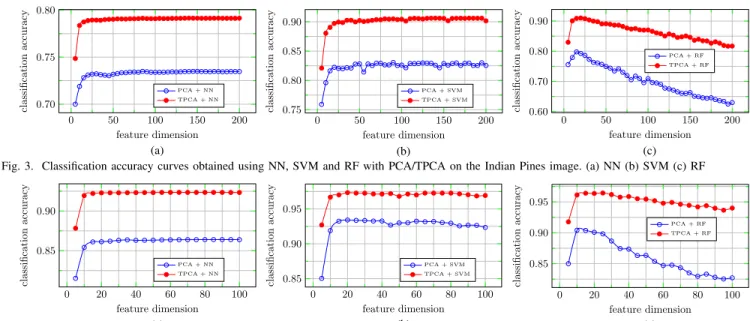
Dmax= 200 for the Indian Pines image and Dmax = 100 for the Pavia University image. The highest classification accuracy for the range of values of D is reported. In the experiments, 10% of the pixels of interests are uniformly randomly chosen as the training samples, the rest of the pixels are chosen as query samples. The classification experiment is repeated independently10times and the average OA andκis recorded. The quantitative comparison of the classification results is given in Table I. The third and fourth column of Table I show the classification result of OA and κ obtained on the Indian Pines image. It is clear that the results obtained by the tensorial features (TDLA, LTDA and TPCA) are better than those ob-tained by the vectorial features (PCA and LDA). Furthermore, among all the extractors, TPCA always yields the highest OA and the largestκ, outperforming its tensorial rivals TDLA and LTDA. For a comparison with its vectorial counterpart, the OA obtained by TPCA is about 6%−11% higher than that obtained by PCA — with RF, the TPCA accuracy is 91.01% compared with the baseline 76.78% and the PCA accuracy 79.78%. The Indian Pines image, the groundtruth and the classification maps with the highest classification accuracies for the different experimental settings are shown in Figure 2. It is clear that TPCA yields the best classification.
Since PCA and TPCA have a similar structure, to compare their performances, the OA curves of PCA and TPCA over varying feature dimension, obtained by classifiers NN, SVM, RF on the Indian Pines image, are given in Figure 3. The figure shows that, no matter which classifier and feature dimension are chosen, TPCA always outperforms PCA.
The classification results obtained using a range of clas-sifiers and feature extractors on the Pavia University image are given in the last two columns of Table I. The visual classification maps obtained by RF with different extractors, are shown in Figure 2. The maps with the highest classification accuracies for the different experimental settings are shown. To
compare the performances of PCA and TPCA, the OA curves of PCA and TPCA for changing feature dimension, obtained by classifiers NN, SVM, RF on the Pavia University image, are given in Figure 4. From Table I, Figure 2 and Figure 4, a similar observation that TPCA outperforms its rivals can be drawn, supporting our claims for TPCA.
TABLE I
CLASSIFICATION ACCURACY COMPARISON OBTAINED ON THEINDIAN
PINES IMAGE AND THEPAVIAUNIVERSITY IMAGE
Classifier Extractor Indian Pines Pavia
OA κ OA κ NN original 73.43 0.6972 86.35 0.8170 PCA 73.49 0.6977 86.40 0.8178 LDA 71.54 0.6642 85.04 0.8037 TDLA[6] 74.21 0.7209 89.27 0.8568 LTDA[7] 75.14 0.7216 90.48 0.8718 TPCA[ours] 79.15 0.7624 92.35 0.8979 SVM original 82.95 0.8053 93.60 0.9143 PCA 83.06 0.8065 93.41 0.9123 LDA 79.53 0.7673 89.76 0.8606 TDLA[6] 83.51 0.8168 96.14 0.9498 LTDA[7] 85.68 0.8372 94.91 0.9324 TPCA[ours] 90.62 0.8930 97.34 0.9648 RF original 76.78 0.7315 89.79 0.8624 PCA 79.78 0.7667 90.42 0.8712 LDA 76.59 0.7353 87.74 0.8395 TDLA[6] 84.96 0.8237 94.32 0.9245 LTDA[7] 86.57 0.8475 93.03 0.9178 TPCA[ours] 91.01 0.8969 96.44 0.9526 V. CONCLUSION
A novel tensor-based feature extractor called TPCA (Tensor Principal Component Analysis) is proposed for hyperspectral image classification. First, we propose a new tensor matrix algebraic framework, which combines the merits of the re-cently emerged t-product model, which is based on the circular convolution, and the traditional matrix algebra. With the help of the proposed algebraic framework, we extend the traditional PCA algorithm to its tensorial variant TPCA. To speed up the tensor-based computing of TPCA, we also propose a fast TPCA for which the calculations are conducted in the Fourier domain. With a tensorization scheme via a neighborhood of each pixel, each sample is defined by a tensorial vector whose entries are all second-order tensors and TPCA can effectively extract the spectral-spatial information in a given hyperspectral image. To make TPCA applicable to traditional vector-based classifiers, we design a straightforward but effective approach to transform TPCA’s output tensor vector to a traditional vector. Experiments to classify the pixels of two publicly available benchmark hyperspectral images show that TPCA outperforms its rivals including PCA, LDA, TDLA and LDLA in term of classification accuracy.
ACKNOWLEDGEMENTS
This work is funded by the National Natural Science Foun-dation of China (No. U1404607), the open foundation program of the Shaanxi Provincial Key Laboratory of Speech and Image Information Processing (No. SJ2013001), the High-end For-eign Experts Recruitment Program (No. GDW20134100119) and the Key Science and Technology Program of Henan (No.
(a) (b) (c) (d) (e) (f) (g) (h)
Fig. 1. Classification maps obtained using RF with different types of features on the Indian Pines images.. (a) Pavia University scene (b) groundtruth (c) original (d) PCA (e) LDA (f) TDLA (g) LTDA (h) TPCA
(a)
1
(b) (c) (d) (e) (f) (g) (h)
Fig. 2. Classification maps obtained using RF with different types of features on the Pavia University images. (a) Pavia University scene (b) groundtruth (c) original (d) PCA (e) LDA (f) TDLA (g) LTDA (h) TPCA
0 50 100 150 200 0.70 0.75 0.80 feature dimension classification accuracy PCA + NN TPCA + NN (a) 0 50 100 150 200 0.75 0.80 0.85 0.90 feature dimension classification accuracy PCA + SVM TPCA + SVM (b) 0 50 100 150 200 0.60 0.70 0.80 0.90 feature dimension classification accuracy PCA + RF TPCA + RF (c) Fig. 3. Classification accuracy curves obtained using NN, SVM and RF with PCA/TPCA on the Indian Pines image. (a) NN (b) SVM (c) RF
0 20 40 60 80 100 0.85 0.90 feature dimension classification accuracy PCA + NN TPCA + NN (a) 0 20 40 60 80 100 0.85 0.90 0.95 feature dimension classification accuracy PCA + SVM TPCA + SVM (b) 0 20 40 60 80 100 0.85 0.90 0.95 feature dimension classification accuracy PCA + RF TPCA + RF (c)
Fig. 4. Classification accuracy curves obtained using NN, SVM and RF with PCA/TPCA on the Pavia University image. (a) NN (b) SVM (c) RF 142102210557). In this work, Liang Liao and Stephen
May-bank are primarily responsible for the algebraic framework of tensorial matrices and TPCA. Yuemei Ren is primarily responsible for the experiments on the hyperspectral data. Liao also contributed significantly to the experiments.
REFERENCES
[1] J. M. Bioucas-Dias, A. Plaza, G. Camps-Valls, and P. Scheunders, “Hyperspectral remote sensing data analysis and future challenges,”
IEEE Geoscience & Remote Sensing Magazine, vol. 1, no. 2, pp. 6–
36, 2013.
[2] M. He and S. Mei, “Dimension reduction by random projection for endmember extraction,” in 2010 5th IEEE Conference on Industrial
Electronics and Applications (ICIEA), 2010, pp. 2323–2327.
[3] T. Gkamas, F. Renard, C. Heinrich, and S. Kremer, “A fourth order tensor statistical model for diffusion weighted MRI application to population comparison,” Fresenius Zeitschrift F¨ur Analytische Chemie, vol. 182, no. 3, pp. 221–222, 2015.
[4] D. Ai, G. Duan, X. Han, and Y. W. Chen, “Generalized N-dimensional independent component analysis and its application to multiple feature selection and fusion for image classification,”Neurocomputing, vol. 103, no. 2, pp. 186–197, 2013.
[5] M. Tao, F. Zhou, Y. Liu, and Z. Zhang, “Tensorial independent com-ponent analysis-based feature extraction for polarimetric SAR data classification,” IEEE Transactions on Geoscience & Remote Sensing, vol. 53, no. 5, pp. 2481–2495, 2015.
[6] L. Zhang, L. Zhang, D. Tao, and X. Huang, “Tensor discriminative local-ity alignment for hyperspectral image spectralcspatial feature extraction,”
IEEE Transactions on Geoscience & Remote Sensing, vol. 51, no. 1, pp.
242–256, 2013.
[7] Z. Zhong, B. Fan, J. Duan, L. Wang, K. Ding, S. Xiang, and C. Pan, “Discriminant tensor spectral-spatial feature extraction for hyperspectral image classification,” IEEE Geoscience & Remote Sensing Letters, vol. 12, no. 5, pp. 1028–1032, 2015.
[8] M. E. Kilmer and C. D. Martin, “Factorization strategies for third-order tensors,”Linear Algebra & Its Applications, vol. 435, no. 3, pp. 641– 658, 2011.
[9] K. Braman, “Third-order tensors as linear operators on a space of matrices,”Linear Algebra & Its Applications, vol. 433, no. 7, pp. 1241– 1253, 2010.
[10] M. E. Kilmer, K. Braman, N. Hao, and R. C. Hoover, “Third-order tensors as operators on matrices: A theoretical and computational frame-work with applications in imaging,”Siam Journal on Matrix Analysis & Applications, vol. 34, no. 1, pp. 148–172, 2013.
[11] R. W. Fitzgerald and B. G. Lees, “Assessing the classification accuracy of multisource remote sensing data,”Remote Sensing of Environment, vol. 47, no. 3, pp. 362–368, 1994.